EP0893250A1 - Procédé pour séparer les composants d'un vitrage feuilleté - Google Patents
Procédé pour séparer les composants d'un vitrage feuilleté Download PDFInfo
- Publication number
- EP0893250A1 EP0893250A1 EP98113527A EP98113527A EP0893250A1 EP 0893250 A1 EP0893250 A1 EP 0893250A1 EP 98113527 A EP98113527 A EP 98113527A EP 98113527 A EP98113527 A EP 98113527A EP 0893250 A1 EP0893250 A1 EP 0893250A1
- Authority
- EP
- European Patent Office
- Prior art keywords
- laminated glass
- glass pane
- plastic layer
- gas
- gas atmosphere
- Prior art date
- Legal status (The legal status is an assumption and is not a legal conclusion. Google has not performed a legal analysis and makes no representation as to the accuracy of the status listed.)
- Granted
Links
Images
Classifications
-
- B—PERFORMING OPERATIONS; TRANSPORTING
- B32—LAYERED PRODUCTS
- B32B—LAYERED PRODUCTS, i.e. PRODUCTS BUILT-UP OF STRATA OF FLAT OR NON-FLAT, e.g. CELLULAR OR HONEYCOMB, FORM
- B32B43/00—Operations specially adapted for layered products and not otherwise provided for, e.g. repairing; Apparatus therefor
- B32B43/006—Delaminating
-
- B—PERFORMING OPERATIONS; TRANSPORTING
- B09—DISPOSAL OF SOLID WASTE; RECLAMATION OF CONTAMINATED SOIL
- B09B—DISPOSAL OF SOLID WASTE NOT OTHERWISE PROVIDED FOR
- B09B3/00—Destroying solid waste or transforming solid waste into something useful or harmless
- B09B3/70—Chemical treatment, e.g. pH adjustment or oxidation
-
- B—PERFORMING OPERATIONS; TRANSPORTING
- B32—LAYERED PRODUCTS
- B32B—LAYERED PRODUCTS, i.e. PRODUCTS BUILT-UP OF STRATA OF FLAT OR NON-FLAT, e.g. CELLULAR OR HONEYCOMB, FORM
- B32B17/00—Layered products essentially comprising sheet glass, or glass, slag, or like fibres
- B32B17/06—Layered products essentially comprising sheet glass, or glass, slag, or like fibres comprising glass as the main or only constituent of a layer, next to another layer of a specific material
- B32B17/10—Layered products essentially comprising sheet glass, or glass, slag, or like fibres comprising glass as the main or only constituent of a layer, next to another layer of a specific material of synthetic resin
- B32B17/10005—Layered products essentially comprising sheet glass, or glass, slag, or like fibres comprising glass as the main or only constituent of a layer, next to another layer of a specific material of synthetic resin laminated safety glass or glazing
- B32B17/10807—Making laminated safety glass or glazing; Apparatus therefor
- B32B17/1099—After-treatment of the layered product, e.g. cooling
-
- H—ELECTRICITY
- H10—SEMICONDUCTOR DEVICES; ELECTRIC SOLID-STATE DEVICES NOT OTHERWISE PROVIDED FOR
- H10F—INORGANIC SEMICONDUCTOR DEVICES SENSITIVE TO INFRARED RADIATION, LIGHT, ELECTROMAGNETIC RADIATION OF SHORTER WAVELENGTH OR CORPUSCULAR RADIATION
- H10F71/00—Manufacture or treatment of devices covered by this subclass
-
- Y—GENERAL TAGGING OF NEW TECHNOLOGICAL DEVELOPMENTS; GENERAL TAGGING OF CROSS-SECTIONAL TECHNOLOGIES SPANNING OVER SEVERAL SECTIONS OF THE IPC; TECHNICAL SUBJECTS COVERED BY FORMER USPC CROSS-REFERENCE ART COLLECTIONS [XRACs] AND DIGESTS
- Y02—TECHNOLOGIES OR APPLICATIONS FOR MITIGATION OR ADAPTATION AGAINST CLIMATE CHANGE
- Y02P—CLIMATE CHANGE MITIGATION TECHNOLOGIES IN THE PRODUCTION OR PROCESSING OF GOODS
- Y02P20/00—Technologies relating to chemical industry
- Y02P20/10—Process efficiency
- Y02P20/133—Renewable energy sources, e.g. sunlight
-
- Y—GENERAL TAGGING OF NEW TECHNOLOGICAL DEVELOPMENTS; GENERAL TAGGING OF CROSS-SECTIONAL TECHNOLOGIES SPANNING OVER SEVERAL SECTIONS OF THE IPC; TECHNICAL SUBJECTS COVERED BY FORMER USPC CROSS-REFERENCE ART COLLECTIONS [XRACs] AND DIGESTS
- Y02—TECHNOLOGIES OR APPLICATIONS FOR MITIGATION OR ADAPTATION AGAINST CLIMATE CHANGE
- Y02W—CLIMATE CHANGE MITIGATION TECHNOLOGIES RELATED TO WASTEWATER TREATMENT OR WASTE MANAGEMENT
- Y02W30/00—Technologies for solid waste management
- Y02W30/50—Reuse, recycling or recovery technologies
- Y02W30/62—Plastics recycling; Rubber recycling
-
- Y—GENERAL TAGGING OF NEW TECHNOLOGICAL DEVELOPMENTS; GENERAL TAGGING OF CROSS-SECTIONAL TECHNOLOGIES SPANNING OVER SEVERAL SECTIONS OF THE IPC; TECHNICAL SUBJECTS COVERED BY FORMER USPC CROSS-REFERENCE ART COLLECTIONS [XRACs] AND DIGESTS
- Y02—TECHNOLOGIES OR APPLICATIONS FOR MITIGATION OR ADAPTATION AGAINST CLIMATE CHANGE
- Y02W—CLIMATE CHANGE MITIGATION TECHNOLOGIES RELATED TO WASTEWATER TREATMENT OR WASTE MANAGEMENT
- Y02W30/00—Technologies for solid waste management
- Y02W30/50—Reuse, recycling or recovery technologies
- Y02W30/82—Recycling of waste of electrical or electronic equipment [WEEE]
Definitions
- the invention relates to a method for separating the components a laminated glass pane, which at least from an inorganic glass pane and one connected to it There is a plastic layer in which the laminated glass pane thermally treated in a gas atmosphere becomes.
- Thermal decomposition is also described by T M Bruton et al in "Re-Cycling of High Value, High Energy Content Components of Silicon PV Modules”, published in 12th European Photovoltaic Solar Energy Conference, April 1994, as viewed critically, especially in terms of impact on solar cells because the carbonizing plastic Make silicon wafers completely unusable.
- the laminated glass pane, at least one inorganic glass pane - is connected to a plastic layer, with a maximum heating rate of 50 ° C / min to a final temperature is heated to at least 300 ° C.
- Prefers is with a heating rate of maximum 30 ° C / min, worked at a maximum of 5 ° C / min. It understands that the heating process is normally from room temperature going out.
- the laminated glass pane in a holding phase the final temperature until the plastic layer in the is substantially thermally decomposed and / or evaporated.
- thermally decomposed and / or evaporated means within the scope of the invention that at the beginning of the treatment existing plastic layer practically completely, typically at least 95% of that Glass plate is removed or so decomposed that the Decomposition products easily from the glass pane are mechanically removable, e.g. by brushing, blowing off or wiping.
- the invention is based on the finding that the thermal Separation of the components of a laminated glass pane in a gas atmosphere with a specifically selected heating rate as well as a holding phase after reaching the final temperature, due to the generally uniform temperature distribution is achieved, a lower thermal load the laminated glass pane and in particular from it additionally arranged components, such as solar cells, causes.
- laminated glass especially those which is a plastic layer with a high thermal Have stability, e.g. made of silicone, it is appropriate heat to a final temperature of at least 600 ° C.
- the length of the hold phase at the final temperature judges depends on how far the separation of the components of the Laminated glass pane when the final temperature is reached is already advanced. Their length can be extreme be a few seconds. However, it usually has a duration of at least 5 min.
- the heating phase For the most part, preference is given to the heating phase set a constant heating rate. However, it can also be useful in the heating phase at least one additional hold phase with essentially constant or even slightly lower temperature.
- the remaining components of the laminated glass pane typically down to room temperature.
- the cooling rate not exceeding 50 ° C / min worked. It is particularly preferred that the amount of Cooling rate does not exceed 30 ° C / min, in particular 5 ° C / min.
- the cooling becomes essentially constant Cooling rate.
- the laminated glass pane is thermally treated at least in the heating phase and / or in the holding phase advantageously in an oxidizing agent for the Gas atmosphere containing plastic layer.
- the exact composition of the gas atmosphere to be set depends on the type and structure of the laminated glass pane that to be treated. For example, is the laminated glass pane unproblematic in the technical sense, contains so they are not heat-sensitive electrical devices or the like, it may be quite sufficient that Laminated glass pane to be heated in air and inside the Treat the holding phase thermally. To the oxidation of the Favor plastic parts of the laminated glass pane, can, however, in the heating phase and / or the holding phase even in an oxygen-enriched gas atmosphere be worked.
- At least one of the gases CO 2 , H 2 O, SO 2 , SO 3 , O 3 , NO 2 or Cl 2 can also be added to the gas atmosphere as an oxidizing agent.
- the treatment process is simplified if a gas mixture of essentially the same composition is supplied to the gas atmosphere in the heating phase and the holding phase and, if appropriate, in the cooling phase.
- reaction conditions are set if possible that lead to a selective attack on the Lead plastic material.
- oxygen under defined conditions in low concentrations added to the gas atmosphere.
- the oxygen percentage the gas atmosphere is typically between 2 and 25 Vol.% Set.
- a reduction in the oxygen content for example at the beginning of the heating phase, for example indirectly by adding argon, nitrogen or other inert gases, but also by adding them reducing gases such as ammonia, natural gas or its Components or hydrogen, which is then in the gas atmosphere be pre-burned.
- the resulting heat can be used directly for heating the oven.
- Prefers contains that of the gas atmosphere during the thermal Treatment of the gas mixture supplied to the laminated glass pane at least one oxidizing agent with a share of 1 - 30 vol.% And at least one inert gas with a share of 70-99% by volume.
- the rate of decomposition and the course of the decomposition reactions can also be controlled if necessary be that the laminated glass pane at least two is treated thermally at negative pressure.
- the method according to the invention can be influenced in a targeted manner, in particular shortened, if at least the heating of the laminated glass pane is carried out in the presence of a reaction auxiliary which influences the decomposition of the plastic layer (for example a catalyst or a chemical which promotes the decomposition of the plastic layer).
- a reaction auxiliary which influences the decomposition of the plastic layer
- the reaction auxiliary is expediently applied to the exposed edge regions of the plastic layer before the laminated glass pane is heated.
- the reaction aid can be added to the gas atmosphere as a volatile compound.
- the reaction auxiliary can optionally also act as an inhibitor which controls the reaction rate and thus also the heat tone of the reaction.
- An acidic or alkaline compound such as SO 2 , AlCl 3 , NH 3 or CaO is particularly suitable as reaction aid.
- the proportion of a gaseous reaction auxiliary in the gas mixture supplied to the gas atmosphere is preferably 0.01-5% by volume.
- the separation of the components of the laminated glass pane can are supported by the fact that on the laminated glass pane Before the start of the heating phase, devices for mechanical Separation of the individual components attached, in particular be pressed into the plastic layer at the edge.
- the elastic preload that can be generated in this way is facilitated the penetration of the gas atmosphere into the laminated glass pane and can lead to accelerated decomposition of the plastic layer.
- the process is particularly advantageous for thermal Treatment of laminated glass panes used in which at least one glass sheet made of soda lime silicate glass or Borosilicate glass exists.
- Another preferred application consists in the thermal treatment of laminated glass panes with a plastic layer made of aliphatic or aromatic polyurethanes, polyvinyl butyral, Ethylene vinyl acetate, acrylic acid derivatives, such as n-butyl acrylate, Epoxides, silicones or mixtures consist of it.
- electrical devices such as antenna elements, Heating elements, alarm devices and / or solar energy conversion elements included is the procedure suitable.
- the solar cells in particular made of silicon, copper indium diselenide, gallium arsenide or Cadmium telluride exist.
- Laminated glass panes in particular laminated safety glass panes, at least on the plastic layer another glass pane is laminated on, whereby So the plastic layer is the composite layer of two glass panes forms, can with the inventive method be treated. It is particularly useful here before starting thermal treatment facilities, such as. Wedges or expansion elements in the plastic layer to insert, for example, to press in on the edge, that keep the glass panes at a distance. The procedure but is also suitable for the treatment of Insulating glass panes with spacers.
- a preferred device for performing the invention comprises a heatable rack oven, the at least one gas supply for clogging of gases to the gas atmosphere and at least one gas extraction device with a device for afterburning the Exhaust gases.
- the gas atmosphere can have multiple gas feeds for supplying gases spaced apart locations of the rack oven provided be. Can be worked particularly cheap energetically if a feedback device for the at the Post-combustion waste heat generated in the rack oven is provided.
- a device with which the procedure can be driven continuously according to the invention includes an endless, heat-resistant conveyor belt for the laminated glass panes to be treated, which by a Number of furnace segments is performed, being in the furnace segments different gas atmospheres and / or temperatures are adjustable.
- a laminated glass pane with the dimensions 40 x 40 cm 2 designed as a photovoltaic solar module, consisted of a 4 mm thick cover plate made of low-iron soda lime silicate glass, a likewise 4 mm thick carrier sheet made of soda lime silicate glass, and between the glass panes a 2 mm thick plastic layer serving as a composite layer.
- the plastic layer had been produced by pouring in and then curing a monomer mixture based on acrylate with an acrylate content of more than 80% by weight, four solar cells made of polycrystalline silicon being embedded in the plastic layer.
- the finished laminated glass was placed horizontally in a steel frame and placed in a convection oven. Several metal wedges were driven into the exposed edge of the plastic layer at a distance from one another as spacers. In another experiment, hooks were used which were subjected to a controlled tensile force and thus kept the glass panes apart during the thermal treatment.
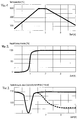
- the laminated glass pane initially at room temperature was prevalent in the oven in air with a constant heating rate of 5 ° C / min to a final temperature heated from 550 ° C and at this temperature for about 30 min held. Cooling to a temperature near room temperature took place with a predominantly constant cooling rate with an amount of 3 ° C / min.
- the temperature / time course on the glass pane can be seen from Figure 1.
- the solar cells were one in the Semiconductor technology usual wafer cleaning process, the from a series of etching steps with acidic and alkaline Media exists. You got silicon wafers, those without significant loss of quality Solar cells could be processed.
- a laminated glass pane with the dimensions 20 x 30 cm 2 designed as a photovoltaic solar module, consisted of a 3 mm thick cover plate made of low-iron soda lime silicate glass, a polyester film coated on both sides with polyvinyl fluoride with a total thickness of 0.2 mm as a base layer, and a laminated layer between the glass plate and polyester film serving, 2 mm thick ethylene vinyl acetate copolymer film in which four solar cells made of monocrystalline silicon were embedded.
- the laminated glass pane was placed horizontally in a chamber furnace with the support layer upwards. It was heated in air to a final temperature of about 500 ° C. at an essentially constant heating rate of 10 ° C./min and held at this temperature for about 40 minutes. This was followed by cooling with a cooling rate of 5 ° C./min initially to 120 ° C., which was followed by an additional holding phase of approx. 5 min at this temperature. The subsequent cooling to room temperature was carried out at the same cooling rate as before.
- the plastic parts of the laminated glass were after Completion of thermal treatment completely burned. The intact ones lay on the undamaged glass pane Solar cells and the connectors. The solar cells could successfully treated for recycling as in Example 1 become.
- a laminated glass pane with the dimensions 40 x 40 cm 2 designed as a photovoltaic solar module, consisted of a 3 mm thick cover plate made of soda lime silicate glass, which was coated on one side with thin-film solar cells made of silicon.
- a 4 mm thick plastic layer formed from a monomer mixture with about 78% by weight of n-butyl acrylate was applied to the solar cell layer as a composite layer to form a 4 mm thick carrier disk made of soda lime silicate glass.
- the laminated glass was provided with a silicone edge seal. Before the start of the treatment, it was provided with a spacer which was pressed into the plastic layer from the edge and held under tension. With the progressive burning of the plastic layer, the spacer penetrated further into the plastic layer and thus ensured an increasing spacing between the cover plate and the carrier plate, which favored the complete removal of the plastic. Otherwise the test conditions corresponded to those of Example 1.
- the method according to the invention can be used in batch mode and in continuous mode be worked.
- batch operation is special a heated rack oven suitable, the minimum a gas supply for adding gases to the gas atmosphere and has at least one gas suction device, wherein the exhaust gas is optionally afterburned catalytically becomes.
- Heat-resistant steel frames are preferred Steel mat supports used, the most varied Pick up types of laminated glass to be treated can. If possible, several gas feeds to the Feeding gases at spaced locations of the rack oven should be provided so that as possible homogeneous gas atmosphere can be set.
- continuous Operation with a furnace is particularly suitable an endless, heat-resistant conveyor belt for the Laminated glass panes that pass through a number of furnace segments is performed, with different in the furnace segments Gas atmospheres and / or temperatures are adjustable.
Landscapes
- Health & Medical Sciences (AREA)
- Chemical & Material Sciences (AREA)
- Chemical Kinetics & Catalysis (AREA)
- General Chemical & Material Sciences (AREA)
- General Health & Medical Sciences (AREA)
- Toxicology (AREA)
- Engineering & Computer Science (AREA)
- Environmental & Geological Engineering (AREA)
- Processing Of Solid Wastes (AREA)
- Joining Of Glass To Other Materials (AREA)
- Photovoltaic Devices (AREA)
Applications Claiming Priority (2)
| Application Number | Priority Date | Filing Date | Title |
|---|---|---|---|
| DE19731160A DE19731160C2 (de) | 1997-07-21 | 1997-07-21 | Verfahren zum Trennen der Komponenten einer Verbundglasscheibe |
| DE19731160 | 1997-07-21 |
Publications (2)
| Publication Number | Publication Date |
|---|---|
| EP0893250A1 true EP0893250A1 (fr) | 1999-01-27 |
| EP0893250B1 EP0893250B1 (fr) | 2003-06-04 |
Family
ID=7836335
Family Applications (1)
| Application Number | Title | Priority Date | Filing Date |
|---|---|---|---|
| EP98113527A Expired - Lifetime EP0893250B1 (fr) | 1997-07-21 | 1998-07-20 | Procédé pour séparer les composants d'un vitrage feuilleté |
Country Status (5)
| Country | Link |
|---|---|
| EP (1) | EP0893250B1 (fr) |
| JP (1) | JPH11165150A (fr) |
| AT (1) | ATE242120T1 (fr) |
| DE (1) | DE19731160C2 (fr) |
| ES (1) | ES2200241T3 (fr) |
Cited By (11)
| Publication number | Priority date | Publication date | Assignee | Title |
|---|---|---|---|---|
| EP0935295A3 (fr) * | 1998-02-05 | 2000-08-23 | Canon Kabushiki Kaisha | Dispositiv à semi-conducteur, module de cellules solaires et leur méthodes de démontage |
| EP1187224A1 (fr) * | 2000-09-11 | 2002-03-13 | ANTEC Solar GmbH | Méthode de recyclage pour modules de cellules solaires en couche minces en CdTe/CdS |
| WO2013089630A1 (fr) * | 2011-12-15 | 2013-06-20 | Midsummer Ab | Recyclage de diséléniure de cuivre, d'indium et de gallium |
| ITVR20120103A1 (it) * | 2012-05-19 | 2013-11-20 | Univ Padova | Metodo per la separazione di componenti di moduli fotovoltaici laminati |
| ITBA20130021A1 (it) * | 2013-03-12 | 2014-09-13 | Politecnico Di Bari | "processo criogenico per il recupero di materiali rigidi mono o poli-cristallini od amorfi rivestiti con materiali plastici" |
| EP2858125A1 (fr) * | 2013-10-01 | 2015-04-08 | Korea Institute of Energy Research | Procédé pour démonter un module photovoltaïque |
| EP2998038A1 (fr) * | 2014-09-16 | 2016-03-23 | SASIL S.p.A. | Procédé et appareil de détachement de verre d'un panneau photovoltaïque à base de silicium mono- ou polycristallin |
| WO2017037129A1 (fr) * | 2015-09-03 | 2017-03-09 | Fraunhofer-Gesellschaft zur Förderung der angewandten Forschung e.V. | Procédé de recyclage de matériaux composites et matériaux composites recyclés |
| CN113748299A (zh) * | 2019-04-26 | 2021-12-03 | 新见太阳能股份有限公司 | 热分解装置 |
| US20230241655A1 (en) * | 2020-07-01 | 2023-08-03 | Tokuyama Corporation | Waste Photovoltaic Module Processing Method |
| EP4574377A1 (fr) * | 2023-12-21 | 2025-06-25 | Heinz Schirmacher GmbH | Séparation d'éléments composites plats contenant des couches de verre et de plastique |
Families Citing this family (13)
| Publication number | Priority date | Publication date | Assignee | Title |
|---|---|---|---|---|
| CN100368497C (zh) * | 2003-04-14 | 2008-02-13 | 积水化学工业株式会社 | 被粘物的剥离方法、从电子部件层叠体回收电子部件的方法及夹层玻璃的剥离方法 |
| JP4502197B2 (ja) * | 2004-10-06 | 2010-07-14 | 独立行政法人産業技術総合研究所 | 自動車用ガラスの再利用方法 |
| JP2008188521A (ja) * | 2007-02-02 | 2008-08-21 | Takasago Ind Co Ltd | 廃ガラス用熱処理炉 |
| DE102007034441B4 (de) * | 2007-07-20 | 2020-06-04 | Ulrich Loser | Technisches Verfahren zum Entfernen der Front- und Rückseitenkontakte von Solarzellen bei gleichzeitiger Gewinnung von Wertstoffen und Minimierung von Abfällen |
| DE102008047675B4 (de) * | 2008-06-13 | 2014-05-15 | Ctf Solar Gmbh | Recycling-Verfahren für Dünnschichtsolarzellenmodule |
| JP5207410B2 (ja) * | 2010-03-23 | 2013-06-12 | 独立行政法人産業技術総合研究所 | 自動車用ガラスの再利用方法 |
| JP6297254B2 (ja) * | 2012-11-30 | 2018-03-20 | 株式会社新菱 | 太陽電池素子構成材料の回収方法 |
| DE102013112004B4 (de) | 2013-10-31 | 2018-08-16 | variata Dorit Lang GmbH & Co. KG | Recycling von Photovoltaikmodulen und/oder Solarmodulen |
| JP2015229126A (ja) * | 2014-06-03 | 2015-12-21 | 株式会社日本スペリア社 | 太陽電池パネルの再生処理方法 |
| JP6596735B2 (ja) * | 2014-11-10 | 2019-10-30 | 株式会社ジンテク | 太陽電池モジュールから有価物を回収する方法及び回収するための処理装置 |
| JP6593585B2 (ja) * | 2015-03-17 | 2019-10-23 | 株式会社ジンテク | 合わせガラスからガラスを回収する方法及び回収するための処理装置 |
| JP7108037B2 (ja) | 2018-08-06 | 2022-07-27 | 株式会社トクヤマ | 太陽電池モジュールから有価物を回収する方法 |
| WO2024252911A1 (fr) | 2023-06-09 | 2024-12-12 | 株式会社トクヤマ | Procédé de production de chlorosilane |
Citations (4)
| Publication number | Priority date | Publication date | Assignee | Title |
|---|---|---|---|---|
| US4738753A (en) * | 1984-09-28 | 1988-04-19 | Alusuisse Italia S.P.A | Method of producing carbonaceous bodies |
| JPH04349152A (ja) * | 1991-04-24 | 1992-12-03 | Sekisui Chem Co Ltd | 積層安全ガラス板からガラス板を分離回収する方法 |
| EP0648829A1 (fr) * | 1993-10-19 | 1995-04-19 | Mitsubishi Jukogyo Kabushiki Kaisha | Procédé pour la gazéification de matériaux organiques, procédés pour la gazéification de matières plastiques renforcées de fibres de verre et appareillage |
| DE4418573C1 (de) * | 1994-05-27 | 1996-02-22 | Joerg Weinfurtner | Verfahren zum Recyceln von Isolier- und Verbundgläsern |
Family Cites Families (2)
| Publication number | Priority date | Publication date | Assignee | Title |
|---|---|---|---|---|
| DE4304294C2 (de) * | 1993-02-12 | 1995-04-06 | Strepp Gmbh & Co Kg Papierfabr | Verfahren zur Gewinnung verwertbarer Stoffe aus Verbundmaterial |
| DE19608045A1 (de) * | 1996-03-02 | 1997-09-04 | Tzn Forschung & Entwicklung | Verfahren zum Trennen von Glas und Folien insbesondere von Verbundscheiben |
-
1997
- 1997-07-21 DE DE19731160A patent/DE19731160C2/de not_active Expired - Fee Related
-
1998
- 1998-07-20 ES ES98113527T patent/ES2200241T3/es not_active Expired - Lifetime
- 1998-07-20 AT AT98113527T patent/ATE242120T1/de not_active IP Right Cessation
- 1998-07-20 EP EP98113527A patent/EP0893250B1/fr not_active Expired - Lifetime
- 1998-07-21 JP JP10237908A patent/JPH11165150A/ja active Pending
Patent Citations (4)
| Publication number | Priority date | Publication date | Assignee | Title |
|---|---|---|---|---|
| US4738753A (en) * | 1984-09-28 | 1988-04-19 | Alusuisse Italia S.P.A | Method of producing carbonaceous bodies |
| JPH04349152A (ja) * | 1991-04-24 | 1992-12-03 | Sekisui Chem Co Ltd | 積層安全ガラス板からガラス板を分離回収する方法 |
| EP0648829A1 (fr) * | 1993-10-19 | 1995-04-19 | Mitsubishi Jukogyo Kabushiki Kaisha | Procédé pour la gazéification de matériaux organiques, procédés pour la gazéification de matières plastiques renforcées de fibres de verre et appareillage |
| DE4418573C1 (de) * | 1994-05-27 | 1996-02-22 | Joerg Weinfurtner | Verfahren zum Recyceln von Isolier- und Verbundgläsern |
Non-Patent Citations (1)
| Title |
|---|
| PATENT ABSTRACTS OF JAPAN vol. 17, no. 205 (C - 1051) 22 April 1993 (1993-04-22) * |
Cited By (19)
| Publication number | Priority date | Publication date | Assignee | Title |
|---|---|---|---|---|
| EP0935295A3 (fr) * | 1998-02-05 | 2000-08-23 | Canon Kabushiki Kaisha | Dispositiv à semi-conducteur, module de cellules solaires et leur méthodes de démontage |
| US6940008B2 (en) | 1998-02-05 | 2005-09-06 | Canon Kabushiki Kaisha | Semiconductor device, solar cell module, and methods for their dismantlement |
| EP1187224A1 (fr) * | 2000-09-11 | 2002-03-13 | ANTEC Solar GmbH | Méthode de recyclage pour modules de cellules solaires en couche minces en CdTe/CdS |
| US6572782B2 (en) | 2000-09-11 | 2003-06-03 | Antec Solar Gmbh | Process for recycling CdTe/Cds thin film solar cell modules |
| CZ302626B6 (cs) * | 2000-09-11 | 2011-08-10 | Antec Solar Gmbh | Zpusob recyklování modulu solárních clánku s tenkým filmem CdTe/CdS |
| WO2013089630A1 (fr) * | 2011-12-15 | 2013-06-20 | Midsummer Ab | Recyclage de diséléniure de cuivre, d'indium et de gallium |
| ITVR20120103A1 (it) * | 2012-05-19 | 2013-11-20 | Univ Padova | Metodo per la separazione di componenti di moduli fotovoltaici laminati |
| WO2014141311A1 (fr) * | 2013-03-12 | 2014-09-18 | Politecnico Di Bari | Procédé de délaminage cryogénique régulé thermomécaniquement pour la pleine récupération de matériaux rigides mono/polycristallins ou amorphes revêtus de matière plastique |
| ITBA20130021A1 (it) * | 2013-03-12 | 2014-09-13 | Politecnico Di Bari | "processo criogenico per il recupero di materiali rigidi mono o poli-cristallini od amorfi rivestiti con materiali plastici" |
| CN105246604A (zh) * | 2013-03-12 | 2016-01-13 | 巴里理工大学 | 用于完全回收涂覆有塑料材料的刚性单体材料、多晶材料或非晶材料的热机控制的低温分层处理 |
| EP2858125A1 (fr) * | 2013-10-01 | 2015-04-08 | Korea Institute of Energy Research | Procédé pour démonter un module photovoltaïque |
| US9455367B2 (en) | 2013-10-01 | 2016-09-27 | Korea Institute Of Energy Research | Disassembling photovoltaic module |
| EP2998038A1 (fr) * | 2014-09-16 | 2016-03-23 | SASIL S.p.A. | Procédé et appareil de détachement de verre d'un panneau photovoltaïque à base de silicium mono- ou polycristallin |
| WO2017037129A1 (fr) * | 2015-09-03 | 2017-03-09 | Fraunhofer-Gesellschaft zur Förderung der angewandten Forschung e.V. | Procédé de recyclage de matériaux composites et matériaux composites recyclés |
| CN113748299A (zh) * | 2019-04-26 | 2021-12-03 | 新见太阳能股份有限公司 | 热分解装置 |
| US20230241655A1 (en) * | 2020-07-01 | 2023-08-03 | Tokuyama Corporation | Waste Photovoltaic Module Processing Method |
| US12544814B2 (en) * | 2020-07-01 | 2026-02-10 | Tokuyama Corporation | Waste photovoltaic module processing method |
| EP4574377A1 (fr) * | 2023-12-21 | 2025-06-25 | Heinz Schirmacher GmbH | Séparation d'éléments composites plats contenant des couches de verre et de plastique |
| WO2025131935A1 (fr) * | 2023-12-21 | 2025-06-26 | Heinz Schirmacher Gmbh | Séparation d'éléments composites plans contenant des couches de verre et des couches de plastique |
Also Published As
| Publication number | Publication date |
|---|---|
| ATE242120T1 (de) | 2003-06-15 |
| JPH11165150A (ja) | 1999-06-22 |
| DE19731160A1 (de) | 1999-01-28 |
| DE19731160C2 (de) | 1999-05-27 |
| EP0893250B1 (fr) | 2003-06-04 |
| ES2200241T3 (es) | 2004-03-01 |
Similar Documents
| Publication | Publication Date | Title |
|---|---|---|
| EP0893250B1 (fr) | Procédé pour séparer les composants d'un vitrage feuilleté | |
| DE69825931T2 (de) | Verfahren zur Herstellung von SOI-Substraten mit einer sehr effizienten Beseitigung von durch Ionenimplantation verursachten Schäden | |
| EP0655976B1 (fr) | Procede et dispositif de fabrication de modules photovoltaiques | |
| DE112013005591B4 (de) | Verfahren und Vorrichtung zum Herstellen eines Photovoltaikelements mit stabilisiertem Wirkungsgrad | |
| DE2941908C2 (de) | Verfahren zum Herstellen einer eine Silizium-Schicht aufweisenden Solarzelle | |
| EP2905346B1 (fr) | Procede de traitement de la chaleur | |
| EP0196447A1 (fr) | Procédé pour l'amélioration de la résistance à l'oxydation et à la corrosion par un traitement de surface d'un article en un superalliage renforcé par dispersion | |
| DE3015461C2 (de) | Verfahren zum durchlaufgluehen eines kaltgewalzten niedriggehkohlten stahlbandes | |
| DE2119920A1 (de) | Verfahren und Vorrichtung zur kontinuierlichen Metallisierung eines langgestreckten metallischen Grundmaterials | |
| EP2478121A1 (fr) | Procédé de prétraitement et de préparation d'une pièce de tôle | |
| DE3332447A1 (de) | Verfahren zur befreiung von siliciumbruchstuecken von verunreinigungen | |
| DE3400879A1 (de) | Verfahren zum verbinden aneinander grenzender metallschichten | |
| DE102011102270A1 (de) | Verfahren und Vorrichtung zur Ablation von Schichten von Halbleitersubstraten, sowie zur Nachbehandlung | |
| DE3232518A1 (de) | Verfahren zur herstellung von kornorientiertem elektrostahlblech | |
| DE69100862T2 (de) | Die Verwendung eines amorphen Legierungskatalysators zur Zersetzung von Chlorfluorkohlenstoffen. | |
| EP0158181B1 (fr) | Procédé de fabrication des corps des cristaux de silicium à grandes surfaces pour des cellules solaires | |
| DE2361330C2 (de) | Verfahren zur Herstellung von zylindrischen Wälzkörpern | |
| DE2645374A1 (de) | Verfahren zum herstellen von fuer halbleiterbauelemente verwendbarem polykristallinem silicium | |
| DE1583276A1 (de) | Anlage zur metallurgischen,kontinuierlichen Behandlung verschiedener Materialien bei Unterdruck und erhoehter Temperatur,z.B.von Ferrolegierungen | |
| CH665849A5 (de) | Verfahren zur herstellung amorpher legierungen. | |
| DE69108148T2 (de) | Verfahren zur Zersetzung von Chlorfluorkohlenwasserstoffen. | |
| WO2018050565A1 (fr) | Procédé de production d'une couche de silicium cristallin et composant semi-conducteur à base de silicium | |
| DE69819552T2 (de) | Verfahren zum einstellen der zusammensetzung eines metallischen erzeugnisses | |
| DD290665A5 (de) | Einrichtung zur automatischen waermebehandlung von werkstuecken | |
| DE102018220173B4 (de) | Vorrichtung und Verfahren zur Herstellung reduzierter Metalloberflächen |
Legal Events
| Date | Code | Title | Description |
|---|---|---|---|
| PUAI | Public reference made under article 153(3) epc to a published international application that has entered the european phase |
Free format text: ORIGINAL CODE: 0009012 |
|
| AK | Designated contracting states |
Kind code of ref document: A1 Designated state(s): AT BE CH DK ES FI FR GB IT LI NL SE |
|
| AX | Request for extension of the european patent |
Free format text: AL;LT;LV;MK;RO;SI |
|
| 17P | Request for examination filed |
Effective date: 19990720 |
|
| AKX | Designation fees paid |
Free format text: AT BE CH DK ES FI FR GB GR IE IT LI |
|
| RBV | Designated contracting states (corrected) |
Designated state(s): AT BE CH DK ES FI FR GB IT LI NL SE |
|
| REG | Reference to a national code |
Ref country code: DE Ref legal event code: 8566 |
|
| 17Q | First examination report despatched |
Effective date: 20000926 |
|
| GRAG | Despatch of communication of intention to grant |
Free format text: ORIGINAL CODE: EPIDOS AGRA |
|
| RAP1 | Party data changed (applicant data changed or rights of an application transferred) |
Owner name: WAMBACH, KARSTEN DR. |
|
| RAP1 | Party data changed (applicant data changed or rights of an application transferred) |
Owner name: DEUTSCHE SOLAR AG |
|
| GRAG | Despatch of communication of intention to grant |
Free format text: ORIGINAL CODE: EPIDOS AGRA |
|
| GRAH | Despatch of communication of intention to grant a patent |
Free format text: ORIGINAL CODE: EPIDOS IGRA |
|
| GRAH | Despatch of communication of intention to grant a patent |
Free format text: ORIGINAL CODE: EPIDOS IGRA |
|
| GRAA | (expected) grant |
Free format text: ORIGINAL CODE: 0009210 |
|
| AK | Designated contracting states |
Designated state(s): AT BE CH DK ES FI FR GB IT LI NL SE |
|
| PG25 | Lapsed in a contracting state [announced via postgrant information from national office to epo] |
Ref country code: FI Free format text: LAPSE BECAUSE OF FAILURE TO SUBMIT A TRANSLATION OF THE DESCRIPTION OR TO PAY THE FEE WITHIN THE PRESCRIBED TIME-LIMIT Effective date: 20030604 |
|
| REG | Reference to a national code |
Ref country code: GB Ref legal event code: FG4D Free format text: NOT ENGLISH |
|
| REG | Reference to a national code |
Ref country code: CH Ref legal event code: EP |
|
| PG25 | Lapsed in a contracting state [announced via postgrant information from national office to epo] |
Ref country code: DK Free format text: LAPSE BECAUSE OF FAILURE TO SUBMIT A TRANSLATION OF THE DESCRIPTION OR TO PAY THE FEE WITHIN THE PRESCRIBED TIME-LIMIT Effective date: 20030904 |
|
| REG | Reference to a national code |
Ref country code: SE Ref legal event code: TRGR |
|
| GBT | Gb: translation of ep patent filed (gb section 77(6)(a)/1977) |
Effective date: 20031014 |
|
| REG | Reference to a national code |
Ref country code: ES Ref legal event code: FG2A Ref document number: 2200241 Country of ref document: ES Kind code of ref document: T3 |
|
| PLBE | No opposition filed within time limit |
Free format text: ORIGINAL CODE: 0009261 |
|
| STAA | Information on the status of an ep patent application or granted ep patent |
Free format text: STATUS: NO OPPOSITION FILED WITHIN TIME LIMIT |
|
| ET | Fr: translation filed | ||
| 26N | No opposition filed |
Effective date: 20040305 |
|
| PGFP | Annual fee paid to national office [announced via postgrant information from national office to epo] |
Ref country code: SE Payment date: 20050722 Year of fee payment: 8 |
|
| PG25 | Lapsed in a contracting state [announced via postgrant information from national office to epo] |
Ref country code: SE Free format text: LAPSE BECAUSE OF NON-PAYMENT OF DUE FEES Effective date: 20060721 |
|
| EUG | Se: european patent has lapsed | ||
| PGFP | Annual fee paid to national office [announced via postgrant information from national office to epo] |
Ref country code: ES Payment date: 20080723 Year of fee payment: 11 Ref country code: CH Payment date: 20080709 Year of fee payment: 11 |
|
| PGFP | Annual fee paid to national office [announced via postgrant information from national office to epo] |
Ref country code: NL Payment date: 20080722 Year of fee payment: 11 Ref country code: IT Payment date: 20080726 Year of fee payment: 11 Ref country code: FR Payment date: 20080718 Year of fee payment: 11 Ref country code: AT Payment date: 20080709 Year of fee payment: 11 |
|
| PGFP | Annual fee paid to national office [announced via postgrant information from national office to epo] |
Ref country code: GB Payment date: 20080723 Year of fee payment: 11 |
|
| PGFP | Annual fee paid to national office [announced via postgrant information from national office to epo] |
Ref country code: BE Payment date: 20080723 Year of fee payment: 11 |
|
| BERE | Be: lapsed |
Owner name: DEUTSCHE *SOLAR A.G. Effective date: 20090731 |
|
| REG | Reference to a national code |
Ref country code: CH Ref legal event code: PL |
|
| GBPC | Gb: european patent ceased through non-payment of renewal fee |
Effective date: 20090720 |
|
| NLV4 | Nl: lapsed or anulled due to non-payment of the annual fee |
Effective date: 20100201 |
|
| REG | Reference to a national code |
Ref country code: FR Ref legal event code: ST Effective date: 20100331 |
|
| PG25 | Lapsed in a contracting state [announced via postgrant information from national office to epo] |
Ref country code: LI Free format text: LAPSE BECAUSE OF NON-PAYMENT OF DUE FEES Effective date: 20090731 Ref country code: FR Free format text: LAPSE BECAUSE OF NON-PAYMENT OF DUE FEES Effective date: 20090731 Ref country code: CH Free format text: LAPSE BECAUSE OF NON-PAYMENT OF DUE FEES Effective date: 20090731 |
|
| PG25 | Lapsed in a contracting state [announced via postgrant information from national office to epo] |
Ref country code: GB Free format text: LAPSE BECAUSE OF NON-PAYMENT OF DUE FEES Effective date: 20090720 |
|
| PG25 | Lapsed in a contracting state [announced via postgrant information from national office to epo] |
Ref country code: BE Free format text: LAPSE BECAUSE OF NON-PAYMENT OF DUE FEES Effective date: 20090731 Ref country code: AT Free format text: LAPSE BECAUSE OF NON-PAYMENT OF DUE FEES Effective date: 20090720 |
|
| REG | Reference to a national code |
Ref country code: ES Ref legal event code: FD2A Effective date: 20090721 |
|
| PG25 | Lapsed in a contracting state [announced via postgrant information from national office to epo] |
Ref country code: ES Free format text: LAPSE BECAUSE OF NON-PAYMENT OF DUE FEES Effective date: 20090721 |
|
| PG25 | Lapsed in a contracting state [announced via postgrant information from national office to epo] |
Ref country code: IT Free format text: LAPSE BECAUSE OF NON-PAYMENT OF DUE FEES Effective date: 20090720 |
|
| PG25 | Lapsed in a contracting state [announced via postgrant information from national office to epo] |
Ref country code: NL Free format text: LAPSE BECAUSE OF NON-PAYMENT OF DUE FEES Effective date: 20100201 |