EP0893434B1 - Zwischenprodukte für die Herstellung von Oximäthern - Google Patents
Zwischenprodukte für die Herstellung von Oximäthern Download PDFInfo
- Publication number
- EP0893434B1 EP0893434B1 EP98115073A EP98115073A EP0893434B1 EP 0893434 B1 EP0893434 B1 EP 0893434B1 EP 98115073 A EP98115073 A EP 98115073A EP 98115073 A EP98115073 A EP 98115073A EP 0893434 B1 EP0893434 B1 EP 0893434B1
- Authority
- EP
- European Patent Office
- Prior art keywords
- alkyl
- compounds
- formula
- methyl
- spp
- Prior art date
- Legal status (The legal status is an assumption and is not a legal conclusion. Google has not performed a legal analysis and makes no representation as to the accuracy of the status listed.)
- Expired - Lifetime
Links
- 0 *C(c1c(*)cccc1)=* Chemical compound *C(c1c(*)cccc1)=* 0.000 description 2
Classifications
-
- C—CHEMISTRY; METALLURGY
- C07—ORGANIC CHEMISTRY
- C07D—HETEROCYCLIC COMPOUNDS
- C07D213/00—Heterocyclic compounds containing six-membered rings, not condensed with other rings, with one nitrogen atom as the only ring hetero atom and three or more double bonds between ring members or between ring members and non-ring members
- C07D213/02—Heterocyclic compounds containing six-membered rings, not condensed with other rings, with one nitrogen atom as the only ring hetero atom and three or more double bonds between ring members or between ring members and non-ring members having three double bonds between ring members or between ring members and non-ring members
- C07D213/04—Heterocyclic compounds containing six-membered rings, not condensed with other rings, with one nitrogen atom as the only ring hetero atom and three or more double bonds between ring members or between ring members and non-ring members having three double bonds between ring members or between ring members and non-ring members having no bond between the ring nitrogen atom and a non-ring member or having only hydrogen or carbon atoms directly attached to the ring nitrogen atom
- C07D213/24—Heterocyclic compounds containing six-membered rings, not condensed with other rings, with one nitrogen atom as the only ring hetero atom and three or more double bonds between ring members or between ring members and non-ring members having three double bonds between ring members or between ring members and non-ring members having no bond between the ring nitrogen atom and a non-ring member or having only hydrogen or carbon atoms directly attached to the ring nitrogen atom with substituted hydrocarbon radicals attached to ring carbon atoms
- C07D213/28—Radicals substituted by singly-bound oxygen or sulphur atoms
- C07D213/30—Oxygen atoms
-
- A—HUMAN NECESSITIES
- A01—AGRICULTURE; FORESTRY; ANIMAL HUSBANDRY; HUNTING; TRAPPING; FISHING
- A01N—PRESERVATION OF BODIES OF HUMANS OR ANIMALS OR PLANTS OR PARTS THEREOF; BIOCIDES, e.g. AS DISINFECTANTS, AS PESTICIDES OR AS HERBICIDES; PEST REPELLANTS OR ATTRACTANTS; PLANT GROWTH REGULATORS
- A01N37/00—Biocides, pest repellants or attractants, or plant growth regulators containing organic compounds containing a carbon atom having three bonds to hetero atoms with at the most two bonds to halogen, e.g. carboxylic acids
- A01N37/36—Biocides, pest repellants or attractants, or plant growth regulators containing organic compounds containing a carbon atom having three bonds to hetero atoms with at the most two bonds to halogen, e.g. carboxylic acids containing at least one carboxylic group or a thio analogue, or a derivative thereof, and a singly bound oxygen or sulfur atom attached to the same carbon skeleton, this oxygen or sulfur atom not being a member of a carboxylic group or of a thio analogue, or of a derivative thereof, e.g. hydroxy-carboxylic acids
-
- A—HUMAN NECESSITIES
- A01—AGRICULTURE; FORESTRY; ANIMAL HUSBANDRY; HUNTING; TRAPPING; FISHING
- A01N—PRESERVATION OF BODIES OF HUMANS OR ANIMALS OR PLANTS OR PARTS THEREOF; BIOCIDES, e.g. AS DISINFECTANTS, AS PESTICIDES OR AS HERBICIDES; PEST REPELLANTS OR ATTRACTANTS; PLANT GROWTH REGULATORS
- A01N37/00—Biocides, pest repellants or attractants, or plant growth regulators containing organic compounds containing a carbon atom having three bonds to hetero atoms with at the most two bonds to halogen, e.g. carboxylic acids
- A01N37/44—Biocides, pest repellants or attractants, or plant growth regulators containing organic compounds containing a carbon atom having three bonds to hetero atoms with at the most two bonds to halogen, e.g. carboxylic acids containing at least one carboxylic group or a thio analogue, or a derivative thereof, and a nitrogen atom attached to the same carbon skeleton by a single or double bond, this nitrogen atom not being a member of a derivative or of a thio analogue of a carboxylic group, e.g. amino-carboxylic acids
- A01N37/50—Biocides, pest repellants or attractants, or plant growth regulators containing organic compounds containing a carbon atom having three bonds to hetero atoms with at the most two bonds to halogen, e.g. carboxylic acids containing at least one carboxylic group or a thio analogue, or a derivative thereof, and a nitrogen atom attached to the same carbon skeleton by a single or double bond, this nitrogen atom not being a member of a derivative or of a thio analogue of a carboxylic group, e.g. amino-carboxylic acids the nitrogen atom being doubly bound to the carbon skeleton
-
- A—HUMAN NECESSITIES
- A01—AGRICULTURE; FORESTRY; ANIMAL HUSBANDRY; HUNTING; TRAPPING; FISHING
- A01N—PRESERVATION OF BODIES OF HUMANS OR ANIMALS OR PLANTS OR PARTS THEREOF; BIOCIDES, e.g. AS DISINFECTANTS, AS PESTICIDES OR AS HERBICIDES; PEST REPELLANTS OR ATTRACTANTS; PLANT GROWTH REGULATORS
- A01N43/00—Biocides, pest repellants or attractants, or plant growth regulators containing heterocyclic compounds
- A01N43/02—Biocides, pest repellants or attractants, or plant growth regulators containing heterocyclic compounds having rings with one or more oxygen or sulfur atoms as the only ring hetero atoms
- A01N43/04—Biocides, pest repellants or attractants, or plant growth regulators containing heterocyclic compounds having rings with one or more oxygen or sulfur atoms as the only ring hetero atoms with one hetero atom
- A01N43/06—Biocides, pest repellants or attractants, or plant growth regulators containing heterocyclic compounds having rings with one or more oxygen or sulfur atoms as the only ring hetero atoms with one hetero atom five-membered rings
-
- A—HUMAN NECESSITIES
- A01—AGRICULTURE; FORESTRY; ANIMAL HUSBANDRY; HUNTING; TRAPPING; FISHING
- A01N—PRESERVATION OF BODIES OF HUMANS OR ANIMALS OR PLANTS OR PARTS THEREOF; BIOCIDES, e.g. AS DISINFECTANTS, AS PESTICIDES OR AS HERBICIDES; PEST REPELLANTS OR ATTRACTANTS; PLANT GROWTH REGULATORS
- A01N43/00—Biocides, pest repellants or attractants, or plant growth regulators containing heterocyclic compounds
- A01N43/02—Biocides, pest repellants or attractants, or plant growth regulators containing heterocyclic compounds having rings with one or more oxygen or sulfur atoms as the only ring hetero atoms
- A01N43/04—Biocides, pest repellants or attractants, or plant growth regulators containing heterocyclic compounds having rings with one or more oxygen or sulfur atoms as the only ring hetero atoms with one hetero atom
- A01N43/06—Biocides, pest repellants or attractants, or plant growth regulators containing heterocyclic compounds having rings with one or more oxygen or sulfur atoms as the only ring hetero atoms with one hetero atom five-membered rings
- A01N43/10—Biocides, pest repellants or attractants, or plant growth regulators containing heterocyclic compounds having rings with one or more oxygen or sulfur atoms as the only ring hetero atoms with one hetero atom five-membered rings with sulfur as the ring hetero atom
-
- A—HUMAN NECESSITIES
- A01—AGRICULTURE; FORESTRY; ANIMAL HUSBANDRY; HUNTING; TRAPPING; FISHING
- A01N—PRESERVATION OF BODIES OF HUMANS OR ANIMALS OR PLANTS OR PARTS THEREOF; BIOCIDES, e.g. AS DISINFECTANTS, AS PESTICIDES OR AS HERBICIDES; PEST REPELLANTS OR ATTRACTANTS; PLANT GROWTH REGULATORS
- A01N43/00—Biocides, pest repellants or attractants, or plant growth regulators containing heterocyclic compounds
- A01N43/02—Biocides, pest repellants or attractants, or plant growth regulators containing heterocyclic compounds having rings with one or more oxygen or sulfur atoms as the only ring hetero atoms
- A01N43/24—Biocides, pest repellants or attractants, or plant growth regulators containing heterocyclic compounds having rings with one or more oxygen or sulfur atoms as the only ring hetero atoms with two or more hetero atoms
- A01N43/26—Biocides, pest repellants or attractants, or plant growth regulators containing heterocyclic compounds having rings with one or more oxygen or sulfur atoms as the only ring hetero atoms with two or more hetero atoms five-membered rings
- A01N43/28—Biocides, pest repellants or attractants, or plant growth regulators containing heterocyclic compounds having rings with one or more oxygen or sulfur atoms as the only ring hetero atoms with two or more hetero atoms five-membered rings with two hetero atoms in positions 1,3
- A01N43/30—Biocides, pest repellants or attractants, or plant growth regulators containing heterocyclic compounds having rings with one or more oxygen or sulfur atoms as the only ring hetero atoms with two or more hetero atoms five-membered rings with two hetero atoms in positions 1,3 with two oxygen atoms in positions 1,3, condensed with a carbocyclic ring
-
- A—HUMAN NECESSITIES
- A01—AGRICULTURE; FORESTRY; ANIMAL HUSBANDRY; HUNTING; TRAPPING; FISHING
- A01N—PRESERVATION OF BODIES OF HUMANS OR ANIMALS OR PLANTS OR PARTS THEREOF; BIOCIDES, e.g. AS DISINFECTANTS, AS PESTICIDES OR AS HERBICIDES; PEST REPELLANTS OR ATTRACTANTS; PLANT GROWTH REGULATORS
- A01N43/00—Biocides, pest repellants or attractants, or plant growth regulators containing heterocyclic compounds
- A01N43/34—Biocides, pest repellants or attractants, or plant growth regulators containing heterocyclic compounds having rings with one nitrogen atom as the only ring hetero atom
- A01N43/40—Biocides, pest repellants or attractants, or plant growth regulators containing heterocyclic compounds having rings with one nitrogen atom as the only ring hetero atom six-membered rings
-
- C—CHEMISTRY; METALLURGY
- C07—ORGANIC CHEMISTRY
- C07C—ACYCLIC OR CARBOCYCLIC COMPOUNDS
- C07C251/00—Compounds containing nitrogen atoms doubly-bound to a carbon skeleton
- C07C251/32—Oximes
- C07C251/50—Oximes having oxygen atoms of oxyimino groups bound to carbon atoms of substituted hydrocarbon radicals
- C07C251/60—Oximes having oxygen atoms of oxyimino groups bound to carbon atoms of substituted hydrocarbon radicals of hydrocarbon radicals substituted by carboxyl groups
-
- C—CHEMISTRY; METALLURGY
- C07—ORGANIC CHEMISTRY
- C07C—ACYCLIC OR CARBOCYCLIC COMPOUNDS
- C07C255/00—Carboxylic acid nitriles
- C07C255/01—Carboxylic acid nitriles having cyano groups bound to acyclic carbon atoms
- C07C255/11—Carboxylic acid nitriles having cyano groups bound to acyclic carbon atoms containing cyano groups and singly-bound oxygen atoms bound to the same saturated acyclic carbon skeleton
- C07C255/13—Carboxylic acid nitriles having cyano groups bound to acyclic carbon atoms containing cyano groups and singly-bound oxygen atoms bound to the same saturated acyclic carbon skeleton containing cyano groups and etherified hydroxy groups bound to the carbon skeleton
-
- C—CHEMISTRY; METALLURGY
- C07—ORGANIC CHEMISTRY
- C07C—ACYCLIC OR CARBOCYCLIC COMPOUNDS
- C07C255/00—Carboxylic acid nitriles
- C07C255/63—Carboxylic acid nitriles containing cyano groups and nitrogen atoms further bound to other hetero atoms, other than oxygen atoms of nitro or nitroso groups, bound to the same carbon skeleton
- C07C255/64—Carboxylic acid nitriles containing cyano groups and nitrogen atoms further bound to other hetero atoms, other than oxygen atoms of nitro or nitroso groups, bound to the same carbon skeleton with the nitrogen atoms further bound to oxygen atoms
-
- C—CHEMISTRY; METALLURGY
- C07—ORGANIC CHEMISTRY
- C07C—ACYCLIC OR CARBOCYCLIC COMPOUNDS
- C07C323/00—Thiols, sulfides, hydropolysulfides or polysulfides substituted by halogen, oxygen or nitrogen atoms, or by sulfur atoms not being part of thio groups
- C07C323/50—Thiols, sulfides, hydropolysulfides or polysulfides substituted by halogen, oxygen or nitrogen atoms, or by sulfur atoms not being part of thio groups containing thio groups and carboxyl groups bound to the same carbon skeleton
- C07C323/51—Thiols, sulfides, hydropolysulfides or polysulfides substituted by halogen, oxygen or nitrogen atoms, or by sulfur atoms not being part of thio groups containing thio groups and carboxyl groups bound to the same carbon skeleton having the sulfur atoms of the thio groups bound to acyclic carbon atoms of the carbon skeleton
- C07C323/56—Thiols, sulfides, hydropolysulfides or polysulfides substituted by halogen, oxygen or nitrogen atoms, or by sulfur atoms not being part of thio groups containing thio groups and carboxyl groups bound to the same carbon skeleton having the sulfur atoms of the thio groups bound to acyclic carbon atoms of the carbon skeleton the carbon skeleton containing six-membered aromatic rings
-
- C—CHEMISTRY; METALLURGY
- C07—ORGANIC CHEMISTRY
- C07D—HETEROCYCLIC COMPOUNDS
- C07D213/00—Heterocyclic compounds containing six-membered rings, not condensed with other rings, with one nitrogen atom as the only ring hetero atom and three or more double bonds between ring members or between ring members and non-ring members
- C07D213/02—Heterocyclic compounds containing six-membered rings, not condensed with other rings, with one nitrogen atom as the only ring hetero atom and three or more double bonds between ring members or between ring members and non-ring members having three double bonds between ring members or between ring members and non-ring members
- C07D213/04—Heterocyclic compounds containing six-membered rings, not condensed with other rings, with one nitrogen atom as the only ring hetero atom and three or more double bonds between ring members or between ring members and non-ring members having three double bonds between ring members or between ring members and non-ring members having no bond between the ring nitrogen atom and a non-ring member or having only hydrogen or carbon atoms directly attached to the ring nitrogen atom
- C07D213/24—Heterocyclic compounds containing six-membered rings, not condensed with other rings, with one nitrogen atom as the only ring hetero atom and three or more double bonds between ring members or between ring members and non-ring members having three double bonds between ring members or between ring members and non-ring members having no bond between the ring nitrogen atom and a non-ring member or having only hydrogen or carbon atoms directly attached to the ring nitrogen atom with substituted hydrocarbon radicals attached to ring carbon atoms
- C07D213/44—Radicals substituted by doubly-bound oxygen, sulfur, or nitrogen atoms, or by two such atoms singly-bound to the same carbon atom
- C07D213/53—Nitrogen atoms
-
- C—CHEMISTRY; METALLURGY
- C07—ORGANIC CHEMISTRY
- C07D—HETEROCYCLIC COMPOUNDS
- C07D279/00—Heterocyclic compounds containing six-membered rings having one nitrogen atom and one sulfur atom as the only ring hetero atoms
- C07D279/10—1,4-Thiazines; Hydrogenated 1,4-thiazines
- C07D279/12—1,4-Thiazines; Hydrogenated 1,4-thiazines not condensed with other rings
-
- C—CHEMISTRY; METALLURGY
- C07—ORGANIC CHEMISTRY
- C07D—HETEROCYCLIC COMPOUNDS
- C07D307/00—Heterocyclic compounds containing five-membered rings having one oxygen atom as the only ring hetero atom
- C07D307/02—Heterocyclic compounds containing five-membered rings having one oxygen atom as the only ring hetero atom not condensed with other rings
- C07D307/34—Heterocyclic compounds containing five-membered rings having one oxygen atom as the only ring hetero atom not condensed with other rings having two or three double bonds between ring members or between ring members and non-ring members
- C07D307/38—Heterocyclic compounds containing five-membered rings having one oxygen atom as the only ring hetero atom not condensed with other rings having two or three double bonds between ring members or between ring members and non-ring members with substituted hydrocarbon radicals attached to ring carbon atoms
- C07D307/52—Radicals substituted by nitrogen atoms not forming part of a nitro radical
-
- C—CHEMISTRY; METALLURGY
- C07—ORGANIC CHEMISTRY
- C07D—HETEROCYCLIC COMPOUNDS
- C07D307/00—Heterocyclic compounds containing five-membered rings having one oxygen atom as the only ring hetero atom
- C07D307/77—Heterocyclic compounds containing five-membered rings having one oxygen atom as the only ring hetero atom ortho- or peri-condensed with carbocyclic rings or ring systems
- C07D307/78—Benzo [b] furans; Hydrogenated benzo [b] furans
- C07D307/79—Benzo [b] furans; Hydrogenated benzo [b] furans with only hydrogen atoms, hydrocarbon or substituted hydrocarbon radicals, directly attached to carbon atoms of the hetero ring
- C07D307/81—Radicals substituted by nitrogen atoms not forming part of a nitro radical
-
- C—CHEMISTRY; METALLURGY
- C07—ORGANIC CHEMISTRY
- C07D—HETEROCYCLIC COMPOUNDS
- C07D307/00—Heterocyclic compounds containing five-membered rings having one oxygen atom as the only ring hetero atom
- C07D307/77—Heterocyclic compounds containing five-membered rings having one oxygen atom as the only ring hetero atom ortho- or peri-condensed with carbocyclic rings or ring systems
- C07D307/78—Benzo [b] furans; Hydrogenated benzo [b] furans
- C07D307/82—Benzo [b] furans; Hydrogenated benzo [b] furans with hetero atoms or with carbon atoms having three bonds to hetero atoms with at the most one bond to halogen, e.g. ester or nitrile radicals, directly attached to carbon atoms of the hetero ring
- C07D307/83—Oxygen atoms
-
- C—CHEMISTRY; METALLURGY
- C07—ORGANIC CHEMISTRY
- C07D—HETEROCYCLIC COMPOUNDS
- C07D307/00—Heterocyclic compounds containing five-membered rings having one oxygen atom as the only ring hetero atom
- C07D307/77—Heterocyclic compounds containing five-membered rings having one oxygen atom as the only ring hetero atom ortho- or peri-condensed with carbocyclic rings or ring systems
- C07D307/78—Benzo [b] furans; Hydrogenated benzo [b] furans
- C07D307/82—Benzo [b] furans; Hydrogenated benzo [b] furans with hetero atoms or with carbon atoms having three bonds to hetero atoms with at the most one bond to halogen, e.g. ester or nitrile radicals, directly attached to carbon atoms of the hetero ring
- C07D307/84—Carbon atoms having three bonds to hetero atoms with at the most one bond to halogen
-
- C—CHEMISTRY; METALLURGY
- C07—ORGANIC CHEMISTRY
- C07D—HETEROCYCLIC COMPOUNDS
- C07D317/00—Heterocyclic compounds containing five-membered rings having two oxygen atoms as the only ring hetero atoms
- C07D317/08—Heterocyclic compounds containing five-membered rings having two oxygen atoms as the only ring hetero atoms having the hetero atoms in positions 1 and 3
- C07D317/10—Heterocyclic compounds containing five-membered rings having two oxygen atoms as the only ring hetero atoms having the hetero atoms in positions 1 and 3 not condensed with other rings
- C07D317/32—Heterocyclic compounds containing five-membered rings having two oxygen atoms as the only ring hetero atoms having the hetero atoms in positions 1 and 3 not condensed with other rings with hetero atoms or with carbon atoms having three bonds to hetero atoms with at the most one bond to halogen, e.g. ester or nitrile radicals, directly attached to ring carbon atoms
- C07D317/34—Oxygen atoms
-
- C—CHEMISTRY; METALLURGY
- C07—ORGANIC CHEMISTRY
- C07D—HETEROCYCLIC COMPOUNDS
- C07D317/00—Heterocyclic compounds containing five-membered rings having two oxygen atoms as the only ring hetero atoms
- C07D317/08—Heterocyclic compounds containing five-membered rings having two oxygen atoms as the only ring hetero atoms having the hetero atoms in positions 1 and 3
- C07D317/44—Heterocyclic compounds containing five-membered rings having two oxygen atoms as the only ring hetero atoms having the hetero atoms in positions 1 and 3 ortho- or peri-condensed with carbocyclic rings or ring systems
- C07D317/46—Heterocyclic compounds containing five-membered rings having two oxygen atoms as the only ring hetero atoms having the hetero atoms in positions 1 and 3 ortho- or peri-condensed with carbocyclic rings or ring systems condensed with one six-membered ring
-
- C—CHEMISTRY; METALLURGY
- C07—ORGANIC CHEMISTRY
- C07D—HETEROCYCLIC COMPOUNDS
- C07D317/00—Heterocyclic compounds containing five-membered rings having two oxygen atoms as the only ring hetero atoms
- C07D317/08—Heterocyclic compounds containing five-membered rings having two oxygen atoms as the only ring hetero atoms having the hetero atoms in positions 1 and 3
- C07D317/44—Heterocyclic compounds containing five-membered rings having two oxygen atoms as the only ring hetero atoms having the hetero atoms in positions 1 and 3 ortho- or peri-condensed with carbocyclic rings or ring systems
- C07D317/46—Heterocyclic compounds containing five-membered rings having two oxygen atoms as the only ring hetero atoms having the hetero atoms in positions 1 and 3 ortho- or peri-condensed with carbocyclic rings or ring systems condensed with one six-membered ring
- C07D317/48—Methylenedioxybenzenes or hydrogenated methylenedioxybenzenes, unsubstituted on the hetero ring
- C07D317/50—Methylenedioxybenzenes or hydrogenated methylenedioxybenzenes, unsubstituted on the hetero ring with only hydrogen atoms, hydrocarbon or substituted hydrocarbon radicals, directly attached to atoms of the carbocyclic ring
- C07D317/58—Radicals substituted by nitrogen atoms
-
- C—CHEMISTRY; METALLURGY
- C07—ORGANIC CHEMISTRY
- C07D—HETEROCYCLIC COMPOUNDS
- C07D317/00—Heterocyclic compounds containing five-membered rings having two oxygen atoms as the only ring hetero atoms
- C07D317/08—Heterocyclic compounds containing five-membered rings having two oxygen atoms as the only ring hetero atoms having the hetero atoms in positions 1 and 3
- C07D317/44—Heterocyclic compounds containing five-membered rings having two oxygen atoms as the only ring hetero atoms having the hetero atoms in positions 1 and 3 ortho- or peri-condensed with carbocyclic rings or ring systems
- C07D317/46—Heterocyclic compounds containing five-membered rings having two oxygen atoms as the only ring hetero atoms having the hetero atoms in positions 1 and 3 ortho- or peri-condensed with carbocyclic rings or ring systems condensed with one six-membered ring
- C07D317/48—Methylenedioxybenzenes or hydrogenated methylenedioxybenzenes, unsubstituted on the hetero ring
- C07D317/62—Methylenedioxybenzenes or hydrogenated methylenedioxybenzenes, unsubstituted on the hetero ring with hetero atoms or with carbon atoms having three bonds to hetero atoms with at the most one bond to halogen, e.g. ester or nitrile radicals, directly attached to atoms of the carbocyclic ring
-
- C—CHEMISTRY; METALLURGY
- C07—ORGANIC CHEMISTRY
- C07D—HETEROCYCLIC COMPOUNDS
- C07D317/00—Heterocyclic compounds containing five-membered rings having two oxygen atoms as the only ring hetero atoms
- C07D317/08—Heterocyclic compounds containing five-membered rings having two oxygen atoms as the only ring hetero atoms having the hetero atoms in positions 1 and 3
- C07D317/44—Heterocyclic compounds containing five-membered rings having two oxygen atoms as the only ring hetero atoms having the hetero atoms in positions 1 and 3 ortho- or peri-condensed with carbocyclic rings or ring systems
- C07D317/46—Heterocyclic compounds containing five-membered rings having two oxygen atoms as the only ring hetero atoms having the hetero atoms in positions 1 and 3 ortho- or peri-condensed with carbocyclic rings or ring systems condensed with one six-membered ring
- C07D317/48—Methylenedioxybenzenes or hydrogenated methylenedioxybenzenes, unsubstituted on the hetero ring
- C07D317/62—Methylenedioxybenzenes or hydrogenated methylenedioxybenzenes, unsubstituted on the hetero ring with hetero atoms or with carbon atoms having three bonds to hetero atoms with at the most one bond to halogen, e.g. ester or nitrile radicals, directly attached to atoms of the carbocyclic ring
- C07D317/64—Oxygen atoms
-
- C—CHEMISTRY; METALLURGY
- C07—ORGANIC CHEMISTRY
- C07D—HETEROCYCLIC COMPOUNDS
- C07D319/00—Heterocyclic compounds containing six-membered rings having two oxygen atoms as the only ring hetero atoms
- C07D319/04—1,3-Dioxanes; Hydrogenated 1,3-dioxanes
- C07D319/08—1,3-Dioxanes; Hydrogenated 1,3-dioxanes condensed with carbocyclic rings or ring systems
-
- C—CHEMISTRY; METALLURGY
- C07—ORGANIC CHEMISTRY
- C07D—HETEROCYCLIC COMPOUNDS
- C07D319/00—Heterocyclic compounds containing six-membered rings having two oxygen atoms as the only ring hetero atoms
- C07D319/10—1,4-Dioxanes; Hydrogenated 1,4-dioxanes
- C07D319/14—1,4-Dioxanes; Hydrogenated 1,4-dioxanes condensed with carbocyclic rings or ring systems
- C07D319/16—1,4-Dioxanes; Hydrogenated 1,4-dioxanes condensed with carbocyclic rings or ring systems condensed with one six-membered ring
- C07D319/18—Ethylenedioxybenzenes, not substituted on the hetero ring
-
- C—CHEMISTRY; METALLURGY
- C07—ORGANIC CHEMISTRY
- C07D—HETEROCYCLIC COMPOUNDS
- C07D319/00—Heterocyclic compounds containing six-membered rings having two oxygen atoms as the only ring hetero atoms
- C07D319/10—1,4-Dioxanes; Hydrogenated 1,4-dioxanes
- C07D319/14—1,4-Dioxanes; Hydrogenated 1,4-dioxanes condensed with carbocyclic rings or ring systems
- C07D319/16—1,4-Dioxanes; Hydrogenated 1,4-dioxanes condensed with carbocyclic rings or ring systems condensed with one six-membered ring
- C07D319/20—1,4-Dioxanes; Hydrogenated 1,4-dioxanes condensed with carbocyclic rings or ring systems condensed with one six-membered ring with substituents attached to the hetero ring
-
- C—CHEMISTRY; METALLURGY
- C07—ORGANIC CHEMISTRY
- C07D—HETEROCYCLIC COMPOUNDS
- C07D321/00—Heterocyclic compounds containing rings having two oxygen atoms as the only ring hetero atoms, not provided for by groups C07D317/00 - C07D319/00
- C07D321/02—Seven-membered rings
-
- C—CHEMISTRY; METALLURGY
- C07—ORGANIC CHEMISTRY
- C07D—HETEROCYCLIC COMPOUNDS
- C07D333/00—Heterocyclic compounds containing five-membered rings having one sulfur atom as the only ring hetero atom
- C07D333/02—Heterocyclic compounds containing five-membered rings having one sulfur atom as the only ring hetero atom not condensed with other rings
- C07D333/04—Heterocyclic compounds containing five-membered rings having one sulfur atom as the only ring hetero atom not condensed with other rings not substituted on the ring sulphur atom
- C07D333/06—Heterocyclic compounds containing five-membered rings having one sulfur atom as the only ring hetero atom not condensed with other rings not substituted on the ring sulphur atom with only hydrogen atoms, hydrocarbon or substituted hydrocarbon radicals, directly attached to the ring carbon atoms
- C07D333/22—Radicals substituted by doubly bound hetero atoms, or by two hetero atoms other than halogen singly bound to the same carbon atom
-
- C—CHEMISTRY; METALLURGY
- C07—ORGANIC CHEMISTRY
- C07D—HETEROCYCLIC COMPOUNDS
- C07D333/00—Heterocyclic compounds containing five-membered rings having one sulfur atom as the only ring hetero atom
- C07D333/02—Heterocyclic compounds containing five-membered rings having one sulfur atom as the only ring hetero atom not condensed with other rings
- C07D333/04—Heterocyclic compounds containing five-membered rings having one sulfur atom as the only ring hetero atom not condensed with other rings not substituted on the ring sulphur atom
- C07D333/26—Heterocyclic compounds containing five-membered rings having one sulfur atom as the only ring hetero atom not condensed with other rings not substituted on the ring sulphur atom with hetero atoms or with carbon atoms having three bonds to hetero atoms with at the most one bond to halogen, e.g. ester or nitrile radicals, directly attached to ring carbon atoms
- C07D333/28—Halogen atoms
-
- C—CHEMISTRY; METALLURGY
- C07—ORGANIC CHEMISTRY
- C07C—ACYCLIC OR CARBOCYCLIC COMPOUNDS
- C07C2601/00—Systems containing only non-condensed rings
- C07C2601/02—Systems containing only non-condensed rings with a three-membered ring
-
- C—CHEMISTRY; METALLURGY
- C07—ORGANIC CHEMISTRY
- C07C—ACYCLIC OR CARBOCYCLIC COMPOUNDS
- C07C2601/00—Systems containing only non-condensed rings
- C07C2601/12—Systems containing only non-condensed rings with a six-membered ring
- C07C2601/14—The ring being saturated
Definitions
- the compounds of the invention are useful as starting products for the production of fungicide effective.
- the compounds of general formula I have fungicidal properties and are suitable as fungicidal active ingredients, in particular for use in agriculture and in Horticulture.
- the compounds of the formula IIIc according to the invention make it possible: a process for the preparation of the compounds of the general formula I, fungicidal compositions which contain such compounds as active ingredients, and Use of such compounds and agents for controlling fungi in agriculture and in horticulture.
- alkyl and alkenyl as such or as part of larger groups, e.g. Heteroarylalkyl, depending on the number of Carbon atoms can be straight-chain or branched.
- the alkenyl groups have one or more double bonds.
- Halogen as a substituent means fluorine, Chlorine, bromine or iodine, with fluorine, chlorine and bromine being preferred.
- a halogen alkyl group can have one or more identical or different halogen substituents exhibit.
- Aryl includes, in particular, phenyl, naphthyl, phenanthryl or fluorenyl understand.
- Heteroaryl means a heterocyclic group with an aromatic character and 1-3 heteroatoms N, O and / or S. Triazole or other five-membered rings are preferred and six rings with 1-2 heteroatoms, which in turn additionally condensed one or two May have benzene rings.
- group Het * are pyrrolyl, pyridyl, furyl, thienyl, Isoxazolyl, thiazolyl, pyrazinyl, pyridazinyl, imidazolyl, pyrimidinyl or triazolyI, or such a group with condensed benzene, e.g. Quinolinyl, quinoxalinyl, Benzofuryl, Benzothienyl or Dibenzofuryl called.
- This also applies to "Aryl” or "heteroaryl” as part of a larger group, e.g. Aralkyl or heteroarylalkyl.
- the aryl and heteroaryl groups can each be one or more of the following Have substituents:
- aryl group is phenyl, whether alone or as part of another Substituents appear. Accordingly, aroyl is preferably benzoyl.
- C 2 -alkanoyl means acetyL.
- Haloalkyl is understood to mean alkyl groups which are substituted by F, Cl, Br and / or J up to six times the same or different. Examples of haloalkyl groups alone or as part of another substituent (such as haloalkoxy) are CH 2 Cl, CHCl 2 , CCl 3 , CHBr 2 , CH 2 CH 2 Cl, CHCl-CHCl 2 , CF 2 Cl, CH 2 J, CF 3 , C 2 F 5 , CF 2 -CF 2 Cl, CHF 2 , CH 2 F, CF 2 CHFCF 3 .
- Trifluoromethyl, difluoromethoxy and trifluoromethoxy are preferred.
- Examples of such groups are 5-benzofuryl, 6-benzodioxanyl and 5- (1,3-benzodioxolyl).
- R 2 and R 3 together with the carbon atom to which they are attached form an optionally substituted ring come as substituents on the ring in particular C 1-6 alkyl or optionally substituted phenyl in question.
- the condensed benzene ring if present, can also be substituted. Possible substituents for the phenyl group or the benzene ring itself are those mentioned above in connection with the aryl group.
- R 1 is preferably methyl.
- (YX) preferably means methoxyimino (N-OCH 3 ).
- R 2 is preferably hydrogen, C 1-4 -alkyl (in particular methyl or ethyl), C 1-4 -haloalkyl (in particular trifluoromethyl) or C 3-6 - Cycloalkyl (in particular cyclopropyl) and R 3 is preferably optionally substituted phenyl, naphthyl (in particular ⁇ -naphthyl) or benzyl, any substituents preferably having up to three identical or different halogen atoms (in particular fluorine, chlorine and / or bromine), C 1-4 - Alkyl groups (especially methyl), C 1-4 haloalkyl groups (especially trifluoromethyl), C 1-4 haloalkoxy groups (especially trifluoromethoxy) and alkylenedioxy (especially 3,4-methylenedioxy), or heteroaryl, especially furyl optionally substituted with up to two methyl groups , Thienyl, pyr
- R 2 is preferably methyl.
- This reaction is a nucleophilic substitution usual reaction conditions can be carried out in this regard.
- the leaving group U present in benzyl alcohol derivative of the formula III is preferred
- an inert organic diluent such as a cyclic ether, e.g. Tetrahydrofuran or dioxane; Acetone, dimethylformamide or dimethyl sulfoxide in the presence of a base such as sodium hydride, sodium or Potassium carbonate, a tertiary amine, e.g.
- a trialkylamine especially diazabicyclononane or diazabicycloundecane, or silver oxide, at temperatures between -20 ° C and 80 ° C, preferably in the temperature range from 0 ° C to 20 ° C.
- reaction can be carried out under phase transfer catalysis in an organic Solvents such as methylene chloride in the presence of an aqueous basic solution, e.g. Sodium hydroxide solution and a phase transfer catalyst, such as tetrabutylammonium hydrogen sulfate, at room temperature [see for example W.E. Keller, "Phase Transfer Reactions", Fluka Compendium Vol. I and II, Georg Thieme Verlag, Stuttgart (1986/1987), in which in particular Chemistry Letters 1980, pages 869-870, is mentioned].
- organic Solvents such as methylene chloride
- a phase transfer catalyst such as tetrabutylammonium hydrogen sulfate
- the compounds of general formula I mentioned have fungicidal activity and can accordingly to combat or prevent fungal attack in agriculture, in Horticulture and wood protection are used. They are particularly suitable for Inhibition of growth or for the destruction of phytopathogenic fungi on parts of plants, e.g. Leaves, stems, roots, tubers, fruits or flowers, and on Seeds and harmful fungi occurring in the soil. Furthermore, with the inventive Compounds wood-degrading and wood-staining fungi are combated.
- the compounds of general formula I mentioned are effective, for example, in combating of fungi of the classes Deuteromycetes, Ascomycetes, Basidiomycetes and Phycomycetes.
- the compounds also act, for example, against fungi of the Tilletia genus, Ustilago, Rhizoctonia, Verticillium, Fusarium, Pythium, Gaeumannomyces, Sclerotinia, Monilia, Botrytis, Peronospora, Bremia, Gloeosporium, Cercosporidium, Penicillium, Ceratocystis, Rhynchosporium, Pyrenophora, Diaporthe, Ramularia and Leptosphaeria.
- Certain representatives of the compounds according to the invention also have activity against wood-damaging fungi, such as, for example, the genera Coniophora, Gloeophyllum, Poria, Merulius, Trametes, Aureobasidium, Sclerophoma and Trichoderma.
- wood-damaging fungi such as, for example, the genera Coniophora, Gloeophyllum, Poria, Merulius, Trametes, Aureobasidium, Sclerophoma and Trichoderma.
- the compounds of formula I mentioned are characterized by prophylactic and curative, but above all characterized by a clear systemic effect.
- the compounds of general formula I mentioned can be added to various means, e.g. Solutions, suspensions, emulsions, emulsifiable concentrates and powder Preparations to be formulated.
- the fungicidal agents mentioned are thereby characterized in that they contain an effective amount of at least one compound of general Formula I, as defined above, and contain formulation auxiliaries.
- the means appropriately contain at least one of the following formulation auxiliaries:
- Solid carriers Solid carriers; Solvents or dispersants; Surfactants (wetting agents and emulsifiers); Dispersant (without surfactant); and stabilizers.
- the following are essentially suitable as solid carriers: natural minerals, such as Kaolin, clays, diatomaceous earth, talc, bentonite, chalk, e.g. Chalk, magnesium carbonate, Limestone, quartz, dolomite, attapulgite, montmorillonite and diatomaceous earth; synthetic minerals such as finely divided silica, aluminum oxide and silicates; organic substances such as cellulose, starch, urea and synthetic resins; and fertilizers, such as Phosphates and nitrates, such carriers e.g. present as granules or powder can.
- natural minerals such as Kaolin, clays, diatomaceous earth, talc, bentonite, chalk, e.g. Chalk, magnesium carbonate, Limestone, quartz, dolomite, attapulgite, montmorillonite and diatomaceous earth
- synthetic minerals such as finely divided silica, aluminum oxide and silicates
- organic substances such as cellulose, starch, urea and
- aromatics such as Toluene, xylenes, benzene and alkylnaphthalenes
- chlorinated aromatics and chlorinated aliphatic Hydrocarbons such as chlorobenzenes, chlorethylenes and methylene chloride
- aliphatic hydrocarbons such as cyclohexane and paraffins, e.g.
- Petroleum fractions Petroleum fractions; Alcohols, such as butanol and glycol, and their ethers and esters; Ketones, such as acetone, Methyl ethyl ketone, methyl isobutyl ketone and cyclohexanone; and strongly polar solution or dispersants such as dimethylformamide, N-methylpyrrolidone and dimethyl sulfoxide, such solvents or dispersants preferably having flash points of have at least 30 ° C and boiling points of at least 50 ° C, and water.
- solvents or dispersants also come into question so-called liquefied gaseous extenders or carriers which are such products which are used in Are gaseous at room temperature and under normal pressure. Examples of such products are in particular aerosol propellants, such as (halogen) hydrocarbons.
- water can e.g. also organic solvents as Auxiliary solvents can be used.
- the surfactants can be non-ionic compounds, such as Condensation products of fatty acids, fatty alcohols or fat-substituted phenols ethylene oxide; Fatty acid esters and ethers of sugars or polyhydric alcohols; the Products made from sugars or polyhydric alcohols by condensation Ethylene oxide can be obtained; Block copolymers of ethylene oxide and propylene oxide; or Alkyldimethylamine.
- the surfactants can also be anionic compounds, such as soaps; Fettsulfatester, e.g. Dodecyl sodium sulfate, octadecyl sodium sulfate and cetyl sodium sulfate; alkylsulfonates, Aryl sulfonates and fatty aromatic sulfonates such as alkylbenzenesulfonates, e.g. Calcium dodecylbenzenesulfonate, and butylnaphthalenesulfonate; and more complex fatty sulfonates, e.g. the amide condensation products of oleic acid and N-methyl taurine and that Sodium sulfonate of dioctyl succinate.
- anionic compounds such as soaps; Fettsulfatester, e.g. Dodecyl sodium sulfate, octadecyl sodium sulfate and cetyl sodium sulf
- the surfactants can be canonical compounds, such as alkyldimethylbenzylammonium chlorides, Dialkyldimethylammoniumchloride, AlkyItrimethylammoniumchloride and ethoxylated quaternary ammonium chlorides.
- lignin Sodium and ammonium salts of lignosulfonic acid, sodium salts of maleic anhydride-diisobutylene copolymers, Sodium and ammonium salts of sulfonated Polycondensation products from naphthalene and formaldehyde, and sulfite waste liquors.
- a dispersant which is particularly useful as a thickening or anti-settling agent suitable, e.g. Methyl cellulose, carboxymethyl cellulose, hydroxyethyl cellulose, Polyvinyl alcohol, alginates, caseinates and blood albumin can be used.
- Suitable stabilizers are acid-generating agents, e.g. epichlorohydrin, Phenylglycidyl ether and soya epoxides; Antioxidants, e.g. Gallic acid esters and butylated hydroxytoluene; UV absorbers, e.g. substituted benzophenones, diphenylacrylonitrile acid esters and cinnamon ester; and deactivators, e.g. Salts of ethylenediaminetetraacetic acid and polyglycols.
- acid-generating agents e.g. epichlorohydrin, Phenylglycidyl ether and soya epoxides
- Antioxidants e.g. Gallic acid esters and butylated hydroxytoluene
- UV absorbers e.g. substituted benzophenones, diphenylacrylonitrile acid esters and cinnamon ester
- deactivators e.g. Salts of ethylenediaminet
- the fungicidal compositions mentioned can also contain other active substances, e.g. other fungicidal, insecticidal and acaricides, bactericides, plant growth regulators and fertilizers.
- Such Combination agents are suitable for broadening the spectrum of activity or for specific Influencing plant growth.
- the said agents contain between 0.0001 and 85 percent by weight of the compound mentioned Compounds of general formula I as active ingredient (s). They can be in a form that is suitable for storage and transportation. In such forms, e.g. emulsifiable Concentrates, the drug concentration is usually in the higher range concentration interval above. These shapes can then be the same or different Formulation aids are diluted to drug concentrations that are suitable for practical use, and such concentrations are normally in the lower range of the above concentration interval.
- emulsifiable Concentrates generally contain 5 to 85 percent by weight, preferably 25 to 75 percent by weight of the compound (s) of the general formula I mentioned come among others ready-to-use solutions, emulsions and suspensions, for example are suitable as spray liquors, in question. In such spray liquors. e.g. concentrations between 0.0001 and 20 percent by weight.
- spray liquors can be formulated in which the active ingredient concentration is preferably from 0.5 to 20 percent by weight, while in the low-volume process and spray liquors formulated in the high-volume process are preferred an active ingredient concentration of 0.02 to 1.0 or 0.002 to 0.1 percent by weight exhibit.
- the fungicidal compositions mentioned can be prepared by at least one compound of the general formula I mentioned is mixed with formulation auxiliaries.
- the preparation of the agents can be carried out in a known manner, e.g. by Mixing the active ingredients with solid carriers, by dissolving or suspending them in suitable solvents or dispersing agents, possibly using surfactants as wetting agents or emulsifiers or of dispersing agents, by dilution prepared emulsifiable concentrates with solvents or dispersing agents, etc.
- the active ingredient can be mixed with a solid carrier be mixed, e.g. by grinding together; or you can use the solid carrier impregnate with a solution or suspension of the active ingredient and then the solution or dispersants by evaporation, heating or by vacuuming under reduced pressure Remove pressure.
- a solid carrier be mixed, e.g. by grinding together; or you can use the solid carrier impregnate with a solution or suspension of the active ingredient and then the solution or dispersants by evaporation, heating or by vacuuming under reduced pressure Remove pressure.
- surfactants or dispersants make powdery agents easily wettable with water so that they can be dissolved in water Suspensions, e.g. suitable as a spray, can be transferred.
- the compounds of general formula I mentioned can also with a surfactant and a solid Carrier are mixed to form a wettable powder, which in water is dispersible, or they can be formulated with a solid pre-granulated carrier a granular product can be mixed.
- a compound of the general formula I mentioned cannot be combined with water miscible solvents, such as an alicyclic ketone, are dissolved, contains the expediently dissolved emulsifier, so that the solution when added to Water is self-emulsifying. Otherwise, the active ingredient with an emulsifier mixed and then the mixture diluted with water to the desired concentration become.
- the active ingredient can be dissolved in a solvent and then with a Emulsifier can be mixed. Such a mixture can also with water on the desired concentration can be diluted. In this way you get emulsifiable Concentrates or ready-to-use emulsions.
- the use of the agents mentioned can according to the in plant protection or in the usual application methods in agriculture.
- the procedure mentioned to combat fungi is characterized in that the one to be protected Location or the property to be protected e.g. Plants, parts of plants or seeds, with a effective amount of a compound of the general formula I or one mentioned Treated by means.
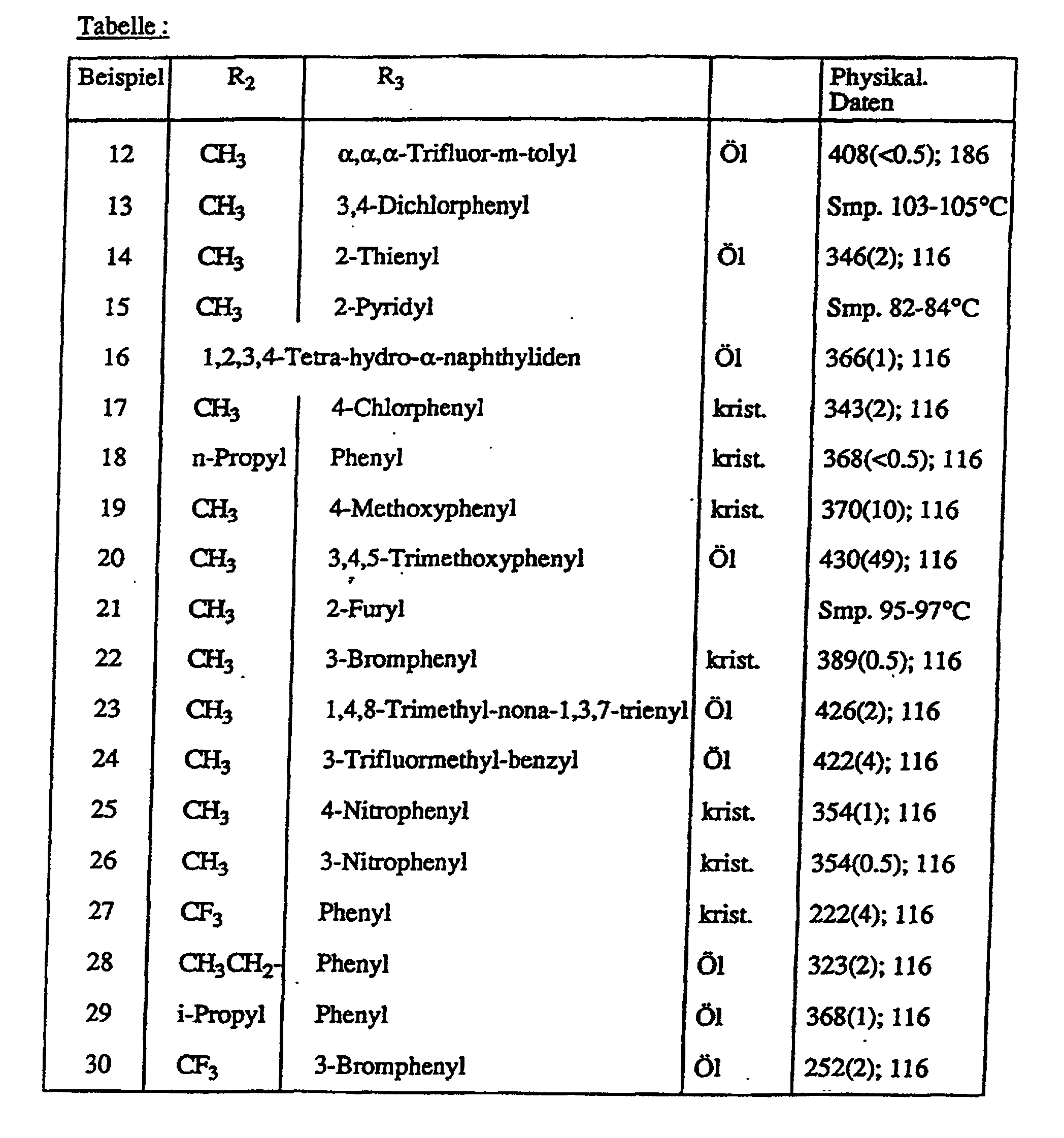
- the first value corresponds to the highest absorption.
- the second value corresponds to the base peak.
- an emulsifiable concentrate has the following composition: g / liter Active ingredient in the table 100 Nonylphenol (10) ethoxylate (non-ionic emulsifier) 50 Calcium dodecylbenzenesulfonate (anionic emulsifier) 25 N-methyl-2-pyrrolidone (solubilizer) 200 Mixture of alkylbenzenes (solvents) ad 1 liter
- the active ingredient and the emulsifiers are in the solvent and in the solubilizer solved. By emulsifying this concentrate in water, a ready-to-use Spray liquor of any dilution can be produced.
- a wettable powder has the following composition, for example: weight Active ingredient in the table 25.0 Silica (hydrated; carrier) 20.0 Sodium IauryIsulfate (wetting agent) 2.0 Sodium lignosulfonate (dispersant) 4.0 Kaolin (carrier) 49.0
- the components are mixed together and finely ground in a suitable mill. Dispersing the mixture in water results in a suspension that is suitable as a ready-to-use spray mixture.
- oat seedlings of the "Selma" variety are infected with Puccinia coronata by spraying with an aqueous spore suspension (approx. 150,000 uredospores / ml).
- the test plants are then incubated for 24 hours at 20-24 ° C. and dew point conditions.
- the oat seedlings are then thoroughly sprayed on all sides with a spray mixture (containing 160 ppm of active substance) made from a wettable powder of the active ingredient. Further cultivation takes place in a climate cabin at 19 ° C. and a photoperiod of 14 hours.
- the test evaluation is carried out 9-10 days after the infection by determining the leaf area affected by Puccinia coronata in percent compared to the infected, untreated control.
- the following compounds show more than 75% activity at 160 ppm: 12, 17, 78, 90, 107, 128, 131, 133, 138, 148.
- Example B2 Action against Cercospora arachidicola on peanut plants (curative action)
- Two peanut plants of the "Tamnut” variety are sprayed in the 4-leaf stage with a conidia suspension of Cercospora arachidicola (approx. 200,000 conidia / ml) and then incubated at 25-26 ° C and dew point conditions. After two days, the plants are sprayed thoroughly on all sides with a spray liquor (with 160 ppm active substance) made from a powdered active ingredient. The treated plants are then incubated in a climate cabin under the following conditions: 25-27 ° C. and 80% atmospheric humidity during the day, 20 ° C. and dew point conditions during the night; the photoperiod is 16 hours each. 12 days after the treatment, the test is evaluated by determining the percentage of leaf area affected by Cercospora arachidicola compared to the infected control.
- the following compounds show more than 75% activity at 160 ppm: 12, 13, 14, 17, 19, 22, 24, 25, 26, 30, 32, 33, 34, 36, 38, 40, 41, 44, 49, 52, 66, 68, 71, 83, 90, 101, 129, 130, 133, 138, 145, 148.
- the following compounds show more than 75% activity at 160 ppm: 1, 13, 15, 16, 18, 23, 24, 25, 27, 29, 31, 33, 34, 37, 39, 40, 52, 53, 70, 86, 89, 105, 119, 120, 126, 127, 128, 135, 137, 141, 149.
- Two "Golden Delicious" apple seedlings are grown with a conidia suspension sprayed by Venturia inaequalis and then at 18 ° C and dew point conditions incubated. After 24 hours, spray the plants thoroughly on all sides with one a wettable powder of the active ingredient spray liquor (with 50 ppm active ingredient). The treated apple seedlings are then cultivated further in the greenhouse. 9-10 days after treatment, the test is evaluated by determining the from Venturia inaequalis overgrown leaf surface in percent compared to the infected Control.
- the following compounds show more than 75% activity at 50 ppm: 12, 13, 14, 15, 17, 19, 20, 22, 24, 28, 29, 30, 31, 32, 33, 34, 36, 38, 44, 49, 54, 61, 64, 66, 78, 82, 83, 85, 105, 106, 117, 124, 131, 134, 135, 139, 142, 147.
- the following compounds show more than 75% activity at 50 ppm: 1, 12, 13, 14, 17, 20, 22, 23, 24, 25, 26, 28, 29, 30, 31, 32, 33, 34, 36, 38, 54, 55, 67, 92, 105, 124, 130, 136, 138, 143, 150.
- Tomato plants of the "Red Gnome” variety are grown with a Zoospores suspension of the mushroom sprayed and in a cabin at 18 to 20 ° and incubated saturated humidity. Humidification interrupted after 24 hours. To After the plants have dried, they are sprayed with a broth, which the Contains wettable powder formulated active substance in a concentration of 200 ppm. To After the spray coating has dried on, the plants are again in the wet room set up during 4 days. Number and size of those that occurred after this time Typical leaf spots are the evaluation standard for the effectiveness of the tested Substances.
- the active substance formulated as a wettable powder is used in a concentration of 60 ppm (based on soil volume) on the soil surface of three weeks old potted tomato plants of the "Red Gnome" variety. After three days of waiting the underside of the leaves of the plants with a zoo spore suspension of Phytophthora sprayed infestans. You will then be in a spray booth at 18 to 20 ° C for 5 days and saturated humidity. After this time, typical ones form Leaf spots, their number and size to evaluate the effectiveness of the tested Serve substances.
- test evaluation takes place on the 6th day after infection by determination of the leaf area affected by Plasmopara viticola in% compared to the infected, not treated control.
Landscapes
- Chemical & Material Sciences (AREA)
- Organic Chemistry (AREA)
- Life Sciences & Earth Sciences (AREA)
- Agronomy & Crop Science (AREA)
- Pest Control & Pesticides (AREA)
- Plant Pathology (AREA)
- Health & Medical Sciences (AREA)
- Engineering & Computer Science (AREA)
- Dentistry (AREA)
- General Health & Medical Sciences (AREA)
- Wood Science & Technology (AREA)
- Zoology (AREA)
- Environmental Sciences (AREA)
- Agricultural Chemicals And Associated Chemicals (AREA)
- Organic Low-Molecular-Weight Compounds And Preparation Thereof (AREA)
- Pyridine Compounds (AREA)
- Plural Heterocyclic Compounds (AREA)
- Nitrogen- Or Sulfur-Containing Heterocyclic Ring Compounds With Rings Of Six Or More Members (AREA)
- Furan Compounds (AREA)
- Heterocyclic Compounds That Contain Two Or More Ring Oxygen Atoms (AREA)
- Heterocyclic Compounds Containing Sulfur Atoms (AREA)
- Management, Administration, Business Operations System, And Electronic Commerce (AREA)
- Investigating Or Analysing Materials By The Use Of Chemical Reactions (AREA)
Description

- R1
- für C1-4-AIkyl und
- U
- für Chlor, Brom, Jod, Mesyloxy, Benzolsulfonyloxy oder Tosyloxy steben mit der Massgabe, dass R1 und C1-2-Alkyl nicht gleichzeitig Methyl bedeuten wenn U für Brom steht.
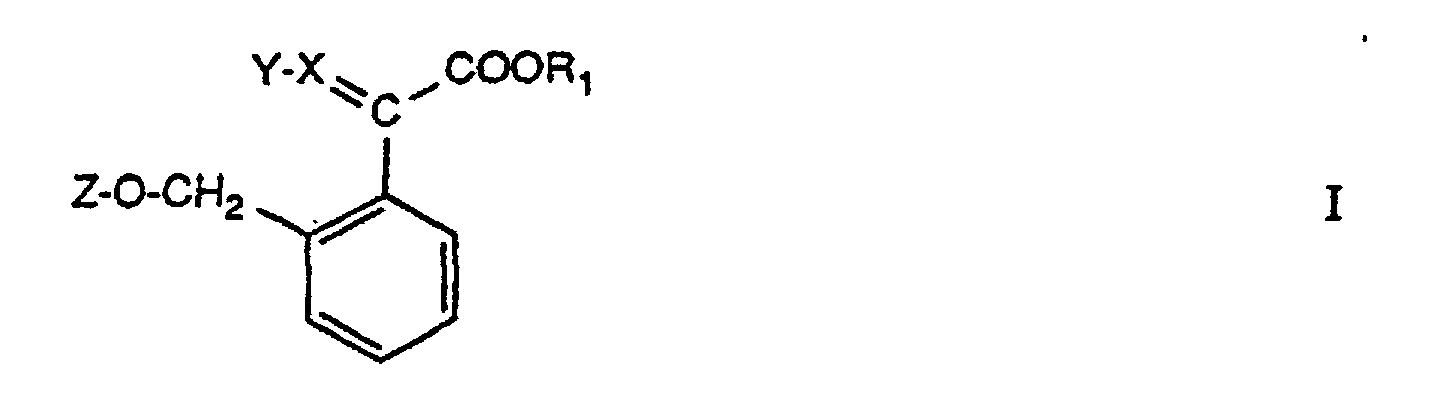
- R1
- C1-4-Alkyl bedeutet,
- (Y-X)
- C1-2-alkyl-ON= bedeutet
- und Z
- für eine Aldimino- oder Ketiminogruppe steht, und zwar insbesondere für
eine Gruppe

- worin R2
- Wasserstoff, C1-4-Alkyl, C1-4-Halogenalkyl, C3-6-Cycloalkyl, C2-4-Alkenyl, C2-4-Alkinyl, C1-2-Alkoxymethyl, C1-2-Alkylthiomethyl, C1-4-Alkylsulfonyl, C1-3-Alkoxy, C1-3-Alkylthio oder Cyano
- und R3
- C1-6-Alkyl, Aryl-C1-4-alkyl, Heteroaryl-C1-4-alkyl, C2-12-Alkenyl,Aryl-C2-4-alkenyl, Aryloxy-C1-4-alkyl, Heteroaryloxy-C1-4-alkyl, Heteroaryl-C2-4-alkenyl, C3-6-Cycloalkyl, Aryl, Heteroaryl, C2-5-Alkanoyl, Aroyl oder Heteroaroyl bedeuten,
- oder R2
- und R3 zusammen mit dem Kohlenstoffatom, an das sie gebunden sind, einen gegebenenfalls substituierten, gegebenenfalls ein Sauerstoffatom, Schwefelatom und/oder Stickstoffatom enthaltenden vier- bis siebengliedrigen gesättigten oder ungesättigten Ring bilden, der zudem einen gegebenenfalls substituierten ankondensierten Benzolring aufweisen kann.
worin
- R1
- C1-4-Alkyl bedeutet,
- (Y-X)
- C1-2-alkyl-ON= bedeutet
- und Z
- für eine Aldimino- oder Ketiminogruppe steht, und zwar insbesondere für
eine Gruppe

- worin R2
- Wasserstoff, C1-4-Alkyl, C1-4-Halogenalkyl, C3-6-Cycloalkyl
- und R3
- C1-6-Alkyl, Aryl-C1-4-alkyl, Heteroaryl-C1-4-alkyl, C2-6-Alkenyl,Aryl-C2-4-alkenyl, Heteroaryl-C2-4-alkenyl, C3-6-Cycloalkyl, Aryl, Heteroaryl, C2-5-Alkanoyl, Aroyl oder Heteroaroyl bedeuten,
- oder R2
- und R3 zusammen mit dem Kohlenstoffatom, an das sie gebunden sind, einen gegebenenfalls substituierten, gegebenenfalls ein Sauerstoff- oder Schwefelatom enthaltenden vier- bis siebengliedrigen gesättigten Ring bilden, der zudem einen gegebenenfalls substituierten ankondensierten Benzolring aufweisen kann.
sowie auch einen Heteroarylrest, einen Heteroaryl-C1-4-alkylrest, einen Heteroaryloxy-C1-4-alkylrest, einen Heteroaryl-C2-4-aIkenylrest, einen Heteroaryl-C1-4-alkoxyrest oder einen Heteroaryloxyrest; wobei hierin unter dem Begriff Heteroaryl ein Vertreter der obengenannten "Gruppe Het*" zu verstehen ist.


mit einem Benzylalkoholderivat der allgemeinen Formel




| g/Liter | |
| Wirkstoff der Tabelle | 100 |
| Nonylphenol-(10)äthoxylat (nicht ionischer Emulgator) | 50 |
| Calcium-dodecylbenzolsulfonat (anionischer Emulgator) | 25 |
| N-Methyl-2-pyrrolidon (Lösungsvermittler) | 200 |
| Gemisch von Alkylbenzolen (Lösungsmittel) | ad 1 Liter |
| Gewichtsprozent | |
| Wirkstoff der Tabelle | 25,0 |
| Kieselsäure (hydrarisiert; Trägerstoff) | 20,0 |
| Natrium-IauryIsulfat (Netzmittel) | 2,0 |
| Natrium-lignosulfonat (Dispergiermittel) | 4,0 |
| Kaolin (Trägerstoff) | 49,0 |
12, 17, 78, 90, 107, 128, 131, 133, 138, 148.
12, 13, 14, 17, 19, 22, 24, 25, 26, 30, 32, 33, 34, 36, 38, 40, 41, 44, 49, 52, 66, 68, 71, 83, 90, 101, 129, 130, 133, 138, 145, 148.
1, 13, 15, 16, 18, 23, 24, 25, 27, 29, 31, 33, 34, 37, 39, 40, 52, 53, 70, 86, 89, 105, 119, 120, 126, 127, 128, 135, 137, 141, 149.
12, 13, 14, 15, 17, 19, 20, 22, 24, 28, 29, 30, 31, 32, 33, 34, 36, 38, 44, 49, 54, 61, 64, 66, 78, 82, 83, 85, 105, 106, 117, 124, 131, 134, 135, 139, 142, 147.
1, 12, 13, 14, 17, 20, 22, 23, 24, 25, 26, 28, 29, 30, 31, 32, 33, 34, 36, 38, 54, 55, 67, 92, 105, 124, 130, 136, 138, 143, 150.
Claims (1)
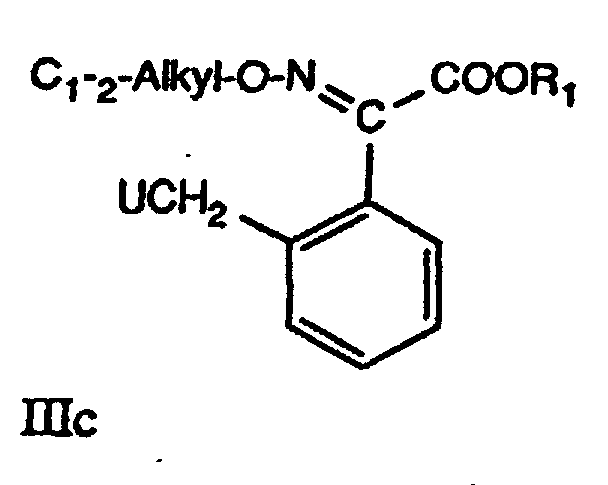
- Verbindungen der allgemeinen Formel IIIcworin
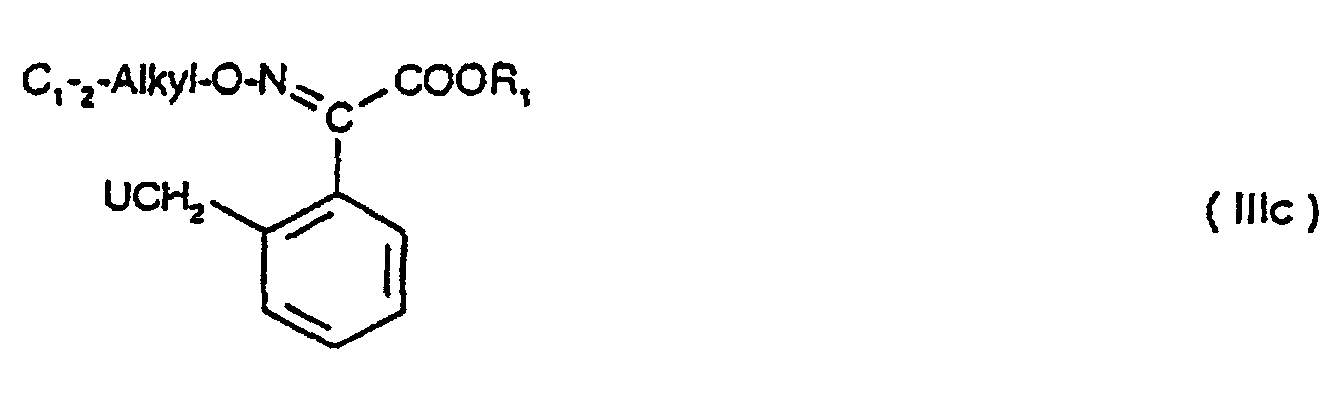
- R1
- für C1-4-Alkyl und
- U
- für Chlor, Brom, Jod, Mesyloxy, Benzolsulfonyloxy oder Tosyloxy stehen mit der Massgabe, dass R1 und C1-2-AIkyl nicht gleichzeitig Methyl bedeuten wenn U für Brom steht.
Applications Claiming Priority (8)
| Application Number | Priority Date | Filing Date | Title |
|---|---|---|---|
| CH189190 | 1990-06-05 | ||
| CH1891/90 | 1990-06-05 | ||
| CH189190 | 1990-06-05 | ||
| CH01208/91A CH689421A5 (de) | 1991-04-23 | 1991-04-23 | Zwischenprodukte für Oximäther. |
| CH120891 | 1991-04-23 | ||
| CH1208/91 | 1991-04-23 | ||
| EP91109035A EP0460575B1 (de) | 1990-06-05 | 1991-06-03 | Aromatische Verbindungen |
| EP95112791A EP0694529B1 (de) | 1990-06-05 | 1991-06-03 | Alkylthio-Oximäther-Derivate und deren Verwendung als Fungizide |
Related Parent Applications (1)
| Application Number | Title | Priority Date | Filing Date |
|---|---|---|---|
| EP95112791A Division EP0694529B1 (de) | 1990-06-05 | 1991-06-03 | Alkylthio-Oximäther-Derivate und deren Verwendung als Fungizide |
Publications (2)
| Publication Number | Publication Date |
|---|---|
| EP0893434A1 EP0893434A1 (de) | 1999-01-27 |
| EP0893434B1 true EP0893434B1 (de) | 2003-02-26 |
Family
ID=25686997
Family Applications (4)
| Application Number | Title | Priority Date | Filing Date |
|---|---|---|---|
| EP91109035A Expired - Lifetime EP0460575B1 (de) | 1990-06-05 | 1991-06-03 | Aromatische Verbindungen |
| EP95112791A Expired - Lifetime EP0694529B1 (de) | 1990-06-05 | 1991-06-03 | Alkylthio-Oximäther-Derivate und deren Verwendung als Fungizide |
| EP98115073A Expired - Lifetime EP0893434B1 (de) | 1990-06-05 | 1991-06-03 | Zwischenprodukte für die Herstellung von Oximäthern |
| EP95112790A Withdrawn EP0703215A1 (de) | 1990-06-05 | 1991-06-03 | Aromatische Verbindungen |
Family Applications Before (2)
| Application Number | Title | Priority Date | Filing Date |
|---|---|---|---|
| EP91109035A Expired - Lifetime EP0460575B1 (de) | 1990-06-05 | 1991-06-03 | Aromatische Verbindungen |
| EP95112791A Expired - Lifetime EP0694529B1 (de) | 1990-06-05 | 1991-06-03 | Alkylthio-Oximäther-Derivate und deren Verwendung als Fungizide |
Family Applications After (1)
| Application Number | Title | Priority Date | Filing Date |
|---|---|---|---|
| EP95112790A Withdrawn EP0703215A1 (de) | 1990-06-05 | 1991-06-03 | Aromatische Verbindungen |
Country Status (28)
| Country | Link |
|---|---|
| US (2) | US6407100B1 (de) |
| EP (4) | EP0460575B1 (de) |
| JP (1) | JP3000240B2 (de) |
| KR (1) | KR0172948B1 (de) |
| AR (1) | AR247725A1 (de) |
| AT (3) | ATE233236T1 (de) |
| BR (1) | BR9102305A (de) |
| CA (1) | CA2043733C (de) |
| CZ (1) | CZ279709B6 (de) |
| DE (3) | DE59109247D1 (de) |
| DK (3) | DK0460575T3 (de) |
| ES (3) | ES2091834T3 (de) |
| GR (2) | GR3021080T3 (de) |
| HK (1) | HK1005721A1 (de) |
| HU (2) | HU0000906D0 (de) |
| IE (3) | IE80848B1 (de) |
| IL (2) | IL98341A (de) |
| LU (1) | LU90620I2 (de) |
| LV (1) | LV10609B (de) |
| MD (1) | MD1025C2 (de) |
| NL (1) | NL350004I2 (de) |
| NZ (1) | NZ238346A (de) |
| PH (1) | PH11991042549B1 (de) |
| PL (1) | PL168218B1 (de) |
| PT (1) | PT97848B (de) |
| RU (1) | RU2077527C1 (de) |
| SG (1) | SG42939A1 (de) |
| SK (1) | SK278282B6 (de) |
Families Citing this family (137)
| Publication number | Priority date | Publication date | Assignee | Title |
|---|---|---|---|---|
| DE59109047D1 (de) * | 1990-06-27 | 1998-10-08 | Basf Ag | O-Benzyl-Oximether und diese Verbindungen enthaltende Pflanzenschutzmittel |
| GB9018408D0 (en) * | 1990-08-22 | 1990-10-03 | Ici Plc | Fungicides |
| AU2755892A (en) * | 1991-10-25 | 1993-05-21 | Ciba-Geigy Ag | 2-(2-benzo(b)thienyl)-3-methoxyacrylate and -2-iminoacetate derivatives to be used as pesticides |
| TW221965B (de) * | 1992-02-28 | 1994-04-01 | Ciba Geigy | |
| GB9221584D0 (en) * | 1992-10-14 | 1992-11-25 | Ici Plc | Chemical process |
| TW279845B (de) * | 1992-12-01 | 1996-07-01 | Ciba Geigy Ag | |
| EP0738260B2 (de) * | 1994-01-05 | 2006-12-13 | Bayer CropScience AG | Schädlingsbekämpfungsmittel |
| PL315668A1 (en) * | 1994-01-27 | 1996-11-25 | Ciba Geigy Ag | Method of obtaining derivatives of aryloacetic ester by palladium-catalysed cross-coupling reaction |
| PT738259E (pt) * | 1994-02-04 | 2001-01-31 | Basf Ag | Derivados do acido fenilacetico processo e produtos intermediarios para sua preparacao e agentes que os contem |
| KR970006238B1 (en) * | 1994-03-15 | 1997-04-25 | Korea Res Inst Chem Tech | Propenoic ester derivatives having 4-hydroxy pyrazole group |
| GB9405492D0 (en) * | 1994-03-21 | 1994-05-04 | Zeneca Ltd | Chemical compounds |
| CN1082503C (zh) * | 1994-06-10 | 2002-04-10 | 巴斯福股份公司 | α-甲氧基亚氨基羧酸的甲基酰胺的制备方法及其中间体 |
| DE4442560A1 (de) * | 1994-11-30 | 1996-06-05 | Basf Ag | Iminooxybenzylcrotonsäureester, Verfahren zu ihrer Herstellung und ihre Verwendung |
| CN1182423A (zh) * | 1995-02-24 | 1998-05-20 | 纳幕尔杜邦公司 | 杀菌环酰胺 |
| UA54395C2 (uk) * | 1995-06-16 | 2003-03-17 | Баєр Акціенгезельшафт | Фітобактерициднa композиція, спосіб контролю та запобігання хворобам рослин, матеріал для розмноження рослин |
| MY115814A (en) * | 1995-06-16 | 2003-09-30 | Bayer Ip Gmbh | Crop protection compositions |
| DE19523288A1 (de) * | 1995-06-27 | 1997-01-02 | Basf Ag | Iminooxybenzylverbindungen, Verfahren zu ihrer Herstellung und ihre Verwendung |
| DE69637267T2 (de) * | 1995-08-15 | 2008-06-26 | Bayer Cropscience Ag | Pestizide indazol-derivate |
| ES2173330T5 (es) * | 1995-11-29 | 2007-03-16 | Bayer Cropscience Ag | Procedimiento para la preparacion de derivados de acido metoximinofenilglioxilico. |
| CN1111155C (zh) * | 1995-12-07 | 2003-06-11 | 拜尔公开股份有限公司 | 农药的制备方法 |
| CN1238337C (zh) * | 1995-12-07 | 2006-01-25 | 拜尔公开股份有限公司 | 农药 |
| EP0882025A1 (de) | 1996-02-05 | 1998-12-09 | Basf Aktiengesellschaft | Pyrimidinderivate, verfahren und zwischenprodukte zu ihrer herstellung und sie enthaltende mittel zur bekämpfung von tierischen schädlingen oder von schadpilzen |
| WO1997040671A1 (en) * | 1996-04-26 | 1997-11-06 | Novartis Ag | Pesticidal compositions |
| TR199700975A2 (xx) * | 1996-09-27 | 1998-04-21 | Novartis Ag | Salg�n hastal�k ila�lar� (pepticides). |
| UA59381C2 (uk) | 1996-12-13 | 2003-09-15 | Баєр Акціенгезельшафт | Бактерицидна композиція для захисту рослин та спосіб боротьби із захворюваннями рослин та запобігання їм |
| RU2193848C2 (ru) * | 1996-12-13 | 2002-12-10 | Байер Аг | Фунгицидная композиция для растений и способ ее применения |
| DE19711168A1 (de) | 1997-03-18 | 1998-09-24 | Basf Ag | Phenylketiminooxybenzylverbindungen, Verfahren zu ihrer Herstellung und ihre Verwendung |
| DE19716237A1 (de) | 1997-04-18 | 1998-10-22 | Basf Ag | Substituierte Benzyloxyimino-Verbindungen |
| DE19716257A1 (de) | 1997-04-18 | 1998-10-22 | Bayer Ag | Fungizide Wirkstoffkombination |
| US6084120A (en) * | 1997-07-09 | 2000-07-04 | Hoffmann-La Roche Inc. | β-Alkoxyacrylates against malaria |
| CN1062711C (zh) | 1998-02-10 | 2001-03-07 | 化工部沈阳化工研究院 | 不饱和肟醚类杀虫、杀真菌剂 |
| DE69906170T2 (de) * | 1998-02-10 | 2003-10-23 | Dow Agrosciences Llc, Indianapolis | Ungesättigte Oxim-Ether und ihre Verwendung als Fungizide oder Insectizide |
| US6313344B1 (en) | 1998-05-27 | 2001-11-06 | Bayer Aktiengesellschaft | Organic compounds |
| UA70327C2 (uk) * | 1998-06-08 | 2004-10-15 | Баєр Акціенгезельшафт | Спосіб боротьби з фітопатогенними хворобами сільськогосподарських рослин та фунгіцидна композиція |
| FR2787295A1 (fr) * | 1998-12-22 | 2000-06-23 | Rhone Poulenc Agrochimie | Composition fongicide synergique comprenant un compose analogue de la strobilurine |
| GB9900963D0 (en) | 1999-01-15 | 1999-03-10 | Novartis Ag | Organic compounds |
| GB9908530D0 (en) | 1999-04-14 | 1999-06-09 | Novartis Ag | Organic compounds |
| GB9912220D0 (en) | 1999-05-26 | 1999-07-28 | Novartis Ag | Organic compounds |
| GB9912219D0 (en) * | 1999-05-26 | 1999-07-28 | Novartis Ag | Organic compounds |
| MXPA02004965A (es) | 1999-12-07 | 2002-09-18 | Basf Ag | Metodo para producir cloruros del acido o-clorometilbenzoico. |
| TR200201544T2 (tr) * | 1999-12-13 | 2002-11-21 | Bayer Aktiengesellschaft | Fungusid aktivitesine sahip bileşik kombinasyonları. |
| DE10019758A1 (de) | 2000-04-20 | 2001-10-25 | Bayer Ag | Fungizide Wirkstoffkombinationen |
| GB0010200D0 (en) * | 2000-04-26 | 2000-06-14 | Novartis Ag | Organic compounds |
| DE10103832A1 (de) * | 2000-05-11 | 2001-11-15 | Bayer Ag | Fungizide Wirkstoffkombinationen |
| DE10059605A1 (de) | 2000-12-01 | 2002-06-06 | Bayer Ag | Fungizide Wirkstoffkombinationen |
| BR0206451A (pt) * | 2001-01-16 | 2003-12-30 | Basf Ag | Mistura fungicida, método para combater fungos nocivos, e, agente fungicida |
| DE10140108A1 (de) | 2001-08-16 | 2003-03-06 | Bayer Cropscience Ag | Fungizide Wirkstoffkombinationen |
| DE10141618A1 (de) * | 2001-08-24 | 2003-03-06 | Bayer Cropscience Ag | Fungizide Wirkstoffkombinationen |
| DE10144459A1 (de) * | 2001-09-10 | 2003-04-03 | Werner Kluft | Überwachung von Werkzeugmaschinen-Komponenten mit einem Überwachungssystem |
| ATE397860T1 (de) * | 2002-03-01 | 2008-07-15 | Basf Se | Fungizide mischungen auf der basis von prothioconazole und picoxystrobin |
| DE10209145A1 (de) * | 2002-03-01 | 2003-09-04 | Bayer Cropscience Ag | Halogenbenzole |
| BR0308831A (pt) * | 2002-04-05 | 2005-01-25 | Basf Ag | Mistura fungicida, processo para combater fungos nocivos, e, agente fungicida |
| DE10228102A1 (de) * | 2002-06-24 | 2004-01-15 | Bayer Cropscience Ag | Fungizide Wirkstoffkombinationen |
| DE10228104A1 (de) * | 2002-06-24 | 2004-01-15 | Bayer Cropscience Ag | Fungizide Wirkstoffkombination |
| DE10228103A1 (de) * | 2002-06-24 | 2004-01-15 | Bayer Cropscience Ag | Fungizide Wirkstoffkombinationen |
| CN1179942C (zh) * | 2002-09-13 | 2004-12-15 | 湖南化工研究院 | 具有杀菌活性的含硫不饱和肟醚类化合物及其制备方法 |
| WO2004043150A1 (de) | 2002-11-12 | 2004-05-27 | Basf Aktiengesellschaft | Verfahren zur ertragssteigerung bei glyphosate resistenten leguminosen |
| DE10326917A1 (de) * | 2003-06-16 | 2005-02-10 | Bayer Chemicals Ag | Herstellung von fluorhaltigen Acetophenonen |
| DE10335183A1 (de) * | 2003-07-30 | 2005-02-24 | Bayer Cropscience Ag | Fungizide Wirkstoffkombinationen |
| DE10341945A1 (de) * | 2003-09-11 | 2005-04-21 | Bayer Cropscience Ag | Verwendung von fungiziden Mitteln zur Beizung von Saatgut |
| TW200526126A (en) * | 2003-10-01 | 2005-08-16 | Basf Ag | Fungicidal mixture for controlling rice pathogens |
| CN100377646C (zh) * | 2003-10-01 | 2008-04-02 | 巴斯福股份公司 | 防治稻病原体的杀真菌混合物 |
| DE10347090A1 (de) | 2003-10-10 | 2005-05-04 | Bayer Cropscience Ag | Synergistische fungizide Wirkstoffkombinationen |
| DE10349501A1 (de) | 2003-10-23 | 2005-05-25 | Bayer Cropscience Ag | Synergistische fungizide Wirkstoffkombinationen |
| UA85690C2 (ru) | 2003-11-07 | 2009-02-25 | Басф Акциенгезелльшафт | Смесь для применения в сельском хозяйстве, содержащая стробилурин и модулятор этилена, способ обработки и борьбы с инфекциями в бобовых культурах |
| CN100357263C (zh) * | 2004-03-05 | 2007-12-26 | 同济大学 | 一种肟菌酯的制备方法 |
| CN1303061C (zh) * | 2004-03-05 | 2007-03-07 | 同济大学 | 聚乙二醇液相合成肟菌酯的方法 |
| DE102004020840A1 (de) * | 2004-04-27 | 2005-11-24 | Bayer Cropscience Ag | Verwendung von Alkylcarbonsäureamiden als Penetrationsförderer |
| CA2560341A1 (en) | 2004-04-30 | 2005-11-10 | Jordi Tormo I Blasco | Fungicidal mixtures |
| DE102004049041A1 (de) | 2004-10-08 | 2006-04-13 | Bayer Cropscience Ag | Fungizide Wirkstoffkombinationen |
| DE102004049761A1 (de) * | 2004-10-12 | 2006-04-13 | Bayer Cropscience Ag | Fungizide Wirkstoffkombinationen |
| CN100430373C (zh) * | 2005-04-05 | 2008-11-05 | 湖南化工研究院 | 具生物活性的含双三氟甲基苯基的甲氧丙烯酸酯类化合物及其制备方法 |
| DE102005015677A1 (de) * | 2005-04-06 | 2006-10-12 | Bayer Cropscience Ag | Synergistische fungizide Wirkstoffkombinationen |
| DE102005023835A1 (de) * | 2005-05-24 | 2006-12-07 | Bayer Cropscience Ag | Fungizide Wirkstoffkombination |
| CN104170838B (zh) | 2005-06-09 | 2016-03-30 | 拜尔农作物科学股份公司 | 活性物质结合物 |
| DE102005026482A1 (de) | 2005-06-09 | 2006-12-14 | Bayer Cropscience Ag | Wirkstoffkombinationen |
| DE102005035300A1 (de) | 2005-07-28 | 2007-02-01 | Bayer Cropscience Ag | Synergistische fungizide Wirkstoffkombinationen |
| MX2008003071A (es) * | 2005-09-09 | 2008-03-19 | Bayer Cropscience Ag | Formulacion solida de mezclas fungicidas. |
| KR20080061408A (ko) * | 2005-10-28 | 2008-07-02 | 바스프 에스이 | 유해 진균에 대한 저항성을 유도하는 방법 |
| DE102005057837A1 (de) | 2005-12-03 | 2007-06-06 | Bayer Cropscience Ag | Fungizide Wirkstoffkombination |
| DE102005058838A1 (de) | 2005-12-09 | 2007-06-14 | Bayer Cropscience Ag | Fungizide Wirkstoffkombination |
| DE102005060281A1 (de) * | 2005-12-16 | 2007-06-21 | Bayer Cropscience Ag | Fungizide Wirkstoffkombination |
| KR20080111058A (ko) * | 2006-03-14 | 2008-12-22 | 바스프 에스이 | 세균증에 대해 식물의 내성을 유도하는 방법 |
| PT2001294T (pt) | 2006-03-24 | 2017-01-13 | Basf Se | Método para combater fungos fitopatogénicos |
| KR20080111021A (ko) * | 2006-03-29 | 2008-12-22 | 바스프 에스이 | 철 대사 장애의 치료를 위한 스트로빌루린의 용도 |
| DE102006023263A1 (de) * | 2006-05-18 | 2007-11-22 | Bayer Cropscience Ag | Synergistische Wirkstoffkombinationen |
| EP2091330B1 (de) | 2006-09-18 | 2017-07-05 | Basf Se | Pestizide mischungen, die ein anthranilamidinsektizid und ein fungizid enthalten |
| EP2679096A1 (de) | 2007-02-06 | 2014-01-01 | Basf Se | Pestizidgemische |
| MX2009011456A (es) | 2007-04-23 | 2009-11-05 | Basf Se | Aumento de la productividad de las plantas por combinacion de agentes quimicos con modificaciones transgenicas. |
| EP2000030A1 (de) | 2007-06-06 | 2008-12-10 | Bayer CropScience AG | Fungizide Wirkstoffkombinationen |
| WO2009003953A2 (en) * | 2007-06-29 | 2009-01-08 | Basf Se | Strobilurins for increasing the resistance of plants to abiotic stress |
| PT2205082E (pt) | 2007-09-26 | 2012-05-02 | Basf Se | Composições fungicidas ternárias compreendendo boscalide e clorotalonil |
| DE102007045920B4 (de) | 2007-09-26 | 2018-07-05 | Bayer Intellectual Property Gmbh | Synergistische Wirkstoffkombinationen |
| EP2224810A2 (de) * | 2007-11-05 | 2010-09-08 | Basf Se | Verfahren, anwendung und mittel zum schutz einer pflanze gegen phakopsora |
| EP2100506A2 (de) | 2009-01-23 | 2009-09-16 | Bayer CropScience AG | Verwendungen von Fluopyram |
| UA104887C2 (uk) | 2009-03-25 | 2014-03-25 | Баєр Кропсаєнс Аг | Синергічні комбінації активних речовин |
| CN104430378A (zh) | 2009-07-16 | 2015-03-25 | 拜尔农作物科学股份公司 | 含苯基三唑的协同活性物质结合物 |
| US20120129696A1 (en) | 2009-07-28 | 2012-05-24 | Basf Se | Method for increasing the level of free amino acids in storage tissues of perennial plants |
| WO2011026796A1 (en) | 2009-09-01 | 2011-03-10 | Basf Se | Synergistic fungicidal mixtures comprising lactylates and method for combating phytopathogenic fungi |
| NZ598965A (en) | 2009-09-25 | 2013-03-28 | Basf Se | Method for reducing pistillate flower abortion in plants using at least one strobilurin |
| WO2011092147A1 (en) | 2010-01-29 | 2011-08-04 | Bayer Cropscience Ag | Method to reduce the frequency and/or intensity of blossom-end rot disorder in horticultural crops |
| US20130267476A1 (en) | 2010-12-20 | 2013-10-10 | Basf Se | Pesticidal Active Mixtures Comprising Pyrazole Compounds |
| EP2481284A3 (de) | 2011-01-27 | 2012-10-17 | Basf Se | Pestizidgemische |
| CN102067856B (zh) * | 2011-02-23 | 2014-03-05 | 陕西美邦农药有限公司 | 一种含多抗霉素与噁唑类化合物的杀菌组合物 |
| EP2688405B1 (de) | 2011-03-23 | 2017-11-22 | Basf Se | Zusammensetzungen mit polymeren, ionischen verbindungen mit imidazoliumgruppen |
| CN102217617A (zh) * | 2011-03-25 | 2011-10-19 | 陕西汤普森生物科技有限公司 | 一种含有肟菌酯的农药组合物 |
| CN102217618B (zh) * | 2011-03-31 | 2014-03-05 | 陕西汤普森生物科技有限公司 | 一种含肟菌酯与抗生素类化合物的杀菌组合物 |
| CN103719086A (zh) * | 2011-03-31 | 2014-04-16 | 陕西汤普森生物科技有限公司 | 一种含肟菌酯与抗生素类化合物的杀菌组合物 |
| AR085588A1 (es) | 2011-04-13 | 2013-10-09 | Bayer Cropscience Ag | Combinaciones de compuestos activos |
| AR085587A1 (es) | 2011-04-13 | 2013-10-09 | Bayer Cropscience Ag | Combinaciones de compuestos activos |
| EP2750507A2 (de) | 2011-09-02 | 2014-07-09 | Basf Se | Landwirtschaftliche mischungen mit arylchinazolinon-verbindungen |
| CN102428928A (zh) * | 2011-11-04 | 2012-05-02 | 利尔化学股份有限公司 | 杀菌农药组合物 |
| WO2013144924A1 (en) | 2012-03-29 | 2013-10-03 | Rallis India Ltd. | An improved process for the synthesis of strobilurin fungicides viz trifloxystrobin and kresoxim-methyl |
| CN102640757B (zh) * | 2012-04-13 | 2013-11-27 | 永农生物科学有限公司 | 含有肟菌酯的复配农药杀菌组合物 |
| CN102657188B (zh) * | 2012-04-24 | 2016-03-30 | 陕西韦尔奇作物保护有限公司 | 一种高效杀菌组合物 |
| CN102669139A (zh) * | 2012-05-24 | 2012-09-19 | 利民化工股份有限公司 | 一种肟菌酯与霜脲氰复配的水分散粒剂及其制备方法 |
| WO2013189801A1 (en) | 2012-06-20 | 2013-12-27 | Basf Se | Pyrazole compound and pesticidal mixtures comprising a pyrazole compound |
| US20150257383A1 (en) | 2012-10-12 | 2015-09-17 | Basf Se | Method for combating phytopathogenic harmful microbes on cultivated plants or plant propagation material |
| BR112015014753B8 (pt) | 2012-12-20 | 2020-03-03 | Basf Agro Bv | composições, uso de uma composição, método para o combate de fungos fitopatogênicos e uso dos componentes |
| EP2783569A1 (de) | 2013-03-28 | 2014-10-01 | Basf Se | Zusammensetzungen mit einer Triazol-Verbindung |
| EP2835052A1 (de) | 2013-08-07 | 2015-02-11 | Basf Se | Fungizide Mischungen mit Pyrimidinfungiziden |
| WO2015032692A1 (de) | 2013-09-03 | 2015-03-12 | Bayer Cropscience Ag | Verwendung fungizider wirkstoffe zur kontrolle von chalara fraxinea an eschenbäumen |
| CA2923101A1 (en) | 2013-09-16 | 2015-03-19 | Basf Se | Fungicidal pyrimidine compounds |
| WO2015036059A1 (en) | 2013-09-16 | 2015-03-19 | Basf Se | Fungicidal pyrimidine compounds |
| CN103524378B (zh) * | 2013-10-23 | 2015-04-15 | 江苏七洲绿色化工股份有限公司 | 一种肟菌酯的制备方法 |
| EP2979549A1 (de) | 2014-07-31 | 2016-02-03 | Basf Se | Verfahren zur verbesserung der gesundheit einer pflanze |
| BR112017008200A2 (pt) | 2014-10-24 | 2017-12-26 | Basf Se | partículas, método para depositar um metal a partir de um eletrólito, e, usos de um polímero e das partículas. |
| EP2910126A1 (de) | 2015-05-05 | 2015-08-26 | Bayer CropScience AG | Wirkstoffkombinationen mit insektiziden eigenschaften |
| CN107809906A (zh) | 2015-07-02 | 2018-03-16 | 巴斯夫农业公司 | 包含三唑化合物的农药组合物 |
| CN105028427B (zh) * | 2015-07-02 | 2017-03-01 | 江西禾益化工股份有限公司 | 一种含叶枯唑和肟菌酯的杀菌组合物 |
| GB201903942D0 (en) * | 2019-03-22 | 2019-05-08 | Syngenta Crop Protection Ag | Microbiocidal compounds |
| CA3139524A1 (en) | 2019-05-10 | 2020-11-19 | Bayer Cropscience Lp | Active compound combinations |
| JPWO2021153758A1 (de) * | 2020-01-31 | 2021-08-05 | ||
| KR20230005261A (ko) * | 2020-04-28 | 2023-01-09 | 바스프 에스이 | Qo 억제제 II 에 대한 내성을 부여하는 미토콘드리아 시토크롬 b 단백질 내에 아미노산 치환 F129L 을 함유하는 식물병원성 진균의 퇴치를 위한 스트로빌루린 유형 화합물의 용도 |
| US20230255200A1 (en) * | 2020-07-08 | 2023-08-17 | Basf Se | Use of strobilurin type compounds for combating phytopathogenic fungi containing an amino acid substitution f129l in the mitochondrial cytochrome b protein conferring resistance to qo inhibitors vi |
| JPWO2023127767A1 (de) | 2021-12-27 | 2023-07-06 | ||
| CN116354848B (zh) * | 2023-04-13 | 2025-06-03 | 波顿香料股份有限公司 | 一种生姜香气化合物及其制备方法和生姜香型香基 |
Family Cites Families (11)
| Publication number | Priority date | Publication date | Assignee | Title |
|---|---|---|---|---|
| NZ213630A (en) * | 1984-10-19 | 1990-02-26 | Ici Plc | Acrylic acid derivatives and fungicidal compositions |
| GB8521082D0 (en) * | 1985-08-22 | 1985-09-25 | Ici Plc | Fungicides |
| DE3623921A1 (de) * | 1986-07-16 | 1988-01-21 | Basf Ag | Oximether und diese enthaltende fungizide |
| GB8617648D0 (en) | 1986-07-18 | 1986-08-28 | Ici Plc | Fungicides |
| DE3733870A1 (de) * | 1987-10-07 | 1989-04-27 | Basf Ag | Orthosubstituierte carbonsaeure-benzylester und fungizide, die diese verbindungen enthalten |
| DE3821503A1 (de) * | 1988-06-25 | 1989-12-28 | Basf Ag | (alpha)-aryl-acrylsaeureester und diese enthaltende fungizide |
| DE3835028A1 (de) * | 1988-10-14 | 1990-04-19 | Basf Ag | Oximether-derivate, verfahren zu ihrer herstellung und diese enthaltende fungizide |
| EP0370629B2 (de) * | 1988-11-21 | 1998-01-07 | Zeneca Limited | Fungizide |
| DE59109047D1 (de) * | 1990-06-27 | 1998-10-08 | Basf Ag | O-Benzyl-Oximether und diese Verbindungen enthaltende Pflanzenschutzmittel |
| GB9018408D0 (en) * | 1990-08-22 | 1990-10-03 | Ici Plc | Fungicides |
| JPH06504538A (ja) * | 1991-01-30 | 1994-05-26 | ゼネカ・リミテッド | 殺菌剤 |
-
1991
- 1991-05-30 PH PH42549A patent/PH11991042549B1/en unknown
- 1991-05-31 NZ NZ238346A patent/NZ238346A/en not_active IP Right Cessation
- 1991-06-03 EP EP91109035A patent/EP0460575B1/de not_active Expired - Lifetime
- 1991-06-03 CA CA002043733A patent/CA2043733C/en not_active Expired - Lifetime
- 1991-06-03 EP EP95112791A patent/EP0694529B1/de not_active Expired - Lifetime
- 1991-06-03 AR AR91319853A patent/AR247725A1/es active
- 1991-06-03 DK DK91109035.5T patent/DK0460575T3/da not_active Application Discontinuation
- 1991-06-03 ES ES91109035T patent/ES2091834T3/es not_active Expired - Lifetime
- 1991-06-03 PT PT97848A patent/PT97848B/pt not_active IP Right Cessation
- 1991-06-03 AT AT98115073T patent/ATE233236T1/de not_active IP Right Cessation
- 1991-06-03 AT AT95112791T patent/ATE182880T1/de not_active IP Right Cessation
- 1991-06-03 AT AT91109035T patent/ATE143003T1/de active
- 1991-06-03 DE DE59109247T patent/DE59109247D1/de not_active Expired - Lifetime
- 1991-06-03 SG SG1996001100A patent/SG42939A1/en unknown
- 1991-06-03 DE DE59109146T patent/DE59109146D1/de not_active Expired - Lifetime
- 1991-06-03 ES ES98115073T patent/ES2192722T3/es not_active Expired - Lifetime
- 1991-06-03 DK DK95112791T patent/DK0694529T3/da active
- 1991-06-03 DK DK98115073T patent/DK0893434T3/da active
- 1991-06-03 EP EP98115073A patent/EP0893434B1/de not_active Expired - Lifetime
- 1991-06-03 IL IL9834191A patent/IL98341A/en not_active IP Right Cessation
- 1991-06-03 EP EP95112790A patent/EP0703215A1/de not_active Withdrawn
- 1991-06-03 DE DE59108191T patent/DE59108191D1/de not_active Expired - Lifetime
- 1991-06-03 ES ES95112791T patent/ES2137421T3/es not_active Expired - Lifetime
- 1991-06-04 IE IE189991A patent/IE80848B1/en not_active IP Right Cessation
- 1991-06-04 IE IE970618A patent/IE83213B1/en not_active IP Right Cessation
- 1991-06-04 IE IE20010092A patent/IE83646B1/en not_active IP Right Cessation
- 1991-06-04 KR KR1019910009225A patent/KR0172948B1/ko not_active Expired - Lifetime
- 1991-06-04 HU HU0000906A patent/HU0000906D0/hu unknown
- 1991-06-04 BR BR919102305A patent/BR9102305A/pt not_active IP Right Cessation
- 1991-06-04 SK SK1688-91A patent/SK278282B6/sk not_active IP Right Cessation
- 1991-06-04 CZ CS911688A patent/CZ279709B6/cs not_active IP Right Cessation
- 1991-06-04 RU SU914895703A patent/RU2077527C1/ru active
- 1991-06-04 PL PL91290533A patent/PL168218B1/pl unknown
- 1991-06-04 HU HU871/91A patent/HU218303B/hu unknown
- 1991-06-05 JP JP3160979A patent/JP3000240B2/ja not_active Expired - Lifetime
-
1993
- 1993-05-25 LV LVP-93-420A patent/LV10609B/en unknown
- 1993-09-01 US US08/114,991 patent/US6407100B1/en not_active Expired - Lifetime
-
1994
- 1994-07-11 MD MD94-0259A patent/MD1025C2/ro unknown
-
1995
- 1995-06-07 US US08/483,727 patent/US6355634B1/en not_active Expired - Lifetime
-
1996
- 1996-05-30 IL IL11848696A patent/IL118486A0/xx unknown
- 1996-09-19 GR GR960402334T patent/GR3021080T3/el unknown
-
1998
- 1998-06-03 HK HK98104803A patent/HK1005721A1/xx not_active IP Right Cessation
-
1999
- 1999-10-27 GR GR990402732T patent/GR3031643T3/el unknown
-
2000
- 2000-08-05 LU LU90620C patent/LU90620I2/fr unknown
-
2002
- 2002-07-17 NL NL350004C patent/NL350004I2/nl unknown
Also Published As
Similar Documents
| Publication | Publication Date | Title |
|---|---|---|
| EP0460575B1 (de) | Aromatische Verbindungen | |
| EP0403618B1 (de) | Aldimino- oder ketimino-oxy-ortho-tolylacrylsäure-methylester, ihre herstellung und diese enthaltende fungizide | |
| DE69412033T2 (de) | O-benzyloximether-derivate und ihre verwendung als pestizide | |
| EP0470600B1 (de) | Naphthylalkylaminopyrimidin-Derivate, Verfahren zu ihrer Herstellung und diese enthaltende Schädlingsbekämpfungsmittel | |
| EP0433233B1 (de) | Heterocyclische Verbindungen | |
| CH686307A5 (de) | Oximether des 3-Methoxy-2-(o-tolyl)acrylsouremethylesters, Verfahren zu ihrer Herstellung und fungizide Mittel, die diese als Wirkstoffe enthalten. | |
| EP0464381A2 (de) | 2-Methoximinocarbonsäureester | |
| DE3919348A1 (de) | Mikrobizide mittel | |
| EP0584625B1 (de) | Pyridyloxy-acrylsäureester | |
| DE3618662A1 (de) | Trisubstituierte 1,3,5-triazin-2,4,6-trione | |
| EP0554729B1 (de) | Substituierte Aminosäureamide | |
| EP0670836B1 (de) | 3-pyridyl-1,2,4-thiadiazole als pestizide | |
| EP0278352A2 (de) | Aminomethyltetrahydrofurane | |
| EP0590458B1 (de) | Substituierte Thiophencarbonsäureamide | |
| DE69808256T2 (de) | Als mikrobizide mittel verwendbare n-sulfonyl- und n-sulfinyl-aminosäureamide | |
| DE2611902C2 (de) | N-(Fluordichlormethylthio)-benzoesäureanilide, Verfahren zu ihrer Herstellung und diese enthaltende Fungizide | |
| EP0278311A1 (de) | 2-Aminomethyltetrahydrofurane | |
| DE2919825C2 (de) | ||
| DE3625460A1 (de) | N-(2-cyan-2-oximinoacetyl)-aminonitrile | |
| EP0268923A1 (de) | Saccharin-Salze von Aminomethylheterocyclen | |
| DE3702853A1 (de) | 1-aminomethyl-3-aryl-4-cyano-pyrrole | |
| EP0274023A1 (de) | Saccharin-Salze von substituierten Aminen | |
| DD298392A5 (de) | Fungizide mittel auf basis von 1,3,5-triaryl-2-pyrazolin-derivaten, neue 1,3,5-triaryl-2-pyrazoline und ein verfahren zu ihrer herstellung | |
| DE3724554A1 (de) | Substituierte 3-arylpyrrole | |
| EP0272555A2 (de) | Aminomethylisoxazolidine |
Legal Events
| Date | Code | Title | Description |
|---|---|---|---|
| PUAI | Public reference made under article 153(3) epc to a published international application that has entered the european phase |
Free format text: ORIGINAL CODE: 0009012 |
|
| AC | Divisional application: reference to earlier application |
Ref document number: 694529 Country of ref document: EP |
|
| AK | Designated contracting states |
Kind code of ref document: A1 Designated state(s): AT BE CH DE DK ES FR GB GR IT LI LU NL SE Kind code of ref document: A1 Designated state(s): AT BE DE DK ES FR GB GR IT LU NL SE |
|
| RIN1 | Information on inventor provided before grant (corrected) |
Inventor name: DRECHSEL-WEISS, BETTINA Inventor name: ISENRING, HANS PETER, DR. |
|
| 17P | Request for examination filed |
Effective date: 19990624 |
|
| 17Q | First examination report despatched |
Effective date: 20000314 |
|
| RAP1 | Party data changed (applicant data changed or rights of an application transferred) |
Owner name: SYNGENTA PARTICIPATIONS AG |
|
| RAP1 | Party data changed (applicant data changed or rights of an application transferred) |
Owner name: BAYER AKTIENGESELLSCHAFT |
|
| RBV | Designated contracting states (corrected) |
Designated state(s): AT BE DE DK ES FR GB GR IT LU NL SE |
|
| GRAH | Despatch of communication of intention to grant a patent |
Free format text: ORIGINAL CODE: EPIDOS IGRA |
|
| GRAH | Despatch of communication of intention to grant a patent |
Free format text: ORIGINAL CODE: EPIDOS IGRA |
|
| RAP1 | Party data changed (applicant data changed or rights of an application transferred) |
Owner name: BAYER CROPSCIENCE AG |
|
| GRAA | (expected) grant |
Free format text: ORIGINAL CODE: 0009210 |
|
| AC | Divisional application: reference to earlier application |
Ref document number: 0460575 Country of ref document: EP Kind code of ref document: P Ref document number: 0694529 Country of ref document: EP Kind code of ref document: P |
|
| AK | Designated contracting states |
Designated state(s): AT BE DE DK ES FR GB GR IT LU NL SE |
|
| PG25 | Lapsed in a contracting state [announced via postgrant information from national office to epo] |
Ref country code: GR Free format text: LAPSE BECAUSE OF FAILURE TO SUBMIT A TRANSLATION OF THE DESCRIPTION OR TO PAY THE FEE WITHIN THE PRESCRIBED TIME-LIMIT Effective date: 20030226 |
|
| REG | Reference to a national code |
Ref country code: GB Ref legal event code: FG4D Free format text: NOT ENGLISH |
|
| REF | Corresponds to: |
Ref document number: 59109247 Country of ref document: DE Date of ref document: 20030403 Kind code of ref document: P |
|
| PG25 | Lapsed in a contracting state [announced via postgrant information from national office to epo] |
Ref country code: SE Free format text: LAPSE BECAUSE OF FAILURE TO SUBMIT A TRANSLATION OF THE DESCRIPTION OR TO PAY THE FEE WITHIN THE PRESCRIBED TIME-LIMIT Effective date: 20030526 |
|
| REG | Reference to a national code |
Ref country code: DK Ref legal event code: T3 |
|
| PG25 | Lapsed in a contracting state [announced via postgrant information from national office to epo] |
Ref country code: LU Free format text: LAPSE BECAUSE OF NON-PAYMENT OF DUE FEES Effective date: 20030603 |
|
| GBT | Gb: translation of ep patent filed (gb section 77(6)(a)/1977) |
Effective date: 20030508 |
|
| ET | Fr: translation filed | ||
| REG | Reference to a national code |
Ref country code: ES Ref legal event code: FG2A Ref document number: 2192722 Country of ref document: ES Kind code of ref document: T3 |
|
| PLBE | No opposition filed within time limit |
Free format text: ORIGINAL CODE: 0009261 |
|
| STAA | Information on the status of an ep patent application or granted ep patent |
Free format text: STATUS: NO OPPOSITION FILED WITHIN TIME LIMIT |
|
| 26N | No opposition filed |
Effective date: 20031127 |
|
| PGFP | Annual fee paid to national office [announced via postgrant information from national office to epo] |
Ref country code: FR Payment date: 20100709 Year of fee payment: 20 Ref country code: DK Payment date: 20100610 Year of fee payment: 20 |
|
| PGFP | Annual fee paid to national office [announced via postgrant information from national office to epo] |
Ref country code: IT Payment date: 20100619 Year of fee payment: 20 Ref country code: AT Payment date: 20100610 Year of fee payment: 20 |
|
| PGFP | Annual fee paid to national office [announced via postgrant information from national office to epo] |
Ref country code: NL Payment date: 20100603 Year of fee payment: 20 Ref country code: ES Payment date: 20100713 Year of fee payment: 20 Ref country code: BE Payment date: 20100615 Year of fee payment: 20 |
|
| PGFP | Annual fee paid to national office [announced via postgrant information from national office to epo] |
Ref country code: GB Payment date: 20100602 Year of fee payment: 20 Ref country code: DE Payment date: 20100602 Year of fee payment: 20 |
|
| REG | Reference to a national code |
Ref country code: DE Ref legal event code: R071 Ref document number: 59109247 Country of ref document: DE |
|
| REG | Reference to a national code |
Ref country code: DE Ref legal event code: R071 Ref document number: 59109247 Country of ref document: DE |
|
| REG | Reference to a national code |
Ref country code: NL Ref legal event code: V4 Effective date: 20110603 |
|
| REG | Reference to a national code |
Ref country code: DK Ref legal event code: EUP |
|
| REG | Reference to a national code |
Ref country code: GB Ref legal event code: PE20 Expiry date: 20110602 |
|
| BE20 | Be: patent expired |
Owner name: *BAYER CROPSCIENCE A.G. Effective date: 20110603 |
|
| PG25 | Lapsed in a contracting state [announced via postgrant information from national office to epo] |
Ref country code: NL Free format text: LAPSE BECAUSE OF EXPIRATION OF PROTECTION Effective date: 20110603 Ref country code: GB Free format text: LAPSE BECAUSE OF EXPIRATION OF PROTECTION Effective date: 20110602 |
|
| REG | Reference to a national code |
Ref country code: ES Ref legal event code: FD2A Effective date: 20120220 |
|
| PG25 | Lapsed in a contracting state [announced via postgrant information from national office to epo] |
Ref country code: ES Free format text: LAPSE BECAUSE OF EXPIRATION OF PROTECTION Effective date: 20110604 |
|
| PG25 | Lapsed in a contracting state [announced via postgrant information from national office to epo] |
Ref country code: DE Free format text: LAPSE BECAUSE OF EXPIRATION OF PROTECTION Effective date: 20110604 |