EP0894360B1 - Machine electrique a courant continu - Google Patents
Machine electrique a courant continu Download PDFInfo
- Publication number
- EP0894360B1 EP0894360B1 EP97920667A EP97920667A EP0894360B1 EP 0894360 B1 EP0894360 B1 EP 0894360B1 EP 97920667 A EP97920667 A EP 97920667A EP 97920667 A EP97920667 A EP 97920667A EP 0894360 B1 EP0894360 B1 EP 0894360B1
- Authority
- EP
- European Patent Office
- Prior art keywords
- direct current
- rotor
- coil
- current machine
- pole
- Prior art date
- Legal status (The legal status is an assumption and is not a legal conclusion. Google has not performed a legal analysis and makes no representation as to the accuracy of the status listed.)
- Expired - Lifetime
Links
Images


Classifications
-
- H—ELECTRICITY
- H02—GENERATION; CONVERSION OR DISTRIBUTION OF ELECTRIC POWER
- H02K—DYNAMO-ELECTRIC MACHINES
- H02K23/00—DC commutator motors or generators having mechanical commutator; Universal AC/DC commutator motors
- H02K23/54—Disc armature motors or generators
-
- H—ELECTRICITY
- H02—GENERATION; CONVERSION OR DISTRIBUTION OF ELECTRIC POWER
- H02K—DYNAMO-ELECTRIC MACHINES
- H02K23/00—DC commutator motors or generators having mechanical commutator; Universal AC/DC commutator motors
- H02K23/26—DC commutator motors or generators having mechanical commutator; Universal AC/DC commutator motors characterised by the armature windings
- H02K23/36—DC commutator motors or generators having mechanical commutator; Universal AC/DC commutator motors characterised by the armature windings having two or more windings; having two or more commutators; having two or more stators
Definitions
- the invention relates to an electrical direct current machine.
- the invention has for its object such electric DC machine with higher power, which they are also suitable as drive motors for vehicles makes further training so that they are simple in construction and thus cost-effective construction high efficiency achieved.
- an electrical DC machine with one in one housing rotatable rotor, which is a variety of by far from the axis of rotation arranged electromagnets with each a coil winding on one or more electrical (s) Has conductor-carrying coil core, the Radial ends of the electrical conductors forming the coil led inside and with each assigned, total taken together a contact elements forming a commutator electrically conductively connected to one contact surface each are on which held in the housing to a DC power source or a direct current consumer can be connected Sliding contacts are pressed, and with in even Angular distances on the inside of the housing end walls arranged, facing the end faces of the coil cores Pole surfaces of permanent magnets in the circumferential direction successively opposite polarity, each coil core with the associated coil winding a separately manufactured electromagnet component forms which in a rotationally fixed with the shaft of the rotor connected hub carriers are held, the pole faces of the permanent magnets one each in the circumferential direction extension covering
- the prefabrication of the electromagnet components and their retrofitting in a hub carrier provides the desired simple structure and inexpensive assembly sure, it being designed so that each Permanent magnets each have several electromagnet components are assigned, is possible in each case while the rotor is running Electromagnetic component entering the field of a permanent magnet controlled by the commutator so that they have an opposite polarity and so from Electromagnets are tightened in the circumferential direction. As soon as the coil core of the respective electromagnet component then aligned in the center of the permanent magnet over the opposite of the commutator contact surfaces Contact surfaces a polarity reversal of the coil core, which the Electromagnet component then the same polarity as that opposite permanent magnet has and in the direction of rotation is pushed further.
- the contact surfaces of the Sliding contacts of the commutator and the contact surfaces of the assigned to the commutator sliding contacts, in pairs electrically connected sliding contacts relatively to each other in the direction of rotor rotation by a predetermined amount are adjustable. In this way, the effective contact area the commutator sliding contacts in the circumferential direction and thus the characteristics of the DC machine to be changed.
- the coil cores are preferably in the form of radial and essentially parallel to the rotor axis rectangular discs, the edge of which is radial running front edges over the coil winding carried by them step forward.
- These emerging marginal areas of the Coil cores work - especially when they are in the radial direction are aligned - like radial blades of a blower, which is engine cooling by drawing in ambient air in the radially inner housing area and blowing off enables in the radially outer housing area.
- the radial and disc-shaped design of the coil cores makes it possible moreover, a large number on a given diameter to provide electromagnet components, in particular then if the machine in question after the Axial field principle with a relatively large diameter and smaller axial extension is formed.
- An optimal one Space utilization is achieved when the coil cores one placed at right angles through the rotor shaft Section plane one from the radially inner boundary edge to the radially outer boundary edge diverging cross section to have.
- the electrical conductors of an electromagnet component can be one of each elongated in at least one Half turn electrical around the coil core Conductors, e.g. a metal strip made of a copper alloy be formed.
- One of such electromagnet components assembled rotor then has a sufficient Inherent stability, i.e. needs no or only one skeletal rotor frame, so that the electrical conductors for the flow of air and thus the rotor cooling are easily accessible.
- the electrical conductors of the electromagnet components also from a variety of in side Side by side in at least one half turn around the Coil core led around electrically conductive metal wires be formed.
- the coil cores of the electromagnet components can be in radial Distance from and essentially parallel to the rotor axis of rotation be arranged.
- the coil cores of the electromagnet components even at a radial distance from and so at an angle be inclined to the rotor axis of rotation that their opposite to the permanent magnet End faces are offset from one another in the circumferential direction.
- the opposite end faces of the coil cores can in the radial direction the same distance from the rotor axis of rotation to have.
- the configuration can also be made so that the coil cores of the electromagnet components in radial Distance from and so inclined at an angle to the rotor axis of rotation are arranged so that their opposite, to the permanent magnets facing end faces in a radial Direction different distance from the rotor axis of rotation to have.
- An expedient and advantageous embodiment of the permanent magnets is obtained when two in the circumferential direction successive pole faces facing the rotor different polarity of the permanent magnets from the two parallel pole faces pointing inside the housing a permanent magnet shaped like a horseshoe magnet be formed.
- This permanent magnet can be shaped like a horseshoe magnet from the rotor facing end faces from through the End walls made of non-magnetic material passed through soft magnetic pole pieces be outside of the assigned housing end wall coupled to one pole of a permanent magnet are.
- the permanent magnets can then be simple be designed as ordinary bar magnets.
- pole pieces are conveniently packaged in held closer together, however electrically insulated transformer sheets formed to Minimize eddy current losses.
- electrically insulated transformer sheets formed to Minimize eddy current losses.
- An adjustable parallel to the rotor axis of rotation and inside of a predetermined adjustment range fixable design of the pole shoes in the assigned housing end wall allows the distance between the end faces the coil cores of the electromagnet components of the rotor and the inside of the end faces of the pole shoes formed pole faces of the permanent magnets on a straight still allowable low dimension and thus the efficiency to optimize the machine itself.
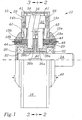
- FIG. 1 to 3 in its entirety is 10 designated embodiment of an inventive DC machine shown in a schematic representation which can be used as a motor and as a generator.
- the Machine 10 has one in the special case in the axial direction relatively short housing 12, which consists of two disk-like housing end walls 14a, 14b relatively large Diameter and practically to a cylindrical ring relatively small length redesigned actual housing peripheral wall 16 composes. Housing end walls 14a, 14b and housing peripheral wall 16 are through - not shown - Screws or other fasteners can be removed together connected.
- housing covers 18a, 18b Central through openings 15a, 15b in the end walls 14a, 14b are closed by housing covers 18a, 18b, in which each have a bearing seat 20 in the center for a radial bearing 22 is formed, in which one of the housing cover 18a penetrating shaft 24 is rotatably supported.
- This Shaft 24 carries the rotor 26 which is held on it in a rotationally fixed manner (Fig. 3).
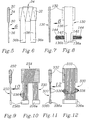
- the rotor 26 (FIG. 3) is made up of a variety of initially Electromagnetic components manufactured as separate individual components 30, in total in the case shown seventy-two components 30 assembled. 5 and 6 such a component 30 is shown separately.
- Each of the electromagnet components 30 has an as Disc made of soft magnetic material coil core 32, over which as a coil winding 34 in total two turns of a metal strip are wound, which is expediently made of an electrically highly conductive copper alloy is made.
- the strip is in the Winding on the coil core forming area in the usual Way - e.g. through a non-conductive paint - against the coil core and adjacent components 30 isolated.
- the Coil core 32 in turn is in the usual way for the most part Suppression of eddy currents from each other insulated and packed transformer sheets.
- the two ends 36a, 36b of the strip 36 of each electromagnet component 30 are radially inward towards led to the shaft 24 and held there in a hub carrier 38, e.g. in the manner indicated in Fig. 1 two axially offset from each other, one of the ends 36a or 36b of the components 30 receiving plastic ring bodies 38a, 38b made of insulating material.
- the strip ends 36a, 36b are all annular bodies 38a, 38b Electromagnet components 30 isolated from each other kept poured.
- Rotor 26 rotatably connected to the shaft 24.
- the one from the hub carrier 38 and the plurality of electromagnet components formed Rotor 26 is with a suitable choice and dimensioning of the Material for the strips 36 self-supporting, alternatively but an additional stiffening of the rotor partial shedding of the between the radial Conductor strip 36 existing spaces is conceivable.
- the disk-shaped coil cores 32 occur in the axial direction over the coil winding 34, so that they are running Rotor in the housing a radially from the inside to the outside Cause air flow in the housing.
- suitable air supply ducts in the end walls 14a and / or 14b and air discharge openings in the actual housing 16 can be a cooling of the Machine inevitably ensures circulation of ambient air be enforced.
- washers 41 made of magnetic Non-conductive material can circulate the ambient air on the gaps between the electromagnet components 30 concentrated and thus optimized the cooling effect become.
- these washers stabilize 41 the electromagnet components by placing them in a predetermined radial distance from the rotor axis of rotation as well in their circumferential distance relative to each other fix.
- connection of the electromagnet components 30 to an external one DC electrical source, e.g. an accumulator, or - if used as a generator - to one DC consumer follows on the machine 10 Sliding contacts 42, which - according to the illustration 1 - as by springs 44 directly to the - not isolated - end faces of the radial Portions of the conductor strips 36 pressed carbon brushes can be trained.
- the non-insulated front edges the strip 36 of all the electromagnet components 30 together form the commutator on the rotor 26 Machine 10.
- the commutator can of course also separately on the conductors forming the coil winding attached contact elements are formed if this e.g. with regard to wear of the contact surfaces, desirable is.
- Electromagnetic components are described below, with those on the conductors forming the coil winding separate contact elements for the commutator connected, e.g. are welded on. From the description above the DC machine 10 is clear that the to Housing end walls provided, the coil cores 32 of the Electromagnet components 30 opposing permanent magnets 28 such an extent in the circumferential direction have them more than three at a time Electromagnet components face each other. By the commutator the electromagnet components are supplied with power in such a way that the polarity of the coil core is one between one Pair of associated permanent magnet electromagnet components entering the polarity of the assigned permanent magnets is opposite, so that the respective component 30 by the magnetic interaction between Permanent magnet is pulled.
- FIG. 4 schematically shown circuit reached.
- the permanent magnet When half the circumference is reached the permanent magnet then takes place Reverse polarity of the electromagnet components 30, so by the then opposite polarization of the coil core takes place repelling and thus an inevitable turning of the rotor is effected.
- FIG. 4 schematically shown circuit reached.
- In the drawing are two circumferentially offset to each other, in the circumferential extent but still the same permanent magnet associated electromagnet components 30 shown, via lines 46 to the associated DC power source 48, e.g. an accumulator are connected.
- the sliding contacts 42 have a circumferential extent, which is at most half the circumferential extent of a permanent magnet 28 corresponds so that over the respective conductor 36 so the excitation of the respective coil core 32 in desired sense is such that the respective component 30 during the first half of the admission between an associated pair of permanent magnets 28 attracted becomes.
- the respective coil core 32 over the Middle of the currently opposed pair of permanent magnets 28 steps away, the current flow from the DC power source 48 via a pair of electrically interconnected connected sliding contacts 50 reversed, so that the Polarity of the magnetic field generated in the respective coil core 32 reverses and then equals the polarity of each opposed pairs of permanent magnets.
- the Coil core 32 and thus the respective electromagnet component 30 then becomes the associated pair of permanent magnets 28 ousted, i.e. the rotor 26 receives one pushing him further in the direction of rotation.
- FIGS. 7 and 8 show a modification of the previously described 5 and 6 shown electromagnet component 30 shown, which is designated overall by 130 is.
- the coil core 132 with only one here
- the electrical conductor surrounding the half turn again has the Form of a - correspondingly wider - strip 136 highly conductive metal, the ends 136a, 136b of which opposite end edges are machined so that on each side only the front edge of one of the ends for the creation of a sliding contact 142 is accessible.
- the machined end regions 136a, 136b of the electromagnet components 130 together form the commutator. It is essential that the mutually facing inner surfaces of conductor strip 136 by an appropriate one Coating isolated from each other or the coil core 132 are.
- the modification of an electromagnet component shown in FIGS. 9 and 10 230 differs from the component 30 in that instead of the strip-shaped conductor 36 for the coil winding 234 a number of connected in parallel Conductors 236 made of copper wire are provided in the special case in two turns around the coil core 232 are led around.
- the radially inward ends are in separate metallic contact elements 236a, 236b held, for example welded.
- This metallic Contact elements of the electromagnet components 230 overall, they form the commutator. You can also they also define the components 230 in the hub body of the rotor be suitably designed.
- the coil core 232 in turn in this case is made of a block of isolating stacked and interconnected Transformer sheets shaped by mechanical processing so that it widens radially outward and thus with respect to the core cross section in the housing Optimal use of available space.
- FIGS. 11 and 12 there is one designated 330 Modification of the electromagnet component 130 shown in which again the strip-shaped conductor 136 replaced by a plurality of parallel copper wires 336 is.
- the close juxtaposition around the coil core 232 guided wires are in turn at the ends in contact elements 336a, 336b z. B. soldered or welded, which on opposite sides in opposite Withstand the direction, so that they in turn face form the contact surfaces for commutator sliding contacts.
- the copper wires can in the usual way by a insulating paint in the lying and over areas guided to the coil core 332, wherein that to be provided between the contact elements 336a, 336b insulating separator layer 337 further between the two parallel copper wire sections up to the coil core 232 is led.
- this insulating layer In addition to ensuring the insulation of the Contact elements 336a, 336b and the copper wires against each other can this insulating layer then also the stiffness of the Increase electromagnet component 330 overall. For prevention the copper wires 336 slide off the core 332, are briefly occurring in the protruding areas Approaches 333 provided.
- the change made relates in particular on the formation of permanent magnets. While at the previously described embodiment alternately flat plate-shaped permanent magnets 28 with successive each in opposite polarity on the Inside of the housing end walls 14a facing the rotor 26, 14b are arranged in a modified embodiment two successive ones in the circumferential direction Permanent magnets from the pole ends of one according to Art a horseshoe magnet shaped permanent magnet 60 is formed.
- pole shoes 62a, 62b formed pole ends of the permanent magnets 60 even soft magnetic from layered transformer sheets manufactured components, which matching openings 64 in the non-magnetic material - e.g. made of plastic - Push through produced housing end walls 14a, 14b.
- the two are on the outside facing away from the rotor Pole shoes 62a, 62b then through the actual, as a bar magnet 66 trained permanent magnets connected.
- suitable, i.e. the ends of the bar magnet 66 fitting receptacles 68 in the pole pieces 62a, 62b is an optimal magnetic coupling of the Bar magnets 66 ensured on the pole shoes 62a, 62b.
- adjustable and in selectable adjustment positions fixable mounting of the pole shoes 62a, 62b in the openings 64 of the end walls 14a, 14b can be between the end faces the coil cores 32 of the electromagnet components 30 and the end faces of the pole shoes facing them constructively required gap to ensure a possible good efficiency can be optimized.
- the shape, in particular the cross-sectional shape, of the Coil cores of the electromagnet components also from that described disc-shaped configuration differ. If a smaller number of electromagnet components to one Rotor to be put together can also be simple rod-shaped coil cores with - for example - circular Cross section are provided.
- Deviating from the parallel arrangement of the described Coil cores with respect to the rotor axis of rotation can also be be sensible, the coil cores slightly obliquely in the circumferential direction and / or to arrange the radial direction inclined.
Landscapes
- Engineering & Computer Science (AREA)
- Power Engineering (AREA)
- Dc Machiner (AREA)
- Insulation, Fastening Of Motor, Generator Windings (AREA)
- Control Of Direct Current Motors (AREA)
- Permanent Magnet Type Synchronous Machine (AREA)
- Pyrane Compounds (AREA)
- Permanent Field Magnets Of Synchronous Machinery (AREA)
- Iron Core Of Rotating Electric Machines (AREA)
- Synchronous Machinery (AREA)
Claims (18)
- Machine électrique à courant continu (10) comportant un rotor (26) qui est monté tournant dans une carcasse (12) et présente un grand nombre d'électro-aimants placés à distance de l'axe de rotation et ayant chacun un enroulement en bobine (34, 234) sur un noyau (32 ; 132 ; 232 ; 332) portant un ou plusieurs conducteurs électriques, les extrémités des conducteurs électriques formant la bobine étant menées radialement vers l'intérieur et étant en liaison conductrice avec des éléments de contact respectivement associés, réunis en totalité et formant un collecteur qui ont chacun une surface de contact et contre lesquels sont serrés des contacts glissants (42 ; 142) montés dans la carcasse et pouvant être reliés à une source de courant continu (par exemple 48) ou à un récepteur de courant continu, et des faces polaires d'aimants permanents (28) placées à des distances angulaires égales sur les faces intérieures des parois frontales (14a ; 14b) de la carcasse et opposées aux faces frontales des noyaux (32 ; 132 ; 232 ; 332), avec polarités alternant dans la direction circonférentielle, chaque noyau (32 ; 132 ; 232 ; 332) formant avec l'enroulement associé un élément électro-aimant fabriqué séparément qui est monté dans un support moyeu (38) joint sans liberté de rotation relative à l'arbre (24) du rotor (26), les faces polaires des aimants permanents (28) ayant chacune dans la direction circonférentielle une étendue qui couvre plusieurs noyaux opposés (32 ; 132 ; 232 ; 332), les deux contacts glissants (42) du collecteur associés chacun à un aimant permanent situé extérieurement radialement (28) s'étendant suffisamment dans la direction circonférentielle pour couvrir les surfaces de contact d'environ la moitié des éléments de contact associés à une face polaire d'un aimant permanent (28), et étant prévues, décalées des surfaces de contact des éléments de contact formant le collecteur, des surfaces de contact qui sont reliées électriquement aux surfaces de contact côté collecteur respectives et contre lesquelles sont serrés des contacts glissants (50) qui correspondent sensiblement en étendue circonférentielle aux contacts glissants (42) du collecteur et sont eux-mêmes reliés électriquement par paires.
- Machine à courant continu selon la revendication 1, caractérisée par le fait que les surfaces de contact des contacts glissants (42) du collecteur et les surfaces de contact des contacts glissants (50) associés aux contacts glissants (42) du collecteur et reliés électriquement par paires sont déplaçables les unes par rapport aux autres dans la direction de rotation du rotor.
- Machine à courant continu selon l'une des revendications 1 et 2, caractérisée par le fait que les noyaux (32 ; 132 ; 232 ; 332) ont la forme de plaques sensiblement rectangulaires dont les zones de bord ayant les côtés frontaux s'étendant radialement dépassent de l'enroulement qu'elles portent.
- Machine à courant continu selon la revendication 3, caractérisée par le fait que les zones de bord dépassent de l'enroulement dans la direction radiale.
- Machine à courant continu selon l'une des revendications 3 et 4, caractérisée par le fait que les noyaux (232) présentent, par rapport à un plan coupant à angle droit l'axe de rotation du rotor, une section qui diverge du côté limite intérieur radialement vers le côté limite extérieur radialement.
- Machine à courant continu selon l'une des revendications 1 à 5, caractérisée par le fait que les conducteurs électriques des éléments électro-aimants (30 ; 130) sont formés chacun d'au moins une bande allongée de métal conducteur qui passe autour du noyau (32 ; 132) en au moins une demi-spire.
- Machine à courant continu selon l'une des revendications 1 à 5, caractérisée par le fait que les conducteurs électriques des éléments électro-aimants (230 ; 330) sont formés d'un grand nombre de fils métalliques conducteurs qui passent, placés côte à côte, autour du noyau (232 ; 332) en un au moins une demi-spire.
- Machine à courant continu selon l'une des revendications 1 à 7, caractérisée par le fait que les noyaux (32 ; 132 ; 232 ; 332) des éléments électro-aimants (30) sont placés à distance radiale de l'axe de rotation du rotor et sensiblement parallèlement à cet axe.
- Machine à courant continu selon l'une des revendications 1 à 7, caractérisée par le fait que les noyaux (32 ; 132 ; 232 ; 332) des éléments électro-aimants (30) sont placés à distance radiale de l'axe de rotation du rotor et inclinés d'un certain angle par rapport à cet axe de façon que leurs faces frontales opposées dirigées vers les faces polaires des aimants permanents (28) soient décalées l'une de l'autre dans la direction circonférentielle.
- Machine à courant continu selon la revendication 9, caractérisée par le fait que les faces frontales opposées des noyaux (32 ; 132 ; 232 ; 332) sont à égale distance dans la direction radiale de l'axe de rotation du rotor.
- Machine à courant continu selon l'une des revendications 1 à 7 ou la revendication 8, caractérisée par le fait que les noyaux (32 ; 132 ; 232 ; 332) des éléments électro-aimants (30) sont placés à distance radiale de l'axe de rotation du rotor et inclinés d'un certain angle par rapport à cet axe de façon que leurs faces frontales opposées dirigées vers les faces polaires des aimants permanents (28) soient à des distances différentes dans la direction radiale de l'axe de rotation du rotor.
- Machine à courant continu selon l'une des revendications 1 à 11, caractérisée par le fait que les noyaux (32) de tous les éléments électro-aimants (30) sont reliés de chaque côté par un disque annulaire (41) en matière non magnétique prévu dans les zones d'extrémité des noyaux voisines des faces frontales.
- Machine à courant continu selon la revendication 12, caractérisée par le fait que les faces frontales opposées des noyaux (32) traversent chacune le disque annulaire (41) associé.
- Machine à courant continu selon l'une des revendications 1 à 13, caractérisée par le fait que chaque fois deux faces polaires, de polarités différentes, des aimants permanents (28) se suivant dans la direction circonférentielle et dirigées vers le rotor (26) sont formées par les deux faces polaires parallèles, dirigées vers l'intérieur de la carcasse, d'un aimant permanent du genre aimant en fer à cheval.
- Machine à courant continu selon la revendication 14, caractérisée par le fait que les faces frontales, dirigées vers le rotor, des aimants permanents sont formées sur des épanouissements polaires magnétiques doux (62a ; 62b) qui traversent les parois frontales, en matière non magnétique (14a ; 14b) de la carcasse et sont accouplés chacun, à l'extérieur des parois frontales de la carcasse, à un pôle d'un aimant permanent.
- Machine à courant continu selon la revendication 15, caractérisée par le fait que les épanouissements polaires (62a ; 62b) sont formés par des paquets de tôles pour transformateurs serrées les unes contre les autres mais isolées électriquement les unes des autres.
- Machine à courant continu selon l'une des revendications 15 et 16, caractérisée par le fait que les aimants permanents sont formés de barreaux aimantés (66) dont les extrémités opposées sont montées chacune dans un logement (68) de forme au moins en partie complémentaire de celle de l'extrémité du barreau fait dans l'épanouissement polaire respectif (62a ; 62b).
- Machine à courant continu selon l'une des revendications 15 à 17, caractérisée par le fait que les épanouissements polaires (62a ; 62b) sont montés dans la paroi frontale associée (14a ; 14b) de la carcasse de façon à pouvoir être déplacés parallèlement à l'axe de rotation du rotor et être fixés à l'intérieur d'un domaine fixé de déplacement.
Applications Claiming Priority (5)
| Application Number | Priority Date | Filing Date | Title |
|---|---|---|---|
| DE19615219 | 1996-04-18 | ||
| DE19615219 | 1996-04-18 | ||
| DE19620291 | 1996-05-21 | ||
| DE19620291A DE19620291C1 (de) | 1996-04-18 | 1996-05-21 | Elektrische Gleichstrom-Maschine |
| PCT/EP1997/001842 WO1997040572A1 (fr) | 1996-04-18 | 1997-04-12 | Machine electrique a courant continu |
Publications (2)
| Publication Number | Publication Date |
|---|---|
| EP0894360A1 EP0894360A1 (fr) | 1999-02-03 |
| EP0894360B1 true EP0894360B1 (fr) | 2001-05-16 |
Family
ID=26024833
Family Applications (1)
| Application Number | Title | Priority Date | Filing Date |
|---|---|---|---|
| EP97920667A Expired - Lifetime EP0894360B1 (fr) | 1996-04-18 | 1997-04-12 | Machine electrique a courant continu |
Country Status (10)
| Country | Link |
|---|---|
| US (1) | US6246146B1 (fr) |
| EP (1) | EP0894360B1 (fr) |
| JP (1) | JP2000508878A (fr) |
| CN (1) | CN1070653C (fr) |
| AT (1) | ATE201292T1 (fr) |
| DK (1) | DK0894360T3 (fr) |
| ES (1) | ES2157071T3 (fr) |
| GR (1) | GR3035889T3 (fr) |
| PT (1) | PT894360E (fr) |
| WO (1) | WO1997040572A1 (fr) |
Families Citing this family (30)
| Publication number | Priority date | Publication date | Assignee | Title |
|---|---|---|---|---|
| WO2001023768A1 (fr) * | 1999-09-30 | 2001-04-05 | Mitsubishi Denki Kabushiki Kaisha | Palier de butee magnetique |
| US7884522B1 (en) | 2004-10-25 | 2011-02-08 | Novatorque, Inc. | Stator and rotor-stator structures for electrodynamic machines |
| US20030052564A1 (en) * | 2001-07-09 | 2003-03-20 | Doris Wilsdorf | Bipolar machines-a new class of homopolar motor/generator |
| WO2003052902A1 (fr) | 2001-12-18 | 2003-06-26 | Cutsforth Products, Inc. | Porte-balais conçu pour etre retire sans arret de la machine |
| US6774530B2 (en) | 2002-06-07 | 2004-08-10 | Briggs & Stratton Corporation | Winding assemblies for electrical machines |
| AU2002312694A1 (en) * | 2002-06-12 | 2003-12-31 | Microcut Ag | Electromagnetic linear optical positioner |
| US7105979B1 (en) * | 2002-07-08 | 2006-09-12 | Gabrys Christopher W | Compact heteropolar hybrid alternator-motor |
| US20060038456A1 (en) * | 2004-08-20 | 2006-02-23 | Dumitru Bojiuc | Monopole field electric motor generator |
| US7834503B2 (en) * | 2004-08-20 | 2010-11-16 | Clearwater Holdings, Ltd. | Immersed windings, monopole field, electromagnetic rotating machine |
| US7982350B2 (en) | 2004-10-25 | 2011-07-19 | Novatorque, Inc. | Conical magnets and rotor-stator structures for electrodynamic machines |
| US8471425B2 (en) | 2011-03-09 | 2013-06-25 | Novatorque, Inc. | Rotor-stator structures including boost magnet structures for magnetic regions having angled confronting surfaces in rotor assemblies |
| US8543365B1 (en) | 2004-10-25 | 2013-09-24 | Novatorque, Inc. | Computer-readable medium, a method and an apparatus for designing and simulating electrodynamic machines implementing conical and cylindrical magnets |
| US8283832B2 (en) | 2004-10-25 | 2012-10-09 | Novatorque, Inc. | Sculpted field pole members and methods of forming the same for electrodynamic machines |
| US9093874B2 (en) | 2004-10-25 | 2015-07-28 | Novatorque, Inc. | Sculpted field pole members and methods of forming the same for electrodynamic machines |
| US8330316B2 (en) | 2011-03-09 | 2012-12-11 | Novatorque, Inc. | Rotor-stator structures including boost magnet structures for magnetic regions in rotor assemblies disposed external to boundaries of conically-shaped spaces |
| US7061152B2 (en) * | 2004-10-25 | 2006-06-13 | Novatorque, Inc. | Rotor-stator structure for electrodynamic machines |
| US7294948B2 (en) * | 2004-10-25 | 2007-11-13 | Novatorque, Inc. | Rotor-stator structure for electrodynamic machines |
| US7327061B2 (en) * | 2005-10-25 | 2008-02-05 | Rogala Richard L | AC generator and method |
| TWI451667B (zh) * | 2007-03-23 | 2014-09-01 | Shinetsu Chemical Co | 永磁式發電機及使用該永磁式發電機之風力發電機 |
| JP5151486B2 (ja) * | 2007-04-26 | 2013-02-27 | セイコーエプソン株式会社 | ブラシレス電気機械、装置、移動体、及び、ロボット |
| BRPI0813185B1 (pt) * | 2007-07-09 | 2023-12-19 | Clearwater Holdings, Ltd | Máquina eletromagnética giratória |
| CN101295906A (zh) * | 2008-04-28 | 2008-10-29 | 刘盛荣 | 一种侧感式永磁直流电动机 |
| US7646178B1 (en) | 2009-05-08 | 2010-01-12 | Fradella Richard B | Broad-speed-range generator |
| US8350502B2 (en) * | 2009-07-09 | 2013-01-08 | Rabal Clifford R | Electromagnetic motor |
| US9018891B2 (en) | 2009-07-09 | 2015-04-28 | Clifford R. Rabal | Direct current brushless motor |
| CN103095043A (zh) * | 2011-11-04 | 2013-05-08 | 六汉企业股份有限公司 | 发电装置 |
| JP5406390B1 (ja) * | 2013-02-01 | 2014-02-05 | 森内 アツ子 | 多目的軸型3abcモータ |
| WO2017078653A1 (fr) * | 2015-11-02 | 2017-05-11 | Lukashenko Gennadii | Centrale électrique |
| CN116802948A (zh) | 2020-11-04 | 2023-09-22 | 科茨福斯有限公司 | 刷架组件 |
| JP7624768B2 (ja) | 2020-12-01 | 2025-01-31 | カッツフォース インコーポレイテッド | ブラシホルダアセンブリ |
Family Cites Families (4)
| Publication number | Priority date | Publication date | Assignee | Title |
|---|---|---|---|---|
| DE3140437A1 (de) * | 1981-10-12 | 1983-04-21 | Wolfgang Dr.-Ing. 8740 Bad Neustadt Volkrodt | Ringbewickelte gleichstrommmaschine mit axialerregung |
| GB8414953D0 (en) * | 1984-06-12 | 1984-07-18 | Maghemite Inc | Brushless permanent magnet dc motor |
| DK0619638T3 (da) * | 1993-04-03 | 1999-04-12 | Knoerzer Karl Heinz | Elektrisk skiverotormaskine |
| GB2286293A (en) * | 1993-12-23 | 1995-08-09 | London Innovation Limited | Adjustable stator: winding construction: cooling and commutator construction inan electric machine |
-
1997
- 1997-04-12 EP EP97920667A patent/EP0894360B1/fr not_active Expired - Lifetime
- 1997-04-12 US US09/171,406 patent/US6246146B1/en not_active Expired - Fee Related
- 1997-04-12 CN CN97193890A patent/CN1070653C/zh not_active Expired - Fee Related
- 1997-04-12 ES ES97920667T patent/ES2157071T3/es not_active Expired - Lifetime
- 1997-04-12 DK DK97920667T patent/DK0894360T3/da active
- 1997-04-12 AT AT97920667T patent/ATE201292T1/de not_active IP Right Cessation
- 1997-04-12 JP JP9537684A patent/JP2000508878A/ja active Pending
- 1997-04-12 WO PCT/EP1997/001842 patent/WO1997040572A1/fr not_active Ceased
- 1997-04-12 PT PT97920667T patent/PT894360E/pt unknown
-
2001
- 2001-05-17 GR GR20010400739T patent/GR3035889T3/el not_active IP Right Cessation
Also Published As
| Publication number | Publication date |
|---|---|
| WO1997040572A1 (fr) | 1997-10-30 |
| ATE201292T1 (de) | 2001-06-15 |
| CN1216642A (zh) | 1999-05-12 |
| US6246146B1 (en) | 2001-06-12 |
| ES2157071T3 (es) | 2001-08-01 |
| EP0894360A1 (fr) | 1999-02-03 |
| JP2000508878A (ja) | 2000-07-11 |
| PT894360E (pt) | 2001-09-28 |
| GR3035889T3 (en) | 2001-08-31 |
| DK0894360T3 (da) | 2001-08-06 |
| CN1070653C (zh) | 2001-09-05 |
Similar Documents
| Publication | Publication Date | Title |
|---|---|---|
| EP0894360B1 (fr) | Machine electrique a courant continu | |
| EP0512080B1 (fr) | Moteur electrique | |
| DE69026938T2 (de) | Elektromotorische leichtgewichtsvorrichtung von hoher leistung | |
| DE3427677C2 (fr) | ||
| DE69126125T2 (de) | Ständer für dynamoelektrische maschinen | |
| DE69309444T2 (de) | Bürstenloser gleichstrommotor/-generator | |
| DE69103150T2 (de) | Dynamoelektrische maschine mit quer in abschnitten verlaufendem fluss. | |
| EP1173917B1 (fr) | Unite de production de courant constituee d'un generateur et d'un moteur a combustion interne a piston alternatif servant de systeme de commande | |
| DE3904516C1 (fr) | ||
| DE69218470T2 (de) | Stator und Rotor aufweisende, scheibenförmige Maschine mit hohem Wirkungsgrad und kleiner Reaktanz | |
| DE69501066T3 (de) | Synchronmotor mit im Rotor eingebetteten Permanentmagneten | |
| DE2831518A1 (de) | Elektrische maschine | |
| DE102004017507A1 (de) | Rotoranordnung für eine elektrische Maschine | |
| DE2419292A1 (de) | Rotor oder anker einer dynamomaschine | |
| EP0246410A2 (fr) | Moteur à induction | |
| DE102010054847A1 (de) | Bürstenloser Elektromotor oder Generator in Schalenbauweise | |
| DE1230486B (de) | Elektrische Maschine, die mit zwei beiderseits des Rotors angeordneten Magneten versehen ist | |
| DE3933790C2 (de) | Elektrische Maschine mit einem Rotor und einem Stator | |
| DE4027041A1 (de) | Elektrischer generator | |
| DE10048492A1 (de) | Axialfeldmaschine | |
| DE102009010162A1 (de) | Elektromaschine für ein Wellenarray | |
| DE102005036041B4 (de) | Permanenterregte elektrische Maschine | |
| DE19620291C1 (de) | Elektrische Gleichstrom-Maschine | |
| WO2007088101A1 (fr) | Machine électrique | |
| DE2913691C2 (de) | Ständer für einen bürstenlosen Elektromotor |
Legal Events
| Date | Code | Title | Description |
|---|---|---|---|
| PUAI | Public reference made under article 153(3) epc to a published international application that has entered the european phase |
Free format text: ORIGINAL CODE: 0009012 |
|
| 17P | Request for examination filed |
Effective date: 19981013 |
|
| AK | Designated contracting states |
Kind code of ref document: A1 Designated state(s): AT BE CH DE DK ES FI FR GB GR IT LI NL PT SE |
|
| GRAG | Despatch of communication of intention to grant |
Free format text: ORIGINAL CODE: EPIDOS AGRA |
|
| GRAG | Despatch of communication of intention to grant |
Free format text: ORIGINAL CODE: EPIDOS AGRA |
|
| GRAH | Despatch of communication of intention to grant a patent |
Free format text: ORIGINAL CODE: EPIDOS IGRA |
|
| RBV | Designated contracting states (corrected) |
Designated state(s): AT BE CH DE DK ES FI FR GB GR IT LI NL PT SE |
|
| 17Q | First examination report despatched |
Effective date: 20000922 |
|
| GRAH | Despatch of communication of intention to grant a patent |
Free format text: ORIGINAL CODE: EPIDOS IGRA |
|
| GRAA | (expected) grant |
Free format text: ORIGINAL CODE: 0009210 |
|
| AK | Designated contracting states |
Kind code of ref document: B1 Designated state(s): AT BE CH DE DK ES FI FR GB GR IT LI NL PT SE |
|
| REF | Corresponds to: |
Ref document number: 201292 Country of ref document: AT Date of ref document: 20010615 Kind code of ref document: T |
|
| REG | Reference to a national code |
Ref country code: CH Ref legal event code: EP |
|
| GBT | Gb: translation of ep patent filed (gb section 77(6)(a)/1977) |
Effective date: 20010516 |
|
| REF | Corresponds to: |
Ref document number: 59703553 Country of ref document: DE Date of ref document: 20010621 |
|
| REG | Reference to a national code |
Ref country code: ES Ref legal event code: FG2A Ref document number: 2157071 Country of ref document: ES Kind code of ref document: T3 |
|
| REG | Reference to a national code |
Ref country code: DK Ref legal event code: T3 |
|
| ITF | It: translation for a ep patent filed | ||
| REG | Reference to a national code |
Ref country code: PT Ref legal event code: SC4A Free format text: AVAILABILITY OF NATIONAL TRANSLATION Effective date: 20010619 |
|
| ET | Fr: translation filed | ||
| REG | Reference to a national code |
Ref country code: GB Ref legal event code: IF02 |
|
| PLBE | No opposition filed within time limit |
Free format text: ORIGINAL CODE: 0009261 |
|
| STAA | Information on the status of an ep patent application or granted ep patent |
Free format text: STATUS: NO OPPOSITION FILED WITHIN TIME LIMIT |
|
| PGFP | Annual fee paid to national office [announced via postgrant information from national office to epo] |
Ref country code: DE Payment date: 20020415 Year of fee payment: 6 Ref country code: CH Payment date: 20020415 Year of fee payment: 6 |
|
| PGFP | Annual fee paid to national office [announced via postgrant information from national office to epo] |
Ref country code: PT Payment date: 20020416 Year of fee payment: 6 |
|
| PGFP | Annual fee paid to national office [announced via postgrant information from national office to epo] |
Ref country code: SE Payment date: 20020417 Year of fee payment: 6 Ref country code: GB Payment date: 20020417 Year of fee payment: 6 |
|
| PGFP | Annual fee paid to national office [announced via postgrant information from national office to epo] |
Ref country code: ES Payment date: 20020419 Year of fee payment: 6 |
|
| PGFP | Annual fee paid to national office [announced via postgrant information from national office to epo] |
Ref country code: DK Payment date: 20020424 Year of fee payment: 6 |
|
| PGFP | Annual fee paid to national office [announced via postgrant information from national office to epo] |
Ref country code: AT Payment date: 20020426 Year of fee payment: 6 |
|
| PGFP | Annual fee paid to national office [announced via postgrant information from national office to epo] |
Ref country code: GR Payment date: 20020429 Year of fee payment: 6 |
|
| PGFP | Annual fee paid to national office [announced via postgrant information from national office to epo] |
Ref country code: NL Payment date: 20020430 Year of fee payment: 6 Ref country code: FR Payment date: 20020430 Year of fee payment: 6 |
|
| 26N | No opposition filed | ||
| PGFP | Annual fee paid to national office [announced via postgrant information from national office to epo] |
Ref country code: BE Payment date: 20020515 Year of fee payment: 6 |
|
| PG25 | Lapsed in a contracting state [announced via postgrant information from national office to epo] |
Ref country code: GB Free format text: LAPSE BECAUSE OF NON-PAYMENT OF DUE FEES Effective date: 20030412 Ref country code: AT Free format text: LAPSE BECAUSE OF NON-PAYMENT OF DUE FEES Effective date: 20030412 |
|
| PG25 | Lapsed in a contracting state [announced via postgrant information from national office to epo] |
Ref country code: SE Free format text: LAPSE BECAUSE OF NON-PAYMENT OF DUE FEES Effective date: 20030413 |
|
| PG25 | Lapsed in a contracting state [announced via postgrant information from national office to epo] |
Ref country code: ES Free format text: LAPSE BECAUSE OF NON-PAYMENT OF DUE FEES Effective date: 20030414 |
|
| PG25 | Lapsed in a contracting state [announced via postgrant information from national office to epo] |
Ref country code: LI Free format text: LAPSE BECAUSE OF NON-PAYMENT OF DUE FEES Effective date: 20030430 Ref country code: DK Free format text: LAPSE BECAUSE OF NON-PAYMENT OF DUE FEES Effective date: 20030430 Ref country code: CH Free format text: LAPSE BECAUSE OF NON-PAYMENT OF DUE FEES Effective date: 20030430 Ref country code: BE Free format text: LAPSE BECAUSE OF NON-PAYMENT OF DUE FEES Effective date: 20030430 |
|
| BERE | Be: lapsed |
Owner name: *SCHILLER HELMUT Effective date: 20030430 |
|
| PG25 | Lapsed in a contracting state [announced via postgrant information from national office to epo] |
Ref country code: PT Free format text: LAPSE BECAUSE OF NON-PAYMENT OF DUE FEES Effective date: 20031031 |
|
| PGFP | Annual fee paid to national office [announced via postgrant information from national office to epo] |
Ref country code: FI Payment date: 20031031 Year of fee payment: 7 |
|
| PG25 | Lapsed in a contracting state [announced via postgrant information from national office to epo] |
Ref country code: NL Free format text: LAPSE BECAUSE OF NON-PAYMENT OF DUE FEES Effective date: 20031101 Ref country code: DE Free format text: LAPSE BECAUSE OF NON-PAYMENT OF DUE FEES Effective date: 20031101 |
|
| PG25 | Lapsed in a contracting state [announced via postgrant information from national office to epo] |
Ref country code: GR Free format text: LAPSE BECAUSE OF NON-PAYMENT OF DUE FEES Effective date: 20031104 |
|
| NLV4 | Nl: lapsed or anulled due to non-payment of the annual fee |
Effective date: 20031101 |
|
| EUG | Se: european patent has lapsed | ||
| GBPC | Gb: european patent ceased through non-payment of renewal fee |
Effective date: 20030412 |
|
| REG | Reference to a national code |
Ref country code: DK Ref legal event code: EBP |
|
| REG | Reference to a national code |
Ref country code: CH Ref legal event code: PL |
|
| PG25 | Lapsed in a contracting state [announced via postgrant information from national office to epo] |
Ref country code: FR Free format text: LAPSE BECAUSE OF NON-PAYMENT OF DUE FEES Effective date: 20031231 |
|
| REG | Reference to a national code |
Ref country code: FR Ref legal event code: ST Ref country code: PT Ref legal event code: MM4A Free format text: LAPSE DUE TO NON-PAYMENT OF FEES Effective date: 20031031 |
|
| PG25 | Lapsed in a contracting state [announced via postgrant information from national office to epo] |
Ref country code: FI Free format text: LAPSE BECAUSE OF NON-PAYMENT OF DUE FEES Effective date: 20040412 |
|
| REG | Reference to a national code |
Ref country code: ES Ref legal event code: FD2A Effective date: 20030414 |
|
| PG25 | Lapsed in a contracting state [announced via postgrant information from national office to epo] |
Ref country code: IT Free format text: LAPSE BECAUSE OF NON-PAYMENT OF DUE FEES;WARNING: LAPSES OF ITALIAN PATENTS WITH EFFECTIVE DATE BEFORE 2007 MAY HAVE OCCURRED AT ANY TIME BEFORE 2007. THE CORRECT EFFECTIVE DATE MAY BE DIFFERENT FROM THE ONE RECORDED. Effective date: 20050412 |