EP0894887A2 - Verfahren zum Bemustern von Kleidungsstücken - Google Patents
Verfahren zum Bemustern von Kleidungsstücken Download PDFInfo
- Publication number
- EP0894887A2 EP0894887A2 EP98113742A EP98113742A EP0894887A2 EP 0894887 A2 EP0894887 A2 EP 0894887A2 EP 98113742 A EP98113742 A EP 98113742A EP 98113742 A EP98113742 A EP 98113742A EP 0894887 A2 EP0894887 A2 EP 0894887A2
- Authority
- EP
- European Patent Office
- Prior art keywords
- garment
- fabric
- shrinked
- seams
- bands
- Prior art date
- Legal status (The legal status is an assumption and is not a legal conclusion. Google has not performed a legal analysis and makes no representation as to the accuracy of the status listed.)
- Granted
Links
Images





Classifications
-
- D—TEXTILES; PAPER
- D06—TREATMENT OF TEXTILES OR THE LIKE; LAUNDERING; FLEXIBLE MATERIALS NOT OTHERWISE PROVIDED FOR
- D06B—TREATING TEXTILE MATERIALS USING LIQUIDS, GASES OR VAPOURS
- D06B11/00—Treatment of selected parts of textile materials, e.g. partial dyeing
- D06B11/0093—Treatments carried out during or after a regular application of treating materials, in order to get differentiated effects on the textile material
- D06B11/0096—Treatments carried out during or after a regular application of treating materials, in order to get differentiated effects on the textile material to get a faded look
-
- D—TEXTILES; PAPER
- D06—TREATMENT OF TEXTILES OR THE LIKE; LAUNDERING; FLEXIBLE MATERIALS NOT OTHERWISE PROVIDED FOR
- D06B—TREATING TEXTILE MATERIALS USING LIQUIDS, GASES OR VAPOURS
- D06B11/00—Treatment of selected parts of textile materials, e.g. partial dyeing
- D06B11/0073—Treatment of selected parts of textile materials, e.g. partial dyeing of articles
-
- D—TEXTILES; PAPER
- D06—TREATMENT OF TEXTILES OR THE LIKE; LAUNDERING; FLEXIBLE MATERIALS NOT OTHERWISE PROVIDED FOR
- D06B—TREATING TEXTILE MATERIALS USING LIQUIDS, GASES OR VAPOURS
- D06B11/00—Treatment of selected parts of textile materials, e.g. partial dyeing
- D06B11/0079—Local modifications of the ability of the textile material to receive the treating materials, (e.g. its dyeability)
- D06B11/0089—Local modifications of the ability of the textile material to receive the treating materials, (e.g. its dyeability) the textile material being a surface
-
- D—TEXTILES; PAPER
- D06—TREATMENT OF TEXTILES OR THE LIKE; LAUNDERING; FLEXIBLE MATERIALS NOT OTHERWISE PROVIDED FOR
- D06C—FINISHING, DRESSING, TENTERING OR STRETCHING TEXTILE FABRICS
- D06C23/00—Making patterns or designs on fabrics
Definitions
- the invention relates to a method for making localized or non localized folds, curls, patterns, etc. having a casual shape on ready-to-wear clothing articles.
- curling means are applied along the garment seams and the so curled garment is subjected to treatments such as fading, dyeing, sand blasting, scratching, brushing, "stone-washing", etc., acting only or mainly on the exposed fabric areas and to a less extent or to no extent at all on the inward curl areas, to determine the desired final effect.
- the curl obtained by means of any suitable material, e.g. strings, threads, elastic bands, clips or the like being applied on the seams, can be made on the whole garment or just a part thereof (for instance in the case of trousers a "wear” or light-and-shade effect can be achieved by making folds or the like, for example only in the knee area).
- any suitable material e.g. strings, threads, elastic bands, clips or the like being applied on the seams
- the garments are dyed or processed otherwise, for example to remove partly the surface colour and enhance the fabric fibre etc.
- suitable means such as a ribbon, a string or the like is slidingly applied on the garment, preferably on the seams; by tightening said ribbon, string etc. the garment curls so that a portion of the fabric surface is exposed outwards and, therefore, it is more subject to the action of subsequent treatments, such as those previously mentioned, whereas other fabric portions inside the folds are affected by the treatments to a less extent or they are not even processed.
- flexible means such as threads or a ribbon, string, band, rubber band or the like are applied to the garment, preferably on the seams.
- the fabric By tightening said ribbon, string etc. the fabric curls, after which the garment is subjected to a subsequent process changing the garment surface colour, so much more as more exposed the fabric is.
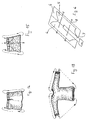
- a flexible means such as a ribbon or a string 3 or the like, or even a rubber band, is applied onto the seams 2 of a garment, such as, for example, a pair of trousers 1.
- the ribbon (figs. 3a-3c) is slidingly applied to the garment, as will be illustrated in more detail below, so that the garment, by sliding on the ribbon 3 or the like, can be curled, thus assuming the illustrated configuration.
- Figure 4 shows the configuration of the fabric at the beginning of the curling phase, when a band fastened in several places is used.
- the garment is then subjected to a treatment which changes the garment surface colour.
- These treatments are already known and they can comprise, for example, sand-blasting, brushing, scratching, cleaning treatments with chemicals, enzymes, abrasives, dyeing treatments with dyes and chemicals, manual processing with bags, spraying dyes and/or fading products, and other processes, all of which change the fabric colour (and the fibre structure) in the contact areas, more or less evidently depending on the processing time, the contact extent, etc.
- the exposed fabric areas are then subjected to decolorizing and/or wear, whereas the less exposed fabric areas, for example the inward fold areas or the contact areas of two fabric surfaces, are not affected by the treatment or are much less affected by it.
- the garment looks for example like in figure 5, with a plurality of marks due to decolorizing which extend from the curled areas.
- figure 25 shows the effect which is obtained by curling the fabric on the seams.
- numerals 4 and 5 respectively show the seam edges in a garment 6.
- Means for inserting flexible elements such as a string, a ribbon and/or a band 7 or the like are applied to the seam edges, said means comprising clips, rings or the like and, as shown in the figure, fastening means 8.
- the fastening means 8 are preferably applied on the seam inward edges, to prevent the fabric surface from being pierced.
- seam edges can also be pierced to let a band or the like pass therethrough, by tightening which the fabric is fastened and curled.
- the ribbon or band 7 When the ribbon or band 7 has been inserted, it can be tightened and tied in various ways by folding it on one side or the other (i.e. towards the inside or the outside of the garment, as shown by the dotted lines L1 and L2 of figure 11) to curl the fabric.
- the ribbon 7 can be applied along the whole height of the garment or just on some parts thereof, thus obtaining the desired effect only in some areas, for example in the knee area and in the pockets, as schematically shown in figure 12.
- figure 14 shows the results obtained by curling a skirt along its two side seams
- figure 15 schematically shows the result obtained by curling said skirt not only along the seams, but also along other lines therebetween (not necessarily along a seam length).
- a plurality of bands, rings or loops, through which the sliding means is inserted can be incorporated in the seams or applied along the garment seams by sewing, stapling or stitching with conventional thread or with a special kind of thread which melts at a certain temperature.
- Said bands, rings or loops can be joined and fastened together to make folds.
- fastening to make stripes without using flexible means to fold and curl the fabric is to staple and/or sew two or more fabric portions, thus making the fold or curl.
- Figures 18-21 respectively show a method for curling a garment by means of a rubber band stitched with conventional thread (figs. 18-19), with thermic thread (fig. 20) or with fastening means or the like (fig. 21).
- the stretched rubber band is fastened or sewn on the garment, and when it is loosened it shrinks, thus curling the fabric.
- the rubber band is removed, during or after the above mentioned processes, for example by manually removing the seaming thread or by melting it during the treatments, in the case of thread which melts when the temperature rises.
- the curled and shrinked garment can be sand-blasted with various abrasives, brushed and scratched, dyed, etc. to wear the curls and folds unevenly.
- the brushing and scratching means process the garments curled and folded according to the invention, and worn by means of brushes which brush and/or scratch on the fabric folds and curls or on other fabric portions having no particular rising areas.
- pipes are used which shoot granulated and/or powdered abrasives at a certain pressure onto the garment.
- curled garments could also be brushed, scratched and sand-blasted placing and holding them on a flat surface.
- the garment shrinked with the method of the invention is visibly marked and creased on the curls, after which, when the string, or strings, has been cut or the clasping means which kept the garment shrinked are removed, the garment is inserted onto an inflatable support or the like to adhere to said support, showing however rising uneven folding marks.
- the shrinked garment can be treated with a plurality of products to provide different patterns, for example if it is treated with enzymes, abrasives, pumice, clay, etc., chemicals and/or fabric fading products, combining, if necessary, one or more of these treatments to obtain special effects.
- the shrinked garments are processed in a washing machine with water and these chemicals, adding, if necessary, an abrasive such as granulated or pelleted pumice.
- the folds and curls are worn with any kind of pellets or abrasive granules, thus forming parts which fade and other parts which keep dark because the abrasive cannot effectively pass through the folds.
- the garments can be washed:
- the shrinked garments can be treated in rotating drums or washing machine cylinders with dry abrasives, forming, due to wear, portions with a lighter and darker tone or colour (the garments must be rinsed and processed in a water bath).
- the curled and shrinked garments can be subjected to colouring or dyeing processes in a washing machine or in dyeing vats.
- the curled and shrinked garments can come from the stone washing process or from treatments with fading and non fading chemicals and then they can be finished.
- the dye dyes differently the striped and/or curled fabric portions and other fabric portions giving differentiated chromatic effects.
- the garments can be dyed:
Landscapes
- Engineering & Computer Science (AREA)
- Chemical & Material Sciences (AREA)
- Materials Engineering (AREA)
- Textile Engineering (AREA)
- Treatment Of Fiber Materials (AREA)
- Details Of Garments (AREA)
- Laminated Bodies (AREA)
Applications Claiming Priority (2)
| Application Number | Priority Date | Filing Date | Title |
|---|---|---|---|
| IT97PC000016A IT1296222B1 (it) | 1997-07-28 | 1997-07-28 | Procedimento per realizzare segni di piegature, arricciature, righe, figure, ecc. di forma casuale, localizzate e non, su capi di |
| ITPC970016 | 1997-07-28 |
Publications (3)
| Publication Number | Publication Date |
|---|---|
| EP0894887A2 true EP0894887A2 (de) | 1999-02-03 |
| EP0894887A3 EP0894887A3 (de) | 2000-05-17 |
| EP0894887B1 EP0894887B1 (de) | 2003-10-08 |
Family
ID=11389246
Family Applications (1)
| Application Number | Title | Priority Date | Filing Date |
|---|---|---|---|
| EP98113742A Expired - Lifetime EP0894887B1 (de) | 1997-07-28 | 1998-07-23 | Verfahren zum Bemustern von Kleidungsstücken |
Country Status (3)
| Country | Link |
|---|---|
| EP (1) | EP0894887B1 (de) |
| DE (1) | DE69818765T2 (de) |
| IT (1) | IT1296222B1 (de) |
Cited By (4)
| Publication number | Priority date | Publication date | Assignee | Title |
|---|---|---|---|---|
| EP1132515A1 (de) * | 2000-03-10 | 2001-09-12 | Norichika Kondo | Bindeverfahren zum Schrumpfen von Kleidungsstücken |
| EP1076126A3 (de) * | 1999-08-11 | 2001-10-31 | Milestone Color di Moroni Claudio & C.S.a.s. | Verfahren zum Bilden von erhöhten Falten auf Kleidungsstücken sowie danach hergestellte Kleidungsstücke |
| WO2007043905A1 (en) * | 2005-10-07 | 2007-04-19 | Lavandaria Pizarro, Sa. | Aging procedure for fabrics using reducing or oxidizing discolorating agents spray applied. |
| ITPC20080031A1 (it) * | 2008-07-10 | 2010-01-11 | Claudio Moroni | Metodo per realizzare segni di usura e/o figure su capi di abbigliamento |
Family Cites Families (4)
| Publication number | Priority date | Publication date | Assignee | Title |
|---|---|---|---|---|
| US3102771A (en) * | 1961-03-09 | 1963-09-03 | Southern Bleachery And Print W | Method and apparatus for dyeing running lengths of fabric |
| US4951483A (en) * | 1989-04-10 | 1990-08-28 | Olphen Beatrice T Van | Do-it yourself tye-dye kit apparatus and method |
| FR2663652B1 (fr) * | 1990-06-25 | 1994-03-25 | Bri Production | Procede et dispositif de traitement d'un tissu. |
| JP2850166B2 (ja) * | 1991-08-22 | 1999-01-27 | 株式会社 三宅デザイン事務所 | プリーツ製品の加工方法 |
-
1997
- 1997-07-28 IT IT97PC000016A patent/IT1296222B1/it active IP Right Grant
-
1998
- 1998-07-23 DE DE69818765T patent/DE69818765T2/de not_active Expired - Fee Related
- 1998-07-23 EP EP98113742A patent/EP0894887B1/de not_active Expired - Lifetime
Cited By (5)
| Publication number | Priority date | Publication date | Assignee | Title |
|---|---|---|---|---|
| EP1076126A3 (de) * | 1999-08-11 | 2001-10-31 | Milestone Color di Moroni Claudio & C.S.a.s. | Verfahren zum Bilden von erhöhten Falten auf Kleidungsstücken sowie danach hergestellte Kleidungsstücke |
| EP1132515A1 (de) * | 2000-03-10 | 2001-09-12 | Norichika Kondo | Bindeverfahren zum Schrumpfen von Kleidungsstücken |
| WO2007043905A1 (en) * | 2005-10-07 | 2007-04-19 | Lavandaria Pizarro, Sa. | Aging procedure for fabrics using reducing or oxidizing discolorating agents spray applied. |
| ITPC20080031A1 (it) * | 2008-07-10 | 2010-01-11 | Claudio Moroni | Metodo per realizzare segni di usura e/o figure su capi di abbigliamento |
| WO2010004520A1 (en) * | 2008-07-10 | 2010-01-14 | Claudio Moroni | Method for making signs of wear and tear and/or figures on articles of clothing |
Also Published As
| Publication number | Publication date |
|---|---|
| DE69818765T2 (de) | 2004-08-05 |
| EP0894887B1 (de) | 2003-10-08 |
| ITPC970016A0 (it) | 1997-07-28 |
| DE69818765D1 (de) | 2003-11-13 |
| IT1296222B1 (it) | 1999-06-18 |
| EP0894887A3 (de) | 2000-05-17 |
| ITPC970016A1 (it) | 1999-01-28 |
Similar Documents
| Publication | Publication Date | Title |
|---|---|---|
| US11147321B2 (en) | Garment and manufacturing method | |
| US7748058B2 (en) | Clothing system having pants and interchangeable cuffs | |
| US20050198724A1 (en) | Interchangeable hemline for the hem of a garment | |
| US20010008039A1 (en) | Printed flocked pile fabric and method for making same | |
| JPH08510510A (ja) | 織物に付与するストレッチ | |
| Kalaoglu et al. | Finishing of jeans and quality control | |
| EP0894887B1 (de) | Verfahren zum Bemustern von Kleidungsstücken | |
| US20140335294A1 (en) | Fiber product provided with water repellant coating layer and method for manufacturing the fiber product | |
| US5948120A (en) | Process for producing a controlled rumpled effect to denim or twill garments | |
| US7014662B1 (en) | Vintage fading method for jeans | |
| GB2225592A (en) | Garment pressing apparatus | |
| KR100351508B1 (ko) | 불규칙한 모양의 주름이 형성된 원단 및 의류의 제조방법 | |
| CN1981058B (zh) | 由人造或天然毛皮制成的毛皮制品和毛皮花边及制造方法 | |
| EP1088926A2 (de) | Verfahren zur Herstellung von Kleidung der Shibori-Art | |
| EP1210466B9 (de) | Ein kombinationsstoff aus tuch und pelz und sein herstellungsverfahren | |
| US6523196B1 (en) | Shibori clothes manufacturing method, etc. and shibori clothes made by said manufacturing method | |
| EP1076126A2 (de) | Verfahren zum Bilden von erhöhten Falten auf Kleidungsstücken sowie danach hergestellte Kleidungsstücke | |
| KR100624716B1 (ko) | 진 원단 제조 방법 및 이를 이용하여 제작된 진 원단 | |
| KR20000006657A (ko) | 의류의 무늬 형성방법 | |
| KR100404784B1 (ko) | 가모시 염색방법 | |
| RU2530874C2 (ru) | Способ производства предмета одежды | |
| ITVR20090037A1 (it) | Procedimento per la realizzazione di un capo d'abbigliamento e prodotto cosi' ottenuto | |
| JP3008391U (ja) | ジーンズ生地製多様的着物 | |
| FI95487B (fi) | Menetelmä luonnonkarvoista ja/tai silkistä tehtyjen tuotteiden värjäämiseksi/kuvioimiseksi, luonnonkarvasta tehty tuote sekä näiden käyttö | |
| JPH0114354B2 (de) |
Legal Events
| Date | Code | Title | Description |
|---|---|---|---|
| PUAI | Public reference made under article 153(3) epc to a published international application that has entered the european phase |
Free format text: ORIGINAL CODE: 0009012 |
|
| AK | Designated contracting states |
Kind code of ref document: A2 Designated state(s): DE IT |
|
| AX | Request for extension of the european patent |
Free format text: AL;LT;LV;MK;RO;SI |
|
| PUAL | Search report despatched |
Free format text: ORIGINAL CODE: 0009013 |
|
| AK | Designated contracting states |
Kind code of ref document: A3 Designated state(s): AT BE CH CY DE DK ES FI FR GB GR IE IT LI LU MC NL PT SE |
|
| AX | Request for extension of the european patent |
Free format text: AL;LT;LV;MK;RO;SI |
|
| 17P | Request for examination filed |
Effective date: 20001106 |
|
| AKX | Designation fees paid |
Free format text: DE IT |
|
| 17Q | First examination report despatched |
Effective date: 20021001 |
|
| GRAH | Despatch of communication of intention to grant a patent |
Free format text: ORIGINAL CODE: EPIDOS IGRA |
|
| GRAS | Grant fee paid |
Free format text: ORIGINAL CODE: EPIDOSNIGR3 |
|
| GRAA | (expected) grant |
Free format text: ORIGINAL CODE: 0009210 |
|
| AK | Designated contracting states |
Kind code of ref document: B1 Designated state(s): DE IT |
|
| REF | Corresponds to: |
Ref document number: 69818765 Country of ref document: DE Date of ref document: 20031113 Kind code of ref document: P |
|
| PLBE | No opposition filed within time limit |
Free format text: ORIGINAL CODE: 0009261 |
|
| STAA | Information on the status of an ep patent application or granted ep patent |
Free format text: STATUS: NO OPPOSITION FILED WITHIN TIME LIMIT |
|
| 26N | No opposition filed |
Effective date: 20040709 |
|
| PGFP | Annual fee paid to national office [announced via postgrant information from national office to epo] |
Ref country code: DE Payment date: 20060620 Year of fee payment: 9 |
|
| PGFP | Annual fee paid to national office [announced via postgrant information from national office to epo] |
Ref country code: IT Payment date: 20070705 Year of fee payment: 10 |
|
| PG25 | Lapsed in a contracting state [announced via postgrant information from national office to epo] |
Ref country code: DE Free format text: LAPSE BECAUSE OF NON-PAYMENT OF DUE FEES Effective date: 20080201 |
|
| PG25 | Lapsed in a contracting state [announced via postgrant information from national office to epo] |
Ref country code: IT Free format text: LAPSE BECAUSE OF NON-PAYMENT OF DUE FEES Effective date: 20080723 |