EP0895187A2 - Verfahren zur massstäblichen Umformung von Bildern - Google Patents
Verfahren zur massstäblichen Umformung von Bildern Download PDFInfo
- Publication number
- EP0895187A2 EP0895187A2 EP98305940A EP98305940A EP0895187A2 EP 0895187 A2 EP0895187 A2 EP 0895187A2 EP 98305940 A EP98305940 A EP 98305940A EP 98305940 A EP98305940 A EP 98305940A EP 0895187 A2 EP0895187 A2 EP 0895187A2
- Authority
- EP
- European Patent Office
- Prior art keywords
- image data
- pixels
- scaled image
- data
- scaling
- Prior art date
- Legal status (The legal status is an assumption and is not a legal conclusion. Google has not performed a legal analysis and makes no representation as to the accuracy of the status listed.)
- Withdrawn
Links
Images


Classifications
-
- G—PHYSICS
- G09—EDUCATION; CRYPTOGRAPHY; DISPLAY; ADVERTISING; SEALS
- G09G—ARRANGEMENTS OR CIRCUITS FOR CONTROL OF INDICATING DEVICES USING STATIC MEANS TO PRESENT VARIABLE INFORMATION
- G09G5/00—Control arrangements or circuits for visual indicators common to cathode-ray tube indicators and other visual indicators
- G09G5/36—Control arrangements or circuits for visual indicators common to cathode-ray tube indicators and other visual indicators characterised by the display of a graphic pattern, e.g. using an all-points-addressable [APA] memory
- G09G5/39—Control of the bit-mapped memory
- G09G5/391—Resolution modifying circuits, e.g. variable screen formats
-
- G—PHYSICS
- G06—COMPUTING OR CALCULATING; COUNTING
- G06T—IMAGE DATA PROCESSING OR GENERATION, IN GENERAL
- G06T3/00—Geometric image transformations in the plane of the image
- G06T3/40—Scaling of whole images or parts thereof, e.g. expanding or contracting
-
- G—PHYSICS
- G06—COMPUTING OR CALCULATING; COUNTING
- G06F—ELECTRIC DIGITAL DATA PROCESSING
- G06F3/00—Input arrangements for transferring data to be processed into a form capable of being handled by the computer; Output arrangements for transferring data from processing unit to output unit, e.g. interface arrangements
- G06F3/14—Digital output to display device ; Cooperation and interconnection of the display device with other functional units
-
- G—PHYSICS
- G09—EDUCATION; CRYPTOGRAPHY; DISPLAY; ADVERTISING; SEALS
- G09G—ARRANGEMENTS OR CIRCUITS FOR CONTROL OF INDICATING DEVICES USING STATIC MEANS TO PRESENT VARIABLE INFORMATION
- G09G2340/00—Aspects of display data processing
- G09G2340/04—Changes in size, position or resolution of an image
- G09G2340/045—Zooming at least part of an image, i.e. enlarging it or shrinking it
Definitions
- the present invention relates generally to the sizing of an image shown on a display.
- it relates to a method for scaling an image by a scale factor and generating a scaled image for display on a display device.
- a Personal Display Assistant which is a type of pen-based handheld device that may function as a cellular phone, fax sender and electronic personal organizer, is a common product offered in the marketplace.
- PDAs are controlled by operating systems (OS) which have graphics routines to generate and display graphics and text images of varying sizes.
- OS operating systems
- LCD Liquid Crystal Display
- LCD screens with small display areas have display resolution of 640 x 240 pixels, each of these pixels will therefore have a viewing dot of small size and pitch.
- LCD screens have poorer viewing contrast compared with Cathode Ray Tube (CRT) monitors. Text images appearing on such small LCD screens, especially those with small font sizes, therefore are extremely difficult to read.
- a simple solution to this reading problem would be to enlarge, or zoom into, a window, or a part, of the text image.
- Such a solution can be implemented using known software or software-plus-hardward scaling techniques.
- Scaling techniques that involve software control and hardware resources are generally more complicated and thus are not cost-effective implementations. Unless the OS or hardware of the PDA can support such scaling operations, the conventional software-based bitmap scaling technique is usually a preferred option.
- the present invention provides a solution to various prior art deficiencies, which include those present with the conventional software-based bitmap scaling technique described in the preceding paragraphs, to provide a cost effective and fast image scaling method.
- the present invention provides a method of scaling a preselected portion of an image which is stored in an image buffer as a series of image data.
- a scaled image is generated and stored in a scaled image buffer as a series of scaled image data.
- the series of scaled image data are subsequently read, and the scaled image shown on a display device.
- the method involves the initial step of assigning memory blocks for use as the scaled image buffer and a series of look-up tables.
- a series of table data are then generated by using the different possible values of the image data.
- Each of these table data is stored in one of the look-up tables at an address location indexed by the value of the corresponding image data.
- the display device is subsequently directed to read from the scaled image buffer.
- the scaled image buffer is filled with the series of scaled image data which are converted from a series of table data. These table data are retrieved from the look-up tables by using the corresponding series of image data which form the preselected portion of the image as address indices.
- the display device then shows the scaled image stored in the scaled image buffer.
- Figure 1 illustrates a scaling operation using the preferred embodiment of the invention.
- FIG. 2 is a data-flow diagram of the resources used in the embodiment of Figure 1.
- Figure 3 is an operational flow chart of the embodiment in Figure 1.
- Figure 4 is a diagram illustrating the pixel arrangement of an image data and the corresponding scaled image data during a 4:3 horizontal scaling operation.
- Figure 5 is a data flow diagram illustrating the data flow between the read-write memory and the scaling routine during the process of updating the scaled image buffer for the 4:3 horizontal scaling operation.
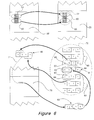
- Figure 6 is a data flow diagram illustrating the data flow between the read-write memory and the scaling routine during the process of updating the scaled image buffer for a 4:3 vertical scaling operation.
- a preferred embodiment of the invention as a solution to the foregoing prior art deficiencies, will be described in the ensuring paragraphs as a method of scaling a preselected portion 11 of an image 12 shown on an LCD screen 13 during a scaling operation, as illustrated in Figure 1.
- the LCD screen 13 subsequently displays a scaled image 15 in place of the image 12.
- an LCD controller and a Direct Memory Access Controller (DMAC) collectively form a display device.
- This display device in return, forms a display sub-system of a PDA handheld device (not shown) together with other resources that will be described in later paragraphs.
- a graphics routine in the OS of the PDA writes display information into an image buffer (not shown). This display information is then shown on the LCD screen 13.
- the graphics routine continues to write the display information into the image buffer as if the LCD screen 13 is displaying the image 12.
- the LCD screen 13 switches to display the scaled image 15
- the graphics routine continues to write the display information into the image buffer as if the LCD screen 13 is displaying the image 12.
- the display information which forms the scaled image 15 will be generated from the display information which forms the preselected portion 11 of the image 12 and stored in a scaled image buffer (not shown).
- the display device 13 which originally reads from the image buffer, will be re-programmed to read from the scaled image buffer in order for it to display the scaled image 15.
- the display device 13 will continue to read periodically from the scaled image buffer until scaling operation is deactivated.
- the display information residing in the image buffer and forming the preselected portion 11 of the image 12 is also periodically checked for changes. If there are changes, corresponding changes will also be made to the scaled image 15 stored in the scale image buffer.
- FIGS 2A and 2B are block diagrams showing the data-flow among the software and hardware resources forming the display sub-system of the PDA during a normal display operation and the scaling operation respectively.
- the OS graphics routine 21 will generate the display information which is subsequently stored in the image buffer 22 residing in a read-write memory of the PDA.
- the display information stored in the image buffer 22 is periodically read, at a rate of 70 Hertz for example, by the display device 23, which displays the display information on the LCD screen 13 as an output for viewing.
- the data-flow path of the display information during the scaling operation is seen to be significantly different from the data-flow path shown in Figure 2A.
- the display information no longer flows directly from the image buffer 22 to the display device 23, but is re-routed to a scaling routine 24.
- the scaling routine 24 then performs the novel scaling process, which will be described in further paragraphs, on part of the display information.
- the results of the novel scaling process are subsequently stored in the scaled image buffer 25.
- the display device 23 is re-programmed to read the display information from the scaled image buffer 25. While the display information in the image buffer 22 is updated by the OS graphic routine 21, the display information in the scaled image buffer 25 is correspondingly updated by the scaling routine 24.
- the rate at which the scaled image buffer 25 is updated by the scaling routine 24 is determined by the rate of change of the display information stored in the image buffer 22.
- the scaling routine 24 periodically checks the image buffer 22 after preparing and storing a first set of display information in the scaled image buffer 25. During these checks, the scaling routine 24 performs a checksum test pass on the display information of the preselected portion 11 of the image 12 stored in the image buffer 22. Upon detecting a discrepancy between the results of the current and last checksum test passes, the scaling routine 24 will update the display information in the scaled image buffer 25.
- FIG. 3 A flow chart of the scaling routine 24, which performs the novel scaling process during the scaling operation, is shown in Figure 3.
- the scaling routine 24 When the scaling operation is activated, the scaling routine 24 enters a start state 31.
- the scaling routine 24 then immediately enters an initialisation state 32, where the scaling operation is initialised.
- This initialisation includes allocating a block of contiguous memory for use as the scaled image buffer 25.
- the initialisation also includes the generation of a set of display conversion information in the form of look-up tables, which will be stored in the read-write memory.
- the scaling routine 24 enters a display re-route state 33, where the scaling routine 24 re-programs the display device 23 to read from the scaled image buffer 25 instead of the image buffer 22.
- the re-routing of the display information does not affect the operation of the OS graphics routine 21.
- the scaling routine 24 subsequently enters a checksum test state 34, where the scaling routine 24 waits for 50 ms for example, before performing the checksum test pass as described earlier. If changes have occurred in the display information of the preselected portion 11 of the image 12 stored in the image buffer 22, or a request is received from an input check state 36 to shift the preselected portion 11 of the image 12, the scaling routine 24 will perform updating activities.
- the updating activities involve the generation of the display information for storage in the scaled image buffer 25 by using the display conversion information generated in the initialisation state 32.
- the checksum test pass is skipped, however, during a first pass of the scaling routine 24, since the scaled image buffer 25 is required to be initialised with a first scaled image 15.
- the scaling routine 24 enters a pointer re-map state 35, where a pointing device, if any is connected to the PDA, is re-mapped.
- the re-mapping of the pointing device is necessary, for the display co-ordinates of the scaled image 15 are different from the display co-ordinates of the image 12.
- the scaling routine 24 After re-mapping the pointing device, the scaling routine 24 enters the input check state 36. In the input check state 36, the scaling routine 24 checks all the connected input devices of the PDA for a request to shift the preselected portion 11 of the image 12. In particular, a keyboard of the pointing device will be polled for such a request.
- the scaling routine 24 enters an exit check state 37, where the scaling routine 24 polls the input devices for an instruction to deactivate the scaling operation. If a request to deactivate the scaling operation is received, the scaling routine 24 will reset the resources described earlier and re-program the display device 23 to revert to reading the display information from the image buffer 22. Otherwise, the scaling routine 24 will loop to the checksum test state 34, and thus check for changes to the display information of the preselected portion 11 of the image 12 stored in the image buffer 22 at a rate of 20 Hertz (or every 50 ms), for example.
- the activities performed by the scaling routine 24, when it enters the initialisation state 32 and checksum test state 34, will be described in further details in the following paragraphs.
- the description will be specific for a 4:3 scaling process for illustrative purposes.
- a two-bits-per-pixel (2BP) gray scale device independent bitmapped (DIB) display device 23 will be described.
- the 4:3 scaling process essentially means that a set of three pixels which belong to the image 12 will be scaled to a corresponding set of four pixels which will form part of the scaled image 15.
- a set of three butes which come from the image 12 is scaled to a set of four bytes in the scaled image 15.
- the 4:3 scaling process uses three bytes of the image 12 to generate four bytes of the scaled image 15.
- every three bytes of the image 12 will be referred to as an image data, and every corresponding four bytes of the scaled image 15 as a scaled image data.
- the 4:3 scaling process may involve a 4:3 horizontal scaling process, a 4:3 vertical scaling process, or a combination of the horizontal and vertical scaling processes.
- a 4:3 horizontal scaling process may involve a 4:3 horizontal scaling process, a 4:3 vertical scaling process, or a combination of the horizontal and vertical scaling processes.
- the scaling routine 24 allocates a block of contiguous read-write memory for use as the scaled image buffer 25.
- a series of look-up tables are generated by the scaling routine 24. These look-up tables are subsequently stored in blocks of contiguous read-write memory.
- each byte of display information comprises four pixels in the case of the 2 BP gray scale DIB LCD screen 13. Therefore, each image data 40 comprises twelve pixels which are displayed in a horizontal alignment in the image 12, and each scaled image data 41 consists of sixteen pixels which are horizontally aligned in the scaled image 15. Out of the sixteen pixels found in the scaled image data 41, twelve of them are duplicates of the twelve pixels found in the image data 40. The remaining four pixels, to be known as stretch pixels, therefore must be generated by the scaling routine 24.
- stretch pixels namely stretch pixels A 43, B 46, C 48 and D 49 of the scaled image data 41
- Figure 4 also shows that each of the four stretch pixels A 43, B 46, C 48 and D 49 of the scaled data 41 is sandwiched between two duplicate pixels which are copied from adjacent pixels in the same byte of the image data 40.
- the stretch pixel A 43 in the scaled image data 41 is sandwiched between the duplicate pixels of a first set of adjacent pixels 42 and 44 from the first byte of the image data 40.
- the stretch pixel B 46 in the scaled image data 41 is sandwiched between the duplicate pixels of a second set of adjacent pixels 45 and 47 which are also from the first byte of the image data 40.
- the advantages of placing the stretch pixels A 43, B 46, C 48, and D 49 in these positions are manifold as shown in the following paragraphs.
- the stretch pixels A 43, B 46, C 48 and D 49 By evenly spacing out the stretch pixels A 43, B 46, C 48 and D 49 among the twelve duplicate pixels in the scaled image data 41, the stretching effects of the scaling process are evenly spread throughout the scaled image 15. As a result, a more aesthetic view of the scaled image 15 is achieved.
- the stretch pixels A 43, B 46, C 48 and D 49 because of their positions within the scaled image data 41, are also generated in a way to achieve a smoothing effect on the scaled image 15.
- Each of the stretch pixels A 43, B 46, C 48 and D 49 is generated by using the corresponding neighbouring duplicate pixels which are copied from adjacent pixels in the image data 40, where the display intensity gradient of these adjacent pixels is concerned.
- the contrast caused by two adjacent pixels in the image data 40 having a large display intensity gradient is smoothed out if a stretch pixel of an intermediate display intensity is placed between the corresponding duplicate pixels in the scaled image data 41.
- the preferred implementation, in the scaling process, to achieve such a smoothing effect is to generate each stretch pixel in the scaled image data 41 by using the display intensity average of the corresponding neighbouring duplicate pixels.
- FIG. 5 illustrates the data flow, indicated by solid arrows, between read-write memory and the scaling routine 24 during the process of updating the scaled image buffer 25.
- a corresponding table data 51 is generated.
- the first byte of the image data 40 comprising the first and second sets of adjacent pixels 42, 44, 45 and 47 is used to generate the table data 51 comprising the four duplicate pixels in addition to pixels A 43 and B 46.
- the rest of the table data 51 is stuffed with zero bits.
- Each of these table data 51 is subsequently stored in a read-write memory location, where the address is indexed by the value of the corresponding byte within the image data 40, as shown by dotted lines 55. Since there are three bytes of data in the image data 40, three look-up tables 52, 53 and 54 are subsequently generated during initialisation of the 4:3 horizontal scaling process. In addition, each of the look-up tables 52, 53 and 54 contains 256 X four bytes of table data 51, since there are 2 8 or 256 possible values of each byte of display information within the image data 40.
- the look-up tables 52, 53 and 54 are subsequently used for updating the scaled image 15 when the scaling routine 24 enters the checksum test state 34.
- the scaling routine 24 Upon detecting a change in the image data 40 forming part or all of the preselected portion 11 of the image 12 during the checksum test pass, the scaling routine 24 will grab the image data 40 associated with the change. Using each byte of these image data 40 as an address index, the corresponding table data 51 is retrieved, as shown by the dotted lines 55. A set of three table data 56 which are retrieved using the corresponding three bytes of display information within each affected image data 40 are then ORed to give each scaled image data 41. These scaled image data 41 are subsequently stored into the scaled image buffer 25, which had earlier been allocated as a block of contiguous read-write memory.
- the scaling routine 24 allocates a block of contiguous read-write memory for use as the scaled image buffer 25.
- a series of look-up tables are generated by the scaling routine 24.
- Figure 6 illustrates the data flow, indicated by solid arrows, between the read-write memory and the scaling routine 24 during the process of updating the scaled image buffer 25.
- the scaling routine 24 uses the image data 40 which consists of three bytes of horizontally aligned display information during the 4:3 horizontal scaling process.
- the scaling routine 24 uses an image data 60 which consists of three bytes of vertically stacked display information. Therefore, the display information in the image data 60, which are grabbed from the image buffer 22 for use during the 4:3 vertical process, consists of three rows of four pixels taken from the image 12. Another difference which exists between these scaling processes lies in the display information found within the different scaled image data generated.
- a fourth row consisting of four pixels is generated as a scaled image data 61, in contrast to the scaled image data 41 generated during the 4:3 horizontal scaling process, which consists of four stretch pixels evenly spaced out among the 12 duplicate pixels.
- the scaled image data 61 which is generated during the 4:3 vertical scaling process, consists of four pixels sandwiched between the last byte of a top image data 60 and the first byte of a bottom image data 60, as shown in Figure 6.
- a pixel A 63 is sandwiched between a pixel 9 (65) of the last byte of the top image data 60 and a pixel 1 (67) of the first byte of the bottom image data 60.
- a pixel B 64 is also sandwiched between a pixel 10 (66) of the top image data 60 and a pixel 2 (68) of the first byte of the bottom image data 60.
- the pixels A 63 and B 64 are also taken as the averages of the pixels 9 (65) and 1 (67), and pixels 10 (66) and 2 (68) respectively.
- the pixels A 63 and B 64 are thus stored as display information within the table data 62 in an address location in the read-write memory which is indexed by the value of a table index 69 formed from the combination of pixels 9 (65), 10 (66), 1 (67) and 2 (68).
- a table index 69 formed from the combination of pixels 9 (65), 10 (66), 1 (67) and 2 (68).
- the value of any pair of pixels stored as display information within the table data 62 is derived by averaging the first two pixels with the next two pixels of the table index 69. All the possible values of the table index 69 are considered during the preparation of the table data 62. This process therefore results in 2 8 or 256 table data 62 to form the look-up table 70.
- the look-up table 70 is subsequently used for updating the scaled image 15 when the scaling routine 24 enters the checksum test state 34.
- the scaling routine 24 starts the checksum test state 34 by conducting the routine checksum test pass.
- duplicates of the affected image data 60 are copied from the image buffer 22 into the scaled image buffer 25 to fill the first three rows of display information while leaving the fourth row of display information empty.
- the corresponding pixels of the image data 60 are grouped together to form the table index 69.
- This table index 69 is subsequently used as an index to access the table data 62, which is stored in the look-up table 70, as shown by a dotted line 71.
- the table data 62 is subsequently shifted and ORed with other corresponding table data 62 to fill the fourth row in the scaled image buffer 25.
- the 4:3 horizontal scaling process will be performed first in the preferred embodiment.
- these scaled data 41 are subsequently processed as image data 60 to provide a final vertically scaled image buffer.
- a 3:2 scaling operation can also be implemented using the methods as described.
- an m:n scaling operation can be implemented without having to depart from the scope and spirit of the invention, in which n pixels of the image data are scaled to m pixels of the scaled image data.
- a four-bits-per-pixel gray scale display device may be used instead of the 2BP gray scale DIB display device.
- the stretch pixels of the scaled image data may be generated by copying one of the two corresponding neighbouring duplicate pixels to achieve a shorter initialisation period during the scaling operation.
- the stretch pixels may be generated at sub-pixel levels using previously known methods to achieve an enhanced smoothing effect.
- the look-up tables may be pre-determined and premanently stored and reside in a read-only memory. The initialisation state of the scaling process, in this case, will therefore exclude the generation of the set of display conversion information, and hence have a shorter initialisation period.
Landscapes
- Engineering & Computer Science (AREA)
- Physics & Mathematics (AREA)
- General Physics & Mathematics (AREA)
- Theoretical Computer Science (AREA)
- Computer Hardware Design (AREA)
- Image Processing (AREA)
- Editing Of Facsimile Originals (AREA)
- Controls And Circuits For Display Device (AREA)
- Liquid Crystal Display Device Control (AREA)
- Storing Facsimile Image Data (AREA)
Applications Claiming Priority (2)
| Application Number | Priority Date | Filing Date | Title |
|---|---|---|---|
| US904103 | 1992-06-24 | ||
| US08/904,103 US5952994A (en) | 1997-07-31 | 1997-07-31 | Method for scaling an image |
Publications (2)
| Publication Number | Publication Date |
|---|---|
| EP0895187A2 true EP0895187A2 (de) | 1999-02-03 |
| EP0895187A3 EP0895187A3 (de) | 1999-12-29 |
Family
ID=25418561
Family Applications (1)
| Application Number | Title | Priority Date | Filing Date |
|---|---|---|---|
| EP98305940A Withdrawn EP0895187A3 (de) | 1997-07-31 | 1998-07-27 | Verfahren zur massstäblichen Umformung von Bildern |
Country Status (4)
| Country | Link |
|---|---|
| US (1) | US5952994A (de) |
| EP (1) | EP0895187A3 (de) |
| JP (1) | JPH11167378A (de) |
| TW (1) | TW385426B (de) |
Cited By (6)
| Publication number | Priority date | Publication date | Assignee | Title |
|---|---|---|---|---|
| EP1052598A3 (de) * | 1999-05-13 | 2001-01-03 | Matsushita Electric Industrial Co., Ltd. | Informationsterminal mit Skalierungseinheit für Bilder und Auswahleinheit für Hintergrundbild |
| WO2000068883A3 (en) * | 1999-05-11 | 2001-06-28 | Palm Inc | Display scaling, based on software or hardware depending on direction |
| EP1204072A3 (de) * | 2000-11-03 | 2002-07-31 | Eastman Kodak Company | Bildverarbeitungsvorrichtung für Daumennagelbilder |
| GB2383490A (en) * | 2001-11-09 | 2003-06-25 | Nec Corp | Picture displaying method using thumbnails |
| WO2004109595A3 (en) * | 2003-05-22 | 2006-08-03 | Lee Jin H | Method for doubling resolution lcd display using line doubling and non-linear interpolation curve |
| US7555171B2 (en) | 2004-03-15 | 2009-06-30 | Sharp Laboratories Of America, Inc. | Systems and methods for down scaling a bitmap |
Families Citing this family (30)
| Publication number | Priority date | Publication date | Assignee | Title |
|---|---|---|---|---|
| US6310621B1 (en) * | 1998-04-03 | 2001-10-30 | Avid Technology, Inc. | Extended support for numerical controls |
| US6310601B1 (en) * | 1998-05-12 | 2001-10-30 | International Business Machines Corporation | Resizing images to improve network throughput |
| US6674436B1 (en) | 1999-02-01 | 2004-01-06 | Microsoft Corporation | Methods and apparatus for improving the quality of displayed images through the use of display device and display condition information |
| US6342890B1 (en) * | 1999-03-19 | 2002-01-29 | Microsoft Corporation | Methods, apparatus, and data structures for accessing sub-pixel data having left side bearing information |
| US6469702B1 (en) | 1999-04-16 | 2002-10-22 | Avid Technology, Inc. | Method and system for editing function curves in two dimensions |
| US7012600B2 (en) | 1999-04-30 | 2006-03-14 | E Ink Corporation | Methods for driving bistable electro-optic displays, and apparatus for use therein |
| US7210099B2 (en) | 2000-06-12 | 2007-04-24 | Softview Llc | Resolution independent vector display of internet content |
| JP2002027544A (ja) * | 2000-07-04 | 2002-01-25 | Fujitsu Ltd | データ蓄積システム |
| TW466415B (en) * | 2000-08-28 | 2001-12-01 | Compal Electronics Inc | Hand-held device with zooming display function |
| US8676921B1 (en) * | 2000-10-03 | 2014-03-18 | Nokia Corporation | Contextual mapping based learning by converting information |
| US6636235B1 (en) * | 2000-10-12 | 2003-10-21 | International Business Machines Corporation | Lettering adjustments for display resolution |
| US6931661B2 (en) * | 2000-10-19 | 2005-08-16 | Motorola, Inc. | Dynamic image provisioning |
| JP2002149152A (ja) * | 2000-11-10 | 2002-05-24 | Fujitsu Ltd | 画像表示制御装置 |
| US7219309B2 (en) | 2001-05-02 | 2007-05-15 | Bitstream Inc. | Innovations for the display of web pages |
| JP2004533641A (ja) * | 2001-05-02 | 2004-11-04 | ビットストリーム インコーポレーティッド | 非線形カラー・バランスを使用して副画素最適化フォント・ビットマップを生成及び表示するための方法、システム、及びプログラム |
| DE10164631A1 (de) * | 2001-07-16 | 2003-02-13 | Thinprint Gmbh | Verfahren zur Ausgabe von Inhalten aus dem Internet oder einem Intranet |
| US7075513B2 (en) * | 2001-09-04 | 2006-07-11 | Nokia Corporation | Zooming and panning content on a display screen |
| US7009599B2 (en) * | 2001-11-20 | 2006-03-07 | Nokia Corporation | Form factor for portable device |
| FR2833132B1 (fr) * | 2001-11-30 | 2004-02-13 | Eastman Kodak Co | Procede pour selectionner et enregistrer un sujet d'interet dans une image numerique fixe |
| KR100472464B1 (ko) * | 2002-07-20 | 2005-03-10 | 삼성전자주식회사 | 직렬로 스케일링하는 장치 및 방법 |
| US7365758B2 (en) * | 2002-10-21 | 2008-04-29 | Microsoft Corporation | System and method for scaling data according to an optimal width for display on a mobile device |
| TWI247245B (en) * | 2003-09-16 | 2006-01-11 | Realtek Semiconductor Corp | A scaling device and method capable of controlling data input and/or output capacity |
| KR100586174B1 (ko) | 2004-07-02 | 2006-06-07 | 삼성전자주식회사 | 디스플레이 장치를 구동하기 위한 응용 프로세스 및데이터 스케일링 방법 |
| DE102004049690A1 (de) * | 2004-10-12 | 2006-04-20 | Siemens Ag | Anzeigeeinheit mit Ansteuerlogik |
| KR100610364B1 (ko) * | 2005-02-14 | 2006-08-09 | 삼성전자주식회사 | 자동조정기능을 구비한 영상표시장치 및 자동조정방법 |
| JP4900640B2 (ja) * | 2005-03-30 | 2012-03-21 | 京セラ株式会社 | 携帯端末装置およびその文書表示制御方法 |
| US7706635B2 (en) * | 2005-10-20 | 2010-04-27 | Marvell International Technology Ltd. | Methods and systems for image scaling |
| CA2666622A1 (en) * | 2006-10-20 | 2008-04-24 | Nokia Corporation | Generic indication of adaptation paths for scalable multimedia |
| TWI425499B (zh) * | 2009-02-27 | 2014-02-01 | Chi Lin Technology Co Ltd | 顯示系統 |
| CN113672183B (zh) * | 2020-05-14 | 2024-03-01 | 扬智科技股份有限公司 | 图像处理装置与图像处理方法 |
Family Cites Families (9)
| Publication number | Priority date | Publication date | Assignee | Title |
|---|---|---|---|---|
| US4872064A (en) * | 1987-10-19 | 1989-10-03 | Interand Corporation | System for selective scaling of digital video images |
| JPH0682391B2 (ja) * | 1989-03-15 | 1994-10-19 | インターナショナル・ビジネス・マシーンズ・コーポレーション | N画素をm画素に変換する装置 |
| US5029107A (en) * | 1989-03-31 | 1991-07-02 | International Business Corporation | Apparatus and accompanying method for converting a bit mapped monochromatic image to a grey scale image using table look up operations |
| US5235432A (en) * | 1991-11-22 | 1993-08-10 | Creedon Brendan G | Video-to-facsimile signal converter |
| EP0624300B1 (de) * | 1992-11-30 | 1998-09-23 | Eastman Kodak Company | Auflösungserhöhungssystem für binäre Bilder |
| CA2148177A1 (en) * | 1994-05-16 | 1995-11-17 | Kent E. Biggs | Method and apparatus for stretching bitmaps to non-integer multiples |
| CA2124030C (en) * | 1994-05-20 | 1999-08-24 | Albert Z. Zhao | Method for colour image scaling and other geometrical transformations |
| US5793379A (en) * | 1995-04-03 | 1998-08-11 | Nvidia Corporation | Method and apparatus for scaling images having a plurality of scan lines of pixel data |
| US5784047A (en) * | 1995-04-28 | 1998-07-21 | Intel Corporation | Method and apparatus for a display scaler |
-
1997
- 1997-07-31 US US08/904,103 patent/US5952994A/en not_active Expired - Lifetime
-
1998
- 1998-06-08 TW TW087109064A patent/TW385426B/zh not_active IP Right Cessation
- 1998-07-27 EP EP98305940A patent/EP0895187A3/de not_active Withdrawn
- 1998-07-28 JP JP10212527A patent/JPH11167378A/ja active Pending
Cited By (10)
| Publication number | Priority date | Publication date | Assignee | Title |
|---|---|---|---|---|
| WO2000068883A3 (en) * | 1999-05-11 | 2001-06-28 | Palm Inc | Display scaling, based on software or hardware depending on direction |
| EP1052598A3 (de) * | 1999-05-13 | 2001-01-03 | Matsushita Electric Industrial Co., Ltd. | Informationsterminal mit Skalierungseinheit für Bilder und Auswahleinheit für Hintergrundbild |
| US6674439B1 (en) | 1999-05-13 | 2004-01-06 | Matsushita Electric Industrial Co., Ltd. | Information terminal device |
| EP1204072A3 (de) * | 2000-11-03 | 2002-07-31 | Eastman Kodak Company | Bildverarbeitungsvorrichtung für Daumennagelbilder |
| US6804418B1 (en) | 2000-11-03 | 2004-10-12 | Eastman Kodak Company | Petite size image processing engine |
| GB2383490A (en) * | 2001-11-09 | 2003-06-25 | Nec Corp | Picture displaying method using thumbnails |
| US6839068B2 (en) | 2001-11-09 | 2005-01-04 | Nec Corporation | Picture displaying method and information device |
| GB2383490B (en) * | 2001-11-09 | 2005-05-11 | Nec Corp | Picture displaying method and information device |
| WO2004109595A3 (en) * | 2003-05-22 | 2006-08-03 | Lee Jin H | Method for doubling resolution lcd display using line doubling and non-linear interpolation curve |
| US7555171B2 (en) | 2004-03-15 | 2009-06-30 | Sharp Laboratories Of America, Inc. | Systems and methods for down scaling a bitmap |
Also Published As
| Publication number | Publication date |
|---|---|
| JPH11167378A (ja) | 1999-06-22 |
| US5952994A (en) | 1999-09-14 |
| EP0895187A3 (de) | 1999-12-29 |
| TW385426B (en) | 2000-03-21 |
Similar Documents
| Publication | Publication Date | Title |
|---|---|---|
| US5952994A (en) | Method for scaling an image | |
| US6366292B1 (en) | Scaling method and apparatus for a flat panel display | |
| EP0681280B1 (de) | Verfahren zum senkrechten Filtern einer nach einem Gitter abgetasteten Anzeige | |
| KR910000545B1 (ko) | 컬러 화상 표시 시스템 | |
| EP0201210B1 (de) | Videoanzeigesystem | |
| WO1983002509A1 (en) | Method and apparatus for controlling the display of a computer generated raster graphic system | |
| US6360029B1 (en) | Method and apparatus for variable magnification of an image | |
| US20010043227A1 (en) | Priority methods for texture map storage | |
| US4918429A (en) | Display system with symbol font memory | |
| US5291188A (en) | Method and apparatus for allocating off-screen display memory | |
| US6281876B1 (en) | Method and apparatus for text image stretching | |
| US8086070B2 (en) | Image processing apparatus using alpha plane and method thereof | |
| EP0062669A1 (de) | Grafik- und text-bildgenerator für eine rasterabtastanzeige. | |
| JP3084729B2 (ja) | デジタルオシロスコープ | |
| JPH06175606A (ja) | ハードウエアスクリーン上への画像表示方法および装置 | |
| JP2001228818A (ja) | 表示装置 | |
| US7348983B1 (en) | Method and apparatus for text image stretching | |
| JP2613933B2 (ja) | 表示容量変換装置および表示システム | |
| JP2506825B2 (ja) | 色混合処理制御方法 | |
| EP0146594A4 (de) | Verfahren und vorrichtung zum erzeugen von vektorattributen. | |
| HK1012458B (en) | Vertical filtering method for raster scanner display | |
| JPS63195696A (ja) | 高速描画方法 | |
| HK1013160B (en) | Vertical filtering method for raster scanner display | |
| HK1012457B (en) | Vertical filtering method for raster scanner display | |
| JPH04110998A (ja) | 表示制御装置 |
Legal Events
| Date | Code | Title | Description |
|---|---|---|---|
| PUAI | Public reference made under article 153(3) epc to a published international application that has entered the european phase |
Free format text: ORIGINAL CODE: 0009012 |
|
| AK | Designated contracting states |
Kind code of ref document: A2 Designated state(s): DE FR GB |
|
| AX | Request for extension of the european patent |
Free format text: AL;LT;LV;MK;RO;SI |
|
| PUAL | Search report despatched |
Free format text: ORIGINAL CODE: 0009013 |
|
| AK | Designated contracting states |
Kind code of ref document: A3 Designated state(s): AT BE CH CY DE DK ES FI FR GB GR IE IT LI LU MC NL PT SE |
|
| AX | Request for extension of the european patent |
Free format text: AL;LT;LV;MK;RO;SI |
|
| 17P | Request for examination filed |
Effective date: 20000117 |
|
| AKX | Designation fees paid |
Free format text: DE FR GB |
|
| RAP1 | Party data changed (applicant data changed or rights of an application transferred) |
Owner name: HEWLETT-PACKARD COMPANY, A DELAWARE CORPORATION |
|
| 17Q | First examination report despatched |
Effective date: 20020425 |
|
| STAA | Information on the status of an ep patent application or granted ep patent |
Free format text: STATUS: THE APPLICATION IS DEEMED TO BE WITHDRAWN |
|
| 18D | Application deemed to be withdrawn |
Effective date: 20020906 |