EP0895259A2 - Leitendes Polymer verwendender Festelektrolytkondensator und Herstellungsverfahren - Google Patents
Leitendes Polymer verwendender Festelektrolytkondensator und Herstellungsverfahren Download PDFInfo
- Publication number
- EP0895259A2 EP0895259A2 EP98114011A EP98114011A EP0895259A2 EP 0895259 A2 EP0895259 A2 EP 0895259A2 EP 98114011 A EP98114011 A EP 98114011A EP 98114011 A EP98114011 A EP 98114011A EP 0895259 A2 EP0895259 A2 EP 0895259A2
- Authority
- EP
- European Patent Office
- Prior art keywords
- conducting polymer
- polymer layer
- solid electrolytic
- derivative
- electrolytic capacitor
- Prior art date
- Legal status (The legal status is an assumption and is not a legal conclusion. Google has not performed a legal analysis and makes no representation as to the accuracy of the status listed.)
- Granted
Links
Images
Classifications
-
- H—ELECTRICITY
- H01—ELECTRIC ELEMENTS
- H01G—CAPACITORS; CAPACITORS, RECTIFIERS, DETECTORS, SWITCHING DEVICES, LIGHT-SENSITIVE OR TEMPERATURE-SENSITIVE DEVICES OF THE ELECTROLYTIC TYPE
- H01G9/00—Electrolytic capacitors, rectifiers, detectors, switching devices, light-sensitive or temperature-sensitive devices; Processes of their manufacture
- H01G9/004—Details
- H01G9/022—Electrolytes; Absorbents
- H01G9/025—Solid electrolytes
-
- H—ELECTRICITY
- H01—ELECTRIC ELEMENTS
- H01G—CAPACITORS; CAPACITORS, RECTIFIERS, DETECTORS, SWITCHING DEVICES, LIGHT-SENSITIVE OR TEMPERATURE-SENSITIVE DEVICES OF THE ELECTROLYTIC TYPE
- H01G11/00—Hybrid capacitors, i.e. capacitors having different positive and negative electrodes; Electric double-layer [EDL] capacitors; Processes for the manufacture thereof or of parts thereof
- H01G11/22—Electrodes
- H01G11/30—Electrodes characterised by their material
- H01G11/48—Conductive polymers
-
- H—ELECTRICITY
- H01—ELECTRIC ELEMENTS
- H01G—CAPACITORS; CAPACITORS, RECTIFIERS, DETECTORS, SWITCHING DEVICES, LIGHT-SENSITIVE OR TEMPERATURE-SENSITIVE DEVICES OF THE ELECTROLYTIC TYPE
- H01G11/00—Hybrid capacitors, i.e. capacitors having different positive and negative electrodes; Electric double-layer [EDL] capacitors; Processes for the manufacture thereof or of parts thereof
- H01G11/54—Electrolytes
- H01G11/56—Solid electrolytes, e.g. gels; Additives therein
-
- H—ELECTRICITY
- H01—ELECTRIC ELEMENTS
- H01G—CAPACITORS; CAPACITORS, RECTIFIERS, DETECTORS, SWITCHING DEVICES, LIGHT-SENSITIVE OR TEMPERATURE-SENSITIVE DEVICES OF THE ELECTROLYTIC TYPE
- H01G9/00—Electrolytic capacitors, rectifiers, detectors, switching devices, light-sensitive or temperature-sensitive devices; Processes of their manufacture
- H01G9/004—Details
- H01G9/022—Electrolytes; Absorbents
- H01G9/025—Solid electrolytes
- H01G9/028—Organic semiconducting electrolytes, e.g. TCNQ
-
- H—ELECTRICITY
- H01—ELECTRIC ELEMENTS
- H01G—CAPACITORS; CAPACITORS, RECTIFIERS, DETECTORS, SWITCHING DEVICES, LIGHT-SENSITIVE OR TEMPERATURE-SENSITIVE DEVICES OF THE ELECTROLYTIC TYPE
- H01G9/00—Electrolytic capacitors, rectifiers, detectors, switching devices, light-sensitive or temperature-sensitive devices; Processes of their manufacture
- H01G9/15—Solid electrolytic capacitors
-
- Y—GENERAL TAGGING OF NEW TECHNOLOGICAL DEVELOPMENTS; GENERAL TAGGING OF CROSS-SECTIONAL TECHNOLOGIES SPANNING OVER SEVERAL SECTIONS OF THE IPC; TECHNICAL SUBJECTS COVERED BY FORMER USPC CROSS-REFERENCE ART COLLECTIONS [XRACs] AND DIGESTS
- Y02—TECHNOLOGIES OR APPLICATIONS FOR MITIGATION OR ADAPTATION AGAINST CLIMATE CHANGE
- Y02E—REDUCTION OF GREENHOUSE GAS [GHG] EMISSIONS, RELATED TO ENERGY GENERATION, TRANSMISSION OR DISTRIBUTION
- Y02E60/00—Enabling technologies; Technologies with a potential or indirect contribution to GHG emissions mitigation
- Y02E60/13—Energy storage using capacitors
Definitions
- This invention relates to solid electrolytic capacitors using conducting polymer layers as solid electrolytes, and a method of making the same.
- a solid electrolytic capacitor has a structure in which a porous compact of an electrochemical valve metal such as tantalum or aluminum is used as a first electrode (anode), an oxide film thereof as a dielectric, and a solid electrolyte such as manganese dioxide (MnO 2 ) or a 7,7',8,8'-tetracyanoquinodimethane (TCNQ) complex as part of a second electrode (cathode).
- the solid electrolyte must perform the function of electrically connecting the whole dielectric surfaces within the porous compact with an electrode lead, and the function of repairing electrical short circuits arising from defects of the dielectric film.
- conducting polymers comprising conjugated polymers (e.g., polyacetylene, poly-p-phenylene, polypyrrole and polyaniline) doped with an electron-donating or electron-attracting compound (dopant) have been developed.
- conjugated polymers e.g., polyacetylene, poly-p-phenylene, polypyrrole and polyaniline
- an electron-donating or electron-attracting compound dopant
- five-membered heterocyclic compounds e.g., polypyrrole and polythiophene
- polyaniline can easily yield conducting polymers by electrolytic polymerization, and such conducting polymers are being used as solid electrolytes for capacitors (Japanese Patent Laid-Open Nos. 36012/'89 and 64013/'91).
- this method involves electrolytic polymerization on an oxide film having electrical insulating properties, so that it has been very difficult to form a uniform conducting polymer film.
- the capacitance appearance factor of a capacitor can be enhanced by forming relatively easily formable polyaniline in the inside of the device and then forming polypyrrole thereon, or the heat resistance of a capacitor can be improved by forming polypyrrole having a high electric conductivity in the inside of the device and then forming thereon polyaniline having high heat resistance.
- An object of the present invention is to provide a solid electrolytic capacitor having high heat resistance and showing an improvement in capacitance appearance factor and frequency characteristics, as well as a method of making the same.
- a first aspect of the present invention relates to a solid electrolytic capacitor using conducting polymers. Specifically, according to this first aspect, there is provided a solid electrolytic capacitor using an oxide film of an electrochemical valve metal as the dielectric and having, as solid electrolytes, first and second conducting polymer layers formed successively on the oxide film by polymerization reactions, wherein the first conducting polymer layer is formed from a compound having a lower reaction rate than the compound used to form the second conducting polymer layer.
- a second aspect of the present invention relates to a method of making a solid electrolytic capacitor using conducting polymers. Specifically, according to this second aspect, there is provided a method of making a solid electrolytic capacitor using an oxide film of an electrochemical valve metal as the dielectric and having, as solid electrolytes, first and second conducting polymer layers formed successively on the oxide film, which comprises forming the first and second conducting polymer layers by chemical oxidative polymerization processes using an oxidizing agent, and forming the first conducting polymer layer from a compound having a lower reaction rate than the compound used to form the second conducting polymer layer.
- a first effect of the present invention is that a high capacitance appearance factor can be achieved in capacitor devices having a finely porous structure and hence a highly extended surface area.
- a second effect of the present invention is that solid electrolytic capacitors having good frequency characteristics can be made.
- a third effect of the present invention is that highly reliable solid electrolytic capacitors having excellent heat resistance and a method of making the same can be provided.
- the polymerization reactions are carried out by chemical oxidative polymerization processes using an oxidizing agent, and the first and second conducting polymer layers formed on the oxide film each comprise a layer of a polymer of aniline, pyrrole, thiophene or a derivative thereof.
- a polymer of thiophene or a derivative thereof which is obtained by the chemical oxidative polymerization of thiophene monomer or a derivative thereof is used as the first conducting polymer having a lower reaction rate. Then, a polymer of pyrrole or a derivative thereof is formed on its outer surface as a conducting polymer having a higher electric conductivity, or a polymer of aniline or a derivative thereof is formed on its outer surface as a conducting polymer having higher heat resistance.
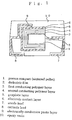
- FIG. 1 is a sectional view of a solid electrolytic capacitor in accordance with one embodiment of the present invention.
- the surface of a porous compact 1 of an electrochemical valve metal i.e., tantalum or aluminum
- an electrochemical valve metal i.e., tantalum or aluminum
- a dielectric film 2 of a metallic oxide is formed on the wall surfaces of these pores.
- first and second conducting polymer layers 3 and 4 which serve as solid electrolytes, are successively formed on the surface of the dielectric film 2 so that they penetrate deep into the pores.
- the reaction rates of conducting polymers vary according to the type and position of the substituent group(s) and the oxidation-reduction process employed. However, they qualitatively decrease in the following order: polypyrrole > polythiophene > polyaniline.
- the first conducting polymer layer 3 is formed from a compound having a lower reaction rate than the compound used to form the second conducting polymer layer 4.
- the electric conductivities of conducting polymers are affected by the type of the dopant, the degree of polymerization, and the type of the substituent group(s). However, they qualitatively decrease in the following order: polypyrrole > polythiophene > polyaniline.
- An electrode contact layer 6 serving as a cathode is formed on the surface of the second conducting polymer layer 4. In order to establish good electrical contact, a graphite layer 5 may be formed between the electrode contact layer 6 and the second conducting polymer layer 4.
- an anode lead 7 is attached to a metal rod implanted in the compact 1, and a cathode lead 8 is attached to the electrode contact layer 6 through the medium of an electrically-conductive paste layer 9.
- the present invention is further illustrated by the following examples. However, it is to be understood that the present invention is not limited to these examples.
- a porous compact comprising a sintered pellet 1 of finely powdered tantalum in the shape of a rectangular parallelepiped having 1 mm long sides was anodically oxidized at 33 V in a 0.1 wt.% aqueous solution of nitric acid. Thus, a dielectric film 2 was formed on the surfaces thereof.
- a solution was prepared by dissolving thiophene monomer and ferric p-toluenesulfonate in methanol so that thiophene monomer and ferric p-toluenesulfonate were present in a ratio of 1:2 and at a concentration of 15% by weight based on the weight of the methanol. While this solution was maintained at -30°C, the sintered pellet 1 having the dielectric film 2 formed thereon was soaked in the solution for 1 minute. Thereafter, the sintered pellet 1 was taken out and held at room temperature for 30 minutes to effect polymerization This procedure was repeated three times. Subsequently, the sintered pellet 1 was washed in butanol for 30 minutes. Thus, a first conducting polymer layer 3 comprising black polythiophene was formed on the dielectric film 2.
- a pyrrole solution was prepared by dissolving pyrrole and ferric p-toluenesulfonate in methanol so that pyrrole and ferric p-toluenesulfonate were present in a ratio of 1:2 and at a concentration of 15% by weight based on the weight of the methanol. While this pyrrole solution was maintained at -30°C, the sintered pellet 1 was soaked therein for 1 minute. Thereafter, the sintered pellet 1 was taken out and held at room temperature for 30 minutes to effect polymerization. This procedure was repeated four times. Thus, a second conducting polymer layer 4 comprising black polypyrrole was formed on the first conducting polymer layer 3.
- a capacitor was completed in the same manner as in Example 1, except that the polypyrrole constituting the second conducting polymer layer 4 in Example 1 was replaced by polyaniline.
- an aniline solution was prepared by dissolving equimolar amounts of aniline and p-toluenesulfonic acid in a mixed solvent composed of 70% by weight of methanol and 30% by weight of water so that aniline and p-toluenesulfonic acid were present at a concentration of 15% by weight based on the weight of the solvent. While this aniline solution was maintained at 0°C, the sintered pellet 1 was soaked therein for 30 seconds, and then soaked in a 25 wt.% aqueous solution of ammonium peroxodisulfate at 0°C for 30 minutes. Thereafter, the sintered pellet 1 was taken out and held at room temperature for 30 minutes to effect polymerization. This procedure was repeated five times. Thus, a second conducting polymer layer 4 comprising black polyaniline was formed.
- a capacitor was completed in the same manner as in Example 1, except that the method employed in Example 1 for the formation of the first conducting polymer layer 3 (polythiophene) was changed.
- the sintered pellet 1 was soaked in thiophene monomer for 1 minute and then held at room temperature for 5 minutes. Thereafter, the sintered pellet 1 was soaked in a 50 wt.% solution of ferric p-toluenesulfonate in butanol for 10 minutes and held at room temperature for 30 minutes to effect polymerization. This procedure was repeated three times. Subsequently, the sintered pellet 1 was washed in butanol for 30 minutes. Thus, a first conducting polymer layer 3 comprising black polythiophene was formed. Thereafter, a second conducting polymer layer comprising polypyrrole was formed in the same manner as in Example 1.
- a capacitor was completed in the same manner as in Example 1, except that the polythiophene constituting the first conducting polymer layer 3 in Example 1 was replaced by poly(3,4-ethylenedioxythiophene).
- a solution was prepared by dissolving 3,4-ethylenedioxythiophene and ferric p-toluenesulfonate in butanol so that 3,4-ethylenedioxythiophene and ferric p-toluenesulfonate were present in a ratio of 1:2 and at a concentration of 15% by weight based on the weight of the butanol. While this solution was maintained at -30°C, the sintered pellet 1 was soaked therein for 1 minute. Thereafter, the sintered pellet 1 was taken out and held at room temperature for 30 minutes to effect polymerization. This procedure was repeated three times. Subsequently, the sintered pellet 1 was washed in butanol for 15 minutes. Thus, a first conducting polymer layer 3 comprising black poly(3,4-ethylenedioxythiophene) was formed. Thereafter, a second conducting polymer layer comprising polypyrrole was formed in the same manner as in Example 1.
- a capacitor was completed in the same manner as in Example 2, except that the first conducting polymer layer 3 and the method for its formation were changed.
- a solution was prepared by dissolving 3,4-ethylenedioxythiophene and ferric p-toluenesulfonate in butanol so that 3,4-ethylenedioxythiophene and ferric p-toluenesulfonate were present in a ratio of 1:2 and at a concentration of 15% by weight based on the weight of the butanol. While this solution was maintained at -30°C, the sintered pellet 1 was soaked therein for 1 minute. Thereafter, the sintered pellet 1 was taken out and held at room temperature for 30 minutes to effect polymerization. This procedure was repeated three times. Subsequently, the sintered pellet 1 was washed in butanol for 15 minutes. Thus, a first conducting polymer layer 3 comprising black poly(3,4-ethylenedioxythiophene) was formed. Thereafter, a second conducting polymer layer comprising polyaniline was formed in the same manner as in Example 2.
- a capacitor was completed in the same manner as in Example 4, except that the method for the formation of the second conducting polymer layer 4 (polypyrrole) was changed.
- the sintered pellet 1 was soaked in pyrrole monomer for 1 minute and then held at room temperature for 5 minutes. Thereafter, the sintered pellet 1 was soaked in a 50 wt.% solution of ferric dodecylbenzenesulfonate in methanol for 10 minutes and held at room temperature for 15 minutes to effect polymerization. This procedure was repeated four times. Subsequently, the sintered pellet 1 was washed in methanol for 30 minutes. Thus, a second conducting polymer layer 4 comprising black polypyrrole was formed.
- a capacitor was completed in the same manner as in Example 1, except that, in forming the second conducting polymer layer 4 (polypyrrole), ferric dodecylbenzenesulfonate was used in place of ferric p-toluenesulfonate.
- the second conducting polymer layer 4 polypyrrole
- ferric dodecylbenzenesulfonate was used in place of ferric p-toluenesulfonate.
- a capacitor was completed in the same manner as in Example 1, except that, in forming the second conducting polymer layer 4 (polypyrrole), ferric naphthalenesulfonate was used in place of ferric p-toluenesulfonate.
- the second conducting polymer layer 4 polypyrrole
- ferric naphthalenesulfonate was used in place of ferric p-toluenesulfonate.
- a capacitor was completed in the same manner as in Example 1, except that, in forming the second conducting polymer layer 4, 3,4-dimethylpyrrole was used in place of pyrrole.
- a sintered pellet 1 of finely powdered tantalum similar to that used in Example 1 was anodically oxidized at 33 V in a 0.1 wt.% aqueous solution of nitric acid to form a dielectric film 2.
- an aniline solution was prepared by dissolving equimolar amounts of aniline and p-toluenesulfonic acid in a mixed solvent composed of 70% by weight of ethanol and 30% by weight of water so that aniline and p-toluenesulfonic acid were present at a concentration of 10% by weight based on the weight of the solvent. While this aniline solution was maintained at 0°C, the sintered pellet 1 was soaked therein for 30 seconds, and then soaked in a 25 wt.% aqueous solution of ammonium peroxodisulfate at 0°C for 30 minutes. Thereafter, the sintered pellet 1 was taken out and held at room temperature for 30 minutes to effect polymerization. This procedure was repeated twice. Thus, a first conducting polymer layer 3 comprising black polyaniline was formed on the dielectric film 2.
- a pyrrole solution was prepared by dissolving pyrrole and ferric dodecylbenzenesulfonate in methanol so that pyrrole and ferric dodecylbenzenesulfonate were present in a ratio of 1:2 and at a concentration of 15% by weight based on the weight of the methanol. While this pyrrole solution was maintained at -30°C, the sintered pellet 1 was soaked therein for 1 minute. Thereafter, the sintered pellet 1 was taken out and held at room temperature for 30 minutes to effect polymerization. This procedure was repeated four times. Thus, a second conducting polymer layer 4 comprising black polypyrrole was formed.
- a sintered pellet 1 of finely powdered tantalum similar to that used in Example 1 was anodically oxidized at 33 V in a 0.1 wt.% aqueous solution of nitric acid to form a dielectric film 2.
- a pyrrole solution was prepared by dissolving pyrrole and ferric dodecylbenzenesulfonate in methanol so that pyrrole and ferric dodecylbenzenesulfonate were present in a ratio of 1:2 and at a concentration of 15% by weight based on the weight of the methanol. While this pyrrole solution was maintained at -30°C, the sintered pellet 1 was soaked therein for 1 minute. Thereafter, the sintered pellet 1 was taken out and held at room temperature for 30 minutes to effect polymerization. This procedure was repeated three times. Thus, a first conducting polymer layer 3 comprising black polypyrrole was formed on the dielectric film 2.
- an aniline solution was prepared by dissolving equimolar amounts of aniline and p-toluenesulfonic acid in a mixed solvent composed of 70% by weight of methanol and 30% by weight of water so that aniline and p-toluenesulfonic acid were present at a concentration of 15% by weight based on the weight of the solvent. While this aniline solution was maintained at 0°C, the sintered pellet 1 was soaked therein for 30 seconds, and then soaked in a 25 wt.% aqueous solution of ammonium peroxodisulfate at 0°C for 30 minutes. Thereafter, the sintered pellet 1 was taken out and held at room temperature for 30 minutes to effect polymerization. This procedure was repeated five times. Thus, a second conducting polymer layer 4 comprising black polyaniline was formed. Thereafter, leads were attached in the same manner as in Example 1 to complete a capacitor.
- a sintered pellet 1 of finely powdered tantalum similar to that used in Example 1 was anodically oxidized at 33 V in a 0.1 wt.% aqueous solution of nitric acid to form a dielectric film 2.
- a solution was prepared by dissolving 3,4-ethylenedioxythiophene and ferric p-toluenesulfonate in butanol so that 3,4-ethylenedioxythiophene and ferric p-toluenesulfonate were present in a ratio of 1:2 and at a concentration of 15% by weight based on the weight of the butanol. While this solution was maintained at -30°C, the sintered pellet 1 was soaked therein for 1 minute. Thereafter, the sintered pellet 1 was taken out and held at room temperature for 30 minutes to effect polymerization. This procedure was repeated six times. Subsequently, the sintered pellet 1 was washed in butanol for 15 minutes. Thus, a conducting polymer layer comprising black poly(3,4-ethylenedioxythiophene) was formed.
- the capacitors obtained in the examples of the present invention show a high capacitance appearance factor even in capacitor devices having a highly extended surface area, and a low impedance which is excellent in frequency characteristics. Moreover, it can also be seen that they have excellent frequency characteristics and high heat resistance.
- the combinations of the first conducting polymer layer and the second conducting polymer layer were as follows: polythiophene/polypyrrole, polythiophene/polyaniline, poly(3,4-ethylenedioxythiophene)/polypyrrole, poly(3,4-ethylenedioxythiophene)/polyaniline and poly(3,4-ethylenedioxythiophene)/poly(3,4-dimethylpyrrole).
- polythiophene/polypyrrole polythiophene/polyaniline
- poly(3,4-ethylenedioxythiophene)/polypyrrole poly(3,4-ethylenedioxythiophene)/polyaniline
- poly(3,4-ethylenedioxythiophene)/poly(3,4-dimethylpyrrole) poly(3,4-dimethylpyrrole).
- dodecylbenzenesulfonic acid p-toluenesulfonic acid, benezenedisulfonic acid and naphthalenesulfonic acid were used as dopants.
- dodecylbenzenesulfonic acid p-toluenesulfonic acid
- benezenedisulfonic acid naphthalenesulfonic acid
- naphthalenesulfonic acid naphthalenesulfonic acid
- aromatic sulfonic acids such as sulfobenzoic acid may also be used.
Landscapes
- Engineering & Computer Science (AREA)
- Power Engineering (AREA)
- Chemical & Material Sciences (AREA)
- Chemical Kinetics & Catalysis (AREA)
- Electrochemistry (AREA)
- Microelectronics & Electronic Packaging (AREA)
- Materials Engineering (AREA)
- Polyoxymethylene Polymers And Polymers With Carbon-To-Carbon Bonds (AREA)
- Macromolecular Compounds Obtained By Forming Nitrogen-Containing Linkages In General (AREA)
Applications Claiming Priority (3)
| Application Number | Priority Date | Filing Date | Title |
|---|---|---|---|
| JP20487797A JP3157748B2 (ja) | 1997-07-30 | 1997-07-30 | 導電性高分子を用いた固体電解コンデンサ及びその製造方法 |
| JP204877/97 | 1997-07-30 | ||
| JP20487797 | 1997-07-30 |
Publications (3)
| Publication Number | Publication Date |
|---|---|
| EP0895259A2 true EP0895259A2 (de) | 1999-02-03 |
| EP0895259A3 EP0895259A3 (de) | 2001-04-25 |
| EP0895259B1 EP0895259B1 (de) | 2008-07-16 |
Family
ID=16497885
Family Applications (1)
| Application Number | Title | Priority Date | Filing Date |
|---|---|---|---|
| EP98114011A Expired - Lifetime EP0895259B1 (de) | 1997-07-30 | 1998-07-27 | Leitende Polymere verwendender Festelektrolytkondensator und dessen Herstellungsverfahren |
Country Status (5)
| Country | Link |
|---|---|
| US (2) | US6154358A (de) |
| EP (1) | EP0895259B1 (de) |
| JP (1) | JP3157748B2 (de) |
| KR (1) | KR100334918B1 (de) |
| DE (1) | DE69839716D1 (de) |
Cited By (7)
| Publication number | Priority date | Publication date | Assignee | Title |
|---|---|---|---|---|
| EP0974988A3 (de) * | 1998-07-07 | 2001-04-25 | Matsushita Electric Industrial Co., Ltd. | Herstellungsverfahren eines Elektrolytkondensators |
| WO2001052288A1 (en) * | 2000-01-07 | 2001-07-19 | Kemet Electronics Corporation | Solid electrolytic capacitor with low esr and high humidity resistance |
| EP1100097A4 (de) * | 1998-06-25 | 2004-12-08 | Nichicon Corp | Festelektrolytkondensator und herstellungsverfahren |
| EP1154449A3 (de) * | 2000-05-11 | 2006-05-10 | NEC TOKIN Toyama, Ltd. | Herstellungsverfahren von einem Festelektrolytkondensator |
| EP1073074A3 (de) * | 1999-07-30 | 2006-06-14 | Nec Tokin Corporation | Festelektrolytkondensatoren und deren Herstellungsverfahren |
| EP0820076B2 (de) † | 1996-07-16 | 2011-03-02 | Nec Tokin Corporation | Festelektrolytkondensator und dessen Herstellungsverfahren |
| GB2474747A (en) * | 2009-10-23 | 2011-04-27 | Avx Corp | Polymer Solid Electrolytic Capacitor |
Families Citing this family (36)
| Publication number | Priority date | Publication date | Assignee | Title |
|---|---|---|---|---|
| WO2001020625A1 (en) * | 1999-09-10 | 2001-03-22 | Matsushita Electric Industrial Co., Ltd. | Solid electrolytic capacitor and production method thereof, and conductive polymer polymerizing oxidizing agent solution |
| US6602741B1 (en) * | 1999-09-14 | 2003-08-05 | Matsushita Electric Industrial Co., Ltd. | Conductive composition precursor, conductive composition, solid electrolytic capacitor, and their manufacturing method |
| JP3465076B2 (ja) * | 1999-10-12 | 2003-11-10 | Necトーキン株式会社 | 固体電解コンデンサ |
| JP3881480B2 (ja) | 1999-10-14 | 2007-02-14 | ローム株式会社 | 固体電解コンデンサおよびその製法 |
| TW502267B (en) * | 2000-01-28 | 2002-09-11 | Matsushita Electric Industrial Co Ltd | Solid eleotrolytic capacitors and method for manufacturing the same |
| US6430032B2 (en) * | 2000-07-06 | 2002-08-06 | Showa Denko K. K. | Solid electrolytic capacitor and method for producing the same |
| US6674635B1 (en) | 2001-06-11 | 2004-01-06 | Avx Corporation | Protective coating for electrolytic capacitors |
| TWI254333B (en) * | 2002-03-18 | 2006-05-01 | Sanyo Electric Co | Solid electrolytic capacitor and method of manufacturing same |
| JP4010447B2 (ja) * | 2002-05-30 | 2007-11-21 | ローム株式会社 | 固体電解コンデンサ及びその製造方法 |
| US6864147B1 (en) | 2002-06-11 | 2005-03-08 | Avx Corporation | Protective coating for electrolytic capacitors |
| JP2004063822A (ja) * | 2002-07-30 | 2004-02-26 | Fujitsu Media Device Kk | チップ型固体電解コンデンサ |
| JP4366055B2 (ja) * | 2002-08-01 | 2009-11-18 | ローム株式会社 | 固体電解コンデンサの製造方法 |
| US7079377B2 (en) * | 2002-09-30 | 2006-07-18 | Joachim Hossick Schott | Capacitor and method for producing a capacitor |
| DE60327869D1 (de) * | 2002-09-30 | 2009-07-16 | Nippon Chemicon | Festelektrolytkondensator |
| JPWO2004070750A1 (ja) * | 2003-02-10 | 2006-05-25 | Tdk株式会社 | 固体電解コンデンサ及びその製造方法 |
| US7256982B2 (en) * | 2003-05-30 | 2007-08-14 | Philip Michael Lessner | Electrolytic capacitor |
| JP2005093591A (ja) * | 2003-09-16 | 2005-04-07 | Sanyo Electric Co Ltd | 固体電解コンデンサ |
| DE102004022110A1 (de) * | 2004-05-05 | 2005-12-01 | H.C. Starck Gmbh | Verfahren zur Herstellung von Elektrolytkondensatoren |
| JP4701680B2 (ja) * | 2004-11-05 | 2011-06-15 | Tdk株式会社 | 固体電解コンデンサ及びその製造方法 |
| JP4799852B2 (ja) * | 2004-11-22 | 2011-10-26 | 株式会社フジクラ | 光電変換素子用電極、光電変換素子および色素増感太陽電池 |
| JP4799853B2 (ja) * | 2004-11-22 | 2011-10-26 | 株式会社フジクラ | 光電変換素子用電極、光電変換素子および色素増感太陽電池 |
| US7324329B2 (en) * | 2005-12-22 | 2008-01-29 | Giner, Inc. | Electrochemical-electrolytic capacitor and method of making the same |
| US7697267B2 (en) * | 2005-12-28 | 2010-04-13 | Showa Denko K.K. | Capacitor and method for manufacturing same |
| US20070171596A1 (en) * | 2006-01-20 | 2007-07-26 | Chacko Antony P | Electrode compositions containing carbon nanotubes for solid electrolyte capacitors |
| US7515396B2 (en) * | 2007-03-21 | 2009-04-07 | Avx Corporation | Solid electrolytic capacitor containing a conductive polymer |
| US7460358B2 (en) * | 2007-03-21 | 2008-12-02 | Avx Corporation | Solid electrolytic capacitor containing a protective adhesive layer |
| US7483259B2 (en) * | 2007-03-21 | 2009-01-27 | Avx Corporation | Solid electrolytic capacitor containing a barrier layer |
| JP2009209259A (ja) * | 2008-03-04 | 2009-09-17 | Nec Tokin Corp | 導電性高分子およびそれを用いた固体電解コンデンサ |
| US8486799B2 (en) * | 2009-03-02 | 2013-07-16 | Showa Denko K.K. | Method for manufacturing solid electrolytic capacitor |
| KR20110035990A (ko) * | 2009-09-30 | 2011-04-06 | 하.체.스타르크 클레비오스 게엠베하 | 선택된 색수를 갖는 모노머 및 그들로부터 제조된 커패시터 |
| US8946903B2 (en) * | 2010-07-09 | 2015-02-03 | Micron Technology, Inc. | Electrically conductive laminate structure containing graphene region |
| US9767964B2 (en) | 2011-04-07 | 2017-09-19 | Avx Corporation | Multi-anode solid electrolytic capacitor assembly |
| WO2015040883A1 (ja) * | 2013-09-20 | 2015-03-26 | 株式会社村田製作所 | 固体電解コンデンサの製造方法 |
| CN109643610B (zh) * | 2016-08-31 | 2021-02-09 | 松下知识产权经营株式会社 | 电解电容器及其制造方法 |
| US11270847B1 (en) | 2019-05-17 | 2022-03-08 | KYOCERA AVX Components Corporation | Solid electrolytic capacitor with improved leakage current |
| JP7850926B2 (ja) * | 2020-02-28 | 2026-04-24 | パナソニックIpマネジメント株式会社 | 電解コンデンサ用電極の製造方法 |
Family Cites Families (22)
| Publication number | Priority date | Publication date | Assignee | Title |
|---|---|---|---|---|
| US158236A (en) * | 1874-12-29 | Improvement in dumping-cars | ||
| JPS6432619A (en) * | 1987-07-29 | 1989-02-02 | Japan Carlit Co Ltd | Manufacture of solid electrolytic capacitor |
| JPS6436012A (en) * | 1987-07-31 | 1989-02-07 | Asahi Glass Co Ltd | Solid electrolytic capacitor |
| JPS6474712A (en) * | 1987-09-17 | 1989-03-20 | Japan Carlit Co Ltd | Manufacture of solid electrolytic capacitor |
| JPH01225110A (ja) * | 1988-03-04 | 1989-09-08 | Asahi Glass Co Ltd | 固体電解コンデンサ |
| DE3814730A1 (de) | 1988-04-30 | 1989-11-09 | Bayer Ag | Feststoff-elektrolyte und diese enthaltende elektrolyt-kondensatoren |
| JPH02117121A (ja) * | 1988-10-27 | 1990-05-01 | Marcon Electron Co Ltd | 固体電解コンデンサ |
| JP2631896B2 (ja) * | 1989-06-30 | 1997-07-16 | 日東電工株式会社 | 固体電解コンデンサー及びその製造方法 |
| JPH0364013A (ja) * | 1989-08-02 | 1991-03-19 | Marcon Electron Co Ltd | 固体電解コンデンサ及びその製造方法 |
| JPH04137517A (ja) * | 1990-09-27 | 1992-05-12 | Marcon Electron Co Ltd | 固体電解コンデンサの製造方法 |
| JP3522294B2 (ja) * | 1992-04-25 | 2004-04-26 | ニチコン株式会社 | 固体電解コンデンサの製造方法 |
| JP3542613B2 (ja) * | 1992-07-24 | 2004-07-14 | 日本ケミコン株式会社 | 固体電解コンデンサの製造方法 |
| JPH0645199A (ja) * | 1992-07-24 | 1994-02-18 | Nippon Chemicon Corp | 固体電解コンデンサ |
| JPH0645200A (ja) * | 1992-07-24 | 1994-02-18 | Nippon Chemicon Corp | 固体電解コンデンサ |
| JP2765462B2 (ja) * | 1993-07-27 | 1998-06-18 | 日本電気株式会社 | 固体電解コンデンサおよびその製造方法 |
| JPH0745481A (ja) * | 1993-07-29 | 1995-02-14 | Nec Corp | 固体電解コンデンサ及びその製造方法 |
| JP3068430B2 (ja) * | 1995-04-25 | 2000-07-24 | 富山日本電気株式会社 | 固体電解コンデンサ及びその製造方法 |
| JP3223790B2 (ja) * | 1995-06-26 | 2001-10-29 | 松下電器産業株式会社 | コンデンサ及びその製造方法 |
| JP3294973B2 (ja) * | 1995-09-21 | 2002-06-24 | 旭光学工業株式会社 | カメラのバリヤ移動制限機構 |
| US5812367A (en) * | 1996-04-04 | 1998-09-22 | Matsushita Electric Industrial Co., Ltd. | Solid electrolytic capacitors comprising a conductive layer made of a polymer of pyrrole or its derivative |
| KR100442073B1 (ko) * | 1996-04-26 | 2004-09-18 | 닛뽄 케미콘 가부시끼가이샤 | 고체전해콘덴서및그제조방법 |
| JPH10284351A (ja) | 1997-04-09 | 1998-10-23 | Nichicon Corp | 固体電解コンデンサ及びその製造方法 |
-
1997
- 1997-07-30 JP JP20487797A patent/JP3157748B2/ja not_active Expired - Fee Related
-
1998
- 1998-07-23 US US09/121,269 patent/US6154358A/en not_active Expired - Lifetime
- 1998-07-27 DE DE69839716T patent/DE69839716D1/de not_active Expired - Fee Related
- 1998-07-27 EP EP98114011A patent/EP0895259B1/de not_active Expired - Lifetime
- 1998-07-29 KR KR1019980030562A patent/KR100334918B1/ko not_active Expired - Fee Related
-
2000
- 2000-07-26 US US09/626,076 patent/US6210450B1/en not_active Expired - Lifetime
Cited By (10)
| Publication number | Priority date | Publication date | Assignee | Title |
|---|---|---|---|---|
| EP0820076B2 (de) † | 1996-07-16 | 2011-03-02 | Nec Tokin Corporation | Festelektrolytkondensator und dessen Herstellungsverfahren |
| EP1100097A4 (de) * | 1998-06-25 | 2004-12-08 | Nichicon Corp | Festelektrolytkondensator und herstellungsverfahren |
| EP0974988A3 (de) * | 1998-07-07 | 2001-04-25 | Matsushita Electric Industrial Co., Ltd. | Herstellungsverfahren eines Elektrolytkondensators |
| EP1073074A3 (de) * | 1999-07-30 | 2006-06-14 | Nec Tokin Corporation | Festelektrolytkondensatoren und deren Herstellungsverfahren |
| WO2001052288A1 (en) * | 2000-01-07 | 2001-07-19 | Kemet Electronics Corporation | Solid electrolytic capacitor with low esr and high humidity resistance |
| US6304427B1 (en) | 2000-01-07 | 2001-10-16 | Kemet Electronics Corporation | Combinations of materials to minimize ESR and maximize ESR stability of surface mount valve-metal capacitors after exposure to heat and/or humidity |
| EP1154449A3 (de) * | 2000-05-11 | 2006-05-10 | NEC TOKIN Toyama, Ltd. | Herstellungsverfahren von einem Festelektrolytkondensator |
| GB2474747A (en) * | 2009-10-23 | 2011-04-27 | Avx Corp | Polymer Solid Electrolytic Capacitor |
| US8125768B2 (en) | 2009-10-23 | 2012-02-28 | Avx Corporation | External coating for a solid electrolytic capacitor |
| GB2474747B (en) * | 2009-10-23 | 2013-11-20 | Avx Corp | External coating for a solid electrolytic capacitor |
Also Published As
| Publication number | Publication date |
|---|---|
| US6154358A (en) | 2000-11-28 |
| JP3157748B2 (ja) | 2001-04-16 |
| JPH1154373A (ja) | 1999-02-26 |
| EP0895259A3 (de) | 2001-04-25 |
| DE69839716D1 (de) | 2008-08-28 |
| KR19990014267A (ko) | 1999-02-25 |
| KR100334918B1 (ko) | 2002-06-20 |
| US6210450B1 (en) | 2001-04-03 |
| EP0895259B1 (de) | 2008-07-16 |
Similar Documents
| Publication | Publication Date | Title |
|---|---|---|
| US6154358A (en) | Solid electrolytic capacitor using a conducting polymer | |
| US5461537A (en) | Solid electrolytic capacitor and method of manufacturing the same | |
| JP2765462B2 (ja) | 固体電解コンデンサおよびその製造方法 | |
| EP0652576B1 (de) | Herstellungsverfahren für einer Festelektrolytkondensator | |
| EP0274755A2 (de) | Festelektrolytkondensator | |
| US6128180A (en) | Solid electrolytic capacitor using a conductive polymer film | |
| EP0654804B1 (de) | Festelektrolytkondensator | |
| EP0617442B1 (de) | Festelektrolytkondensator und dessen Herstellungsverfahren | |
| JP3202668B2 (ja) | 固体電解コンデンサの製造方法 | |
| EP0716424B1 (de) | Festelektrolytkondensator mit wärmebeständigem Polyanilin und Verfahren zur Herstellung desselben | |
| JP2765453B2 (ja) | 固体電解コンデンサの製造方法 | |
| JP3228323B2 (ja) | 固体電解コンデンサおよびその製造方法 | |
| EP0477584B1 (de) | Verfahren zur Herstellung eines Festelektrolytkondensators | |
| KR20000053593A (ko) | 고체 전해 콘덴서의 제조방법 | |
| US5965062A (en) | Electrically-conductive polymer and production method thereof, and solid-electrolytic capacitor | |
| KR100753612B1 (ko) | 고체 전해 커패시터 및 그 제조방법 | |
| JP2853376B2 (ja) | コンデンサの製造方法 | |
| JPH10303080A (ja) | 固体電解コンデンサの製造方法 | |
| JP2765440B2 (ja) | 固体電解コンデンサの製造方法 | |
| JP2570152B2 (ja) | 固体電解コンデンサの製造方法 | |
| JPH10303074A (ja) | 固体電解コンデンサの製造方法 | |
| KR0148613B1 (ko) | 고체 전해 커패시터 및 그의 제조방법 | |
| JP2000040643A (ja) | 固体電解コンデンサおよびその製造方法 | |
| JPH10303075A (ja) | 固体電解コンデンサの製造方法 | |
| JPH06252002A (ja) | 固体電解コンデンサの製造方法 |
Legal Events
| Date | Code | Title | Description |
|---|---|---|---|
| PUAI | Public reference made under article 153(3) epc to a published international application that has entered the european phase |
Free format text: ORIGINAL CODE: 0009012 |
|
| AK | Designated contracting states |
Kind code of ref document: A2 Designated state(s): DE FR GB NL |
|
| AX | Request for extension of the european patent |
Free format text: AL;LT;LV;MK;RO;SI |
|
| PUAL | Search report despatched |
Free format text: ORIGINAL CODE: 0009013 |
|
| AK | Designated contracting states |
Kind code of ref document: A3 Designated state(s): AT BE CH CY DE DK ES FI FR GB GR IE IT LI LU MC NL PT SE |
|
| AX | Request for extension of the european patent |
Free format text: AL;LT;LV;MK;RO;SI |
|
| 17P | Request for examination filed |
Effective date: 20010315 |
|
| AKX | Designation fees paid |
Free format text: DE FR GB NL |
|
| RAP1 | Party data changed (applicant data changed or rights of an application transferred) |
Owner name: NEC TOKIN TOYAMA, LTD. |
|
| 17Q | First examination report despatched |
Effective date: 20060830 |
|
| 17Q | First examination report despatched |
Effective date: 20060830 |
|
| RTI1 | Title (correction) |
Free format text: SOLID ELECTROLYTIC CAPACITOR USING CONDUCTING POLYMERS AND METHOD OF MAKING SAME |
|
| GRAP | Despatch of communication of intention to grant a patent |
Free format text: ORIGINAL CODE: EPIDOSNIGR1 |
|
| GRAS | Grant fee paid |
Free format text: ORIGINAL CODE: EPIDOSNIGR3 |
|
| GRAA | (expected) grant |
Free format text: ORIGINAL CODE: 0009210 |
|
| AK | Designated contracting states |
Kind code of ref document: B1 Designated state(s): DE FR GB NL |
|
| REG | Reference to a national code |
Ref country code: GB Ref legal event code: FG4D |
|
| REF | Corresponds to: |
Ref document number: 69839716 Country of ref document: DE Date of ref document: 20080828 Kind code of ref document: P |
|
| RAP2 | Party data changed (patent owner data changed or rights of a patent transferred) |
Owner name: NEC TOKIN CORPORATION |
|
| REG | Reference to a national code |
Ref country code: GB Ref legal event code: 732E |
|
| PGFP | Annual fee paid to national office [announced via postgrant information from national office to epo] |
Ref country code: NL Payment date: 20080722 Year of fee payment: 11 Ref country code: FR Payment date: 20080731 Year of fee payment: 11 |
|
| NLT2 | Nl: modifications (of names), taken from the european patent patent bulletin |
Owner name: NEC TOKIN CORPORATION Effective date: 20081105 |
|
| NLS | Nl: assignments of ep-patents |
Owner name: NEC TOKIN CORPORATION Effective date: 20090105 |
|
| PLBE | No opposition filed within time limit |
Free format text: ORIGINAL CODE: 0009261 |
|
| STAA | Information on the status of an ep patent application or granted ep patent |
Free format text: STATUS: NO OPPOSITION FILED WITHIN TIME LIMIT |
|
| 26N | No opposition filed |
Effective date: 20090417 |
|
| REG | Reference to a national code |
Ref country code: FR Ref legal event code: TP |
|
| PGFP | Annual fee paid to national office [announced via postgrant information from national office to epo] |
Ref country code: GB Payment date: 20090722 Year of fee payment: 12 Ref country code: DE Payment date: 20090723 Year of fee payment: 12 |
|
| NLV4 | Nl: lapsed or anulled due to non-payment of the annual fee |
Effective date: 20100201 |
|
| REG | Reference to a national code |
Ref country code: FR Ref legal event code: ST Effective date: 20100331 |
|
| PG25 | Lapsed in a contracting state [announced via postgrant information from national office to epo] |
Ref country code: FR Free format text: LAPSE BECAUSE OF NON-PAYMENT OF DUE FEES Effective date: 20090731 |
|
| GBPC | Gb: european patent ceased through non-payment of renewal fee |
Effective date: 20100727 |
|
| PG25 | Lapsed in a contracting state [announced via postgrant information from national office to epo] |
Ref country code: DE Free format text: LAPSE BECAUSE OF NON-PAYMENT OF DUE FEES Effective date: 20110201 |
|
| REG | Reference to a national code |
Ref country code: DE Ref legal event code: R119 Ref document number: 69839716 Country of ref document: DE Effective date: 20110201 |
|
| PG25 | Lapsed in a contracting state [announced via postgrant information from national office to epo] |
Ref country code: GB Free format text: LAPSE BECAUSE OF NON-PAYMENT OF DUE FEES Effective date: 20100727 |
|
| PG25 | Lapsed in a contracting state [announced via postgrant information from national office to epo] |
Ref country code: NL Free format text: LAPSE BECAUSE OF NON-PAYMENT OF DUE FEES Effective date: 20100201 |