EP0895749A2 - Appareil de surveillance d'un patient. - Google Patents
Appareil de surveillance d'un patient. Download PDFInfo
- Publication number
- EP0895749A2 EP0895749A2 EP98114757A EP98114757A EP0895749A2 EP 0895749 A2 EP0895749 A2 EP 0895749A2 EP 98114757 A EP98114757 A EP 98114757A EP 98114757 A EP98114757 A EP 98114757A EP 0895749 A2 EP0895749 A2 EP 0895749A2
- Authority
- EP
- European Patent Office
- Prior art keywords
- wave
- qrs
- pulse
- amplitude
- judging means
- Prior art date
- Legal status (The legal status is an assumption and is not a legal conclusion. Google has not performed a legal analysis and makes no representation as to the accuracy of the status listed.)
- Withdrawn
Links
Images

Classifications
-
- A—HUMAN NECESSITIES
- A61—MEDICAL OR VETERINARY SCIENCE; HYGIENE
- A61B—DIAGNOSIS; SURGERY; IDENTIFICATION
- A61B5/00—Measuring for diagnostic purposes; Identification of persons
- A61B5/24—Detecting, measuring or recording bioelectric or biomagnetic signals of the body or parts thereof
- A61B5/316—Modalities, i.e. specific diagnostic methods
- A61B5/318—Heart-related electrical modalities, e.g. electrocardiography [ECG]
- A61B5/346—Analysis of electrocardiograms
- A61B5/349—Detecting specific parameters of the electrocardiograph cycle
- A61B5/364—Detecting abnormal ECG interval, e.g. extrasystoles, ectopic heartbeats
-
- A—HUMAN NECESSITIES
- A61—MEDICAL OR VETERINARY SCIENCE; HYGIENE
- A61B—DIAGNOSIS; SURGERY; IDENTIFICATION
- A61B5/00—Measuring for diagnostic purposes; Identification of persons
- A61B5/02—Detecting, measuring or recording for evaluating the cardiovascular system, e.g. pulse, heart rate, blood pressure or blood flow
- A61B5/0205—Simultaneously evaluating both cardiovascular conditions and different types of body conditions, e.g. heart and respiratory condition
-
- A—HUMAN NECESSITIES
- A61—MEDICAL OR VETERINARY SCIENCE; HYGIENE
- A61B—DIAGNOSIS; SURGERY; IDENTIFICATION
- A61B5/00—Measuring for diagnostic purposes; Identification of persons
- A61B5/145—Measuring characteristics of blood in vivo, e.g. gas concentration or pH-value ; Measuring characteristics of body fluids or tissues, e.g. interstitial fluid or cerebral tissue
- A61B5/1455—Measuring characteristics of blood in vivo, e.g. gas concentration or pH-value ; Measuring characteristics of body fluids or tissues, e.g. interstitial fluid or cerebral tissue using optical sensors, e.g. spectral photometrical oximeters
Definitions
- the present invention relates to an apparatus for non-invasively monitoring a supraventricular extrasystole as one of state changes of the excitation conducting system of the heat by use of electrocardiogram information and pulse-wave information.
- the non-invasive monitoring apparatus uses mainly the information of electrocardiograms, arterial oxygen saturation, blood pressure measured by the oscillometric blood-pressure measuring apparatus and the like as parameters representative of dynamic states of a patient.
- electrocardiogram information may continuously be measured.
- the electrocardiogram information is used as a parameter sensitively representing a change of a dynamic state of the patient.
- the electrocardiogram information has been used as the continuously monitoring parameter.
- An arrhythmia of the patient is monitored by use of the waveforms and heat rate on the electrocardiogram.
- the monitoring based on only the electrocardiogram has the following problems.
- a supraventricular extrasystole if it frequently occurs, indicates a symptom of a disease of the atrium or a premonitary symptom of the atrial fibrillation. Because of this, it must be detected. In detecting the supraventricular extrasystole, one will encounter the following difficulties. A QRS wave caused by the normal sinus rhythm contraction as a normal contraction is the same as by the supraventricular extrasystole. Therefore, it is impossible to discriminate between the normal sinus rhythm contraction and the supraventricular extrasystole by use of the QRS wave alone. The supraventricular extrasystole does not always appear as a clear variation of the R-R interval (R-wave to R wave interval).
- a discrimination between the normal sinus rhythm contraction and the supraventricular extrasystole may be made on the basis of a waveshape of the P wave.
- the signal level of the P wave is small. Therefore, the P wave sometimes sinks into the preceding T wave.
- the waveshape of the P wave varies depending on a location where the extrasystole takes place. For this reason, it is difficult to discriminate between the sinus rhythm contraction and the supraventricular extrasystole.
- an object of the present invention is to monitor the supraventricular extrasystole in non-invasive manner.
- a patient monitoring apparatus comprising: electrocardiogram measuring means for measuring electrocardiograms; pulse-wave measuring means for measuring pulse waves; QRS-wave detecting means for detecting QRS waves on an electrocardiogram measured by the electrocardiogram measuring means; pulse-amplitude detecting means for detecting amplitudes of pulse waves measured by the pulse-wave measuring means; first judging means for judging whether or not the QRS wave measured by QRS-wave detecting means is caused by a ventricular premature contraction; and second judging means for operating such that if the first judging means judges that the QRS wave is not the QRS wave caused by a ventricular premature contraction, the second judging means judges whether or not the amplitude of the pulse wave corresponding to the QRS wave detected by pulse-amplitude detecting means is smaller than a preset value.
- the first judging means removes the QRS wave caused by the ventricular premature contraction
- the second judging means judges whether or not the amplitude of the pulse wave corresponding to the QRS wave which is not the QRS wave caused by the ventricular premature contraction is smaller than a preset value.
- the second judging means includes third judging means for judging whether or not at least two QRS waves, which are those not caused by the ventricular premature contraction, appear in successive fashion; and fourth judging means operating such that if the third judging means judges that at least two QRS waves which are those not caused by the ventricular permature contraction successively appear, the fourth judging means judges whether or not the amplitude of the pulse wave corresponding to the second QRS wave is smaller than a value set up on the basis of the amplitude of the pulse wave corresponding to the first QRS wave.
- the fourth judging means judges whether or not the amplitude of the pulse wave corresponding to the second QRS wave is smaller than a value set up on the basis of the amplitude of the pulse wave corresponding to the first QRS wave.
- the embodiment is a patient monitoring apparatus for detecting a supraventricular extrasystole of the heart.
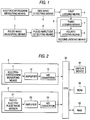
- the patient monitoring apparatus is generally made up of electrocardiogram measuring means 1, pulse-wave measuring means 2 for measuring a pulse wave, QRS-wave detecting means 3 for measuring a QRS wave on an electrocardiogram measured by the electrocardiogram measuring means 1, pulse-amplitude detecting means 4 for detecting an amplitude of a pulse wave measured by the pulse-wave measuring means 2, first judging means 5 for judging as to whether or not a QRS wave detected by the QRS-wave detecting means 3 is a wave produced by the ventricular premature contraction (VPC), and second judging means 6 for judging as to whether or not a ratio of amplitudes of a pulse wave detected by the pulse-amplitude detecting means 4 is larger or smaller than a preset value, the detected pulse wave corresponding to the QRS wave, which is judged to be not the wave produced by the VPC.
- VPC ventricular premature contraction
- the second judging means 6 includes third judging means 7 and fourth judging means 8.
- the third judging means 7 judges as to whether or not two QRS waves not by the VPC have appeared in succession.
- the fourth judging means 8 operates such that when the third judging means 7 judges that two QRS waves have successively appeared, the fourth judging means 8 judges whether or not the amplitude of the pulse wave corresponding to the second QRS wave of those successive ones is smaller than a value set on the basis of the amplitude of the pulse wave corresponding to the first QRS wave of the successive ones (in the specification, the first QRS wave appears earlier than the second one).
- the electrocardiogram measuring means 1 includes an electrocardiogram electrode 11 to be placed on the chest of a patient, an amplifier 12 for amplifying a cardiogram signal derived from the electrocardiogram electrode 11, and an A/D converter 13 for converting the amplified cardiogram signal into a digital signal.
- the pulse-wave measuring means 2 includes a photoelectric pulse wave sensor 21 put on the finger tip of the patient, an amplifier 22 for amplifying a pulse wave signal derived from the photoelectric pulse wave sensor 21, and an A/D converter 23 for amplifying the amplified pulse wave signal into a digital signal.
- the output signals of the A/D converter 13 and the A/D converter 23 are input to a CPU 30.
- the CPU 30 is connected to a display device 31, a ROM 32 and a RAM 33.
- the CPU 30 receives a cardiogram signal from the electrocardiogram measuring means 1 and a pulse wave signal from the pulse-wave measuring means 2, processes those signals in predetermined rules, and displays the result of the processing on the display device 31.
- the ROM 32 stores programs for the process carried out by the CPU 30, and data used for the processing.
- the RAM 33 is used such that when the CPU 30 executes the process, writes necessary data into the RAM 33 and reads out necessary data.
- a part of the contents of the RAM 33 contains registers A1 and A0, and flags F1, F2 and F3: register A1 contains the amplitude of the pulse wave corresponding to the previous QRS wave; register A0 contains the amplitude of the pulse wave corresponding to the QRS wave appearing two waves before the present one; flag F1 indicates whether or not the present QRS wave is due to the ventricular premature contraction (VPC); flag F2 indicates whether or not the previous QRS wave is due to the VPC; and flag F3 indicates the QRS wave appearing two waves earlier than the present one.
- VPC ventricular premature contraction
- flag F2 indicates whether or not the previous QRS wave is due to the VPC
- flag F3 indicates the QRS wave appearing two waves earlier than the present one.
- the corresponding flags F1 to F3 are set to "0", and if it is not due to the VPC, those corresponding flags are set to "1".
- step S1 the CPU 30 clears the registers and the flags (step S1); waits till a QRS wave at preset of a cardiogram signal derived from the electrocardiogram measuring means 1 appears (step S2); and if it detects the QRS wave, it judges whether or not the QRS wave is due to the ventricular premature contraction (VPC) (step S3).
- VPC ventricular premature contraction
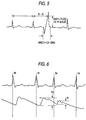
- Fig. 6 diagrammatically shows examples of the amplitude value A1 of the pulse wave corresponding to the QRS wave previously detected, and the amplitude value A0 of the pulse wave corresponding to the QRS wave detected two waves earlier than the present one.
- step S9 the CPU 30 judges that the supraventricular extrasystole takes place, and displays that the supraventricular extrasystole takes place on the screen of the display device 31 (step S12), and goes to a step S10.
- the CPU 30 shifts the data from the register A1 to the register A0.
- the flag F2 is not "1”
- the CPU 30 advances to a step S10 when F3 is not "1” in the step S8 and also when A0 x k > A1 is not satisfied in the step S9.
- step S11 the CPU 30 goes to a step S11.
- the CPU 30 writes the contents of the flag F1 into the flag F2, and the contents of the flag F2 into the flag F3, and returns to the step S2.
- the CPU 30 first checks if the VPC takes place; if the VPC does not take place, it checks if the amplitude of the pulse wave drops; and detects that the supraventricular extrasystole takes place. The reason why the above process is used will be described hereinafter.
- the cardiac output per one heart beat in the former is smaller than in the latter under the condition of the equal heart rates.
- the present invention removes the QRS wave caused by the VPC in advance, and observes the pulse wave corresponding to the QRS wave left after the removal of the VPC basis QRS wave.
- the VPC can be recognized from the cardiogram, as already stated.
- the patient monitoring apparatus of the present invention measures the two successive pulse waves, or the first and second pulse waves, and detects a state that the amplitude of the second pulse wave decreases to a predetermined percentage or larger of that of the first pulse wave. Therefore, an invariable detecting accuracy of the pulse amplitude detection is secured for all the patients.
- the correspondence of the processing functions of the CPU 30 (Fig. 4) and the blocks of the Fig. 1 diagram is as follows: the processing of the step S2 (Fig. 4) corresponds to the QRS-wave detecting means 3 (Fig. 1); the processing of the step S6 (Fig. 4) corresponds to the pulse amplitude detecting means 4 (Fig. 1); the processing of the step S3, to the first judging means 5; the processings of the steps S7, S8 and S9, to the second judging means 6; the processings of the steps S7 and S8, to the third judging means 7; and the processing of the step S9, to the fourth judging means 8.
- k in the step S9 is 0.8. Also in the embodiment, if the systole is the supraventricular extrasystole, the information of that meaning is displayed. The same information may be presented by an alarm sound.
- the patient monitoring apparatus is used for monitoring the supraventricular extrasystole.
- the patient monitoring apparatus like the normal monitoring apparatus, is capable of displaying electrocardiograms and pulse wave signals by use of the display device 31.
- a no-invasive blood pressure measuring device may be attached to the patient monitoring apparatus of the invention. When the supraventricular extrasystole is measured, the blood pressure monitoring device is operated to quickly measure a blood pressure at that time.
- the technical idea of the present invention enables the patient monitoring apparatus constructed incorporating the same thereinto to monitor the supraventricular extrasystole in a non-invasive manner.
- the criterion in judging a decrease of the amplitude of the pulse wave is set up depending on the amplitude of the first pulse wave of the two successive ones. Therefore, an invariable detecting accuracy of the pulse amplitude detection is secured for all the patients.
Landscapes
- Health & Medical Sciences (AREA)
- Cardiology (AREA)
- Life Sciences & Earth Sciences (AREA)
- Heart & Thoracic Surgery (AREA)
- Molecular Biology (AREA)
- Pathology (AREA)
- Engineering & Computer Science (AREA)
- Biomedical Technology (AREA)
- Physics & Mathematics (AREA)
- Medical Informatics (AREA)
- Biophysics (AREA)
- Surgery (AREA)
- Animal Behavior & Ethology (AREA)
- General Health & Medical Sciences (AREA)
- Public Health (AREA)
- Veterinary Medicine (AREA)
- Measurement And Recording Of Electrical Phenomena And Electrical Characteristics Of The Living Body (AREA)
- Measuring And Recording Apparatus For Diagnosis (AREA)
- Measuring Pulse, Heart Rate, Blood Pressure Or Blood Flow (AREA)
Applications Claiming Priority (3)
| Application Number | Priority Date | Filing Date | Title |
|---|---|---|---|
| JP21029297 | 1997-08-05 | ||
| JP210292/97 | 1997-08-05 | ||
| JP21029297A JP3465133B2 (ja) | 1997-08-05 | 1997-08-05 | 患者監視装置 |
Publications (2)
| Publication Number | Publication Date |
|---|---|
| EP0895749A2 true EP0895749A2 (fr) | 1999-02-10 |
| EP0895749A3 EP0895749A3 (fr) | 2000-03-15 |
Family
ID=16586992
Family Applications (1)
| Application Number | Title | Priority Date | Filing Date |
|---|---|---|---|
| EP98114757A Withdrawn EP0895749A3 (fr) | 1997-08-05 | 1998-08-05 | Appareil de surveillance d'un patient. |
Country Status (3)
| Country | Link |
|---|---|
| US (1) | US6011989A (fr) |
| EP (1) | EP0895749A3 (fr) |
| JP (1) | JP3465133B2 (fr) |
Cited By (1)
| Publication number | Priority date | Publication date | Assignee | Title |
|---|---|---|---|---|
| JP2018201800A (ja) * | 2017-06-02 | 2018-12-27 | 日本電信電話株式会社 | 期外収縮判別装置、期外収縮判別方法及びプログラム |
Families Citing this family (11)
| Publication number | Priority date | Publication date | Assignee | Title |
|---|---|---|---|---|
| US6801802B2 (en) * | 2001-06-29 | 2004-10-05 | Ge Medical Systems Information Technologies, Inc. | System and method for selecting physiological data from a plurality of physiological data sources |
| JP2003175105A (ja) * | 2001-12-11 | 2003-06-24 | K & S:Kk | 麻酔深度測定装置 |
| AU2006204886B2 (en) | 2005-01-13 | 2011-08-04 | Welch Allyn, Inc. | Vital signs monitor |
| KR100732600B1 (ko) | 2005-07-21 | 2007-06-27 | 삼성전자주식회사 | 생체신호 측정장치를 구비한 휴대 단말기 |
| US7846106B2 (en) * | 2006-04-26 | 2010-12-07 | The General Electric Company | Atrial fibrillation detection using SPO2 |
| JP5576234B2 (ja) * | 2010-10-14 | 2014-08-20 | 株式会社デンソー | 生体状態監視装置 |
| KR102261769B1 (ko) * | 2013-06-19 | 2021-06-08 | 프레코르디오르 오와이 | 심장 기능 부전을 나타내는 정보를 결정하기 위한 방법 및 장치 |
| JP6312585B2 (ja) * | 2014-12-08 | 2018-04-18 | 日本光電工業株式会社 | 心電図解析装置 |
| JP6580158B2 (ja) * | 2015-11-17 | 2019-09-25 | 国立大学法人東北大学 | 血圧推定装置、情報処理装置、血圧推定方法、及び、血圧推定プログラム |
| JP7141611B2 (ja) * | 2017-03-30 | 2022-09-26 | 国立大学法人大阪大学 | 管理システム、及び、運動用システム |
| CN114601435B (zh) * | 2022-04-02 | 2025-08-12 | 北京雪扬科技有限公司 | 一种用于监测胎儿胎动的监测方法 |
Family Cites Families (8)
| Publication number | Priority date | Publication date | Assignee | Title |
|---|---|---|---|---|
| US3742938A (en) * | 1971-01-04 | 1973-07-03 | T Stern | Cardiac pacer and heart pulse monitor |
| US4181135A (en) * | 1978-03-03 | 1980-01-01 | American Optical Corporation | Method and apparatus for monitoring electrocardiographic waveforms |
| JPS63309242A (ja) * | 1987-06-10 | 1988-12-16 | Nippon Koden Corp | 動脈波伝播解析装置 |
| US5033472A (en) * | 1989-02-23 | 1991-07-23 | Nihon Kohden Corp. | Method of and apparatus for analyzing propagation of arterial pulse waves through the circulatory system |
| US5339822A (en) * | 1991-05-07 | 1994-08-23 | Protocol Systems, Inc. | Method of validating physiologic events resulting from a heartbeat |
| JPH05176902A (ja) * | 1991-12-27 | 1993-07-20 | Nec San-Ei Instr Co Ltd | 簡易不整脈モニタ |
| JPH0767845A (ja) * | 1993-09-03 | 1995-03-14 | Fukuda Denshi Co Ltd | 長時間心電図におけるqrs波判定方法及び装置 |
| US5544661A (en) * | 1994-01-13 | 1996-08-13 | Charles L. Davis | Real time ambulatory patient monitor |
-
1997
- 1997-08-05 JP JP21029297A patent/JP3465133B2/ja not_active Expired - Fee Related
-
1998
- 1998-08-05 US US09/129,213 patent/US6011989A/en not_active Expired - Lifetime
- 1998-08-05 EP EP98114757A patent/EP0895749A3/fr not_active Withdrawn
Non-Patent Citations (1)
| Title |
|---|
| None |
Cited By (1)
| Publication number | Priority date | Publication date | Assignee | Title |
|---|---|---|---|---|
| JP2018201800A (ja) * | 2017-06-02 | 2018-12-27 | 日本電信電話株式会社 | 期外収縮判別装置、期外収縮判別方法及びプログラム |
Also Published As
| Publication number | Publication date |
|---|---|
| JP3465133B2 (ja) | 2003-11-10 |
| US6011989A (en) | 2000-01-04 |
| EP0895749A3 (fr) | 2000-03-15 |
| JPH1147107A (ja) | 1999-02-23 |
Similar Documents
| Publication | Publication Date | Title |
|---|---|---|
| US6083171A (en) | Blood pressure monitoring apparatus | |
| JP2764702B2 (ja) | 血圧監視装置 | |
| JP3114142B2 (ja) | 血圧の測定と不整脈の検出とを同時に行うための装置 | |
| US20220296113A1 (en) | Non-invasive blood pressure measurement | |
| US6702754B2 (en) | Arteriosclerosis inspecting apparatus | |
| US5033472A (en) | Method of and apparatus for analyzing propagation of arterial pulse waves through the circulatory system | |
| US8388542B2 (en) | System for cardiac pathology detection and characterization | |
| US7029449B2 (en) | Arteriosclerosis inspecting apparatus | |
| JPH11347004A (ja) | 身体に挿入しない血圧の測定方法および装置、および不整脈の検出方法および装置 | |
| EP0956817A1 (fr) | Appareil pour la détermination de la pression sanguine | |
| US6011989A (en) | Patient monitoring apparatus | |
| US5603329A (en) | Multi-functional blood pressure monitor | |
| EP2462871A1 (fr) | Système, stéthoscope et procédé pour indiquer le risque de maladie coronarienne | |
| US6129677A (en) | Non-invasive heart monitoring apparatus and method | |
| US6616608B2 (en) | Periodic-physical-information measuring apparatus | |
| US5365933A (en) | Apparatus and method for distinguishing heart beats from intra-aortic balloon pump beats | |
| KR102521294B1 (ko) | 연속 혈압 측정을 이용한 생체활력징후 모니터링 시스템 | |
| US5687731A (en) | Oscillometric method for determining hemodynamic parameters of the arterial portion of patient's circulatory system and a measuring system for its realization | |
| JPH08583A (ja) | 脈波伝達時間監視装置 | |
| US6934577B2 (en) | Risk monitoring | |
| JPH1066681A (ja) | 血圧監視装置 | |
| US6506163B1 (en) | Method and system of distinguishing pressure pulses from v waves during wedge pressure measurement | |
| JPH0866377A (ja) | 多機能血圧計 | |
| US20080214943A1 (en) | Detection of Blood Flow Using Emitted Light Absorption | |
| JP3129295B2 (ja) | 上室性期外収縮判定方法および装置と上室性期外収縮判定のためのプログラムを記憶した記憶媒体 |
Legal Events
| Date | Code | Title | Description |
|---|---|---|---|
| PUAI | Public reference made under article 153(3) epc to a published international application that has entered the european phase |
Free format text: ORIGINAL CODE: 0009012 |
|
| AK | Designated contracting states |
Kind code of ref document: A2 Designated state(s): AT BE CH CY DE DK ES FI FR GB GR IE IT LI LU MC NL PT SE |
|
| AX | Request for extension of the european patent |
Free format text: AL;LT;LV;MK;RO;SI |
|
| PUAL | Search report despatched |
Free format text: ORIGINAL CODE: 0009013 |
|
| AK | Designated contracting states |
Kind code of ref document: A3 Designated state(s): AT BE CH CY DE DK ES FI FR GB GR IE IT LI LU MC NL PT SE |
|
| AX | Request for extension of the european patent |
Free format text: AL;LT;LV;MK;RO;SI |
|
| RIC1 | Information provided on ipc code assigned before grant |
Free format text: 7A 61B 5/0468 A, 7A 61B 5/0456 B, 7A 61B 5/0285 B |
|
| AKX | Designation fees paid | ||
| REG | Reference to a national code |
Ref country code: DE Ref legal event code: 8566 |
|
| STAA | Information on the status of an ep patent application or granted ep patent |
Free format text: STATUS: THE APPLICATION IS DEEMED TO BE WITHDRAWN |
|
| 18D | Application deemed to be withdrawn |
Effective date: 20000916 |