EP0896320A2 - Dispositif pour classer des résultats potentiels de reconnaissance vocale, obtenus par un processeur linguistique, en un ordre optimisé - Google Patents
Dispositif pour classer des résultats potentiels de reconnaissance vocale, obtenus par un processeur linguistique, en un ordre optimisé Download PDFInfo
- Publication number
- EP0896320A2 EP0896320A2 EP98115009A EP98115009A EP0896320A2 EP 0896320 A2 EP0896320 A2 EP 0896320A2 EP 98115009 A EP98115009 A EP 98115009A EP 98115009 A EP98115009 A EP 98115009A EP 0896320 A2 EP0896320 A2 EP 0896320A2
- Authority
- EP
- European Patent Office
- Prior art keywords
- voice
- appointed
- prospective
- language processing
- recognition
- Prior art date
- Legal status (The legal status is an assumption and is not a legal conclusion. Google has not performed a legal analysis and makes no representation as to the accuracy of the status listed.)
- Granted
Links
- 230000001186 cumulative effect Effects 0.000 claims abstract description 21
- 238000010586 diagram Methods 0.000 description 4
- 239000013598 vector Substances 0.000 description 2
- 230000001934 delay Effects 0.000 description 1
- 238000000034 method Methods 0.000 description 1
- 238000013518 transcription Methods 0.000 description 1
- 230000035897 transcription Effects 0.000 description 1
Images



Classifications
-
- G—PHYSICS
- G10—MUSICAL INSTRUMENTS; ACOUSTICS
- G10L—SPEECH ANALYSIS TECHNIQUES OR SPEECH SYNTHESIS; SPEECH RECOGNITION; SPEECH OR VOICE PROCESSING TECHNIQUES; SPEECH OR AUDIO CODING OR DECODING
- G10L15/00—Speech recognition
- G10L15/08—Speech classification or search
-
- G—PHYSICS
- G10—MUSICAL INSTRUMENTS; ACOUSTICS
- G10L—SPEECH ANALYSIS TECHNIQUES OR SPEECH SYNTHESIS; SPEECH RECOGNITION; SPEECH OR VOICE PROCESSING TECHNIQUES; SPEECH OR AUDIO CODING OR DECODING
- G10L15/00—Speech recognition
- G10L15/08—Speech classification or search
- G10L15/12—Speech classification or search using dynamic programming techniques, e.g. dynamic time warping [DTW]
-
- G—PHYSICS
- G10—MUSICAL INSTRUMENTS; ACOUSTICS
- G10L—SPEECH ANALYSIS TECHNIQUES OR SPEECH SYNTHESIS; SPEECH RECOGNITION; SPEECH OR VOICE PROCESSING TECHNIQUES; SPEECH OR AUDIO CODING OR DECODING
- G10L15/00—Speech recognition
- G10L15/08—Speech classification or search
- G10L15/18—Speech classification or search using natural language modelling
- G10L15/183—Speech classification or search using natural language modelling using context dependencies, e.g. language models
- G10L15/19—Grammatical context, e.g. disambiguation of the recognition hypotheses based on word sequence rules
- G10L15/197—Probabilistic grammars, e.g. word n-grams
Definitions
- the present invention relates to a voice recognition system, particularly to a voice recognition system which selects an optimized sequence of recognition results as a whole from a plurality of prospective voice recognition results, respectively for more than two voices.
- a voice recognition system which automatically selects and displays a sequence of recognition results optimized by a language model from prospective recognition results obtained per each voice for each word.
- a voice recognition system seeks a plurality of prospective recognition results with respect to at least two input voices and selects each one prospective recognition result among respective a plurality of prospective recognition results with respect to the two input voices, so that an optimized sequence of recognition results is obtained as a whole.
- a voice recognition system comprising: primary language processing means for carrying out a primary language processing by the use of dynamic programming on a primary prospective recognition result of a preceding voice which is preceding an appointed voice; secondary language processing means for carrying out a secondary language processing by the use of dynamic programming on a secondary prospective recognition result of a following voice which is following the appointed voice; scoring means for calculating, on each of primary prospective recognition results of the preceding voice, a cumulative score of an optimized path including appointed prospective recognition results of the appointed voice with reference to each result of the primary language processing and the secondary language processing; and sorting means for sorting the appointed prospective recognition results of the appointed voice in order from one of the appointed prospective recognition results having the largest value of the cumulative score.
- a voice recognition system comprising: an acoustic processing unit for analyzing an input voice to produce an analyzed input voice; a standard pattern memorizing unit having standard acoustic patterns which have already been analyzed; a voice recognition unit which determines acoustic likelihood for showing similarities between the analyzed input voice and each of the standard acoustic patterns and which produces at least one prospective recognition result for each one voice together with the acoustic likelihood; a recognition result holding unit which stores the at least one prospective recognition result produced from the voice recognition unit to output a predetermined amount of the at least one prospective recognition result; a language processing unit which carries out a primary language processing on a primary prospective recognition result of a preceding input voice preceding an appointed input voice and a secondary language processing on a secondary prospective recognition result of a following input voice following the appointed input voice simultaneously by the use of dynamic programming, the language processing unit calculating, on each of prospective recognition results of the appointed voice, a cumulative score of an optimized path including the each of appointed
- the language processing may be carried out on all of voices in the lattice to obtain an optimized sequence of recognition results.
- the voice recognition system may display a sequence of recognition results on the appointed voice in which prospective recognition results are sorted in optimized order and on the other voices following the appointed voice so as not to lose time after the appointed voice, so that the voice recognition system may rewrite the prospective recognition results in a case that recognition results are renewed by the the other voices following the appointed voice.
- a voice recognition system comprising: an acoustic processing unit for analyzing an input voice to produce an analyzed input voice; a standard pattern memorizing unit having standard acoustic patterns which have already been analyzed; a voice recognition unit which determines acoustic likelihood for showing similarities between the analyzed input voice and each of the standard acoustic patterns and which produces at least one prospective recognition result for each one voice together with the acoustic likelihood; a recognition result holding unit which stores the at least one prospective recognition result produced from the voice recognition unit to output a predetermined amount of the at least one prospective recognition result; a lattice constructing unit for constructing a lattice composed of the a predetermined amount of the at least one prospective recognition result output by the recognition result holding unit; and a language processing unit which carries out a primary language processing on a primary prospective recognition result of a preceding input voice preceding an appointed input voice and a secondary language processing on a secondary prospective recognition result of a following input voice
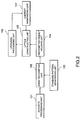
- Fig. 1 is a flow chart for showing operations of automatically selecting the higher n prospective recognition results in rank obtained with respect to a certain voice (the i-th voice) in the conventional voice recognition system.
- An input voice is turned into a plurality of prospective voice recognition results and stored in a recognition result holding portion as the prospective voice recognition results.
- the higher n prospective recognition results in rank are displayed with respect to the i-th voice by repeating the following operations n times.
- all of the stored prospective recognition results are subjected to a language processing by the use of dynamic programming from one side to the other side, for example from a left side to a right side to seek an optimized path (step 1101).
- a prospective recognition result included in the optimized path is displayed and deleted from the prospective recognition results (step 1102).
- Fig. 2 is a block diagram for showing a voice recognition system according to a first embodiment of the present invention.
- an input voice produced per word is analyzed by an acoustic processing unit 101.
- the input voice analyzed by the acoustic processing unit 101 is compared with each standard pattern of the word stored in a standard pattern memorizing unit 103 by a voice recognition unit 102. Thereby, acoustic likelihood is determined between the input voice and each of the standard patterns.
- the input voice is analyzed, as mentioned above, and is changed into a sequence of parameter vectors by the acoustic processing unit 101.
- the acoustic processing unit 101 is composed of a filter bank, a Fourier transformer, a linear predictive factor type analyzer, and the like.
- the standard patterns stored in the standard pattern memorizing unit 103 are expressed as a sequence of parameter vectors.
- a plurality of the standard patterns having a large acoustic likelihood with the analyzed input voice are selected as prospective recognition results by the voice recognition unit 102.
- a predetermined amount of the prospective recognition results are memorized and stored by a recognition result holding unit 104 in order from the one produced precedently.
- a part of the prospective recognition results is deleted from an older one thereof in the recognition result holding unit 104.
- a cumulative score obtained with respect to a precedent voice by a language processing using dynamic programming in a preceding direction in a language processing unit 106 and prospective recognition results with respect to the precedent voice are memorized by a context memorizing unit 107.
- a lattice is constructed by a lattice constructing unit 105 based on the prospective voice recognition results supplied from the the recognition result holding unit 104 and results of the language processing provided till then from the context memorizing unit 107.
- the lattice has prospective voice recognition results with respect to a voice immediately therebefore provided till then from the context memorizing unit 107 at the left end portion.
- the lattice also has prospective voice recognition results supplied from the recognition result holding unit 104 at a portion positioned right side of the left end portion.
- the language processing unit 106 applies a language model to the lattice provided from the lattice constructing unit 105 to sort the prospective voice recognition results with respect to an appointed voice in optimized order.
- Fig. 3 is a view for showing an example of a lattice used in the voice recognition system according to the first embodiment of the present invention.
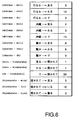
- Fig. 5 is a view for showing a table of cumulative score and acoustic score in the voice recognition system according to the first embodiment of the present invention.
- Fig. 6 is a view for showing a table of language score in the voice recognition system according to the first embodiment of the present invention.
- a prospective voice recognition result located at the left end portion is expressed "w_1”
- prospective voice recognition results to be sorted with respect to an appointed voice is expressed "w_2”
- a prospective voice recognition result located at the right and portion is expressed "w_k+2”.
- An answer of the following equation (1) is determined with respect to every "w_2" in the language processing unit 106.
- G(w_1) is a cumulative score of a column at the left end of the lattice
- 1(w_1,w_2) is a language score decided by the word bigram model (a score decided in proportion to a conditional probability that a word "w_2" is produced next to award "w_1")
- a(w_i) is an acoustic likelihood of a word "w_i”
- w is a constant.
- the answer of the above equation (1) can be efficiently determined by applying dynamic programming in a forward(future) direction (namely, toward a right hand direction of the sheet of Fig. 4, as depicted by a large arrow 200 in Fig. 4) from the left end.
- an answer of the following equation (2) is determined with respect to every "w_2" by applying dynamic programming in a backward(past) direction (namely, toward a left hand direction of the sheet of Fig. 4, as depicted by a large arrow 300 in Fig. 4) from the right end to the appointed voice.
- the prospective voice recognition results are sorted in order from the one having the biggest score S_f(w_2) + S_b(w_2). Further, the language processing unit 106 produces each "w_2" and each S_f(w_2) to the recognition result holding unit 104 as a new cumulative score G(w_2).
- the prospective voice recognition results are sorted in order from the one having the biggest score S_f(w_2) + S_b(w_2).
- the sorted prospective voice recognition results are arranged in the following manner.
- the prospective voice recognition results with respect to the appointed voice can be sorted in optimized order only by simultaneously applying dynamic programming of once from both the directions, namely from both the aforesaid forward and backward directions.
- Fig. 4 illustrated in the sorted prospective voice recognition results with respect to the appointed voice in optimized order [in order (de), (reru), (miru)].
- an optimized word sequence can also be determined in the lattice (the optimized word sequence is shown in the above manner by surrounded with a broken line). Therefore, an improved voice recognition system which never delays to a produced voice can be provided by displaying such an optimized word sequence.
- the recognition results after the appointed voice among the optimized word sequences the result can be rewritten with respect even to the voices of which the result has already been displayed. Thus, an accuracy of the recognition results can be improved accordingly.
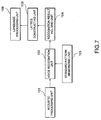
- Fig. 7 is a block diagram for showing a voice recognition system according to a second embodiment of the present invention.
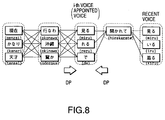
- Fig. 8 is a view for showing an example of a lattice used in the voice recognition system according to the second embodiment of the present invention.
- the voice recognition system according to the second embodiment has a structure basically similar to that of the first embodiment except that the voice recognition system of the second embodiment does not have a context memorizing unit 107 in the first embodiment. Similar portions are designated by like reference numerals.
- a lattice is constructed only from prospective voice recognition results stored in the recognition result holding unit 104.
- a language processing is carried out by the use of dynamic programming in a forward direction, namely, from the left end of the lattice to the appointed voice with respect to the prospective voice recognition results.
- another language processing is also carried out by the use of dynamic programming in a backward direction, namely, from the right end of the lattice to the appointed voice with respect to the prospective voice recognition results.
- a sum of cumulative scores obtained by the language processing in the forward direction is compared with another sum of cumulative scores obtained by the another language processing in the backward direction.
- the prospective voice recognition results are sorted. Accordingly, the prospective voice recognition results sorted in optimized order can be obtained.
- a score supplied only from the left end of the lattice can be employed, similarly to the word unigram.
- a context memorizing unit can be omitted in the voice recognition system.
- the voice recognition system can be free from an influence of an error made before the stored prospective voice recognition results.
- a respective language processing is simultaneously carried out toward an appointed voice by the use of dynamic programming from the both ends of the stored prospective voice recognition results, namely in both forward and backward directions.
- a voice recognition system becomes capable of sorting prospective recognition results obtained for the appointed voice in optimized order only by language processing of once.
- word bigram is used as a language model.
- other language models such as n-gram model may be employed alternatively, provided that the language models can be applied by the use of dynamic programming.
- the voice recognition system of the present invention is applied to voice recognition in Japanese language.
- the principle of the present invention can be applied to voice recognition in any languages other than Japanese language.
- voice in the foregoing description is not a “voice " in its conventional sense, but that the term voice refers to one of a part of a word, a word, a part of a sentence or a sentence which is to be recognized by the voice recognition system.
Landscapes
- Engineering & Computer Science (AREA)
- Computational Linguistics (AREA)
- Health & Medical Sciences (AREA)
- Audiology, Speech & Language Pathology (AREA)
- Human Computer Interaction (AREA)
- Physics & Mathematics (AREA)
- Acoustics & Sound (AREA)
- Multimedia (AREA)
- Machine Translation (AREA)
- Document Processing Apparatus (AREA)
Applications Claiming Priority (3)
| Application Number | Priority Date | Filing Date | Title |
|---|---|---|---|
| JP227584/97 | 1997-08-08 | ||
| JP9227584A JP3050180B2 (ja) | 1997-08-08 | 1997-08-08 | 音声認識装置 |
| JP22758497 | 1997-08-08 |
Publications (3)
| Publication Number | Publication Date |
|---|---|
| EP0896320A2 true EP0896320A2 (fr) | 1999-02-10 |
| EP0896320A3 EP0896320A3 (fr) | 1999-09-01 |
| EP0896320B1 EP0896320B1 (fr) | 2006-05-03 |
Family
ID=16863215
Family Applications (1)
| Application Number | Title | Priority Date | Filing Date |
|---|---|---|---|
| EP98115009A Expired - Lifetime EP0896320B1 (fr) | 1997-08-08 | 1998-08-10 | Dispositif pour classer des résultats potentiels de reconnaissance vocale, obtenus par un processeur linguistique, en un ordre optimisé |
Country Status (4)
| Country | Link |
|---|---|
| US (1) | US6088672A (fr) |
| EP (1) | EP0896320B1 (fr) |
| JP (1) | JP3050180B2 (fr) |
| DE (1) | DE69834366T2 (fr) |
Cited By (1)
| Publication number | Priority date | Publication date | Assignee | Title |
|---|---|---|---|---|
| US20220020362A1 (en) * | 2020-07-17 | 2022-01-20 | Samsung Electronics Co., Ltd. | Speech signal processing method and apparatus |
Families Citing this family (2)
| Publication number | Priority date | Publication date | Assignee | Title |
|---|---|---|---|---|
| US20040267529A1 (en) * | 2003-06-24 | 2004-12-30 | Aurilab, Llc | N-gram spotting followed by matching continuation tree forward and backward from a spotted n-gram |
| US8478578B2 (en) | 2008-01-09 | 2013-07-02 | Fluential, Llc | Mobile speech-to-speech interpretation system |
Family Cites Families (8)
| Publication number | Priority date | Publication date | Assignee | Title |
|---|---|---|---|---|
| US4712243A (en) * | 1983-05-09 | 1987-12-08 | Casio Computer Co., Ltd. | Speech recognition apparatus |
| DE3819178A1 (de) * | 1987-06-04 | 1988-12-22 | Ricoh Kk | Spracherkennungsverfahren und -einrichtung |
| JP3003276B2 (ja) * | 1991-06-19 | 2000-01-24 | 松下電器産業株式会社 | 信号解析装置 |
| JP3114468B2 (ja) * | 1993-11-25 | 2000-12-04 | 松下電器産業株式会社 | 音声認識方法 |
| JP3311460B2 (ja) * | 1994-01-28 | 2002-08-05 | 富士通株式会社 | 音声認識装置 |
| US5655058A (en) * | 1994-04-12 | 1997-08-05 | Xerox Corporation | Segmentation of audio data for indexing of conversational speech for real-time or postprocessing applications |
| DE4412930A1 (de) * | 1994-04-15 | 1995-10-19 | Philips Patentverwaltung | Verfahren zum Ermitteln einer Folge von Wörtern |
| JP3280825B2 (ja) * | 1995-04-26 | 2002-05-13 | 富士通株式会社 | 音声特徴分析装置 |
-
1997
- 1997-08-08 JP JP9227584A patent/JP3050180B2/ja not_active Expired - Fee Related
-
1998
- 1998-08-10 US US09/131,547 patent/US6088672A/en not_active Expired - Fee Related
- 1998-08-10 EP EP98115009A patent/EP0896320B1/fr not_active Expired - Lifetime
- 1998-08-10 DE DE69834366T patent/DE69834366T2/de not_active Expired - Lifetime
Cited By (2)
| Publication number | Priority date | Publication date | Assignee | Title |
|---|---|---|---|---|
| US20220020362A1 (en) * | 2020-07-17 | 2022-01-20 | Samsung Electronics Co., Ltd. | Speech signal processing method and apparatus |
| US11670290B2 (en) * | 2020-07-17 | 2023-06-06 | Samsung Electronics Co., Ltd. | Speech signal processing method and apparatus |
Also Published As
| Publication number | Publication date |
|---|---|
| EP0896320A3 (fr) | 1999-09-01 |
| EP0896320B1 (fr) | 2006-05-03 |
| JPH1152980A (ja) | 1999-02-26 |
| DE69834366D1 (de) | 2006-06-08 |
| DE69834366T2 (de) | 2007-04-19 |
| US6088672A (en) | 2000-07-11 |
| JP3050180B2 (ja) | 2000-06-12 |
Similar Documents
| Publication | Publication Date | Title |
|---|---|---|
| EP0807306B1 (fr) | Systeme et procede de reconnaissance de la parole a generation de syntaxe automatique | |
| US4661924A (en) | Multiple-parts-of-speech disambiguating method and apparatus for machine translation system | |
| US7263484B1 (en) | Phonetic searching | |
| KR100749289B1 (ko) | 텍스트의 자동 세그멘테이션 방법 및 시스템 | |
| US5970448A (en) | Historical database storing relationships of successively spoken words | |
| CA1301345C (fr) | Methodes pour determiner la nature grammaticale et utilisation de ces methodes | |
| US5659771A (en) | System for spelling correction in which the context of a target word in a sentence is utilized to determine which of several possible words was intended | |
| US5564046A (en) | Method and system for creating a database by dividing text data into nodes which can be corrected | |
| EP0637805A2 (fr) | Méthode pour trouver de l'information sur un mot en liaison avec son contacte dans un dictionnaire électronique | |
| EP0634042A1 (fr) | Systeme de reconnaissance de la parole destine aux langues a mots combines | |
| EP1209659A2 (fr) | Méthode et appareil d'entrée de texte à l'aide de reconnaissance de la parole | |
| US20080059149A1 (en) | Mapping of semantic tags to phases for grammar generation | |
| JP2633824B2 (ja) | 仮名漢字変換装置 | |
| EP0524694A1 (fr) | Procédé pour donner des inflexions aux mots et une unité de traitement de données pour réaliser ce procédé | |
| EP0896320A2 (fr) | Dispositif pour classer des résultats potentiels de reconnaissance vocale, obtenus par un processeur linguistique, en un ordre optimisé | |
| Bobrow | Statistical agenda parsing | |
| KR100191001B1 (ko) | 고속교정장치 및 그 방법 | |
| JPH04232997A (ja) | 音声認識装置における認識結果表示方式 | |
| JP2708771B2 (ja) | 音声認識方式 | |
| JPH0236473A (ja) | 日本語解析装置 | |
| JPH05151259A (ja) | 文入力処理方式 | |
| JPH04211862A (ja) | 仮名漢字変換方法 | |
| JPH05143604A (ja) | 自動綴り訂正装置の単語選択方法 | |
| JPH0887502A (ja) | テキスト用話題構造認識における話題語選択方法と話題構造認識装置 | |
| JP2000330586A (ja) | 音声認識方法および音声認識装置 |
Legal Events
| Date | Code | Title | Description |
|---|---|---|---|
| PUAI | Public reference made under article 153(3) epc to a published international application that has entered the european phase |
Free format text: ORIGINAL CODE: 0009012 |
|
| AK | Designated contracting states |
Kind code of ref document: A2 Designated state(s): DE FR GB |
|
| AX | Request for extension of the european patent |
Free format text: AL;LT;LV;MK;RO;SI |
|
| PUAL | Search report despatched |
Free format text: ORIGINAL CODE: 0009013 |
|
| AK | Designated contracting states |
Kind code of ref document: A3 Designated state(s): AT BE CH CY DE DK ES FI FR GB GR IE IT LI LU MC NL PT SE |
|
| AX | Request for extension of the european patent |
Free format text: AL;LT;LV;MK;RO;SI |
|
| 17P | Request for examination filed |
Effective date: 19991213 |
|
| AKX | Designation fees paid |
Free format text: DE FR GB |
|
| 17Q | First examination report despatched |
Effective date: 20030328 |
|
| GRAP | Despatch of communication of intention to grant a patent |
Free format text: ORIGINAL CODE: EPIDOSNIGR1 |
|
| RIC1 | Information provided on ipc code assigned before grant |
Ipc: 7G 10L 15/08 A |
|
| GRAS | Grant fee paid |
Free format text: ORIGINAL CODE: EPIDOSNIGR3 |
|
| GRAA | (expected) grant |
Free format text: ORIGINAL CODE: 0009210 |
|
| AK | Designated contracting states |
Kind code of ref document: B1 Designated state(s): DE FR GB |
|
| REG | Reference to a national code |
Ref country code: GB Ref legal event code: FG4D |
|
| REF | Corresponds to: |
Ref document number: 69834366 Country of ref document: DE Date of ref document: 20060608 Kind code of ref document: P |
|
| ET | Fr: translation filed | ||
| PLBE | No opposition filed within time limit |
Free format text: ORIGINAL CODE: 0009261 |
|
| STAA | Information on the status of an ep patent application or granted ep patent |
Free format text: STATUS: NO OPPOSITION FILED WITHIN TIME LIMIT |
|
| 26N | No opposition filed |
Effective date: 20070206 |
|
| PGFP | Annual fee paid to national office [announced via postgrant information from national office to epo] |
Ref country code: FR Payment date: 20100824 Year of fee payment: 13 Ref country code: DE Payment date: 20100812 Year of fee payment: 13 |
|
| PGFP | Annual fee paid to national office [announced via postgrant information from national office to epo] |
Ref country code: GB Payment date: 20100811 Year of fee payment: 13 |
|
| GBPC | Gb: european patent ceased through non-payment of renewal fee |
Effective date: 20110810 |
|
| REG | Reference to a national code |
Ref country code: FR Ref legal event code: ST Effective date: 20120430 |
|
| REG | Reference to a national code |
Ref country code: DE Ref legal event code: R119 Ref document number: 69834366 Country of ref document: DE Effective date: 20120301 |
|
| PG25 | Lapsed in a contracting state [announced via postgrant information from national office to epo] |
Ref country code: GB Free format text: LAPSE BECAUSE OF NON-PAYMENT OF DUE FEES Effective date: 20110810 Ref country code: FR Free format text: LAPSE BECAUSE OF NON-PAYMENT OF DUE FEES Effective date: 20110831 |
|
| PG25 | Lapsed in a contracting state [announced via postgrant information from national office to epo] |
Ref country code: DE Free format text: LAPSE BECAUSE OF NON-PAYMENT OF DUE FEES Effective date: 20120301 |