EP0896839A2 - Verfahren zur Herstellung von Blech aus einer Titanlegierung - Google Patents
Verfahren zur Herstellung von Blech aus einer Titanlegierung Download PDFInfo
- Publication number
- EP0896839A2 EP0896839A2 EP98112311A EP98112311A EP0896839A2 EP 0896839 A2 EP0896839 A2 EP 0896839A2 EP 98112311 A EP98112311 A EP 98112311A EP 98112311 A EP98112311 A EP 98112311A EP 0896839 A2 EP0896839 A2 EP 0896839A2
- Authority
- EP
- European Patent Office
- Prior art keywords
- titanium alloy
- slab
- carbon steel
- release agent
- assembled
- Prior art date
- Legal status (The legal status is an assumption and is not a legal conclusion. Google has not performed a legal analysis and makes no representation as to the accuracy of the status listed.)
- Granted
Links
Images

Classifications
-
- B—PERFORMING OPERATIONS; TRANSPORTING
- B21—MECHANICAL METAL-WORKING WITHOUT ESSENTIALLY REMOVING MATERIAL; PUNCHING METAL
- B21B—ROLLING OF METAL
- B21B3/00—Rolling materials of special alloys so far as the composition of the alloy requires or permits special rolling methods or sequences ; Rolling of aluminium, copper, zinc or other non-ferrous metals
-
- Y—GENERAL TAGGING OF NEW TECHNOLOGICAL DEVELOPMENTS; GENERAL TAGGING OF CROSS-SECTIONAL TECHNOLOGIES SPANNING OVER SEVERAL SECTIONS OF THE IPC; TECHNICAL SUBJECTS COVERED BY FORMER USPC CROSS-REFERENCE ART COLLECTIONS [XRACs] AND DIGESTS
- Y10—TECHNICAL SUBJECTS COVERED BY FORMER USPC
- Y10T—TECHNICAL SUBJECTS COVERED BY FORMER US CLASSIFICATION
- Y10T29/00—Metal working
- Y10T29/30—Foil or other thin sheet-metal making or treating
- Y10T29/301—Method
- Y10T29/303—Method with assembling or disassembling of a pack
- Y10T29/305—Method with assembling or disassembling of a pack including bond prevention treatment
-
- Y—GENERAL TAGGING OF NEW TECHNOLOGICAL DEVELOPMENTS; GENERAL TAGGING OF CROSS-SECTIONAL TECHNOLOGIES SPANNING OVER SEVERAL SECTIONS OF THE IPC; TECHNICAL SUBJECTS COVERED BY FORMER USPC CROSS-REFERENCE ART COLLECTIONS [XRACs] AND DIGESTS
- Y10—TECHNICAL SUBJECTS COVERED BY FORMER USPC
- Y10T—TECHNICAL SUBJECTS COVERED BY FORMER US CLASSIFICATION
- Y10T29/00—Metal working
- Y10T29/49—Method of mechanical manufacture
- Y10T29/4981—Utilizing transitory attached element or associated separate material
Definitions
- the present invention relates to a method for manufacturing a titanium alloy sheet, and particularly, to a method for efficiently manufacturing a titanium alloy sheet excellent in surface conditions and workability.
- a titanium alloy sheet, particularly an ⁇ + ⁇ type titanium alloy sheet is conventionally manufactured by a pack-rolling using a plate mill as disclosed in Japanese Patent Provisional Publication No. JP-A-63-76,706 (hereinafter referred to as the "prior art 1").
- the pack-rolled titanium alloy sheet is conventionally manufactured by covering at least upper and lower surfaces of a titanium alloy slab with mill scale or a titanium alloy slab subjected to a surface treatment such as descaling with carbon steel plates, and hot-rolling the titanium alloy slab thus covered with the carbon steel plates.
- Another conventional pack-rolling comprises the steps, as shown in Figs. 1 and 2, of covering upper and lower surfaces and peripheral side surfaces of a titanium alloy slab 4 with mill scale or a titanium alloy slab 4 subjected to a surface treatment such as descaling with an envelope comprising carbon steel plates 1 (hereinafter referred to as the "carbon steel envelope" ) to prepare an assembled slab, providing deaerating holes 5 for discharging air in the interior of the assembled slab during the hot-rolling in the open air, or slits having a function equivalent to the above holes 5, on the carbon steel envelope, and then hot-rolling the titanium alloy slab thus covered with the carbon steel envelope, i.e., the assembled slab.
- a surface treatment such as descaling with an envelope comprising carbon steel plates 1 (hereinafter referred to as the "carbon steel envelope” ) to prepare an assembled slab, providing deaerating holes 5 for discharging air in the interior of the assembled slab during the hot-rolling in the open air, or slits having a function equivalent to the
- a release agent is disposed therebetween when preparing the foregoing assembled slab.
- the above-mentioned assembled slab is prepared by welding together the carbon steel plates 1 on the upper surface, the lower surface and the peripheral side surfaces in the open air along welding grooves 6 provided between the upper and the peripheral side carbon steel plates and between the lower and the peripheral side carbon steel plates.
- temperature of a titanium alloy slab remarkably decreases during the hot-rolling according as the thickness thereof decreases, resulting in a lower workability.
- the method of the prior art 1 since the titanium alloy slab is covered with the carbon steel envelope, there is only a slight decrease in temperature of the titanium alloy slab during the hot-rolling, thus making it possible to roll the titanium alloy slab within a high temperature range. It is consequently possible to manufacture a titanium alloy sheet by the use of an ordinary hot-rolling mill such as a plate mill.
- a commercially pure titanium sheet and a titanium alloy sheet have anisotropy in strength.
- a cross-rolling can be applied, thus permitting reduction of anisotropy in strength of the commercially pure titanium sheet and the titanium alloy sheet.
- said encapsulating step comprises the following sub-steps of: (a) preparing a metal frame of said second metal, said metal frame having a window therein, (b) mounting-said first metal in said window in said metal frame, (c) interleaving said metal frame and said first metal between two layers of said second metal, thereby forming a laminate metal assembly, and (d) welding said two layers of said second metal to said metal frame, and wherein said two layers of said second metal include surface depressions, and said release agent is disposed in said surface depressions.
- the sub-step of welding the two layers of the second metal to the metal frame comprises an electron beam welding under a vacuum atmosphere.
- the metal assembly under a vacuum atmosphere which houses the titanium alloy slab therein is hot-rolled. It is therefore possible to restrain the formation of a thick and tight oxide scale on the surface of the titanium alloy slab during the heating and during the hot-rolling of the metal assembly in the open air. It is accordingly possible to omit or simplify an excessive polishing or grinding step by means of a grinder, which serves also for a thickness adjustment, or a shot-blasting step or a pickling step, for removing the thick and tight oxide scale.
- the interior of the metal assembly tack-welded in the open air can be made a vacuum atmosphere in a vacuum chamber within a relatively short period of time. More specifically, it is possible to achieve a vacuum atmosphere within a relatively short period of time in the interior of the metal assembly, which interior has a small space because of the titanium alloy slab housed therein, and accordingly has a large deaeration resistance.
- the prior arts 1 and 2 have however the following problems.
- an oxide scale and/or a deteriorated layer in which a large quantity of oxygen is dissolved in the form of solid-solution, are formed during the heating or during the hot-rolling of the assembled slab not only when a slab in the assembled slab is a titanium alloy slab with mill scale, but also even when the slab is a titanium alloy slab subjected to a surface treatment such as descaling.
- the above-mentioned oxide scale and deteriorated layer cause deterioration of surface conditions of the titanium alloy sheet as a product and a serious decrease in material properties such as bendability. It is therefore necessary to remove these oxide scale and deteriorated layer.
- Available methods for removing the oxide scale and the deteriorated layer include a method of polishing and grinding the surface of the titanium alloy sheet by means of a grinder or the like to remove the oxide scale and the deteriorated layer, and a method of using a shot-blasting and a pickling to remove the oxide scale and the deteriorated layer.
- thickness of the sheet can be simultaneously adjusted. It is therefore possible to manufacture a titanium alloy sheet having a high thickness accuracy and containing only a little strain.
- a problem is however that, because the titanium alloy sheet having a low machinability and a large area is to be polished or ground, the foregoing descaling step requires a long period of time and the manufacturing cost is higher.
- a release agent is used.
- the release agent comes off during preparing the metal assembly after applying the release agent, and during hot-rolling, thus causing the aforesaid bonding, or the releasing agent coheres, thus causing dents or the like on the surface of the titanium alloy sheet.
- a special working step is required for providing depressions in the non-reactive second metal. Because the release agent is disposed in the depressions of the second metal, the metal assembly can receive only a sheet of the reactive first metal. This makes it impossible to adopt an efficient method of, for example, forming a plurality of sheets of the reactive first metal by means of a single run of hot-rolling.
- An object of the present invention is therefore to provide a method for efficiently manufacturing a titanium alloy sheet excellent in surface conditions and workability by overcoming the problems in the foregoing prior arts.
- a method for manufacturing a titanium alloy sheet which comprises the steps of:
- said hot-rolled assembled slab is subjected to a heat treatment.
- said heat treatment comprises a creep flattening.
- an oxide layer formed on the surface of the titanium alloy slab also prevents bonding between the carbon steel envelope covering the titanium alloy slab and the titanium alloy slab, or between two or more titanium alloy slabs, thus, the oxide layer has the same function as that of the release agent
- the state of vacuum in the assembled slab affects the total applying quantity of the release agent.
- the surface of the titanium alloy slab and a new surface formed by the hot-rolling are slightly oxidized by gaseous elements such as oxygen remaining in the assembled slab.
- the thus formed oxide layer serves to restrain bonding between the carbon steel envelope and the titanium alloy slab, so that a smaller total applying quantity of the release agent suffices when the state of vacuum is not satisfactory.
- the release agent in order to prevent the dents on the surface of the titanium alloy sheet caused by cohesion of the release agent, on the other hand, it is necessary to adjust the upper limit value of the total applying quantity of the release agent in response to the degree of vacuum in the assembled slab. More specifically, when applying the release agent in a large quantity over the prescribed quantity in order to prevent bonding between the carbon steel envelope covering the titanium alloy slab and the titanium alloy slab, or between two or more titanium alloy slabs, the release agent coheres and the dents occur on the surface of the titanium alloy sheet as a product. When applying the release agent in a small quantity under the prescribed quantity, bonding occurs between the carbon steel envelope and the titanium alloy slab, or between the titanium alloy slabs, although the occurrence of the dents caused by coherence of the release agent can be restrained.
- the present invention was developed on the basis of the foregoing findings, and a method of the present invention for manufacturing a titanium alloy sheet comprises the steps of:
- said hot-rolled assembled slab is subjected to a heat treatment.
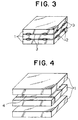
- Fig. 3 is a schematic perspective view illustrating an embodiment of the preparing step of an assembled slab using an electron beam welding in the method of the present invention
- Fig. 4 is a schematic exploded perspective view of the assembled slab in the method of the present invention, as shown in Fig. 3.
- 1 is a carbon steel plate
- 2 is a tack-welded joint
- 3 is a deaerating section.
- 4 is a titanium alloy slab.
- an upper surface, a lower surface and peripheral side surfaces of at least one titanium alloy slab are covered with respective carbon steel plates 1, and the carbon steel plates 1 are tack-welded together in the open air to prepare a tack-welded carbon steel envelope, thereby preparing a provisional assembled slab containing the titanium alloy slab therein.
- the provisional assembled slab thus prepared is then housed in a vacuum chamber (not shown), to deaerate from the interior of the tack-welded carbon steel envelope through the deaerating section 3 thereof in a vacuum atmosphere of up to 10 -2 Torr. Then, all gaps including the deaerating section 3 of the carbon steel envelope are welded, thereby preparing an assembled slab containing the titanium alloy slab therein, with an interior thereof kept at a degree of vacuum of up to 10 -2 Torr.
- the assembled slab of which the interior is kept at a vacuum atmosphere is subjected to a hot-rolling.
- the reason is that it is possible to restrain, during the hot-rolling, the formation of a thick and tight oxide scale and/or a deteriorated layer, in which a large quantity of oxygen is dissolved in the form of solid-solution, on the surface of the titanium alloy slab.
- the assembled slab is prepared in the vacuum chamber by means of the high-energy-density welding such as an electron beam welding.
- the high-energy-density welding such as an electron beam welding.
- the method of the present invention provides not only a titanium alloy sheet excellent in material properties but also more favorable economic merits.
- the surface of the titanium alloy slab is slightly oxidized by oxygen remaining in the assembled slab even if a new surface is formed on the titanium alloy slab under the effect of the hot-rolling of the assembled slab.
- the thus formed oxide layer restrains bonding between the titanium alloy slab and the carbon steel envelope and/or between the titanium alloy slabs. It is consequently possible to reduce the quantity of the solid content in the release agent. Therefore, the total applying quantity of the release agent onto the surfaces of the titanium alloy slab, or onto the respective inner surfaces of the carbon steel envelope facing to the surfaces of the titanium alloy slab, is adjusted in response to the quantity of the solid content in the release agent and the degree of vacuum in the interior of the assembled slab.
- the total applying quantity of the release agent becomes so small that there is occurred bonding between the titanium alloy sheets and between the titanium alloy sheet and the carbon steel envelope during the hot-rolling of the assembled slab.
- the metal oxide or the metal nitride as the solid content in the release agent must comprise a substance having an ability of preventing bonding between the metals even after the hot-rolling when applied onto the contact surface between the metals, and more particularly, comprise alumina, zirconia, boron nitride or titania.
- a Ti-4.5wt.% Al-3wt.% V-2wt.% Mo-2wt.% Fe alloy was employed as a material for a titanium alloy slab.
- Three titanium alloy slabs each having the foregoing chemical composition and having dimensions of a thickness of 20 mm, a width of 100 mm and a length of 150 mm, were piled up.
- An upper surface of the uppermost slab, a lower surface of the lowermost slab, and peripheral side surfaces of the three slabs were covered with respective carbon steel plates, and the carbon steel plates were tack-welded together in the open air to prepare a tack-welded carbon steel envelope, thereby preparing a provisional assembled slab containing the three titanium alloy slabs therein, and having dimensions of a thickness of 180 mm, a width of 150 mm and a length of 200 mm.
- a release agent in a quantity of 300 ml/m 2 comprising a powdery alumina as a solid content in a quantity of 50 wt.%, having a particle size of 325 mesh, was applied onto the surfaces of the three titanium alloy slabs.
- the thus prepared provisional assembled slab was housed in a vacuum chamber to deaerate from the interior of the tack-welded carbon steel envelope.
- the carbon steel plates forming the carbon steel envelope were welded together in a vacuum atmosphere by means of an electron beam welding, thereby preparing an assembled slab having dimensions of a thickness of 180 mm, a width of 150 mm and a length of 200 mm, and containing the three titanium alloy slabs therein, each having the above-mentioned dimensions, with an interior kept at a degree of vacuum (Torr) as shown in Table 1.
- the thus prepared assembled slab was heated to a temperature of about 850°C and subjected to a hot-rolling comprising a cross-rolling by means of a plate mill within a temperature range of from 830 to 680°C to form three titanium alloy sheets.
- the carbon steel envelope was removed from the thus formed titanium alloy sheets, thereby preparing three titanium alloy sheets, each having dimensions of a thickness of 2 mm, a width of 250 mm and a length of 500 mm, within the scope of the present invention (hereinafter referred to as the "samples of the invention") Nos. A01 to A04.
- the thus prepared assembled slab was subjected to the hot-rolling comprising the cross-rolling in the same manner as in the samples of the invention Nos. A01 to A04 to form three titanium alloy sheets.
- the carbon steel envelope was removed from the thus formed titanium alloy sheets, thereby preparing three titanium alloy sheets, each having dimensions of a thickness of 2 mm, a width of 250 mm and a length of 500 mm, outside the scope of the present invention (hereinafter referred to as the "sample for comparison") No. A05.
- the thick oxide scale and the thick deteriorated layer were formed during the heating and the hot-rolling of the assembled slab because the degree of vacuum in the interior thereof was poor outside the scope of the present invention with a value of 5 ⁇ 10 -2 Torr. Accordingly, the critical bend factor of the sample for comparison No. A05 was 6, representing a bendability inferior to that of the samples of the invention Nos. A01 to A04.
- a Ti-6wt.% Al-4wt.% V alloy was employed as a material for a titanium alloy slab.
- a release agent in a quantity of 300 ml/m 2 comprising a powdery alumina as a solid content in a quantity of 50 wt.%, having a particle size of 325 mesh, was applied onto the upper surface and the lower surface of the titanium alloy slab.
- the thus prepared provisional assembled slab was housed in a vacuum chamber to deaerate from the interior of the tack-welded carbon steel envelope.
- the carbon steel plates forming the carbon steel envelope were welded together in a vacuum atmosphere by means of an electron beam welding, thereby preparing an assembled slab having dimensions of a thickness of 140 mm, a width of 150 mm and a length of 200 mm, and containing the titanium alloy slab therein, having the above-mentioned dimensions, with an interior kept at a degree of vacuum (Torr) as shown in Table 2.
- the thus prepared assembled slab was heated to a temperature of about 950°C and subjected to a hot-rolling comprising a cross-rolling by means of a plate mill within a temperature range of from 930 to 780 °C to form a titanium alloy sheet.
- the carbon steel envelope was removed from the thus formed titanium alloy sheet, thereby preparing a titanium alloy sheet having dimensions of a thickness of 2 mm, a width of 250 mm and a length of 500 mm, within the scope of the present invention (hereinafter referred to as the "samples of the invention") Nos. B01 to B04.
- a titanium alloy slab having the same chemical composition and the same dimensions as in the samples of the invention Nos. B01 to B04 was used, and an assembled slab, having dimensions of a thickness of 140 mm, a width of 150 mm and a length of 200 mm, and containing the titanium alloy slab therein with an interior kept at a degree of vacuum (Torr) as shown in Table 2, was prepared in the same manner as in the samples of the invention Nos. B01 to B04, except that the degree of vacuum during the electron beam welding was low outside the scope of the present invention.
- Torr degree of vacuum
- the thus prepared assembled slab was subjected to the hot-rolling comprising the cross-rolling in the same manner as in the samples of the invention Nos. B01 to B04 to form a titanium alloy sheet.
- the carbon steel envelope was removed from the thus formed titanium alloy sheet, thereby preparing a titanium alloy sheet having dimensions of a thickness of 2 mm, a width of 250 mm and a length of 500 mm, outside the scope of the present invention (hereinafter referred to as the "sample for comparison") No. B05.
- the thick oxide scale and the thick deteriorated layer were formed during the heating and the hot-rolling of the assembled slab because the degree of vacuum in the interior thereof was poor outside the scope of the present invention with a value of 5 ⁇ 10 -2 Torr. Accordingly, the critical bend factor of the sample for comparison No. B05 was 8, representing a bendability inferior to that of the samples of the invention Nos. B01 to B04.
- a Ti-4 5wt.% Al-3wt.% V-2wt.% Mo-2wt.% Fe alloy was employed as a material for a titanium alloy slab.
- Two titanium alloy slabs each having the foregoing chemical composition and having dimensions of a thickness of 20 mm, a width of 100 mm and a length of 150 mm, were piled up.
- An upper surface of the upper slab, a lower surface of the lower slab, and peripheral side surfaces of the two slabs were covered with respective carbon steel plates, and the carbon steel plates were tack-welded together in the open air to prepare a tack-welded carbon steel envelope, thereby preparing a provisional assembled slab containing the two titanium alloy slabs therein, and having dimensions of a thickness of 160 mm, a width of 150 mm and a length of 200 mm.
- a release agent in a quantity (ml/m 2 ) as shown in Table 4 comprising a powdery alumina, a powdery zirconia, a powdery boron nitride or a powdery titania as a solid content having a particle size (mesh) and in a quantity (wt.%) as shown in Table 3, was applied onto the surfaces of the two titanium alloy slabs.
- the thus prepared provisional assembled slab was housed in a vacuum chamber to deaerate from the interior of the tack-welded carbon steel envelope.
- the carbon steel plates forming the carbon steel envelope were welded together in a vacuum atmosphere by means of an electron beam welding, thereby preparing an assembled slab having dimensions of a thickness of 160 mm, a width of 150 mm and a length of 200 mm, and containing the two titanium alloy slabs therein, each having the above-mentioned dimensions, with an interior kept at a degree of vacuum (Torr) as shown in Table 3.
- the thus prepared assembled slab was heated to a temperature of about 850°C and subjected to a hot-rolling comprising a cross-rolling by means of a plate mill within a temperature range of from 830 to 680°C to form two titanium alloy sheets.
- the assembled slab was subjected to a heat treatment at a temperature of 720°C for an hour, and then, the two titanium alloy sheets, from which the carbon steel envelope were removed, were subjected to a pickling, thereby preparing titanium alloy sheets within the scope of the present invention (hereinafter referred to as the "samples of the invention") Nos.
- the release agent cohered because the value of X ⁇ Y/ (1 - ⁇ Z) representing the total applying quantity of the release agent was so large as 25,359 outside the scope of the present invention, and as a result, large dents occurred on the sample surface.
- the Ti-4.5wt.% Al-3wt.% V-2wt.% Mo-2wt.% Fe alloy or the Ti-6wt.% Al-4wt.% V alloy was employed as a material for titanium alloy slabs.
- the titanium alloys used in the present invention are not however limited to these alloys, but applicable titanium alloys include a Ti-6wt.% Al-2wt.% Sn-4wt.% Zr-6wt.% Mo alloy, a Ti-8wt.% Al-1wt.% Mo-1wt.% v alloy and a Ti-5wt.% Al-2.5wt.% Sn alloy and so on.
- the electron beam welding was applied as the high-energy-density welding in a vacuum atmosphere.
- the high-energy-density welding in the method of the present invention is not limited to this, but a laser beam welding is also applicable.
- the number of titanium alloy slabs to be contained in the carbon steel envelope may be arbitrary.
Landscapes
- Engineering & Computer Science (AREA)
- Mechanical Engineering (AREA)
- Pressure Welding/Diffusion-Bonding (AREA)
- Metal Rolling (AREA)
- Welding Or Cutting Using Electron Beams (AREA)
- Powder Metallurgy (AREA)
Applications Claiming Priority (3)
| Application Number | Priority Date | Filing Date | Title |
|---|---|---|---|
| JP9219529A JPH1157810A (ja) | 1997-08-14 | 1997-08-14 | チタン合金シート材の製造方法 |
| JP21952997 | 1997-08-14 | ||
| JP219529/97 | 1997-08-14 |
Publications (3)
| Publication Number | Publication Date |
|---|---|
| EP0896839A2 true EP0896839A2 (de) | 1999-02-17 |
| EP0896839A3 EP0896839A3 (de) | 2002-01-16 |
| EP0896839B1 EP0896839B1 (de) | 2004-04-14 |
Family
ID=16736914
Family Applications (1)
| Application Number | Title | Priority Date | Filing Date |
|---|---|---|---|
| EP98112311A Expired - Lifetime EP0896839B1 (de) | 1997-08-14 | 1998-07-02 | Verfahren zur Herstellung von Blech aus einer Titanlegierung |
Country Status (4)
| Country | Link |
|---|---|
| US (1) | US5932036A (de) |
| EP (1) | EP0896839B1 (de) |
| JP (1) | JPH1157810A (de) |
| DE (1) | DE69823112T2 (de) |
Cited By (5)
| Publication number | Priority date | Publication date | Assignee | Title |
|---|---|---|---|---|
| WO2005019489A1 (en) * | 2003-08-25 | 2005-03-03 | The Boeing Company | Method for manufacturing thin sheets of high-strength titanium alloys |
| CN102941228A (zh) * | 2012-11-29 | 2013-02-27 | 西北有色金属研究院 | 一种钛合金箔材的制备方法 |
| CN108246825A (zh) * | 2017-12-25 | 2018-07-06 | 南京钢铁股份有限公司 | 一种tmcp型船用双相不锈钢复合板的制备方法 |
| CN109128691A (zh) * | 2018-10-26 | 2019-01-04 | 山东钢铁集团日照有限公司 | 一种高碳高合金钢板用复合铸坯的制备工艺 |
| CN119794739A (zh) * | 2025-01-14 | 2025-04-11 | 山西太钢不锈钢股份有限公司 | 一种大尺寸宽幅高硼不锈钢板材的加工方法 |
Families Citing this family (21)
| Publication number | Priority date | Publication date | Assignee | Title |
|---|---|---|---|---|
| US7335426B2 (en) * | 1999-11-19 | 2008-02-26 | Advanced Bio Prosthetic Surfaces, Ltd. | High strength vacuum deposited nitinol alloy films and method of making same |
| US6379383B1 (en) | 1999-11-19 | 2002-04-30 | Advanced Bio Prosthetic Surfaces, Ltd. | Endoluminal device exhibiting improved endothelialization and method of manufacture thereof |
| AU2002233936A1 (en) | 2000-11-07 | 2002-05-21 | Advanced Bio Prosthetic Surfaces, Ltd. | Endoluminal stent, self-fupporting endoluminal graft and methods of making same |
| EP1549248A4 (de) | 2002-09-26 | 2015-11-25 | Advanced Bio Prosthetic Surfac | In vakuum abgeschiedene nitinol-legierungsfilme hoher festigkeit, medizinische dünnfilm-implantatmaterialien und herstellungsverfahren dafür |
| US8381631B2 (en) * | 2008-12-01 | 2013-02-26 | Battelle Energy Alliance, Llc | Laminate armor and related methods |
| CN102000960B (zh) * | 2010-09-13 | 2012-07-25 | 大连重矿设备制造有限公司 | 基于冷变形再结晶过程生产金属复合材料的工艺方法 |
| CN102773243A (zh) * | 2012-07-27 | 2012-11-14 | 济钢集团有限公司 | 一种利用废旧钢板生产中厚板材的方法 |
| CN103212596B (zh) * | 2013-05-10 | 2015-03-18 | 山东亚盛重工股份有限公司 | 复合板轧制前处理工艺 |
| CN104217058B (zh) * | 2013-06-05 | 2017-09-19 | 上海宝信软件股份有限公司 | 厚板智能材料设计方法 |
| CN104190715B (zh) * | 2014-09-26 | 2017-01-25 | 西部钛业有限责任公司 | 一种tc1钛合金薄板的叠轧加工方法 |
| RU2702880C2 (ru) * | 2014-10-08 | 2019-10-11 | Ниппон Стил Корпорейшн | Титансодержащая структура и титановый продукт |
| CN104550233B (zh) * | 2014-12-19 | 2017-01-11 | 山东钢铁股份有限公司 | 一种热轧复合坯的生产工艺 |
| CN104874635A (zh) * | 2015-06-16 | 2015-09-02 | 攀钢集团攀枝花钢铁研究院有限公司 | 以铜为中间层高结合强度钛钢复合板的制备方法 |
| WO2017018522A1 (ja) | 2015-07-29 | 2017-02-02 | 新日鐵住金株式会社 | チタン複合材および熱間加工用チタン材 |
| JP6658756B2 (ja) | 2015-07-29 | 2020-03-04 | 日本製鉄株式会社 | チタン複合材および熱間圧延用チタン材 |
| CN107159724A (zh) * | 2017-07-20 | 2017-09-15 | 河北工业大学 | 一种复合板组坯过程的密封装置 |
| CN109317515B (zh) * | 2018-10-19 | 2021-04-27 | 太原钢铁(集团)有限公司 | 一次获得多张热轧板的轧制方法 |
| KR102518087B1 (ko) * | 2019-09-10 | 2023-04-04 | 재단법인 포항산업과학연구원 | 티타늄 판재의 압연 방법 |
| CN112372131A (zh) * | 2020-11-02 | 2021-02-19 | 中国航空制造技术研究院 | 一种钛合金空心结构的扩散连接制备方法 |
| CN112958678B (zh) * | 2021-02-04 | 2022-10-04 | 宝鸡盛辉钛业有限公司 | 深海耐压钛合金半球型舱体的加工工艺 |
| CN119216359A (zh) * | 2024-11-29 | 2024-12-31 | 西部超导材料科技股份有限公司 | 高均匀Ti650高温钛合金薄板的轧制方法 |
Family Cites Families (6)
| Publication number | Priority date | Publication date | Assignee | Title |
|---|---|---|---|---|
| US3122423A (en) * | 1960-04-04 | 1964-02-25 | Beryllium Corp | Method and apparatus for hot rolling high quality metal sheet |
| JP2515514B2 (ja) * | 1986-09-18 | 1996-07-10 | 日本鋼管株式会社 | α+β型合金チタンの薄板製造方法 |
| US5121535A (en) * | 1988-12-14 | 1992-06-16 | Sulzer Bros. Ltd. | Method for production of thin sections of reactive metals |
| US5127146A (en) * | 1988-12-14 | 1992-07-07 | Sulzer Brothers, Ltd. | Method for production of thin sections of reactive metals |
| ATE156393T1 (de) * | 1992-05-08 | 1997-08-15 | Sulzer Innotec Ag | Herstellung von dünnwandigen, bei erhöhter temperatur korrosionsanfälligen metallteilen |
| ATE156394T1 (de) * | 1993-05-25 | 1997-08-15 | Sulzer Innotec Ag | Trennmittel für die warmumformung von gekapselten metallteilen und verfahren zum herstellen des trennmittels |
-
1997
- 1997-08-14 JP JP9219529A patent/JPH1157810A/ja active Pending
-
1998
- 1998-06-29 US US09/107,558 patent/US5932036A/en not_active Expired - Lifetime
- 1998-07-02 EP EP98112311A patent/EP0896839B1/de not_active Expired - Lifetime
- 1998-07-02 DE DE69823112T patent/DE69823112T2/de not_active Expired - Fee Related
Cited By (7)
| Publication number | Priority date | Publication date | Assignee | Title |
|---|---|---|---|---|
| WO2005019489A1 (en) * | 2003-08-25 | 2005-03-03 | The Boeing Company | Method for manufacturing thin sheets of high-strength titanium alloys |
| US7708845B2 (en) | 2003-08-25 | 2010-05-04 | The Boeing Company | Method for manufacturing thin sheets of high strength titanium alloys description |
| CN102941228A (zh) * | 2012-11-29 | 2013-02-27 | 西北有色金属研究院 | 一种钛合金箔材的制备方法 |
| CN108246825A (zh) * | 2017-12-25 | 2018-07-06 | 南京钢铁股份有限公司 | 一种tmcp型船用双相不锈钢复合板的制备方法 |
| CN109128691A (zh) * | 2018-10-26 | 2019-01-04 | 山东钢铁集团日照有限公司 | 一种高碳高合金钢板用复合铸坯的制备工艺 |
| CN109128691B (zh) * | 2018-10-26 | 2020-11-06 | 山东钢铁集团日照有限公司 | 一种高碳高合金钢板用复合铸坯的制备工艺 |
| CN119794739A (zh) * | 2025-01-14 | 2025-04-11 | 山西太钢不锈钢股份有限公司 | 一种大尺寸宽幅高硼不锈钢板材的加工方法 |
Also Published As
| Publication number | Publication date |
|---|---|
| EP0896839B1 (de) | 2004-04-14 |
| EP0896839A3 (de) | 2002-01-16 |
| JPH1157810A (ja) | 1999-03-02 |
| US5932036A (en) | 1999-08-03 |
| DE69823112D1 (de) | 2004-05-19 |
| DE69823112T2 (de) | 2005-03-24 |
Similar Documents
| Publication | Publication Date | Title |
|---|---|---|
| EP0896839A2 (de) | Verfahren zur Herstellung von Blech aus einer Titanlegierung | |
| EP3330393B1 (de) | Magnesiumlegierungsblech | |
| US6348139B1 (en) | Tantalum-comprising articles | |
| US6238494B1 (en) | Polycrystalline, metallic sputtering target | |
| EP3330077B1 (de) | Titanverbundwerkstoff und titanwerkstoff für die warmumformung | |
| AU761334B2 (en) | Steel band with good forming properties and method for producing same | |
| JP2806228B2 (ja) | 難加工性Co合金の低透磁率化方法 | |
| EP3098329B1 (de) | Verfahren zur herstellung eines aluminiummetallfolienprodukts | |
| US2985945A (en) | Pack rolling | |
| CN108501471A (zh) | 电子设备用轧制接合体及电子设备用壳体 | |
| EP3427850B1 (de) | Titanmaterial und verfahren zur herstellung davon | |
| WO2017171056A1 (ja) | チタン複合材およびその製造方法、ならびに、梱包体 | |
| ZA200600425B (en) | Thin strips or foils of alfesi alloy | |
| TWI626093B (zh) | Titanium composite and titanium for hot rolling | |
| TWI600772B (zh) | Titanium composite material and hot processing titanium material | |
| US5503794A (en) | Metal alloy foils | |
| TW201718892A (zh) | 鈦複合材以及熱間加工用鈦材 | |
| JP2002226933A (ja) | 深絞り加工用アルミニウム合金板およびその製造方法 | |
| JP3297012B2 (ja) | 冷延性に優れた高強度チタン合金 | |
| EP4570938A1 (de) | Blech aus aluminiumlegierung für tab | |
| JP3515597B2 (ja) | 急冷凝固アルミニウム合金粉末の製造方法 | |
| CN120099363A (zh) | 磁盘用铝合金板、磁盘用铝合金坯体和磁盘用铝合金基片 | |
| TWI589703B (zh) | Titanium composite material and hot processing titanium material | |
| CN120536785A (zh) | 磁盘用铝合金板、磁盘用铝合金坯体以及磁盘用铝合金基片 | |
| JP2024076767A (ja) | チタン合金板の製造方法 |
Legal Events
| Date | Code | Title | Description |
|---|---|---|---|
| PUAI | Public reference made under article 153(3) epc to a published international application that has entered the european phase |
Free format text: ORIGINAL CODE: 0009012 |
|
| 17P | Request for examination filed |
Effective date: 19980730 |
|
| AK | Designated contracting states |
Kind code of ref document: A2 Designated state(s): AT BE CH CY DE DK ES FI FR GB GR IE IT LI LU MC NL PT SE Kind code of ref document: A2 Designated state(s): DE FR GB |
|
| AX | Request for extension of the european patent |
Free format text: AL;LT;LV;MK;RO;SI |
|
| PUAL | Search report despatched |
Free format text: ORIGINAL CODE: 0009013 |
|
| AK | Designated contracting states |
Kind code of ref document: A3 Designated state(s): AT BE CH CY DE DK ES FI FR GB GR IE IT LI LU MC NL PT SE |
|
| AX | Request for extension of the european patent |
Free format text: AL;LT;LV;MK;RO;SI |
|
| AKX | Designation fees paid |
Free format text: DE FR GB |
|
| 17Q | First examination report despatched |
Effective date: 20030411 |
|
| GRAP | Despatch of communication of intention to grant a patent |
Free format text: ORIGINAL CODE: EPIDOSNIGR1 |
|
| GRAA | (expected) grant |
Free format text: ORIGINAL CODE: 0009210 |
|
| GRAS | Grant fee paid |
Free format text: ORIGINAL CODE: EPIDOSNIGR3 |
|
| AK | Designated contracting states |
Kind code of ref document: B1 Designated state(s): DE FR GB |
|
| REG | Reference to a national code |
Ref country code: GB Ref legal event code: FG4D |
|
| REF | Corresponds to: |
Ref document number: 69823112 Country of ref document: DE Date of ref document: 20040519 Kind code of ref document: P |
|
| REG | Reference to a national code |
Ref country code: IE Ref legal event code: FG4D |
|
| ET | Fr: translation filed | ||
| PLBE | No opposition filed within time limit |
Free format text: ORIGINAL CODE: 0009261 |
|
| STAA | Information on the status of an ep patent application or granted ep patent |
Free format text: STATUS: NO OPPOSITION FILED WITHIN TIME LIMIT |
|
| 26N | No opposition filed |
Effective date: 20050117 |
|
| REG | Reference to a national code |
Ref country code: IE Ref legal event code: MM4A |
|
| PGFP | Annual fee paid to national office [announced via postgrant information from national office to epo] |
Ref country code: DE Payment date: 20070628 Year of fee payment: 10 |
|
| PG25 | Lapsed in a contracting state [announced via postgrant information from national office to epo] |
Ref country code: DE Free format text: LAPSE BECAUSE OF NON-PAYMENT OF DUE FEES Effective date: 20090203 |
|
| PGFP | Annual fee paid to national office [announced via postgrant information from national office to epo] |
Ref country code: GB Payment date: 20130626 Year of fee payment: 16 |
|
| PGFP | Annual fee paid to national office [announced via postgrant information from national office to epo] |
Ref country code: FR Payment date: 20130724 Year of fee payment: 16 |
|
| GBPC | Gb: european patent ceased through non-payment of renewal fee |
Effective date: 20140702 |
|
| REG | Reference to a national code |
Ref country code: FR Ref legal event code: ST Effective date: 20150331 |
|
| PG25 | Lapsed in a contracting state [announced via postgrant information from national office to epo] |
Ref country code: FR Free format text: LAPSE BECAUSE OF NON-PAYMENT OF DUE FEES Effective date: 20140731 Ref country code: GB Free format text: LAPSE BECAUSE OF NON-PAYMENT OF DUE FEES Effective date: 20140702 |