EP0897013A1 - Procede de transformation de riz de type indica - Google Patents
Procede de transformation de riz de type indica Download PDFInfo
- Publication number
- EP0897013A1 EP0897013A1 EP97909573A EP97909573A EP0897013A1 EP 0897013 A1 EP0897013 A1 EP 0897013A1 EP 97909573 A EP97909573 A EP 97909573A EP 97909573 A EP97909573 A EP 97909573A EP 0897013 A1 EP0897013 A1 EP 0897013A1
- Authority
- EP
- European Patent Office
- Prior art keywords
- medium
- rice
- agrobacterium
- indica rice
- gene
- Prior art date
- Legal status (The legal status is an assumption and is not a legal conclusion. Google has not performed a legal analysis and makes no representation as to the accuracy of the status listed.)
- Withdrawn
Links
- 238000000034 method Methods 0.000 title claims abstract description 59
- 240000002582 Oryza sativa Indica Group Species 0.000 title claims abstract description 33
- 230000001131 transforming effect Effects 0.000 title claims abstract description 10
- 241000589158 Agrobacterium Species 0.000 claims abstract description 29
- FGIUAXJPYTZDNR-UHFFFAOYSA-N potassium nitrate Chemical compound [K+].[O-][N+]([O-])=O FGIUAXJPYTZDNR-UHFFFAOYSA-N 0.000 claims abstract description 18
- 210000001161 mammalian embryo Anatomy 0.000 claims abstract description 13
- UXVMQQNJUSDDNG-UHFFFAOYSA-L Calcium chloride Chemical compound [Cl-].[Cl-].[Ca+2] UXVMQQNJUSDDNG-UHFFFAOYSA-L 0.000 claims abstract description 9
- 239000007836 KH2PO4 Substances 0.000 claims abstract description 9
- KGBXLFKZBHKPEV-UHFFFAOYSA-N boric acid Chemical compound OB(O)O KGBXLFKZBHKPEV-UHFFFAOYSA-N 0.000 claims abstract description 9
- 239000001110 calcium chloride Substances 0.000 claims abstract description 9
- 229910001628 calcium chloride Inorganic materials 0.000 claims abstract description 9
- SQQMAOCOWKFBNP-UHFFFAOYSA-L manganese(II) sulfate Chemical compound [Mn+2].[O-]S([O-])(=O)=O SQQMAOCOWKFBNP-UHFFFAOYSA-L 0.000 claims abstract description 9
- 229910000357 manganese(II) sulfate Inorganic materials 0.000 claims abstract description 9
- 229910000402 monopotassium phosphate Inorganic materials 0.000 claims abstract description 9
- GNSKLFRGEWLPPA-UHFFFAOYSA-M potassium dihydrogen phosphate Chemical compound [K+].OP(O)([O-])=O GNSKLFRGEWLPPA-UHFFFAOYSA-M 0.000 claims abstract description 9
- KCXVZYZYPLLWCC-UHFFFAOYSA-N EDTA Chemical compound OC(=O)CN(CC(O)=O)CCN(CC(O)=O)CC(O)=O KCXVZYZYPLLWCC-UHFFFAOYSA-N 0.000 claims abstract description 8
- CDAISMWEOUEBRE-GPIVLXJGSA-N inositol Chemical compound O[C@H]1[C@H](O)[C@@H](O)[C@H](O)[C@H](O)[C@@H]1O CDAISMWEOUEBRE-GPIVLXJGSA-N 0.000 claims abstract description 8
- 229960000367 inositol Drugs 0.000 claims abstract description 8
- CDAISMWEOUEBRE-UHFFFAOYSA-N scyllo-inosotol Natural products OC1C(O)C(O)C(O)C(O)C1O CDAISMWEOUEBRE-UHFFFAOYSA-N 0.000 claims abstract description 8
- 150000003839 salts Chemical class 0.000 claims abstract description 7
- CSNNHWWHGAXBCP-UHFFFAOYSA-L Magnesium sulfate Chemical compound [Mg+2].[O-][S+2]([O-])([O-])[O-] CSNNHWWHGAXBCP-UHFFFAOYSA-L 0.000 claims abstract description 6
- UQHKFADEQIVWID-UHFFFAOYSA-N cytokinin Natural products C1=NC=2C(NCC=C(CO)C)=NC=NC=2N1C1CC(O)C(CO)O1 UQHKFADEQIVWID-UHFFFAOYSA-N 0.000 claims abstract description 6
- 239000004062 cytokinin Substances 0.000 claims abstract description 6
- 239000003349 gelling agent Substances 0.000 claims abstract description 6
- OVSKIKFHRZPJSS-DOMIDYPGSA-N 2-(2,4-dichlorophenoxy)acetic acid Chemical compound OC(=O)[14CH2]OC1=CC=C(Cl)C=C1Cl OVSKIKFHRZPJSS-DOMIDYPGSA-N 0.000 claims abstract description 4
- 229910052943 magnesium sulfate Inorganic materials 0.000 claims abstract description 3
- 235000007164 Oryza sativa Nutrition 0.000 claims description 19
- PVNIIMVLHYAWGP-UHFFFAOYSA-N Niacin Chemical compound OC(=O)C1=CC=CN=C1 PVNIIMVLHYAWGP-UHFFFAOYSA-N 0.000 claims description 16
- 235000009566 rice Nutrition 0.000 claims description 15
- GUBGYTABKSRVRQ-PICCSMPSSA-N Maltose Natural products O[C@@H]1[C@@H](O)[C@H](O)[C@@H](CO)O[C@@H]1O[C@@H]1[C@@H](CO)OC(O)[C@H](O)[C@H]1O GUBGYTABKSRVRQ-PICCSMPSSA-N 0.000 claims description 11
- GUBGYTABKSRVRQ-QUYVBRFLSA-N beta-maltose Chemical compound OC[C@H]1O[C@H](O[C@H]2[C@H](O)[C@@H](O)[C@H](O)O[C@@H]2CO)[C@H](O)[C@@H](O)[C@@H]1O GUBGYTABKSRVRQ-QUYVBRFLSA-N 0.000 claims description 11
- 239000002253 acid Substances 0.000 claims description 10
- 229910004619 Na2MoO4 Inorganic materials 0.000 claims description 8
- 229960003512 nicotinic acid Drugs 0.000 claims description 8
- 235000001968 nicotinic acid Nutrition 0.000 claims description 8
- 239000011664 nicotinic acid Substances 0.000 claims description 8
- 239000011684 sodium molybdate Substances 0.000 claims description 8
- TVXXNOYZHKPKGW-UHFFFAOYSA-N sodium molybdate (anhydrous) Chemical compound [Na+].[Na+].[O-][Mo]([O-])(=O)=O TVXXNOYZHKPKGW-UHFFFAOYSA-N 0.000 claims description 8
- NWONKYPBYAMBJT-UHFFFAOYSA-L zinc sulfate Chemical compound [Zn+2].[O-]S([O-])(=O)=O NWONKYPBYAMBJT-UHFFFAOYSA-L 0.000 claims description 8
- 229910000368 zinc sulfate Inorganic materials 0.000 claims description 8
- 239000011686 zinc sulphate Substances 0.000 claims description 8
- 229910021580 Cobalt(II) chloride Inorganic materials 0.000 claims description 6
- PRPINYUDVPFIRX-UHFFFAOYSA-N 1-naphthaleneacetic acid Chemical compound C1=CC=C2C(CC(=O)O)=CC=CC2=C1 PRPINYUDVPFIRX-UHFFFAOYSA-N 0.000 claims description 5
- FBPFZTCFMRRESA-KVTDHHQDSA-N D-Mannitol Chemical compound OC[C@@H](O)[C@@H](O)[C@H](O)[C@H](O)CO FBPFZTCFMRRESA-KVTDHHQDSA-N 0.000 claims description 5
- NWBJYWHLCVSVIJ-UHFFFAOYSA-N N-benzyladenine Chemical compound N=1C=NC=2NC=NC=2C=1NCC1=CC=CC=C1 NWBJYWHLCVSVIJ-UHFFFAOYSA-N 0.000 claims description 5
- CZMRCDWAGMRECN-UGDNZRGBSA-N Sucrose Chemical compound O[C@H]1[C@H](O)[C@@H](CO)O[C@@]1(CO)O[C@@H]1[C@H](O)[C@@H](O)[C@H](O)[C@@H](CO)O1 CZMRCDWAGMRECN-UGDNZRGBSA-N 0.000 claims description 5
- 229930006000 Sucrose Natural products 0.000 claims description 5
- 239000005720 sucrose Substances 0.000 claims description 5
- WQZGKKKJIJFFOK-GASJEMHNSA-N Glucose Natural products OC[C@H]1OC(O)[C@H](O)[C@@H](O)[C@@H]1O WQZGKKKJIJFFOK-GASJEMHNSA-N 0.000 claims description 4
- 235000010355 mannitol Nutrition 0.000 claims description 4
- LXNHXLLTXMVWPM-UHFFFAOYSA-N pyridoxine Chemical compound CC1=NC=C(CO)C(CO)=C1O LXNHXLLTXMVWPM-UHFFFAOYSA-N 0.000 claims description 4
- 150000005846 sugar alcohols Chemical class 0.000 claims description 4
- JZRWCGZRTZMZEH-UHFFFAOYSA-N thiamine Chemical compound CC1=C(CCO)SC=[N+]1CC1=CN=C(C)N=C1N JZRWCGZRTZMZEH-UHFFFAOYSA-N 0.000 claims description 4
- 229930195725 Mannitol Natural products 0.000 claims description 3
- 239000000594 mannitol Substances 0.000 claims description 3
- OWEGMIWEEQEYGQ-UHFFFAOYSA-N 100676-05-9 Natural products OC1C(O)C(O)C(CO)OC1OCC1C(O)C(O)C(O)C(OC2C(OC(O)C(O)C2O)CO)O1 OWEGMIWEEQEYGQ-UHFFFAOYSA-N 0.000 claims description 2
- FBPFZTCFMRRESA-FSIIMWSLSA-N D-Glucitol Natural products OC[C@H](O)[C@H](O)[C@@H](O)[C@H](O)CO FBPFZTCFMRRESA-FSIIMWSLSA-N 0.000 claims description 2
- FBPFZTCFMRRESA-JGWLITMVSA-N D-glucitol Chemical compound OC[C@H](O)[C@@H](O)[C@H](O)[C@H](O)CO FBPFZTCFMRRESA-JGWLITMVSA-N 0.000 claims description 2
- ONIBWKKTOPOVIA-UHFFFAOYSA-N Proline Natural products OC(=O)C1CCCN1 ONIBWKKTOPOVIA-UHFFFAOYSA-N 0.000 claims description 2
- WQZGKKKJIJFFOK-VFUOTHLCSA-N beta-D-glucose Chemical compound OC[C@H]1O[C@@H](O)[C@H](O)[C@@H](O)[C@@H]1O WQZGKKKJIJFFOK-VFUOTHLCSA-N 0.000 claims description 2
- ARUVKPQLZAKDPS-UHFFFAOYSA-L copper(II) sulfate Chemical compound [Cu+2].[O-][S+2]([O-])([O-])[O-] ARUVKPQLZAKDPS-UHFFFAOYSA-L 0.000 claims description 2
- 229910000366 copper(II) sulfate Inorganic materials 0.000 claims description 2
- 239000008103 glucose Substances 0.000 claims description 2
- ZDXPYRJPNDTMRX-UHFFFAOYSA-N glutamine Natural products OC(=O)C(N)CCC(N)=O ZDXPYRJPNDTMRX-UHFFFAOYSA-N 0.000 claims description 2
- 235000008160 pyridoxine Nutrition 0.000 claims description 2
- 239000011677 pyridoxine Substances 0.000 claims description 2
- 239000000600 sorbitol Substances 0.000 claims description 2
- 235000019157 thiamine Nutrition 0.000 claims description 2
- 239000011721 thiamine Substances 0.000 claims description 2
- 229940011671 vitamin b6 Drugs 0.000 claims description 2
- 241000209094 Oryza Species 0.000 claims 1
- 239000002609 medium Substances 0.000 description 71
- 239000013612 plasmid Substances 0.000 description 30
- 241000196324 Embryophyta Species 0.000 description 29
- 210000004027 cell Anatomy 0.000 description 29
- 108090000623 proteins and genes Proteins 0.000 description 27
- 210000002257 embryonic structure Anatomy 0.000 description 26
- YQYJSBFKSSDGFO-UHFFFAOYSA-N Epihygromycin Natural products OC1C(O)C(C(=O)C)OC1OC(C(=C1)O)=CC=C1C=C(C)C(=O)NC1C(O)C(O)C2OCOC2C1O YQYJSBFKSSDGFO-UHFFFAOYSA-N 0.000 description 24
- 230000009466 transformation Effects 0.000 description 24
- 240000007594 Oryza sativa Species 0.000 description 18
- 239000000203 mixture Substances 0.000 description 17
- 241000589155 Agrobacterium tumefaciens Species 0.000 description 14
- 239000013598 vector Substances 0.000 description 13
- XLYOFNOQVPJJNP-ZSJDYOACSA-N heavy water Substances [2H]O[2H] XLYOFNOQVPJJNP-ZSJDYOACSA-N 0.000 description 12
- 230000008929 regeneration Effects 0.000 description 12
- 238000011069 regeneration method Methods 0.000 description 12
- 108020004414 DNA Proteins 0.000 description 11
- 206010020649 Hyperkeratosis Diseases 0.000 description 11
- 239000005631 2,4-Dichlorophenoxyacetic acid Substances 0.000 description 10
- 238000012258 culturing Methods 0.000 description 10
- 229960002160 maltose Drugs 0.000 description 10
- 229920002148 Gellan gum Polymers 0.000 description 9
- DKXNBNKWCZZMJT-UHFFFAOYSA-N O4-alpha-D-Mannopyranosyl-D-mannose Natural products O=CC(O)C(O)C(C(O)CO)OC1OC(CO)C(O)C(O)C1O DKXNBNKWCZZMJT-UHFFFAOYSA-N 0.000 description 9
- HXKWSTRRCHTUEC-UHFFFAOYSA-N 2,4-Dichlorophenoxyaceticacid Chemical compound OC(=O)C(Cl)OC1=CC=C(Cl)C=C1 HXKWSTRRCHTUEC-UHFFFAOYSA-N 0.000 description 8
- DHMQDGOQFOQNFH-UHFFFAOYSA-N Glycine Chemical compound NCC(O)=O DHMQDGOQFOQNFH-UHFFFAOYSA-N 0.000 description 6
- ZDXPYRJPNDTMRX-VKHMYHEASA-N L-glutamine Chemical compound OC(=O)[C@@H](N)CCC(N)=O ZDXPYRJPNDTMRX-VKHMYHEASA-N 0.000 description 6
- 229910052927 chalcanthite Inorganic materials 0.000 description 6
- 230000000052 comparative effect Effects 0.000 description 6
- 229910052564 epsomite Inorganic materials 0.000 description 6
- ZUFQODAHGAHPFQ-UHFFFAOYSA-N pyridoxine hydrochloride Chemical compound Cl.CC1=NC=C(CO)C(CO)=C1O ZUFQODAHGAHPFQ-UHFFFAOYSA-N 0.000 description 6
- 229960004172 pyridoxine hydrochloride Drugs 0.000 description 6
- 235000019171 pyridoxine hydrochloride Nutrition 0.000 description 6
- 239000011764 pyridoxine hydrochloride Substances 0.000 description 6
- DPJRMOMPQZCRJU-UHFFFAOYSA-M thiamine hydrochloride Chemical compound Cl.[Cl-].CC1=C(CCO)SC=[N+]1CC1=CN=C(C)N=C1N DPJRMOMPQZCRJU-UHFFFAOYSA-M 0.000 description 6
- 210000001519 tissue Anatomy 0.000 description 6
- 230000001018 virulence Effects 0.000 description 6
- 241000894006 Bacteria Species 0.000 description 5
- 229930182816 L-glutamine Natural products 0.000 description 5
- 240000008467 Oryza sativa Japonica Group Species 0.000 description 5
- 238000004458 analytical method Methods 0.000 description 5
- 230000000408 embryogenic effect Effects 0.000 description 5
- 238000005286 illumination Methods 0.000 description 5
- 229930027917 kanamycin Natural products 0.000 description 5
- SBUJHOSQTJFQJX-NOAMYHISSA-N kanamycin Chemical compound O[C@@H]1[C@@H](O)[C@H](O)[C@@H](CN)O[C@@H]1O[C@H]1[C@H](O)[C@@H](O[C@@H]2[C@@H]([C@@H](N)[C@H](O)[C@@H](CO)O2)O)[C@H](N)C[C@@H]1N SBUJHOSQTJFQJX-NOAMYHISSA-N 0.000 description 5
- 229960000318 kanamycin Drugs 0.000 description 5
- 229930182823 kanamycin A Natural products 0.000 description 5
- 239000003550 marker Substances 0.000 description 5
- 239000002245 particle Substances 0.000 description 5
- 210000001938 protoplast Anatomy 0.000 description 5
- 239000000523 sample Substances 0.000 description 5
- 206010059866 Drug resistance Diseases 0.000 description 4
- ONIBWKKTOPOVIA-BYPYZUCNSA-N L-Proline Chemical compound OC(=O)[C@@H]1CCCN1 ONIBWKKTOPOVIA-BYPYZUCNSA-N 0.000 description 4
- OJOBTAOGJIWAGB-UHFFFAOYSA-N acetosyringone Chemical compound COC1=CC(C(C)=O)=CC(OC)=C1O OJOBTAOGJIWAGB-UHFFFAOYSA-N 0.000 description 4
- 230000032459 dedifferentiation Effects 0.000 description 4
- 230000006801 homologous recombination Effects 0.000 description 4
- 238000002744 homologous recombination Methods 0.000 description 4
- 229960002429 proline Drugs 0.000 description 4
- JXCKZXHCJOVIAV-UHFFFAOYSA-N 6-[(5-bromo-4-chloro-1h-indol-3-yl)oxy]-3,4,5-trihydroxyoxane-2-carboxylic acid;cyclohexanamine Chemical compound [NH3+]C1CCCCC1.O1C(C([O-])=O)C(O)C(O)C(O)C1OC1=CNC2=CC=C(Br)C(Cl)=C12 JXCKZXHCJOVIAV-UHFFFAOYSA-N 0.000 description 3
- 229920000936 Agarose Polymers 0.000 description 3
- LFQSCWFLJHTTHZ-UHFFFAOYSA-N Ethanol Chemical compound CCO LFQSCWFLJHTTHZ-UHFFFAOYSA-N 0.000 description 3
- 239000004471 Glycine Substances 0.000 description 3
- 229930182821 L-proline Natural products 0.000 description 3
- 230000001580 bacterial effect Effects 0.000 description 3
- 239000006285 cell suspension Substances 0.000 description 3
- 238000007796 conventional method Methods 0.000 description 3
- 238000011161 development Methods 0.000 description 3
- 230000018109 developmental process Effects 0.000 description 3
- 239000012634 fragment Substances 0.000 description 3
- 101150054900 gus gene Proteins 0.000 description 3
- 238000001727 in vivo Methods 0.000 description 3
- 239000012882 rooting medium Substances 0.000 description 3
- 238000012546 transfer Methods 0.000 description 3
- 238000011426 transformation method Methods 0.000 description 3
- 229940088594 vitamin Drugs 0.000 description 3
- 229930003231 vitamin Natural products 0.000 description 3
- 235000013343 vitamin Nutrition 0.000 description 3
- 239000011782 vitamin Substances 0.000 description 3
- 241000209510 Liliopsida Species 0.000 description 2
- 101150064547 SP gene Proteins 0.000 description 2
- 240000008042 Zea mays Species 0.000 description 2
- 229960004261 cefotaxime Drugs 0.000 description 2
- AZZMGZXNTDTSME-JUZDKLSSSA-M cefotaxime sodium Chemical compound [Na+].N([C@@H]1C(N2C(=C(COC(C)=O)CS[C@@H]21)C([O-])=O)=O)C(=O)\C(=N/OC)C1=CSC(N)=N1 AZZMGZXNTDTSME-JUZDKLSSSA-M 0.000 description 2
- 235000013339 cereals Nutrition 0.000 description 2
- 229940079593 drug Drugs 0.000 description 2
- 239000003814 drug Substances 0.000 description 2
- 230000000694 effects Effects 0.000 description 2
- 238000005516 engineering process Methods 0.000 description 2
- 241001233957 eudicotyledons Species 0.000 description 2
- JTEDVYBZBROSJT-UHFFFAOYSA-N indole-3-butyric acid Chemical compound C1=CC=C2C(CCCC(=O)O)=CNC2=C1 JTEDVYBZBROSJT-UHFFFAOYSA-N 0.000 description 2
- 238000011081 inoculation Methods 0.000 description 2
- 239000006870 ms-medium Substances 0.000 description 2
- BASFCYQUMIYNBI-UHFFFAOYSA-N platinum Chemical compound [Pt] BASFCYQUMIYNBI-UHFFFAOYSA-N 0.000 description 2
- 230000010152 pollination Effects 0.000 description 2
- 229920001817 Agar Polymers 0.000 description 1
- ZGTMUACCHSMWAC-UHFFFAOYSA-L EDTA disodium salt (anhydrous) Chemical compound [Na+].[Na+].OC(=O)CN(CC([O-])=O)CCN(CC(O)=O)CC([O-])=O ZGTMUACCHSMWAC-UHFFFAOYSA-L 0.000 description 1
- 241000588724 Escherichia coli Species 0.000 description 1
- 108091029865 Exogenous DNA Proteins 0.000 description 1
- 101100049353 Hypocrea virens (strain Gv29-8 / FGSC 10586) virC gene Proteins 0.000 description 1
- 108010044467 Isoenzymes Proteins 0.000 description 1
- 206010028980 Neoplasm Diseases 0.000 description 1
- 244000061176 Nicotiana tabacum Species 0.000 description 1
- 235000002637 Nicotiana tabacum Nutrition 0.000 description 1
- 229920001213 Polysorbate 20 Polymers 0.000 description 1
- 244000184734 Pyrus japonica Species 0.000 description 1
- 240000000528 Ricinus communis Species 0.000 description 1
- 235000004443 Ricinus communis Nutrition 0.000 description 1
- 238000012300 Sequence Analysis Methods 0.000 description 1
- 101100018379 Shigella flexneri icsA gene Proteins 0.000 description 1
- 239000005708 Sodium hypochlorite Substances 0.000 description 1
- 101100476911 Yersinia enterocolitica yscW gene Proteins 0.000 description 1
- 235000007244 Zea mays Nutrition 0.000 description 1
- 235000005824 Zea mays ssp. parviglumis Nutrition 0.000 description 1
- 235000002017 Zea mays subsp mays Nutrition 0.000 description 1
- 239000006661 aam medium Substances 0.000 description 1
- 230000001133 acceleration Effects 0.000 description 1
- 239000008272 agar Substances 0.000 description 1
- 238000004166 bioassay Methods 0.000 description 1
- 230000015572 biosynthetic process Effects 0.000 description 1
- 238000004113 cell culture Methods 0.000 description 1
- 210000000349 chromosome Anatomy 0.000 description 1
- 238000010367 cloning Methods 0.000 description 1
- KTVIXTQDYHMGHF-UHFFFAOYSA-L cobalt(2+) sulfate Chemical compound [Co+2].[O-]S([O-])(=O)=O KTVIXTQDYHMGHF-UHFFFAOYSA-L 0.000 description 1
- 235000020415 coconut juice Nutrition 0.000 description 1
- 235000005822 corn Nutrition 0.000 description 1
- 238000004520 electroporation Methods 0.000 description 1
- 238000002474 experimental method Methods 0.000 description 1
- 230000035558 fertility Effects 0.000 description 1
- 230000004720 fertilization Effects 0.000 description 1
- 230000002068 genetic effect Effects 0.000 description 1
- 230000035784 germination Effects 0.000 description 1
- 101150092831 hptS gene Proteins 0.000 description 1
- 230000001939 inductive effect Effects 0.000 description 1
- 238000004519 manufacturing process Methods 0.000 description 1
- 230000013011 mating Effects 0.000 description 1
- 230000001404 mediated effect Effects 0.000 description 1
- 229910052603 melanterite Inorganic materials 0.000 description 1
- 238000010369 molecular cloning Methods 0.000 description 1
- 238000004161 plant tissue culture Methods 0.000 description 1
- 229910052697 platinum Inorganic materials 0.000 description 1
- 239000000256 polyoxyethylene sorbitan monolaurate Substances 0.000 description 1
- 235000010486 polyoxyethylene sorbitan monolaurate Nutrition 0.000 description 1
- 230000006798 recombination Effects 0.000 description 1
- 108091008146 restriction endonucleases Proteins 0.000 description 1
- 230000000717 retained effect Effects 0.000 description 1
- 238000005204 segregation Methods 0.000 description 1
- SUKJFIGYRHOWBL-UHFFFAOYSA-N sodium hypochlorite Chemical compound [Na+].Cl[O-] SUKJFIGYRHOWBL-UHFFFAOYSA-N 0.000 description 1
- 239000007787 solid Substances 0.000 description 1
- 230000030118 somatic embryogenesis Effects 0.000 description 1
- UNFWWIHTNXNPBV-WXKVUWSESA-N spectinomycin Chemical compound O([C@@H]1[C@@H](NC)[C@@H](O)[C@H]([C@@H]([C@H]1O1)O)NC)[C@]2(O)[C@H]1O[C@H](C)CC2=O UNFWWIHTNXNPBV-WXKVUWSESA-N 0.000 description 1
- 229960000268 spectinomycin Drugs 0.000 description 1
- 238000001228 spectrum Methods 0.000 description 1
- 239000000725 suspension Substances 0.000 description 1
- 238000012360 testing method Methods 0.000 description 1
- 230000009261 transgenic effect Effects 0.000 description 1
- 241001515965 unidentified phage Species 0.000 description 1
- 230000017260 vegetative to reproductive phase transition of meristem Effects 0.000 description 1
- 101150076562 virB gene Proteins 0.000 description 1
- 101150033532 virG gene Proteins 0.000 description 1
- 238000005406 washing Methods 0.000 description 1
- XLYOFNOQVPJJNP-UHFFFAOYSA-N water Substances O XLYOFNOQVPJJNP-UHFFFAOYSA-N 0.000 description 1
Images
Classifications
-
- C—CHEMISTRY; METALLURGY
- C12—BIOCHEMISTRY; BEER; SPIRITS; WINE; VINEGAR; MICROBIOLOGY; ENZYMOLOGY; MUTATION OR GENETIC ENGINEERING
- C12N—MICROORGANISMS OR ENZYMES; COMPOSITIONS THEREOF; PROPAGATING, PRESERVING, OR MAINTAINING MICROORGANISMS; MUTATION OR GENETIC ENGINEERING; CULTURE MEDIA
- C12N15/00—Mutation or genetic engineering; DNA or RNA concerning genetic engineering, vectors, e.g. plasmids, or their isolation, preparation or purification; Use of hosts therefor
- C12N15/09—Recombinant DNA-technology
- C12N15/63—Introduction of foreign genetic material using vectors; Vectors; Use of hosts therefor; Regulation of expression
- C12N15/79—Vectors or expression systems specially adapted for eukaryotic hosts
- C12N15/82—Vectors or expression systems specially adapted for eukaryotic hosts for plant cells, e.g. plant artificial chromosomes (PACs)
-
- C—CHEMISTRY; METALLURGY
- C12—BIOCHEMISTRY; BEER; SPIRITS; WINE; VINEGAR; MICROBIOLOGY; ENZYMOLOGY; MUTATION OR GENETIC ENGINEERING
- C12N—MICROORGANISMS OR ENZYMES; COMPOSITIONS THEREOF; PROPAGATING, PRESERVING, OR MAINTAINING MICROORGANISMS; MUTATION OR GENETIC ENGINEERING; CULTURE MEDIA
- C12N15/00—Mutation or genetic engineering; DNA or RNA concerning genetic engineering, vectors, e.g. plasmids, or their isolation, preparation or purification; Use of hosts therefor
- C12N15/09—Recombinant DNA-technology
- C12N15/63—Introduction of foreign genetic material using vectors; Vectors; Use of hosts therefor; Regulation of expression
- C12N15/79—Vectors or expression systems specially adapted for eukaryotic hosts
- C12N15/82—Vectors or expression systems specially adapted for eukaryotic hosts for plant cells, e.g. plant artificial chromosomes (PACs)
- C12N15/8201—Methods for introducing genetic material into plant cells, e.g. DNA, RNA, stable or transient incorporation, tissue culture methods adapted for transformation
- C12N15/8202—Methods for introducing genetic material into plant cells, e.g. DNA, RNA, stable or transient incorporation, tissue culture methods adapted for transformation by biological means, e.g. cell mediated or natural vector
- C12N15/8205—Agrobacterium mediated transformation
Definitions
- the present invention relates to method for transforming rice by the Agrobacterium method.
- Conventional methods for transforming rice include electroporation method and PEG method using protoplasts, and these methods have been applied to Japonica rice which may easily be cultured. However, these methods may be applied only to the varieties for which redifferentiation system from protoplasts have been established, and have scarcely been applied to Indica rice which is difficult to culture.
- the Agrobacterium method has been widely used for dicotyledons as a simple and stable transformation method.
- the Agrobacterium method could not be applied to monocotyledons such as rice (Potrykus I., (1990) Gene transfer to cereals: an assessment Bio/technology 8:535-542).
- the Agrobacterium method may be applied to rice which is a monocotyledon (WO94/00977; WO95/06722; Hiei Y., Ohta, S., Komari, T. and Kumashiro, T.
- Rance et al. disclose an NB medium useful for inducing a callus having redifferentiation ability from mature seeds of Indica rice (Iann M. Rance,I.M. et al., Partial desiccation of mature embryo-derived calli, a simple treatment that dramatically enhances the regeneration ability of Indica rice, Plant Cell Reports (1994) 13:647-651).
- Li et al. reported transformation of Japonica rice with high efficiency using a medium similar to NB medium (not containing NAA, BA and L-glutamine) (Li L. et al., (1993) An improved rice transformation system using the biolistic method. Plant Cell Report 12: 250-255).
- Li et al. did not study application of the medium to the Agrobacterium method.
- the Agrobacterium method may be a candidate for the method for transforming Indica rice.
- transformation of Japonica rice by the Agrobacterium method is known.
- the present inventors investigated whether the method applied to Japonica rice may be applied to Indica rice or not.
- the first candidate for the method for transforming rice by Agrobacterium is the method using a dedifferentiated tissue as described in WO94/00977 and Hiei et al. (1994).
- the present inventors tried to introduce gene by Agrobacterium into a callus, using several varieties of Indica rice belonging to Group I. As a result, it was proved that transformants could be obtained although the number was small. However, a transformation system having reproducibility could not be established.
- an object of the present invention is to provide a method by which Indica rice can be transformed with a high efficiency.
- the present inventors intensively studied to discover that high transformation efficiency may be attained for Indica rice by using a medium based on the above-described NB medium by Rance et al., as the medium used in the selection step of the transformed cells in the method described in WO95/06722 and EP-A-0672752 in which immature embryo cells of rice are transformed by Agrobacterium , thereby completing the present invention.
- the present invention provides a method for transforming rice comprising transforming immature embryo cells of Indica rice by Agrobacterium method and selecting transformed cells, characterized in that a medium containing 2000 to 4000 mg/l of KNO 3 , 60 to 200 mg/l of MgSO 4 , 200 to 600 mg/l of KH 2 PO 4 , 100 to 450 mg/l of CaCl 2, 200 to 600 mg/l of (NH 4 ) 2 ⁇ SO 4 , 1 to 7 mg/l of H 3 BO 3 , 2 to 20 mg/l of MnSO 4 , 20 to 50 mg/l of EDTA or a salt thereof, 3 to 8 mg/l of Fe, 50 to 200 mg/l of myoinositol, 0.5 to 10 mg/l of 2,4-dichlorophenoxyacetic acid, 0.01 to 5 mg/l of a cytokinin, 5000 to 80,000 mg/l of a sugar, and a gelling agent, which medium has a pH of 4.5 to 6.5, is used
- the cells subjected to the transformation method according the present invention are immature embryo cells of Indica rice.
- the Indica rice is not restricted.
- the present invention is especially useful when applied to those belonging to Group I (Glaszmann, supra ) which are difficult to transform by the conventional methods.
- Examples of the varieties belonging to Group I of Indica rice include IR8, IR24, IR26, IR36, IR54, IR64 IR72, Xin Qing Ai, Nan Jin 11, Suewon 258 and the like, but the varieties belonging to Group I of Indica rice are not restricted to these.
- the term "immature embryo” herein means the embryo of an immature seed which is in the stage of maturing after pollination.
- the maturing stage of the immature embryos to be treated by the method of the present invention are not restricted and the collected embryos may be in any stage after pollination.
- Preferred embryos are those collected on not less than 2 days after their fertilization.
- the immature embryos may preferably be inbreds, F1 between inbreds, F1 between an inbred and a naturally-pollinated variety, and commercial F1 varieties. Among the embryos, scutellum cells are preferred. It is not necessary to subject the immature embryos to a dedifferentiation treatment before contacting the immature embryos with Agrobacterium .
- “Dedifferentiation treatment” herein means a process of obtaining cell clusters, such as callus, that show unorganized growth by culturing differentiated cells of plant tissues on a dedifferentiation medium.
- Agrobacterium which have Ti plasmid or Ri plasmid and which have heretofore been employed for the transformation of dicotyledons can be employed. Many of these Agrobacterium contain a vector having a DNA region originated from the virulence region ( vir region) of Ti plasmid originated from Agrobacterium tumefaciens . The gene encoding the character which is desired to be given to the plant is inserted in this vector, or exists in a separate plasmid and inserted into the Ti plasmid in vivo by homologous recombination or the like. Komari et al.
- the vector having the virulence region of Ti plasmid pTiBo542 contained in Agrobacterium tumefaciens A281, left and right border sequences of T-DNA of a Ti plasmid or an Ri plasmid of a bacterium belonging to the genus Agrobacterium , and a desired gene located between said left and right border sequences is called a "super binary vector".
- a super binary vector may preferably be used.
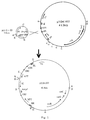
- pTOK162 Japanese Laid-Open Patent Application (Kokai) No. 4-222527, U.S. Patent No. 5,591,616, EP-A-0 604 662). Its structure is shown in Fig. 1.
- This plasmid comprises a plasmid called pTOK154 which can replicate in both Escherichia coli and in Agrobacterium tumefaciens
- pTOK154 is a plasmid containing T region, which was constructed by the method described below from a known plasmid pGA472 derived from the Ti plasmid and a known plasmid having a wide host spectrum called pVCK101), into which a KpnI fragment (containing vir B, vir G and vir C genes) with a size of 15.2 kb originated from the virulence region of pTiBo542 has been inserted, the KpnI fragment having been cloned.
- a kanamycin-resistant gene is inserted as a gene to be introduced into Indica rice.
- a vector pTOK233 (Hiei et al., supra ) is also a preferred example of a super binary vector, which was derived from pTOK162 and pGL2-IG (WO95/06722), which has a hygromycin-resistant gene (hpt) and an intron GUS gene of castor-oil plant inserted in the T-DNA region of pTOK162 by homologous recombination.
- the structure of pTOK233 is also shown in Fig. 1.
- the gene which is desired to be incorporated into Indica rice may be inserted into a restriction site in the T-DNA region of the above-described plasmid, and the desired recombinant plasmid may be selected depending on an appropriate selective marker such as drug resistance and the like which the plasmid has.
- the vector such as pTOK162 shown in Fig. 1
- the desired DNA can be inserted into pTOK162 by utilizing the in vivo homologous recombination (Herrera-Esterella L. et al., 1983; EMBO J.
- pTOK162 is first introduced into Agrobacterium tumefaciens and the plasmid pBR322 (or a similar plasmid) containing the desired DNA is further introduced thereinto. Since the DNA of pTOK162 has a region homologous with that of pBR322, the pBR322 derivative containing the desired gene is to be inserted into pTOK162 by the genetic recombination via the homologous regions.
- pTOK162::pBR322 derivative the recombined pTOK162 and pBR322 is hereinafter referred to as "pTOK162::pBR322 derivative").
- the present inventors made a study by introducing various plasmids into Agrobacterium tumefaciens containing pTOK162 to discover that, as the selection marker of the pBR322 derivative, spectinomycin-resistant gene (SP) originated from transposon Tn7 (De Greve, H.H. et al., 1981; Plasmid 6:235-248) is excellent.
- SP spectinomycin-resistant gene
- a plasmid containing a DNA originated from pBR322 and SP gene is first provided, and the desired gene may be inserted into this plasmid.
- the desired gene may be inserted into this plasmid.
- the border sequences of the T region it is possible to finally arrange the kanamycin-resistant gene and the desired gene in separate T regions in pTOK162.
- both T regions may be inserted into different chromosomes, it may be possible to subsequently segregate the desired gene from the kanamycin-resistant gene.
- Agrobacterium tumefaciens may preferably be employed, although not restricted.
- Agrobacterium such as Agrobacterium tumefaciens
- introduction of a plasmid into the bacteria belonging to the genus Agrobacterium such as Agrobacterium tumefaciens can be carried out by a conventional method such as triparental mating method of bacteria (Ditta G. et al., 1980; Proc. Natl. Acad. Sci. USA, 77:7347-7351).
- the gene which is desired to be introduced into Indica rice is arranged between border sequences of the T region as in the prior art, and the desired gene may be arranged in the Ti plasmid or in another plasmid in the Agrobacterium .
- the transformation of the immature embryos of Indica rice by the Agrobacterium may be carried out by merely contacting the immature embryos with the Agrobacterium .
- a cell suspension of the Agrobacterium having a population density of approximately from 10 6 to 10 11 cells/ml is prepared and the immature embryos are immersed in this suspension for about 3 to 10 minutes.
- the resulting immature embryos are then cultured on a solid medium for several days together with the Agrobacterium .
- the immature embryos need not be subjected to a dedifferentiation treatment such as culturing in the presence of 2,4-D.
- the thus transformed immature embryos be selected and grown under dedifferentiated condition.
- the selection may be effected on the basis of the expression of the above-mentioned desired gene and a marker (drug resistance and the like).
- the dedifferentiated cells are desired to be in the form of a callus having an ability to produce normal plants.
- the selection of the transformed cells is carried out on the medium having the above-described composition and pH.
- a preferred example of the cytokinin is 6-benzylaminopurine.
- preferred examples of the sugar include maltose, sucrose and glucose as well as mixtures thereof.
- the gelling agent include agar, agarose, gelangum and the like. Such a gelling agent is for gelling the medium and the content thereof is not restricted as long as gelling of the medium is attained. Usually, the amount of the gelling agent is about 2 to 10 g/l.
- the medium further comprising at least 0.5 to 2 mg/l of KI, 0.7 to 5 mg/l of ZnSO 4 , 0.1 to 0.3 mg/l of Na 2 MoO 4 , 0.01 to 0.02 mg/l of CuSO 4 , 0.01 to 0.02 mg/l of CoCl 2 , 0.25 to 10 mg/l of nicotinic acid, 0.25 to 5 mg/l of pyridoxine, and 0.05 to 20 mg/l of thiamin in addition to the above-described composition may also preferably be used.
- the medium still further comprising at least 100 to 3000 mg/l of Casamino acid, 100 to 3000 mg/l of proline, 100 to 3000 mg/l of glutamine and 0.01 to 5 mg/l of ⁇ -naphthaleneacetic acid in addition to the composition just mentioned above may also preferably be used.
- the medium further comprising 1000 to 60,000 mg/l of a sugar alcohol in addition to each of the above-described compositions may also preferably be used.
- Preferred examples of the sugar alcohol include mannitol, sorbitol and the like.
- the medium contains, needless to say, the drug in addition to the above-mentioned compositions. It is preferred to carry out the selection 2 to 5 times.
- the duration of the first selection may preferably be about 2 to 3 weeks and the duration of the second selection may preferably be about 2 weeks.
- all of the selections are carried out on the medium described above. However, different selection steps may be carried out on different media having different contents of the components but within the ranges mentioned above.
- the regeneration of plants from the transformed cells may be effected by known methods (Rance et al., 1994 ( supra )). In this case, it is preferred to add the drug for selection also to the regeneration medium. In this way, plants which acquired the desired character by the transformation, preferably transformed plants which acquired the desired character and have normal fertility can be regenerated.
- LBA4404 ATCC 37349 was used and the above-described pTOK233 (see Fig. 1) was used as a vector.
- IR8 IR24, IR26, IR36, IR54, IR64, IR72, Xin Qing Ai 1, Nan Jin 11 and Suewon 258 were used. Immature seeds on 10 to 14 days after flowering were husked and sterilized in 70% ethanol for several seconds and then in aqueous 1% sodium hypochlorite solution containing Tween 20 for 15 minutes. After washing the seeds several times with sterilized water, immature embryos with lengths of 1.5 to 2 mm were excised under a stereoscopic microscope.
- Colonies of Agrobacterium cultured on AB medium (Chilton M-D. et al. (1974) Agrobacterium tumefaciens DNA and PS8 bacteriophage DNA not detected in crown gall tumors. Proc. Natl. Acad. Sci. USA, 71:3672-3676) containing 50 mg/l of hygromycin and 50 mg/l of kanamycin for 3 to 7 days were recovered with a platinum loop and suspended in AAM medium (Hiei et al., 1994, supra ) to prepare an inoculation solution. The population density of the bacterial cells was adjusted to 2 x 10 8 to 3 x 10 8 cells/ml.
- NB-AS medium for cocultivation such that the scutella face upside, and cocultivation was carried out in the dark at 25°C for 4 to 5 days.
- the composition of the NB-AS medium used here was the same as the NB medium described in Rance et al.
- composition of the medium was as follows: KNO 3 2830 mg/l, MgSO 4 ⁇ 7H 2 O 185 mg/l, KH 2 PO 4 400 mg/l, CaCl 2 ⁇ 2H 2 O 166 mg/l, (NH 4 ) 2 ⁇ SO 4 463 mg/l, KI 0.7 mg/l, H 3 BO 3 3.0 mg/l MnSO 4 ⁇ H 2 O 10 mg/l, ZnSO 4 ⁇ 7H 2 O 2.0 mg/l, Na 2 MoO 4 ⁇ 2H 2 O 0.25 mg/l, CuSO 4 ⁇ 5H 2 O 0.025 mg/l, CoCl 2 ⁇ 6H 2 O 0.025 mg/l, Na 2 ⁇ EDTA 37.3 mg/l, Fe 2 SO 4 ⁇ 7H 2 O 27.8 mg/l, myoinositol 100 mg/l, nicotinic acid 1.0 mg/l, pyridoxine hydrochloride 1.0 mg/l, thiamin hydrochloride 10 mg/
- the elongated shoots were removed with a scalpel and the immature embryos were transplanted to NBM medium containing 3 mg/l of hygromycin, followed by culturing the immature embryos in the dark at 30°C for 3 to 4 days.
- the immature embryos were then transplanted to each of the first selection media which were NBM medium (Example 1), 2N6M medium (Comparative Example 1), CCM medium (Comparative Example 2) and MSM (Comparative Example 3), each of which contained 20 to 50 mg/l of hygromycin, and cultured under illumination at 30°C for 2 to 3 weeks.
- the hygromycin-resistant calli formed on the scutella of the immature embryos were transplanted to NB2 medium containing 20 mg/l of hygromycin or to CCM medium containing 30 mg/l of hygromycin, and the second selection was carried out under illumination at 30°C for 2 weeks.
- Compact and embryogenic calli were selected and grown on the above-mentioned NB2 medium or on CCM medium containing 50 mg/l of hygromycin for 1 to 3 times (3-5th selection) at 10 to 14 days' intervals.
- the compositions of the NBM, 2N6M, CCM, MSM and NB2 media used here are shown below.
- the used selection media contained 250 mg/l of cefotaxime in addition to the compositions described below.
- N6 inorganic salts N6 vitamins (Chu C.-C. (1978) The N6 medium and its applications to anther culture of cereal crops. In proc. Symp. Plant Tissue Culture. Peking: Science Press, pp. 43-50) to which 1 g/l of Casamino acid, 2 mg/l of 2,4-dichlorophenoxyacetic acid, 30 g/l of D-maltose and 2.5 g/l of gelangum (trademark Gelrite, commercially available from Sigma) were added.
- the medium had the following composition: KNO 3 2830 mg/l, MgSO 4 ⁇ 7H 2 O 185 mg/l, KH 2 PO 4 400 mg/l, CaCl 2 ⁇ 2H 2 O 166 mg/l, (NH 4 ) 2 ⁇ SO 4 463 mg/l, KI 0.8 mg/l, H 3 BO 3 1.6 mg/l, MnSO 4 ⁇ 4H 2 O 3.3 mg/l, ZnSO 4 ⁇ 7H 2 O 1.5 mg/l, Na 2 MoO 4 ⁇ 2H 2 O 0.25 mg/l, CuSO 4 ⁇ 5H 2 O 0.025 mg/l, Na 2 ⁇ EDTA 37.3 mg/l, Fe 2 SO 4 ⁇ 7H 2 O 27.8 mg/l, nicotinic acid 0.5 mg/l, pyridoxine hydrochloride 0.5 mg/l, thiamin hydrochloride 1.0 mg/l, Casamino acid 1 g/l, glycine 2 mg/l, 2,4-dichlor
- CC medium (Potrykus I et al(1979) Callus formation from cell culture protoplasts of corn (Zea mays L.). Theor. Appl. Genet. 54:209-214; Hartke S. et al (1989) Somatic embryogenesis and plant regeneration from various Indica rice (Oryza Sativa L.) genotypes. J. Genet & Breed. 43: 205-214) to which 30 g/l of D-maltose, 2 mg/l of 2,4-dichlorophenoxyacetic acid and 2.5 g/l of gelangum (trademark Gelrite, commercially available from Sigma) were added.
- the medium had the following composition: KNO 3 1212 mg/l, NH 4 NO 3 640 mg/l, CaCl 2 ⁇ 2H 2 O 588 mg/l, MgSO 4 ⁇ 7H 2 O 247 mg/l, KH 2 PO 4 136 mg/l, FeSO 4 ⁇ 7H 2 O 27.8 mg/l, Na 2 EDTA 37.3 mg/l, H 3 BO 3 3.1 mg/l, MnSO 4 ⁇ 4H 2 O 11.15 mg/l, ZnSO 4 ⁇ 7H 2 O 5.76 mg/l, KI 0.83 mg/l, Na 2 MoO 4 ⁇ 2H 2 O 0.24 mg/l, CuSO 4 ⁇ 5H 2 O 0.025 mg/l, CoSO 4 ⁇ 7H 2 O 0.028 mg/l, nicotinic acid 6 mg/l, thiamin hydrochloride 8.5 mg/l, pyridoxine hydrochloride 1 mg/l, glycine 2 mg/l, myoinositol
- MS inorganic salts MS vitamins (Murashige, T. and Skoog, F. (1962) A revised medium for rapid growth and bioassays with tobacco tissue cultures. Physiol. Plant. 15: 473-497) to which 1 g/l of Casamino acid, 30 g/l of D-maltose, 2 mg/l of 2,4-dichlorophenoxyacetic acid and 2.5 g/l of gelangum (trademark Gelrite, commercially available from Sigma) were added.
- the medium had the following composition: NH 4 NO 3 1650 mg/l KNO 3 1900 mg/l, MgSO 4 ⁇ 7H 2 O 370 mg/l, KH 2 PO 4 170 mg/l, CaCl 2 ⁇ 2H 2 O 440 mg/l, KI 0.83 mg/l, H 3 BO 3 6.2 mg/l, MnSO 4 ⁇ 4H 2 O 22.3 mg/l, ZnSO 4 ⁇ 7H 2 O 8.6 mg/l, Na 2 MoO 4 ⁇ 2H 2 O 0.25 mg/l, CuSO 4 ⁇ 5H 2 O 0.025 mg/l, CoCl 2 ⁇ 6H 2 O 0.025 mg/l, Na 2 ⁇ EDTA 37.3 mg/l, Fe 2 SO 4 ⁇ 7H 2 O 27.8 mg/l, myoinositol 100 mg/l, nicotinic acid 0.5 mg/l, pyridoxine hydrochloride 0.5 mg/l, thiamin hydrochloride 0.1 mg/l,
- the selected calli were transplanted to NBM regeneration preculture medium containing 40 mg/l of hygromycin and cultured under illumination at 30°C for about 10 days.
- the hygromycin-resistant embryogenic calli obtained by the preculture of regeneration were dried in a petri dish in which a filter paper was laid (Rance et al., 1994 ( supra )), and the calli were placed on RNM regeneration medium (containing 30 mg/l of hygromycin) which had the same composition as the RN medium (Rance et al., 1994, ( supra )) except that the sugar source was replaced with 30 g/l of D-maltose.
- the regenerated plants were transplanted to MSI rooting medium (half concentrations of MS major inorganic salts, MS minor inorganic salts and MS vitamins, 1 g/l of Casamino acid, 0.2 mg/l of indolebutyric acid, 15 g/l of sucrose and 3 g/l of Gelrite, pH 5.8) and cultivated under illumination at 25°C for about 3 weeks.
- MSI rooting medium half concentrations of MS major inorganic salts, MS minor inorganic salts and MS vitamins, 1 g/l of Casamino acid, 0.2 mg/l of indolebutyric acid, 15 g/l of sucrose and 3 g/l of Gelrite, pH 5.8
- Pieces of leaves of the obtained hygromycin-resistant regenerated plants were subjected to X-Gluc treatment so as to check GUS expression (Hiei et al., 1994, supra ).
- the regenerated plants were then transplanted to 500-fold diluted aqueous Hypon
- the DNAs extracted from leaves of the regenerated plants which expressed GUS were digested by restriction enzyme Hind III or Kpn I and Southern analysis using hpt or GUS gene as a probe was carried out.
- the Southern analysis was carried out by the method described by Sambrook et al. (1990) (Sambrook, J. et al., Molecular cloning: A Laboratory Manual, 2nd Edn. Cold Spring Harbor, NY: Cold Spring Harbor Laboratory Press).
- the transformants were self-pollinated and the seeds of the next generation was sown on hormone-free MS medium. After germination, GUS expression was checked by X-Gluc treatment of pieces of leaves.
- the seedlings were transplanted to hormone-free MS medium containing 50 mg/l of hygromycin and resistance to hygromycin was checked.
- hygromycin-resistant calli were obtained at a much higher frequency when the medium was NBM medium than in the cases where CCM, MSM or 2N6M medium was used.
- the immature embryos during the first selection step were checked for the expression of the GUS gene by X-Gluc treatment. As a result, it was confirmed that a plurality of cell clumps formed on the scutella of the immature embryos cultured on the NBM medium uniformly expressed GUS. As for those cultured on the CCM medium or MSM medium, the entire scutella swelled and specific growth of the GUS-expressing region was not substantially observed.
- the culturing duration for the first selection is preferably 2 to 3 weeks. If culture is continued for a period longer than this, the calli formed on the scutella of the immature embryos unnecessarily grow, so that it is difficult to select a plurality of independent calli per one immature embryo and the morphology of the calli tended to be bad.
Landscapes
- Health & Medical Sciences (AREA)
- Life Sciences & Earth Sciences (AREA)
- Genetics & Genomics (AREA)
- Engineering & Computer Science (AREA)
- Biomedical Technology (AREA)
- Biotechnology (AREA)
- General Engineering & Computer Science (AREA)
- Bioinformatics & Cheminformatics (AREA)
- Organic Chemistry (AREA)
- Chemical & Material Sciences (AREA)
- Zoology (AREA)
- Wood Science & Technology (AREA)
- Molecular Biology (AREA)
- Microbiology (AREA)
- Plant Pathology (AREA)
- Cell Biology (AREA)
- Biophysics (AREA)
- Biochemistry (AREA)
- General Health & Medical Sciences (AREA)
- Physics & Mathematics (AREA)
- Micro-Organisms Or Cultivation Processes Thereof (AREA)
- Breeding Of Plants And Reproduction By Means Of Culturing (AREA)
Applications Claiming Priority (3)
| Application Number | Priority Date | Filing Date | Title |
|---|---|---|---|
| JP8298039A JPH10117776A (ja) | 1996-10-22 | 1996-10-22 | インディカイネの形質転換方法 |
| JP298039/96 | 1996-10-22 | ||
| PCT/JP1997/003806 WO1998017813A1 (fr) | 1996-10-22 | 1997-10-22 | Procede de transformation de riz de type indica |
Publications (2)
| Publication Number | Publication Date |
|---|---|
| EP0897013A1 true EP0897013A1 (fr) | 1999-02-17 |
| EP0897013A4 EP0897013A4 (fr) | 2001-11-07 |
Family
ID=17854340
Family Applications (1)
| Application Number | Title | Priority Date | Filing Date |
|---|---|---|---|
| EP97909573A Withdrawn EP0897013A4 (fr) | 1996-10-22 | 1997-10-22 | Procede de transformation de riz de type indica |
Country Status (7)
| Country | Link |
|---|---|
| US (1) | US6329571B1 (fr) |
| EP (1) | EP0897013A4 (fr) |
| JP (1) | JPH10117776A (fr) |
| KR (1) | KR19990072163A (fr) |
| AU (1) | AU736027B2 (fr) |
| CA (1) | CA2240454C (fr) |
| WO (1) | WO1998017813A1 (fr) |
Cited By (3)
| Publication number | Priority date | Publication date | Assignee | Title |
|---|---|---|---|---|
| WO2008028119A3 (fr) * | 2006-08-31 | 2008-04-17 | Monsanto Technology Llc | Procédés pour transformer rapidement des monocotylédones |
| EP1728418A4 (fr) * | 2004-03-25 | 2008-06-25 | Nat Inst Of Agrobio Sciences | Methode de transformation de graine monocotyledonee |
| US8519227B2 (en) | 2002-03-12 | 2013-08-27 | Hiroshi Tanaka | Ultra-fast transformation technique for monocotyledons |
Families Citing this family (168)
| Publication number | Priority date | Publication date | Assignee | Title |
|---|---|---|---|---|
| US6987025B1 (en) * | 1999-02-11 | 2006-01-17 | The Arizona Board Of Regents On Behalf Of The University Of Arizona | Dwf4 polynucleotides, polypeptides and uses thereof |
| EP1586645A3 (fr) * | 1999-02-25 | 2006-02-22 | Ceres Incorporated | Fragments d'ADN avec des séquences déterminées et polypeptides encodées par lesdits fragments |
| US7399850B2 (en) * | 1999-06-18 | 2008-07-15 | Ceres, Inc. | Sequence-determined DNA fragments encoding AP2 domain proteins |
| US7485715B2 (en) * | 1999-06-18 | 2009-02-03 | Ceres, Inc. | Sequence-determined DNA encoding AP2 domain polypeptides |
| US7479555B2 (en) * | 1999-07-21 | 2009-01-20 | Ceres, Inc. | Polynucleotides having a nucleotide sequence that encodes a polypeptide having MOV34 family activity |
| US20060194958A1 (en) * | 1999-11-10 | 2006-08-31 | Nickolai Alexandrov | Sequence-determined DNA fragments encoding AN1-like zinc finger proteins |
| CA2394367C (fr) * | 1999-12-15 | 2014-01-21 | Regents Of The University Of Minnesota | Procede concu pour renforcer la transformation de vegetaux par l'agrobacterie |
| US7691991B2 (en) * | 2000-04-17 | 2010-04-06 | Ceres, Inc. | Sequence-determined DNA fragments encoding cytochrome P450 proteins |
| US7468475B2 (en) | 2000-06-16 | 2008-12-23 | Schmuelling Thomas | Method for modifying plant morphology, biochemistry and physiology |
| KR100807434B1 (ko) * | 2000-08-03 | 2008-02-25 | 니뽄 다바코 산교 가부시키가이샤 | 식물세포로의 유전자도입의 효율을 향상시키는 방법 |
| ATE417933T1 (de) | 2000-08-03 | 2009-01-15 | Japan Tobacco Inc | Verfahren zur verbesserung der gentransfer- effizienz in pflanzenzellen |
| US7385046B2 (en) * | 2001-01-03 | 2008-06-10 | Ceres, Inc. | Sequence-determined DNA fragments encoding ethylene responsive element binding proteins |
| US20060194959A1 (en) * | 2002-07-15 | 2006-08-31 | Nickolai Alexandrov | Sequence-determined DNA fragments encoding SRF-type transcription factors |
| AU2003295333A1 (en) * | 2002-09-17 | 2004-04-08 | Ceres, Inc. | Biological containment system |
| US7476777B2 (en) * | 2002-09-17 | 2009-01-13 | Ceres, Inc. | Biological containment system |
| EP2311964A1 (fr) | 2003-04-11 | 2011-04-20 | CropDesign N.V. | Method pour augmenter la resitance des plantes au stress |
| US7682829B2 (en) * | 2003-05-30 | 2010-03-23 | Monsanto Technology Llc | Methods for corn transformation |
| JP4555229B2 (ja) * | 2003-08-13 | 2010-09-29 | 日本たばこ産業株式会社 | 銅イオンの添加により植物の形質転換効率を向上させる方法 |
| US7812222B2 (en) * | 2003-08-13 | 2010-10-12 | Japan Tobacco Inc. | Method of transducing gene into plant material |
| EP1709188A1 (fr) * | 2004-01-16 | 2006-10-11 | Ceres, Inc. | Cellules vegetales comprenant des polypeptides recepteurs |
| CN1973044B (zh) * | 2004-04-23 | 2010-07-07 | 塞雷斯公司 | 用于提高植物耐旱性的方法和材料 |
| CA2577736A1 (fr) * | 2004-08-20 | 2006-03-02 | Ceres, Inc. | Polynucleotides, polypeptides de p<sb>450</sb> et leurs utilisations |
| WO2006031859A2 (fr) | 2004-09-14 | 2006-03-23 | Ceres Inc. | Modulation de la teneur des plantes en acides amines et sucres |
| US20060059585A1 (en) * | 2004-09-14 | 2006-03-16 | Boris Jankowski | Modulating plant sugar levels |
| US7429692B2 (en) * | 2004-10-14 | 2008-09-30 | Ceres, Inc. | Sucrose synthase 3 promoter from rice and uses thereof |
| WO2006062971A2 (fr) * | 2004-12-08 | 2006-06-15 | Ceres Inc. | Modulation des teneurs en carbone dans les plantes |
| WO2008076922A1 (fr) * | 2006-12-15 | 2008-06-26 | Ceres, Inc. | Modulation de niveaux de protéines végétales |
| US9758790B2 (en) | 2004-12-08 | 2017-09-12 | Ceres, Inc. | Modulating the level of components within plants |
| EP1828388A2 (fr) * | 2004-12-16 | 2007-09-05 | Ceres, Inc. | Modulation de niveaux d'azote dans des plantes |
| US7335760B2 (en) * | 2004-12-22 | 2008-02-26 | Ceres, Inc. | Nucleic acid sequences encoding zinc finger proteins |
| AU2006216715A1 (en) * | 2005-02-22 | 2006-08-31 | Ceres Inc. | Modulating plant alkaloids |
| WO2006115575A1 (fr) * | 2005-04-20 | 2006-11-02 | Ceres Inc. | Regions regulatoires de papaveraceae |
| WO2006133461A1 (fr) | 2005-06-08 | 2006-12-14 | Ceres Inc. | Identification d'associations entre des proteines regulatrices et des regions regulatrices liees a la biosynthese des terpenoides |
| US8551917B2 (en) * | 2005-11-07 | 2013-10-08 | Los Alamos National Security, Llc | Use of prolines for improving growth and/or yield |
| US20090304901A1 (en) * | 2006-01-25 | 2009-12-10 | Steven Craig Bobzin | Modulating plant protein levels |
| US8222482B2 (en) * | 2006-01-26 | 2012-07-17 | Ceres, Inc. | Modulating plant oil levels |
| US20070199090A1 (en) * | 2006-02-22 | 2007-08-23 | Nestor Apuya | Modulating alkaloid biosynthesis |
| WO2007120989A2 (fr) * | 2006-02-24 | 2007-10-25 | Ceres, Inc. | Régions de régulation d'ombre |
| US20100154082A1 (en) * | 2006-05-10 | 2010-06-17 | Ceres, Inc. | Shade tolerance in plants |
| US20100024070A1 (en) * | 2006-05-15 | 2010-01-28 | Steven Craig Bobzin | Modulation of oil levels in plants |
| US20100005549A1 (en) * | 2006-06-14 | 2010-01-07 | Shing Kwok | Increasing uv-b tolerance in plants |
| US20090320165A1 (en) * | 2006-06-21 | 2009-12-24 | Steven Craig Bobzin | Modulation of protein levels in plants |
| US20130191941A1 (en) | 2006-07-05 | 2013-07-25 | Shing Kwok | Modulating light response pathways in plants, increasing light-related tolerances in plants, and increasing biomass in plants |
| WO2008006033A1 (fr) | 2006-07-05 | 2008-01-10 | Ceres, Inc. | Augmentation de la tolérance à la lumière faible chez les végétaux |
| WO2008064222A2 (fr) * | 2006-11-20 | 2008-05-29 | Ceres, Inc. | Tolérance à l'ombre chez les plantes |
| EP2048939A4 (fr) | 2006-08-17 | 2010-04-28 | Monsanto Technology Llc | Plantes transgéniques à caractères agronomiques renforcés |
| US9187761B2 (en) | 2006-09-25 | 2015-11-17 | Thomas Schmulling | Transcriptional repressors of cytokinin signaling and their use |
| US8362322B2 (en) | 2006-10-27 | 2013-01-29 | Ceres, Inc. | Modulating lignin in plants |
| US20100205688A1 (en) * | 2006-11-03 | 2010-08-12 | Shing Kwok | Increasing tolerance of plants to low light conditions |
| US8222388B2 (en) * | 2006-11-22 | 2012-07-17 | Ceres, Inc. | Broadly expressing regulatory regions |
| CA2681515A1 (fr) | 2007-03-23 | 2008-10-02 | Basf Plant Science Gmbh | Plantes transgeniques offrant une amelioration de la tolerance au stressamelioree et du rendement exprimant une proteine lrp-2 |
| BRPI0812060A2 (pt) | 2007-05-29 | 2014-10-07 | Basf Plant Science Gmbh | Planta transgênica, polinucleotídeo isolado, polipeptídeo isolado, e, métodos para produzir uma planta transgênica e para aumentar o crescimento e/ou rendimento de planta sob condições normais ou de água limitada e/ou aumentar a tolerância da planta a um estresse ambiental |
| US20110214199A1 (en) | 2007-06-06 | 2011-09-01 | Monsanto Technology Llc | Genes and uses for plant enhancement |
| WO2009009142A2 (fr) | 2007-07-10 | 2009-01-15 | Monsanto Technology, Llc | Plantes transgéniques à caractéristiques agronomiques améliorées |
| CA2692650A1 (fr) | 2007-07-13 | 2009-01-22 | Basf Plant Science Gmbh | Plantes transgeniques presentant une tolerance au stress accrue et un rendement accru |
| CA2694142A1 (fr) | 2007-08-02 | 2009-02-05 | Basf Plant Science Gmbh | Plantes transgeniques a rendement et tolerance au stress accrus |
| US8097712B2 (en) | 2007-11-07 | 2012-01-17 | Beelogics Inc. | Compositions for conferring tolerance to viral disease in social insects, and the use thereof |
| CA2706799A1 (fr) | 2007-11-27 | 2009-06-04 | Basf Plant Science Gmbh | Plantes transgeniques presentant une tolerance au stress et un rendement accrus |
| WO2009134339A2 (fr) | 2008-04-29 | 2009-11-05 | Monsanto Technology, Llc | Gènes et leurs utilisations pour améliorer les plantes |
| AU2009267007B2 (en) | 2008-07-01 | 2016-02-25 | Monsanto Technology, Llc | Recombinant DNA constructs and methods for modulating expression of a target gene |
| US8419145B2 (en) * | 2008-07-25 | 2013-04-16 | Eastman Kodak Company | Inkjet printhead and method of printing with multiple drop volumes |
| DE112009001976T5 (de) | 2008-08-20 | 2011-07-14 | BASF Plant Science GmbH, 67063 | Transgene Pflanzen mit erhöhtem Ertrag |
| DE112009002213T5 (de) | 2008-09-23 | 2011-07-28 | BASF Plant Science GmbH, 67063 | Transgene Pflanzen mit erhöhtem Ertrag |
| US8298794B2 (en) * | 2008-10-09 | 2012-10-30 | Ceres, Inc. | Cinnamyl-alcohol dehydrogenases |
| US20110258735A1 (en) | 2008-12-22 | 2011-10-20 | Marie Coffin | Genes and uses for plant enhancement |
| US12612435B2 (en) | 2009-01-12 | 2026-04-28 | Ulla Bonas | Modular DNA-binding domains and methods of use |
| EP2206723A1 (fr) | 2009-01-12 | 2010-07-14 | Bonas, Ulla | Domaines modulaires de liaison à l'ADN |
| US20110239315A1 (en) | 2009-01-12 | 2011-09-29 | Ulla Bonas | Modular dna-binding domains and methods of use |
| BRPI1005375A2 (pt) | 2009-01-28 | 2016-08-09 | Basf Plant Science Co Gmbh | planta transgênica transformada com um cassete de expressão, semente e método para incrementar o rendimento de uma planta |
| AU2010209843A1 (en) | 2009-01-28 | 2011-08-18 | Basf Plant Science Company Gmbh | Engineering NF-YB transcription factors for enhanced drought resistance and increased yield in transgenic plants |
| US20120277117A1 (en) | 2009-02-27 | 2012-11-01 | Adel Zayed | Hydroponic apparatus and methods of use |
| CN102361988A (zh) | 2009-03-23 | 2012-02-22 | 巴斯夫植物科学有限公司 | 具有改变的氧化还原机制和提高的产量的转基因植物 |
| US20120297505A1 (en) | 2009-07-20 | 2012-11-22 | Chuan-Yin Wu | Transgenic plants having increased biomass |
| US8586526B2 (en) | 2010-05-17 | 2013-11-19 | Sangamo Biosciences, Inc. | DNA-binding proteins and uses thereof |
| US8962584B2 (en) | 2009-10-14 | 2015-02-24 | Yissum Research Development Company Of The Hebrew University Of Jerusalem, Ltd. | Compositions for controlling Varroa mites in bees |
| WO2011072246A2 (fr) | 2009-12-10 | 2011-06-16 | Regents Of The University Of Minnesota | Modification de l'adn induite par l'effecteur tal |
| ES2641642T3 (es) | 2010-03-08 | 2017-11-10 | Monsanto Technology Llc | Moléculas de polinucleótido para regulación génica en plantas |
| WO2011140329A1 (fr) | 2010-05-06 | 2011-11-10 | Ceres, Inc. | Plantes transgéniques à biomasse augmentée |
| CN105671108A (zh) | 2010-06-02 | 2016-06-15 | 沃维公司 | 甜菊糖苷的重组生产 |
| US8816153B2 (en) | 2010-08-27 | 2014-08-26 | Monsanto Technology Llc | Recombinant DNA constructs employing site-specific recombination |
| WO2012058223A1 (fr) | 2010-10-27 | 2012-05-03 | Ceres, Inc. | Plantes transgéniques ayant une composition de biomasse modifiée |
| CA2867139A1 (fr) | 2011-04-11 | 2012-10-18 | Targeted Growth, Inc. | Identification et utilisation de mutants de krp dans des plantes |
| IN2014CN01129A (fr) | 2011-08-08 | 2015-04-10 | Evolva Sa | |
| CN108570464B (zh) | 2011-08-08 | 2021-12-21 | 国际香料香精公司 | 用于香草醛或香草醛β-D-葡萄糖苷的生物合成的组合物和方法 |
| CN108396044A (zh) | 2011-08-08 | 2018-08-14 | 埃沃尔瓦公司 | 甜菊醇糖苷类的重组生产 |
| BR112014003311B1 (pt) | 2011-08-12 | 2020-11-10 | Ceres, Inc. | método para obtenção de uma célula vegetal, método de obtenção de uma planta, vetor |
| US9840715B1 (en) | 2011-09-13 | 2017-12-12 | Monsanto Technology Llc | Methods and compositions for delaying senescence and improving disease tolerance and yield in plants |
| MX342856B (es) | 2011-09-13 | 2016-10-13 | Monsanto Technology Llc | Metodos y composiciones para el control de malezas. |
| UA116089C2 (uk) | 2011-09-13 | 2018-02-12 | Монсанто Текнолоджи Ллс | Спосіб та композиція для боротьби з бур'янами (варіанти) |
| CN103974967A (zh) | 2011-09-13 | 2014-08-06 | 孟山都技术公司 | 用于杂草控制的方法和组合物 |
| US10806146B2 (en) | 2011-09-13 | 2020-10-20 | Monsanto Technology Llc | Methods and compositions for weed control |
| BR112014005958A2 (pt) | 2011-09-13 | 2020-10-13 | Monsanto Technology Llc | métodos e composições químicas agrícolas para controle de planta, método de redução de expressão de um gene accase em uma planta, cassete de expressão microbiana, método para fazer um polinucleotídeo, método de identificação de polinucleotídeos úteis na modulação de expressão do gene accase e composição herbicida |
| US10829828B2 (en) | 2011-09-13 | 2020-11-10 | Monsanto Technology Llc | Methods and compositions for weed control |
| US10760086B2 (en) | 2011-09-13 | 2020-09-01 | Monsanto Technology Llc | Methods and compositions for weed control |
| US9920326B1 (en) | 2011-09-14 | 2018-03-20 | Monsanto Technology Llc | Methods and compositions for increasing invertase activity in plants |
| WO2013067128A1 (fr) | 2011-11-02 | 2013-05-10 | Ceres, Inc. | Plantes transgéniques ayant une tolérance accrue à l'aluminium |
| KR101355922B1 (ko) * | 2011-11-02 | 2014-01-28 | 세종대학교산학협력단 | 벼의 형질전환 방법 |
| WO2013086499A2 (fr) | 2011-12-09 | 2013-06-13 | Ceres, Inc. | Plantes transgéniques ayant une composition de biomasse altérée |
| KR101447118B1 (ko) * | 2012-05-16 | 2014-10-06 | 한국생명공학연구원 | 인공 씨감자 배양용 고형 배지 조성물 및 이를 이용한 원-스텝 인공 씨감자 배양 방법 |
| US10240161B2 (en) | 2012-05-24 | 2019-03-26 | A.B. Seeds Ltd. | Compositions and methods for silencing gene expression |
| US20150225734A1 (en) | 2012-06-19 | 2015-08-13 | Regents Of The University Of Minnesota | Gene targeting in plants using dna viruses |
| MX364070B (es) | 2012-10-18 | 2019-04-10 | Monsanto Technology Llc | Métodos y composiciones para el control de plagas vegetales. |
| JP6450683B2 (ja) | 2012-11-01 | 2019-01-09 | セレクティス | 治療用タンパク質の生産のための植物 |
| CN104769121B (zh) | 2012-11-05 | 2021-06-01 | 埃沃尔瓦公司 | 香草醛合酶 |
| WO2014084884A1 (fr) | 2012-11-28 | 2014-06-05 | Monsanto Technology Llc | Plantes transgéniques ayant des caractéristiques améliorées |
| US10513698B2 (en) | 2012-12-21 | 2019-12-24 | Cellectis | Potatoes with reduced cold-induced sweetening |
| US10683505B2 (en) | 2013-01-01 | 2020-06-16 | Monsanto Technology Llc | Methods of introducing dsRNA to plant seeds for modulating gene expression |
| WO2014106837A2 (fr) | 2013-01-01 | 2014-07-10 | A. B. Seeds Ltd. | Molécules d'arnds isolées et procédés pour les utiliser pour le silençage de molécules d'intérêt cibles |
| US10000767B2 (en) | 2013-01-28 | 2018-06-19 | Monsanto Technology Llc | Methods and compositions for plant pest control |
| SG11201505597SA (en) | 2013-02-06 | 2015-08-28 | Evolva Sa | Methods for improved production of rebaudioside d and rebaudioside m |
| CA2900882A1 (fr) | 2013-02-11 | 2014-08-14 | Evolva Sa | Production efficace de glycosides steviol dans les hotes recombinants |
| BR112015022797A2 (pt) | 2013-03-13 | 2017-11-07 | Monsanto Technology Llc | método para controle de ervas daninhas, composição herbicida, cassete de expressão microbiano e método de produção de polinucleotídeo |
| EP2971185A4 (fr) | 2013-03-13 | 2017-03-08 | Monsanto Technology LLC | Procédés et compositions utilisables pour lutter contre les mauvaises herbes |
| US9045392B2 (en) | 2013-03-14 | 2015-06-02 | Los Alamos National Security, Llc | Preparation of 4-amino-2,4-dioxobutanoic acid |
| US20140283211A1 (en) | 2013-03-14 | 2014-09-18 | Monsanto Technology Llc | Methods and Compositions for Plant Pest Control |
| US9290442B2 (en) | 2013-03-14 | 2016-03-22 | Los Alamos National Security, Llc | Preparation of 4-amino-2,4-dioxobutanoic acid |
| US9290443B2 (en) | 2013-03-14 | 2016-03-22 | Los Alamos National Security, Llc | Preparation of 4-amino-2,4-dioxobutanoic acid |
| US10568328B2 (en) | 2013-03-15 | 2020-02-25 | Monsanto Technology Llc | Methods and compositions for weed control |
| US10113162B2 (en) | 2013-03-15 | 2018-10-30 | Cellectis | Modifying soybean oil composition through targeted knockout of the FAD2-1A/1B genes |
| US9850496B2 (en) | 2013-07-19 | 2017-12-26 | Monsanto Technology Llc | Compositions and methods for controlling Leptinotarsa |
| RU2703498C2 (ru) | 2013-07-19 | 2019-10-17 | Монсанто Текнолоджи Ллс | Композиции и способы борьбы с leptinotarsa |
| SI3044320T1 (sl) | 2013-09-11 | 2020-07-31 | Impossible Foods Inc. | Sekrecija polipeptidov, ki vsebujejo hem |
| US20160237447A1 (en) | 2013-10-07 | 2016-08-18 | Monsanto Technology Llc | Transgenic Plants With Enhanced Traits |
| HRP20221172T1 (hr) | 2013-10-29 | 2023-02-03 | Biotech Institute, Llc | Uzgoj, proizvodnja, prerada i uporaba specijalnog sinsemilla kanabisa |
| HUE070313T2 (hu) | 2013-11-04 | 2025-05-28 | Greenlight Biosciences Inc | Ízeltlábú paraziták és kártevõfertõzöttség szabályozására szolgáló készítmények és eljárások |
| UA119253C2 (uk) | 2013-12-10 | 2019-05-27 | Біолоджикс, Інк. | Спосіб боротьби із вірусом у кліща varroa та у бджіл |
| AU2015206585A1 (en) | 2014-01-15 | 2016-07-21 | Monsanto Technology Llc | Methods and compositions for weed control using EPSPS polynucleotides |
| US10053717B2 (en) | 2014-01-31 | 2018-08-21 | University Of Copenhagen | Biosynthesis of forskolin and related compounds |
| WO2015113570A1 (fr) | 2014-01-31 | 2015-08-06 | University Of Copenhagen | Procédés de production de diterpènes |
| BR112016022711A2 (pt) | 2014-04-01 | 2017-10-31 | Monsanto Technology Llc | composições e métodos para controle de pragas de inseto |
| US9101100B1 (en) | 2014-04-30 | 2015-08-11 | Ceres, Inc. | Methods and materials for high throughput testing of transgene combinations |
| CA2952906A1 (fr) | 2014-06-20 | 2015-12-23 | Cellectis | Pommes de terre a teneur reduite en enzyme gbss |
| US10988764B2 (en) | 2014-06-23 | 2021-04-27 | Monsanto Technology Llc | Compositions and methods for regulating gene expression via RNA interference |
| WO2015197075A1 (fr) | 2014-06-23 | 2015-12-30 | University Of Copenhagen | Procédés et matières pour la production de terpénoïdes |
| EP3161138A4 (fr) | 2014-06-25 | 2017-12-06 | Monsanto Technology LLC | Procédés et compositions pour administrer des acides nucléiques à des cellules végétales et réguler l'expression génique |
| AU2015289691B2 (en) | 2014-07-15 | 2020-12-24 | Ceres, Inc. | Methods of increasing crop yield under abiotic stress |
| RU2021123470A (ru) | 2014-07-29 | 2021-09-06 | Монсанто Текнолоджи Ллс | Композиции и способы борьбы с насекомыми-вредителями |
| AU2015303294A1 (en) | 2014-08-11 | 2017-02-02 | Evolva Sa. | Production of steviol glycosides in recombinant hosts |
| AU2015314251A1 (en) | 2014-09-09 | 2017-03-16 | Evolva Sa | Production of steviol glycosides in recombinant hosts |
| WO2016070885A1 (fr) | 2014-11-07 | 2016-05-12 | University Of Copenhagen | Biosynthèse de 13r-mo oxydé et de composés apparentés |
| EP3218495A1 (fr) | 2014-11-13 | 2017-09-20 | Evolva SA | Procédés et matières pour la biosynthèse d'oxyde de manoyle |
| JP6942632B2 (ja) | 2015-01-22 | 2021-09-29 | モンサント テクノロジー エルエルシー | Leptinotarsa防除用組成物及びその方法 |
| SG11201705606PA (en) | 2015-01-30 | 2017-08-30 | Evolva Sa | Production of steviol glycosides in recombinant hosts |
| CA2979931A1 (fr) | 2015-03-16 | 2016-09-22 | Dsm Ip Assets B.V. | Udp-glycosyltransferases |
| PT3294762T (pt) | 2015-05-11 | 2022-03-21 | Impossible Foods Inc | Constructos de expressão e métodos de modificar geneticamente levedura metilotrófica |
| EP3297642B1 (fr) | 2015-05-22 | 2019-09-11 | STCube & Co., Inc. | Procédés de criblage pour des cibles pour la thérapie du cancer |
| US10883103B2 (en) | 2015-06-02 | 2021-01-05 | Monsanto Technology Llc | Compositions and methods for delivery of a polynucleotide into a plant |
| EP3302030A4 (fr) | 2015-06-03 | 2019-04-24 | Monsanto Technology LLC | Procédés et compositions pour l'introduction d'acides nucléiques dans des plantes |
| AU2016307066A1 (en) | 2015-08-07 | 2018-02-08 | Evolva Sa | Production of steviol glycosides in recombinant hosts |
| US10837024B2 (en) | 2015-09-17 | 2020-11-17 | Cellectis | Modifying messenger RNA stability in plant transformations |
| US9963423B2 (en) | 2016-01-12 | 2018-05-08 | Millennium Enterprises, Inc. | Synthesis of 4-amino-2, 4-dioxobutanoic acid |
| WO2017134601A1 (fr) | 2016-02-02 | 2017-08-10 | Cellectis | Modification de la composition d'huile de soja par invalidation ciblée des gènes fad3a/b/c |
| US10982249B2 (en) | 2016-04-13 | 2021-04-20 | Evolva Sa | Production of steviol glycosides in recombinant hosts |
| WO2017198682A1 (fr) | 2016-05-16 | 2017-11-23 | Evolva Sa | Production de glycosides de stéviol dans des hôtes de recombinaison |
| WO2018015512A1 (fr) | 2016-07-20 | 2018-01-25 | Evolva Sa | Biosynthèse de dérivés d'oxyde de 13r-manoyl |
| AU2017309313B2 (en) | 2016-08-09 | 2023-11-02 | River Stone Biotech, Inc. | Biosynthesis of benzylisoquinoline alkaloids and benzylisoquinoline alkaloid precursors |
| US11396669B2 (en) | 2016-11-07 | 2022-07-26 | Evolva Sa | Production of steviol glycosides in recombinant hosts |
| CA3042857A1 (fr) | 2016-11-16 | 2018-05-24 | Cellectis | Methodes de modification de la teneur en acides amines de plantes par decalages du cadre de lecture |
| CA3060622A1 (fr) | 2017-04-25 | 2018-11-01 | Cellectis | Luzerne presentant une composition a teneur reduite en lignine |
| WO2020190363A1 (fr) | 2019-03-19 | 2020-09-24 | Massachusetts Institute Of Technology | Contrôle de la fixation de l'azote dans les bactéries rhizobium s'associant à des céréales |
| EP3959311A1 (fr) | 2019-04-25 | 2022-03-02 | Impossible Foods Inc. | Compositions et procédés pour la production de protéines contenant de l'hème |
| US11473086B2 (en) | 2019-06-19 | 2022-10-18 | Ut-Battelle, Llc | Loss of function alleles of PtEPSP-TF and its regulatory targets in rice |
| CN110384043B (zh) * | 2019-06-27 | 2021-09-21 | 遵义医科大学 | 一种基本培养基、半夏组织培养基及半夏组织培养方法 |
| WO2022072846A2 (fr) | 2020-10-02 | 2022-04-07 | Impossible Foods Inc. | Plantes transgéniques ayant des profils d'acides gras modifiés et une biosynthèse d'hème régulée à la hausse |
| WO2022072833A2 (fr) | 2020-10-02 | 2022-04-07 | Impossible Foods Inc. | Constructions d'expression et méthodes de modification génétique de cellules |
| US20240093220A1 (en) | 2022-09-09 | 2024-03-21 | Friedrich Alexander Universität Erlangen-Nürnberg | Plant regulatory elements and uses thereof |
| US12225874B2 (en) | 2023-03-27 | 2025-02-18 | Redsea Science And Technology Inc. | Tomato plant designated ‘X22-31’ |
| US20250075226A1 (en) | 2023-08-29 | 2025-03-06 | University Of Freiburg | Proteins for regulation of symbiotic infection and associated regulatory elements |
Family Cites Families (4)
| Publication number | Priority date | Publication date | Assignee | Title |
|---|---|---|---|---|
| JPH04222527A (ja) | 1990-12-19 | 1992-08-12 | Japan Tobacco Inc | トマトの形質転換方法 |
| JPH04330234A (ja) | 1991-03-20 | 1992-11-18 | Japan Tobacco Inc | キュウリモザイクウィルス抵抗性トマト及びその作出方法 |
| ATE398679T1 (de) | 1992-07-07 | 2008-07-15 | Japan Tobacco Inc | Verfahren zur transformation einer monokotyledon pflanze |
| EP0672752B1 (fr) | 1993-09-03 | 2004-05-26 | Japan Tobacco Inc. | Procede permettant de transformer une monocotyledone avec un scutellum d'embryon immature |
-
1996
- 1996-10-22 JP JP8298039A patent/JPH10117776A/ja active Pending
-
1997
- 1997-10-22 CA CA002240454A patent/CA2240454C/fr not_active Expired - Fee Related
- 1997-10-22 WO PCT/JP1997/003806 patent/WO1998017813A1/fr not_active Ceased
- 1997-10-22 KR KR1019980704510A patent/KR19990072163A/ko not_active Ceased
- 1997-10-22 US US09/091,666 patent/US6329571B1/en not_active Expired - Lifetime
- 1997-10-22 AU AU47219/97A patent/AU736027B2/en not_active Ceased
- 1997-10-22 EP EP97909573A patent/EP0897013A4/fr not_active Withdrawn
Cited By (17)
| Publication number | Priority date | Publication date | Assignee | Title |
|---|---|---|---|---|
| US8519227B2 (en) | 2002-03-12 | 2013-08-27 | Hiroshi Tanaka | Ultra-fast transformation technique for monocotyledons |
| EP1728418A4 (fr) * | 2004-03-25 | 2008-06-25 | Nat Inst Of Agrobio Sciences | Methode de transformation de graine monocotyledonee |
| US8853488B2 (en) | 2006-08-31 | 2014-10-07 | Monsanto Technology Llc | Methods for rapidly transforming monocots |
| US8962326B2 (en) | 2006-08-31 | 2015-02-24 | Monsanto Technology Llc | Methods for producing transgenic plants |
| US8513016B2 (en) | 2006-08-31 | 2013-08-20 | Monsanto Technology Llc | Methods for producing transgenic plants |
| US8124411B2 (en) | 2006-08-31 | 2012-02-28 | Monsanto Technology Llc | Methods for producing transgenic plants |
| US8581035B2 (en) | 2006-08-31 | 2013-11-12 | Monsanto Technology Llc | Plant transformation without selection |
| US8847009B2 (en) | 2006-08-31 | 2014-09-30 | Monsanto Technology Llc | Plant transformation without selection |
| WO2008028119A3 (fr) * | 2006-08-31 | 2008-04-17 | Monsanto Technology Llc | Procédés pour transformer rapidement des monocotylédones |
| US8395020B2 (en) | 2006-08-31 | 2013-03-12 | Monsanto Technology Llc | Methods for rapidly transforming monocots |
| US9617552B2 (en) | 2006-08-31 | 2017-04-11 | Monsanto Technology Llc | Plant transformation without selection |
| US9783813B2 (en) | 2006-08-31 | 2017-10-10 | Monsanto Technology Llc | Methods for rapidly transforming monocots |
| US10006036B2 (en) | 2006-08-31 | 2018-06-26 | Monsanto Technology Llc | Methods for producing transgenic plants |
| US10233455B2 (en) | 2006-08-31 | 2019-03-19 | Monsanto Technology Llc | Plant transformation without selection |
| US10941407B2 (en) | 2006-08-31 | 2021-03-09 | Monsanto Technology Llc | Plant transformation without selection |
| US11091766B2 (en) | 2006-08-31 | 2021-08-17 | Monsanto Technology Llc | Methods for producing transgenic plants |
| US11718855B2 (en) | 2006-08-31 | 2023-08-08 | Monsanto Technology, Llc | Methods for producing transgenic plants |
Also Published As
| Publication number | Publication date |
|---|---|
| KR19990072163A (ko) | 1999-09-27 |
| CA2240454C (fr) | 2003-06-03 |
| AU736027B2 (en) | 2001-07-26 |
| WO1998017813A1 (fr) | 1998-04-30 |
| CA2240454A1 (fr) | 1998-04-30 |
| US6329571B1 (en) | 2001-12-11 |
| JPH10117776A (ja) | 1998-05-12 |
| AU4721997A (en) | 1998-05-15 |
| EP0897013A4 (fr) | 2001-11-07 |
Similar Documents
| Publication | Publication Date | Title |
|---|---|---|
| US6329571B1 (en) | Method for transforming indica rice | |
| CA2121545C (fr) | Methode pour transformer les monocotyledones | |
| US7186889B2 (en) | Method for genetic transformation of woody trees | |
| CN101679997B (zh) | 诱导棉花胚发生性愈伤组织的方法 | |
| US7060876B2 (en) | Method for transforming monocotyledons | |
| US20140223607A1 (en) | Transformation system in camelina sativa | |
| US20090151023A1 (en) | Transformation system for Camelina sativa | |
| Hu et al. | A combination of overgrowth-control antibiotics improves Agrobacterium tumefaciens-mediated transformation efficiency for cultivated tomato (L. esculentum) | |
| AU2594300A (en) | Plant transformation process | |
| JPH0765A (ja) | 綿の再生及び形質転換 | |
| Pons et al. | Regeneration and genetic transformation of Spanish rice cultivars using mature embryos | |
| Cho et al. | Improved shoot regeneration protocol for hairy roots of the legume Astragalus sinicus | |
| Schreuder et al. | Efficient production of transgenic plants by Agrobacterium-mediated transformation of cassava (Manihot esculenta Crantz) | |
| Norouzi et al. | Using a competent tissue for efficient transformation of sugarbeet (Beta vulgaris L.) | |
| WO1992003041A1 (fr) | Procede de production de chrysanthemes transformes | |
| Mangena | A simplified in-planta genetic transformation in soybean | |
| Atkins et al. | Genetic transformation and regeneration of legumes | |
| AU706650B2 (en) | Genetic modification of plants | |
| AU782198C (en) | High-efficiency agrobacterium-mediated transformation of cotton using petiole explants | |
| Arrillaga et al. | In vitro plant regeneration and gene transfer in the wild tomato Lycopersicon cheesmanii | |
| Blay et al. | Agrobacterium tumefaciens-mediated transformation of Solanum gilo Raddi as influenced by explant type | |
| Kojima et al. | Development of in planta transformation methods using Agrobacterium tumefaciens | |
| JPWO1994000977A1 (ja) | 単子葉植物の形質転換方法 | |
| Delbreil et al. | Genetic Transformation in Asparagus officinalis L. | |
| Kim et al. | The effect of hygromycin on regeneration in different Alstroemeria explant types after Agrobacterium-mediated transformation |
Legal Events
| Date | Code | Title | Description |
|---|---|---|---|
| PUAI | Public reference made under article 153(3) epc to a published international application that has entered the european phase |
Free format text: ORIGINAL CODE: 0009012 |
|
| 17P | Request for examination filed |
Effective date: 19980713 |
|
| AK | Designated contracting states |
Kind code of ref document: A1 Designated state(s): AT BE CH DE DK ES FI FR GB GR IE IT LI LU MC NL PT SE |
|
| A4 | Supplementary search report drawn up and despatched |
Effective date: 20010925 |
|
| AK | Designated contracting states |
Kind code of ref document: A4 Designated state(s): AT BE CH DE DK ES FI FR GB GR IE IT LI LU MC NL PT SE |
|
| 17Q | First examination report despatched |
Effective date: 20030807 |
|
| STAA | Information on the status of an ep patent application or granted ep patent |
Free format text: STATUS: THE APPLICATION IS DEEMED TO BE WITHDRAWN |
|
| 18D | Application deemed to be withdrawn |
Effective date: 20031218 |