EP0897906A2 - Verfahren zur Herstellung einer Polyoxyalkylencarbonsäure - Google Patents
Verfahren zur Herstellung einer Polyoxyalkylencarbonsäure Download PDFInfo
- Publication number
- EP0897906A2 EP0897906A2 EP97114793A EP97114793A EP0897906A2 EP 0897906 A2 EP0897906 A2 EP 0897906A2 EP 97114793 A EP97114793 A EP 97114793A EP 97114793 A EP97114793 A EP 97114793A EP 0897906 A2 EP0897906 A2 EP 0897906A2
- Authority
- EP
- European Patent Office
- Prior art keywords
- acid
- salt
- mol
- amount
- polyoxyalkylenecarboxylic
- Prior art date
- Legal status (The legal status is an assumption and is not a legal conclusion. Google has not performed a legal analysis and makes no representation as to the accuracy of the status listed.)
- Granted
Links
Images


Classifications
-
- C—CHEMISTRY; METALLURGY
- C07—ORGANIC CHEMISTRY
- C07C—ACYCLIC OR CARBOCYCLIC COMPOUNDS
- C07C51/00—Preparation of carboxylic acids or their salts, halides or anhydrides
- C07C51/347—Preparation of carboxylic acids or their salts, halides or anhydrides by reactions not involving formation of carboxyl groups
- C07C51/367—Preparation of carboxylic acids or their salts, halides or anhydrides by reactions not involving formation of carboxyl groups by introduction of functional groups containing oxygen only in singly bound form
Definitions
- the present invention relates to a process for producing a polyoxyalkylenecarboxylic acid. More particularly, the present invention relates to a process for producing a high purity, high molecular weight polyoxyalkylenecarboxylic acid which contains only small amount of a polyoxyalkylene compound used as a starting material and can advantageously be used as a material for drugs.
- a process for producing a carboxyalkyl ether compound by adding an aqueous caustic alkali solution dropwise into a mixture of a compound having an alcoholic hydroxyl group and an alkali salt of a monohalogenated lower carboxylic acid under heating at a decreased pressure to allow the dehydration reaction to take place is proposed in Japanese Patent Publication No. Showa 54(1979)-4932.
- a process for producing an ether carboxylic acid by alternatively adding an aqueous solution or an alcohol solution of a salt of a monohalogenated lower carboxylic acid and an aqueous caustic alkali solution dropwise to an ether alcohol in separate several portions under heating at a decreased pressure to allow the reaction to take place is proposed in Japanese Patent Application Laid-Open No.
- a process for producing an ether carboxylic acid by supplying a solid alkali metal hydroxide and a salt of a monohalogenated lower carboxylic acid in the form of powder into a mixture of an ether alcohol and an organic solvent, allowing the reaction to take place to obtain a salt of an ether carboxylic acid, and then converting the salt of an ether carboxylic acid into an ether carboxylic acid by an aqueous solution of an inorganic acid is proposed in Japanese Patent Application Laid-Open No. Heisei 8(1996)-245496.
- a process for producing an ether carboxylic acid by adding an aqueous solution of an alkali metal hydroxide dropwise into a mixture of an ether alcohol, a salt of a monohalogenated lower carboxylic acid in the form of powder, and an organic solvent under heating at a decreased pressure, allowing the dehydration reaction to take place to obtain a salt of an ether carboxylic acid, and then converting the salt of an ether carboxylic acid into an ether carboxylic acid by an aqueous solution of an inorganic acid is proposed in Japanese Patent Application Laid-Open No. Heisei 8(1996)-245499.
- the above processes are considered to easily provide high purity polyoxyalkylenecarboxylic acids industrially.
- the polyoxyalkylene compounds used in the above processes as the starting materials have a hydrocarbon group having 6 or more carbon atoms and a low molecular weight, i.e., the number of addition of an alkylene oxide of 10 or less, because the produced polyoxyalkylenecarboxylic acids are mainly used as components of detergents.
- High molecular weight derivatives of polyoxyalkylenecarboxylic acids containing no alkyl group or an alkyl group having 4 or less carbon atoms and having a molecular weight of 2,000 or more are recently used for chemical modification of physiologically active proteins and as a material for drugs, such as a material for a delivery system for drugs such as liposome. Therefore, a high purity, high molecular weight polyoxyalkylenecarboxylic acid containing little byproducts or unreacted raw materials has been desired.
- the concentration of hydroxyl group in the reaction system at the start of the reaction is high because a polyoxyalkylene compound used as the starting material has a low molecular weight, and the hydroxyl group has a sufficient opportunity to be brought into contact with a salt of a halogenated carboxylic acid. Therefore, a sufficient conversion can be obtained by using the polyoxyalkylene compound in an only slightly excess amount. A high purity can be obtained even when the concentration of the residual hydroxyl group in the unreacted raw material after the reaction is relatively high because the concentration of hydroxyl group at the start of the reaction is high.
- polyethylene glycol monomethyl ether was dissolved in tert-butyl alcohol, potassium butoxide was added to the solution, the resultant solution was stirred for 8 hours, ethyl monobromoacetate was added dropwise to the solution to allow the reaction to proceed, an aqueous solution of sodium hydroxide was added to the reaction mixture for saponification to obtain a salt of a carboxylic acid, pH was adjusted to 2 by adding hydrochloric acid to convert the salt into a free ether carboxylic acid, the product was extracted with dichloromethane, and the solvent was removed.
- the reaction contains the following steps: using ethyl bromoacetate for the reaction; saponifying the reaction product; converting the obtained salt into a free carboxylic acid by adding an inorganic acid; and extracting the product with chloroform or dichloromethane.
- Producing a polyoxyalkylenecarboxylic acid in a large scale is difficult because environmental problems, such as disposal of waste water, arise from the use of a solvent containing chlorine.
- the present invention has an object of providing a process for easily producing a high purity, high molecular weight polyoxyalkylenecarboxylic acid which contains only a small amounts of unreacted raw materials or byproducts.
- the present invention provides:
- a polyoxyalkylene compound represented by general formula [1]: or a polyoxyalkylene compound represented by general formula [2]: is used as the starting material.
- R 1 represents a hydrocarbon group having 1 to 4 carbon atoms
- Z represents ethylene group, propylene group, or trimethylene group
- AO represents an oxyalkylene group having 3 or 4 carbon atoms
- examples of the hydrocarbon group having 1 to 4 carbon atoms which is represented by R 1 include methyl group, ethyl group, propyl group, isopropyl group, butyl group, isobutyl group, sec-butyl group, and t-butyl group.
- examples of the oxyalkylene group having 3 or 4 carbon atoms which is represented by AO include oxypropylene group, oxybutylene group, oxytrimethylene group, and oxytetramethylene group.
- the process for producing the polyoxyalkylene compound represented by general formula [1] which is used in the present invention is not particularly limited.
- the polyoxyalkylene compound can be obtained by copolymerizing ethylene oxide and an alkylene oxide having 3 or 4 carbon atoms, an oxetane having 3 or 4 carbon atoms, or tetrahydrofuran in the presence of a glycol, such as ethylene glycol, propylene glycol, trimethylene glycol, diethylene glycol, dipropylene glycol, and triethylene glycol, to form a random or block addition polymer which is bonded to the glycol.
- the process for producing the polyoxyalkylene compound represented by general formula [2] is not particularly limited.
- the polyoxyalkylene compound can be obtained by copolymerizing ethylene oxide and an alkylene oxide having 3 or 4 carbon atoms, an oxetane having 3 or 4 carbon atoms, or tetrahydrofuran in the presence of an alcohol, such as methanol, ethanol, propanol, isopropanol, or butanol, to form a random or block addition polymer which is bonded to the alcohol.
- an alcohol such as methanol, ethanol, propanol, isopropanol, or butanol
- Examples of the salt of a halogenated carboxylic acid represented by general formula [3] include sodium monochloroacetate, potassium monochloroacetate, sodium monobromoacetate, potassium monobromoacetate, sodium ⁇ -monochloropropionate, potassium ⁇ -monochloropropionate, sodium ⁇ -monobromopropionate, potassium ⁇ -monobromopropionate, sodium ⁇ -monochloropropionate, potassium ⁇ -monochloropropionate, sodium ⁇ -monobromopropionate, and potassium ⁇ -monobromopropionate.
- step (A) of the process of the present invention the salt of a halogenated carboxylic acid represented by general formula [3] and an alkali metal hydroxide are added to the polyoxyalkylene compound represented by general formula [1] or [2], and the reaction is allowed to proceed in the presence of a solvent.
- the used alkali metal hydroxide include lithium hydroxide, sodium hydroxide, potassium hydroxide, and rubidium hydroxide. Among these alkali metal hydroxides, sodium hydroxide and potassium hydroxide are preferably used.
- the used organic solvent include benzene, toluene, xylene, ethylbenzene, solvent naphtha, perchloroethylene, and monochlorobenzene. Among these organic solvent, toluene and xylene are preferably used.
- step (C) When the amount of the salt of a halogenated carboxylic acid exceeds 50 mol per 1 mol of the polyoxyalkylene compound, there is the possibility that a salt of a hydroxycarboxylic acid formed as a byproduct is increased, and the number of repeated washing in step (C) must be increased to remove the byproduct. Therefore, the process is industrially disadvantageous.
- the entire amounts of the salt of a halogenated carboxylic acid and the alkali metal hydroxide may be added together to the polyoxyalkylene compound, or the salt of a halogenated carboxylic acid and the alkali metal hydroxide may be added to the polyoxyalkylene compound in several separate portions.
- the salt of a halogenated carboxylic acid and the alkali metal hydroxide are added in several separate portions, 4 mol or more of the salt of a halogenated carboxylic acid and 8 mol or more of the alkali metal hydroxide per 1 mol of the polyoxyalkylene compound are preferably used in the first addition of these compounds.
- R 1 represents a hydrocarbon group having 1 to 4 carbon atoms
- Z represents ethylene group, propylene group, or trimethylene group
- AO represents an oxyalkylene group having 3 or 4 carbon atoms
- m represents 1 or 2
- M represents sodium or potassium.
- the salt of a hydroxycarboxylic acid which is formed in a large amount and the unreacted salt of a halogenated carboxylic acid remaining in a large amount are converted into respective free carboxylic acids in step (B) and removed by washing with an aqueous solution of an inorganic salt. Therefore, a high purity, high molecular weight polyoxyalkylenecarboxylic acid can be produced.
- the amount by weight of the aqueous solution of an inorganic salt used in one washing operation exceeds 4 times the amount by weight of the polyoxyalkylene compound used as the starting material, there is the possibility that the polyoxyalkylenecarboxylic acid is transferred into the aqueous solution of an inorganic salt, and the yield of the polyoxyalkylenecarboxylic acid is decreased.
- the washing is sufficiently achieved when the washing operation is repeated 5 times.
- the washing operation is repeated 6 times or more, there is the possibility that the amount of the polyoxyalkylenecarboxylic acid which is transferred into the aqueous solution of an inorganic salt is increased, and the yield of the polyoxyalkylenecarboxylic acid is decreased.
- An organic solvent may additionally be used in step (C) where necessary.
- the hydroxyl group of the polyoxyalkylene compound represented by general formula [1] or [2] which remains unreacted can be brought into reaction with the salt of a halogenated carboxylic acid represented by general formula [3] by removing the solvent and water by distillation, adding the solvent again, and subsequently resuming the reaction.
- the purity of the polyoxyalkylenecarboxylic acid can be increased further.
- step (F) may be conducted in which the salt of a halogenated carboxylic acid represented by general formula [3] and the alkali metal hydroxide are added to a reaction mixture obtained in step (A) or step (E), amounts by weight of the salt of a halogenated carboxylic acid and the alkali metal hydroxide being 0.1 to 0.5 times the amounts by weight of the respective compounds used in step (A), the reaction is allowed to proceed, and this procedure is repeated 1 to 6 times; and then step (B) may be conducted using a product of step (F) in place of the reaction mixture obtained in step (A).
- step (B) may be conducted using a product of step (F) in place of the reaction mixture obtained in step (A).
- Unreacted hydroxyl group of the polyoxyalkylene compound represented by general formula [1] or [2] remains in a small amount after step (A) or step (E) has been completed.
- the hydroxyl group of the polyoxyalkylene compound represented by general formula [1] or [2] which remains unreacted can completely be converted into a carboxyalkyl ether group by adding the salt of a halogenated carboxylic acid and the alkali metal hydroxide and resuming the reaction.
- the added amount by mol of the alkali metal hydroxide is less than the amount by mol of the salt of a polyoxyalkylenecarboxylic acid, there is the possibility that conversion of the hydroxyl group which remains unreacted into a carboxyalkyl ether is insufficient. Because the amount of hydroxyl group which remains unreacted is small, it is generally not necessary that the alkali metal hydroxide is added in an amount exceeding 20 times the amount by mol of the polyoxyalkylenecarboxylic acid.
- the conversion of hydroxyl group into a carboxyalkyl ether group can be increased to 80% or more in the reaction of a high molecular weight polyoxyalkylene compound and a salt of a halogenated carboxylic acid by using the salt of a halogenated carboxylic acid and an alkali metal hydroxide in large excess amounts and allowing the reaction to proceed in an organic solvent at a high temperature.
- the purity of a product was obtained by the liquid chromatography.
- the conditions of the measurement of the liquid chromatography were as follows:
- the temperature was decreased to 80°C again, and 72 g (1.8 mol) of sodium hydroxide in granules and 96 g (0.82 mol) of sodium monochloroacetic acid were added.
- the autoclave was quickly purged with nitrogen and heated to 130°C. The mixture was kept being stirred at 130°C for 3 hours to allow the reaction to proceed.
- the temperature was decreased to 80°C again, and 72 g (1.8 mol) of sodium hydroxide in granules and 96 g (0.82 mol) of sodium monochloroacetic acid were added.
- the autoclave was quickly purged with nitrogen and heated to 130°C. The mixture was kept being stirred at 130°C for 3 hours to allow the reaction to proceed.
- the toluene layer was taken out, and water and the solvent were removed at a decreased pressure of 5 to 30 mmHg at 80 ⁇ 5°C while nitrogen gas was blown into the solution. Salts precipitated from the product were removed by filtration with pressure, and 1,018 g of polyoxyethylenediacetic acid expressed by formula [13]: HOOCCH 2 O(C 2 H 4 O) 70 CH 2 COOH was obtained.
- the toluene layer was taken out, and water and the solvent were removed at a decreased pressure of 5 to 30 mmHg at 80 ⁇ 5°C while nitrogen gas was blown into the solution. Salts precipitated from the product were removed by filtration with pressure, and 562 g of polyoxyethylenediacetic acid expressed by formula [13]: HOOCCH 2 O(C 2 H 4 O) 70 CH 2 COOH was obtained.
- the obtained polyoxyethylenediacetic acid had an acid value of 34.2 (theoretical value: 34.87), a hydroxyl value of 0.8 after correction by the acid value (theoretical value: 0), a conversion of the hydroxyl group into the carboxylic acid of 98.1% as calculated from the acid value, and a saponification value of 34.5 (theoretical value: 34.87).
- the temperature was decreased to 80°C again, and 11.2 g (0.2 mol) of potassium hydroxide in flakes and 28.0 g (0.16 mol) of sodium ⁇ -monobromopropionate were added.
- the autoclave was quickly purged with nitrogen and heated to 130°C. The mixture was kept being stirred at 130°C for 3 hours to allow the reaction to proceed.
- the temperature was decreased to 80°C again, and 11.2 g (0.2 mol) of potassium hydroxide in flakes and 28.0 g (0.16 mol) of sodium ⁇ -monobromopropionate were added.
- the autoclave was quickly purged with nitrogen and heated to 130°C. The mixture was kept being stirred at 130°C for 3 hours to allow the reaction to proceed.
- the temperature was decreased to 80°C again, and 11.2 g (0.2 mol) of potassium hydroxide in flakes and 28.0 g (0.16 mol) of sodium ⁇ -monobromopropionate were added.
- the autoclave was quickly purged with nitrogen and heated to 130°C. The mixture was kept being stirred at 130°C for 3 hours to allow the reaction to proceed.
- the toluene layer was taken out, and water and the solvent were removed at a decreased pressure of 5 to 30 mmHg at 80 ⁇ 5°C while nitrogen gas was blown into the solution. Salts precipitated from the product were removed by filtration with pressure, and 830 g of methoxypolyoxyethylenepropionic acid expressed by formula [15]: CH 3 O(C 2 H 4 O) 477 CH 2 CH 2 COOH was obtained.
- the toluene layer was taken out, and water and the solvent were removed at a decreased pressure of 5 to 30 mmHg at 80 ⁇ 5°C while nitrogen gas was blown into the solution. Salts precipitated from the product were removed by filtration with pressure, and 342 g of methoxypolyoxyethylenepropionic acid expressed by formula [15]: CH 3 O(C 2 H 4 O) 477 CH 2 CH 2 COOH was obtained.
- the obtained methoxypolyoxyethylenepropionic acid had an acid value of 2.32 (theoretical value: 2.66), a hydroxyl value of 0.1 after correction by the acid value (theoretical value: 0), a conversion of the hydroxyl group into the carboxylic acid of 89.2% as calculated from the acid value, and a saponification value of 2.40 (theoretical value: 2.66).
- the entire amount of the reaction mixture was transferred into a separation funnel, and pH of the reaction mixture was adjusted to 1.5 by adding a 38% by weight hydrochloric acid. Then, the obtained mixture was heated to 90°C. After the heated mixture was left standing at 90°C for 1 hour, a separated aqueous lower layer was removed. The upper layer was transferred to a Kjeldahl flask and dehydrated at 70°C at a decreased pressure of 30 mmHg or less for 2 hours. Salts precipitated from the product were removed by filtration with pressure, and 1,042 g of polyoxyethylenediacetic acid expressed by formula [13]: HOOCCH 2 O(C 2 H 4 O) 70 CH 2 COOH was obtained.
- the obtained polyoxyethylenediacetic acid had an acid value of 15.4 (theoretical value: 34.87), a hydroxyl value of 22.0 after correction by the acid value (theoretical value: 0), a conversion of the hydroxyl group into the carboxylic acid of 44.1% as calculated from the acid value, and a saponification value of 17.8 (theoretical value: 34.87).
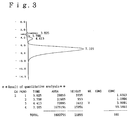
- the chromatogram obtained in accordance with the same method as that used in Example 3 is shown in Figure 6.
- the peak at the retention time of 3.72 minute is assigned to polyethylene glycol expressed by formula [12]
- the peak at the retention time of 7.77 minutes is assigned to polyoxyethylenediacetic acid expressed by formula [13].
- three other peaks are found in the chromatogram shown in Figure 6, and it can be understood that byproducts other than the starting material and the object product are present.
- the purity of the obtained polyoxyethylenediacetic acid was found to be 36.8% by weight which is markedly different from the value calculated from the acid value. This result is considered to have been obtained because the number of repeated washing of the product was insufficient, and hydrochloric acid used for adjustment of pH remained in the product.
- the entire amount of the reaction mixture was transferred into a separation funnel.
- 10% by weight hydrochloric acid was added to adjust pH of the reaction mixture to 1.5.
- the mixture was heated to 90°C while being stirred, and the heated mixture was left standing at 90°C for 1 hour. Because the mixture was not separated into two layers even after 1 hour, 600 g of xylene was added while the mixture was stirred, and the resultant mixture was left standing at 90°C. Then, the aqueous lower layer was removed. The remaining upper layer was transferred to a Kjeldahl flask and dehydrated at 70°C at a decreased pressure of 30 mmHg or less for 2 hours.
- Salts precipitated from the product were removed by filtration with pressure, and 1,042 g of polyoxyethylenediacetic acid expressed by formula [13]: HOOCCH 2 O(C 2 H 4 O) 70 CH 2 COOH was obtained.
- the obtained polyoxyethylenediacetic acid had an acid value of 26.0 (theoretical value: 34.87), a hydroxyl value of 11.5 after correction by the acid value (theoretical value: 0), a conversion of the hydroxyl group into the carboxylic add of 74.6% as calculated from the acid value, and a saponification value of 24.2 (theoretical value: 34.8).
Landscapes
- Chemical & Material Sciences (AREA)
- Organic Chemistry (AREA)
- Chemical Kinetics & Catalysis (AREA)
- Engineering & Computer Science (AREA)
- Oil, Petroleum & Natural Gas (AREA)
- Polyethers (AREA)
- Organic Low-Molecular-Weight Compounds And Preparation Thereof (AREA)
Applications Claiming Priority (3)
| Application Number | Priority Date | Filing Date | Title |
|---|---|---|---|
| JP05098497A JP3855344B2 (ja) | 1997-02-19 | 1997-02-19 | ポリオキシアルキレンカルボン酸の製造方法 |
| JP50984/97 | 1997-02-19 | ||
| JP5098497 | 1997-02-19 |
Publications (3)
| Publication Number | Publication Date |
|---|---|
| EP0897906A2 true EP0897906A2 (de) | 1999-02-24 |
| EP0897906A3 EP0897906A3 (de) | 1999-05-12 |
| EP0897906B1 EP0897906B1 (de) | 2003-12-17 |
Family
ID=12874070
Family Applications (1)
| Application Number | Title | Priority Date | Filing Date |
|---|---|---|---|
| EP97114793A Expired - Lifetime EP0897906B1 (de) | 1997-02-19 | 1997-08-27 | Verfahren zur Herstellung einer Polyoxyalkylencarbonsäure |
Country Status (5)
| Country | Link |
|---|---|
| US (1) | US5840973A (de) |
| EP (1) | EP0897906B1 (de) |
| JP (1) | JP3855344B2 (de) |
| DE (1) | DE69726850T2 (de) |
| NO (1) | NO307924B1 (de) |
Cited By (3)
| Publication number | Priority date | Publication date | Assignee | Title |
|---|---|---|---|---|
| WO2000053701A1 (en) * | 1999-03-05 | 2000-09-14 | Castrol Limited | Lubricant composition comprising a carboxy-terminated reaction product |
| EP1354905A3 (de) * | 2002-04-18 | 2004-03-03 | Clariant GmbH | Verfahren zur Herstellung von Ethercarbonsäuren mit niedrigem Stockpunkt |
| EP1574560A1 (de) | 2004-03-04 | 2005-09-14 | Clariant GmbH | Verfahren zur lösungsmittelfreien Herstellung von Ethercarbonsäuren mit niedrigem Restsalzgehalt |
Families Citing this family (12)
| Publication number | Priority date | Publication date | Assignee | Title |
|---|---|---|---|---|
| ITMI20031104A1 (it) * | 2003-06-03 | 2004-12-04 | Solvay Solexis Spa | Acidi carbossilici(per) fluoropolieterei e loro uso per il trattamento oleorepellente della carta |
| US20050214250A1 (en) * | 2003-11-06 | 2005-09-29 | Harris J M | Method of preparing carboxylic acid functionalized polymers |
| US7462627B2 (en) * | 2006-02-09 | 2008-12-09 | Enzon Pharmaceuticals, Inc. | Multi-arm polymeric conjugates of 7-ethyl-10-hydroxycamptothecin for treatment of breast, colorectal, pancreatic, ovarian and lung cancers |
| US7671067B2 (en) * | 2006-02-09 | 2010-03-02 | Enzon Pharmaceuticals, Inc. | Treatment of non-hodgkin's lymphomas with multi-arm polymeric conjugates of 7-ethyl-10-hydroxycamtothecin |
| KR20090108082A (ko) * | 2007-02-09 | 2009-10-14 | 엔존 파마슈티컬즈, 인코포레이티드 | 7-에틸-10-하이드록시캄토테신 다분지형 고분자 접합체를 이용한 내성 또는 불응성 암의 치료방법 |
| JP5150297B2 (ja) * | 2008-02-14 | 2013-02-20 | ネクター セラピューティックス エイエル,コーポレイション | ヘテロ二官能性ポリエチレングリコール誘導体およびその調製方法 |
| WO2010025337A1 (en) * | 2008-08-29 | 2010-03-04 | Enzon Pharmaceuticals, Inc. | Method of treating ras associated cancer |
| US20100098654A1 (en) * | 2008-10-21 | 2010-04-22 | Fabio Pastorino | Treatment of neuroblastoma with multi-arm polymeric conjugates of 7-ethyl-10-hydroxycamptothecin |
| JP5953459B2 (ja) * | 2012-03-27 | 2016-07-20 | ネクター セラピューティクス | ヘテロ二官能性ポリエチレングリコール誘導体およびその調製方法 |
| JP6184462B2 (ja) * | 2015-10-28 | 2017-08-23 | ウェルズ ファーゴ バンク ナショナル アソシエイション | ヘテロ二官能性ポリエチレングリコール誘導体およびその調製方法 |
| JP6361083B2 (ja) * | 2017-06-27 | 2018-07-25 | ウェルズ ファーゴ バンク ナショナル アソシエイション | ヘテロ二官能性ポリエチレングリコール誘導体およびその調製方法 |
| JP6500318B2 (ja) * | 2018-04-04 | 2019-04-17 | ウェルズ ファーゴ バンク ナショナル アソシエイション | ヘテロ二官能性ポリエチレングリコール誘導体およびその調製方法 |
Family Cites Families (10)
| Publication number | Priority date | Publication date | Assignee | Title |
|---|---|---|---|---|
| US4219672A (en) * | 1971-02-03 | 1980-08-26 | Henkel Kommanditgesellschaft Auf Aktien (Henkel Kgaa) | Ether carboxylic acids |
| DE2104976C2 (de) * | 1971-02-03 | 1984-06-07 | Henkel KGaA, 4000 Düsseldorf | Ätherpolycarbonsäuren, ihre Herstellung und Verwendung |
| GB1448988A (en) * | 1972-12-07 | 1976-09-08 | Unilever Ltd | Dicarboxy- alkyl ethers used as builders in detergent compositions |
| FR2268006B1 (de) * | 1974-04-17 | 1980-08-14 | Huels Chemische Werke Ag | |
| DE3202299C1 (de) * | 1982-01-26 | 1983-05-05 | Th. Goldschmidt Ag, 4300 Essen | Verfahren zum Flexibilisieren von Epoxidharzen |
| JPH0643365B2 (ja) * | 1987-05-13 | 1994-06-08 | 三洋化成工業株式会社 | カルボン酸類 |
| CA2012171A1 (en) * | 1989-05-22 | 1990-11-22 | Thomas A. Cripe | Process for making alkyl ethoxy carboxylates |
| DE4224362A1 (de) * | 1992-07-23 | 1994-01-27 | Henkel Kgaa | Verfahren zur Herstellung von Ethercarbonsäuresalzen mit vermindertem Restpolyglycolethergehalt |
| JPH06287276A (ja) * | 1993-04-05 | 1994-10-11 | Sanyo Chem Ind Ltd | 水性エポキシ樹脂組成物 |
| GB9407778D0 (en) * | 1994-04-20 | 1994-06-15 | Sandoz Ltd | Improvements in or relating to organic compounds |
-
1997
- 1997-02-19 JP JP05098497A patent/JP3855344B2/ja not_active Expired - Fee Related
- 1997-08-27 DE DE69726850T patent/DE69726850T2/de not_active Expired - Lifetime
- 1997-08-27 US US08/917,824 patent/US5840973A/en not_active Expired - Lifetime
- 1997-08-27 EP EP97114793A patent/EP0897906B1/de not_active Expired - Lifetime
- 1997-09-22 NO NO974359A patent/NO307924B1/no not_active IP Right Cessation
Cited By (6)
| Publication number | Priority date | Publication date | Assignee | Title |
|---|---|---|---|---|
| WO2000053701A1 (en) * | 1999-03-05 | 2000-09-14 | Castrol Limited | Lubricant composition comprising a carboxy-terminated reaction product |
| EP1354905A3 (de) * | 2002-04-18 | 2004-03-03 | Clariant GmbH | Verfahren zur Herstellung von Ethercarbonsäuren mit niedrigem Stockpunkt |
| DE10217208A1 (de) * | 2002-04-18 | 2004-04-08 | Clariant Gmbh | Verfahren zur Herstellung von Ethercarbonsäuren mit niedrigem Stockpunkt |
| DE10217208B4 (de) * | 2002-04-18 | 2004-09-16 | Clariant Gmbh | Verwendung von Ethercarbonsäuren mit niedrigem Stockpunkt |
| EP1574560A1 (de) | 2004-03-04 | 2005-09-14 | Clariant GmbH | Verfahren zur lösungsmittelfreien Herstellung von Ethercarbonsäuren mit niedrigem Restsalzgehalt |
| DE102004010505A1 (de) * | 2004-03-04 | 2005-09-29 | Clariant Gmbh | Verfahren zur lösungsmittelfreien Herstellung von Ethercarbonsäuren mit niedrigem Restsalzgehalt |
Also Published As
| Publication number | Publication date |
|---|---|
| EP0897906A3 (de) | 1999-05-12 |
| JPH10231270A (ja) | 1998-09-02 |
| JP3855344B2 (ja) | 2006-12-06 |
| US5840973A (en) | 1998-11-24 |
| DE69726850D1 (de) | 2004-01-29 |
| EP0897906B1 (de) | 2003-12-17 |
| NO974359L (no) | 1998-08-20 |
| NO974359D0 (no) | 1997-09-22 |
| DE69726850T2 (de) | 2004-11-04 |
| NO307924B1 (no) | 2000-06-19 |
Similar Documents
| Publication | Publication Date | Title |
|---|---|---|
| EP0897906B1 (de) | Verfahren zur Herstellung einer Polyoxyalkylencarbonsäure | |
| JP3174479B2 (ja) | 活性水素を有する化合物のアルキレンオキサイド付加物の製造方法 | |
| JP2002506898A (ja) | 殆ど臭気のないポリエーテルポリオールの製造方法 | |
| JP3773963B2 (ja) | ポリエーテルポリオールの製造方法 | |
| US6326514B1 (en) | Process for the preparation of ether carboxylic acids with low residual alcohol content | |
| US5962749A (en) | Process for the removal of alkalinity in the manufacture of polyether polyols and the reuse of this alkalinity in the manufacture of polyether polyols | |
| EP1311468A1 (de) | Verfahren zur reinigung von fluorierten alkansäuren | |
| CN102471479B (zh) | 非离子表面活性剂的制造方法 | |
| JPS6126779B2 (de) | ||
| JPH09188755A (ja) | ポリグリセリンモノアルキルエーテルの製造方法 | |
| JP4102188B2 (ja) | フルオロメチルヘキサフルオロイソプロピルエーテルの製造方法 | |
| WO1996001243A1 (en) | Propofol purification | |
| US3959389A (en) | Method of manufacturing alkylene oxide adducts of an aliphatic alcohol | |
| JP2021107532A (ja) | 分岐型ポリエチレングリコールの精製方法 | |
| US3932531A (en) | Method of manufacturing alkylene oxide adducts of an aliphatic alcohol | |
| SG190671A1 (en) | Method for producing polyoxyalkylene alkyl ether | |
| JPH0558012B2 (de) | ||
| JP3671482B2 (ja) | 非イオン界面活性剤の製造方法 | |
| US20010020076A1 (en) | Production process for glyoxylic acid (salt)-based polymer | |
| JPH09255773A (ja) | ポリオキシアルキレン脂肪酸アルカノールアミドの製造方法 | |
| CN1867556A (zh) | 制备1-氢过氧基-16-氧杂二环[10.4.0]十六烷的方法 | |
| CN1096027A (zh) | 氟甲基醚的合成 | |
| JPH04136031A (ja) | ポリカーボネートの製造方法 | |
| JP2000128943A (ja) | グリオキシル酸塩系重合体の製造方法 | |
| JPS61151143A (ja) | アルコキシハロゲン化物の製造方法 |
Legal Events
| Date | Code | Title | Description |
|---|---|---|---|
| PUAI | Public reference made under article 153(3) epc to a published international application that has entered the european phase |
Free format text: ORIGINAL CODE: 0009012 |
|
| AK | Designated contracting states |
Kind code of ref document: A2 Designated state(s): CH DE DK FR GB IT LI SE |
|
| AX | Request for extension of the european patent |
Free format text: AL;LT;LV;RO;SI |
|
| PUAL | Search report despatched |
Free format text: ORIGINAL CODE: 0009013 |
|
| AK | Designated contracting states |
Kind code of ref document: A3 Designated state(s): AT BE CH DE DK ES FI FR GB GR IE IT LI LU MC NL PT SE |
|
| AX | Request for extension of the european patent |
Free format text: AL;LT;LV;RO;SI |
|
| 17P | Request for examination filed |
Effective date: 19991015 |
|
| AKX | Designation fees paid |
Free format text: CH DE DK FR GB IT LI SE |
|
| GRAG | Despatch of communication of intention to grant |
Free format text: ORIGINAL CODE: EPIDOS AGRA |
|
| 17Q | First examination report despatched |
Effective date: 20020627 |
|
| GRAG | Despatch of communication of intention to grant |
Free format text: ORIGINAL CODE: EPIDOS AGRA |
|
| GRAG | Despatch of communication of intention to grant |
Free format text: ORIGINAL CODE: EPIDOS AGRA |
|
| GRAH | Despatch of communication of intention to grant a patent |
Free format text: ORIGINAL CODE: EPIDOS IGRA |
|
| GRAS | Grant fee paid |
Free format text: ORIGINAL CODE: EPIDOSNIGR3 |
|
| GRAA | (expected) grant |
Free format text: ORIGINAL CODE: 0009210 |
|
| AK | Designated contracting states |
Kind code of ref document: B1 Designated state(s): CH DE DK FR GB IT LI SE |
|
| PG25 | Lapsed in a contracting state [announced via postgrant information from national office to epo] |
Ref country code: LI Free format text: LAPSE BECAUSE OF FAILURE TO SUBMIT A TRANSLATION OF THE DESCRIPTION OR TO PAY THE FEE WITHIN THE PRESCRIBED TIME-LIMIT Effective date: 20031217 Ref country code: IT Free format text: LAPSE BECAUSE OF FAILURE TO SUBMIT A TRANSLATION OF THE DESCRIPTION OR TO PAY THE FEE WITHIN THE PRESCRIBED TIME-LIMIT;WARNING: LAPSES OF ITALIAN PATENTS WITH EFFECTIVE DATE BEFORE 2007 MAY HAVE OCCURRED AT ANY TIME BEFORE 2007. THE CORRECT EFFECTIVE DATE MAY BE DIFFERENT FROM THE ONE RECORDED. Effective date: 20031217 Ref country code: CH Free format text: LAPSE BECAUSE OF FAILURE TO SUBMIT A TRANSLATION OF THE DESCRIPTION OR TO PAY THE FEE WITHIN THE PRESCRIBED TIME-LIMIT Effective date: 20031217 |
|
| REG | Reference to a national code |
Ref country code: GB Ref legal event code: FG4D |
|
| REG | Reference to a national code |
Ref country code: CH Ref legal event code: EP |
|
| REF | Corresponds to: |
Ref document number: 69726850 Country of ref document: DE Date of ref document: 20040129 Kind code of ref document: P |
|
| PG25 | Lapsed in a contracting state [announced via postgrant information from national office to epo] |
Ref country code: SE Free format text: LAPSE BECAUSE OF FAILURE TO SUBMIT A TRANSLATION OF THE DESCRIPTION OR TO PAY THE FEE WITHIN THE PRESCRIBED TIME-LIMIT Effective date: 20040317 Ref country code: DK Free format text: LAPSE BECAUSE OF FAILURE TO SUBMIT A TRANSLATION OF THE DESCRIPTION OR TO PAY THE FEE WITHIN THE PRESCRIBED TIME-LIMIT Effective date: 20040317 |
|
| REG | Reference to a national code |
Ref country code: CH Ref legal event code: PL |
|
| ET | Fr: translation filed | ||
| PLBE | No opposition filed within time limit |
Free format text: ORIGINAL CODE: 0009261 |
|
| STAA | Information on the status of an ep patent application or granted ep patent |
Free format text: STATUS: NO OPPOSITION FILED WITHIN TIME LIMIT |
|
| 26N | No opposition filed |
Effective date: 20040920 |
|
| REG | Reference to a national code |
Ref country code: FR Ref legal event code: PLFP Year of fee payment: 20 |
|
| PGFP | Annual fee paid to national office [announced via postgrant information from national office to epo] |
Ref country code: DE Payment date: 20160822 Year of fee payment: 20 Ref country code: GB Payment date: 20160819 Year of fee payment: 20 |
|
| PGFP | Annual fee paid to national office [announced via postgrant information from national office to epo] |
Ref country code: FR Payment date: 20160822 Year of fee payment: 20 |
|
| REG | Reference to a national code |
Ref country code: DE Ref legal event code: R071 Ref document number: 69726850 Country of ref document: DE |
|
| REG | Reference to a national code |
Ref country code: GB Ref legal event code: PE20 Expiry date: 20170826 |
|
| PG25 | Lapsed in a contracting state [announced via postgrant information from national office to epo] |
Ref country code: GB Free format text: LAPSE BECAUSE OF EXPIRATION OF PROTECTION Effective date: 20170826 |