EP0897990A2 - Réduction de contamination croisée concernant l'amplification des acides nucléiques - Google Patents
Réduction de contamination croisée concernant l'amplification des acides nucléiques Download PDFInfo
- Publication number
- EP0897990A2 EP0897990A2 EP98115491A EP98115491A EP0897990A2 EP 0897990 A2 EP0897990 A2 EP 0897990A2 EP 98115491 A EP98115491 A EP 98115491A EP 98115491 A EP98115491 A EP 98115491A EP 0897990 A2 EP0897990 A2 EP 0897990A2
- Authority
- EP
- European Patent Office
- Prior art keywords
- reagent
- enzyme
- amplification
- nucleic acids
- sample
- Prior art date
- Legal status (The legal status is an assumption and is not a legal conclusion. Google has not performed a legal analysis and makes no representation as to the accuracy of the status listed.)
- Granted
Links
Images

Classifications
-
- C—CHEMISTRY; METALLURGY
- C12—BIOCHEMISTRY; BEER; SPIRITS; WINE; VINEGAR; MICROBIOLOGY; ENZYMOLOGY; MUTATION OR GENETIC ENGINEERING
- C12Q—MEASURING OR TESTING PROCESSES INVOLVING ENZYMES, NUCLEIC ACIDS OR MICROORGANISMS; COMPOSITIONS OR TEST PAPERS THEREFOR; PROCESSES OF PREPARING SUCH COMPOSITIONS; CONDITION-RESPONSIVE CONTROL IN MICROBIOLOGICAL OR ENZYMOLOGICAL PROCESSES
- C12Q1/00—Measuring or testing processes involving enzymes, nucleic acids or microorganisms; Compositions therefor; Processes of preparing such compositions
- C12Q1/68—Measuring or testing processes involving enzymes, nucleic acids or microorganisms; Compositions therefor; Processes of preparing such compositions involving nucleic acids
- C12Q1/6844—Nucleic acid amplification reactions
- C12Q1/6848—Nucleic acid amplification reactions characterised by the means for preventing contamination or increasing the specificity or sensitivity of an amplification reaction
Definitions
- the invention relates to methods for amplifying nucleic acids, methods for the detection of nucleic acids using these amplification methods, the use of lauroylsarcosine to prevent the reactivation of uracil-N-glycosilase as well Reagent and a reagent kit to perform this procedure.
- nucleic acid diagnostics Since the introduction of methods for the amplification of nucleic acids (e.g. the polymerase chain reaction (PCR), as described in US-A-4,683,202) in nucleic acid diagnostics a whole series of analytes have become analytically detectable for the first time. These methods are able to analyze analyte nucleic acids, even in the smallest concentrations, e.g. B. of HCV, to the extent that they are accessible to such nucleic acid tests that were previously reserved for highly concentrated analytes.
- PCR polymerase chain reaction
- EP-B-0 566 050 describes a method for stabilizing alkaline nucleic acid-containing Solutions with anionic, non-ionic and zwitterionic detergents are described.
- EP-A-0 401 037 describes a method which partially overcomes the deficiency described remedies.
- each analyte nucleic acid is amplified during amplification mononucleotides not naturally contained in the nucleic acid to be detected built-in.
- the sample is put together with the reagents used, subjected to a pretreatment in which all introduced Amplificates of previous amplifications are broken down enzymatically.
- exemplary are uracil-N-glycosilase (UNG) as a degradation reagent and as a modifying building block for Amplificates called dUTP.
- UNG uracil-N-glycosilase
- An alternative method is used instead of uracil-containing ones Uracil-containing primers mononucleotides. Such a procedure in which the primer binding sites are degraded on previously generated amplificates is described in EP-A-0 415 755.
- UNG of the sample is usually already with the master mix, which is all for the Contains amplification required reagents added. Before the subsequent amplification the above-mentioned degradation reaction takes place in a short incubation step. Warmed up then the reaction mixture to a temperature above about 40 ° C, so the UNG is deactivated. This is necessary to ensure that the UNG is not the new one degrades synthesized DNA that accumulates in the course of amplification.
- the amplicons are in stored at elevated temperatures (e.g.> 50 ° C). However, this will either result in an additional temperature-controlled device is required or the thermal cycler station is through the reaction vessel blocked until the test continues. On the other hand, it happens under these conditions with time also a temperature-related disintegration of the amplificate.
- the amplificates are stored at low temperatures (e.g.
- the object of the present invention was therefore to overcome the disadvantages of the prior art entirely or partially to avoid, and in particular a simpler method for amplification with provide reduced risk of contamination.
- the invention also relates to a reagent for use in the above method and Use of detergents in methods for amplifying nucleic acids.
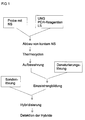
- FIG. 1 An exemplary detection method is shown schematically in FIG. 1, in which the reagent is added to the sample before amplification.
- FIG. 2 A method is schematically shown in which the reagent is added after amplification becomes.
- a detergent in the sense of the present invention is a surface-active Understood substance that is principally anionic, cationic, ampholytic or non-ionic can be. Anionic detergents are preferred.
- the essence of the present invention is the realization that it is possible to reactivate Degradation enzymes after amplification by adding a reagent before amplification to suppress.
- One skilled in the art would not have expected a reagent to exist that prevents the reactivation of the enzyme, but not the activity of the native enzyme significantly affected.
- the amplification method according to the invention uses a sample in which the one to be amplified Nucleic acid is included.
- the method according to the invention is mostly used in analysis are used, which is why the nucleic acid contained in the sample also analyte nucleic acid will be called.
- analyte nucleic acids are any To understand origin, for example nucleic acids viroid, viral, bacterial or cellular Origin. You can in solution, suspension, but also fixed to solids or in cell-containing media, cell smears, fixed cells, tissue sections or fixed organisms available.
- the nucleic acids are preferably in solution.
- nucleic acid is not yet accessible, it is advantageous to use the corresponding one Reagents made available. Both changes in pH (alkaline), heat, repetition of extreme temperature changes (freezing / thawing), Change in physiological growth conditions (osmotic pressure), impact of detergents, chaotropic salts or enzymes (e.g. proteases, lipases), alone or in Combination contribute to the release of the nucleic acids.
- An outstanding example of such an enzyme is uracil-N-glycosilase, which recognizes uracil incorporated in the amplificates and all nucleic acids containing U so far degrades that it is no longer available as a template for the subsequent amplification stand. This is done in the amplification reaction instead of or in addition to the normal dTTP or the corresponding oligonucleotide dUTP or a U-containing primer used. This will result in the amplificates from sources other than the current sample chemically differentiable from the nucleic acids of the current sample to be amplified.
- the enzymatic degradation reaction is carried out until there are probably no cross-contaminating ones There are more nucleic acids in the sample.
- the enzyme is then inactivated. This can be done in a variety of ways, but is preferred thermal inactivation, since the reaction vessel does not have to be opened. For this the reaction mixture is heated to a temperature at which the enzyme is inactivated means that it is presumably changed by changing its spatial arrangement so that the enzymatic activity is lost.
- heat unstable UNG is one Temperature of 50 ° C, preferably from 40 ° C to 96 ° C is sufficient for this. The heat-stable UNG requires a higher temperature for inactivation.
- Thermal amplification can inactivate the first heat step of the Amplification procedures are done so that a separate step can be omitted.
- the reagents required for amplification i. H. especially the (Mono) nucleoside triphosphates, the polymerase, the primers and possibly buffers, all together, or shortly before or after adding the degradation enzyme to the sample.
- those required for amplification and those required for degradation and the reagents required for inactivation as a mixture or Solution added. This saves work steps and lowers the active and the passive risk of contamination.
- Amplification in the sense of the invention includes all in vitro methods for multiplication of nucleic acids or parts thereof, in particular on the implementation of Procedures based on thermal cycles.
- the particularly preferred amplification method is PCR.
- Prefers are, in particular, those amplification methods in which using the ones to be amplified Nucleic acid as template nucleic acid under catalysis by a DNA polymerase, preferably a thermostable polymerase, particularly preferably T. aq. (DNA) or T.th. (RNA) Polymerase, extension products of a primer are formed, which in turn as Template nucleic acid for the extension of a primer are available.
- a DNA polymerase preferably a thermostable polymerase, particularly preferably T. aq. (DNA) or T.th. (RNA) Polymerase
- extension products of a primer are formed, which in turn as Template nucleic acid for the extension of a primer are available.
- Nucleoside triphosphates are ribo (rNTP) - or deoxybonucleoside triphosphates (dNTP). They can be marked as well as unmarked.
- a template nucleic acid is a nucleic acid to which it is essentially complementary Nucleic acid strand is newly formed.
- the template nucleic acid is used in relation to the sequence information as a matrix for the description.
- the reactions preferably take place in a plastic vessel.
- a plastic vessel In particular are there such vessels can be used, which are normally used as amplification vessels in conventional thermal cyclers be used. Examples are vessels made of polystyrene, polyethylene or luran.
- the reagent preventing the reactivation can in principle be carried out at any stage of the sample Reaction may be added, but advantageously before the enzyme has the opportunity to reactivate has, that means at the latest after amplification, depending on the storage temperature
- the reaction mixture after amplification is reactivated differently fast, which is why an earlier addition makes more sense at higher temperatures than at lower ones Temperatures. Waiting lowers the yield of amplificates, because the enzyme just amplified nucleic acids begins to degrade again.
- the reagent is preferred already added to the sample together with the degrading enzyme.
- Substances with a hydrophobic group have proven to be a reagent Detergents, proven useful. It was found that the refolding of the Enzyme can be largely suppressed by such substances. This applies in particular to Detergents with a pronounced hydrophobic content of approx. 5 to 30 carbon atoms, e.g. B. a fatty acid residue, such as preferably a lauroyl residue or N-acyl amino acids. By Addition of the hydrophobic residues will probably make restructuring more difficult.
- Possible further reagents are, for example, LDS (lithium dodecyl sulfate) or SDS (sodium dodecyl sulfate), although this has the problem of low solubility at low temperatures to have.
- LDS lithium dodecyl sulfate
- SDS sodium dodecyl sulfate
- the anionic class is particularly suitable in the sense of the inventions Detergents, especially lauroylsarcosine.
- the reagent is to be contained during the amplification, care must also be taken be that the reagent does not significantly affect the activity of the polymerase.
- the person skilled in the art from the group of the reagents mentioned above can do this by simple experiments find out for amplification in the presence of the chosen reagent. A slightly diminished one Amplification efficiency can also be offset by adding a little more polymerase become.
- the concentration of the reagent also depends on the reagent itself, so that for the whole Group valid information is very difficult to provide.
- LS N-lauroylsarcosine
- the process according to the invention has the advantage that the resulting reaction mixtures After amplification, detection does not have to be carried out immediately, but also some Time can be stored at room temperature without significant degradation of the Amplification products takes place. A separate addition of reagents can be omitted.
- the amplification method according to the invention can be used to obtain a sufficient Generate amount of detectable nucleic acids.
- the invention formed amplificates then detected in a generally known manner become.
- Detectable groups e.g. B. Fluorescence labels into which amplified products are incorporated.
- the amplificates are preferred hybridized with a labeled probe, captured on a solid phase, if desired Exempt from any excess of labeled components and on the solid phase proven based on the existing marking.
- a variety of formats for such evidence is known, e.g. B. a format as described in EP-A-0 324 474.
- the sample e.g. B. a serum after sample preparation, a reagent containing UNG, LS, mononucleoside triphosphate mixture (also containing dUTP), T.th.-polymerase and HIV-specific biotin labels Primers added.
- the vessel is closed and incubated for a while. Then the vessel is placed in a thermal cycler and heated as long as the thermocycles require. The vessel is then opened, the nucleic acid is denatured and then a ruthenium-labeled detector probe and a suspension of streptavidin-coated Magnetbeads added. After mixing, the mixture is placed in a measuring cell for brought an electrochemiluminescence measurement. The measured signal is a sign of the Amount or presence of HIV nucleic acids in the sample.
- the invention also relates to a reagent kit for the amplification of nucleic acids, containing reagents for the amplification of nucleic acids in one or more containers, a nucleic acid-degrading enzyme and an enzyme that prevents reactivation Reagent.
- the invention also relates to the use of lauroylsarcosine for prevention reactivation of uracil-N-glycosilase.
- detergents are used in processes for the detection of nucleic acids with the steps in vitro production of a variety of Copies of a portion of the nucleic acid and detection of the copies as a measure of the presence or the amount of nucleic acid to be detected can thereby be improved can that a detergent is added to the solution with the copies before detection.
- the Detergent probably leads to a reduction in unwanted side reactions of DNA polymerases at low temperatures, e.g. B. Filling reactions on single-stranded templates. These side reactions can significantly affect the performance of the detection procedure.
- a special subject is a method for the amplification of nucleic acids in a Sample containing the steps of treating the sample with an enzyme under conditions which products from amplifications of nucleic acids from other samples are enzymatically degraded inactivating the enzyme and treating the sample under conditions where the nucleic acids are amplified, a reagent being added to the sample after amplification which does not impair the enzyme activity of the active enzyme but which does not reactivate of the enzyme prevented.
- FIG. 2 Such a method is shown schematically in FIG. 2.
- the reaction mixture is subjected to the thermal cycles. After amplification the reagent (here Lauroylsarcosin, LS) is added. The resulting mixture can now be kept until a denaturing solution for single-stranding the Amplificates should be added. Then a solution with a detector probe is added, Hybridization conditions are set and, if necessary, the hybrids are detected.
- LS Lauroylsarcosin
- the amplification was carried out according to the following cycler protocol: 10min 37 ° C Decontamination by UNG 5min 95 ° C Denaturation 1min 60 ° C Primer annealing and elongation 30sec 95 ° C 29 cycles of amplification 1min 60 ° C
- the amplification was carried out according to the following cycler protocol: 10min 37 ° C Decontamination by UNG 30 min 60 ° C reverse transcription 4 cycles: 10sec 95 ° C Denaturation 10sec 55 ° C Primer annealing 10sec 72 ° C Elongation 26 cycles: 10sec 90 ° C Denaturation 10sec 60 ° C Primer annealing 10sec 72 ° C Elongation
- 10 2 , 10 4 and 10 5 copies of HIV-RNA standard were amplified in multiple determinations. After amplification, all samples were first divided and measured (t 0 ), then half of the samples were stopped with 0.05% LS (w / v, final concentration) and all samples were incubated for 3 hours at 30 ° C. (t 3 hours ) and then again measured (ECL detection, Flash Symu). A ruthenium-labeled DNA probe was used for hybridization. (SK102b, ATCAATGAGGAAGCTGCAGA, SEQ.ID.NO. 6).
Landscapes
- Chemical & Material Sciences (AREA)
- Organic Chemistry (AREA)
- Life Sciences & Earth Sciences (AREA)
- Chemical Kinetics & Catalysis (AREA)
- Zoology (AREA)
- Wood Science & Technology (AREA)
- Proteomics, Peptides & Aminoacids (AREA)
- Health & Medical Sciences (AREA)
- Engineering & Computer Science (AREA)
- Biophysics (AREA)
- Biochemistry (AREA)
- Microbiology (AREA)
- Molecular Biology (AREA)
- Biotechnology (AREA)
- Analytical Chemistry (AREA)
- Physics & Mathematics (AREA)
- Immunology (AREA)
- Bioinformatics & Cheminformatics (AREA)
- General Engineering & Computer Science (AREA)
- General Health & Medical Sciences (AREA)
- Genetics & Genomics (AREA)
- Measuring Or Testing Involving Enzymes Or Micro-Organisms (AREA)
- Saccharide Compounds (AREA)
Applications Claiming Priority (2)
| Application Number | Priority Date | Filing Date | Title |
|---|---|---|---|
| DE19736062 | 1997-08-20 | ||
| DE19736062A DE19736062A1 (de) | 1997-08-20 | 1997-08-20 | Reduktion von Kreuzkontaminationen bei Nukleinsäureamplifikationen |
Publications (3)
| Publication Number | Publication Date |
|---|---|
| EP0897990A2 true EP0897990A2 (fr) | 1999-02-24 |
| EP0897990A3 EP0897990A3 (fr) | 2002-05-02 |
| EP0897990B1 EP0897990B1 (fr) | 2009-10-07 |
Family
ID=7839519
Family Applications (1)
| Application Number | Title | Priority Date | Filing Date |
|---|---|---|---|
| EP98115491A Expired - Lifetime EP0897990B1 (fr) | 1997-08-20 | 1998-08-18 | Réduction de contamination croisée concernant l'amplification des acides nucléiques |
Country Status (5)
| Country | Link |
|---|---|
| US (1) | US6248522B1 (fr) |
| EP (1) | EP0897990B1 (fr) |
| JP (1) | JPH11113599A (fr) |
| AT (1) | ATE445021T1 (fr) |
| DE (2) | DE19736062A1 (fr) |
Cited By (2)
| Publication number | Priority date | Publication date | Assignee | Title |
|---|---|---|---|---|
| WO2002034905A1 (fr) * | 2000-10-27 | 2002-05-02 | Supercritical Co., Ltd. | Procédé d'amplification de gènes |
| EP2031070A1 (fr) * | 2002-12-04 | 2009-03-04 | Applera Corporation | Amplification multiplexe de polynucléotides |
Families Citing this family (6)
| Publication number | Priority date | Publication date | Assignee | Title |
|---|---|---|---|---|
| US7569342B2 (en) | 1997-12-10 | 2009-08-04 | Sierra Molecular Corp. | Removal of molecular assay interferences |
| FR2864541B1 (fr) * | 2003-12-31 | 2006-03-10 | Kabertex | Anticorps anti-inhibiteur de l'uracile-adn-glycosylase et leurs applications pour la decontamination des reactions d'amplification des acides nucleiques |
| ATE452992T1 (de) * | 2004-02-04 | 2010-01-15 | Qiagen North American Holdings | Zusammensetzungen auf dutp-basis zurverringerung der primeraggregatbildung während der nukleinsäureamplifikation |
| US7833716B2 (en) | 2006-06-06 | 2010-11-16 | Gen-Probe Incorporated | Tagged oligonucleotides and their use in nucleic acid amplification methods |
| US7687027B2 (en) * | 2008-02-27 | 2010-03-30 | Becton, Dickinson And Company | Cleaning compositions, methods and materials for reducing nucleic acid contamination |
| FR2940805B1 (fr) * | 2009-01-05 | 2015-10-16 | Biomerieux Sa | Procede d'amplification et/ou de detection d'acides nucleiques, kits et utilisations de ce procede |
Family Cites Families (6)
| Publication number | Priority date | Publication date | Assignee | Title |
|---|---|---|---|---|
| US5418149A (en) * | 1990-07-24 | 1995-05-23 | Hoffmann-La Roche Inc. | Reduction of non-specific amplification glycosylase using DUTP and DNA uracil |
| US5466591A (en) * | 1986-08-22 | 1995-11-14 | Hoffmann-La Roche Inc. | 5' to 3' exonuclease mutations of thermostable DNA polymerases |
| US5374553A (en) * | 1986-08-22 | 1994-12-20 | Hoffmann-La Roche Inc. | DNA encoding a thermostable nucleic acid polymerase enzyme from thermotoga maritima |
| CA2073298C (fr) * | 1991-07-12 | 2007-04-17 | James L. Hartley | Procede de reduction de la contamination lors des reactions d'amplification d'acides nucleiques |
| CA2122203C (fr) * | 1993-05-11 | 2001-12-18 | Melinda S. Fraiser | Decontamination des reactions d'amplification d'acides nucleiques |
| DE19750237A1 (de) * | 1997-11-13 | 1999-05-20 | Roche Diagnostics Gmbh | Verfahren zum Nachweis von Nukleinsäuren aus mehreren Proben |
-
1997
- 1997-08-20 DE DE19736062A patent/DE19736062A1/de not_active Withdrawn
-
1998
- 1998-08-14 JP JP10229725A patent/JPH11113599A/ja active Pending
- 1998-08-18 EP EP98115491A patent/EP0897990B1/fr not_active Expired - Lifetime
- 1998-08-18 AT AT98115491T patent/ATE445021T1/de not_active IP Right Cessation
- 1998-08-18 DE DE59814400T patent/DE59814400D1/de not_active Expired - Lifetime
- 1998-08-20 US US09/136,959 patent/US6248522B1/en not_active Expired - Lifetime
Cited By (5)
| Publication number | Priority date | Publication date | Assignee | Title |
|---|---|---|---|---|
| WO2002034905A1 (fr) * | 2000-10-27 | 2002-05-02 | Supercritical Co., Ltd. | Procédé d'amplification de gènes |
| EP2031070A1 (fr) * | 2002-12-04 | 2009-03-04 | Applera Corporation | Amplification multiplexe de polynucléotides |
| US9822405B2 (en) | 2002-12-04 | 2017-11-21 | Applied Biosystems, Llc | Multiplex amplification of polynucleotides |
| US10689695B2 (en) | 2002-12-04 | 2020-06-23 | Applied Biosystems, Llc | Multiplex amplification of polynucleotides |
| US11667964B2 (en) | 2002-12-04 | 2023-06-06 | Applied Biosystems, Llc | Multiplex amplification of polynucleotides |
Also Published As
| Publication number | Publication date |
|---|---|
| EP0897990B1 (fr) | 2009-10-07 |
| JPH11113599A (ja) | 1999-04-27 |
| ATE445021T1 (de) | 2009-10-15 |
| DE59814400D1 (de) | 2009-11-19 |
| US6248522B1 (en) | 2001-06-19 |
| DE19736062A1 (de) | 1999-02-25 |
| EP0897990A3 (fr) | 2002-05-02 |
Similar Documents
| Publication | Publication Date | Title |
|---|---|---|
| DE69527171T2 (de) | Strangverdrängungsamplifikation unter Verwendung von thermophilen Enzymen | |
| DE69022291T2 (de) | Verfahren zur Beherrschung von Kontamination der Nukleinsäure-Amplifikation. | |
| DE69829328T2 (de) | Strangverdrängungsamplifikation von RNA | |
| EP0705905B1 (fr) | Procédé pour la détection sensible d'acides nucléiques | |
| DE69524653T2 (de) | Amplifizierung von langen Nukleinsäuresequenzen mit PCR | |
| DE69119083T2 (de) | Direkte klonierung von pcr amplifizierten nukleinsäuren | |
| DE69332852T2 (de) | Nachweis von Nukleinsäuren im Blut | |
| DE60212175T2 (de) | Verfahren zur reduzierung unspezifischer amplifikation bei pcr | |
| DE69213112T2 (de) | Verbesserte Methoden zur Nukleinsäure-Amplifizierung | |
| EP0718408A2 (fr) | Méthode sensible pour détecter des acides nucléiques | |
| DE69627408T2 (de) | Primers und Sonden zum Nachweis von HIV | |
| DE69434688T2 (de) | Diagnostischer nachweis von rna und reagentiensätze unter verwendung binärer rna proben und einer rna-abhängigen rna ligase | |
| DE60219579T2 (de) | Reversibel modifizierte thermostabile Enzyme für die in vitro-Synthese und -Amplifizierung von DNA | |
| DE10150121B4 (de) | Echtzeitdetektion von DNA-Amplifikationsprodukten | |
| DE69428167T2 (de) | Reagenz und Verfahren für reverse Transkription bei hoher Temperatur, verbunden mit einer Polymerase-Kettenreaktion | |
| US20100075383A1 (en) | Methods for amplifying polymeric nucleic acids | |
| DE69328524T2 (de) | Exonuklease-Dekontaminierungsverfahren | |
| DE69319573T2 (de) | Nichtradioaktive DNS-Sequenzierung | |
| WO1997020069A1 (fr) | Procede pour detecter l'activite d'une telomerase | |
| EP0897990B1 (fr) | Réduction de contamination croisée concernant l'amplification des acides nucléiques | |
| DD298430A5 (de) | Verfahren zum nachweis und/oder zur identifizierung einer nucleinsaeuresequenz | |
| DE69222897T2 (de) | Verfahren zur Beherrschung der Verunreinigung von Nukleinsäure-Amplifizierungsreaktionen | |
| EP0566050B1 (fr) | Procédé pour la détection d'acides nucléiques | |
| DE69724487T2 (de) | Amplifizierung und Erkennung von Zielnukleinsäuren mit einem nachträglichen Inkubationsschritt | |
| EP3555315B1 (fr) | Procédé et système de multiplication d'un acide nucléique |
Legal Events
| Date | Code | Title | Description |
|---|---|---|---|
| PUAI | Public reference made under article 153(3) epc to a published international application that has entered the european phase |
Free format text: ORIGINAL CODE: 0009012 |
|
| AK | Designated contracting states |
Kind code of ref document: A2 Designated state(s): AT BE CH CY DE DK ES FI FR GB GR IE IT LI LU MC NL PT SE Kind code of ref document: A2 Designated state(s): AT CH DE ES FR GB IT LI NL |
|
| AX | Request for extension of the european patent |
Free format text: AL;LT;LV;MK;RO;SI |
|
| RAP3 | Party data changed (applicant data changed or rights of an application transferred) |
Owner name: ROCHE DIAGNOSTICS GMBH |
|
| PUAL | Search report despatched |
Free format text: ORIGINAL CODE: 0009013 |
|
| AK | Designated contracting states |
Kind code of ref document: A3 Designated state(s): AT BE CH CY DE DK ES FI FR GB GR IE IT LI LU MC NL PT SE |
|
| AX | Request for extension of the european patent |
Free format text: AL;LT;LV;MK;RO;SI |
|
| RIN1 | Information on inventor provided before grant (corrected) |
Inventor name: SOBEK, HARALD, DR. Inventor name: JAEGER, STEPHAN, DR. Inventor name: HABERHAUSEN, GERD, DR. |
|
| 17P | Request for examination filed |
Effective date: 20021104 |
|
| AKX | Designation fees paid |
Free format text: AT CH DE ES FR GB IT LI NL |
|
| 17Q | First examination report despatched |
Effective date: 20051213 |
|
| GRAP | Despatch of communication of intention to grant a patent |
Free format text: ORIGINAL CODE: EPIDOSNIGR1 |
|
| GRAS | Grant fee paid |
Free format text: ORIGINAL CODE: EPIDOSNIGR3 |
|
| GRAA | (expected) grant |
Free format text: ORIGINAL CODE: 0009210 |
|
| AK | Designated contracting states |
Kind code of ref document: B1 Designated state(s): AT CH DE ES FR GB IT LI NL |
|
| REG | Reference to a national code |
Ref country code: GB Ref legal event code: FG4D Free format text: NOT ENGLISH |
|
| REG | Reference to a national code |
Ref country code: CH Ref legal event code: EP |
|
| REG | Reference to a national code |
Ref country code: CH Ref legal event code: NV Representative=s name: F. HOFFMANN-LA ROCHE AG |
|
| REF | Corresponds to: |
Ref document number: 59814400 Country of ref document: DE Date of ref document: 20091119 Kind code of ref document: P |
|
| NLV1 | Nl: lapsed or annulled due to failure to fulfill the requirements of art. 29p and 29m of the patents act | ||
| PG25 | Lapsed in a contracting state [announced via postgrant information from national office to epo] |
Ref country code: ES Free format text: LAPSE BECAUSE OF FAILURE TO SUBMIT A TRANSLATION OF THE DESCRIPTION OR TO PAY THE FEE WITHIN THE PRESCRIBED TIME-LIMIT Effective date: 20100118 |
|
| PG25 | Lapsed in a contracting state [announced via postgrant information from national office to epo] |
Ref country code: NL Free format text: LAPSE BECAUSE OF FAILURE TO SUBMIT A TRANSLATION OF THE DESCRIPTION OR TO PAY THE FEE WITHIN THE PRESCRIBED TIME-LIMIT Effective date: 20091007 |
|
| PLBE | No opposition filed within time limit |
Free format text: ORIGINAL CODE: 0009261 |
|
| STAA | Information on the status of an ep patent application or granted ep patent |
Free format text: STATUS: NO OPPOSITION FILED WITHIN TIME LIMIT |
|
| 26N | No opposition filed |
Effective date: 20100708 |
|
| PG25 | Lapsed in a contracting state [announced via postgrant information from national office to epo] |
Ref country code: IT Free format text: LAPSE BECAUSE OF FAILURE TO SUBMIT A TRANSLATION OF THE DESCRIPTION OR TO PAY THE FEE WITHIN THE PRESCRIBED TIME-LIMIT Effective date: 20091007 |
|
| PG25 | Lapsed in a contracting state [announced via postgrant information from national office to epo] |
Ref country code: AT Free format text: LAPSE BECAUSE OF NON-PAYMENT OF DUE FEES Effective date: 20100818 |
|
| PGFP | Annual fee paid to national office [announced via postgrant information from national office to epo] |
Ref country code: DE Payment date: 20130902 Year of fee payment: 16 Ref country code: CH Payment date: 20130806 Year of fee payment: 16 |
|
| PGFP | Annual fee paid to national office [announced via postgrant information from national office to epo] |
Ref country code: FR Payment date: 20130725 Year of fee payment: 16 Ref country code: GB Payment date: 20130726 Year of fee payment: 16 |
|
| REG | Reference to a national code |
Ref country code: DE Ref legal event code: R119 Ref document number: 59814400 Country of ref document: DE |
|
| REG | Reference to a national code |
Ref country code: CH Ref legal event code: PL |
|
| GBPC | Gb: european patent ceased through non-payment of renewal fee |
Effective date: 20140818 |
|
| PG25 | Lapsed in a contracting state [announced via postgrant information from national office to epo] |
Ref country code: LI Free format text: LAPSE BECAUSE OF NON-PAYMENT OF DUE FEES Effective date: 20140831 Ref country code: CH Free format text: LAPSE BECAUSE OF NON-PAYMENT OF DUE FEES Effective date: 20140831 |
|
| REG | Reference to a national code |
Ref country code: FR Ref legal event code: ST Effective date: 20150430 |
|
| REG | Reference to a national code |
Ref country code: DE Ref legal event code: R119 Ref document number: 59814400 Country of ref document: DE Effective date: 20150303 |
|
| PG25 | Lapsed in a contracting state [announced via postgrant information from national office to epo] |
Ref country code: GB Free format text: LAPSE BECAUSE OF NON-PAYMENT OF DUE FEES Effective date: 20140818 Ref country code: DE Free format text: LAPSE BECAUSE OF NON-PAYMENT OF DUE FEES Effective date: 20150303 |
|
| PG25 | Lapsed in a contracting state [announced via postgrant information from national office to epo] |
Ref country code: FR Free format text: LAPSE BECAUSE OF NON-PAYMENT OF DUE FEES Effective date: 20140901 |