EP0899678A2 - Autofokus-Strichcodeleser - Google Patents
Autofokus-Strichcodeleser Download PDFInfo
- Publication number
- EP0899678A2 EP0899678A2 EP98115913A EP98115913A EP0899678A2 EP 0899678 A2 EP0899678 A2 EP 0899678A2 EP 98115913 A EP98115913 A EP 98115913A EP 98115913 A EP98115913 A EP 98115913A EP 0899678 A2 EP0899678 A2 EP 0899678A2
- Authority
- EP
- European Patent Office
- Prior art keywords
- laser beam
- bar code
- section
- distance
- focal position
- Prior art date
- Legal status (The legal status is an assumption and is not a legal conclusion. Google has not performed a legal analysis and makes no representation as to the accuracy of the status listed.)
- Withdrawn
Links
Images

Classifications
-
- G—PHYSICS
- G06—COMPUTING OR CALCULATING; COUNTING
- G06K—GRAPHICAL DATA READING; PRESENTATION OF DATA; RECORD CARRIERS; HANDLING RECORD CARRIERS
- G06K7/00—Methods or arrangements for sensing record carriers, e.g. for reading patterns
- G06K7/10—Methods or arrangements for sensing record carriers, e.g. for reading patterns by electromagnetic radiation, e.g. optical sensing; by corpuscular radiation
- G06K7/10544—Methods or arrangements for sensing record carriers, e.g. for reading patterns by electromagnetic radiation, e.g. optical sensing; by corpuscular radiation by scanning of the records by radiation in the optical part of the electromagnetic spectrum
- G06K7/10792—Special measures in relation to the object to be scanned
- G06K7/10801—Multidistance reading
- G06K7/10811—Focalisation
Definitions
- the present invention relates to a bar code reader, and more particularly to an autofocus bar code reader.
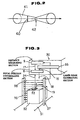
- a conveyer 31 transports an article 32 having attached thereto a bar code label 33.
- a distance measuring section 9 measures distance 34 to the bar code label 33 and generates a distance information pulse signal 17 indicative of the measured distance.
- the distance information pulse signal 17 is fed to a focal position controlling section 8.
- a laser beam generating section 35 generates circular shape laser beam 16.
- the focal position controlling section 8 conducts a local position control so that the circular shape laser beam 16 will have its local position on the bar code label 33.
- the circular shape laser beam that has been subjected to the focal position control is used as a scan laser beam 18 upon lighting the bar code label 33.
- the distance measuring section 9 determines the distance 34 to the bar code label 33 by calculation after inputting result of detection of height of the article 32 by a multi-optical-axis sensor.
- the multi-optical-axis sensor includes a light emitter 36 and a light interceptor 37 between which a number of parallel optical beams extend.
- the light interceptor 37 detects the optical beams, in number, which are interrupted by the article 32 and provides the output indicative of the detected result to the distance measuring section 9.
- the diameter of the scan laser beam 18 is determined in accordance with the width of the narrowest bar of the bar code label 33. If the laser beam diameter is too large as compared to the width of the narrowest bar, a reduction in resolution occurs, making it impossible to detect the width of each bar with good accuracy, causing a drop in read performance. If the laser beam diameter is too small as compared to the width of the narrowest bar, there is the tendency to detect fine defects and/or small dirty spots on a bar code label, causing a drop in read performance. It is therefore generally known to adjust the diameter of the scan laser beam upon being intercepted by a bar code label on its face as large as the width of the narrowest bar of the bar code label.
- Read operation under this condition may be called read operation with the optimized beam diameter.
- the diameter 40 of a laser beam 41 is the smallest at its focal position 42. Therefore, it is the common practice to adjust the beam diameter equal to the above-mentioned optimized beam diameter at the focal position 42 that lies on the face of a bar code label to be read.
- the laser beam generating section 35 is further described to clarify what causes the deviation from the optimized beam diameter.
- the laser beam generating section 35 includes a semiconductor laser diode 1, a collimating lens 2, a cylindrical lens a 3, and a cylindrical lens b 4, and generates a shaped laser means in the form of a circular shape laser beam 16. It has been found that variation in the ambient temperature of the laser beam generating section 35 causes variation in the focal position of the circular shape laser beam 16, thus inducing occurrence of the above-mentioned deviation. As is readily seen from Figure 2, any deviation from the focal position 42 causes the laser beam diameter 40 to increase, causing a drop in read performance.
- This phenomenon is observed in a bar code reader that employs a semiconductor laser diode as a source of laser beam when the ambient temperature is subjected to variation.
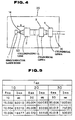
- the semiconductor laser diode 1 generates an elliptical shape divergent laser beam 14 having different angles of divergence 50 in different directions.
- the maximum value of the angles of divergence 50 is around 60 degrees.
- the collimating lens 2 converts the elliptical shape divergent laser beam 14 to a collimating laser beam 15.
- Distance a between the semiconductor laser diode 1 and the collimating lens 2 may be increased by using, as the collimating lens 2, a lens with increased aperture.
- the use of such lens results in an increase in accommodation space for the collimating lens 2 and an increase in manufacturing cost.
- the semiconductor laser diode 1 generates the elliptical divergent laser beam at a low output level. Thus, it is necessary to collect the entire laser beam within the angles of divergent 50 to provide the shaped laser beam at a sufficiently high output. This is the reason why the lens with a large aperture is required to collect all of the beams emitted by the semiconductor laser diode 1.
- the collimating laser beam 15 still has an elliptical cross sectional profile.
- two cylindrical lenses 3 and 4 are provided to convert the collimating laser beam 15 to the circular shape laser beam 16 with a circular cross sectional profile.
- the two cylindrical lenses 3 and 4 have a short focal distance.
- Two cylindrical lenses with a long focal distance may be used. In this case, an increase in accommodation space for the cylindrical lenses 3 and 4 and an increase in manufacturing cost result.
- the semiconductor laser diode 1 and the lenses 2, 3 and 4 are mounted to and assembled with a casing made of aluminum.
- An increase in the ambient temperature causes thermal expansion of the casing.
- This expansion causes a change in distance between the semiconductor laser diode 1 and the collimating lens 2, a change in distance between the collimating lens 2 and the cylindrical lens a 3, and a change in distance between the cylindrical lens a 3 and the cylindrical lens b 4.
- these changes cause a substantial deviation of the focal distance of the circular shape laser beam 16 from the distance to the bar code label.
- Figures 5 shows the results of calculation of the variables f, a and b.
- the rate at which collimating light converges increases as the focal distance f of a lens decreases, This means that the laser beam 15, which is to be collimated, tends to converge in response to an increase in the distance between the semiconductor laser diode 1 and the collimating lens 2.
- the use of the semiconductor laser diode 1 as the source of is intended to accomplish minituarization and cost reduction of the bar code reader Thus, it would be required to use lenses with a short focal distance in shaping the laser beam.
- the use of the lenses with a short focal distance poses the problem that a small change in the distance a due to thermal expansion causes a substantial change in the focal position of the circular shape laser beam 16.
- This change in the focal position of the circular shape laser beam 16 causes a change in the focal position of the scan laser beam 18.
- the autofocus bar code reader shown in Figure 3 has potential problem that, when used in the environment of varying temperatures, it would be difficult to keep the focal position of the scan laser beam 18 on the bar code label 33 with good accuracy.
- the collimating lens and the cylindrical lenses are no longer required. In this case, there is no potential problem of the above-mentioned kind due to the thermal expansion.
- An object of the present invention is to improve the bar code reader of the above kind such that the influence of temperature on performance of the device is eliminated to allow the use of a semiconductor laser diode as a source of laser beam.
- a method of controlling the focal position of a shaped laser beam employed by a bar code reader comprising the steps of:
- a bar code reader comprising:
- the bar code reader comprises a laser beam generating (LBG) section 7.
- the LBG section 7 includes a semiconductor laser diode 1 as a laser beam source, a laser beam contour shaping (LBCS) unit, a casing 5, and a temperature sensor 6 arranged to detect temperature of the casing 5.
- the LBCS unit includes a collimating lens 2, a cylindrical lens a 3, and a cylindrical lens b 4.
- the bar code reader also comprises a focal position controlling (FPC) section 8, a distance measuring (DM) section 9, a scanning section 10, a light intercepting (LI) section 11, a decoding section 12, and a decoded result outputting (DRO) section 13.
- FPC focal position controlling
- DM distance measuring
- LI light intercepting
- DRO decoded result outputting
- the semiconductor laser diode 1 generates an elliptical shape divergent laser beam 14.
- the collimating lens 2 converts the divergent laser beam 14 to a collimated laser beam 15.
- the cylindrical lens 3 and 4 cooperate with each other to convert the collimated laser beam 15 to a shaped laser beam in the form of a circular shape laser beam 16.
- the circular shape laser beam 16 is fed to the FPC section 8.
- the distance measuring section 9 determines the position of the bar code label by measuring or detecting a distance to the bar code label, and generates a distance information pulse signal 17.
- the distance information pulse signal 17 is fed to the FPC section 8.
- the FPC section 8 employs the same focal position controlling system as that described in JP-A 5-46796, which was laid-open on February 26, 1993. According to this system, a group of lenses mounted within the FPC section 8 can take different positions. Specifically, external pulses applied to the FPC section 8 cause a motor, such as a stepping motor, to move the position of the group of lenses for adjustment of the focal position of the circular shape laser beam 16. In this embodiment, the external pulses are in the form of the distance information pulse signal 17.
- the FPC section 8 conducts a focal position control so that the scan laser beam 18 will have its focal position at a position 1000 mm distant from the FPC section 8.
- the focal distance of the circular shape laser beam 16 must stay within a predetermined range to hold the relation that if 100 pulses, then the focal position of the scan laser beam 18 is 1000 mm distant.
- a change in environment temperature of the LBG section 7 causes a change in the focal position of the circular shape laser beam 16, causing a change in the focal position of the scan laser beam 18.
- the change in the focal position of the circular shape laser beam 16 is caused by a change in distance between the semiconductor laser diode 1 and the collimating lens 2 owing to thermal expansion taking place in the LBG section 7.
- this change in distance is determined by thermal expansion coefficient and temperature of the material which the casing 5, see Figure 1(b), is made of. Let us consider the case where the material of the casing 5 is aluminum.
- Thermal expansion coefficient of aluminum is 23 x 10 -6 .
- the distance between the semiconductor laser diode 1 and the collimating lens 2 determines the focal distance of the circular shape laser beam 16, so that a change In ambient temperature determines a change in the focal distance of the circular shape laser beam 16. Thus, a change in ambient temperature determines a change in the local distance of the scan laser beam 18.
- a change in the focal distance of the scan laser beam 18 against a change in ambient temperature may be given by calculation.
- an increase of 1 (one) degree C in temperature of the casing 5 causes a reduction of ⁇ mm in the focal position of the scan laser beam 18.
- the bar code reader is installed and adjusted such that, when the casing 5 is at normal temperature of 25 degrees C, the focal distance of the scan laser beam 18 is as far as the distance to the bar code label. Let us now consider the case where the casing temperature has increased by 10 degrees C to 35 degrees C from 25 degrees C, causing the focal position of the scan laser beam 18 to decrease by 10 ⁇ mm.
- the temperature sensor 6 of the LBG section 7 In response to the increase in temperature of 10 degrees C, the temperature sensor 6 of the LBG section 7 generates a temperature information pulse signal 20.
- the FPC section 8 is operable in response to the total of the pulses given as the distance information signal 17 and as the temperature information signal 20.
- the FPC section 8 can compensate for the reduction of 10 ⁇ mm owing to the temperature rise of 10 degrees C and conduct the focal position control so that the scan laser beam 18 will has its focal position at a location 1000 mm distant.
- a scanning section 10 lights the bar code label with the scan laser beam 18, which is the circular shape laser beam 16 that has been subjected to the focal position control conducted by the FPC section 8.
- a light intercepting section 11 intercepts reflected light 19 by the bar code label and converts an optical signal to an electric signal.
- a decoding section 12 decodes the intercepted reflected light.
- a decoded result outputting section 13 outputs the decoded result to an external device.
Landscapes
- Physics & Mathematics (AREA)
- Electromagnetism (AREA)
- Engineering & Computer Science (AREA)
- Health & Medical Sciences (AREA)
- General Health & Medical Sciences (AREA)
- Toxicology (AREA)
- Artificial Intelligence (AREA)
- Computer Vision & Pattern Recognition (AREA)
- General Physics & Mathematics (AREA)
- Theoretical Computer Science (AREA)
- Length Measuring Devices By Optical Means (AREA)
- Optical Radar Systems And Details Thereof (AREA)
Applications Claiming Priority (3)
| Application Number | Priority Date | Filing Date | Title |
|---|---|---|---|
| JP9228455A JP3036480B2 (ja) | 1997-08-25 | 1997-08-25 | バーコード読取装置およびその焦点制御方法 |
| JP22845597 | 1997-08-25 | ||
| JP228455/97 | 1997-08-25 |
Publications (2)
| Publication Number | Publication Date |
|---|---|
| EP0899678A2 true EP0899678A2 (de) | 1999-03-03 |
| EP0899678A3 EP0899678A3 (de) | 2000-05-17 |
Family
ID=16876764
Family Applications (1)
| Application Number | Title | Priority Date | Filing Date |
|---|---|---|---|
| EP98115913A Withdrawn EP0899678A3 (de) | 1997-08-25 | 1998-08-24 | Autofokus-Strichcodeleser |
Country Status (3)
| Country | Link |
|---|---|
| US (1) | US6315203B1 (de) |
| EP (1) | EP0899678A3 (de) |
| JP (1) | JP3036480B2 (de) |
Cited By (1)
| Publication number | Priority date | Publication date | Assignee | Title |
|---|---|---|---|---|
| US7646680B2 (en) * | 2005-03-25 | 2010-01-12 | Hon Hai Precision Industry Co., Ltd. | Optical system for collimating elliptical light beam and optical device using the same |
Families Citing this family (16)
| Publication number | Priority date | Publication date | Assignee | Title |
|---|---|---|---|---|
| EP2123293A3 (de) * | 2000-12-14 | 2010-09-08 | Amylin Pharmaceuticals, Inc. | Peptid YY und Peptid YY-Agonisten zur Behandlung von Stoffwechselstörungen |
| US6789737B2 (en) * | 2001-12-19 | 2004-09-14 | Riotec Corp. | Light source mechanism of barcode scanner |
| WO2003105763A2 (en) * | 2002-06-14 | 2003-12-24 | Amylin Pharmaceuticals, Inc. | Prevention and/or treatment of inflammatory bowel disease using pyy or agonists thereof |
| US20040182933A1 (en) * | 2003-03-17 | 2004-09-23 | Kai-Yuan Tien | Light source structure without moving parts for a laser barcode scanner |
| US8603969B2 (en) * | 2004-02-11 | 2013-12-10 | Amylin Pharmaceuticals, Llc | Pancreatic polypeptide family motifs and polypeptides comprising the same |
| DE102004038310A1 (de) * | 2004-08-05 | 2006-02-23 | Kuka Schweissanlagen Gmbh | Lasereinrichtung und Betriebsverfahren |
| EP2360180A3 (de) | 2004-12-13 | 2012-02-08 | Amylin Pharmaceuticals Inc. | Motive der bauchspeicheldrüsen-polypeptid familie, polypeptide und methoden und verwendung derselben |
| US7568628B2 (en) | 2005-03-11 | 2009-08-04 | Hand Held Products, Inc. | Bar code reading device with global electronic shutter control |
| US7780089B2 (en) | 2005-06-03 | 2010-08-24 | Hand Held Products, Inc. | Digital picture taking optical reader having hybrid monochrome and color image sensor array |
| US7611060B2 (en) * | 2005-03-11 | 2009-11-03 | Hand Held Products, Inc. | System and method to automatically focus an image reader |
| US7770799B2 (en) | 2005-06-03 | 2010-08-10 | Hand Held Products, Inc. | Optical reader having reduced specular reflection read failures |
| US8794526B2 (en) | 2007-06-04 | 2014-08-05 | Hand Held Products, Inc. | Indicia reading terminal processing plurality of frames of image data responsively to trigger signal activation |
| US20090072037A1 (en) * | 2007-09-17 | 2009-03-19 | Metrologic Instruments, Inc. | Autofocus liquid lens scanner |
| US8629926B2 (en) | 2011-11-04 | 2014-01-14 | Honeywell International, Inc. | Imaging apparatus comprising image sensor array having shared global shutter circuitry |
| US10268854B1 (en) * | 2018-04-13 | 2019-04-23 | Zebra Technologies Corporation | Illumination assemblies for use in barcode readers and devices and methods associated therewith |
| CN113834635B (zh) * | 2020-06-24 | 2024-08-16 | 浙江宇视科技有限公司 | 图像采集虚焦测试方法、装置、设备及存储介质 |
Family Cites Families (9)
| Publication number | Priority date | Publication date | Assignee | Title |
|---|---|---|---|---|
| JPH0275489A (ja) * | 1988-09-10 | 1990-03-15 | Sumitomo Electric Ind Ltd | 焦点距離自動調整装置 |
| JPH02133891A (ja) * | 1988-11-15 | 1990-05-23 | Tokyo Electric Co Ltd | バーコードスキャナー |
| JPH04167990A (ja) * | 1990-10-29 | 1992-06-16 | Mitsubishi Electric Corp | 焦点距離調整装置 |
| JP2661430B2 (ja) | 1991-08-12 | 1997-10-08 | 日本電気株式会社 | 光学記号読取装置 |
| US5436439A (en) | 1992-06-11 | 1995-07-25 | Nec Corporation | Bar code reader for processing a plurality of bar codes in a read area |
| JPH07200714A (ja) | 1993-12-28 | 1995-08-04 | Nec Corp | 光学記号読取装置 |
| JP3379837B2 (ja) * | 1994-10-27 | 2003-02-24 | 富士通株式会社 | 光学読取装置 |
| JP3730673B2 (ja) | 1994-11-01 | 2006-01-05 | 株式会社オプトエレクトロニクス | 光学的情報読取装置 |
| US5877883A (en) * | 1996-02-22 | 1999-03-02 | Seiko Epson Corporation | Optical scanner |
-
1997
- 1997-08-25 JP JP9228455A patent/JP3036480B2/ja not_active Expired - Fee Related
-
1998
- 1998-08-24 EP EP98115913A patent/EP0899678A3/de not_active Withdrawn
- 1998-08-25 US US09/139,712 patent/US6315203B1/en not_active Expired - Lifetime
Cited By (1)
| Publication number | Priority date | Publication date | Assignee | Title |
|---|---|---|---|---|
| US7646680B2 (en) * | 2005-03-25 | 2010-01-12 | Hon Hai Precision Industry Co., Ltd. | Optical system for collimating elliptical light beam and optical device using the same |
Also Published As
| Publication number | Publication date |
|---|---|
| JP3036480B2 (ja) | 2000-04-24 |
| JPH1166219A (ja) | 1999-03-09 |
| EP0899678A3 (de) | 2000-05-17 |
| US6315203B1 (en) | 2001-11-13 |
Similar Documents
| Publication | Publication Date | Title |
|---|---|---|
| US6315203B1 (en) | Autofocus bar code reader | |
| US6785028B1 (en) | Optical scanning device having a temperature compensation unit | |
| US6459520B1 (en) | Optical scanning apparatus and image forming apparatus using it | |
| US5498869A (en) | Apparatus for wobble correction using an agile beam polygon ROS and all-spherical optics | |
| US4872747A (en) | Use of prisms to obtain anamorphic magnification | |
| US5610753A (en) | Optical design of laser scanner to reduce thermal sensitivity | |
| US5539719A (en) | Light beam deviation detecting device used in an image forming apparatus | |
| US20070021939A1 (en) | Method for generating a control output for a position control loop | |
| US6134039A (en) | Wavelength dependent thermally compensated optical system | |
| US6163333A (en) | Multi-beam scanning optical apparatus | |
| EP0610909B1 (de) | Optisches Abtastsystem | |
| EP0601800B1 (de) | Verhinderung von Streulichtreflexionen bei einem Rasterscanner mit voll ausgeleuchtetem Polygon | |
| US5532479A (en) | Temperature, pressure, vibration or humidity sensor based on reflected light from a bimetallic, plastic or dehumidifying material | |
| JPH0585100B2 (de) | ||
| US12468014B2 (en) | Sensor device | |
| JPH09258091A (ja) | レーザー光射出光学ユニットのピント測定方法 | |
| JPH04219714A (ja) | 書き出し位置調整方法 | |
| EP0704738A1 (de) | Kompensation von Facettenfehlern | |
| JPH06242387A (ja) | レーザ走査光学系 | |
| JPH05209719A (ja) | 走査型レーザ変位計 | |
| WO2000050842A1 (en) | An apparatus for measuring distance | |
| RU2059196C1 (ru) | Устройство для контроля углового положения объектов | |
| JPH10200707A (ja) | 画像形成装置 | |
| JPH0436629A (ja) | 走査光学系におけるビーム形状測定装置 | |
| JP2000028487A (ja) | 走査光学系の測定装置及び測定方法 |
Legal Events
| Date | Code | Title | Description |
|---|---|---|---|
| PUAI | Public reference made under article 153(3) epc to a published international application that has entered the european phase |
Free format text: ORIGINAL CODE: 0009012 |
|
| AK | Designated contracting states |
Kind code of ref document: A2 Designated state(s): DE IT |
|
| AX | Request for extension of the european patent |
Free format text: AL;LT;LV;MK;RO;SI |
|
| PUAL | Search report despatched |
Free format text: ORIGINAL CODE: 0009013 |
|
| AK | Designated contracting states |
Kind code of ref document: A3 Designated state(s): AT BE CH CY DE DK ES FI FR GB GR IE IT LI LU MC NL PT SE |
|
| AX | Request for extension of the european patent |
Free format text: AL;LT;LV;MK;RO;SI |
|
| 17P | Request for examination filed |
Effective date: 20000413 |
|
| AKX | Designation fees paid |
Free format text: DE IT |
|
| 17Q | First examination report despatched |
Effective date: 20040802 |
|
| STAA | Information on the status of an ep patent application or granted ep patent |
Free format text: STATUS: THE APPLICATION IS DEEMED TO BE WITHDRAWN |
|
| 18D | Application deemed to be withdrawn |
Effective date: 20050215 |