EP0905257B2 - Procédé de préparation de dérivés optiquement actifs d'acides 2-amino-omega-oxoalcanoiques - Google Patents
Procédé de préparation de dérivés optiquement actifs d'acides 2-amino-omega-oxoalcanoiques Download PDFInfo
- Publication number
- EP0905257B2 EP0905257B2 EP98202972A EP98202972A EP0905257B2 EP 0905257 B2 EP0905257 B2 EP 0905257B2 EP 98202972 A EP98202972 A EP 98202972A EP 98202972 A EP98202972 A EP 98202972A EP 0905257 B2 EP0905257 B2 EP 0905257B2
- Authority
- EP
- European Patent Office
- Prior art keywords
- amino acid
- atoms
- acid amide
- converted
- amino
- Prior art date
- Legal status (The legal status is an assumption and is not a legal conclusion. Google has not performed a legal analysis and makes no representation as to the accuracy of the status listed.)
- Expired - Lifetime
Links
- 0 C*(C)(C(C(N)=O)N)C(O*)O* Chemical compound C*(C)(C(C(N)=O)N)C(O*)O* 0.000 description 2
Classifications
-
- C—CHEMISTRY; METALLURGY
- C07—ORGANIC CHEMISTRY
- C07D—HETEROCYCLIC COMPOUNDS
- C07D319/00—Heterocyclic compounds containing six-membered rings having two oxygen atoms as the only ring hetero atoms
- C07D319/04—1,3-Dioxanes; Hydrogenated 1,3-dioxanes
- C07D319/06—1,3-Dioxanes; Hydrogenated 1,3-dioxanes not condensed with other rings
-
- C—CHEMISTRY; METALLURGY
- C07—ORGANIC CHEMISTRY
- C07C—ACYCLIC OR CARBOCYCLIC COMPOUNDS
- C07C229/00—Compounds containing amino and carboxyl groups bound to the same carbon skeleton
- C07C229/02—Compounds containing amino and carboxyl groups bound to the same carbon skeleton having amino and carboxyl groups bound to acyclic carbon atoms of the same carbon skeleton
- C07C229/04—Compounds containing amino and carboxyl groups bound to the same carbon skeleton having amino and carboxyl groups bound to acyclic carbon atoms of the same carbon skeleton the carbon skeleton being acyclic and saturated
- C07C229/22—Compounds containing amino and carboxyl groups bound to the same carbon skeleton having amino and carboxyl groups bound to acyclic carbon atoms of the same carbon skeleton the carbon skeleton being acyclic and saturated the carbon skeleton being further substituted by oxygen atoms
-
- C—CHEMISTRY; METALLURGY
- C07—ORGANIC CHEMISTRY
- C07C—ACYCLIC OR CARBOCYCLIC COMPOUNDS
- C07C231/00—Preparation of carboxylic acid amides
- C07C231/06—Preparation of carboxylic acid amides from nitriles by transformation of cyano groups into carboxamide groups
-
- C—CHEMISTRY; METALLURGY
- C07—ORGANIC CHEMISTRY
- C07C—ACYCLIC OR CARBOCYCLIC COMPOUNDS
- C07C237/00—Carboxylic acid amides, the carbon skeleton of the acid part being further substituted by amino groups
- C07C237/02—Carboxylic acid amides, the carbon skeleton of the acid part being further substituted by amino groups having the carbon atoms of the carboxamide groups bound to acyclic carbon atoms of the carbon skeleton
- C07C237/04—Carboxylic acid amides, the carbon skeleton of the acid part being further substituted by amino groups having the carbon atoms of the carboxamide groups bound to acyclic carbon atoms of the carbon skeleton the carbon skeleton being acyclic and saturated
-
- C—CHEMISTRY; METALLURGY
- C07—ORGANIC CHEMISTRY
- C07C—ACYCLIC OR CARBOCYCLIC COMPOUNDS
- C07C253/00—Preparation of carboxylic acid nitriles
-
- C—CHEMISTRY; METALLURGY
- C07—ORGANIC CHEMISTRY
- C07D—HETEROCYCLIC COMPOUNDS
- C07D317/00—Heterocyclic compounds containing five-membered rings having two oxygen atoms as the only ring hetero atoms
- C07D317/08—Heterocyclic compounds containing five-membered rings having two oxygen atoms as the only ring hetero atoms having the hetero atoms in positions 1 and 3
- C07D317/10—Heterocyclic compounds containing five-membered rings having two oxygen atoms as the only ring hetero atoms having the hetero atoms in positions 1 and 3 not condensed with other rings
- C07D317/14—Heterocyclic compounds containing five-membered rings having two oxygen atoms as the only ring hetero atoms having the hetero atoms in positions 1 and 3 not condensed with other rings with substituted hydrocarbon radicals attached to ring carbon atoms
- C07D317/28—Radicals substituted by nitrogen atoms
-
- C—CHEMISTRY; METALLURGY
- C07—ORGANIC CHEMISTRY
- C07D—HETEROCYCLIC COMPOUNDS
- C07D317/00—Heterocyclic compounds containing five-membered rings having two oxygen atoms as the only ring hetero atoms
- C07D317/08—Heterocyclic compounds containing five-membered rings having two oxygen atoms as the only ring hetero atoms having the hetero atoms in positions 1 and 3
- C07D317/10—Heterocyclic compounds containing five-membered rings having two oxygen atoms as the only ring hetero atoms having the hetero atoms in positions 1 and 3 not condensed with other rings
- C07D317/14—Heterocyclic compounds containing five-membered rings having two oxygen atoms as the only ring hetero atoms having the hetero atoms in positions 1 and 3 not condensed with other rings with substituted hydrocarbon radicals attached to ring carbon atoms
- C07D317/30—Radicals substituted by carbon atoms having three bonds to hetero atoms with at the most one bond to halogen, e.g. ester or nitrile radicals
-
- C—CHEMISTRY; METALLURGY
- C12—BIOCHEMISTRY; BEER; SPIRITS; WINE; VINEGAR; MICROBIOLOGY; ENZYMOLOGY; MUTATION OR GENETIC ENGINEERING
- C12P—FERMENTATION OR ENZYME-USING PROCESSES TO SYNTHESISE A DESIRED CHEMICAL COMPOUND OR COMPOSITION OR TO SEPARATE OPTICAL ISOMERS FROM A RACEMIC MIXTURE
- C12P13/00—Preparation of nitrogen-containing organic compounds
- C12P13/04—Alpha- or beta- amino acids
-
- C—CHEMISTRY; METALLURGY
- C12—BIOCHEMISTRY; BEER; SPIRITS; WINE; VINEGAR; MICROBIOLOGY; ENZYMOLOGY; MUTATION OR GENETIC ENGINEERING
- C12P—FERMENTATION OR ENZYME-USING PROCESSES TO SYNTHESISE A DESIRED CHEMICAL COMPOUND OR COMPOSITION OR TO SEPARATE OPTICAL ISOMERS FROM A RACEMIC MIXTURE
- C12P41/00—Processes using enzymes or microorganisms to separate optical isomers from a racemic mixture
- C12P41/006—Processes using enzymes or microorganisms to separate optical isomers from a racemic mixture by reactions involving C-N bonds, e.g. nitriles, amides, hydantoins, carbamates, lactames, transamination reactions, or keto group formation from racemic mixtures
Definitions
- the invention relates to a process for preparing an optically active 2-amino- ⁇ -oxoalkanoic acid derivative of formula 1, in which n equals 0, 1, 2, 3 or 4 and R 1 and R 2 each independently represent an alkyl group with 1-10 C atoms or form a ring with 3 or 4 C atoms together with the O atoms to which they are bound and the C atom to which the O atoms are bound.
- the invention provides a new, simple concept for preparing 2-amino- ⁇ -oxoalkanoic acid derivatives.
- optically active compounds of formula 1 are new and are particularly suitable for use in the preparation of, for example, allysin, an important crosslinker in proteins, as described in Int. J. Pept. Protein Res. (1988), 307-20, and in the preparation of pharmaceuticals, for example as described in EP-A-629627.
- EP-A-0383403 and EP-A-0307023 both relate to the stereoselective preparation of amino acids.
- the amino acids are prepared from the respective amino acid amides, which are converted by an amidase to amino acids.
- the other enantiomer can either be converted to its amino acid form via a Schiff base with benzaldehyde or converted to its other enantiomer by a racemase.
- EP-A-0052201 dicloses the preparation of a racemic mixture of 1,3-diox(ol)an-2yl-propionic acid from 1,3-diox (ol)an-2yl-propenal, using HCN, NH 4 and CO 2 followed by hydrolysis with OH - .
- JP 48 039416 A discloses the preparation of 1,3-dioxolan-2yl butanal from glutaraldehyde and glycol.
- GB-A-1124149 discloses the preparation of amino acids starting from aldehydes by the reaction of HCN and NH 4 followed by hydrolysis of the so obtained ⁇ -amino-nitrile.
- JP-A-57158743 discloses the preparation of ⁇ -amino acid-amide by contacting ⁇ -amino-nitrile with NaOH and acetone.
- one of the two aldehyde functions in the aldehyde of formula 2 is first protected through conversion, in a manner known per se into an acetal.
- This can for example be done with the aid of an alcohol, for example an alcohol with 1-5 C atoms when R 1 and R 2 represent an alkyl group, or with the aid of a diol, in particular a 1,2-ethanediol or a 1,3-propanediol, whether or not substituted with for example an alkyl group with 1-5 C atoms, for example 1,2-ethanediol, 1,2-propanediol, 1,3-propanediol or 2,3-butanediol, when R 1 and R 2 form part of a ring structure; or via re-acetalization, for example with the aid of ortho-formate esters.
- the acetalization can for example be carried out by bringing the aldehyde of formula 2 into contact with an alcohol or a diol under acid conditions, for example in the presence of a sulphonic acid, in particular p-toluenesulphonic acid.
- the acetalization is optionally carried out in the presence of a solvent.
- any solvent that does not interfere with the reaction can be used as a solvent, for example aromatic hydrocarbons, in particular benzene, toluene and xylene; halogenated hydrocarbons, for example dichloromethane; esters, preferably hindered esters, in particular isopropyl acetate or isobutyl acetate and ethers, in particular methyl-t-butyl ether (MTBE).
- a solvent for example aromatic hydrocarbons, in particular benzene, toluene and xylene; halogenated hydrocarbons, for example dichloromethane; esters, preferably hindered esters, in particular isopropyl acetate or isobutyl acetate and ethers, in particular methyl-t-butyl ether (MTBE).
- the acetalization with an alcohol or diol is preferably carried out at elevated temperature, for example at a temperature of between 50 and 150°C, preferably at reflux temperature.
- the acetal-protected aldehyde obtained is subsequently converted into the corresponding aminonitrile, for example via the Strecker chemistry known per se.
- the acetal-protected aldehyde can for example be converted into the aminonitrile in the presence of ammonia with the aid of a cyanide compound, for example HCN, NaCN or KCN.
- the aminonitrile is subsequently converted into the corresponding racemic amino acid amine, for example, as described in GB-A-1548032, by converting the aminonitrile at a pH of between 11 and 14, preferably between 12.5 and 13.5, in the presence of a base and a ketone or aldehyde, optionally followed by hydrolysis of the intermediately formed Schiff base in the presence of water.
- a base preferably between 12.5 and 13.5
- KOH or NaOH or a corresponding base is used as the base and an aliphatic ketone, for example acetone, methyl ethyl ketone or cyclohexanone, or an aromatic aldehyde, for example benzaldehyde, as the ketone or aldehyde.
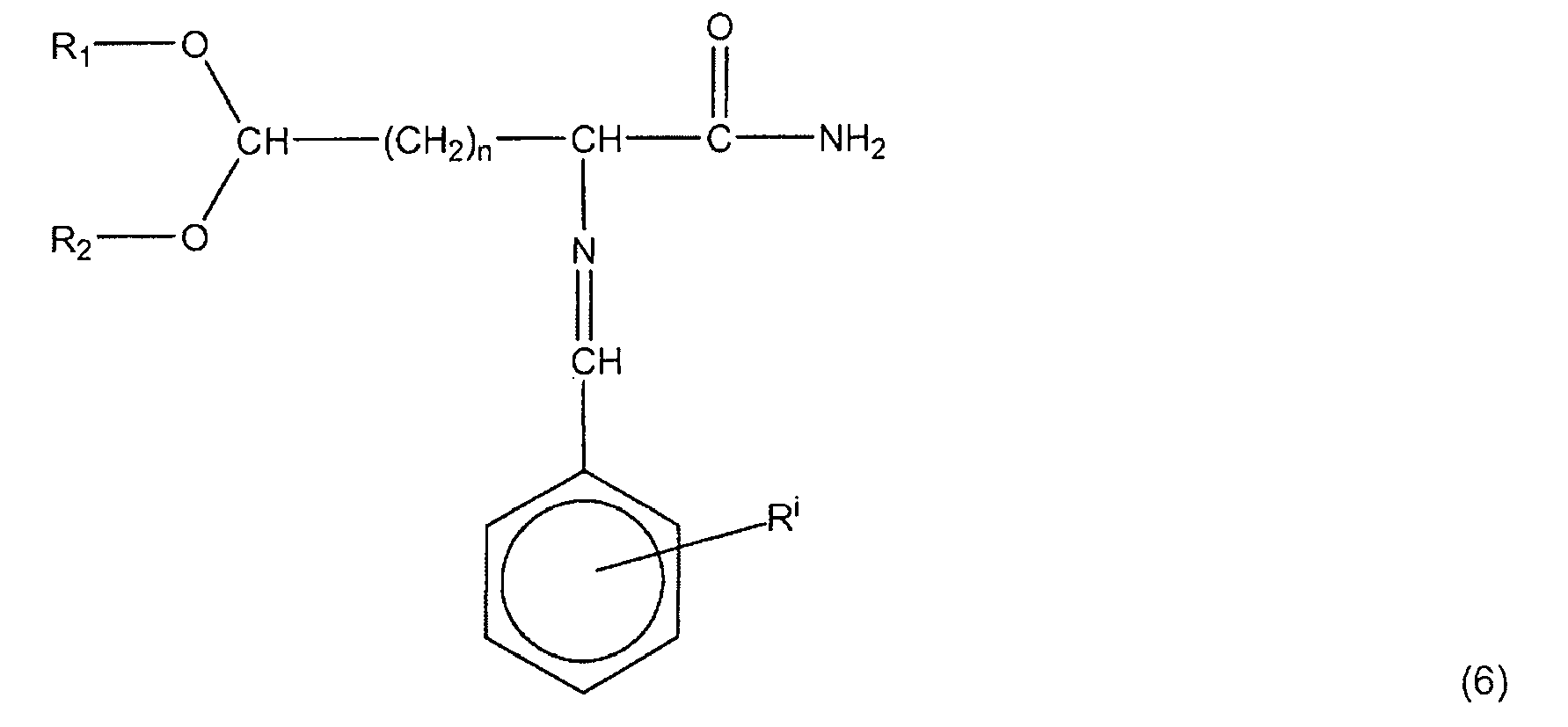
- the reaction mixture is preferably first subjected to a treatment with an aldehyde, for example a benzaldehyde, upon which the Schiff base of the amino acid amide is obtained and, any racemic amino acid formed remains in solution.
- an aldehyde for example a benzaldehyde
- Such a treatment presents the advantage that the desired (S) amino acid can be obtained in a higher enantiomeric excess.
- a benzaldehyde is used in the formation of the Schiff base of the amino acid amide.
- benzaldehyde is that it is easy to separate the Schiff base and recover the benzaldehyde.
- Another advantage of benzaldehyde is that it is not miscible with water, as a result of which it is also far more preferable than other extraction means for use as extraction means because the formed Schiff base of the optically active amino acid amide dissolves in the benzaldehyde and the other components of the reaction mixture in the water phase. It has surprisingly been found that the hydrolysis of the Schiff base of the amino acid amide resulting in the salt of the amino acid amide can be carried out without the acetal function deteriorating significantly.
- Benzaldehyde' is also understood to include substituted benzaldehydes such as lower (1-4 C) alkylbenzaldehydes, halogenbenzaldehydes, nitrobenzaldehydes and lower (1-4 C) alkoxybenzaldehydes.
- the reaction with benzaldehyde resulting in the formation of a Schiff base can for example be carried at a temperature of between 20 and 60°C, preferably between 35 and 45°C. If equimolar amounts of benzaldehyde, for example 0.9-2, in particular 0.95-1.1 equivalents relative to the amino acid amide, are used in the formation of the Schiff base without a different solvent for the Schiff base of the amide, a precipitate of the Schiff base of the amino acid amide is obtained. The other components remain dissolved in the mother liquor. If an excess of benzaldehyde is used, the benzaldehyde acts not only as a reaction means, but also as a solvent, and two layers are obtained.
- mixtures of benzaldehyde and other solvents for example mixtures with aromatic hydrocarbons, for example toluene, ketones, for example methyl isobutyl ketone, halogenated hydrocarbons, for example chloroform or dichloromethane; esters, for example ethyl acetate and butyl acetate.
- aromatic hydrocarbons for example toluene
- ketones for example methyl isobutyl ketone
- halogenated hydrocarbons for example chloroform or dichloromethane
- esters for example ethyl acetate and butyl acetate.
- the amino acid amide can be recovered from the corresponding Schiff base in a simple manner, through acidification with a strong acid, for example sulphuric acid, until a pH of between 3 and 5, preferably between 3.5 and 4.5 has been obtained, with the Schiff base decomposing to form the aldehyde and the corresponding salt of the amino acid amide.
- a strong acid for example sulphuric acid
- the free amino acid amide can subsequently be obtained from the salt through treatment with a base, for example with triethylamine.
- a base for example with triethylamine.
- the conversion of the salt into the free amino acid amide is carried out with the aid of a (strongly) basic ion exchanger, for example Amberlyst 26 TM or IRA 900 TM .
- the amino acid amides of formula 5 and the Schiff bases thereof of formula 6 that are obtained as intermediates are new compounds per se.
- the invention hence also relates to these intermediates, both in racemic form and in optically active form, in particular the amino acid amides having an e.e. greater than 80%, preferably greater than 90%, more preferably greater than 95%, most preferably greater than 98%, in particular greater than 99%.
- the amino acid amide is subsequently subjected to an enantioselective, enzymatic hydrolysis in which the S enantiomer is selectively converted into the corresponding acid and the R enantiomer remains unaffected.
- the (S)-2-amino- ⁇ -oxoalkanoic acid derivative can then be obtained with an e.e. of more than 90%, in particular more than 95%, preferably more than 98%, in particular more than 99%.
- the enantioselective enzymatic hydrolysis is preferably carried out in an aqueous environment. It is however also possible to use an organic solvent.
- the temperature is not particularly critical and lies, for example, between 0 and 60°C, preferably between 20 and 50°C.
- the pH at which the enzymatic hydrolysis is carried out is preferably between 5 and 10.5, in particular between 8.0 and 9.5.
- An amidase for example an amidase derived from the genus Aspergillus, Mycobacterium, Aeromonas, Bacillus, Pseudomonas or Ochrobactrum, is suitable for use as the enzyme.
- an amidase derived from Pseudomonas putida or from Ochrobactrum anthropi is used.
- the optically active (S)-2-amino- ⁇ -oxoalkanoic acid derivative can be obtained.
- the Schiff base of the (R) enantiomer of the amino acid amide can optionally be converted into the free amino acid amide, which in turn can optionally be hydrolyzed under mild conditions, for example via a (non-stereoselective) enzymatic hydrolysis as described in EP-A-179523, using Rhodococcus erythropolis or an extract thereof, to obtain the (R)-2-amino- ⁇ -oxoalkanoic acid derivative.
- optically active (R)-2-amino- ⁇ -oxoalkanoic acid derivatives are new compoundsi with various very interesting applications.
- the compounds of formula 7 are for example very suitable for use in the preparation of D-pipecolic acid derivatives as for example described in J. O.C. (1990), 5551-3, and in Bioorg. & Med. Chem. (1995), 1237-1240, which are in turn used perse in the preparation of various pharmaceuticals as for example described in EP-A-672665, DE-A-3702943 and US-A-5409946.
- Another interesting use of the compounds of formula 7 is the use as intermediate in the preparation of D-proline, which is used for example in the preparation of Elitriptan as described in 'Drugs of the Future' (1997), 221-223, herein incorporated by reference.
- the invention also relates to these new compounds, in particular to the optically active (R)-2-amino- ⁇ -oxoalkanoic acid derivatives having an e.e. greater than 80%, preferably greater than 90%, in particular greater than 95%.
- Toluene (1 litre), ethylene glycol (155 grammes, 2.5 mol) and p-toluenesulphonic acid (1 gramme) were successively dosed to a 50% solution of glutardialdehyde in water (500 grammes, 2.5 mol). The mixture was heated to reflux temperature. The water was azeotropically removed with the aid of a Dean-Stark apparatus. As soon as all the water had been removed with the aid of the Dean-Stark apparatus (approx. 6 hours) the solution was cooled to room temperature.
- Example 2 Sodium cyanide (49 grammes, 1 mol) and ammonium acetate (77 grammes, 1 mol) were successively added to a 25% solution of ammonia in water (500 ml). In one hour's time the oil obtained in Example 1 (288 grammes, 1 mol) was added dropwise to this solution. After 5 hours' further stirring, acetone (100 ml) and a 45% solution of potassium hydroxide in water (10 ml) were successively dosed to this solution. After 3 hours glacial acetic acid (7 ml) was added. The solution was concentrated to approx. 400 grammes with the aid of a rotary film evaporator.
- Glacial acetic acid was added to the water phase obtained after the toluene extraction (see Example II) so that the pH became 9.0. At 37°C
Landscapes
- Chemical & Material Sciences (AREA)
- Organic Chemistry (AREA)
- Wood Science & Technology (AREA)
- Life Sciences & Earth Sciences (AREA)
- Engineering & Computer Science (AREA)
- Zoology (AREA)
- Health & Medical Sciences (AREA)
- General Engineering & Computer Science (AREA)
- General Chemical & Material Sciences (AREA)
- Chemical Kinetics & Catalysis (AREA)
- Biotechnology (AREA)
- Biochemistry (AREA)
- Bioinformatics & Cheminformatics (AREA)
- Microbiology (AREA)
- General Health & Medical Sciences (AREA)
- Genetics & Genomics (AREA)
- Analytical Chemistry (AREA)
- Organic Low-Molecular-Weight Compounds And Preparation Thereof (AREA)
- Preparation Of Compounds By Using Micro-Organisms (AREA)
- Acyclic And Carbocyclic Compounds In Medicinal Compositions (AREA)
- Heterocyclic Compounds That Contain Two Or More Ring Oxygen Atoms (AREA)
Claims (9)
- Procédé de préparation d'un dérivé d'acide (S)-2-amino-ω-oxoalcanoïque de formule 1,


- Procédé selon la revendication 1, dans lequel le mélange réactionnel obtenu après la conversion de l'aminonitrile en l'amide d'aminoacide est soumis à un traitement avec un benzaldéhyde, moyennant quoi la base de Schiff de l'amide d'aminoacide est formée, la base de Schiff est séparée et est convertie en l'amide d'aminoacide libre.
- Procédé selon la revendication 1 ou la revendication 2, dans lequel le (R)-amide d'aminoacide est hydrolysé pour former le (R) aminoacide et le (R) aminoacide est récupéré.
- Procédé selon l'une quelconque des revendications 1 à 3, dans lequel R1 et R2 forment un cycle ayant 3 ou 4 atomes de C conjointement avec les atomes de O auxquels ils sont liés et l'atome de C auquel les atomes d'oxygène sont liés.
- Amide de 2-aminoacide de formule 5

- Composé optiquement actif selon la revendication 5 avec un e.e. qui est > 95 %.
- Composé optiquement actif selon la revendication 6 avec un e.e. qui est > 98 %.
- Composés selon l'une quelconque des revendications 5 à 7, dans lesquels n vaut 2 ou 3.
- Composés selon l'une quelconque des revendications 5 à 8, dans lesquels R1 et R2 forment un cycle avec 3 ou 4 atomes de C conjointement avec les atomes de O auxquels ils sont liés et l'atome de C auquel les atomes de O sont liés.
Applications Claiming Priority (2)
| Application Number | Priority Date | Filing Date | Title |
|---|---|---|---|
| NL1007113 | 1997-09-25 | ||
| NL1007113A NL1007113C2 (nl) | 1997-09-25 | 1997-09-25 | Werkwijze voor de bereiding van optisch actieve 2-amino-omega- oxoalkaanzuurderivaten. |
Publications (3)
| Publication Number | Publication Date |
|---|---|
| EP0905257A1 EP0905257A1 (fr) | 1999-03-31 |
| EP0905257B1 EP0905257B1 (fr) | 2004-05-19 |
| EP0905257B2 true EP0905257B2 (fr) | 2007-02-21 |
Family
ID=19765731
Family Applications (1)
| Application Number | Title | Priority Date | Filing Date |
|---|---|---|---|
| EP98202972A Expired - Lifetime EP0905257B2 (fr) | 1997-09-25 | 1998-09-04 | Procédé de préparation de dérivés optiquement actifs d'acides 2-amino-omega-oxoalcanoiques |
Country Status (15)
| Country | Link |
|---|---|
| EP (1) | EP0905257B2 (fr) |
| JP (1) | JPH11236361A (fr) |
| KR (1) | KR19990030181A (fr) |
| CN (1) | CN1218797A (fr) |
| AT (1) | ATE267265T1 (fr) |
| CA (1) | CA2247952A1 (fr) |
| CZ (1) | CZ308698A3 (fr) |
| DE (1) | DE69823941T3 (fr) |
| ES (1) | ES2221974T5 (fr) |
| HU (1) | HU220580B1 (fr) |
| IL (1) | IL126313A (fr) |
| NL (1) | NL1007113C2 (fr) |
| NO (1) | NO984447L (fr) |
| SG (1) | SG74077A1 (fr) |
| TW (1) | TW430641B (fr) |
Families Citing this family (10)
| Publication number | Priority date | Publication date | Assignee | Title |
|---|---|---|---|---|
| WO1999041249A1 (fr) * | 1998-02-17 | 1999-08-19 | Daicel Chemical Industries, Ltd. | Procedes de production de monoacetals de dialdehyde |
| US6174711B1 (en) | 1998-07-05 | 2001-01-16 | Mitsubishi Gas Chemical Company | Method for producing L-allysine acetal |
| KR20010071895A (ko) * | 1998-07-15 | 2001-07-31 | 스티븐 비. 데이비스 | 신규 디옥솔란을 통한 (s)-2-아미노-6,6-디메톡시헥산산메틸 에스테르의 제조 방법 |
| US6620600B2 (en) | 2000-09-15 | 2003-09-16 | Bristol-Myers Squibb Co. | Enzymatic resolution of aryl and thio-substituted acids |
| JP2003081964A (ja) * | 2001-09-13 | 2003-03-19 | Japan Hydrazine Co Inc | α−アミノ酸アミドの製造方法 |
| JP4851668B2 (ja) * | 2001-09-13 | 2012-01-11 | 株式会社日本ファインケム | ジアルデヒドモノエチレンアセタールアミノニトリルの製造方法 |
| DE10155065A1 (de) * | 2001-11-09 | 2003-05-22 | Degussa | Verfahren zur Kristallisation von Oxonorleucinacetal |
| JP4412279B2 (ja) * | 2003-04-02 | 2010-02-10 | 田辺三菱製薬株式会社 | 光学活性α−アミノニトリル化合物の製法 |
| CN114988989A (zh) * | 2021-03-02 | 2022-09-02 | 汉淇生医科技有限公司 | 戊二醛与1,6-己二醇之加成物、包含其之医药组合物及应用 |
| CN118791870B (zh) * | 2024-08-06 | 2026-06-30 | 浙江新力新材料股份有限公司 | 一种抗菌透明尼龙复合材料及其制备方法与应用 |
Citations (1)
| Publication number | Priority date | Publication date | Assignee | Title |
|---|---|---|---|---|
| EP0919630A1 (fr) † | 1997-04-22 | 1999-06-02 | Kaneka Corporation | Procede de preparation d'acetals de l-allysine |
Family Cites Families (6)
| Publication number | Priority date | Publication date | Assignee | Title |
|---|---|---|---|---|
| JPS5142111B2 (fr) * | 1971-10-02 | 1976-11-13 | ||
| DE3043159C2 (de) * | 1980-11-15 | 1982-12-09 | Degussa Ag, 6000 Frankfurt | Cyclische Acetale des Glutaminsäure-γ-semialdehyds, Verfahren zu deren Herstellung und ihre Verwendung |
| DE3043252C2 (de) * | 1980-11-15 | 1982-12-02 | Degussa Ag, 6000 Frankfurt | Cyclische Acetale von N-Acylglutaminsäure -γ- semialdehyden, Verfahren zu deren Herstellung und ihre Verwendung |
| JPH02501531A (ja) * | 1987-08-17 | 1990-05-31 | ノヴオ―ノルデイスク アー/エス | 有機化学品の製法 |
| EP0383403A1 (fr) * | 1989-02-16 | 1990-08-22 | Stamicarbon B.V. | Procédé de préparation de produits chimiques organiques |
| US5332826A (en) * | 1993-10-13 | 1994-07-26 | Eastman Kodak Company | Process for preparing aminoacetonitriles in one vessel |
-
1997
- 1997-09-25 NL NL1007113A patent/NL1007113C2/nl not_active IP Right Cessation
-
1998
- 1998-09-04 AT AT98202972T patent/ATE267265T1/de not_active IP Right Cessation
- 1998-09-04 EP EP98202972A patent/EP0905257B2/fr not_active Expired - Lifetime
- 1998-09-04 ES ES98202972T patent/ES2221974T5/es not_active Expired - Lifetime
- 1998-09-04 DE DE69823941T patent/DE69823941T3/de not_active Expired - Fee Related
- 1998-09-15 SG SG1998003660A patent/SG74077A1/en unknown
- 1998-09-23 CA CA002247952A patent/CA2247952A1/fr not_active Abandoned
- 1998-09-23 IL IL12631398A patent/IL126313A/en not_active IP Right Cessation
- 1998-09-24 JP JP10306243A patent/JPH11236361A/ja active Pending
- 1998-09-24 KR KR1019980040182A patent/KR19990030181A/ko not_active Withdrawn
- 1998-09-24 CN CN98120647.6A patent/CN1218797A/zh not_active Withdrawn
- 1998-09-24 HU HU9802146A patent/HU220580B1/hu not_active IP Right Cessation
- 1998-09-24 NO NO984447A patent/NO984447L/no unknown
- 1998-09-25 CZ CZ983086A patent/CZ308698A3/cs unknown
- 1998-09-29 TW TW087116386A patent/TW430641B/zh active
Patent Citations (1)
| Publication number | Priority date | Publication date | Assignee | Title |
|---|---|---|---|---|
| EP0919630A1 (fr) † | 1997-04-22 | 1999-06-02 | Kaneka Corporation | Procede de preparation d'acetals de l-allysine |
Also Published As
| Publication number | Publication date |
|---|---|
| CA2247952A1 (fr) | 1999-03-25 |
| HU9802146D0 (en) | 1998-12-28 |
| NO984447L (no) | 1999-03-26 |
| CZ308698A3 (cs) | 1999-05-12 |
| NL1007113C2 (nl) | 1999-03-26 |
| ES2221974T5 (es) | 2007-10-16 |
| DE69823941T2 (de) | 2005-08-11 |
| IL126313A0 (en) | 1999-05-09 |
| IL126313A (en) | 2001-04-30 |
| CN1218797A (zh) | 1999-06-09 |
| ES2221974T3 (es) | 2005-01-16 |
| KR19990030181A (ko) | 1999-04-26 |
| NO984447D0 (no) | 1998-09-24 |
| HU220580B1 (hu) | 2002-03-28 |
| DE69823941T3 (de) | 2007-10-18 |
| SG74077A1 (en) | 2000-07-18 |
| ATE267265T1 (de) | 2004-06-15 |
| DE69823941D1 (de) | 2004-06-24 |
| HUP9802146A3 (en) | 1999-09-28 |
| EP0905257A1 (fr) | 1999-03-31 |
| HUP9802146A2 (hu) | 1999-04-28 |
| TW430641B (en) | 2001-04-21 |
| JPH11236361A (ja) | 1999-08-31 |
| EP0905257B1 (fr) | 2004-05-19 |
Similar Documents
| Publication | Publication Date | Title |
|---|---|---|
| EP0057092B1 (fr) | Procédé de racémisation d'alpha-aminoacides optiquement actifs ou de leurs sels | |
| US20060135790A1 (en) | Process for the preparation of an alpha-amino carbonyl compound | |
| EP0905257B1 (fr) | Procédé de préparation de dérivés optiquement actifs d'acides 2-amino-omega-oxoalcanoiques | |
| KR0179028B1 (ko) | 광학적으로 활성이 있는 아미노산 아마이드의 제조방법 | |
| US6133002A (en) | Process for preparing optically active 2-amino-ω-oxoalkanoic acid derivatives | |
| US4880737A (en) | Process for the preparation of L-alpha-amino acid and d-alpha-amino acid amide | |
| CA1108181A (fr) | Procede de separation dans un melange d'amide de phenylglycine et de phenylglycine optiquement actifs | |
| JP3714964B2 (ja) | 光学活性アミン類の製造方法 | |
| KR100416927B1 (ko) | 광학적활성아민의제조방법 | |
| EP0330247B1 (fr) | Alpha-amino-acides N-hydroxylés, amides et autres dérivés | |
| ES2278061T3 (es) | Proceso enzimatico para preparacion del acido 2-amino-3-(2-amino-fenilsulfanil)-propionico sustituido. | |
| JP4492765B2 (ja) | L−アリシンアセタールの製造法 | |
| EP0972845B1 (fr) | Procédé de préparation d'un acétal de L-Allysine | |
| JP4995429B2 (ja) | マンデル酸類の精製方法 | |
| HK1018952A (en) | PROCESS FOR PREPARING OPTICALLY ACTIVE 2-AMINO-ω-OXOALKANOIC ACID DERIVATIVES | |
| JPH11508567A (ja) | β−アミノ−α−ヒドロキシカルボン酸及びその誘導体の製造方法 | |
| JP2000514283A (ja) | 光学活性アミンの製造方法 | |
| EP0716062A1 (fr) | Un procédé pour la préparation de N-(S)-alpha-alkylbenzylamide D-aminoacide | |
| Rossi et al. | Regioselective hydration and deprotection of chiral, dissymmetric iminodinitriles in the scope of an asymmetric Strecker strategy | |
| JP2531501B2 (ja) | N−クロロアセチルグルタミン酸γ−低級アルキルエステルアンモニウム塩 | |
| JPS598267B2 (ja) | コウガクカツセイアルフア − アミノサンノ セイゾウホウホウ | |
| US20090187017A1 (en) | Process for preparing enantiomerically enriched beta-amino acid derivatives | |
| JPH06733B2 (ja) | 光学活性3−ハイドロキシ−4−ハロゲノ−ブチロニトリルの製造法 | |
| JP2004155696A (ja) | 光学活性2−アミノ−2−フェニルエタノール類の製造方法およびその中間体 | |
| WO2000002843A1 (fr) | Procede de preparation de 1-arylalkylamines optiquement actifs et de leurs intermediaires |
Legal Events
| Date | Code | Title | Description |
|---|---|---|---|
| PUAI | Public reference made under article 153(3) epc to a published international application that has entered the european phase |
Free format text: ORIGINAL CODE: 0009012 |
|
| AK | Designated contracting states |
Kind code of ref document: A1 Designated state(s): AT BE CH DE DK ES FI FR GB IE IT LI LU NL SE |
|
| AX | Request for extension of the european patent |
Free format text: AL;LT;LV;MK;RO;SI |
|
| 17P | Request for examination filed |
Effective date: 19990419 |
|
| AKX | Designation fees paid |
Free format text: AT BE CH DE DK ES FI FR GB IE IT LI LU NL SE |
|
| 17Q | First examination report despatched |
Effective date: 20020131 |
|
| RAP1 | Party data changed (applicant data changed or rights of an application transferred) |
Owner name: DSM IP ASSETS B.V. |
|
| GRAP | Despatch of communication of intention to grant a patent |
Free format text: ORIGINAL CODE: EPIDOSNIGR1 |
|
| GRAS | Grant fee paid |
Free format text: ORIGINAL CODE: EPIDOSNIGR3 |
|
| GRAA | (expected) grant |
Free format text: ORIGINAL CODE: 0009210 |
|
| AK | Designated contracting states |
Kind code of ref document: B1 Designated state(s): AT BE CH DE DK ES FI FR GB IE IT LI LU NL SE |
|
| PG25 | Lapsed in a contracting state [announced via postgrant information from national office to epo] |
Ref country code: FI Free format text: LAPSE BECAUSE OF FAILURE TO SUBMIT A TRANSLATION OF THE DESCRIPTION OR TO PAY THE FEE WITHIN THE PRESCRIBED TIME-LIMIT Effective date: 20040519 |
|
| REG | Reference to a national code |
Ref country code: GB Ref legal event code: FG4D |
|
| REG | Reference to a national code |
Ref country code: CH Ref legal event code: EP |
|
| REG | Reference to a national code |
Ref country code: IE Ref legal event code: FG4D |
|
| REF | Corresponds to: |
Ref document number: 69823941 Country of ref document: DE Date of ref document: 20040624 Kind code of ref document: P |
|
| PG25 | Lapsed in a contracting state [announced via postgrant information from national office to epo] |
Ref country code: SE Free format text: LAPSE BECAUSE OF FAILURE TO SUBMIT A TRANSLATION OF THE DESCRIPTION OR TO PAY THE FEE WITHIN THE PRESCRIBED TIME-LIMIT Effective date: 20040819 Ref country code: DK Free format text: LAPSE BECAUSE OF FAILURE TO SUBMIT A TRANSLATION OF THE DESCRIPTION OR TO PAY THE FEE WITHIN THE PRESCRIBED TIME-LIMIT Effective date: 20040819 |
|
| PG25 | Lapsed in a contracting state [announced via postgrant information from national office to epo] |
Ref country code: LU Free format text: LAPSE BECAUSE OF NON-PAYMENT OF DUE FEES Effective date: 20040904 |
|
| PG25 | Lapsed in a contracting state [announced via postgrant information from national office to epo] |
Ref country code: IE Free format text: LAPSE BECAUSE OF NON-PAYMENT OF DUE FEES Effective date: 20040906 |
|
| REG | Reference to a national code |
Ref country code: CH Ref legal event code: AEN Free format text: DAS PATENT IST AUF GRUND DES WEITERBEHANDLUNGSANTRAGS VOM 16.09.2004 REAKTIVIERT WORDEN. |
|
| REG | Reference to a national code |
Ref country code: ES Ref legal event code: FG2A Ref document number: 2221974 Country of ref document: ES Kind code of ref document: T3 |
|
| PLAQ | Examination of admissibility of opposition: information related to despatch of communication + time limit deleted |
Free format text: ORIGINAL CODE: EPIDOSDOPE2 |
|
| PLAR | Examination of admissibility of opposition: information related to receipt of reply deleted |
Free format text: ORIGINAL CODE: EPIDOSDOPE4 |
|
| PLBQ | Unpublished change to opponent data |
Free format text: ORIGINAL CODE: EPIDOS OPPO |
|
| ET | Fr: translation filed | ||
| PLBI | Opposition filed |
Free format text: ORIGINAL CODE: 0009260 |
|
| PLAQ | Examination of admissibility of opposition: information related to despatch of communication + time limit deleted |
Free format text: ORIGINAL CODE: EPIDOSDOPE2 |
|
| PLAR | Examination of admissibility of opposition: information related to receipt of reply deleted |
Free format text: ORIGINAL CODE: EPIDOSDOPE4 |
|
| PLBQ | Unpublished change to opponent data |
Free format text: ORIGINAL CODE: EPIDOS OPPO |
|
| PLAB | Opposition data, opponent's data or that of the opponent's representative modified |
Free format text: ORIGINAL CODE: 0009299OPPO |
|
| PLAQ | Examination of admissibility of opposition: information related to despatch of communication + time limit deleted |
Free format text: ORIGINAL CODE: EPIDOSDOPE2 |
|
| PLAR | Examination of admissibility of opposition: information related to receipt of reply deleted |
Free format text: ORIGINAL CODE: EPIDOSDOPE4 |
|
| PLAX | Notice of opposition and request to file observation + time limit sent |
Free format text: ORIGINAL CODE: EPIDOSNOBS2 |
|
| PLBQ | Unpublished change to opponent data |
Free format text: ORIGINAL CODE: EPIDOS OPPO |
|
| PLAB | Opposition data, opponent's data or that of the opponent's representative modified |
Free format text: ORIGINAL CODE: 0009299OPPO |
|
| 26 | Opposition filed |
Opponent name: DEGUSSA AG Effective date: 20050217 |
|
| R26 | Opposition filed (corrected) |
Opponent name: DEGUSSA AG Effective date: 20050217 |
|
| R26 | Opposition filed (corrected) |
Opponent name: DEGUSSA AG Effective date: 20050217 |
|
| PLAX | Notice of opposition and request to file observation + time limit sent |
Free format text: ORIGINAL CODE: EPIDOSNOBS2 |
|
| NLR1 | Nl: opposition has been filed with the epo |
Opponent name: DEGUSSA AG |
|
| REG | Reference to a national code |
Ref country code: IE Ref legal event code: MM4A |
|
| NLR1 | Nl: opposition has been filed with the epo |
Opponent name: DEGUSSA AG |
|
| PLBB | Reply of patent proprietor to notice(s) of opposition received |
Free format text: ORIGINAL CODE: EPIDOSNOBS3 |
|
| PUAH | Patent maintained in amended form |
Free format text: ORIGINAL CODE: 0009272 |
|
| STAA | Information on the status of an ep patent application or granted ep patent |
Free format text: STATUS: PATENT MAINTAINED AS AMENDED |
|
| 27A | Patent maintained in amended form |
Effective date: 20070221 |
|
| AK | Designated contracting states |
Kind code of ref document: B2 Designated state(s): AT BE CH DE DK ES FI FR GB IE IT LI LU NL SE |
|
| REG | Reference to a national code |
Ref country code: CH Ref legal event code: AEN Free format text: AUFRECHTERHALTUNG DES PATENTES IN GEAENDERTER FORM |
|
| NLR2 | Nl: decision of opposition |
Effective date: 20070221 |
|
| NLR3 | Nl: receipt of modified translations in the netherlands language after an opposition procedure | ||
| ET3 | Fr: translation filed ** decision concerning opposition | ||
| REG | Reference to a national code |
Ref country code: ES Ref legal event code: DC2A Date of ref document: 20070521 Kind code of ref document: T5 |
|
| PGFP | Annual fee paid to national office [announced via postgrant information from national office to epo] |
Ref country code: ES Payment date: 20080926 Year of fee payment: 11 Ref country code: CH Payment date: 20080930 Year of fee payment: 11 |
|
| PGFP | Annual fee paid to national office [announced via postgrant information from national office to epo] |
Ref country code: NL Payment date: 20080924 Year of fee payment: 11 Ref country code: IT Payment date: 20080926 Year of fee payment: 11 Ref country code: FR Payment date: 20080917 Year of fee payment: 11 Ref country code: AT Payment date: 20080820 Year of fee payment: 11 |
|
| PGFP | Annual fee paid to national office [announced via postgrant information from national office to epo] |
Ref country code: GB Payment date: 20080929 Year of fee payment: 11 |
|
| PGFP | Annual fee paid to national office [announced via postgrant information from national office to epo] |
Ref country code: DE Payment date: 20081031 Year of fee payment: 11 |
|
| PGFP | Annual fee paid to national office [announced via postgrant information from national office to epo] |
Ref country code: BE Payment date: 20081009 Year of fee payment: 11 |
|
| BERE | Be: lapsed |
Owner name: *DSM IP ASSETS B.V. Effective date: 20090930 |
|
| REG | Reference to a national code |
Ref country code: NL Ref legal event code: V1 Effective date: 20100401 |
|
| REG | Reference to a national code |
Ref country code: CH Ref legal event code: PL |
|
| GBPC | Gb: european patent ceased through non-payment of renewal fee |
Effective date: 20090904 |
|
| REG | Reference to a national code |
Ref country code: FR Ref legal event code: ST Effective date: 20100531 |
|
| PG25 | Lapsed in a contracting state [announced via postgrant information from national office to epo] |
Ref country code: AT Free format text: LAPSE BECAUSE OF NON-PAYMENT OF DUE FEES Effective date: 20090904 |
|
| PG25 | Lapsed in a contracting state [announced via postgrant information from national office to epo] |
Ref country code: NL Free format text: LAPSE BECAUSE OF NON-PAYMENT OF DUE FEES Effective date: 20100401 Ref country code: FR Free format text: LAPSE BECAUSE OF NON-PAYMENT OF DUE FEES Effective date: 20090930 Ref country code: DE Free format text: LAPSE BECAUSE OF NON-PAYMENT OF DUE FEES Effective date: 20100401 |
|
| PG25 | Lapsed in a contracting state [announced via postgrant information from national office to epo] |
Ref country code: BE Free format text: LAPSE BECAUSE OF NON-PAYMENT OF DUE FEES Effective date: 20090930 |
|
| PG25 | Lapsed in a contracting state [announced via postgrant information from national office to epo] |
Ref country code: LI Free format text: LAPSE BECAUSE OF NON-PAYMENT OF DUE FEES Effective date: 20090930 Ref country code: CH Free format text: LAPSE BECAUSE OF NON-PAYMENT OF DUE FEES Effective date: 20090930 |
|
| PG25 | Lapsed in a contracting state [announced via postgrant information from national office to epo] |
Ref country code: GB Free format text: LAPSE BECAUSE OF NON-PAYMENT OF DUE FEES Effective date: 20090904 |
|
| PG25 | Lapsed in a contracting state [announced via postgrant information from national office to epo] |
Ref country code: IT Free format text: LAPSE BECAUSE OF NON-PAYMENT OF DUE FEES Effective date: 20090904 |
|
| REG | Reference to a national code |
Ref country code: ES Ref legal event code: FD2A Effective date: 20110715 |
|
| PG25 | Lapsed in a contracting state [announced via postgrant information from national office to epo] |
Ref country code: ES Free format text: LAPSE BECAUSE OF NON-PAYMENT OF DUE FEES Effective date: 20110705 |
|
| PG25 | Lapsed in a contracting state [announced via postgrant information from national office to epo] |
Ref country code: ES Free format text: LAPSE BECAUSE OF NON-PAYMENT OF DUE FEES Effective date: 20090905 |