EP0905569A2 - Révélateur magnétique, méthode de production d' images et cartouche de traitement - Google Patents
Révélateur magnétique, méthode de production d' images et cartouche de traitement Download PDFInfo
- Publication number
- EP0905569A2 EP0905569A2 EP98118132A EP98118132A EP0905569A2 EP 0905569 A2 EP0905569 A2 EP 0905569A2 EP 98118132 A EP98118132 A EP 98118132A EP 98118132 A EP98118132 A EP 98118132A EP 0905569 A2 EP0905569 A2 EP 0905569A2
- Authority
- EP
- European Patent Office
- Prior art keywords
- magnetic
- iron oxide
- weight
- magnetic toner
- magnetic iron
- Prior art date
- Legal status (The legal status is an assumption and is not a legal conclusion. Google has not performed a legal analysis and makes no representation as to the accuracy of the status listed.)
- Granted
Links
Images


Classifications
-
- G—PHYSICS
- G03—PHOTOGRAPHY; CINEMATOGRAPHY; ANALOGOUS TECHNIQUES USING WAVES OTHER THAN OPTICAL WAVES; ELECTROGRAPHY; HOLOGRAPHY
- G03G—ELECTROGRAPHY; ELECTROPHOTOGRAPHY; MAGNETOGRAPHY
- G03G9/00—Developers
- G03G9/08—Developers with toner particles
- G03G9/083—Magnetic toner particles
- G03G9/0831—Chemical composition of the magnetic components
- G03G9/0834—Non-magnetic inorganic compounds chemically incorporated in magnetic components
-
- G—PHYSICS
- G03—PHOTOGRAPHY; CINEMATOGRAPHY; ANALOGOUS TECHNIQUES USING WAVES OTHER THAN OPTICAL WAVES; ELECTROGRAPHY; HOLOGRAPHY
- G03G—ELECTROGRAPHY; ELECTROPHOTOGRAPHY; MAGNETOGRAPHY
- G03G9/00—Developers
- G03G9/08—Developers with toner particles
- G03G9/0819—Developers with toner particles characterised by the dimensions of the particles
-
- G—PHYSICS
- G03—PHOTOGRAPHY; CINEMATOGRAPHY; ANALOGOUS TECHNIQUES USING WAVES OTHER THAN OPTICAL WAVES; ELECTROGRAPHY; HOLOGRAPHY
- G03G—ELECTROGRAPHY; ELECTROPHOTOGRAPHY; MAGNETOGRAPHY
- G03G9/00—Developers
- G03G9/08—Developers with toner particles
- G03G9/083—Magnetic toner particles
- G03G9/0831—Chemical composition of the magnetic components
- G03G9/0833—Oxides
-
- G—PHYSICS
- G03—PHOTOGRAPHY; CINEMATOGRAPHY; ANALOGOUS TECHNIQUES USING WAVES OTHER THAN OPTICAL WAVES; ELECTROGRAPHY; HOLOGRAPHY
- G03G—ELECTROGRAPHY; ELECTROPHOTOGRAPHY; MAGNETOGRAPHY
- G03G9/00—Developers
- G03G9/08—Developers with toner particles
- G03G9/0821—Developers with toner particles characterised by physical parameters
-
- G—PHYSICS
- G03—PHOTOGRAPHY; CINEMATOGRAPHY; ANALOGOUS TECHNIQUES USING WAVES OTHER THAN OPTICAL WAVES; ELECTROGRAPHY; HOLOGRAPHY
- G03G—ELECTROGRAPHY; ELECTROPHOTOGRAPHY; MAGNETOGRAPHY
- G03G9/00—Developers
- G03G9/08—Developers with toner particles
- G03G9/0827—Developers with toner particles characterised by their shape, e.g. degree of sphericity
-
- G—PHYSICS
- G03—PHOTOGRAPHY; CINEMATOGRAPHY; ANALOGOUS TECHNIQUES USING WAVES OTHER THAN OPTICAL WAVES; ELECTROGRAPHY; HOLOGRAPHY
- G03G—ELECTROGRAPHY; ELECTROPHOTOGRAPHY; MAGNETOGRAPHY
- G03G9/00—Developers
- G03G9/08—Developers with toner particles
- G03G9/087—Binders for toner particles
- G03G9/08775—Natural macromolecular compounds or derivatives thereof
- G03G9/08782—Waxes
-
- G—PHYSICS
- G03—PHOTOGRAPHY; CINEMATOGRAPHY; ANALOGOUS TECHNIQUES USING WAVES OTHER THAN OPTICAL WAVES; ELECTROGRAPHY; HOLOGRAPHY
- G03G—ELECTROGRAPHY; ELECTROPHOTOGRAPHY; MAGNETOGRAPHY
- G03G9/00—Developers
- G03G9/08—Developers with toner particles
- G03G9/097—Plasticisers; Charge controlling agents
- G03G9/09708—Inorganic compounds
- G03G9/09716—Inorganic compounds treated with organic compounds
-
- G—PHYSICS
- G03—PHOTOGRAPHY; CINEMATOGRAPHY; ANALOGOUS TECHNIQUES USING WAVES OTHER THAN OPTICAL WAVES; ELECTROGRAPHY; HOLOGRAPHY
- G03G—ELECTROGRAPHY; ELECTROPHOTOGRAPHY; MAGNETOGRAPHY
- G03G9/00—Developers
- G03G9/08—Developers with toner particles
- G03G9/097—Plasticisers; Charge controlling agents
- G03G9/09708—Inorganic compounds
- G03G9/09725—Silicon-oxides; Silicates
Definitions
- the present invention relates to a magnetic toner used for image forming methods such as an electrophotographic method, an electrostatic printing method, a magnetic recording method, and a toner jet method.
- the present invention relates to a magnetic toner for developing electrostatic latent images, and an image forming method and a process cartridge, both of which use the magnetic toner.
- U. S. Patent No. 3,909,258 proposes a developing method using a magnetic toner having electric conductivity for development.
- a conductive magnetic toner is supported on a cylindrical conductive sleeve having magnetism therein, and is brought into contact with an electrostatic latent image holding member having an electrostatic latent image to develop the latent image.
- a conductive path is formed by toner particles between the surface of the electrostatic latent image holding member and the sleeve surface.
- Another known development method using a high-resistance insulating magnetic toner is a method in which magnetic toner particles are triboelectrically charged by friction between the respective magnetic toner particles and friction between the magnetic toner particles and a triboelectric charging member such as a sleeve or the like to develop an electrostatic latent image by the magnetic toner having triboelectric charge.
- a triboelectric charging member such as a sleeve or the like to develop an electrostatic latent image by the magnetic toner having triboelectric charge.
- such a method has problems in which the number of times of friction between the magnetic toner particles and the triboelectric charging member is small, causing insufficient triboelectric charge, and in which the charged magnetic toner particles easily agglomerate on the sleeve due to an increase in Coulomb's force between the toner particles and the sleeve.
- Japanese Patent Laid-Open No. 55-18656 discloses a new jumping development method capable of solving the above problems.
- a magnetic toner is thinly coated on a sleeve, and frictionally charged, and then the magnetic toner layer on the sleeve is brought near an electrostatic latent image to develop the latent image.
- the magnetic toner is thinly coated on the sleeve to increase the opportunity of contact between the sleeve and the magnetic toner, thereby permitting sufficient triboelectric charge.
- the magnetic toner is supported by magnetic force, and a magnet and the magnetic toner are relatively moved to prevent agglomeration of the magnetic toner particles and cause sufficient friction with the sleeve, thereby obtaining an excellent image.
- the insulating toner used in the above development method comprises a sufficient amount of finely powdered magnetic material mixed and dispersed therein, and partially exposed from the surfaces of the toner particles. Therefore, the type of the magnetic material used influences the fluidity and triboelectric chargeability of the magnetic toner, thereby influencing various characteristics required for the magnetic toner, such as the development performance and durability of the magnetic toner, etc.
- repetition of a development step for example, copying
- repetition of a development step causes deterioration in the fluidity of a one-component type developer containing the magnetic toner, insufficient triboelectric charge, nonuniformity in charging, and fogging in an environment of low temperature and low humidity, thereby causing a problem of image quality.
- repetition of the development step causes separation of the magnetic material from the surfaces of the magnetic toner particles. There is thus the tendency to cause an adverse effect on the toner image, such as a decrease in density of the toner image.
- the small particles of the magnetic toner containing a large amount of magnetic material are accumulated on the sleeve, thereby sometimes causing a decrease in image density and the occurrence of nonuniformity in density, which is referred to as "sleeve ghost".
- magnetic toner containing magnetic iron oxide particles containing a silicon element is proposed in Japanese Patent Laid-Open Nos. 62-279352 (corresponding to U. S. Patent No. 4820603), and 62-278131 (corresponding to U. S. Patent No. 4975214).
- a silicon element is positively contained in such magnetic iron oxide particles
- the magnetic toner containing the magnetic ion oxide particles has the need to improve the fluidity of the magnetic toner.
- a method is proposed in Japanese Patent Laid-Open No. 61-34070, in which triiron tetraoxide is produced by adding a hydroxosilicate solution in oxidization to triiron tetraoxide.
- the triiron tetraoxide particles obtained by this method contain Si element in the vicinity of the surfaces thereof, but have a problem in which the surfaces have low resistance to mechanical shock such as fraction or the like because the Si element is present in a layer near the surfaces of the triiron tetraoxide particles.
- a magnetic toner which contains magnetic iron oxide particles containing 0.4 to 4% by weight of silicon element, 44 to 84% of the total content of the silicon element being present in the vicinity of the surfaces of the magnetic particles.
- the magnetic toner containing the magnetic iron oxide particles In the magnetic toner containing the magnetic iron oxide particles, the fluidity of the toner, and the adhesion between the binder resin and the magnetic iron oxide particles are improved.
- a large amount of silicate component is present in the uppermost surfaces, and a porous structure is formed in the surfaces of the magnetic iron oxide particles, thereby increasing the BET specific surface area of the magnetic iron oxide particles. Therefore, the magnetic toner containing the magnetic iron oxide particles have the tendency that triboelectric charge properties deteriorate after allowing to stand in an environment of high humidity for a long time.
- Japanese Patent Laid-Open No. 4-362954 (corresponding to European Patent Application Publication No. EP-A468525) discloses magnetic iron oxide particles containing silicon and aluminum elements. However, there is demand for further improving environmental properties.
- Japanese Patent Laid-Open No. 5-213620 discloses magnetic iron oxide particles containing a silicon component which is exposed from the surfaces thereof. However, like the above magnetic iron oxide particles, there is demand for further improving environmental properties.
- Japanese Patent Laid-Open No. 7-239571 discloses that magnetic iron oxide particles contain silicon element, and the Fe-Si ratio of the uppermost surface is controlled. Although this improves frictional chargeability in an environment of high humidity, the magnetic iron oxide particles described in a production example have the tendency that the bulk density is increased, and a toner containing the magnetic iron oxide particles is liable to be densely packed in a development unit.
- Such a magnetic toner is also insufficient in improvement of fluidity.
- the toner contained in the cartridge is deviated to one side and tapped therein. Therefore, in this state, image formation easily causes nonuniformity in distribution of the toner on the sleeve, and sometimes causes blanking in an image.
- Japanese Patent Laid-Open Nos. 9-59024 and 9-59025 disclose magnetite particles containing 1.7 to 4.5 atomic % of silicon in terms of Si based on Fe, and, as a metal element other than Fe, 0 to 10 atomic % of at least one metal element selected from Mn, Zn, Ni, Cu, Al, and Ti based on Fe.
- the fluidity of the toner cannot be sufficiently improved only by adding the above metals, and the toner has a property to be further improved.
- Japanese Patent Laid-Open Nos. 62-226260, 63-139365, 3-50559 and 6-208244 disclose a toner or toner resin composition containing polypropylene modified by carboxylic acid or maleic acid. However, the fluidity of the toner cannot be sufficiently improved.
- a copying machine is increasingly made highly functional, and is thus increasingly digitized.
- an electrostatic image is mainly formed by a laser, and thus resolution is also increased.
- a development system having high resolution and high definition is required.
- Japanese Patent Laid-Open Nos. 1-112253 and 2-284158 disclose a toner having a small particle size.
- a high-resolution and high-definition image can be formed by decreasing the particle size, of a toner, while the surface area per unit weight of the magnetic toner is increased to increase the tribo charge of the magnetic toner. Therefore, the fluidity of the magnetic toner deteriorates, thereby making further significant the fading phenomenon and nonuniformity in the magnetic toner on the sleeve.
- An object of the present invention is to provide a magnetic toner in which the above problems are solved, and an image forming method and a process cartridge both of which use the magnetic toner.
- Another object of the present invention is to provide a magnetic toner which can form an image with high density and excellent reproducibility, and an image forming method and a process cartridge both of which use the magnetic toner.
- Still another object of the present invention is to provide a magnetic toner causing no fogging in long-term use and having stable chargeability, and an image forming method and a process cartridge both of which use the magnetic toner.
- a further object of the present invention is to provide a magnetic toner exhibiting excellent chargeability and long-term storage properties even in an environment of high humidity, and an image forming method and a process cartridge both of which use the magnetic toner.
- a still further object of the present invention is to provide a magnetic toner causing no fading phenomenon even in application to an image forming method using a high-capacity development unit, and an image forming method and a process cartridge both of which use the magnetic toner.
- a further object of the present invention is to provide a magnetic toner which can form an image with high resolution and high definition and which causes no fading phenomenon even in application to an image forming method using a high-capacity development unit, and an image forming method and a process cartridge both of which use the magnetic toner.
- a further object of the present invention is to provide a magnetic toner which can be supplied onto a sleeve even when the toner is tapped on one side in a cartridge, and thus causes no blanking in an image, and an image forming method and a process cartridge both of which use the magnetic toner.
- a object of the present invention is to provide a magnetic toner comprising:
- a object of the present invention is to provide an image forming method comprising the steps of:
- a object of the present invention is to provide a process cartridge detachably mountable on a main assembly of an image forming apparatus comprising:
- the inventors found that the fluidity, long-term storage stability, durability and dispersibility of a magnetic material in toner particles of a toner having a small particle diameter can be improved by controlling the composition and structure of the magnetic iron oxide particles contained in the magnetic toner.
- the present invention is characterized in that the magnetic iron oxide contained in the magnetic toner contains 0.2 to 0.8% by weight of silicon element, and as a metal element other than iron, 0.2 to 4.0% by weight of at least one metal element (another metal element) selected from the group consisting of Mn, Zn, Ni, Cu, Co, Cr, Cd, Al, Sn and Mg, on the basis of the iron element.
- a metal element other than iron 0.2 to 4.0% by weight of at least one metal element (another metal element) selected from the group consisting of Mn, Zn, Ni, Cu, Co, Cr, Cd, Al, Sn and Mg, on the basis of the iron element.
- the magnetic iron oxide preferably contains 0.2 to 0.8% by weight of silicon element, more preferably 0.3 to 0.7% by weight, based on the iron element.
- the silicon element With the silicon element at a content of less than 0.2% by weight, the effect of improving the magnetic toner, particularly the effect of improving the fluidity of the magnetic toner, is insufficient. With the silicon element at a content of over 0.8% by weight, chargeability deteriorates in long-terms storage and long-term duration in an environment of high humidity, and the durability of the magnetic toner and the dispersibility of the magnetic iron oxide in the toner binder resin also deteriorate.
- the ratio (B si /A Si ) ⁇ 100 of the content B Si of the silicon element present in the magnetic iron oxide up to an iron element solubility of 20% by weight to the total content A Si of the silicon element present in the magnetic iron oxide is 45 to 85%, preferably 50 to 80%.
- the ratio (C si /A Si ) ⁇ 100 of the content C Si of the silicon element present in the magnetic iron oxide up to an iron element solubility of 10% by weight to the total content A Si is 35 to 70%, preferably 40 to 65%.
- a ratio (B si /A Si ) ⁇ 100 of less than 45%, or a ratio (C si /A Si ) ⁇ 100 of less than 35% a large amount of silicon is present the magnetic material, thereby adversely affecting the production process and producing magnetic iron oxide having unstable magnetic properties.
- a ratio (B si /A Si ) ⁇ 100 of over 85%, or a ratio (C si /A Si ) ⁇ 100 of over 70% a large amount of silicon element is present in the surface layer of the magnetic iron oxide, thereby lowering the resistance to mechanical shock and easily causing trouble in use for a magnetic toner.
- a metal of metal element present in the magnetic iron oxide is preferably 40 to 100%.
- the content of the Mn element in the magnetic iron oxide is preferably 0.7 to 2.0% by weight, more preferably 0.8 to 1.8% by weight, based on the iron element.
- the effect of improving the magnetic toner is insufficient.
- chargeability deteriorates in long-term storage and long-term duration in an environment of high humidity, and the durability of the toner and the dispersibility of the magnetic iron oxide in the binder resin also deteriorate.
- a Mn of Mn element present in the magnetic iron oxide is preferably 50 to 90%, more preferably 60 to 85%.
- the content of the Zn element in the magnetic iron oxide is preferably 0.2 to 0.8% by weight, more preferably 0.3 to 0.7% by weight, based on the iron element.
- a Zn of Zn element present in the magnetic iron oxide is preferably 50 to 90%, more preferably 55 to 90%.
- the content of the Cu element in the magnetic iron oxide is preferably 0.01 to 0.8% by weight, more preferably 0.05 to 0.7% by weight, based on the iron element.
- the ratio (B Cu /A Cu ) ⁇ 100 of the content B Cu of Cu element present in the magnetic iron oxide up to an iron element solubility of 10% by weight to the total content A Cu of Cu element present in the magnetic iron oxide is preferably 70 to 100%, more preferably 80 to 100%.
- the content of the Ni element in the magnetic iron oxide is preferably 0.1 to 0.6% by weight, more preferably 0.2 to 0.6% by weight, based on the iron element.
- Ni element content of less than 0.1% by weight the effect of improving a magnetic toner, particularly the effect of improving the fluidity of the magnetic toner, is insufficient.
- chargeability deteriorates in long-term storage and long-term duration in an environment of high humidity, and the durability of the toner and the dispersibility of the magnetic iron oxide in the binder resin also deteriorate.
- the ratio (B Ni /A Ni ) ⁇ 100 of the content B Ni of Ni element present in the magnetic iron oxide up to an iron element solubility of 20% by weight to the total content A Ni of Ni element present in the magnetic iron oxide is preferably 40 to 100%, more preferably 50 to 100%.
- the magnetic iron oxide preferably has a spheroidicity of 0.80 to 1.00, more preferably 0.82 to 1.00, based on the measurement method which will be described below.
- the magnetic iron oxide particles With a spheroidicity of less than 0.80, the magnetic iron oxide particles are brought into surface contact with each other, and thus magnetic iron oxide particles having a small particle diameter of 0.1 to 1.0 ⁇ m cannot be easily separated from each other even by mechanical shearing force. Therefore, in some cases, the magnetic iron oxide cannot be sufficiently dispersed in the magnetic toner.
- the magnetic iron oxide particles preferably have a bulk density of 0.4 to 0.8 g/m 3 , more preferably 0.5 to 0.7 g/m 3 , based on the measurement method which will be described below.
- the magnetic iron oxide of the present invention preferably has a number average particle diameter of 0.05 to 1.00 ⁇ m, more preferably 0.10 to 0.40 ⁇ m, based on the measurement method which will be described below.
- the magnetic ion oxide having a number average particle diameter of over 1.00 ⁇ m With the magnetic ion oxide having a number average particle diameter of over 1.00 ⁇ m, the number of the magnetic iron oxide particles contained in the toner is decreased, thereby easily causing nonuniformity in dispersion of the magnetic iron oxide in the binder resin, and thus deteriorating uniformity of chargeability. With the magnetic ion oxide having a number average particle diameter of less than 0.05 ⁇ m, adhesion between the magnetic iron oxide particles is increased, thereby deteriorating dispersibility in the binder resin.
- the magnetic toner of the present invention preferably has a weight average particle diameter of 3.5 to 10.0 ⁇ m, more preferably 4.5 to 9.0 ⁇ m. From the viewpoint of improvements in resolution and definition of an image, the content of the magnetic toner particles having a particle diameter of 12.7 ⁇ m or more, which is determined from a volume distribution, is 0 to 30% volume, preferably 0 to 20% by volume.
- the diameter thereof is significantly different from the diameter of the fine toner contained, thereby causing nonouniformity in chargeability and easily causing fogging.
- the magnetic toner of the present invention preferably has a volume average particle diameter of 2.5 to 6.0 ⁇ m.
- the content of the magnetic toner particles having a diameter of less than 4.0 ⁇ m (a particle diameter of 2.0 m to 4.0 ⁇ m), which is determined from a number distribution, is 10 to 40% by number.
- the magnetic toner containing over 40% by number of toner particles having a particle diameter of less than 4.0 ⁇ m fogging easily occurs due to nonuniform charging, while with the magnetic toner containing less than 10% by number of toner particles having a particle diameter of less than 4.0 ⁇ m, reproducibility of a faithful image deteriorates.
- the magnetic toner of the present invention preferably contains 20 to 200 parts by weight of magnetic iron oxide particles, more preferably 30 to 150 parts by weight, based on 100 parts by weight of binder resin.
- the magnetic iron oxide particles of the present invention may be treated with a surface treatment agent such as a silane coupling agent, a titanium coupling agent, titanate, aminosilane or an organosilicic compound, or the like.
- a surface treatment agent such as a silane coupling agent, a titanium coupling agent, titanate, aminosilane or an organosilicic compound, or the like.
- binder resin contained in the magnetic toner of the present invention examples include homopolymers of styrene or substituted styrene, such as polystyrene, polyvinyltoluene, and the like; styrene copolymers such as styrene-propylene copolymers, styrene-vinyltoluene copolymers, styrene-vinylnaphthalene copolymers, styrene-methyl acrylate copolymers, styrene-ethyl acrylate copolymers, styrene-butyl acrylate copolymers, styrene-octyl acrylate copolymers, styrene-dimethylaminoethyl acrylate copolymers, styrene-methyl methacrylate copolymers, styrene-ethyl me
- the magnetic toner of the present invention preferably contains as a fixing auxiliary hydrocarbon wax and ethylenic olefin polymer (homopolymer or copolymer) together with the binder resin.
- polymers used as ethylenic olefin homopolymers or ethylenic olefin copolymers include polyethylene, polypropylene, ethylene-propylene copolymers, ethylene-vinyl acetate copolymers, ethylene-ethyl acrylate copolymers, ionomers having a polyethylene skeleton, and the like. These copolymers preferably contain 50 mol% or more (more preferably 60 mol% or more) of olefin monomer.
- polypropylene wax having an acid value of 1 to 30 mg KOH/g is preferably used.
- the magnetic ion oxide used in the present invention another metal element is used together with silicon element to suppress precipitation of a silicon compound in the vicinity of the surfaces of the magnetic iron oxide, and the suppression of precipitation is compensated for by another metal. Therefore, it is possible to keep down hygroscopicity without deteriorating the effect of improving the fluidity of the magnetic iron oxide. Furthermore, the use of polypropylene wax having a specified acid value improves the dispersibility of the wax in the binder resin so that the wax functions as a plasticizer for the binder resin to decrease the melt viscosity of the toner, thereby further improving the dispersibility of the magnetic iron oxide in the toner.
- the fluidity of the toner can more effectively be improved, and thus the uniformity of the toner coat is improved over the whole region of the development sleeve, thereby maintaining a high image density even at the image ends.
- the toner contained in a toner container is weakly agitated and transferred to the development sleeve, the toner is sufficiently supplied to the development sleeve because of good fluidity of the toner, thereby causing no problem in development.
- the polypropylene wax used in the present invention preferably has an acid value of 1 to 30 mgKOH/g, more preferably 1 to 15 mgKOH/g, most preferably 1 to 10 mgKOH/g.
- the polypropylene wax used in the present invention preferably shows an endothermic peak at 130°C or less in DSC measurement. With an endothermic peak at 130°C or more, the softening point of the toner is lowered, and the dispersibility of the magnetic material is further improved.
- the content of the ethylene component is 3% by weight or more, preferably 3 to 20% by weight, more preferably 3 to 10% by weight.
- the degree of crystallization of the wax is decreased, and the dispersibility of the wax in the toner is improved so that the wax functions as a plasticizer for the binder resin, thereby further improving the dispersibility of the magnetic material.
- polypropylene wax used in the present invention examples include propylene copolymers, and copolymers of propylene and other olefin (particularly, ethylene s preferable).
- an acid monomer used for modifying the polypropylene wax used in the present invention include, a monomer containing at least one of carboxyl group, carboxylic anhydride group, and carboxylate group.
- monomers include acrylic acid and ⁇ - or ⁇ -alkyl derivatives thereof such as acrylic acid, methacrylic acid, ⁇ -ethylacrylic acid, crotonic acid, and the like; unsaturated dicarboxylic acids and monoester derivatives or anhydrides thereof, such as fumaric acid, maleic acid, citraconic acid, and the like.
- These acid monomers can be used independently or in a mixture.
- polypropylene wax modified with at least one acid monomer selected from maleic acid, maleic acid half ester, and maleic anhydride is possible to use.
- the polypropylene wax preferably has a weight average molecular weight of 50,000 or less, and is preferably contained in the magnetic toner particles in an amount of 0.5 to 20 parts by weight based on 100 parts by weight of the binder resin.
- wax having no acid value can be combined.
- the wax component having no acid value preferably has a weight average molecular weight of 50,000 or less, and is preferably contained in the magnetic toner particles in a content of 0.5 to 20 parts by weight based on 100 parts by weight of the binder resin.
- the magnetic toner of the present invention may further contain as a coloring material a conventional known pigment or dye such as carbon black, copper phthalocyanine, or the like.
- the magnetic toner of the present invention may contain a charge controlling agent according to demand.
- a negative charge controlling agent such as a metal complex of a monoazo dye, a metal complex of salicylic acid, alkylsalicyic acid, dialkylsalicylic acid or naphthoic acid is used.
- a positive charge controlling agent such as a nigrosine compound, an organic quaternary ammonium salt, or the like is used.
- an inorganic fine powder or hydrophobic inorganic fine powder is preferably mixed with the magnetic toner particles.
- examples of such inorganic fine powders include a silica fine powder and titanium oxide fine powder. These powders are preferably used independently or in a combination.
- silica fine powder used in the present invention it is possible to use both so-called dry silica produced by vapor phase oxidization of a silicon halide compound or dry silica referred to as "fumed silica” and so-called wet silica produced by water glass. However, it is preferable to use dry silica having less silanol groups in the surface and inside, and no production residue.
- the silica fine powder used in the present invention may be further subjected to hydrophobic treatment.
- the hydrophobic treatment is preferably effected by chemically treating the silica fine powder with a treatment agent such as an organosilicic compound which reacts with or physically adsorbs the silica fine powder.
- a treatment agent such as an organosilicic compound which reacts with or physically adsorbs the silica fine powder.
- the hydrophobic treatment method include a method comprising treating the dry silica fine powder produced by vapor phase oxidization of a silicon halide compound with a silane coupling agent, and then treating with an organosilicic compound such as silicone oil, and a method comprising treating with a silane coupling agent and, at the same time, treating with an organosilicic compound such as silicone oil.
- silane coupling agent used for hydrophobic treatment examples include hexamethylsilane, trimethylsilane, trimethylchlorosilane, trimethylethoxysilane, dimethyldichlorosilane, methyltrichlorosilane, allyldimethylchlorosilane, allylphenyldichlorosilane, benzyldimethylchlorosilane, bromomethyldimethylchlorosialne, ⁇ -chloroethyltrichlorosilane, ⁇ -chloroethyltrichlorosilane, chloromethyldimethylchlorosilane, triorganosilane mercaptan, trimethylsilyl mercaptan, triorganosilyl acrylate, vinyldimethylacetoxysilane, dimethylethoxysilane, dimethyldimethoxysilane, diphenyldiethoxysilane, hexamethyldis
- An organosilicic compound used for hydrophobic treatment is silicone oil.
- silicone oil silicone oil having a viscosity of about 30 to 1,000 centistokes at 25°C is preferably used.
- Preferable examples of such silicone oil include dimethyl silicone oil, methylphenyl silicone oil, methylstyrene modified silicone oil, chlorophenyl silicone oil, and fluorine-modified silicone oil.
- silicone oil treatment method examples include a method of directly mixing the silica fine powder treated with a silane coupling agent and silicone oil by using a mixer such as a Henschel mixer or the like, a method of jetting silicone oil to silica used as a base, and a method comprising dissolving or dispersing silicone oil in an appropriate solvent, mixing the silicone oil with silica fine powder used as a base, and then removing the solvent.
- the silica fine powder is treated with dimethylchlorosilane, hexamethyldisilane, and then silicone oil.
- This treatment of the silica fine powder with at least two silane coupling agents and then silicone oil can effectively improve the degree of hydrophobicity.
- a titanium oxide fine powder subjected to the same hydrophobic treatment and oil treatment as the silica fine powder can preferably be used in the present invention.
- the inorganic fine power or hydrophobic inorganic fine powder mixed with the magnetic toner particles is preferably used in an amount of 0.1 to 5.0 parts by weight, more preferably 0.1 to 3.0 parts by weight, based on 100 parts by weight of magnetic toner particles.
- the magnetic toner of the present invention may contain external additives other than the silica fine powder according to demand.
- Examples of such external additives include resin fine particles and inorganic fine particles serving as a charge auxiliary, a conductivity additive, a fluidity additive, an anti-caking agent, a releasing agent used in thermal roll fixing, a lubricant, an abrasive, or the like.
- the resin fine particles used preferably have a number average particle diameter of 0.03 to 1.0 ⁇ m based on the measurement method, which will be described below.
- polymerizable monomers which constitute the resin include styrene monomers such as styrene, o-methylstyrene, m-methylstyrene, p-methylstyrene, p-methoxystyrene, p-ethylstyrene, and the like; acrylic acid; acrylates such as methyl acrylate, ethyl acrylate, n-butyl acrylate, isobutyl acrylate, n-propyl acrylate, n-octyl acrylate, dodecyl acrylate, 2-ethylhexyl acrylate, stearyl acrylate, 2-chloroethyl acrylate, phenyl acrylate, and the like; methacrylic acid; methacrylates such
- suspension polymerization As the method of polymerizing the above monomers for the resin fine particles, suspension polymerization, emulsion polymerization, and soap free polymerization can be used. However, the particles obtained by soap free polymerization are preferably used.
- the resin fine particles having the above characteristics have the significant effect of suppressing fusion to the drum.
- inorganic fine particles include lubricants such as zinc stearate, cerium oxide, silicon carbide, strontium titanate, and the like (preferably strontium titanate); fluidity additives such as titanium oxide, aluminum oxide, and the like (preferably hydrophobic particles; anti-caking agents such as carbon black, zinc oxide, antimony oxide, and the like; conductivity additives such as tin oxide, and the like; development improvers such as reverse-polarity white fine particles, black fine particles, and the like. Small amounts of these inorganic fine particles can be used.
- the magnetic toner containing the magnetic toner particles and additives is used in some cases.
- the particles having a particle size of 2 ⁇ m or more are measured in measurement of the particle size distribution of the magnetic toner.
- the additives generally have a particle size smaller than that of the particles measured, and are added in small amounts, the particle size distribution is substantially the same before and after addition of the additives to the magnetic toner particles.
- magnetic iron oxide, a vinyl or non-vinyl thermoplastic resin, and if required, a pigment or dye as a colorant, a charge controller, and other additives are sufficiently mixed in a mixer such as a ball mill or the like, and the resultant mixture is then melted and kneaded by using a heat kneader such as a heating roll, a kneader, an extruder, or the like to disperse or dissolve magnetic iron oxide and the pigment or dye in the resins compatible with each other, followed by cooling, grinding and then strict classification to obtain the magnetic toner of the present invention.
- a polymerization method can be used for producing the toner.
- a polymerizable monomer, magnetic iron oxide, a polymerization initiator if required, a cross-linking agent, a charge controller and other additive
- a monomer composition if required, a cross-linking agent, a charge controller and other additive
- the monomer composition or the monomer composition which has previously be polymerized is dispersed in a continuous phase (e.g., water) containing a dispersion stabilizer by using an appropriate agitator, and at the same time, subjected to polymerization reaction to produce the toner particles having a desired particle diameter.
- the magnetic iron oxide used in the present invention is preferably previously subjected to hydrophobic treatment.
- the silicon element and another metal element contained are basically present in both the inside and the surface of the magnetic iron oxide.
- the magnetic iron oxide containing the silicon element of the present invention is produced by, for example, the method below.
- a salt of at least one metal selected from Mn, Zn, Ni, Cu, Co, Cr, Cd, Al, Sn and Mg, and silicate is added to the resultant mixture in an amount equivalent to or more the iron component to prepare an aqueous solution containing ferrous hydroxide.
- Air is blown into the thus-prepared aqueous solution with the pH maintained at pH 7 or more (preferably pH 8 to 10), and ferrous hydroxide is oxidized under heating of the aqueous solution to 70°C or more to produce seed crystals as cores of the magnetic iron oxide particles.
- aqueous solution containing about one equivalent of ferrous sulfate based on the amount of the alkali previously added Reaction of ferrous hydroxide is allowed to proceed by blowing air with the pH maintained at 6 to 10 to grow the magnetic iron oxide particles with the seed crystals as the cores.
- the pH of the solution is preferably adjusted to 6 or more.
- the pH of the solution is preferably adjusted in the final stage of oxidation reaction to localize predetermined amounts of another metal compound in both the surface layers and the surfaces of the magnetic iron oxide particles.
- silicate added examples include sodium silicate and potassium silicate.
- salt of a metal added as a metal other than iron examples include a sulfate, a nitrate, and a chloride.
- ferrous salt iron sulfate secondarily produced in titanium production by a sulfuric acid method, and iron sulfate secondarily produced in washing the surface of a copper plate can be used. Also, iron chloride and the like can be used.
- the iron concentration is 0.5 to 2 mol/l from the viewpoint of solubility of iron sulfate.
- concentration of iron sulfate decreases, the particle size of the product decreases.
- reaction as the amount of the air used increases, and the reaction temperature decreases, the particle size decreases.
- the magnetic iron oxide particles produced by the above production method and containing the silicon element and another metal element comprises spherical particles having curved surfaces without plate surfaces, and hardly comprises octahedral particles.
- Such a magnetic iron oxide is preferably used for the magnetic toner.
- the content (based on the iron element) of a metal element other than iron contained in the magnetic iron oxide, the solubility of the iron element and the content of the metal element other than iron relative to the iron element solubility can be determined by the following methods. For example, to a 5 liter beaker is added about 3 liter of deionized water, followed by heating to 45 to 50°C in a water bath. To the 5 liter beaker is added about 400 ml of deionized water slurry containing about 25 g of magnetic iron oxide together with about 300 ml of deionized water used for washing.
- hydrochloric acid or a acid mixture of hydrochloric acid and hydrofluoric acid is added to the beaker at a temperature and agitation speed which are maintained at about 50°C and about 200 rpm, respectively, to start dissolution.
- concentration of the aqueous hydrochloric acid solution is about 3 N.
- about 20 ml of solution is sampled several times, and filtered with a 0.1- ⁇ membrane filter to collect a filtrate.
- the amounts of the iron element and the metal element other than iron are determined by plasma emission spectroscopy (ICP).
- Iron element Solubility (%) Concentration of iron element of sample (ml/g) Concentration of iron element of sample at the time of completion of dissolution (ml/g) ⁇ 100
- the total content A of the metal element other than the iron element in magnetic iron oxide corresponds to the metal element concentration (mg/l) per unit weight of magnetic iron oxide after complete dissolution.
- the contents B and C of the metal element other than the iron element in magnetic iron oxide correspond to the concentrations (mg/l) of the metal element other than the iron element per unit weight of magnetic iron oxide with solubilities of magnetic iron oxide of 20% and 10%, respectively.
- the bulk density of the magnetic iron oxide particles in the present invention is measured in accordance with the pigment test method of JIS-K-5101.
- the spheroidicity of magnetic iron oxide of the present invention is calculated by the following equation.
- Spheroidicity ⁇ Minimum length of magnetic iron oxide particles ( ⁇ m)
- spheroidicity a sample of treated magnetic iron oxide in a collodion film copper mesh is photographed at the applied voltage of 100 kV and a magnification of ⁇ 10000 by an electron microscope (produced by Hitachi, Ltd., H-700H), and printed at a magnification of ⁇ 3 to obtain a photograph at a final magnification of ⁇ 30000.
- the shape of the magnetic iron oxide is observed by using the thus-obtained photograph. Namely, 100 specimens of magnetic iron oxide particles are randomly selected, the maximum and minimum lengths are measured, and average maximum and minimum lengths are calculated.
- 100 particles are randomly selected in a photograph of an electron microscope (magnification of ⁇ 30000), the diameters of the particles are measured, and an average value is calculated to obtain a number average particle diameter.
- the particle size distribution of the toner of the present invention is measured by using Coulter counter TA-II model or Coulter multianalyzer (produced by Coulter Corp.).
- a 1% aqueous NaCl solution is prepared by using an extra pure reagent of sodium chloride.
- ISOTON R-II produced by Coulter Scientific Japan Co.
- a surfactant as a dispersant preferably 0.1 to 5 ml of alkylbenzene sulfonate, and 2 to 20 mg of measurement sample is added to the mixture.
- the electrolyte containing the sample suspended therein is dispersed by an ultrasonic disperser for about 1 to 3 minutes, and then the volume and number of toner particles of 2 ⁇ m or more are measured by using the above measurement apparatus with an aperture of 100 ⁇ m to calculate the volume distribution and number distribution.
- the acid value of wax is determined by the following method:
- toner sample 0.5 to 1.0 g is weighed and placed in a cylindrical filter (for example, NO. 86R produced by Toyo Filter), followed by extraction using a Soxhlet extractor and 100 to 200 ml of toluene as a solvent for 20 hours.
- the solvent of the eluate containing a soluble component is evaporated, and then the residue is dried at 100°C under vacuum for several hours.
- To the thus-obtained extract is added 20 ml of chloroform, and the resultant mixture is allowed to stand for 1 hour, filtered with a membrane filter having a pore size of 0.45 ⁇ m, followed by drying to obtain a wax component.
- DSC measurement behavior is observed by heat transfer, and thus measurement must be performed by an inner heat-type input compensation differential scanning calorimeter with high precision from the viewpoint of measurement principle.
- DSC-7 produced by Perkin Elmer Co. can be used.
- Measurement is carried out in accordance with ASTM D3418-82.
- a DSC curve is measured by increasing the temperature to measure pre-history, and then decreasing and increasing the temperature at a temperature rate of 10°C/min in the temperature range of 0 to 200°C.
- the endothermic peak temperature represents the peak temperature in the plus direction in the DSC curve, i.e., the point in the peak curve in which the differential value is zero in change from a positive value to negative value.
- the content of the ethylene component in wax can be measured by composition analysis using a nuclear magnetic resonance apparatus ( 13 C-NMR).
- measurement can be carried out by using, for example, 400-MHz EX 400 FT-NMR apparatus produced by Nihon Electronics Co., Ltd. under the following conditions:
- the content of the ethylene unit is calculated from the integral value of the peak due to a difference in chemical shift accompanied with a difference in carbon bond between the measured methine and methylene groups in molecules.
- 100 particles having a diameter of 0.005 ⁇ m or more are randomly selected in an enlarged electron microscope photograph (x 10000) of the resin fine particles, the diameters of the particles are measured, and the calculated average value is considered as the number average particle diameter of the resin fine particles.
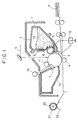
- an OPC photosensitive drum 3 serving as an electrostatic latent image holding member is charged to negative polarity by a contact charging member 11 comprising a charging roller as a primary charging unit, and the image is scanned by exposure 5 using a laser beam to form a digital latent image.
- the latent image is reversed and developed by a negative frictional chargeable magnetic toner 13 of a development unit 1 as development means provided in the counter direction and comprising an urethane rubber elastic blade 8 and a development sleeve 6 as a toner carrying member containing a magnet 15.
- an amorphous silicon photosensitive member used as the electrostatic latent image holding member is charged to positive polarity to form an electrostatic latent image, and the latent image is normally developed by using a negative frictional chargeable polar toner.
- the fill amount of the toner in the development unit is generally 100 to 900 g.
- the present invention can be applied to cases in which the development unit is filled with a large amount of the toner, e.g., 1000 to 4000 g, as compared with the fill amount of ordinary development units.
- An alternate bias, a pulse bias and/or a DC bias is applied to the development sleeve 6 by bias applying means 12.
- a contact transfer member 4 comprising a transfer roller serving as transfer means to electrostatically transfer the toner image on the photosensitive drum onto the transfer paper P.
- the transfer paper P separated from the photosensitive drum 3 is subjected to fixing processing for fixing the toner image on the transfer paper P by a heating pressure fixing unit comprising a heating roller 21 having heating means 20 therein and a pressure roller 22.
- the magnetic toner remaining on the photosensitive drum 3 after the transfer step is removed by a cleaning unit 14 comprising a cleaning blade 7. After cleaning, the photosensitive drum 3 is destaticized by erase exposure 10, and the process starting from the charging step by the primary charger 11 is gain repeated.
- the electrostatic latent image holding member (photosensitive drum) comprises a photosensitive layer and a conductive substrate, and is moved in a direction shown by an arrow.
- the nonmagnetic cylindrical development sleeve 6 serving as the toner carrying member is rotated in the same direction as the surface of the electrostatic latent image holding member.
- the nonmagnetic cylindrical development sleeve 6 is nonrotatably disposed the multipolar permanent magnet 15 (magnet roll) serving as magnetic field generating means.
- the magnetic toner 13 is coated on the development sleeve 6, and the magnetic toner particles are provided with negative tribo charge by friction between the surface of the development sleeve 6 and the magnetic toner particles.
- the elastic blade 8 is disposed for controlling the toner layer to be thin (thickness of 30 to 300 ⁇ m) and uniform to form in a non-contact state the toner layer thinner than the space between the photosensitive drum 3 and the development sleeve 6 in the region of the development unit where the photosensitive drum and the development sleeve are opposite to each other.
- the rotational speed of the development sleeve 6 is controlled so that the surface speed of the toner carrying member is substantially the same or close to the surface speed of the electrostatic latent image holding member.
- An AC bias or pulse bias may be applied to the development sleeve 6 by the bias applying means 12.
- the AC bias preferably has f of 200 to 4,000 Hz and Vpp of 500 to 3,000 V.
- the magnetic toner In transfer of the magnetic toner from the toner carrying member to the electrostatic latent image holding member in the development unit, the magnetic toner is transferred to the electrostatic latent image holding member side by the action of the electrostatic force of the surface of the electrostatic latent image holding member for holding the electrostatic latent image, and the AC bias or pulse bias.
- a plurality of components may be integrally combined to form a process cartridge as an apparatus unit, and the process cartridge may be detachably mounted on the main assembly of the apparatus.
- the primary charging means and the development device may be integrally supported together with the photosensitive drum to form the process cartridge as a single unit detachable from the main assembly so that the process cartridge is detachably mounted on the main assembly by using guide means such as a rail or the like.
- the cleaning means may be provided on the process cartridge.
- Fig. 2 shows a process cartridge in accordance with an embodiment of the present invention.
- a development unit 1 a drum-shaped electrostatic latent image holding member (photosensitive drum) 3, a cleaner 14, and a primary charger 11 are integrated to form a process cartridge 18.
- This process cartridge 18 is changed by a new cartridge when the magnetic toner 13 of the development device 1 is used up.
- the development device 1 comprises the magnetic toner 13, and forms a predetermined electric field between the photosensitive drum 3 and the development sleeve 6.
- the distance between the photosensitive drum 3 and the development sleeve 6 is very important for preferably performing the development step. In this embodiment, the distance is adjusted to, for example, 300 ⁇ m with an error of 20 ⁇ m.
- the development device 1 comprises a toner container 2 for containing the magnetic toner 13, the development sleeve 6 for carrying the magnetic toner 13 in the toner container 2 from the toner container 2 to the development region (unit) opposite to the electrostatic latent image holding member 3, and an elastic blade 8 carried by the development sleeve 6 and serving as a toner layer thickness regulating member for regulating the thickness of the magnetic toner carried to the development region to a predetermined thickness to form the toner thin layer on the development sleeve 6.
- the development sleeve 6 may have any desired structure.
- the development sleeve 6 comprises a nonmagnetic development sleeve containing a magnet 15.
- the development sleeve 6 may comprise a cylindrical rotatable member or a circularly moving belt.
- aluminum or SUS is generally preferably used as the material for the development sleeve 6.
- the elastic blade 8 comprises an elastic plate made of a rubber elastic material such as urethane rubber, silicone rubber, NBR, or the like; a metal elastic material such as phosphor bronze, stainless, or the like; or a resin elastic material such as polyethylene terephthalate, high-density polyethylene, or the like.
- the elastic blade 8 is brought into contact with the development sleeve 6 by the elasticity possessed by the elastic blade 8, and is fixed to the toner container 2 by a blade supporting member 9 comprising a rigid material such as iron or the like.
- the elastic blade 8 is preferably brought into contact with the development sleeve 6 carrying the magnetic toner under linear pressure of 5 to 80 g/cm in the counter direction relative to the rotation direction of the development sleeve 6.
- a blade-shaped charging blade can be used in place of the above charging roller.
- Fig. 3 is a block diagram showing an example of this application.
- a controller 31 controls an image reading unit 30 and a printer 39.
- the entire controller 31 is controlled by CPU 37.
- the read data from the image reading unit 30 is transmitted to an opposite party through a transmitting circuit 33.
- the data received from the opposite party is sent to the printer 39 through a receiving circuit 32.
- In an image memory is stored predetermined image data.
- a printer controller 38 controls the printer 39. This example further comprises a telephone 34.
- the image (image information from a remote terminal connected through the line) received through a line 35 is demodulated by the receiving circuit 32, decoded by the CPU 37 and then successively stored in the image memory 36.
- the CPU 37 reads the image information of one page from the memory 36, and sends the decoded image information of one page to the printer controller 38.
- the printer controller 38 controls the printer 39 to record the image information of the page.
- the CPU 37 receives information of a next page during recording by the printer 39.
- the magnetic toner of the present invention realizes formation of a uniform image having excellent quality without fading and fogging, exhibits high development performance and excellent long-term durability in each of environments of low temperature and low humidity and high temperature and high humidity.
- aqueous ferrous sulfate solution sodium silicate so that the silicon element content was 1.8% based on the iron element, and zinc sulfate was further added so that the zinc element content was 0.6% based on the iron element.
- sodium hydroxide solution was mixed in an amount of 1.0 to 1.1 equivalent based on iron ions to prepare an aqueous solution containing ferrous hydroxide.
- Magnetic iron oxides B to G having the characteristics shown in Table 1 were obtained by the same method as Production Example 1 except that the amount of sodium silicate and the amounts of other metal salts added were changed as shown in Table 1.
- Magnetic iron oxide a having the characteristics shown in Table 1 was obtained by the same method as Production Example 1 except that neither sodium silicate nor zinc sulfate were added.
- Magnetic iron oxides c to j having the characteristics shown in Table 1 were obtained by the same method as Production Example 1 except that the amount of sodium silicate and the amounts of other metal salts added were changed as shown in Table 1.
- a mixture of the above components was melted and kneaded by a biaxial extruder heated to 140°C, and then cooled.
- the kneaded mixture was coarsely ground by a hammer mill, and then finely ground by a jet, mill to obtain a finely-ground powder.
- the finely-ground powder was classified by a fixed wall type pneumatic classifier to produce classified powder.
- the thus-obtained classified powder was strictly classified by a multi-division classifier (Produced by Nittetsu Kogyo Co., Erbojet Classifier) employing a Coanda effect to remove ultrafine powder and coarse powder, to obtain negative chargeable magnetic toner particles having a weight average particle diameter (D4) of 6.7 ⁇ m, and a volume average particle diameter (D1) of 5.25 ⁇ m, and containing 0.2% of magnetic toner particles having a particle diameter of 12.7 ⁇ m or more and 20.5% of magnetic toner particles having a particle diameter of less than 4.0 ⁇ m (diameter of 2.0 to 4.0 ⁇ m).
- a multi-division classifier Provided by Nittetsu Kogyo Co., Erbojet Classifier
- the image forming apparatus shown in Fig. 1 was used, in which a laser beam printer Laser shot 930 produced by Canon Inc. was modified from 24 sheets/min to 32 sheets/min.
- the process cartridge shown in Fig. 2 was modified so that it can be filled with 1700 g of toner, and filled with 1700 g of the magnetic toner 1.
- the process cartridge filled with the external magnetic toner was mounted on the main assembly of the image forming apparatus. In this apparatus, the process speed was 145 mm/sec.
- the magnetic toner image formed on the OPC photosensitive member was transferred to plain paper at the above-described plus transfer potential, and the plain paper having the magnetic toner image was passed through the roller fixing unit to fix the magnetic toner image.
- the surface temperature of the heating roller of the heating pressure roller fixing unit was set to 190°C, and the total pressure between the heating roller and the pressure roller was set to 30 kg.
- the apparatus was allowed to stand for 2 days in the same environment, and then the print out test was further carried out for 15000 sheets.
- the image density was evaluated by measuring images printed out on copying plain paper (deposit: 75 g/m 2 ).
- image density the relative density of a white portion having an original density of 0.00 to the printed out image by using a Macbeth reflection densitometer (produced by Macbeth Co.,).
- Uniformity in page was judged from a difference between the maximum and minimum image densities in a printed out image.
- Fogging was calculated from a difference (Ds - Sr) between the whiteness (Dr) of transfer paper before printing and the whiteness (Ds) of transfer paper after printing of solid white, which were measured by a reflectometer (produced by Tokyo Denshoku Co., Ltd.). Images were formed in an environment of low temperature and low humidity (15°C, 10% RH), and the print mode was set to 2 sheets/20 sec.
- Magnetic toners 2 to 7 of Examples 2 to 7 were obtained by the same method as Example 1 except that magnetic iron oxides B to G of Production Examples 2 to 7 were respectively used.
- the magnetic toners 2 to 7 obtained were evaluated by the same method as Example 1. The results of evaluation are shown in Table 2.
- Magnetic toners 8 to 17 were produced by the same method as Example 1 except that magnetic iron oxides a to j of Comparative Production Examples 1 to 10 were respectively used. The results of evaluation are shown in Table 2.
- aqueous ferrous sulfate solution sodium silicate so that the silicon element content was 1.5% based on the iron element, and zinc sulfate was further added so that the zinc element content was 0.5% based on the iron element.
- sodium hydroxide solution was mixed in an amount of 1.0 to 1.1 equivalents based on iron ions to prepare an aqueous solution containing ferrous hydroxide.
- Magnetic iron oxides BB to FF having the characteristics shown in Table 3 were obtained by the same method as Production Example 8 except that the amount of sodium silicate and the amounts of other metal salts added were changed as shown in Table 3.
- Magnetic iron oxide aa having the characteristics shown in Table 3 was obtained by the same method as Production Example 8 except that neither sodium silicate nor zinc sulfate were added.
- Magnetic iron oxides cc to gg having the characteristics shown in Table 3 were obtained by the same method as Production Example 8 except that the amount of sodium silicate and the amounts of other metal salts added were changed as shown in Table 3.
- a mixture of the above components was melted and kneaded by a biaxial extruder heated to 140°C, and then cooled.
- the kneaded mixture was coarsely ground by a hammer mill, and then finely ground by a jet mill to obtain a finely-ground powder.
- the finely-ground powder was classified by a fixed wall type pneumatic classifier to produce classified powder.
- the thus-obtained classified powder was strictly classified by a multi-division classifier (Produced by Nitesu Kogyo Co., Erbojet Classifier) employing a Coanda effect to remove ultrafine powder and coarse powder, to obtain negative chargeable magnetic toner particles having a weight average particle diameter (D 4 ) of 6.8 ⁇ m, and a volume average particle diameter (D 1 ) of 5.37 ⁇ m, and containing 0.1% of magnetic toner particles having a particle diameter of 12.7 ⁇ m or more and 19.7% of magnetic toner particles having a particle diameter of less than 4.0 ⁇ m.
- a multi-division classifier Provided by Nitesu Kogyo Co., Erbojet Classifier
- D 4 weight average particle diameter
- D 1 volume average particle diameter
- a laser beam printer Laser shot 430 produced by Canon Inc. (8 sheets/min) was used for evaluating the state of supply of the toner to the sleeve and the images formed.
- the image forming apparatus shown in Fig. 1 and the process cartridge shown in Fig. 2 were used for the print out test by the following method. This print out test was carried out as an extreme simulation in which the toner in the process cartridge was deviated to one side and tapped when the process cartridge was transported for a long time.
- the magnetic toner image formed on the OPC photosensitive member was transferred to plain paper at the above-described plus transfer potential, and the plain paper having the magnetic toner image was passed through the fixing unit comprising heating and pressure rollers to fix the magnetic toner image.
- the surface temperature of the heating roller of the heating pressure roller fixing unit was set to 180°C, and the total pressure between the heating roller and the pressure roller was set to 7.5 kg.
- the print out test was continuously carried out for 30,000 sheets by using the process cartridge allowed to stand for 2 days in an environment of high temperature and high humidity (32.5°C, 85% RH), and an environment of low temperature and low humidity (15°C, 10% RH), and the obtained images were evaluated with respect to the items such as (1) the image density, (2) uniformity of image density in page (3) fogging and (4) image quality by the same method as Example 1.
- Magnetic toners 19 to 22 of Examples 9 to 12 were obtained by the same method as Example 8 except that magnetic iron oxides BB to EE of Production Examples 9 to 12 and the wax shown in Table 4 were respectively used.
- the magnetic toners 19 to 22 obtained were evaluated by the same method as Example 8. The results of evaluation are shown in Table 5.
- Negative chargeable magnetic toner 23 was obtained by the same method as Example 8 except that magnetic iron oxide FF of Production Examples 13 and the wax shown in Table 4 were used, and 4 parts of unmodified polypropylene wax (propylene component 99% or more, DSC endothermic peak at 137°C) was further added.
- the magnetic toner 23 obtained was evaluated by the same method as Example 8. The results of evaluation are shown in Table 5.
- Negative chargeable magnetic toner 24 of Example 14 was obtained by the same method as Example 8 except that the wax shown in Table 4 were used.
- the magnetic toner 24 obtained was evaluated by the same method as Example 8. The results of evaluation are shown in Table 5.
- Magnetic toners 25 to 31 were produced by the same method as Example 8 except that magnetic iron oxides aa to gg of Comparative Production Examples 11 to 17, and the wax shown in Table 4 were respectively used. The results of evaluation are shown in Table 5. Wax Wax acid value (mgKOH/g) DSC endothermic peak (C) Ethylene component content (%) Amount of wax used (parts)
- Example 8 Acrylic acid modified PP-PE 11.0 128 6 3 9 Maleic anhydride modified PP-PE 2.1 128 5 3 10 Maleic anhydride modified PP-PE 4.3 125 11 3 11 Maleic anhydride modified PP-PE 3.7 128 6 3 12 Maleic anhydride modified PP-PE 4.3 125 11 3 13 Maleic anhydride modified PP-PE 3.7 128 6 3 polypropylene wax 0 137 1 or less 4 14 Polypropylene wax 0 137 1 or less 3 Comp.
- Example 11 Maleic anhydride modified PP-PE 0.8 127 6 3 12 Acrylic acid modified PP-PE 31.3 128 5 3 13 Maleic anhydride modified PP-PE 0.5 135 2 3 14 Acrylic acid modified PP-PE 31.3 128 5 3 15 Maleic anhydride modified PP-PE 1.5 135 2 3 16 Acrylic acid modified PP-PE 0.8 127 6 3 17 Acrylic acid modified PP-PE 31.3 128 5 3
- a magnetic toner includes magnetic toner particles containing at least a binder resin and a magnetic iron oxide.
- the magnetic iron oxide contains 0.2 to 4.0% by weight of at least one metal element selected from the group consisting of Mn, Zn, Ni, Cu, Co, Cr, Cd, Al, Sn and Mg, and 0.2 to 0.8% by weight of silicon element on the basis of an iron element; the ratio (B si /A Si ) ⁇ 100 of the content B Si of the silicon element present in the magnetic iron oxide up to an iron element solubility of 20% by weight to the total content A Si of the silicon element present in the magnetic iron oxide is 45 to 85%; the ratio (C si /A Si ) ⁇ 100 of the content C Si of the silicon element present in the magnetic iron oxide up to an iron element solubility of 10% by weight to the total content A Si is 35 to 70%; and the magnetic toner has a weight average particle diameter of 3.5 to 10.0 ⁇ m, and contains 0 to 30% by volume of magnetic toner particles having a volume particle diameter of 1
Landscapes
- Physics & Mathematics (AREA)
- General Physics & Mathematics (AREA)
- Chemical & Material Sciences (AREA)
- Inorganic Chemistry (AREA)
- Developing Agents For Electrophotography (AREA)
Applications Claiming Priority (6)
| Application Number | Priority Date | Filing Date | Title |
|---|---|---|---|
| JP259993/97 | 1997-09-25 | ||
| JP25999397 | 1997-09-25 | ||
| JP25999397 | 1997-09-25 | ||
| JP5493098 | 1998-03-06 | ||
| JP54930/98 | 1998-03-06 | ||
| JP5493098 | 1998-03-06 |
Publications (3)
| Publication Number | Publication Date |
|---|---|
| EP0905569A2 true EP0905569A2 (fr) | 1999-03-31 |
| EP0905569A3 EP0905569A3 (fr) | 1999-05-19 |
| EP0905569B1 EP0905569B1 (fr) | 2003-11-26 |
Family
ID=26395765
Family Applications (1)
| Application Number | Title | Priority Date | Filing Date |
|---|---|---|---|
| EP98118132A Expired - Lifetime EP0905569B1 (fr) | 1997-09-25 | 1998-09-24 | Révélateur magnétique et son utilisation dans une méthode de production d' images et dans une cartouche de traitement |
Country Status (3)
| Country | Link |
|---|---|
| US (1) | US6007957A (fr) |
| EP (1) | EP0905569B1 (fr) |
| DE (1) | DE69819997T2 (fr) |
Cited By (2)
| Publication number | Priority date | Publication date | Assignee | Title |
|---|---|---|---|---|
| US6447969B1 (en) * | 1999-06-02 | 2002-09-10 | Canon Kabushiki Kaisha | Toner and image forming method |
| EP1403725A3 (fr) * | 2002-09-27 | 2005-08-24 | Canon Kabushiki Kaisha | Révélateur magnétique |
Families Citing this family (22)
| Publication number | Priority date | Publication date | Assignee | Title |
|---|---|---|---|---|
| JP3417291B2 (ja) * | 1998-03-31 | 2003-06-16 | 日本アエロジル株式会社 | 電子写真用トナーの外添剤の製造方法 |
| US6589701B2 (en) | 2000-07-28 | 2003-07-08 | Canon Kabushiki Kaisha | Dry toner, image forming method and process cartridge |
| DE10221663A1 (de) * | 2001-05-16 | 2002-12-12 | Kao Corp | Toner |
| US7273686B2 (en) * | 2003-08-01 | 2007-09-25 | Canon Kabushiki Kaisha | Toner |
| US20050227158A1 (en) * | 2004-04-07 | 2005-10-13 | Kabushiki Kaisha Toshiba | Toner for producing wiring board and method of producing wiring board using thereof |
| EP1645914B1 (fr) * | 2004-10-08 | 2012-06-06 | Canon Kabushiki Kaisha | Révélateur magnétique |
| JP2010164829A (ja) * | 2009-01-16 | 2010-07-29 | Fuji Xerox Co Ltd | 静電荷像現像用キャリア、静電荷像現像剤、プロセスカートリッジ、画像形成方法、及び、画像形成装置 |
| US8426094B2 (en) | 2010-05-31 | 2013-04-23 | Canon Kabushiki Kaisha | Magnetic toner |
| US10082743B2 (en) | 2015-06-15 | 2018-09-25 | Canon Kabushiki Kaisha | Toner |
| JP6740014B2 (ja) | 2015-06-15 | 2020-08-12 | キヤノン株式会社 | トナー及びトナーの製造方法 |
| JP6750849B2 (ja) | 2016-04-28 | 2020-09-02 | キヤノン株式会社 | トナー及びトナーの製造方法 |
| JP6921609B2 (ja) | 2016-05-02 | 2021-08-18 | キヤノン株式会社 | トナーの製造方法 |
| JP6815753B2 (ja) | 2016-05-26 | 2021-01-20 | キヤノン株式会社 | トナー |
| US10036970B2 (en) | 2016-06-08 | 2018-07-31 | Canon Kabushiki Kaisha | Magenta toner |
| US10197936B2 (en) | 2016-11-25 | 2019-02-05 | Canon Kabushiki Kaisha | Toner |
| JP6849409B2 (ja) | 2016-11-25 | 2021-03-24 | キヤノン株式会社 | トナー |
| JP6833570B2 (ja) | 2017-03-10 | 2021-02-24 | キヤノン株式会社 | トナー |
| JP7237688B2 (ja) | 2018-05-01 | 2023-03-13 | キヤノン株式会社 | トナー |
| US10955765B2 (en) | 2018-11-22 | 2021-03-23 | Canon Kabushiki Kaisha | Magnetic carrier and two-component developer |
| DE102019132817B4 (de) | 2018-12-05 | 2022-09-29 | Canon Kabushiki Kaisha | Toner |
| JP7391572B2 (ja) | 2019-08-29 | 2023-12-05 | キヤノン株式会社 | トナー及びトナーの製造方法 |
| JP7475982B2 (ja) | 2020-06-19 | 2024-04-30 | キヤノン株式会社 | トナー |
Family Cites Families (11)
| Publication number | Priority date | Publication date | Assignee | Title |
|---|---|---|---|---|
| JPH0810341B2 (ja) * | 1986-05-28 | 1996-01-31 | キヤノン株式会社 | 磁性トナ− |
| EP0468525B1 (fr) * | 1990-07-27 | 1997-11-26 | Canon Kabushiki Kaisha | Développateur magnétique, appareil électrophotographique et procédé de reconnaissance de caractères à encre magnétique |
| JP2769918B2 (ja) * | 1990-10-26 | 1998-06-25 | キヤノン株式会社 | 静電荷像現像用磁性黒色現像剤 |
| US5424810A (en) * | 1991-09-13 | 1995-06-13 | Canon Kabushiki Kaisha | Magnetic toner, magnetic developer, apparatus unit, image forming apparatus and facsimile apparatus |
| JPH0611951A (ja) * | 1992-06-26 | 1994-01-21 | Hitachi Metals Ltd | 電子写真プリンタ |
| DE69417678T2 (de) * | 1993-10-08 | 1999-10-28 | Canon K.K., Tokio/Tokyo | Magnetischer Entwickler, Prozesskassette und Bildherstellungsverfahren |
| JP3044432B2 (ja) * | 1993-10-29 | 2000-05-22 | キヤノン株式会社 | 磁性トナー及び画像形成方法 |
| DE69520328T2 (de) * | 1994-11-08 | 2001-08-23 | Canon K.K., Tokio/Tokyo | Toner für die Entwicklung elektrostatischer Bilder, Zwei-Komponenten-Entwickler, Entwicklungsmethode, Bilderzeugungsverfahren, Hitzefixierverfahren und Verfahren zur Herstellung von Tonern |
| EP0750232B1 (fr) * | 1995-06-15 | 2004-01-07 | Toda Kogyo Corporation | Particules magnétiques pour révélateurs magnétiques et procédé de leur préparation |
| US5652060A (en) * | 1995-06-15 | 1997-07-29 | Toda Kogyo Corporation | Spherical magnetic particles for magnetic toner and process for producing the same |
| EP0797123B1 (fr) * | 1996-03-22 | 2001-06-13 | Canon Kabushiki Kaisha | Révélateur magnétique pour le développement d'images électrostatiques, méthode de formation d'images et cartouche de traitement |
-
1998
- 1998-09-24 EP EP98118132A patent/EP0905569B1/fr not_active Expired - Lifetime
- 1998-09-24 US US09/159,573 patent/US6007957A/en not_active Expired - Lifetime
- 1998-09-24 DE DE69819997T patent/DE69819997T2/de not_active Expired - Lifetime
Cited By (2)
| Publication number | Priority date | Publication date | Assignee | Title |
|---|---|---|---|---|
| US6447969B1 (en) * | 1999-06-02 | 2002-09-10 | Canon Kabushiki Kaisha | Toner and image forming method |
| EP1403725A3 (fr) * | 2002-09-27 | 2005-08-24 | Canon Kabushiki Kaisha | Révélateur magnétique |
Also Published As
| Publication number | Publication date |
|---|---|
| DE69819997T2 (de) | 2004-10-07 |
| US6007957A (en) | 1999-12-28 |
| DE69819997D1 (de) | 2004-01-08 |
| EP0905569B1 (fr) | 2003-11-26 |
| EP0905569A3 (fr) | 1999-05-19 |
Similar Documents
| Publication | Publication Date | Title |
|---|---|---|
| EP0905569B1 (fr) | Révélateur magnétique et son utilisation dans une méthode de production d' images et dans une cartouche de traitement | |
| US9034551B2 (en) | Two-component developer | |
| US5424810A (en) | Magnetic toner, magnetic developer, apparatus unit, image forming apparatus and facsimile apparatus | |
| US7029813B2 (en) | Toner | |
| US5750302A (en) | Magnetic toner for developing electrostatic image, image forming process, and process cartridge | |
| EP0689100B1 (fr) | Véhiculeur pour électrophotographie, développeur du type à deux composants et procédé de formation d'images | |
| HK105696A (en) | Image forming apparatus | |
| JP2018040967A (ja) | トナー | |
| JP2862412B2 (ja) | 磁性トナー、磁性現像剤、装置ユニット、画像形成装置及びファクシミリ装置 | |
| US20030016955A1 (en) | Process cartridge | |
| US7166404B2 (en) | Carrier for developer for developing electrostatic latent image, image forming method using same and image forming apparatus using same | |
| GB2209842A (en) | Magnetic toner, negatively chargeable one component developer and image forming method | |
| EP0650099B1 (fr) | Matériau de véhiculation pour électrophotographie, révélateur du type à deux composants, et procédé de formation d'image | |
| EP1353236A2 (fr) | Toner | |
| US5705306A (en) | Toner for forming electrophotographic image and developers using the same | |
| JP3869954B2 (ja) | 磁性トナー、画像形成方法及びプロセスカートリッジ | |
| JP2003337444A (ja) | 負帯電性トナー、画像形成方法及びプロセスカートリッジ | |
| JP2003015364A (ja) | トナー | |
| JP2866257B2 (ja) | 磁性現像剤 | |
| JP3131753B2 (ja) | 磁性トナー及び画像形成方法 | |
| JP3485861B2 (ja) | 磁性一成分現像剤及びその現像方法 | |
| JP2759528B2 (ja) | カラー現像剤 | |
| JP3598570B2 (ja) | 静電荷像現像剤 | |
| JP2004333636A (ja) | 現像剤担持体、現像装置、現像方法、画像形成方法及びプロセスカートリッジ | |
| JP3558972B2 (ja) | 静電荷像現像用トナー及び画像形成方法 |
Legal Events
| Date | Code | Title | Description |
|---|---|---|---|
| PUAI | Public reference made under article 153(3) epc to a published international application that has entered the european phase |
Free format text: ORIGINAL CODE: 0009012 |
|
| AK | Designated contracting states |
Kind code of ref document: A2 Designated state(s): DE FR GB IT |
|
| AX | Request for extension of the european patent |
Free format text: AL;LT;LV;MK;RO;SI |
|
| PUAL | Search report despatched |
Free format text: ORIGINAL CODE: 0009013 |
|
| AK | Designated contracting states |
Kind code of ref document: A3 Designated state(s): AT BE CH CY DE DK ES FI FR GB GR IE IT LI LU MC NL PT SE |
|
| AX | Request for extension of the european patent |
Free format text: AL;LT;LV;MK;RO;SI |
|
| 17P | Request for examination filed |
Effective date: 19991005 |
|
| AKX | Designation fees paid |
Free format text: DE FR GB IT |
|
| RTI1 | Title (correction) |
Free format text: MAGNETIC TONER AND ITS USE IN AN IMAGE FORMING METHOD AND IN A PROCESS CARTRIDGE |
|
| GRAH | Despatch of communication of intention to grant a patent |
Free format text: ORIGINAL CODE: EPIDOS IGRA |
|
| RTI1 | Title (correction) |
Free format text: MAGNETIC TONER AND ITS USE IN AN IMAGE FORMING METHOD AND IN A PROCESS CARTRIDGE |
|
| GRAS | Grant fee paid |
Free format text: ORIGINAL CODE: EPIDOSNIGR3 |
|
| GRAA | (expected) grant |
Free format text: ORIGINAL CODE: 0009210 |
|
| AK | Designated contracting states |
Kind code of ref document: B1 Designated state(s): DE FR GB IT |
|
| REG | Reference to a national code |
Ref country code: GB Ref legal event code: FG4D |
|
| REF | Corresponds to: |
Ref document number: 69819997 Country of ref document: DE Date of ref document: 20040108 Kind code of ref document: P |
|
| ET | Fr: translation filed | ||
| PLBE | No opposition filed within time limit |
Free format text: ORIGINAL CODE: 0009261 |
|
| STAA | Information on the status of an ep patent application or granted ep patent |
Free format text: STATUS: NO OPPOSITION FILED WITHIN TIME LIMIT |
|
| 26N | No opposition filed |
Effective date: 20040827 |
|
| REG | Reference to a national code |
Ref country code: FR Ref legal event code: PLFP Year of fee payment: 18 |
|
| PGFP | Annual fee paid to national office [announced via postgrant information from national office to epo] |
Ref country code: GB Payment date: 20150922 Year of fee payment: 18 Ref country code: DE Payment date: 20150930 Year of fee payment: 18 |
|
| PGFP | Annual fee paid to national office [announced via postgrant information from national office to epo] |
Ref country code: FR Payment date: 20150928 Year of fee payment: 18 |
|
| PGFP | Annual fee paid to national office [announced via postgrant information from national office to epo] |
Ref country code: IT Payment date: 20150903 Year of fee payment: 18 |
|
| REG | Reference to a national code |
Ref country code: DE Ref legal event code: R119 Ref document number: 69819997 Country of ref document: DE |
|
| GBPC | Gb: european patent ceased through non-payment of renewal fee |
Effective date: 20160924 |
|
| REG | Reference to a national code |
Ref country code: FR Ref legal event code: ST Effective date: 20170531 |
|
| PG25 | Lapsed in a contracting state [announced via postgrant information from national office to epo] |
Ref country code: GB Free format text: LAPSE BECAUSE OF NON-PAYMENT OF DUE FEES Effective date: 20160924 Ref country code: FR Free format text: LAPSE BECAUSE OF NON-PAYMENT OF DUE FEES Effective date: 20160930 Ref country code: DE Free format text: LAPSE BECAUSE OF NON-PAYMENT OF DUE FEES Effective date: 20170401 |
|
| PG25 | Lapsed in a contracting state [announced via postgrant information from national office to epo] |
Ref country code: IT Free format text: LAPSE BECAUSE OF NON-PAYMENT OF DUE FEES Effective date: 20160924 |