EP0908324A1 - Procédé d'enregistrement par jet d'encre et milieu d'enregistrement imprimé - Google Patents
Procédé d'enregistrement par jet d'encre et milieu d'enregistrement imprimé Download PDFInfo
- Publication number
- EP0908324A1 EP0908324A1 EP98119245A EP98119245A EP0908324A1 EP 0908324 A1 EP0908324 A1 EP 0908324A1 EP 98119245 A EP98119245 A EP 98119245A EP 98119245 A EP98119245 A EP 98119245A EP 0908324 A1 EP0908324 A1 EP 0908324A1
- Authority
- EP
- European Patent Office
- Prior art keywords
- ink
- porous layer
- layer including
- pigment
- polymer particles
- Prior art date
- Legal status (The legal status is an assumption and is not a legal conclusion. Google has not performed a legal analysis and makes no representation as to the accuracy of the status listed.)
- Granted
Links
- 238000000034 method Methods 0.000 title claims abstract description 40
- 239000002245 particle Substances 0.000 claims abstract description 192
- 239000000049 pigment Substances 0.000 claims abstract description 167
- 229920000642 polymer Polymers 0.000 claims abstract description 108
- 239000011148 porous material Substances 0.000 claims abstract description 89
- 239000000758 substrate Substances 0.000 claims abstract description 53
- 238000009826 distribution Methods 0.000 claims abstract description 46
- 230000015572 biosynthetic process Effects 0.000 claims abstract description 10
- 239000001023 inorganic pigment Substances 0.000 claims description 61
- 239000002952 polymeric resin Substances 0.000 claims description 29
- 229920003002 synthetic resin Polymers 0.000 claims description 29
- 239000010410 layer Substances 0.000 description 263
- 239000000976 ink Substances 0.000 description 126
- 239000002609 medium Substances 0.000 description 94
- 229920005989 resin Polymers 0.000 description 62
- 239000011347 resin Substances 0.000 description 62
- PNEYBMLMFCGWSK-UHFFFAOYSA-N aluminium oxide Inorganic materials [O-2].[O-2].[O-2].[Al+3].[Al+3] PNEYBMLMFCGWSK-UHFFFAOYSA-N 0.000 description 31
- 239000000975 dye Substances 0.000 description 28
- XLYOFNOQVPJJNP-UHFFFAOYSA-N water Substances O XLYOFNOQVPJJNP-UHFFFAOYSA-N 0.000 description 24
- VYPSYNLAJGMNEJ-UHFFFAOYSA-N Silicium dioxide Chemical compound O=[Si]=O VYPSYNLAJGMNEJ-UHFFFAOYSA-N 0.000 description 23
- 238000011156 evaluation Methods 0.000 description 20
- 239000008199 coating composition Substances 0.000 description 19
- 230000003287 optical effect Effects 0.000 description 18
- 238000001035 drying Methods 0.000 description 17
- 239000002904 solvent Substances 0.000 description 17
- 238000000576 coating method Methods 0.000 description 16
- 239000006185 dispersion Substances 0.000 description 15
- 239000000047 product Substances 0.000 description 15
- 239000011248 coating agent Substances 0.000 description 14
- 238000010438 heat treatment Methods 0.000 description 13
- 239000000839 emulsion Substances 0.000 description 11
- 229920001225 polyester resin Polymers 0.000 description 10
- 239000004645 polyester resin Substances 0.000 description 10
- 238000003860 storage Methods 0.000 description 10
- 239000011230 binding agent Substances 0.000 description 9
- OKTJSMMVPCPJKN-UHFFFAOYSA-N Carbon Chemical compound [C] OKTJSMMVPCPJKN-UHFFFAOYSA-N 0.000 description 8
- 230000008859 change Effects 0.000 description 8
- MTHSVFCYNBDYFN-UHFFFAOYSA-N diethylene glycol Chemical compound OCCOCCO MTHSVFCYNBDYFN-UHFFFAOYSA-N 0.000 description 8
- 238000005562 fading Methods 0.000 description 8
- 239000011247 coating layer Substances 0.000 description 7
- 239000002270 dispersing agent Substances 0.000 description 7
- 239000000377 silicon dioxide Substances 0.000 description 7
- 239000007787 solid Substances 0.000 description 7
- RTZKZFJDLAIYFH-UHFFFAOYSA-N Diethyl ether Chemical compound CCOCC RTZKZFJDLAIYFH-UHFFFAOYSA-N 0.000 description 6
- PEDCQBHIVMGVHV-UHFFFAOYSA-N Glycerine Chemical compound OCC(O)CO PEDCQBHIVMGVHV-UHFFFAOYSA-N 0.000 description 6
- KFZMGEQAYNKOFK-UHFFFAOYSA-N Isopropanol Chemical compound CC(C)O KFZMGEQAYNKOFK-UHFFFAOYSA-N 0.000 description 6
- 230000000740 bleeding effect Effects 0.000 description 6
- 239000003795 chemical substances by application Substances 0.000 description 6
- 238000004040 coloring Methods 0.000 description 6
- 229920001577 copolymer Polymers 0.000 description 6
- 230000000694 effects Effects 0.000 description 6
- 238000007602 hot air drying Methods 0.000 description 6
- 239000011159 matrix material Substances 0.000 description 6
- 239000002344 surface layer Substances 0.000 description 6
- LYCAIKOWRPUZTN-UHFFFAOYSA-N Ethylene glycol Chemical compound OCCO LYCAIKOWRPUZTN-UHFFFAOYSA-N 0.000 description 5
- 235000019241 carbon black Nutrition 0.000 description 5
- 239000010954 inorganic particle Substances 0.000 description 5
- 239000003960 organic solvent Substances 0.000 description 5
- -1 polyethylene Polymers 0.000 description 5
- 239000011164 primary particle Substances 0.000 description 5
- 239000002002 slurry Substances 0.000 description 5
- CBENFWSGALASAD-UHFFFAOYSA-N Ozone Chemical compound [O-][O+]=O CBENFWSGALASAD-UHFFFAOYSA-N 0.000 description 4
- 239000004372 Polyvinyl alcohol Substances 0.000 description 4
- 238000010521 absorption reaction Methods 0.000 description 4
- 239000007864 aqueous solution Substances 0.000 description 4
- 230000005540 biological transmission Effects 0.000 description 4
- 239000006229 carbon black Substances 0.000 description 4
- 230000000052 comparative effect Effects 0.000 description 4
- 238000002474 experimental method Methods 0.000 description 4
- 230000009477 glass transition Effects 0.000 description 4
- 239000000463 material Substances 0.000 description 4
- 239000000203 mixture Substances 0.000 description 4
- 229920000728 polyester Polymers 0.000 description 4
- 229920002451 polyvinyl alcohol Polymers 0.000 description 4
- 230000008569 process Effects 0.000 description 4
- 239000000741 silica gel Substances 0.000 description 4
- 229910002027 silica gel Inorganic materials 0.000 description 4
- 239000000243 solution Substances 0.000 description 4
- OKKJLVBELUTLKV-UHFFFAOYSA-N Methanol Chemical compound OC OKKJLVBELUTLKV-UHFFFAOYSA-N 0.000 description 3
- ZMXDDKWLCZADIW-UHFFFAOYSA-N N,N-Dimethylformamide Chemical compound CN(C)C=O ZMXDDKWLCZADIW-UHFFFAOYSA-N 0.000 description 3
- LRHPLDYGYMQRHN-UHFFFAOYSA-N N-Butanol Chemical compound CCCCO LRHPLDYGYMQRHN-UHFFFAOYSA-N 0.000 description 3
- DNIAPMSPPWPWGF-UHFFFAOYSA-N Propylene glycol Chemical compound CC(O)CO DNIAPMSPPWPWGF-UHFFFAOYSA-N 0.000 description 3
- DKGAVHZHDRPRBM-UHFFFAOYSA-N Tert-Butanol Chemical compound CC(C)(C)O DKGAVHZHDRPRBM-UHFFFAOYSA-N 0.000 description 3
- GWEVSGVZZGPLCZ-UHFFFAOYSA-N Titan oxide Chemical compound O=[Ti]=O GWEVSGVZZGPLCZ-UHFFFAOYSA-N 0.000 description 3
- 239000011324 bead Substances 0.000 description 3
- XCJYREBRNVKWGJ-UHFFFAOYSA-N copper(II) phthalocyanine Chemical compound [Cu+2].C12=CC=CC=C2C(N=C2[N-]C(C3=CC=CC=C32)=N2)=NC1=NC([C]1C=CC=CC1=1)=NC=1N=C1[C]3C=CC=CC3=C2[N-]1 XCJYREBRNVKWGJ-UHFFFAOYSA-N 0.000 description 3
- SWXVUIWOUIDPGS-UHFFFAOYSA-N diacetone alcohol Natural products CC(=O)CC(C)(C)O SWXVUIWOUIDPGS-UHFFFAOYSA-N 0.000 description 3
- 239000001041 dye based ink Substances 0.000 description 3
- 125000001495 ethyl group Chemical group [H]C([H])([H])C([H])([H])* 0.000 description 3
- 238000000227 grinding Methods 0.000 description 3
- 230000001771 impaired effect Effects 0.000 description 3
- 238000007603 infrared drying Methods 0.000 description 3
- 230000007246 mechanism Effects 0.000 description 3
- 238000002156 mixing Methods 0.000 description 3
- 229920000036 polyvinylpyrrolidone Polymers 0.000 description 3
- 239000001267 polyvinylpyrrolidone Substances 0.000 description 3
- 235000013855 polyvinylpyrrolidone Nutrition 0.000 description 3
- 238000003825 pressing Methods 0.000 description 3
- RMAQACBXLXPBSY-UHFFFAOYSA-N silicic acid Chemical compound O[Si](O)(O)O RMAQACBXLXPBSY-UHFFFAOYSA-N 0.000 description 3
- 229920001909 styrene-acrylic polymer Polymers 0.000 description 3
- 239000000126 substance Substances 0.000 description 3
- SVTBMSDMJJWYQN-UHFFFAOYSA-N 2-methylpentane-2,4-diol Chemical compound CC(O)CC(C)(C)O SVTBMSDMJJWYQN-UHFFFAOYSA-N 0.000 description 2
- CSCPPACGZOOCGX-UHFFFAOYSA-N Acetone Chemical compound CC(C)=O CSCPPACGZOOCGX-UHFFFAOYSA-N 0.000 description 2
- IJGRMHOSHXDMSA-UHFFFAOYSA-N Atomic nitrogen Chemical compound N#N IJGRMHOSHXDMSA-UHFFFAOYSA-N 0.000 description 2
- 229920002799 BoPET Polymers 0.000 description 2
- VTYYLEPIZMXCLO-UHFFFAOYSA-L Calcium carbonate Chemical compound [Ca+2].[O-]C([O-])=O VTYYLEPIZMXCLO-UHFFFAOYSA-L 0.000 description 2
- LFQSCWFLJHTTHZ-UHFFFAOYSA-N Ethanol Chemical compound CCO LFQSCWFLJHTTHZ-UHFFFAOYSA-N 0.000 description 2
- SECXISVLQFMRJM-UHFFFAOYSA-N N-Methylpyrrolidone Chemical compound CN1CCCC1=O SECXISVLQFMRJM-UHFFFAOYSA-N 0.000 description 2
- SJEYSFABYSGQBG-UHFFFAOYSA-M Patent blue Chemical compound [Na+].C1=CC(N(CC)CC)=CC=C1C(C=1C(=CC(=CC=1)S([O-])(=O)=O)S([O-])(=O)=O)=C1C=CC(=[N+](CC)CC)C=C1 SJEYSFABYSGQBG-UHFFFAOYSA-M 0.000 description 2
- 239000004698 Polyethylene Substances 0.000 description 2
- 239000004793 Polystyrene Substances 0.000 description 2
- WYURNTSHIVDZCO-UHFFFAOYSA-N Tetrahydrofuran Chemical compound C1CCOC1 WYURNTSHIVDZCO-UHFFFAOYSA-N 0.000 description 2
- XLOMVQKBTHCTTD-UHFFFAOYSA-N Zinc monoxide Chemical compound [Zn]=O XLOMVQKBTHCTTD-UHFFFAOYSA-N 0.000 description 2
- 239000000980 acid dye Substances 0.000 description 2
- 239000012736 aqueous medium Substances 0.000 description 2
- 238000000149 argon plasma sintering Methods 0.000 description 2
- TZCXTZWJZNENPQ-UHFFFAOYSA-L barium sulfate Chemical compound [Ba+2].[O-]S([O-])(=O)=O TZCXTZWJZNENPQ-UHFFFAOYSA-L 0.000 description 2
- BTANRVKWQNVYAZ-UHFFFAOYSA-N butan-2-ol Chemical compound CCC(C)O BTANRVKWQNVYAZ-UHFFFAOYSA-N 0.000 description 2
- 239000011575 calcium Substances 0.000 description 2
- OSGAYBCDTDRGGQ-UHFFFAOYSA-L calcium sulfate Chemical compound [Ca+2].[O-]S([O-])(=O)=O OSGAYBCDTDRGGQ-UHFFFAOYSA-L 0.000 description 2
- 125000004432 carbon atom Chemical group C* 0.000 description 2
- 229920006026 co-polymeric resin Polymers 0.000 description 2
- 238000001816 cooling Methods 0.000 description 2
- 238000005336 cracking Methods 0.000 description 2
- 238000000280 densification Methods 0.000 description 2
- 239000000982 direct dye Substances 0.000 description 2
- 238000010410 dusting Methods 0.000 description 2
- 230000002708 enhancing effect Effects 0.000 description 2
- 150000002148 esters Chemical class 0.000 description 2
- 235000019441 ethanol Nutrition 0.000 description 2
- 239000004744 fabric Substances 0.000 description 2
- 239000006260 foam Substances 0.000 description 2
- 239000007788 liquid Substances 0.000 description 2
- 230000007774 longterm Effects 0.000 description 2
- 239000012046 mixed solvent Substances 0.000 description 2
- 229940099800 pigment red 48 Drugs 0.000 description 2
- 229920001200 poly(ethylene-vinyl acetate) Polymers 0.000 description 2
- 229920000573 polyethylene Polymers 0.000 description 2
- 229920002223 polystyrene Polymers 0.000 description 2
- 229920005749 polyurethane resin Polymers 0.000 description 2
- 229920000915 polyvinyl chloride Polymers 0.000 description 2
- 239000004800 polyvinyl chloride Substances 0.000 description 2
- BDERNNFJNOPAEC-UHFFFAOYSA-N propan-1-ol Chemical compound CCCO BDERNNFJNOPAEC-UHFFFAOYSA-N 0.000 description 2
- 238000001454 recorded image Methods 0.000 description 2
- 239000011369 resultant mixture Substances 0.000 description 2
- 239000004576 sand Substances 0.000 description 2
- 238000001179 sorption measurement Methods 0.000 description 2
- 230000008961 swelling Effects 0.000 description 2
- 229920001169 thermoplastic Polymers 0.000 description 2
- 235000010215 titanium dioxide Nutrition 0.000 description 2
- 238000002834 transmittance Methods 0.000 description 2
- PUPZLCDOIYMWBV-UHFFFAOYSA-N (+/-)-1,3-Butanediol Chemical compound CC(O)CCO PUPZLCDOIYMWBV-UHFFFAOYSA-N 0.000 description 1
- ZWVMLYRJXORSEP-UHFFFAOYSA-N 1,2,6-Hexanetriol Chemical compound OCCCCC(O)CO ZWVMLYRJXORSEP-UHFFFAOYSA-N 0.000 description 1
- QCGOYKXFFGQDFY-UHFFFAOYSA-M 1,3,3-trimethyl-2-[3-(1,3,3-trimethylindol-1-ium-2-yl)prop-2-enylidene]indole;chloride Chemical compound [Cl-].CC1(C)C2=CC=CC=C2N(C)\C1=C\C=C\C1=[N+](C)C2=CC=CC=C2C1(C)C QCGOYKXFFGQDFY-UHFFFAOYSA-M 0.000 description 1
- CYSGHNMQYZDMIA-UHFFFAOYSA-N 1,3-Dimethyl-2-imidazolidinon Chemical compound CN1CCN(C)C1=O CYSGHNMQYZDMIA-UHFFFAOYSA-N 0.000 description 1
- RYHBNJHYFVUHQT-UHFFFAOYSA-N 1,4-Dioxane Chemical compound C1COCCO1 RYHBNJHYFVUHQT-UHFFFAOYSA-N 0.000 description 1
- NJIRSTSECXKPCO-UHFFFAOYSA-M 3-[n-methyl-4-[2-(1,3,3-trimethylindol-1-ium-2-yl)ethenyl]anilino]propanenitrile;chloride Chemical compound [Cl-].C1=CC(N(CCC#N)C)=CC=C1\C=C\C1=[N+](C)C2=CC=CC=C2C1(C)C NJIRSTSECXKPCO-UHFFFAOYSA-M 0.000 description 1
- AVERNFJXXRIVQN-XSDYUOFFSA-N 5-[(4-ethoxyphenyl)diazenyl]-2-[(e)-2-[4-[(4-ethoxyphenyl)diazenyl]-2-sulfophenyl]ethenyl]benzenesulfonic acid Chemical compound C1=CC(OCC)=CC=C1N=NC(C=C1S(O)(=O)=O)=CC=C1\C=C\C1=CC=C(N=NC=2C=CC(OCC)=CC=2)C=C1S(O)(=O)=O AVERNFJXXRIVQN-XSDYUOFFSA-N 0.000 description 1
- 244000215068 Acacia senegal Species 0.000 description 1
- 239000005995 Aluminium silicate Substances 0.000 description 1
- 238000004438 BET method Methods 0.000 description 1
- JUQPZRLQQYSMEQ-UHFFFAOYSA-N CI Basic red 9 Chemical compound [Cl-].C1=CC(N)=CC=C1C(C=1C=CC(N)=CC=1)=C1C=CC(=[NH2+])C=C1 JUQPZRLQQYSMEQ-UHFFFAOYSA-N 0.000 description 1
- 229920002134 Carboxymethyl cellulose Polymers 0.000 description 1
- 241000557626 Corvus corax Species 0.000 description 1
- HMEKVHWROSNWPD-UHFFFAOYSA-N Erioglaucine A Chemical compound [NH4+].[NH4+].C=1C=C(C(=C2C=CC(C=C2)=[N+](CC)CC=2C=C(C=CC=2)S([O-])(=O)=O)C=2C(=CC=CC=2)S([O-])(=O)=O)C=CC=1N(CC)CC1=CC=CC(S([O-])(=O)=O)=C1 HMEKVHWROSNWPD-UHFFFAOYSA-N 0.000 description 1
- IMROMDMJAWUWLK-UHFFFAOYSA-N Ethenol Chemical compound OC=C IMROMDMJAWUWLK-UHFFFAOYSA-N 0.000 description 1
- 108010010803 Gelatin Proteins 0.000 description 1
- 229920000084 Gum arabic Polymers 0.000 description 1
- 239000004354 Hydroxyethyl cellulose Substances 0.000 description 1
- FXHOOIRPVKKKFG-UHFFFAOYSA-N N,N-Dimethylacetamide Chemical compound CN(C)C(C)=O FXHOOIRPVKKKFG-UHFFFAOYSA-N 0.000 description 1
- WHNWPMSKXPGLAX-UHFFFAOYSA-N N-Vinyl-2-pyrrolidone Chemical compound C=CN1CCCC1=O WHNWPMSKXPGLAX-UHFFFAOYSA-N 0.000 description 1
- GRYLNZFGIOXLOG-UHFFFAOYSA-N Nitric acid Chemical compound O[N+]([O-])=O GRYLNZFGIOXLOG-UHFFFAOYSA-N 0.000 description 1
- 229920002845 Poly(methacrylic acid) Chemical class 0.000 description 1
- 239000002202 Polyethylene glycol Substances 0.000 description 1
- 239000004115 Sodium Silicate Substances 0.000 description 1
- 229920002125 Sokalan® Polymers 0.000 description 1
- 229920002472 Starch Polymers 0.000 description 1
- 244000010375 Talinum crassifolium Species 0.000 description 1
- 235000015055 Talinum crassifolium Nutrition 0.000 description 1
- FMRLDPWIRHBCCC-UHFFFAOYSA-L Zinc carbonate Chemical compound [Zn+2].[O-]C([O-])=O FMRLDPWIRHBCCC-UHFFFAOYSA-L 0.000 description 1
- GRPFBMKYXAYEJM-UHFFFAOYSA-M [4-[(2-chlorophenyl)-[4-(dimethylamino)phenyl]methylidene]cyclohexa-2,5-dien-1-ylidene]-dimethylazanium;chloride Chemical compound [Cl-].C1=CC(N(C)C)=CC=C1C(C=1C(=CC=CC=1)Cl)=C1C=CC(=[N+](C)C)C=C1 GRPFBMKYXAYEJM-UHFFFAOYSA-M 0.000 description 1
- YKTSYUJCYHOUJP-UHFFFAOYSA-N [O--].[Al+3].[Al+3].[O-][Si]([O-])([O-])[O-] Chemical compound [O--].[Al+3].[Al+3].[O-][Si]([O-])([O-])[O-] YKTSYUJCYHOUJP-UHFFFAOYSA-N 0.000 description 1
- 239000000205 acacia gum Substances 0.000 description 1
- 235000010489 acacia gum Nutrition 0.000 description 1
- 230000009471 action Effects 0.000 description 1
- 239000012790 adhesive layer Substances 0.000 description 1
- 238000007754 air knife coating Methods 0.000 description 1
- 150000005215 alkyl ethers Chemical class 0.000 description 1
- 125000005233 alkylalcohol group Chemical group 0.000 description 1
- 125000002947 alkylene group Chemical group 0.000 description 1
- 229910052782 aluminium Inorganic materials 0.000 description 1
- XAGFODPZIPBFFR-UHFFFAOYSA-N aluminium Chemical compound [Al] XAGFODPZIPBFFR-UHFFFAOYSA-N 0.000 description 1
- 235000012211 aluminium silicate Nutrition 0.000 description 1
- 150000001408 amides Chemical class 0.000 description 1
- 239000003945 anionic surfactant Substances 0.000 description 1
- 239000002518 antifoaming agent Substances 0.000 description 1
- 239000008346 aqueous phase Substances 0.000 description 1
- LFZDEAVRTJKYAF-UHFFFAOYSA-L barium(2+) 2-[(2-hydroxynaphthalen-1-yl)diazenyl]naphthalene-1-sulfonate Chemical compound [Ba+2].C1=CC=CC2=C(S([O-])(=O)=O)C(N=NC3=C4C=CC=CC4=CC=C3O)=CC=C21.C1=CC=CC2=C(S([O-])(=O)=O)C(N=NC3=C4C=CC=CC4=CC=C3O)=CC=C21 LFZDEAVRTJKYAF-UHFFFAOYSA-L 0.000 description 1
- VJDDAARZIFHSQY-UHFFFAOYSA-N basic black 2 Chemical compound [Cl-].C=1C2=[N+](C=3C=CC=CC=3)C3=CC(N(CC)CC)=CC=C3N=C2C=CC=1NN=C1C=CC(=O)C=C1 VJDDAARZIFHSQY-UHFFFAOYSA-N 0.000 description 1
- 239000000981 basic dye Substances 0.000 description 1
- 229910000019 calcium carbonate Inorganic materials 0.000 description 1
- 239000000378 calcium silicate Substances 0.000 description 1
- 229910052918 calcium silicate Inorganic materials 0.000 description 1
- 235000012241 calcium silicate Nutrition 0.000 description 1
- OYACROKNLOSFPA-UHFFFAOYSA-N calcium;dioxido(oxo)silane Chemical compound [Ca+2].[O-][Si]([O-])=O OYACROKNLOSFPA-UHFFFAOYSA-N 0.000 description 1
- 229910052799 carbon Inorganic materials 0.000 description 1
- 239000001768 carboxy methyl cellulose Substances 0.000 description 1
- 235000010948 carboxy methyl cellulose Nutrition 0.000 description 1
- 229920003090 carboxymethyl hydroxyethyl cellulose Polymers 0.000 description 1
- 239000008112 carboxymethyl-cellulose Substances 0.000 description 1
- 239000005018 casein Substances 0.000 description 1
- BECPQYXYKAMYBN-UHFFFAOYSA-N casein, tech. Chemical compound NCCCCC(C(O)=O)N=C(O)C(CC(O)=O)N=C(O)C(CCC(O)=N)N=C(O)C(CC(C)C)N=C(O)C(CCC(O)=O)N=C(O)C(CC(O)=O)N=C(O)C(CCC(O)=O)N=C(O)C(C(C)O)N=C(O)C(CCC(O)=N)N=C(O)C(CCC(O)=N)N=C(O)C(CCC(O)=N)N=C(O)C(CCC(O)=O)N=C(O)C(CCC(O)=O)N=C(O)C(COP(O)(O)=O)N=C(O)C(CCC(O)=N)N=C(O)C(N)CC1=CC=CC=C1 BECPQYXYKAMYBN-UHFFFAOYSA-N 0.000 description 1
- 235000021240 caseins Nutrition 0.000 description 1
- 239000001913 cellulose Substances 0.000 description 1
- 229920002678 cellulose Polymers 0.000 description 1
- 229920002301 cellulose acetate Polymers 0.000 description 1
- 238000005119 centrifugation Methods 0.000 description 1
- IWWWBRIIGAXLCJ-BGABXYSRSA-N chembl1185241 Chemical compound C1=2C=C(C)C(NCC)=CC=2OC2=C\C(=N/CC)C(C)=CC2=C1C1=CC=CC=C1C(=O)OCC IWWWBRIIGAXLCJ-BGABXYSRSA-N 0.000 description 1
- PZTQVMXMKVTIRC-UHFFFAOYSA-L chembl2028348 Chemical compound [Ca+2].[O-]S(=O)(=O)C1=CC(C)=CC=C1N=NC1=C(O)C(C([O-])=O)=CC2=CC=CC=C12 PZTQVMXMKVTIRC-UHFFFAOYSA-L 0.000 description 1
- 229910052681 coesite Inorganic materials 0.000 description 1
- 239000008119 colloidal silica Substances 0.000 description 1
- 239000003086 colorant Substances 0.000 description 1
- 150000001875 compounds Chemical class 0.000 description 1
- 238000003851 corona treatment Methods 0.000 description 1
- 229910052906 cristobalite Inorganic materials 0.000 description 1
- 238000004132 cross linking Methods 0.000 description 1
- 239000013078 crystal Substances 0.000 description 1
- 238000007766 curtain coating Methods 0.000 description 1
- 238000000354 decomposition reaction Methods 0.000 description 1
- 230000002950 deficient Effects 0.000 description 1
- 230000006735 deficit Effects 0.000 description 1
- 239000008367 deionised water Substances 0.000 description 1
- 229910021641 deionized water Inorganic materials 0.000 description 1
- 238000003795 desorption Methods 0.000 description 1
- 238000011161 development Methods 0.000 description 1
- 238000007607 die coating method Methods 0.000 description 1
- 238000007599 discharging Methods 0.000 description 1
- 208000037265 diseases, disorders, signs and symptoms Diseases 0.000 description 1
- AOMZHDJXSYHPKS-UHFFFAOYSA-L disodium 4-amino-5-hydroxy-3-[(4-nitrophenyl)diazenyl]-6-phenyldiazenylnaphthalene-2,7-disulfonate Chemical compound [Na+].[Na+].[O-]S(=O)(=O)C1=CC2=CC(S([O-])(=O)=O)=C(N=NC=3C=CC=CC=3)C(O)=C2C(N)=C1N=NC1=CC=C([N+]([O-])=O)C=C1 AOMZHDJXSYHPKS-UHFFFAOYSA-L 0.000 description 1
- YCMOBGSVZYLYBZ-UHFFFAOYSA-L disodium 5-[[4-[4-[(2-amino-8-hydroxy-6-sulfonatonaphthalen-1-yl)diazenyl]phenyl]phenyl]diazenyl]-2-hydroxybenzoate Chemical compound NC1=CC=C2C=C(C=C(O)C2=C1N=NC1=CC=C(C=C1)C1=CC=C(C=C1)N=NC1=CC=C(O)C(=C1)C(=O)O[Na])S(=O)(=O)O[Na] YCMOBGSVZYLYBZ-UHFFFAOYSA-L 0.000 description 1
- 208000035475 disorder Diseases 0.000 description 1
- 238000004090 dissolution Methods 0.000 description 1
- 230000007613 environmental effect Effects 0.000 description 1
- 150000002170 ethers Chemical class 0.000 description 1
- 238000001125 extrusion Methods 0.000 description 1
- 238000011049 filling Methods 0.000 description 1
- 235000002864 food coloring agent Nutrition 0.000 description 1
- 230000004927 fusion Effects 0.000 description 1
- 239000008273 gelatin Substances 0.000 description 1
- 229920000159 gelatin Polymers 0.000 description 1
- 235000019322 gelatine Nutrition 0.000 description 1
- 235000011852 gelatine desserts Nutrition 0.000 description 1
- 239000011521 glass Substances 0.000 description 1
- 238000007756 gravure coating Methods 0.000 description 1
- 229940051250 hexylene glycol Drugs 0.000 description 1
- 235000019447 hydroxyethyl cellulose Nutrition 0.000 description 1
- 239000001866 hydroxypropyl methyl cellulose Substances 0.000 description 1
- 229920003088 hydroxypropyl methyl cellulose Polymers 0.000 description 1
- 235000010979 hydroxypropyl methyl cellulose Nutrition 0.000 description 1
- UFVKGYZPFZQRLF-UHFFFAOYSA-N hydroxypropyl methyl cellulose Chemical compound OC1C(O)C(OC)OC(CO)C1OC1C(O)C(O)C(OC2C(C(O)C(OC3C(C(O)C(O)C(CO)O3)O)C(CO)O2)O)C(CO)O1 UFVKGYZPFZQRLF-UHFFFAOYSA-N 0.000 description 1
- 230000006872 improvement Effects 0.000 description 1
- 235000019239 indanthrene blue RS Nutrition 0.000 description 1
- UHOKSCJSTAHBSO-UHFFFAOYSA-N indanthrone blue Chemical compound C1=CC=C2C(=O)C3=CC=C4NC5=C6C(=O)C7=CC=CC=C7C(=O)C6=CC=C5NC4=C3C(=O)C2=C1 UHOKSCJSTAHBSO-UHFFFAOYSA-N 0.000 description 1
- 150000002500 ions Chemical class 0.000 description 1
- NLYAJNPCOHFWQQ-UHFFFAOYSA-N kaolin Chemical compound O.O.O=[Al]O[Si](=O)O[Si](=O)O[Al]=O NLYAJNPCOHFWQQ-UHFFFAOYSA-N 0.000 description 1
- 150000002576 ketones Chemical class 0.000 description 1
- 238000007759 kiss coating Methods 0.000 description 1
- 238000003475 lamination Methods 0.000 description 1
- 235000010187 litholrubine BK Nutrition 0.000 description 1
- 239000000314 lubricant Substances 0.000 description 1
- HCWCAKKEBCNQJP-UHFFFAOYSA-N magnesium orthosilicate Chemical compound [Mg+2].[Mg+2].[O-][Si]([O-])([O-])[O-] HCWCAKKEBCNQJP-UHFFFAOYSA-N 0.000 description 1
- 239000000391 magnesium silicate Substances 0.000 description 1
- 229910052919 magnesium silicate Inorganic materials 0.000 description 1
- 235000019792 magnesium silicate Nutrition 0.000 description 1
- FPYJFEHAWHCUMM-UHFFFAOYSA-N maleic anhydride Chemical compound O=C1OC(=O)C=C1 FPYJFEHAWHCUMM-UHFFFAOYSA-N 0.000 description 1
- 238000004519 manufacturing process Methods 0.000 description 1
- 238000005259 measurement Methods 0.000 description 1
- 238000002844 melting Methods 0.000 description 1
- 230000008018 melting Effects 0.000 description 1
- QSHDDOUJBYECFT-UHFFFAOYSA-N mercury Chemical compound [Hg] QSHDDOUJBYECFT-UHFFFAOYSA-N 0.000 description 1
- 229910052753 mercury Inorganic materials 0.000 description 1
- 229910052751 metal Inorganic materials 0.000 description 1
- 239000002184 metal Substances 0.000 description 1
- 150000002739 metals Chemical class 0.000 description 1
- 239000003607 modifier Substances 0.000 description 1
- 239000000178 monomer Substances 0.000 description 1
- ZTBANYZVKCGOKD-UHFFFAOYSA-M n-(2-chloroethyl)-n-methyl-4-[2-(1,3,3-trimethylindol-1-ium-2-yl)ethenyl]aniline;chloride Chemical compound [Cl-].C1=CC(N(CCCl)C)=CC=C1C=CC1=[N+](C)C2=CC=CC=C2C1(C)C ZTBANYZVKCGOKD-UHFFFAOYSA-M 0.000 description 1
- 229910017604 nitric acid Inorganic materials 0.000 description 1
- 229910052757 nitrogen Inorganic materials 0.000 description 1
- 239000002736 nonionic surfactant Substances 0.000 description 1
- 238000000643 oven drying Methods 0.000 description 1
- 230000003647 oxidation Effects 0.000 description 1
- 238000007254 oxidation reaction Methods 0.000 description 1
- 239000003002 pH adjusting agent Substances 0.000 description 1
- 238000012856 packing Methods 0.000 description 1
- 230000035699 permeability Effects 0.000 description 1
- 239000012466 permeate Substances 0.000 description 1
- IEQIEDJGQAUEQZ-UHFFFAOYSA-N phthalocyanine Chemical compound N1C(N=C2C3=CC=CC=C3C(N=C3C4=CC=CC=C4C(=N4)N3)=N2)=C(C=CC=C2)C2=C1N=C1C2=CC=CC=C2C4=N1 IEQIEDJGQAUEQZ-UHFFFAOYSA-N 0.000 description 1
- 229940110337 pigment blue 1 Drugs 0.000 description 1
- 229940104573 pigment red 5 Drugs 0.000 description 1
- 229920003023 plastic Polymers 0.000 description 1
- 239000004033 plastic Substances 0.000 description 1
- 239000002985 plastic film Substances 0.000 description 1
- 229920006255 plastic film Polymers 0.000 description 1
- 229920003229 poly(methyl methacrylate) Polymers 0.000 description 1
- 239000004584 polyacrylic acid Substances 0.000 description 1
- 229920001515 polyalkylene glycol Polymers 0.000 description 1
- 239000004417 polycarbonate Substances 0.000 description 1
- 229920000515 polycarbonate Polymers 0.000 description 1
- 229920006267 polyester film Polymers 0.000 description 1
- 229920001223 polyethylene glycol Polymers 0.000 description 1
- 239000002861 polymer material Substances 0.000 description 1
- 239000004926 polymethyl methacrylate Substances 0.000 description 1
- 229920001451 polypropylene glycol Polymers 0.000 description 1
- 229920002635 polyurethane Polymers 0.000 description 1
- 239000004814 polyurethane Substances 0.000 description 1
- 238000002459 porosimetry Methods 0.000 description 1
- 238000002360 preparation method Methods 0.000 description 1
- 238000012545 processing Methods 0.000 description 1
- HNJBEVLQSNELDL-UHFFFAOYSA-N pyrrolidin-2-one Chemical compound O=C1CCCN1 HNJBEVLQSNELDL-UHFFFAOYSA-N 0.000 description 1
- 239000000985 reactive dye Substances 0.000 description 1
- OARRHUQTFTUEOS-UHFFFAOYSA-N safranin Chemical compound [Cl-].C=12C=C(N)C(C)=CC2=NC2=CC(C)=C(N)C=C2[N+]=1C1=CC=CC=C1 OARRHUQTFTUEOS-UHFFFAOYSA-N 0.000 description 1
- 238000004062 sedimentation Methods 0.000 description 1
- 238000000926 separation method Methods 0.000 description 1
- SCPYDCQAZCOKTP-UHFFFAOYSA-N silanol Chemical compound [SiH3]O SCPYDCQAZCOKTP-UHFFFAOYSA-N 0.000 description 1
- 125000005372 silanol group Chemical group 0.000 description 1
- 235000012239 silicon dioxide Nutrition 0.000 description 1
- BQHRKYUXVHKLLZ-UHFFFAOYSA-M sodium 7-amino-2-[[4-[(4-aminophenyl)diazenyl]-2-methoxy-5-methylphenyl]diazenyl]-3-sulfonaphthalen-1-olate Chemical compound [Na+].COc1cc(N=Nc2ccc(N)cc2)c(C)cc1N=Nc1c(O)c2cc(N)ccc2cc1S([O-])(=O)=O BQHRKYUXVHKLLZ-UHFFFAOYSA-M 0.000 description 1
- NTHWMYGWWRZVTN-UHFFFAOYSA-N sodium silicate Chemical compound [Na+].[Na+].[O-][Si]([O-])=O NTHWMYGWWRZVTN-UHFFFAOYSA-N 0.000 description 1
- 229910052911 sodium silicate Inorganic materials 0.000 description 1
- 235000019794 sodium silicate Nutrition 0.000 description 1
- UDTJJVCMRRCRDB-UHFFFAOYSA-M sodium;4-(3-methyl-5-oxo-4-phenyldiazenyl-4h-pyrazol-1-yl)benzenesulfonate Chemical compound [Na+].CC1=NN(C=2C=CC(=CC=2)S([O-])(=O)=O)C(=O)C1N=NC1=CC=CC=C1 UDTJJVCMRRCRDB-UHFFFAOYSA-M 0.000 description 1
- 238000005507 spraying Methods 0.000 description 1
- 239000008107 starch Substances 0.000 description 1
- 235000019698 starch Nutrition 0.000 description 1
- 229910052682 stishovite Inorganic materials 0.000 description 1
- 150000005846 sugar alcohols Polymers 0.000 description 1
- 238000004381 surface treatment Methods 0.000 description 1
- 239000004094 surface-active agent Substances 0.000 description 1
- 239000000725 suspension Substances 0.000 description 1
- 239000000454 talc Substances 0.000 description 1
- 229910052623 talc Inorganic materials 0.000 description 1
- 239000008399 tap water Substances 0.000 description 1
- 235000020679 tap water Nutrition 0.000 description 1
- 238000012360 testing method Methods 0.000 description 1
- YLQBMQCUIZJEEH-UHFFFAOYSA-N tetrahydrofuran Natural products C=1C=COC=1 YLQBMQCUIZJEEH-UHFFFAOYSA-N 0.000 description 1
- MPCYPRXRVWZKGF-UHFFFAOYSA-J tetrasodium 5-amino-3-[[4-[4-[(8-amino-1-hydroxy-3,6-disulfonatonaphthalen-2-yl)diazenyl]phenyl]phenyl]diazenyl]-4-hydroxynaphthalene-2,7-disulfonate Chemical compound [Na+].[Na+].[Na+].[Na+].C1=C(S([O-])(=O)=O)C=C2C=C(S([O-])(=O)=O)C(N=NC3=CC=C(C=C3)C3=CC=C(C=C3)N=NC3=C(C=C4C=C(C=C(C4=C3O)N)S([O-])(=O)=O)S([O-])(=O)=O)=C(O)C2=C1N MPCYPRXRVWZKGF-UHFFFAOYSA-J 0.000 description 1
- SMBAGGHBUKLZPQ-UHFFFAOYSA-J tetrasodium 6-amino-4-hydroxy-3-[[7-sulfinato-4-[(4-sulfonatophenyl)diazenyl]naphthalen-1-yl]diazenyl]naphthalene-2,7-disulfonate Chemical compound C1=CC(=CC=C1N=NC2=C3C=CC(=CC3=C(C=C2)N=NC4=C(C5=CC(=C(C=C5C=C4S(=O)(=O)[O-])S(=O)(=O)[O-])N)O)S(=O)[O-])S(=O)(=O)[O-].[Na+].[Na+].[Na+].[Na+] SMBAGGHBUKLZPQ-UHFFFAOYSA-J 0.000 description 1
- 229920005992 thermoplastic resin Polymers 0.000 description 1
- 239000002562 thickening agent Substances 0.000 description 1
- YODZTKMDCQEPHD-UHFFFAOYSA-N thiodiglycol Chemical compound OCCSCCO YODZTKMDCQEPHD-UHFFFAOYSA-N 0.000 description 1
- 229950006389 thiodiglycol Drugs 0.000 description 1
- 229910052905 tridymite Inorganic materials 0.000 description 1
- ZIBGPFATKBEMQZ-UHFFFAOYSA-N triethylene glycol Chemical compound OCCOCCOCCO ZIBGPFATKBEMQZ-UHFFFAOYSA-N 0.000 description 1
- 238000001291 vacuum drying Methods 0.000 description 1
- UGCDBQWJXSAYIL-UHFFFAOYSA-N vat blue 6 Chemical compound O=C1C2=CC=CC=C2C(=O)C(C=C2Cl)=C1C1=C2NC2=C(C(=O)C=3C(=CC=CC=3)C3=O)C3=CC(Cl)=C2N1 UGCDBQWJXSAYIL-UHFFFAOYSA-N 0.000 description 1
- 229920006163 vinyl copolymer Polymers 0.000 description 1
- 238000004078 waterproofing Methods 0.000 description 1
- 239000012463 white pigment Substances 0.000 description 1
- 235000004416 zinc carbonate Nutrition 0.000 description 1
- 239000011667 zinc carbonate Substances 0.000 description 1
- 229910000010 zinc carbonate Inorganic materials 0.000 description 1
- 239000011787 zinc oxide Substances 0.000 description 1
- 235000014692 zinc oxide Nutrition 0.000 description 1
Images


Classifications
-
- B—PERFORMING OPERATIONS; TRANSPORTING
- B41—PRINTING; LINING MACHINES; TYPEWRITERS; STAMPS
- B41M—PRINTING, DUPLICATING, MARKING, OR COPYING PROCESSES; COLOUR PRINTING
- B41M5/00—Duplicating or marking methods; Sheet materials for use therein
- B41M5/50—Recording sheets characterised by the coating used to improve ink, dye or pigment receptivity, e.g. for ink-jet or thermal dye transfer recording
- B41M5/52—Macromolecular coatings
-
- B—PERFORMING OPERATIONS; TRANSPORTING
- B41—PRINTING; LINING MACHINES; TYPEWRITERS; STAMPS
- B41M—PRINTING, DUPLICATING, MARKING, OR COPYING PROCESSES; COLOUR PRINTING
- B41M7/00—After-treatment of prints, e.g. heating, irradiating, setting of the ink, protection of the printed stock
-
- C—CHEMISTRY; METALLURGY
- C09—DYES; PAINTS; POLISHES; NATURAL RESINS; ADHESIVES; COMPOSITIONS NOT OTHERWISE PROVIDED FOR; APPLICATIONS OF MATERIALS NOT OTHERWISE PROVIDED FOR
- C09D—COATING COMPOSITIONS, e.g. PAINTS, VARNISHES OR LACQUERS; FILLING PASTES; CHEMICAL PAINT OR INK REMOVERS; INKS; CORRECTING FLUIDS; WOODSTAINS; PASTES OR SOLIDS FOR COLOURING OR PRINTING; USE OF MATERIALS THEREFOR
- C09D11/00—Inks
- C09D11/30—Inkjet printing inks
-
- C—CHEMISTRY; METALLURGY
- C09—DYES; PAINTS; POLISHES; NATURAL RESINS; ADHESIVES; COMPOSITIONS NOT OTHERWISE PROVIDED FOR; APPLICATIONS OF MATERIALS NOT OTHERWISE PROVIDED FOR
- C09D—COATING COMPOSITIONS, e.g. PAINTS, VARNISHES OR LACQUERS; FILLING PASTES; CHEMICAL PAINT OR INK REMOVERS; INKS; CORRECTING FLUIDS; WOODSTAINS; PASTES OR SOLIDS FOR COLOURING OR PRINTING; USE OF MATERIALS THEREFOR
- C09D11/00—Inks
- C09D11/30—Inkjet printing inks
- C09D11/32—Inkjet printing inks characterised by colouring agents
-
- C—CHEMISTRY; METALLURGY
- C09—DYES; PAINTS; POLISHES; NATURAL RESINS; ADHESIVES; COMPOSITIONS NOT OTHERWISE PROVIDED FOR; APPLICATIONS OF MATERIALS NOT OTHERWISE PROVIDED FOR
- C09D—COATING COMPOSITIONS, e.g. PAINTS, VARNISHES OR LACQUERS; FILLING PASTES; CHEMICAL PAINT OR INK REMOVERS; INKS; CORRECTING FLUIDS; WOODSTAINS; PASTES OR SOLIDS FOR COLOURING OR PRINTING; USE OF MATERIALS THEREFOR
- C09D11/00—Inks
- C09D11/30—Inkjet printing inks
- C09D11/32—Inkjet printing inks characterised by colouring agents
- C09D11/322—Pigment inks
-
- B—PERFORMING OPERATIONS; TRANSPORTING
- B41—PRINTING; LINING MACHINES; TYPEWRITERS; STAMPS
- B41M—PRINTING, DUPLICATING, MARKING, OR COPYING PROCESSES; COLOUR PRINTING
- B41M5/00—Duplicating or marking methods; Sheet materials for use therein
- B41M5/50—Recording sheets characterised by the coating used to improve ink, dye or pigment receptivity, e.g. for ink-jet or thermal dye transfer recording
- B41M5/502—Recording sheets characterised by the coating used to improve ink, dye or pigment receptivity, e.g. for ink-jet or thermal dye transfer recording characterised by structural details, e.g. multilayer materials
- B41M5/506—Intermediate layers
-
- B—PERFORMING OPERATIONS; TRANSPORTING
- B41—PRINTING; LINING MACHINES; TYPEWRITERS; STAMPS
- B41M—PRINTING, DUPLICATING, MARKING, OR COPYING PROCESSES; COLOUR PRINTING
- B41M5/00—Duplicating or marking methods; Sheet materials for use therein
- B41M5/50—Recording sheets characterised by the coating used to improve ink, dye or pigment receptivity, e.g. for ink-jet or thermal dye transfer recording
- B41M5/52—Macromolecular coatings
- B41M5/5218—Macromolecular coatings characterised by inorganic additives, e.g. pigments, clays
Definitions
- the present invention relates to an ink-jet recording method which is suitable for the formation of images using inks containing a pigment component, and a print obtained by the ink-jet recording method.
- An ink-jet recording system is a recording system in which minute droplets of an ink are ejected by any of various working principles to apply them to a recording medium such as paper, thereby making a record of images, characters and/or the like, and has quickly spread as a recording system for recording apparatus of various images in various applications including information instruments because it has features that recording can be conducted at high speed and with a low noise, color images can be formed with ease, recording patterns are very flexible, and development and fixing processes are unnecessary.
- ink-jet recording media are required to combine great ink-absorbing capacity with high ink-absorbing speed.
- Japanese Patent Application Laid-Open No. 2-276670 a porous layer comprising an alumina hydrate is provided on a substrate for the purpose of enhancing absorbency, color reproducibility and resolution.
- Japanese Patent Application Laid-Open No. 4-101880 proposes a recording medium in which an ink- fixing layer is formed with a resin, which is transparent and dissolved in or swelled with a solvent contained in an ink, on a substrate.
- inks of the type that a dye component is dissolved in a solvent have heretofore been often used.
- the resulting print involves a problem that since the print is naturally poor in light fastness and ozone fastness, it undergoes fading or color change when it is stored for a long period of time. Therefore, Japanese Patent Application Laid-Open No. 58-136482 and U.S. Patent No. 5,374,475 propose recording media in which a porous layer comprising a thermoplastic polymer material is provided on a substrate, and the porous layer is melted by the action of heat and pressure after printing to make the porous layer dense.
- Japanese Patent Publication No. 2-31673 proposes a recording medium having an ink-receiving layer of a two-layer structure in which a layer of an inorganic pigment having a great ink-absorbing capacity is formed on a substrate, and an ink-receptive layer comprising an organic thermoplastic polymer is provided as the outermost layer.
- pigment inks have been recently spread in place of the dye-based inks for the purpose of solving the problems of light fastness, water fastness and ozone fastness and providing images of higher optical density, and also applied to the ink-jet recording system.
- a problem that the resulting print becomes poor in rub-off resistance and water fastness when the image is exposed on the surface of a recording medium arises because a pigment contained in the ink is not dissolved in a solvent. Therefore, a mechanism that the pigment is captured and fixed is required.
- a polymeric fixing agent is contained in an ink in addition to a pigment component to fix the pigment by the polymeric fixing agent upon the impact of the ink.
- this system must be still improved to achieve high fixing ability.
- a recording liquid making combined use of a pigment and a dye is known from the viewpoint of providing images of high optical density.
- the viscosity and strength of the resin portion are continuously reduced due to the dissolution or swelling of the resin portion in or with a solvent in an ink, and ink-absorbing speed is slowed, so that its sticking and separation by contact occur.
- the color density of the resulting image is also insufficient.
- coloring materials, both pigment component and dye component are trapped in a microporous layer through a microporous structure. Therefore, the pigment component 200 large in particle diameter is dispersed and arranged by halves in pores in the resin layer 402 as illustrated in Fig. 10, so that the optical density of the resulting image cannot be enhanced even when the amount of the ink is increased.
- the recording medium described in Japanese Patent Publication No. 2-31673 is designed so as to achieve a more sufficient ink-absorbing capacity, but not intended to be applicable to pigment inks as well. More specifically, since correlation between a pigment and the size of pores in the resin layer is not optimized, the pigment component in the pigment ink is dispersed and arranged in pores in the resin layer provided on the inorganic pigment layer, so that the optical density of the resulting image cannot be enhanced even when the amount of the ink is increased.
- a porous undercoat layer having a pore size of the submicron order is provided on a substrate, and an overcoat layer containing plastic beads and having pores of the micron order is provided thereon to trap a pigment forming an image in the pores of the micron order in the overcoat layer.
- an overcoat layer containing plastic beads and having pores of the micron order is provided thereon to trap a pigment forming an image in the pores of the micron order in the overcoat layer.
- the pigment trapped is dispersed in a vertical direction of the overcoat layer to penetrate thereinto, it is difficult to realize a high optical density of image.
- the pigment since the pigment only penetrate into the pores in the overcoat layer, and is not fixed, the recording medium has involved a problem that the resulting print is lacking in long-term reliability upon its storage.
- a surface layer 603 having pores through which a pigment 200 passes, and an ink-holding layer 602 are provided on a transparent substrate 601 as illustrated in Fig. 11.
- the pore volume and pH of the surface layer are adjusted so as to conduct printing with a pigment ink from the side of the surface layer 603, and an image formed is observed from the side of the transparent substrate 601.
- the medium involves a problem that when characters are printed, an apparatus for printing reflected-image characters and a pretreatment of the image are required.
- the surface layer 603 since the surface layer 603 has the pores of the size that the pigment can pass through, the transparency of the surface layer 603 is lowered, and so the medium has been not suitable for a recording medium of the transmission type such as OHP.
- a porous alumina hydrate layer is provided as a lower layer on a substrate, and another porous layer having a smaller average pore diameter than the porous alumina hydrate layer is provided thereon.
- the upper layer controls an ink-absorbing speed to uniformly disperse and absorb a pigment ink.
- the ink-absorbing speed of the upper layer is slow, and so problems such as feathering have arisen when a large amount of the ink is ejected.
- a porous alumina hydrate layer having a thickness of 1 to 200 ⁇ m is provided on a substrate, and a water-soluble resin layer having a thickness of 0.01 to 50 ⁇ m is provided thereon to absorb a solvent in an ink and swell, thereby moderately controlling a drying speed.
- this medium has involved problems that the medium takes a long time from the swelling to the drying, and that feathering occurs when a large amount of the ink is ejected.
- an object of the present invention to provide an ink-jet recording method, by which even when a pigment ink comprising a pigment component as a coloring material is used, the pigment can be uniformly fixed to achieve a high optical density of image, and a print obtained by such an ink-jet recording method.
- an ink-jet recording method in which recording is conducted with an ink comprising a pigment component on a recording medium comprising a substrate and a porous layer including polymer particles provided thereon, the method comprising,
- a print on a recording medium comprising a substrate and a polymer resin layer provided on the substrate, wherein a pigment component in an ink is fixed in the vicinity of the surface of the polymer resin layer, and a dye component in the ink is fixed on the substrate.
- a print on a recording medium comprising a substrate, a porous layer including inorganic pigment and a polymer resin layer successively formed on the substrate, wherein a pigment component in an ink is fixed in the vicinity of the surface of the polymer resin layer, and a dye component in the ink is fixed into the porous layer including inorganic pigment.
- a feature of the present invention resides in an ink-jet recording method, by which when printing is conducted with an ink comprising a pigment component as a main component of a coloring material, the pigment is uniformly fixed to achieve a high optical density of image.
- Another feature resides in a print which has excellent water fastness and light fastness, is capable of storing for a long period of time and achieving good rub-off resistance though an ink relatively high in pigment concentration is used, satisfactorily exhibits the effects brought about by enhancing the concentration of a pigment in the ink, and realizes a high optical density of image and excellent color tone.
- the present invention has been completed by further investigating findings obtained by experiments by the present inventors.
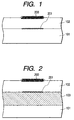
- Figs. 1 and 2 illustrate examples of the print according to the present invention.
- reference numeral 101 indicates a substrate
- 102 is a polymer resin layer formed into a film by heating a porous layer including polymer particles
- 200 is a pigment component fixed
- 201 is a dye component fixed.
- a porous layer including inorganic pigment 103 is provided between the substrate 101 and the polymer resin layer 102, in which the pigment component is fixed in the vicinity of the surface of the resin layer 102, and the dye component 201 is fixed on the porous layer including inorganic pigment 103.
- the pigment component 200 in the ink is uniformly arranged and fixed in the vicinity of the surface of the polymer resin layer 102. Therefore, the transmission of light through the image is prevented as much as possible even when printing is conducted over a wide range like solid printing, so that a print on which an image of high optical density has been formed can be obtained. Since the polymer resin layer 102 is transparent, a print also usable for OHP and the like making good use of optical transmission is provided.
- transparent polymer resin layer as used herein means a layer having a light transmittance of at least 50 %, preferably 85 % or higher.
- the dye component is fixed on the substrate 101 or the porous layer including inorganic pigment 103, the optical density of image is further enhanced to achieve excellent color tone, and moreover the fading or color change characteristically occurred in the dye component can be prevented because the dye component is covered with the polymer resin layer 102.
- the polymer resin layer 102 is formed by heat-treating a porous layer including polymer particles to make it dense, a molten resin penetrates into the pigment component uniformly arranged at the same time as the densification, and the resin and pigment component strongly unite after cooling, so that the print comes to have high rub-off resistance and water fastness.
- Recording media used for providing such prints as illustrated in Figs. 1 and 2 are those illustrated in Figs. 3 and 4, respectively.
- reference numeral 104 indicates the porous layer including polymer particles to be formed into the polymer resin layer by heating.
- Reference numerals 101 and 103 are a substrate and a porous layer including inorganic pigment, respectively.
- Fig. 5 schematically illustrates the porous layer including polymer particles viewed from the ink-impact surface.
- the porous layer including polymer particles is formed in a porous matrix structure. Voids in the porous matrix structure correspond to pores.
- reference numeral 901 indicates a polymer resin particle
- 902 is a pore
- 200 is a pigment component impacted.
- the porous layer including polymer particles 104 functions as a layer that is permeated by the solvent in the ink and moreover as a pigment component-retaining layer for fixing the pigment component.
- the resin layer plays a role of "filter” that is permeated by water (solvent) in the ink, but not permeated by the pigment component.
- filter that is permeated by water (solvent) in the ink, but not permeated by the pigment component.
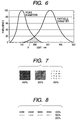
- the role as "filter” is developed by controlling the degree of overlapping between both distributions in terms of frequency distribution as illustrated in Fig. 6.
- the effect of the filter that the pigment component is successfully held and arranged, and the solvent permeates is achieved by controlling a proportion of the frequency (frequency of an area A) of the pore diameter of the porous layer including polymer particles, which overlaps the particle diameter distribution of the pigment component, to the frequency of the whole pore diameter of the porous layer including polymer particles to from 0.1 % to 10 %. If the proportion is lower than 0.1 %, the permeation of the solvent in the ink is inhibited. If the proportion is higher than 10 %, the effect for uniformly arranging the pigment component is lowered. It is more preferred that the degree of overlapping be 5 % or lower.
- the pore diameter of the porous layer including polymer particles be within a range of from 10 to 300 nm. If the pore diameter is smaller than 10 nm, the absorbing speed of the resulting recording medium cannot be enhanced. If pores of greater than 300 nm are present, the degree of overlapping with the particle diameter of the pigment component in the ink is increased, so that the effect for uniformly arranging the pigment component is lowered.
- the pores in the porous layer including polymer particles may be distributed in such a manner that their pore diameters are gradient from a surface layer portion through an intermediate layer portion to a lower layer portion.
- the pore diameter of the porous layer including polymer particles within a range of from the surface of the porous layer including polymer particles to the depth of 5 ⁇ m is controlled to 100 nm or smaller, the effect for uniformly arranging the pigment component in the vicinity of the surface of the porous layer including polymer particles is further enhanced.
- the pigment component is controlled to be present within a depth of 1 ⁇ m from the sarface, the optical density of an image formed on the resulting recording medium can be further enhanced.
- the measurement of the pore diameter distribution is conducted in accordance with the mercury intrusion porosimetry [the details are described in literature such as E. W. WASHIBURN, Proc. Natl. Acad. Sci. 7, p. 115 (1921)] after vacuum-drying a recording medium sample obtained by forming a porous layer including polymer particles on a PET film for at least 24 hours.
- the calculation of a pore diameter is conducted in accordance with the method by Barrett et al. [J. Am. Chem. Soc. 73, 373 (1951)].
- particle diameter of the pigment component substantially means a diameter of an aggregate of primary particles.
- the particle diameter distribution of the pigment component used in an ink-jet system is generally within a range of from 30 to 500 nm, preferably from 60 to 200 nm.
- the particle diameter of pigment particles is measured in accordance with the centrifugal sedimentation method.
- Such pores in the porous layer including polymer particles as described above can be obtained by optimizing the relationship among the kind and particle diameter of polymer resin particles used, drying conditions, film thickness and the like.
- particles of a thermoplastic resin are used to form the porous layer including polymer particles.
- the resin particles are used in the form of an aqueous or non-aqueous dispersion or suspension, or a colloidal solution in a solvent or water.
- Such resin particles include particles of polyester, polyethylene, polyurethane, styrene-acrylic copolymers, polyacrylic acid esters, polymethacrylic acid esters, ethylene-vinyl acetate copolymers, polystyrene and polyvinyl chloride.
- the present invention is not limited to these resins. Besides, those obtained by modifying these resins, and copolymers of these resins with other monomers may be used. These resins may be used either singly or in any combination thereof as desired.
- the form of the resin particles may be either spherical or needle. However, they are preferably in the form near a sphere in order to form a porous layer including polymer particles having more uniform pores.
- the resin particles preferably have an average particle diameter of 0.1 ⁇ m to 5.0 ⁇ m. If the average particle diameter of the resin particles is smaller than 0.1 ⁇ m, any pore having a pore diameter of 10 nm or greater cannot be obtained, so that no porous layer including polymer particles having good ink absorbency and ink permeability can be provided. Therefore, the resulting recording medium causes ink overflowing and feathering or bleeding upon printing. If the average particle diameter of the resin particles exceeds 5.0 ⁇ m, pores having a pore diameter of 300 nm or greater come to exist in plenty in the resulting porous layer including polymer particles.
- the average particle diameter of the resin particles is more preferably within a range of from 0.2 ⁇ m to 3.0 ⁇ m.
- the minimum film-forming temperature of the resin particles is preferably within a range of from 40°C to 150°C.
- the minimum film-forming temperature means the minimum temperature at which the resin particles can be formed into a uniform film when they are applied and heated.
- the resin particles are uniformly applied to form a porous layer including polymer particles. Therefore, it is necessary to heat and dry the coating layer under such conditions that the resin particles are fusion-bonded to one another to a degree that the coating layer has a certain film strength, so as to form a porous matrix structure.
- the porous matrix structure is such that the polymer resin particles are partially bonded to one another by heating to form a matrix structure, and voids among the particles other than the matrix are utilized to absorb an ink, and is different from the structure of the porous layer including inorganic pigment, in which inorganic particles themselves have pores, and the pores are utilized to absorb the ink. Therefore, if the minimum film-forming temperature is lower than 40°C, the resin particles tend to be formed into a dense film when they are applied and dried, so that the porosity is lost. As a result, the permeation of not only the pigment component in the ink, but also water is prevented, and so the resulting recording medium causes ink overflowing and feathering or bleeding upon printing.
- the drying temperature may be lowered.
- a solvent in the dispersion or colloidal solution coated becomes hard to be dried, so that it takes a long time to dry the coating layer.
- the minimum film-forming temperature exceeds 150°C, it is necessary to conduct a heat treatment after formation of an image at a high temperature, so that problems of decomposition, oxidation and/or coloring of the substrate, porous layer including inorganic pigment, and pigment and dye in the ink arise.
- the more preferable minimum film-forming temperature is from 50°C to 130°C.
- the thickness of the porous layer including polymer particles is preferably from 1 ⁇ m to 40 ⁇ m. If the thickness is smaller than 1 ⁇ m, such a resin film cannot fulfill the role as the ink-absorbing layer, and moreover its function of fixing the pigment component is also lowered. More specifically, the reason why a pigment component in an ink can be fixed in the present invention is as follows. When printing is conducted with the ink, the ink is first uniformly arranged in the vicinity of the surface of the porous layer including polymer particles.
- the pigment component itself more closely overlaps each other on the surface of the porous layer including polymer particles after impact of the ink, whereby the pigment component is uniformly arranged with a dense layer formed.
- the resin particles of the resin layer are not bonded to the pigment component.
- the resin particles forming the porous layer including polymer particles are melted around the pigment component uniformly arranged by heating after the printing, and bonded to the pigment component.
- the resin particles are not enough to be bonded to the pigment component if the thickness of the porous layer including polymer particles is not sufficient, so that an unfixed pigment component remains.
- the viscosity of the resin particles is lowered by the heating, so that the resin particles penetrate in a molten state into voids defined among the particles of the pigment component arranged to fulfill the role of a binder to bond the particles of the pigment component to each other.
- the molten resin particles are allowed to penetrate into the voids of the pigment component in the ink sufficiently and to cover further the surface of the pigment component suggiciently, by forming the porous layer including polymer particles in a sufficient thickness.
- the effects of the resin layer on light fastness and ozone fastness are also reduced if the thickness is too thin.
- the resin layer is too thick, it may crack in some cases upon drying, so that its strength is lowered, and the evenness of the coating film is impaired. As a result, the transparency thereof, and the brightness of an image formed on the resulting recording medium are also lowered.
- the thickness of the porous layer including polymer particles is more preferably from 3 ⁇ m to 30 ⁇ m.
- the heat treatment for making the porous layer including polymer particles dense is carried out in a hot-air drying oven or infrared drying oven, or on a hot plate, which is commonly used. These devices may be used in combination.
- the heating may be conducted from the front side, back side or both sides of a print. Pressing may be used in combination with the heat treatment. At this time, the melting by the heat treatment is facilitated by the pressing. Therefore, the densification of the resin layer is accelerated, so that the treatment can be conducted in a shorter period of time.
- a coated substrate is passed through heated rolls used in lamination and the like and then through cooling rolls to complete the heat treatment. When the surface of each roll is planished, a smoother surface may be provided. When the surface of each roll is roughened on the other hand, a matted surface may also be provided.
- the concentration of the polymer resin particles in a coating formulation may be suitably used in a concentration of 5 to 50 % by weight.
- a small amount of a polymer component functioning as a binder may be added to the polymer resin particles.
- the coating method of the polymer resin particles may be conducted by a roll coater, air knife coater, blade coater, bar coater, gravure coater, rod coater or the like.
- the drying is conducted at a temperature lower than the minimum film-forming temperature of the polymer resin particles by a hot-air drying oven, infrared drying oven or the like commonly used, or any combination thereof.
- substrate 101 used No particular limitation is imposed on the substrate 101 used, and various kinds of substrates may be used.
- substrates include paper webs such as suitably sized paper, water leaf paper and resin-coated paper, resin films or sheets, cloths, glass and metals.
- the resin films or sheets may be used transparent films or sheets composed of polyester, polystyrene, polyvinyl chloride, polymethyl methacrylate, cellulose acetate, polyethylene or polycarbonate, as well as opaque films or sheets opacified by the filling of an alumina hydrate, titanium white or the like, or the formation of minute foams.
- the resulting recording medium can also be used as a sheet for OHP (overhead projector) or in the formation of medical images as an X-ray film or the like.
- OHP overhead projector
- the resulting recording medium can also be used in a field of photographic images like photoprints.
- various kinds of color pigments may be contained in a substrate to make it translucent or colored, thereby controlling the color tone of the whole image.
- the substrate may be subjected to a surface treatment such as a corona discharge treatment for improving its adhesiveness to the ink-receiving layer, or provided with an easy-adhesive layer as an undercoat.
- a curl-preventing layer such as a resin layer or a pigment layer for preventing curling may be provided on the back surface of the substrate or at a desired position thereof.
- the thickness of the substrate is preferably from 5 ⁇ m to 500 ⁇ m.
- the thickness of the substrate may be suitably selected as necessary for the end application intended.
- a recording medium capable of realizing higher image density and higher gradation
- a recording medium comprising a substrate 101, and a porous layer including inorganic pigment 103 and a porous layer including polymer particles 104 successively formed on the substrate 101 as illustrated in Figs. 2 and 4.
- the recording medium illustrated in Fig. 4 is used in the present invention, high absorbing ability is achieved because the relationship between the absorbing capacity and absorbing speed of the porous layer including polymer particles 104 and the porous layer including inorganic pigment 103 is optimized.
- the recording medium can also be used in printing by a printer from which a great amount of an ink is ejected. Therefore, an image high in optical density of image and gradation can be provided.
- the absorbing capacity of the porous layer including inorganic pigment 103 of a lower layer is made greater than that of the porous layer including polymer particles 104 of an upper layer, whereby most of a solvent is absorbed in the porous layer including inorganic pigment 103, so that the solvent is prevented from running in lateral directions in the porous layer including polymer particles 104.
- a dot diameter of the ink impacted can be optimized by adjusting the balance of ink absorption among all the layers in such a manner, so that the high optical density of image obtained by the pigment component can be secured without any impairment.
- the absorbing speed of the porous layer including polymer particles 104 of the upper layer is made higher than that of the porous layer including inorganic pigment 103 of the lower layer, whereby the solvent in the ink impacted can be transferred to the lower layer immediately after printing, so that a possibility of feathering at the surface can be further reduced, and an image higher in resolution can be formed.
- the porous layer including inorganic pigment 103 functions as an absorbing layer for the solvent component in the ink and moreover as a fixing layer for a dye component when the ink contains the dye component, and assumes most of the ink absorption by the whole ink-absorbing layer of the recording medium. Therefore, it is desirable to have a great ink-absorbing capacity in particular.
- the average pore diameter of the porous layer including inorganic pigment be 20 nm or smaller, and any pore exceeding 20 nm be substantially not present. If the average pore diameter exceeds 20 nm, light scattering occurs on the resulting porous layer including inorganic pigment, so that the transparency of the recording medium is impaired, and moreover an image formed thereon by printing becomes whity. Therefore, such a great average pore diameter is not preferred.
- the pore diameter distribution is determined by the nitrogen adsorption and desorption method.
- the total pore volume of the porous layer including inorganic pigment be within a range of from 0.1 to 1.0 cc/g, preferably from 0.4 to 0.6 cc/g. If the pore volume of the porous layer including inorganic pigment is greater than the upper limit of the above range, cracking and dusting tend to occur upon the formation of porous layer including inorganic pigment. If the pore volume is smaller than the lower limit of the above range, the porous layer including inorganic pigment becomes poor in ink absorption. It is also desirable that the pore volume per unit area of the porous layer including inorganic pigment be at least 8 cc/m 2 .
- the BET specific surface area of the porous layer including inorganic pigment is preferably within a range of from 20 to 450 m 2 /g. If the BET specific surface area is to small, the haze degree of the porous layer including inorganic pigment increases, so that an image formed thereon tends to wear a white haze. If the BET specific surface area is too great on the other hand, the porous layer including inorganic pigment tends to crack.
- the porous layer including inorganic pigment is desirably formed on the substrate as a layer composed of inorganic pigment particles bound by a binder.
- the inorganic pigment particles are preferably porous particles.
- the particle diameter thereof is preferably from 20 to 500 nm.
- the resulting porous layer including inorganic pigment may tend to crack in some cases.
- particles having a particle diameter greater than the upper limit of the above range are used on the other than, light scattering occurs on the resulting porous layer including inorganic pigment, so that the haze degree thereof increases, and an image formed thereon becomes whity as a whole.
- the inorganic pigment examples include calcium carbonate, kaolin, talc, calcium sulfate, barium sulfate, titania, zinc oxide, zinc carbonate, aluminum silicate, alumina hydrate, silicic acid, sodium silicate, magnesium silicate, calcium silicate and silica. These pigments may be used either singly or in any combination thereof.
- Examples of a pigment preferably used from the viewpoints of ink absorbency and resolution in particular include silica and alumina hydrate.
- silica there may be used any of natural silica, synthetic silica, amorphous silica and chemically modified silica compounds. However, silica having a positive charge is particularly preferred.
- the alumina hydrate Since the alumina hydrate has a positive charge, a dye in an ink is well fixed thereto, and an image high in gloss and good in coloring can hence be provided.
- an ink-receiving layer comprising such an alumina hydrate has a low haze degree and high transparency compared with ink-receiving layers using another pigment. Therefore, the alumina hydrate is more preferred as a pigment used for the porous layer including inorganic pigment.
- the alumina hydrate used in the present invention is represented by the general formula Al 2 O 3-n (OH) 2n ⁇ mH 2 O wherein n is an integer of 0, 1, 2 or 3, and m is a number of 0 to 10, preferably 0 to 5.
- n is an integer of 0, 1, 2 or 3
- m is a number of 0 to 10, preferably 0 to 5.
- mH 2 O represents an aqueous phase which does not participate in the formation of a crystal lattice, but is able to be eliminated. Therefore, m may take a value other than an integer.
- m may take a value of 0 when this kind of alumina hydrate is calcinated.
- an alumina hydrate useful in the practice of the present invention may preferably be used an alumina hydrate described in Japanese Patent Application Laid-Open Nos. 5-125437, 5-125438, 5-125439 or 6-114571.
- the pore properties of the alumina hydrate are adjusted in the course of its production.
- an alumina hydrate the pore volume of which is within a range of from 0.1 to 1.0 ml/g. If the pore volume of the alumina hydrate is outside the above range, it is difficult to adjust the pore volume of the porous layer including inorganic pigment within the above-specified range.
- An alumina hydrate having a BET specific surface area within a range of from 40 to 500 m 2 /g is preferably used. If the BET specific surface area of the alumina hydrate is outside the above range, it is difficult to adjust the BET specific surface area of the porous layer including inorganic pigment within the above-specified range.
- a binder used in combination with the above pigment is preferably a water-soluble or water-dispersible polymer.
- Preferable examples thereof include polyvinyl alcohol or modified products thereof (cationically modified, anionically modified, silanol modified), starch or modified products thereof (oxidized, etherified), gelatin or modified products thereof, casein or modified products thereof, gum arabic, cellulose derivatives such as carboxymethyl cellulose, hydroxyethyl cellulose and hydroxypropylmethyl cellulose, conjugated diene copolymer latexes such as SBR latexes, NBR latexes and methyl methacrylate-butadiene copolymers, functional group- modified polymer latexes, vinyl copolymer latexes such as ethylene-vinyl acetate copolymers, polyvinyl pyrrolidone, maleic anhydride polymers or copolymers thereof, and acrylic ester copolymers. These binders may be used either singly or in any combination thereof.
- the mixing ratio of the pigment to the binder may be optionally selected from a range of from 1:1 to 30:1, preferably from 5:1 to 25:1 so far as the BET specific surface area and pore volume of the resulting porous layer including inorganic pigment satisfy the above ranges, respectively. If the amount of the binder is less than the lower limit of the above range, the mechanical strength of the resulting porous layer including inorganic pigment becomes insufficient, which forms the cause of cracking and dusting. If the amount is greater than the upper limit of the above range, the pore volume of the resulting porous layer including inorganic pigment is reduced, resulting in a recording medium poor in ink absorbency.
- a coating formulation is obtained by using the above-described inorganic pigment and binder. This coating formulation is applied to a substrate, whereby the porous layer including inorganic pigment can be formed.
- the coating formulation itself preferably has a pH of 3 to 7.
- the porous layer including inorganic pigment is formed using a coating formulation having a pH lower than 3, the ink applied to the porous layer including inorganic pigment may tend to undergo color change in some cases.
- the pH is higher than 7 on the other hand, the coating formulation tends to increase its viscosity, and so its stability with time may be deteriorated in some cases.
- a dispersing agent such as sodium sulfate, sodium EDTA, sodium metabisulfite, sodium metabisulfite, sodium metabisulfite, sodium metabisulfite, sodium metabisulfite, sodium metabisulfite, sodium metabisulfite, sodium metabisulfite, sodium metabisulfite, sodium metabisulfite, sodium metabisulfite, sodium metabisulfite, sodium metabisulfite, sodium metabisulfite, sodium metabisulfite, sodium metabisulfite, sodium metabisulfite, sodium metabisulfite, sodium metabisulfite, sodium metabisulfite, sodium metabisulfite, sodium metabisulfite, sodium metabisulfite, sodium metabisulfite, sodium metabisulfite, sodium metabisulfite, sodium metabisulfite, sodium metabisulfite, sodium metabisulfite, sodium metabisulfite, sodium metabisulfite, sodium metabisulfite, sodium metabisulfite
- the coating formulation on the substrate may be applied by a coating process using, for example, a blade coating system, air-knife coating system, roll coating system, brush coating system, gravure coating system, kiss coating system, die coating system, extrusion system, slide bead (slide hopper) system, curtain coating system or spray coating system.
- a blade coating system air-knife coating system
- roll coating system brush coating system
- gravure coating system kiss coating system
- die coating system die coating system
- extrusion system extrusion system
- slide bead (slide hopper) system curtain coating system or spray coating system.
- the coating weight of the coating formulation on the substrate may be suitably selected as necessary for the end application intended. If the coating film is too thin, the resulting porous layer including inorganic pigment fails to sufficiently absorb an ink applied, so that feathering or bleeding occurs on the porous layer including polymer particles of the upper layer. Therefore, such a too thin coating film is not preferred. If the coating film is too thick on the other hand, the strength of the resulting porous layer including inorganic pigment is lowered, and a defective coating film is formed upon applying or drying, so that portions incapable of securing a sufficient ink-absorbing capacity are partially formed in the resulting porous layer.
- the thickness of the porous layer including inorganic pigment is preferably within a range of from 5 to 50 ⁇ m.
- the coating layer provided on the substrate is subjected to a drying treatment by heating as needed, thereby obtaining the porous layer including inorganic pigment.
- the aqueous medium (dispersing medium) is evaporated by the drying treatment, and at the same time a film is formed by crosslinking or fusion bonding between the alumina hydrate particles and the binder.
- the conditions of the drying treatment may be suitably determined according to the composition of the coating formulation used.
- the drying is conducted by a hot-air drying oven, infrared drying oven or the like commonly used, or any combination thereof.
- the amount of a pigment component contained in the pigment inks used in the present invention is preferably within a range of from 0.1 to 20 % by weight, more preferably from 1 to 12 % by weight based on the total weight of the ink.
- Any pigment may be used in the present invention.
- carbon black used in a black ink may be mentioned those produced in accordance with the furnace process or channel process and having such properties that the primary particle diameter is from 15 to 40 nm, the specific surface area is from 50 to 300 m 2 /g as measured by the BET method, the oil absorption is from 40 to 150 ml/100 g as determined by using DBP, the volatile matter is from 0.5 to 10 %, and the pH is from 2 to 9.
- Examples of commercially-available carbon black having such properties include No. 2300, No. 900, MCF88, No. 33, No. 40, No. 45, No. 52, MA7, MA8 and No. 2200B (all, products of Mitsubishi Chemical Industries Limited), RAVEN 1255 (product of Columbian Carbon Japan Limited), REGAL 400R, REGAL 330, REGAL 660R and MOGUL L (all, products of Cabot Company), and Color Black FW1, Color Black FW18, Color Black S170, Color Black S150, Printex 35 and Printex U (all, products of Degussa AG).
- pigments used in yellow, magenta and cyan inks may be mentioned C.I. Pigment Yellow 1, C.I.
- Pigment Yellow 2 C.I. Pigment Yellow 3, C.I. Pigment Yellow 13, C.I. Pigment Yellow 16, C.I. Pigment Yellow 74 and C.I. Pigment Yellow 83, C.I. Pigment Yellow 142; C.I. Pigment Red 5, C.I. Pigment Red 7, C.I. Pigment Red 12, C.I. Pigment Red 48(Ca), C.I. Pigment Red 48(Mn), C.I. Pigment Red 57(Ca), C.I. Pigment Red 112 and C.I. Pigment Red 122; and C.I. Pigment Blue 1, C.I. Pigment Blue 2, C.I. Pigment Blue 3, C.I. Pigment Blue 15, C.I. Pigment Blue 15:3, C.I.
- Pigment Blue 16 C.I. Pigment Blue 22, C.I. Pigment Blue 199, C.I. Vat Blue 4 and C.I. Vat Blue 6, respectively.
- the pigments are not limited to these pigments. Those newly prepared for the practice of the present invention may also be used in addition to the above pigments.
- a dispersing agent may be added.
- the dispersing agent include nonionic surfactants, anionic surfactants and water-soluble resins.
- any dispersing agent may not be added.
- the inks used in the present invention be adjusted to neutrality or alkalinity as a whole because the solubility of the water-soluble resin used as the dispersing agent is enhanced, so that the ink can be provided as an ink far excellent in long-term storability.
- the pH be adjusted to a range of from 7 to 10 because too high alkalinity forms the cause that various parts used in an ink-jet recording apparatus may be corroded.
- the pigment and the water-soluble resin as a dispersing agent as described above are dispersed or dissolved in a liquid medium.
- An aqueous medium suitable for the inks used in the present invention is a mixed solvent of water and a water-soluble organic solvent.
- water it is preferred to use ion-exchanged water such as deionized water, not tap water containing various ions.
- alkyl alcohols having 1 to 4 carbon atoms such as methyl alcohol, ethyl alcohol, n-propyl alcohol, isopropyl alcohol, n-butyl alcohol, sec-butyl alcohol and tert-butyl alcohol; amides such as dimethylformamide and dimethylacetamide; ketones and ketone alcohols such as acetone and diacetone alcohol; ethers such as tetrahydrofuran and dioxane; polyalkylene glycols such as polyethylene glycol and polypropylene glycol; alkylene glycols the alkylene moiety of which has 2 to 6 carbon atoms, such as ethylene glycol, propylene glycol, butylene glycol, triethylene glycol, thiodiglycol, hexylene glycol and diethylene glycol; 1,2,6-hexanetriol; glycerol; lower alkyl ethers of polyhydr
- the content of the water-soluble organic solvent in the ink used in the present invention is generally within a range of from 3 to 50 % by weight, preferably from 3 to 40 % by weight based on the total weight of the ink, while the content of water used is within a range of from 10 to 90 % by weight, preferably from 30 to 80 % by weight based on the total weight of the ink.
- the inks used in the present invention are prepared in the following manner.
- a pigment and a dispersing agent if needed are first added to an aqueous solution comprising a water-soluble organic solvent and water, and the mixture is stirred.
- a dispersion treatment is then conducted in accordance with a dispersing technique described below, and as needed, a centrifugation is carried out to obtain a desired dispersion.
- Compounds used in the present invention, or such components as mentioned above are then added to the dispersion. The resultant mixture is stirred to prepare an ink.
- premixing for at least 30 minutes before the aqueous solution containing the pigment is subjected to the dispersion treatment.
- This premixing operation serves to improve the wettability of the surface of the pigment and facilitate adsorption of a resin on the pigment surface when a water-soluble resin is contained.
- Any dispersing machine commonly used may be employed as a dispersing machine used in the present invention.
- a dispersing machine used in the present invention may be mentioned ball mills, roll mills and sand mills. Of these mills, a high-speed sand mill is preferred. Specific examples thereof include Super Mill, Sand Grinder, Beads Mill, Agitator Mill, Grain Mill, Dyno Mill, Pearl Mill and Coball Mill (all, trade names).
- a pigment having a desired particle diameter distribution may be mentioned techniques in which the size of a grinding medium in a dispersing machine is made smaller, in which the packing rate of a grinding medium is made higher, in which processing time is made longer, in which discharging rate is made lower, and in which classification is conducted by filter, centrifugal separator or the like after grinding. Any combination thereof may also be included.
- the dye optionally contained in the inks in the present invention may be any of the known water-soluble dyes typified by direct dyes, acid dyes, basic dyes, reactive dyes and food colors.
- direct dyes such as C.I. Direct Black 17, 19, 32, 51, 71, 108 and 146, C.I. Direct Blue 6, 22, 25, 71, 86, 90, 106 and 199, C.I. Direct Red 1, 4, 17, 28 and 83, and C.I. Direct Yellow 12, 24, 26, 86, 98 and 142
- acid dyes such as C.I. Acid Black 2, 7, 24, 26, 31, 52, 63, 112 and 118, C.I.
- the above-mentioned dyes are examples of dyes particularly preferred for the inks applicable to the recording method of the present invention.
- the dyes for the inks used in the present invention are not limited to these dyes.
- the content of these dyes in the inks is preferably within a range of from 0.5 to 4.0 % by weight.
- a transparent PET film (100Q80D, trade name, product of Toray Industries, Inc., transmittance: 88.74 %) having a thickness of 100 ⁇ m was used as a substrate.
- a coating dispersion was prepared in accordance with the following process. Aluminum dodeoxide was first hydrolyzed to prepare an alumina slurry. Water was added to the alumina slurry until the solids content of alumina hydrate reached 7.9 %. After a 3.9 % nitric acid solution was then added to this slurry to adjust the pH of the slurry, the slurry was aged to obtain colloidal sol.
- This colloidal sol was spray-dried at 75°C to obtain an alumina hydrate.
- the alumina hydrate was dispersed in ion-exchanged water to prepare a 15 % aqueous dispersion.
- Polyvinyl alcohol (Gohsenol NH18, trade name, product of The Nippon Synthetic Chemical Industry Co., Ltd.) was then dissolved in ion-exchanged water to obtain a 10 % aqueous solution.
- the alumina hydrate dispersion and the polyvinyl alcohol solution were mixed so as to give a mixing ratio of 10:1 by weight, and the resultant mixture was stirred to prepare a coating dispersion.
- This coating dispersion was die-coated on the substrate using a coater and an hot-air drying oven and then dried (drying temperature: 140°C), thereby forming a porous layer including inorganic pigment having a thickness of 35 ⁇ m.
- the pore diameter of the coating layer was 8 to 18 nm.
- a porous layer including polymer particles was then formed in the following manner.
- a coating formulation composed of an aqueous dispersion of a polyester resin (average particle diameter of resin in emulsion: 1.0 ⁇ m; minimum film-forming temperature: 100°C; glass transition temperature: 57°C; solids concentration: 30.0%) was die-coated on the porous layer including inorganic pigment using a coater and an hot-air drying oven and then dried (drying temperature: 60°C) to form a porous layer including polymer particles having a thickness of 18 ⁇ m, thereby obtaining a recording medium.
- the pore diameter of the coating layer was 30 to 100 nm.
- a solid pattern illustrated in Fig. 7 and a linear pattern illustrated in Fig. 8 were printed on the recording medium thus obtained by means of an ink-jet printer equipped with a feeding mechanism.
- an ink-jet printer was used an experimental printer equipped with 4 heads each having 64 nozzles the orifice diameter of which was 40 ⁇ 40 ⁇ m. The printing was conducted at densities of 200 %, 300 % and 400 %.
- An ink used was a black single-color pigment ink having the following composition.
- the aggregate of primary particles of carbon black of the pigment had a particle diameter of 50 to 250 nm.
- Dispersion of carbon black (MCF88, trade name, product of Mitsubishi Chemical Industries Limited) 20 parts Diethylene glycol 5 parts Glycerol 1 part Ion-exchanged water 68 parts Isopropyl alcohol 1 part.
- the degree of overlapping between the pore diameter distribution of the porous layer including polymer particles and the particle diameter distribution of the pigment component was 4.3 %.
- the recording medium printed was placed in a hot-air drying oven and held at 140°C for 1 minute to heat-fix the pigment in the ink, thereby obtaining a print.
- the corners of the recording medium were held by a holding jig to prevent the print from curling.
- the print was cooled to room temperature and taken out of the jig.
- the recording medium and print were evaluated as to the following items (1) to (7).
- the evaluation results are shown in Table 1.
- the test samples were judged to be accepted in the case that there is no rank C in all the evaluation items.
- the printed area of a fixed print sample was visually observed to confirm whether feathering and beading occurred.
- the absorbing ability of the recording medium sample was evaluated in accordance with the following standard:
- the printed area of a fixed print sample was rubbed with a cloth soaked with water, and the ink-fixing ability of the recording medium sample was evaluated in accordance with the following standard:
- the optical density of image (in a single-color ink quantity of 400 %) of the printed area of a fixed print sample was measured from the printed side by means of a Macbeth densitometer RD-918.
- a fixed print sample was projected by a illuminated photo display case (Schaukasten) for film projection to visually observe the projected image.
- the resolution of the print image was evaluated in accordance with the following standard:
- a fixed print sample was placed in an environmental tester capable of holding at a temperature of 45°C and a relative humidity of 95 % and left to stand for 240 hours, and then the sample was taken out and observed as to print quality and the degree of color change (fading).
- the storage stability of the print sample was evaluated in accordance with the following standard:
- a fixed print sample was left to stand indoors for 3 months to observe the degree of color change (fading).
- the storage stability of the print sample was evaluated in accordance with the following standard:
- a recording medium was obtained in exactly the same manner as in Example 1 except that the porous layer including polymer particles was not provided as the upper layer. Printing was continuously conducted on this recording medium by the same ink-jet printer as that used in Example 1, and the ink applied was dried to obtain a print. The recording medium and print were evaluated as to the items (1) to (7) in the same manner as in Example 1. The evaluation results are shown in Table 1.
- a recording medium was obtained in exactly the same manner as in Example 1 except that the degree of overlapping between the pore diameter distribution of the porous layer including polymer particles as an upper layer and the particle diameter distribution of the pigment component in the ink was greater.
- the average particle diameter of the polyester resin used in the coating formulation for the porous layer including polymer particles of the upper layer was controlled to 6 ⁇ m.
- the drying temperature and the thickness of the resin layer were controlled to 60°C and 18 ⁇ m, respectively.
- the pore diameter of the porous layer including polymer particles was from 120 to 360 nm, and the degree of overlapping between the pore diameter distribution of the porous layer including polymer particles and the particle diameter distribution of the pigment component was 58 %.
- Example 1 Printing was continuously conducted on this recording medium by the same ink-jet printer as that used in Example 1, and the heat fixing was conducted in the same manner as in Example 1 to obtain a print.
- the recording medium and print were evaluated as to the items (1) to (7) in the same manner as in Example 1. The evaluation results are shown in Table 1.
- a recording medium was obtained in exactly the same manner as in Example 1 except that the upper layer was changed to a porous layer including inorganic pigment.
- a silica gel layer was formed as the porous layer including inorganic pigment.
- the coating formulation was die-coated on the lower layer by a coater, and then dried at 140°C to provide the silica gel layer having a thickness of 10 ⁇ m as the upper layer, thereby obtaining a recording medium.
- the pore diameter of the coating layer was from 5 to 15 nm.
- Printing was continuously conducted on this recording medium by the same ink-jet printer as that used in Example 1, and the ink applied was dried to obtain a print.
- the recording medium and print were evaluated as to the items (1) to (7) in the same manner as in Example 1. The evaluation results are shown in Table 1.
- a recording medium was obtained in exactly the same manner as in Example 1 except that the upper layer was changed to a water-soluble resin layer.
- a 10 % aqueous solution of polyvinyl pyrrolidone (PVP K15, trade name, product of Gokyo Trading Co., Ltd.) was used as a coating formulation for forming the water-soluble resin layer.
- This coating formulation was die-coated on the lower layer at 80°C by a coater, and then heat- treated at 140°C to provide a polyvinyl pyrrolidone layer having a thickness of 5 ⁇ m as the upper layer, thereby obtaining a recording medium.
- a recording medium was obtained in exactly the same manner as in Example 1 except that the porous layer including polymer particles as an upper layer was changed to a layer composed of a polyurethane resin.
- an aqueous dispersion of a polyurethane resin (average particle diameter of resin in emulsion: 0.8 ⁇ m; minimum film-forming temperature: 110°C; glass transition temperature: 53°C; solids concentration: 30.0%) was used as a coating formulation for obtaining the porous layer including polymer particles of the upper layer.
- the drying temperature and the thickness of the resin layer were controlled to 60°C and 18 ⁇ m, respectively.
- the pore diameter of the porous layer including polymer particles was from 36 to 112 nm, and the degree of overlapping between the pore diameter distribution of the porous layer including polymer particles and the particle diameter distribution of the pigment component was 5.2 %.
- Printing was continuously conducted on this recording medium by the same ink-jet printer as that used in Example 1, and the heat fixing was conducted in the same manner as in Example 1 to obtain a print.
- the recording medium and print were evaluated as to the items (1) to (7) in the same manner as in Example 1. The evaluation results are shown in Table 2.
- a recording medium was obtained in exactly the same manner as in Example 1 except that the porous layer including polymer particles as an upper layer was changed to a layer composed of a styrene-acrylic copolymer resin.
- an aqueous dispersion of a styrene-acrylic copolymer resin (average particle diameter of resin emulsion: 1.2 ⁇ m; minimum film-forming temperature: 109°C; glass transition temperature: 53°C; solids concentration: 30.0%) was used as a coating formulation for obtaining the porous layer including polymer particles as an upper layer.
- the drying temperature and the thickness of the resin layer were controlled to 60°C and 18 ⁇ m, respectively.
- the pore diameter of the porous layer including polymer particles was from 41 to 124 nm, and the degree of overlapping between the pore diameter distribution of the porous layer including polymer particles and the particle diameter distribution of the pigment component was 6.4 %.
- Printing was continuously conducted on this recording medium by the same ink-jet printer as that used in Example 1, and the heat fixing was conducted in the same manner as in Example 1 to obtain a print.
- the recording medium and print were evaluated as to the items (1) to (7) in the same manner as in Example 1. The evaluation results are shown in Table 2.
- a recording medium was obtained in exactly the same manner as in Example 1 except that the porous inorganic particle resin layer as a lower layer was changed to a porous silica gel layer, and colloidal silica (Adelite CT-100, trade name, product of Asahi Denka Kogyo K.K.) was used as inorganic particles.
- the thickness and pore diameter of the inorganic particle layer as a lower layer was 30 ⁇ m, and from 6 to 24 nm, respectively.
- a polyester resin layer having a thickness of 18 ⁇ m was formed in the same manner as in Example 1 to obtain a recording medium. Printing by the ink-jet printer and the heat fixing were conducted in the same manner as in Example 1 to obtain a print.
- the recording medium and print were evaluated as to the items (1) to (7) in the same manner as in Example 1. The evaluation results are shown in Table 2.
- a recording medium was obtained in exactly the same manner as in Example 1 except that the layer structure was changed to a structure that a polyester layer was formed directly on a substrate without providing any lower layer.
- the thickness of the polyester layer was controlled to 40 ⁇ m.
- the pore diameter of the porous layer including polymer particles was within a range of from 30 to 96 nm, and the degree of overlapping between the pore diameter distribution of the porous layer including polymer particles and the particle diameter distribution of the pigment component was 4.6 %.
- Printing by the ink-jet printer and the heat fixing were conducted in the same manner as in Example 1 to obtain a print.
- the recording medium and print were evaluated as to the items (1) to (7) in the same manner as in Example 1. The evaluation results are shown in Table 2.
- Example 2 An experiment was conducted in the same manner as in Example 1 except that a pigment- and dye-containing ink prepared by adding a dye component as a shading material to the pigment ink used in Example 1 was used. A porous alumina layer as a lower layer and a polyester resin layer as an upper layer were formed in the same manner as in Example 1 to obtain a recording medium.
- the ink used was an ink containing 1.0 % of C.I. Food Black 2 as a dye component. Printing by the ink-jet printer and the heat fixing were conducted in the same manner as in Example 1 to obtain a print.
- the recording medium and print were evaluated as to the items (1) to (7) in the same manner as in Example 1. The evaluation results are shown in Table 2.
- Example 2 An experiment was conducted in the same manner as in Example 1 except that the pigment ink was changed to inks of yellow, magenta and cyan colors.
- a porous alumina layer as a lower layer and a polyester resin layer as an upper layer were formed in the same manner as in Example 1 to obtain a recording medium.
- C.I. Pigment Yellow 74, C.I. Pigment Blue 15 and C.I. Pigment Red 112 were used as pigment components to prepare the respective pigment inks.
- the aggregate of primary particles of each pigment had a particle diameter within a range of from 50 to 300 nm, and the degree of overlapping between the pore diameter distribution of the porous layer including polymer particles and the particle diameter distribution of the pigment component was 5.3 %.
- Example 1 Printing by the ink-jet printer and the heat fixing were conducted in the same manner as in Example 1 to obtain a print.
- the recording medium and print were evaluated as to the items (1) to (7) in the same manner as in Example 1. As a result, the recording medium was judged to be accepted like that of Example 1.
- a recording medium was obtained by forming a porous alumina layer as a lower layer and a polyester resin layer as an upper layer in exactly the same manner as in Example 1 except that the substrate was changed to a white polyester film (Lumirror, trade name, product of Toray Industries, Inc.) having a thickness of 100 ⁇ m. Printing by the ink-jet printer and the heat fixing were then conducted in the same manner as in Example 1 to obtain a print. The recording medium and print were evaluated as to the items (1) to (7) in the same manner as in Example 1. Incidentally, the evaluation as to (4) the image density was conducted by means of a Macbeth reflection densitometer RD-1255. As a result, the recording medium was judged to be accepted like that of Example 1.
- porous layer including polymer particless different in pore diameter distribution from one another were formed with the average particle diameter of emulsion resin particles forming the upper layer varied from 0.05 ⁇ m to 10.0 ⁇ m.
- Recording media were obtained by forming a porous alumina layer as a lower layer and an upper layer using an emulsion of a polyester resin having its corresponding particle diameter shown in Table 3 in the same manner as in Example 1 except for the above-described conditions. Printing by the ink-jet printer and the heat fixing were then conducted in the same manner as in Example 1 to obtain prints. The recording media and prints were evaluated as to the items (1) to (7) in the same manner as in Example 1. The evaluation results are shown in Table 3.
- a porous layer including polymer particles as an upper layer was formed with a coating formulation composed of a mixture of two resins A and B in emulsions different in the average particle diameter of emulsion resin particles forming the upper layer from each other.
- a recording medium was obtained by forming a porous alumina layer as a lower layer and a porous layer including polymer particles as an upper layer in the same manner as in Example 1 except for the above-described conditions.
- the average particle diameters of a polyester resin A in emulsion and a polyester resin B in emulsion were 2.5 ⁇ m and 0.2 ⁇ m, respectively. These resin emulsions were mixed at a ratio of 5:1.
- the glass transition temperatures of the polyester resins in emulsions were both 57°C, and the minimum film-forming temperature after the mixing was 100°C.
- the pore diameter of the resultant porous layer including polymer particles was within a range of from 26 to 121 nm, and the degree of overlapping between the pore diameter distribution of the porous layer including polymer particles and the particle diameter distribution of the pigment component was 6.1 %.
- Example 1 Printing by the ink-jet printer and the heat fixing were then conducted in the same manner as in Example 1 to obtain a print.
- the recording medium and print were evaluated as to the items (1) to (7) in the same manner as in Example 1. As a result, the recording medium was judged to be accepted like that of Example 1.
- Example 2 An experiment was conducted in the same manner as in Example 1 except that in the heat fixing, a pressing treatment was conducted in addition to the heat treatment.
- a heated-roll laminator was used in the heat fixing.
- the surfaces of both rolls were smoothed, whereby the smoothness of the printed surface of the resulting print was enhanced.
- the surfaces of both rolls were matte-finished with a pitch of 0.5 ⁇ m and a depth of 0.5 ⁇ m, whereby a print having a low-reflective printed surface was obtained.
- the recording medium and print were evaluated as to the items (1) to (7) in the same manner as in Example 1. As a result, the recording medium was judged to be accepted like that of Example 1. Evaluation item Ex. 1 Comp. Ex. 1 Comp. Ex. 2 Comp.
- the porous layer including polymer particles is formed on a substrate, or the porous layer including polymer particles is formed after a porous layer including inorganic pigment is formed as needed, so as to control the degree of overlapping between the pore diameter distribution of the porous layer including polymer particles and the particle diameter distribution of a pigment component in a pigment ink, whereby the pigment component is arranged in the vicinity of the surface of the porous layer including polymer particles when printing is conducted with the pigment ink, and so a print having a high optical density of image and excellent resolution can be provided.
- the porous layer including polymer particles is heated to make it dense and transparent, whereby the pigment ink is reliably fixed, and so the rub-off resistance and water fastness of an image formed can be enhanced. Further, when printing is conducted with an ink containing both pigment component and dye component, both components can be uniformly arranged and fixed. Therefore, the present invention provides a print having good color tone and storage stability.
- an ink-jet recording method in which recording is conducted with an ink comprising a pigment component on a recording medium comprising a substrate and a porous layer including polymer particles provided thereon, the method comprising, in the case where the pore diameter distribution of the porous layer including polymer particles and the particle diameter distribution of the pigment component are both expressed in terms of frequency distribution, the steps of forming an image upon controlling a proportion of the frequency of the pore diameter of the porous layer including polymer particles, which overlaps the particle diameter distribution of the pigment component, to the frequency of the whole pore diameter of the porous layer including polymer particles to from 0.1 % to 10 % ; and heat-treating the porous layer including polymer particles after the formation of the image.
Landscapes
- Chemical & Material Sciences (AREA)
- Life Sciences & Earth Sciences (AREA)
- Engineering & Computer Science (AREA)
- Materials Engineering (AREA)
- Wood Science & Technology (AREA)
- Organic Chemistry (AREA)
- Ink Jet Recording Methods And Recording Media Thereof (AREA)
- Ink Jet (AREA)
Applications Claiming Priority (3)
| Application Number | Priority Date | Filing Date | Title |
|---|---|---|---|
| JP27873097 | 1997-10-13 | ||
| JP278730/97 | 1997-10-13 | ||
| JP27873097 | 1997-10-13 |
Publications (2)
| Publication Number | Publication Date |
|---|---|
| EP0908324A1 true EP0908324A1 (fr) | 1999-04-14 |
| EP0908324B1 EP0908324B1 (fr) | 2003-04-16 |
Family
ID=17601411
Family Applications (1)
| Application Number | Title | Priority Date | Filing Date |
|---|---|---|---|
| EP98119245A Expired - Lifetime EP0908324B1 (fr) | 1997-10-13 | 1998-10-12 | Procédé d'enregistrement par jet d'encre et milieu d'enregistrement imprimé |
Country Status (3)
| Country | Link |
|---|---|
| US (1) | US6550909B2 (fr) |
| EP (1) | EP0908324B1 (fr) |
| DE (1) | DE69813437T2 (fr) |
Cited By (19)
| Publication number | Priority date | Publication date | Assignee | Title |
|---|---|---|---|---|
| EP1078775A3 (fr) * | 1999-08-04 | 2001-11-28 | Ilford Imaging UK Limited | Milieu d'enregistrement par jet d'encre et méthode d'impression |
| EP1184197A1 (fr) * | 2000-09-01 | 2002-03-06 | Konica Corporation | Appareil et méthode d'enregistrement à jet d'encre |
| EP1211088A2 (fr) * | 2000-11-29 | 2002-06-05 | Konica Corporation | Feuille pour l'enregistrement par jet d'encre, procédé d'enregistrement par jet d'encre et procédé de fabrication de la feuille |
| US6419355B1 (en) * | 2001-01-26 | 2002-07-16 | Eastman Kodak Company | Ink jet printing method |
| EP1188574A3 (fr) * | 2000-09-15 | 2002-08-28 | ILFORD Imaging Switzerland GmbH | Matériau d'enregistrement et méthode d'enregistrement |
| WO2003059638A1 (fr) * | 2002-01-16 | 2003-07-24 | Walki Wisa Oy | Support d'enregistrement et procede pour le produire |
| EP1188573A3 (fr) * | 2000-09-15 | 2003-08-13 | ILFORD Imaging Switzerland GmbH | Matériau d'enregistrement et procédé d'enregistrement |
| EP1228888A3 (fr) * | 2001-02-05 | 2003-11-19 | Hewlett-Packard Company | Document de sécurité, élément d'impression, procédé d'impression et dispositif |
| EP1182050A3 (fr) * | 2000-08-22 | 2003-11-19 | Eastman Kodak Company | Procédé d'impression par jet d'encre |
| US6686000B2 (en) | 1999-12-27 | 2004-02-03 | Canon Kabushiki Kaisha | Recording medium and image forming method |
| GB2400335A (en) * | 2003-04-08 | 2004-10-13 | Ilford Imaging Uk Ltd | Recording materials |
| EP1400366A3 (fr) * | 2002-09-20 | 2005-02-09 | Eastman Kodak Company | Ensemble poreux pour l'enregistrement par jet d'encre contenant une couche superficielle pour retenir les pigments d'encre |
| US6911239B2 (en) | 1999-08-04 | 2005-06-28 | Ilford Imaging Uk Limited | Recording material and method |
| EP1336504A3 (fr) * | 2002-02-13 | 2005-12-07 | Konica Corporation | Bande de fixation, rouleau de fixation, méthode de production de ceux-ci, dispositif de fixation et procédé de fixation des images utilisant ce dispositif |
| EP1705027A1 (fr) * | 2005-03-23 | 2006-09-27 | Fuji Photo Film B.V. | Elément d'impression |
| US7150522B2 (en) * | 2002-12-04 | 2006-12-19 | Hewlett-Packard Development Company, L.P. | Sealable topcoat for porous media |
| WO2011056178A1 (fr) * | 2009-11-06 | 2011-05-12 | Hewlett-Packard Development Company, L.P. | Matériau d'impression jet d'encre |
| WO2012030515A1 (fr) * | 2010-09-03 | 2012-03-08 | Carestream Health, Inc. | Films, compositions et procédés d'impression à jet d'encre transparente |
| CN102555466A (zh) * | 2010-12-16 | 2012-07-11 | 富士胶片株式会社 | 图像形成装置和图像形成方法 |
Families Citing this family (19)
| Publication number | Priority date | Publication date | Assignee | Title |
|---|---|---|---|---|
| JP2000198265A (ja) * | 1999-01-07 | 2000-07-18 | Canon Inc | インクジェット用画像記録媒体 |
| ATE301738T1 (de) * | 1999-08-31 | 2005-08-15 | Seiren Co Ltd | Verfahren zum bedrucken eines gewebes mit tintenstrahldruckern |
| US6979480B1 (en) * | 2000-06-09 | 2005-12-27 | 3M Innovative Properties Company | Porous inkjet receptor media |
| EP1186435A1 (fr) * | 2000-09-12 | 2002-03-13 | ZANDERS Feinpapiere AG | Matériau d'enregistrement comportant une image intégrée |
| US20030194539A1 (en) * | 2001-08-08 | 2003-10-16 | Hidenobu Ohya | Ink-jet recording medium and ink-jet image forming method using the recording medium |
| US6827772B2 (en) | 2002-05-24 | 2004-12-07 | Cabot Corporation | Carbon black and compositions containing same |
| US6783230B2 (en) * | 2002-05-28 | 2004-08-31 | Konica Corporation | Ink jet recording medium |
| US7638176B2 (en) * | 2003-06-11 | 2009-12-29 | Hewlett-Packard Development Company, L.P. | Sealable coating for ink-jet media |
| US20050191444A1 (en) | 2004-02-26 | 2005-09-01 | Eastman Kodak Company | Inkjet recording media with a fusible bead layer on a porous substrate and method |
| US20050266180A1 (en) * | 2004-05-26 | 2005-12-01 | Yubai Bi | Ink-jet recording medium for dye-or pigment-based ink-jet inks |
| US7507451B2 (en) * | 2005-03-11 | 2009-03-24 | Eastman Kodak Company | Fusible reactive media |
| JP4882248B2 (ja) * | 2005-03-14 | 2012-02-22 | コニカミノルタホールディングス株式会社 | インクジェットインク及びインクジェット記録方法 |
| US7264856B2 (en) * | 2005-03-21 | 2007-09-04 | Eastman Kodak Company | Fusible inkjet recording element and printing method |
| US7597439B2 (en) | 2005-07-01 | 2009-10-06 | Eastman Kodak Company | Inkjet print and a method of printing |
| DE602007003908D1 (de) * | 2006-08-22 | 2010-02-04 | Oce Tech Bv | Bilderzeugungsverfahren, das eine Phasenaustauschtinte auf einem selbstlaminierenden Aufzeichnungsmedium verwendet |
| JP4949297B2 (ja) * | 2008-03-12 | 2012-06-06 | 富士フイルム株式会社 | 画像記録方法、インクセット、及びインクジェット記録物 |
| US8760726B2 (en) * | 2010-06-10 | 2014-06-24 | Scodix Ltd. | High resolution digital embossing |
| US20120058272A1 (en) * | 2010-09-03 | 2012-03-08 | Simpson Sharon M | Transparent ink-jet recording films, compositions, and methods |
| EP3932686B1 (fr) * | 2020-06-30 | 2024-10-02 | Unilin, BV | Procédé de fabrication de papier ou de film imprimable à jet d' encre pour utilisation comme papier décoratif ou film |
Citations (15)
| Publication number | Priority date | Publication date | Assignee | Title |
|---|---|---|---|---|
| JPS58136482A (ja) | 1982-02-09 | 1983-08-13 | Canon Inc | インクジエツト記録法 |
| JPH0231673A (ja) | 1988-07-22 | 1990-02-01 | Eiken Chem Co Ltd | 細菌用培地 |
| JPH02276670A (ja) | 1988-12-16 | 1990-11-13 | Asahi Glass Co Ltd | 記録用シート |
| JPH04101880A (ja) | 1990-08-22 | 1992-04-03 | Nisshinbo Ind Inc | インクジェット記録用ohpシート |
| JPH06143797A (ja) * | 1992-11-09 | 1994-05-24 | Mitsubishi Paper Mills Ltd | インクジェット記録媒体 |
| US5374475A (en) | 1992-06-20 | 1994-12-20 | Celfa Ag | Record carrier for the receipt of coloring materials |
| JPH07237348A (ja) * | 1994-01-07 | 1995-09-12 | Asahi Glass Co Ltd | 記録物およびその製造方法および記録シート |
| JPH082090A (ja) * | 1994-06-21 | 1996-01-09 | Asahi Glass Co Ltd | インクジェット記録型カード類、その製造方法およびその記録媒体 |
| JPH08197833A (ja) * | 1995-01-30 | 1996-08-06 | Canon Inc | インクジェット記録用情報記録媒体、記録方法及び製造方法 |
| JPH08230308A (ja) | 1995-02-28 | 1996-09-10 | Olympus Optical Co Ltd | インクジェットプリントシート及び原図用シート |
| JPH08300802A (ja) * | 1995-05-10 | 1996-11-19 | Canon Inc | 画像記録方法 |
| EP0743193A1 (fr) * | 1995-05-18 | 1996-11-20 | Canon Kabushiki Kaisha | Moyen d'impression et méthode d'impression à jet d'encre l'utilisant |
| JPH0930116A (ja) | 1995-05-18 | 1997-02-04 | Canon Inc | 記録媒体、これを用いた記録方法及び印字物の製造方法 |
| JPH0966660A (ja) | 1995-09-01 | 1997-03-11 | Asahi Glass Co Ltd | 顔料インク用記録シート |
| EP0858905A1 (fr) * | 1997-02-18 | 1998-08-19 | Canon Kabushiki Kaisha | Matériau d'enregistrement, procédé pour sa production et imprimé utilisant le dit matériau |
Family Cites Families (4)
| Publication number | Priority date | Publication date | Assignee | Title |
|---|---|---|---|---|
| JPH09123593A (ja) | 1995-09-01 | 1997-05-13 | Asahi Glass Co Ltd | 顔料インク用インクジェット記録媒体及び記録方法 |
| EP0819737B1 (fr) * | 1996-07-19 | 2003-04-23 | Orient Chemical Industries, Ltd. | Composition pigmentaire aqueuse pour encre |
| US6027210A (en) * | 1996-08-02 | 2000-02-22 | Canon Kabushiki Kaisha | Ink-jet recording process using liquid formulation and ink in combination |
| ATE218445T1 (de) * | 1997-02-18 | 2002-06-15 | Canon Kk | Aufzeichnungsmaterial sowie tintenstrahldruckverfahren unter verwendung desselbe |
-
1998
- 1998-10-09 US US09/168,686 patent/US6550909B2/en not_active Expired - Fee Related
- 1998-10-12 DE DE69813437T patent/DE69813437T2/de not_active Expired - Lifetime
- 1998-10-12 EP EP98119245A patent/EP0908324B1/fr not_active Expired - Lifetime
Patent Citations (15)
| Publication number | Priority date | Publication date | Assignee | Title |
|---|---|---|---|---|
| JPS58136482A (ja) | 1982-02-09 | 1983-08-13 | Canon Inc | インクジエツト記録法 |
| JPH0231673A (ja) | 1988-07-22 | 1990-02-01 | Eiken Chem Co Ltd | 細菌用培地 |
| JPH02276670A (ja) | 1988-12-16 | 1990-11-13 | Asahi Glass Co Ltd | 記録用シート |
| JPH04101880A (ja) | 1990-08-22 | 1992-04-03 | Nisshinbo Ind Inc | インクジェット記録用ohpシート |
| US5374475A (en) | 1992-06-20 | 1994-12-20 | Celfa Ag | Record carrier for the receipt of coloring materials |
| JPH06143797A (ja) * | 1992-11-09 | 1994-05-24 | Mitsubishi Paper Mills Ltd | インクジェット記録媒体 |
| JPH07237348A (ja) * | 1994-01-07 | 1995-09-12 | Asahi Glass Co Ltd | 記録物およびその製造方法および記録シート |
| JPH082090A (ja) * | 1994-06-21 | 1996-01-09 | Asahi Glass Co Ltd | インクジェット記録型カード類、その製造方法およびその記録媒体 |
| JPH08197833A (ja) * | 1995-01-30 | 1996-08-06 | Canon Inc | インクジェット記録用情報記録媒体、記録方法及び製造方法 |
| JPH08230308A (ja) | 1995-02-28 | 1996-09-10 | Olympus Optical Co Ltd | インクジェットプリントシート及び原図用シート |
| JPH08300802A (ja) * | 1995-05-10 | 1996-11-19 | Canon Inc | 画像記録方法 |
| EP0743193A1 (fr) * | 1995-05-18 | 1996-11-20 | Canon Kabushiki Kaisha | Moyen d'impression et méthode d'impression à jet d'encre l'utilisant |
| JPH0930116A (ja) | 1995-05-18 | 1997-02-04 | Canon Inc | 記録媒体、これを用いた記録方法及び印字物の製造方法 |
| JPH0966660A (ja) | 1995-09-01 | 1997-03-11 | Asahi Glass Co Ltd | 顔料インク用記録シート |
| EP0858905A1 (fr) * | 1997-02-18 | 1998-08-19 | Canon Kabushiki Kaisha | Matériau d'enregistrement, procédé pour sa production et imprimé utilisant le dit matériau |
Non-Patent Citations (5)
| Title |
|---|
| DATABASE WPI Section Ch Week 9425, Derwent World Patents Index; Class A11, AN 94-205934, XP002091264 * |
| DATABASE WPI Section Ch Week 9641, Derwent World Patents Index; Class G05, AN 96-407461, XP002091263 * |
| PATENT ABSTRACTS OF JAPAN vol. 096, no. 001 31 January 1996 (1996-01-31) * |
| PATENT ABSTRACTS OF JAPAN vol. 096, no. 005 31 May 1996 (1996-05-31) * |
| PATENT ABSTRACTS OF JAPAN vol. 097, no. 003 31 March 1997 (1997-03-31) * |
Cited By (23)
| Publication number | Priority date | Publication date | Assignee | Title |
|---|---|---|---|---|
| US6811253B1 (en) | 1999-08-04 | 2004-11-02 | Ilford Imaging Uk Limited | Ink jet printing method |
| EP1078775A3 (fr) * | 1999-08-04 | 2001-11-28 | Ilford Imaging UK Limited | Milieu d'enregistrement par jet d'encre et méthode d'impression |
| US6911239B2 (en) | 1999-08-04 | 2005-06-28 | Ilford Imaging Uk Limited | Recording material and method |
| US6686000B2 (en) | 1999-12-27 | 2004-02-03 | Canon Kabushiki Kaisha | Recording medium and image forming method |
| EP1182050A3 (fr) * | 2000-08-22 | 2003-11-19 | Eastman Kodak Company | Procédé d'impression par jet d'encre |
| EP1184197A1 (fr) * | 2000-09-01 | 2002-03-06 | Konica Corporation | Appareil et méthode d'enregistrement à jet d'encre |
| US6820975B2 (en) | 2000-09-01 | 2004-11-23 | Konica Corporation | Inkjet recording apparatus and inkjet recording method |
| EP1188573A3 (fr) * | 2000-09-15 | 2003-08-13 | ILFORD Imaging Switzerland GmbH | Matériau d'enregistrement et procédé d'enregistrement |
| EP1188574A3 (fr) * | 2000-09-15 | 2002-08-28 | ILFORD Imaging Switzerland GmbH | Matériau d'enregistrement et méthode d'enregistrement |
| EP1211088A2 (fr) * | 2000-11-29 | 2002-06-05 | Konica Corporation | Feuille pour l'enregistrement par jet d'encre, procédé d'enregistrement par jet d'encre et procédé de fabrication de la feuille |
| US6419355B1 (en) * | 2001-01-26 | 2002-07-16 | Eastman Kodak Company | Ink jet printing method |
| EP1228888A3 (fr) * | 2001-02-05 | 2003-11-19 | Hewlett-Packard Company | Document de sécurité, élément d'impression, procédé d'impression et dispositif |
| WO2003059638A1 (fr) * | 2002-01-16 | 2003-07-24 | Walki Wisa Oy | Support d'enregistrement et procede pour le produire |
| EP1336504A3 (fr) * | 2002-02-13 | 2005-12-07 | Konica Corporation | Bande de fixation, rouleau de fixation, méthode de production de ceux-ci, dispositif de fixation et procédé de fixation des images utilisant ce dispositif |
| EP1400366A3 (fr) * | 2002-09-20 | 2005-02-09 | Eastman Kodak Company | Ensemble poreux pour l'enregistrement par jet d'encre contenant une couche superficielle pour retenir les pigments d'encre |
| US7150522B2 (en) * | 2002-12-04 | 2006-12-19 | Hewlett-Packard Development Company, L.P. | Sealable topcoat for porous media |
| GB2400335A (en) * | 2003-04-08 | 2004-10-13 | Ilford Imaging Uk Ltd | Recording materials |
| EP1705027A1 (fr) * | 2005-03-23 | 2006-09-27 | Fuji Photo Film B.V. | Elément d'impression |
| WO2011056178A1 (fr) * | 2009-11-06 | 2011-05-12 | Hewlett-Packard Development Company, L.P. | Matériau d'impression jet d'encre |
| US8628166B2 (en) | 2009-11-06 | 2014-01-14 | Hewlett-Packard Development Company, L.P. | Inkjet recording material |
| WO2012030515A1 (fr) * | 2010-09-03 | 2012-03-08 | Carestream Health, Inc. | Films, compositions et procédés d'impression à jet d'encre transparente |
| CN102555466A (zh) * | 2010-12-16 | 2012-07-11 | 富士胶片株式会社 | 图像形成装置和图像形成方法 |
| CN102555466B (zh) * | 2010-12-16 | 2015-09-30 | 富士胶片株式会社 | 图像形成装置和图像形成方法 |
Also Published As
| Publication number | Publication date |
|---|---|
| EP0908324B1 (fr) | 2003-04-16 |
| DE69813437D1 (de) | 2003-05-22 |
| DE69813437T2 (de) | 2004-01-15 |
| US20020048655A1 (en) | 2002-04-25 |
| US6550909B2 (en) | 2003-04-22 |
Similar Documents
| Publication | Publication Date | Title |
|---|---|---|
| EP0908324B1 (fr) | Procédé d'enregistrement par jet d'encre et milieu d'enregistrement imprimé | |
| EP1016542B1 (fr) | Milieu d'enregistrement et son procédé de fabrication | |
| US4832984A (en) | Image forming method | |
| EP0736392B1 (fr) | Matériau pour l'impression, procédé pour sa fabrication et méthode pour former des images | |
| JP4143187B2 (ja) | インクジェット記録方法 | |
| EP1016544B1 (fr) | Milieu d'enregistrement, méthode de fabrication de ce milieu, et méthode de formation d'image à partir de celui-ci | |
| JPH0796331B2 (ja) | インクジェット記録媒体の製造方法 | |
| GB2165771A (en) | Recording medium | |
| EP0997314B1 (fr) | Feuille contenant des particules de silice pour l'enregistrement par jet d'encre et méthode l'utilisant | |
| JP2001277705A (ja) | 顔料インク用インクジェット記録媒体 | |
| JP2818353B2 (ja) | 記録シート | |
| JPH09286166A (ja) | インクジェット記録用シートおよびインクジェット記録方法 | |
| JP3411151B2 (ja) | インクジェット記録体 | |
| EP1016543A1 (fr) | Elément d'enregistrement, procédé de sa production et la formation d'images l'utilisant | |
| US6616991B1 (en) | Ink jet recording material for non-aqueous ink | |
| JPH01283182A (ja) | インクジェット記録方法 | |
| JP3784183B2 (ja) | インクジェット方式用インク受容層付記録シートおよびそのインク受容層形成用塗布液 | |
| JP4497716B2 (ja) | 被記録媒体、その製造方法及び画像形成方法 | |
| JP3911837B2 (ja) | インクジェット記録体 | |
| JP3802103B2 (ja) | インクジェット被記録材 | |
| JPH09156204A (ja) | インクジェット記録方法 | |
| JP2004351807A (ja) | インクジェット記録材料およびインクジェット記録方法 | |
| JP2000318298A (ja) | インクジェット記録用シート及び記録方法 | |
| JPH10181193A (ja) | バックプリント記録媒体 | |
| JP2000071608A (ja) | 被記録媒体およびこの被記録媒体を用いた記録方法 |
Legal Events
| Date | Code | Title | Description |
|---|---|---|---|
| PUAI | Public reference made under article 153(3) epc to a published international application that has entered the european phase |
Free format text: ORIGINAL CODE: 0009012 |
|
| AK | Designated contracting states |
Kind code of ref document: A1 Designated state(s): DE FR GB IT |
|
| AX | Request for extension of the european patent |
Free format text: AL;LT;LV;MK;RO;SI |
|
| 17P | Request for examination filed |
Effective date: 19990901 |
|
| AKX | Designation fees paid |
Free format text: DE FR GB IT |
|
| 17Q | First examination report despatched |
Effective date: 20001214 |
|
| GRAG | Despatch of communication of intention to grant |
Free format text: ORIGINAL CODE: EPIDOS AGRA |
|
| GRAG | Despatch of communication of intention to grant |
Free format text: ORIGINAL CODE: EPIDOS AGRA |
|
| GRAH | Despatch of communication of intention to grant a patent |
Free format text: ORIGINAL CODE: EPIDOS IGRA |
|
| GRAH | Despatch of communication of intention to grant a patent |
Free format text: ORIGINAL CODE: EPIDOS IGRA |
|
| GRAA | (expected) grant |
Free format text: ORIGINAL CODE: 0009210 |
|
| AK | Designated contracting states |
Designated state(s): DE FR GB IT |
|
| REG | Reference to a national code |
Ref country code: GB Ref legal event code: FG4D |
|
| REF | Corresponds to: |
Ref document number: 69813437 Country of ref document: DE Date of ref document: 20030522 Kind code of ref document: P |
|
| ET | Fr: translation filed | ||
| PLBE | No opposition filed within time limit |
Free format text: ORIGINAL CODE: 0009261 |
|
| STAA | Information on the status of an ep patent application or granted ep patent |
Free format text: STATUS: NO OPPOSITION FILED WITHIN TIME LIMIT |
|
| 26N | No opposition filed |
Effective date: 20040119 |
|
| PGFP | Annual fee paid to national office [announced via postgrant information from national office to epo] |
Ref country code: IT Payment date: 20071027 Year of fee payment: 10 |
|
| PGFP | Annual fee paid to national office [announced via postgrant information from national office to epo] |
Ref country code: FR Payment date: 20071009 Year of fee payment: 10 |
|
| REG | Reference to a national code |
Ref country code: FR Ref legal event code: ST Effective date: 20090630 |
|
| PG25 | Lapsed in a contracting state [announced via postgrant information from national office to epo] |
Ref country code: IT Free format text: LAPSE BECAUSE OF NON-PAYMENT OF DUE FEES Effective date: 20081012 |
|
| PG25 | Lapsed in a contracting state [announced via postgrant information from national office to epo] |
Ref country code: FR Free format text: LAPSE BECAUSE OF NON-PAYMENT OF DUE FEES Effective date: 20081031 |
|
| PGFP | Annual fee paid to national office [announced via postgrant information from national office to epo] |
Ref country code: GB Payment date: 20131018 Year of fee payment: 16 Ref country code: DE Payment date: 20131031 Year of fee payment: 16 |
|
| REG | Reference to a national code |
Ref country code: DE Ref legal event code: R119 Ref document number: 69813437 Country of ref document: DE |
|
| GBPC | Gb: european patent ceased through non-payment of renewal fee |
Effective date: 20141012 |
|
| PG25 | Lapsed in a contracting state [announced via postgrant information from national office to epo] |
Ref country code: GB Free format text: LAPSE BECAUSE OF NON-PAYMENT OF DUE FEES Effective date: 20141012 Ref country code: DE Free format text: LAPSE BECAUSE OF NON-PAYMENT OF DUE FEES Effective date: 20150501 |