EP0908435B1 - Verfahren zur Herstellung von Übergangsmetallverbindungen - Google Patents
Verfahren zur Herstellung von Übergangsmetallverbindungen Download PDFInfo
- Publication number
- EP0908435B1 EP0908435B1 EP98119225A EP98119225A EP0908435B1 EP 0908435 B1 EP0908435 B1 EP 0908435B1 EP 98119225 A EP98119225 A EP 98119225A EP 98119225 A EP98119225 A EP 98119225A EP 0908435 B1 EP0908435 B1 EP 0908435B1
- Authority
- EP
- European Patent Office
- Prior art keywords
- group
- carbon atoms
- titanium dichloride
- phenoxy
- transition metal
- Prior art date
- Legal status (The legal status is an assumption and is not a legal conclusion. Google has not performed a legal analysis and makes no representation as to the accuracy of the status listed.)
- Expired - Lifetime
Links
- 0 Bc1c(*=*)c(*)c(*)c(*=*C)c1IN*C Chemical compound Bc1c(*=*)c(*)c(*)c(*=*C)c1IN*C 0.000 description 4
Classifications
-
- C—CHEMISTRY; METALLURGY
- C07—ORGANIC CHEMISTRY
- C07F—ACYCLIC, CARBOCYCLIC OR HETEROCYCLIC COMPOUNDS CONTAINING ELEMENTS OTHER THAN CARBON, HYDROGEN, HALOGEN, OXYGEN, NITROGEN, SULFUR, SELENIUM OR TELLURIUM
- C07F17/00—Metallocenes
-
- Y—GENERAL TAGGING OF NEW TECHNOLOGICAL DEVELOPMENTS; GENERAL TAGGING OF CROSS-SECTIONAL TECHNOLOGIES SPANNING OVER SEVERAL SECTIONS OF THE IPC; TECHNICAL SUBJECTS COVERED BY FORMER USPC CROSS-REFERENCE ART COLLECTIONS [XRACs] AND DIGESTS
- Y10—TECHNICAL SUBJECTS COVERED BY FORMER USPC
- Y10S—TECHNICAL SUBJECTS COVERED BY FORMER USPC CROSS-REFERENCE ART COLLECTIONS [XRACs] AND DIGESTS
- Y10S526/00—Synthetic resins or natural rubbers -- part of the class 520 series
- Y10S526/943—Polymerization with metallocene catalysts
Definitions
- the present invention relates to a method for purifying specific transition metal compounds which can be industrially used.
- Transition metal compounds are useful as reaction reagents in a lot of organic synthesis reactions and catalysts, and currently widely used and investigated.
- specific transition metal complexes containing a group having a cyclopentadiene type anionic skeleton (so-called metallocene transition metal compounds), in particular, a compound of an early transition metal such as titanium or zirconium is extremely effective as catalyst components for olefin polymerization, and development of the compounds including their utilization is widely studied.
- transition metal compound In production of such transition metal compound, it is preferable to isolate and purify the compound obtained.
- a solid transition metal compound containing impurities, which has not been purified is used as it is, there often is a reduction of activity or influence on composition distribution of the resulting polymer, which are guessed to be derived from the impurities.
- a reaction solid containing a transition metal compound is dissolved in a specific solvent or a mixed solvent composed of several solvents having different properties, and the mixture is allowed to stand still for a long period of time at normal temperature or with cooling to deposit crystals on the bottom or wall of a flask for obtaining the intended transition metal compound of high purity.
- the above-described method in which crystals are deposited on the inner wall of a reaction vessel has not only a problem that taking out of the crystals is extremely difficult but also a problem that the apparatus used is injured when the crystals are taken out, therefore, industrial operation is extremely difficult.
- An object of the present invention is to provide a method for purifying and producting specific transition metal compound, which can be practiced even on industrial scale and is economically advantageous.
- the present invention relates to a method for purifying a transition metal compound as defined in the annexed claims.
- the purification method of a transition metal compound of the present invention is a purification method in which a solution containing the transition metal compound is subjected to crystallization while stirring, and, for example, a purification method in which e.g. a solution (reaction solution) containing a crude product of the transition metal compound produced or a solution into which the transition metal compound containing impurities is dissolved, is subjected to crystallization.
- any solvent which dissolves the transition metal compound can be used, and, usually, a solvent used for crystallization is preferred.
- the solvent include aromatic hydrocarbon solvents such as benzene, toluene, xylene, mesitylene, chlorobenzene and dichlorobenzene; aliphatic hydrocarbon solvents such as pentane, hexane, heptane, octane and petroleum ether; etheral solvents such as tetrahydrofuran, dioxane, diethyl ether, diisopropyl ether and dimethoxyethane; and halogenated hydrocarbon solvents such as dichloromethane, dichloroethane and chloroform.
- the amount of the solvent used is usually from 1 to 200 g/ml in terms of the weight of a transition metal compound per volume of a solvent. Excess amount of the solvent used causes not only reduction in volume efficiency but also increase in the amount of the compound remaining in the solution. Though the amount used varies depending on the temperature and the solubility of the compound, it is preferably in the range from 3 to 50 g/ml.
- the poor solvent means a solvent having lower solubility of a transition metal compound than that of the solvent used in the above-described solution containing a transition metal compound. It is impossible to define unconditionally which solvent is suitable as a poor solvent, however, in many transition metal compounds, an aromatic hydrocarbon solvent and/or aliphatic hydrocarbon solvent can be used as a poor solvent.
- examples of the former solvent include, but are not limited to, halogen-based solvents
- examples of the latter poor solvent include, but are not limited to, aromatic hydrocarbon solvents.
- examples of the former solvent include, but are not limited to, aromatic hydrocarbon solvents, and examples of the latter poor solvent include, but are not limited to, aliphatic hydrocarbon solvents.
- the suitable amount of the poor solvent used is varied depending on the temperature and the solubility of a compound in the poor solvent, however, it is preferably in the range from 0.1 to 10-fold by volume, more preferably in the range from 0.1 to 3-fold by volume based on the amount of the above-described solvent for a solution containing a transition metal compound since excess amount of solvent used causes not only reduction in volume efficiency but also increase in the amount of the compound remaining in the solution.
- the solution containing a transition metal compound is preferably concentrated prior to crystallization.
- concentration method e.g. a method in which the solution is heated, or a method in which the solution is heated under reduced pressure are listed.
- crystallization of the transition metal compound is preferably carried out while stirring and cooling the solution containing the transition metal compound.
- the cooling temperature is not particularly restricted providing it is temperature usually suitable for crystallization, and preferably from -100 to 35°C, more preferably from -50 to 30°C, and most preferably in the range from -20 to 25°C which is advantageous for industrial process.
- a solution which has been prepared by dissolving the transition metal compound in a solvent in an amount as small as possible at a temperature as high as possible is cooled slowly, and subjected to crystallization while stirring and cooling.
- the temperature as high as possible means, depending on a solvent used, preferably a temperature in the range from 35 to 150°C, more preferably a temperature in the range from 40 to 100°C.
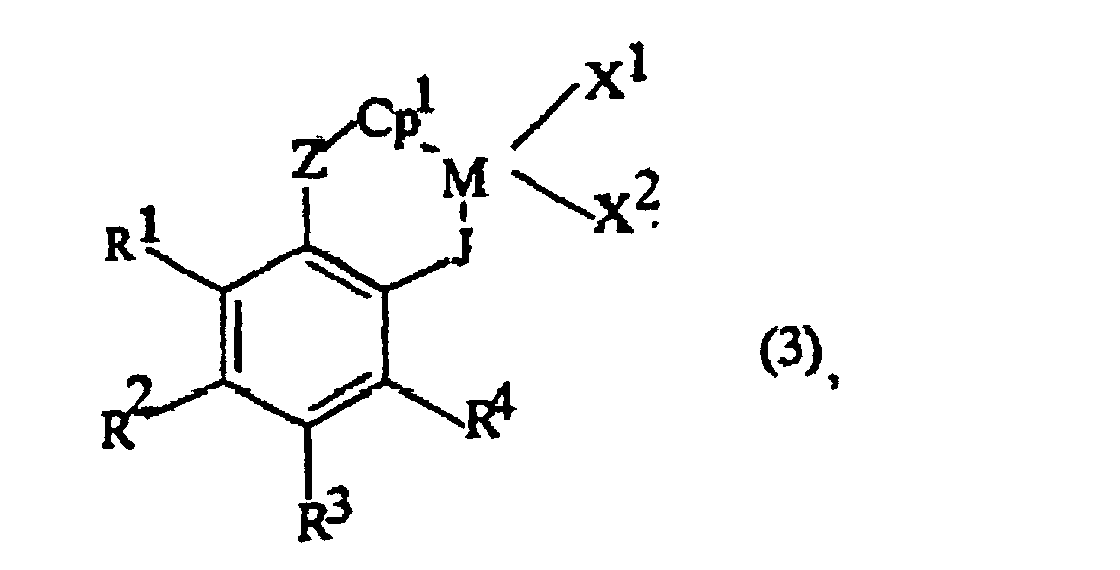
- the transition metal compound used in the present invention is a transition metal complex represented by the following general formulas (1) to (5): and wherein M represents a transition metal atom chosen from titanium, zirconium and hafnium; Cp 1 and Cp 2 represent each independently a group having a cyclopentadiene type anion skeleton; X 1 , X 2 , R 1 , R 2 , R 1 and R 4 represent each independently a hydrogen atom, a halogen atom, an alkyl group having 1 to 20 carbon atoms, an aralkyl group having 7 to 20 carbon atoms, an aryl group having 6 to 20 carbon atoms, a silyl group having 1 to 20 carbon atoms, an alkoxy group having 1 to 20 carbon atoms, an aralkyloxy group having 7 to 20 carbon atoms, an aryloxy group having 6 to 20 carbon atoms or an amino group having 2 to 20 carbon atoms; R 1 , R 2 , R 3 and R 4 may optional
- T represents a divalent group represented by -O-, -S-, -NR 5 - or -PR 6 -, wherein, R 5 and R 6 represent each independently an alkyl group having 1 to 20 carbon atoms, an aralkyl group having 7 to 20 carbon atoms, an aryl group having 6 to 20 carbon atoms or a silyl group having 1 to 20 carbon atoms ; J represents an atom of Group XVI of the Periodic Table of Elements; and Q represents -OR 7 , -SR 8 , -NR 9 R 10 , or PR 11 R 12 , wherein R 7 , R 8 , R 9 , R 10 , R 11 and R 12 represent each independently an alkyl group having 1 to 20 carbon atoms, an aralkyl group having 7 to 20 carbon atoms, an aryl group having 6 to 20 carbon atoms or a silyl group having 1
- M represents a transition metal atom of Group IV of the Periodic Table of Elements (IUPAC Inorganic Chemical Nomenclature, Revised Edition 1989), and examples thereof include a titanium atom, zirconium atom and hafnium atom.
- Examples of the groups having a cyclopentadiene type anionic skeleton shown as Cp1 and Cp2 include the ⁇ 5 -cyclopentadienyl group, ⁇ 5 -methylcyclopentadienyl group, ⁇ 5 -dimethylcyclopentadienyl group, ⁇ 5 -trimethylcyclopentadienyl group, ⁇ 5 -tetramethylcyclopentadienyl group, ⁇ 5 -pentamethylcyclopentadienyl group(in compounds represented by the general formulas(4) and (5)), ⁇ 5 -ethylcyclopentadienyl group, ⁇ 5 -n-propylcyclopentadienyl group, ⁇ 5 -isopropylcyclopentadienyl group, ⁇ 5 -n-butylcyclopentadienyl group, ⁇ 5 -sec-butylcyclopentadienyl group, ⁇ 5 -tert
- Example of the halogen atom in X 1 , X 2 , R 1 , R 2 , R 3 or R 4 include a fluorine atom, chlorine atom, bromine atom and iodine atom.
- Examples of the alkyl group having 1 to 20 carbon atoms in X 1 , X 2 , R 1 , R 2 , R 3 or R 4 include a methyl group, ethyl group, n-propyl group, isopropyl group, n-butyl group, sec-butyl group, tert-butyl group, n-pentyl group, isopenthyl group, neopentyl group, n-hexyl group, n-octyl group, n-decyl group, n-dodecyl group, n-pentadecyl group and n-eicosyl group and preferable examples thereof include a methyl group, ethyl group, isopropyl group, tert-butyl group, n-pentyl group isopenthyl group, and neopentyl group.
- alkyl groups may be substituted with a halogen atom such as a fluorine atom, chlorine atom, bromine atom or iodine atom.
- a halogen atom such as a fluorine atom, chlorine atom, bromine atom or iodine atom.
- alkyl group having 1 to 20 carbon atoms substituted with a halogen atom examples include a fluoromethyl group, difluoromethyl group, trifluoromethyl group, chloromethyl group, dichloromethyl group, trichloromethyl group, bromomethyl group, dibromomethyl group, tribromomethyl group, iodomethyl group, diiodomethyl group, triiodomethyl group, fluoroethyl group, difluoroethyl group, trifluoroethyl group, tetrafluoroethyl group, pentafluoroethyl group, chloroethyl group, dichloroethyl group, trichloroethyl group, tetrachloroethyl group, pentachloroethyl group, bromoethyl group, dibromoethyl group, tribromoethyl group, tetrabromoeth
- alkyl groups may be partially substituted with an alkoxy group such as a methoxy group or ethoxy group, an aryloxy group such as a phenoxy group, and an aralkyloxy group such as a benzyloxy group.
- an alkoxy group such as a methoxy group or ethoxy group
- an aryloxy group such as a phenoxy group
- an aralkyloxy group such as a benzyloxy group.
- Examples of the aralkyl group having 7 to 20 carbon atoms in X 1 , X 2 , R 1 , R 2 , R 3 or R 4 include a benzyl group, (2-methylphenyl)methyl group, (3-methylphenyl)methyl group, (4-methylphenyl)methyl group, (2,3-dimethylphenyl)methyl group, (2,4-dimethylphenyl)methyl group, (2,5-dimethylphenyl)methyl group, (2,6-dimethylphenyl)methyl group, (3,4-dimethylphenyl)methyl group, (4,6-dimethylphenyl)methyl group, (2,3,4-trimethylphenyl)methyl group, (2,3,5-trimethylphenyl)methyl group, (2,3,6-trimethylphenyl)methyl group, (3,4,5-trimethylphenyl)methyl group, (2,4,6-trimethylphenyl)methyl group, (2,3,4,5-tetramethylphenyl)methyl group, (2,3,4,6
- aralkyl groups may be substituted with a halogen atom such as a fluorine atom, chlorine atom, bromine atom, or iodine atom, an alkoxy group such as a methoxy group or ethoxy group, an aryloxy group such as a phenoxy group, and an aralkyloxy group such as a benzyloxy group.
- a halogen atom such as a fluorine atom, chlorine atom, bromine atom, or iodine atom
- an alkoxy group such as a methoxy group or ethoxy group
- an aryloxy group such as a phenoxy group
- an aralkyloxy group such as a benzyloxy group.
- Examples of the aryl group having 6 to 20 carbon atoms in X 1 , X 2 , R 1 , R 2 , R 3 or R 4 include a phenyl group, 2-tolyl group, 3-tolyl group, 4-tolyl group, 2,3-xylyl group, 2,4-xylyl group, 2,5-xylyl group, 2,6-xylyl group, 3,4-xylyl group, 3,5-xylyl group, 2,3,4-trimethylphenyl group, 2,3,5-trimethylphenyl group,2,3,6-trimethylphenyl group, 2,4,6-trimethylphenyl group, 3,4,5-trimethylphenyl group, 2,3,4,5-tetramethylphenyl group, 2,3,4,6-tetramethylphenyl group, 2,3,5,6-tetramethylphenyl group, pentamethylphenyl group, ethylphenyl group, n-propylphenyl group, isopropylphenyl group,
- aryl groups may be substituted with a halogen atom such as a fluorine atom, chlorine atom, bromine atom or iodine atom, an alkoxy group such as a methoxy group or ethoxy group, an aryloxy group such as a phenoxy group, and an aralkyloxy group such as a benzyloxy group.
- a halogen atom such as a fluorine atom, chlorine atom, bromine atom or iodine atom
- an alkoxy group such as a methoxy group or ethoxy group
- an aryloxy group such as a phenoxy group
- an aralkyloxy group such as a benzyloxy group.
- the silyl group having 1 to 20 carbon atoms in X 1 , X 2 , R 1 , R 2 , R 3 or R 4 is a silyl group substituted with a hydrocarbon group
- examples of the hydrocarbon group include alkyl groups having 1 to 10 carbon atoms such as a methyl group, ethyl group, n-propyl group, isopropyl group, n-butyl group, sec-butyl group, tert-butyl group, isobutyl group, n-pentyl group, n-hexyl group and cyclohexyl group and an aryl group such as a phenyl group.
- silyl group having 1 to 20 carbon atoms examples include mono-substituted silyl groups having 1 to 20 carbon atoms such as a methylsilyl group, ethylsilyl group and phenylsilyl group, di-substituted silyl groups having 2 to 20 carbon atoms such as a dimethylsilyl group, diethylsilyl group and diphenylsilyl group, tri-substituted silyl groups having 3 to 20 carbon atoms such as a trimethylsilyl group, triethylsilyl group, tri-n-propylsilyl group, triisopropylsilyl group, tri-n-butylsilyl group, tri-sec-butylsilyl group, tri-tert-butylsilyl group, triisobutylsilyl group, tert-butyl-dimethylsilyl group, tri-n-pentylsilyl group, tri-
- silyl groups may be substituted with a halogen atom such as a fluorine atom, chlorine atom, bromine atom or iodine atom, an alkoxy group such as a methoxy group or ethoxy group, an aryloxy group such as a phenoxy group, and an aralkyloxy group such as benzyloxy group.
- a halogen atom such as a fluorine atom, chlorine atom, bromine atom or iodine atom
- an alkoxy group such as a methoxy group or ethoxy group
- an aryloxy group such as a phenoxy group
- an aralkyloxy group such as benzyloxy group.
- Examples of the alkoxy group having 1 to 20 carbon atoms in X 1 , X 2 , R 1 , R 2 , R 3 or R 4 include a methoxy group, ethoxyl group, n-propoxy group, isopropoxy group, n-butoxy group, sec-butoxy group, t-butoxy group, n-pentoxy group, neopentoxy group, n-hexoxy group, n-octoxy group, n-dodecoxy group, pentadecoxy and n-itacoxy group, and preferably examples thereof include a methoxy group, ethoxy group and t-butoxy group.
- alkoxy groups may be substituted with a halogen atom such as a fluorine atom, chlorine atom, bromine atom or iodine atom, an alkoxy group such as a methoxy group or ethoxy group, an aryloxy group such as a phenoxy group, and an aralkyloxy group such as a benzyloxy group.
- a halogen atom such as a fluorine atom, chlorine atom, bromine atom or iodine atom
- an alkoxy group such as a methoxy group or ethoxy group
- an aryloxy group such as a phenoxy group
- an aralkyloxy group such as a benzyloxy group.
- Examples of the aralkyloxy group having 7 to 20 carbon atoms in X 1 , X 2 , R 1 , R 2 , R 3 or R 4 include a benzyloxy group, (2-methylphenyl)methoxy group, (3-methylphenyl)methoxy group, (4-methylphenyl)methoxy group, (2,3-dimethylphenyl)methoxy group, (2,4-dimethylphenyl)methoxy group, (2,5-dimethylphenyl)methoxy group, (2,6-dimethylphenyl)methoxy group, (3,4-dimethylphenyl)methoxy group, (3,5-dimethylphenyl)methoxy group, (2,3,4-trimethylphenyl)methoxy group, (2,3,5-trimethylphenyl)methoxy group, (2,3,6-trimethylphenyl)methoxy group, (2,4,5-trimethylphenyl)methoxy group, (2,4,6-trimethyl
- aralkyloxy groups may be substituted with a halogen atom such as a fluorine atom, chlorine atom, bromine atom or iodine atom, an alkoxy group such as a methoxy group or ethoxy group, an aryloxy group such as a phenoxy group, and an aralkyloxy group such as a benzyloxy group.
- a halogen atom such as a fluorine atom, chlorine atom, bromine atom or iodine atom
- an alkoxy group such as a methoxy group or ethoxy group
- an aryloxy group such as a phenoxy group
- an aralkyloxy group such as a benzyloxy group.
- Examples of the aryloxy group having 1 to 20 carbon atoms in X 1 , X 2 , R 1 , R 2 , R 3 or R 4 include aryloxy groups having 6 to 20 carbon atoms such as a phenoxy group, 2-methylphenoxy group, 3-methylphenoxy group, 4-methylphenoxy group, 2,3-dimethylphenoxy group, 2,4-dimethylphenoxy group, 2,5-dimethylphenoxy group, 2,6-dimethylphenoxy group, 3,4-dimethylphenoxy group, 3,5-dimethylphenoxy group, 2,3,4-trimethylphenoxy group, 2,3,5-trimethylphenoxy group, 2,3,6-trimethylphenoxy group, 2,4,5-trimethylphenoxy group, 2,4,6-trimethylphenoxy group, 3,4,5-trimethylphenoxy group, 2,3,4,5-tetramethylphenoxy group, 2,3,4,6-tetramethylphenoxy group, 2,3,5,6-tetramethylphenoxy group, pentamethylphenoxy group, ethylphenoxy group,
- aryloxy groups may be substituted with a halogen atom such as a fluorine atom, chlorine atom, bromine atom or iodine atom, an alkoxy group such as a methoxy group or ethoxy group, an aryloxy group such as a phenoxy group, and an aralkyloxy group such as a benzyloxy group.
- a halogen atom such as a fluorine atom, chlorine atom, bromine atom or iodine atom
- an alkoxy group such as a methoxy group or ethoxy group
- an aryloxy group such as a phenoxy group
- an aralkyloxy group such as a benzyloxy group.
- the di-substituted amino group having 2 to 20 carbon atoms in X 1 , X 2 , R 1 , R 2 , R 3 or R 4 is an amino group substituted with two hydrocarbon groups, and examples of the hydrocarbon group include alkyl groups having 1 to 10 carbon atoms such as a methyl group, ethyl group, n-propyl group, isopropyl group, n-butyl group, sec-butyl group, tert-butyl group, isobutyl group, n-pentyl group, n-hexyl group and cyclohexyl group and an aryl group such as a phenyl group.
- di-substituted amino group having 1 to 10 carbon atoms examples include a dimethylamino group, diethylamino group, di-n-propylamino group, diisopropylamino group, di-n-butylamino group, di-sec-butylamino group, di-tert-butylamino group, di-isobutylamino group, tert-butylisopropylamino group, di-n-hexylamino group, di-n-octylamino group, di-n-decylamino group, diphenylamino group, bistrimethylsilylamino group and bis-tert-butyldimethylsilylamino group, and a dimethylamino group and diethylamino group are preferable.
- R 1 , R 2 , R 3 and R 4 may optionally be connected to form a ring.
- R 1 , R 2 , R 3 and R 4 preferably represent each independently a hydrogen atom, a halogen atom, an alkyl group having 1 to 20 carbon atoms, an aryl group having 6 to 20 carbon atoms, an alkoxy group having 1 to 20 carbon atoms or a silyl group having 1 to 20 carbon atoms, wherein these groups may be substituted with a halogen atom, an alkoxy group, an aryloxy group or an aralkyloxy group, and more preferably a hydrogen atom, chlorine atom, methyl group, amyl group, tert-butyl group, phenyl group, methoxy group, trimethylsilyl group, or tertbutyldimethylsilyl group.
- X 1 and X 2 preferably represent each independently a halogen atom, an alkyl group having 1 to 20 carbon atoms, an aralkyl group having 7 to 20 carbon atoms, an alkoxy group having 1 to 20 carbon atoms, an aralkyloxy group having 7 to 20 carbon atoms, or an aryloxy group having 6 to 20 carbon atoms, wherein these groups may be substituted with a halogen atom, an alkoxy group, an aryloxy group or an aralkyloxy group.
- halogen atom alkyl group having 1 to 20 carbon atoms, aralkyl group having 7 to 20 carbon atoms, aryl group having 6 to 20 carbon atoms, silyl group having 1 to 20 carbon atoms, alkoxy group having 1 to 20 carbon atoms, aralkyloxy group having 7 to 20 carbon atoms, aryloxy group having 6 to 20 carbon atoms and di-substituted amino group having 2 to 20 carbon atoms as R' are the same as described above.
- R's When a plurality of R's exist, they may be connected to form a ring, and examples of the R's include alkylene groups such as a tetramethylenediyl group or petamethylenediyl group.
- R' represents preferably a hydrogen atom, said alkyl group, aryl group, alkoxy group or alkylene group, and more preferably a hydrogen atom, methyl group, ethyl group, phenyl group, methoxy group, tetramethylenediyl group or pentamethylenediyl group.
- Z include dimethylsilylene, ethylmethylsilylene, diethylsilylene, methylphenylsilylene, diphenylsilylene, dimethoxysilylene, methylene, ethylidene, isopropylene, ethylmethylmethylene, diethylmethylene, methylphenylmethylene, diphenylmethylene, cyclopentene, cyclohexene, tetraethyldisilylene, tetraphenyldisilylene, ethylene, tetramethylethylene, tetraphenylethylene, dimethylgermilene, diphenylgermilene, methylborene and phenylborene, and among these, dimethylsilylene, diphenylsilylene, divinylsilylene, methylene, isopropylene, diphenylmethylene and ethylene are preferable.
- T represents a divalent group represented by -O-, -S-, -NR 5 - or -PR 6 - (wherein, R 5 and R 6 represent each independently an alkyl group having 1 to 20 carbon atoms, an aralkyl group having 7 to 20 carbon atoms, an aryl group having 6 to 20 carbon atoms or a silyl group having 1 to 20 carbon atoms, wherein these groups may be substituted with a halogen atom, an alkoxy group, an aryloxy group or an aralkyloxy group).
- R 5 and R 6 represent, each independently, preferably an alkyl group or aryl group, more preferably a methyl group, ethyl group, n-propyl group, iso-propyl group, tert-butyl group, cyclohexyl group or phenyl group.
- the T is preferably a divalent group represented by -O- or -NR 5 -.
- Q represents a divalent group represented by -OR 7 , -SR 8 , -NR 9 R 10 or -PR 11 R 12 (wherein, R 7 to R 12 represent each independently an alkyl group having 1 to 20 carbon atoms, an aralkyl group having 7 to 20 carbon atoms, an aryl group having 6 to 20 carbon atoms or a silyl group having 1 to 20 carbon atoms, wherein these groups may be substituted with a halogen atom, an alkoxy group, an aryloxy group or an aralkyloxy group).
- R 7 to R 12 represent, each independently, preferably the alkyl group or aryl group, more preferably a methyl group, ethyl group, n-propyl group, iso-propyl group, tert-butyl group, cyclohexyl group or phenyl group.
- the Q is preferably a group represented by -OR 7 or -NR 9 R 10 .
- R 9 and R 10 , and R 11 and R 12 may optionally be connected to each other to form a ring.
- J is an atom of Group XVI in the Periodic Table of Elements, and examples thereof include an oxygen atom, sulfur atom and selenium atom, and among these, an oxygen atom is most preferable.
- transition metal complexes such as methylenebis(cyclopentadienyl)titanium dichloride, isopropylideneibis(cyclopentadienyl)titanium dichloride, dimethylsilylenebis(cyclopentadienyl)titanium dichloride, diphenylsilylenebis(cyclopentadienyl)titanium dichloride, methylenebis(methylcyclopentadienyl)titanium dichloride, isopropylidenebis(methylcyclopentadienyl)titanium dichloride, dimethylsilylenebis(methylcyclopentadienyl)titanium dichloride, diphenylsilylenebis(methylcyclopentadienyl)titanium dichloride, methylenebis(dimethylcyclopentadienyl)titanium dichloride, isopropyliden
- the compound represented by the above-described general formula (2) include transition metal complexes such as dimethylsilylene(methylamide)(cyclopentadienyl)titanium dichloride, dimethylsilylene(ethylamide)(cyclopentadienyl)titanium dichloride, dimethylsilylene(n-propylamide)(cyclopentadienyl)titanium dichloride, dimethylsilylene(isopropylamide)(cyclopentadienyl) titanium dichloride, dimethylsilylene(t-butylamide)(cyclopentadienyl)titanium dichloride, dimethylsilylene(phenylamide)(cyclopentadienyl)titanium dichloride, dimethylsilylene(cyclohexylamide) (cyclopentadienyl)titanium dichloride, compounds wherein cyclopentadienyl in these compounds is replaced by methylcyclopenta
- transition metal compounds such as methylene(cyclopentadienyl) (3,5-dimethyl-2-phenoxy)titanium dichloride, methylene(cyclopentadienyl)(3-tert-butyl-2-phenoxy)titanium dichloride, methylene(cyclopentadienyl)(3-tert-butyl-5-methyl-2-phenoxy)titanium dichloride, methylene(cyclopentadienyl)(3-phenyl-2-phenoxy)titanium dichloride, methylene(cyclopentadienyl)(3-tert-butyldimethylsilyl-5-methyl-2-phenoxy)titanium dichloride, methylene(cyclopentadienyl)(3-trimethylsilyl-5-methyl-2-phenoxy)titanium dichloride, methylene(cyclopentadienyl)(3-trimethylsilyl-5-methyl-2-phenoxy)t
- Specific examples of the compound represented by the above-described general formula (3) include transition metal complexes such as dimethylsilylene(cyclopentadienyl)(2-phenoxy)titanium dichloride, dimethylsilylene(cyclopentadienyl)(3-methyl-2-phenoxy)titanium dichloride, dimethylsilylene(cyclopentadienyl)(3,5-dimethyl-2-phenoxy)titanium dichloride, dimethylsilylene(cyclopentadienyl)(3-tert-butyl-2-phenoxy)titanium dichloride, dimethylsilylene(cyclopentadienyl)(3-tert-butyl-5-methyl-2-phenoxy)titanium dichloride, dimethylsilylene(cyclopentadienyl)(3,5-di-tert-butyl-2-phenoxy)titanium dichloride, dimethylsilylene(cyclopentadienyl)(5-
- transition metal complexes such as bis(cyclopentadienyl)titanium dichloride, bis(methylcyclopentadienyl)titanium dichloride, bis(dimethylcyclopentadienyl)titanium dichloride, bis(trimethylcyclopentadienyl)titanium dichloride, bis(tetramethylcyclopentadienyl)titanium dichloride, bis(pentamethylcyclopentadienyl)titanium dichloride, bis(ethylcyclopentadienyl)titanium dichloride, bis(n-butylcyclopentadienyl)titanium dichloride, bis(tert-butylcyclopentadienyl)titanium dichloride, bis(indenyl)titanium dichloride, bis(tetrahydroindenyl)titanium dichloride
- transition metal compounds such as (dimethylamide)(cyclopentadienyl)titanium dichloride, (diethylamide)(cyclopentadienyl)titanium dichloride, (di-n-propylamide)(cyclopentadienyl)titanium dichloride, (diisopropylamide)(cyclopentadienyl)titanium dicbloride, (di-t-butylamide)(cyclopentadienyl)titanium dichloride, (diphenylamide)(cyclopentadienyl)titanium dichloride, (dicyclohexylamide)(cyclopentadienyl)titanium dichloride, (cyclopentadienyl)(pyrrolidinyl)titanium dichloride, (cyclopentadienyl)(piperidinyl)
- the transition metal complexes represented by the general formulas (1) to (5) are produced, for example, by reacting a cyclopentadiene compound as a ligand precursor with a strong base, then, reacting the reaction product with a transition metal compound such as a halogenated compound of a transition metal. Further, the transition metal complexes represented by the general formula (1) to (5) can be obtained also by reacting the reaction product with an organoalkaline metal compound such as methyllithium.
- an organoalkaline metal compound, hydrogenated compound of alkaline metal or organomagnesium compound is often used.
- the reaction temperature is usually -100°C or more and not more than the boiling point of the solvent, and preferably in the range from -80 to 150°C.
- the reaction is preferably conducted in the range from -20 to 150°C which is industrially advantageous.
- the reaction of a ligand precursor with a strong base is effective that the reaction is initiated at a low temperature of not more than 50°C and the reaction is carried out with keeping the temperature constant or gradually increasing the temperature since this reaction is generally an exothermic reaction and the strong base used and the produced salt may sometimes be decomposed at high temperature depending on the solvent used. Further, since also the reaction with a transition metal compound such as a transition metal halide compound is generally an exothermic reaction and the produced salt may sometimes be decomposed at high temperature range depending on the solvent used, it is effective that the reaction is initiated at a low temperature of not more than 50°C and the reaction is carried out with keeping the temperature constant or gradually elevating the temperature as described above.
- the above-described reaction is usually conducted in an inert solvent. More specifically, it can be generally effected in the presence of an aromatic hydrocarbon solvent such as benzene, toluene, xylene, mesitylene, chlorobenzene or dichlorobenzene; an aliphatic hydrocarbon solvent such as pentane, hexane, heptane, octane or petroleum ether; an ether solvent such as tetrahydrofuran, dioxane, diethyl ether, diisopropyl ether or dimethoxyethane; or a halogenated hydrocarbon solvent such as dichloromethane or dichloroethane.
- an aromatic hydrocarbon solvent such as benzene, toluene, xylene, mesitylene, chlorobenzene or dichlorobenzene
- an aliphatic hydrocarbon solvent such as pentane, hexane, heptane, oct
- a salt such as lithium chloride by-produced is sometimes unfavorably dissolved in the solvent and mixed into an intended compound in purification.
- the intended compound and the salt can be separated by solvent substitution, however, it increases the number of production steps.
- a solvent such as diethyl ether can control the above-described mixing of lithium chloride, the boiling point thereof is lower for industrial application, and for some transition metal compounds, when an ether solvent is used, a metal-ether bond is produced by the reaction of a center metal with an ether solvent, therefore, the use of an ether solvent may sometimes be undesirable. Accordingly, it is more preferable to use an aliphatic hydrocarbon solvent or an aromatic hydrocarbon solvent, and the subsequent purification operation can be carried out after removing a by-product quickly e.g. by filtration without solvent substitution.
- This reaction solution was added over 2 hours to a solution separately prepared by dissolving 5.58 g (29.4 mmol) of TiCl 4 in 38 g of toluene under nitrogen atmosphere and then cooling to -10°C.
- the resulted reaction solution was heated slowly to room temperature over 1.5 hours, and further heated to the reflux temperature over 1 hour and refluxed for 10 hours.
- the solution changed to brownish color, and a solid of brownish color was deposited. This was filtered through celite, the resulted solid was extracted twice using 20 g of toluene per one operation.
- This reaction solution was added to a solution over 2 hours which had been separately prepared by dissolving 5.58 g (29.4 mmol) of TiCl 4 in 38 g of toluene under nitrogen atmosphere and cooling the mixture down to -10°C.
- the resulted reaction solution was heated slowly to room temperature over 1.5 hours, and further heated to the reflux temperature over 1 hour and refluxed for 10 hours.
- the solution changed to brownish color, and a solid of brownish color was deposited. This was filtered through celite, the resulted solid was extracted twice using 20 g of toluene per one operation.
- the extracted solutions and filtrates were combined, and concentrated to 19 g, and the concentrated solution was heated to 50°C, and the solution was cooled slowly (10°C/hr) to -10°C with stirring, then stirred for 12 hours to deposit a yellow powder. This was filtered, washed with hexane, then, dried under reduced pressure to obtain 2.52 g of a yellow powder. Further, the filtrate was concentrated to 12 g at 50°C, then, the mixture was cooled slowly to -10°C with stirring to obtain further 1.35 g of a yellow powder.
- This reaction solution was added over 2 hours to a solution separately prepared by dissolving 5.58 g (29.4 mmol) of TiCl 4 in 38 g of toluene under nitrogen atmosphere and cooling the mixture down to -10°C.
- the resulted reaction solution was heated slowly to room temperature over 1.5 hours, and further heated to the reflux temperature over 1 hour and refluxed for 10 hours.
- the solution changed to brownish color, and a solid of brownish color was deposited. This was filtered through celite, the resulted solid was extracted twice using 20 g of toluene per one operation.
- the amount of the crystal collected and weighed was 1.11 g.
- the resulted brown plate crystal was recognized as dimethylsilylene(tert-butylamide) (tetramethylcyclopentadienyl)titanium dichloride (yield 37.8 %) since it showed the same spectra as those in Example 3 as a result of the spectroscopic analysis.
- a solution was prepared by suspending 0.95 g (4.1 mmol) of ZrCl 4 in 12 g of toluene under nitrogen atmosphere. Then, to a solution obtained by dissolving the reddish brown powder previously synthesized into 35 g of toluene in a 100 ml four-necked flask was added slowly the ZrCl 4 solution at 15°C over 0.5 hours. This reaction solution was stirred over night, then, further reacted for 2 hours at 60°C. This reaction mixture was filtered through celite, the remaining solid was extracted twice using 8g of toluene per one operation.
Landscapes
- Chemical & Material Sciences (AREA)
- Organic Chemistry (AREA)
- Transition And Organic Metals Composition Catalysts For Addition Polymerization (AREA)
Claims (7)
- Verfahren zur Reinigung einer Übergangsmetallverbindung, das Durchführen der Kristallisation einer Übergangsmetallverbindung aus einer die Übergangsmetallverbindung enthaltenden Lösung unter Rühren umfasst, wobei die Übergangsmetallverbindung aus einer der Übergangsmetallverbindungen ausgewählt ist, die durch die folgenden allgemeinen Formeln (1) bis (5) wiedergegeben sind:
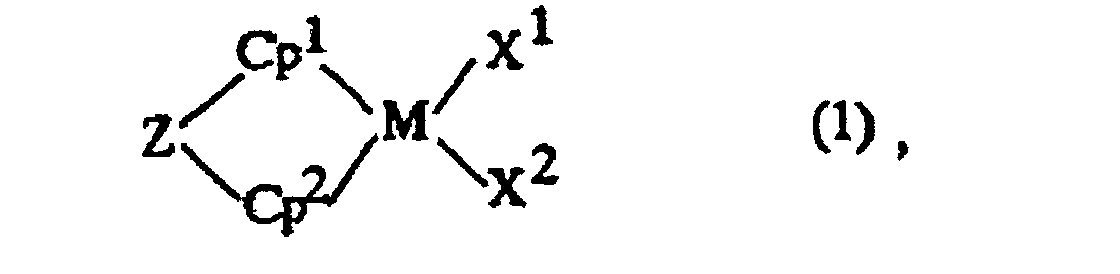

 und
und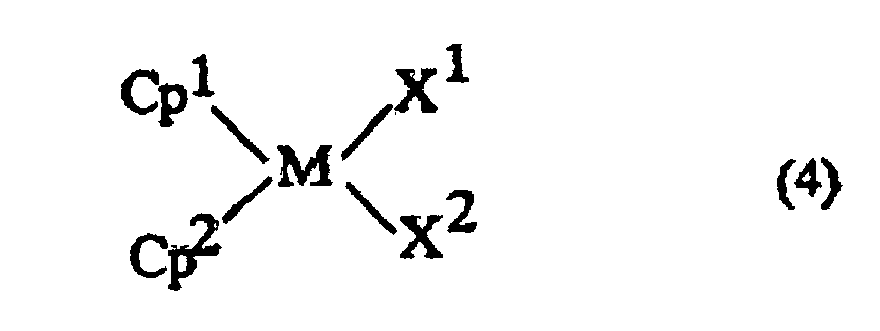 wobei M ein Übergangsmetallatom darstellt, das aus Titan, Zirkonium und Hafnium ausgewählt ist; Cp1 und Cp2 jeweils unabhängig einen Rest mit einem anionischen Grundgerüst vom Cyclopentadien-Typ darstellen; X1, X2, R1, R2, R3 und R4 jeweils unabhängig ein Wasserstoffatom, ein Halogenatom, einen Alkylrest mit 1 bis 20 Kohlenstoffatomen, einen Aralkylrest mit 7 bis 20 Kohlenstoffatomen, einen Arylrest mit 6 bis 20 Kohlenstoffatomen, einen Silylrest mit 1 bis 20 Kohlenstoffatomen, einen Alkoxyrest mit 1 bis 20 Kohlenstoffatomen, einen Aralkyloxyrest mit 7 bis 20 Kohlenstoffatomen, einen Aryloxyrest mit 6 bis 20 Kohlenstoffatomen oder einen Aminorest mit 2 bis 20 Kohlenstoffatomen darstellen; R1, R2, R3 und R4 gegebenenfalls miteinander zu einem Ring verbunden sein können; Z einen divalenten Rest darstellt, der durch einen der Reste SiR'2, CR'2, SiR'2SiR'2, CR'2CR'2, CR'=CR', CR'2SiR'2, GeR'2 oder BR' wiedergegeben ist,
wobei R' jeweils ein Wasserstoffatom, ein Halogenatom, einen Alkylrest mit 1 bis 20 Kohlenstoffatomen, einen Alkenylrest mit 2 bis 20 Kohlenstoffatomen, einen Aralkylrest mit 7 bis 20 Kohlenstoffatomen, einen Arylrest mit 6 bis 20 Kohlenstoffatomen, einen Silylrest mit 1 bis 20 Kohlenstoffatomen, einen Alkoxyrest mit 1 bis 20 Kohlenstoffatomen, einen Aralkyloxyrest mit 7 bis 20 Kohlenstoffatomen, einen Aryloxyrest mit 6 bis 20 Kohlenstoffatomen, die substituiert sein können, oder einen Aminorest mit 2 bis 20 Kohlenstoffatomen darstellt, und wenn eine Mehrzahl von Resten R' vorliegt, diese miteinander zu einem Ring verbunden sein können; T einen divalenten Rest darstellt, der durch eine der Gruppen -O-, -S- oder einen der Reste -NR5- oder -PR6- wiedergegeben ist, wobei R5 und R6 jeweils unabhängig einen Alkylrest mit 1 bis 20 Kohlenstoffatomen, einen Aralkylrest mit 7 bis 20 Kohlenstoffatomen, einen Arylrest mit 6 bis 20 Kohlenstoffatomen oder einen Silylrest mit 1 bis 20 Kohlenstoffatomen darstellen; J ein Atom der Gruppe XVI des Periodensystems der Elemente darstellt; und Q einen Rest -OR7, -SR8, -NR9R10 oder -PR11R12 darstellt, wobei R7, R8, R9, R10, R11 und R12 jeweils unabhängig einen Alkylrest mit 1 bis 20 Kohlenstoffatomen, einen Aralkylrest mit 7 bis 20 Kohlenstoffatomen, einen Arylrest mit 6 bis 20 Kohlenstoffatomen oder einen Silylrest mit 1 bis 20 Kohlenstoffatomen darstellen. - Verfahren zur Reinigung einer Übergangsmetallverbindung gemäß Anspruch 1, das Zugeben eines schlechten Lösungsmittels zu einer eine Übergangsmetallverbindung enthaltenden Lösung und Durchführen der Kristallisation der Übergangsmetallverbindung aus dem resultierenden Gemisch unter Rühren umfasst, wobei die Übergangsmetallverbindung aus einer der Übergangsmetallverbindungen ausgewählt ist, die durch die folgenden allgemeinen Formeln (1) bis (5) wiedergegeben sind:
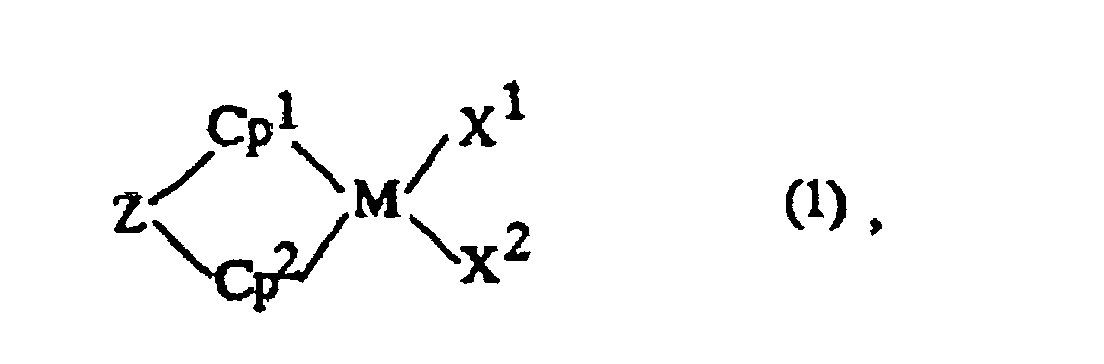
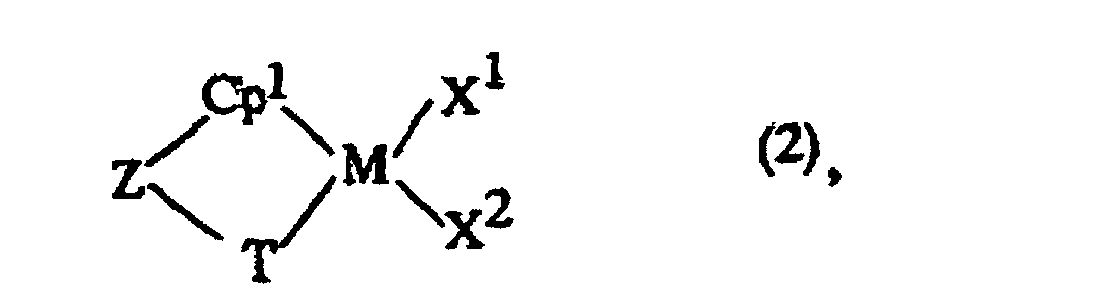
 und
und wobei M ein Übergangsmetallatom darstellt, das aus Titan, Zirkonium und Hafnium ausgewählt ist; Cp1 und Cp2 jeweils unabhängig einen Rest mit einem anionischen Grundgerüst vom Cyclopentadien-Typ darstellen; X1, X2, R1, R2, R3 und R4 jeweils unabhängig ein Wasserstoffatom, ein Halogenatom, einen Alkylrest mit 1 bis 20 Kohlenstoffatomen, einen Aralkylrest mit 7 bis 20 Kohlenstoffatomen, einen Arylrest mit 6 bis 20 Kohlenstoffatomen, einen Silylrest mit 1 bis 20 Kohlenstoffatomen, einen Alkoxyrest mit 1 bis 20 Kohlenstoffatomen, einen Aralkyloxyrest mit 7 bis 20 Kohlenstoffatomen, einen Aryloxyrest mit 6 bis 20 Kohlenstoffatomen oder einen Aminorest mit 2 bis 20 Kohlenstoffatomen darstellen; R1, R2, R3 und R4 gegebenenfalls miteinander zu einem Ring verbunden sein können; Z einen divalenten Rest darstellt, der durch einen der Reste SiR'2, CR'2, SiR'2SiR'2, CR'2CR'2, CR'=CR', CR'2SiR'2, GeR'2 oder BR' wiedergegeben ist,
wobei R' jeweils ein Wasserstoffatom, ein Halogenatom, einen Alkylrest mit 1 bis 20 Kohlenstoffatomen, einen Alkenylrest mit 2 bis 20 Kohlenstoffatomen, einen Aralkylrest mit 7 bis 20 Kohlenstoffatomen, einen Arylrest mit 6 bis 20 Kohlenstoffatomen, einen Silylrest mit 1 bis 20 Kohlenstoffatomen, einen Alkoxyrest mit 1 bis 20 Kohlenstoffatomen, einen Aralkyloxyrest mit 7 bis 20 Kohlenstoffatomen, einen Aryloxyrest mit 6 bis 20 Kohlenstoffatomen, die substituiert sein können, oder einen Aminorest mit 2 bis 20 Kohlenstoffatomen darstellt, und wenn eine Mehrzahl von Resten R'vorliegt, diese miteinander zu einem Ring verbunden sein können; T einen divalenten Rest darstellt, der durch eine der Gruppen -O-, -S- oder einen der Reste -NR5- oder -PR6- wiedergegeben ist, wobei R5 und R6 jeweils unabhängig einen Alkylrest mit 1 bis 20 Kohlenstoffatomen, einen Aralkylrest mit 7 bis 20 Kohlenstoffatomen, einen Arylrest mit 6 bis 20 Kohlenstoffatomen oder einen Silylrest mit 1 bis 20 Kohlenstoffatomen darstellen; J ein Atom der Gruppe XVI des Periodensystems der Elemente darstellt; und Q einen Rest -OR7, -SR8, -NR9R10 oder -PR11R12 darstellt, wobei R7, R8, R9, R10, R11 und R12 jeweils unabhängig einen Alkylrest mit 1 bis 20 Kohlenstoffatomen, einen Aralkylrest mit 7 bis 20 Kohlenstoffatomen, einen Arylrest mit 6 bis 20 Kohlenstoffatomen oder einen Silylrest mit 1 bis 20 Kohlenstoffatomen darstellen,
wobei das schlechte Lösungsmittel ein Lösungsmittel mit geringerer Löslichkeit der Übergangsmetallverbindung als der des Lösungsmittels in der Lösung ist, zu der das schlechte Lösungsmittel zugegeben wird. - Verfahren zur Reinigung einer Übergangsmetallverbindung gemäß Anspruch 1, wobei die eine Übergangsmetallverbindung enthaltende Lösung vor der Kristallisation konzentriert wird.
- Verfahren zur Reinigung einer Übergangsmetallverbindung gemäß Anspruch 2, wobei die eine Übergangsmetallverbindung enthaltende Lösung vor der Zugabe des schlechten Lösungsmittels konzentriert wird.
- Verfahren zur Reinigung einer Übergangsmetallverbindung gemäß einem der Ansprüche 1 bis 4, wobei das Rühren unter Kühlung erfolgt.
- Verfahren zur Reinigung einer Übergangsmetallverbindung gemäß Anspruch 1, wobei Z einen divalenten Rest darstellt, der durch einen der Reste SiR'2, CR'2 oder CR'2CR'2 wiedergegeben ist, wobei R' die oben angegebene Bedeutung hat.
- Verfahren zur Reinigung einer Übergangsmetallverbindung gemäß Anspruch 1, wobei X1 und X2 jeweils unabhängig ein Halogenatom, einen Alkylrest mit 1 bis 20 Kohlenstoffatomen, einen Aralkylrest mit 7 bis 20 Kohlenstoffatomen, einen Arylrest mit 6 bis 20 Kohlenstoffatomen oder einen Alkoxyrest mit 1 bis 10 Kohlenstoffatomen darstellen.
Applications Claiming Priority (3)
| Application Number | Priority Date | Filing Date | Title |
|---|---|---|---|
| JP27857197 | 1997-10-13 | ||
| JP27857197 | 1997-10-13 | ||
| JP278571/97 | 1997-10-13 |
Publications (2)
| Publication Number | Publication Date |
|---|---|
| EP0908435A1 EP0908435A1 (de) | 1999-04-14 |
| EP0908435B1 true EP0908435B1 (de) | 2003-10-01 |
Family
ID=17599128
Family Applications (1)
| Application Number | Title | Priority Date | Filing Date |
|---|---|---|---|
| EP98119225A Expired - Lifetime EP0908435B1 (de) | 1997-10-13 | 1998-10-12 | Verfahren zur Herstellung von Übergangsmetallverbindungen |
Country Status (3)
| Country | Link |
|---|---|
| US (1) | US6107502A (de) |
| EP (1) | EP0908435B1 (de) |
| DE (1) | DE69818602T2 (de) |
Families Citing this family (1)
| Publication number | Priority date | Publication date | Assignee | Title |
|---|---|---|---|---|
| WO2002066693A1 (en) * | 2001-02-19 | 2002-08-29 | Isotis N.V. | Porous metals and metal coatings for implants |
Family Cites Families (9)
| Publication number | Priority date | Publication date | Assignee | Title |
|---|---|---|---|---|
| DD289448A7 (de) * | 1982-07-29 | 1991-05-02 | Amt Fuer Atomsicherheit Und Strahlenschutz,De | Verfahren zur herstellung von s-[2-(3-amino-propylamino)ethyl]-dihydrogenthiophosphat |
| JPH07103115B2 (ja) * | 1986-12-02 | 1995-11-08 | 日本ケミフア株式会社 | 2−(10,11−ジヒドロ−10−オキソジベンゾ〔b,f〕チエピン−2−イル)プロピオン酸の結晶化方法 |
| US5096867A (en) * | 1990-06-04 | 1992-03-17 | Exxon Chemical Patents Inc. | Monocyclopentadienyl transition metal olefin polymerization catalysts |
| EP0426643B1 (de) * | 1989-10-30 | 1995-12-27 | Fina Research S.A. | Verfahren zur Herstellung von Metallocenen |
| ES2108766T3 (es) * | 1991-10-15 | 1998-01-01 | Dow Chemical Co | Preparacion de complejos de coordinacion de metal. |
| US5302733A (en) * | 1992-03-30 | 1994-04-12 | Ethyl Corporation | Preparation of metallocenes |
| KR100311244B1 (ko) * | 1993-02-22 | 2001-12-15 | 가지와라 야스시 | 에틸렌/α-올레핀공중합체의제조방법 |
| JP3623531B2 (ja) * | 1993-06-07 | 2005-02-23 | ビーエーエスエフ アクチェンゲゼルシャフト | 結晶質l−アスコルビン酸−2−燐酸エステルマグネシウム塩の製造法 |
| US5567842A (en) * | 1994-11-16 | 1996-10-22 | Mitsubishi Chemical Corporation | Process for producing terephthalic acid |
-
1998
- 1998-10-09 US US09/168,996 patent/US6107502A/en not_active Expired - Lifetime
- 1998-10-12 DE DE69818602T patent/DE69818602T2/de not_active Expired - Lifetime
- 1998-10-12 EP EP98119225A patent/EP0908435B1/de not_active Expired - Lifetime
Also Published As
| Publication number | Publication date |
|---|---|
| EP0908435A1 (de) | 1999-04-14 |
| DE69818602T2 (de) | 2004-08-05 |
| DE69818602D1 (de) | 2003-11-06 |
| US6107502A (en) | 2000-08-22 |
Similar Documents
| Publication | Publication Date | Title |
|---|---|---|
| US6870017B2 (en) | Transition metal compound, catalyst for addition polymerization, and process for producing addition polymer | |
| US6329478B1 (en) | Transition metal complex, process for producing the same, olefin polymerization catalyst containing the transition metal complex and process for producing olefin polymers | |
| US7615660B2 (en) | Production process of alkoxy-titanium complex | |
| JP4062929B2 (ja) | 遷移金属錯体、配位子、オレフィン重合用触媒およびオレフィン重合体の製造方法 | |
| EP0852230B1 (de) | Übergangsmetallkomplexe, katalysatoren für die olefinpolymerisation und verfahren zur herstellung von olefinpolymeren | |
| EP0970964B1 (de) | Verfahren zur Herstellung eines Titankomplexes | |
| US6107502A (en) | Method for purifying transition metal compound and method for producing the same | |
| US5965758A (en) | Method for producing bridged type transition metal complex | |
| JP3891709B2 (ja) | 遷移金属化合物の精製方法および製造方法 | |
| JP5082247B2 (ja) | アルコキシチタン錯体の製造方法 | |
| US6136995A (en) | Process for producing aminosilane compounds | |
| CN101151271A (zh) | 烷氧基钛络合物的制备方法 | |
| JP2000119286A (ja) | チタン二置換錯体の製造法 | |
| JP3674332B2 (ja) | アリールオキシチタン錯体の製造方法 | |
| JP4432737B2 (ja) | 遷移金属化合物の精製方法。 | |
| JP4496890B2 (ja) | メタロセン化合物の製造方法 | |
| JP2004224881A (ja) | 重合用触媒及びオレフィン系重合体の製造法 | |
| EP2123685A1 (de) | Verfahren zur herstellung von buten-ethylen-copolymer | |
| JP2003342315A (ja) | 重合触媒およびオレフィン系重合体の製造方法 | |
| US7652159B2 (en) | Process for producing metallocene compound | |
| JP4710334B2 (ja) | シクロペンタジエン化合物及びその製造方法 | |
| JP2001348395A (ja) | ハーフメタロセン型金属錯体の精製方法 | |
| JP2010229090A (ja) | 遷移金属錯体の製造方法 | |
| JP2008231018A (ja) | 遷移金属錯体の製造方法 | |
| JPH11222490A (ja) | アミノシラン化合物の製造方法、およびシクロペンタジエン骨格を有する化合物の塩化合物の製造方法 |
Legal Events
| Date | Code | Title | Description |
|---|---|---|---|
| PUAI | Public reference made under article 153(3) epc to a published international application that has entered the european phase |
Free format text: ORIGINAL CODE: 0009012 |
|
| AK | Designated contracting states |
Kind code of ref document: A1 Designated state(s): DE FR GB |
|
| AX | Request for extension of the european patent |
Free format text: AL;LT;LV;MK;RO;SI |
|
| 17P | Request for examination filed |
Effective date: 19990924 |
|
| AKX | Designation fees paid |
Free format text: DE FR GB |
|
| 17Q | First examination report despatched |
Effective date: 20000623 |
|
| GRAH | Despatch of communication of intention to grant a patent |
Free format text: ORIGINAL CODE: EPIDOS IGRA |
|
| GRAS | Grant fee paid |
Free format text: ORIGINAL CODE: EPIDOSNIGR3 |
|
| GRAA | (expected) grant |
Free format text: ORIGINAL CODE: 0009210 |
|
| AK | Designated contracting states |
Kind code of ref document: B1 Designated state(s): DE FR GB |
|
| REG | Reference to a national code |
Ref country code: GB Ref legal event code: FG4D |
|
| RTI1 | Title (correction) |
Free format text: METHOD FOR PURIFYING TRANSITION METAL COMPOUNDS |
|
| REF | Corresponds to: |
Ref document number: 69818602 Country of ref document: DE Date of ref document: 20031106 Kind code of ref document: P |
|
| ET | Fr: translation filed | ||
| PLBE | No opposition filed within time limit |
Free format text: ORIGINAL CODE: 0009261 |
|
| STAA | Information on the status of an ep patent application or granted ep patent |
Free format text: STATUS: NO OPPOSITION FILED WITHIN TIME LIMIT |
|
| 26N | No opposition filed |
Effective date: 20040702 |
|
| PGFP | Annual fee paid to national office [announced via postgrant information from national office to epo] |
Ref country code: GB Payment date: 20071010 Year of fee payment: 10 |
|
| GBPC | Gb: european patent ceased through non-payment of renewal fee |
Effective date: 20081012 |
|
| PG25 | Lapsed in a contracting state [announced via postgrant information from national office to epo] |
Ref country code: GB Free format text: LAPSE BECAUSE OF NON-PAYMENT OF DUE FEES Effective date: 20081012 |
|
| PGFP | Annual fee paid to national office [announced via postgrant information from national office to epo] |
Ref country code: DE Payment date: 20121010 Year of fee payment: 15 Ref country code: FR Payment date: 20121018 Year of fee payment: 15 |
|
| REG | Reference to a national code |
Ref country code: DE Ref legal event code: R119 Ref document number: 69818602 Country of ref document: DE Effective date: 20140501 |
|
| REG | Reference to a national code |
Ref country code: FR Ref legal event code: ST Effective date: 20140630 |
|
| PG25 | Lapsed in a contracting state [announced via postgrant information from national office to epo] |
Ref country code: FR Free format text: LAPSE BECAUSE OF NON-PAYMENT OF DUE FEES Effective date: 20131031 Ref country code: DE Free format text: LAPSE BECAUSE OF NON-PAYMENT OF DUE FEES Effective date: 20140501 |