EP0915376A1 - Dispersion émulsionnée d'un composé hydrophobe, photographique et produit photographique à l'halogénure d'argent sensible à la lumière - Google Patents
Dispersion émulsionnée d'un composé hydrophobe, photographique et produit photographique à l'halogénure d'argent sensible à la lumière Download PDFInfo
- Publication number
- EP0915376A1 EP0915376A1 EP98120643A EP98120643A EP0915376A1 EP 0915376 A1 EP0915376 A1 EP 0915376A1 EP 98120643 A EP98120643 A EP 98120643A EP 98120643 A EP98120643 A EP 98120643A EP 0915376 A1 EP0915376 A1 EP 0915376A1
- Authority
- EP
- European Patent Office
- Prior art keywords
- metal salt
- hydrophobic compound
- fine particles
- emulsified dispersion
- photographic
- Prior art date
- Legal status (The legal status is an assumption and is not a legal conclusion. Google has not performed a legal analysis and makes no representation as to the accuracy of the status listed.)
- Granted
Links
- 239000006185 dispersion Substances 0.000 title claims abstract description 86
- 150000001875 compounds Chemical class 0.000 title claims abstract description 41
- 230000002209 hydrophobic effect Effects 0.000 title claims abstract description 41
- 229910052709 silver Inorganic materials 0.000 title claims abstract description 40
- 239000004332 silver Substances 0.000 title claims abstract description 40
- -1 silver halide Chemical class 0.000 title claims abstract description 40
- 239000000463 material Substances 0.000 title claims abstract description 33
- 150000003839 salts Chemical class 0.000 claims abstract description 57
- 229910052751 metal Inorganic materials 0.000 claims abstract description 56
- 239000002184 metal Substances 0.000 claims abstract description 56
- 239000002245 particle Substances 0.000 claims abstract description 35
- 239000000839 emulsion Substances 0.000 claims description 41
- 239000010419 fine particle Substances 0.000 claims description 32
- 238000004945 emulsification Methods 0.000 claims description 22
- 238000000034 method Methods 0.000 claims description 20
- 238000002156 mixing Methods 0.000 claims description 10
- 239000000084 colloidal system Substances 0.000 claims description 9
- 230000008859 change Effects 0.000 claims description 7
- 229910002651 NO3 Inorganic materials 0.000 claims description 5
- 239000012736 aqueous medium Substances 0.000 claims description 5
- 239000003112 inhibitor Substances 0.000 claims description 5
- NHNBFGGVMKEFGY-UHFFFAOYSA-N nitrate group Chemical group [N+](=O)([O-])[O-] NHNBFGGVMKEFGY-UHFFFAOYSA-N 0.000 claims description 5
- AZDRQVAHHNSJOQ-UHFFFAOYSA-N alumane Chemical class [AlH3] AZDRQVAHHNSJOQ-UHFFFAOYSA-N 0.000 claims description 2
- 159000000009 barium salts Chemical class 0.000 claims description 2
- 159000000007 calcium salts Chemical class 0.000 claims description 2
- 230000001804 emulsifying effect Effects 0.000 claims description 2
- 159000000003 magnesium salts Chemical class 0.000 claims description 2
- 239000010410 layer Substances 0.000 description 30
- 108010010803 Gelatin Proteins 0.000 description 14
- ZCCIPPOKBCJFDN-UHFFFAOYSA-N calcium nitrate Chemical compound [Ca+2].[O-][N+]([O-])=O.[O-][N+]([O-])=O ZCCIPPOKBCJFDN-UHFFFAOYSA-N 0.000 description 14
- 239000008273 gelatin Substances 0.000 description 14
- 229920000159 gelatin Polymers 0.000 description 14
- 235000019322 gelatine Nutrition 0.000 description 14
- 235000011852 gelatine desserts Nutrition 0.000 description 14
- 239000007788 liquid Substances 0.000 description 10
- LYCAIKOWRPUZTN-UHFFFAOYSA-N Ethylene glycol Chemical compound OCCO LYCAIKOWRPUZTN-UHFFFAOYSA-N 0.000 description 9
- VWDWKYIASSYTQR-UHFFFAOYSA-N sodium nitrate Chemical compound [Na+].[O-][N+]([O-])=O VWDWKYIASSYTQR-UHFFFAOYSA-N 0.000 description 8
- 229910021645 metal ion Inorganic materials 0.000 description 7
- XLYOFNOQVPJJNP-UHFFFAOYSA-N water Substances O XLYOFNOQVPJJNP-UHFFFAOYSA-N 0.000 description 7
- 229910021607 Silver chloride Inorganic materials 0.000 description 6
- 239000008346 aqueous phase Substances 0.000 description 6
- 239000003795 chemical substances by application Substances 0.000 description 6
- 239000000975 dye Substances 0.000 description 6
- YIXJRHPUWRPCBB-UHFFFAOYSA-N magnesium nitrate Chemical compound [Mg+2].[O-][N+]([O-])=O.[O-][N+]([O-])=O YIXJRHPUWRPCBB-UHFFFAOYSA-N 0.000 description 6
- HKZLPVFGJNLROG-UHFFFAOYSA-M silver monochloride Chemical compound [Cl-].[Ag+] HKZLPVFGJNLROG-UHFFFAOYSA-M 0.000 description 6
- 238000002360 preparation method Methods 0.000 description 5
- SJOOOZPMQAWAOP-UHFFFAOYSA-N [Ag].BrCl Chemical compound [Ag].BrCl SJOOOZPMQAWAOP-UHFFFAOYSA-N 0.000 description 4
- 239000000654 additive Substances 0.000 description 4
- 239000003945 anionic surfactant Substances 0.000 description 4
- IWOUKMZUPDVPGQ-UHFFFAOYSA-N barium nitrate Chemical compound [Ba+2].[O-][N+]([O-])=O.[O-][N+]([O-])=O IWOUKMZUPDVPGQ-UHFFFAOYSA-N 0.000 description 4
- 238000009835 boiling Methods 0.000 description 4
- 239000011248 coating agent Substances 0.000 description 4
- 238000000576 coating method Methods 0.000 description 4
- 239000006081 fluorescent whitening agent Substances 0.000 description 4
- 239000003960 organic solvent Substances 0.000 description 4
- 239000011347 resin Substances 0.000 description 4
- 229920005989 resin Polymers 0.000 description 4
- 235000010344 sodium nitrate Nutrition 0.000 description 4
- 239000004317 sodium nitrate Substances 0.000 description 4
- 239000007787 solid Substances 0.000 description 4
- 239000000126 substance Substances 0.000 description 4
- XEKOWRVHYACXOJ-UHFFFAOYSA-N Ethyl acetate Chemical compound CCOC(C)=O XEKOWRVHYACXOJ-UHFFFAOYSA-N 0.000 description 3
- BQCADISMDOOEFD-UHFFFAOYSA-N Silver Chemical compound [Ag] BQCADISMDOOEFD-UHFFFAOYSA-N 0.000 description 3
- 230000000694 effects Effects 0.000 description 3
- 239000012071 phase Substances 0.000 description 3
- ABLZXFCXXLZCGV-UHFFFAOYSA-N phosphonic acid group Chemical group P(O)(O)=O ABLZXFCXXLZCGV-UHFFFAOYSA-N 0.000 description 3
- 229920000728 polyester Polymers 0.000 description 3
- 230000001235 sensitizing effect Effects 0.000 description 3
- ADZWSOLPGZMUMY-UHFFFAOYSA-M silver bromide Chemical compound [Ag]Br ADZWSOLPGZMUMY-UHFFFAOYSA-M 0.000 description 3
- XEEYBQQBJWHFJM-UHFFFAOYSA-N Iron Chemical compound [Fe] XEEYBQQBJWHFJM-UHFFFAOYSA-N 0.000 description 2
- 229910019142 PO4 Inorganic materials 0.000 description 2
- KKEYFWRCBNTPAC-UHFFFAOYSA-N Terephthalic acid Chemical compound OC(=O)C1=CC=C(C(O)=O)C=C1 KKEYFWRCBNTPAC-UHFFFAOYSA-N 0.000 description 2
- 230000008901 benefit Effects 0.000 description 2
- 239000011230 binding agent Substances 0.000 description 2
- 230000000295 complement effect Effects 0.000 description 2
- DOIRQSBPFJWKBE-UHFFFAOYSA-N dibutyl phthalate Chemical compound CCCCOC(=O)C1=CC=CC=C1C(=O)OCCCC DOIRQSBPFJWKBE-UHFFFAOYSA-N 0.000 description 2
- 238000005562 fading Methods 0.000 description 2
- 239000000203 mixture Substances 0.000 description 2
- 150000002823 nitrates Chemical class 0.000 description 2
- 235000021317 phosphate Nutrition 0.000 description 2
- 150000003013 phosphoric acid derivatives Chemical class 0.000 description 2
- 229920002451 polyvinyl alcohol Polymers 0.000 description 2
- 235000019422 polyvinyl alcohol Nutrition 0.000 description 2
- 230000008569 process Effects 0.000 description 2
- 230000001681 protective effect Effects 0.000 description 2
- 230000035945 sensitivity Effects 0.000 description 2
- 230000003595 spectral effect Effects 0.000 description 2
- 239000003381 stabilizer Substances 0.000 description 2
- 125000000542 sulfonic acid group Chemical group 0.000 description 2
- 239000012463 white pigment Substances 0.000 description 2
- GHYOCDFICYLMRF-UTIIJYGPSA-N (2S,3R)-N-[(2S)-3-(cyclopenten-1-yl)-1-[(2R)-2-methyloxiran-2-yl]-1-oxopropan-2-yl]-3-hydroxy-3-(4-methoxyphenyl)-2-[[(2S)-2-[(2-morpholin-4-ylacetyl)amino]propanoyl]amino]propanamide Chemical compound C1(=CCCC1)C[C@@H](C(=O)[C@@]1(OC1)C)NC([C@H]([C@@H](C1=CC=C(C=C1)OC)O)NC([C@H](C)NC(CN1CCOCC1)=O)=O)=O GHYOCDFICYLMRF-UTIIJYGPSA-N 0.000 description 1
- 229920002284 Cellulose triacetate Polymers 0.000 description 1
- RYGMFSIKBFXOCR-UHFFFAOYSA-N Copper Chemical compound [Cu] RYGMFSIKBFXOCR-UHFFFAOYSA-N 0.000 description 1
- 239000004698 Polyethylene Substances 0.000 description 1
- NINIDFKCEFEMDL-UHFFFAOYSA-N Sulfur Chemical compound [S] NINIDFKCEFEMDL-UHFFFAOYSA-N 0.000 description 1
- GWEVSGVZZGPLCZ-UHFFFAOYSA-N Titan oxide Chemical compound O=[Ti]=O GWEVSGVZZGPLCZ-UHFFFAOYSA-N 0.000 description 1
- HCHKCACWOHOZIP-UHFFFAOYSA-N Zinc Chemical compound [Zn] HCHKCACWOHOZIP-UHFFFAOYSA-N 0.000 description 1
- NNLVGZFZQQXQNW-ADJNRHBOSA-N [(2r,3r,4s,5r,6s)-4,5-diacetyloxy-3-[(2s,3r,4s,5r,6r)-3,4,5-triacetyloxy-6-(acetyloxymethyl)oxan-2-yl]oxy-6-[(2r,3r,4s,5r,6s)-4,5,6-triacetyloxy-2-(acetyloxymethyl)oxan-3-yl]oxyoxan-2-yl]methyl acetate Chemical compound O([C@@H]1O[C@@H]([C@H]([C@H](OC(C)=O)[C@H]1OC(C)=O)O[C@H]1[C@@H]([C@@H](OC(C)=O)[C@H](OC(C)=O)[C@@H](COC(C)=O)O1)OC(C)=O)COC(=O)C)[C@@H]1[C@@H](COC(C)=O)O[C@@H](OC(C)=O)[C@H](OC(C)=O)[C@H]1OC(C)=O NNLVGZFZQQXQNW-ADJNRHBOSA-N 0.000 description 1
- XCFIVNQHHFZRNR-UHFFFAOYSA-N [Ag].Cl[IH]Br Chemical compound [Ag].Cl[IH]Br XCFIVNQHHFZRNR-UHFFFAOYSA-N 0.000 description 1
- 239000006096 absorbing agent Substances 0.000 description 1
- 230000009471 action Effects 0.000 description 1
- 230000002411 adverse Effects 0.000 description 1
- 238000004220 aggregation Methods 0.000 description 1
- 230000002776 aggregation Effects 0.000 description 1
- 125000001931 aliphatic group Chemical group 0.000 description 1
- 125000003342 alkenyl group Chemical group 0.000 description 1
- 125000000217 alkyl group Chemical group 0.000 description 1
- 150000001408 amides Chemical class 0.000 description 1
- 150000001448 anilines Chemical class 0.000 description 1
- 238000000149 argon plasma sintering Methods 0.000 description 1
- 125000003710 aryl alkyl group Chemical group 0.000 description 1
- 238000000889 atomisation Methods 0.000 description 1
- 230000005540 biological transmission Effects 0.000 description 1
- 125000004432 carbon atom Chemical group C* 0.000 description 1
- 150000004649 carbonic acid derivatives Chemical class 0.000 description 1
- 150000007942 carboxylates Chemical class 0.000 description 1
- 125000002843 carboxylic acid group Chemical group 0.000 description 1
- 238000004581 coalescence Methods 0.000 description 1
- 239000003086 colorant Substances 0.000 description 1
- 229940125797 compound 12 Drugs 0.000 description 1
- 229910052802 copper Inorganic materials 0.000 description 1
- 239000010949 copper Substances 0.000 description 1
- 238000003851 corona treatment Methods 0.000 description 1
- 230000003247 decreasing effect Effects 0.000 description 1
- 238000009792 diffusion process Methods 0.000 description 1
- 238000009826 distribution Methods 0.000 description 1
- GVGUFUZHNYFZLC-UHFFFAOYSA-N dodecyl benzenesulfonate;sodium Chemical compound [Na].CCCCCCCCCCCCOS(=O)(=O)C1=CC=CC=C1 GVGUFUZHNYFZLC-UHFFFAOYSA-N 0.000 description 1
- 238000005516 engineering process Methods 0.000 description 1
- 150000002170 ethers Chemical class 0.000 description 1
- 229910052731 fluorine Inorganic materials 0.000 description 1
- 125000001153 fluoro group Chemical group F* 0.000 description 1
- PCHJSUWPFVWCPO-UHFFFAOYSA-N gold Chemical compound [Au] PCHJSUWPFVWCPO-UHFFFAOYSA-N 0.000 description 1
- 229910052737 gold Inorganic materials 0.000 description 1
- 239000010931 gold Substances 0.000 description 1
- 229910001385 heavy metal Inorganic materials 0.000 description 1
- 125000001183 hydrocarbyl group Chemical class 0.000 description 1
- 125000004435 hydrogen atom Chemical group [H]* 0.000 description 1
- 239000012535 impurity Substances 0.000 description 1
- 150000002500 ions Chemical class 0.000 description 1
- 229910052742 iron Inorganic materials 0.000 description 1
- 238000003475 lamination Methods 0.000 description 1
- 125000005647 linker group Chemical group 0.000 description 1
- WPBNNNQJVZRUHP-UHFFFAOYSA-L manganese(2+);methyl n-[[2-(methoxycarbonylcarbamothioylamino)phenyl]carbamothioyl]carbamate;n-[2-(sulfidocarbothioylamino)ethyl]carbamodithioate Chemical compound [Mn+2].[S-]C(=S)NCCNC([S-])=S.COC(=O)NC(=S)NC1=CC=CC=C1NC(=S)NC(=O)OC WPBNNNQJVZRUHP-UHFFFAOYSA-L 0.000 description 1
- 239000002609 medium Substances 0.000 description 1
- RXOHFPCZGPKIRD-UHFFFAOYSA-N naphthalene-2,6-dicarboxylic acid Chemical compound C1=C(C(O)=O)C=CC2=CC(C(=O)O)=CC=C21 RXOHFPCZGPKIRD-UHFFFAOYSA-N 0.000 description 1
- 125000001791 phenazinyl group Chemical class C1(=CC=CC2=NC3=CC=CC=C3N=C12)* 0.000 description 1
- 125000001644 phenoxazinyl group Chemical class C1(=CC=CC=2OC3=CC=CC=C3NC12)* 0.000 description 1
- 229920000573 polyethylene Polymers 0.000 description 1
- 229920013716 polyethylene resin Polymers 0.000 description 1
- 229920000139 polyethylene terephthalate Polymers 0.000 description 1
- 239000005020 polyethylene terephthalate Substances 0.000 description 1
- 229920000642 polymer Polymers 0.000 description 1
- 238000006116 polymerization reaction Methods 0.000 description 1
- 238000004321 preservation Methods 0.000 description 1
- 239000011241 protective layer Substances 0.000 description 1
- 230000005070 ripening Effects 0.000 description 1
- ZUNKMNLKJXRCDM-UHFFFAOYSA-N silver bromoiodide Chemical compound [Ag].IBr ZUNKMNLKJXRCDM-UHFFFAOYSA-N 0.000 description 1
- 229940080264 sodium dodecylbenzenesulfonate Drugs 0.000 description 1
- 230000006641 stabilisation Effects 0.000 description 1
- 238000011105 stabilization Methods 0.000 description 1
- 238000010186 staining Methods 0.000 description 1
- 238000003860 storage Methods 0.000 description 1
- 239000000758 substrate Substances 0.000 description 1
- 125000001273 sulfonato group Chemical group [O-]S(*)(=O)=O 0.000 description 1
- 239000011593 sulfur Substances 0.000 description 1
- 229910052717 sulfur Inorganic materials 0.000 description 1
- 150000003467 sulfuric acid derivatives Chemical class 0.000 description 1
- 239000004094 surface-active agent Substances 0.000 description 1
- OGIDPMRJRNCKJF-UHFFFAOYSA-N titanium oxide Inorganic materials [Ti]=O OGIDPMRJRNCKJF-UHFFFAOYSA-N 0.000 description 1
- 229940124543 ultraviolet light absorber Drugs 0.000 description 1
- 239000006097 ultraviolet radiation absorber Substances 0.000 description 1
- 229910052725 zinc Inorganic materials 0.000 description 1
- 239000011701 zinc Substances 0.000 description 1
Images



Classifications
-
- G—PHYSICS
- G03—PHOTOGRAPHY; CINEMATOGRAPHY; ANALOGOUS TECHNIQUES USING WAVES OTHER THAN OPTICAL WAVES; ELECTROGRAPHY; HOLOGRAPHY
- G03C—PHOTOSENSITIVE MATERIALS FOR PHOTOGRAPHIC PURPOSES; PHOTOGRAPHIC PROCESSES, e.g. CINE, X-RAY, COLOUR, STEREO-PHOTOGRAPHIC PROCESSES; AUXILIARY PROCESSES IN PHOTOGRAPHY
- G03C1/00—Photosensitive materials
- G03C1/005—Silver halide emulsions; Preparation thereof; Physical treatment thereof; Incorporation of additives therein
-
- G—PHYSICS
- G03—PHOTOGRAPHY; CINEMATOGRAPHY; ANALOGOUS TECHNIQUES USING WAVES OTHER THAN OPTICAL WAVES; ELECTROGRAPHY; HOLOGRAPHY
- G03C—PHOTOSENSITIVE MATERIALS FOR PHOTOGRAPHIC PURPOSES; PHOTOGRAPHIC PROCESSES, e.g. CINE, X-RAY, COLOUR, STEREO-PHOTOGRAPHIC PROCESSES; AUXILIARY PROCESSES IN PHOTOGRAPHY
- G03C7/00—Multicolour photographic processes or agents therefor; Regeneration of such processing agents; Photosensitive materials for multicolour processes
- G03C7/30—Colour processes using colour-coupling substances; Materials therefor; Preparing or processing such materials
- G03C7/388—Processes for the incorporation in the emulsion of substances liberating photographically active agents or colour-coupling substances; Solvents therefor
Definitions
- the present invention relates to a photographic technique, and particularly to an emulsified dispersion of photographic hydrophobic compound fine particles, wherein, by adding a water-soluble metal salt, particle size atomization and particle size stabilization after the passage of time have been attained; the invention also relates to a method of preparing the emulsified dispersion, and to a silver halide photographic light-sensitive material containing that emulsified dispersion.
- Representative examples of these methods include the introduction of a long-chain aliphatic group into the molecule of a low-molecular coupler, in order to prevent the diffusion; and the polymerization as described in US-A-4 080 211.
- couplers themselves are immiscible with aqueous binder (particularly gelatin) solutions, they are generally used in the form of a dispersion.
- a method for making a water-insoluble coupler into an aqueous dispersion a method as described in US-A-2 322 027 can be mentioned, wherein a coupler is dissolved in a high-boiling organic solvent, and the resultant solution is emulsified and dispersed into an aqueous gelatin solution.
- an object of the present invention is to provide an emulsified dispersion whose particle size is small and the stability of the particle size after the lapse of time (the stability of the dispersed particle size with lapse of time when the medium is in the state of sol) is excellent.
- Another object of the present invention is to provide a silver halide photographic light-sensitive material containing this emulsified dispersion.
- the present invention is directed to the following emulsified dispersion and silver halide photographic light-sensitive material containing that emulsified dispersion:
- an added water-soluble metal salt means a water-soluble metal salt added into an aqueous medium before the completion of emulsification, or into an emulsified dispersion after emulsification, and it excludes, for example, the mode in which a water-soluble metal salt inevitably included in gelatin is automatically (unavoidably) added along with the addition of that gelatin.
- the added amount of the water-soluble metal salt added in the present invention is the amount required for lowering the surface tension to sufficiently assist the action of an anionic surfactant used for emulsification and dispersion, and specifically in the case of a monovalent-metal salt, it is required to add 70 mmol to 700 mmol, and preferably 280 mmol to 530 mmol, per 1,000 g of the hydrophobic compound fine particles in the emulsion. Further in the case of a polyvalent-metal salt, the amount to be added is preferably 7 mmol to 70 mmol, and more preferably 28 mmol to 53 mmol.
- the metal salt added dissociates into a ion in the emulsified dispersion.
- a monovalent metal ion K + , Na + , and Li + can be mentioned, with preference given to K + and Na + .
- a polyvalent metal ion a divalent or trivalent metal ion is preferable, and in particular a divalent metal ion is preferable.
- Al 3+ is preferable, and as a divalent metal ion, Ca 2+ , Mg 2+ , and Ba 2+ are preferable.
- nitrates, sulfates, carbonates, and phosphates are preferable, and nitrates are particularly preferable, because they do not bring about photographically adverse influences.
- a polyvalent-metal salt when a water-soluble metal salt is added to an aqueous medium (aqueous phase) before the completion of emulsification, the particle diameter after the emulsification can be reduced in the fine particle size of 0.30 ⁇ m or less, preferably 0.25 ⁇ m or less, and more preferably 0.05 to 0.20 ⁇ m, and the change in the particle diameter of the emulsified dispersion with lapse of time can be reduced remarkably.
- the change in the particle diameter with lapse of time can be reduced remarkably.
- a divalent- or trivalent-metal salt has such an advantage that the amount to be added necessary to attain the object of the present invention can be small.
- the divalent- or trivalent-metal salt dissolved out from the emulsion accumulates in the developing processing solution; and it, together with an oxidized product of the developing agent and gelatin that has also been dissolved out, forms an agglomerate. Therefore, the addition of a divalent- or trivalent-metal salt for obtaining an emulsified dispersion involves a difficulty on the adjustment of the amount to be added.
- a monovalent-metal salt is more preferable, since the above problem is not involved.
- hydrophobic compound used in the present invention examples include water-insoluble and/or oil-soluble photographic additives, including a variety of color couplers, non-dye-forming couplers, dyes, color-mixing inhibitors, image stabilizers, etc., known in the field of photographic technology.
- a representative of the water-insoluble additives is a solid dispersed dye.
- High-boiling organic solvents used for dissolving the oil-soluble photographic additives may be solid or liquid at room temperature; and, for example, phosphates, carboxylates, amides, anilines, and ethers, represented by one of formulas (I), (II), (III), (IV), and (V), and their specific examples, described in JP-A-62-172349 ("JP-A" means unexamined published Japanese patent application), are preferable.
- the hydrophobic compound fine particles may be a dispersion of fine particles of the above hydrophobic compound itself, or a dispersion of one or more of the above hydrophobic compounds in the form of fine oil droplets dissolved in a high-boiling organic solvent that is solid or liquid at room temperature. Further, the hydrophobic compound may be formed into a dispersion of fine particles impregnated into a polymer particle.
- the content (concentration) of the photographic hydrophobic compound in the emulsified dispersion of the present invention is not particularly limited, and it varies depending, for example, on the type and the use of the photographic hydrophobic compound to be dispersed, and the content is not particularly different from that of conventional similar emulsified dispersions.
- the amount of the hydrophobic compound, such as a coupler, an anti-fading agent, a UV absorber, and a color-mixing inhibitor, to be used in the emulsion in relation to the solids is preferably 2 to 20% by weight.
- a protective colloid substance includes, for example, gelatin, gelatin derivatives, polyvinyl alcohols, and modified polyvinyl alcohols.
- the amount of water (an aqueous phase) employed is the amount of parts other than oil-phase components, such as photographic hydrophobic compounds, and silver halide grain components.
- the amount of water can be suitably determined depending on, for example, types and use of the emulsified dispersion, and it is not particularly limited to a range, but is preferably 10 to 90% by weight, and more preferably 40 to 80% by weight, to the total amount of the photographic emulsified dispersion.
- R-(A) n -B wherein R represents an alkyl group, an alkenyl group, an aralkyl group, each of which groups has 4 to 24 carbon atoms, or a fluorinated hydrocarbon group formed by replacing a hydrogen atom(s) of these groups with a fluorine atom(s);
- A represents a divalent linking group, n is 0 or 1
- B represents a sulfonic acid group, a sulfonate group, a carboxylic acid group, a phosphonic acid group, a phosphonate group, a phosphite group, or a salt thereof.
- B is particularly preferably a sulfonic acid group.
- anionic surfactant that can be used in the present invention are shown below, but the present invention is not limited to these.
- the amount of the anionic surfactant to be used is not particularly limited, but it is preferably 2.5% by weight or more, and more preferably 4 to 20% by weight, to the gelatin used for emulsification.
- the light-sensitive material of the present invention has at least one layer containing the emulsified dispersion of the present invention on a base, and the emulsified dispersion is contained in a hydrophilic colloid layer made of a usual gelatin binder.
- the light-sensitive material of the present invention may be a black-and-white light-sensitive material or a color light-sensitive material.
- a general color light-sensitive material can be constructed by applying, onto a base, at least one blue-sensitive silver halide emulsion layer, at least one green-sensitive silver halide emulsion layer, and at least one red-sensitive silver halide emulsion layer, which layers may be in any order.
- an infrared-sensitive silver halide emulsion layer can be used instead of at least one of the light-sensitive emulsion layers.
- silver halide emulsions having sensitivities in respective wavelength ranges and couplers capable of forming dyes having relations complementary to the lights to which the silver halide emulsions are sensitive into these light-sensitive emulsion layers the color reproduction by the subtractive color process can be effected.
- the light-sensitive emulsion layers and the color-formed hues of the couplers may not have the above correspondence.
- silver halide photographic light-sensitive material of the present invention other conventionally known photographic materials and additives can be used.
- a transmission-type base or a reflective-type base can be used as the photographic base (support).
- a transmission-type base a cellulose triacetate film and a transmission film made, for example, of a polyethylene terephthalate, as well as a film made, for example, of a polyester of 2,6-naphthalenedicarboxylic acid (NDCA) and ethylene glycol (EG), or a polyester of NDCA, terephthalic acid, and EG, which film is provided with an information recording layer, such as a magnetic layer, are preferably used.
- NDCA 2,6-naphthalenedicarboxylic acid
- EG ethylene glycol
- an information recording layer such as a magnetic layer
- the reflective-type base particular preference is given to a reflective-type base laminated with several polyethylene layers or polyester layers and containing a white pigment, such as titanium oxide, in at least one of such water-resistant resin layers (lamination layers).
- the above water-resistant resin layers contain a fluorescent whitening agent.
- a fluorescent whitening agent may be dispersed in a hydrophilic colloid layer of the light-sensitive material.
- the fluorescent whitening agent preferably those of a benzoxazole-series, a cumarin-series, and a pyrazoline-series can be used, and more preferably, fluorescent whitening agents of a benzoxazolylnaphthalene-series and a benzoxazolylstylbene-series are used.
- the amount to be used is not particularly limited, but it is preferably 1 to 100 mg/m 2 .
- the mixing ratio is preferably 0.0005 to 3% by weight, and more preferably 0.001 to 0.5% by weight, to the resin.
- the reflective-type base may be one formed by applying a hydrophilic colloid layer containing a white pigment on a transmission-type base or a reflective-type base as mentioned above.
- the reflective-type base may be a base having a specular reflective or a second-class diffuse reflective metallic surface.
- a silver chloride, silver bromide, silver iodobromide, or silver chloro(iodo)bromide emulsion can be used, and in view of rapid processability, a silver chloride or silver chlorobromide emulsion having a silver chloride content of 95 mol% or more is preferable, with more preference given to a silver halide emulsion having a silver chloride content of 98 mol% or more.
- one having a localized silver bromide phase on the surface of each of the silver chloride grains is particularly preferable, because high sensitivity can be obtained, and in addition the photographic performance can be stabilized.
- the above reflective-type base and silver halide emulsion, as well as different metal ion species to be doped into the silver halide grains can be preferably applied in the present invention: the above reflective-type base and silver halide emulsion, as well as different metal ion species to be doped into the silver halide grains; storage stabilizers or antifoggants, chemical sensitizing methods (sensitizers), and spectral sensitizing methods (spectral sensitizers) of the silver halide emulsion; cyan, magenta, and yellow couplers; methods for emulsifying and dispersing these couplers, color-image preservation improvers (anti-staining agents and anti-fading agents), dyes (colored layers), gelatin species, the constitution of layers of the light-sensitive material, the film pH of the light-sensitive material, and the like.
- couplers described in JP-A-62-215272 page 91, right upper column, line 4, to page 121, left upper column, line 6; JP-A-2-33144, page 3, right upper column, line 14, to page 18, left upper column, last line, and from page 30, right upper column, line 6, to page 35, right lower column, line 11; and EP 0355,660 A2, page 4, line 15, to line 27, and from page 5, line 30, to page 28, last line, and from page 45, line 29, to line 31, and from page 47, line 23, to page 63, line 50, are also useful.
- bacteria-proofing/mildew-proofing agents that can be used in the present invention, those described in JP-A-63-271247 are useful,
- hydrophilic colloids used in photographic layers that constitute the light-sensitive material gelatin is preferable, and, in particular, heavy metals contained therein as impurities, such as iron, copper, zinc, and manganese, are preferably in an amount of 5 ppm or less, and more preferably 3 ppm or less.
- the light-sensitive material of the present invention is used in a usual printing system, in which a negative printer is used, and it is also suitable for a scanning exposure system, in which a cathode ray (CRT) or a laser is used.
- a cathode ray (CRT) or a laser is used.
- an emulsified dispersion wherein the particle size is small and the change in the particle diameter due to the lapse of time is small can be obtained, and by using this coupler emulsified dispersion, a color photographic light-sensitive material high in color forming property and stabilized in color density can be obtained.
- the emulsified dispersion prepared in accordance with the present invention using a color-mixing inhibitor in place of a coupler has an effect that the ability for preventing colors from mixing is increased or is obtained stably.
- Liquid (1) and Liquid (2) each having the composition shown below were mixed using a homogenizer, and after the emulsification, an additional water (6610 ml) was added, to prepare 15 kg of Emulsified Dispersion 1.
- Liquid (1) aqueous phase
- gelatin 1,000 g water 4,000 ml
- Liquid (2) oil phase
- cyan coupler 1,030 g ultraviolet light absorber 422 g high-boiling organic solvent (dibutyl phthalate) 620 ml ethyl acetate 1,300 ml surfactant (the above exemplified compound 12) (72%)
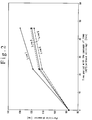
- Emulsified Dispersion 1 the kind of the water-soluble metal salt to be added, the amount to be added thereof, and the time when the addition thereof was made were varied, to prepare various emulsified dispersions; then, the particle diameter immediately after the preparation, and the particle diameter after allowing each of the emulsified dispersions to stand at 40 °C, were measured using the light-scattering method, and the stability with lapse of time was evaluated.
- Figs. 1 to 4 show the particle diameters (nm) immediately after the emulsification and dispersion, and the change of the particle diameters with lapse of time, wherein Line 1 is when no water-soluble metal salt was added, Line 2 is when 60 mmol of calcium nitrate was added to Liquid (1) of Emulsified Dispersion 1, and Line 3 is when 60 mmol of magnesium nitrate was added to Liquid (1) of Emulsified Dispersion 1.
- Fig. 2 shows the changes of the particle diameters with lapse of time, wherein Line 4 is when 60 mmol of magnesium nitrate was added immediately after the preparation of Emulsified Dispersion 1, Line 5 is when 60 mmol of calcium nitrate was added to Emulsified Dispersion 1, and Line 6 is when 60 mmol of barium nitrate was added to Emulsified Dispersion 1.
- Fig. 3 shows the changes of the particle diameters (particle size) when the added amount of calcium nitrate added to Liquid (1) of Emulsified Dispersion 1 was changed, in which Line 7 is when 30 mmol of calcium nitrate was added, and Line 8 is when 120 mmol of calcium nitrate was added.
- Fig. 4 shows the changes of the particle diameters when sodium nitrate was added to Emulsified Dispersion 1 immediately after its preparation, in which Line 9 is when 60 mmol of sodium nitrate was added, Line 10 is when 300 mmol of sodium nitrate was added, and Line 11 is when 600 mmol of sodium nitrate was added.
- a gelatin undercoat layer containing sodium dodecylbenzenesulfonate was provided, and the below-shown silver halide emulsion layer and a gelatin protective layer were successively applied, to prepare a color photographic light-sensitive material.
- an average grain size used hereinbelow means the average value of diameters of circles having the same areas as those of grains measured by the so-called projected area method.
- a silver chlorobromide emulsion (cubes; a mixture of a large-size emulsion C, having an average grain size of 0.50 ⁇ m, and a small-size emulsion C, having an average grain size of 0.41 ⁇ m, in a ratio of 1 : 4 in terms of mol of silver; the deviation coefficients of the grain size distributions being 0.09 and 0.11, respectively; and 0.5 mol% of silver bromide being contained in each of the emulsions locally in part of the surfaces of the grains whose substrate was made of silver chloride) was prepared.
- red-sensitive sensitizing dyes G and H were added, each in an amount of 6.0 x 10 -5 mol per mol of silver to the large-size emulsion, and each in an amount of 9.0 x 10 -5 mol per mol of silver to the small-size emulsion. Further, chemical ripening of this emulsion was optimally carried out by adding a sulfur sensitizer and a gold sensitizer.
- Emulsion Layer Coating Solution 1 was prepared by mixing and dissolving the Emulsified Dispersion 1 and the above silver chlorobromide emulsion.
- Emulsion Layer Coating Solution 2 was prepared by mixing and dissolving the Emulsified Dispersion 2 of a cyan coupler as prepared in Example 1 (one obtained by adding 60 mmol of calcium nitrate to Liquid (1) of Emulsified Dispersion 1) and the above silver chlorobromide emulsion.
- Light-Sensitive Materials 1 and 2 prepared by applying these Emulsion Layer Coating Solutions 1 and 2 respectively, were exposed to light through an exposure wedge and were subjected to rapid color development processing for a development time of 45 sec.
- Light-Sensitive Material 2 wherein Emulsified Dispersion 2 of the present invention was used, gave a higher maximum color density; that is, it was improved in color-forming property.
Landscapes
- Chemical & Material Sciences (AREA)
- Physics & Mathematics (AREA)
- General Physics & Mathematics (AREA)
- Chemical Kinetics & Catalysis (AREA)
- Engineering & Computer Science (AREA)
- Materials Engineering (AREA)
- Silver Salt Photography Or Processing Solution Therefor (AREA)
- Colloid Chemistry (AREA)
Applications Claiming Priority (2)
| Application Number | Priority Date | Filing Date | Title |
|---|---|---|---|
| JP30427097 | 1997-11-06 | ||
| JP304270/97 | 1997-11-06 |
Publications (2)
| Publication Number | Publication Date |
|---|---|
| EP0915376A1 true EP0915376A1 (fr) | 1999-05-12 |
| EP0915376B1 EP0915376B1 (fr) | 2009-09-30 |
Family
ID=17931035
Family Applications (1)
| Application Number | Title | Priority Date | Filing Date |
|---|---|---|---|
| EP98120643A Expired - Lifetime EP0915376B1 (fr) | 1997-11-06 | 1998-11-03 | Dispersion émulsionnée d'un composé hydrophobe, photographique et produit photographique à l'halogénure d'argent sensible à la lumière |
Country Status (4)
| Country | Link |
|---|---|
| US (1) | US6309812B1 (fr) |
| EP (1) | EP0915376B1 (fr) |
| AT (1) | ATE444502T1 (fr) |
| DE (1) | DE69841195D1 (fr) |
Citations (4)
| Publication number | Priority date | Publication date | Assignee | Title |
|---|---|---|---|---|
| GB1193349A (en) * | 1967-10-30 | 1970-05-28 | Ilford Ltd | Dispersing Colour Couplers |
| US3623877A (en) * | 1968-07-24 | 1971-11-30 | Ilford Ltd | Silver halide color photographic materials containing alkaline earth metal salts of color couplers |
| EP0683429A1 (fr) * | 1994-05-20 | 1995-11-22 | Fuji Photo Film Co., Ltd. | Procédé de dispersion de composés hydrophobes utilisables en photographie |
| EP0895119A1 (fr) * | 1997-07-31 | 1999-02-03 | Fuji Photo Film Co., Ltd. | Procédé de dispersion de sensibilisateur spectral et dispersion obtenue par ce procédé |
Family Cites Families (3)
| Publication number | Priority date | Publication date | Assignee | Title |
|---|---|---|---|---|
| BE470936A (fr) | 1940-02-24 | |||
| CH485782A (de) | 1964-06-23 | 1970-02-15 | Gevaert Photo Prod Nv | Verfahren zur Emulsionspolymerisation |
| US5380628A (en) * | 1991-07-29 | 1995-01-10 | Eastman Kodak Company | Method of preparing coupler dispersions |
-
1998
- 1998-11-03 AT AT98120643T patent/ATE444502T1/de not_active IP Right Cessation
- 1998-11-03 EP EP98120643A patent/EP0915376B1/fr not_active Expired - Lifetime
- 1998-11-03 DE DE69841195T patent/DE69841195D1/de not_active Expired - Lifetime
- 1998-11-03 US US09/184,939 patent/US6309812B1/en not_active Expired - Lifetime
Patent Citations (4)
| Publication number | Priority date | Publication date | Assignee | Title |
|---|---|---|---|---|
| GB1193349A (en) * | 1967-10-30 | 1970-05-28 | Ilford Ltd | Dispersing Colour Couplers |
| US3623877A (en) * | 1968-07-24 | 1971-11-30 | Ilford Ltd | Silver halide color photographic materials containing alkaline earth metal salts of color couplers |
| EP0683429A1 (fr) * | 1994-05-20 | 1995-11-22 | Fuji Photo Film Co., Ltd. | Procédé de dispersion de composés hydrophobes utilisables en photographie |
| EP0895119A1 (fr) * | 1997-07-31 | 1999-02-03 | Fuji Photo Film Co., Ltd. | Procédé de dispersion de sensibilisateur spectral et dispersion obtenue par ce procédé |
Non-Patent Citations (1)
| Title |
|---|
| CHEMICAL ABSTRACTS, vol. 90, no. 20, 14 May 1979, Columbus, Ohio, US; abstract no. 160101v, V NECYBOVA: "Silver halide emulsions for color photographic materials" page 514; column l; XP002096308 * |
Also Published As
| Publication number | Publication date |
|---|---|
| US6309812B1 (en) | 2001-10-30 |
| ATE444502T1 (de) | 2009-10-15 |
| DE69841195D1 (de) | 2009-11-12 |
| EP0915376B1 (fr) | 2009-09-30 |
Similar Documents
| Publication | Publication Date | Title |
|---|---|---|
| EP0599808B1 (fr) | Matériau photographique couleur à l'halogénure d'argent | |
| EP0727705B1 (fr) | Epreuve photographique | |
| EP0234472B1 (fr) | Matériau photographique couleur multicouche à l'halogénure d'argent | |
| US6309812B1 (en) | Emulsified dispersion of photographic hydrophobic compound and silver halide photographic light-sensitive material | |
| US5693461A (en) | Mixed packet color photographic system | |
| US6261757B1 (en) | Photographic element comprising an ion exchanged reducing agent | |
| JPH0341816B2 (fr) | ||
| EP0537234B1 (fr) | Materiau de support photographique de couleur inversible possedant une sous-couche de grain fin | |
| JPH07140616A (ja) | ハロゲン化銀カラー写真感光材料 | |
| JPH11119396A (ja) | 感光性ハロゲン化銀写真要素 | |
| JPH11194459A (ja) | 写真用乳化分散物およびこの乳化分散物を含んだハロゲン化銀写真感光材料 | |
| EP0509674A1 (fr) | Matériau couleur photographique à l'halogénure d'argent sensible à la lumière | |
| JPH071386B2 (ja) | ハロゲン化銀カラ−写真感材材料 | |
| JP3140282B2 (ja) | ハロゲン化銀カラー写真感光材料 | |
| JPH103148A (ja) | ハロゲン化銀カラー写真感光材料および画像形成方法 | |
| JP3219206B2 (ja) | カラー画像形成方法 | |
| JP3240525B2 (ja) | 熱現像感光材料 | |
| JP2000221638A (ja) | ハロゲン化銀カラー写真感光材料及びカラープルーフ作製方法 | |
| JPH07152119A (ja) | ハロゲン化銀カラー写真感光材料 | |
| JPS62115444A (ja) | 写真感光材料及びその処理方法 | |
| JPH1130838A (ja) | プリント用支持体、カラープリント、ハロゲン化銀写真感光材料、プリント画像識別方法、プリント画像コピー方法、及び画像形成の制御方法 | |
| JPH05173306A (ja) | ハロゲン化銀カラー写真感光材料 | |
| JPH08152702A (ja) | ハロゲン化銀カラー写真感光材料 | |
| JP2003043643A (ja) | ハロゲン化銀カラー写真感光材料の画像形成方法 | |
| JP2002122970A (ja) | ハロゲン化銀写真感光材料の画像形成方法 |
Legal Events
| Date | Code | Title | Description |
|---|---|---|---|
| PUAI | Public reference made under article 153(3) epc to a published international application that has entered the european phase |
Free format text: ORIGINAL CODE: 0009012 |
|
| AK | Designated contracting states |
Kind code of ref document: A1 Designated state(s): AT BE CH DE DK ES FI FR GB GR IE IT LI LU MC NL PT SE |
|
| AX | Request for extension of the european patent |
Free format text: AL;LT;LV;MK;RO;SI |
|
| RIN1 | Information on inventor provided before grant (corrected) |
Inventor name: FUKUOKA, MASAHIRO Inventor name: AOGAKI, YUKIO |
|
| 17P | Request for examination filed |
Effective date: 19991026 |
|
| AKX | Designation fees paid |
Free format text: AT BE CH DE DK ES FI FR GB GR IE IT LI LU MC NL PT SE |
|
| 17Q | First examination report despatched |
Effective date: 20050103 |
|
| 17Q | First examination report despatched |
Effective date: 20050103 |
|
| RAP1 | Party data changed (applicant data changed or rights of an application transferred) |
Owner name: FUJIFILM CORPORATION |
|
| GRAP | Despatch of communication of intention to grant a patent |
Free format text: ORIGINAL CODE: EPIDOSNIGR1 |
|
| GRAS | Grant fee paid |
Free format text: ORIGINAL CODE: EPIDOSNIGR3 |
|
| GRAA | (expected) grant |
Free format text: ORIGINAL CODE: 0009210 |
|
| AK | Designated contracting states |
Kind code of ref document: B1 Designated state(s): AT BE CH DE DK ES FI FR GB GR IE IT LI LU MC NL PT SE |
|
| REG | Reference to a national code |
Ref country code: GB Ref legal event code: FG4D Ref country code: CH Ref legal event code: EP |
|
| REG | Reference to a national code |
Ref country code: IE Ref legal event code: FG4D |
|
| REF | Corresponds to: |
Ref document number: 69841195 Country of ref document: DE Date of ref document: 20091112 Kind code of ref document: P |
|
| PG25 | Lapsed in a contracting state [announced via postgrant information from national office to epo] |
Ref country code: SE Free format text: LAPSE BECAUSE OF FAILURE TO SUBMIT A TRANSLATION OF THE DESCRIPTION OR TO PAY THE FEE WITHIN THE PRESCRIBED TIME-LIMIT Effective date: 20090930 Ref country code: FI Free format text: LAPSE BECAUSE OF FAILURE TO SUBMIT A TRANSLATION OF THE DESCRIPTION OR TO PAY THE FEE WITHIN THE PRESCRIBED TIME-LIMIT Effective date: 20090930 |
|
| NLV1 | Nl: lapsed or annulled due to failure to fulfill the requirements of art. 29p and 29m of the patents act | ||
| PG25 | Lapsed in a contracting state [announced via postgrant information from national office to epo] |
Ref country code: PT Free format text: LAPSE BECAUSE OF FAILURE TO SUBMIT A TRANSLATION OF THE DESCRIPTION OR TO PAY THE FEE WITHIN THE PRESCRIBED TIME-LIMIT Effective date: 20100201 Ref country code: ES Free format text: LAPSE BECAUSE OF FAILURE TO SUBMIT A TRANSLATION OF THE DESCRIPTION OR TO PAY THE FEE WITHIN THE PRESCRIBED TIME-LIMIT Effective date: 20100110 |
|
| PG25 | Lapsed in a contracting state [announced via postgrant information from national office to epo] |
Ref country code: MC Free format text: LAPSE BECAUSE OF NON-PAYMENT OF DUE FEES Effective date: 20091130 Ref country code: BE Free format text: LAPSE BECAUSE OF FAILURE TO SUBMIT A TRANSLATION OF THE DESCRIPTION OR TO PAY THE FEE WITHIN THE PRESCRIBED TIME-LIMIT Effective date: 20090930 Ref country code: AT Free format text: LAPSE BECAUSE OF FAILURE TO SUBMIT A TRANSLATION OF THE DESCRIPTION OR TO PAY THE FEE WITHIN THE PRESCRIBED TIME-LIMIT Effective date: 20090930 |
|
| REG | Reference to a national code |
Ref country code: CH Ref legal event code: PL |
|
| PG25 | Lapsed in a contracting state [announced via postgrant information from national office to epo] |
Ref country code: NL Free format text: LAPSE BECAUSE OF FAILURE TO SUBMIT A TRANSLATION OF THE DESCRIPTION OR TO PAY THE FEE WITHIN THE PRESCRIBED TIME-LIMIT Effective date: 20090930 Ref country code: DK Free format text: LAPSE BECAUSE OF FAILURE TO SUBMIT A TRANSLATION OF THE DESCRIPTION OR TO PAY THE FEE WITHIN THE PRESCRIBED TIME-LIMIT Effective date: 20090930 |
|
| PLBE | No opposition filed within time limit |
Free format text: ORIGINAL CODE: 0009261 |
|
| STAA | Information on the status of an ep patent application or granted ep patent |
Free format text: STATUS: NO OPPOSITION FILED WITHIN TIME LIMIT |
|
| GBPC | Gb: european patent ceased through non-payment of renewal fee |
Effective date: 20091230 |
|
| REG | Reference to a national code |
Ref country code: FR Ref legal event code: ST Effective date: 20100730 |
|
| 26N | No opposition filed |
Effective date: 20100701 |
|
| PG25 | Lapsed in a contracting state [announced via postgrant information from national office to epo] |
Ref country code: LI Free format text: LAPSE BECAUSE OF NON-PAYMENT OF DUE FEES Effective date: 20091130 Ref country code: IE Free format text: LAPSE BECAUSE OF NON-PAYMENT OF DUE FEES Effective date: 20091103 Ref country code: GR Free format text: LAPSE BECAUSE OF FAILURE TO SUBMIT A TRANSLATION OF THE DESCRIPTION OR TO PAY THE FEE WITHIN THE PRESCRIBED TIME-LIMIT Effective date: 20091231 Ref country code: FR Free format text: LAPSE BECAUSE OF NON-PAYMENT OF DUE FEES Effective date: 20091130 Ref country code: CH Free format text: LAPSE BECAUSE OF NON-PAYMENT OF DUE FEES Effective date: 20091130 |
|
| PG25 | Lapsed in a contracting state [announced via postgrant information from national office to epo] |
Ref country code: GB Free format text: LAPSE BECAUSE OF NON-PAYMENT OF DUE FEES Effective date: 20091230 |
|
| PGFP | Annual fee paid to national office [announced via postgrant information from national office to epo] |
Ref country code: DE Payment date: 20101006 Year of fee payment: 13 |
|
| PG25 | Lapsed in a contracting state [announced via postgrant information from national office to epo] |
Ref country code: IT Free format text: LAPSE BECAUSE OF FAILURE TO SUBMIT A TRANSLATION OF THE DESCRIPTION OR TO PAY THE FEE WITHIN THE PRESCRIBED TIME-LIMIT Effective date: 20090930 |
|
| PG25 | Lapsed in a contracting state [announced via postgrant information from national office to epo] |
Ref country code: LU Free format text: LAPSE BECAUSE OF NON-PAYMENT OF DUE FEES Effective date: 20091103 |
|
| REG | Reference to a national code |
Ref country code: DE Ref legal event code: R119 Ref document number: 69841195 Country of ref document: DE Effective date: 20130601 |
|
| PG25 | Lapsed in a contracting state [announced via postgrant information from national office to epo] |
Ref country code: DE Free format text: LAPSE BECAUSE OF NON-PAYMENT OF DUE FEES Effective date: 20130601 |