EP0915897B1 - Verfahren zur kombination von paralleler oligonukleotidsynthese und darstellung von oligomer-chips - Google Patents
Verfahren zur kombination von paralleler oligonukleotidsynthese und darstellung von oligomer-chips Download PDFInfo
- Publication number
- EP0915897B1 EP0915897B1 EP97931663A EP97931663A EP0915897B1 EP 0915897 B1 EP0915897 B1 EP 0915897B1 EP 97931663 A EP97931663 A EP 97931663A EP 97931663 A EP97931663 A EP 97931663A EP 0915897 B1 EP0915897 B1 EP 0915897B1
- Authority
- EP
- European Patent Office
- Prior art keywords
- synthesis
- npeoc
- matrix
- oligonucleotides
- oligomer
- Prior art date
- Legal status (The legal status is an assumption and is not a legal conclusion. Google has not performed a legal analysis and makes no representation as to the accuracy of the status listed.)
- Expired - Lifetime
Links
Images





Classifications
-
- C—CHEMISTRY; METALLURGY
- C07—ORGANIC CHEMISTRY
- C07H—SUGARS; DERIVATIVES THEREOF; NUCLEOSIDES; NUCLEOTIDES; NUCLEIC ACIDS
- C07H21/00—Compounds containing two or more mononucleotide units having separate phosphate or polyphosphate groups linked by saccharide radicals of nucleoside groups, e.g. nucleic acids
-
- B—PERFORMING OPERATIONS; TRANSPORTING
- B01—PHYSICAL OR CHEMICAL PROCESSES OR APPARATUS IN GENERAL
- B01J—CHEMICAL OR PHYSICAL PROCESSES, e.g. CATALYSIS OR COLLOID CHEMISTRY; THEIR RELEVANT APPARATUS
- B01J19/00—Chemical, physical or physico-chemical processes in general; Their relevant apparatus
- B01J19/0046—Sequential or parallel reactions, e.g. for the synthesis of polypeptides or polynucleotides; Apparatus and devices for combinatorial chemistry or for making molecular arrays
-
- C—CHEMISTRY; METALLURGY
- C12—BIOCHEMISTRY; BEER; SPIRITS; WINE; VINEGAR; MICROBIOLOGY; ENZYMOLOGY; MUTATION OR GENETIC ENGINEERING
- C12Q—MEASURING OR TESTING PROCESSES INVOLVING ENZYMES, NUCLEIC ACIDS OR MICROORGANISMS; COMPOSITIONS OR TEST PAPERS THEREFOR; PROCESSES OF PREPARING SUCH COMPOSITIONS; CONDITION-RESPONSIVE CONTROL IN MICROBIOLOGICAL OR ENZYMOLOGICAL PROCESSES
- C12Q1/00—Measuring or testing processes involving enzymes, nucleic acids or microorganisms; Compositions therefor; Processes of preparing such compositions
- C12Q1/68—Measuring or testing processes involving enzymes, nucleic acids or microorganisms; Compositions therefor; Processes of preparing such compositions involving nucleic acids
- C12Q1/6813—Hybridisation assays
- C12Q1/6834—Enzymatic or biochemical coupling of nucleic acids to a solid phase
- C12Q1/6837—Enzymatic or biochemical coupling of nucleic acids to a solid phase using probe arrays or probe chips
-
- B—PERFORMING OPERATIONS; TRANSPORTING
- B01—PHYSICAL OR CHEMICAL PROCESSES OR APPARATUS IN GENERAL
- B01J—CHEMICAL OR PHYSICAL PROCESSES, e.g. CATALYSIS OR COLLOID CHEMISTRY; THEIR RELEVANT APPARATUS
- B01J2219/00—Chemical, physical or physico-chemical processes in general; Their relevant apparatus
- B01J2219/00274—Sequential or parallel reactions; Apparatus and devices for combinatorial chemistry or for making arrays; Chemical library technology
- B01J2219/00277—Apparatus
- B01J2219/00279—Features relating to reactor vessels
- B01J2219/00306—Reactor vessels in a multiple arrangement
-
- B—PERFORMING OPERATIONS; TRANSPORTING
- B01—PHYSICAL OR CHEMICAL PROCESSES OR APPARATUS IN GENERAL
- B01J—CHEMICAL OR PHYSICAL PROCESSES, e.g. CATALYSIS OR COLLOID CHEMISTRY; THEIR RELEVANT APPARATUS
- B01J2219/00—Chemical, physical or physico-chemical processes in general; Their relevant apparatus
- B01J2219/00274—Sequential or parallel reactions; Apparatus and devices for combinatorial chemistry or for making arrays; Chemical library technology
- B01J2219/00277—Apparatus
- B01J2219/00351—Means for dispensing and evacuation of reagents
- B01J2219/00427—Means for dispensing and evacuation of reagents using masks
- B01J2219/0043—Means for dispensing and evacuation of reagents using masks for direct application of reagents, e.g. through openings in a shutter
-
- B—PERFORMING OPERATIONS; TRANSPORTING
- B01—PHYSICAL OR CHEMICAL PROCESSES OR APPARATUS IN GENERAL
- B01J—CHEMICAL OR PHYSICAL PROCESSES, e.g. CATALYSIS OR COLLOID CHEMISTRY; THEIR RELEVANT APPARATUS
- B01J2219/00—Chemical, physical or physico-chemical processes in general; Their relevant apparatus
- B01J2219/00274—Sequential or parallel reactions; Apparatus and devices for combinatorial chemistry or for making arrays; Chemical library technology
- B01J2219/00277—Apparatus
- B01J2219/00497—Features relating to the solid phase supports
- B01J2219/00527—Sheets
-
- B—PERFORMING OPERATIONS; TRANSPORTING
- B01—PHYSICAL OR CHEMICAL PROCESSES OR APPARATUS IN GENERAL
- B01J—CHEMICAL OR PHYSICAL PROCESSES, e.g. CATALYSIS OR COLLOID CHEMISTRY; THEIR RELEVANT APPARATUS
- B01J2219/00—Chemical, physical or physico-chemical processes in general; Their relevant apparatus
- B01J2219/00274—Sequential or parallel reactions; Apparatus and devices for combinatorial chemistry or for making arrays; Chemical library technology
- B01J2219/00277—Apparatus
- B01J2219/00497—Features relating to the solid phase supports
- B01J2219/00527—Sheets
- B01J2219/00533—Sheets essentially rectangular
-
- B—PERFORMING OPERATIONS; TRANSPORTING
- B01—PHYSICAL OR CHEMICAL PROCESSES OR APPARATUS IN GENERAL
- B01J—CHEMICAL OR PHYSICAL PROCESSES, e.g. CATALYSIS OR COLLOID CHEMISTRY; THEIR RELEVANT APPARATUS
- B01J2219/00—Chemical, physical or physico-chemical processes in general; Their relevant apparatus
- B01J2219/00274—Sequential or parallel reactions; Apparatus and devices for combinatorial chemistry or for making arrays; Chemical library technology
- B01J2219/00583—Features relative to the processes being carried out
- B01J2219/00585—Parallel processes
-
- B—PERFORMING OPERATIONS; TRANSPORTING
- B01—PHYSICAL OR CHEMICAL PROCESSES OR APPARATUS IN GENERAL
- B01J—CHEMICAL OR PHYSICAL PROCESSES, e.g. CATALYSIS OR COLLOID CHEMISTRY; THEIR RELEVANT APPARATUS
- B01J2219/00—Chemical, physical or physico-chemical processes in general; Their relevant apparatus
- B01J2219/00274—Sequential or parallel reactions; Apparatus and devices for combinatorial chemistry or for making arrays; Chemical library technology
- B01J2219/00583—Features relative to the processes being carried out
- B01J2219/0059—Sequential processes
-
- B—PERFORMING OPERATIONS; TRANSPORTING
- B01—PHYSICAL OR CHEMICAL PROCESSES OR APPARATUS IN GENERAL
- B01J—CHEMICAL OR PHYSICAL PROCESSES, e.g. CATALYSIS OR COLLOID CHEMISTRY; THEIR RELEVANT APPARATUS
- B01J2219/00—Chemical, physical or physico-chemical processes in general; Their relevant apparatus
- B01J2219/00274—Sequential or parallel reactions; Apparatus and devices for combinatorial chemistry or for making arrays; Chemical library technology
- B01J2219/00583—Features relative to the processes being carried out
- B01J2219/00596—Solid-phase processes
-
- B—PERFORMING OPERATIONS; TRANSPORTING
- B01—PHYSICAL OR CHEMICAL PROCESSES OR APPARATUS IN GENERAL
- B01J—CHEMICAL OR PHYSICAL PROCESSES, e.g. CATALYSIS OR COLLOID CHEMISTRY; THEIR RELEVANT APPARATUS
- B01J2219/00—Chemical, physical or physico-chemical processes in general; Their relevant apparatus
- B01J2219/00274—Sequential or parallel reactions; Apparatus and devices for combinatorial chemistry or for making arrays; Chemical library technology
- B01J2219/00583—Features relative to the processes being carried out
- B01J2219/00603—Making arrays on substantially continuous surfaces
- B01J2219/00605—Making arrays on substantially continuous surfaces the compounds being directly bound or immobilised to solid supports
-
- B—PERFORMING OPERATIONS; TRANSPORTING
- B01—PHYSICAL OR CHEMICAL PROCESSES OR APPARATUS IN GENERAL
- B01J—CHEMICAL OR PHYSICAL PROCESSES, e.g. CATALYSIS OR COLLOID CHEMISTRY; THEIR RELEVANT APPARATUS
- B01J2219/00—Chemical, physical or physico-chemical processes in general; Their relevant apparatus
- B01J2219/00274—Sequential or parallel reactions; Apparatus and devices for combinatorial chemistry or for making arrays; Chemical library technology
- B01J2219/00583—Features relative to the processes being carried out
- B01J2219/00603—Making arrays on substantially continuous surfaces
- B01J2219/00605—Making arrays on substantially continuous surfaces the compounds being directly bound or immobilised to solid supports
- B01J2219/0061—The surface being organic
-
- B—PERFORMING OPERATIONS; TRANSPORTING
- B01—PHYSICAL OR CHEMICAL PROCESSES OR APPARATUS IN GENERAL
- B01J—CHEMICAL OR PHYSICAL PROCESSES, e.g. CATALYSIS OR COLLOID CHEMISTRY; THEIR RELEVANT APPARATUS
- B01J2219/00—Chemical, physical or physico-chemical processes in general; Their relevant apparatus
- B01J2219/00274—Sequential or parallel reactions; Apparatus and devices for combinatorial chemistry or for making arrays; Chemical library technology
- B01J2219/00583—Features relative to the processes being carried out
- B01J2219/00603—Making arrays on substantially continuous surfaces
- B01J2219/00605—Making arrays on substantially continuous surfaces the compounds being directly bound or immobilised to solid supports
- B01J2219/00612—Making arrays on substantially continuous surfaces the compounds being directly bound or immobilised to solid supports the surface being inorganic
-
- B—PERFORMING OPERATIONS; TRANSPORTING
- B01—PHYSICAL OR CHEMICAL PROCESSES OR APPARATUS IN GENERAL
- B01J—CHEMICAL OR PHYSICAL PROCESSES, e.g. CATALYSIS OR COLLOID CHEMISTRY; THEIR RELEVANT APPARATUS
- B01J2219/00—Chemical, physical or physico-chemical processes in general; Their relevant apparatus
- B01J2219/00274—Sequential or parallel reactions; Apparatus and devices for combinatorial chemistry or for making arrays; Chemical library technology
- B01J2219/00583—Features relative to the processes being carried out
- B01J2219/00603—Making arrays on substantially continuous surfaces
- B01J2219/00605—Making arrays on substantially continuous surfaces the compounds being directly bound or immobilised to solid supports
- B01J2219/00623—Immobilisation or binding
- B01J2219/00626—Covalent
-
- B—PERFORMING OPERATIONS; TRANSPORTING
- B01—PHYSICAL OR CHEMICAL PROCESSES OR APPARATUS IN GENERAL
- B01J—CHEMICAL OR PHYSICAL PROCESSES, e.g. CATALYSIS OR COLLOID CHEMISTRY; THEIR RELEVANT APPARATUS
- B01J2219/00—Chemical, physical or physico-chemical processes in general; Their relevant apparatus
- B01J2219/00274—Sequential or parallel reactions; Apparatus and devices for combinatorial chemistry or for making arrays; Chemical library technology
- B01J2219/00583—Features relative to the processes being carried out
- B01J2219/00603—Making arrays on substantially continuous surfaces
- B01J2219/00605—Making arrays on substantially continuous surfaces the compounds being directly bound or immobilised to solid supports
- B01J2219/00632—Introduction of reactive groups to the surface
- B01J2219/00637—Introduction of reactive groups to the surface by coating it with another layer
-
- B—PERFORMING OPERATIONS; TRANSPORTING
- B01—PHYSICAL OR CHEMICAL PROCESSES OR APPARATUS IN GENERAL
- B01J—CHEMICAL OR PHYSICAL PROCESSES, e.g. CATALYSIS OR COLLOID CHEMISTRY; THEIR RELEVANT APPARATUS
- B01J2219/00—Chemical, physical or physico-chemical processes in general; Their relevant apparatus
- B01J2219/00274—Sequential or parallel reactions; Apparatus and devices for combinatorial chemistry or for making arrays; Chemical library technology
- B01J2219/00583—Features relative to the processes being carried out
- B01J2219/00603—Making arrays on substantially continuous surfaces
- B01J2219/00659—Two-dimensional arrays
-
- B—PERFORMING OPERATIONS; TRANSPORTING
- B01—PHYSICAL OR CHEMICAL PROCESSES OR APPARATUS IN GENERAL
- B01J—CHEMICAL OR PHYSICAL PROCESSES, e.g. CATALYSIS OR COLLOID CHEMISTRY; THEIR RELEVANT APPARATUS
- B01J2219/00—Chemical, physical or physico-chemical processes in general; Their relevant apparatus
- B01J2219/00274—Sequential or parallel reactions; Apparatus and devices for combinatorial chemistry or for making arrays; Chemical library technology
- B01J2219/00718—Type of compounds synthesised
- B01J2219/0072—Organic compounds
- B01J2219/00722—Nucleotides
-
- C—CHEMISTRY; METALLURGY
- C40—COMBINATORIAL TECHNOLOGY
- C40B—COMBINATORIAL CHEMISTRY; LIBRARIES, e.g. CHEMICAL LIBRARIES
- C40B40/00—Libraries per se, e.g. arrays, mixtures
- C40B40/04—Libraries containing only organic compounds
- C40B40/06—Libraries containing nucleotides or polynucleotides, or derivatives thereof
-
- C—CHEMISTRY; METALLURGY
- C40—COMBINATORIAL TECHNOLOGY
- C40B—COMBINATORIAL CHEMISTRY; LIBRARIES, e.g. CHEMICAL LIBRARIES
- C40B60/00—Apparatus specially adapted for use in combinatorial chemistry or with libraries
- C40B60/14—Apparatus specially adapted for use in combinatorial chemistry or with libraries for creating libraries
Definitions
- the invention relates to a method for the combination of parallel oligonucleotide synthesis and representation of Oligomer chips.
- oligomer chip Technology has an increasing role in diagnostic DNA analysis. Also with respect to many methods of genome analysis, e.g. for "sequencing by hybridization", there is a big one Potential in the use of matrices, on the ordered Oligonucleotide screens were applied.
- the object of the present invention is therefore to to provide a method with which it is possible to simple way possible different oligonucleotides to provide, on the one hand, as “oligomer chips" for Hybridization experiments can serve, but on the other hand also orderly removable and thus available for molecular biological reactions such as PCR or DNA sequencing are.
- the inventors are in the development of their new process of the "Oligomerchip technology" (Southern, E. M. et al., Genomics 13, 1008-1017; Caviani-Pease, A.C. et al., Proc. Natl. Acad. Sci. U.S.A. 91, 5022-5026), which was previously used for the sequencing of DNA.
- This technique becomes a target matrix with short oligonucleotide sequences bound thereto used for hybridization experiments. It is ensured that the attached to the matrix oligonucleotides are firmly connected.
- the inventors have now made this binding of the oligonucleotides to the matrix so modified that on the one hand it is possible to the resulting Oligomerchip too Hybridization analysis of DNA using oligomer chip technology or replace the oligonucleotides orderly, then for PCR purposes or in the enzymatic sequencing of DNA or as a probe for hybridizations use.
- the matrix on which the oligonucleotides are bound can be a polymer film or a glass surface, but an aminated one is preferred Polypropylene film, which is further surface-modified.
- a possible surface modification the attachment of alkylamino groups is preferred Methylamino groups. This happens, for example, in that an aminated Polypropylene film in a mixture of dry dichloromethane, dry Dioxane, p-Nitrophenylchlorformiat and triethylamine shaken for a few hours becomes. After washing with dichloromethane, the film is in a mixture shaken by pyridine and acetic anhydride for several hours, leaving remaining Saturated amino groups on the surface.
- a protruding matrix in particular a methylamino-modified membrane, can be clamped in a synthesis chamber, for example one as shown in FIG.
- Protected nucleosides 3'-succinate derivatives eg NPEOC , dC NPEOC , dG NPEOC / NPE , dT and fluorescein-labeled dC
- 3'-succinate derivatives can be applied to the matrix, the 3'-succinate derivatives as described in Kierzek et al. (Biochemistry 25, pp. 7840-7846 (1986)).
- desired nucleoside 3'-succinates are mixed with an organic solvent such as N-methylmorpholine and acetonitrile before O - [(ethoxycarbonyl) cyanomethyleneamino] N, N, N ', N'-tetramethyluronium tetrafluoroborate (TOTU) is added ,
- This reaction mixture is fed into the synthesis chamber and a simple preset cycle in the chamber is activated.
- This cycle looks like that the rows on the matrix, preferably the methylamino-modified polypropylene film, are moistened with the reaction mixture and incubated for a certain time, for example 30 minutes.
- the reagents are then rinsed off and the rows are washed several times with an organic solvent such as acetonitrile.
- an organic solvent such as acetonitrile.
- the matrix removed from the synthesis chamber may be treated in a mixture of acetic anhydride, pyridine and N-methylimidazole. After washing with DMF, methanol and acetone, the matrix is dried.
- oligonucleotide synthesis it may be beneficial to use the scheme below.
- the synthesis chamber shown in Fig. 1 is suitable. Modifications of the scheme with regard to sequence of steps, replacement of reagents or solvents and incubation times are within the skill of the artisan and the scheme is not to be construed as limiting the invention in any way.
- the matrix is removed from the synthesis chamber and in 1M 1,8-diazabicyclo- (5.4.0) -undec-7en (DBU) in acetonitrile for deprotection shaken the oligonucleotides.
- DBU 1,8-diazabicyclo- (5.4.0) -undec-7en
- the matrix is washed, e.g. with acetonitrile and acetone.
- the detached Oligonucleotide products are lyophilized and used for PCR or DNA sequencing methods used.
- a polyoxymethylene (POM) block was prepared containing 8 channels, each 1 mm deep, 70 mm long and 4 mm wide, with 2 holes at both ends for connection to the inlet and outlet of a standard DNA synthesizer.
- the polypropylene film was held in place by a silicone seal and a Plexiglas lid screwed onto the POM base ( Figure 1). To obtain a perfect seal, additional pressure was applied to the entire device by means of a clamp. By removing the polypropylene film after a single or multiple cycles, rotating through 90 ° and continuing synthesis, this simple and small instrument allows the synthesis of up to 64 different oligomers.
- the film was washed with dichloromethane and taken up in 50 ml of acetonitrile or dimethylformamide (DMF); 0.2 ml of 1,6-bis (methylamino) hexane was added and the mixture was shaken at 40 ° C for 48 h. After successive washing with DMF, methanol and acetone, the methylamino-modified propylene film was dried and stored at 4 ° C.
- DMF acetonitrile or dimethylformamide
- dA NPEOC , dC NPEOC , dG NPEOC / NPE , dT and fluorescein-labeled dC were prepared by the method described by Kierzek et al. (Biochemistry 25, pp. 7840-7846 (1986)).
- the derivatized polypropylene membranes were removed from the chamber and shaken in a mixture of 10 ml of acetic anhydride, 10 ml of dry pyridine and 1 ml of N-methylimidazole for 2 h in a polypropylene box. After subsequent washing with DMF, methanol and acetone, the films were dried and stored at 4 ° C until use.
- the oligonucleotide synthesis was performed on the polypropylene film as in the above Table 1 can be seen. After complete synthesis, the Foils removed from the chamber and in 1 M DBU in acetonitrile in a polypropylene box shaken at 40 ° C overnight. The membrane was treated with acetonitrile and Acetone washed before either for hybridization experiments or was used to detach the oligomers.
- Oligonucleotide probes were end labeled with [ ⁇ 32 P] ATP under standard conditions.
- PCR was performed on the recombinant plasmid pTZ18R under standard conditions as previously described (Scholler et al., Nucleic Acids Res. 23, pages 3842-3849, (1995)). Primers were 26- and 29-mers that bind to the vector just next to each side of the insert DNA. An oligonucleotide amount corresponding to an area of 0.16 cm 2 of the polypropylene surface was used in the 25 ⁇ l volume reactions. PCR was performed: primer annealing and extension at 68 ° C, strand denaturation at 95 ° C. On an agarose gel, the products were compared with the results obtained with conventional commercial primer molecules used at a concentration of 1 ⁇ M. As can be seen from Fig. 6, there was no significant difference in quality and quantity of the PCR products.
Landscapes
- Chemical & Material Sciences (AREA)
- Organic Chemistry (AREA)
- Life Sciences & Earth Sciences (AREA)
- Health & Medical Sciences (AREA)
- Biochemistry (AREA)
- Molecular Biology (AREA)
- Engineering & Computer Science (AREA)
- Zoology (AREA)
- Wood Science & Technology (AREA)
- Genetics & Genomics (AREA)
- Biotechnology (AREA)
- Proteomics, Peptides & Aminoacids (AREA)
- General Health & Medical Sciences (AREA)
- Immunology (AREA)
- Analytical Chemistry (AREA)
- Physics & Mathematics (AREA)
- Chemical Kinetics & Catalysis (AREA)
- Bioinformatics & Cheminformatics (AREA)
- General Engineering & Computer Science (AREA)
- Microbiology (AREA)
- Biophysics (AREA)
- Saccharide Compounds (AREA)
- Measuring Or Testing Involving Enzymes Or Micro-Organisms (AREA)
Description
| Schema einer Oligonukleotidsynthese | ||
| Schritt | Reagenz oder Lösungsmittel | Zeit (s) |
| Waschen | Acetonitril | 30 |
| Detritylierung | 3 % TCA in Dichlormethan | 80 |
| Waschen | Acetonitril | 210 |
| Koppeln | 75 mM Phosphoramidit + 0,5 M Tetrazol in Acetonitril | 40 |
| Waschen | Acetonitril | 30 |
| Ablösen | Acetanhydrid/N-Methylimidazol in Acetonitril | 50 |
| Oxidation | 1 M t-Butylhydroperoxid in Acetonitril | 130 |
| Waschen | Acetonitril | 120 |
- Abb. 1:
- Reaktionskammer für die Oligonukleotidsynthese auf Polypropylenfolie, wobei das Gerät so ausgerichtet ist, daß es eine 90° Rotation der Polypropylenfolie zwischen den Syntheseschritten erlaubt.
- Abb. 2:
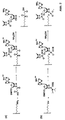
- Anbringung einer Probe und Ablösung durch Ammoniak (NH4OH), verwendet für die Standardsynthese freier Oligonukleotide (a) und für die Herstellung von Oligonukleotid-Anordnungen (b); X = O; X = NH
- Abb. 3:
- Abtrennnung der Festphasen-gebundenen Oligonukleotide von der Oberfläche. Anwendung der "NPE/NPEOC-Strategie" erlaubt die alternative Verwendung der Oligomerchips für entweder Hybridisierungsexperimente (Option I) oder als Quelle für die Isolation einzelner Primermoleküle (Option II).
- Abb. 4:
- Aktivierung der Methylamino-modifizierten Polypropylenfolie und Kopplung der geeignet geschützten Nukleoside.
- Abb. 5:
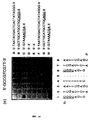
- Exemplarische Hybridisierungen zu Oligomeranordnungen auf Polypropylenmembranen. (a), (b): 4 verschiedene Startnukleoside, dCNPEOC (Säulen 3,7), dANPEOC (Säulen 2,6), dCbz (Säule 1) und dCf1 (Säulen 4,8) wurden an eine Polypropylenfolie unter Verwendung eines 8-Kanal-Synthesegeräts aufgebracht. Die Folie wurde dann aus der Reaktionskammer entfernt und um 90° gedreht. Nachfolgend wurden 7 verschiedene Oligonukleotide synthetisiert (A-H), die 49 Plätze mit 28 verschiedenen Sequenzen erzeugen. Ein Kanal wurde in beiden Dimensionen als Kontrolle leer gelassen (Spuren 5 und D). Nach Oligomerdeprotektion wurden einige Plätze (z.B. B2,6,8; C8; E8) zur Analyse ausgeschnitten. Die verbleibende Folie wurde mit einem (a) 9-mer d(CTATAGTGA) und (b) einem 12-mer d(GA11) hybridisiert. Komplementäre Sequenzen sind unterstrichen. In (c) und (d) wurde die Folie zwischen den Syntheseschritten um 90° gedreht. Es wurden Nonamere hybridisiert, deren Sequenzen Bruchpunkte der Synthese abdecken.
- Abb. 6:
- PCR-Amplifikation eines Plasmid-Inserts. Beide kommerziellen Primer wurden für die Reaktion verwendet, die in Spur 1 aufgetragen ist. In den Spuren B und C wurde jeder der Primer durch Oligonukleotide ersetzt, die von einem 0,16 cm2 Stück der erfindungsgemäß behandelten Polypropylenfolie isoliert worden sind. Marker (Spur D) ist HindIII-verdaute λ-DNA und mit Fspl geschnittene Plasmid pUC18-DNA.
Claims (6)
- Verfahren zur parallelen Synthese von Oligonukleotiden auf einer Alkylamino-modifizierten Matrixoberfläche, dadurch gekennzeichnet, daß 3'-Succinat-Derivate von geschützten Nukleosiden darauf gereiht angebracht werden und Oligonukleotidsynthese mittels automatisierter DNA-Synthese stattfindet.
- Verfahren nach Anspruch 1, wobei die Matrixoberfläche mit Methylamino-Gruppen modifiziert ist.
- Verfahren nach Anspruch 1 oder 2, wobei die 3'-Succinat-Derivate von dANPEOC, dCNPEOC, dGNPEOC/NPE, dT und Fluorescein-markiertem dC sind.
- Verfahren nach einem der Ansprüche 1 bis 3, wobei die Matrix in einer Synthesekammer mit mehreren Kanälen eingespannt ist.
- Verfahren nach einem der Ansprüche 1 bis 4, wobei die Matrix aus Glas oder einem Polymer, bevorzugt Polypropylen, ist.
- Verwendung des bei dem Verfahren nach einem der Ansprüche 1 bis 5 entstehenden Oligomer-Chips, die die in Anspruch 1 angegebene Matrixoberfläche haben, in Hybridisierungsexperimente oder als Quelle hochqualitativer Biopolymere.
Applications Claiming Priority (3)
| Application Number | Priority Date | Filing Date | Title |
|---|---|---|---|
| DE19625397 | 1996-06-25 | ||
| DE19625397A DE19625397A1 (de) | 1996-06-25 | 1996-06-25 | Verfahren zur Kombination von paralleler Oligonukleotidsynthese und Darstellung von Oligomer-Chips |
| PCT/DE1997/001332 WO1997049714A1 (de) | 1996-06-25 | 1997-06-24 | Verfahren zur kombination von paralleler oligonukleotidsynthese und darstellung von oligomer-chips |
Publications (2)
| Publication Number | Publication Date |
|---|---|
| EP0915897A1 EP0915897A1 (de) | 1999-05-19 |
| EP0915897B1 true EP0915897B1 (de) | 2005-04-13 |
Family
ID=7797958
Family Applications (1)
| Application Number | Title | Priority Date | Filing Date |
|---|---|---|---|
| EP97931663A Expired - Lifetime EP0915897B1 (de) | 1996-06-25 | 1997-06-24 | Verfahren zur kombination von paralleler oligonukleotidsynthese und darstellung von oligomer-chips |
Country Status (7)
| Country | Link |
|---|---|
| US (1) | US20070282098A1 (de) |
| EP (1) | EP0915897B1 (de) |
| JP (1) | JP2000513216A (de) |
| AT (1) | ATE293121T1 (de) |
| DE (2) | DE19625397A1 (de) |
| ES (1) | ES2242228T3 (de) |
| WO (1) | WO1997049714A1 (de) |
Families Citing this family (4)
| Publication number | Priority date | Publication date | Assignee | Title |
|---|---|---|---|---|
| DE19819735A1 (de) * | 1998-05-02 | 1999-11-04 | Novartis Ag | Vorrichtung und Verfahren zur Herstellung einer Anordnung von Kettenmolekülen auf einem Trägermaterial |
| DE19842164B4 (de) * | 1998-09-15 | 2004-06-03 | Deutsches Krebsforschungszentrum Stiftung des öffentlichen Rechts | Verfahren zur Qualitätskontrolle beim Aufbau von Oligomerrastern |
| DE19935749C2 (de) * | 1999-07-28 | 2003-06-26 | Epigenomics Ag | Verfahren zur Chrakterisierung von Nukleinsäurefragmenten |
| WO2020037194A1 (en) * | 2018-08-17 | 2020-02-20 | Sierra Biosystems, Inc. | Row-independent oligonucleotide synthesis |
Family Cites Families (8)
| Publication number | Priority date | Publication date | Assignee | Title |
|---|---|---|---|---|
| EP0090789A1 (de) * | 1982-03-26 | 1983-10-05 | Monsanto Company | Chemische DNA-Synthese |
| FR2529892A1 (fr) * | 1982-07-09 | 1984-01-13 | Transgene Sa | Nouveau support pour la synthese des polynucleotides, en particulier par la methode triester et procede pour sa preparation |
| AU660534B2 (en) * | 1992-02-13 | 1995-06-29 | Novo Nordisk A/S | Polyethylene or polypropylene glycol containing polymer |
| US5472672A (en) * | 1993-10-22 | 1995-12-05 | The Board Of Trustees Of The Leland Stanford Junior University | Apparatus and method for polymer synthesis using arrays |
| US5429807A (en) * | 1993-10-28 | 1995-07-04 | Beckman Instruments, Inc. | Method and apparatus for creating biopolymer arrays on a solid support surface |
| DE4343126A1 (de) * | 1993-12-17 | 1995-06-22 | Hoechst Ag | Festphasensynthese von Oligoribonucleotiden |
| WO1995030774A1 (en) * | 1994-05-05 | 1995-11-16 | Beckman Instruments, Inc. | Oligonucleotide repeat arrays |
| US5599695A (en) * | 1995-02-27 | 1997-02-04 | Affymetrix, Inc. | Printing molecular library arrays using deprotection agents solely in the vapor phase |
-
1996
- 1996-06-25 DE DE19625397A patent/DE19625397A1/de not_active Withdrawn
-
1997
- 1997-06-24 DE DE59712270T patent/DE59712270D1/de not_active Expired - Fee Related
- 1997-06-24 EP EP97931663A patent/EP0915897B1/de not_active Expired - Lifetime
- 1997-06-24 AT AT97931663T patent/ATE293121T1/de not_active IP Right Cessation
- 1997-06-24 JP JP10502115A patent/JP2000513216A/ja active Pending
- 1997-06-24 WO PCT/DE1997/001332 patent/WO1997049714A1/de not_active Ceased
- 1997-06-24 ES ES97931663T patent/ES2242228T3/es not_active Expired - Lifetime
-
2007
- 2007-01-31 US US11/700,617 patent/US20070282098A1/en not_active Abandoned
Also Published As
| Publication number | Publication date |
|---|---|
| JP2000513216A (ja) | 2000-10-10 |
| WO1997049714A1 (de) | 1997-12-31 |
| ATE293121T1 (de) | 2005-04-15 |
| DE59712270D1 (de) | 2005-05-19 |
| DE19625397A1 (de) | 1998-01-08 |
| EP0915897A1 (de) | 1999-05-19 |
| ES2242228T3 (es) | 2005-11-01 |
| US20070282098A1 (en) | 2007-12-06 |
Similar Documents
| Publication | Publication Date | Title |
|---|---|---|
| DE60007498T2 (de) | Verfahren yur Herstellung von Oligonukleotidarrays | |
| DE69221980T2 (de) | Verfahren und vorrichtung zur bestimmung von dns-nukleotid-sequenzen | |
| DE60034878T2 (de) | Verfahren zur Amplifizierung einer Nukleinsäuresequenz unter Verwendung eines chimären Primers | |
| DE69424930T2 (de) | Synthese von biopolymeren unter verwendung von oberflaechenakativierten organischen polymeren | |
| DE60029042T2 (de) | Festphase Nukleinsäuremarkierung durch Transaminierung | |
| DE3689954T2 (de) | Amplifiziertes hybridisierungstestverfahren. | |
| DE60208278T2 (de) | System und Verfahren zum Testen von Nukleinsäuremolekülen | |
| EP0174525B1 (de) | Verfahren zur Aufreinigung synthetischer Oligonucleotide | |
| DE102006039479A1 (de) | Programmierbare Oligonukleotidsynthese | |
| EP1436609B1 (de) | Mikrofluidisches extraktionsverfahren | |
| DE60000836T2 (de) | Verfahren zur herstellung eines dns chip | |
| DE3789812T2 (de) | Poröser wafer zur segmentierten herstellung von bipolymeren. | |
| DE3935098C2 (de) | Chromatographisches Trägermaterial sowie seine Verwendung in einem Verfahren zur chromatographischen Trennung von Nukleinsäuren | |
| EP0915897B1 (de) | Verfahren zur kombination von paralleler oligonukleotidsynthese und darstellung von oligomer-chips | |
| DE10128510A1 (de) | Methode zur Fermentationskontrolle | |
| EP1242816B1 (de) | Chromatographiematerial und verfahren unter verwendung desselben | |
| DE69328693T2 (de) | Biopolymersynthese mittels oberflächenaktivierter organischer polymere | |
| DE69929708T2 (de) | Methode zur herstellung von sätzen komplementärer oligonucleotide | |
| DE19610255A1 (de) | Nukleinsäuresequenzen und Verfahren zum Nachweis von Translokationen zwischen Chromosomen | |
| EP0698122B1 (de) | Mittel zur komplexen diagnostik der genexpression und verfahren zur anwendung für die medizinische diagnostik und die genisolierung | |
| DE602004005300T2 (de) | Polynucleotide microarray einschließlich zwei oder mehr Gruppen von Polynukleotide-sonden immobilisiert auf einem Substrat | |
| DE19855180A1 (de) | in situ-Hybridisierungsverfahren | |
| EP1543151A2 (de) | Verfahren zum nachweis und zur differenzierung von bakterien | |
| DE60218884T2 (de) | Zusammensetzungen für lösungen für sonden, reaktionsfähiger chip bei dem diese verwendet werden, sowie herstellungsverfahren | |
| DE19825899A1 (de) | Vorrichtung zur parallelen Identifizierung und Quantifizierung von Polynukleinsäuren |
Legal Events
| Date | Code | Title | Description |
|---|---|---|---|
| PUAI | Public reference made under article 153(3) epc to a published international application that has entered the european phase |
Free format text: ORIGINAL CODE: 0009012 |
|
| 17P | Request for examination filed |
Effective date: 19990122 |
|
| AK | Designated contracting states |
Kind code of ref document: A1 Designated state(s): AT BE CH DE DK ES FR GB IT LI NL SE |
|
| 17Q | First examination report despatched |
Effective date: 20031006 |
|
| GRAP | Despatch of communication of intention to grant a patent |
Free format text: ORIGINAL CODE: EPIDOSNIGR1 |
|
| GRAS | Grant fee paid |
Free format text: ORIGINAL CODE: EPIDOSNIGR3 |
|
| GRAA | (expected) grant |
Free format text: ORIGINAL CODE: 0009210 |
|
| AK | Designated contracting states |
Kind code of ref document: B1 Designated state(s): AT BE CH DE DK ES FR GB IT LI NL SE |
|
| PG25 | Lapsed in a contracting state [announced via postgrant information from national office to epo] |
Ref country code: IT Free format text: LAPSE BECAUSE OF FAILURE TO SUBMIT A TRANSLATION OF THE DESCRIPTION OR TO PAY THE FEE WITHIN THE PRE;WARNING: LAPSES OF ITALIAN PATENTS WITH EFFECTIVE DATE BEFORE 2007 MAY HAVE OCCURRED AT ANY TIME BEFORE 2007. THE CORRECT EFFECTIVE DATE MAY BE DIFFERENT FROM THE ONE RECORDED.SCRIBED TIME-LIMIT Effective date: 20050413 |
|
| REG | Reference to a national code |
Ref country code: GB Ref legal event code: FG4D Free format text: NOT ENGLISH |
|
| REG | Reference to a national code |
Ref country code: CH Ref legal event code: EP |
|
| REF | Corresponds to: |
Ref document number: 59712270 Country of ref document: DE Date of ref document: 20050519 Kind code of ref document: P |
|
| PG25 | Lapsed in a contracting state [announced via postgrant information from national office to epo] |
Ref country code: SE Free format text: LAPSE BECAUSE OF FAILURE TO SUBMIT A TRANSLATION OF THE DESCRIPTION OR TO PAY THE FEE WITHIN THE PRESCRIBED TIME-LIMIT Effective date: 20050713 Ref country code: DK Free format text: LAPSE BECAUSE OF FAILURE TO SUBMIT A TRANSLATION OF THE DESCRIPTION OR TO PAY THE FEE WITHIN THE PRESCRIBED TIME-LIMIT Effective date: 20050713 |
|
| GBT | Gb: translation of ep patent filed (gb section 77(6)(a)/1977) |
Effective date: 20050801 |
|
| REG | Reference to a national code |
Ref country code: CH Ref legal event code: NV Representative=s name: ING. MARCO ZARDI C/O M. ZARDI & CO. S.A. |
|
| REG | Reference to a national code |
Ref country code: ES Ref legal event code: FG2A Ref document number: 2242228 Country of ref document: ES Kind code of ref document: T3 |
|
| PLBE | No opposition filed within time limit |
Free format text: ORIGINAL CODE: 0009261 |
|
| STAA | Information on the status of an ep patent application or granted ep patent |
Free format text: STATUS: NO OPPOSITION FILED WITHIN TIME LIMIT |
|
| ET | Fr: translation filed | ||
| 26N | No opposition filed |
Effective date: 20060116 |
|
| PGFP | Annual fee paid to national office [announced via postgrant information from national office to epo] |
Ref country code: NL Payment date: 20081231 Year of fee payment: 12 Ref country code: CH Payment date: 20081231 Year of fee payment: 12 |
|
| PGFP | Annual fee paid to national office [announced via postgrant information from national office to epo] |
Ref country code: ES Payment date: 20081219 Year of fee payment: 12 Ref country code: AT Payment date: 20081222 Year of fee payment: 12 |
|
| PGFP | Annual fee paid to national office [announced via postgrant information from national office to epo] |
Ref country code: BE Payment date: 20081222 Year of fee payment: 12 |
|
| PGFP | Annual fee paid to national office [announced via postgrant information from national office to epo] |
Ref country code: DE Payment date: 20081230 Year of fee payment: 12 |
|
| PGFP | Annual fee paid to national office [announced via postgrant information from national office to epo] |
Ref country code: GB Payment date: 20081231 Year of fee payment: 12 |
|
| PGFP | Annual fee paid to national office [announced via postgrant information from national office to epo] |
Ref country code: FR Payment date: 20081224 Year of fee payment: 12 |
|
| BERE | Be: lapsed |
Owner name: DEUTSCHES *KREBSFORSCHUNGSZENTRUM STIFTUNG DES OFF Effective date: 20090630 |
|
| REG | Reference to a national code |
Ref country code: CH Ref legal event code: PL |
|
| GBPC | Gb: european patent ceased through non-payment of renewal fee |
Effective date: 20090624 |
|
| NLV4 | Nl: lapsed or anulled due to non-payment of the annual fee |
Effective date: 20100101 |
|
| REG | Reference to a national code |
Ref country code: FR Ref legal event code: ST Effective date: 20100226 |
|
| PG25 | Lapsed in a contracting state [announced via postgrant information from national office to epo] |
Ref country code: LI Free format text: LAPSE BECAUSE OF NON-PAYMENT OF DUE FEES Effective date: 20090630 Ref country code: FR Free format text: LAPSE BECAUSE OF NON-PAYMENT OF DUE FEES Effective date: 20090630 Ref country code: CH Free format text: LAPSE BECAUSE OF NON-PAYMENT OF DUE FEES Effective date: 20090630 |
|
| PG25 | Lapsed in a contracting state [announced via postgrant information from national office to epo] |
Ref country code: GB Free format text: LAPSE BECAUSE OF NON-PAYMENT OF DUE FEES Effective date: 20090624 |
|
| PG25 | Lapsed in a contracting state [announced via postgrant information from national office to epo] |
Ref country code: DE Free format text: LAPSE BECAUSE OF NON-PAYMENT OF DUE FEES Effective date: 20100101 Ref country code: BE Free format text: LAPSE BECAUSE OF NON-PAYMENT OF DUE FEES Effective date: 20090630 Ref country code: AT Free format text: LAPSE BECAUSE OF NON-PAYMENT OF DUE FEES Effective date: 20090624 |
|
| PG25 | Lapsed in a contracting state [announced via postgrant information from national office to epo] |
Ref country code: NL Free format text: LAPSE BECAUSE OF NON-PAYMENT OF DUE FEES Effective date: 20100101 |
|
| REG | Reference to a national code |
Ref country code: ES Ref legal event code: FD2A Effective date: 20090625 |
|
| PG25 | Lapsed in a contracting state [announced via postgrant information from national office to epo] |
Ref country code: ES Free format text: LAPSE BECAUSE OF NON-PAYMENT OF DUE FEES Effective date: 20090625 |