EP0919306B1 - procédé et appareil de fabrication de profilés et de laminés - Google Patents
procédé et appareil de fabrication de profilés et de laminés Download PDFInfo
- Publication number
- EP0919306B1 EP0919306B1 EP98904418A EP98904418A EP0919306B1 EP 0919306 B1 EP0919306 B1 EP 0919306B1 EP 98904418 A EP98904418 A EP 98904418A EP 98904418 A EP98904418 A EP 98904418A EP 0919306 B1 EP0919306 B1 EP 0919306B1
- Authority
- EP
- European Patent Office
- Prior art keywords
- component members
- workpiece
- pressure bonding
- component
- punch
- Prior art date
- Legal status (The legal status is an assumption and is not a legal conclusion. Google has not performed a legal analysis and makes no representation as to the accuracy of the status listed.)
- Expired - Lifetime
Links
Images




Classifications
-
- B—PERFORMING OPERATIONS; TRANSPORTING
- B23—MACHINE TOOLS; METAL-WORKING NOT OTHERWISE PROVIDED FOR
- B23P—METAL-WORKING NOT OTHERWISE PROVIDED FOR; COMBINED OPERATIONS; UNIVERSAL MACHINE TOOLS
- B23P15/00—Making specific metal objects by operations not covered by a single other subclass or a group in this subclass
- B23P15/24—Making specific metal objects by operations not covered by a single other subclass or a group in this subclass dies
- B23P15/246—Laminated dies
-
- B—PERFORMING OPERATIONS; TRANSPORTING
- B21—MECHANICAL METAL-WORKING WITHOUT ESSENTIALLY REMOVING MATERIAL; PUNCHING METAL
- B21D—WORKING OR PROCESSING OF SHEET METAL OR METAL TUBES, RODS OR PROFILES WITHOUT ESSENTIALLY REMOVING MATERIAL; PUNCHING METAL
- B21D28/00—Shaping by press-cutting; Perforating
- B21D28/02—Punching blanks or articles with or without obtaining scrap; Notching
-
- B—PERFORMING OPERATIONS; TRANSPORTING
- B21—MECHANICAL METAL-WORKING WITHOUT ESSENTIALLY REMOVING MATERIAL; PUNCHING METAL
- B21D—WORKING OR PROCESSING OF SHEET METAL OR METAL TUBES, RODS OR PROFILES WITHOUT ESSENTIALLY REMOVING MATERIAL; PUNCHING METAL
- B21D28/00—Shaping by press-cutting; Perforating
- B21D28/02—Punching blanks or articles with or without obtaining scrap; Notching
- B21D28/10—Incompletely punching in such a manner that the parts are still coherent with the work
-
- B—PERFORMING OPERATIONS; TRANSPORTING
- B21—MECHANICAL METAL-WORKING WITHOUT ESSENTIALLY REMOVING MATERIAL; PUNCHING METAL
- B21D—WORKING OR PROCESSING OF SHEET METAL OR METAL TUBES, RODS OR PROFILES WITHOUT ESSENTIALLY REMOVING MATERIAL; PUNCHING METAL
- B21D35/00—Combined processes according to or processes combined with methods covered by groups B21D1/00 - B21D31/00
-
- B—PERFORMING OPERATIONS; TRANSPORTING
- B23—MACHINE TOOLS; METAL-WORKING NOT OTHERWISE PROVIDED FOR
- B23K—SOLDERING OR UNSOLDERING; WELDING; CLADDING OR PLATING BY SOLDERING OR WELDING; CUTTING BY APPLYING HEAT LOCALLY, e.g. FLAME CUTTING; WORKING BY LASER BEAM
- B23K26/00—Working by laser beam, e.g. welding, cutting or boring
- B23K26/20—Bonding
- B23K26/21—Bonding by welding
- B23K26/22—Spot welding
-
- B—PERFORMING OPERATIONS; TRANSPORTING
- B23—MACHINE TOOLS; METAL-WORKING NOT OTHERWISE PROVIDED FOR
- B23K—SOLDERING OR UNSOLDERING; WELDING; CLADDING OR PLATING BY SOLDERING OR WELDING; CUTTING BY APPLYING HEAT LOCALLY, e.g. FLAME CUTTING; WORKING BY LASER BEAM
- B23K26/00—Working by laser beam, e.g. welding, cutting or boring
- B23K26/20—Bonding
- B23K26/21—Bonding by welding
- B23K26/24—Seam welding
-
- B—PERFORMING OPERATIONS; TRANSPORTING
- B23—MACHINE TOOLS; METAL-WORKING NOT OTHERWISE PROVIDED FOR
- B23P—METAL-WORKING NOT OTHERWISE PROVIDED FOR; COMBINED OPERATIONS; UNIVERSAL MACHINE TOOLS
- B23P15/00—Making specific metal objects by operations not covered by a single other subclass or a group in this subclass
-
- B—PERFORMING OPERATIONS; TRANSPORTING
- B23—MACHINE TOOLS; METAL-WORKING NOT OTHERWISE PROVIDED FOR
- B23P—METAL-WORKING NOT OTHERWISE PROVIDED FOR; COMBINED OPERATIONS; UNIVERSAL MACHINE TOOLS
- B23P2700/00—Indexing scheme relating to the articles being treated, e.g. manufactured, repaired, assembled, connected or other operations covered in the subgroups
- B23P2700/12—Laminated parts
-
- Y—GENERAL TAGGING OF NEW TECHNOLOGICAL DEVELOPMENTS; GENERAL TAGGING OF CROSS-SECTIONAL TECHNOLOGIES SPANNING OVER SEVERAL SECTIONS OF THE IPC; TECHNICAL SUBJECTS COVERED BY FORMER USPC CROSS-REFERENCE ART COLLECTIONS [XRACs] AND DIGESTS
- Y10—TECHNICAL SUBJECTS COVERED BY FORMER USPC
- Y10T—TECHNICAL SUBJECTS COVERED BY FORMER US CLASSIFICATION
- Y10T156/00—Adhesive bonding and miscellaneous chemical manufacture
- Y10T156/10—Methods of surface bonding and/or assembly therefor
- Y10T156/1052—Methods of surface bonding and/or assembly therefor with cutting, punching, tearing or severing
- Y10T156/1056—Perforating lamina
-
- Y—GENERAL TAGGING OF NEW TECHNOLOGICAL DEVELOPMENTS; GENERAL TAGGING OF CROSS-SECTIONAL TECHNOLOGIES SPANNING OVER SEVERAL SECTIONS OF THE IPC; TECHNICAL SUBJECTS COVERED BY FORMER USPC CROSS-REFERENCE ART COLLECTIONS [XRACs] AND DIGESTS
- Y10—TECHNICAL SUBJECTS COVERED BY FORMER USPC
- Y10T—TECHNICAL SUBJECTS COVERED BY FORMER US CLASSIFICATION
- Y10T156/00—Adhesive bonding and miscellaneous chemical manufacture
- Y10T156/10—Methods of surface bonding and/or assembly therefor
- Y10T156/1052—Methods of surface bonding and/or assembly therefor with cutting, punching, tearing or severing
- Y10T156/1062—Prior to assembly
-
- Y—GENERAL TAGGING OF NEW TECHNOLOGICAL DEVELOPMENTS; GENERAL TAGGING OF CROSS-SECTIONAL TECHNOLOGIES SPANNING OVER SEVERAL SECTIONS OF THE IPC; TECHNICAL SUBJECTS COVERED BY FORMER USPC CROSS-REFERENCE ART COLLECTIONS [XRACs] AND DIGESTS
- Y10—TECHNICAL SUBJECTS COVERED BY FORMER USPC
- Y10T—TECHNICAL SUBJECTS COVERED BY FORMER US CLASSIFICATION
- Y10T156/00—Adhesive bonding and miscellaneous chemical manufacture
- Y10T156/10—Methods of surface bonding and/or assembly therefor
- Y10T156/1052—Methods of surface bonding and/or assembly therefor with cutting, punching, tearing or severing
- Y10T156/1062—Prior to assembly
- Y10T156/1075—Prior to assembly of plural laminae from single stock and assembling to each other or to additional lamina
-
- Y—GENERAL TAGGING OF NEW TECHNOLOGICAL DEVELOPMENTS; GENERAL TAGGING OF CROSS-SECTIONAL TECHNOLOGIES SPANNING OVER SEVERAL SECTIONS OF THE IPC; TECHNICAL SUBJECTS COVERED BY FORMER USPC CROSS-REFERENCE ART COLLECTIONS [XRACs] AND DIGESTS
- Y10—TECHNICAL SUBJECTS COVERED BY FORMER USPC
- Y10T—TECHNICAL SUBJECTS COVERED BY FORMER US CLASSIFICATION
- Y10T156/00—Adhesive bonding and miscellaneous chemical manufacture
- Y10T156/12—Surface bonding means and/or assembly means with cutting, punching, piercing, severing or tearing
- Y10T156/13—Severing followed by associating with part from same source
-
- Y—GENERAL TAGGING OF NEW TECHNOLOGICAL DEVELOPMENTS; GENERAL TAGGING OF CROSS-SECTIONAL TECHNOLOGIES SPANNING OVER SEVERAL SECTIONS OF THE IPC; TECHNICAL SUBJECTS COVERED BY FORMER USPC CROSS-REFERENCE ART COLLECTIONS [XRACs] AND DIGESTS
- Y10—TECHNICAL SUBJECTS COVERED BY FORMER USPC
- Y10T—TECHNICAL SUBJECTS COVERED BY FORMER US CLASSIFICATION
- Y10T156/00—Adhesive bonding and miscellaneous chemical manufacture
- Y10T156/12—Surface bonding means and/or assembly means with cutting, punching, piercing, severing or tearing
- Y10T156/1304—Means making hole or aperture in part to be laminated
-
- Y—GENERAL TAGGING OF NEW TECHNOLOGICAL DEVELOPMENTS; GENERAL TAGGING OF CROSS-SECTIONAL TECHNOLOGIES SPANNING OVER SEVERAL SECTIONS OF THE IPC; TECHNICAL SUBJECTS COVERED BY FORMER USPC CROSS-REFERENCE ART COLLECTIONS [XRACs] AND DIGESTS
- Y10—TECHNICAL SUBJECTS COVERED BY FORMER USPC
- Y10T—TECHNICAL SUBJECTS COVERED BY FORMER US CLASSIFICATION
- Y10T156/00—Adhesive bonding and miscellaneous chemical manufacture
- Y10T156/12—Surface bonding means and/or assembly means with cutting, punching, piercing, severing or tearing
- Y10T156/1317—Means feeding plural workpieces to be joined
- Y10T156/1322—Severing before bonding or assembling of parts
-
- Y—GENERAL TAGGING OF NEW TECHNOLOGICAL DEVELOPMENTS; GENERAL TAGGING OF CROSS-SECTIONAL TECHNOLOGIES SPANNING OVER SEVERAL SECTIONS OF THE IPC; TECHNICAL SUBJECTS COVERED BY FORMER USPC CROSS-REFERENCE ART COLLECTIONS [XRACs] AND DIGESTS
- Y10—TECHNICAL SUBJECTS COVERED BY FORMER USPC
- Y10T—TECHNICAL SUBJECTS COVERED BY FORMER US CLASSIFICATION
- Y10T156/00—Adhesive bonding and miscellaneous chemical manufacture
- Y10T156/12—Surface bonding means and/or assembly means with cutting, punching, piercing, severing or tearing
- Y10T156/137—Stamp from multiple row sheet type
-
- Y—GENERAL TAGGING OF NEW TECHNOLOGICAL DEVELOPMENTS; GENERAL TAGGING OF CROSS-SECTIONAL TECHNOLOGIES SPANNING OVER SEVERAL SECTIONS OF THE IPC; TECHNICAL SUBJECTS COVERED BY FORMER USPC CROSS-REFERENCE ART COLLECTIONS [XRACs] AND DIGESTS
- Y10—TECHNICAL SUBJECTS COVERED BY FORMER USPC
- Y10T—TECHNICAL SUBJECTS COVERED BY FORMER US CLASSIFICATION
- Y10T156/00—Adhesive bonding and miscellaneous chemical manufacture
- Y10T156/17—Surface bonding means and/or assemblymeans with work feeding or handling means
- Y10T156/1702—For plural parts or plural areas of single part
- Y10T156/1744—Means bringing discrete articles into assembled relationship
- Y10T156/1751—At least three articles
- Y10T156/1761—Stacked serially
-
- Y—GENERAL TAGGING OF NEW TECHNOLOGICAL DEVELOPMENTS; GENERAL TAGGING OF CROSS-SECTIONAL TECHNOLOGIES SPANNING OVER SEVERAL SECTIONS OF THE IPC; TECHNICAL SUBJECTS COVERED BY FORMER USPC CROSS-REFERENCE ART COLLECTIONS [XRACs] AND DIGESTS
- Y10—TECHNICAL SUBJECTS COVERED BY FORMER USPC
- Y10T—TECHNICAL SUBJECTS COVERED BY FORMER US CLASSIFICATION
- Y10T29/00—Metal working
- Y10T29/49—Method of mechanical manufacture
- Y10T29/49462—Gear making
- Y10T29/49467—Gear shaping
- Y10T29/49472—Punching or stamping
-
- Y—GENERAL TAGGING OF NEW TECHNOLOGICAL DEVELOPMENTS; GENERAL TAGGING OF CROSS-SECTIONAL TECHNOLOGIES SPANNING OVER SEVERAL SECTIONS OF THE IPC; TECHNICAL SUBJECTS COVERED BY FORMER USPC CROSS-REFERENCE ART COLLECTIONS [XRACs] AND DIGESTS
- Y10—TECHNICAL SUBJECTS COVERED BY FORMER USPC
- Y10T—TECHNICAL SUBJECTS COVERED BY FORMER US CLASSIFICATION
- Y10T29/00—Metal working
- Y10T29/49—Method of mechanical manufacture
- Y10T29/49462—Gear making
- Y10T29/49467—Gear shaping
- Y10T29/49478—Gear blank making
-
- Y—GENERAL TAGGING OF NEW TECHNOLOGICAL DEVELOPMENTS; GENERAL TAGGING OF CROSS-SECTIONAL TECHNOLOGIES SPANNING OVER SEVERAL SECTIONS OF THE IPC; TECHNICAL SUBJECTS COVERED BY FORMER USPC CROSS-REFERENCE ART COLLECTIONS [XRACs] AND DIGESTS
- Y10—TECHNICAL SUBJECTS COVERED BY FORMER USPC
- Y10T—TECHNICAL SUBJECTS COVERED BY FORMER US CLASSIFICATION
- Y10T29/00—Metal working
- Y10T29/51—Plural diverse manufacturing apparatus including means for metal shaping or assembling
- Y10T29/5136—Separate tool stations for selective or successive operation on work
- Y10T29/5137—Separate tool stations for selective or successive operation on work including assembling or disassembling station
- Y10T29/5142—Separate tool stations for selective or successive operation on work including assembling or disassembling station and means to sever work from supply
-
- Y—GENERAL TAGGING OF NEW TECHNOLOGICAL DEVELOPMENTS; GENERAL TAGGING OF CROSS-SECTIONAL TECHNOLOGIES SPANNING OVER SEVERAL SECTIONS OF THE IPC; TECHNICAL SUBJECTS COVERED BY FORMER USPC CROSS-REFERENCE ART COLLECTIONS [XRACs] AND DIGESTS
- Y10—TECHNICAL SUBJECTS COVERED BY FORMER USPC
- Y10T—TECHNICAL SUBJECTS COVERED BY FORMER US CLASSIFICATION
- Y10T83/00—Cutting
- Y10T83/04—Processes
- Y10T83/0476—Including stacking of plural workpieces
Definitions
- This invention relates generally to a method and apparatus for manufacturing a profile having different cross-sectional shapes in the axial or height direction from a laminate comprising blanked sheets. and a method and apparatus for manufacturing component members having outer contours corresponding to the cross-sectional shapes of a laminate in the axial or height direction by blanking sheet stock and sequentially laminating the component members into a profile. and more particularly to a method and apparatus for manufacturing a laminate that can be integrally laminated into a profile easily and positively.
- FIG. 1 is a diagram of assistance in explaining a profile to which this invention is applied: (a) being a front view and (b) a plan view.
- FIG. 2 is cross-sectional shapes of the profile of FIG. 1 . viewed from different angles: (a) to (e) being sectional views taken substantially on lines A-A. B-B. C-C. D-D and E-E. respectively, in FIG. 1 (a) .
- hatching has been omitted for simplicity.
- the portion of the profile 100 having a circular cross section as shown in FIG. 2 (b) and (d) can be machined by lathe turning. but the portions having square. hexagonal and pseudo-cross-shaped cross sections as shown in FIG. 2(a), (c) and (e) require extremely complex machining operations. and accordingly increased man-hours and machining cost.
- JP06114467 shows how to successively form a laminated body after progressive working of component members or pieces having different shapes. JP06114467 further shows that at the final processing stage of laminating the pieces the laminated body is held by the friction between at internal surface of a groove in which the pieces are laminated and an outer contour of some pieces having the largest diameter which pieces are necessarily at the lowermost position of the stack of pieces to be laminated. Such holding merely by friction is, moreover, insecure.
- casting means for example, have been employed.
- Manufacture of profiles with casting means involves a large number of steps ranging from the manufacture of models, to the formation of casting molds, the pouring of molten metal into the molds and so on. This also requires a large amount of man-hours and manufacturing cost.
- Even by adopting a precision casting method, such as the lost-wax method it is difficult to maintain high precision and to finish the product into a very smooth surface after casting. The surface finish of the product required after casting tends to increase the cost for manufacturing profiles.
- the aforementioned profile can be manufactured by blanking sheet stock into component members having outer contours corresponding to the cross-sectional shapes of the profile in the axial or height direction, and laminating the component members into a laminate corresponding to the profile.
- laminating component members is usually carried out manually, requiring a large amount of man-hours even when the outer contours of component members are identical. This also involves increased manufacturing cost.
- Laminating component members having complex outer contours as shown in Fig. 1 requires much more trouble in positioning the component members. This would also increase manufacturing cost.
- Means for laminating component members into a laminate include spot welding and laser welding. These welding means tend to cause locally deformed welds, or local weld buildups, leading to gaps between the component members, or reduced laminated density of the laminate, or reduced dimensional accuracy. This would result in loss of pre-determined functions as a laminate in extreme cases.
- This invention is intended to solve these problems inherent in the prior art. It is therefore an object of this invention to provide a method and apparatus for manufacturing a profile having different cross-sectional shapes in the height direction by laminating sheet members into a laminate. It is also an object of this invention to provide a method and apparatus for manufacturing a laminate in which a plurality of component members can be easily and positively laminated into a laminate.
- FIGS. 3(a)-(g) are diagrams of assistance in explaining a profile and component member thereof in an embodiment of this invention; (a) and (b) being front and plan views of the profile, and (c) through (g) plan views of component members comprising the profile.
- a profile 100 is of the same shape as that shown in FIG. 1 formed by laminating multiple pieces each (two pieces each in FIG. 3 ) of multiple types of component members 101 ⁇ 105 having different outer contours corresponding to the cross-sectional shapes of the profile 100 at each positions in the height direction.
- Numeral 106 refers to a dowel hole (blind hole): a plurality of dowel holes 106 of the same shape and size are provided at identical relative positions in the center of the component members 101 ⁇ 105 using a means which will be described later.
- the component members 101 ⁇ 105 may be composed of either a single piece or two or more pieces. depending on the shape and size of the profile 100.
- FIG. 4 is an enlarged longitudinal sectional view illustrating an example of laminating component members in an embodiment of this invention. Like parts are indicated by like reference numerals shown in FIG. 3 .
- numeral 107 refers to a dowel formed coaxially with the dowel hole 106.
- the dowel hole 106 and the dowel 107 can be formed by using a punch and a die having a circular cross-sectional shape. for example. and making the penetration depth d of the punch into the die smaller than the thickness t of the component members 103 ⁇ 105 (the same applies to the component members 101 and 102 in FIG. 3 ).
- the dowel hole 106 and the dowel 107 may be formed simultaneously with the blanking of the component members 101 ⁇ 105 in FIG.
- the cross-sectional shape of the dowel hole 106 and the dowel 107 may be any geometrical shape other than the circular shape as described above.
- the component members 101 ⁇ 105 formed in the aforementioned manner can be sequentially laminated into a laminate by pressure bonding the adjoining component members shown in FIG. 4 each other. with the dowels 107 engaged with the dowel holes 106.
- the dowel holes 106 and the dowel 107. which are provided in the same shape and size at the same relative positions in the center of the component members 101 ⁇ 105. serve as positioning means for laminating the component members into a laminate.
- Through holes 106a should preferably be provided on the lowermost layer of the component member 105. instead of the dowel 107.
- FIGS. 5(a) through (e) are diagrams of assistance in explaining another profile and component members thereof in an embodiment of this invention: (a) being a longitudinal sectional view of the profile. (b) through (e) plan views of component members comprising the profile.
- a profile 200 is formed by laminating component members 201 - 204 blanked from steel sheets. for example. using a punch/die set into a laminate, in the same manner as that shown in FIG. 3 .
- numeral 205 refers to dowel holes provided on the upper surface of the component members 201 ⁇ 204. and the dowels (not shown) are provided coaxially with the dowel holes 205 on the lower surface of the component members 201 - 205. as in the case of that shown in FIG. 4 .
- Numeral 206 refers to guide holes provided on the component members 201 - 205 to improve the positioning accuracy of the component members 201 ⁇ 205 by engaging with guide pins provided on the laminating device at the time of laminating and pressure bonding the component members.
- Numeral 207 refers to a round hole. and 208 to a spline hole, both provided in the center of the component members 202 ⁇ 204.
- the profile 200 is formed. That is. a gear portion is formed by the component members 202 and 204, a cam portion by the component member 203 on the outer periphery thereof, and a spacer portion by the component member 201 on the upper surface, and between the cam portion and the gear portion.
- the positioning accuracy of the component members 201 - 204 is further improved by engaging the guide pins with the guide holes 206. in addition to the engagement of the dowels (not shown) with the dowel holes 205.
- the outer surfaces of the cam and gear portions are accurately aligned with each other. This leads to the highly accurate workmanship of the product. making the product fully achieve its functions.
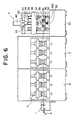
- FIG. 6 is a front view illustrating an embodiment of this invention.
- numeral 1 refers to a feeding device. 2 to a punch/die set. 5 to a laminating device: these three disposed in the workpiece feeding direction in that order. That is. the feeding device 1 is adapted to intermittently index the workpiece 4. wound in a hoop. in the longitudinal direction and disposed on the most upstream side in the workpiece feeding direction. for example.
- the feeding device 1, however. may be installed on the downstream side of the laminating device 5. or between the base machines 3 and 3, as will be described later.
- the punch/die set 2 has such a construction as will be described later. and is disposed in the feeding direction of the workpiece 4 at intervals of mP (m is a given positive integer, and P is a feeding pitch of the workpiece 4).
- a plurality (three in FIG. 3 ) of the punch/die sets 2 are provided in the base machine 3, for example; each adapted to be selectively operable, with the position of each set adjustable in the workpiece feeding direction.
- Different types of the punch/die sets 2 are provided in accordance with the types of component members to be formed. as shown in FIGS. 3 and 5 . In this case. an appropriate number of the base machines 3 having a plurality of the punch/die sets 2 are connected in tandem in the feeding direction of the workpiece 4.
- the laminating device 5 is provided on the most downstream side in the workpiece feeding direction at intervals of nP (n is a given positive integer) with the punch/die set 2. and comprises a base 51. a holding device 52. a supporting device 53 and a pressure bonding device 54. A holding plate 56 having a hole 55 for restricting the downward movement of the workpiece 4 and allowing the component members (not shown. Refer to numerals 101 ⁇ 105 in FIG. 3 .) to pass. and a guide member 57 formed in such a manner as to press and release the workpiece 4 are provided on the holding device 52.
- the supporting device 53 provided below the holding device 52 is adapted so as to carry the component members and the profile 100 thereon.
- a pressure bonding punch 58 that is vertically movable so as to eject component members from the workpiece 4. laminate and pressure bond them.
- a plurality of the pressure bonding punches 58 having outer contours similar or corresponding to the outer contours of the component members are prepared and attached to a holder 59 so that a specific pressure bonding punch 58 is selectively caused to move immediately above the workpiece 4 as the holder 59 rotates around the vertical shaft of the holder 59.
- Numeral 60 refers to an actuating device comprising a hydraulic cylinder. for example, that is constructed so that an actuating member 63 is forced onto and released from the pressure bonding punch 58 via columns 61 provided upright on the base 51. and a supporting plate 62 placed on the columns 61.
- FIG. 7 is a side view illustrating an example of the punch/die set 2 shown in FIG. 6 .
- numeral 21 refers to a punch/die set proper formed of a steel material, for example. into substantially a U shape, with a dovetail 22 integrally fitted to the lower end thereof.
- the dovetail 22 is adapted to engage with a dovetail groove 23 provided on the base 20 so that the punch/die set proper 21 can be moved in the workpiece feeding direction (in the direction vertical to the paper surface). while the movement of punch/die set 2 in the direction vertical to the workpiece feeding direction, that is, in the horizontal direction in FIG. 7 . is restricted.
- the punch/die set proper 21 is locked on the base 20 by a clamp device 24.
- the punch/die set 2 may comprise a gate-type punch/die set proper having upper and lower molds connected together with four guide bars.
- numeral 25 refers to a cassette formed of a steel material, for example, into a substantially U shape. with a punch 26 vertically movably provided on the upper part thereof and a die forming a pair with the punch 26 provided on the lower part thereof.
- the cassette 25 is detachably provided on the punch/die set proper 21.
- Numeral 28 refers to a clamp screw for locking the cassette 25 onto the punch/die set proper 21.
- Numeral 29 refers to a hydraulic cylinder provided on the upper end of the punch/die set proper 21 and adapted to actuate the punch 26 via an actuating lever 30.
- FIGS. 8 (a) and (b) are enlarged longitudinal sectional views illustrating a push-back device in an embodiment of this invention: (a) showing the state where a component member is blanked. and (b) showing the state where the component member is pushed back to the workpiece 4.
- the component member is indicated by numeral 104.
- numeral 31 refers to a stripper for forcing the workpiece 4 in position on the surface of the die 27 before and after the actuation of the punch 26.
- Numeral 32 refers to a push-back device provided in the die 27. comprising a receiving member 33 and a compressed coil spring 34 for forcing the receiving member 33 upward.
- a means for forcing the receiving member 33 upward may be a hydraulic cylinder and any other drive means.
- FIG. 9 is a plan view illustrating the first processing step embodying this invention.
- the figure shows the state where component members 101 - 105 are processed to manufacture the profile 100 shown in FIG. 3 .
- the workpiece 4 is intermittently indexed by the feeding device 1 shown in FIG. 6 at predetermined intervals of P in the direction shown by an arrow.
- Numeral 6 refers to a pilot hole formed at intervals of P on the workpiece 4 by the punch/die set 2. shown in FIG. 6 , located on the most upstream side.
- the pilot holes 6 serve as reference holes for positioning in the subsequent processing steps.
- dowel holes 106 are provided with a similar punch/die set 2, and dowels (not shown. Refer to numeral 107 in FIG. 4 .) are provided coaxially with the dowel holes 106.
- pilot pins engaging with the pilot holes 6 are provided on the punch/die set 2 so that processing can be carried out by positioning the punch/die set 2 using the pilot holes 6 as reference holes. (The same applies to the punch/die sets used in the subsequent steps.)
- the component members 101 ⁇ 105 are sequentially blanked and pushed back and replaced to the original punched holes on the workpiece 4 while indexing the workpiece 4 at intervals of P.
- five types of the punch/die sets 2 shown in FIG. 6 corresponding to the outer contours of the component members 101 - 105 are disposed so that these punch/die sets 2 can be selectively actuated.
- Two pieces each. for example of the component members 101 - 105 corresponding to the profile 100 shown in FIG. 3 are formed sequentially. as shown in FIG. 9 .
- the component members 101 ⁇ 105 thus blanked are pushed back into the punched holes 35 on the workpiece 4. and transported. together with the workpiece 4. to the final stage.
- the component members 101 ⁇ 105 pushed back and replaced to the workpiece 4 in the aforementioned manner are transported to the laminating device 5 provided in the final stage in FIG. 6 . and sequentially laminated in the order of the component members 105 - 101 to form the profile 100. That is. the actuating device 60 is operated in the state where as the guide member 57 is lowered, and positioning is carried out by engaging the pilot pins on the punch/die set 2 with the pilot holes on the workpiece 4.
- the component members 101 ⁇ 105 are thus sequentially ejected. or pushed out of the workpiece 4 via the actuating member 63 and the pressure bonding punch 58 and placed on the supporting device 53.
- the component members 101 - 105 are laminated as they are guided by the punched hole 35 (refer to FIG. 8 ) which serves as a die.
- the adjoining component members can be laminated integrally as the dowels 107 are engaged with the dowel holes 106. as shown in FIG. 4 .
- the hole 55 provided on the holding plate 56 on the holding device 52 is formed into a size larger than the maximum outer contour of the component members 101 - 105 so that any of the component members 101 ⁇ 105 can be passed through the hole 55 without hindrance.
- the supporting device 53 for supporting the component members 101 - 105 should preferably be designed so that when the component members 101 ⁇ 105 are laminated and pressure bonded by the pressure bonding punch 58, the supporting device 53 is lowered by an amount equal to the thickness of the component members 101 - 105 and stopped at that position. After the profile 100 shown in FIG. 3 has been formed in the aforementioned manner, the profile 100 is discharged from the supporting device 53. and the next laminating and pressure bonding sequence is repeated.
- FIG. 10 is a plan view illustrating the second processing step embodying this invention. Like parts are indicated by like reference numerals used in FIG. 9 .
- the pilot holes 6 and dowel holes 106 shown in FIG. 9 are omitted for the sake of simplicity.
- numeral 7 refers to a connecting part formed in a small width on part of the outer contour of a component member 101. for example to connect the workpiece 4 and the component member 101. That is. a slit-shaped punched part 8 is formed by the punch/die set.
- the workpiece 4 is then indexed in the direction shown by an arrow. and the area of the workpiece 4 except for the connecting part 7 thereof is shaved by the next punch/die set. That is. the outer contour of a component member is removed by a slight amount. such as 0.1 mm. using a punch/die set having virtually no clearance between the punch and the die.
- the sheared edge of a blanked workpiece has irregular shapes peculiar to shearing work. including a sheared surface, a fracture surface. round edges. or burrs. By subjecting to shaving operation. the sheared edge is finished into a smooth surface.
- the connecting parts 7 are fractured as the component member 101 is forced out of the workpiece 4 in the final stage. problems involving the fracture can be eliminated by providing the connecting parts 7 at locations where the state of surface causes no problems.
- the aforementioned shaving operation can be applied to other component members 102 and 103.
- FIG. 11 is a plan view illustrating the third processing step embodying this invention. Like part are indicated by like numerals used in FIG. 10 .
- a component member 101 for example. is blanked, pushed back and replaced to the original punched hole 35 in the same manner as the first processing step (refer to FIGS. 8 and 9 ).
- the component member 101 is then shaved with the next punch/die set excluding the non-shaving parts 9, pushed back and replaced to the punched hole 35, and retained on the workpiece 4 via non-shaving parts 9.
- Non-shaving parts 9 should preferably be provided at least at two selected locations where surface condition is not a prime consideration.
- FIG. 12 is a longitudinal sectional view illustrating the fourth processing step embodying this invention. Like parts are indicated by like numerals used in FIG. 8 .
- numeral 36 refers to an inverted-V-shaped ridge provided on the stripper 31 along the punched hole 35.
- a component member 101 is shown as an example, but the same applied to other component members.
- FIG. 12 there is virtually no clearance between the punch 26 and the die 27 (fine blanking).
- a component member 101 having no rounded edges or burrs on the outer periphery thereof can be blanked by lowering the punch 26. with the stripper 31brought into close contact with the workpiece 4 as the inverted-V-shaped ridge 36 provided on the stripper 31 cuts into the surface of the workpiece 4. After blanked out of the workpiece 4. the component member 101 is pushed back and replaced to the punched hole 35 as the receiving member 33 is pushed upward.
- FIG. 13 is an enlarged longitudinal sectional view showing the state where component members formed from another workpiece embodying this invention are laminated.
- numeral 10 refers to adhesive applied between the component members 101 and 101 to strongly bond the laminated component members 101. To achieve such a laminated state. it is sufficient to apply a 10- ⁇ 50- ⁇ m thickness of adhesive or deposit a heat bonding sheet material in advance on the surface of the workpiece.
- FIG. 14 is a plan view showing still another example of workpiece embodying this invention.
- shaded areas denote the adhesive applied in stripes or strips on the surface of the workpiece 4.
- a profile 200 as shown in FIG. 5 for example, is formed using such a workpiece 4.
- small gaps are formed between the adhesives 10 and 10 applied in stripes or strips.
- Lubricant is penetrated or accumulated in these small gaps to feed the lubricant to the gear.
- cam or other portions of the profile 200 Deposition of a thin film containing lubricant such as carbon fine powder on the surface of the workpiece 4 would also be useful for lubricating the profile 200.
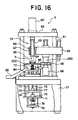
- FIGS. 15 and 16 are partially sectional front and side views showing another example of laminating device embodying this invention. Like parts are indicated by like reference numerals used in FIG. 6 .
- a material guide 64 is vertically movably provided on the holding plate 56 in such a manner as to engage with the longitudinal edge of the workpiece 4 so that the workpiece 4 is allowed to move in the longitudinal direction but prevented to move in the direction orthogonally intersecting the feeding direction.
- numeral 65 refers to a holder support provided on the base 51 to support the holder 59 having a plurality of the pressure bonding devices 54 on the circumferential direction.
- the holder support 65 is adapted to cause the holder 59 to rotate around the vertical shaft to selectively place a predetermined pressure bonding punch 58 immediately above the workpiece 4.
- Numeral 66 refers to a drive motor provided on the holder support 65 and connected to the holder 59 so that the holder can be rotated selectively.
- the pressure bonding punch 58 constituting the pressure bonding device 54 is provided on the lower end of an actuating lever 68 that is vertically movably fitted to the holder 59 via a bush 67.
- Numeral 69 refers to a compression coil spring fitted to the actuating lever 68 so as to preload the actuating lever 68 to move upward.
- the supporting device 53 is fitted to and supported by the base 51 by a supporting rod 70 and a supporting plate 71 provided on the base 51.
- Numeral 72 refers to a table supported by guide bars 73 passing through the base 51. and by a supporting shaft 76 provided upright on a guide plate 74 and the supporting plate 71 and having a male thread 75 on the upper end thereof.
- Numeral 77 is a female-thread member provided on the guide plate 74 to be enmeshed with the male thread 75.
- the male thread 75 and the female thread on the female-thread member 77 should preferably be multi-start threads so that a sufficient amount of lead can be achieved.
- Numeral 78 refers to a brake device provided below the supporting plate 71 via a mounting member 79.
- the brake device 78 is adapted to engage with the lower end of the supporting shaft 76 so that the rotation of the supporting shaft 76 can be braked or released.
- Numeral 80 refers to a drive motor provided on the supporting plate 71 for causing the supporting shaft 76 to rotate in the normal or reverse direction.
- Numeral 81 refers to a hydraulic cylinder provided on the base 51 for causing an actuating lever 82 to protrude upward.
- Guide pins 84 passing through the table 72 are vertically movably provided on the upper end of the actuating lever 82 via supporting member 83.
- Numerals 85 and 86 refer to a discharging device and a discharging chute, respectively, provided on the base 51 for discharging a profile 200, for example, after laminating and pressure bonding the component members thereof. from the table 72.
- a pressure bonding punch 58 suitable for ejecting a component member is brought immediately above the workpiece 4 by operating the drive motor 66.
- the component member is ejected from the workpiece 4 by operating the pressure bonding device 54 by the hydraulic cylinder 60. and then placed on the table 72 constituting the supporting device 53.
- the guide pins 84 that are protruded from the table 72 in advance by the operation of the hydraulic cylinder 81 are engaged with the guide holes 206 as shown in FIG. 5 provided on the component member to be ejected.
- the component members 201 ⁇ 204. for example. are placed in position on the table 72.
- the workpiece 4 is indexed by one pitch. and the next component member is ejected from the workpiece 4 and placed on the preceding component member in the same manner as described above for lamination and pressure bonding.
- the adjoining component members are laminated and pressure bonded safely and tightly, as shown in FIG. 4 as the dowels 107 are engaged with the dowel holes 106 by the operation of the pressure bonding punch 58.
- a profile 200 can be formed by laminating a predetermined number of component members into one unit.
- the guide pins 84 are lowered below the table 72 by the operation of the hydraulic cylinder 81. and the discharging device 85 is operated to discharge the laminated and pressure bonded profile 200 through the discharging chute 86.
- the drive motor 80 is operated in the state where the brake device is released. causing the supporting shaft 76 to rotate to lift the table 72 to a position immediately below the holding plate 56, and the drive motor 80 is then stopped. with the brake device brought to the braked state. to secure the table 72 at that position.
- the hydraulic cylinder 81 is operated to cause guide pins 84 to protrude on the table 72 to make the entire device ready for receiving the next component member, and the above-described operations are repeated.
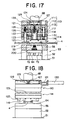
- FIGS. 17 and 18 are cross-sectional and partially sectional side view showing another example of pressure bonding device embodying this invention. Like parts are indicated by like reference numerals used in FIGS. 15 and 16 .
- numeral 110 refers to a punch holder comprising an upper plate 111. middle plate 112 and lower plate 113, for example. These plates 111, 112 and 113 are laminated into a punch holder with a fastening means (not shown) and fixedly fitted to the lower end of the actuating lever 68.
- Numeral 114 refers to a guide member formed by laminating an upper plate 115 and a lower plate 116 with a fastening means (not shown).
- the guide member 114 is connected to the punch holder 110 via a bolt 117, and a compression coil spring 118 is interposed between the middle plate 112 and the lower plate 116 so that the punch holder 110 can be connected to. and disconnected from the guide member 114.
- Numeral 119 refers to a pilot pin protruding downward on the guide member 114 to engage with the pilot hole 6 shown in FIG. 9 so that the workpiece 4 can be positioned.
- Numeral 120 refers to a guide pin provided on the punch holder 110 via a bolt 121, with the lower ends thereof passing through the guide member 114. in such a manner that the guide pin 120 can make sliding contact with the guide member 114.
- Numerals 122 and 123 refer to inner and outer pressure bonding punches. each formed into a circular shape in cross section and adapted in a coaxially and vertically movable manner, and provided on the middle and lower plates 112 and 113 constituting the punch holder 110. That is. the inner pressure bonding punch 122 is fixedly fitted to the middle plate 112 via a bolt 124. and the outer pressure bonding punch 123 is fitted to the lower plate 113 via a flange 125 on the upper end thereof.
- Numeral 126 refers to a compression coil spring provided on the lower plate 113 to preload the outer pressure bonding punch 123 upward via the flange 125.
- Numeral 127 refers to an actuating pin embedded on the flange 125 of the outer pressure bonding punch 123: with the upper end thereof protruded into a cam chamber 128 provided on the upper plate 111.
- Numeral 129 refers to a swash cam horizontally movably provided in the cam chamber 128 and adapted to make contact with the upper end of the actuating pin 127.
- Numeral 130 refers to an air cylinder connected to the swash cam 129 via an actuating lever 131. When the air cylinder 130 is operated to cause the outer pressure bonding punch 123 to move downward via the swash cam 129 and the actuating pin 127, the lower end surfaces of the inner pressure bonding and outer pressure bonding punches 122 and 123 are made flush with each other.
- the pilot pin 119 provided on the guide member 114 engages with the pilot hole (not shown. Refer to numeral 6 in FIG. 9 .) to position the component member that has been replaced on the workpiece 4.
- the material guide 64 preloaded upward by the compression coil spring (not shown)
- the workpiece 4 is pressed and held between the holding plate 56 and the guide member 114.
- the component member is ejected from the workpiece 4 by the inner and outer pressure bonding punches 122 and 123. and placed on the table 72 via the guide pins 84.
- the swash cam 129 is selectively moved to a position shown by a chain line in FIG. 18 by operating the air cylinder 130 in the opposite direction. Since this causes the outer pressure bonding punch 123 to be preloaded upward by the compression coil spring 126. the outer pressure bonding punch 123 does not come in contact with the workpiece 4, and only the inner pressure bonding punch 122 is operated by the lowering of the actuating lever 68 to eject the component member from the workpiece 4. Consequently, a component member 102. for example. of a smaller outer contour as shown in FIG. 9 can be smoothly ejected. laminated and pressure bonded.
- component members When processing a component member 101 of a larger outer contour. on the other hand.
- component members can be ejected from the workpiece 4. laminated and pressure bonded smoothly and positively by causing both the inner and outer pressure bonding punches 122 and 123 to collaborate, as described above. That is, the inner and outer pressure bonding punches 122 and 123 can be selectively operated with a single pressure bonding device. in accordance with the outer contours of component members.
- the holder 59 is adapted to be rotated around the vertical shaft.
- the holder 59. however. may be adapted to be moved horizontally.
- a plurality of types of pressure bonding punches 58 provided on the holder 59 and formed into a plurality of cross-sectional outside dimensions smaller than the outer contours of component members connected to the workpiece 4 may be adapted to be selectively operated in accordance with the outer contours of component members.
- the cross-sectional shape of the inner and outer pressure bonding punches 122 and 123 shown in FIGS. 17 and 18 may be any shape. other than a circular shape, that can be selected appropriately, taking into account the outer contour of component members to be ejected from the workpiece 4 and laminated.
- one unit of the outer pressure bonding punch 123 is shown, but a plurality of outer pressure bonding punches may be used so that they can be selectively operated in accordance with the outer contours of component members to be ejected.
Landscapes
- Engineering & Computer Science (AREA)
- Mechanical Engineering (AREA)
- Physics & Mathematics (AREA)
- Optics & Photonics (AREA)
- Plasma & Fusion (AREA)
- Manufacture Of Motors, Generators (AREA)
- Laser Beam Processing (AREA)
- Laminated Bodies (AREA)
Abstract
Claims (14)
- Procédé de fabrication de profilés (100, 200) ayant différentes formes en coupe dans la direction de la hauteur au moyen d'un appareil de fabrication de profilés, dans lequel une pluralité de poinçons d'assemblage par pression (58) formés de sorte à avoir une pluralité de dimensions en coupe plus petites que le contour externe desdits éléments composants (101 à 105, 201 à 204) est prévue sur un support (59), afin que lesdits poinçons d'assemblage par pression (58) puissent être sélectivement actionnés selon les contours externes desdits éléments composants (101 à 105, 201 à 204) comprenant les étapes consistant à : indexer un cercle de pièce à usiner de longue dimension (4) dans la direction longitudinale, ébaucher une pluralité de types d'éléments composants ayant des contours externes correspondant aux formes en coupe d'un profilé de ladite pièce à usiner en une pluralité d'étapes de traitement, repousser et replacer lesdits éléments composants ébauchés dans les trous perforés (35) sur ladite pièce à usiner, éjecter en séquence lesdits éléments composants en utilisant lesdits trous perforés (35) comme guides, supporter lesdits éléments composants éjectés depuis le dessous, laminer lesdits éléments composants en ledit profilé en abaissant lesdits éléments composants supportés d'une quantité égale à l'épaisseur desdits éléments composants et arrêter lesdits éléments composants à cette position chaque fois que lesdits éléments composants sont laminés et assemblés par pression dans l'étape d'indexage de pièce à usiner finale (5).
- Procédé de fabrication de profilés selon la revendication 1, dans lequel une partie ou l'ensemble desdits éléments composants est grossièrement ébauché(e) et ensuite, lesdits éléments composants ébauchés sont repoussés et replacés dans les trous perforés (35) sur ladite pièce à usiner, la partie restante du contour externe dudit élément composant est ébarbée, une partie non ébarbée (9) étant laissée sur une partie du contour externe dudit élément composant, et ledit élément composant ébarbé est replacé dans le trou perforé (35) sur ladite pièce à usiner.
- Procédé de fabrication de profilés selon la revendication 1, dans lequel une partie ou l'ensemble desdits éléments composants est ébauché(e), en ne laissant virtuellement aucun espace entre un poinçon (26) et une matrice (27).
- Procédé de fabrication de profilés (100, 200) ayant différentes formes en coupe dans la direction de la hauteur au moyen d'un appareil de fabrication de profilés, dans lequel une pluralité de poinçons d'assemblage par pression (58) formés de sorte à avoir une pluralité de dimensions en coupe plus petites que le contour externe desdits éléments composants (101 à 105, 201 à 204) est prévue sur un support (59) afin que lesdits poinçons d'assemblage par pression (58) puissent être sélectivement actionnés selon les contours externes desdits éléments composants (101 à 105, 201 à 204), comprenant les étapes consistant à : indexer un cercle de longue dimension de pièce à usiner (4) dans la direction longitudinale, fendre une pluralité de types d'éléments composants ayant des contours externes par rapport aux formes en coupe d'un profilé à partir de ladite pièce à usiner en une pluralité d'étapes de traitement, en laissant des parties de liaison (7) à ladite pièce à usiner sur une partie desdits contours externes, ébarber la circonférence externe desdits éléments composants autres que lesdites parties de liaison (7), et éjecter en séquence lesdits éléments composants desdits trous perforés (35), et laminer lesdits éléments composants en ledit profilé dans l'étape d'indexage de pièce à usiner finale (5).
- Procédé de fabrication de profilés (100, 200) ayant différentes formes en coupe dans la direction de la hauteur au moyen d'un appareil de fabrication de profilés dans lequel une pluralité de poinçons d'assemblage par pression (58) formés de sorte à avoir une pluralité de dimensions en coupe plus petites que le contour externe desdits éléments composants (101 à 105, 201 à 204) est prévue sur un support (59) afin que lesdits poinçons d'assemblage par pression (58) puissent être sélectivement actionnés selon les contours externes desdits éléments composants (101 à 105, 201 à 204) comprenant les étapes consistant à : indexer un cercle de longue dimension de pièce à usiner (4) dans la direction longitudinale, ébaucher une partie d'une pluralité de types d'éléments composants ayant des contours externes correspondant aux formes en coupe d'un profilé à partir de ladite pièce à usiner en une pluralité d'étapes de traitement, repousser et replacer lesdits éléments composants ébauchés dans les trous perforés (35) sur ladite pièce à usiner, fendre l'autre partie desdits éléments composants, en laissant des parties de liaison (7) à ladite pièce à usiner sur une partie desdits contours externes, ébarber la circonférence externe desdits éléments composants autres que lesdites parties de liaison (7), éjecter en séquence lesdits éléments composants à partir desdits trous perforés (35), et laminer lesdits éléments composants en ledit profilé dans l'étape d'indexage de pièce à usiner finale (5).
- Procédé de fabrication de profilés selon l'une quelconque des revendications 1 à 5, dans lequel une pluralité de trous de guidage (206) traversant les éléments composants sont formés de sorte que les éléments composants soient positionnés en mettant en prise des axes de guidage (84) avec lesdits trous de guidage (206) dans l'étape d'indexage finale (5).
- Procédé de fabrication de profilés selon l'une quelconque des revendications 1 à 5, dans lequel on utilise une pièce à usiner sur la surface de laquelle est appliqué de l'adhésif (10).
- Procédé de fabrication de profilés selon la revendication 7, dans lequel l'adhésif (10) est appliqué en bandes.
- Procédé de fabrication de profilés selon l'une quelconque des revendications 1 à 5, dans lequel on utilise une pièce à usiner sur la surface de laquelle est appliqué un mince film contenant un adhésif.
- Appareil de fabrication de profilés (100, 200) ayant différentes formes en coupe dans la direction de la hauteur comprenant un dispositif de fourniture (1) pour indexer de façon intermittente un cercle de pièce à usiner (4) de longue dimension dans la direction longitudinale, une pluralité d'ensembles poinçon/matrice (2) disposés dans la direction de fourniture de la pièce à usiner pour former une pluralité de types d'éléments composants (101 à 105, 201 à 204) ayant des contours externes correspondant aux formes en coupe du profilé et conçus pour être actionnables sélectivement, et un dispositif de laminage (5) prévu dans le côté le plus en aval desdits ensembles poinçon/matrice dans la direction de fourniture de pièce à usiner pour éjecter en séquence lesdits éléments composants desdits trous perforés (35) et laminer lesdits éléments composants en un profilé ;
caractérisé en ce que :ledit dispositif de laminage (5) comprend un dispositif de maintien (52) ayant un trou (55) permettant à l'élément composant de passer à travers et conçu pour limiter le mouvement vers le bas de ladite pièce à usiner (4),un dispositif d'assemblage par pression (54) disposé au-dessus dudit dispositif de maintien (52) et possédant une pluralité de poinçons d'assemblage par pression (58) formés de sorte à avoir une pluralité de dimensions en coupe plus petites que le contour externe desdits éléments composants est prévu sur un support (59) afin que lesdits poinçons d'assemblage par pression (58) puissent être actionnés sélectivement selon les contours externes desdits éléments composants afin d'éjecter les éléments composants de ladite pièce à usiner (4) et de laminer et assembler par pression lesdits éléments composants, etun dispositif de support (53) est prévu en dessous dudit dispositif de maintien (52) et ayant un élément de support mobile verticalement (72) qui peut maintenir lesdits éléments composants éjectés. - Appareil de fabrication de profilés selon la revendication 10, dans lequel ledit élément de support (72) est conçu pour s'abaisser d'une quantité égale à l'épaisseur desdits éléments composants et s'arrêter à ladite position chaque fois que lesdits éléments composants sont laminés et assemblés par pression par ledit poinçon d'assemblage par pression (58).
- Appareil de fabrication de profilés selon la revendication 10 ou 11, dans lequel lesdits poinçons d'assemblage par pression (58) sont prévus sur un support rotatif (59) ayant un axe vertical (353) de telle manière que les centres de travail des poinçons d'assemblage par pression (58) soient situés à distance égale dudit axe vertical.
- Appareil de fabrication de profilés selon la revendication 12, dans lequel un poinçon d'assemblage par pression interne (122) et une pluralité de poinçons d'assemblage par pression externes creux (123) sont prévus de façon coaxiale, et les surfaces d'assemblage par pression desdits poinçons d'assemblage par pression externes (123) sont formées de façon rétractable.
- Appareil de fabrication de profilés selon la revendication 10, dans lequel sont prévus un ensemble poinçon/matrice (2) pour perforer des trous de guidage (206) sur les éléments composants et des axes de guidage mobiles verticalement (84) qui traversent ledit élément de support (72) et font saillie vers le haut ; lesdits trous de guidage (206) étant en prise avec lesdits axes de guidage (84) pour positionner lesdits éléments composants (100, 200).
Applications Claiming Priority (7)
| Application Number | Priority Date | Filing Date | Title |
|---|---|---|---|
| JP39618/97 | 1997-02-25 | ||
| JP03961897A JP3948575B2 (ja) | 1997-02-25 | 1997-02-25 | 異形部材の製造方法 |
| JP48624/97 | 1997-03-04 | ||
| JP04862497A JP3935236B2 (ja) | 1997-03-04 | 1997-03-04 | 異形部材の製造装置 |
| JP48625/97 | 1997-03-04 | ||
| JP9048625A JPH10244650A (ja) | 1997-03-04 | 1997-03-04 | 積層体の製造方法および製造装置 |
| PCT/JP1998/000729 WO1998037993A1 (fr) | 1997-02-25 | 1998-02-24 | Element a formes differentes et procede et appareil de fabrication d'un corps construit par couches |
Publications (3)
| Publication Number | Publication Date |
|---|---|
| EP0919306A1 EP0919306A1 (fr) | 1999-06-02 |
| EP0919306A4 EP0919306A4 (fr) | 2005-06-01 |
| EP0919306B1 true EP0919306B1 (fr) | 2009-06-24 |
Family
ID=27290197
Family Applications (1)
| Application Number | Title | Priority Date | Filing Date |
|---|---|---|---|
| EP98904418A Expired - Lifetime EP0919306B1 (fr) | 1997-02-25 | 1998-02-24 | procédé et appareil de fabrication de profilés et de laminés |
Country Status (4)
| Country | Link |
|---|---|
| US (1) | US6682625B1 (fr) |
| EP (1) | EP0919306B1 (fr) |
| DE (1) | DE69840926D1 (fr) |
| WO (1) | WO1998037993A1 (fr) |
Families Citing this family (21)
| Publication number | Priority date | Publication date | Assignee | Title |
|---|---|---|---|---|
| US5972476A (en) * | 1997-11-21 | 1999-10-26 | Means Industries, Inc. | Laminated parts and method of making same |
| DE60136975D1 (de) | 2001-12-25 | 2009-01-22 | Inst Tech Prec Elect Discharge | Verfahren und system zur herstellung von laminat |
| US6851171B2 (en) * | 2002-11-27 | 2005-02-08 | Battelle Memorial Institute | Method of fabricating multi-channel devices and multi-channel devices therefrom |
| DE502004010706D1 (de) * | 2004-09-02 | 2010-03-18 | Ford Global Tech Llc | Verfahren und Werkzeug zum Stanzen und/oder Formen |
| DE102004049115A1 (de) * | 2004-10-07 | 2006-04-27 | Johnson Controls Gmbh | Geschweißte Struktur, insbesondere von Sitzkomponenten |
| DE102006008401B4 (de) * | 2006-02-21 | 2012-03-01 | Johnson Controls Gmbh | Verstellbeschlag für eine Kraftfahrzeugkomponente |
| DE102006051403B3 (de) * | 2006-10-27 | 2008-02-14 | Johnson Controls Gmbh | Komponente, insbesondere für einen Fahrzeugsitz |
| TW200823513A (en) * | 2006-11-24 | 2008-06-01 | Ind Tech Res Inst | Cholesteric liquid crystal display devices and driving methods thereof |
| US20090188097A1 (en) * | 2008-01-25 | 2009-07-30 | Siemens Power Generation, Inc. | Method of layered fabrication |
| US8912702B2 (en) | 2009-04-29 | 2014-12-16 | Ernesto Malvestiti S.P.A. | Process and mold for producing ferromagnetic cores of electric motors |
| KR20130036592A (ko) * | 2011-10-04 | 2013-04-12 | 삼성디스플레이 주식회사 | 인쇄 회로 필름 모재 제조 방법 및 상기 인쇄 회로 필름을 타발하는 장치 |
| EP2608299B1 (fr) * | 2011-12-22 | 2014-04-09 | Feintool Intellectual Property AG | Dispositif et procédé de fabrication de plaques bipolaires métalliques |
| JP6080288B2 (ja) * | 2012-09-07 | 2017-02-15 | 株式会社放電精密加工研究所 | 積層装置及び積層体製造システム |
| CN106944801A (zh) * | 2017-05-11 | 2017-07-14 | 重庆市大足区君治五金工具有限公司 | 一种抹泥板的支架与板体一体成型的工艺 |
| CN107948914B (zh) * | 2017-12-25 | 2024-04-12 | 苏州格洛佛精密科技有限公司 | 焊接机 |
| CN111546559B (zh) * | 2020-06-05 | 2025-01-14 | 廊坊江昊防腐材料有限公司 | 塑料支架串联机 |
| CN112275930B (zh) * | 2020-11-19 | 2025-09-19 | 无锡海特精密模具有限公司 | 一种夹持送料机构及冷冲级进模 |
| CN112959001B (zh) * | 2021-02-01 | 2023-06-23 | 东莞市锦洲科技有限公司 | 一种铝合金型材加工方法 |
| CN114178864B (zh) * | 2021-12-07 | 2023-07-28 | 浙江上虹货架有限公司 | 一种货架横梁配件生产方法及焊接搬运加工中心 |
| CN117718756A (zh) * | 2022-09-02 | 2024-03-19 | 昆山小为云智能科技有限公司 | 一种水冷板模内焊网装置及焊网方法 |
| CN119982724A (zh) * | 2025-04-11 | 2025-05-13 | 温州长隆机械有限公司 | 基于液控单向阀的液压系统节流控制方法 |
Family Cites Families (19)
| Publication number | Priority date | Publication date | Assignee | Title |
|---|---|---|---|---|
| JPS53149855A (en) * | 1977-06-01 | 1978-12-27 | Hitachi Metals Ltd | Laminating of amorphous alloy |
| US4242678A (en) | 1978-07-17 | 1980-12-30 | Dennison Manufacturing Company | Variable size character generation using neighborhood-derived shapes |
| FR2435149A1 (fr) * | 1978-09-01 | 1980-03-28 | Mitsui Mfg Co Ltd | Appareil de formation d'un empilage de feuillets magnetiques |
| US4285754A (en) * | 1979-11-05 | 1981-08-25 | Solid Photography Inc. | Method and apparatus for producing planar elements in the construction of surfaces and bodies |
| US4445272A (en) * | 1980-06-16 | 1984-05-01 | International Business Machines Corporation | Method and apparatus for stacking rotor blanks on a shaft |
| EP0042046B1 (fr) * | 1980-06-16 | 1984-07-18 | International Business Machines Corporation | Méthode et appareils de fabrication d'une structure feuilletée de machine dynamoélectrique |
| JPH0344346Y2 (fr) * | 1986-08-07 | 1991-09-18 | ||
| US5015312A (en) * | 1987-09-29 | 1991-05-14 | Kinzie Norman F | Method and apparatus for constructing a three-dimensional surface of predetermined shape and color |
| GB8729929D0 (en) * | 1987-12-23 | 1988-02-03 | Lacy R M | Linerless self-adhesive labels |
| FR2640896A1 (en) * | 1988-12-22 | 1990-06-29 | Peugeot | Installation and method for the unpiling (peeling off) of parts which are cut out by punching and are put back into a sheet |
| US5160682A (en) * | 1989-03-09 | 1992-11-03 | Calfee Craig D | Method of manufacturing a composite bicycle frame |
| DE3922518A1 (de) | 1989-07-08 | 1991-01-17 | Bayer Ag | Verfahren zur herstellung von (alpha)-methylbenzyl-substituierten phenolen |
| JP3317727B2 (ja) * | 1992-10-02 | 2002-08-26 | 株式会社放電精密加工研究所 | 順送り加工装置 |
| US6056843A (en) * | 1993-12-29 | 2000-05-02 | Kira Corporation | Sheet lamination modeling method and sheet lamination modeling apparatus |
| JP3497911B2 (ja) | 1995-02-22 | 2004-02-16 | 黒田精工株式会社 | モータ用積層鉄心の製造方法及び金型装置 |
| JPH09163691A (ja) | 1995-12-01 | 1997-06-20 | Toshiba Mec Kk | 積層形コア及びその製造方法 |
| JP3546579B2 (ja) | 1996-02-28 | 2004-07-28 | 松下電器産業株式会社 | 積層金型装置 |
| US5730817A (en) * | 1996-04-22 | 1998-03-24 | Helisys, Inc. | Laminated object manufacturing system |
| US5755023A (en) * | 1996-06-05 | 1998-05-26 | L.H. Carbide Corporation | Lamina stack with at least one lamina layer having a plurality of discrete segments and an apparatus and method for manufacturing said stack |
-
1998
- 1998-02-24 WO PCT/JP1998/000729 patent/WO1998037993A1/fr not_active Ceased
- 1998-02-24 DE DE69840926T patent/DE69840926D1/de not_active Expired - Lifetime
- 1998-02-24 EP EP98904418A patent/EP0919306B1/fr not_active Expired - Lifetime
- 1998-02-24 US US09/171,997 patent/US6682625B1/en not_active Expired - Lifetime
Also Published As
| Publication number | Publication date |
|---|---|
| EP0919306A4 (fr) | 2005-06-01 |
| US6682625B1 (en) | 2004-01-27 |
| EP0919306A1 (fr) | 1999-06-02 |
| WO1998037993A1 (fr) | 1998-09-03 |
| DE69840926D1 (de) | 2009-08-06 |
Similar Documents
| Publication | Publication Date | Title |
|---|---|---|
| EP0919306B1 (fr) | procédé et appareil de fabrication de profilés et de laminés | |
| EP1504896B1 (fr) | Procede et systeme de production de lamines | |
| US8132441B2 (en) | Method and device for fine blanking and forming a workpiece | |
| US4270253A (en) | Apparatus for simultaneous machining of a stack of plate-like workpieces | |
| EP2893990B1 (fr) | Dispositif de stratification et système de production de stratifié | |
| JP2005103638A (ja) | モータ用積層コアの製造方法、その製造装置、及び積層治具 | |
| JP2007000901A (ja) | パンチプレスのバリ取りツール | |
| CA2083098C (fr) | Dispositif de changement de cassette pour systemes d'usinage indexes | |
| JP3317727B2 (ja) | 順送り加工装置 | |
| JPH0581337B2 (fr) | ||
| JP3948575B2 (ja) | 異形部材の製造方法 | |
| EP3247541B1 (fr) | Dispositif pour le perçage des paneaux murales avec douilles d'extraction | |
| US4462147A (en) | Method for simultaneous machining of a stack of plate-like workpieces | |
| JP3935236B2 (ja) | 異形部材の製造装置 | |
| JP4372981B2 (ja) | 積層体の製造方法および製造装置 | |
| JP4666423B2 (ja) | 異形部材の製造方法および製造装置 | |
| JPH09225553A (ja) | 板状製品のプレス自動製造方法 | |
| JP4191306B2 (ja) | 積層体の製造方法および製造装置 | |
| JP2001009531A (ja) | 積層体の製造装置 | |
| US7739780B2 (en) | Method of manufacturing using a die to produce a machined part | |
| US4509395A (en) | Process for precision cutting | |
| JP2000033433A (ja) | 積層体の製造方法 | |
| JP4220590B2 (ja) | 微小寸法の穴および/またはスリットを有する製品の製造方法 | |
| JPH10296366A (ja) | プレス成形品のリム加工方法および同装置 | |
| US7032293B2 (en) | Process for producing bundles of laminated sheet metal for magnet cores |
Legal Events
| Date | Code | Title | Description |
|---|---|---|---|
| PUAI | Public reference made under article 153(3) epc to a published international application that has entered the european phase |
Free format text: ORIGINAL CODE: 0009012 |
|
| 17P | Request for examination filed |
Effective date: 19981122 |
|
| AK | Designated contracting states |
Kind code of ref document: A1 Designated state(s): CH DE FR IT LI |
|
| RAP1 | Party data changed (applicant data changed or rights of an application transferred) |
Owner name: JAPAN SCIENCE AND TECHNOLOGY CORPORATION Owner name: INSTITUTE OF TECHNOLOGY PRECISION ELECTRICAL DISCH |
|
| RIN1 | Information on inventor provided before grant (corrected) |
Inventor name: AOKI, ISAMU, DEPT. OF MECHANICAL ENGINEERING Inventor name: MURATA, CHIKARA, INSTITUTE OF TECHNOLOGY PRECISIO Inventor name: FUTUMURA, SHOJI, INSTITUTE OF TECHNOLOGY PRECISION |
|
| RIC1 | Information provided on ipc code assigned before grant |
Ipc: 7B 23K 26/20 B Ipc: 7B 23P 15/00 B Ipc: 7B 21D 28/22 B Ipc: 7B 21D 35/00 B Ipc: 7B 21D 28/10 B Ipc: 7B 23P 23/04 B Ipc: 7B 21D 28/02 A |
|
| A4 | Supplementary search report drawn up and despatched |
Effective date: 20050420 |
|
| 17Q | First examination report despatched |
Effective date: 20080403 |
|
| RTI1 | Title (correction) |
Free format text: METHOD AND APPARATUS FOR MANUFACTURING PROFILES AND LAMINATES |
|
| GRAP | Despatch of communication of intention to grant a patent |
Free format text: ORIGINAL CODE: EPIDOSNIGR1 |
|
| GRAS | Grant fee paid |
Free format text: ORIGINAL CODE: EPIDOSNIGR3 |
|
| GRAA | (expected) grant |
Free format text: ORIGINAL CODE: 0009210 |
|
| AK | Designated contracting states |
Kind code of ref document: B1 Designated state(s): CH DE FR IT LI |
|
| REG | Reference to a national code |
Ref country code: CH Ref legal event code: EP |
|
| REF | Corresponds to: |
Ref document number: 69840926 Country of ref document: DE Date of ref document: 20090806 Kind code of ref document: P |
|
| REG | Reference to a national code |
Ref country code: CH Ref legal event code: NV Representative=s name: E. BLUM & CO. AG PATENT- UND MARKENANWAELTE VSP |
|
| PLBE | No opposition filed within time limit |
Free format text: ORIGINAL CODE: 0009261 |
|
| STAA | Information on the status of an ep patent application or granted ep patent |
Free format text: STATUS: NO OPPOSITION FILED WITHIN TIME LIMIT |
|
| 26N | No opposition filed |
Effective date: 20100325 |
|
| PGFP | Annual fee paid to national office [announced via postgrant information from national office to epo] |
Ref country code: CH Payment date: 20140212 Year of fee payment: 17 |
|
| REG | Reference to a national code |
Ref country code: FR Ref legal event code: PLFP Year of fee payment: 18 |
|
| PGFP | Annual fee paid to national office [announced via postgrant information from national office to epo] |
Ref country code: DE Payment date: 20150218 Year of fee payment: 18 Ref country code: IT Payment date: 20150209 Year of fee payment: 18 |
|
| PGFP | Annual fee paid to national office [announced via postgrant information from national office to epo] |
Ref country code: FR Payment date: 20150210 Year of fee payment: 18 |
|
| REG | Reference to a national code |
Ref country code: CH Ref legal event code: PL |
|
| PG25 | Lapsed in a contracting state [announced via postgrant information from national office to epo] |
Ref country code: CH Free format text: LAPSE BECAUSE OF NON-PAYMENT OF DUE FEES Effective date: 20150228 Ref country code: LI Free format text: LAPSE BECAUSE OF NON-PAYMENT OF DUE FEES Effective date: 20150228 |
|
| REG | Reference to a national code |
Ref country code: DE Ref legal event code: R119 Ref document number: 69840926 Country of ref document: DE |
|
| REG | Reference to a national code |
Ref country code: FR Ref legal event code: ST Effective date: 20161028 |
|
| PG25 | Lapsed in a contracting state [announced via postgrant information from national office to epo] |
Ref country code: IT Free format text: LAPSE BECAUSE OF NON-PAYMENT OF DUE FEES Effective date: 20160224 |
|
| PG25 | Lapsed in a contracting state [announced via postgrant information from national office to epo] |
Ref country code: DE Free format text: LAPSE BECAUSE OF NON-PAYMENT OF DUE FEES Effective date: 20160901 Ref country code: FR Free format text: LAPSE BECAUSE OF NON-PAYMENT OF DUE FEES Effective date: 20160229 |