EP0924221A2 - Nouveau lipopolysaccharide-biosuractif - Google Patents
Nouveau lipopolysaccharide-biosuractif Download PDFInfo
- Publication number
- EP0924221A2 EP0924221A2 EP98123614A EP98123614A EP0924221A2 EP 0924221 A2 EP0924221 A2 EP 0924221A2 EP 98123614 A EP98123614 A EP 98123614A EP 98123614 A EP98123614 A EP 98123614A EP 0924221 A2 EP0924221 A2 EP 0924221A2
- Authority
- EP
- European Patent Office
- Prior art keywords
- biosurfactant
- eps
- dodecanoic acid
- acid
- lipopolysaccharidic
- Prior art date
- Legal status (The legal status is an assumption and is not a legal conclusion. Google has not performed a legal analysis and makes no representation as to the accuracy of the status listed.)
- Granted
Links
Images

Classifications
-
- C—CHEMISTRY; METALLURGY
- C12—BIOCHEMISTRY; BEER; SPIRITS; WINE; VINEGAR; MICROBIOLOGY; ENZYMOLOGY; MUTATION OR GENETIC ENGINEERING
- C12N—MICROORGANISMS OR ENZYMES; COMPOSITIONS THEREOF; PROPAGATING, PRESERVING, OR MAINTAINING MICROORGANISMS; MUTATION OR GENETIC ENGINEERING; CULTURE MEDIA
- C12N1/00—Microorganisms; Compositions thereof; Processes of propagating, maintaining or preserving microorganisms or compositions thereof; Processes of preparing or isolating a composition containing a microorganism; Culture media therefor
- C12N1/20—Bacteria; Culture media therefor
- C12N1/205—Bacterial isolates
-
- C—CHEMISTRY; METALLURGY
- C08—ORGANIC MACROMOLECULAR COMPOUNDS; THEIR PREPARATION OR CHEMICAL WORKING-UP; COMPOSITIONS BASED THEREON
- C08B—POLYSACCHARIDES; DERIVATIVES THEREOF
- C08B37/00—Preparation of polysaccharides not provided for in groups C08B1/00 - C08B35/00; Derivatives thereof
-
- C—CHEMISTRY; METALLURGY
- C12—BIOCHEMISTRY; BEER; SPIRITS; WINE; VINEGAR; MICROBIOLOGY; ENZYMOLOGY; MUTATION OR GENETIC ENGINEERING
- C12P—FERMENTATION OR ENZYME-USING PROCESSES TO SYNTHESISE A DESIRED CHEMICAL COMPOUND OR COMPOSITION OR TO SEPARATE OPTICAL ISOMERS FROM A RACEMIC MIXTURE
- C12P19/00—Preparation of compounds containing saccharide radicals
- C12P19/26—Preparation of nitrogen-containing carbohydrates
-
- C—CHEMISTRY; METALLURGY
- C12—BIOCHEMISTRY; BEER; SPIRITS; WINE; VINEGAR; MICROBIOLOGY; ENZYMOLOGY; MUTATION OR GENETIC ENGINEERING
- C12R—INDEXING SCHEME ASSOCIATED WITH SUBCLASSES C12C - C12Q, RELATING TO MICROORGANISMS
- C12R2001/00—Microorganisms ; Processes using microorganisms
- C12R2001/01—Bacteria or Actinomycetales ; using bacteria or Actinomycetales
-
- Y—GENERAL TAGGING OF NEW TECHNOLOGICAL DEVELOPMENTS; GENERAL TAGGING OF CROSS-SECTIONAL TECHNOLOGIES SPANNING OVER SEVERAL SECTIONS OF THE IPC; TECHNICAL SUBJECTS COVERED BY FORMER USPC CROSS-REFERENCE ART COLLECTIONS [XRACs] AND DIGESTS
- Y10—TECHNICAL SUBJECTS COVERED BY FORMER USPC
- Y10S—TECHNICAL SUBJECTS COVERED BY FORMER USPC CROSS-REFERENCE ART COLLECTIONS [XRACs] AND DIGESTS
- Y10S516/00—Colloid systems and wetting agents; subcombinations thereof; processes of
- Y10S516/905—Agent composition per se for colloid system making or stabilizing, e.g. foaming, emulsifying, dispersing, or gelling
- Y10S516/914—The agent contains organic compound containing nitrogen, except if present solely as NH4+
-
- Y—GENERAL TAGGING OF NEW TECHNOLOGICAL DEVELOPMENTS; GENERAL TAGGING OF CROSS-SECTIONAL TECHNOLOGIES SPANNING OVER SEVERAL SECTIONS OF THE IPC; TECHNICAL SUBJECTS COVERED BY FORMER USPC CROSS-REFERENCE ART COLLECTIONS [XRACs] AND DIGESTS
- Y10—TECHNICAL SUBJECTS COVERED BY FORMER USPC
- Y10S—TECHNICAL SUBJECTS COVERED BY FORMER USPC CROSS-REFERENCE ART COLLECTIONS [XRACs] AND DIGESTS
- Y10S516/00—Colloid systems and wetting agents; subcombinations thereof; processes of
- Y10S516/905—Agent composition per se for colloid system making or stabilizing, e.g. foaming, emulsifying, dispersing, or gelling
- Y10S516/914—The agent contains organic compound containing nitrogen, except if present solely as NH4+
- Y10S516/915—The compound contains -C[=O]NHH where substitution may be made for the hydrogen
-
- Y—GENERAL TAGGING OF NEW TECHNOLOGICAL DEVELOPMENTS; GENERAL TAGGING OF CROSS-SECTIONAL TECHNOLOGIES SPANNING OVER SEVERAL SECTIONS OF THE IPC; TECHNICAL SUBJECTS COVERED BY FORMER USPC CROSS-REFERENCE ART COLLECTIONS [XRACs] AND DIGESTS
- Y10—TECHNICAL SUBJECTS COVERED BY FORMER USPC
- Y10S—TECHNICAL SUBJECTS COVERED BY FORMER USPC CROSS-REFERENCE ART COLLECTIONS [XRACs] AND DIGESTS
- Y10S516/00—Colloid systems and wetting agents; subcombinations thereof; processes of
- Y10S516/905—Agent composition per se for colloid system making or stabilizing, e.g. foaming, emulsifying, dispersing, or gelling
- Y10S516/917—The agent contains organic compound containing oxygen
-
- Y—GENERAL TAGGING OF NEW TECHNOLOGICAL DEVELOPMENTS; GENERAL TAGGING OF CROSS-SECTIONAL TECHNOLOGIES SPANNING OVER SEVERAL SECTIONS OF THE IPC; TECHNICAL SUBJECTS COVERED BY FORMER USPC CROSS-REFERENCE ART COLLECTIONS [XRACs] AND DIGESTS
- Y10—TECHNICAL SUBJECTS COVERED BY FORMER USPC
- Y10S—TECHNICAL SUBJECTS COVERED BY FORMER USPC CROSS-REFERENCE ART COLLECTIONS [XRACs] AND DIGESTS
- Y10S516/00—Colloid systems and wetting agents; subcombinations thereof; processes of
- Y10S516/905—Agent composition per se for colloid system making or stabilizing, e.g. foaming, emulsifying, dispersing, or gelling
- Y10S516/917—The agent contains organic compound containing oxygen
- Y10S516/918—The compound contains carboxylic acid ester group
Definitions
- the present invention relates to a new lipopolysaccaride biosurfactant, a strain of Acinetobacter calcoaceticus which produces this biosurfactant, a process for the preparation of the biosurfactant and its use in energy and environmental fields.
- Phenomena resulting from the leakage of hydrocarbon pollutants in water environments are well known.
- the main mechanism with which the ecosystem reacts to pollution by hydrocarbons consists of biodegradation by the hydrocarbonclastic flora.
- Petroleum which under normal conditions is a liquid which is substantially immiscible in water, tends to spread over the surface of the water in the form of a fine layer ("stain").
- any phenomenum capable of breaking and dispersing the "stain” should be considered as being positive.
- a partial solubilization or adhesion on solid particles in suspension or emulsification in water favours the action of microorganisms which are given a wider surface for attachment.
- biosurfactants are biodegradable and are therefore potentially less toxic than the synthetic compounds used at present.
- a group of biosurfactants of particular interest is represented by lipopolysaccharide biopolymers produced from strains of Acinetobacter calcoaceticus .
- Emulsan a polyanionic lipopolysaccharide obtained by the fermentation of the strain Acinetobacter calcoaceticus RAG1 ATCC 31012 (U.S. 3.941.692, U.S. 4.395.354).
- This biosurfactant is responsible for the formation and stabilization of oil/water emulsions and is essentially used for the transportation of heavy crude oils in association with synthetic surface-active agents (PCT WO 8501.889) and for the cleaning of tanks.
- Emulsan can also be used in fields such as cosmetics (EP 242.296, DE 3.610.384, JP 62.286.914, JP 62.289.508) and detergents (JP 62.297.397).
- lipopolysaccharide biosurfactants owing to their linear structure and high molecular weight, greatly modify the characteristics of the water/oil interface, thus determining a significant variation in the adhesion capacity of microorganisms.
- Emulsan inhibits the adhesion of microorganisms to the water/oil interface [E. Rosenberg et al., Infect. Immun., 39 , 1024-1028 (1983)].
- the surface of the oil covered with the biosurfactant becomes less analogous to the biomass and reduces the capacity of adhering to it.
- Emulsan reduces the biodegradation of linear alkanes and other saturated hydrocarbons, as well as aromatic compounds, by 50 ⁇ 90%, on the part of mixed cultures or purified cultures, [J.M. Foght et al., Appl. Environ. Microbiol., 55 , 36-42 (1989)].
- this group of emulsifying agents is not suitable for resolving problems of the environmental type which can take place in the case of the leakage of crude oils in water.
- this strain produces a hexocellular lipopolysaccharide biosurfactant (herein also indicated with the term EPS) which has an excellent capacity for forming and stabilizing oil/water emulsions and at the same time favours the adhesion of microorganisms to the water/oil interface and promotes the biodegradation of hydrocarbons in water.
- EPS hexocellular lipopolysaccharide biosurfactant
- An object of the present invention consequently relates to the strain A. calcoaceticus CBS 962.97.
- Another object of the present invention relates to a biosurfactant obtained from A. calcoaceticus CBS 962.97.
- a further object of the present invention relates to a process for the preparation of this biosurfactant characterized by the use of the strain A. calcoaceticus CBS 962.97.
- Another object of the present invention relates to the use of the biosurfactant thus obtained in energy and environmental fields.
- the isolation was carried out by successive enrichment and purification phases in saline earth containing a hydrocarbon (for example fuel oil, crude oil, vaseline oil, n-hexadecane or gasoil) as single carbon source according to the Bushnell-Haas method (J. Bateriol., 41 , 653-673 (1940)), even though other conventional techniques can be used.
- a hydrocarbon for example fuel oil, crude oil, vaseline oil, n-hexadecane or gasoil
- the method consists in putting a pure culture in contact with a hydrocarbon, for example, crude oil, and in verifying the fracture of the oil meniscus which is obtained in the presence of a biosurfactant.
- a hydrocarbon for example, crude oil
- strain ER-96 of the present invention assigns the strain ER-96 of the present invention to the Acinetobacter group and, more specifically, to the species Acinetobacter calcoaceticus .
- ER-96, RAG-1 and 217 The characteristics of the strains ER-96, RAG-1 and 217 are indicated in Table 1 below; ER-96 RAG-1 217 Average cellular dimensions in ⁇ m (pleomorph cells) 0.8x1.8 1.3x3.3 1.8x2.6 Distinctive physiological characteristics gelatinase - + + Reduction nitrates to nitrites - + + Reduction nitrates to N 2 - n.d. + Indole production - n.d. + NH 4 + utilization + + - Urease - - + Ox/Ferm. Test Oxidative n.d. Fermentative Lysine decarboxylase - n.d.
- strain ER-96 is cultured using a carbon source which is soluble in water, such as ethanol for example, the emulsification cannot be observed directly, but if hydrocarbons are added to the culture, these are immediately emulsified.
- a carbon source which is soluble in water such as ethanol for example
- various methods can be used which consist in diluting an aliquot of culture broth, without cells, with water or with a suitable buffer, adding a certain quantity of hydrocarbons, stirring this mixture and measuring the turbidity of the emulsion.
- the system which is extremely reproducible, used in the present invention is a variation of the method described by Gutnick et al. [EP 16.546]: 50 ⁇ l of a mixture of hexadecane and 2-methylnaphthalene (1:1) are added to 3.25 ml of a solution of biosurfactant in tris-hydroxymethylaminomethane 20 mM buffer, pH 7.2, containing MgSO 4 10 mM and the whole mixture is stirred; the optical density of the emulsion is measured at 620 nm in a cuvette with an oPtical path of 1 cm.
- the fermentation broth without cells and lyophilized was indicated with the term raw EPS.
- Various techniques can be used for this purpose, such as for example selective precipitation with ammonium sulfate, concentration and desalification of the fermentation broth by means of spiral ultrafiltration membranes such as, hollow fibres or flat membranes, or also selective absorption on a solid carrier.
- the polymeric biosurfactant was precipitated by the addition of ammonium sulfate to the fermentation broth.
- the precipitate obtained with concentrations of ammonium sulfate ranging from 30 to 40% of the saturation value, recovered by centrifugation, dialyzed against water and lyophilized was called EPS.
- This biosurfactant proves to consist of about 20-25% by weight of proteins (Bio-Rad Protein Assay Kit), about 65-70% by weight of a lipopolysaccharide and the remaining percentage of metallic ions, essentially magnesium and sodium.
- the EPS was additionally purified to eliminate any possible contamination on the part of nucleic acids and to separate the lipopolysaccharide from the proteins and metallic ions.
- the removal of the nucleic acids can be carried out enzymatically with a nuclease, whereas the proteic fraction can be removed by enzymatic digestion or treatment with warm phenol or by a combination of both.
- the EPS without nucleic acids, was treated first with a protease and then with warm phenol according to the method of O. Westphal & K. Jann ["Methods in Carbohydrate Chemistry", R.L. Whistler Ed., Vol. V, pages 83-91, Academic Press, New York, 1965].
- the aqueous extract was washed with ethyl ether, subsequently dialyzed against water, sodium EDTA, water, NaCl, water, HCl, water, and then lyophilized.
- the lipopolysaccharide biosurfactant without proteins was called EPS II.
- the specific emulsifying capacity of EPS II proved to be about half (48 UE/mg) of that of EPS.
- EPS II proves to consist of a heteropolysaccharide skeleton bound by an ester bond to a lipidic fraction consisting of saturated and/or unsaturated acid radicals with a length of the lipophilic chain of 10 to 18 carbon and wherein said fraction consists of about 5-20% of lipopolysaccharide.
- EPS II was treated at boiling point with methanol soda in the presence of boron trifluoride as catalyst for the formation of methyl esters of fatty acids.
- the esters were subsequently extracted with n-heptane and the fatty acids identified by gaschromatography/mass spectrometry.
- Emulsan showed the following differences: Fatty acid EPS II Emulsan % total fatty acids decanoic (capric) - 11.4 dodecanoic (lauric) 69.8 23.0 dodecenoic - 2.4 2-hydroxydodecanoic 2.6 10.5 3-hydroxydodecanoic 20.3 39.5 hexadecanoic 2.0 0.7 hexadecenoic - traces octadecanoic 0.8 0.3 octadecenoic 0.9 traces not identified 3.9 12.0
- dodecanoic acid and 3-hydroxy-dodecanoic acid are always present as main products and within a range of 95 to 50% and dodecanoic acid is generally predomi nant with respect to 3-hydroxy-dodecanoic acid.
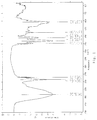
- the characterization of the polysaccharide skeleton of EPS II was carried out by acid hydrolysis of the polymer, in an inert atmosphere, incubating at 105°C for 4 hours. After cooling, the acid was removed under vacuum, the precipitate was disrupted and extracted with ethyl ether, and then.dissolved in D 2 O and subjected to NMR analysis.
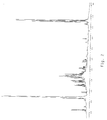
- figure 2 shows an enlargement of the region of the previous spectrum (figure 2) between 4.5 and 5.5 p.p.m., which comprises the signals of the protons relating to carbon in position 1 of monosaccharides in general.
- the EPS II was dissolved in HCl 0.5 M, and under a gas seal of N 2 , it was reflux boiled for 6 hours. The solution was cooled, concentrated under vacuum and extracted three times with equal volumes of ethyl ether. The solution was subsequently evaporated, then diluted with water and reconcentrated under vacuum; this treatment was repeated three times before drying.
- the dry product was added to water and then treated according to the scheme described by R.W. Weath [Methods Enzymol., 8 , 60-78 (1966)].
- the hydrolyzed product was charged onto a column of strong cationic resin in the form of H + and the column was subsequently eluated with water until the pH of the eluate had returned to neutrality.
- the column onto which the amino sugars had been fixed, was isocratically eluated with HCl 0.3 M.
- the fractions collected were analyzed for the reducing sugars and two chromatographic peaks were observed.
- the fractions relating to the peaks were joined, dried and added to water several times to remove the HCl and were then lyophilized and subjected to NMR analysis.
- the first peak was identified as glucosamine:
- the NMR spectrum of the proton was equal to that of a commercial sample of glucosamine ⁇ HCl (Fluka).
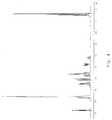
- the spectrum of the second peak (figure 4) is consistent with that of an aminohexose with a methyl in position 6 (rather than -CH 2 OH); more specifically, the compound proves to be a 2-amino-2,6-dideoxyaldohexose and represents about 70-80% of the polysaccharidic skeleton.
- the lipopolysaccharide comprises a heteropolysaccharidic chain consisting of 70-80% of a 2-amino-2,6-dideoxyaldohexose, 5-10% of glucosamine and 15-20% of one or more non-aminated sugars.
- the amine groups prove to be totally or almost totally acetylated.
- the experimentation was carried out by incubating the above microbic flora with crude oil in the presence of and without the biosurfactant produced by A. calcoaceticus ER-96 and also comparing the effect induced by this biosurfactant with that of a commercial dispersing agent.
- the biosurfactant of the present invention stimulates the biodegradation of hydrocarbons in sea water on the part of both hydrocarbonclastic microbic flora adapted for growth on hydrocarbons and autochthone microbic flora. It is important to remember that in this respect Emulsan has an inhibiting effect.
- Emulsan To determine the capacity of EPS to promote adhesion of hydrocarbonclastic microorganisms to hydrocarbons, the method adopted for Emulsan was used [E. Rosenberg et al. [Infect. Immun., 39, 1024-1028, 1983]. The method consists in wriggling a microbic suspension with a certain quantity of hydrocarbons and measuring the reductionn in turbidity of the microbic suspension due to adhesion.
- the adhesion was from 2 to 4 times greater with EPS than the control without EPS.
- the biosurfactant of the present invention is therefore particularly suitable for the treatment of "oil spills" in both the sea and internal water.
- the production of the biosurfactant is obtained by cultivating the strain A. calcoaceticus ER-96 in a culture medium containing carbon sources, nitrogen, phosphorous and sulfur, and mineral salts.
- AssimXlable carbon sources comprise for example ethanol, sodium, palmitate, oleic acid, soybean oil, etc.
- These sources are generally used at a concentration ranging from 0.2 to 5% with respect to half the culture, and preferably from 1 to 3%.
- Nitrogen sources can be selected, for example, from mineral ammonium salts, such as ammonium nitrate, ammonium sulfate, ammoniumchloride, ammonium bicarbonate or materials containing organic or inorganic nitrogen such as peptone, yeast extract or meat extract, and also ammonia can be used.
- mineral ammonium salts such as ammonium nitrate, ammonium sulfate, ammoniumchloride, ammonium bicarbonate or materials containing organic or inorganic nitrogen such as peptone, yeast extract or meat extract, and also ammonia can be used.
- cations and anions are equally suitable for the purposes of the present invention: potassium, sodium, magnesium, iron, calcium, manganese, cobalt, copper, zinc, molibden, phosphates, sulfates and chlorides. Concentrations ranging from 1 to 100 mM are generally used.
- the fermentation is carried out in a stirred and extremely aerated medium, at a temperature ranging from 25 to 37°C, preferably between 28 and 32°C.
- Sterile compressed air is circulated in the fermentation medium in a quantity varying from 0.2 to 1 vol/vol/minute.
- the pH of the fermentation medium is maintained within values ranging from 6.5 to 7.5 and preferably between 6.8 and 7.2.
- the pH regulation can be carried out, for example, by the addition of a basic aqueouc solution such as an aqueous solution of ammonia, potassium hydroxide, sodium hydroxide.
- the foam which is formed in the fermentation can be controlled by the addition of a suitable antifoam agent selected from those available on the market such as for example polypropyleneglycol, or with mechanical devices.
- a suitable antifoam agent selected from those available on the market such as for example polypropyleneglycol, or with mechanical devices.
- the fermentation process can be carried out in batch, in fed batch, or in continuous.
- the biosurfactant can be isolated and purified using one of the known techniques.
- the fermentation broth as such or without cells can be used directly.
- the determination of the concentration of lipopolysaccharide in the culture broth during and at the end of the fermentations of the producer strain can be carried out in two ways: the first consists in measuring the emulsifying capacity of the fermentation broth and obtaining the concentration of Enispol by means of a calibration curve; the second consists in determining the aminated sugars and also in this case obtaining the concentration of EPS by means of a calibration curve.
- the flasks were incubated for 8 hours at 22°C in an orbital stirrer at 200 revs/min.
- the culture broths were then used to carry out a series of three subcultures for each of the carbon sources used.
- the various culture broths were inoculated in 50 ml flasks each containing 20 ml of BMM and 0.1 ml of the carbon source, subsequently incubating at 22°C on an orbital stirrer at 200 revs/min for 5 days.
- the isolation of the single microbic phenotypes present in the enriched culture broths was carried out by plating on "LAB-LEMCO Broth medium (OXOID) agarized at 2%. The plates were incubated at 22°C for 48 hours.
- Strips of the single pure cultures thus obtained were shuffled on plates of agarized BHB medium at 2%.
- the carbon source was administered in gaseous phase, placing a disk of filter paper soaked with a mixture of crude oil/vaseline oil/gas oil by autotraction (50:40:10), in the lid of the plate. The plates were incubated for 7 days at 22°C in an oven.
- polystyrene plates with 24 test-holes were used, introducing 1 ml of microbic suspension in each test-hole and carefully topping up with 0.025 ml of crude oil.
- the test-holes were immediately examined under the microscope (10 X) to observe the fracture of the oily meniscus which indicates the presence of surfactants.
- Lyophilized cells of A.calcoaceticus ER-96 were revitalized in "Lab-Lemco" Broth medium (OXOID CM 15) and a 250 ml flask containing 50 ml of culture medium (T1) containing per litre: ethanol 10 g, KH 2 PO 4 10 g, NH 4 Cl 4.0 g, MgSO 4 ⁇ 7H 2 O 0.5 g, CaCl 2 2.08 mg, CoCl 2 ⁇ 6H 2 O 2.08 mg, MnCl 2 ⁇ 4H 2 O 1.73 mg, Na 2 MoO 4 2.12 mg, MnSO 4 ⁇ H 2 O 1.49 mg, ZnSO 4 ⁇ 7H 2 O 2.52 mg, FeSO 4 ⁇ 7H 2 O 2.43 mg, pH adjusted to 7.4 with NaOH, was inoculated with this culture (5%).
- the flask was incubated on an orbital stirrer at 180 revs/min, at 30°C for 48 hours and then used to inoculate a 2 l flask, equipped with breakwaters, containing 500 ml of T1 medium.
- the culture was prolonged for 48 hours under the above conditions and was subsequently used to inoculate (5%) a 14 l Chemap® fermenter, with breakwaters, containing 10 l of T2 culture broth having the same composition as the T1 medium, but with 7 g/l of KH 2 PO 4 , 10 g/l of NH 4 Cl and 1 g/l of MgSO 4 ⁇ 7H 2 O.
- the fermentation was carried out with an aeration of 0.5 l/l per minute, at 30°C, stirring with 2 turbines at 700 revs/min.
- the pH was automatically corrected to 7 with NaOH and the foaming controlled with Polypropyleneglycol (PPG 2000).
- the fermentation broth was centrifuged to remove the cells and the surnatant (which forms raw EPS) was lyophilized. 700 mg/l of product and 3.7 g/l (dry weight) of biomass were obtained.
- the fermentation was carried out under the same operating conditions described in example 2, but using NH 4 OH 10 M to correct the pH to 7.
- A. calcoaceticus ER-96 was cultured under the same operating conditions as example 3. When the optical density at 660 nm of the culture broth reached a value of 4, a solution of aqueous ethanol at 47.5% was added to the fermentation broth with such a flow-rate as to impose a duplication time of 24 hours of the cells. After 83 hours of culture, the fermentation was interrupted. The yield of EPS was 6.7 g/l, that of the cells 13 g/l (dry weight).
- A. calcoaceticus ER-96 was cultured with the same procedure as example 4, except that the foaming was mechanically controlled with the use of Fundafoam® (Chemap) foam-breaker; in addition, the initial concentration of ethanol was 5 ml/l. After 14 hours, when the optical density at 660 nm of the culture broth had reached a value of 4.5, the addition of ethanol was started, in such a quantity as to impose a duplication time of 16 hours. The fermentation was prolonged for 90 hours. 20 g/l of EPS and 21 g/l of biomass were obtained.
- Calcoaceticus ER-96 was cultured under the same operating conditions as example 4, but using oleic acid instead of ethanol as single carbon source. After 83 hours the yield of EPS was 7.5 g/l, that of the cells 24.8 g/l (dry weight).
- Cells of A. calcoaceticus ER-96 were cultured adopting the same procedure as example 6, but using soybean oil instead of oleic acid as single carbon source. After 72 hours of fermentation the yield of EPS was 15 g/l, that of the cells 20 g/l (dry weight).
- Cells of A. calcoaceticus ER-96 were cultured in a 14 litre Chemap® fermenter containing 10 l of T2 medium to which 20 g/l of ethanol had been added. Further ethanol was added at various times as required and the pH was maintained at 7 with ammonia.
- Ammonium sulfate (166 g/l) was added to the surnatant (10.4 l) which was left under stirring for a night and then centrifuged (13,000 x g max ; SorvallDuPont® RC-5B).
- Ammonium sulfate (57 g/l) was added to the limpid surnatant and after 4 hours of stirring the precipitate was recovered by centrifugation, dissolved with a minimum quantity of water, dialyzed against water and lyophilized.
- the emulsifying capacity was determined with a modification of the method of Gutnick et al. [EPA 16546] .
- a solution of EPS in a buffer of tris-hydroxymethylaminomethane (Tris-HCl) 50 mM brought to pH 7.2 with HCl and containing MgSO 4 10 mM were introduced into a boronsilicate 25 x 80 mm, glass test-tube, with a screw top and teflon seal and 50 ⁇ l of a mixture of n-hexadecane and 2-methylnaphthalene (1:1; v/v) were added.
- the mixture was stirred at 800 strokes/min with a vertical shake stirrer having an amplitude of 10 mm ("Agitest" Bioblock) for 5 minutes, then the whole contents of the test-tube were poured into a glass cuvette and the absorbance at 620 nm was determined.
- the quantity of biosurfactant that under the standard conditions described above gives an optical density of 1 is defined with Eniricerche emulsifying capacity Units (1 UE).
- the specific emulsifying capacity was consequently defined as the emulsifying capacity of 1 mg of product.
- EPS proved to consist of about 22% of proteins (Bio-Rad Protein Assay Kit), about 67% of a lipopolysaccharide and the remaining percentage of metallic ions, essentially magnesium and sodium.
- a fermentation of A. calcoaceticus ER-96 was carried out under the same conditions as example 4. At the end, 1660 g of ammonium sulfate were added to 10 l of this culture broth. After a night at 4°C under stirring, the suspension was centrifuged (13,000 x g max ) and 434 g of ammonium sulfate were added to the resulting surnatant (7.6 litres).
- the suspension was centrifuged and the precipitate was dissolved in 2 l of water and concentrated by passage through an ultrafiltration spiral membrane with a cut-off of 10,000 Daltons (Amicon S1Y1O) up to a volume of 400 ml.
- the mixture reduced to 1 litre was heated to 70°C and then an equal volume of phenol redistilled and preheated to 70°C was added, according to the method of O. Westphal & K. Jann ("Methods in Carbohydrate Chemistry" arranged by R.L. Whistler, Vol. V, pages 83-91, Academic Press, Inc., New York, 1965). After 15 minutes at 70°C under vigorous stirring, the mixture was cooled to room temperature and the emulsion formed was separated by centrifugation at 23,000 x g max .
- the phenolic phase was extracted three times with an equal volume of water and the aqueous extracts were joined and, after being extracted three times with an equal volume of ether, were concentrated with the membrane to 500 ml. After the addition of 500 ml of EDTANa 2 0.1 M pH 8, the solution was reconcentrated to 500 ml and this treatment was repeated 6 times.
- esters were then extracted in n-heptane and the fatty acids were identified by gaschromatography/mass spectrometry.
- EPS II 80 mg were dissolved in 8 ml of HCl 5 M and incubated, in an inert atmosphere, for 4 hours at 105°C. After cooling to room temperature the HCl was removed under vacuum.
- Figure 3 shows an enlargement of the region of the previous spectrum between 4.5 and 5.5 p.p.m., which comprises the signals of the protons relating to carbon in position 1 of monosaccharides in general.
- the resulting solution was evaporated to 10 ml, diluted to 100 ml with water and reconcentrated to 10 ml under vacuum. This treatment was repeated three times before drying by rotavapor.
- the hydrolyzed product was charged onto a column (1.2 cm d.i. x 50 cm h) of Dowex® 50 X-4, 200-400 mesh strong cationic resin, in the form of H + , and the column was subsequently eluated with water until the pH of the eluate was neutral.
- the column onto which the aminosugars had been fixed, was isocratically eluated with HCl 0.3 M. The fractions collected were analyzed for the reducing sugars and two chromatographic peaks were observed.
- the first peak which was about 10% of the total, was identified as glucosamine; the NMR spectrum of the proton was equal to that of a commercial sample of glucosamine-HCl (Fluka).
- the spectrum of the second peak (figure 4) was consistent with that of an aminohexose with a methyl in position 6. More specifically, the compound proved to be a 2-amino-2,6-dideoxy-aldohexose.
- the flasks were incubated under aerobic conditions on an orbital stirrer at 100 revs/min at 22°C, taking test samples at zero time and at different time intervals to determine the content of biomass and hydrocarbons.
- the biomass was determined by means of a count of the total heterotroph bacteria effected on agarized culture medium with soybean criptone-peptone (Oxoid, CM 131).
- the hydrocarbons were dosed by extracting each single flask with 1,2-trichloro-1,2,2-trifluoroethane (Freon®-113), measuring the extinction at 2930 cm -1 , corresponding to the maximum absorption, and obtaining the concentration of hydrocarbons by means of a calibration curve formed with a standard consisting of n-hexadecane/iso-octane/chlorobenzene in a volumetric ratio 15/15/10.
- EPS prepared as described in example 8 was used.
- the cells were then collected by centrifugation, washed and resuspended twice with 50 ml of PUM buffer solution (containing per litre: K 2 HPO 4 ⁇ 3H 2 O 22.2 g; K 2 PO 4 7.26 g; Urea 1.8 g; MgSO 4 ⁇ 7H 2 O 0.2 g; pH 7.1).
- PUM buffer solution containing per litre: K 2 HPO 4 ⁇ 3H 2 O 22.2 g; K 2 PO 4 7.26 g; Urea 1.8 g; MgSO 4 ⁇ 7H 2 O 0.2 g; pH 7.1).
- the grown colonies were collected with a sterile loop in PUM buffer, in a 19 x 180 mm bacteriological tube, until cellular suspensions of a suitable concentration were obtained.
Landscapes
- Chemical & Material Sciences (AREA)
- Life Sciences & Earth Sciences (AREA)
- Health & Medical Sciences (AREA)
- Engineering & Computer Science (AREA)
- Organic Chemistry (AREA)
- Zoology (AREA)
- Wood Science & Technology (AREA)
- Biochemistry (AREA)
- Biotechnology (AREA)
- Bioinformatics & Cheminformatics (AREA)
- General Health & Medical Sciences (AREA)
- Genetics & Genomics (AREA)
- Microbiology (AREA)
- Chemical Kinetics & Catalysis (AREA)
- Molecular Biology (AREA)
- Medicinal Chemistry (AREA)
- General Engineering & Computer Science (AREA)
- General Chemical & Material Sciences (AREA)
- Materials Engineering (AREA)
- Polymers & Plastics (AREA)
- Tropical Medicine & Parasitology (AREA)
- Virology (AREA)
- Biomedical Technology (AREA)
- Preparation Of Compounds By Using Micro-Organisms (AREA)
- Polysaccharides And Polysaccharide Derivatives (AREA)
- Emulsifying, Dispersing, Foam-Producing Or Wetting Agents (AREA)
- Micro-Organisms Or Cultivation Processes Thereof (AREA)
- Cephalosporin Compounds (AREA)
- Pharmaceuticals Containing Other Organic And Inorganic Compounds (AREA)
Applications Claiming Priority (2)
| Application Number | Priority Date | Filing Date | Title |
|---|---|---|---|
| IT97MI002809A IT1296987B1 (it) | 1997-12-19 | 1997-12-19 | Biosurfattante lipopolisaccaridico |
| ITMI972809 | 1997-12-19 |
Publications (3)
| Publication Number | Publication Date |
|---|---|
| EP0924221A2 true EP0924221A2 (fr) | 1999-06-23 |
| EP0924221A3 EP0924221A3 (fr) | 2000-12-06 |
| EP0924221B1 EP0924221B1 (fr) | 2009-02-18 |
Family
ID=11378399
Family Applications (1)
| Application Number | Title | Priority Date | Filing Date |
|---|---|---|---|
| EP98123614A Expired - Lifetime EP0924221B1 (fr) | 1997-12-19 | 1998-12-10 | Nouveau lipopolysaccharide-biosuractif |
Country Status (9)
| Country | Link |
|---|---|
| US (1) | US6063602A (fr) |
| EP (1) | EP0924221B1 (fr) |
| JP (1) | JPH11269203A (fr) |
| AT (1) | ATE423142T1 (fr) |
| CA (1) | CA2255157C (fr) |
| DE (1) | DE69840562D1 (fr) |
| ES (1) | ES2323025T3 (fr) |
| IT (1) | IT1296987B1 (fr) |
| PT (1) | PT924221E (fr) |
Cited By (6)
| Publication number | Priority date | Publication date | Assignee | Title |
|---|---|---|---|---|
| WO2003006147A3 (fr) * | 2001-07-13 | 2003-11-20 | Eni Spa | Compositions de dispersion biphasiques pour produits petroliers |
| US7052520B2 (en) | 2002-05-23 | 2006-05-30 | Unilever Home & Personal Care Usa, A Division Of Conopco, Inc. | Article and process for cleaning fabrics |
| KR100866526B1 (ko) * | 2007-09-14 | 2008-11-03 | 전남대학교산학협력단 | 차량 폐유 또는 선박 누출유 분해를 위한 조성물 및 방법 |
| DE102007028030A1 (de) * | 2007-06-14 | 2008-12-24 | Universität Karlsruhe (Th) | Biotenside und deren Herstellung |
| WO2012010406A1 (fr) | 2010-07-22 | 2012-01-26 | Unilever Plc | Combinaisons de rhamnolipides et d'enzymes pour nettoyage amélioré |
| EP2691509A4 (fr) * | 2011-03-29 | 2014-10-08 | Danisco Us Inc | Procédés de régulation de la mousse |
Families Citing this family (9)
| Publication number | Priority date | Publication date | Assignee | Title |
|---|---|---|---|---|
| US6512014B2 (en) * | 2000-12-13 | 2003-01-28 | Ramot University Authority For Applied Research And Industrial Development Limited | Compositions containing bioemulsifiers and a method for their preparation |
| RU2337069C1 (ru) * | 2007-04-02 | 2008-10-27 | Закрытое акционерное общество "Биоойл" | Препарат для очистки почвы и воды от нефти и нефтепродуктов |
| AU2008313721B2 (en) * | 2007-10-18 | 2013-03-21 | Unilever Plc | Method for producing a foaming agent |
| US20100112139A1 (en) * | 2008-03-28 | 2010-05-06 | Conopco, Inc., D/B/A Unilever | Foaming Agents Comprising Hydrophobin |
| JP2012505645A (ja) * | 2008-10-16 | 2012-03-08 | ユニリーバー・ナームローゼ・ベンノートシヤープ | 消泡剤を含むハイドロフォビン溶液 |
| AU2009328324B2 (en) | 2008-12-16 | 2013-03-21 | Unilever Plc | Method for extracting hydrophobin from a solution |
| CA2704702C (fr) * | 2009-06-02 | 2018-06-12 | Unilever Plc | Produits aeres cuits au four |
| US20110151100A1 (en) * | 2009-12-19 | 2011-06-23 | Satyanarayana Ganti | Green Process for Production of Biosurfactants or Biopolymers through Waste Oil Utilization |
| JP6539400B1 (ja) * | 2018-10-24 | 2019-07-03 | 株式会社アンチエイジング・プロ | Lps高含有組成物の製造方法 |
Family Cites Families (6)
| Publication number | Priority date | Publication date | Assignee | Title |
|---|---|---|---|---|
| US3941692A (en) * | 1973-04-03 | 1976-03-02 | David Gutnick | Cleaning of cargo compartments |
| US4395354A (en) * | 1979-02-22 | 1983-07-26 | Petroleum Fermentations N.V. | αEmulsans |
| CA1149302A (fr) * | 1979-02-22 | 1983-07-05 | David L. Gutnick | Emulsanes |
| US4883757A (en) * | 1984-11-30 | 1989-11-28 | Petroleum Fermentations N.V. | Bioemulsifier production by Acinetobacter calcoaceticus strains |
| DD240389A1 (de) * | 1985-08-19 | 1986-10-29 | Akad Wissenschaften Ddr | Verfahren zur produktion von biomulgatoren |
| JP2911544B2 (ja) * | 1989-06-05 | 1999-06-23 | ライオン株式会社 | 新規アシネトバクター・カルコアセティカス及び新規バイオサーファクタント |
-
1997
- 1997-12-19 IT IT97MI002809A patent/IT1296987B1/it active IP Right Grant
-
1998
- 1998-12-10 DE DE69840562T patent/DE69840562D1/de not_active Expired - Lifetime
- 1998-12-10 PT PT98123614T patent/PT924221E/pt unknown
- 1998-12-10 EP EP98123614A patent/EP0924221B1/fr not_active Expired - Lifetime
- 1998-12-10 ES ES98123614T patent/ES2323025T3/es not_active Expired - Lifetime
- 1998-12-10 AT AT98123614T patent/ATE423142T1/de active
- 1998-12-16 US US09/212,409 patent/US6063602A/en not_active Expired - Lifetime
- 1998-12-18 CA CA2255157A patent/CA2255157C/fr not_active Expired - Fee Related
- 1998-12-18 JP JP10361201A patent/JPH11269203A/ja not_active Withdrawn
Cited By (9)
| Publication number | Priority date | Publication date | Assignee | Title |
|---|---|---|---|---|
| WO2003006147A3 (fr) * | 2001-07-13 | 2003-11-20 | Eni Spa | Compositions de dispersion biphasiques pour produits petroliers |
| GB2392635A (en) * | 2001-07-13 | 2004-03-10 | Eni Spa | Biphasic dispersing compositions for oil products |
| GB2392635B (en) * | 2001-07-13 | 2005-04-06 | Eni Spa | Biphasic dispersing compositions for oil products |
| US7052520B2 (en) | 2002-05-23 | 2006-05-30 | Unilever Home & Personal Care Usa, A Division Of Conopco, Inc. | Article and process for cleaning fabrics |
| DE102007028030A1 (de) * | 2007-06-14 | 2008-12-24 | Universität Karlsruhe (Th) | Biotenside und deren Herstellung |
| WO2008151615A3 (fr) * | 2007-06-14 | 2009-09-03 | Universität Karlsruhe (Th) | Tensio-actifs biologiques et leur préparation |
| KR100866526B1 (ko) * | 2007-09-14 | 2008-11-03 | 전남대학교산학협력단 | 차량 폐유 또는 선박 누출유 분해를 위한 조성물 및 방법 |
| WO2012010406A1 (fr) | 2010-07-22 | 2012-01-26 | Unilever Plc | Combinaisons de rhamnolipides et d'enzymes pour nettoyage amélioré |
| EP2691509A4 (fr) * | 2011-03-29 | 2014-10-08 | Danisco Us Inc | Procédés de régulation de la mousse |
Also Published As
| Publication number | Publication date |
|---|---|
| ITMI972809A1 (it) | 1999-06-19 |
| CA2255157A1 (fr) | 1999-06-19 |
| IT1296987B1 (it) | 1999-08-03 |
| ES2323025T3 (es) | 2009-07-03 |
| JPH11269203A (ja) | 1999-10-05 |
| PT924221E (pt) | 2009-05-21 |
| CA2255157C (fr) | 2010-03-30 |
| EP0924221B1 (fr) | 2009-02-18 |
| DE69840562D1 (de) | 2009-04-02 |
| US6063602A (en) | 2000-05-16 |
| EP0924221A3 (fr) | 2000-12-06 |
| ATE423142T1 (de) | 2009-03-15 |
Similar Documents
| Publication | Publication Date | Title |
|---|---|---|
| EP0924221B1 (fr) | Nouveau lipopolysaccharide-biosuractif | |
| Desai et al. | Production of biosurfactants | |
| Calvo et al. | Application of bioemulsifiers in soil oil bioremediation processes. Future prospects | |
| Desai et al. | Microbial production of surfactants and their commercial potential | |
| Nicolaus et al. | Haloarcula spp able to biosynthesize exo-and endopolymers | |
| Berg et al. | Identification and characterization of a soil bacterium with extracellular emulsifying activity | |
| US4230801A (en) | Production of α-emulsans | |
| US4395354A (en) | αEmulsans | |
| US4234689A (en) | Production of α-emulsans | |
| Jagtap et al. | Production of bioemulsifier by Acinetobacter species isolated from healthy human skin | |
| Hayder et al. | Optimized conditions for bioemulsifier production by local Streptomyces sp. SS 20 isolated from hydrocarbon contaminated soil | |
| EP0016546B1 (fr) | Lipohétéropolysaccharides microbiens extracellulaires et dérivés, leur préparation, préparations les contenant et leurs utilisations | |
| Wu et al. | Extracellular particles of polymeric material formed in n-hexadecane fermentation by Pseudomonas aeruginosa | |
| US4432887A (en) | De-emulsification agents of microbiological origin | |
| JPH0670754A (ja) | シュードモナス・アエルギノーザおよびl−ラムノースのバイオテクノロジー的製造方法へのその使用 | |
| US4311829A (en) | Apo-β-emulsans | |
| US4380504A (en) | ψ-Emulsans | |
| US4311831A (en) | Apo-ψ-emulsans | |
| US4311830A (en) | Apo-α-emulsans | |
| US4395353A (en) | Polyanionic heteropolysaccharide biopolymers | |
| Goodfellow et al. | Transfer of Nocardia amarae Lechevalier and Lechevalier 1974 to the genus Gordona as Gordona amarae comb. nov. | |
| US4311832A (en) | Proemulsans | |
| Kumari | Biosurfactant as an antimicrobial and biodegradable agent a review | |
| Tian et al. | Characterization of a Biosurfactant-producing Strain Rhodococcus sp. HL-6 | |
| Sahoo et al. | Biosurfactant production from n-paraffins by an air isolate Pseudomonas aeruginosa OCD1 |
Legal Events
| Date | Code | Title | Description |
|---|---|---|---|
| PUAI | Public reference made under article 153(3) epc to a published international application that has entered the european phase |
Free format text: ORIGINAL CODE: 0009012 |
|
| AK | Designated contracting states |
Kind code of ref document: A2 Designated state(s): AT BE CH CY DE DK ES FI FR GB GR IE LI LU MC NL PT SE |
|
| AX | Request for extension of the european patent |
Free format text: AL PAYMENT 19981210;LT PAYMENT 19981210;LV PAYMENT 19981210;MK PAYMENT 19981210;RO PAYMENT 19981210;SI PAYMENT 19981210 |
|
| PUAL | Search report despatched |
Free format text: ORIGINAL CODE: 0009013 |
|
| AK | Designated contracting states |
Kind code of ref document: A3 Designated state(s): AT BE CH CY DE DK ES FI FR GB GR IE IT LI LU MC NL PT SE |
|
| AX | Request for extension of the european patent |
Free format text: AL PAYMENT 19981210;LT PAYMENT 19981210;LV PAYMENT 19981210;MK PAYMENT 19981210;RO PAYMENT 19981210;SI PAYMENT 19981210 |
|
| 17P | Request for examination filed |
Effective date: 20010601 |
|
| AKX | Designation fees paid |
Free format text: AT BE CH CY DE DK ES FI FR GB GR IE LI LU MC NL PT SE |
|
| AXX | Extension fees paid |
Free format text: AL PAYMENT 19981210;LT PAYMENT 19981210;LV PAYMENT 19981210;MK PAYMENT 19981210;RO PAYMENT 19981210;SI PAYMENT 19981210 |
|
| GRAP | Despatch of communication of intention to grant a patent |
Free format text: ORIGINAL CODE: EPIDOSNIGR1 |
|
| GRAS | Grant fee paid |
Free format text: ORIGINAL CODE: EPIDOSNIGR3 |
|
| RAP1 | Party data changed (applicant data changed or rights of an application transferred) |
Owner name: ENI S.P.A. |
|
| GRAA | (expected) grant |
Free format text: ORIGINAL CODE: 0009210 |
|
| AK | Designated contracting states |
Kind code of ref document: B1 Designated state(s): AT BE CH CY DE DK ES FI FR GB GR IE LI LU MC NL PT SE |
|
| AX | Request for extension of the european patent |
Extension state: AL LT LV MK RO SI |
|
| REG | Reference to a national code |
Ref country code: GB Ref legal event code: FG4D |
|
| REG | Reference to a national code |
Ref country code: CH Ref legal event code: EP |
|
| REG | Reference to a national code |
Ref country code: IE Ref legal event code: FG4D |
|
| REF | Corresponds to: |
Ref document number: 69840562 Country of ref document: DE Date of ref document: 20090402 Kind code of ref document: P |
|
| REG | Reference to a national code |
Ref country code: PT Ref legal event code: SC4A Free format text: AVAILABILITY OF NATIONAL TRANSLATION Effective date: 20090515 |
|
| REG | Reference to a national code |
Ref country code: CH Ref legal event code: NV Representative=s name: BOHEST AG |
|
| REG | Reference to a national code |
Ref country code: ES Ref legal event code: FG2A Ref document number: 2323025 Country of ref document: ES Kind code of ref document: T3 |
|
| LTIE | Lt: invalidation of european patent or patent extension |
Effective date: 20090218 |
|
| PG25 | Lapsed in a contracting state [announced via postgrant information from national office to epo] |
Ref country code: FI Free format text: LAPSE BECAUSE OF FAILURE TO SUBMIT A TRANSLATION OF THE DESCRIPTION OR TO PAY THE FEE WITHIN THE PRESCRIBED TIME-LIMIT Effective date: 20090218 |
|
| PG25 | Lapsed in a contracting state [announced via postgrant information from national office to epo] |
Ref country code: SE Free format text: LAPSE BECAUSE OF FAILURE TO SUBMIT A TRANSLATION OF THE DESCRIPTION OR TO PAY THE FEE WITHIN THE PRESCRIBED TIME-LIMIT Effective date: 20090518 |
|
| PG25 | Lapsed in a contracting state [announced via postgrant information from national office to epo] |
Ref country code: BE Free format text: LAPSE BECAUSE OF FAILURE TO SUBMIT A TRANSLATION OF THE DESCRIPTION OR TO PAY THE FEE WITHIN THE PRESCRIBED TIME-LIMIT Effective date: 20090218 |
|
| PG25 | Lapsed in a contracting state [announced via postgrant information from national office to epo] |
Ref country code: DK Free format text: LAPSE BECAUSE OF FAILURE TO SUBMIT A TRANSLATION OF THE DESCRIPTION OR TO PAY THE FEE WITHIN THE PRESCRIBED TIME-LIMIT Effective date: 20090218 |
|
| PLBE | No opposition filed within time limit |
Free format text: ORIGINAL CODE: 0009261 |
|
| STAA | Information on the status of an ep patent application or granted ep patent |
Free format text: STATUS: NO OPPOSITION FILED WITHIN TIME LIMIT |
|
| 26N | No opposition filed |
Effective date: 20091119 |
|
| PG25 | Lapsed in a contracting state [announced via postgrant information from national office to epo] |
Ref country code: MC Free format text: LAPSE BECAUSE OF NON-PAYMENT OF DUE FEES Effective date: 20100701 |
|
| REG | Reference to a national code |
Ref country code: IE Ref legal event code: MM4A |
|
| PG25 | Lapsed in a contracting state [announced via postgrant information from national office to epo] |
Ref country code: IE Free format text: LAPSE BECAUSE OF NON-PAYMENT OF DUE FEES Effective date: 20091210 Ref country code: GR Free format text: LAPSE BECAUSE OF FAILURE TO SUBMIT A TRANSLATION OF THE DESCRIPTION OR TO PAY THE FEE WITHIN THE PRESCRIBED TIME-LIMIT Effective date: 20090519 |
|
| PG25 | Lapsed in a contracting state [announced via postgrant information from national office to epo] |
Ref country code: LU Free format text: LAPSE BECAUSE OF NON-PAYMENT OF DUE FEES Effective date: 20091210 |
|
| PG25 | Lapsed in a contracting state [announced via postgrant information from national office to epo] |
Ref country code: CY Free format text: LAPSE BECAUSE OF FAILURE TO SUBMIT A TRANSLATION OF THE DESCRIPTION OR TO PAY THE FEE WITHIN THE PRESCRIBED TIME-LIMIT Effective date: 20090218 |
|
| PGFP | Annual fee paid to national office [announced via postgrant information from national office to epo] |
Ref country code: PT Payment date: 20130611 Year of fee payment: 16 Ref country code: GB Payment date: 20131227 Year of fee payment: 16 Ref country code: DE Payment date: 20131230 Year of fee payment: 16 Ref country code: CH Payment date: 20131230 Year of fee payment: 16 Ref country code: AT Payment date: 20131120 Year of fee payment: 16 |
|
| PGFP | Annual fee paid to national office [announced via postgrant information from national office to epo] |
Ref country code: FR Payment date: 20131217 Year of fee payment: 16 Ref country code: NL Payment date: 20131226 Year of fee payment: 16 Ref country code: ES Payment date: 20131226 Year of fee payment: 16 |
|
| REG | Reference to a national code |
Ref country code: CH Ref legal event code: PCAR Free format text: NEW ADDRESS: HOLBEINSTRASSE 36-38, 4051 BASEL (CH) |
|
| REG | Reference to a national code |
Ref country code: PT Ref legal event code: MM4A Free format text: LAPSE DUE TO NON-PAYMENT OF FEES Effective date: 20150611 |
|
| REG | Reference to a national code |
Ref country code: DE Ref legal event code: R119 Ref document number: 69840562 Country of ref document: DE |
|
| REG | Reference to a national code |
Ref country code: NL Ref legal event code: V1 Effective date: 20150701 |
|
| REG | Reference to a national code |
Ref country code: NL Ref legal event code: V1 Effective date: 20150701 |
|
| PG25 | Lapsed in a contracting state [announced via postgrant information from national office to epo] |
Ref country code: PT Free format text: LAPSE BECAUSE OF NON-PAYMENT OF DUE FEES Effective date: 20150611 |
|
| REG | Reference to a national code |
Ref country code: CH Ref legal event code: PL |
|
| REG | Reference to a national code |
Ref country code: AT Ref legal event code: MM01 Ref document number: 423142 Country of ref document: AT Kind code of ref document: T Effective date: 20141210 |
|
| GBPC | Gb: european patent ceased through non-payment of renewal fee |
Effective date: 20141210 |
|
| REG | Reference to a national code |
Ref country code: FR Ref legal event code: ST Effective date: 20150831 |
|
| PG25 | Lapsed in a contracting state [announced via postgrant information from national office to epo] |
Ref country code: NL Free format text: LAPSE BECAUSE OF NON-PAYMENT OF DUE FEES Effective date: 20150701 |
|
| PG25 | Lapsed in a contracting state [announced via postgrant information from national office to epo] |
Ref country code: CH Free format text: LAPSE BECAUSE OF NON-PAYMENT OF DUE FEES Effective date: 20141231 Ref country code: LI Free format text: LAPSE BECAUSE OF NON-PAYMENT OF DUE FEES Effective date: 20141231 Ref country code: GB Free format text: LAPSE BECAUSE OF NON-PAYMENT OF DUE FEES Effective date: 20141210 Ref country code: DE Free format text: LAPSE BECAUSE OF NON-PAYMENT OF DUE FEES Effective date: 20150701 |
|
| PG25 | Lapsed in a contracting state [announced via postgrant information from national office to epo] |
Ref country code: AT Free format text: LAPSE BECAUSE OF NON-PAYMENT OF DUE FEES Effective date: 20141210 Ref country code: FR Free format text: LAPSE BECAUSE OF NON-PAYMENT OF DUE FEES Effective date: 20141231 |
|
| REG | Reference to a national code |
Ref country code: ES Ref legal event code: FD2A Effective date: 20160126 |
|
| PG25 | Lapsed in a contracting state [announced via postgrant information from national office to epo] |
Ref country code: ES Free format text: LAPSE BECAUSE OF NON-PAYMENT OF DUE FEES Effective date: 20141211 |