EP0926108A1 - Outil coupant en céramique - Google Patents
Outil coupant en céramique Download PDFInfo
- Publication number
- EP0926108A1 EP0926108A1 EP98310732A EP98310732A EP0926108A1 EP 0926108 A1 EP0926108 A1 EP 0926108A1 EP 98310732 A EP98310732 A EP 98310732A EP 98310732 A EP98310732 A EP 98310732A EP 0926108 A1 EP0926108 A1 EP 0926108A1
- Authority
- EP
- European Patent Office
- Prior art keywords
- ceramic material
- cutting tool
- ceramic
- component
- wal
- Prior art date
- Legal status (The legal status is an assumption and is not a legal conclusion. Google has not performed a legal analysis and makes no representation as to the accuracy of the status listed.)
- Granted
Links
- 238000005520 cutting process Methods 0.000 title claims abstract description 73
- 239000000919 ceramic Substances 0.000 title claims abstract description 44
- 229910010293 ceramic material Inorganic materials 0.000 claims abstract description 56
- 239000010936 titanium Substances 0.000 claims abstract description 40
- RTAQQCXQSZGOHL-UHFFFAOYSA-N Titanium Chemical compound [Ti] RTAQQCXQSZGOHL-UHFFFAOYSA-N 0.000 claims abstract description 33
- 229910052719 titanium Inorganic materials 0.000 claims abstract description 33
- PNEYBMLMFCGWSK-UHFFFAOYSA-N aluminium oxide Inorganic materials [O-2].[O-2].[O-2].[Al+3].[Al+3] PNEYBMLMFCGWSK-UHFFFAOYSA-N 0.000 claims abstract description 30
- IJGRMHOSHXDMSA-UHFFFAOYSA-N Atomic nitrogen Chemical compound N#N IJGRMHOSHXDMSA-UHFFFAOYSA-N 0.000 claims abstract description 8
- 229910052593 corundum Inorganic materials 0.000 claims abstract description 8
- 229910001845 yogo sapphire Inorganic materials 0.000 claims abstract description 8
- OKTJSMMVPCPJKN-UHFFFAOYSA-N Carbon Chemical compound [C] OKTJSMMVPCPJKN-UHFFFAOYSA-N 0.000 claims abstract description 7
- 229910052799 carbon Inorganic materials 0.000 claims abstract description 7
- 229910052782 aluminium Inorganic materials 0.000 claims abstract description 5
- XAGFODPZIPBFFR-UHFFFAOYSA-N aluminium Chemical compound [Al] XAGFODPZIPBFFR-UHFFFAOYSA-N 0.000 claims abstract description 5
- 229910052757 nitrogen Inorganic materials 0.000 claims abstract description 5
- MCMNRKCIXSYSNV-UHFFFAOYSA-N Zirconium dioxide Chemical compound O=[Zr]=O MCMNRKCIXSYSNV-UHFFFAOYSA-N 0.000 claims description 32
- MTPVUVINMAGMJL-UHFFFAOYSA-N trimethyl(1,1,2,2,2-pentafluoroethyl)silane Chemical compound C[Si](C)(C)C(F)(F)C(F)(F)F MTPVUVINMAGMJL-UHFFFAOYSA-N 0.000 claims description 24
- 238000005245 sintering Methods 0.000 claims description 23
- 239000002245 particle Substances 0.000 claims description 13
- 229910052684 Cerium Inorganic materials 0.000 claims description 4
- 229910052777 Praseodymium Inorganic materials 0.000 claims description 4
- 229910052771 Terbium Inorganic materials 0.000 claims description 4
- 229910052761 rare earth metal Inorganic materials 0.000 claims description 4
- 229910052692 Dysprosium Inorganic materials 0.000 claims description 2
- 229910052691 Erbium Inorganic materials 0.000 claims description 2
- 229910052693 Europium Inorganic materials 0.000 claims description 2
- 229910052688 Gadolinium Inorganic materials 0.000 claims description 2
- 229910052689 Holmium Inorganic materials 0.000 claims description 2
- 229910052765 Lutetium Inorganic materials 0.000 claims description 2
- 229910052779 Neodymium Inorganic materials 0.000 claims description 2
- 229910002637 Pr6O11 Inorganic materials 0.000 claims description 2
- 229910052772 Samarium Inorganic materials 0.000 claims description 2
- 229910052775 Thulium Inorganic materials 0.000 claims description 2
- 229910052769 Ytterbium Inorganic materials 0.000 claims description 2
- 229910052791 calcium Inorganic materials 0.000 claims description 2
- CETPSERCERDGAM-UHFFFAOYSA-N ceric oxide Chemical compound O=[Ce]=O CETPSERCERDGAM-UHFFFAOYSA-N 0.000 claims description 2
- 229910000422 cerium(IV) oxide Inorganic materials 0.000 claims description 2
- 229910052735 hafnium Inorganic materials 0.000 claims description 2
- CJNBYAVZURUTKZ-UHFFFAOYSA-N hafnium(IV) oxide Inorganic materials O=[Hf]=O CJNBYAVZURUTKZ-UHFFFAOYSA-N 0.000 claims description 2
- 229910052746 lanthanum Inorganic materials 0.000 claims description 2
- 229910052749 magnesium Inorganic materials 0.000 claims description 2
- 229910044991 metal oxide Inorganic materials 0.000 claims description 2
- 150000004706 metal oxides Chemical class 0.000 claims description 2
- 229910052706 scandium Inorganic materials 0.000 claims description 2
- 229910052727 yttrium Inorganic materials 0.000 claims description 2
- 229910052726 zirconium Inorganic materials 0.000 claims description 2
- 239000012071 phase Substances 0.000 description 29
- CPLXHLVBOLITMK-UHFFFAOYSA-N Magnesium oxide Chemical compound [Mg]=O CPLXHLVBOLITMK-UHFFFAOYSA-N 0.000 description 20
- 239000000463 material Substances 0.000 description 20
- XEEYBQQBJWHFJM-UHFFFAOYSA-N Iron Chemical compound [Fe] XEEYBQQBJWHFJM-UHFFFAOYSA-N 0.000 description 18
- 238000005299 abrasion Methods 0.000 description 12
- 229910052751 metal Inorganic materials 0.000 description 11
- 239000002184 metal Substances 0.000 description 11
- 229910001141 Ductile iron Inorganic materials 0.000 description 9
- 229910052742 iron Inorganic materials 0.000 description 9
- 238000000034 method Methods 0.000 description 8
- 239000002253 acid Substances 0.000 description 7
- 239000000126 substance Substances 0.000 description 7
- 238000012360 testing method Methods 0.000 description 7
- 230000000694 effects Effects 0.000 description 6
- 239000000843 powder Substances 0.000 description 6
- 239000007858 starting material Substances 0.000 description 6
- ODINCKMPIJJUCX-UHFFFAOYSA-N Calcium oxide Chemical compound [Ca]=O ODINCKMPIJJUCX-UHFFFAOYSA-N 0.000 description 5
- 239000011195 cermet Substances 0.000 description 5
- 238000002156 mixing Methods 0.000 description 5
- CSCPPACGZOOCGX-UHFFFAOYSA-N Acetone Chemical compound CC(C)=O CSCPPACGZOOCGX-UHFFFAOYSA-N 0.000 description 4
- 239000000203 mixture Substances 0.000 description 4
- NRTOMJZYCJJWKI-UHFFFAOYSA-N Titanium nitride Chemical compound [Ti]#N NRTOMJZYCJJWKI-UHFFFAOYSA-N 0.000 description 3
- 239000010730 cutting oil Substances 0.000 description 3
- RUDFQVOCFDJEEF-UHFFFAOYSA-N yttrium(III) oxide Inorganic materials [O-2].[O-2].[O-2].[Y+3].[Y+3] RUDFQVOCFDJEEF-UHFFFAOYSA-N 0.000 description 3
- 150000001875 compounds Chemical class 0.000 description 2
- 238000005262 decarbonization Methods 0.000 description 2
- 238000010586 diagram Methods 0.000 description 2
- 239000006185 dispersion Substances 0.000 description 2
- NLQFUUYNQFMIJW-UHFFFAOYSA-N dysprosium(III) oxide Inorganic materials O=[Dy]O[Dy]=O NLQFUUYNQFMIJW-UHFFFAOYSA-N 0.000 description 2
- 238000007731 hot pressing Methods 0.000 description 2
- 230000001771 impaired effect Effects 0.000 description 2
- 238000010348 incorporation Methods 0.000 description 2
- 238000005121 nitriding Methods 0.000 description 2
- 230000002035 prolonged effect Effects 0.000 description 2
- HBMJWWWQQXIZIP-UHFFFAOYSA-N silicon carbide Chemical compound [Si+]#[C-] HBMJWWWQQXIZIP-UHFFFAOYSA-N 0.000 description 2
- 229910010271 silicon carbide Inorganic materials 0.000 description 2
- FIXNOXLJNSSSLJ-UHFFFAOYSA-N ytterbium(III) oxide Inorganic materials O=[Yb]O[Yb]=O FIXNOXLJNSSSLJ-UHFFFAOYSA-N 0.000 description 2
- 229910001018 Cast iron Inorganic materials 0.000 description 1
- 238000002441 X-ray diffraction Methods 0.000 description 1
- 238000004833 X-ray photoelectron spectroscopy Methods 0.000 description 1
- 230000001133 acceleration Effects 0.000 description 1
- 230000002411 adverse Effects 0.000 description 1
- 125000001931 aliphatic group Chemical group 0.000 description 1
- 230000000052 comparative effect Effects 0.000 description 1
- 230000006866 deterioration Effects 0.000 description 1
- 230000002542 deteriorative effect Effects 0.000 description 1
- 229910003460 diamond Inorganic materials 0.000 description 1
- 239000010432 diamond Substances 0.000 description 1
- 238000004868 gas analysis Methods 0.000 description 1
- 239000011521 glass Substances 0.000 description 1
- 229910002804 graphite Inorganic materials 0.000 description 1
- 239000010439 graphite Substances 0.000 description 1
- 238000000227 grinding Methods 0.000 description 1
- 230000002706 hydrostatic effect Effects 0.000 description 1
- 239000007791 liquid phase Substances 0.000 description 1
- 238000003754 machining Methods 0.000 description 1
- 238000004519 manufacturing process Methods 0.000 description 1
- 238000005259 measurement Methods 0.000 description 1
- 238000002844 melting Methods 0.000 description 1
- 230000008018 melting Effects 0.000 description 1
- 150000002739 metals Chemical class 0.000 description 1
- 239000002480 mineral oil Substances 0.000 description 1
- 235000010446 mineral oil Nutrition 0.000 description 1
- 229910052759 nickel Inorganic materials 0.000 description 1
- 238000003825 pressing Methods 0.000 description 1
- 238000000682 scanning probe acoustic microscopy Methods 0.000 description 1
- 229910052710 silicon Inorganic materials 0.000 description 1
- 239000010703 silicon Substances 0.000 description 1
- 239000006104 solid solution Substances 0.000 description 1
- 238000004901 spalling Methods 0.000 description 1
- 239000004094 surface-active agent Substances 0.000 description 1
- 239000008207 working material Substances 0.000 description 1
Images


Classifications
-
- C—CHEMISTRY; METALLURGY
- C04—CEMENTS; CONCRETE; ARTIFICIAL STONE; CERAMICS; REFRACTORIES
- C04B—LIME, MAGNESIA; SLAG; CEMENTS; COMPOSITIONS THEREOF, e.g. MORTARS, CONCRETE OR LIKE BUILDING MATERIALS; ARTIFICIAL STONE; CERAMICS; REFRACTORIES; TREATMENT OF NATURAL STONE
- C04B35/00—Shaped ceramic products characterised by their composition; Ceramics compositions; Processing powders of inorganic compounds preparatory to the manufacturing of ceramic products
- C04B35/622—Forming processes; Processing powders of inorganic compounds preparatory to the manufacturing of ceramic products
- C04B35/64—Burning or sintering processes
- C04B35/645—Pressure sintering
-
- B—PERFORMING OPERATIONS; TRANSPORTING
- B23—MACHINE TOOLS; METAL-WORKING NOT OTHERWISE PROVIDED FOR
- B23B—TURNING; BORING
- B23B27/00—Tools for turning or boring machines; Tools of a similar kind in general; Accessories therefor
- B23B27/14—Cutting tools of which the bits or tips or cutting inserts are of special material
-
- B—PERFORMING OPERATIONS; TRANSPORTING
- B23—MACHINE TOOLS; METAL-WORKING NOT OTHERWISE PROVIDED FOR
- B23B—TURNING; BORING
- B23B27/00—Tools for turning or boring machines; Tools of a similar kind in general; Accessories therefor
- B23B27/14—Cutting tools of which the bits or tips or cutting inserts are of special material
- B23B27/148—Composition of the cutting inserts
-
- C—CHEMISTRY; METALLURGY
- C04—CEMENTS; CONCRETE; ARTIFICIAL STONE; CERAMICS; REFRACTORIES
- C04B—LIME, MAGNESIA; SLAG; CEMENTS; COMPOSITIONS THEREOF, e.g. MORTARS, CONCRETE OR LIKE BUILDING MATERIALS; ARTIFICIAL STONE; CERAMICS; REFRACTORIES; TREATMENT OF NATURAL STONE
- C04B35/00—Shaped ceramic products characterised by their composition; Ceramics compositions; Processing powders of inorganic compounds preparatory to the manufacturing of ceramic products
- C04B35/01—Shaped ceramic products characterised by their composition; Ceramics compositions; Processing powders of inorganic compounds preparatory to the manufacturing of ceramic products based on oxide ceramics
- C04B35/10—Shaped ceramic products characterised by their composition; Ceramics compositions; Processing powders of inorganic compounds preparatory to the manufacturing of ceramic products based on oxide ceramics based on aluminium oxide
-
- C—CHEMISTRY; METALLURGY
- C04—CEMENTS; CONCRETE; ARTIFICIAL STONE; CERAMICS; REFRACTORIES
- C04B—LIME, MAGNESIA; SLAG; CEMENTS; COMPOSITIONS THEREOF, e.g. MORTARS, CONCRETE OR LIKE BUILDING MATERIALS; ARTIFICIAL STONE; CERAMICS; REFRACTORIES; TREATMENT OF NATURAL STONE
- C04B35/00—Shaped ceramic products characterised by their composition; Ceramics compositions; Processing powders of inorganic compounds preparatory to the manufacturing of ceramic products
- C04B35/515—Shaped ceramic products characterised by their composition; Ceramics compositions; Processing powders of inorganic compounds preparatory to the manufacturing of ceramic products based on non-oxide ceramics
- C04B35/56—Shaped ceramic products characterised by their composition; Ceramics compositions; Processing powders of inorganic compounds preparatory to the manufacturing of ceramic products based on non-oxide ceramics based on carbides or oxycarbides
- C04B35/5607—Shaped ceramic products characterised by their composition; Ceramics compositions; Processing powders of inorganic compounds preparatory to the manufacturing of ceramic products based on non-oxide ceramics based on carbides or oxycarbides based on refractory metal carbides
- C04B35/5611—Shaped ceramic products characterised by their composition; Ceramics compositions; Processing powders of inorganic compounds preparatory to the manufacturing of ceramic products based on non-oxide ceramics based on carbides or oxycarbides based on refractory metal carbides based on titanium carbides
-
- C—CHEMISTRY; METALLURGY
- C04—CEMENTS; CONCRETE; ARTIFICIAL STONE; CERAMICS; REFRACTORIES
- C04B—LIME, MAGNESIA; SLAG; CEMENTS; COMPOSITIONS THEREOF, e.g. MORTARS, CONCRETE OR LIKE BUILDING MATERIALS; ARTIFICIAL STONE; CERAMICS; REFRACTORIES; TREATMENT OF NATURAL STONE
- C04B35/00—Shaped ceramic products characterised by their composition; Ceramics compositions; Processing powders of inorganic compounds preparatory to the manufacturing of ceramic products
- C04B35/515—Shaped ceramic products characterised by their composition; Ceramics compositions; Processing powders of inorganic compounds preparatory to the manufacturing of ceramic products based on non-oxide ceramics
- C04B35/56—Shaped ceramic products characterised by their composition; Ceramics compositions; Processing powders of inorganic compounds preparatory to the manufacturing of ceramic products based on non-oxide ceramics based on carbides or oxycarbides
- C04B35/5607—Shaped ceramic products characterised by their composition; Ceramics compositions; Processing powders of inorganic compounds preparatory to the manufacturing of ceramic products based on non-oxide ceramics based on carbides or oxycarbides based on refractory metal carbides
- C04B35/5626—Shaped ceramic products characterised by their composition; Ceramics compositions; Processing powders of inorganic compounds preparatory to the manufacturing of ceramic products based on non-oxide ceramics based on carbides or oxycarbides based on refractory metal carbides based on tungsten carbides
-
- C—CHEMISTRY; METALLURGY
- C04—CEMENTS; CONCRETE; ARTIFICIAL STONE; CERAMICS; REFRACTORIES
- C04B—LIME, MAGNESIA; SLAG; CEMENTS; COMPOSITIONS THEREOF, e.g. MORTARS, CONCRETE OR LIKE BUILDING MATERIALS; ARTIFICIAL STONE; CERAMICS; REFRACTORIES; TREATMENT OF NATURAL STONE
- C04B35/00—Shaped ceramic products characterised by their composition; Ceramics compositions; Processing powders of inorganic compounds preparatory to the manufacturing of ceramic products
- C04B35/515—Shaped ceramic products characterised by their composition; Ceramics compositions; Processing powders of inorganic compounds preparatory to the manufacturing of ceramic products based on non-oxide ceramics
- C04B35/58—Shaped ceramic products characterised by their composition; Ceramics compositions; Processing powders of inorganic compounds preparatory to the manufacturing of ceramic products based on non-oxide ceramics based on borides, nitrides, i.e. nitrides, oxynitrides, carbonitrides or oxycarbonitrides or silicides
- C04B35/58007—Shaped ceramic products characterised by their composition; Ceramics compositions; Processing powders of inorganic compounds preparatory to the manufacturing of ceramic products based on non-oxide ceramics based on borides, nitrides, i.e. nitrides, oxynitrides, carbonitrides or oxycarbonitrides or silicides based on refractory metal nitrides
- C04B35/58014—Shaped ceramic products characterised by their composition; Ceramics compositions; Processing powders of inorganic compounds preparatory to the manufacturing of ceramic products based on non-oxide ceramics based on borides, nitrides, i.e. nitrides, oxynitrides, carbonitrides or oxycarbonitrides or silicides based on refractory metal nitrides based on titanium nitrides, e.g. TiAlON
- C04B35/58021—Shaped ceramic products characterised by their composition; Ceramics compositions; Processing powders of inorganic compounds preparatory to the manufacturing of ceramic products based on non-oxide ceramics based on borides, nitrides, i.e. nitrides, oxynitrides, carbonitrides or oxycarbonitrides or silicides based on refractory metal nitrides based on titanium nitrides, e.g. TiAlON based on titanium carbonitrides
-
- C—CHEMISTRY; METALLURGY
- C04—CEMENTS; CONCRETE; ARTIFICIAL STONE; CERAMICS; REFRACTORIES
- C04B—LIME, MAGNESIA; SLAG; CEMENTS; COMPOSITIONS THEREOF, e.g. MORTARS, CONCRETE OR LIKE BUILDING MATERIALS; ARTIFICIAL STONE; CERAMICS; REFRACTORIES; TREATMENT OF NATURAL STONE
- C04B35/00—Shaped ceramic products characterised by their composition; Ceramics compositions; Processing powders of inorganic compounds preparatory to the manufacturing of ceramic products
- C04B35/622—Forming processes; Processing powders of inorganic compounds preparatory to the manufacturing of ceramic products
- C04B35/64—Burning or sintering processes
- C04B35/645—Pressure sintering
- C04B35/6455—Hot isostatic pressing
-
- C—CHEMISTRY; METALLURGY
- C04—CEMENTS; CONCRETE; ARTIFICIAL STONE; CERAMICS; REFRACTORIES
- C04B—LIME, MAGNESIA; SLAG; CEMENTS; COMPOSITIONS THEREOF, e.g. MORTARS, CONCRETE OR LIKE BUILDING MATERIALS; ARTIFICIAL STONE; CERAMICS; REFRACTORIES; TREATMENT OF NATURAL STONE
- C04B2235/00—Aspects relating to ceramic starting mixtures or sintered ceramic products
- C04B2235/70—Aspects relating to sintered or melt-casted ceramic products
- C04B2235/96—Properties of ceramic products, e.g. mechanical properties such as strength, toughness, wear resistance
Definitions
- the present invention relates to a ceramic cutting tool. More particularly, the present invention relates to a ceramic cutting tool suitable for cutting of, e.g., ductile cast iron (nodular graphite cast iron).
- titanium carbide exhibits a high melting point and hardness and a low thermal expansion coefficient and shows no drop of thermal conductivity at high temperatures.
- titanium carbide is known as a high-temperature material having a high spalling resistance.
- titanium carbide can be hardly sintered.
- it has been considered indispensable that titanium carbide is complexed with a metal such as Co and Ni to form a cermet, making it possible to obtain a dense sintered product which can be used for cutting tool, etc.
- cermet has some disadvantages.
- JP-B-2-25866 (The term “JP-B” as used herein means an “examined Japanese patent publication")
- JP-A-62-36065 (The term “JP-A” as used herein means an "unexamined published Japanese patent application”)
- titanium carbide-based ceramic material which exhibits improved toughness while maintaining its good high-temperature properties
- silicon carbide whisker incorporated therein JP-B-8-16028
- this titanium carbide-based ceramic material exhibits improved toughness due to the incorporation of silicon carbide whisker, it is disadvantageously liable to reaction of silicon in the whisker with iron in the material to be cut resulting in remarkable deterioration of abrasion resistance when used in cutting of an iron-based material, particularly ductile cast iron.
- An object of the present invention is to provide a ceramic cutting tool mainly comprising a titanium-based hard phase having an excellent heat resistance and abrasion resistance which exhibits an excellent toughness and is capable of cutting a tough iron-based material such as ductile cast iron.
- the ceramic cutting tool defined in a first aspect of the present invention comprises in its essential part a ceramic material mainly comprising a titanium carbonitride-based hard phase mainly comprising titanium carbonitride and an alumina-based phase mainly comprising alumina, said titanium carbonitride-based hard phase and alumina-based phase satisfying the following relationships:
- titanium carbonitride which mainly forms the hard phase has both the advantages of titanium carbide having an excellent heat resistance and a high hardness and titanium nitride having an excellent toughness.
- a ceramic cutting tool excellent in heat resistance and abrasion resistance can be realized.
- alumina which mainly forms the alumina-based phase is a chemically stable substance having an excellent acid resistance which produces a low free energy. The dispersion of alumina in titanium carbonitride makes it possible to improve the acid resistance and chemical stability of the ceramic material as a whole.
- the ceramic material does not undergo excessive reaction, making it possible to further improve the abrasion resistance of cutting tool.
- WAl 2 O 3 which corresponds to the content of alumina in the ceramic material, is adjusted to range from 10 to 45% by weight.
- WTiCN which corresponds to the content of titanium carbonitride-based hard phase, is adjusted to range from 51 to 89.5% by weight. Further, WAl 2 O 3 + WTiCN is adjusted to range from 96 to 99.5% by weight.
- WAl 2 O 3 falls below 10% by weight, the resulting effect of improving the acid resistance and chemical stability of ceramic material is insufficient. On the contrary, if WAl 2 O 3 exceeds 45% by weight, the relative content of titanium carbonitride (i.e., WTiCN) is reduced, making the ceramic material less heat resistant and hard. It is preferred that WAl 2 O 3 be adjusted to range from 20 to 30% by weight taking into account the balance of hardness and toughness of the ceramic material.
- WTiCN titanium carbonitride
- WTiCN titanium carbonitride
- WAl 2 O 3 + WTiCN falls below 96% by weight, the content of alumina and titanium carbonitride which mainly forms the ceramic material is insufficient, making it impossible to obtain desired tool properties.
- WAl 2 O 3 + WTiCN exceeds 99.5% by weight, the content of a sintering aid component described later is insufficient, making it impossible to obtain a high density sintered product.
- the ceramic cutting tool defined in a second aspect of the present invention is a ceramic cutting tool according to the first aspect of the present invention, wherein KN/(KC + KN) and KTi/(KC + KN) are adjusted to range from more than 0 to not more than 0.5 and from not less than 0.6 to not more than 0.9, respectively, supposing that KTi is the molar content of Ti component in said ceramic material, KC is the molar content of C component in said ceramic material and KN is the molar content of N component in said ceramic material.
- KN/(KC + KN) value is preferably not more than 0.3.
- KTi/(KC + KN) value which is the ratio of the content of Ti component to that of the content of light elements (C, N)
- KTi/(KC + KN) value falls below 0.6, unstable compounds can be deposited, possibly impairing the chemical stability of the ceramic material or deteriorating the high-temperature properties of the material.
- KTi/(KC + KN) value exceeds 0.9, free light elements can be deposited or the sinterability of the material can be deteriorated, making it easy to form voids that reduce the hardness, toughness or strength of the material.
- the ceramic cutting tool defined in a third aspect of the present invention is a ceramic cutting tool according to the first or second aspect of the present invention, wherein the average particle diameter of said titanium carbonitride-based hard phase in said ceramic material is not more than 0.5 ⁇ m.
- the predetermination of the average particle diameter of the titanium carbonitride-based hard phase to the above defined range makes it possible to realize a ceramic cutting tool further excellent in hardness, strength and toughness.
- the average particle diameter of the titanium carbonitride-based hard phase is preferably predetermined to not more than 0.3 ⁇ m.
- the average particle diameter of the alumina phase is preferably predetermined to not more than 1.0 ⁇ m to provide the ceramic material with sufficient strength and hardness.
- the ceramic cutting tool defined in a fourth aspect of the present invention is a ceramic cutting tool comprising in its essential part a ceramic material mainly comprising a titanium carbide-based hard phase mainly comprising titanium carbide and an alumina-based phase mainly comprising alumina, said titanium carbide-based hard phase and alumina-based phase satisfying the following relationships:
- titanium carbide which mainly forms the hard phase exhibits an excellent heat resistance and a high hardness. Further, the predetermination of the average particle diameter of the hard phase to not more than 0.5 ⁇ m allows the enhancement of toughness, making it possible to realize a ceramic cutting tool excellent in heat resistance, abrasion resistance and toughness. Further, alumina which mainly forms the alumina-based phase is a chemically stable substance having an excellent acid resistance which produces a low free energy. The dispersion of alumina in titanium carbide makes it possible to improve the acid resistance and chemical stability of the ceramic material as a whole.
- the ceramic material does not undergo excessive reaction, making it possible to further improve the abrasion resistance of cutting tool.
- KTi/KC value which is the ratio of the content of titanium component to that of light element component (C)
- KTi/KC value falls below 0.6
- the high-temperature properties of the material can be deteriorated.
- KTi/KC value exceeds 0.9, the sinterability of the material can be deteriorated to form voids that deteriorate the hardness, toughness or strength of the material.
- the ceramic cutting tool defined in a sixth aspect of the present invention is a ceramic cutting tool according to any one of the first to fifth aspects of the present invention, wherein said ceramic material comprises a sintering aid component mainly comprising metal oxides other than Al 2 O 3 incorporated therein in an amount of from 0.5 to 4% by weight.
- a sintering aid component in the ceramic material allows the acceleration of sintering, making it possible to invariably obtain a dense ceramic cutting tool having a high strength. If the content of the sintering aid component falls below 0.5% by weight, the foregoing effects cannot be sufficiently exerted. On the contrary, if the content of the sintering aid component exceeds 4% by weight, the heat resistance of the material can be impaired.
- the ceramic cutting tool defined in a seventh aspect of the present invention is a ceramic cutting tool according to any one of the first to sixth aspects of the present invention, wherein said ceramic material comprises one or more metallic components selected from the group consisting of Mg, Ca, Zr, Hf and R (in which R comprises one or more rare earth elements selected from the group consisting of Sc, Y, La, Ce, Pr, Nd, Sm, Eu, Gd, Tb, Dy, Ho, Er, Tm, Yb and Lu) incorporated therein in a total amount of from 0.5 to 4% by weight as calculated in terms of MgO for Mg, CaO for Ca, ZrO 2 for Zr, HfO 2 for Hf, CeO 2 for Ce, Pr 6 O 11 for Pr, Tb 4 O 7 for Tb and M 2 O 3 for the rest of the metallic components (in which M represents said rare earth elements excluding Ce, Pr and Tb).
- R comprises one or more rare earth elements selected from the group consisting of Sc, Y, La, Ce, Pr, N
- the foregoing metal components may be incorporated in the material in the form of oxide. When sintered, these metal components are melted and vitrified to form a liquid phase that acts as a sintering aid for accelerating sintering. It is presumed that these metal components are mostly present in the ceramic material thus sintered in the form of oxide. However, these metal components often form an amorphous glass phase and thus can be hardly identified in the form of individual oxide. In this case, the total content of these metal components may be from 0.5 to 4% by weight as calculated in terms of individual oxide. If the content of these metal components as calculated in terms of oxide falls below 0.5% by weight, a dense ceramic material can be hardly obtained. On the contrary, if the content of these metal components as calculated in terms of oxide exceeds 4% by weight, the heat resistance of the material can be impaired.
- the ceramic cutting tool defined an eighth aspect of the present invention is a ceramic cutting tool according to any one of the first to seventh aspects of the present invention, wherein said ceramic material exhibits a fracture toughness of not less than 5.6 MPam 1/2 .
- the ceramic cutting tool defined in a ninth aspect of the present invention is a ceramic cutting tool according to any one of the first to eighth aspects of the present invention, wherein said ceramic material exhibits a Vickers hardness Hv of not less than 2,200.
- the employment of the present invention makes it possible to realize a ceramic cutting tool having a high toughness and a high hardness as mentioned above.
- the ceramic cutting tool thus obtained can cut a tough iron-based material such as ductile cast iron at a high speed without any problems.
- the fracture toughness value as used herein indicates the value measured by IF method (Indentation-Fracture method) among the fracture toughness testing methods defined in JIS-R1607 (1990).
- the mixing and grinding of the starting material powder can be accomplished by means of a known mixing means such as ball mill, attritor and V-type mixer.
- a known mixing means such as ball mill, attritor and V-type mixer.
- the value of KN/(KC + KN) or KTi/(KC + KN) needs to be adjusted.
- the adjustment of these values can be accomplished by adjusting the mixing ratio of titanium carbide powder and titanium nitride powder used as starting materials.
- titanium carbonitride having a desired mixing ratio of carbon and nitrogen may be used.
- treatment such as nitriding and decarbonization may be effected in a nonoxidizing atmosphere as a sintering atmosphere to adjust the value of KN/(KC + KN) or KTi/(KC + KN).
- the foregoing starting material powder may be formed into a desired shape, and then subjected to sintering such as hot pressing, usual sintering and HIP treatment to produce a cutting tool.
- sintering such as hot pressing, usual sintering and HIP treatment to produce a cutting tool.
- the starting material needs to be heated to a temperature of from 1,500°C to 2,000°C.
- the various starting materials were each measured out in a predetermined proportion, and then wet-ground with acetone in a stainless ball mill for 30 hours. Thereafter, the mixture was dried in a dryer to evaporate acetone. Thus, a base powder was obtained.
- the base powder was sintered at the sintering temperature set forth in Table 1 by the sintering method set forth in Table 1 to obtain a cutting tool which was then subjected to comparison test with comparative examples.
- the following sintering methods were used:
- nitriding or decarbonization was effected at the same time with sintering at various mixing proportions of Ar and N 2 and atmospheric pressures to adjust the composition of sintered product.
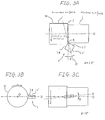
- the sintered product thus obtained was polished by a diamond grind wheel to prepare a cutting tool specimen having a shape shown in Figs. 1A-1C (defined as SNGN120408 in ISO).
- the specimen 1 was a flat prism having an almost square section with a side length of about 12.7 mm and a thickness of about 4.76 mm.
- the corner 1a had a curvature radius R of about 0.8 mm.
- the edge portion 1b was chamfered such that the width t of the chamfer on the main plane 1c side was about 0.1 mm and the angle ⁇ of inclination of the chamfer with respect to the main plane 1c was about 25°.
- the various specimens were each mirror-polished, and then measured for density ratio to theoretical value (relative density), fracture toughness and Vickers hardness.
- Kc fracture toughness
- IF method defined in JIS-R1607 (1990) was employed.
- a Vickers indenter was pressed against the specimen under a load of 30 kgf for 30 seconds.
- Vickers hardness was determined by the dent area and load.
- the specimen was observed for polished surface by scanning electron microscope. From the image thus obtained, the average particle diameter of titanium carbonitride-based hard phase (or titanium carbide-base hard phase) was determined. The results are set forth in Table 2.
- the weight content of Ti component (WTi), Al component (WAl) and metal component as sintering aid were identified by fluorescent X-ray analysis, and the weight content of C component (WC) and N component (WN) were identified by gas analysis. WAl was then converted to oxide basis to determine the weight content of alumina WAl 2 O 3 .
- the weight content of the hard phase (WTiCN or WTiC) was determined from WTi + WC + WN (or WTi + WC).
- the various weight contents were converted to molar contents to determine the foregoing value of KN/(KC + KN) and KTi/(KC + KN). The results are set forth in Table 1.
- Auger electron spectroscopy and X-ray photoelectron spectroscopy showed that almost all C components and N components are incorporated in the sintered product in the form of compound with titanium, i.e., become incorporated in the titanium carbonitride-based hard phase or titanium carbide-based hard phase.
- the various specimens were evaluated for cutting properties under the following conditions.
- a rod work (working material) W having a shape shown in Fig. 2A was rotated on its axis.
- the specimen 1 shown in Figs. 1A-1C supported by a holder was allowed to come in contact with the outer periphery of the work W as shown in Fig. 2C.
- the outer periphery of the work W was continuously wet-ground under the following conditions:
- a rod work W having a shape shown in Fig. 2D was rotated on its axis.
- the specimen 1 shown in Figs. 1A-1C was allowed to come in contact with the outer periphery of the work W as shown in Figs. 2C.
- one of the main planes 1c as rake surface (hereinafter referred to as "1c'") and the side surface 1e as relief surface the outer periphery of the work W was continuously wet-ground under the following conditions:
Landscapes
- Engineering & Computer Science (AREA)
- Chemical & Material Sciences (AREA)
- Ceramic Engineering (AREA)
- Manufacturing & Machinery (AREA)
- Materials Engineering (AREA)
- Structural Engineering (AREA)
- Organic Chemistry (AREA)
- Inorganic Chemistry (AREA)
- Mechanical Engineering (AREA)
- Cutting Tools, Boring Holders, And Turrets (AREA)
- Ceramic Products (AREA)
- Compositions Of Oxide Ceramics (AREA)
Applications Claiming Priority (2)
| Application Number | Priority Date | Filing Date | Title |
|---|---|---|---|
| JP9368547A JPH11189473A (ja) | 1997-12-25 | 1997-12-25 | セラミック工具 |
| JP36854797 | 1997-12-25 |
Publications (2)
| Publication Number | Publication Date |
|---|---|
| EP0926108A1 true EP0926108A1 (fr) | 1999-06-30 |
| EP0926108B1 EP0926108B1 (fr) | 2005-04-27 |
Family
ID=18492109
Family Applications (1)
| Application Number | Title | Priority Date | Filing Date |
|---|---|---|---|
| EP98310732A Expired - Lifetime EP0926108B1 (fr) | 1997-12-25 | 1998-12-24 | Outil coupant en céramique |
Country Status (5)
| Country | Link |
|---|---|
| US (1) | US6248681B1 (fr) |
| EP (1) | EP0926108B1 (fr) |
| JP (1) | JPH11189473A (fr) |
| KR (1) | KR100528558B1 (fr) |
| DE (1) | DE69829936T2 (fr) |
Cited By (2)
| Publication number | Priority date | Publication date | Assignee | Title |
|---|---|---|---|---|
| CN1102555C (zh) * | 2000-05-26 | 2003-03-05 | 清华大学 | 高耐磨性复合金属陶瓷刀具材料 |
| EP1132358A3 (fr) * | 2000-03-08 | 2003-07-30 | NGK Spark Plug Company Limited | Matériau fritté composite à base d'alumine, organe résistant à l'usure et procédé de fabrication d'un matériau fritté composite à base d'alumine |
Families Citing this family (4)
| Publication number | Priority date | Publication date | Assignee | Title |
|---|---|---|---|---|
| US6905992B2 (en) * | 2002-07-30 | 2005-06-14 | Kennametal Inc. | Ceramic body reinforced with coarse silicon carbide whiskers and method for making the same |
| US20040231894A1 (en) * | 2003-05-21 | 2004-11-25 | Dvorachek Harold A | Rotary tools or bits |
| JP4682023B2 (ja) * | 2005-11-17 | 2011-05-11 | 日本特殊陶業株式会社 | セラミックス焼結体、切削インサート、切削工具及びフライスカッター |
| KR101586532B1 (ko) * | 2013-04-30 | 2016-01-18 | 동부대우전자 주식회사 | 조리장치 |
Citations (4)
| Publication number | Priority date | Publication date | Assignee | Title |
|---|---|---|---|---|
| FR1600142A (fr) * | 1968-12-31 | 1970-07-20 | ||
| US3886254A (en) * | 1972-10-06 | 1975-05-27 | Ngk Spark Plug Co | Method of making ceramic sintered body |
| EP0174463A1 (fr) * | 1984-07-13 | 1986-03-19 | NGK Spark Plug Co. Ltd. | Procédé pour la fabrication de matériaux céramiques résistant à la chaleur et à l'usure, produit de ce procédé et produit de départ pour ce procédé |
| US5196385A (en) * | 1985-08-06 | 1993-03-23 | Ngk Spark Plug Co., Ltd. | Process for the preparation of a heat-resistant and wear resistant ceramic material |
Family Cites Families (12)
| Publication number | Priority date | Publication date | Assignee | Title |
|---|---|---|---|---|
| KR870000309B1 (ko) | 1984-05-29 | 1987-02-26 | 한국과학기술원 | 절삭 공구용 질화규소 소결체 및 그의 제조 방법 |
| DE3420848A1 (de) | 1984-06-05 | 1985-12-05 | Gebr. Happich Gmbh, 5600 Wuppertal | Verfahren und vorrichtung zum anbringen von endstuecken an kunststoff-profilleisten |
| JPS6117473A (ja) | 1985-05-17 | 1986-01-25 | 三菱マテリアル株式会社 | 切削工具用窒化けい素基焼結材料 |
| JPS6236065A (ja) | 1985-08-06 | 1987-02-17 | 日本特殊陶業株式会社 | 耐熱・耐摩耗性セラミツク材料の製造法 |
| JPH0816028B2 (ja) | 1986-07-31 | 1996-02-21 | 日本特殊陶業株式会社 | 高靱性を有するセラミック焼結体及びセラミック工具と焼結体の製造方法 |
| JPH0225866A (ja) | 1988-07-15 | 1990-01-29 | Canon Inc | 現像装置 |
| US5017524A (en) * | 1989-02-13 | 1991-05-21 | Iscar Ltd. | Ceramic cutting tool |
| JPH06122563A (ja) | 1992-10-12 | 1994-05-06 | Sumitomo Electric Ind Ltd | セラミックス複合材料及びその製造方法 |
| JPH0725589B2 (ja) * | 1992-10-12 | 1995-03-22 | 工業技術院長 | 高靭性炭窒化チタン−酸化ジルコニウム系セラミックス材料 |
| JP2792391B2 (ja) * | 1993-05-21 | 1998-09-03 | 株式会社神戸製鋼所 | サーメット焼結体 |
| JPH0816028A (ja) | 1994-06-28 | 1996-01-19 | Canon Inc | 定着装置 |
| BR9611449A (pt) * | 1995-11-13 | 1999-03-30 | Kennametal Inc | Ferramenta cortante cerâmica e composição produzida pela consolidação de uma mistura de componentes de partida |
-
1997
- 1997-12-25 JP JP9368547A patent/JPH11189473A/ja active Pending
-
1998
- 1998-12-24 DE DE69829936T patent/DE69829936T2/de not_active Expired - Lifetime
- 1998-12-24 EP EP98310732A patent/EP0926108B1/fr not_active Expired - Lifetime
- 1998-12-24 KR KR1019980057988A patent/KR100528558B1/ko not_active Expired - Fee Related
- 1998-12-28 US US09/220,752 patent/US6248681B1/en not_active Expired - Lifetime
Patent Citations (4)
| Publication number | Priority date | Publication date | Assignee | Title |
|---|---|---|---|---|
| FR1600142A (fr) * | 1968-12-31 | 1970-07-20 | ||
| US3886254A (en) * | 1972-10-06 | 1975-05-27 | Ngk Spark Plug Co | Method of making ceramic sintered body |
| EP0174463A1 (fr) * | 1984-07-13 | 1986-03-19 | NGK Spark Plug Co. Ltd. | Procédé pour la fabrication de matériaux céramiques résistant à la chaleur et à l'usure, produit de ce procédé et produit de départ pour ce procédé |
| US5196385A (en) * | 1985-08-06 | 1993-03-23 | Ngk Spark Plug Co., Ltd. | Process for the preparation of a heat-resistant and wear resistant ceramic material |
Cited By (3)
| Publication number | Priority date | Publication date | Assignee | Title |
|---|---|---|---|---|
| EP1132358A3 (fr) * | 2000-03-08 | 2003-07-30 | NGK Spark Plug Company Limited | Matériau fritté composite à base d'alumine, organe résistant à l'usure et procédé de fabrication d'un matériau fritté composite à base d'alumine |
| US6740611B2 (en) | 2000-03-08 | 2004-05-25 | Ngk Spark Plug Co., Ltd. | Alumina-based composite sintered material, wear resistant member and a method of manufacturing alumina based composite sintered material |
| CN1102555C (zh) * | 2000-05-26 | 2003-03-05 | 清华大学 | 高耐磨性复合金属陶瓷刀具材料 |
Also Published As
| Publication number | Publication date |
|---|---|
| US6248681B1 (en) | 2001-06-19 |
| KR19990063395A (ko) | 1999-07-26 |
| KR100528558B1 (ko) | 2006-03-14 |
| JPH11189473A (ja) | 1999-07-13 |
| EP0926108B1 (fr) | 2005-04-27 |
| DE69829936D1 (de) | 2005-06-02 |
| DE69829936T2 (de) | 2006-02-09 |
Similar Documents
| Publication | Publication Date | Title |
|---|---|---|
| KR101414910B1 (ko) | 입방정 질화붕소 소결체 공구 | |
| EP1188504B1 (fr) | Outil de coupe revêtu | |
| US5965471A (en) | Wear and thermal shock resistant SiAION cutting tool material | |
| EP0926108B1 (fr) | Outil coupant en céramique | |
| EP0803486A2 (fr) | Matériau de glissage en céramique de nitrure de silicium et sa fabrication | |
| EP2402098B2 (fr) | Insert en sialon et outil de découpe doté de celui-ci | |
| EP0819664A3 (fr) | Matèriau d'outil coupant en nitrure de silicium | |
| EP0913490A2 (fr) | Outil de coupe en cermet à base de carbonitrure et son procédé de préparation | |
| EP0796828B1 (fr) | Matériau d'outil coupant en sialon résistant à l'abrasion et au choc thermique | |
| JP2855243B2 (ja) | 耐摩耗性の優れた窒化珪素質焼結体 | |
| EP0856498B1 (fr) | Outil en matériau complexe de carbonitrure de titane-nitrure de silicium | |
| EP1038854A1 (fr) | Outil à couper et materiau résistant à l'abrasion | |
| KR960016069B1 (ko) | 질화규소에 기초한 소결체 | |
| EP1043292A1 (fr) | Outil de coupage et son procédé de fabrication | |
| EP0963962A1 (fr) | Agglomere ceramique a base d'alumine et procede de production dudit agglomere | |
| EP1312592A2 (fr) | Nitrure de silicium fritté et un outil en nitrure de silicium | |
| JPH06172910A (ja) | 耐摩耗性および耐欠損性のすぐれた炭窒化チタン基サーメット製切削工具 | |
| JPH06329470A (ja) | 窒化ケイ素基焼結体およびその被覆焼結体 | |
| JP4383225B2 (ja) | セラミックス焼結体、切削インサート、切削工具およびその製造方法 | |
| JPH06298568A (ja) | ウイスカー強化サイアロン基焼結体およびその被覆焼結体 | |
| JP2002192405A (ja) | 切削工具 | |
| JPH0663804A (ja) | コーテッド窒化けい素系セラミックス製切削用スローアウェイチップ | |
| JP3715775B2 (ja) | 高速切削用工具 | |
| JPH0295502A (ja) | 高速切削用チップ | |
| JP2001322009A (ja) | アルミナセラミックス切削工具およびその製造方法 |
Legal Events
| Date | Code | Title | Description |
|---|---|---|---|
| PUAI | Public reference made under article 153(3) epc to a published international application that has entered the european phase |
Free format text: ORIGINAL CODE: 0009012 |
|
| AK | Designated contracting states |
Kind code of ref document: A1 Designated state(s): DE FR GB |
|
| AX | Request for extension of the european patent |
Free format text: AL;LT;LV;MK;RO;SI |
|
| 17P | Request for examination filed |
Effective date: 19991029 |
|
| AKX | Designation fees paid |
Free format text: DE FR GB |
|
| 17Q | First examination report despatched |
Effective date: 20031215 |
|
| GRAJ | Information related to disapproval of communication of intention to grant by the applicant or resumption of examination proceedings by the epo deleted |
Free format text: ORIGINAL CODE: EPIDOSDIGR1 |
|
| GRAP | Despatch of communication of intention to grant a patent |
Free format text: ORIGINAL CODE: EPIDOSNIGR1 |
|
| GRAS | Grant fee paid |
Free format text: ORIGINAL CODE: EPIDOSNIGR3 |
|
| GRAA | (expected) grant |
Free format text: ORIGINAL CODE: 0009210 |
|
| AK | Designated contracting states |
Kind code of ref document: B1 Designated state(s): DE FR GB |
|
| REG | Reference to a national code |
Ref country code: GB Ref legal event code: FG4D |
|
| REF | Corresponds to: |
Ref document number: 69829936 Country of ref document: DE Date of ref document: 20050602 Kind code of ref document: P |
|
| PLBE | No opposition filed within time limit |
Free format text: ORIGINAL CODE: 0009261 |
|
| STAA | Information on the status of an ep patent application or granted ep patent |
Free format text: STATUS: NO OPPOSITION FILED WITHIN TIME LIMIT |
|
| ET | Fr: translation filed | ||
| 26N | No opposition filed |
Effective date: 20060130 |
|
| PGFP | Annual fee paid to national office [announced via postgrant information from national office to epo] |
Ref country code: FR Payment date: 20081212 Year of fee payment: 11 |
|
| PGFP | Annual fee paid to national office [announced via postgrant information from national office to epo] |
Ref country code: GB Payment date: 20081224 Year of fee payment: 11 |
|
| GBPC | Gb: european patent ceased through non-payment of renewal fee |
Effective date: 20091224 |
|
| REG | Reference to a national code |
Ref country code: FR Ref legal event code: ST Effective date: 20100831 |
|
| PG25 | Lapsed in a contracting state [announced via postgrant information from national office to epo] |
Ref country code: FR Free format text: LAPSE BECAUSE OF NON-PAYMENT OF DUE FEES Effective date: 20091231 |
|
| PG25 | Lapsed in a contracting state [announced via postgrant information from national office to epo] |
Ref country code: GB Free format text: LAPSE BECAUSE OF NON-PAYMENT OF DUE FEES Effective date: 20091224 |
|
| PGFP | Annual fee paid to national office [announced via postgrant information from national office to epo] |
Ref country code: DE Payment date: 20151215 Year of fee payment: 18 |
|
| REG | Reference to a national code |
Ref country code: DE Ref legal event code: R119 Ref document number: 69829936 Country of ref document: DE |
|
| PG25 | Lapsed in a contracting state [announced via postgrant information from national office to epo] |
Ref country code: DE Free format text: LAPSE BECAUSE OF NON-PAYMENT OF DUE FEES Effective date: 20170701 |