EP0930535A1 - Behandlungsverfahren für verbrauchte Stabilisierungsbäder,die in photographischen Verarbeitung verwendet werden - Google Patents
Behandlungsverfahren für verbrauchte Stabilisierungsbäder,die in photographischen Verarbeitung verwendet werden Download PDFInfo
- Publication number
- EP0930535A1 EP0930535A1 EP99420005A EP99420005A EP0930535A1 EP 0930535 A1 EP0930535 A1 EP 0930535A1 EP 99420005 A EP99420005 A EP 99420005A EP 99420005 A EP99420005 A EP 99420005A EP 0930535 A1 EP0930535 A1 EP 0930535A1
- Authority
- EP
- European Patent Office
- Prior art keywords
- bath
- stabilization
- permeate
- photographic
- stabilization bath
- Prior art date
- Legal status (The legal status is an assumption and is not a legal conclusion. Google has not performed a legal analysis and makes no representation as to the accuracy of the status listed.)
- Granted
Links
- 230000006641 stabilisation Effects 0.000 title claims abstract description 97
- 238000011105 stabilization Methods 0.000 title claims abstract description 97
- 238000000034 method Methods 0.000 title claims abstract description 50
- 230000008569 process Effects 0.000 title claims abstract description 38
- 238000012545 processing Methods 0.000 title description 35
- 239000012466 permeate Substances 0.000 claims abstract description 46
- 238000001728 nano-filtration Methods 0.000 claims abstract description 29
- DHCDFWKWKRSZHF-UHFFFAOYSA-N sulfurothioic S-acid Chemical compound OS(O)(=O)=S DHCDFWKWKRSZHF-UHFFFAOYSA-N 0.000 claims abstract 3
- 239000000463 material Substances 0.000 claims description 23
- XEEYBQQBJWHFJM-UHFFFAOYSA-N Iron Chemical compound [Fe] XEEYBQQBJWHFJM-UHFFFAOYSA-N 0.000 claims description 17
- 238000005406 washing Methods 0.000 claims description 16
- 230000014759 maintenance of location Effects 0.000 claims description 13
- 239000000203 mixture Substances 0.000 claims description 11
- QAOWNCQODCNURD-UHFFFAOYSA-L Sulfate Chemical compound [O-]S([O-])(=O)=O QAOWNCQODCNURD-UHFFFAOYSA-L 0.000 claims description 9
- 229910052709 silver Inorganic materials 0.000 claims description 8
- 239000004332 silver Substances 0.000 claims description 7
- 229910052742 iron Inorganic materials 0.000 claims description 6
- 238000003672 processing method Methods 0.000 claims description 6
- BQCADISMDOOEFD-UHFFFAOYSA-N Silver Chemical compound [Ag] BQCADISMDOOEFD-UHFFFAOYSA-N 0.000 claims description 5
- 239000012528 membrane Substances 0.000 description 31
- 239000000243 solution Substances 0.000 description 22
- 101100340769 Homo sapiens ILF2 gene Proteins 0.000 description 18
- 102000049951 Nuclear Factor 45 Human genes 0.000 description 18
- 108700031302 Nuclear Factor 45 Proteins 0.000 description 18
- 239000003344 environmental pollutant Substances 0.000 description 12
- 231100000719 pollutant Toxicity 0.000 description 12
- 230000009467 reduction Effects 0.000 description 11
- 239000000126 substance Substances 0.000 description 11
- DHCDFWKWKRSZHF-UHFFFAOYSA-L thiosulfate(2-) Chemical compound [O-]S([S-])(=O)=O DHCDFWKWKRSZHF-UHFFFAOYSA-L 0.000 description 10
- -1 silver ions Chemical class 0.000 description 6
- 150000004764 thiosulfuric acid derivatives Chemical class 0.000 description 6
- 238000009736 wetting Methods 0.000 description 6
- LTGCWMRYVSKQHE-UHFFFAOYSA-L S(=S)(=S)([O-])[O-].[Ag+2] Chemical compound S(=S)(=S)([O-])[O-].[Ag+2] LTGCWMRYVSKQHE-UHFFFAOYSA-L 0.000 description 5
- 238000011161 development Methods 0.000 description 5
- 230000018109 developmental process Effects 0.000 description 5
- 239000007788 liquid Substances 0.000 description 5
- XLYOFNOQVPJJNP-UHFFFAOYSA-N water Substances O XLYOFNOQVPJJNP-UHFFFAOYSA-N 0.000 description 5
- JVXHQHGWBAHSSF-UHFFFAOYSA-L 2-[2-[bis(carboxylatomethyl)amino]ethyl-(carboxylatomethyl)amino]acetate;hydron;iron(2+) Chemical compound [H+].[H+].[Fe+2].[O-]C(=O)CN(CC([O-])=O)CCN(CC([O-])=O)CC([O-])=O JVXHQHGWBAHSSF-UHFFFAOYSA-L 0.000 description 4
- 239000000975 dye Substances 0.000 description 4
- 238000001223 reverse osmosis Methods 0.000 description 4
- 238000000926 separation method Methods 0.000 description 4
- WSFSSNUMVMOOMR-UHFFFAOYSA-N Formaldehyde Chemical compound O=C WSFSSNUMVMOOMR-UHFFFAOYSA-N 0.000 description 3
- 230000032683 aging Effects 0.000 description 3
- 239000012141 concentrate Substances 0.000 description 3
- 230000000087 stabilizing effect Effects 0.000 description 3
- XNCSCQSQSGDGES-UHFFFAOYSA-N 2-[2-[bis(carboxymethyl)amino]propyl-(carboxymethyl)amino]acetic acid Chemical compound OC(=O)CN(CC(O)=O)C(C)CN(CC(O)=O)CC(O)=O XNCSCQSQSGDGES-UHFFFAOYSA-N 0.000 description 2
- IJGRMHOSHXDMSA-UHFFFAOYSA-N Atomic nitrogen Chemical compound N#N IJGRMHOSHXDMSA-UHFFFAOYSA-N 0.000 description 2
- UDHXJZHVNHGCEC-UHFFFAOYSA-N Chlorophacinone Chemical compound C1=CC(Cl)=CC=C1C(C=1C=CC=CC=1)C(=O)C1C(=O)C2=CC=CC=C2C1=O UDHXJZHVNHGCEC-UHFFFAOYSA-N 0.000 description 2
- KCXVZYZYPLLWCC-UHFFFAOYSA-N EDTA Chemical compound OC(=O)CN(CC(O)=O)CCN(CC(O)=O)CC(O)=O KCXVZYZYPLLWCC-UHFFFAOYSA-N 0.000 description 2
- 238000004061 bleaching Methods 0.000 description 2
- 150000001875 compounds Chemical class 0.000 description 2
- 238000010586 diagram Methods 0.000 description 2
- 238000001035 drying Methods 0.000 description 2
- 239000012530 fluid Substances 0.000 description 2
- 150000002894 organic compounds Chemical class 0.000 description 2
- 238000002360 preparation method Methods 0.000 description 2
- 150000003839 salts Chemical class 0.000 description 2
- 239000007787 solid Substances 0.000 description 2
- OKTJSMMVPCPJKN-UHFFFAOYSA-N Carbon Chemical compound [C] OKTJSMMVPCPJKN-UHFFFAOYSA-N 0.000 description 1
- 101710201629 Ribulose bisphosphate carboxylase/oxygenase activase 2, chloroplastic Proteins 0.000 description 1
- NINIDFKCEFEMDL-UHFFFAOYSA-N Sulfur Chemical compound [S] NINIDFKCEFEMDL-UHFFFAOYSA-N 0.000 description 1
- 239000002253 acid Substances 0.000 description 1
- 239000003463 adsorbent Substances 0.000 description 1
- 229910052783 alkali metal Inorganic materials 0.000 description 1
- XYXNTHIYBIDHGM-UHFFFAOYSA-N ammonium thiosulfate Chemical compound [NH4+].[NH4+].[O-]S([O-])(=O)=S XYXNTHIYBIDHGM-UHFFFAOYSA-N 0.000 description 1
- 238000004458 analytical method Methods 0.000 description 1
- QVGXLLKOCUKJST-UHFFFAOYSA-N atomic oxygen Chemical compound [O] QVGXLLKOCUKJST-UHFFFAOYSA-N 0.000 description 1
- 230000008901 benefit Effects 0.000 description 1
- 230000015572 biosynthetic process Effects 0.000 description 1
- 229910052799 carbon Inorganic materials 0.000 description 1
- 230000008859 change Effects 0.000 description 1
- 239000013626 chemical specie Substances 0.000 description 1
- 239000000356 contaminant Substances 0.000 description 1
- 238000007865 diluting Methods 0.000 description 1
- 238000010790 dilution Methods 0.000 description 1
- 239000012895 dilution Substances 0.000 description 1
- FGRVOLIFQGXPCT-UHFFFAOYSA-L dipotassium;dioxido-oxo-sulfanylidene-$l^{6}-sulfane Chemical compound [K+].[K+].[O-]S([O-])(=O)=S FGRVOLIFQGXPCT-UHFFFAOYSA-L 0.000 description 1
- 238000007598 dipping method Methods 0.000 description 1
- 238000001704 evaporation Methods 0.000 description 1
- 230000008020 evaporation Effects 0.000 description 1
- 238000002474 experimental method Methods 0.000 description 1
- 238000001914 filtration Methods 0.000 description 1
- 150000002484 inorganic compounds Chemical class 0.000 description 1
- 229910010272 inorganic material Inorganic materials 0.000 description 1
- 150000004698 iron complex Chemical class 0.000 description 1
- 238000004519 manufacturing process Methods 0.000 description 1
- 238000005259 measurement Methods 0.000 description 1
- WSFSSNUMVMOOMR-NJFSPNSNSA-N methanone Chemical compound O=[14CH2] WSFSSNUMVMOOMR-NJFSPNSNSA-N 0.000 description 1
- 238000012986 modification Methods 0.000 description 1
- 230000004048 modification Effects 0.000 description 1
- 230000007935 neutral effect Effects 0.000 description 1
- 229910052757 nitrogen Inorganic materials 0.000 description 1
- 229910052760 oxygen Inorganic materials 0.000 description 1
- 239000001301 oxygen Substances 0.000 description 1
- 239000004848 polyfunctional curative Substances 0.000 description 1
- 239000011148 porous material Substances 0.000 description 1
- 239000002244 precipitate Substances 0.000 description 1
- 239000002243 precursor Substances 0.000 description 1
- 238000011084 recovery Methods 0.000 description 1
- 238000011160 research Methods 0.000 description 1
- 230000000717 retained effect Effects 0.000 description 1
- 239000012465 retentate Substances 0.000 description 1
- 150000003378 silver Chemical class 0.000 description 1
- AKHNMLFCWUSKQB-UHFFFAOYSA-L sodium thiosulfate Chemical compound [Na+].[Na+].[O-]S([O-])(=O)=S AKHNMLFCWUSKQB-UHFFFAOYSA-L 0.000 description 1
- 235000019345 sodium thiosulphate Nutrition 0.000 description 1
- 238000001179 sorption measurement Methods 0.000 description 1
- 239000003381 stabilizer Substances 0.000 description 1
- 238000003860 storage Methods 0.000 description 1
- 229910052717 sulfur Inorganic materials 0.000 description 1
- 239000011593 sulfur Substances 0.000 description 1
- 150000003467 sulfuric acid derivatives Chemical class 0.000 description 1
- 231100000331 toxic Toxicity 0.000 description 1
- 230000002588 toxic effect Effects 0.000 description 1
- 238000000108 ultra-filtration Methods 0.000 description 1
Images
Classifications
-
- G—PHYSICS
- G03—PHOTOGRAPHY; CINEMATOGRAPHY; ANALOGOUS TECHNIQUES USING WAVES OTHER THAN OPTICAL WAVES; ELECTROGRAPHY; HOLOGRAPHY
- G03C—PHOTOSENSITIVE MATERIALS FOR PHOTOGRAPHIC PURPOSES; PHOTOGRAPHIC PROCESSES, e.g. CINE, X-RAY, COLOUR, STEREO-PHOTOGRAPHIC PROCESSES; AUXILIARY PROCESSES IN PHOTOGRAPHY
- G03C5/00—Photographic processes or agents therefor; Regeneration of such processing agents
- G03C5/26—Processes using silver-salt-containing photosensitive materials or agents therefor
- G03C5/395—Regeneration of photographic processing agents other than developers; Replenishers therefor
- G03C5/3956—Microseparation techniques using membranes, e.g. reverse osmosis, ion exchange, resins, active charcoal
Definitions
- This invention relates to a process for treating a seasoned stabilization bath containing a pollutant carried over from the fixing or bleach-fixing bath.
- the processing of color photographic materials conventionally comprises a color development step, and a desilvering step.
- This desilvering step comprises bleaching of the photographic material, which consists in converting the free silver into silver ions, followed by fixing, which consists in removing the silver ions contained in the photographic material.
- the photographic processing can include washing and stabilizing baths.
- a stabilization bath As a final bath. Such a bath allows the dye stain to be reduced and/or the stability of the dyes to be improved.
- the stabilization bath contains a dye stabilizer such as formaldehyde or a precursor of formaldehyde, hardeners, alkanolamine compounds, etc. Stabilization baths are described in Research Disclosure , September 1996, N°38957, section XX, D.
- Photographic materials are usually developed automatically and as rapidly as possible.
- the photographic material is conveyed through each of the baths described above.
- appreciable quantities of chemicals are carried over from one tank to the next one, either on the photographic material itself, or on the belts that convey the photographic material.
- These chemicals build up in the processing baths, thereby reducing the efficiency of these baths.
- the pollution of baths by carry-over of chemicals worsens as the processing speed of photographic materials increases.
- washing baths are placed between successive processing baths. In particular, after treatment in a fixing or bleach-fixing bath, the film is conveyed through several washing baths before being immersed in the stabilization bath.
- a replenishing solution is introduced into the polluted bath to be replenished, and an equivalent volume of spent bath runs off via the overflow.
- This method generates an appreciable volume of spent bath solutions that are no longer of any use in photographic processing.
- U.S. Patent 5,552,055 describes a method for treating photographic effluents from 'minilabs'(small rapid automatic photographic processing units). In this method, a mixture of effluents from the minilab are first treated with adsorbents to eliminate organic and inorganic compounds, and the fluid obtained is then filtered through a membrane. U.S. Patent 5,552,055 specifies that the fluid thus treated can be either disposed of via the sewers, or re-used in the photographic processing. Although this method reduces the volume of toxic solid effluents obtained in the adsorption step, it does not fully solve the problem of effluent disposal, because the solid effluents have still to be made safe.
- washing baths in photographic processing by various means of filtration, such as reverse osmosis, ultrafiltration, or nanofiltration. These washing baths can be easily treated by these techniques because they contain low concentrations of chemicals.
- Patent Applications EP 409,065, 407,979 and 435,352 describe methods for the processing of a photographic material in which the replenishing of the washing solutions and/or stabilization bath is performed by reverse osmosis. However, this process is applied only to solutions that contain low concentrations of pollutants from the fixing or bleach-fixing bath, by means of an intermediate bath. This intermediate bath, which is more concentrated, is not submitted to reverse osmosis.
- Spent washing solutions generally contain a quantity of pollutants of the order of 1 g/l, much lower than the quantity of pollutants present in the other spent photographic processing baths.
- spent stabilization baths contain a total quantity of pollutants generally greater than 10 g/l.
- pollutants include, for example, thiosulfates, sulfate, a silver complex, a ferric complex, etc.
- concentrations of pollutants preclude efficient treatment of stabilization baths by reverse osmosis.
- a way to reduce the time taken to process photographic materials is to reduce the number of washing baths.
- processing time is reduced when the photographic material, after the fixing or bleach-fixing bath, go straight to a stabilization bath with no intermediate washing.
- the stabilization bath is thus polluted by thiosulfates, complexed silver, iron, polythionates, etc. These compounds degrade the stabilization bath when they are present by the formation of precipitates, sulfur, etc.
- a photographic material processed in such a polluted stabilization bath will display unacceptable sensitometric characteristics.
- This invention also relates to a method of photographic processing comprising the treatment of a photographic material in a fixing or bleach-fixing bath, followed by a stabilization bath, the method comprising treating the stabilization bath when it contains at least 2 g/l of thiosulfate by means of a nanofiltration system to yield a photographically useful permeate.
- the photographic processing method of the invention is particularly suitable for those processes in which the stabilization bath comes straight after the fixing or bleach-fixing bath, with no intermediate washing bath.
- the process of the invention provides a photographically useful permeate, i.e., a solution that can be re-used in one of the photographic processing baths either directly, or in the preparation of one of these baths, while maintaining the sensitometric characteristics of the photographic materials processed in these baths within the tolerance limits for the photographic process.
- the permeate has to be colorless and the nanofiltration membrane has to have a wetting angle less than or equal to 30°, preferably less than 20°.
- the concentration of thiosulfate in the permeate has to be no more than 2 g/l.
- the process of this invention allows the volume of photographic processing effluents to be significantly reduced, because it yields a permeate that can be directly re-used in a photographic processing bath.
- the permeate can be used to compensate for evaporation from the bleaching, fixing, bleach-fixing and stabilization baths, or to prepare a replenishing solution for these baths from concentrated solutions.
- the process of the invention allows treatment of the stabilization bath in a single easily performed and efficient step.
- the other pollutants that can degrade the stabilization bath are silver complexes such as silver dithiosulfate, ferric complexes of aminopolycarboxylic acid such as complexes of iron and ethylenediaminetetraacetic acid (EDTA), complexes of iron and propylenediaminetetraacetic acid (PDTA), and polythionates.
- EDTA ethylenediaminetetraacetic acid
- PDTA propylenediaminetetraacetic acid
- polythionates polythionates.
- the sulfate present in the stabilization baths can leave marks on drying.
- the process of the invention besides its selectivity towards thiosulfates, exhibits a high selectivity with regard to these pollutants.
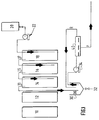
- Figure 1 is a schematic diagram of a particular embodiment of this invention.
- the thiosulfate ions present in the stabilization bath are in the form of salts. These salts include ammonium thiosulfate, and alkali metal thiosulfates such as sodium thiosulfate and potassium thiosulfate.
- the nanofiltration system used in the invention is a conventional system comprising one or several nanofiltration membranes able to yield a photographically useful permeate.
- the membranes that are useful in the invention behave in principle as large surface-area sieves, in which the 'holes' are pores of microscopic or molecular size, the dimensions of which must be very uniform so that molecules greater than a particular size are retained by the membrane while smaller molecules or simple salt ions are let through.
- the nanofiltration membranes that are useful in the invention have a water cutoff threshold of at least 200.
- the nanofiltration system must be able to retain pollutants contained in the stabilization bath, in particular thiosulfates, but it must not retain the organic compounds initially present in the stabilization bath when the permeate is to be re-used in the preparation of a new stabilization bath.
- the nanofiltration system must show, throughout the stabilization bath treatment, a thiosulfate retention rate of at least 0.70, preferably at least 0.8. It is also desirable to use a nanofiltration system with an iron-complex retention rate of at least 0.90 and/or a silver-complex retention rate of at least 0.9 and/or a sulfate + polythionate retention rate of at least 0.9.
- the nanofiltration system must allow retention of thiosulfates, complexed iron, complexed silver, sulfates and polythionates in the conditions described above.
- the treatment throughput and the pressure applied will be chosen appropriately according to the nanofiltration system.
- the nanofiltration system comprises several filters in series.
- the advantage of using nonofiltration filters in series is that the flow rates and efficiencies of the system can be considerably improved.
- the nanofiltration membrane is the FILMTEC® NF45 membrane commercially available from DOW Europe Separation Systems®.
- FIG. 1 is a schematic diagram of a method of photographic processing that includes a device to implement the process of the invention.
- a photographic material (not shown in the figure) is carried by a conveyer belt into the development bath 10, into the bleach-fixing bath 12, into the stabilization bath 14, and then into two stabilization and/or washing baths 16 and 18.
- a replenishing solution 20 for the stabilization bath is fed into the washing bath 18 by means of the countercurrent pump 22.
- the overflow 17 of the bath 18 is led through piping to the bath 16.
- the overflow 15 of the bath 16 is led through piping to the stabilization bath 14.
- the overflow 11 ofthe stabilization bath is then led through piping to an intermediate tank 30 fitted with an outlet 32 from which it will be treated.
- the solution 36 held in the intermediate tank 30 is fed by means of a pump 34 into the nanofiltration system 40.
- a permeate (P) that can be fed back into the baths 10, 12, 14, 16, or 18. It can also be used to prepare the replenishment solution 20.
- the retentate R from the nanofiltration system 40 is fed back into the intermediate tank 30.
- the device comprises a single washing bath 16 and the replenishment solution is added to the washing bath 16.
- the device does not include a washing bath, and the replenishment solution 20 is added directly to the stabilization bath 14.
- This process is especially suitable for the treatment of stabilization baths used in minilabs.
- the process of this invention advantageously allows the processing of stabilizing baths from the processing of color photographic papers, such as the stabilizing bath in the C-41 FLEXICOLOR® and FLEXICOLOR SM® processes commercially available from EASTMAN KODAK, and stabilization baths from the processing of color photographic films, such as the stabilization bath in the EKTACOLOR RA4® and EKTACOLOR RA2-SM® processes commercially available from EASTMAN KODAK. It can also be used in reversal processing methods.
- the process of the invention allows the treatment of mixture of stabilization baths used in the processing of photographic papers and films. By using a single process for treating stabilization baths the costs incurred by effluent treatment are reduced and the operations made simpler.
- the treatment of stabilization baths in this invention can be readily integrated in a minilab because the treatment needs no technical intervention by the operator in charge of the development of the photographic materials.
- a spent stabilization bath was treated by means of a Berghof® nanofiltration cell commercially available from the Prolabo company, of capacity 400 ml fitted with a nanofiltration membrane having a surface area of 32 cm 2 .
- the cell was equipped with a magnetic stirrer.
- examples 1.1 to 1.3 below was treated a spent stabilization bath of the KODAK FLEXICOLOR® C41 process designed for the processing of negative photographic films. This bath was used in the treatment method illustrated in Figure 1.
- the spent stabilization bath treated by nanofiltration was solution 11 of Figure 1 at the outlet from the stabilization bath 14.
- This stabilization bath contained (averages):
- examples 1.4 to 1.6 below was treated a spent stabilization bath obtained from the stabilization bath of the KODAK EKTACOLOR® RA4 process designed for the processing of color photographic papers. This bath was used in a processing method that comprised, in succession, a developing bath, a bleach-fixing bath, and four stabilization baths. The replenishing solution is added to the last stabilization bath.
- the treated spent stabilization bath in these examples was the overflow from the first stabilization bath obtained as indicated in Figure 1.
- This spent stabilization bath contained (averages):
- the nanofiltration was performed using the following membranes: FILMTEC NF45® (cutoff threshold 200), marketed by DOW Europe Separating Systems, SeIRO® MPF-11 (cutoffthreshold 300) and MPF-34 (cutoffthreshold 300) marketed by Kiriat Weizmann Ltd.
- a variation in the wetting angle of +/- 3° indicates a change of the surface state.
- the hydrophobicity increases with the value of the wetting angle.
- example 1 the experiment of example 1 was carried out for the treatment of a mixture of spent stabilization baths comprising one volume of KODAK FLEXICOLOR C41® stabilization bath for two volumes of KODAK EKTACOLOR RA4® stabilization bath.
- the spent stabilization baths were obtained under the conditions described above.
- a mixture of stabilization baths with the following composition was obtained.
- a permeate was obtained with the composition given in Table 4.
- Total organic carbon (TOC) was measured according to AFNOR standard NF T90-102, June 1985, and the chemical oxygen demand (COD) was measured according to AFNOR standard NF T90-101.
- Reduction of pollutants was calculated using the following formula: (1 - (Cx/Cxi))x100, where Cx is the concentration of species x in the permeate after treatment, and Cxi is the initial concentration of species x in the solution to be treated.
- the MPF-11® and MPF-34® membranes performed less well than the FILMTEC NF45® membrane in terms of retention rate and permeate volume yield. In addition, these two membranes do not afford a colorless permeate. When such a permeate is used to prepare new stabilization solutions, such solutions are strongly colored and cause problems of dye stain and image stability of the photographic materials thus treated.
- a spent stabilization bath was treated in a continuous operation by means of a nanofiltration system equipped with a NF45 FILMTEC® membrane with a useful surface area of 2.21 m 2 .
- a spent stabilization bath was simulated by adding a set amount of spent bleach-fixing bath to an RA2-SM process stabilization bath prepared from the commercial concentrate.
- the stabilization bath contained:
- the permeate of Table 8 was used to prepare a new stabilization bath for the EKTACOLOR RA2-SM® process.
- 17 ml of stabilization bath concentrate was diluted in 3 liters of permeate.
- a second stabilization bath was prepared by diluting the stabilization bath concentrate with water under the same conditions of dilution.
- An exposed EKTACOLOR Royal® photographic paper was then processed with the EKTACOLOR RA-2 SM process using the following processing sequence; the stabilization bath was as described above: Development 45 s at 37.8°C Bleach-fixing 45 s at 37.8°C Rinsing (demineralized water) 20 s at 32°C Stabilization Drying at 60°C 100 s at 32°C
- ⁇ x is the difference in the sensitometric characteristic x observed between when the paper was processed with a stabilization bath prepared with water, and when the photographic paper was processed with a stabilization bath prepared from the permeate.
- ⁇ ( ⁇ x) is the difference between the ⁇ x values after 14 days of aging under the conditions stated in the above table.
Landscapes
- Engineering & Computer Science (AREA)
- Water Supply & Treatment (AREA)
- Physics & Mathematics (AREA)
- General Physics & Mathematics (AREA)
- Silver Salt Photography Or Processing Solution Therefor (AREA)
- Separation Using Semi-Permeable Membranes (AREA)
Applications Claiming Priority (2)
| Application Number | Priority Date | Filing Date | Title |
|---|---|---|---|
| FR9800816 | 1998-01-21 | ||
| FR9800816A FR2773891B1 (fr) | 1998-01-21 | 1998-01-21 | Procede pour le traitement de bains de stabilisation saisonnes utilises dans les traitements photographiques |
Publications (2)
| Publication Number | Publication Date |
|---|---|
| EP0930535A1 true EP0930535A1 (de) | 1999-07-21 |
| EP0930535B1 EP0930535B1 (de) | 2004-11-24 |
Family
ID=9522179
Family Applications (1)
| Application Number | Title | Priority Date | Filing Date |
|---|---|---|---|
| EP99420005A Expired - Lifetime EP0930535B1 (de) | 1998-01-21 | 1999-01-13 | Behandlungsverfahren für verbrauchte Stabilisierungsbäder, die in der photographischen Verarbeitung verwendet werden |
Country Status (4)
| Country | Link |
|---|---|
| US (1) | US5998108A (de) |
| EP (1) | EP0930535B1 (de) |
| DE (1) | DE69922062D1 (de) |
| FR (1) | FR2773891B1 (de) |
Cited By (4)
| Publication number | Priority date | Publication date | Assignee | Title |
|---|---|---|---|---|
| EP1258779A1 (de) * | 2001-05-15 | 2002-11-20 | Eastman Kodak Company | Verfahren zum Bearbeiten eines farbumkehrfotografischen Filmes |
| EP1345078A1 (de) * | 2002-03-15 | 2003-09-17 | Eastman Kodak Company | Verfahren zur Entwicklung von photographischem Farbpapier |
| EP1586562A1 (de) * | 2004-03-30 | 2005-10-19 | Council of Scientific and Industrial Research | Gewinnung von Natriumthiocyanat aus einer Lösung von einem industriellen Verfahren durch Nanofiltrationshilfen |
| WO2006048293A3 (de) * | 2004-11-03 | 2007-02-15 | Basf Ag | Verfahren zur herstellung von natriumdithionit |
Families Citing this family (3)
| Publication number | Priority date | Publication date | Assignee | Title |
|---|---|---|---|---|
| EP0932078B1 (de) * | 1998-01-22 | 2004-09-15 | Eastman Kodak Company | Verfahren und Vorrichtung zur Rückführung von Waschwasser in photographischen Verarbeitungen |
| JPWO2002097531A1 (ja) * | 2001-05-30 | 2004-09-16 | 稔 菅野 | 酸化抑制現像液およびその製造方法 |
| FR2828291B1 (fr) * | 2001-08-06 | 2004-04-09 | Eastman Kodak Co | Procede pour le traitement d'un film photographique inversible couleur |
Citations (4)
| Publication number | Priority date | Publication date | Assignee | Title |
|---|---|---|---|---|
| EP0407979A1 (de) * | 1989-07-14 | 1991-01-16 | Fuji Photo Film Co., Ltd. | Verfahren zur Verarbeitung von photoempfindlichen Silberhalogenidmaterialien |
| EP0435352A1 (de) * | 1989-12-28 | 1991-07-03 | Fuji Photo Film Co., Ltd. | Verfahren zur Verarbeitung farbphotographischer Silberhalogenidmaterialien |
| EP0687496A1 (de) * | 1994-06-17 | 1995-12-20 | Kodak-Pathe | Verfahren und Vorrichtung zur Trennung von im Spülwasser eines Behandlungsbads für photographische Filme gelösten Stoffen |
| FR2737792A1 (fr) * | 1995-08-11 | 1997-02-14 | Kodak Pathe | Procede et dispositif pour l'extraction selective des ions halogenures des bains photographiques |
-
1998
- 1998-01-21 FR FR9800816A patent/FR2773891B1/fr not_active Expired - Fee Related
-
1999
- 1999-01-13 EP EP99420005A patent/EP0930535B1/de not_active Expired - Lifetime
- 1999-01-13 DE DE69922062T patent/DE69922062D1/de not_active Expired - Lifetime
- 1999-01-21 US US09/234,762 patent/US5998108A/en not_active Expired - Fee Related
Patent Citations (4)
| Publication number | Priority date | Publication date | Assignee | Title |
|---|---|---|---|---|
| EP0407979A1 (de) * | 1989-07-14 | 1991-01-16 | Fuji Photo Film Co., Ltd. | Verfahren zur Verarbeitung von photoempfindlichen Silberhalogenidmaterialien |
| EP0435352A1 (de) * | 1989-12-28 | 1991-07-03 | Fuji Photo Film Co., Ltd. | Verfahren zur Verarbeitung farbphotographischer Silberhalogenidmaterialien |
| EP0687496A1 (de) * | 1994-06-17 | 1995-12-20 | Kodak-Pathe | Verfahren und Vorrichtung zur Trennung von im Spülwasser eines Behandlungsbads für photographische Filme gelösten Stoffen |
| FR2737792A1 (fr) * | 1995-08-11 | 1997-02-14 | Kodak Pathe | Procede et dispositif pour l'extraction selective des ions halogenures des bains photographiques |
Cited By (8)
| Publication number | Priority date | Publication date | Assignee | Title |
|---|---|---|---|---|
| EP1258779A1 (de) * | 2001-05-15 | 2002-11-20 | Eastman Kodak Company | Verfahren zum Bearbeiten eines farbumkehrfotografischen Filmes |
| FR2824923A1 (fr) * | 2001-05-15 | 2002-11-22 | Eastman Kodak Co | Procede et dispositif pour le traitement d'un film photographique inversible couleur |
| US6723247B2 (en) | 2001-05-15 | 2004-04-20 | Eastman Kodak Company | Method for processing a color reversal photographic film |
| EP1345078A1 (de) * | 2002-03-15 | 2003-09-17 | Eastman Kodak Company | Verfahren zur Entwicklung von photographischem Farbpapier |
| FR2837292A1 (fr) * | 2002-03-15 | 2003-09-19 | Eastman Kodak Co | Procede et dispositif pour le traitement d'un papier photographique couleur |
| EP1586562A1 (de) * | 2004-03-30 | 2005-10-19 | Council of Scientific and Industrial Research | Gewinnung von Natriumthiocyanat aus einer Lösung von einem industriellen Verfahren durch Nanofiltrationshilfen |
| WO2006048293A3 (de) * | 2004-11-03 | 2007-02-15 | Basf Ag | Verfahren zur herstellung von natriumdithionit |
| US7968076B2 (en) | 2004-11-03 | 2011-06-28 | Basf Se | Method for producing sodium dithionite |
Also Published As
| Publication number | Publication date |
|---|---|
| EP0930535B1 (de) | 2004-11-24 |
| FR2773891B1 (fr) | 2000-02-18 |
| FR2773891A1 (fr) | 1999-07-23 |
| DE69922062D1 (de) | 2004-12-30 |
| US5998108A (en) | 1999-12-07 |
Similar Documents
| Publication | Publication Date | Title |
|---|---|---|
| JP3343162B2 (ja) | 写真廃液の処理方法 | |
| EP0930535B1 (de) | Behandlungsverfahren für verbrauchte Stabilisierungsbäder, die in der photographischen Verarbeitung verwendet werden | |
| US4128464A (en) | Process for regenerating bleaching-fixing solution | |
| US3907568A (en) | Process for regenerating blixing solution for color photographic processing | |
| EP0128720A2 (de) | Verfahren und Vorrichtung zur Trennung und Rückgewinnung von Farbentwicklern | |
| FR2748130A1 (fr) | Procede et dispositif pour l'extraction selective des ions halogenures des bains photographiques | |
| US6451518B2 (en) | Method and device for processing a color reversal photographic film | |
| JP2724435B2 (ja) | 銀を含有する廃水の精製方法 | |
| JPH0346652A (ja) | ハロゲン化銀写真感光材料の処理方法 | |
| EP0762200B1 (de) | Verfahren und Vorrichtung zur selektiven Extraktion von Halogenionen aus photographischen Lösungen | |
| EP0409065B1 (de) | Verfahren zur Verarbeitung von photoempfindlichen Silberhalogenidmaterialien | |
| US5795485A (en) | Process for treating photographic processing waste solution | |
| US6723247B2 (en) | Method for processing a color reversal photographic film | |
| EP1227367A1 (de) | Verfahren zur Verarbeitung eines photographischen Abwassers | |
| JP3310732B2 (ja) | 金属含有溶液の処理方法 | |
| EP1345078A1 (de) | Verfahren zur Entwicklung von photographischem Farbpapier | |
| US20050175337A1 (en) | Method for processing a color reversal photographic film | |
| JPH03252656A (ja) | 写真処理廃液からの銀回収方法 | |
| JPS62127740A (ja) | ハロゲン化銀カラ−写真感光材料の処理方法 | |
| EP0514868A1 (de) | Verfahren zur Verarbeitung eines photographischen lichtempfindlichen Silberhalogenidmaterials und Verfahren zur Wiederverwendung einer photographischen Lösung | |
| JPH06118594A (ja) | 写真処理方法 | |
| JPH04104146A (ja) | 写真処理方法および処理装置 | |
| JPS62127736A (ja) | ハロゲン化銀写真用処理液の脱銀方法 | |
| JPS614049A (ja) | ハロゲン化銀カラー写真感光材料の処理廃液からの銀回収方法 | |
| JPH11282141A (ja) | 写真処理における洗浄水を再循環させる方法及び装置 |
Legal Events
| Date | Code | Title | Description |
|---|---|---|---|
| PUAI | Public reference made under article 153(3) epc to a published international application that has entered the european phase |
Free format text: ORIGINAL CODE: 0009012 |
|
| AK | Designated contracting states |
Kind code of ref document: A1 Designated state(s): DE FR GB |
|
| AX | Request for extension of the european patent |
Free format text: AL;LT;LV;MK;RO;SI |
|
| 17P | Request for examination filed |
Effective date: 19991220 |
|
| AKX | Designation fees paid |
Free format text: DE FR GB |
|
| 17Q | First examination report despatched |
Effective date: 20030911 |
|
| GRAP | Despatch of communication of intention to grant a patent |
Free format text: ORIGINAL CODE: EPIDOSNIGR1 |
|
| GRAS | Grant fee paid |
Free format text: ORIGINAL CODE: EPIDOSNIGR3 |
|
| GRAA | (expected) grant |
Free format text: ORIGINAL CODE: 0009210 |
|
| AK | Designated contracting states |
Kind code of ref document: B1 Designated state(s): DE FR GB |
|
| PG25 | Lapsed in a contracting state [announced via postgrant information from national office to epo] |
Ref country code: FR Free format text: LAPSE BECAUSE OF NON-PAYMENT OF DUE FEES Effective date: 20041124 |
|
| REG | Reference to a national code |
Ref country code: GB Ref legal event code: FG4D |
|
| REF | Corresponds to: |
Ref document number: 69922062 Country of ref document: DE Date of ref document: 20041230 Kind code of ref document: P |
|
| PG25 | Lapsed in a contracting state [announced via postgrant information from national office to epo] |
Ref country code: GB Free format text: LAPSE BECAUSE OF NON-PAYMENT OF DUE FEES Effective date: 20050224 |
|
| PG25 | Lapsed in a contracting state [announced via postgrant information from national office to epo] |
Ref country code: DE Free format text: LAPSE BECAUSE OF FAILURE TO SUBMIT A TRANSLATION OF THE DESCRIPTION OR TO PAY THE FEE WITHIN THE PRESCRIBED TIME-LIMIT Effective date: 20050225 |
|
| PLBE | No opposition filed within time limit |
Free format text: ORIGINAL CODE: 0009261 |
|
| STAA | Information on the status of an ep patent application or granted ep patent |
Free format text: STATUS: NO OPPOSITION FILED WITHIN TIME LIMIT |
|
| GBPC | Gb: european patent ceased through non-payment of renewal fee |
Effective date: 20050223 |
|
| 26N | No opposition filed |
Effective date: 20050825 |
|
| EN | Fr: translation not filed |