EP0930586A2 - Dispositif et méthode pour l'échange de données entre une machine d'affranchissement et des cartes à puce - Google Patents
Dispositif et méthode pour l'échange de données entre une machine d'affranchissement et des cartes à puce Download PDFInfo
- Publication number
- EP0930586A2 EP0930586A2 EP98250405A EP98250405A EP0930586A2 EP 0930586 A2 EP0930586 A2 EP 0930586A2 EP 98250405 A EP98250405 A EP 98250405A EP 98250405 A EP98250405 A EP 98250405A EP 0930586 A2 EP0930586 A2 EP 0930586A2
- Authority
- EP
- European Patent Office
- Prior art keywords
- chip card
- data
- franking machine
- chip
- card
- Prior art date
- Legal status (The legal status is an assumption and is not a legal conclusion. Google has not performed a legal analysis and makes no representation as to the accuracy of the status listed.)
- Granted
Links
Images

Classifications
-
- G—PHYSICS
- G07—CHECKING-DEVICES
- G07F—COIN-FREED OR LIKE APPARATUS
- G07F7/00—Mechanisms actuated by objects other than coins to free or to actuate vending, hiring, coin or paper currency dispensing or refunding apparatus
- G07F7/08—Mechanisms actuated by objects other than coins to free or to actuate vending, hiring, coin or paper currency dispensing or refunding apparatus by coded identity card or credit card or other personal identification means
- G07F7/10—Mechanisms actuated by objects other than coins to free or to actuate vending, hiring, coin or paper currency dispensing or refunding apparatus by coded identity card or credit card or other personal identification means together with a coded signal, e.g. in the form of personal identification information, like personal identification number [PIN] or biometric data
- G07F7/1008—Active credit-cards provided with means to personalise their use, e.g. with PIN-introduction/comparison system
-
- G—PHYSICS
- G06—COMPUTING OR CALCULATING; COUNTING
- G06K—GRAPHICAL DATA READING; PRESENTATION OF DATA; RECORD CARRIERS; HANDLING RECORD CARRIERS
- G06K13/00—Conveying record carriers from one station to another, e.g. from stack to punching mechanism
- G06K13/02—Conveying record carriers from one station to another, e.g. from stack to punching mechanism the record carrier having longitudinal dimension comparable with transverse dimension, e.g. punched card
- G06K13/08—Feeding or discharging cards
- G06K13/0806—Feeding or discharging cards using an arrangement for ejection of an inserted card
- G06K13/0825—Feeding or discharging cards using an arrangement for ejection of an inserted card the ejection arrangement being of the push-push kind
-
- G—PHYSICS
- G06—COMPUTING OR CALCULATING; COUNTING
- G06Q—INFORMATION AND COMMUNICATION TECHNOLOGY [ICT] SPECIALLY ADAPTED FOR ADMINISTRATIVE, COMMERCIAL, FINANCIAL, MANAGERIAL OR SUPERVISORY PURPOSES; SYSTEMS OR METHODS SPECIALLY ADAPTED FOR ADMINISTRATIVE, COMMERCIAL, FINANCIAL, MANAGERIAL OR SUPERVISORY PURPOSES, NOT OTHERWISE PROVIDED FOR
- G06Q20/00—Payment architectures, schemes or protocols
- G06Q20/22—Payment schemes or models
- G06Q20/229—Hierarchy of users of accounts
- G06Q20/2295—Parent-child type, e.g. where parent has control on child rights
-
- G—PHYSICS
- G06—COMPUTING OR CALCULATING; COUNTING
- G06Q—INFORMATION AND COMMUNICATION TECHNOLOGY [ICT] SPECIALLY ADAPTED FOR ADMINISTRATIVE, COMMERCIAL, FINANCIAL, MANAGERIAL OR SUPERVISORY PURPOSES; SYSTEMS OR METHODS SPECIALLY ADAPTED FOR ADMINISTRATIVE, COMMERCIAL, FINANCIAL, MANAGERIAL OR SUPERVISORY PURPOSES, NOT OTHERWISE PROVIDED FOR
- G06Q20/00—Payment architectures, schemes or protocols
- G06Q20/30—Payment architectures, schemes or protocols characterised by the use of specific devices or networks
- G06Q20/34—Payment architectures, schemes or protocols characterised by the use of specific devices or networks using cards, e.g. integrated circuit [IC] cards or magnetic cards
- G06Q20/341—Active cards, i.e. cards including their own processing means, e.g. including an IC or chip
-
- G—PHYSICS
- G06—COMPUTING OR CALCULATING; COUNTING
- G06Q—INFORMATION AND COMMUNICATION TECHNOLOGY [ICT] SPECIALLY ADAPTED FOR ADMINISTRATIVE, COMMERCIAL, FINANCIAL, MANAGERIAL OR SUPERVISORY PURPOSES; SYSTEMS OR METHODS SPECIALLY ADAPTED FOR ADMINISTRATIVE, COMMERCIAL, FINANCIAL, MANAGERIAL OR SUPERVISORY PURPOSES, NOT OTHERWISE PROVIDED FOR
- G06Q20/00—Payment architectures, schemes or protocols
- G06Q20/30—Payment architectures, schemes or protocols characterised by the use of specific devices or networks
- G06Q20/34—Payment architectures, schemes or protocols characterised by the use of specific devices or networks using cards, e.g. integrated circuit [IC] cards or magnetic cards
- G06Q20/346—Cards serving only as information carrier of service
-
- G—PHYSICS
- G07—CHECKING-DEVICES
- G07B—TICKET-ISSUING APPARATUS; FARE-REGISTERING APPARATUS; FRANKING APPARATUS
- G07B17/00—Franking apparatus
- G07B17/00016—Relations between apparatus, e.g. franking machine at customer or apparatus at post office, in a franking system
- G07B17/0008—Communication details outside or between apparatus
-
- G—PHYSICS
- G07—CHECKING-DEVICES
- G07B—TICKET-ISSUING APPARATUS; FARE-REGISTERING APPARATUS; FRANKING APPARATUS
- G07B17/00—Franking apparatus
- G07B17/00016—Relations between apparatus, e.g. franking machine at customer or apparatus at post office, in a franking system
- G07B17/0008—Communication details outside or between apparatus
- G07B2017/00153—Communication details outside or between apparatus for sending information
- G07B2017/00177—Communication details outside or between apparatus for sending information from a portable device, e.g. a card or a PCMCIA
-
- G—PHYSICS
- G07—CHECKING-DEVICES
- G07B—TICKET-ISSUING APPARATUS; FARE-REGISTERING APPARATUS; FRANKING APPARATUS
- G07B17/00—Franking apparatus
- G07B17/00733—Cryptography or similar special procedures in a franking system
- G07B2017/00935—Passwords
Definitions
- the invention relates to an arrangement and a method for data exchange between a franking machine and chip cards according to the im Preamble of claims 1 and 9 specified type.
- the franking machine is with a chip card read / write unit and associated Control equipped, which on the one hand for valid chip cards certain order for inserting them into the chip card / Reading unit requests to reload data and which other hand the authorized user is allowed to insert additional chip cards low order to establish a certain order the function and data entry into the franking machine simplify.
- Modern franking machines such as those from US 4,746,234 well-known thermal transfer franking machine, set fully electronic digital printing devices. In principle it is possible to use any Texts and special characters in the franking stamp printing area and a any or an advertising cliché assigned to a cost center to press.
- the applicant's franking machine T1000 a microprocessor, which is surrounded by a secured housing which has an opening for feeding a letter. At a letter feed is transmitted by a mechanical letter sensor (microswitch) a pressure request signal to the microprocessor.
- the franking imprint contains a previously entered and saved postal address Information about the transport of the letter. It is also possible to generate internal cost center printouts with the same printing device.
- Cost centers have long been known for franking machines.
- the purpose of the cost centers is to provide transparency in the billing of Bring devices that are used by different users become.
- cost center is one for the departmental Billing or booking of intended use understand non-volatile memory area in the franking machine.
- Each cost center is assigned a number and / or description, via which the aforementioned memory area is selected.
- the franking machine works with chip cards, which are themselves equipped with a microprocessor and are thus able to check whether the franking machine transmits a valid data word to the chip card before a response is sent to the franking machine. However, if there is no response or user identification, this is registered as an error in the franking machine and displayed before a prompt appears in the display to remove the chip card.
- DE 195 16 429 describes a method for access authorization to a secure facility using card-shaped master elements Known which card-shaped authorization elements can be recognized as valid do. Card-shaped authorization elements validated in this way later allow access to the secured facility, without the user being in possession of the master element. Can too further authorization elements are confirmed as valid. The confirmation process concludes an exchange of information between one Master element of higher rank and an authorization element or Master element of lower rank and an electronic lock, the secured facility. Special customer requests can however, are not taken into account, because all maps generated in this way are technically and functionally the same and serve only the distribution of Access authorizations for a hierarchically structured administration of secured facilities. The use of a chip card for access authorization even in different hierarchy levels known, but the keyboard is responsible for further data entry User to launch or set an application.
- the chip cards are usually from the chip card manufacturer and Postage meter machine manufacturer initialized. However, it is for the franking machine manufacturer elaborate, the special customer requests consider. This exists for the user of the franking machine Necessity to inform the manufacturer of his customer wishes, which ones relate to a special input function via chip card. Until the user receives an appropriately initialized chip card, the Franking machine still only by franking machine keyboard for the special input function can be set.
- the invention has for its object an arrangement and a Method for data exchange between a franking machine and To create smart cards, the sequence being inserted sequentially Chip cards partly defined by the manufacturer and the other part is defined by the user.
- the sequence being inserted sequentially Chip cards partly defined by the manufacturer and the other part is defined by the user.
- a first processor chip card is used, which is also a represents general access authorization to the franking machine and a Reload option in the franking machine offers.
- the first processor chip card contains a sequence number saved, which is a Has relation to a sequence number of another chip card.
- the other chip cards can either be inserted into the franking machine Supplement stored information or change it in a suitable manner and / or provide limited access to the functions of the Franking machine.
- the franking machine is equipped with a chip card read / write unit and associated control, which on the one hand requires a certain sequence for valid chip cards to be inserted into the chip card read / read unit in order to reload data and which on the other hand allows the authorized user to insert more suitably initialized, low-ranked chip cards to determine a specific sequence in order to simplify the function and data entry into the franking machine.
- the latter chip cards set the franking machine to operate with a restricted range of functions.
- a table with a special hierarchical structure can be created using the keyboard and display and with the aid of a microprocessor and the associated non-volatile memories in memory areas in the franking machine, in that the pre-stored structure is modified accordingly by the user.
- the arrangement for data exchange between the franking machine and Chip cards make it possible in a cost-effective and customer-friendly way load various data into the franking machine or to select. So there is the requirement, in the franking machine stored data depending on unpredictable external Change events, i.e. then perform a data update from the control device of the franking machine the data from unsecured and then from secured memory areas of the chip card Validity loaded and with previously loaded data from others Smart cards linked in a suitable manner.
- the chip card read / write unit works for one for the Different communication protocol provided for each type of card and downloads data from inserted valid chip cards Controlled by the control device of the franking machine.
- the Control device is with a program memory and a microprocessor equipped to according to an application program the corresponding non-volatile memory areas by the Smart card read / write unit to save currently received data and connect them to the storage areas in a suitable manner, which previously loaded data from previously inserted valid data Chip cards included.
- the chip card reading unit of the franking machine consists of a Contacting unit for mechanical recording and electrical Connection of the chip card and an associated microprocessor card, which acts as the link between the franking machine and the Chip card acts to communicate or transfer data enable.
- the interface of the chip card reader is a serial one Interface according to the RS232 standard, the software protocol can vary depending on the manufacturer.
- the chip card reader is in the Base housing of the franking machine integrated.
- the invention is based on the idea of different security levels allow different safeguards to a to achieve adapted security.
- the authorized access to the Chip card data can be checked within the chip card itself.
- the Franking machine transmits its serial number to the chip card, the one Comparison of the transmitted serial number with a saved one Serial number and the comparison result to the chip card read / write unit transmitted. If the comparison result is positive the latter receives a data record with numbers, default data and Reloading data and an associated authorization code MAC.
- the control of the franking machine checks the authorization of the loaded one Data based on the transmitted authorization code MAC. For the Reloading data becomes a manufacturer-defined order for the Insert the reload chip cards with a next to the base number transmitted sequence number saved.
- control system is equipped with a program so that the user, in particular the franking machine user, can program security individually adapted to the hierarchical principle into the franking machine.
- the entire cost center handling within the franking machine is controlled with the aid of a consecutive chip card number in each chip card that is used together with the franking machine.
- a first application is stored in the program memory of the franking machine, which assigns certain chip card numbers certain privileges (hierarchies), security measures and cost center numbers.
- a first chip card supplied with the franking machine is referred to as a master card. Authorization is not restricted for the latter.
- the master card also contains other data in its secured non-volatile memory areas.
- the hierarchically higher second chip card thus stores a limit account in a protected memory area of a non-volatile memory of the franking machine for a lower-ranking follow-up card.
- the aforementioned table is at least partially displayed before it is saved.
- a limit account specified by the master card can only be changed in one direction, i.e. it can only be limited more.
- the limit specified by a chip card with a higher rank cannot therefore be lifted by a chip card with a lower rank.
- the cost center release can be a release of predetermined others Functions only by entering a chip card number, i.e. by Insert a follow-up chip card initialized in this regard into a Chip card read / write unit can be achieved.
- This chip card number are functions and / or data assigned in the table saved.
- the table is in the corresponding memory areas of the non-volatile memory of the franking machine is stored.
- the above table has a special hierarchical and modifiable Structure in which limit data is assigned.
- the aforementioned modifiable structure is valid in a directory Card number, link conditions and associated parameter sets divided up. Every second and subsequent chip card only needs one Chip card number included.
- the franking machine reserves one Storage space for a parameter value for at least one limit type.
- the split, modifiable structure is again via so-called pointers producible to a corresponding data entry in the main memory make, the microprocessor of the franking machine a corresponding function or a saved order of Executes functions according to the application program.
- One of the Functions can be performed to structure the table to display at least partially or to be able to modify them.
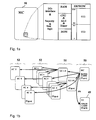
- the memory is located under the contact field of the chip, the memory areas of which are divided into unprotected and protected areas. Other data generated by the franking machine and chip card manufacturer is stored in both areas. Together with the non-volatile read / write memory EEPROM, with the unprotected CC1 and protected memory area CC2, a general memory area in the read-only memory ROM is also provided on the common chip of the intelligent memory card.
- the authorization of follow-up cards by means of a first chip card can therefore be valid for a limited time, for example, if the corresponding stored security-relevant data is loaded into a franking machine and stored there as a condition for an authorized follow-up card.
- the data in the protected area was created in different ways.
- a first part of the identification string can only be written to by the chip card manufacturer in the read-only memory ROM.
- a second part of the identification string can only be written by the franking machine manufacturer in the protected non-volatile EEPROM area.
- a third part of the identification string is provided in the unprotected data area and can be modified by the customer. For master cards, this part is described by the franking machine manufacturer.
- a single function card FC 2 which is initialized internally by means of the group card GC 1-4 franking machine, allows its owners only to make an informational request for the bookings under cost center number 2 and only to carry out zero-value frankings with the franking machine. Furthermore, it is provided in a second branch to create a single card EC 5 and a function card FC 5, both of which are assigned to the fifth cost center, omitting the generation of a group card.
- a single function card FC 5 initialized by means of the single card EC 5 franking machine internally allows its owners, for example, only to query the bookings under cost center number 5 and zero value frankings with the franking machine. It is also possible to initialize only one sequence card FC 9 franking machine internal assigned to a lowest hierarchical level in a branch, omitting further hierarchical levels. The cards of the lowest hierarchical level are the most restricted in terms of the range of functions.
- a number of sequential cards assigned to each hierarchical level can be initialized in stages, ie a group card GC 6-8 as sequential card 51 in the first hierarchical level, a single card EC 8 as sequential card 52 in the second hierarchical level and a function card FC 8 as a follow-up card 53 in the third hierarchical level.
- the follow-up cards in the first to third groups 51, 52, 53 (hierarchy level) can advantageously be of a cheaper type than the master chip card.
- the follow-up cards are preferably of type a and the master chip card is preferably of type c.
- a sequence number FN is also stored in the secured non-volatile memory area of the processor chip card, which refers to a further reload chip card 49 with which the reload can be continued or modified.
- This additional reloading chip card is described by the manufacturer with reloading data and with a further sequence number, which refers to a subsequent additional reloading chip card, which may be supplied by the manufacturer in the future.
- the processor chip card 50 is of type c
- the further reload chip cards 49 can be of the same type or of a different type, preferably of type b.
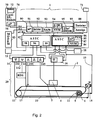
- FIG. 2 shows a block diagram for setting the function of the Franking machine and for controlling the printing device 20 with a Chip card read / write unit 70 and with a control device 1 of Franking machine.
- the control device 1 forms the actual meter and includes a first controller 90, a keyboard 88 and one Display unit 89 and a first and second application-specific Circuit ASIC 87 and 97.
- the first control unit 90 contains a first microprocessor 91 and known per se Storage means 92, 93, 94 and a clock / date circuit 95.
- Im Non-volatile memories 94 are areas for storing the accounting data provided that are assigned to the cost centers.
- the first application-specific circuit ASIC 87 forms together with a second microprocessor 85 and a non-volatile memory 84 a postal security means PSM 86.
- the postal security means PSM 86 is enclosed in a secured housing and has a fast serial interface to the printer controller 16. Before each franking imprint, hardware billing takes place in the first application-specific circuit ASIC 87. The billing takes place independently of cost centers.
- the second microprocessor 85 contains - not shown - integrated read-only memory int.ROM the special application program for the franking machine from the postal authority or the respective postal carrier.
- the postal security means PSM 86 can be designed as in the European application EP 789 333 A3 has been described in more detail.
- Both of the aforementioned ASICs are connected at least to the control unit 90 and the display unit 89 via the parallel ⁇ C bus.
- the first microprocessor 91 preferably has connections for the keyboard 88, a serial interface SI-1 for the connection of the chip card read / write unit 70 and a serial interface SI-2 for the optional connection of a MODEM.
- the credit stored in the non-volatile memory 84 of the postal security means PSM 86 can be increased by means of the MODEM.
- the second ASIC 97 has a serial interface circuit 98 to a device 13 connected upstream in the mail stream, a serial interface circuit 96 to the printing device 20 and a serial interface circuit 99 to a device 18 downstream of the printing device 20 in the mail stream.
- An unprecedented German application 197 11 997.2 shows an embodiment variant for the peripheral interface which is suitable for several peripheral devices (stations). It has the title: Arrangement for communication between a base station and other stations of a mail processing machine and for their emergency shutdown.
- Interface circuit 96 coupled to that in the machine base located interface circuit 14 provides at least one connection to the sensors 6, 7, 17 and to the actuators, for example to Drive motor 15 for the roller 11 and a cleaning and Sealing station RDS for the inkjet print head 4, as well as for the inkjet print head 4 of the machine base.
- the basic arrangement and that The interaction between the inkjet printhead and the RDS is the German application 197 26 642.8 not prepublished, entitled: Arrangement for Positioning an Inkjet Printhead and a cleaning and sealing device.
- the transport device consists of a conveyor belt 10 and two rollers 11, 11 '.
- One of the reels is that equipped with a motor 15 drive roller 11, another is idler roller 11 '.
- the drive roller 11 is as Toothed roller executed
- the conveyor belt 10 is accordingly as Toothed belt executed, which ensures the clear power transmission.
- Encoder 5 6 is coupled to one of the rollers 11, 11 '.
- the drive roller 11 with an incremental encoder 5 sits firmly on one Axis.
- the incremental encoder 5 is, for example, a slotted disc executed that interacts with a light barrier 6.
- the individual print elements of the print head are connected to printhead electronics within its housing and that the print head can be controlled for purely electronic printing is.
- the pressure control is based on the path control, the selected stamp offset is taken into account, which is via the keyboard 88 Entered directly or, if necessary, indirectly via chip card and in the memory NVM 94 is stored non-volatile.
- a planned imprint results thus from stamp offset (without printing), the franking print image and if necessary, additional print images for advertising cliché, shipping information (Election prints) and additional editable messages.
- the franking machine contains a 92 in its program memory corresponding application program, so that in the chip card read / write unit 70 inserted first chip card 50 a setting the franking machine for at least one functional application on the allowed at the highest hierarchical level.
- control device 1 has a control unit 90 equipped with a microprocessor 91 with associated memories 92, 93, 94, 95 and a connected user interface 88, 89 which, depending on a predetermined input, has a top-down initialization of Allow at least one of a number of further chip cards 51, 52, 53 to be inserted by the user in order to simplify the function input and the management of cost center data to be booked in connection with suitably initialized chip cards, the aforementioned further chip cards 51, 52, 53 sequentially in an insertion slot 72 of the chip card read / write unit 70 are inserted and initialized, using the keyboard 88 and display 89 and with the aid of the microprocessor 91 and the associated non-volatile memories within the postage meter machine a table having a special hierarchical structure is created by the pre-stored structure is modified accordingly and assigned to a respective chip card number is stored in one of the associated non-volatile memories 94, 95, the chip card number being stored in a part of an
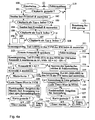
- FIG. 4a shows a flow chart for control by the microprocessor the franking machine when entering data using a chip card shown.
- the switch 71 After switching on a - not shown - Power supply of the franking machine with the switch 71, which in step 100 is registered by the microprocessor 91 of the franking machine one with a contacting device 74 of the chip card read / write unit 70 connected microprocessor 75 to the microprocessor 91 of the franking machine, if a chip card is inserted into the slot 72, what in step 101 from the microprocessor 91 of the franking machine is registered. Between the smart card read / write unit 70 and the Chip card then communicates after a first predetermined Protocol and an evaluation in step 102.
- the query step 103 it is checked whether the chip card can be read as type c. If this is the case, is branched from the query step 103 to a step 111 to one Part I of the identifier string in the non-volatile memory 94 of the Franking machine to load, with the microprocessor 91 the Franking machine an evaluation of the company identification number (company ID) is made. But if the chip card as type c is not readable, is branched from the query step 103 to a step 104 to a Communication according to a second predetermined protocol and one Evaluation in step 104 to determine whether the chip card can be read as type b.
- a timer value is loaded into an area of the non-volatile memories 94 or 95 of the franking machine, which forms a counter that defines a time window for a subsequent treatment, which is carried out, for example, with a subsequent chip card becomes.
- step 114 a part II of the identification string is loaded into the non-volatile memory 94 of the postage meter machine, with the microprocessor 91 of the postage meter machine masking the initial code number A to derive a first code number A1, with which subsequently an arithmetic operation to form a second code number A2 is carried out in order to subsequently check whether the first part I originating from the identification string and the code number A2 have a predetermined relationship to one another.
- Check the microprocessor 91 of the franking machine using the company code B as follows: Key figure B A2
- step 118 it is checked whether there is a master card. Is this the case branches to a step 120 to enter a timer value in the load non-volatile memory 94 of the postage meter machine, whereby by the microprocessor 91 of the franking machine in step 121 Functionality is released, which in the program memory 92 Postage meter for the master card is provided.
- This functionality includes creation of a special function application map by means of the franking machine, what in a parallel application is explained in more detail.
- step 122 it is checked whether the card is still is always stuck. If this is the case, the functionality is still released. Otherwise, a timer is started in step 123.
- the timer is for example one using memory cells in volatile memory 93 or in one of the non-volatile memories 94, 95 of the franking machine realized down counter for which the oscillator in the clock / date circuit 95 provides a corresponding clock.
- step 124 checks whether the timer end has been reached. If not and one Another chip card is inserted, then step 101 (point c) branched back. This loop to point c enables reloading continue regardless of type after inserting another chip card.
- an interrupt is triggered for the microprocessor 91 of the franking machine.
- the further use of the franking machine is then blocked for at least one of the franking functions.
- step 118 If it is determined in query step 118 that there is no master card, it branches to a step 119 to the part III of the identifier string in the non-volatile memory 94 or 95 of the franking machine and an evaluation of the chip card number originating there to make.
- a number of different application functionalities is in a memory area of the non-volatile Memory 94 or 95 of the franking machine listed where everyone Application functionality assigned a corresponding chip card number is. Is none in the list of a certain chip card number Application assigned stored is from query step 125 to the Follow step 131 branches to the further use of the franking machine to block franking for at least one functionality.
- step 127 the functionality listed is corresponding released the chip card number and in step 129 a timer started after it was determined in step 128 that the card was not is more stuck. The timer again forces the reloading must be continued with another card. But is the first card still plugged in, there is a branching back and the functionality is released further. At the end of the timer there is an interrupt for the microprocessor 91 of the postage meter machine is triggered and to the subsequent step 131 branches. In the case of a follow-up chip card of the type a Go through the aforementioned steps 111-119 and 125-130.
- the identifier string has a key function.
- the identifier string is stored non-volatile in the chip card so that several Security areas are included, whereby to change the im part of the identification string stored in the respective security area different security requirements have to be met.
- the microprocessor 91 is programmed, one in the Change chip card stored chip card number and a Assignment of the chip card number to listed application functions store in the non-volatile memory of the franking machine.
- microprocessor 91 of the control device 90 is programmed to be used in conjunction with suitably initialized chip cards the entry of functions and the administration of cost center data to be booked to simplify, the function input being the top-down initialization of other smart cards.
- the chip card read / write unit 70 consists of an associated one mechanical support for the microprocessor card and contact unit 74.
- the latter allows a secure mechanical mounting of the chip card in reading position and clear signaling of reaching the Reading position of the chip card in the contacting unit, for example Tactile signaled by pressure point according to the push / push principle, eject button or display / beeper message of the franking machine, a reliable electrical contacting of contact-based chip cards according to ISO 7816 for at least 100,000 contacting cycles as well easy usability when inserting and removing the chip card.
- the Microprocessor card with the microprocessor 75 has a programmed Readability for all types of memory cards, as well as for Chip cards with and without PIN coding.
- An encryption or decryption for security algorithms (e.g. RSA, DES) is possible.
- the interface to Franking machine is a serial interface according to the RS232 standard.
- the data transfer rate is min. 1.2 K baud.
- a self test function with a readiness message is executable or will be followed Switching on the power supply by means of switch 71 automatically executed.
- the master card 50 inserted into the insertion slot 72 grants at least one access authorization to the total cost center, i.e. all master chip cards issued only access this cost center to. Then there is the option of another cost center via keyboard.
- master chip cards for the invention Definition of the chip card / cost center relationship and intended to release / lock cards. It can be an extension the range of functions provides access to defined cost centers created on the follow-up cards using the franking machine be, with a storage of the assignment according to a any hierarchy is possible.
- the data exchange is controlled by the control device 1 by means of data records based on the specific protocol for each chip card type, a data record including the chip card number being loaded and data from the specially secured non-volatile memory areas of the chip card being loaded into the non-volatile memory areas of control device 1 of the franking machine at least by means of an additional data record.
- the authorized person can use a sequence number FN entered into the franking machine by means of a second chip card (49) which is also a reloading chip card.
- the sequence number FN previously loaded into the franking machine has one predetermined relationship to a subsequent one in the franking machine loaded base number BN of another reload chip card 49.
- From the subsequently into the chip card read / write unit 70 of the franking machine inserted recharge chip card 49 data is loaded when the base number BN has a predetermined relationship with it corresponding to the has sequence number FN stored in the franking machine.
- the following base number BN loaded into the franking machine the above-mentioned second code, which is principally used by the authorized person can also be entered using the keyboard.
- a multifunction chip card 50 can now advantageously be used access to all listed application functions as well as one Reloading of cryptographic session keys, rate tables and other reloading data. Changes to the tariff tables can with other chip cards of the same or a different type be reloaded. This also enables a cost-effective solution with another reload chip card 49 if a single chip card reloading data is not complete due to storage capacity may contain. Another reloading chip card 49 can also be used Access to listed application functions as well as reloading of cryptographic session keys, rate tables and others Allow reloading data.
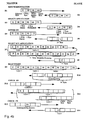
- data is exchanged between the chip card read / write unit of the franking machine of the chip card, the chip card read / write unit of the franking machine acting as a master and sending out a first data record D1.
- the representation of the first data record D1 shows four fields for an address byte, a CTRL byte, a data length byte and a check byte.
- the chip card works as a slave and sends a second data record D2 with the same structure back to the chip card read / write unit.
- the address and check byte are changed accordingly compared to the first data record D1.
- the address byte of the first data record D1 and all other data records with an odd number identifies the device address of the SCP slave.
- the data length byte in the third field shows the data length zero, since no data is sent.
- the check byte is preferably the result of an XOR combination of the aforementioned bytes of a data record (transmission block).
- the third data record D3 contains the SELECT APPLICATION command F1 in the fourth field. This command resets the SCP slave and selects an application protocol.
- the answer 81 in the fourth field of the fourth data record D4 is a return code.
- Command 01 in the fourth field of the fifth data record D5 signals that the voltage is switched on.
- the sixth data record D6 contains a corresponding answer.
- the identifier of the card manufacturer is transmitted in the seventh data record D7 and a corresponding answer is transmitted in the eighth data record D8.
- the command READ TOKEN is transmitted in the ninth data record D9 to cause the identification string to be read out, and a corresponding response with the identification string is transmitted in the tenth data record D10.
- the chip card is used to enter the cost center number for the total cost center, for example by masking the identification string or by means of a special computing operation, and indirectly gives access authorization to the franking machine.
- a user or the franking machine is authorized by a special number or code on the chip card to additionally read out particularly secure data from the secure memory area of the chip card.
- an eleventh data record D11 contains a special number, preferably the serial number SN of the franking machine, and a sixth command COMPBN.
- the data record D11 is transmitted from the franking machine to the chip card 50 via the chip card reading unit.
- the sixth command COMPBN instructs the chip card to compare the serial number SN stored in the chip card with the SN transmitted in the eleventh data record D11.
- the chip card contains at least 1 byte of the serial number SN of the franking machine, which belongs to the user group. The chip card therefore checks whether it belongs to the user group of the franking machine by comparing parts of the serial number SN of the franking machine with the internally stored parts of the serial number SN of the franking machine.
- the comparison result is transmitted to the chip card reading unit, which (in the 1st variant) receives the following twelfth data record D12 if the comparison result is positive:
- the twelfth data record D12 received by the chip card reading unit contains a unique base number if the comparison result is positive BN as the first code to make an assignment in the franking machine stored characteristics / data to change to a second code, the is entered below.
- the latter can be used when initializing a Follow-up card manually using the keyboard or when calling a function using a subsequently inserted second chip card 49 can be entered.
- the accuracy of the order can be checked by the loaded chip card from the previous sequence number FN n in a sequence number FN n + 1 converted and is stored permanently. It can then be compared with a currently loaded sequence number FN n + 1 . If the sequence number FN n + 1 transmitted in the twelfth data record D12 corresponds to a sequence number FN n + 1 stored in the franking machine, then the chip card is a sequence card inserted in the correct order. Alternatively, a pointer points to one of the listed sequence numbers corresponding to the loaded sequence number. Then the pointer position is changed and the pointer points to the next sequence number, which is expected in the order of the next reload.
- the pointer is designed as an up / down counter and the change is designed as up / down counting and is implemented in the memory cells of the non-volatile memory of the franking machine.
- the transmitted data BN, FN and ND are through secured a Message Authentication Code (MAC).
- MAC Message Authentication Code
- the OTP processor One Time Programmable
- the data record D12 by sending the transmitted data BN, FN using a secret Encrypted key to a reference MAC.
- a first current one Secret key K1 is encrypted to Kb [K1] and initially at the Initialization stored in the franking machine's NVRAM.
- the latter can in the OTP processor with a DES algorithm stored in the internal OTP-ROM (Data Encrytion Standard) and secret basic key Kb be decrypted.
- the first current secret key K1 becomes Encrypt the given base number BN and sequence number FN used for the reference MAC, whereby the process is only internal to OTP expires and therefore cannot be read out.
- the Authentication of the transmitted data BN, FN, ND in the Franking machine is done by comparing the transmitted MAC with the Reference MAC. The comparison is preferably made before aforementioned separate evaluation of the transmitted data BN, FN.
- An encrypted session key K1 [KEY n + 1 ] is also among the transmitted data.
- no such secret data as the secret basic key Kb is stored in the chip card either, but instead an encrypted session key K1 [KEY n + 1 ].
- the latter is also encrypted and saved as a crypto key in the franking machine's NVRAM.
- the encrypted session key K1 [KEY n + 1 ] is first decrypted to the session key KEY n + 1 , the first current secret key K1 being applied to the DES algorithm.
- the unencrypted key KEY n + 1 is encrypted in the OTP processor to Kb [KEY n + 1 ], whereby the secret basic key Kb is applied to the DES algorithm, and thus forms the basis for the use as the next current secret session key Decrypt the crypto key Kb [KEY n + 1 ] stored in the NVRAM.
- the aforementioned session key KEY n + 1 can be used in a variety of ways. For example, the latter is required in order to top up or renew or assign service features or data that have to be paid for with additional chip cards.
- the first inserted chip card is also called the master chip card 50 designated.
- the master chip card 50 designated. After their authorization, for example Service features released. It may be necessary to have one Combination of a service feature that has already been saved and one that is to be loaded to build. For the service feature to be loaded manual entries must now be made or another chip card previously 49 with the service feature to be loaded into the slot, after the master chip card 50 has been removed.
- a further chip card 49 is inserted, which is provided with a corresponding external identification for the user.
- Data records are exchanged again and after receiving the twelfth data record D12 and the above-mentioned authorization and evaluation of the transmitted data, a thirteenth data record D13 is transmitted from the franking machine with the chip card / reading unit to the chip card, the data record D13 having the sequence number FN n + 1 includes that was entered with the predecessor chip card 50.
- the fourteenth and fifteenth bytes are for additional tasks provided, but not mandatory. More bytes, for example, the sixteenth to eighteenth bytes are for Reload data ND provided. Authorization of numbers BN, FN, Default data VGS, TL or reloading data ND takes place in the Franking machine again based on the associated MAC. The tenth byte for P or N is therefore optional and does not necessarily have to be transmitted become. If the comparison result is negative (N), the twelfth data record D12 an invalid base number BN, sequence number FN or specifications transmitted from zero size.
- the twelfth data record D12 received by the chip card / reading unit contains a unique base number BN as the first code in order to change an assignment of features / data stored in the postage meter machine to a second code, which is done manually or by a second chip card 49 subsequently inserted is entered.
- the aforementioned assignment is limited for a number of pieces specified by the VGS for franking and must then be renewed when the limit is reached (number sleeping mode for chip card).
- a separate limitation of the number of pieces for franking is preferably provided for each cost center KST in the franking machine.
- a time limit TL for all features of the FM is specified for each function that is achieved by means of the unique number BN.
- at least some or all of the specifications BN, FN, VGS and TL and reloading data ND are secured by a MAC (Message Authentication Code).
- the OTP processor (One Time Programmable) of the franking machine processes, for example, the data record D12 after data exchange between the OTP processor (in the security module) of the FM and the chip card / reading unit by using all the specifications BN, FN, VGS and TL as well as reloading data ND encrypted with a secret key to a reference MAC.
- the principle of cumulative MAC formation can be used to authenticate any number of bytes protected in this way.
- 8-byte input values are encrypted with DES (Data Encryption Standard) and the 8-byte output values are XOR-linked with 8-byte second input values and then encrypted again with DES, etc.
- a secret key and the DES algorithm are again stored in the OTP-ROM in order to form the reference MAC in the above-mentioned manner.
- the OTP internally formed reference MAC and the MAC transmitted to the OTP are compared.
- the franking machine's OTP processor checks whether the number of pieces set by VGS has been exceeded in accordance with the set cost center KST.
- the invention includes the idea of increasing or renewing the number of pieces with additional chip cards that have to be paid extra.
- the OTP processor checks whether the time limit set by TL has been exceeded in accordance with the set cost center KST.
- the invention includes the idea of increasing or renewing the time limit for individual features with additional chip cards that have to be paid for separately. The features are then released, for example.
- the security in terms of card copy protection is ensured by manufacturer and user-specific information in a read-only area the card guaranteed.
- the chip cards are manufacturer-specific with an FP Key figure B in read-only part I of the identifier string Mistake.
- the key figure A is stored as read-only, which results from the serial number of the franking machine and an attached example 3 digit consecutive number 505010 001.
- the franking machine Jet Mail® is able to automatically send chip cards Authorize use on it. This happens from one for that provided cost center menu sub-item by after Insert the master card and select the authorization function any follow-up card of an existing or newly defined cost center or group is assigned. For this, the corresponding follow-up card inserted and on the part of the franking machine with a code number A described.
- both indicators (A and B) loaded from the chip card into the postage meter machine and there after an arithmetic operation compared. For example in the case of equality the hidden 3 last digits of the Key figure A using a table, etc. regarding what account number this card is assigned. The first entry in the table is made for the master card.
- the franking machine is without an inserted one
- the user has the option of using the type a chip card with the to label the current cost center number.
- Assignment changes between chip cards and cost center numbers are only about the master card possible.
- certain link conditions for the cost centers for example regarding advertising slogan no., value limitation per unit of time can be changed in the same way.
- invalid cards on the part of the franking machine with a corresponding error message responds.
- the function "duplicate follow-up cards” the franking machine Jet Mail® continues to be able to use the master card to automatically authorize follow-up cards for use on it. This will the corresponding follow-up card is inserted and on the part of the franking machine described with the code number A.
- each cost center KST one temporary, however, (monthly) renewable value limit for the consumption of franking values per calendar month using the master card be determined.
- the maximum for each cost center is KST Credit available in the Jet Mail® franking machine.
- the predetermined value limit taken over, there are no carryovers.
- Assignment changes between chip card no. and KST-Nr., functions with limit data and the value limits are only possible with the help of the master card.
- the user interface of the franking machine is completely available at all times, however, when selecting the points reserved for the master card, if the master card is not inserted, it requires authorization.
- the displayable table for managing the chip card functionality can e.g. the fields: chip card no. / KST-No.
- the control device connected to the chip card read / write unit 70 90 of the franking machine has a non-volatile memory 94, 95 with Memory areas A, B, C according to the invention for an assignment of listed application functions with limit data to a predetermined Chip card and for parameters.
- the assignment can be displayed according to the above table or in a similar form respectively.
- the franking machine with a chip card read / write unit 70 and associated control device 1 is provided, that a microprocessor 85, 91st the control device 1 with the chip card read / write unit 70 and with a non-volatile memory with memory areas A, B for one Assignment of listed application functions with limit data to one predetermined chip card and with a memory area C for parameters connected is.
- the microprocessor 85, 91 is programmed, on the one hand, to Reload data, whereby for valid chip cards 50, 49 one by one Sequence number specific sequence for inserting the chip card 49 is requested in the chip card read / write unit, and on the other hand for Data entry that allows the authorized user for the Insert further suitably initialized chip cards 51, 52, 53 low Ranges set a specific order to the functional and Simplify data entry into the franking machine.
- microprocessor 91 of the control unit 90 is programmed, which is stored in the first chip card 50 Limit data in a memory area C of the non-volatile memory 94, 95 of the franking machine as parameters.
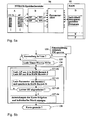
- FIG. 5a shows a division of the structure into memory areas A, B. and C, a directory valid in the first memory area A.
- Card number, in the second memory area B link conditions and associated parameter sets in the third memory area C. stored non-volatile.
- the above structure can be in modified each of the aforementioned memory areas A and B separately become.
- the listing in the directory is valid Card number CC no. added another card number.
- Each card number is assigned an address pointer AP, which points to shows an address in the second memory area B, under which the card number dependent link conditions together with associated condition pointers BP and Wertpointem WP saved are.
- the WP value pointer points to an address for the associated one Parameter set in the third memory area C. Via the condition pointer BP, which has an address for another condition pointer the associated value pointer, a link can be freely selected.
- the WP value pointer then points to an address with the associated one Parameter set in the third memory area C.
- the divided, modifiable structure is again via the pointer producible, wherein in memory areas E, F of the main memory RAM 93 temporarily stores the loaded pointer, whereby a corresponding data input into a memory area D of the Main working memory RAM 93 for storing a data record is carried out, the microprocessor 91 of the franking machine a corresponding function or a saved order of Functions according to the application program and the like entered parameters.
- One of the functions can be used Initialization of follow-up cards are performed to modify them to be able to or at least partially to structure the structure in a table display.
- FIG. 5b shows a detail of the flowchart according to FIG. 4 in order to illustrate the control by the microprocessor 91 when at least one of the functions is called up according to the stored structure by entering a chip card number.
- that address pointer AP which is assigned to the chip card number in the memory area A is loaded into a memory area E of the main working memory RAM 93 in a sub-step 127-01.
- the condition pointer BP is loaded step by step into a memory area F of the main working memory RAM 93 each time a loop S is run through.
- These aforementioned memory areas E and F of the main working memory RAM 93 serve to temporarily store the data of the pointers AP and BP for the subsequent data processing.
- a value pointer WP stored in the second memory area B is found, which is assigned to the condition pointer BP.
- a reference to a subsequent condition pointer BP, which the microprocessor 91 is to access in order to find further associated value pointers WP is taken from the data of the condition pointer BP.
- the further data processing in sub-step 127-02 is preferably nested, ie organized in a time-optimized manner.
- So-called "pipelineing" can be carried out if the value pointer WP points to the parameter sets in the third memory area C and corresponding parameter sets are loaded from the third memory area C for storage in the RAM area D of the main working memory RAM 93.
- the applications of the inserted card are released, in accordance with the data record in the memory area D, which was compiled individually during the processing of the above-mentioned loop S.
- the microprocessor 91 accesses function applications stored in the program memory 92 and the parameters which are described in the above-mentioned cached data record are available.
- an individual menu corresponding to the individual data record can be displayed in the display unit 89. It is contemplated that a function application stored in program memory 92 provide keyboard input so that microprocessor 91 can finish executing the application program.
- the microprocessor 91 is programmed to access three memory areas A, B, C of the non-volatile memory 94, 95 of the control device 90 in order to call up an assignment of the listed application functions to the respective chip card number in the non-volatile memory 94, 95 of the franking machine and the to carry out corresponding application programs.
- the assignment represents a predetermined structure, the modifiable structure divided into the three memory areas A, B, C of the non-volatile memory 94, 95 being able to be restored by means of a pointer.
- the structure present in the non-volatile memory 94, 95 of the postage meter machine is a hierarchical structure given by the order in which the chip card number is listed and by the assignment of listed application functions.
- the microprocessor 91 of the control unit 90 is programmed to load the chip card number, which is stored in a part of an identification string stored in the protected memory areas of the chip cards 50, 51, 52, 53, in order to carry out a function input accordingly after the chip card has been inserted, to simplify the administration of cost center data to be booked by accessing the associated function application.
- Such parameters can be used for everyone Powers and limitations down to one Expiry date can be given on which the application is blocked.
- the chip card that has granted powers and limitations can block or renew the grant alone.
- the microprocessor 91 of the franking machine the microprocessor 75 of the chip card read / write unit 70 Send data record to the first chip card 50 to load the one Function associated limit data
- at least the first chip card 50 is a processor chip card, with one Read-only memory ROM for a general memory area, with a non-volatile read / write memory EEPROM, which is an unprotected CC1 and protected memory area CC2, with a special safety and protection logic.
Landscapes
- Engineering & Computer Science (AREA)
- Physics & Mathematics (AREA)
- General Physics & Mathematics (AREA)
- Business, Economics & Management (AREA)
- Theoretical Computer Science (AREA)
- Strategic Management (AREA)
- General Business, Economics & Management (AREA)
- Accounting & Taxation (AREA)
- Microelectronics & Electronic Packaging (AREA)
- Computer Networks & Wireless Communication (AREA)
- Health & Medical Sciences (AREA)
- Child & Adolescent Psychology (AREA)
- General Health & Medical Sciences (AREA)
- Devices For Checking Fares Or Tickets At Control Points (AREA)
- Control Of Vending Devices And Auxiliary Devices For Vending Devices (AREA)
Applications Claiming Priority (2)
| Application Number | Priority Date | Filing Date | Title |
|---|---|---|---|
| DE19757649A DE19757649B4 (de) | 1997-12-15 | 1997-12-15 | Anordnung und Verfahren zum Datenaustausch zwischen einer Frankiermaschine und Chipkarten |
| DE19757649 | 1997-12-15 |
Publications (3)
| Publication Number | Publication Date |
|---|---|
| EP0930586A2 true EP0930586A2 (fr) | 1999-07-21 |
| EP0930586A3 EP0930586A3 (fr) | 2000-09-27 |
| EP0930586B1 EP0930586B1 (fr) | 2006-06-07 |
Family
ID=7853247
Family Applications (1)
| Application Number | Title | Priority Date | Filing Date |
|---|---|---|---|
| EP98250405A Expired - Lifetime EP0930586B1 (fr) | 1997-12-15 | 1998-11-23 | Dispositif et méthode pour l'échange de données entre une machine d'affranchissement et des cartes à puce |
Country Status (3)
| Country | Link |
|---|---|
| US (1) | US6385597B1 (fr) |
| EP (1) | EP0930586B1 (fr) |
| DE (2) | DE19757649B4 (fr) |
Families Citing this family (18)
| Publication number | Priority date | Publication date | Assignee | Title |
|---|---|---|---|---|
| DE19958559A1 (de) * | 1999-12-04 | 2001-06-07 | Orga Kartensysteme Gmbh | Verfahren zur Initialisierung und/oder Personalisierung von Chipkarten sowie eine entsprechende Einrichtung |
| FR2804778A1 (fr) * | 2000-02-03 | 2001-08-10 | Georges Obanos | Procede de controle d'acces a des ressources d'un equipement informatique, et systeme de controle pour la mise en oeuvre du procede |
| KR100341843B1 (ko) * | 2000-04-12 | 2002-06-24 | 황정남 | 자성체내의 자화 용이축 회전 및 다중 자화축 물질 제조방법 |
| US6824045B2 (en) | 2000-04-20 | 2004-11-30 | Canon Kabushiki Kaisha | Method and system for using multiple smartcards in a reader |
| US20020044655A1 (en) * | 2000-10-18 | 2002-04-18 | Applebaum David C. | Information appliance and use of same in distributed productivity environments |
| US20020133471A1 (en) * | 2001-02-23 | 2002-09-19 | Fetneh Eskandari | Configuration enablement of franking system |
| US20020128986A1 (en) * | 2001-02-23 | 2002-09-12 | Peter Stutz | Communication system for franking system |
| US20020169728A1 (en) * | 2001-02-23 | 2002-11-14 | Christian Moy | Modular franking system |
| EP1313020A1 (fr) * | 2001-11-19 | 2003-05-21 | EM Microelectronic-Marin SA | Architecture d'un circuit intégré pour carte à puce et procédé d'allocation mémoire associé |
| US20060026350A1 (en) * | 2004-07-28 | 2006-02-02 | Lee Kyoung-Jae | Method and apparatus to automatically switch memory cards in a multi-functional device, and method of configuring a removable disc driver |
| US20080287927A1 (en) * | 2004-12-02 | 2008-11-20 | Sie Ag Surgical Instrument Engineering | Protective device for ophthalmic laser treatment |
| US20050143718A1 (en) * | 2004-12-02 | 2005-06-30 | Sie Ag Surgical Instrument Engineering | Method for surgical treatment of a patient's eye by means of a laser |
| EP1942470A1 (fr) * | 2006-12-29 | 2008-07-09 | Legic Identsystems AG | Système d'authentification |
| WO2009089015A1 (fr) * | 2008-01-07 | 2009-07-16 | Security First Corporation | Systèmes et procédés pour sécuriser des données à l'aide d'une dispersion à clé ou à plusieurs facteurs |
| AU2014203626B2 (en) * | 2008-01-07 | 2016-03-03 | Security First Corp. | Systems and methods for securing data using multi-factor or keyed dispersal |
| EP2160030B1 (fr) * | 2008-08-27 | 2016-12-21 | Irdeto B.V. | Système d'accès conditionnel à vendeurs multiples |
| WO2011075076A1 (fr) * | 2009-12-16 | 2011-06-23 | T-Data Systems (S) Pte Ltd | Procédé de conversion de données numériques |
| EP4322465A3 (fr) * | 2011-12-15 | 2024-04-17 | Daedalus Prime LLC | Procédé et dispositif pour communications sécurisées dans un réseau à l'aide d'un moteur de sécurité du matériel |
Citations (7)
| Publication number | Priority date | Publication date | Assignee | Title |
|---|---|---|---|---|
| US4746234A (en) | 1983-07-23 | 1988-05-24 | Francotyp-Postalia Gmbh | Relating to postal franking machines |
| US4802218A (en) | 1986-11-26 | 1989-01-31 | Wright Technologies, L.P. | Automated transaction system |
| US5490077A (en) | 1993-01-20 | 1996-02-06 | Francotyp-Postalia Gmbh | Method for data input into a postage meter machine, arrangement for franking postal matter and for producing an advert mark respectively allocated to a cost allocation account |
| DE19516429A1 (de) | 1995-05-04 | 1996-11-14 | Siemens Ag | Verfahren für eine Zugangsautorisierung zu einer gesicherten Einrichtung |
| DE19605015C1 (de) | 1996-01-31 | 1997-03-06 | Francotyp Postalia Gmbh | Vorrichtung zum Bedrucken eines auf einer Kante stehenden Druckträgers |
| EP0789333A2 (fr) | 1996-01-31 | 1997-08-13 | Francotyp-Postalia Aktiengesellschaft & Co. | Machine d'affranchissement |
| DE19711997A1 (de) | 1997-03-13 | 1998-09-17 | Francotyp Postalia Gmbh | Anordnung zur Kommunikation zwischen einer Basisstation und weiteren Stationen einer Postbearbeitungsmaschine und zu deren Notabschaltung |
Family Cites Families (11)
| Publication number | Priority date | Publication date | Assignee | Title |
|---|---|---|---|---|
| US4900904A (en) * | 1986-11-26 | 1990-02-13 | Wright Technologies, L.P. | Automated transaction system with insertable cards for downloading rate or program data |
| CA1301334C (fr) * | 1988-02-08 | 1992-05-19 | Pitney Bowes Inc. | Systeme de comptabilisation des droits postaux |
| CA1328927C (fr) * | 1988-02-08 | 1994-04-26 | Glynn M. Brasington | Systeme de comptabilite d'affranchissement postal |
| DE4224955C2 (de) * | 1992-07-24 | 1998-11-26 | Francotyp Postalia Gmbh | Anordnung und Verfahren für einen internen Kostenstellendruck |
| DE19534530A1 (de) * | 1995-09-08 | 1997-03-13 | Francotyp Postalia Gmbh | Verfahren zur Absicherung von Daten und Programmcode einer elektronischen Frankiermaschine |
| US5742683A (en) * | 1995-12-19 | 1998-04-21 | Pitney Bowes Inc. | System and method for managing multiple users with different privileges in an open metering system |
| DE19549305A1 (de) * | 1995-12-22 | 1997-07-03 | Francotyp Postalia Gmbh | Verfahren und Anordnung zur Dateneingabe in eine Frankiermaschine |
| GB9601588D0 (en) * | 1996-01-26 | 1996-03-27 | Neopost Ltd | Postage meter |
| US5787406A (en) * | 1996-12-11 | 1998-07-28 | Pitney Bowes Inc. | Value dispensing mechanism, such as a postage meter, having automatic display/printing selection |
| US5809485A (en) * | 1996-12-11 | 1998-09-15 | Pitney Bowes, Inc. | Method and apparatus for automatically disabling a removable, portable vault of a postage metering |
| DE19757651B4 (de) * | 1997-12-15 | 2005-06-23 | Francotyp-Postalia Ag & Co. Kg | Frankiermaschine mit einer Chipkarten-Schreib-/Leseeinheit |
-
1997
- 1997-12-15 DE DE19757649A patent/DE19757649B4/de not_active Expired - Fee Related
-
1998
- 1998-11-23 DE DE59813581T patent/DE59813581D1/de not_active Expired - Lifetime
- 1998-11-23 EP EP98250405A patent/EP0930586B1/fr not_active Expired - Lifetime
- 1998-12-15 US US09/211,339 patent/US6385597B1/en not_active Expired - Fee Related
Patent Citations (7)
| Publication number | Priority date | Publication date | Assignee | Title |
|---|---|---|---|---|
| US4746234A (en) | 1983-07-23 | 1988-05-24 | Francotyp-Postalia Gmbh | Relating to postal franking machines |
| US4802218A (en) | 1986-11-26 | 1989-01-31 | Wright Technologies, L.P. | Automated transaction system |
| US5490077A (en) | 1993-01-20 | 1996-02-06 | Francotyp-Postalia Gmbh | Method for data input into a postage meter machine, arrangement for franking postal matter and for producing an advert mark respectively allocated to a cost allocation account |
| DE19516429A1 (de) | 1995-05-04 | 1996-11-14 | Siemens Ag | Verfahren für eine Zugangsautorisierung zu einer gesicherten Einrichtung |
| DE19605015C1 (de) | 1996-01-31 | 1997-03-06 | Francotyp Postalia Gmbh | Vorrichtung zum Bedrucken eines auf einer Kante stehenden Druckträgers |
| EP0789333A2 (fr) | 1996-01-31 | 1997-08-13 | Francotyp-Postalia Aktiengesellschaft & Co. | Machine d'affranchissement |
| DE19711997A1 (de) | 1997-03-13 | 1998-09-17 | Francotyp Postalia Gmbh | Anordnung zur Kommunikation zwischen einer Basisstation und weiteren Stationen einer Postbearbeitungsmaschine und zu deren Notabschaltung |
Also Published As
| Publication number | Publication date |
|---|---|
| DE59813581D1 (de) | 2006-07-20 |
| DE19757649A1 (de) | 1999-06-24 |
| EP0930586B1 (fr) | 2006-06-07 |
| EP0930586A3 (fr) | 2000-09-27 |
| US6385597B1 (en) | 2002-05-07 |
| DE19757649B4 (de) | 2005-10-20 |
Similar Documents
| Publication | Publication Date | Title |
|---|---|---|
| DE19757652B4 (de) | Frankiermaschine mit einer Chipkarten-Schreib-/Leseeinheit | |
| EP0930586B1 (fr) | Dispositif et méthode pour l'échange de données entre une machine d'affranchissement et des cartes à puce | |
| DE3613007B4 (de) | System zur Ermittlung von nicht-abgerechneten Drucken | |
| DE68922011T3 (de) | Postgebühren-Buchungssystem. | |
| DE69729409T2 (de) | Elektronisches Frankiermaschinensystem mit internem Abrechnungssystem und entfernbarem externem Abrechnungssystem | |
| DE3688014T2 (de) | Verfahren zur Steuerung von Frankiermaschinen. | |
| DE3729342A1 (de) | Sicherheitsdrucker fuer ein wertdrucksystem | |
| DE3729345A1 (de) | Sicherheitsgehaeuse mit elektronischer anzeige fuer ein wertdrucksystem | |
| EP0927970B1 (fr) | Machine à affranchir avec dispositif de lecture/écriture de cartes à puce | |
| EP0566225B1 (fr) | Procédé de saisie de données dans une machine d'affranchissement et ensemble pour traiter le courrier et pour produire une image d'affranchissement à chaque fois à l'office de traitement de courrier | |
| DE3712181A1 (de) | Frankiermaschinennachladesystem | |
| EP0762335A2 (fr) | Procédé pour changer les données chargées dans des cellules de stockage d'une machine d'affranchissement | |
| EP0504367B1 (fr) | Systeme distributeur de bandes d'affranchissement | |
| EP1035516B1 (fr) | Système pour un module de sécurité | |
| EP0927971B1 (fr) | Procédé et dispositif postal avec une unité de lecture/écriture de cartes à puce pour le rechargement de données de changement dans une carte à puce | |
| EP0927969B1 (fr) | Machine à affranchir avec dispositif de lecture/écriture de cartes à puce | |
| DE19622304A1 (de) | Auswechselbares Portorechnermodul und Verfahren zur Datenübertragung | |
| EP0969420B1 (fr) | Procédé pour sécuriser la transmission de données de service à un terminal et dispositif pour la mise en oeuvre de ce procédé | |
| EP1202223B1 (fr) | Machine postale et procédé pour l'initialisation | |
| DE19847947A1 (de) | Anordnung und Verfahren zur Speicherung von Daten über eine Benutzung eines Endgerätes | |
| DE19847951A1 (de) | Anordnung und Verfahren zur Speicherung von Daten über eine Benutzung eines Endgerätes | |
| DE4302097A1 (de) | Anordnung zur Erzeugung eines jeweils einer Kostenstelle zugeordneten Frankierbildes | |
| WO2005038416A1 (fr) | Procede pour effectuer un paiement sans numeraire | |
| EP1855252B1 (fr) | Agencement et procédé destinés à la fabrication d'un affranchissement | |
| DE4312894A1 (de) | Verfahren zur Dateneingabe in eine Frankiermaschine |
Legal Events
| Date | Code | Title | Description |
|---|---|---|---|
| PUAI | Public reference made under article 153(3) epc to a published international application that has entered the european phase |
Free format text: ORIGINAL CODE: 0009012 |
|
| AK | Designated contracting states |
Kind code of ref document: A2 Designated state(s): CH DE FR GB IT LI |
|
| AX | Request for extension of the european patent |
Free format text: AL;LT;LV;MK;RO;SI |
|
| PUAL | Search report despatched |
Free format text: ORIGINAL CODE: 0009013 |
|
| AK | Designated contracting states |
Kind code of ref document: A3 Designated state(s): AT BE CH CY DE DK ES FI FR GB GR IE IT LI LU MC NL PT SE |
|
| AX | Request for extension of the european patent |
Free format text: AL;LT;LV;MK;RO;SI |
|
| 17P | Request for examination filed |
Effective date: 20010122 |
|
| AKX | Designation fees paid |
Free format text: CH DE FR GB IT LI |
|
| RAP1 | Party data changed (applicant data changed or rights of an application transferred) |
Owner name: FRANCOTYP-POSTALIA AG & CO. KG |
|
| GRAP | Despatch of communication of intention to grant a patent |
Free format text: ORIGINAL CODE: EPIDOSNIGR1 |
|
| RAP1 | Party data changed (applicant data changed or rights of an application transferred) |
Owner name: FRANCOTYP-POSTALIA GMBH |
|
| GRAS | Grant fee paid |
Free format text: ORIGINAL CODE: EPIDOSNIGR3 |
|
| GRAA | (expected) grant |
Free format text: ORIGINAL CODE: 0009210 |
|
| AK | Designated contracting states |
Kind code of ref document: B1 Designated state(s): CH DE FR GB IT LI |
|
| PG25 | Lapsed in a contracting state [announced via postgrant information from national office to epo] |
Ref country code: IT Free format text: LAPSE BECAUSE OF FAILURE TO SUBMIT A TRANSLATION OF THE DESCRIPTION OR TO PAY THE FEE WITHIN THE PRESCRIBED TIME-LIMIT;WARNING: LAPSES OF ITALIAN PATENTS WITH EFFECTIVE DATE BEFORE 2007 MAY HAVE OCCURRED AT ANY TIME BEFORE 2007. THE CORRECT EFFECTIVE DATE MAY BE DIFFERENT FROM THE ONE RECORDED. Effective date: 20060607 |
|
| REG | Reference to a national code |
Ref country code: GB Ref legal event code: FG4D Free format text: NOT ENGLISH |
|
| REG | Reference to a national code |
Ref country code: CH Ref legal event code: EP |
|
| REG | Reference to a national code |
Ref country code: CH Ref legal event code: NV Representative=s name: ROTTMANN, ZIMMERMANN + PARTNER AG |
|
| REF | Corresponds to: |
Ref document number: 59813581 Country of ref document: DE Date of ref document: 20060720 Kind code of ref document: P |
|
| GBT | Gb: translation of ep patent filed (gb section 77(6)(a)/1977) |
Effective date: 20060906 |
|
| ET | Fr: translation filed | ||
| PLBE | No opposition filed within time limit |
Free format text: ORIGINAL CODE: 0009261 |
|
| STAA | Information on the status of an ep patent application or granted ep patent |
Free format text: STATUS: NO OPPOSITION FILED WITHIN TIME LIMIT |
|
| 26N | No opposition filed |
Effective date: 20070308 |
|
| PGFP | Annual fee paid to national office [announced via postgrant information from national office to epo] |
Ref country code: FR Payment date: 20101130 Year of fee payment: 13 |
|
| PGFP | Annual fee paid to national office [announced via postgrant information from national office to epo] |
Ref country code: DE Payment date: 20100915 Year of fee payment: 13 Ref country code: CH Payment date: 20101123 Year of fee payment: 13 |
|
| PGFP | Annual fee paid to national office [announced via postgrant information from national office to epo] |
Ref country code: GB Payment date: 20101118 Year of fee payment: 13 Ref country code: IT Payment date: 20101122 Year of fee payment: 13 |
|
| REG | Reference to a national code |
Ref country code: CH Ref legal event code: PFA Owner name: FRANCOTYP-POSTALIA GMBH Free format text: FRANCOTYP-POSTALIA GMBH#TRIFTWEG 21-26#16547 BIRKENWERDER (DE) -TRANSFER TO- FRANCOTYP-POSTALIA GMBH#TRIFTWEG 21-26#16547 BIRKENWERDER (DE) |
|
| REG | Reference to a national code |
Ref country code: CH Ref legal event code: PL |
|
| GBPC | Gb: european patent ceased through non-payment of renewal fee |
Effective date: 20111123 |
|
| PG25 | Lapsed in a contracting state [announced via postgrant information from national office to epo] |
Ref country code: LI Free format text: LAPSE BECAUSE OF NON-PAYMENT OF DUE FEES Effective date: 20111130 Ref country code: CH Free format text: LAPSE BECAUSE OF NON-PAYMENT OF DUE FEES Effective date: 20111130 |
|
| REG | Reference to a national code |
Ref country code: FR Ref legal event code: ST Effective date: 20120731 |
|
| PG25 | Lapsed in a contracting state [announced via postgrant information from national office to epo] |
Ref country code: IT Free format text: LAPSE BECAUSE OF NON-PAYMENT OF DUE FEES Effective date: 20111123 |
|
| REG | Reference to a national code |
Ref country code: DE Ref legal event code: R119 Ref document number: 59813581 Country of ref document: DE Effective date: 20120601 |
|
| PG25 | Lapsed in a contracting state [announced via postgrant information from national office to epo] |
Ref country code: GB Free format text: LAPSE BECAUSE OF NON-PAYMENT OF DUE FEES Effective date: 20111123 |
|
| PG25 | Lapsed in a contracting state [announced via postgrant information from national office to epo] |
Ref country code: FR Free format text: LAPSE BECAUSE OF NON-PAYMENT OF DUE FEES Effective date: 20111130 |
|
| PG25 | Lapsed in a contracting state [announced via postgrant information from national office to epo] |
Ref country code: DE Free format text: LAPSE BECAUSE OF NON-PAYMENT OF DUE FEES Effective date: 20120601 |