EP0932076B1 - Procédé pour la préparation des grains tabulaires riches en chlorure d'argent avec croissance en épaisseur réduite et homogénéité améliorée - Google Patents
Procédé pour la préparation des grains tabulaires riches en chlorure d'argent avec croissance en épaisseur réduite et homogénéité améliorée Download PDFInfo
- Publication number
- EP0932076B1 EP0932076B1 EP98200236A EP98200236A EP0932076B1 EP 0932076 B1 EP0932076 B1 EP 0932076B1 EP 98200236 A EP98200236 A EP 98200236A EP 98200236 A EP98200236 A EP 98200236A EP 0932076 B1 EP0932076 B1 EP 0932076B1
- Authority
- EP
- European Patent Office
- Prior art keywords
- silver
- alkyl
- units
- grains
- substituted alkyl
- Prior art date
- Legal status (The legal status is an assumption and is not a legal conclusion. Google has not performed a legal analysis and makes no representation as to the accuracy of the status listed.)
- Expired - Lifetime
Links
Classifications
-
- G—PHYSICS
- G03—PHOTOGRAPHY; CINEMATOGRAPHY; ANALOGOUS TECHNIQUES USING WAVES OTHER THAN OPTICAL WAVES; ELECTROGRAPHY; HOLOGRAPHY
- G03C—PHOTOSENSITIVE MATERIALS FOR PHOTOGRAPHIC PURPOSES; PHOTOGRAPHIC PROCESSES, e.g. CINE, X-RAY, COLOUR, STEREO-PHOTOGRAPHIC PROCESSES; AUXILIARY PROCESSES IN PHOTOGRAPHY
- G03C1/00—Photosensitive materials
- G03C1/005—Silver halide emulsions; Preparation thereof; Physical treatment thereof; Incorporation of additives therein
- G03C1/0051—Tabular grain emulsions
- G03C1/0053—Tabular grain emulsions with high content of silver chloride
-
- G—PHYSICS
- G03—PHOTOGRAPHY; CINEMATOGRAPHY; ANALOGOUS TECHNIQUES USING WAVES OTHER THAN OPTICAL WAVES; ELECTROGRAPHY; HOLOGRAPHY
- G03C—PHOTOSENSITIVE MATERIALS FOR PHOTOGRAPHIC PURPOSES; PHOTOGRAPHIC PROCESSES, e.g. CINE, X-RAY, COLOUR, STEREO-PHOTOGRAPHIC PROCESSES; AUXILIARY PROCESSES IN PHOTOGRAPHY
- G03C1/00—Photosensitive materials
- G03C1/005—Silver halide emulsions; Preparation thereof; Physical treatment thereof; Incorporation of additives therein
- G03C1/06—Silver halide emulsions; Preparation thereof; Physical treatment thereof; Incorporation of additives therein with non-macromolecular additives
- G03C1/07—Substances influencing grain growth during silver salt formation
-
- G—PHYSICS
- G03—PHOTOGRAPHY; CINEMATOGRAPHY; ANALOGOUS TECHNIQUES USING WAVES OTHER THAN OPTICAL WAVES; ELECTROGRAPHY; HOLOGRAPHY
- G03C—PHOTOSENSITIVE MATERIALS FOR PHOTOGRAPHIC PURPOSES; PHOTOGRAPHIC PROCESSES, e.g. CINE, X-RAY, COLOUR, STEREO-PHOTOGRAPHIC PROCESSES; AUXILIARY PROCESSES IN PHOTOGRAPHY
- G03C1/00—Photosensitive materials
- G03C1/005—Silver halide emulsions; Preparation thereof; Physical treatment thereof; Incorporation of additives therein
- G03C1/035—Silver halide emulsions; Preparation thereof; Physical treatment thereof; Incorporation of additives therein characterised by the crystal form or composition, e.g. mixed grain
- G03C2001/0357—Monodisperse emulsion
-
- G—PHYSICS
- G03—PHOTOGRAPHY; CINEMATOGRAPHY; ANALOGOUS TECHNIQUES USING WAVES OTHER THAN OPTICAL WAVES; ELECTROGRAPHY; HOLOGRAPHY
- G03C—PHOTOSENSITIVE MATERIALS FOR PHOTOGRAPHIC PURPOSES; PHOTOGRAPHIC PROCESSES, e.g. CINE, X-RAY, COLOUR, STEREO-PHOTOGRAPHIC PROCESSES; AUXILIARY PROCESSES IN PHOTOGRAPHY
- G03C1/00—Photosensitive materials
- G03C1/005—Silver halide emulsions; Preparation thereof; Physical treatment thereof; Incorporation of additives therein
- G03C1/035—Silver halide emulsions; Preparation thereof; Physical treatment thereof; Incorporation of additives therein characterised by the crystal form or composition, e.g. mixed grain
- G03C2001/03594—Size of the grains
-
- G—PHYSICS
- G03—PHOTOGRAPHY; CINEMATOGRAPHY; ANALOGOUS TECHNIQUES USING WAVES OTHER THAN OPTICAL WAVES; ELECTROGRAPHY; HOLOGRAPHY
- G03C—PHOTOSENSITIVE MATERIALS FOR PHOTOGRAPHIC PURPOSES; PHOTOGRAPHIC PROCESSES, e.g. CINE, X-RAY, COLOUR, STEREO-PHOTOGRAPHIC PROCESSES; AUXILIARY PROCESSES IN PHOTOGRAPHY
- G03C2200/00—Details
- G03C2200/03—111 crystal face
-
- G—PHYSICS
- G03—PHOTOGRAPHY; CINEMATOGRAPHY; ANALOGOUS TECHNIQUES USING WAVES OTHER THAN OPTICAL WAVES; ELECTROGRAPHY; HOLOGRAPHY
- G03C—PHOTOSENSITIVE MATERIALS FOR PHOTOGRAPHIC PURPOSES; PHOTOGRAPHIC PROCESSES, e.g. CINE, X-RAY, COLOUR, STEREO-PHOTOGRAPHIC PROCESSES; AUXILIARY PROCESSES IN PHOTOGRAPHY
- G03C2200/00—Details
- G03C2200/47—Polymer
-
- G—PHYSICS
- G03—PHOTOGRAPHY; CINEMATOGRAPHY; ANALOGOUS TECHNIQUES USING WAVES OTHER THAN OPTICAL WAVES; ELECTROGRAPHY; HOLOGRAPHY
- G03C—PHOTOSENSITIVE MATERIALS FOR PHOTOGRAPHIC PURPOSES; PHOTOGRAPHIC PROCESSES, e.g. CINE, X-RAY, COLOUR, STEREO-PHOTOGRAPHIC PROCESSES; AUXILIARY PROCESSES IN PHOTOGRAPHY
- G03C5/00—Photographic processes or agents therefor; Regeneration of such processing agents
- G03C5/16—X-ray, infrared, or ultraviolet ray processes
Definitions
- the present invention is related with a preparation method of ⁇ 111 ⁇ tabular emulsion grains rich in silver chloride showing less thickness growth and improved homogeneity in diameter and in thickness and with silver halide photographic materials comprising said emulsions.
- Tabular silver halide grains are grains possessing two parallel crystal faces with an aspect ratio of two or more. Said aspect ratio is defined as the ratio between the diameter of a circle having an equivalent surface area as one of these crystal faces, and the thickness, being the distance between the two major faces.
- Tabular grains are known in the photographic art for quite some time. As early as 1961 Berry et al. described the preparation and growth of tabular silver bromoiodide grains in Photographic Science and Engineering, Vol 5, No 6. A discussion of tabular grains appeared in Duffin, Photographic Emulsion Chemistry, Focal Press, 1966, p. 66-72.
- the main photographic advantages of tabular grains compared to normal globular grains are a high covering power at high forehardening levels as described in US-A 4,414,304, a high developability and higher sharpness especially in double side coated spectrally sensitized materials thereby lowering of cross-over as specifically described in US-A's 4,425,425 and 4,425,426.
- a common variability coefficient (defined as a ratio between average standard deviation on equivalent circular diameter and the said average equivalent circular diameter) of 0.30 to 0.60 is calculated, partly due to the presence of quite a large number of non-tabular grains having a sphere equivalent diameter of less than 0.3 ⁇ m. Moreover differences in thickness growth are observed, said differences leading to unevenness as a consequence of observed differences in image tone.
- Heterodispersity of grain morphology further leads to e.g. uncontrolled chemical and spectral sensitization, lower contrast and lower covering power, thereby loosing typical advantages of the said grains as referred to hereinbefore.
- a method has therefor been described for preparing a gelatinous emulsion having grains rich in silver choride, wherein at least 70 %, and more preferred 90%, of the total projected area of all grains is provided by ⁇ 111 ⁇ tabular grains having an average aspect ratio of more than 2:1, an average equivalent circular diameter of at least 0.3 ⁇ m and an average thickness of from 0.05 to 0.25 ⁇ m, wherein aminual variation on average equivalent circular diameter of said tabular grains is 30 % or less and wherein amitual variation on average thickness of said tabular grains is 20 % or less and wherein said tabular grains are present ingranual numerical amounts of at least 90 %, said method comprising following steps :
- hydrophilic amphoteric block copolymers added to the reaction vessel according to the present invention are acrylic polymers characterized by three essential features, which will be explained hereinafter.
- the acrylic polymer derivatives used according to the present invention are so-called amphoteric polymers carrying both anionic and cationic groups in the same polymer chain. Such ionic groups are capable of mutual interactions which provide the polymer with certain special properties: pH dependant swelling, pH dependant crosslinking, etc..
- Amphoteric polymers form internal salts at a certain well defined pH value called isoelectric point and accordingly, the polymer in this state has a minimum solubility and/or swelling in water.
- amphoteric (meth)acrylates are analogous to proteins and other natural polymers such as gelatin.
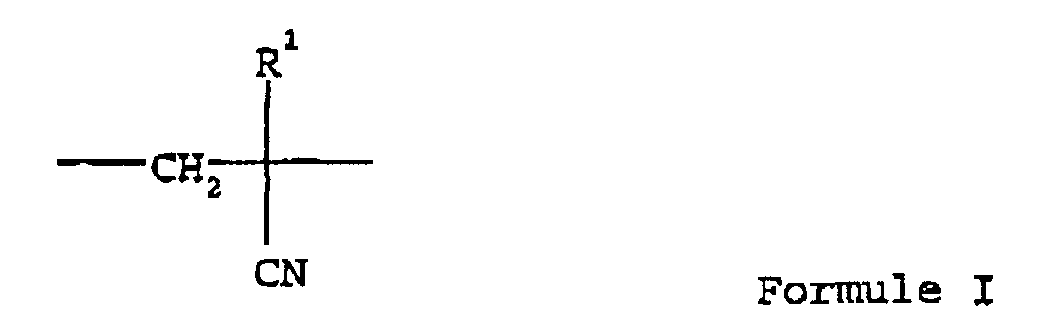
- a first essential feature of the hydrophilic amphoteric block copolymers used according to the present invention is the presence of a non-ionic block comprising a sequence of units having pendant nitrile groups according to formula I, wherein R 1 is hydrogen, alkyl or substituted alkyl.
- This non-ionic block may be a continuous sequence of the same monomer in order to form a homopolymer, preferably polyacrylonitrile or polymethacrylonitrile, but the block may also be a random polymer of e.g. acrylonitrile and methacrylonitrile units.
- the number of units comprised in said non-ionic block is two or more, but preferably at least about ten.
- the units of formula I may be separated from one another by other non-ionic acrylic co-monomers without a pendant nitrile group.
- the ratio of such non-CN co-monomers versus the monomers according to formula I may be as high as 50% but preferably the amount of non-CN co-monomers is kept below 15 molar% for optimum results.
- a second essential feature of the hydrophilic amphoteric block copolymers used according to the present invention is the presence of a so-called acrylamid(in)ic block comprising a sequence of acrylamidic or acrylamidinic units corresponding to formula II, wherein R 2 is hydrogen, alkyl or substituted alkyl, preferably hydrogen or methyl, R 3 is hydrogen, alkyl or substituted alkyl, aryl or substituted aryl, and X is O or NH.
- This sequence of acrylamides or acrylamidines may be a homopolymer or a random polymer.
- the acrylamid(in)ic units may be N-substituted.
- the N-substituent R 3 can be a carrier of various functional groups, including the acidic and basic groups referred to hereinafter. Hydrophobic moieties can also be present in this acrylamid(in)ic block, obtained by N-substitution with R 3 being a non-polar substituent such as an alkyl with 4 to 24 carbon atoms, an aryl group, oxygen containing substituents such as hydroxyl, esters, saccharides or epoxides, an alkylsiloxane -(Si(R) 2 -O) n -Si(R) 3 where n is 0 to about 100 and R is an alkyl with 4 to 24 carbon atoms.
- R 3 being a non-polar substituent such as an alkyl with 4 to 24 carbon atoms, an aryl group, oxygen containing substituents such as hydroxyl, esters, saccharides or epoxides, an alkylsiloxane -(Si(R) 2
- R 3 When R 3 is an alkyl or aryl group, it may be substituted with e.g. one or more halogen atoms, lactone, lactame, nitrile, nitro or nitroso groups.
- a third essential feature of the hydrophilic amphoteric block copolymers used according to the present invention is the presence of acrylic units having pendant acidic groups as well as acrylic units having pendant basic groups within the acrylamid(in)ic block(s).
- the acidic and basic groups may be randomly distributed over some or all of the acrylamid(in)ic blocks of the polymer.
- Each of said acrylamid(in)ic blocks may contain either only acidic groups, only basic groups or a mixture of acidic and basic groups.
- the polymers used according to the present invention can have a molar excess of either group, thus having isoelectric points at either alkaline or acidic pH, depending on the molar ratio between the basic groups and acidic groups which may vary from about 1:20 to about 20:1, but preferably from about 1:10 to about 10:1. Because of their strong mutual interactions, the acidic and basic groups affect the properties of the polymer already at very low concentrations (as low as 1 molar %), but preferably the concentration of ionic groups is higher than 5 molar %.
- the units having pendant acidic groups are of the general formulae III or IV or are salts thereof. If present as a salt, preferred counterions are metallic ions or nitrogen containing bases.
- R 4 represents hydrogen, alkyl or substituted alkyl. Preferably, R 4 is hydrogen or methyl.
- R 5 represents hydrogen, alkyl or substituted alkyl, preferably hydrogen or methyl
- X is O or NH
- R 6 is an organic linking group having at least one carbon atom, preferably ethylene or substituted ethylene
- Y is -COOH, -OPO 3 H 2 , -SO 3 H or -OSO 3 H.
- the units having pendant basic groups are preferably of the general formulae V or VI or are salts thereof. If present as a salt, the counterions may be e.g. carboxylate, sulphate, sulphonate, phosphate, nitrate, nitrite, carbonate or halide.
- R 7 represents hydrogen, alkyl or substituted alkyl, preferably hydrogen or methyl
- R 8 represents hydrogen, alkyl or substituted alkyl, aryl or substituted aryl.
- Formula V is limited to amidines, as amides are generally not being considered basic.
- R 9 represents hydrogen, alkyl or substituted alkyl, preferably hydrogen or methyl
- X is O or NH
- R 10 is an organic linking group having at least one carbon atom, preferably ethylene or substituted ethylene
- Z is a nitrogen containing base.
- nitrogen containing bases are primary, secondary and tertiary amines, quaternary bases, pyridine or naphtyridine derivatives, guanidines, amidines, imines and imidines.
- a block copolymer with a polyacrylonitrile block of formula I and an acrylamid(in)ic block of formula II comprising units with the pendant group -CNH-NH-R 6 -Y as sole ionic units within said acrylamid(in)ic block are also hydrophylic amphoteric block copolymers within the scope of the present invention.
- a highly preferred example of a specific hydrophilic amphoteric block copolymer used according to the present invention is a polymer, referred to herein as HYPAN TC240® from HYMEDICS, comprising N-(2-sulpho-ethyl)-acrylamide and N-(2-sulpho-ethyl)-acrylamidine.
- HYPAN TC240® may be represented by formula VII :
- the frequency distribution of the units of HYPAN TC240® is approximately as follows : Pendant group Frequency -CN 19% -CO-NH-CH 2 -CH 2 -SO 3 - and -CNH-NH-CH 2 -CH 2 -SO 3 - 45% -CO-NH 2 and -CNH-NH 2 24% -COO - 12%
- hydrophilic amphoteric polymers used in the method according to the present invention can be synthesized according to the methods disclosed in US-A's 5,252,692 and 4,943,618 which are incorporated herein by reference.
- a preferred method is the hydrolysis of the CN groups of polyacrylonitrile dissolved in a mixture of a solvent, a primary amine, water and an optional basic catalyst. If the reaction conditions are suitably selected, the hydrolysis of the CN groups proceeds via a so-called "zipper mechanism", which may lead to structures as indicated in formula VII with various substituents being organized in blocks rather than being randomly distributed along the polymer chain.
- the resulting block copolymers may optionally be covalently or physically crosslinked and may form hydrogels as they are swellable rather than soluble in water.
- the average molecular weight is typically 150,000 though block copolymers with a much higher or much lower molecular weight can also be used according to the present invention.
- said polymers are added to the reaction vessel, initially comprising a crystal habit grain modifying agent in order to prepare a suitable dispersion medium wherein nucleation takes place in the nucleation step, but addition, in one or more parts in different steps as e.g. after the said nucleation step, before or during one of the following growth steps is possible. Moreover addition during physical ripening after growth is not excluded and addition of the said polymers before or during redispersion and even to the coating solutions before coating is not excluded.
- said copolymer(s) is(are) added before precipitation of silver halide, preferably with a minimum of about 10 % of the total amount of hydrophilic protective colloid present in the nucleation step.
- an emulsion having ⁇ 111 ⁇ tabular grains rich in silver choride is thus prepared wherein said grains, being composed of silver chloride, silver chlorobromide, silver chloroiodide or silver chlorobromoiodide have at least 50 mole % of silver chloride and more preferably more than 90 % of silver chloride.
- the said ⁇ 111 ⁇ tabular emulsion grains are further characterized by a total projective area of at least 70 %, and more preferably 90%, of the total projected area of all grains and an average aspect ratio of more than 2:1, an average equivalent circular diameter of at least 0.3 ⁇ m up to at most 5 ⁇ m, more preferably from 0.4 up to 2.0 ⁇ m and an average thickness of from 0.05 to 0.25 ⁇ m, wherein a corpual variation on average equivalent circular diameter (also called "ECD”) of said tabular grains is 30 % or less, normally in the range between 20 % and 30 %.
- ECD average equivalent circular diameter
- the presence in emulsion preparation of the hydrophilic amphoteric block-copolymers as disclosed hereinbefore makes thetempoual variation on average grain thickness of the tabu-lar grains present reduce to a level of 20 % or less: preferablytempoual variations on thickness are in the range between 10 and 20 %.
- iodide is present in an amount of up to 3 mole%.
- Iodide ions are provided by using aqueous solutions of inorganic salts thereof as e.g. potassium iodide, sodium iodide or ammonium iodide as described in RD 39433, published January 1997, but as an alternative iodide ions provided by organic compounds releasing iodide ions are very useful as has e.g.
- iodide ions is triggered in the preparation method by changing the pH value in the reaction vessel during or, preferably, after addition of the said organic agent releasing iodide ions, wherein this pH change is performed therein in such a way as required by the method of the present invention.
- the said organic compounds releasing iodide ions are leading to a more homogeneous iodide ion distribution over the different tabular crystals, thus avoiding undefined heterogeneities and irreproducibilities.
- said tabular grains are enriched in iodide by adding silver iodide microcrystals having an average crystal size of up to at most 0.05 ⁇ m.
- Generation of iodide ions is triggered therein by differences in solubility between large ⁇ 111 ⁇ tabular silver chlor(oiod)ide or silver chlorobrom(oiodid)ide crystals and such fine silver iodide microcrystals, a phenomenon that is well-known as "Ostwald ripening".
- Simple conversion techniques making use of the well-known inorganic iodide salts (preferably alkaline earth metal salts such as potassium or sodium iodide) can however be applied.
- Combinations of inorganic and organic agents providing iodide ions may also be useful.
- the presence of iodide ions thereby stabilizes the (111)-crystal faces: it has e.g. been established that the concentration of crystal habit modifier present at the surface of the tabular grains rich in silver chloride can be decreased to a considerable extent as iodide ions, provided to the surface of the said grains, lead to preservation of a stable crystal habit.
- Iodide ions can thus replace conventional crystal habit modifiers such as adenine, etc..
- Other compounds as spectral sensitizers or stabilizers can also be used as suitable compounds replacing said crystal habit modifiers due to their crystal habit stabilizing action.
- a dispersion medium comprising an initial amount of a crystal habit modifying agent is indeed added to the reaction vessel.
- Compounds that are useful as crystal habit modifier of crystals rich in silver chloride include substances disclosed in EP-A's 0 430 196, 0 481 133 and 0 532 801 and in US-A's 5,176,991; 5,176,992; 5,178,997; 5,178,998; 5,183,732; 5,185,239; 5,217,858; 5,221,602; 5,252,452; 5,264,337; 5,272,052; 5,298,385; 5,298,387; 5,298,388; 5,399,478; 5,405,738; 5,411,852 and 5,418,125.
- the crystal habit growth modifier is adenine, a 2-hydro-amino-azine or a 4-amino-pyrazolo[3,4,d] pyrimidine.
- a hydrophilic protective colloid e.g. gelatin, colloidal silica, potato starch, dextranes, acrylamides or a combination thereof can be present.
- protective colloids or binders have been described in a general review published September 1, 1996, in Research Disclosure No. 38957. It is clear that as according to the method of the present invention a gelatinous emulsion is formed, gelatin remains an essential hydrophilic protective colloid during preparation of the said emulsion.
- said gelatin is present in the reaction vessel wherein the dispersion medium is prepared before nucleation.
- a small part of the gelatin is added before nucleation (having more particularly a methionine content of less than 30 ⁇ moles per gram of said gelatin), whereas higher amounts are added in the following steps( optionally having a methionine content of less than 30 ⁇ moles per gram of said gelatin), preferably during the physical ripening steps between nucleation and growth or between consecutive growth steps.
- Even after ending growth an amount of gelatin can be added, but it is preferable to add the said amount after flocculation or ultrafiltration in order to provide good redispersion properties for the thus prepared emulsions.
- Gelatins for use in the preparation of photographic emulsions have been described e.g. in Research Disclosure No.38957, Chapter 2, published September 1, 1996.
- gelatin When during nucleation and/or a physical ripening step inbetween the nucleation step and the first growth step, gelatin is present as a hydrophilic dispersion medium in the reaction vessel, a ratio of gelatin to silver, expressed as an equivalent amount of silver nitrate, of less than 10 (about 4 to 7) is calculated, which is rather high. Said ratio, also called “gesi" decreases during the following growth steps to a value of about 0.35 to 0.25. Gelatin, as well as the hydrophilic amphoteric block copolymers used in the method of the present invention, may however be added inbetween or during the nucleation step and the first growth step and/or inbetween or during different growth steps.
- Preparation methods of tabular grains having a ⁇ 111 ⁇ tabular crystal habit are normally characterized by the presence of a nucleation step, wherein preferably up to at most 10 %, and more preferably at most 5 % of the total amount of silver salt in a diluted medium is consumed at a constant temperature between 35°C and 55°C, other temperature intervals however not being excluded.
- Precipitating silver halide crystal nuclei in the reaction vessel proceeds by double-jet precipitation of an aqueous silver nitrate and an aqueous solution comprising halide ions, wherein less than 10 % by weight of a total amount of silver nitrate used is consumed.
- iodide is present a concentration of not more than 0.5 % is preferred in the nucleation step in order to prevent formation of nuclei in an excessive amount.
- bromide may be present in the nucleation step if silver chlorobromoiodide crystals are prepared, its absence is preferred and chloride present therein in an amount of at least 99.5 % is commonly occurring.
- One or more growth steps, with at least one physical ripening step inbetween, are normally following said nucleation step.
- silver halide crystal nuclei rich in silver chloride by further precipitation of silver halide proceeds by means of double-jet precipitation of an aqueous silver nitrate solution and an aqueous solution comprising halide ions, wherein more than 90 %, and more preferably more than 95 % by weight of a total amount of silver nitrate is consumed.
- the growing volume in the reaction vessel leading to an increased dilution of emulsion crystals in the reaction vessel, may be held constant by removing excessive amounts of soluble alkaline nitrates and of water by means of dialysis and/or ultrafiltration.
- growing the said nuclei is performed by double jet precipitation, wherein iodide salt solutions are optionally present in the said halide salt solutions essentially consisting of chloride salts and optionally of bromide salts characterized further by maintaining the said chloride salts in the reaction vessel at a constant concentration of less than 0.15 M.
- nuclei are thus further grown by double jet precipitation, wherein the rest of the total amount of silver is consumed and wherein iodide salts are optionally present in halide salt solutions (normally as alkali iodide solution in an alkali chloride solution, wherein chloride salts are present in excessive amounts versus iodide salts) essentially consisting of chloride salts and optionally of bromide salts (if silver chlorobromoiodide crystals are prepared).
- halide salt solutions normally as alkali iodide solution in an alkali chloride solution, wherein chloride salts are present in excessive amounts versus iodide salts
- bromide salts if silver chlorobromoiodide crystals are prepared.
- an increase of the temperature of the reaction vessel to about 70°C may be performed in order to hold said temperature at the same value during growth of the tabular grains.
- pH remains at the same value of about 6.0 unless, as set forth e.g. in EP-Application No. 97200812, filed March 19, 1997 the setting of pH to a value of lower than 6.0 for least 30 seconds is performed, followed by resetting pH to the said initial pH, in order to further controll thickness of the grains and homogeneity of the crystal size distribution.
- Application of the method of the present invention leads to a homogeneity, mathematically expressed as variability coefficient on average equivalent circular diameter and on average thickness, of less than 0.30, i.e. between 0.10 and 0.30.
- the halide distribution in the tabular grains is homogeneous or heterogeneous over the whole crystal volume.
- phases differing in silver halide composition are present over the crystal volume said crystal has a "core-shell" structure. More than one shell can be present and between different phases it can be recommended to have a phase enriched in silver bromide and/or in silver iodide by applying the so-called conversion technique during preparation.
- At least one conversion step is performed, wherein converting the said emulsion grains is performed by adding inorganic bromide and/or iodide salts and/or organic bromide and/or iodide releasing compounds to the reaction vessel.
- At least one conversion step is performed, wherein converting the said emulsion grains is performed by adding silver iodide or silver bromide microcrystals having an average crystal size of at most 0.05 ⁇ m.
- silver chlorobromide emulsions are thus prepared by converting the said emulsion grains so that the said emulsion comprises ⁇ 111 ⁇ tabular grains having a variable bromide profile, in that the grains have been enriched in bromide at the crystal surface, said profile being characterized by the presence of bromide ions in the crystal volume in lower amounts than at the crystal surface of the said tabular grains and in that, in a more preferred embodiment, an amount of 50 to 100 mole % of the total amount of bromide ions is located at the surface of said tabular grains.
- silver chlorobromoiodide or silver chloroiodide emulsions are thus prepared by converting the said emulsion grains so that the said emulsion comprises tabular grains having a variable iodide profile, in that the grains have been enriched in iodide at the crystal surface, said profile being characterized by the presence of iodide ions (and optionally bromide ions) in the crystal volume in lower amounts than at the crystal surface of the said tabular grains and in that an amount of 50 to 100 mole % of the total amount of iodide ions (and optionally bromide ions) is located at the surface of said tabular grains.
- phase differing in silver halide composition When phases differing in silver halide composition are present over the crystal volume said crystal is said to have a core-shell structure. More than one shell can thus be present, depending on the number of growth steps and inbetween said different phases a phase enriched in silver iodide and/or silver bromide can be applied.
- Bromide ion concentrations of up to 25 mole % based on the total silver amounts are contemplated, but in order to avoid a strong inhibition of the processing and enhanced replenishing amounts of developer and/or fixer solutions, the ⁇ 111 ⁇ tabular silver chlorobro-moiodide or silver chlorobromide emulsion crystals prepared according to the method of the present invention preferably have an amount of silver bromide of not more than 10 mole %, based on silver. In order to reduce the amount of replenisher in the processing of exposed silver halide materials comprising light-sensitive emulsions as described before, it is even more preferable to reduce the amount of bromide ions to less than 5 mole %. Bromide ions may therein be provided from at least one inorganic and/or organic agent providing bromide ions.
- a photographic material comprising a support and on one or on both sides thereof one or more silver halide emulsion layer(s) coated from a gelatinous emulsion prepared as set forth hereinbefore, and more preferably a photographic material which is a single-side or double-side coated radiographic material.
- hydrophilic amphoteric block copolymers described above are present in light-sensitive emulsion layers coated from emulsions having ⁇ 111 ⁇ tabular grains rich in silver chloride, but their presence in another hydrophilic layer, as e.g. in an undercoat layer between the support and an emulsion layer, in an intermediate layer betweeen two emulsion layers or between an emulsion layer farthest from the support and the protective antistress layer or in the antistress layer itself is not excluded.
- the amount of such hydrophilic amphoteric block copolymer may range from 0.05 up to 250 mg/m 2 , more preferably from 0.5 to 100 mg/m 2 , still more preferably from 0.5 up to 10 mg/m 2 and most preferably from 1 to 5 mg/m 2 .
- Said hydrophilic amphoteric block copolymer can also be present in one or more treating solutions applied onto said imaging element.
- treating solutions include processing solutions applied after image-wise exposure of the silver halide photographic materials according to the invention.
- processing solutions are alkaline processing liquids, e.g. developers or activators, neutralizing liquids (also called stabilizing liquids), rinsing liquids and finishers.
- Gelatinous emulsions according to the present invention have silver chloride, silver chlorobromide, silver chloroiodide or silver chlorobromoiodide grains, wherein at least 70 % of a total projected area of all grains is provided by ⁇ 111 ⁇ tabular grains having an average aspect ratio of more than 2:1 and an average thickness of from 0.05 to 0.25 ⁇ m, an average equivalent circular diameter of at least 0.3 ⁇ m and an average thickness of from 0.05 to 0.25 ⁇ m, wherein amitual variation on average equivalent circular diameter of said tabular grains is 30 % or less and wherein aminual variation on average thickness of said tabular grains is 20 % or less, further characterized by the presence of at least one compound being a hydrophilic amphoteric block copolymer containing (i) a non-ionic acrylic block comprising a sequence of units having pendant nitrile groups according to formula I and (ii) a acrylamid(in)ic block comprising a sequence of units according to formula II, said hydro
- the silver halide emulsions may be chemically sensitized according to the procedures described in e.g. "Chimie et Physique Photographique” by P. Glafkides, in “Photographic Emulsion Chemistry” by G.F. Duffin, in “Making and Coating Photographic Emulsion” by V.L. Zelikman et al, and in “Die Grundlagen der Photographischen mit Silberhalogeniden” edited by H. Frieser and published by Akademische Verlagsgesellschaft (1968).
- chemical sensitization can be carried out by effecting the ripening in the presence of small amounts of compounds containing sulphur, selenium or tellurium e.g.
- thiosulphate, thiocyanate, thiourea, selenosulphate, selenocyanate, selenoureas, tellurosulphate, tellurocyanate, sulphites, mercapto compounds, and rhodamines are applied in combination with a noble metal salt, preferably a gold complex salt, but also salts of platinum, palladium and iridium as described in U.S. Patent No. 2,448,060 and British Patent No. 618,061 may be used. Additions of sulphur and/or selenium and/or tellurium and gold may be carried out consecutively or simultaneously.
- a preferred chemical ripening system for ⁇ 111 ⁇ tabular grains rich in silver chloride has e.g. been described in EP-A's 0 443 453, 0 476 345, 0 506 009, 0 563 708 and 0 638 840 and EP-Application Nos. 97200590, filed March 1, 1997 and 97202395, filed August 1, 1997.
- small amounts of compounds of Rh, Ru, Ir and of other elements of group VIII of the Periodic Table of the Elements can be added.
- reductors may be added as chemically sensitizing agents, e.g.
- tin compounds as described in British Patent No. 789,823, amines, hydrazine derivatives, formamidine-sulphinic acids, and silane compounds.
- the chemical sensitization can also proceed in the presence of phenidone and/or its derivatives, a dihydroxybenzene as hydroquinone, resorcinol, catechol and/or a derivative(s) thereof, one or more stabilizer(s) or antifoggant(s), one or more spectral sensitizer(s) or combinations of said ingredients.
- Chemical sensitization may be performed at high temperatures, e.g.
- the silver halide emulsions can be spectrally sensitized according to the spectral emission of the exposure source for which the silver halide photographic material is designed.
- Suitable sensitizing dyes for the visible spectral region include methine dyes such as those described by F.M. Hamer in "The Cyanine Dyes and Related Compounds", 1964, John Wiley & Sons. Dyes that can be used for this purpose include cyanine dyes, merocyanine dyes, complex cyanine dyes, complex merocyanine dyes, homopolar cyanine dyes, hemicyanine dyes, styryl dyes and hemioxonol dyes.
- Particularly valuable dyes are those belonging to the cyanine dyes, merocyanine dyes, complex merocyanine dyes.
- a conventional light source e.g. tungsten light
- a green sensitizing dye is needed.
- an argon ion laser a blue sensitizing dye is incorporated.
- a red light emitting source e.g. a LED or a He/Ne laser
- a red sensitizing dye is used.
- special spectral sensitizing dyes suited for the near infrared are required. Suitable infrared sensitizing dyes are disclosed in i.a.
- Suitable supersensitizers are described in Research Disclosure Vol 289, May 1988, item 28952.
- the spectral sensitizers can be added to the photographic emulsions in the form of an aqueous solution, a solution in an organic solvent or in the form of a dispersion.
- Suitable blue sensitizers have been described in e.g. WO 93/1522, in US-A 4,520,098 and in EP-Appl. No. 97202169, filed July, 11, 1997.
- Suitable green-sensitizers have e.g. been described in EP-A 0 678 772, in EP-Application No. 97200590, filed March 1, 1997 and in Research Disclosure No. 37312, published May 1, 1995.
- the silver halide emulsions may contain the usual emulsion stabilizers.
- Suitable emulsion stabilizers are azaindenes, preferably tetra- or penta-azaindenes, especially those substituted with hydroxy or amino groups. Compounds of this kind have been described by BIRR in Z. Wiss. Photogr. Photophys. Photochem. 47, 2-27 (1952).
- Other suitable emulsion stabilizers are i.a. (heterocyclic) mercapto compounds as e.g. those described in US-A 5,290,674 and the mercapto-triazol, mercapto-imidazol, mercapto-thiadiazol or mercapto-oxadiazol compounds described in EP-A 0 454 149.
- the silver halide emulsions may contain pH controlling ingredients.
- the emulsion layer is coated at a pH value near the isoelectric point of the gelatin to improve the stability characteristics of the coated layer.
- Other ingredients such as antifogging agents, development accelerators, wetting agents, and hardening agents for gelatin may be present.
- the silver halide emulsion layer may comprise light-screening dyes that absorb scattering light and thus promote the image sharpness. Suitable light-absorbing dyes are described in i.a. US-A's 4,092,168; 4,311,787; 5,344,749; 5,380,634 and DE-A 2,453,217. Preparation methods of dispersions thereof have been disclosed in EP-A's 0 554 834 and 0 756 201.
- compositions, preparation and coating of silver halide emulsions can be found in e.g. Product Licensing Index, Vol. 92, December 1971, publication 9232, p. 107-109 and in Research Disclosure No. 38957, published September 1, 1996.
- a base layer that preferably contains an anti-halation substance such as e.g. light-absorbing dyes absorbing the light used for image-wise exposure of the imaging element.
- an anti-halation substance such as e.g. light-absorbing dyes absorbing the light used for image-wise exposure of the imaging element.
- finely divided carbon black can be used as an anti-halation substance.
- light reflecting pigments e.g. titaniumdioxide can be present in the base layer.
- This layer can further contain hardening agents, matting agents, e.g. silica particles, and wetting agents. Suitable matting agents preferably have an average diameter of 2-10 ⁇ m and more preferably between 2 ⁇ m and 5 ⁇ m.
- the matting agents are generally used in a total amount in the imaging element of 0.1 g/m 2 to 2.5 g/m 2 . At least part of these matting agents and/or light reflection pigments may also be present in the silver halide emulsion layer and/or in the cover layer. As a further alternative the light reflecting pigments may be present in a separate layer provided between the antihalation layer and the photosensitive silver halide emulsion layer. Like the emulsion layer the base layer is coated preferably at a pH value near the isoelectric point of the gelatin in the base layer.
- a backing layer is preferably provided at the non-light sensitive side of the support in the case of a single-side coated material.
- This layer which can serve as anticurl layer can contain i.a. matting agents e.g. silica particles, lubricants, antistatic agents, light absorbing dyes, opacifying agents, e.g. titanium oxide and the usual ingredients like hardeners and wetting agents.
- the backing layer can consist of one single layer or a double layer pack.
- the hydrophilic layers usually contain gelatin as hydrophilic colloid binder. Mixtures of different gelatins with different viscosities can be used to adjust the rheological properties of the layer. Like the emulsion layer the other hydrophilic layers are coated preferably at a pH value near the isoelectric point of the gelatin. But instead of or together with gelatin, use can be made of one or more other natural and/or synthetic hydrophilic colloids, e.g. albumin, casein, zein, polyvinyl alcohol, alginic acids or salts thereof, cellulose derivatives such as carboxymethyl cellulose, modified gelatin, e.g. phthaloyl gelatin, etc..
- other natural and/or synthetic hydrophilic colloids e.g. albumin, casein, zein, polyvinyl alcohol, alginic acids or salts thereof, cellulose derivatives such as carboxymethyl cellulose, modified gelatin, e.g. phthaloyl gelatin, etc.
- the hydrophilic layers of the imaging element can be hardened with appropriate hardening agents such as those of the vinyl sulphone type e.g. methylenebis(sulphonylethylene), aldehydes e.g. formaldehyde, glyoxal, and glutaraldehyde, N-methylol compounds e.g. dimethylolurea and methyloldimethylhydantoin, active halogen compounds e.g. 2,4-dichloro-6-hydroxy-s-triazine, and mucohalogenic acids e.g. mucochloric acid and mucophenoxychloric acid.
- hardeners can be used alone or in combination.
- the binders can also be hardened with fast-reacting hardeners such as carbamoylpyridinium salts of the type, described in US 4,063,952.
- hardening agents are of the aldehyde type.
- the hardening agents can be used in a wide concentration range but are preferably used in an amount of 4% to 7% of the hydrophilic colloid. Different amounts of hardener can be used in the different layers of the imaging element or the hardening of one layer may be adjusted by the diffusion of a hardener from another layer.
- the photographic material according to the present invention may further comprise various kinds of surface-active agents in the silver halide emulsion layer or in at least one other hydrophilic colloid layer.
- suitable surface-active agents are described in e.g. EP-A 0 545 452
- compounds containing perfluorinated alkyl groups are used.
- the imaging element of the present embodiment may further comprise various other additives such as e.g. compounds improving the dimensional stability of the imaging element, UV-absorbers, spacing agents and plasticizers as described in Research Disclosure No. 38957, published September 1, 1996, Chapters VI and IX.
- Suitable additives for improving the dimensional stability of the imaging element are e.g. dispersions of a water-soluble or hardly soluble synthetic polymer e.g. polymers of alkyl (meth)acrylates, alkoxy(meth)acrylates, glycidyl (meth)acrylates, (meth)acrylamides, vinyl esters, acrylonitriles, olefins, and styrenes, or copolymers of the above with acrylic acids, methacrylic acids, alpha-beta-unsaturated dicarboxylic acids, hydroxyalkyl (meth)acrylates, sulphoalkyl (meth)acrylates, and styrene sulphonic acids.
- a water-soluble or hardly soluble synthetic polymer e.g. polymers of alkyl (meth)acrylates, alkoxy(meth)acrylates, glycidyl (meth)acrylates, (meth)acrylamides, vinyl esters
- Emulsion A silver chloroiodide tabular grains : comparative example
- a nucleation step was performed by introducing solution A1 and solution B1 simultaneously in dispersion medium C, both at a flow rate of 70 ml per minute during 30 seconds.
- a growth step was performed by introducing by double jet during 1730 seconds solution A1 at a flow rate of 10 ml/min, increasing linearly to 27.4 ml/min and solution B1 at a flow rate in order to maintain a constant mV-value, measured by a silver electrode versus a Ag/AgCl Ingold reference electrode, of +115 mV.
- a pAg adjustment step was performed over a period of 9 min. by introducing a solution A1 at a constant flow rate of 10 ml/min in order to become a desired mV-value, measured by a silver electrode versus a Ag/AgCl Ingold reference electrode, of + 135mV.
- a last precipitation step was performed by introducing solution B2 by single jet during 120 seconds at a constant flow rate of 20ml / min..
- Silver chloroiodide tabular grain emulsions having 1 mole % of iodide ions based on silver were obtained, comprising a high percentage by number (at least 80 %) of tabular grains, having an aspect ratio of more than 7 which was counted from the corresponding electron microscopic photographs, having an average ECD (equivalent circular diameter) of 0.96 ⁇ m and a mean thickness of 120 nm.
- ECD Equivalent circular diameter
- Emulsion B (silver chloroiodide tabular grains : inventive example )
- a nucleation step was performed by introducing solution A1 and solution B1 simultaneously in dispersion medium C, both at a flow rate of 70 ml/min during 30 seconds.
- a growth step was performed by introducing by a double jet during 1730 seconds solution A1 at a flow rate of 10 ml / min, linearly increased up to 27.4 ml/min and solution B1 at a flow rate in order to maintain a constant mV-value, measured by a silver electrode versus a Ag/AgCl Ingold reference electrode, of +115 mV.
- pAg was adjusted over a period of 9 min. by introducing solution A1 at a constant flow rate of 10 ml / min in order to get a desired mV-value, measured by a silver electrode versus a Ag/AgCl Ingold reference electrode, of +135 mV.
- a last precipitation step was performed by introducing a single jet during 120 seconds of solution B2 at a constant flow rate of 20ml/min.
- Emulsion B silver chloroiodide tabular grains
- % var. t TAB results obtained forcual variations on the average thickness of the tabular grains obtained in the emulsion crystal distribution
- % var. t ALL results obtained forcual variations on the thickness of all grains present in the emulsion crystal distribution
Landscapes
- Chemical & Material Sciences (AREA)
- Chemical Kinetics & Catalysis (AREA)
- Engineering & Computer Science (AREA)
- Materials Engineering (AREA)
- Physics & Mathematics (AREA)
- General Physics & Mathematics (AREA)
- Silver Salt Photography Or Processing Solution Therefor (AREA)
Claims (14)
- Procédé de préparation pour une émulsion gélatineuse possédant des grains riches en chlorure d'argent, dans lesquels au moins 70 % de la surface totale de tous les grains sont constitués par des grains tabulaires {111} dont l'indice de forme moyen est supérieur à 2:1, le diamètre moyen de cercle équivalent est au moins 0,3 µm et l'épaisseur moyenne varie de 0,05 à 0,25 µm, le taux de variation du diamètre moyen de cercle équivalent desdits grains tabulaires ne dépassant pas les 30 % et le taux de variation de l'épaisseur moyenne desdits grains tabulaires ne dépassant pas les 20 % et lesdits grains tabulaires étant contenus dans des quantités numériques exprimées en pourcentage d'au moins 90 %, ledit procédé comportant les étapes suivants :dans laquelle R1 représente un atome d'hydrogène, un groupe alkyle ou un groupe alkyle substitué;préparation dans un réacteur d'un milieu dispersant contenant une quantité initiale d'un agent modifiant le faciès cristallin;précipitation de germes d'halogénure d'argent par la précipitation à double jet d'un nitrate d'argent aqueux et d'une solution aqueuse contenant des ions halogénure, où moins de 10 % en poids d'une quantité totale du nitrate d'argent utilisé sont consommés;croissance desdits germes d'halogénure d'argent par précipitation complémentaire d'halogénure d'argent par la précipitation à double jet d'une solution aqueuse de nitrate d'argent et d'une solution aqueuse contenant des ions halogénure, où plus de 90 % en poids d'une quantité totale de nitrate d'argent sont consommés, caractérisé en ce que pendant au moins une desdites étapes on introduit dans ledit réacteur au moins un composé étant un copolymère hydrophile amphotère de type bloc contenantlesdites formules I et II représentant les structures suivantes:(i) un bloc acrylique non-ionique comprenant une séquence de motifs possédant des groupes nitrile latéraux répondant à la formule I et(ii) un bloc acrylamid(in)ique comprenant une séquence de motifs répondant à la formule II, ledit copolymère hydrophile amphotère de type bloc comprenant en outre dans ledit ou lesdits blocs acrylamid(in)iques des motifs possédant des groupes latéraux acides ou leurs sels ainsi que des motifs possédant des groupes latéraux basiques ou leurs sels,

etdans laquelle R2 représente un atome d'hydrogène, un groupe alkyle ou un groupe alkyle substitué, R3 est un atome d'hydrogène, un groupe alkyle, un groupe alkyle substitué, un groupe aryle ou un groupe aryle substitué, et X représente O ou NH.
- Procédé selon la revendication 1, caractérisé en ce que lesdits motifs possédant des groupes latéraux acides répondent à la formule III ou IV :dans laquelle R4 représente un atome d'hydrogène, un groupe alkyle ou un groupe alkyle substitué;
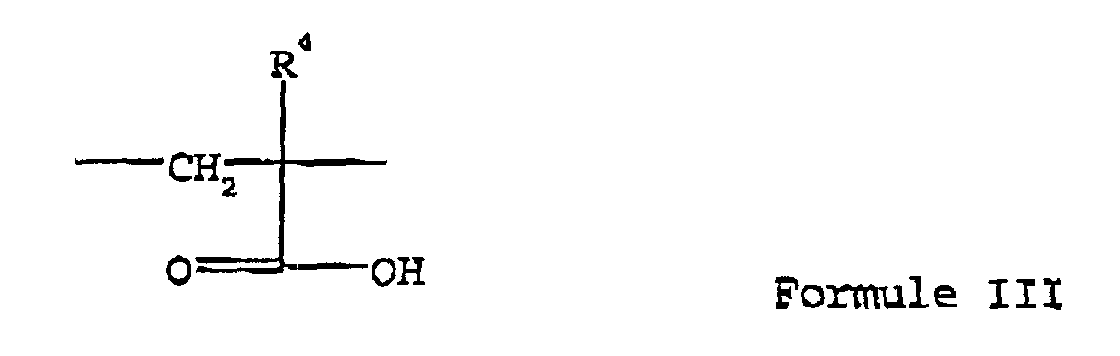 dans laquelle R5 représente un atome d'hydrogène, un groupe alkyle ou un groupe alkyle substitué, X représente O ou NH, R6 représente un groupe de liaison organique avec au moins un atome de carbone, et -Y représente -COOH, -OPO3H, -SO3H ou -OSO3H.
- Procédé selon la revendication 1 ou 2, caractérisé en ce que lesdits motifs possédant des grouper latéraux basiques répondent à la formule V ou VI :dans laquelle R7 représente un atome d'hydrogène, un groupe alkyle ou un groupe alkyle substitué et dans laquelle R8 représente un atome d'hydrogène, un groupe alkyle ou un groupe alkyle substitué, un groupe aryle ou un groupe aryle substitué;
 dans laquelle R9 représente un atome d'hydrogène, un groupe alkyle ou un groupe alkyle substitué, X représente O ou NH, R10 représente un groupe de liaison organique avec au moins un atome de carbone et Z représente une base azotée.
- Procédé selon l'une quelconque des revendications 1 à 3, caractérisé en ce que ledit copolymère hydrophile amphotère de type bloc comprend des motifs acrylamide de N-(2-sulfoéthyle) et acrylamidine de N-(2-sulfoéthyle).
- Procédé selon l'une quelconque des revendications 1 à 4, caractérisé en ce que lesdits grains tabulaires {111} riches en chlorure d'argent sont constitués de chlorure d'argent, de chlorobromure d'argent, de chloroiodure d'argent ou de chlorobromoiodure d'argent.
- Procédé selon la revendication 5, caractérisé en ce que du iodure d'argent est contenu dans ledit chloroiodure d'argent ou chlorobromoiodure d'argent dans une quantité de 0,05 % de moles à 3 % de moles.
- Procédé selon la revendication 6, caractérisé en ce que ledit iodure provient d'un agent libérant le iodure.
- Procédé selon l'une quelconque des revendications 1 à 7, caractérisé en ce qu'au moins 90 % de la surface totale de tous les grains sont constitués par lesdits grains tabulaires {111}.
- Emulsion gélatineuse possédant des grains de chlorure d'argent, de chlorobromure d'argent, de chloroiodure d'argent ou de chlorobromoiodure d'argent, dans lesquels au moins 70 % d'une surface totale de tous les grains sont constitués par des grains tabulaires {111} dont l'indice de forme moyen est supérieur à 2:1 et l'épaisseur moyenne varie de 0,05 à 0,25 µm, le diamètre moyen de cercle équivalent est au moins 0,3 µm et l'épaisseur moyenne varie de 0,05 à 0,25 µm, le taux de variation du diamètre moyen de cercle équivalent desdits grains tabulaires ne dépassant pas les 30 % et le taux de variation de l'épaisseur moyenne desdits grains tabulaires ne dépassant pas les 20 %, caractérisée en outre par la présence d'au moins un composé étant un copolymère hydrophile amphotère de type bloc contenantdans laquelle R1 représente un atome d'hydrogène, un groupe alkyle ou un groupe alkyle substitué;(i) un bloc acrylique non-ionique comprenant une séquence de motifs possédant des groupes nitrile latéraux répondant à la formule I et(ii) un bloc acrylamid(in)ique comprenant une séquence de motifs répondant à la formule II, ledit copolymère hydrophile amphotère de type bloc comprenant en outre dans ledit ou lesdits blocs acrylamid(in)iques des motifs possédant des groupes latéraux acides ou leurs sels ainsi que des motifs possédant des groupes latéraux basiques ou leurs sels, lesdites formules I et II représentant les structures suivantes:
etdans laquelle R2 représente un atome d'hydrogène, un groupe alkyle ou un groupe alkyle substitué, R3 est un atome d'hydrogène, un groupe alkyle, un groupe alkyle substitué, un groupe aryle ou un groupe aryle substitué, et X représente O ou NH.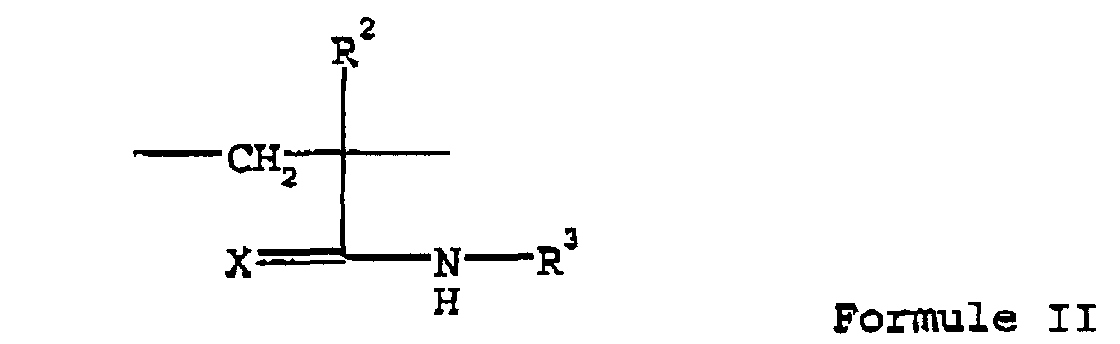
- Emulsion selon la revendication 9, caractérisée en ce que les motifs possédant des groupes latéraux acides répondent à la formule III ou IV :dans laquelle R4 représente un atome d'hydrogène, un groupe alkyle ou un groupe alkyle substitué;
 dans laquelle R5 représente un atome d'hydrogène, un groupe alkyle ou un groupe alkyle substitué, X est O ou NH, R6 est un groupe de liaison organique avec au moins un atome de carbone, et -Y est -COOH, -OPO3H, -SO3H ou -OSO3H.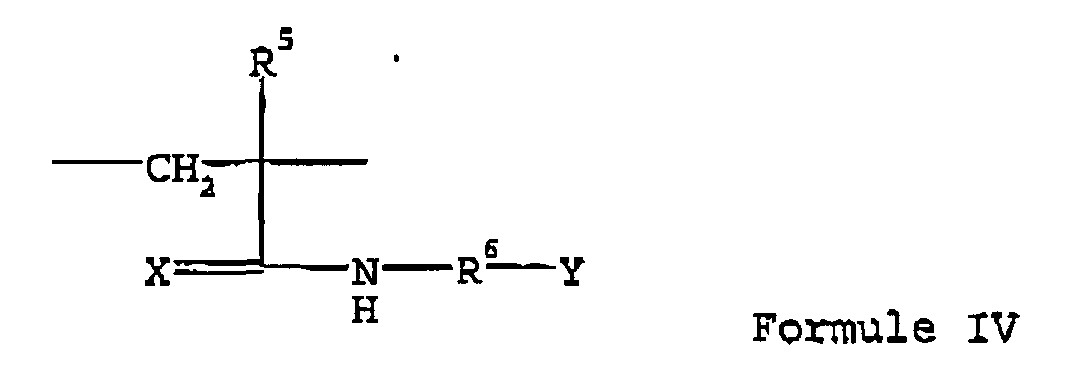
- Emulsion selon la revendication 9 ou 10, caractérisée en ce que les motifs possédant des groupes latéraux basiques répondent à la formule V ou VI :dans laquelle R7 représente un atome d'hydrogène, un groupe alkyle ou un groupe alkyle substitué et dans laquelle R8 représente un atome d'hydrogène, un groupe alkyle ou un groupe alkyle substitué, un groupe aryle ou un groupe aryle substitué;
 dans laquelle R9 représente un atome d'hydrogène, un groupe alkyle ou un groupe alkyle substitué, X représente O ou NH, R10 représente un groupe de liaison organique avec au moins un atome de carbone et Z représente une base azotée.
- Emulsion selon l'une quelconque des revendications 9 à 11, caractérisée en ce que le copolymère hydrophile amphotère de type bloc comprend des motifs acrylamide de N-(2-sulfoéthyle) et acrylamidine de N-(2-sulfoéthyle).
- Matériau photographique comprenant un support ainsi que sur une ou sur les deux faces de celui-ci une ou plusieurs couches d'émulsion aux halogénures d'argent appliquées à partir d'une émulsion gélatineuse telle que définie dans l'une quelconque des revendications 9 à 12.
- Matériau photographique selon la revendication 13, caractérisé en ce qu'il est un matériau radiographique émulsionné sur une face ou sur les deux faces.
Priority Applications (4)
| Application Number | Priority Date | Filing Date | Title |
|---|---|---|---|
| EP98200236A EP0932076B1 (fr) | 1998-01-27 | 1998-01-27 | Procédé pour la préparation des grains tabulaires riches en chlorure d'argent avec croissance en épaisseur réduite et homogénéité améliorée |
| DE69817316T DE69817316D1 (de) | 1998-01-27 | 1998-01-27 | Verfahren zur Herstellung von silberchloridreichen Tafelkörnern mit reduziertem Dickenwachstum und verbesserter Homogenität |
| US09/232,733 US6010840A (en) | 1998-01-27 | 1999-01-19 | Method for preparing tabular grains rich in silver chloride with reduced thickness growth and improved homogeneity |
| JP11013842A JPH11295833A (ja) | 1998-01-27 | 1999-01-22 | 減少された厚さ生長及び改良された均質性を有する塩化銀に富む平板状粒子を製造するための方法 |
Applications Claiming Priority (1)
| Application Number | Priority Date | Filing Date | Title |
|---|---|---|---|
| EP98200236A EP0932076B1 (fr) | 1998-01-27 | 1998-01-27 | Procédé pour la préparation des grains tabulaires riches en chlorure d'argent avec croissance en épaisseur réduite et homogénéité améliorée |
Publications (2)
| Publication Number | Publication Date |
|---|---|
| EP0932076A1 EP0932076A1 (fr) | 1999-07-28 |
| EP0932076B1 true EP0932076B1 (fr) | 2003-08-20 |
Family
ID=8233328
Family Applications (1)
| Application Number | Title | Priority Date | Filing Date |
|---|---|---|---|
| EP98200236A Expired - Lifetime EP0932076B1 (fr) | 1998-01-27 | 1998-01-27 | Procédé pour la préparation des grains tabulaires riches en chlorure d'argent avec croissance en épaisseur réduite et homogénéité améliorée |
Country Status (3)
| Country | Link |
|---|---|
| EP (1) | EP0932076B1 (fr) |
| JP (1) | JPH11295833A (fr) |
| DE (1) | DE69817316D1 (fr) |
Family Cites Families (3)
| Publication number | Priority date | Publication date | Assignee | Title |
|---|---|---|---|---|
| US5252442A (en) * | 1991-05-14 | 1993-10-12 | Eastman Kodak Company | Radiographic elements with improved detective quantum efficiencies |
| US5252453A (en) * | 1992-11-04 | 1993-10-12 | Eastman Kodak Company | Process for accelerating the precipitation of a low coefficient of variation emulsion |
| US5733716A (en) * | 1995-08-16 | 1998-03-31 | Konica Corporation | Silver halide photographic light sensitive material |
-
1998
- 1998-01-27 DE DE69817316T patent/DE69817316D1/de not_active Expired - Lifetime
- 1998-01-27 EP EP98200236A patent/EP0932076B1/fr not_active Expired - Lifetime
-
1999
- 1999-01-22 JP JP11013842A patent/JPH11295833A/ja active Pending
Also Published As
| Publication number | Publication date |
|---|---|
| DE69817316D1 (de) | 2003-09-25 |
| JPH11295833A (ja) | 1999-10-29 |
| EP0932076A1 (fr) | 1999-07-28 |
Similar Documents
| Publication | Publication Date | Title |
|---|---|---|
| GB2110405A (en) | Radiation-sensitive emulsion and process for its preparation | |
| JPH0573209B2 (fr) | ||
| JP3190478B2 (ja) | 平板状ハロゲン化銀粒子の製造法 | |
| US4555482A (en) | Silver halide photographic emulsion | |
| US4078937A (en) | Process for sensitizing a fine grain silver halide photographic emulsion | |
| EP0285308B1 (fr) | Matériaux photographiques à contraste élevé | |
| JP3170525B2 (ja) | 塩化物含量の高い平板状乳剤粒子の製造法 | |
| JPH0433019B2 (fr) | ||
| US6010840A (en) | Method for preparing tabular grains rich in silver chloride with reduced thickness growth and improved homogeneity | |
| JPS58221839A (ja) | ハロゲン化銀写真感光材料 | |
| EP0932076A1 (fr) | Procédé pour la préparation des grains tabulaires riches en chlorure d'argent avec croissance en épaisseur réduite et homogénéité améliorée | |
| JP3225134B2 (ja) | 中間アスペクト比を有する平板状粒子乳剤の製造法 | |
| JP3030259B2 (ja) | レーザー記録医療用ハードコピー材料として使用するための塩化銀リッチの感光性写真材料上に電子的に貯蔵された医療用画像を再生する方法 | |
| JPH11223894A (ja) | 臭化銀に富む形態学的に均一な{111}平板状結晶の製造法 | |
| US6316176B1 (en) | Photosensitive silver halide element comprising chemically sensitized emulsion grains and method to prepare them | |
| US5541053A (en) | Process for the preparation of silver halide photographic emulsions containing grains having (100) faces with cavities and photographic emulsions so prepared | |
| CA1339297C (fr) | Materiaux photographiques a grand contraste pour eclairage intense | |
| US5807667A (en) | Sensitization of selenium and iridium emulsions | |
| US6063558A (en) | Photosensitive element containing a silver halide emulsion chemically sensitized with a chalcogenic compound | |
| JPH07507646A (ja) | 平板状粒子の製造方法 | |
| WO1990016012A1 (fr) | Grains d'halogenure d'argent et leur procede de preparation | |
| US6083678A (en) | Method for preparing a light-sensitive emulsion having (100) tabular grains rich in silver chloride | |
| JP2001056519A (ja) | 化学増感乳剤粒子を含む感光性ハロゲン化銀材料及びその製造方法 | |
| US6136524A (en) | Light-sensitive emulsion having (100) tabular grains rich in silver chloride and method for preparing said grains | |
| EP0889354B1 (fr) | Elément photosensible formateur d'images ayant un meilleur rapport sensibilité/voile |
Legal Events
| Date | Code | Title | Description |
|---|---|---|---|
| PUAI | Public reference made under article 153(3) epc to a published international application that has entered the european phase |
Free format text: ORIGINAL CODE: 0009012 |
|
| AK | Designated contracting states |
Kind code of ref document: A1 Designated state(s): BE DE FR GB |
|
| AX | Request for extension of the european patent |
Free format text: AL;LT;LV;MK;RO;SI |
|
| 17P | Request for examination filed |
Effective date: 20000128 |
|
| AKX | Designation fees paid |
Free format text: BE DE FR GB |
|
| 17Q | First examination report despatched |
Effective date: 20001010 |
|
| RAP1 | Party data changed (applicant data changed or rights of an application transferred) |
Owner name: AGFA-GEVAERT |
|
| GRAH | Despatch of communication of intention to grant a patent |
Free format text: ORIGINAL CODE: EPIDOS IGRA |
|
| GRAH | Despatch of communication of intention to grant a patent |
Free format text: ORIGINAL CODE: EPIDOS IGRA |
|
| GRAA | (expected) grant |
Free format text: ORIGINAL CODE: 0009210 |
|
| AK | Designated contracting states |
Designated state(s): BE DE FR GB |
|
| PG25 | Lapsed in a contracting state [announced via postgrant information from national office to epo] |
Ref country code: FR Free format text: LAPSE BECAUSE OF FAILURE TO SUBMIT A TRANSLATION OF THE DESCRIPTION OR TO PAY THE FEE WITHIN THE PRESCRIBED TIME-LIMIT Effective date: 20030820 Ref country code: BE Free format text: LAPSE BECAUSE OF FAILURE TO SUBMIT A TRANSLATION OF THE DESCRIPTION OR TO PAY THE FEE WITHIN THE PRESCRIBED TIME-LIMIT Effective date: 20030820 |
|
| REG | Reference to a national code |
Ref country code: GB Ref legal event code: FG4D |
|
| REF | Corresponds to: |
Ref document number: 69817316 Country of ref document: DE Date of ref document: 20030925 Kind code of ref document: P |
|
| PG25 | Lapsed in a contracting state [announced via postgrant information from national office to epo] |
Ref country code: DE Free format text: LAPSE BECAUSE OF FAILURE TO SUBMIT A TRANSLATION OF THE DESCRIPTION OR TO PAY THE FEE WITHIN THE PRESCRIBED TIME-LIMIT Effective date: 20031121 |
|
| PG25 | Lapsed in a contracting state [announced via postgrant information from national office to epo] |
Ref country code: GB Free format text: LAPSE BECAUSE OF NON-PAYMENT OF DUE FEES Effective date: 20040127 |
|
| PLBE | No opposition filed within time limit |
Free format text: ORIGINAL CODE: 0009261 |
|
| STAA | Information on the status of an ep patent application or granted ep patent |
Free format text: STATUS: NO OPPOSITION FILED WITHIN TIME LIMIT |
|
| 26N | No opposition filed |
Effective date: 20040524 |
|
| EN | Fr: translation not filed | ||
| GBPC | Gb: european patent ceased through non-payment of renewal fee |
Effective date: 20040127 |