EP0932325B1 - Dispositif et procédé pour la localisation de l'image sonore - Google Patents
Dispositif et procédé pour la localisation de l'image sonore Download PDFInfo
- Publication number
- EP0932325B1 EP0932325B1 EP99300468A EP99300468A EP0932325B1 EP 0932325 B1 EP0932325 B1 EP 0932325B1 EP 99300468 A EP99300468 A EP 99300468A EP 99300468 A EP99300468 A EP 99300468A EP 0932325 B1 EP0932325 B1 EP 0932325B1
- Authority
- EP
- European Patent Office
- Prior art keywords
- coefficient
- signal
- sound image
- listener
- localisation
- Prior art date
- Legal status (The legal status is an assumption and is not a legal conclusion. Google has not performed a legal analysis and makes no representation as to the accuracy of the status listed.)
- Expired - Lifetime
Links
- 238000000034 method Methods 0.000 title description 18
- 230000004807 localization Effects 0.000 description 31
- 238000001914 filtration Methods 0.000 description 26
- 230000006870 function Effects 0.000 description 20
- 230000005236 sound signal Effects 0.000 description 12
- 238000010586 diagram Methods 0.000 description 8
- 230000010354 integration Effects 0.000 description 6
- 238000004519 manufacturing process Methods 0.000 description 3
- 239000011159 matrix material Substances 0.000 description 3
- 238000001228 spectrum Methods 0.000 description 3
- 210000005069 ears Anatomy 0.000 description 2
- 230000003068 static effect Effects 0.000 description 2
- 230000001934 delay Effects 0.000 description 1
- 238000012986 modification Methods 0.000 description 1
- 230000004048 modification Effects 0.000 description 1
- 238000005070 sampling Methods 0.000 description 1
Images



Classifications
-
- H—ELECTRICITY
- H04—ELECTRIC COMMUNICATION TECHNIQUE
- H04S—STEREOPHONIC SYSTEMS
- H04S1/00—Two-channel systems
- H04S1/007—Two-channel systems in which the audio signals are in digital form
Definitions
- the present invention relates to an apparatus and a method of localizing a sound image.
- a home television (TV) set capable of performing a stereophonic audio reproduction includes a pair of speakers (i.e., a left speaker and a right speaker).
- a TV set has a limited width for installing the speakers therein, it is not possible to enjoy stereophonic audio reproduction at satisfactory level.
- a TV set employs a "surround system", it is often difficult to provide surround speakers.
- audio signals are subjected to a sound image localisation treatment (e.g., by using a head-related transfer function (HRTF)) and the treated signals are supplied to the speakers, so as to localise the sound image (i.e., virtual speakers) at positions where speakers are not actually arranged.
- HRTF head-related transfer function
- the virtual speakers make a listener feel that the distance between the actually arranged speakers is wider, or feel that the reproduced sound is coming from the side or rear even though actually only two frontal speakers are arranged in front of the listener.
- the technique includes producing (i) a first processed signal for localising the sound image at a first localisation position located at an angle ⁇ 1 in a circumferential direction away from the front of the listener wherein ⁇ 1 ⁇ ⁇ , and (ii) a second processed signal for localising the sound image at a second localisation position located at an angle ⁇ 2 in the circumferential direction away from the front of the listener wherein ⁇ 2 > ⁇ ; and alternately supplying the first and the second processed signals to the speakers, so as to alternately localise the sound image at the first and the second localisation positions for making the listener recognise the sound image at the predetermined position.
- the method of the present invention like a method known previously from Japanese Laid Open Patent Application JP-A-04030700 and Patent Abstracts of Japan Vol. 016 No. 200 (E-7201) 13 th May 1992, includes the following steps of providing a left speaker and a right speaker in front of a listener; subjecting an audio signal to a sound image localisation treatment by producing a first processed signal which localises the sound image at a first localisation position and a second processed signal which localises the sound image at a second localisation position; multiplying one of the first and the second processed signals by a coefficient k which varies in a range of 0 to 1; multiplying the other one of the first and the second processed signals by a coefficient 1-k; and adding the processed signal multiplied by the coefficient k and the process signal multiplied by the coefficient 1-k; and supplying the processed signal to the left and the right speakers, so as to localise the sound image at a predetermined position; wherein, when the predetermined position is located at an angle ⁇ in a
- the method aforesaid is, in accordance with the present invention, characterised in that the step of multiplying by the coefficient k is performed using as the coefficient a coefficient which varies in the range of 0 to 1 at random.
- a spectrum of the coefficient k has 1/f characteristics.
- a production of the coefficient k includes outputting a random signal having rectangular pulse shape, height of 1, and random pulse width and pitch, and integrating the random signal in an integration circuit.
- a production of the coefficient k includes squaring the audio signal by a squaring circuit, and processing the squared signal through a low pass filter.
- the audio signal is a 2-channel stereophonic signal
- a signal for producing the coefficient is selected from a signal of one of the channels, an added signal of the both channel, or a differential signal of the both channel.
- an apparatus for localising a sound image of the kind such as known from JP-A-04030700, which includes: left and right speakers to be provided in front of a listener; a means for subjecting an audio signal to a sound image localisation treatment comprised of a means for producing a first processed signal which localises the sound image at a first localisation position, and a means for producing a second processed signal which localises sound image at a second localisation position; a means for producing a coefficient k which varies in the range of 0 to 1; a means for multiplying one of the first and the second processed signals by the coefficient k; a means for multiplying the other signal by a coefficient 1-k; and a means for adding the processed signal multiplied by the coefficient k and the processed signal multiplied by the coefficient 1-k and supplying the added signal to the left and the right speakers so as to localise the sound image at a predetermined position; wherein, when the predetermined position is located at an
- the apparatus aforesaid is, in accordance with the present invention, characterised in that the means for producing the coefficient k is a means (PR, SC1, SK, L; SE, SQ ,SC2, LPF) that produces, as the coefficient k, a coefficient which varies in the range of 0 to 1 at random.
- an audio signal processor as defined in claim 7 of the claims appended hereto.
- the invention described herein makes possible the advantages of: (1) providing an apparatus for localising a sound image which provides a natural feeling of hearing; and (2) a method of localising a sound image which provides a natural feeling of hearing.
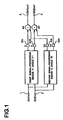
- FIG. 1 is a block diagram illustrating an apparatus according to this embodiment.
- the sound image localisation apparatus (the virtual speaker treatment apparatus) includes first and second input terminals 1 and 2 to which an audio signal is input, a first output terminal 3 connected to a left speaker SPL and a second output terminal 4 connected to a right speaker SPR.
- a 2-channel stereophonic signal is exemplarily shown as an audio signal in Figure 1, the audio signal instead may be a monophonic signal.
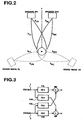
- Figure 2 shows an arrangement of the speakers SPL and SPR.
- a pair of speakers i.e., a left speaker SPL and a right speaker SPR .
- the sound image localization apparatus makes a listener M recognize a sound image at the predetermined position P.
- the position P is located away at an angle ⁇ in a circumferential direction (i.e., counter-clockwise) from the front F of the listener M
- this embodiment of the present invention includes (1) localizing sound image (a virtual speaker) at a first localization a position P1 which is in the vicinity of the predetermined position P and located at an angle ⁇ 1 in the circumferential direction away from the front F of the listener wherein ⁇ 1 ⁇ ⁇ ; and (2) localizing a sound image (a virtual speaker) at a second localization position P2 which is in the vicinity of the predetermined position P and located at an angle ⁇ 2 in the circumferential direction away from the front F of the listener wherein ⁇ 2 > ⁇ .
- this embodiment of the present invention when the position P is located at an angle - ⁇ in another circumferential direction (i.e., clockwise) away from the front F of the listener, this embodiment of the present invention includes (1) localizing a sound image (a virtual speaker) at a first localization position P1 which is in the vicinity of the predetermined position P and located at an angle - ⁇ 1 in the circumferential direction away from the front F of the listener; and (2) localizing sound image (a virtual speaker) at a second localization position P2 which is in the vicinity of the predetermined position P and located at an angle - ⁇ 2 in the circumferential direction away from the front F of the listener.
- a sound image a virtual speaker
- the difference between ⁇ and ⁇ 1 and the difference between ⁇ and ⁇ 2 may be the same or different.
- the difference between ⁇ and ⁇ 1 or between ⁇ and ⁇ 2 may be any suitable amount of angle, and typically, it may be about 30 degrees or less.
- the sound image localization apparatus includes a first signal-processing means (a first virtual speaker treatment means) 11 and a second signal-processing means (a second virtual speaker treatment means) 12 .
- the first and the second means are connected to input terminals 1 and 2 .
- the first signal-processing means 11 is used for localising the sound image at a first localization position P1 and outputs a first L-signal for a left speaker SPL and a first R-signal for a right speaker SPR .
- the second signal-processing means 12 is used for localizing the sound image at a second localisation position P2 and outputs a second L-signal for a left speaker SPL and a second R-signal for a right speaker SPR .
- the first and the second signal-processing means 11 and 12 are typically signal-processing circuits.
- the means 11 and 12 may be a "lattice type” filter or a "shuffler type” filter.
- the sound image localization apparatus may include a pair of lattice type filters or a pair of shuffler type filters.
- a lattice type filter includes: (i) a first L-filtering portion (a first L-signal-processing portion) F1L , which is connected to a first input terminal 1 and outputs an output signal for a left speaker SPL; (ii) a first R-filtering portion (a first R-signal-processing portion) F1R, which is connected td a first input terminal 1 and outputs an output signal for a right speaker SPR; (iii) a second L-filtering portion (a second L-signal-processing portion) F2L, which is connected to a second input terminal 2 and outputs an output signal for a left speaker SPL; (iv) a second R-filtering portion (a second R-signal-processing portion) F2R, which is connected to a second input terminal 2 and outputs an output signal for a right speaker SPR; (v) an adding means M8 which adds output signals of a first and a second L-filtering portions F1L
- a transfer function of a first L-filtering portion F1L, a first R-filtering portion F1R, a second L-filtering portion F2L and a second R-filtering portion F2R is defined as H 11, H 12 , H 21 and H 22 , respectively. The details of the transfer function are described below.
- transfer functions H 11 , H 12 , H 21 and H 22 of the first L-filtering portion F1L, the first R-filtering portion F1R, the second L-filtering portion F2L and the second R-filtering portion F2R are obtained by using head-related transfer functions h LL , h LR , h RL , h RR , h L'L , h L'R , h R'L and h R'R .
- h LL is a head-related transfer function from the left speaker SPL to a left ear of the listener M
- h LR is a head-related transfer function from the left speaker SPL to a right ear of the listener M
- h RL is a head-related transfer function from the right speaker SPR to a left ear of the listener M
- h RR is a head-related transfer function from the right speaker SPR to a right ear of the listener M
- h L'L is a head-related transfer function from the virtual left speaker ZL to a left ear of the listener M
- h L'R is a head-related transfer function from the virtual left speaker ZL to a right ear of the listener M
- h R'L is a head-related transfer function from the virtual right speaker ZR to a left ear of the listener M
- h R'R is a head-related transfer function from the virtual right speaker ZR to a right ear of the listener M
- a matrix [h] of the head-related transfer functions from the speakers SPL and SPR to the ears of the listener M a matrix [h'] of the head-related transfer functions from the virtual speakers ZL and ZR to the ears of the listener M, and a matrix [H] of the lattice type filter.
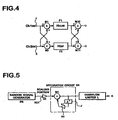
- a shuffler type filter includes: a first filtering portion (a first signal-processing portion) F1 ; a second filtering portion (a second signal-processing portion) F2 ; an adding means M1 which adds audio signals input to the first and second terminals 1 and 2 and inputs the added signal to the first filtering portion F1 ; a subtract means M2 which calculates a differential signal of the audio signals input to the first and second terminals 1 and 2 and inputs the differential signal to the second filtering portion F2 ; an adding means M10 which adds output signals of the first and the second filtering portions F1 and F2 so as to produce a first L-processed signal or a second L-processed signal; a subtract means M11 which subtracts output signal of the second filtering portion F2 from that of the first filtering portion F1 so as to produce a first R-processed signal or a second R-processed signal.
- the shuffler type filter is used in the case where the left and the right speakers SPL and SPR and the left and the right sound image (virtual speakers) ZL and ZR are symmetrically arranged with respect to the listener M.
- transfer functions H SUM and H DIF of the first and the second filtering portions F1 and F2 will be described.
- the transfer functions H SUM and H DIF can be obtained by using the above-mentioned head-related transfer functions h LL , h LR , h RL , h RR , h L'L , h L'R , h R'L and h R'R as follows:
- H SUM (h a' +h b' ) / (h a +h b )
- H DIF (h a' -h b' ) / (h a -h b )
- K1L and K1R respectively denotes a first L-coefficient multiplying means and a first R-coefficient multiplying means.
- the first L- and R-coefficient multiplying means K1L and K1R respectively multiplies the first L-processed signal and the first R-processed signal (which signals are from the first signal-processing means 11 ) by a coefficient k.
- the coefficient k arbitrarily varies in the range of 0 to 1.
- K2L and K2R respectively denotes a second L-coefficient multiplying means and a second R-coefficient multiplying means.
- the second L- and R-coefficient multiplying means K2L and K2R respectively multiplies the second L-processed signal and the second R-processed signal (which signals are from the second signal-processing means 12 ) by a coefficient 1-k.
- a spectrum of the coefficient k has 1/f characteristics. Since the 1/f characteristics provides a physiological nature, an unnatural feeling of a listener can be eliminated by using the coefficient having 1/f characteristics. A method for producing the coefficient having 1/f characteristics will be described below.
- the method includes outputting as a random signal an M-sequence signal from a random signal generator (e.g., a digital signal processor) PR.
- the signal is formed to be a pulse having rectangular shape, height of 1, and random width and pitch.
- the M-sequence signal is multiplied by a coefficient a o in a scaling portion SC1 so as to reduce a possibility that an output value in the succeeding step exceeds 1, and then, as shown in Figure 6B , integrated with respect to time in an integration circuit SK .
- the integration circuit SK includes: a delay circuit J which delays an input signal by one sampling period; a coefficient multiplying means K4 which multiplies an output of the circuit J by a coefficient b 1 ; an adding means (e.g., mixer) M4 which adds an output of the coefficient multiplying means K4 to the input signal to the integration circuit SK .
- the output signal from the integration circuit SK is supplied to an overflow limiter L having a maximum limit value of 1, so as to produce a coefficient k.
- the scaling portion SC1 and the overflow limiter L can be omitted.
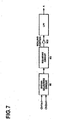
- the method includes supplying an audio signal (2-channel stereophonic signal in Figure 7) to a signal-selecting circuit (e.g., an adding and subtracting circuit) SE and selecting a signal for producing a coefficient from a signal of one of the channels, an added signal of the both channel, or a differential signal of the both channel. Then, the selected signal (shown in Figure 8A ) is squared by a squaring circuit SQ as shown in Figure 8B.
- a signal-selecting circuit e.g., an adding and subtracting circuit
- the squared signal is multiplied by an appropriate coefficient in a scaling portion SC2 so as to reduce a possibility that an output value in the succeeding step exceeds 1. Then, an output signal from the scaling portion SC2 is processed through a low pass filter LPF having a cut-off frequency of about 10 Hz so as to produce a coefficient k ( Figure 8C ).
- M6 and M7 respectively denotes an adding means (e.g., a mixer).
- the adding means M6 adds the first L-processed signal and the second L-processed signal both of which have been multiplied by the coefficient, and supplies the added signal to the left speaker SPL.
- the adding means M7 adds the first R-processed signal and the second R-processed signal both of which have been multiplied by the coefficient, and supplies the added signal to the right speaker SPR.
- this embodiment of the present invention includes producing, by the first signal-processing means 11, the first L-processed signal and the first R-processed signal for localising the sound image at the first localization position P1 which is in the vicinity of the predetermined position P and located at an angle ⁇ 1 (e.g., 90 degrees) counter-clockwise away from the front F of the listener; and producing, by the second signal-processing means 12, the second L-processed signal and the second R-processed signal for localizing the sound image at the second localization position P2 which is in the vicinity of the predetermined position P and located at an angle ⁇ 2 (e.g., 150 degrees) counter-clockwise away from the front F of the listener.
- ⁇ 1 e.g. 90 degrees
- the first L-processed signal and the first R-processed signal are multiplied by a coefficient k (which randomly varies in the range of 0 to 1), and simultaneously the second L-processed signal and the second R-processed signal are multiplied by a coefficient 1-k.
- the multiplied first L-processed signal and the multiplied second L-processed signal are added by the adding means M6 so as to be supplied to the left speaker SPL, and simultaneously the multiplied first R-processed signal and the multiplied second R-processed signal are added by the adding means M7 so as to be supplied to the right speaker SPR.
- the first and the second L-processed signals added in a random ratio are supplied to the left speaker SPL
- the first and the second R-processed signals added in a random ratio are supplied to the right speaker SPR
- the speakers SPL and SPR output a sound wave.
- sound image is localized at a first and a second localization positions P1 and P2.
- a sound volume from the first and the second localization positions P1 and P2 is randomly varied.
- the coefficient k has 1/f characteristics
- the sound volume variation from the first and the second localisation positions P1 and P2 is physiologically natural, thereby providing the listener M with a further natural feeling.
- an apparatus and a method for localising sound image which make a listener clearly recognise that the sound image is at the predetermined position and provide a listener with a natural feeling, can be obtained.
Landscapes
- Engineering & Computer Science (AREA)
- Multimedia (AREA)
- Physics & Mathematics (AREA)
- Acoustics & Sound (AREA)
- Signal Processing (AREA)
- Stereophonic System (AREA)
Claims (7)
- Procédé pour localiser une image sonore, comportant les étapes consistant à :dans lequel, lorsque la position prédéterminée est située à un angle 8 dans une direction circonférentielle loin par rapport à devant (F) l'auditeur (M), la première position de localisation (P1) est à proximité de la position prédéterminée (P) et située à un angle 1 dans la direction circonférentielle loin par rapport à devant (F) l'auditeur (M) où 1 < , et la seconde position de localisation (P2) est à proximité de la position prédéterminée (P) et située à un angle 2 dans la direction circonférentielle loin par rapport à devant (F) l'auditeur (M) où 2 > ,placer un haut-parleur de gauche (SPL) et un haut-parleur de droite (SPR) devant un auditeur,soumettre un signal audio à un traitement de localisation d'image sonore en produisant un premier signal traité qui localise l'image sonore à une première position de localisation (P1) et un second signal traité qui localise l'image sonore à une seconde position de localisation (P2),multiplier l'un des premier et second signaux traités par un coefficient k qui varie dans une plage comprise entre 0 et 1,multiplier l'autre signal des premier et second signaux traités par un coefficient 1-k,additionner le signal traité multiplié par le coefficient k et le signal traité multiplié par le coefficient 1-k, etdélivrer le signal traité aux haut-parleurs de gauche et de droite (SPL, SPR), de manière à localiser l'image sonore à une position prédéterminée (P),
lequel procédé est caractérisé en ce que :l'étape de multiplication par le coefficient k est effectuée en utilisant en tant que coefficient un coefficient qui varie dans la plage comprise de 0 à 1 d'une manière aléatoire. - Procédé selon la revendication 1, dans lequel le spectre du coefficient k a une caractéristique 1/f.
- Procédé selon la revendication 1, incluant la production du coefficient k en générant un signal aléatoire ayant une forme d'impulsion rectangulaire, une hauteur uniforme et une largeur et un pas d'impulsion aléatoires, et l'intégration du signal aléatoire dans un circuit d'intégration (SK : J, K4, M4).
- Procédé selon la revendication 1, incluant la production d'un coefficient k en mettant au carré le signal audio par un circuit d'élévation au carré (SQ), et le passage du signal élevé au carré à travers un filtre passe-bas (LPF).
- Procédé selon la revendication 4, incluant une étape consistant à produire le coefficient k en utilisant un signal dans lequel le signal audio est un signal stéréophonique à 2 canaux, et le signal pour produire le coefficient k est sélectionné parmi l'un ou l'autre des signaux de canal, la somme des deux signaux de canal, ou la différence des deux signaux de canal.
- Dispositif pour localiser une image sonore, comportant :dans lequel, lorsque la position prédéterminée (P) est située à un angle dans une direction circonférentielle loin par rapport à devant (F) l'auditeur (M), la première position de localisation (P1) est à proximité de la position prédéterminée et située à un angle 1 dans la direction circonférentielle loin par rapport à devant (F) l'auditeur où 1 < , et la seconde position de localisation (P2) est à proximité de la position prédéterminée (P) et située à un angle 2 dans la direction circonférentielle loin par rapport à devant (F) l'auditeur (M) où 2 > 0,des haut-parleurs de gauche et droite (SPL, SPR) à placer devant un auditeur (M),des moyens (11, 12) pour soumettre un signal audio à un traitement de localisation d'image sonore, constitués de moyens (11) pour produire un premier signal traité qui localise l'image sonore à une première position de localisation (P1), et de moyens (12) pour produire un second signal traité qui localise une image sonore à une seconde position de localisation (P2),des moyens pour produire un coefficient k qui varie dans une plage comprise entre 0 et 1,des moyens (K1L, K1R) pour multiplier l'un des premier et second signaux traités par le coefficient k,des moyens (K2L, K2R) pour multiplier l'autre signal par un coefficient 1-k, etdes moyens (M6, M7) pour additionner le signal traité multiplié par le coefficient k et le signal traité multiplié par le coefficient 1-k, et délivrer le signal additionné aux haut-parleurs de gauche et de droite (SPL, SPR) de manière à localiser l'image sonore à une position prédéterminée (P),
lequel dispositif est caractérisé en ce que :les moyens pour produire le coefficient k sont les des moyens (PR, SC1, SK, L ; SE, SQ, SC2, LPF) qui produisent, en tant que coefficient k, un coefficient qui varie dans la plage de 0 à 1 d'une manière aléatoire. - Processeur de signal audio, comportant :dans lequel les moyens de processeur comportent :des moyens de processeur (11, 12, K1L-K2R, M6, M7) pour soumettre un signal audio à un traitement de localisation d'image sonore de manière à produire un signal traité, etdes moyens d'émission (3, 4) pour délivrer le signal traité à des haut-parleurs de gauche et de droite (SPL, SPR) pour produire une image sonore localisée à une position prédéterminée (P),dans lequel, lorsque la position prédéterminée (P) est située à un angle dans une direction circonférentielle loin par rapport à devant (F) un auditeur (M), la première position de localisation (P1) est à proximité de la position prédéterminée (P) et située à un angle 1 dans une direction circonférentielle loin par rapport à devant (F) l'auditeur (M) où 1 < , et la seconde position de localisation (P2) est à proximité de la position prédéterminée (P) et située à un angle 2 dans une direction circonférentielle loin par rapport à devant (F) l'auditeur (M) où 2 > ,des moyens (11) pour produire un premier signal traité qui sert à produire une image sonore localisée à une première position de localisation (P1),des moyens (12) pour produire un second signal traité qui sert à produire une image sonore localisée à une seconde position de localisation (P2),des moyens (K1L, K1R) pour multiplier l'un des premier et second signaux traités par un coefficient k,des moyens (K2L, K2R) pour multiplier l'autre signal par un coefficient 1-k, etdes moyens (M6, M7) pour additionner le signal traité multiplié par le coefficient k et le signal traité multiplié par le coefficient 1-k, et délivrer en sortie le signal additionné, comme étant ledit signal traité, auxdits moyens d'émission (3, 4),
lequel processeur de signal audio est caractérisé par :des moyens (PR, SC 1, SK, L ; SE, SQ, SC2, LPF) pour produire le coefficient k en tant que coefficient qui varie dans la plage comprise entre 0 et 1 d'une manière aléatoire.
Applications Claiming Priority (4)
| Application Number | Priority Date | Filing Date | Title |
|---|---|---|---|
| JP02651298A JP3233275B2 (ja) | 1998-01-23 | 1998-01-23 | 音像定位処理方法及びその装置 |
| JP2651298 | 1998-01-23 | ||
| JP3430198 | 1998-01-30 | ||
| JP10034301A JPH11220800A (ja) | 1998-01-30 | 1998-01-30 | 音像移動方法及びその装置 |
Publications (3)
| Publication Number | Publication Date |
|---|---|
| EP0932325A2 EP0932325A2 (fr) | 1999-07-28 |
| EP0932325A3 EP0932325A3 (fr) | 2000-11-29 |
| EP0932325B1 true EP0932325B1 (fr) | 2005-04-27 |
Family
ID=26364297
Family Applications (1)
| Application Number | Title | Priority Date | Filing Date |
|---|---|---|---|
| EP99300468A Expired - Lifetime EP0932325B1 (fr) | 1998-01-23 | 1999-01-22 | Dispositif et procédé pour la localisation de l'image sonore |
Country Status (4)
| Country | Link |
|---|---|
| US (1) | US6504934B1 (fr) |
| EP (1) | EP0932325B1 (fr) |
| CN (1) | CN1151704C (fr) |
| DE (1) | DE69924896T2 (fr) |
Families Citing this family (44)
| Publication number | Priority date | Publication date | Assignee | Title |
|---|---|---|---|---|
| US7242782B1 (en) * | 1998-07-31 | 2007-07-10 | Onkyo Kk | Audio signal processing circuit |
| JP3624805B2 (ja) * | 2000-07-21 | 2005-03-02 | ヤマハ株式会社 | 音像定位装置 |
| CN1993002B (zh) * | 2005-12-28 | 2010-06-16 | 雅马哈株式会社 | 声像定位设备 |
| US8041057B2 (en) * | 2006-06-07 | 2011-10-18 | Qualcomm Incorporated | Mixing techniques for mixing audio |
| JP5214920B2 (ja) * | 2007-07-24 | 2013-06-19 | 株式会社東芝 | 超音波診断装置及び超音波診断装置の音響出力方法 |
| US8498667B2 (en) * | 2007-11-21 | 2013-07-30 | Qualcomm Incorporated | System and method for mixing audio with ringtone data |
| US8515106B2 (en) * | 2007-11-28 | 2013-08-20 | Qualcomm Incorporated | Methods and apparatus for providing an interface to a processing engine that utilizes intelligent audio mixing techniques |
| US8660280B2 (en) * | 2007-11-28 | 2014-02-25 | Qualcomm Incorporated | Methods and apparatus for providing a distinct perceptual location for an audio source within an audio mixture |
| US8572513B2 (en) | 2009-03-16 | 2013-10-29 | Apple Inc. | Device, method, and graphical user interface for moving a current position in content at a variable scrubbing rate |
| JP2011010276A (ja) * | 2009-05-22 | 2011-01-13 | Sanyo Electric Co Ltd | 画像再生装置及び撮像装置 |
| WO2011044063A2 (fr) * | 2009-10-05 | 2011-04-14 | Harman International Industries, Incorporated | Système audio multiplex doté d'une compensation de canal audio |
| KR101844511B1 (ko) | 2010-03-19 | 2018-05-18 | 삼성전자주식회사 | 입체 음향 재생 방법 및 장치 |
| KR101764175B1 (ko) | 2010-05-04 | 2017-08-14 | 삼성전자주식회사 | 입체 음향 재생 방법 및 장치 |
| US10706096B2 (en) | 2011-08-18 | 2020-07-07 | Apple Inc. | Management of local and remote media items |
| US9002322B2 (en) | 2011-09-29 | 2015-04-07 | Apple Inc. | Authentication with secondary approver |
| EP2802161A4 (fr) * | 2012-01-05 | 2015-12-23 | Samsung Electronics Co Ltd | Procédé et dispositif de localisation d'un signal audio multicanal |
| KR102037418B1 (ko) | 2012-12-04 | 2019-10-28 | 삼성전자주식회사 | 오디오 제공 장치 및 오디오 제공 방법 |
| WO2014143776A2 (fr) | 2013-03-15 | 2014-09-18 | Bodhi Technology Ventures Llc | Fourniture d'interactions à distance avec un dispositif hôte à l'aide d'un dispositif sans fil |
| US11256294B2 (en) | 2014-05-30 | 2022-02-22 | Apple Inc. | Continuity of applications across devices |
| US10339293B2 (en) | 2014-08-15 | 2019-07-02 | Apple Inc. | Authenticated device used to unlock another device |
| CN106797493A (zh) | 2014-09-02 | 2017-05-31 | 苹果公司 | 音乐用户界面 |
| US20170257721A1 (en) * | 2014-09-12 | 2017-09-07 | Sony Semiconductor Solutions Corporation | Audio processing device and method |
| CN107251578B (zh) * | 2015-02-25 | 2018-11-06 | 株式会社索思未来 | 信号处理装置 |
| DK179186B1 (en) | 2016-05-19 | 2018-01-15 | Apple Inc | REMOTE AUTHORIZATION TO CONTINUE WITH AN ACTION |
| DK201670622A1 (en) | 2016-06-12 | 2018-02-12 | Apple Inc | User interfaces for transactions |
| US11431836B2 (en) | 2017-05-02 | 2022-08-30 | Apple Inc. | Methods and interfaces for initiating media playback |
| US10992795B2 (en) | 2017-05-16 | 2021-04-27 | Apple Inc. | Methods and interfaces for home media control |
| US10928980B2 (en) | 2017-05-12 | 2021-02-23 | Apple Inc. | User interfaces for playing and managing audio items |
| CN111343060B (zh) | 2017-05-16 | 2022-02-11 | 苹果公司 | 用于家庭媒体控制的方法和界面 |
| US12526361B2 (en) | 2017-05-16 | 2026-01-13 | Apple Inc. | Methods for outputting an audio output in accordance with a user being within a range of a device |
| CN109065010A (zh) * | 2018-08-23 | 2018-12-21 | 张德明 | 一种具同台联唱模式的k歌系统和k歌方法 |
| CA3131489A1 (fr) | 2019-02-27 | 2020-09-03 | Louisiana-Pacific Corporation | Bardage a base de bois fabrique pour resister au feu |
| US10996917B2 (en) | 2019-05-31 | 2021-05-04 | Apple Inc. | User interfaces for audio media control |
| WO2020243691A1 (fr) | 2019-05-31 | 2020-12-03 | Apple Inc. | Interfaces utilisateurs pour une commande média audio |
| DK201970533A1 (en) | 2019-05-31 | 2021-02-15 | Apple Inc | Methods and user interfaces for sharing audio |
| US10904029B2 (en) | 2019-05-31 | 2021-01-26 | Apple Inc. | User interfaces for managing controllable external devices |
| US11513667B2 (en) | 2020-05-11 | 2022-11-29 | Apple Inc. | User interface for audio message |
| US11392291B2 (en) | 2020-09-25 | 2022-07-19 | Apple Inc. | Methods and interfaces for media control with dynamic feedback |
| EP4334811B1 (fr) | 2021-06-06 | 2025-11-19 | Apple Inc. | Interfaces utilisateur pour routage audio |
| US11847378B2 (en) | 2021-06-06 | 2023-12-19 | Apple Inc. | User interfaces for audio routing |
| US12596520B2 (en) | 2021-09-24 | 2026-04-07 | Apple Inc. | Media controls user interface |
| US12563299B2 (en) | 2022-04-04 | 2026-02-24 | Apple Inc. | User interfaces for camera sharing |
| US12379827B2 (en) | 2022-06-03 | 2025-08-05 | Apple Inc. | User interfaces for managing accessories |
| US12321574B2 (en) | 2022-09-02 | 2025-06-03 | Apple Inc. | Content output devices and user interfaces |
Family Cites Families (6)
| Publication number | Priority date | Publication date | Assignee | Title |
|---|---|---|---|---|
| JP3059191B2 (ja) * | 1990-05-24 | 2000-07-04 | ローランド株式会社 | 音像定位装置 |
| US5274708A (en) * | 1992-06-01 | 1993-12-28 | Fusan Labs, Inc. | Digital stereo sound enhancement unit and method |
| EP0637191B1 (fr) | 1993-07-30 | 2003-10-22 | Victor Company Of Japan, Ltd. | Appareil de traitement d'un signal d'effet spatial |
| US5440638A (en) | 1993-09-03 | 1995-08-08 | Q Sound Ltd. | Stereo enhancement system |
| BE1008027A3 (nl) * | 1994-01-17 | 1995-12-12 | Philips Electronics Nv | Signaalcombinatieschakeling, signaalbewerkingsschakeling voorzien van de signaalcombinatieschakeling, stereofonische audioweergave-inrichting voorzien de signaalbewerkingsschakeling, alsmede een audio-visuele weergave-inrichting voorzien van de stereofonische audioweergave-inrichting. |
| JP3367625B2 (ja) | 1995-01-26 | 2003-01-14 | 日本ビクター株式会社 | 音像定位制御装置 |
-
1999
- 1999-01-22 DE DE69924896T patent/DE69924896T2/de not_active Expired - Lifetime
- 1999-01-22 CN CNB991013662A patent/CN1151704C/zh not_active Expired - Fee Related
- 1999-01-22 US US09/235,483 patent/US6504934B1/en not_active Expired - Fee Related
- 1999-01-22 EP EP99300468A patent/EP0932325B1/fr not_active Expired - Lifetime
Also Published As
| Publication number | Publication date |
|---|---|
| CN1151704C (zh) | 2004-05-26 |
| EP0932325A2 (fr) | 1999-07-28 |
| US6504934B1 (en) | 2003-01-07 |
| CN1235505A (zh) | 1999-11-17 |
| DE69924896T2 (de) | 2005-09-29 |
| EP0932325A3 (fr) | 2000-11-29 |
| DE69924896D1 (de) | 2005-06-02 |
Similar Documents
| Publication | Publication Date | Title |
|---|---|---|
| EP0932325B1 (fr) | Dispositif et procédé pour la localisation de l'image sonore | |
| US7177431B2 (en) | Dynamic decorrelator for audio signals | |
| US6111958A (en) | Audio spatial enhancement apparatus and methods | |
| US7440575B2 (en) | Equalization of the output in a stereo widening network | |
| EP0977464B1 (fr) | Circuit de traitement du signal sonore | |
| EP0858243B1 (fr) | Canal audio à effet spatial, codage et décodage | |
| US6577736B1 (en) | Method of synthesizing a three dimensional sound-field | |
| EP1194007A2 (fr) | Procédé et dispositif processeur de signal pour convertir des signaux stéréo pour l'écoute avec casque | |
| EP0991298A2 (fr) | Procédé de localisation d'image acoustique hors tête de l'auditeur par l'intermediaire d'un casque d'écoute | |
| US6504933B1 (en) | Three-dimensional sound system and method using head related transfer function | |
| JP2000050400A (ja) | 左,右両耳用のオーディオ信号を音像定位させるための処理方法 | |
| US5844993A (en) | Surround signal processing apparatus | |
| EP0917400B1 (fr) | Appareil et méthode pour la localisation de l'image sonore | |
| US8064607B2 (en) | Method for producing more than two electric time signals from one first and one second electric time signal | |
| KR20120062727A (ko) | 스테레오포닉 또는 슈도-스테레오포닉 오디오 신호의 개선 장치 및 방법 | |
| KR100437174B1 (ko) | 스테레오음향시스템 | |
| EP1054574A1 (fr) | Dispositif de localisation d'images sonores | |
| JP3547813B2 (ja) | 音場生成装置 | |
| JP2956545B2 (ja) | 音場制御装置 | |
| US5604810A (en) | Sound field control system for a multi-speaker system | |
| US20060008100A1 (en) | Apparatus and method for producing 3D sound | |
| JP4540290B2 (ja) | 入力信号を音像定位させて三次元空間を移動させる方法 | |
| JP3233275B2 (ja) | 音像定位処理方法及びその装置 | |
| JP4371622B2 (ja) | 疑似ステレオ回路 | |
| KR100741302B1 (ko) | 사운드들을 발생시키기 위한 시스템 |
Legal Events
| Date | Code | Title | Description |
|---|---|---|---|
| PUAI | Public reference made under article 153(3) epc to a published international application that has entered the european phase |
Free format text: ORIGINAL CODE: 0009012 |
|
| AK | Designated contracting states |
Kind code of ref document: A2 Designated state(s): DE FR GB |
|
| AX | Request for extension of the european patent |
Free format text: AL;LT;LV;MK;RO;SI |
|
| PUAL | Search report despatched |
Free format text: ORIGINAL CODE: 0009013 |
|
| AK | Designated contracting states |
Kind code of ref document: A3 Designated state(s): AT BE CH CY DE DK ES FI FR GB GR IE IT LI LU MC NL PT SE |
|
| AX | Request for extension of the european patent |
Free format text: AL;LT;LV;MK;RO;SI |
|
| 17P | Request for examination filed |
Effective date: 20001204 |
|
| AKX | Designation fees paid |
Free format text: DE FR GB NL |
|
| RBV | Designated contracting states (corrected) |
Designated state(s): DE FR GB |
|
| 17Q | First examination report despatched |
Effective date: 20031229 |
|
| GRAP | Despatch of communication of intention to grant a patent |
Free format text: ORIGINAL CODE: EPIDOSNIGR1 |
|
| RBV | Designated contracting states (corrected) |
Designated state(s): DE FR GB NL |
|
| GRAS | Grant fee paid |
Free format text: ORIGINAL CODE: EPIDOSNIGR3 |
|
| GRAA | (expected) grant |
Free format text: ORIGINAL CODE: 0009210 |
|
| AK | Designated contracting states |
Kind code of ref document: B1 Designated state(s): DE FR GB NL |
|
| PG25 | Lapsed in a contracting state [announced via postgrant information from national office to epo] |
Ref country code: NL Free format text: LAPSE BECAUSE OF FAILURE TO SUBMIT A TRANSLATION OF THE DESCRIPTION OR TO PAY THE FEE WITHIN THE PRESCRIBED TIME-LIMIT Effective date: 20050427 |
|
| REG | Reference to a national code |
Ref country code: GB Ref legal event code: FG4D |
|
| REF | Corresponds to: |
Ref document number: 69924896 Country of ref document: DE Date of ref document: 20050602 Kind code of ref document: P |
|
| NLV1 | Nl: lapsed or annulled due to failure to fulfill the requirements of art. 29p and 29m of the patents act | ||
| PLBE | No opposition filed within time limit |
Free format text: ORIGINAL CODE: 0009261 |
|
| STAA | Information on the status of an ep patent application or granted ep patent |
Free format text: STATUS: NO OPPOSITION FILED WITHIN TIME LIMIT |
|
| 26N | No opposition filed |
Effective date: 20060130 |
|
| EN | Fr: translation not filed | ||
| PG25 | Lapsed in a contracting state [announced via postgrant information from national office to epo] |
Ref country code: FR Free format text: LAPSE BECAUSE OF FAILURE TO SUBMIT A TRANSLATION OF THE DESCRIPTION OR TO PAY THE FEE WITHIN THE PRESCRIBED TIME-LIMIT Effective date: 20050427 |
|
| REG | Reference to a national code |
Ref country code: DE Ref legal event code: R081 Ref document number: 69924896 Country of ref document: DE Owner name: ONKYO CORP., NEYAGAWA-SHI, JP Free format text: FORMER OWNER: ONKYO CORP., NEYAGAWA, OSAKA, JP Effective date: 20110302 |
|
| REG | Reference to a national code |
Ref country code: DE Ref legal event code: R082 Ref document number: 69924896 Country of ref document: DE |
|
| PGFP | Annual fee paid to national office [announced via postgrant information from national office to epo] |
Ref country code: GB Payment date: 20121228 Year of fee payment: 15 |
|
| PGFP | Annual fee paid to national office [announced via postgrant information from national office to epo] |
Ref country code: DE Payment date: 20130131 Year of fee payment: 15 |
|
| REG | Reference to a national code |
Ref country code: DE Ref legal event code: R119 Ref document number: 69924896 Country of ref document: DE |
|
| GBPC | Gb: european patent ceased through non-payment of renewal fee |
Effective date: 20140122 |
|
| REG | Reference to a national code |
Ref country code: DE Ref legal event code: R119 Ref document number: 69924896 Country of ref document: DE Effective date: 20140801 |
|
| PG25 | Lapsed in a contracting state [announced via postgrant information from national office to epo] |
Ref country code: DE Free format text: LAPSE BECAUSE OF NON-PAYMENT OF DUE FEES Effective date: 20140801 |
|
| PG25 | Lapsed in a contracting state [announced via postgrant information from national office to epo] |
Ref country code: GB Free format text: LAPSE BECAUSE OF NON-PAYMENT OF DUE FEES Effective date: 20140122 |