EP0933941A2 - Automatisches Multimediadatenlieferungssystem - Google Patents
Automatisches Multimediadatenlieferungssystem Download PDFInfo
- Publication number
- EP0933941A2 EP0933941A2 EP99101502A EP99101502A EP0933941A2 EP 0933941 A2 EP0933941 A2 EP 0933941A2 EP 99101502 A EP99101502 A EP 99101502A EP 99101502 A EP99101502 A EP 99101502A EP 0933941 A2 EP0933941 A2 EP 0933941A2
- Authority
- EP
- European Patent Office
- Prior art keywords
- contents
- terminal
- delivery
- data
- display
- Prior art date
- Legal status (The legal status is an assumption and is not a legal conclusion. Google has not performed a legal analysis and makes no representation as to the accuracy of the status listed.)
- Granted
Links
Images




Classifications
-
- H—ELECTRICITY
- H04—ELECTRIC COMMUNICATION TECHNIQUE
- H04N—PICTORIAL COMMUNICATION, e.g. TELEVISION
- H04N21/00—Selective content distribution, e.g. interactive television or video on demand [VOD]
- H04N21/80—Generation or processing of content or additional data by content creator independently of the distribution process; Content per se
- H04N21/81—Monomedia components thereof
- H04N21/812—Monomedia components thereof involving advertisement data
-
- H—ELECTRICITY
- H04—ELECTRIC COMMUNICATION TECHNIQUE
- H04N—PICTORIAL COMMUNICATION, e.g. TELEVISION
- H04N7/00—Television systems
- H04N7/16—Analogue secrecy systems; Analogue subscription systems
- H04N7/173—Analogue secrecy systems; Analogue subscription systems with two-way working, e.g. subscriber sending a programme selection signal
- H04N7/17309—Transmission or handling of upstream communications
- H04N7/17336—Handling of requests in head-ends
Definitions
- the present invention generally relates to a system including a center system, terminal systems, and communication lines for the purpose of delivering and displaying contents, and particularly relates to a multi-media-automatic-delivery system in which data of moving-picture contents such as commercial advertisement is transmitted from a center system to a plurality of terminal systems via communication lines so as to display the contents on screens of the terminal systems.
- cable television which is directed to providing service to a local area, has made a certain progress in market. Installation, however, is required in advance with respect to dedicated adaptors, cables, and the like. Further, cable television also has a difficult technological challenge to overcome in order to deliver information to a selected area within the area of service.
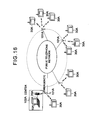
- Fig.16 is an illustrative drawing showing a configuration of the first related-art scheme.
- the first related-art scheme includes a center 102A having a host 10A connected to a PHS terminal.
- This scheme further includes transit antennas 101A used for communications between the center 102A and a public telephone network, and advertisement devices 30A establishing connection with the public telephone network via the transit antennas 101A.
- information is delivered from the host 10A to the advertisement devices 30A based on telephone numbers of the advertisement devices 30A, and intervals of the delivery may be, or may not be, constant.
- the delivered information is displayed or output as audio information in an order of receipt of data (i.e., in an order of received records of the delivered data). Once all the delivered information is displayed or output as audio, the same operation is repeated by going back to the beginning of the data until next information arrives from the host 10A.
- the advertisement devices of the first related-art scheme are supposed to be able to provide a diligent advertisement service at a low cost by use of the PHS terminal 20A and the public telephone network.
- advertisement devices may be installed at convenient stores or super markets where POS registers are located. In such locations, advertisement of sales goods, notices from a local community, traffic information, a local weather forecast, or the like can be provided in a sophisticated manner at a low cost.
- Another example of the schemes directed to overcoming the related-art shortcomings is use of recording media such as magneto-optical memory medium (e.g., MO disk) and magnetic disks (hard-drive disks).
- recording media such as magneto-optical memory medium (e.g., MO disk) and magnetic disks (hard-drive disks).
- MO disk magneto-optical memory medium
- magnetic disks hard-drive disks
- data is recorded in memory media at the host 10A, and, then, the memory media are delivered to client places where the advertisement devices 30A are located.
- the memory media are loaded to reading devices of the advertisement devices 30A so that the advertisement devices 30A can read the data delivered in the form of recording media.
- This scheme is hereinafter referred to as a second related-art scheme.
- the load on the advertisement devices 30A is relatively light when a relatively small amount of data such as still-image information or character information is sent to the advertisement devices 30A. In such a case, a high performance is not an absolute requirement for the advertisement devices 30A.
- moving-picture information or high-definition images having a large amount of multi-media data in the range of several hundreds mega-bytes may need to be transmitted from the host 10A to the advertisement devices 30A when commercials on sales goods, notices from a local community, traffic information, a local weather forecast, or the like is to be delivered.
- a transmission time for the delivery of information becomes unduly lengthy, resulting in an exorbitant fee being required for a lengthy use of the communication network.
- 500-Mbit data which corresponds to one minute's worth of MPEG2 video contents comprised of moving pictures and high-definition images, may be transmitted from the PHS terminal at a data rate of 32 kbs. In this case, even if the advertisement devices run almost at their full capacity, it will take at least 4 hours and 20 minutes to complete the data transmission.
- the first related-art scheme when moving-picture information or high-definition images having a large amount of multi-media data in the range of several hundreds mega-bytes is to be transmitted from the host 10A to the advertisement devices 30A for the purpose of delivering commercials on sales goods, notices from a local community, traffic information, a local weather forecast, or the like, the load on the advertisement devices 30A is quite heavy, resulting in a need for high performance devices. Also, the communication network is required to have a high data-transfer capacity. Enhancing the speed of the advertisement devices 30A leads to a cost increase, and use of a high-speed communication network means an increase in a communication-line-usage fee. Because of this, it is difficult to adapt the first related-art scheme to multi-media applications which employs moving pictures and high-definition images.
- data is recorded in memory media such as magneto-optical recording media or magnetic disks (hard-drive disks) at the site of the host 10A, and the memory media are delivered to client places where the advertisement devices 30A are located.
- the memory media are loaded to reading devices of the advertisement devices 30A so that the advertisement devices 30A can read the data delivered in the form of recording media.
- This configuration requires excessive time and labor, which are spent on recording and reading of the data as well as delivery of the memory media.
- the first and second related-art schemes do not provide the host 10A with a function of remote monitoring to monitor operation conditions of the advertisement devices 30A. This configuration makes it difficult for the transmission side to check whether the advertisement devices 30A are actually displaying the delivered data.
- the host 10A is not provided with a function of remote control for controlling operations of the advertisement devices 30A. Because of this, it is difficult to check operations of the advertisement devices 30A individually with an aim of providing diligent delivery control, remote diagnosis, remote maintenance, etc.
- first and second related-art schemes do not have a function to control a schedule regarding displaying of delivered data. This makes it difficult to customize the contents of the delivered data in accordance with such particulars as seasons, date, day, and locations where the advertisement devices 30A are installed.
- first and second related-art schemes do not provide a function to control a schedule regarding displaying of delivered data, it is difficult to give priority to delivered data of an urgent nature such as earthquake information, a railway accident, etc., over other delivered data.
- the present invention is aimed at addressing the shortcomings described above.
- 500-Mbit data which corresponds to one minute's worth of MPEG2 video contents comprised of moving pictures and high-definition images, may be transmitted from the PHS terminal at a data rate of 64 kbs by use of a public telephone network such as the ISDN.
- the light-load-time-remote-casting function of the present invention is supposed to complete the data delivery within only one hour or two.
- a system for delivering contents includes a center system which delivers the contents, a plurality of terminal systems which receive the contents from the center system and displays the contents, and communication lines connecting the center system to the plurality of terminal systems, wherein the center system includes a delivery-schedule setting unit which sets a schedule of delivery, and a contents-delivery unit which delivers the contents to the terminal systems according to the schedule of delivery during a time period when a load on the terminal systems is lower than a predetermined level.
- the system described above is provided with a light-load-time-period-remote-casting function which delivers contents during time period such as a nighttime when terminal systems are idling, the purpose being not to require the terminal systems to have a high-performance capacity and not to require the communication network to have a high-speed-data-transfer capacity so as to avoid a cost increase associated with enhancement of the terminal systems and to avoid an increase in a communication-line-usage fee caused by use of a high-speed-data-transfer network even when moving-picture information or high-definition images having a large amount of multi-media data in the range of several hundreds mega-bytes is delivered from the center system to a plurality of terminal systems with an aim of delivering commercials on sales goods, notices from a local community, traffic information, a local weather forecast, or the like.
- the light-load-time-period-remote-casting function can deliver the contents during a nighttime when a communication fee is relatively inexpensive for the purpose of avoiding a daytime delivery because such daytime delivery would lead to an increase in a communication-line-usage fee as it takes a lengthy time to deliver a large amount of contents such as moving-picture information or high-definition images having a large amount of multi-media data in the range of several hundreds mega-bytes.
- the system as described above is such that the center system further includes a terminal-system-control unit which registers and controls terminal-attribute information about attributes of the terminal systems, wherein the contents-delivery unit selects some of the plurality of terminal systems based on the terminal-attribute information, and delivers the contents to the selected terminal systems.
- a terminal-system-control unit which registers and controls terminal-attribute information about attributes of the terminal systems, wherein the contents-delivery unit selects some of the plurality of terminal systems based on the terminal-attribute information, and delivers the contents to the selected terminal systems.
- the center system can customize the contents delivered to particular terminal systems by selecting particular terminal systems for delivering particular contents.
- the system as described above is such that the center system further includes a display-schedule setting unit which sets a schedule of display, wherein the contents-delivery unit delivers the contents and the schedule of display to the terminal systems, the schedule of display defining a schedule according to which the contents are displayed on the terminal systems.
- each of the plurality of terminal systems includes a receiving unit which receives the contents and the schedule of display from the center system, a display unit, and a terminal-control unit which displays the contents on the display unit according to a schedule specified in the schedule of display.
- the system described above is provided with a remote control function to control operations of the terminal systems. Based on this function, the displayed contents can be customized in accordance with a season, a date, a day, and locations where the terminal systems are installed. Further, such a remote control function can give priority to contents of an urgent nature such as earthquake information, railway-accident information, etc., over other routine contents.
- each of the plurality of terminal systems includes a receiving unit which receives the contents from the center system, a first display unit which displays the contents on a screen thereof, a monitor camera which takes a picture of the screen of the first display unit, and a still-image-transmission unit which sends the picture to the center device.
- the center system includes a second display unit which displays a plurality of pictures of the screen of the first display unit taken at intervals during a last predetermined time period.
- the system described above allows the transmission side (i.e., the center system) to check whether delivered contents are actually displayed on terminal systems by using a remote monitoring function to monitor operations of the terminal systems.
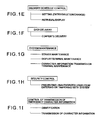
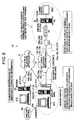
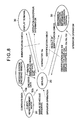
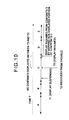
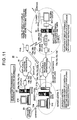
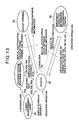
- Figs.1A through 1I are illustrative drawings showing a list of functions provided for a center system (server personal computer) of a multi-media-automatic-delivery system according to the present invention.
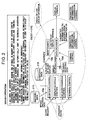
- Fig.2 is an illustrative drawing for explaining the functions of the sender system (server PC).
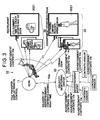
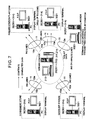
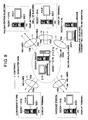
- Fig.3 is an illustrative drawing showing an embodiment of the multi-media-automatic-delivery system according to the present invention.
- a multi-media-automatic-delivery system 10 of this embodiment includes communication lines 11, at least one center system 20, and terminal systems 30 connected to the center system 20 via the communication lines 11.
- the center system 20 delivers contents data to the terminal systems 30 which are located at railway stations, convenience stores, etc., so that the delivered contents are shown on the display unit 302 of the terminal systems 30.
- the contents data include still images and video contents such as moving pictures 10a, character information 10e, etc., and may represent commercial advertisement.
- Fig.15 is a block diagram showing a functional configuration of the center system 20 and a given one of the terminal system 30.
- the moving pictures 10a for commercial advertisement are delivered.
- the moving pictures 10a for commercial advertisement are provided in compliance with the MPEG2 scheme, and are hereinafter referred to as moving-picture-advertisement-contents-MPEG2 data 10a.
- Use of the moving-picture-advertisement-contents-MPEG2 data 10a in compliance with the MPEG2 scheme makes it possible to display high-definition video images comparable to DVD (digital video disk) images on the display unit 302 of the terminal systems 30.
- moving-picture information or high-definition images having a large amount of multi-media data in the range of several hundreds mega-bytes is sent from the center system 20 to the terminal systems 30 for the purpose of delivering commercials on sales goods, notices from a local community, traffic information, a local weather forecast, or the like.
- a contents-delivery unit 204 uses terminal-attribute information 10c to select some of the terminal systems 30 to deliver the contents according to an advertisement-delivery-schedule data 10d generated by a delivery-schedule setting unit 203.
- the contents are delivered by using an efficient transfer scheme based on data compression during a time period when a communication-line-usage fee is relatively inexpensive. Namely, a daytime delivery of the contents is avoided since it would lead to an increase in the communication-line-usage fee for the communication lines (ISDN) 11. In this manner, a light-load-time-period-remote-casting function is implemented at a low cost so as to cope with the data amount of moving pictures or high-definition video images comparable to those of the DVD system.
- 500-Mbit data comprised of moving pictures and high-definition images, which corresponds to one minute's worth of MPEG2 video contents when shown on the display unit 302 such as a large-scale plasma display or an aurora vision, may be transmitted at a data rate of 64 kbs by use of the communication (ISDN) lines 11.
- ISDN communication
- the contents-delivery unit 204 selects the terminal systems 30 based on the terminal-attribute information 10c to deliver the contents according to the advertisement-delivery-schedule data 10d generated by the delivery-schedule setting unit 203 for the purpose of delivering commercials on sales goods, notices from a local community, traffic information, a local weather forecast, or the like
- the contents are delivered by using an efficient transfer scheme based on data compression during a time period when the terminal systems 30 are idling, the purpose being not to require the terminal systems 30 to have a high-performance capacity and not to require the communication (ISDN) lines 11 to have a high-speed-data-transfer capacity so as to avoid a cost increase associated with enhancement of the terminal systems 30 and to avoid an increase in a communication-line-usage fee caused by
- the center system 20 includes a terminal-system-control unit 201, a contents-control unit 202, the delivery-schedule setting unit 203, the contents-delivery unit 204, a display-schedule setting unit 205, and a compression-and-coding unit 206.
- the center system 20 is implemented by a server personal computer.
- the terminal-system-control unit 201 is equipped with a function to register and control the terminal-attribute information 10c regarding the terminal systems 30.
- the terminal-system-control unit 201 is implemented by a microcomputer provided inside the server PC.
- the terminal-system-control unit 201 uses advertisement-display-schedule data 10b to achieve remote control of terminal systems 30 with regard to a display schedule thereof when the advertisement-display-schedule data 10b is sent to the terminal systems 30.
- advertisement-display-schedule data 10b after updating thereof is sent to the terminal systems 30.
- the moving-picture-advertisement-contents-MPEG2 data 10a displayed on the display unit 302 can be changed via an emergency remote control function implemented in the manner as described above.
- the center system 20 is provided with a remote-control function to control operations of the terminal systems 30, and can check operation conditions of the individual terminal systems 30 so as to provide diligent delivery control, remote diagnosis, and remote maintenance.
- a function to control the advertisement-display-schedule data 10b is provided, a light-load-time-period-remote-casting function can give priority to contents of an urgent nature such as earthquake information, fire information, railway-accident information, etc., over any other contents.
- the advertisement-display-schedule data 10b alone can be delivered with an update thereof even after the contents were sent, so as to change the date and time of displaying of the contents at the terminal systems 30. This can be achieved economically by using existing infrastructure, whereas such a change in the date and time of displaying is not possible in the related-art schemes, which are based on either delivery of recording media or one-way delivery of contents.
- the contents-control unit 202 registers the advertisement-moving-picture contents, which are to be sent to the terminal systems 30 via the communication lines 11. Further, the contents-control unit 202 is provided with a function to generate information regarding control of the registered advertisement-moving-picture contents. This is implemented by the microcomputer provided inside the server PC.
- the terminal-system-control unit 201 exchanges the terminal-attribute information 10c with the contents-control unit 202 so as to attend to contents-delivering processing with respect to each of the terminal systems 30 or with each group of the terminal systems 30.
- a light-load-time-period-delivery-scheduling function is implemented so as to control the advertisement-delivery-schedule data 10d and the advertisement-display-schedule data 10b.
- the contents-delivery unit 204 uses the terminal-attribute information 10c to deliver the contents individually to each of the selected terminal systems 30 by taking into account a season, a date, a day, locations of the terminal systems 30, etc. Further, the contents-delivery unit 204 can customize the contents with respect to each of the terminal systems 30 based on characteristics of the terminal systems 30 as such characteristics are specified in the terminal-attribute information 10c.
- Such a function is implemented as the light-load-time-period-remote-casting function.
- collaboration between the terminal-system-control unit 201 and the contents-control unit 202 makes it possible to deliver the contents with respect to the selected terminal systems 30 or with respect to a selected group of the terminal systems 30. All of this makes it possible to implement a delivery-control function which can provide individually tailored and diligent service to each of the terminal systems 30.
- a delivery-control function which can provide individually tailored and diligent service to each of the terminal systems 30.
- time and labor spent on the delivery of the recording media to the terminal systems 30 are eliminated.
- a light-load-time-period-remote-casting function is implemented so as to eliminate a need for time and labor to be spent on recording of contents in memory media, delivery of the memory media, and reading of contents from the memory media.
- the delivery-schedule setting unit 203 lays out a schedule of light-load-time-delivery processing for delivering contents to the terminal systems 30 during a light-load time period when the load on the terminal systems 30 is lower than a predetermined level.
- This function is implemented by the microcomputer provided inside the server PC.
- the delivery-schedule setting unit 203 refers to the advertisement-delivery-schedule data 10d that is already specified and the advertisement-display-schedule data 10b that is already transmitted, thereby controlling delivery operations for sending the advertisement-moving-picture contents.
- the light-load-time-period-remote-casting function based on the delivery-schedule setting unit 203 and the display-schedule setting unit 205 allows the contents-delivery unit 204 to use the terminal-attribute information 10c to deliver the contents individually to each of the selected terminal systems 30 by taking into account a season, a date, a day, locations of the terminal systems 30, etc. Further, the contents-delivery unit 204 can customize the contents with respect to each of the terminal systems 30 based on characteristics of the terminal systems 30 as such characteristics are specified in the terminal-attribute information 10c. Such a function is implemented as the light-load-time-period-remote-casting function.
- a light-load-time-period-remote-casting function can give priority to contents of an urgent nature such as earthquake information, fire information, railway-accident information, etc., over any other contents.
- recording media such as magneto-optical memory media or magnetic disks at the site of the center system 20.
- time and labor spent on the delivery of the recording media to the terminal systems 30 are eliminated.
- a light-load-time-period-remote-casting function is implemented so as to eliminate a need for time and labor to be spent on recording of contents in memory media, delivery of the memory media, and reading of contents from the memory media.
- the delivery-schedule setting unit 203 is provided with the light-load-time-delivery-scheduling function, which sets a schedule of contents delivery so as to deliver the advertisement-moving-picture contents to the terminal systems 30 during a light-load time period when the load on the terminal systems 30 is lower than a predetermined level, especially during a nighttime when the devices are idling or stopped.
- public telephone lines are used as the communication lines 11.
- ISDN lines with a 64-kbps data-transfer rate are used (hereinafter, the communication lines 11 may be referred to as the ISDN lines 11). Because of this configuration, the terminal-attribute information 10c includes telephone numbers of the terminal systems 30 (i.e., telephone numbers of lines connected to DSUs).
- the delivery-schedule setting unit 203 sets the advertisement-delivery-schedule data 10d for delivering the moving-picture-advertisement-contents-MPEG2 data 10a to the terminal systems 30, the delivery-schedule setting unit 203 checks available time periods in the displaying schedules of the terminal systems 30, available time periods in the delivery schedule for delivering the moving-picture-advertisement-contents-MPEG2 data 10a to the terminal systems 30, and a light-load time period of the terminal systems 30. Based on this check, the delivery-schedule setting unit 203 decides appropriate time periods for delivering contents, and estimates time lengths which would be required for such deliveries. In this manner, the light-load-time-period-delivery-scheduling function is implemented so as to deliver the contents during such a time period as to warrant the lowest fee and a reliable delivery.
- the light-load-time-period-delivery-scheduling function as described above can bring about the following improvements.
- moving-picture information or high-definition images comparable to those of the DVD system as having a large amount of multi-media data in the range of several hundreds mega-bytes is sent from the center system 20 to the terminal systems 30 after the contents-delivery unit 204 selects the terminal systems 30 based on the terminal-attribute information 10c to deliver the contents according to the advertisement-delivery-schedule data 10d and the advertisement-display-schedule data 10b generated at the center system 20 for the purpose of delivering commercials on sales goods, notices from a local community, traffic information, a local weather forecast, or the like
- the contents are delivered by using an efficient transfer scheme based on data compression during a nighttime, the purpose being to avoid an increase in a communication-line-usage fee caused by use of the ISDN lines 11 during daytime for a long time period for delivering a large amount of the data.
- the light-load-time-period-remote-casting function is implemented at a low cost so as to cope with the data amount of moving pictures or high-definition video images comparable to those of the DVD system.
- 500-Mbit data comprised of moving pictures and high-definition images, which corresponds to one minute's worth of MPEG2 video contents when shown on the display unit 302 such as a large-scale plasma display or an aurora vision, may be transmitted at a data rate of 64 kbs by use of the communication (ISDN) lines 11.
- ISDN communication
- the contents-delivery unit 204 selects the terminal systems 30 based on the terminal-attribute information 10c to deliver the contents according to the advertisement-delivery-schedule data 10d and the advertisement-display-schedule data 10b generated at the center system 20 for the purpose of delivering commercials on sales goods, notices from a local community, traffic information, a local weather forecast, or the like
- the contents are delivered by using an efficient transfer scheme based on data compression during a light-load time period such as a nighttime when the terminal systems 30 are idling, the purpose being not to require the terminal systems 30 to have a high-performance capacity and not to require the communication lines to have a high-speed-data-transfer capacity so as to avoid a cost increase associated with enhancement of the terminal systems 30 and to avoid an increase
- the light-load-time-period-remote-casting function is implemented at a low cost so as to cope with the data amount of moving pictures or high-definition video images comparable to those of the DVD system.
- This remote-delivery function directed to delivery of high-definition moving pictures i.e., the light-load-time-period-remote-casting function
- the contents-delivery unit 204 selects the advertisement-moving-picture contents based on the advertisement-contents-conrol information so as to deliver the contents to the terminal systems 30 during a time period such as a nighttime when the device operation is in a halt condition or in an idling condition.
- the contents-delivery unit 204 accesses the terminal systems 30 via the ISDN lines 11 based on the terminal-attribute information 10c regarding the terminal systems 30 (i.e., calls the DSUs of the terminal systems 30), and attends to light-load-time-period-delivery processing for sending the advertisement-moving-picture contents to the terminal systems 30 during a light-load-time period such as a nighttime.
- the light-load-time-period-remote-casting function is implemented.
- the contents-delivery unit 204 selects the terminal systems 30 based on the terminal-attribute information 10c to deliver the contents according to the advertisement-delivery-schedule data 10d generated by the delivery-schedule setting unit 203 for the purpose of delivering commercials on sales goods, notices from a local community, traffic information, a local weather forecast, or the like
- the contents are delivered by using an efficient transfer scheme based on data compression during a nighttime, the purpose being to avoid an increase in a communication-line-usage fee caused by use of the ISDN lines 11 during a daytime for a long time period for delivering a large amount of the data.
- the light-load-time-period-remote-casting function is implemented at a low cost so as to cope with the data amount of moving pictures or high-definition video images comparable to those of the DVD system.
- 500-Mbit data comprised of moving pictures and high-definition images, which corresponds to one minute's worth of MPEG2 video contents when shown on the display unit 302 such as a large-scale plasma display or an aurora vision, may be transmitted at a data rate of 64 kbs by use of the communication (ISDN) lines 11.
- ISDN communication
- the contents-delivery unit 204 selects the terminal systems 30 based on the terminal-attribute information 10c to deliver the contents according to the advertisement-delivery-schedule data 10d generated by the delivery-schedule setting unit 203 for the purpose of delivering commercials on sales goods, notices from a local community, traffic information, a local weather forecast, or the like
- the contents are delivered by using an efficient transfer scheme based on data compression during a time period such as a nighttime when the terminal systems 30 are idling, the purpose being not to require the terminal systems 30 to have a high-performance capacity and not to require the communication lines to have a high-speed-data-transfer capacity so as to avoid a cost increase associated with enhancement of the terminal systems 30 and to avoid an increase in a communication-line-usage fee caused
- a light-load-time-period-remote-casting function is implemented at a low cost so as to cope with the data amount of moving pictures or high-definition video images comparable to those of the DVD system.
- recording media such as magneto-optical memory media or magnetic disks at the site of the center system 20.
- time and labor spent on the delivery of the recording media to the terminal systems 30 are eliminated.
- the light-load-time-period-remote-casting function is implemented so as to eliminate a need for time and labor to be spent on recording of contents in memory media, delivery of the memory media, and reading of contents from the memory media.
- This remote-delivery function directed to delivery of high-definition moving pictures i.e., the light-load-time-period-remote-casting function
- the contents-delivery unit 204 selects the advertisement-moving-picture contents based on the advertisement-contents-control information so as to deliver the contents to the terminal systems 30 based on the advertisement-delivery-schedule data 10d during the light-load time period.
- the contents-delivery unit 204 accesses the terminal systems 30 via the ISDN lines 11 by performing a communication-line establishing process based on the telephone-number information (i.e., calls the DSUs of the terminal systems 30), and attends to light-load-time-period-delivery processing for sending the advertisement-moving-picture contents to the terminal systems 30 via the ISDN lines 11 during the light-load time period based on the advertisement-delivery-schedule data 10d regarding the terminal systems 30.
- the light-load-time-period-remote-casting function is implemented. In this embodiment, this function is performed by the microcomputer of the server PC.
- the remote control function is provided for the purpose of controlling operations of the terminal systems 30 from the center system 20 when the terminal systems 30 are selected based on the telephone-number information. Namely, the operation conditions of the terminal systems 30 can be checked individually so as to provide diligent delivery control, remote diagnosis, and remote maintenance with respect to each of the terminal systems 30.
- Such a light-load-time-period-remote-casting function provides a maintenance-free condition for the terminal systems 30.
- a function is provided to control the advertisement-delivery-schedule data 10d regarding the terminal systems 30 selected based on the telephone-number information.
- the contents-delivery unit 204 uses the terminal-attribute information 10c to deliver the contents individually to each of the selected terminal systems 30 by taking into account a season, a date, a day, locations of the terminal systems 30, etc. Further, the contents-delivery unit 204 can customize the contents with respect to each of the terminal systems 30 based on characteristics of the terminal systems 30 as such characteristics are specified in the terminal-attribute information 10c.
- Such a function is implemented as the light-load-time-period-remote-casting function.
- the remote-delivery function directed to delivery of high-definition moving pictures i.e., the light-load-time-period-remote-casting function
- the light-load-time-period-remote-casting function can be achieved economically by using existing infrastructure, whereas such a function cannot be implemented in the related-art schemes which are based on either delivery of recording media or one-way delivery of contents.
- the terminal-attribute information 10c of the present embodiment includes identification numbers of the terminal systems 30.
- the contents-delivery unit 204 selects the advertisement-moving-picture contents based on the advertisement-contents-control information so as to deliver the contents to the terminal systems 30 based on the advertisement-delivery-schedule data 10d during the light-load time period
- the terminal systems 30 are selected based on the identification-number information, and the delivery of the contents is performed automatically based on the advertisement-delivery-schedule data 10d. This is performed by the light-load-time-period-remote-casting function.
- the operation conditions of the terminal systems 30 selected based on the identification-number information can be controlled from the center system 20 via a remote-control function. Based on this function, the operation conditions of the terminal systems 30 can be checked individually so as to provide diligent delivery control, remote diagnosis, and remote maintenance with respect to each of the terminal systems 30. This is implemented as the light-load-time-period-remote-casting function.
- the terminal-attribute information 10c has a data structure which includes a field for specifying places where the terminal systems 30 are installed (e.g., railway stations, convenient stores, department stores, and the like).
- the contents-delivery unit 204 selects the advertisement-moving-picture contents based on the advertisement-contents-control information so as to deliver the contents to the terminal systems 30 based on the advertisement-delivery-schedule data 10d during the light-load time period
- the terminal systems 30 are selected based on the installed-place information, and the delivery of the contents is performed automatically based on the advertisement-delivery-schedule data 10d. This is performed by the light-load-time-period-remote-casting function.
- the operation conditions of the terminal systems 30 selected based on the installed-place information can be controlled from the center system 20 via the remote-control function. Based on this function, the operation conditions of the terminal systems 30 can be checked individually so as to provide diligent delivery control, remote diagnosis, and remote maintenance with respect to each of the terminal systems 30. This is implemented as the light-load-time-period-remote-casting function.
- the display-schedule setting unit 205 is provided with a function to set a schedule for displaying of advertisement-moving-picture contents so as to control the terminal systems 30 with regard to a displaying operation thereof.
- this function is provided by the microcomputer inside the server PC.
- the contents-delivery unit 204 selects the advertisement-moving-picture contents based on the advertisement-contents-control information so as to deliver the contents to the terminal systems 30 during the light-load time period based on the advertisement-delivery-schedule data 10d
- the contents-delivery unit 204 accesses the terminal systems 30 via the ISDN lines 11 based on the terminal-attribute information 10c of the terminal systems 30 (i.e., calls the DSUs of the terminal systems 30).
- the contents-delivery unit 204 attends to light-load-time-period-delivery processing for sending the advertisement-moving-picture contents and the advertisement-display-schedule data 10b to the terminal systems 30 during the light-load-time period based on the advertisement-delivery-schedule data 10d. Further, since the function to control the advertisement-display-schedule data 10b is provided, a light-load-time-period-remote-casting function can give priority to contents of an urgent nature such as earthquake information, fire information, railway-accident information, etc., over any other contents.
- the advertisement-delivery-schedule data 10d that is already set and the advertisement-display-schedule data 10b that is already transmitted are referred to, so that the advertisement-delivery-schedule data 10d is updated to include appropriate contents.
- the advertisement-delivery-schedule data 10d needs to be set in a given one of the terminal systems 30, a check is made to find available time periods in the displaying schedules of the given one of the terminal systems 30, available time periods in the delivery schedule for delivering the moving-picture-advertisement-contents-MPEG2 data 10a to the given one of the terminal systems 30, and a light-load time period of the given one of the terminal systems 30.
- the compression-and-coding unit 206 is provided with a function to generate the moving-picture-advertisement-contents-MPEG2 data 10a that is compressed and encoded.
- This unit is implemented by the microcomputer provided inside the server PC.
- the contents-delivery unit 204 selects the advertisement-moving-picture contents based on the advertisement-contents-control information so as to deliver the contents to the terminal systems 30 based on the advertisement-delivery-schedule data 10d during the light-load time period
- the terminal systems 30 are selected based on the identification-number information, and the compressed contents are automatically delivered to the selected terminal systems 30 based on the advertisement-delivery-schedule data 10d of the selected terminal systems 30.
- the compressing-and-encoding function of the compression-and-coding unit 206 provides the following advantages. Namely, when moving-picture information or high-definition images having a large amount of multi-media data in the range of several hundreds mega-bytes is sent from the center system 20 to the terminal systems 30 after the contents-delivery unit 204 selects the terminal systems 30 based on the terminal-attribute information 10c for the purpose of delivering commercials on sales goods, notices from a local community, traffic information, a local weather forecast, or the like, the contents after compression thereof are delivered during a time period when the communication-line-usage fee is relatively inexpensive, the purpose being to avoid an increase in a communication-line-usage fee caused by use of the ISDN lines 11 during daytime for a long time period for delivering a large amount of the data.
- the light-load-time-period-remote-casting function is implemented at a low cost so as to cope with the delivery of multi-media data such as moving pictures or high-definition images.
- 500-Mbit data comprised of moving pictures and high-definition images which corresponds to one minute's worth of MPEG2 video contents, may be transmitted at a data rate of 64 kbs by use of the communication (ISDN) lines 11.
- ISDN communication
- the compression-and-coding unit 206 is provided with the function to generate the moving-picture-advertisement-contents-MPEG2 data 10a that is compressed and encoded.
- the contents-delivery unit 204 selects the advertisement-moving-picture contents based on the advertisement-contents-control information so as to deliver the contents to the terminal systems 30 based on the advertisement-delivery-schedule data 10d during the light-load time period
- the contents-delivery unit 204 accesses the terminal systems 30 via the ISDN lines 11 based on the terminal-attribute information 10c of the terminal systems 30 (i.e., calls the DSUs of the terminal systems 30), and attends to automatic light-load-time-period-delivery processing for sending the advertisement-moving-picture contents and the advertisement-display-schedule data 10b to the terminal systems 30 during the light-load-time period according to the advertisement-delivery-schedule data 10d of the terminal systems 30.
- the compressing-and-encoding function of the compression-and-coding unit 206 and the light-load-time-period-delivery-scheduling process based on the delivery-schedule setting unit 203 provide the following advantages.
- the contents-delivery unit 204 selects the terminal systems 30 based on the terminal-attribute information 10c to deliver the contents according to the advertisement-delivery-schedule data 10d generated by the delivery-schedule setting unit 203 for the purpose of delivering commercials on sales goods, notices from a local community, traffic information, a local weather forecast, or the like, the contents after compression thereof are delivered during a time period when the communication-line-usage fee is relatively inexpensive, the purpose being to avoid an increase in a communication-line-usage fee caused by use of the ISDN lines 11 during daytime for a long time period for delivering a large amount of the data.
- the light-load-time-period-remote-casting function is implemented at a low cost so as to cope with the delivery of multi-media data such as moving pictures or high-definition images.
- 500-Mbit data comprised of moving pictures and high-definition images, which corresponds to one minute's worth of MPEG2 video contents when displayed on the display unit 302 such as a large-scale plasma display or the aurora vision, may be transmitted at a data rate of 64 kbs by use of the communication (ISDN) lines 11.
- ISDN communication
- the remote-delivery function directed to delivery of high-definition moving pictures i.e., the light-load-time-period-remote-casting function
- the light-load-time-period-remote-casting function can be achieved economically by using existing infrastructure, whereas such a function cannot be implemented in the related-art schemes which are based on either delivery of recording media or one-way delivery of contents.
- the center system 20 further includes a still-image receiving unit 207, a still-image storing unit 208, a still-image decompressing unit 209, and a display unit 210. These units are provided in order to achieve a remote monitoring function to check whether the moving-picture-advertisement-contents-MPEG2 data 10a is displayed as expected on the display unit 302 of the terminal systems 30.
- the still-image receiving unit 207 has a function to receive compressed-still-image data sent from a still-image-transmission unit 314 via the communication lines 11.
- the still-image receiving unit 207 is implemented by the microprocessor of the server PC.
- the still-image storing unit 208 serves a function to store the compressed-still-image data received by the still-image receiving unit 207, and is implemented through a RAM inside the server PC.
- the still-image decompressing unit 209 is provided with a function to read the compressed-still-image data from the still-image storing unit 208 at constant intervals and to decode and decompress the data. This function is provided by the microcomputer of the server PC.
- the display unit 210 displays the still-image data on a remote-monitoring screen with respect to each of the terminal systems 30, and is implemented by a CRT of the server PC.
- the remote-monitoring function is achieved as follows.
- the terminal-control unit sends the still-image data to the display unit 210 at constant intervals and the still-image decompressing unit 209 is instructed to decompress the still-image data, a plurality of still images are simultaneously displayed on the remote-monitoring screen so as to include the most recent still image and immediately preceding still images obtained within a predetermined time period.
- the oldest still image is removed from the display since this image was obtained more than a predetermined time period before the newest still image.
- Such display control is provided by a multi-window-display function.
- contents of an urgent nature such as earthquake information, fire information, railway-accident information, etc.
- contents of an urgent nature such as earthquake information, fire information, railway-accident information, etc.
- contents of an urgent nature such as earthquake information, fire information, railway-accident information, etc.
- contents of an urgent nature such as earthquake information, fire information, railway-accident information, etc.
- contents of an urgent nature such as earthquake information, fire information, railway-accident information, etc.
- contents of an urgent nature such as earthquake information, fire information, railway-accident information, etc.
- the center system 20 further includes a character-information receiving unit 211, an identification unit 212, a terminal-selection unit 213, and a transmission unit 214 in order to implement a security-control function.
- the character-information receiving unit 211 receives the character information 10e, identification data 10f, and selection data from the ISDN lines 11. This unit is implemented via the microcomputer of the server PC, a DSU, and a TA.
- the identification unit 212 identify the terminal systems 30 and users based on the received identification data 10f, and is implemented via the microcomputer of the server PC.
- the terminal-selection unit 213 has a function to select the terminal systems 30 based on the received selection data so that the character information 10e is sent to the selected terminal systems 30. This unit is also implemented via the microcomputer of the server PC.
- the transmission unit 214 serves a function to transmit the received character information 10e to the selected terminal systems 30 only when valid identifications are obtained.
- the microcomputer of the server PC, the DSU, and the TA together provide the function of this unit. Because of all of this, authorized users using authorized terminal systems 30 can display the character information 10e on the display unit 302 such as a large-scale plasma display or an aurora vision, or can select the terminal systems 30 so as to make the character information 10e displayed on the display unit 302 of the selected terminal systems 30.
- the character information 10e includes only a limited amount of data, transmission of such information via the ISDN lines 11 can be completed in a short time period, so that use of the character information 10e is suitable when emergency information requiring a realtime response needs to be displayed. In such a case, specific information of an urgent nature can be displayed on a selected set of terminal systems 30 located in a selected area.
- the contents-delivery unit 204 can be provided with a remote-control function to control the operations of the terminal systems 30 selected based on the terminal-attribute information 10c.
- the contents-delivery unit 204 can be provided with a function to check the operation conditions of the terminal systems 30 selected based on the terminal-attribute information 10c and to provide diligent delivery control, remote diagnosis, and remote maintenance.
- the identification function as described above can be combined with the emergency-responding function which gives priority to contents of an urgent nature such as earthquake information, fire information, railway-accident information, etc., over any other routine contents.
- Such a combination can enhance reliability of the information by allowing a check to be made on the identity of the information source. This helps to avoid such a situation in which erroneous emergency information or fake emergency information are distributed, thereby providing a tight-security delivery function.
- the center system 20 further includes a memory unit 215 into which a memory medium is inserted.
- the center system 20 is provided with a media-interface function to record moving-picture-advertisement-contents-MPEG2 data 10a in the memory medium of the memory unit 215.
- the memory unit 215 may be a removable-disk drive.
- the memory medium can be used for installing the contents in a terminal system 30 when the system is newly installed. This removes a need for transmitting the contents.
- the memory unit 215 can be used as a substitute for a hard drive of the center system 20 when the hard drive suffers malfunction.
- the center system 20 can deliver the contents during a time period when the communication-line-usage fee is relatively inexpensive, the purpose being to avoid an increase in a communication-line-usage fee caused by use of the communication lines during a daytime for a long time period for delivering a large amount of the data.
- the light-load-time-period-remote-casting function is implemented at a low cost so as to cope with the delivery of multi-media data such as moving pictures or high-definition images.
- multi-media data such as moving pictures or high-definition images.
- moving-picture information or high-definition images having a large amount of multi-media data in the range of several hundreds mega-bytes is sent from the center system 20 to the terminal systems 30 for the purpose of delivering commercials on sales goods, notices from a local community, traffic information, a local weather forecast, or the like, the contents are delivered during a time period when the terminal systems 30 are idling, the purpose being not to require the terminal systems 30 to have a high-performance capacity and not to require the communication lines to have a high-speed-data-transfer capacity so as to avoid a cost increase associated with enhancement of the terminal systems 30 and to avoid an increase in a communication-line-usage fee caused by use of a high-speed-data-transfer network.
- the light-load-time-period-remote-casting function is implemented at a low cost so as to cope with delivery of multi-media data such as moving pictures or high-definition video images.
- the contents-delivery unit 204 uses the terminal-attribute information 10c to deliver the contents individually to each of the selected terminal systems 30 by taking into account a season, a date, a day, locations of the terminal systems 30, etc. Further, the contents-delivery unit 204 can customize the contents with respect to each of the terminal systems 30 based on characteristics of the terminal systems 30 as such characteristics are specified in the terminal-attribute information 10c.
- Such a function is implemented as the light-load-time-period-remote-casting function.
- the light-load-time-period-remote-casting function is implemented so as to eliminate a need for time and labor to be spent on recording of contents in memory media, delivery of the memory media, and reading of contents from the memory media.
- the remote-delivery function directed to delivery of high-definition moving pictures i.e., the light-load-time-period-remote-casting function
- the light-load-time-period-remote-casting function can be achieved economically by using existing infrastructure, whereas such a function cannot be implemented in the related-art schemes which are based on either delivery of recording media or one-way delivery of contents.
- the terminal systems 30 are installed at railway stations, convenient stores, and the like, and is equipped with a function to display the moving-picture-advertisement-contents-MPEG2 data 10a on the display unit 302.
- Each of the terminal systems 30 includes a receiving unit 301, the display unit 302, a terminal-control unit 303, and a decompression unit 304, and is implemented via a client personal computer (PC).
- the receiving unit 301 serves a function to receive the moving-picture-advertisement-contents-MPEG2 data 10a and/or the advertisement-display-schedule data 10b sent via the ISDN lines 11. This function is implemented via a microcomputer provided inside the client PC.
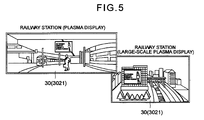
- the display unit 302 includes a display 3021 for displaying the moving-picture-advertisement-contents-MPEG2 data 10a which is received by the receiving unit 301.
- a large-scale plasma display, an aurora vision, or the like is used as the display 3021.
- the display 3021 is referred to as a large-scale plasma display 3021.
- the terminal-control unit 303 controls an operation for displaying the moving-picture-advertisement-contents-MPEG2 data 10a on the display unit 302 based on the advertisement-display-schedule data 10b. This function is also implemented via the microcomputer provided inside the client PC.
- the terminal-control unit 303 separates the advertisement-display-schedule data 10b from the moving-picture-advertisement-contents-MPEG2 data 10a.
- the decompression unit 304 serves to decode and decompress the moving-picture-advertisement-contents-MPEG2 data 10a that is received in an encoded and compressed form. This function is implemented via the microcomputer provided inside the client PC.
- the decompression unit 304 decodes and decompresses the moving-picture-advertisement-contents-MPEG2 data 10a when the receiving unit 301 receives the compressed moving-picture-advertisement-contents-MPEG2 data 10a via the ISDN lines 11.
- the terminal-control unit 303 controls the operation for displaying the moving-picture-advertisement-contents-MPEG2 data 10a on the large-scale plasma display 3021 according to the advertisement-display-schedule data 10b. Because of such a decompression mechanism, it is possible to receive in a compressed form the moving-picture information or high-definition images having a large amount of multi-media data in the range of several hundreds mega-bytes when the contents-delivery unit 204 of the center system 20 needs to send commercials on sales goods, notices from a local community, traffic information, a local weather forecast, or the like.
- the advertisement-moving picture contents are delivered during a time period when the communication-line-usage fee is relatively inexpensive, avoiding a daytime during which use of the ISDN lines 11 for a long time period would lead to an increase in the communication-line-usage fee.
- a low-cost solution is provided to cope with delivery of multi-media data such as moving pictures or high-definition images.
- the remote-delivery function directed to delivery of high-definition moving pictures i.e., the light-load-time-period-remote-casting function
- Each of the terminal systems 30 further includes a remote-monitoring-purpose monitor camera 305, a still-image-compression/encoding unit 306, a still-image storing unit 307, a selection-data transmission unit 311, and a still-image-transmission unit 314. These units are provided for the purpose of implementing a remote-monitoring function which is used for monitoring whether the moving-picture-advertisement-contents-MPEG2 data 10a sent from the center system 20 is displayed as expected on the large-scale plasma display 3021.
- the remote-monitoring-purpose monitor camera 305 takes a picture of what is displayed on the large-scale plasma display 3021, thereby generating still-image data.
- the remote-monitoring-purpose monitor camera 305 may be implemented by a CCD camera connected to the client PC.
- the still-image-compression/encoding unit 306 applies a compression/encoding process to the still-image data to generate compressed-still-image data.
- This unit is implemented via the microcomputer of the client PC.
- the still-image storing unit 307 stores the compressed-still-image data, and a RAM inside the client PC is used for this purpose.
- the still-image-transmission unit 314 serves a function to send the compressed-still-image data stored in the still-image storing unit 307 to the center system 20. This function is implemented via the microcomputer of the client PC, a DSU, and a TA.
- the remote-monitoring function is implemented so as to allow the center system 20 to monitor the operation conditions of the terminal systems 30 which are selected by the contents-delivery unit 204 based on the terminal-attribute information 10c. Namely, a check can be made as to whether the delivered contents are displayed as expected on the large-scale plasma display 3021 of the terminal systems 30 which are selected by the contents-delivery unit 204 based on the terminal-attribute information 10c. This is implemented as part of the light-load-time-period-remote-casting function. In this manner, it is possible to check what is shown on the large-scale plasma display 3021 by sampling pictures at constant intervals to provide a set of still pictures obtained during a predetermined time period prior to a present moment.
- the terminal systems 30 and the center system 20 can implement a superimposing function to display both the character information 10e and the moving-picture-advertisement-contents-MPEG2 data 10a on the large-scale plasma display 3021.
- each of the terminal systems 30 further includes a character-information-transmission unit 308, a identification-transmission unit 309, and a terminal-system selecting unit 310.
- the character-information-transmission unit 308 serves to generate and transmit the character information 10e, and is implemented by the microcomputer of the client PC, the DSU, and the TA.
- the identification-transmission unit 309 serves a function to transmit the identification data 10f of the terminal and the identification data 10f of the user, and the microprocessor of the client PC, the DSU, and the TA are used for this purpose.
- the terminal-system selecting unit 310 as shown in the figures is provided with a function to generate selection data for selecting the terminal systems 30 with an aim of having the character information 10e displayed on the large-scale plasma display 3021 of the selected terminal systems 30. This function is implemented by the microprocessor of the client PC.
- the selection-data transmission unit 311 serves to transmit the selection data, and is implemented by the microprocessor of the client PC, the DSU, and the TA. In this manner, authorized users using authorized terminal systems 30 can make the character information 10e displayed on the large-scale plasma display 3021, or can select the terminal systems 30 for making the selected terminal systems 30 display the character information 10e on the display unit 302 thereof.
- the character information 10e includes only a limited amount of data, transmission of such information via the ISDN lines 11 can be completed in a short time period, so that use of the character information 10e is suitable when emergency information requiring a realtime response needs to be displayed. In such a case, specific information of an urgent nature can be displayed on a selected set of terminal systems 30 located in a selected area.
- the contents-delivery unit 204 can be provided with the remote-control function to control the operations of the terminal systems 30 selected based on the terminal-attribute information 10c.
- the contents-delivery unit 204 can be provided with the function to check the operation conditions of the terminal systems 30 selected based on the terminal-attribute information 10c and to provide diligent delivery control, remote diagnosis, and remote maintenance.
- the identification function for identifying users can be combined with the emergency-responding function which gives priority to contents of an urgent nature such as earthquake information, fire information, railway-accident information, etc., over other routine contents. Such a combination can enhance reliability of the information by allowing a check to be made on the identity of the information source. This helps to avoid such a situation in which erroneous emergency information or fake emergency information are distributed, thereby providing a tight-security delivery function.
- Each of the terminal system 30 further includes a memory unit 312 into which a memory medium is inserted.
- Each of the terminal systems 30 is provided with a media-interface function to read moving-picture-advertisement-contents-MPEG2 data 10a from the memory medium of the memory unit 312.
- the memory unit 312 may be a removable-disk drive.
- the memory medium can be used for installing the contents in a terminal system 30 when the system is newly installed. This removes a need for transmitting the contents via the communication lines.
- the memory unit 312 can be used as a substitute for a hard drive of the terminal systems 30 when the hard drive suffers malfunction.
- the terminal systems 30 can receive the contents during a time period when the communication-line-usage fee is relatively inexpensive, the purpose being to avoid an increase in a communication-line-usage fee caused by use of the communication lines during a daytime for a long time period for delivering a large amount of the data.
- center system 20 determines and sends a display schedule, there is no need for center system 20 to control the display sequence of the terminal systems 30 at every turn. This results in the load on the center system 20 regarding display control being reduced, so that a single center system can attend to control a large number of terminal systems 30.
- Contents data is video images comparable to those of the DVD system.
- the 6-Mbps-advertisement-contents data 10a in compliance with the MPEG2 scheme can be used.
- Schedule-control software is used to achieve customized contents display for each of the terminal systems 30.
- Each of the terminal systems 30 is equipped with a small camera (remote-monitoring-purpose monitor camera 305).
- the display is monitored at all times, and a still image of the display is transmitted to the center system 20 once in several minutes to several tens of minutes.
- the center system 20 displays a thumbnail of the still pictures with respect to each terminal system or with respect to each group of terminal systems, thereby providing a monitoring function.
- a check can be made as to what time period is available for a given terminal system 30, and a setting of a display schedule can be made with respect to each moving-picture-advertisement-contents-MPEG2 data 10a.
- Places of Installation of Terminal Systems 30 (specified in the terminal-attribute information 10c): railway stations, underground malls, convenient stores, gasoline stations, etc.
- Terminal System 30 (Client PC) (see Figs.6, 7, 9, and 10)
- the center system (server PC) 20 has the same configuration as that of the first embodiment, and a description thereof will be omitted. A description will be given with regard to the terminal systems 30.
- the present invention provides the following advantages. Even when moving-picture information or high-definition images having a large amount of multi-media data in the range of several hundreds mega-bytes is sent from the center system to the terminal systems for the purpose of delivering commercials on sales goods, notices from a local community, traffic information, a local weather forecast, or the like, the contents are delivered during a time period when the communication-line-usage fee is relatively inexpensive, the purpose being to avoid an increase in a communication-line-usage fee caused by use of the communication lines during a daytime for a long time period for delivering a large amount of the data.
- the light-load-time-period-remote-casting function is implemented at a low cost so as to cope with the delivery of multi-media data such as moving pictures or high-definition images.
- multi-media data such as moving pictures or high-definition images.
- moving-picture information or high-definition images having a large amount of multi-media data in the range of several hundreds mega-bytes is sent from the center system to the terminal systems for the purpose of delivering commercials on sales goods, notices from a local community, traffic information, a local weather forecast, or the like
- the contents are delivered during a time period when the terminal systems are idling, the purpose being not to require the terminal systems to have a high-performance capacity and not to require the communication lines to have a high-speed-data-transfer capacity so as to avoid a cost increase associated with enhancement of the terminal systems and to avoid an increase in a communication-line-usage fee caused by use of a high-speed-data-transfer network.
- the light-load-time-period-remote-casting function is implemented at a low cost so as to cope with delivery of multi-media data such as moving pictures or high-definition video images.
- the contents are changed for each of the terminal systems based on the characteristics of the individual terminal systems so as to take into account a season, a date, a day, locations of the terminal systems, etc.
- Such a function is implemented as the light-load-time-period-remote-casting function.
- the light-load-time-period-remote-casting function is implemented so as to eliminate a need for time and labor to be spent on recording of contents in memory media, delivery of the memory media, and reading of contents from the memory media.
- the remote-delivery function directed to delivery of high-definition moving pictures i.e., the light-load-time-period-remote-casting function
- the light-load-time-period-remote-casting function can be achieved economically by using existing infrastructure, whereas such a function cannot be implemented in the related-art schemes which are based on either delivery of recording media or one-way delivery of contents.
Landscapes
- Engineering & Computer Science (AREA)
- Multimedia (AREA)
- Signal Processing (AREA)
- Business, Economics & Management (AREA)
- Marketing (AREA)
- Information Transfer Between Computers (AREA)
- Management, Administration, Business Operations System, And Electronic Commerce (AREA)
- Two-Way Televisions, Distribution Of Moving Picture Or The Like (AREA)
- Data Exchanges In Wide-Area Networks (AREA)
Applications Claiming Priority (4)
| Application Number | Priority Date | Filing Date | Title |
|---|---|---|---|
| JP3368198 | 1998-01-31 | ||
| JP3368198 | 1998-01-31 | ||
| JP36247698A JP3936481B2 (ja) | 1998-01-31 | 1998-12-21 | コンテンツ配信装置及びコンテンツ配信方法 |
| JP36247698 | 1998-12-21 |
Publications (3)
| Publication Number | Publication Date |
|---|---|
| EP0933941A2 true EP0933941A2 (de) | 1999-08-04 |
| EP0933941A3 EP0933941A3 (de) | 2001-09-12 |
| EP0933941B1 EP0933941B1 (de) | 2006-10-04 |
Family
ID=26372425
Family Applications (1)
| Application Number | Title | Priority Date | Filing Date |
|---|---|---|---|
| EP99101502A Expired - Lifetime EP0933941B1 (de) | 1998-01-31 | 1999-01-27 | Automatisches Multimediadatenlieferungssystem |
Country Status (4)
| Country | Link |
|---|---|
| US (2) | US6725460B1 (de) |
| EP (1) | EP0933941B1 (de) |
| JP (1) | JP3936481B2 (de) |
| DE (1) | DE69933402T2 (de) |
Cited By (7)
| Publication number | Priority date | Publication date | Assignee | Title |
|---|---|---|---|---|
| WO2001049035A3 (de) * | 1999-12-15 | 2001-11-22 | Cm Community Media Gmbh & Co K | Verfahren zur übertragung und wiedergabe von videodateien |
| WO2002003209A1 (en) | 2000-06-30 | 2002-01-10 | Seiko Epson Corporation | Information distribution system, information distribution method, and computer program for executing the method |
| WO2001084822A3 (en) * | 2000-04-28 | 2002-04-11 | William Wilson Iii | System, method and article of manufacture to facilitate remote station advertising |
| WO2002037849A1 (en) * | 2000-10-31 | 2002-05-10 | Motion Media Technology Limited | Video communication system |
| EP1345434A1 (de) * | 2002-03-15 | 2003-09-17 | Elias Dritsopoulos | System zur Berichtsübertragung zu einem entfernten Terminal |
| SG98442A1 (en) * | 2000-02-17 | 2003-09-19 | Toyo Engineering Corp | Hosting system |
| EP1594281A1 (de) * | 2004-04-27 | 2005-11-09 | NTT DoCoMo, Inc. | Datenübermittlungsgerät und Verfahren zum Ändern des Datenübermittlungszeitpunktes |
Families Citing this family (80)
| Publication number | Priority date | Publication date | Assignee | Title |
|---|---|---|---|---|
| US7397363B2 (en) * | 1993-06-08 | 2008-07-08 | Raymond Anthony Joao | Control and/or monitoring apparatus and method |
| US10011247B2 (en) | 1996-03-27 | 2018-07-03 | Gtj Ventures, Llc | Control, monitoring and/or security apparatus and method |
| US7277010B2 (en) | 1996-03-27 | 2007-10-02 | Raymond Anthony Joao | Monitoring apparatus and method |
| US7253731B2 (en) | 2001-01-23 | 2007-08-07 | Raymond Anthony Joao | Apparatus and method for providing shipment information |
| US10152876B2 (en) | 1996-03-27 | 2018-12-11 | Gtj Ventures, Llc | Control, monitoring, and/or security apparatus and method |
| JP3936481B2 (ja) * | 1998-01-31 | 2007-06-27 | 株式会社リコー | コンテンツ配信装置及びコンテンツ配信方法 |
| US9075136B1 (en) | 1998-03-04 | 2015-07-07 | Gtj Ventures, Llc | Vehicle operator and/or occupant information apparatus and method |
| US6670934B1 (en) * | 1999-02-03 | 2003-12-30 | William H. Gates, III | Method and system for distributing art |
| US20020013852A1 (en) * | 2000-03-03 | 2002-01-31 | Craig Janik | System for providing content, management, and interactivity for thin client devices |
| US7468934B1 (en) * | 1999-07-12 | 2008-12-23 | Ez4Media, Inc. | Clock with link to the internet |
| US7130616B2 (en) * | 2000-04-25 | 2006-10-31 | Simple Devices | System and method for providing content, management, and interactivity for client devices |
| US20050210101A1 (en) * | 1999-03-04 | 2005-09-22 | Universal Electronics Inc. | System and method for providing content, management, and interactivity for client devices |
| JP2001169268A (ja) * | 1999-12-14 | 2001-06-22 | Sony Corp | 情報提供システム、送信サーバ、情報端末装置、オーサリング装置及び情報提供方法 |
| US6564064B1 (en) * | 1999-12-01 | 2003-05-13 | Trimble Navigation Limited | Cellular telephone using pseudolites for determining location |
| AU2001236007A1 (en) * | 2000-02-29 | 2001-09-12 | Sharp Kabushiki Kaisha | Data transmission system, server used for the data transmission system, and terminal adapter |
| TWI221383B (en) | 2000-03-30 | 2004-09-21 | Sony Corp | Profit feedback device, method and system thereof, contents providing device, method and system and program storage media |
| JP4538697B2 (ja) * | 2000-03-30 | 2010-09-08 | ソニー株式会社 | 利益還元装置、利益還元方法及びシステム |
| US7136906B2 (en) * | 2000-04-07 | 2006-11-14 | Clarity Visual Systems, Inc. | System for electronically distributing, displaying and controlling the play scheduling of advertising and other communicative media |
| WO2001077840A1 (en) * | 2000-04-07 | 2001-10-18 | Giacalone Louis D | Method and system for electronically distributing, displaying and controlling advertising and other communicative media |
| JP3528754B2 (ja) * | 2000-04-26 | 2004-05-24 | 日本電気株式会社 | 番組録画配信システム、番組録画配信方法 |
| US7379963B1 (en) * | 2000-07-14 | 2008-05-27 | Knownow-Delaware | Delivery of any type of information to anyone anytime anywhere |
| EP1182878A1 (de) * | 2000-08-22 | 2002-02-27 | Koninklijke Philips Electronics N.V. | Kommunikationssystem, Sender, Empfänger, Verfahren unter Verwendung einer Datenspeicherungsdescriptors |
| JP2002175239A (ja) * | 2000-12-08 | 2002-06-21 | Sharp Corp | 情報表示装置、情報配信装置およびそれらを接続したシステムにおける表示データ配信方法 |
| JP2002182630A (ja) * | 2000-12-12 | 2002-06-26 | Toshiba Transport Eng Inc | 出力制御装置、遠隔操作端末、及びこれらを用いた出力制御装置のリモートメンテナンスシステム |
| JP2002247549A (ja) * | 2001-02-21 | 2002-08-30 | Hitachi Building Systems Co Ltd | 情報表示装置 |
| JP2002259272A (ja) * | 2001-03-06 | 2002-09-13 | Hitachi Kokusai Electric Inc | 情報提供システム |
| US20020143974A1 (en) * | 2001-04-02 | 2002-10-03 | Scott Swix | Local account manager for a media delivery network |
| US20020141348A1 (en) * | 2001-04-02 | 2002-10-03 | Scott Swix | Remote diagnostic tool for a media delivery network |
| US7584491B2 (en) * | 2001-04-25 | 2009-09-01 | Sony Corporation | System and method for managing interactive programming and advertisements in interactive broadcast systems |
| WO2002091261A1 (fr) * | 2001-05-02 | 2002-11-14 | Dentsu Inc. | Systeme de gestion de la distribution des publicites |
| US20030023638A1 (en) * | 2001-05-02 | 2003-01-30 | Weight Christopher F. | Method and apparatus for processing content |
| US7099659B1 (en) * | 2001-06-05 | 2006-08-29 | Sprint Spectrum L.P. | Method and system for management of messages |
| JP2002366069A (ja) * | 2001-06-05 | 2002-12-20 | Matsushita Electric Ind Co Ltd | 表示広告決定装置、表示広告決定方法および表示広告決定プログラム、並びに、広告システム |
| JP2003037829A (ja) * | 2001-07-23 | 2003-02-07 | Akira Fujiwara | 情報配信表示システム |
| US7614065B2 (en) | 2001-12-17 | 2009-11-03 | Automated Media Services, Inc. | System and method for verifying content displayed on an electronic visual display |
| US20030229549A1 (en) * | 2001-10-17 | 2003-12-11 | Automated Media Services, Inc. | System and method for providing for out-of-home advertising utilizing a satellite network |
| US20050075929A1 (en) * | 2002-10-17 | 2005-04-07 | Wolinsky Robert I. | System and method for partitioning airtime for distribution and display of content |
| JP2003230121A (ja) * | 2001-11-30 | 2003-08-15 | Fujitsu Ltd | コンテンツ配信方法、コンテンツ視聴方法、サーバ装置、および端末装置 |
| US20030134260A1 (en) * | 2002-01-11 | 2003-07-17 | Hartman Richard M. | Multi-client type learning system |
| JP2003208489A (ja) * | 2002-01-15 | 2003-07-25 | Sony Corp | 証明システム、証明装置、証明方法、証明プログラム、証明プログラム格納媒体、携帯端末装置、証明情報取得方法、証明情報取得プログラム、証明情報取得プログラム格納媒体、商品販売装置、商品販売方法、商品販売プログラム、商品販売プログラム格納媒体 |
| US10562492B2 (en) | 2002-05-01 | 2020-02-18 | Gtj Ventures, Llc | Control, monitoring and/or security apparatus and method |
| JP2004063001A (ja) * | 2002-07-29 | 2004-02-26 | Pioneer Electronic Corp | 情報再生装置、情報再生方法、情報再生用プログラム及び当該情報再生用プログラムを記録した情報記録媒体 |
| US7613630B2 (en) * | 2002-10-17 | 2009-11-03 | Automated Media Services, Inc. | System and method for editing existing footage to generate and distribute advertising content to retail locations |
| US7546383B2 (en) * | 2003-01-08 | 2009-06-09 | Microsoft Corporation | Enabling broadcast of multiple data configurations |
| KR100507707B1 (ko) * | 2003-08-26 | 2005-08-09 | 니트젠테크놀러지스 주식회사 | 네트웍 기반의 광고/방송 스케줄링 방법, 화면 분할을통한 중앙 통제 관리 시스템 및 방법 |
| JP2005092164A (ja) * | 2003-09-12 | 2005-04-07 | Ac & T:Kk | 多目的電子看板システムと電子看板の配信方法 |
| US20060008256A1 (en) * | 2003-10-01 | 2006-01-12 | Khedouri Robert K | Audio visual player apparatus and system and method of content distribution using the same |
| US20130097302A9 (en) * | 2003-10-01 | 2013-04-18 | Robert Khedouri | Audio visual player apparatus and system and method of content distribution using the same |
| KR100995042B1 (ko) * | 2004-07-23 | 2010-11-22 | 엘지전자 주식회사 | 디지털 방송 수신기 및 그의 긴급 경고 메시지 처리 방법 |
| JP2006277287A (ja) * | 2005-03-29 | 2006-10-12 | Brother Ind Ltd | コンテンツ提供システム,情報収集装置およびプログラム |
| EP1867155B1 (de) * | 2005-03-30 | 2015-09-09 | Nokia Solutions and Networks GmbH & Co. KG | Verfahren und anordnung zum speichern und wiedergeben von tv-sendungen |
| US9002258B2 (en) | 2006-01-18 | 2015-04-07 | Dongju Chung | Adaptable audio instruction system and method |
| DE102006013474B4 (de) * | 2006-03-23 | 2019-01-31 | Siemens Healthcare Gmbh | Verfahren zur Echtzeitrekonstruktion und Darstellung eines dreidimensionalen Zielvolumens |
| JP2007312028A (ja) * | 2006-05-17 | 2007-11-29 | Fuji Xerox Co Ltd | 監視画像送出装置およびプログラム |
| US7859392B2 (en) * | 2006-05-22 | 2010-12-28 | Iwi, Inc. | System and method for monitoring and updating speed-by-street data |
| US7627683B2 (en) | 2006-12-27 | 2009-12-01 | At&T Mobility Ii Llc | System and method for dynamically refreshing an active home screen |
| US20100241509A1 (en) * | 2007-05-25 | 2010-09-23 | Pioneer Solutions Corporation | Advertisement information delivery / display method, advertisement information delivery / display system, and computer program |
| US8069464B2 (en) * | 2007-07-27 | 2011-11-29 | Cisco Technology, Inc. | Architecture for scaling just-in-time placement of advertising content |
| JP2009159188A (ja) * | 2007-12-26 | 2009-07-16 | Hitachi Ltd | コンテンツ表示用サーバ |
| US20090204479A1 (en) * | 2008-02-08 | 2009-08-13 | Automated Media Services, Inc. | System and method for creating an in-store media network using traditional media metrics |
| JP2009201011A (ja) * | 2008-02-25 | 2009-09-03 | Pioneer Electronic Corp | 端末電源管理方法、番組表示端末および端末電源管理プログラム |
| US8112475B2 (en) | 2008-06-27 | 2012-02-07 | Microsoft Corporation | Managing data delivery based on device state |
| GB2473910A (en) | 2009-09-10 | 2011-03-30 | Miniweb Technologies Ltd | Backup for user invoked interruptions |
| JP5930515B2 (ja) * | 2009-10-02 | 2016-06-08 | 小泉 俊司 | 番組の放送方法 |
| US8519860B2 (en) * | 2010-04-09 | 2013-08-27 | Weather Decision Technologies | Multimedia alerting |
| JP2012164208A (ja) * | 2011-02-08 | 2012-08-30 | Nec Access Technica Ltd | ネットワークシステム、ホームゲートウェイ、コンテンツ再生方法、及びネットワーク管理用プログラム |
| US8989280B2 (en) * | 2011-06-30 | 2015-03-24 | Cable Television Laboratories, Inc. | Frame identification |
| JP5650615B2 (ja) * | 2011-09-13 | 2015-01-07 | 日本電信電話株式会社 | 放映計画生成方法、放映計画生成装置及び放映計画生成プログラム |
| JP6047869B2 (ja) | 2011-09-30 | 2016-12-21 | 株式会社リコー | 伝送システム、参加料金管理方法、及びプログラム |
| EP2806669A1 (de) * | 2013-05-23 | 2014-11-26 | Deutsche Telekom AG | Verschobene Übertragung von Daten zur Entlastung der Luftschnittstelle |
| US10546441B2 (en) | 2013-06-04 | 2020-01-28 | Raymond Anthony Joao | Control, monitoring, and/or security, apparatus and method for premises, vehicles, and/or articles |
| US10110541B2 (en) * | 2013-10-17 | 2018-10-23 | International Business Machines Corporation | Optimization of posting in social networks using content delivery preferences comprising hashtags that correspond to geography and a content type associated with a desired time window |
| US9753947B2 (en) | 2013-12-10 | 2017-09-05 | Weather Decision Technologies, Inc. | Four dimensional weather data storage and access |
| US9821738B2 (en) | 2014-06-30 | 2017-11-21 | Raymond Anthony Joao | Battery power management apparatus and method |
| WO2016068873A1 (en) * | 2014-10-28 | 2016-05-06 | Hewlett Packard Enterprise Development Lp | Media content download time |
| JP6054362B2 (ja) * | 2014-12-24 | 2016-12-27 | ソフトバンク株式会社 | 広告配信装置、プログラム及び広告配信方法 |
| US12381953B2 (en) | 2019-07-01 | 2025-08-05 | Raymond Anthony Joao | Control, monitoring, and/or security, apparatus and method for premises, vehicles, and/or articles |
| US12380294B2 (en) | 2019-11-01 | 2025-08-05 | Raymond Anthony Joao | Control, monitoring, and/or security, apparatus and method for premises, vehicles, and/or articles |
| JP6869404B2 (ja) * | 2020-06-24 | 2021-05-12 | 能美防災株式会社 | 防災システム |
| US11760227B2 (en) | 2021-02-15 | 2023-09-19 | Raymond Anthony Joao | Battery power management apparatus and method |
Family Cites Families (28)
| Publication number | Priority date | Publication date | Assignee | Title |
|---|---|---|---|---|
| DE3418618A1 (de) * | 1984-02-16 | 1985-08-22 | Siemens AG, 1000 Berlin und 8000 München | Informationsabrufsystem |
| US4642758A (en) * | 1984-07-16 | 1987-02-10 | At&T Bell Laboratories | File transfer scheduling arrangement |
| US5099319A (en) * | 1989-10-23 | 1992-03-24 | Esch Arthur G | Video information delivery method and apparatus |
| US5253275A (en) * | 1991-01-07 | 1993-10-12 | H. Lee Browne | Audio and video transmission and receiving system |
| EP0595808B1 (de) * | 1991-07-19 | 1999-06-23 | Princeton Video Image, Inc. | Fernsehanzeigen mit ausgewählten eingeblendeten zeichen |
| US5305195A (en) * | 1992-03-25 | 1994-04-19 | Gerald Singer | Interactive advertising system for on-line terminals |
| US5412416A (en) * | 1992-08-07 | 1995-05-02 | Nbl Communications, Inc. | Video media distribution network apparatus and method |
| US5600364A (en) * | 1992-12-09 | 1997-02-04 | Discovery Communications, Inc. | Network controller for cable television delivery systems |
| US5761601A (en) * | 1993-08-09 | 1998-06-02 | Nemirofsky; Frank R. | Video distribution of advertisements to businesses |
| US5734786A (en) * | 1993-10-20 | 1998-03-31 | E Guide, Inc. | Apparatus and methods for deriving a television guide from audio signals |
| DE69409407T2 (de) * | 1993-10-27 | 1998-10-29 | Princeton Electronic Billboard | Abwärtsgerichtete kontrolle einer elektronischer anzeigetafel |
| US5946646A (en) * | 1994-03-23 | 1999-08-31 | Digital Broadband Applications Corp. | Interactive advertising system and device |
| US6021307A (en) * | 1994-04-07 | 2000-02-01 | Chan; Hark C. | Information distribution and processing system |
| US5664948A (en) | 1994-07-29 | 1997-09-09 | Seiko Communications Holding N.V. | Delivery of data including preloaded advertising data |
| US5774170A (en) * | 1994-12-13 | 1998-06-30 | Hite; Kenneth C. | System and method for delivering targeted advertisements to consumers |
| US5557320A (en) * | 1995-01-31 | 1996-09-17 | Krebs; Mark | Video mail delivery system |
| JPH0983565A (ja) | 1995-09-13 | 1997-03-28 | Toshiba Corp | 通信システム |
| US6230325B1 (en) | 1995-10-05 | 2001-05-08 | Nec Corporation | Information network system making use of television or radio broadcasting and broadcast receiving user terminal |
| JPH09139933A (ja) | 1995-11-15 | 1997-05-27 | Nec Corp | 情報ネットワークシステム及びナビゲーション装置 |
| JPH09102944A (ja) | 1995-10-05 | 1997-04-15 | Nec Corp | 情報ネットワークシステム及びナビゲーション装置 |
| JPH09130763A (ja) * | 1995-11-01 | 1997-05-16 | Matsushita Electric Ind Co Ltd | 静止画伝送装置 |
| AU6077196A (en) * | 1996-02-01 | 1997-08-07 | Mitsubishi Denki Kabushiki Kaisha | Multimedia information processing system |
| US5892535A (en) * | 1996-05-08 | 1999-04-06 | Digital Video Systems, Inc. | Flexible, configurable, hierarchical system for distributing programming |
| JPH104379A (ja) | 1996-06-14 | 1998-01-06 | Showa Joho Kiki Kk | 広告装置 |
| CA2199757C (en) * | 1997-03-12 | 2003-05-13 | Dean L. Lacheur | Information display system |
| US6075551A (en) * | 1997-07-08 | 2000-06-13 | United Video Properties, Inc. | Video promotion system with flexible local insertion capabilities |
| US6029045A (en) * | 1997-12-09 | 2000-02-22 | Cogent Technology, Inc. | System and method for inserting local content into programming content |
| JP3936481B2 (ja) * | 1998-01-31 | 2007-06-27 | 株式会社リコー | コンテンツ配信装置及びコンテンツ配信方法 |
-
1998
- 1998-12-21 JP JP36247698A patent/JP3936481B2/ja not_active Expired - Fee Related
-
1999
- 1999-01-27 DE DE69933402T patent/DE69933402T2/de not_active Expired - Lifetime
- 1999-01-27 EP EP99101502A patent/EP0933941B1/de not_active Expired - Lifetime
- 1999-01-28 US US09/238,639 patent/US6725460B1/en not_active Expired - Lifetime
-
2004
- 2004-03-10 US US10/796,178 patent/US7350223B2/en not_active Expired - Fee Related
Cited By (11)
| Publication number | Priority date | Publication date | Assignee | Title |
|---|---|---|---|---|
| WO2001049035A3 (de) * | 1999-12-15 | 2001-11-22 | Cm Community Media Gmbh & Co K | Verfahren zur übertragung und wiedergabe von videodateien |
| SG98442A1 (en) * | 2000-02-17 | 2003-09-19 | Toyo Engineering Corp | Hosting system |
| WO2001084822A3 (en) * | 2000-04-28 | 2002-04-11 | William Wilson Iii | System, method and article of manufacture to facilitate remote station advertising |
| WO2002003209A1 (en) | 2000-06-30 | 2002-01-10 | Seiko Epson Corporation | Information distribution system, information distribution method, and computer program for executing the method |
| US7076522B2 (en) | 2000-06-30 | 2006-07-11 | Seiko Epson Corporation | Information distribution system, information distribution method, and computer program for executing the method |
| EP1223514A4 (de) * | 2000-06-30 | 2009-07-29 | Seiko Epson Corp | INFORMATIONSVERTEILUNGSSYSTEM, INFORMATIONSVERTEILUNGSVERFAHREN UND RECHNERPROGRAMM UM DAS VERFAHREN AUSZUFüHREN |
| WO2002037849A1 (en) * | 2000-10-31 | 2002-05-10 | Motion Media Technology Limited | Video communication system |
| EP1345434A1 (de) * | 2002-03-15 | 2003-09-17 | Elias Dritsopoulos | System zur Berichtsübertragung zu einem entfernten Terminal |
| EP1594281A1 (de) * | 2004-04-27 | 2005-11-09 | NTT DoCoMo, Inc. | Datenübermittlungsgerät und Verfahren zum Ändern des Datenübermittlungszeitpunktes |
| CN100364267C (zh) * | 2004-04-27 | 2008-01-23 | 株式会社Ntt都科摩 | 数据发送装置和数据发送时刻的变更方法 |
| US7493343B2 (en) | 2004-04-27 | 2009-02-17 | Ntt Docomo, Inc. | Data delivery device and alteration method of data delivery time |
Also Published As
| Publication number | Publication date |
|---|---|
| JP3936481B2 (ja) | 2007-06-27 |
| US7350223B2 (en) | 2008-03-25 |
| EP0933941A3 (de) | 2001-09-12 |
| EP0933941B1 (de) | 2006-10-04 |
| US20040172655A1 (en) | 2004-09-02 |
| JPH11284977A (ja) | 1999-10-15 |
| DE69933402T2 (de) | 2007-08-23 |
| US6725460B1 (en) | 2004-04-20 |
| DE69933402D1 (de) | 2006-11-16 |
Similar Documents
| Publication | Publication Date | Title |
|---|---|---|
| US6725460B1 (en) | Multi-media data automatic delivery system | |
| US10756836B2 (en) | Electronic display remote image verification system and method | |
| US5949411A (en) | Remote interactive multimedia preview and data collection kiosk system | |
| CN102457710A (zh) | 一种3g无线视频监控系统及其视频监控方法 | |
| CN102694797A (zh) | 一种应用于交通站台屏蔽门的信息播放控制系统 | |
| CN101999227A (zh) | 实况制作中的内容替换的方法和装置 | |
| US20100241509A1 (en) | Advertisement information delivery / display method, advertisement information delivery / display system, and computer program | |
| US6931658B1 (en) | Image on-demand transmitting device and a method thereof | |
| US20020035731A1 (en) | System and method for broadcasting information in a television distribution system | |
| CN106791975B (zh) | 一种视频直播的方法、终端设备和视频直播系统 | |
| JP2001189895A (ja) | テレビジョン受像機、テレビジョン受像機用リモートコントローラおよびサービス提供システム | |
| US6230296B1 (en) | Method and apparatus for providing error correction | |
| JPH10187107A (ja) | 情報表示システム、表示スケジュール作成装置、案内情報管理装置 | |
| WO2015037304A1 (ja) | 画像監視システムおよび画像送信方法 | |
| JP3718427B2 (ja) | カメラ装置、端末装置及びカメラ監視システム | |
| JP2001057673A (ja) | 放映配信システム | |
| US8745682B1 (en) | Integrated cable modem and cable television management system | |
| JP2005348073A (ja) | 映像配信サーバ及び映像配信方法、並びにプログラム及び記憶媒体 | |
| JP2021034962A (ja) | 制御装置、制御プログラム及び制御システム | |
| JPH10108271A (ja) | ビル遠隔監視装置 | |
| JP2003169311A (ja) | 動画像配信サービスシステムにおける動画像コンテンツ配信切替え装置ならびにその方法、および動画像コンテンツ配信切替えプログラムならびにその記録媒体 | |
| JP2002010233A (ja) | ネットワークを用いた施設情報提供方法ならびにそのシステム | |
| CN116017075B (zh) | 基于录像的即时回放方法、系统、计算机设备和可读存储介质 | |
| JP4382739B2 (ja) | 監視システム | |
| JPH10262237A (ja) | 映像監視システム |
Legal Events
| Date | Code | Title | Description |
|---|---|---|---|
| PUAI | Public reference made under article 153(3) epc to a published international application that has entered the european phase |
Free format text: ORIGINAL CODE: 0009012 |
|
| AK | Designated contracting states |
Kind code of ref document: A2 Designated state(s): AT BE CH CY DE DK ES FI FR GB GR IE IT LI LU MC NL PT SE Kind code of ref document: A2 Designated state(s): DE ES FR GB IT NL |
|
| AX | Request for extension of the european patent |
Free format text: AL;LT;LV;MK;RO;SI |
|
| PUAL | Search report despatched |
Free format text: ORIGINAL CODE: 0009013 |
|
| AK | Designated contracting states |
Kind code of ref document: A3 Designated state(s): AT BE CH CY DE DK ES FI FR GB GR IE IT LI LU MC NL PT SE |
|
| AX | Request for extension of the european patent |
Free format text: AL;LT;LV;MK;RO;SI |
|
| RIC1 | Information provided on ipc code assigned before grant |
Free format text: 7H 04N 7/14 A, 7H 04N 7/173 B |
|
| 17P | Request for examination filed |
Effective date: 20011016 |
|
| AKX | Designation fees paid |
Free format text: DE ES FR GB IT NL |
|
| 17Q | First examination report despatched |
Effective date: 20020920 |
|
| RAP1 | Party data changed (applicant data changed or rights of an application transferred) |
Owner name: RICOH COMPANY LTD. |
|
| GRAP | Despatch of communication of intention to grant a patent |
Free format text: ORIGINAL CODE: EPIDOSNIGR1 |
|
| GRAS | Grant fee paid |
Free format text: ORIGINAL CODE: EPIDOSNIGR3 |
|
| GRAA | (expected) grant |
Free format text: ORIGINAL CODE: 0009210 |
|
| AK | Designated contracting states |
Kind code of ref document: B1 Designated state(s): DE ES FR GB IT NL |
|
| PG25 | Lapsed in a contracting state [announced via postgrant information from national office to epo] |
Ref country code: NL Free format text: LAPSE BECAUSE OF FAILURE TO SUBMIT A TRANSLATION OF THE DESCRIPTION OR TO PAY THE FEE WITHIN THE PRESCRIBED TIME-LIMIT Effective date: 20061004 Ref country code: IT Free format text: LAPSE BECAUSE OF FAILURE TO SUBMIT A TRANSLATION OF THE DESCRIPTION OR TO PAY THE FEE WITHIN THE PRESCRIBED TIME-LIMIT;WARNING: LAPSES OF ITALIAN PATENTS WITH EFFECTIVE DATE BEFORE 2007 MAY HAVE OCCURRED AT ANY TIME BEFORE 2007. THE CORRECT EFFECTIVE DATE MAY BE DIFFERENT FROM THE ONE RECORDED. Effective date: 20061004 |
|
| REG | Reference to a national code |
Ref country code: GB Ref legal event code: FG4D |
|
| REF | Corresponds to: |
Ref document number: 69933402 Country of ref document: DE Date of ref document: 20061116 Kind code of ref document: P |
|
| PG25 | Lapsed in a contracting state [announced via postgrant information from national office to epo] |
Ref country code: ES Free format text: LAPSE BECAUSE OF FAILURE TO SUBMIT A TRANSLATION OF THE DESCRIPTION OR TO PAY THE FEE WITHIN THE PRESCRIBED TIME-LIMIT Effective date: 20070115 |
|
| NLV1 | Nl: lapsed or annulled due to failure to fulfill the requirements of art. 29p and 29m of the patents act | ||
| ET | Fr: translation filed | ||
| PLBE | No opposition filed within time limit |
Free format text: ORIGINAL CODE: 0009261 |
|
| STAA | Information on the status of an ep patent application or granted ep patent |
Free format text: STATUS: NO OPPOSITION FILED WITHIN TIME LIMIT |
|
| 26N | No opposition filed |
Effective date: 20070705 |
|
| PGFP | Annual fee paid to national office [announced via postgrant information from national office to epo] |
Ref country code: FR Payment date: 20130213 Year of fee payment: 15 |
|
| REG | Reference to a national code |
Ref country code: FR Ref legal event code: ST Effective date: 20140930 |
|
| PG25 | Lapsed in a contracting state [announced via postgrant information from national office to epo] |
Ref country code: FR Free format text: LAPSE BECAUSE OF NON-PAYMENT OF DUE FEES Effective date: 20140131 |
|
| PGFP | Annual fee paid to national office [announced via postgrant information from national office to epo] |
Ref country code: DE Payment date: 20170120 Year of fee payment: 19 |
|
| PGFP | Annual fee paid to national office [announced via postgrant information from national office to epo] |
Ref country code: GB Payment date: 20170119 Year of fee payment: 19 |
|
| REG | Reference to a national code |
Ref country code: DE Ref legal event code: R119 Ref document number: 69933402 Country of ref document: DE |
|
| GBPC | Gb: european patent ceased through non-payment of renewal fee |
Effective date: 20180127 |
|
| PG25 | Lapsed in a contracting state [announced via postgrant information from national office to epo] |
Ref country code: DE Free format text: LAPSE BECAUSE OF NON-PAYMENT OF DUE FEES Effective date: 20180801 |
|
| PG25 | Lapsed in a contracting state [announced via postgrant information from national office to epo] |
Ref country code: GB Free format text: LAPSE BECAUSE OF NON-PAYMENT OF DUE FEES Effective date: 20180127 |