EP0936184B1 - Verfahren zur Herstellung von Chlor - Google Patents
Verfahren zur Herstellung von Chlor Download PDFInfo
- Publication number
- EP0936184B1 EP0936184B1 EP99301108.9A EP99301108A EP0936184B1 EP 0936184 B1 EP0936184 B1 EP 0936184B1 EP 99301108 A EP99301108 A EP 99301108A EP 0936184 B1 EP0936184 B1 EP 0936184B1
- Authority
- EP
- European Patent Office
- Prior art keywords
- catalyst
- ruthenium
- carrier
- titanium oxide
- supported
- Prior art date
- Legal status (The legal status is an assumption and is not a legal conclusion. Google has not performed a legal analysis and makes no representation as to the accuracy of the status listed.)
- Expired - Lifetime
Links
Images




Classifications
-
- B—PERFORMING OPERATIONS; TRANSPORTING
- B01—PHYSICAL OR CHEMICAL PROCESSES OR APPARATUS IN GENERAL
- B01J—CHEMICAL OR PHYSICAL PROCESSES, e.g. CATALYSIS OR COLLOID CHEMISTRY; THEIR RELEVANT APPARATUS
- B01J23/00—Catalysts comprising metals or metal oxides or hydroxides, not provided for in group B01J21/00
- B01J23/70—Catalysts comprising metals or metal oxides or hydroxides, not provided for in group B01J21/00 of the iron group metals or copper
- B01J23/74—Iron group metals
-
- B—PERFORMING OPERATIONS; TRANSPORTING
- B01—PHYSICAL OR CHEMICAL PROCESSES OR APPARATUS IN GENERAL
- B01J—CHEMICAL OR PHYSICAL PROCESSES, e.g. CATALYSIS OR COLLOID CHEMISTRY; THEIR RELEVANT APPARATUS
- B01J23/00—Catalysts comprising metals or metal oxides or hydroxides, not provided for in group B01J21/00
- B01J23/38—Catalysts comprising metals or metal oxides or hydroxides, not provided for in group B01J21/00 of noble metals
- B01J23/54—Catalysts comprising metals or metal oxides or hydroxides, not provided for in group B01J21/00 of noble metals combined with metals, oxides or hydroxides provided for in groups B01J23/02 - B01J23/36
- B01J23/56—Platinum group metals
- B01J23/64—Platinum group metals with arsenic, antimony, bismuth, vanadium, niobium, tantalum, polonium, chromium, molybdenum, tungsten, manganese, technetium or rhenium
- B01J23/652—Chromium, molybdenum or tungsten
- B01J23/6522—Chromium
-
- B—PERFORMING OPERATIONS; TRANSPORTING
- B01—PHYSICAL OR CHEMICAL PROCESSES OR APPARATUS IN GENERAL
- B01J—CHEMICAL OR PHYSICAL PROCESSES, e.g. CATALYSIS OR COLLOID CHEMISTRY; THEIR RELEVANT APPARATUS
- B01J23/00—Catalysts comprising metals or metal oxides or hydroxides, not provided for in group B01J21/00
- B01J23/38—Catalysts comprising metals or metal oxides or hydroxides, not provided for in group B01J21/00 of noble metals
- B01J23/40—Catalysts comprising metals or metal oxides or hydroxides, not provided for in group B01J21/00 of noble metals of the platinum group metals
- B01J23/46—Ruthenium, rhodium, osmium or iridium
- B01J23/462—Ruthenium
-
- C—CHEMISTRY; METALLURGY
- C01—INORGANIC CHEMISTRY
- C01B—NON-METALLIC ELEMENTS; COMPOUNDS THEREOF; METALLOIDS OR COMPOUNDS THEREOF NOT COVERED BY SUBCLASS C01C
- C01B7/00—Halogens; Halogen acids
- C01B7/01—Chlorine; Hydrogen chloride
- C01B7/03—Preparation from chlorides
- C01B7/04—Preparation of chlorine from hydrogen chloride
Definitions
- a ruthenium chloride catalyst supported on silica is exemplified.
- a test was conducted using a catalyst prepared by using a process for preparing a ruthenium (III) chloride supported on silica disclosed in said patent publication.
- the ruthenium compound as a catalyst component is drastically volatilized and it was disadvantageous for industrial use.
- European Patent EP-0184413A2 discloses a process for oxidizing hydrogen chloride by using a chromium oxide catalyst.
- conventionally known processes had a problem that the activity of the catalyst is insufficient and high reaction temperature is required.
- Both high activity per unit weight of catalyst and high activity per unit weight of ruthenium contained in the catalyst are required to the catalyst, industrially. Since high activity per unit weight of ruthenium contained in the catalyst can reduce the amount of ruthenium contained in the catalyst, it becomes advantageous in view of cost. It is possible to select the reaction condition which is more advantageous in view of equilibrium by conducting the reaction at a lower temperature using a catalyst having high activity. It is preferred to conduct the reaction at a lower temperature in view of stability of the catalyst.
- the catalyst used in the oxidizing reaction of hydrogen chloride includes, for example, a supported ruthenium oxide catalyst prepared by supporting ruthenium chloride on a carrier, drying the supported one, heating in a hydrogen gas flow to form a supported metal ruthenium catalyst, and oxidizing the catalyst.
- a supported ruthenium oxide catalyst prepared by supporting ruthenium chloride on a carrier, drying the supported one, heating in a hydrogen gas flow to form a supported metal ruthenium catalyst, and oxidizing the catalyst.
- a process for preparing ruthenium oxide supported on a carrier without causing sintering of ruthenium during the preparation step of a catalyst is preferred.
- a process has been desired which is not a process for reducing at high temperature by using hydrogen, but a process for preparing ruthenium oxide on a carrier with preventing sintering by treating a ruthenium compound with a mixture of a basic compound and a reducing compound, or a mixture of an alkali compound and a reducing compound, and oxidizing the treated one.
- a process has been desired which is a process for preparing ruthenium oxide on a carrier with preventing sintering by oxidizing after passing through a state of an oxidation number of 1 to less than 4 valence without preparing a ruthenium compound having an oxidation number of 0 valence by completely reduction.
- a supported ruthenium oxide catalyst obtained by using an anatase crystalline or non-crystalline titanium oxide as a carrier was highly active to oxidation of hydrogen chloride, but it has been required to develop a catalyst having higher activity.
- a ruthenium oxide catalyst is useful as a catalyst in process for preparing chlorine by an oxidizing reaction of hydrogen chloride and is obtained by hydrolyzing ruthenium chloride, oxidizing the hydrolyzed one, and calcining the oxidized one.
- European patent EP-0743277A1 discloses that a ruthenium oxide catalyst supported on titanium oxide is obtained by hydrolyzing a ruthenium compound by using an alkali metal hydroxide, supporting the hydrolyzed one on titanium hydroxide, and calcining the supported one under air. The present inventors have found that the supported ruthenium oxide catalyst is obtained by oxidizing a supported metal ruthenium catalyst.
- a process for preparing the supported metal ruthenium catalyst for example, it is known that a process for preparing a supported metal ruthenium catalyst by supporting ruthenium chloride on a carrier, drying the supported one, and heating the dried one in a hydrogen gas flow.
- a supported ruthenium oxide catalyst prepared by oxidizing a catalyst reduced by hydrogen has low activity due to sintering of ruthenium when ruthenium chloride is reduced with hydrogen.
- a process for preparing ruthenium oxide supported on a carrier with preventing sintering has been required.
- a process has been desired which is not a process for reducing at high temperature by using hydrogen, but for treating a ruthenium compound with a mixture of a reducing compound and a basic compound, or a mixture of an alkali compound and a reducing compound, and oxidizing the treated one.
- a process has been desired which is a process for preparing ruthenium oxide on a carrier with preventing sintering by oxidizing after passing through a state of an oxidation number of 1 to less than 4 valence without preparing a ruthenium compound having an oxidation number of 0 valence by completely reduction.
- a supported ruthenium oxide catalyst obtained by using an anatase crystalline or non-crystalline titanium oxide as a carrier was highly active to oxidation of hydrogen chloride, but it has been required to develop a catalyst having higher activity.
- the rate-determining step of the reaction is under the catalyst pore diffusion control and it is difficult to improve the activity of the catalyst since a supported catalyst is generally prepared by supporting on a carrier having pore diameters of from 30 to 200 angstroms,.
- a supported catalyst is generally prepared by supporting on a carrier having pore diameters of from 30 to 200 angstroms,.
- ruthenium oxide supported on the outer surface of the carrier is used in the reaction but ruthenium oxide supported in the catalytic particles is not used in the reaction since the reaction proceeds in the vicinity of the outer surface of the catalytic particles. Therefore, it has been required to develop a technique for supporting ruthenium oxide on the outer surface of the catalyst.
- DE 19 734 412 discloses a process for producing chlorine by oxidizing hydrogen chloride using a ruthenium catalyst.
- US 4 847 231 relates to a catalyst having a mixture of Ru and RuO x , wherein x is greater than 0 and equal to or less than 2, supported by a suitable metal oxide support material, which is suitable for the heterogeneous catalytic gas phase direct methane production from hydrogen and carbon dioxide.
- EP 0 741 107 relates to catalysts for the process of partial oxidation of light hydrocarbons to synthesis gas, including ruthenium-based catalysts.
- EP 0 087 186 describes an electrode that is an anode for oxygen evolution with titanium particles at the surface of its base, which particles are catalytically activated by means of ruthenium-manganese oxide.
- It is an object of the present invention is to provide a process for producing chlorine by oxidizing hydrogen chloride with oxygen, wherein said process can produce chlorine by using a catalyst having high activity in a smaller amount at a lower reaction temperature.
- One of the above objects of the present invention is to provide a process for producing chlorine by oxidizing hydrogen chloride, wherein said process can facilitate control of the reaction temperature by making it easy to remove the reaction heat from catalyst bed using a catalyst having good thermal conductivity, which can be formed by containing a compound having high thermal conductivity in solid phase, and can attain high reaction conversion by keeping the whole catalyst bed at sufficient temperature for industrially desirable reaction rate capable of oxidizing hydrogen chloride.
- the present invention provides a process for producing chlorine by oxidizing hydrogen chloride with oxygen, wherein said process uses a catalyst which is a supported ruthenium oxide catalyst obtained by using titanium oxide containing not less than 80% by weight of rutile titanium oxide as a carrier, and wherein the carrier is composed of (i) titanium oxide alone or (ii) a mixed oxide of the titanium oxide and other metal oxide, provided that the content of the oxide other than the titanium oxide in the mixed oxide is within a range from 0 to 60% by weight.
- a catalyst which is a supported ruthenium oxide catalyst obtained by using titanium oxide containing not less than 80% by weight of rutile titanium oxide as a carrier
- the carrier is composed of (i) titanium oxide alone or (ii) a mixed oxide of the titanium oxide and other metal oxide, provided that the content of the oxide other than the titanium oxide in the mixed oxide is within a range from 0 to 60% by weight.
- the supported ruthenium oxide catalyst used in the present invention is a supported ruthenium oxide catalyst using titanium oxide containing rutile titanium oxide as a carrier.
- titanium oxide for example, rutile titanium oxide, anatase titanium oxide and non-crystal titanium oxide are known.
- the titanium oxide containing rutile titanium oxide used in the present invention refers to one containing a rutile crystal, wherein a ratio of the rutile crystal to the anatase crystal in the titanium oxide is measured by X-ray diffraction analysis. The measuring process will be described in detail hereinafter.
- the chemical composition of the carrier used in the present invention is composed of titanium oxide alone, the proportion of the rutile crystal.
- the proportion of the rutile crystal is determined by the following process.
- the oxide to be mixed with the titanium oxide includes oxides of elements, and preferred examples thereof include alumina, zirconium oxide and silica.
- the proportion of the rutile crystal in the mixed oxide is also determined from the ratio of the rutile crystal to the anatase crystal in the titanium oxide by using X-ray diffraction analysis. It is necessary to contain the rutile crystal. In this case, the content of the oxide other than the titanium oxide in the mixed oxide is within a range from 0 to 60% by weight.
- Preferred carrier includes titanium oxide which does not contain a metal oxide other than titanium oxide.
- the process for preparing the titanium oxide containing the rutile crystal includes various processes. In general, the following processes are exemplified. For example, when using titanium tetrachloride as a raw material, titanium tetrachloride is dissolved by adding dropwise in ice-cooled water, and then neutralized with an aqueous ammonia solution to form titanium hydroxide (ortho-titanic acid). Thereafter, the formed precipitate was washed with water to remove a chlorine ion. In that case, when the temperature on neutralization becomes higher than 20°C or the chlorine ion is remained in the titanium oxide after washing, conversion into a stable rutile crystal is liable to occur on calcination.
- the preparation process includes, for example, a process of hydrolyzing titanium tetrachloride in the presence of ammonium sulfate and calcining (e. g. Shokubai Kougaku Kouza 10, Catalyst Handbook by Element, 1978, page 254, Chijin Shokan ) and a process of calcining an anatase titanium oxide (e.g. Metal Oxide and Mixed Oxide, 1980, page 107, Kodansha ).
- rutile titanium oxide can be obtained by a process for hydrolyzing an aqueous solution of titanium tetrachloride by heating.
- the process of determining the proportion of the rutile crystal in the titanium oxide includes a X-ray diffraction analysis and, as a X-ray source, various X-ray sources can be used.
- a K ⁇ ray of copper is used as a X-ray source.
- the carrier used in the present invention is one having a peak intensity of the rutile crystal and a peak intensity of the anatase crystal, or one having a peak intensity of the rutile crystal. That is, the carrier has both of a diffraction peak intensity of the rutile crystal and a diffraction peak of the anatase crystal, or has only a diffraction peak of the rutile crystal.
- Preferred carrier is one wherein a proportion of the peak intensity of the rutile crystal to the total of the peak intensity of the rutile crystal and the peak intensity of the anatase crystal is not less than 80%.
- an amount of the OH group of the titanium oxide of the carrier used in the catalyst is usually from 0.1 X 10 -4 to 30 ⁇ 10 -4 (mol/g-carrier), preferably from 0.2 ⁇ 10 -4 to 20 ⁇ 10 -4 (mol/g-carrier), and more preferably from 3.0 ⁇ 10 -4 to 15 ⁇ 10 -4 (mol/g-carrier).
- the titanium oxide used in the present invention is preferably one containing an OH group, and the process of measuring the content of OH group will be described in detail hereinafter.
- the chemical composition of the carrier used in the present invention is consisting essentially of titanium oxide alone, it is determined from the content of the OH group in the titanium oxide.
- a mixed oxide of the titanium oxide and other metal oxide is also The oxide to be mixed with the titanium oxide includes oxides of elements, and preferred examples thereof include alumina, zirconium oxide and silica. In that case, the content of the oxide other than the titanium oxide in the mixed oxide is within a range from 0 to 60% by weight. Also this case, the content of the OH group per unit weight of the carrier contained in the carrier is determined by the measuring process which is also described in detail hereinafter.
- Preferred carrier is titanium oxide which does not contain the metal oxide other than the titanium oxide.
- the carrier and supported ruthenium oxide may react each other, resulting in deactivation.
- the content of the OH group of the carrier is small, the activity of the catalyst is lowered sometimes by sintering of the supported ruthenium oxide and the other phenomenon.
- the process of determining the content of the OH group of the titanium oxide includes various processes. For example, a process using a thermogravimetric process (TG) is exemplified. When using the thermogravimetric process, the temperature is kept constant and, after removing excess water in a sample, the sample is heated and the content of the OH group is measured from a weight loss. According to this process, the amount of the sample is small and it is difficult to measure with good accuracy. When heat decomposable impurities exist in the carrier, there is a drawback that the actual content of the OH group is not determined.
- TG thermogravimetric process
- the measurement with high accuracy can be conducted if the amount of the sample is increased.
- an influence of the heat decomposable impurities is exerted similar to the case of the thermogravimetric process.
- the weight loss obtained by the thermogravimetric process and ignition loss measurement also includes the bulk OH group content which is not effective on preparation of the catalyst.
- a process using sodium naphthalene is also exemplified .
- an OH group in a sample is reacted with sodium naphthalene as a reagent and then the content of the OH group is measured from the titration amount of sodium naphthalene.
- the measuring results are influenced by the storage state of the reagent. Therefore, it is very difficult to obtain a value with good accuracy.
- Most preferred process includes a process of suspending a titanium oxide carrier or a titanium oxide carrier powder in a dehydrated solvent, adding dropwise methyl lithium in a nitrogen atmosphere, and determining the amount of the OH group contained in the titanium oxide from the amount of hydrocarbon generated, and the content of the OH group in the titanium oxide catalyst which is used in the claims of the present invention is a value obtained by this process.
- the measuring procedure includes, for example, the following process. First, a sample is previously dried in an air atmosphere at 150°C for 2 hours and then cooled in a desiccator. Thereafter, a predetermined amount of the sample is transferred in a flask whose atmosphere was replaced by nitrogen, and then suspended in an organic solvent such as dehydrated toluene. The flask is ice-cooled to inhibit heat generation and, after adding dropwise methyl lithium from a dropping funnel, the generated gas is collected and the volume at the measuring temperature is measured.
- the content of the OH group thus determined, which is used in the catalyst, is usually from 0.1 ⁇ 10 -4 to 30 ⁇ 10 -4 (mol/g-carrier), preferably from 0.2 ⁇ 10 -4 to 20 ⁇ 10 -4 (mol/g-carrier), and more preferably from 3.0 ⁇ 10 -4 to 15 ⁇ 10 -4 (mol/g-carrier).
- the process of adjusting the amount of the OH group contained in the titanium oxide carrier to a predetermined amount includes various processes.
- a calcination temperature and a calcination time of the carrier are used for adjusting the OH group of the carrier.
- the OH group in the titanium oxide carrier is eliminated by heating, and the content of the OH group can be controlled by changing the calcination temperature and calcination time.
- the calcination temperature of the carrier is usually from 100 to 1000°C, and preferably from 150 to 800°C.
- the calcination time of the carrier is usually from 30 minutes to 12 hours. In this case, it is necessary to pay attention to the point that the surface area of the carrier decreases with the increase of the calcination temperature or the calcination time.
- the titanium oxide When the titanium oxide is produced from a gas phase, one having small content of the OH group can be produced. Furthermore, when the titanium oxide is produced from an aqueous phase such as aqueous solution, one having large content of the OH group can be produced. Furthermore, a process of treating the OH group of the carrier by using an alkali and a process of reacting the OH group by using 1,1,1-3,3,3-hexamethyldisilazane are exemplified.
- the present invention relates to a process for producing chlorine by using the above supported ruthenium oxide catalyst supported on the carrier.
- a weight ratio of ruthenium oxide to the carrier is usually within a range from 0.1/99.9 to 20.0/80.0, preferably from 0.5/99.5 to 15.0/85.0, and more preferably from 1.0/99.0 to 15.0/85.0.
- the ratio of ruthenium oxide is too low, the activity is lowered sometimes.
- the ratio of ruthenium oxide is too high, the price of the catalyst becomes high sometimes.
- Examples of the ruthenium oxide to be supported include ruthenium dioxide.
- the process for preparing the supported ruthenium oxide catalyst by using the above carrier is a process comprising the steps of supporting a ruthenium compound on a carrier, treating the supported one by using a reducing compound or a reducing agent in a liquid phase, and oxidizing, and the step of treating with a reducing compound or a reducing agent in a liquid phase includes, for example, a process of treating with a reducing compound or a reducing agent in a liquid phase which is conducted in the reference only catalysts (1), (2) and (3) as described later, and the process described below.
- the process includes a process of suspending one comprising the already described ruthenium compound supported on the carrier in an aqueous phase or an organic solvent, and bubbling hydrogen, a process of treating by using an organolithium compound such as butyl lithium, or an organosodium compound or an organopotassium compound in an organic solvent, a process of treating by using an organoaluminum compound such as trialkyl aluminum, and a process of treating by using an organomagnesium compound such as Grignard reagent.
- an organolithium compound such as butyl lithium, or an organosodium compound or an organopotassium compound in an organic solvent
- an organoaluminum compound such as trialkyl aluminum
- an organomagnesium compound such as Grignard reagent
- organometallic compounds can be used and examples thereof include alkali metal alkoxide such as sodium methoxide; alkali metal naphthalene compound such as sodium naphthalene; azide compound such as sodium azide; alkali metal amide compound such as sodium amide; organocalcium compound; organozinc compound; organoaluminum alkoxide such as alkyl aluminum alkoxide; organotin compound; organocopper compound; organoboron compound; boranes such as borane and diborane; sodium ammonia solution; and carbon monoxide.
- Various organic compounds can also be used and examples thereof include diazomethane, hydroquinone and oxalic acid.
- the catalyst is a supported ruthenium oxide catalyst obtained by supporting a ruthenium compound on a carrier, reducing the supported one by using a reducing hydrogenated compound, and oxidizing.
- the catalyst is a supported ruthenium oxide catalyst obtained by supporting a ruthenium compound on a carrier, treating the supported one by using a reducing compound, and oxidizing.
- the catalyst is a supported ruthenium oxide catalyst obtained by supporting a ruthenium compound on a carrier, treating the supported one by using an alkali solution of a reducing compound, and oxidizing.
- the supported ruthenium oxide catalyst produced by one process (A) for producing the catalyst is a supported ruthenium oxide catalyst using titanium oxide containing rutile titanium oxide as a carrier.
- titanium oxide for example, rutile titanium oxide, anatase titanium oxide and non-crystalline titanium oxide are known.
- the titanium oxide containing rutile titanium oxide used in the present invention refers to one containing a rutile crystal by measuring a ratio of the rutile crystal to the anatase crystal in the titanium oxide by X-ray diffraction analysis. The measuring process will be described in detail hereinafter.
- the proportion of the rutile crystal in the mixed oxide is also determined from the ratio of the rutile crystal to the anatase crystal in the titanium oxide by using X-ray diffraction analysis, but it is necessary to contain the rutile crystal.
- the content of the oxide other than the titanium oxide in the mixed oxide is within a range from 0 to 60% by weight.
- Preferred carrier includes titanium oxide which does not contain a metal oxide other than titanium oxide.
- the titanium oxide contains the rutile crystal.
- the content of the rutile crystal is not less than 80%.
- the process for preparing the titanium oxide containing the rutile crystal includes various processes. In general, the following processes are exemplified. For example, when using titanium tetrachloride as a raw material, titanium tetrachloride is dissolved by adding dropwise in ice-cooled water, and then neutralized with an aqueous ammonia solution to form titanium hydroxide (ortho-titanic acid). Thereafter, the formed precipitate was washed with water to remove a chlorine ion. In that case, when the temperature on neutralization becomes higher than 20°C or the chlorine ion remains in the titanium oxide after washing, conversion into a stable rutile crystal is liable to occur on calcination.
- a reaction gas is prepared by passing an oxygen-nitrogen mixed gas through a titanium tetrachloride evaporator and the reaction gas is introduced into a reactor.
- the reaction between titanium tetrachloride and oxygen starts at a temperature of about 400°C and titanium dioxide formed by the reaction of a TiCl 4 -O 2 system is mainly an anatase type.
- the reaction temperature becomes not less than 900°C, formation of a rutile type can be observed ( Catalyst Preparation Chemistry, 1989, page 89, Kodansha ).
- the preparation process includes, for example, a process of hydrolyzing titanium tetrachloride in the presence of ammonium sulfate and calcining (e.g. Shokubai Kougaku Kouza 10, Catalyst Handbook by Element, 1978, page 254, Chijin Shokan ) and a process of calcining an anatase titanium oxide (e.g. Metal Oxide and Mixed Oxide, 1980, page 107, Kodansha ).
- rutile titanium oxide can be obtained by a process for hydrolyzing an aqueous solution of titanium tetrachloride by heating.
- Rutile titanium oxide is also formed by previously mixing an aqueous titanium compound solution of titanium sulfate or titanium chloride with a rutile titanium oxide powder, hydrolyzing the mixture by heating or using an alkali, and calcining at low temperature of about 500°C.
- the carrier used in the present invention is one having a peak intensity of the rutile crystal and a peak intensity of the anatase crystal, or one having a peak intensity of the rutile crystal. That is, the carrier has both of a diffraction peak intensity of the rutile crystal and a diffraction peak of the anatase crystal, or has only a diffraction peak of the rutile crystal.
- the carrier is one wherein a proportion of the peak intensity of the rutile crystal to the total of the peak intensity of the rutile crystal and the peak intensity of the anatase crystal is not less than 80%. Also in the supported ruthenium oxide catalyst using the titanium oxide carrier containing rutile titanium oxide, an amount of an OH group contained in the carrier is preferably similar amount to the catalyst which is produced by the process (B) as described herein.
- the amount of the OH group of the titanium oxide of the carrier used in the catalyst is usually from 0.1 ⁇ 10 -4 to 30 ⁇ 10 -4 (mol/g-carrier), preferably from 0.2 ⁇ 10 -4 to 20 ⁇ 10 -4 (mol/g-carrier), and more preferably from 3.0 X 10 -4 to 15 ⁇ 10 -4 (mol/g-carrier).
- the titanium oxide used in the present invention is one containing an OH group, and the process of measuring the content of OH group will be described in detail hereinafter.
- the chemical composition of the carrier used in the present invention is consisting essentially of titanium oxide alone, it is determined from the content of the OH group in the titanium oxide.
- a mixed oxide of the titanium oxide and other metal oxide is also The oxide to be mixed with the titanium oxide includes oxides of elements, and preferred examples thereof include alumina, zirconium oxide and silica. In that case, the content of the oxide other than the titanium oxide in the mixed oxide is within a range from 0 to 60% by weight. Also this case, the content of the OH group per unit weight of the carrier contained in the carrier is determined by the measuring process which is also described in detail hereinafter.
- Preferred carrier is titanium oxide which does not contain the metal oxide other than the titanium oxide.
- the carrier and supported ruthenium oxide may react with each other, resulting in deactivation.
- the content of the OH group of the carrier is small, the activity of the catalyst is lowered sometimes by sintering of the supported ruthenium oxide and the other phenomenon.
- the process of determining the content of the OH group of the titanium oxide includes various processes. For example, a process using a thermogravimetric process (TG) is exemplified. When using the thermogravimetric process, the temperature is kept constant and, after removing excess water in a sample, the sample is heated and the content of the OH group is measured from a weight loss. According to this process, the amount of the sample is small and it is difficult to measure with good accuracy. When heat decomposable impurities exist in the carrier, there is a drawback that the actual content of the OH group is not determined.
- TG thermogravimetric process
- the measurement with high accuracy can be conducted if the amount of the sample is increased.
- an influence of the heat decomposable impurities is exerted similar to the case of the thermogravimetric process.
- the weight loss obtained by the thermogravimetric process and ignition loss measurement also includes the bulk OH group content which is not effective on preparation of the catalyst.
- a process using sodium naphthalene is also exemplified .
- an OH group in a sample is reacted with sodium naphthalene as a reagent and then the content of the OH group is measured from the titration amount of sodium naphthalene.
- the measuring results are influenced by the storage state of the reagent. Therefore, it is very difficult to obtain a value with good accuracy.
- a titration process using an alkyl alkali metal is also exemplified.
- the titration process using the alkyl alkali metal includes a preferable process of suspending a titanium oxide carrier or a titanium oxide carrier powder in a dehydrated solvent, adding dropwise an alkyl alkali metal in a nitrogen atmosphere, and determining the amount of the OH group contained in the titanium oxide from the amount of hydrocarbon generated. In that case, since an alkyl alkali metal and water contained in the dehydrated solvent react with each other to generate hydrocarbon, the content of the OH group in the titanium oxide must be determined by subtracting the generated amount from the measured value.
- Most preferred process includes a process of suspending a titanium oxide carrier or a titanium oxide carrier powder in a dehydrated toluene , adding dropwise methyl lithium in a nitrogen atmosphere, and determining the amount of the OH group contained in the titanium oxide from the amount of methane generated, and the content of the OH group in the titanium oxide catalyst of the present invention is a value obtained by this process.
- the measuring procedure includes, for example, the following process. First, a sample is previously dried under air atmosphere at a temperature of 150°C for 2 hours and then cooled in a desiccator. Thereafter, a predetermined amount of the sample is transferred in a flask whose atmosphere was replaced by nitrogen, and then suspended in an organic solvent such as dehydrated toluene. The flask is ice-cooled to inhibit heat generation and, after adding dropwise methyl lithium from a dropping funnel, the generated gas is collected and the volume at the measuring temperature is measured.
- the content of the OH group thus determined, which is used in the catalyst, is usually from 0.1 ⁇ 10 -4 to 30 ⁇ 10 -4 (mol/g-carrier), preferably from 0.2 ⁇ 10 -1 to 20 ⁇ 10 -4 (mol/g-carrier), and more preferably from 3.0 ⁇ 10 -4 to 15 ⁇ 10 -4 (mol/g-carrier).
- the process of adjusting the amount of the OH group contained in the titanium oxide carrier to a predetermined amount includes various processes.
- a calcination temperature and a calcination time of the carrier are used for adjusting the OH group of the carrier.
- the OH group in the titanium oxide carrier is eliminated by heating, and the content of the OH group can be controlled by changing the calcination temperature and calcination time.
- the calcination temperature of the carrier is usually from 100 to 1000°C, and preferably from 150 to 800°C.
- the calcination time of the carrier is usually from 30 minutes to 12 hours. In this case, it is necessary to pay attention to the point that the surface area of the carrier decreases with the increase of the calcination temperature or the calcination time.
- the titanium oxide When the titanium oxide is produced from a gas phase, one having small content of the OH group can be produced. Furthermore, when the titanium oxide is produced from an aqueous phase such as aqueous solution, one having large content of the OH group can be produced. Furthermore, a process of treating the OH group of the carrier by using an alkali and a process of reacting the OH group by using 1,1,1-3,3,3-hexamethyldisilazane are exemplified.
- a weight ratio of ruthenium oxide to the carrier is usually within a range from 0.1/99.9 to 20.0/80.0, preferably from 0.5/99.5 to 15.0/85.0, and more preferably from 1.0/99.0 to 15.0/85.0.
- the ratio of ruthenium oxide is too low, the activity is lowered sometimes.
- the ratio of ruthenium oxide is too high, the price of the catalyst becomes high sometimes.
- the ruthenium oxide to be supported include ruthenium dioxide.
- the process for preparing the supported ruthenium oxide catalyst by using the above carrier is a process comprising the steps of supporting a ruthenium compound on a carrier, treating the supported one by using a reducing compound or a reducing agent in a liquid phase, and oxidizing.
- a process of treating the supported one reducing by using a reducing compound or a reducing agent in a liquid phase includes, for example, a process of treating the supported one by using a reducing compound or a reducing agent in a liquid phase which is conducted in the reference only catalysts produced (1), (2) as described later and in the catalysts reduced by a reducing agent such as sodium boron hydride, and the process described below.
- the process includes a process of suspending one comprising the already described ruthenium compound supported on the carrier in an aqueous phase or an organic solvent, and bubbling hydrogen, a process of treating by using an organolithium compound such as butyl lithium, or an organosodium compound or an organopotassium compound in an organic solvent, a process of treating by using an organoaluminum compound such as trialkyl aluminum, and a process of treating by using an organomagnesium compound such as Grignard reagent.
- an organolithium compound such as butyl lithium, or an organosodium compound or an organopotassium compound in an organic solvent
- an organoaluminum compound such as trialkyl aluminum
- an organomagnesium compound such as Grignard reagent
- organometallic compounds can be used and examples thereof include alkali metal alkoxide such as sodium methoxide; alkali metal naphthalene compound such as sodium naphthalene; azide compound such as sodium azide; alkali amide compound such as sodium amide; organocalcium compound, organozinc compound; organoaluminum alkoxide such as alkyl aluminum alkoxide; organotin compound; organocopper compound; organoboron compound; boranes such as borane and diborane; sodium ammonia solution; and carbon monoxide.
- Various organic compound can also be used and examples thereof include diazomethane, hydroquinone and oxalic acid.
- said process comprises supporting a ruthenium compound on a carrier, reducing the supported one by using a reducing hydrogenated compound, and oxidizing.
- said process comprises supporting a ruthenium compound on a carrier, treating the supported one by using an alkali solution of a reducing compound, and oxidizing.
- the catalyst is obtained by supporting a ruthenium halide on a carrier, treating the supported one by using a reducing compound, and oxidizing.
- the catalyst is obtained by supporting a ruthenium halide on a carrier, treating the supported one by using an alkali solution of a reducing compound, and oxidizing.
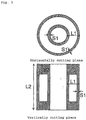
- the structure of the catalyst used in the present invention will be described specifically by using a cross sectional view of the catalyst.
- the case where the catalyst has a cylindrical tablet is as shown in Fig. 3 .
- the catalyst used in the present invention may have a shape other than that described above.
- the reaction system used to obtain chlorine includes, for example, flow system such as fixed bed or fluidized bed, and a gas phase reaction such as fixed bed flow system and gas phase fluidized bed flow system can be preferably used.
- the fixed bed system has an advantage that separation between the reaction gas and catalyst is not required and that high conversion can be accomplished because a raw gas can be sufficiently contacted with a catalyst.
- the fluidized bed system has an advantage that heat in the reactor can be sufficiently removed and temperature distribution width in the reactor can be minimized.
- the reaction is preferably conducted at low temperature and the reaction temperature is usually from 100 to 500°C, preferably from 200 to 400°C, more preferably from 200 to 380°C.
- the reaction pressure is usually from about atmospheric pressure to 50 atm.
- air may be used as it is, or pure oxygen may also be used. Since other components are also discharged simultaneously when an inert nitrogen gas is discharged out of the plant, pure oxygen containing no inert gas is preferable.
- the theoretic molar amount of oxygen based on hydrogen chloride is 1/4 mol, but oxygen is usually fed in an amount that is 0.1-10 times of the theoretical amount.
- the supported ruthenium oxide catalyst (1) (Reference Only: not used in the present invention) is a supported ruthenium oxide catalyst obtained by the steps which comprises supporting a ruthenium compound on a carrier, treating the supported one by using a basic compound, treating by using a reducing compound, and oxidizing the resulting one.
- said catalyst is industrially used in the form of being supported on a carrier.
- the supported ruthenium oxide catalyst (2) (Reference Only: not used in the present invention) is a supported ruthenium oxide catalyst obtained by the steps which comprises supporting a ruthenium compound on a carrier, treating the supported one by using a reducing agent to form ruthenium having an oxidation number of 1 to less than 4 valence, and oxidizing the resulting one.
- a supported ruthenium oxide catalyst comprising supported ruthenium oxide having an oxidation number of 4, which is prepared by supporting ruthenium chloride on a carrier, treating the supported one by using a mixed solution of various reducing compounds and basic compounds, or treating by using an aqueous alkali solution of a reducing compound, or treating by using various reducing agents, thereby to form a ruthenium compound having an oxidation number of 1 to less than 4 valence, and calcining under an air.
- the catalyst prepared by this preparation process can be exemplified as a preparation example which is most active to the oxidizing reaction of hydrogen chloride.
- the process of adjusting the oxidation number of the ruthenium compound supported on the carrier within a range from 1 to less than 4 valence includes various processes, for example, process of treating by using a mixed solution of a reducing compound and a basic compound, process of treating by using an alkali solution of a reducing compound, process of treating by using an organolithium compound, an organosodium compound or an organopotassium compound, process of treating by using an organoaluminum compound, process of treating by using an organomagnesium compound, and process of treating by using hydrogen.
- these reducing agents in an excess amount, the ruthenium compound is reduced to the valence of 0 and, therefore, it is necessary to use a suitable amount.
- the process of measuring the oxidation number of the supported ruthenium includes various processes. For example, since nitrogen is mainly generated when using hydrazine as the reducing agent, the valence number of ruthenium can be determined by the amount of nitrogen generated.
- the oxidation number of ruthenium was determined from the amount of nitrogen generated by using the scheme (1).
- the carrier includes, for example, oxides and mixed oxides of elements, such as titanium oxide, alumina, zirconium oxide, silica, titanium mixed oxide, zirconium mixed oxide, aluminum mixed oxide, silicon mixed oxide and the like.
- Preferable carriers are titanium oxide, alumina, zirconium oxide and silica, and more preferable carrier is titanium oxide.
- the ruthenium compound to be supported on the carrier include compounds, for example, ruthenium chloride such as RuCl 3 and RuCl 3 hydrate; chlororuthenate such as K 3 RuCl 6 , [RuCl 6 ] 3- and K 2 RuCl 6 ; chlororuthenate hydrate such as [RuCl 5 (H 2 O)4] 2- and [RuCl 2 (H 2 O) 4 ] + ; salt of ruthenic acid, such as K 2 RuO 4 ; rutheniumoxy chloride such as Ru 2 OCl 4 , Ru 2 OCl 5 and Ru 2 OCl 6 ; salt of rutheniumoxy chloride, such as K 2 Ru 2 OCl 10 and CsRu 2 OCl 4 ; ruthenium-ammine complex such as [Ru(NH 3 ) 6 ] 2+ , [Ru(NH 3 ) 6 ] 3+ and (Ru(NH 3 ) 5 H 2 O] 2+ ; chloride and bromide of ruthenium-
- Preferable compounds are ruthenium halide compounds, for example, ruthenium chloride such as RuCl 3 and RuCl 3 hydrate and ruthenium bromide such as RuBr 3 and RuBr 3 hydrate. More preferred one is a ruthenium chloride hydrate.
- the reducing compound used for treating the ruthenium compound supported on the carrier includes, for example, a compound having a redox potential of -0.8 to 0.5 V, a solution thereof, and a solution of an organic solvent such as alcohol.
- a standard electrode potential is used in place of the redox potential.
- a standard electrode potential of hydrazine is - 0.23 V
- that of formaldehyde is 0.056 V
- that of formic acid is -0.199 V, respectively.
- the basic compound listed as the catalyst (1) includes, for example, ammonia; amine such as alkyl amine, pyridine, aniline, trimethylamine and hydroxyl amine; alkali metal hydroxide such as potassium hydroxide, sodium hydroxide and lithium hydroxide; alkali metal carbonate such as potassium carbonate, sodium carbonate and lithium carbonate; and hydroxide of quaternary ammonium salt.
- the basic compound for preparing the catalyst (2) includes, for example, ammonia; amine such as alkyl amine, pyridine, aniline, trimethylamine and hydroxyl amine; alkali metal hydroxide such as potassium hydroxide, sodium hydroxide and lithium hydroxide; alkali metal carbonate such as potassium carbonate, sodium carbonate and lithium carbonate; hydroxide of quaternary ammonium salt; and alkyl aluminum such as triethyl aluminum.
- a process of treating by using a reducing compound or an alkali solution of the reducing compound, and adding an alkali metal chloride is also a preferable process.
- a weight ratio of ruthenium oxide to the carrier is preferably within a range from 0.1/99.9 to 20.0/80.0, more preferably from 0.5/99.5 to 15.0/85.0, and most preferably from 1.0/99.0 to 15.0/85.0.
- the ratio of ruthenium oxide is too low, the activity is lowered sometimes.
- the ratio of ruthenium oxide is too high, the price of the catalyst becomes high sometimes.
- the ruthenium oxide to be supported include ruthenium dioxide.
- the ruthenium halide supporting step is a step of supporting ruthenium halide on a carrier of a catalyst.
- the ruthenium compound to be supported on the carrier includes, for example, already listed various ruthenium compounds. Among them, preferred examples thereof are halides of ruthenium, for example, ruthenium chloride such as RuCl 3 and RuCl 3 hydrate and ruthenium bromide such as RuBr 3 and RuBr 3 hydrate. More preferred one is a ruthenium chloride hydrate.
- the amount of ruthenium halide used in the ruthenium halide supporting step is usually an amount corresponding to a preferable weight ratio of ruthenium oxide to the carrier. That is, ruthenium halide is supported by using a process of impregnating an already listed carrier of the catalyst, or a process of performing equilibrium adsorption.
- the solvent for example, water and an organic solvent such as alcohol are used, and water is preferred.
- the impregnated one can be dried, and can also be treated by using an alkali without being dried, but it is preferable the impregnated one is dried.
- the drying temperature is preferably from 50 to 200°C and the drying time is preferably from 1 to 10 hours'.
- the alkali treating step is a step for adding an alkali to one obtained in the ruthenium halide supporting step.
- the alkali used in the alkali treating step includes, for example, hydroxide, carbonate and hydrogencarbonate of alkali metal; aqueous solution of ammonia, ammonium carbonate and ammonium hydrogencarbonate; and solution of an organic solvent such as alcohol.
- As the alkali for example, hydroxide, carbonate and hydrogencarbonate of alkali metal are preferably used.
- the solvent for example, water is preferably used.
- the concentration of the alkali varies depending on the alkali to be used, but is preferably from 0.1 to 10 mol/l.
- a molar ratio of the ruthenium halide to alkali is, for example, 3 mol of sodium hydroxide is equivalent to 1 mol of ruthenium halide.
- the alkali is used in the amount of 0.1-20 equivalent per equivalent of ruthenium halide.
- the process of adding the alkali includes a process of impregnating with a solution of the alkali or a process of dipping in a solution of the alkali.
- the time of impregnation with the solution of the alkali is usually within 60 minutes. Since the activity of the catalyst decreases when the impregnation time is long, the impregnation time is preferably within 10 minutes.
- the temperature is preferably from 0 to 100°C, and more preferably from 10 to 60°C.
- the hydrazine treating step is a step of treating one obtained in the alkali treating step by using hydrazine.
- the process of treating by using hydrazine includes, for example, a process of impregnating with a solution of hydrazine and a process of dipping in a solution of hydrazine.
- the supported ruthenium halide treated by using the alkali in the previous step and an alkali solution may be added to a hydazine solution in a state of being mixed, or may be added to the hydazine solution after the alkaline solution was separated by filtration.
- a preferable process is a process of impregnating the supported ruthenium halide with the alkali and immediately adding to the hydrazine solution.
- concentration of hydrazine used in the hydrazine treating step is preferably not less than 0.1 mol/l.
- Hydrazine hydrate such as hydrazine monohydrate may be used as it is. Alternatively, it is used as a solution of an organic solvent such as alcohol.
- an aqueous solution of hydrazine or hydrazine hydrate is used.
- Anhydride and a monohydrate of hydrazine can also be used.
- hydrazine is used in the amount of 0.1. to 20 mol per mol of ruthenium halide.
- the time of impregnation with the solution of hydrazine is preferably from 5 minutes to 5 hours, and more preferably from 10 minutes to 2 hours.
- the temperature is preferably from 0 to 100°C, and more preferably from 10 to 60°C. After dipping in the hydrazine solution, the dipping one is preferably separated from the solution by filtration.
- Preferable process includes a process of slowly dipping one obtained in the ruthenium halide supporting step to those prepared by mixing a preferable amount of the alkali with a preferable amount of hydazine, and treating for 5 minutes to 5 hours.
- More preferable process includes a process of washing a solid produced in the alkali treating step and hydrazine treating step, thereby to remove the alkali and hydrazine, drying, adding an alkali metal chloride in the following alkali metal chloride adding step, drying, and oxidizing.
- More preferable process includes a process of washing a solid produced in the alkali treating step and hydrazine treating step by using an aqueous solution of an alkali metal chloride, drying, and oxidizing. This process is preferred because the removal of the alkali and hydrazine, and the addition of the alkali metal chloride can be conducted in the same step.
- the alkali metal chloride adding step is a step of adding an alkali metal chloride to one obtained in the alkali treating step and hydrazine treating step.
- This step is not an indispensable step to prepare the supported ruthenium oxide catalyst, but the activity of the catalyst is further improved by conducting said step. That is, the resulting solid is oxidized by the following oxidizing step, but it is a preferable preparation example to convert it into highly active supported ruthenium oxide by oxidizing the resulting solid treated with the alkali and hydrazine in the presence of an alkali metal salt.
- the alkali metal chloride includes, for example, chloride of alkali metal, such as potassium chloride and sodium chloride.
- Preferable alkaline metal chlorides are potassium chloride and sodium chloride, and more preferable one is potassium chloride.
- a molar ratio of the alkali metal salt to ruthenium is preferably from 0.01 to 10, and more preferably from 0.1 to 5.0. When the amount of the alkali metal salt used is too small, sufficient highly active catalyst is not obtained. On the other hand, when the amount of the alkali metal salt used is too large, the cost becomes high from an industrial point of view.
- the process of adding the alkali metal chloride includes a process of impregnating the resulting supported ruthenium one , obtained by washing, drying, treating by using an alkali and hydrazine, with an aqueous solution of the alkali metal chloride, but more preferable process includes a process of impregnating the resulting supported ruthenium one treated with the alkali and hydrazine by washing with an aqueous alkali metal chloride solution without being washed with water.
- hydrochloric acid can be added to an aqueous solution of the alkali metal chloride.
- concentration of the aqueous solution of the alkali metal chloride is preferably from 0.01 to 10 mol/l, and more
- the purpose of washing lies in removal of the alkali and hydrazine, but the alkali and hydrazine can also remain as far as the effect of the present invention is not adversely affected.
- the catalyst After impregnating with the alkali metal chloride, the catalyst is usually dried.
- the drying temperature is preferably from 50 to 200°C and the drying time is preferably from 1 to 10 hours.
- the oxidizing step is a step of oxidizing one obtained in the alkali treating step and hydrazine treating step (in the case of using no alkali metal chloride adding step), or a step of oxidizing one obtained in the alkali metal chloride adding step (in the case of using the alkali metal chloride adding step).
- the oxidizing step can include a process of calcining under an air. It is a preferable preparation example to convert it into highly active supported ruthenium oxide by calcining one treated with the alkali and hydrazine in the presence of an alkali metal salt, in a gas containing oxygen.
- a gas containing oxygen usually includes air.
- the calcination temperature is preferably from 100 to 600°C, and more preferably from 280 to 450°C.
- the calcination temperature is too low, particles formed by the alkali treatment and hydrazine treatment remain in a large amount in the form of a ruthenium oxide precursor and, therefore, the activity of the catalyst becomes insufficient sometimes.
- the calcination temperature is too high, agglomeration of ruthenium oxide particles occurs and, therefore, the activity of the catalyst is lowered.
- the calcination time is preferably from 30 minutes to 10 hours.
- the particles supported on the carrier which are formed by the alkali treatment and hydrazine treatment, are converted into a supported ruthenium oxide catalyst. It can be confirmed by analysis such as X-ray diffraction and XPS (X-ray photoelectron spectroscopy) that the particles formed by the alkali treatment and hydrazine treatment were converted into ruthenium oxide.
- substantially total amount of particles formed by the alkali treatment and hydrazine treatment are preferably converted into ruthenium oxide, but the particles formed by the alkali treatment and hydrazine treatment can remain as far as the effect of the present invention is not adversely affected.
- the process of oxidizing one treated with the alkali and hydrazine, washing the remaining alkali metal chloride, and drying is a preferable preparation process. It is preferred that the alkali metal chloride contained on calcination is sufficiently washed with water.
- the process of measuring the alkali metal chloride after washing includes a process of examining the presence/absence of white turbidity by adding an aqueous silver nitrate solution to the filtrate.
- the alkali metal chloride may be remained as far as the effect of the present invention is not adversely affected.
- the washed catalyst is then dried.
- the drying temperature is preferably from 50 to 200°C and the drying time is preferably from 1 to 10 hours.
- the supported ruthenium oxide catalyst produced by the above steps is highly active, and the activity was higher than that of the catalyst prepared by oxidizing a catalyst obtained by reducing ruthenium chloride with hydrogen. Furthermore, a catalyst obtained by previously treating ruthenium chloride by using an alkali, treating by using hydrazine (alternatively, alkali treatment and hydrazine treatment are simultaneously conducted), and oxidizing showed higher activity than that of a catalyst obtained by treating ruthenium chloride with hydrazine, and oxidizing.
- the supported ruthenium oxide catalyst (3) (Reference Only: not used in the present invention), which is obtained by reducing a ruthenium compound supported on a carrier with a reducing hydrogenated compound, and oxidizing, is a catalyst containing a supported ruthenium oxide catalyst comprising ruthenium oxide supported on a carrier. In general, it is industrially used in the form of being supported on a carrier.
- the same carriers as those used in the reference catalysts (1) and (2) can be used.
- the weight ratio of the ruthenium oxide to the carrier the same ratio as that in the reference catalysts (1) and (2) is used.
- the ruthenium compound to be supported on the carrier for example, the same ruthenium compounds as those used in the reference catalysts (1) and (2) are used.
- the reducing hydrogenated compound used for reducing the ruthenium compound supported on the carrier include , for example, boron hydride compound such as NaBH 4 , Na 2 B 2 H 6 , Na 2 B 4 H 10 , Na 2 B 5 H 9 , LiBH 4 , K 2 B 2 H 6 , K 3 B 4 H 10 , K 2 B 5 H 9 and Al (BH 4 ) 3 ; organometallic boron hydride compound such as LiB[CH(CH 3 )C 2 H 5 ] 3 H, LiB (C 2 H 5 ) 3 H, KB[CH(CH 3 )C 2 H 5 ] 3 H and KB[CH(CH 3 )CH(CH 3 ) 2 ] 3 H; metal hydride such as LiAlH, NaH, LiH and KH; and organometallic hydride such as [(CH 3 ) 2 CHCH 2 ] 2 AlH.
- boron hydride compound such as NaBH 4 , Na 2 B 2 H 6 , Na
- Preferable reducing agents are alkali metal boron hydride compound such as NaBH 4 , Na 2 B 2 H 6 , Na 2 B 4 H 10 , Na 2 B 5 H 9 , LiBH 4 , K 2 B 2 H 6 , K 3 B 4 H 10 and K 2 B 5 H 9 . More preferable one is NaBH 4 .
- Preferred embodiment of the process of preparing the supported ruthenium oxide catalyst used in the reference catalyst (3) includes a preparation process comprising the following steps:
- More preferred embodiment of the process of preparing the supported ruthenium oxide catalyst used in the reference catalyst (3) include a preparation process comprising the following steps:
- More preferred embodiment of the process of preparing the supported ruthenium oxide catalyst used in the reference catalyst (3) include a preparation process comprising the following steps:
- the ruthenium chloride supporting step is a step of supporting ruthenium chloride on a carrier of a catalyst.
- the amount of ruthenium chloride used in the ruthenium chloride supporting step is usually an amount corresponding to a preferable weight ratio of ruthenium oxide to the carrier. That is, a solution of ruthenium chloride is supported on the already listed carrier of the catalyst.
- the solvent for example, water and an organic solvent such as alcohol are used, and water is preferred.
- a ruthenium compound other than ruthenium chloride can also be used. However, when using a compound which does not dissolve in water, there can be used an organic solvent capable of dissolving it, for example, hexane and tetrahydrofuran.
- supported one can be dried or reduced without being dried, but a process of drying is preferred.
- the drying temperature is preferably from 50 to 200°C and the drying time is preferably from 1 to 10 hours.
- the reducing step is a step of reducing one obtained in the ruthenium chloride supporting step by using sodium boron hydride (NaBH 4 ).
- the process of the reducing step includes a process of dipping one obtained in the ruthenium chloride supporting step in a solution of sodium boron hydride.
- the sodium boron hydride solution includes aqueous solution and solution of an organic solvent such as alcohol, but a mixed solution of water and an organic solvent can also be used.
- a mixed solution of water and alcohol is used and, more preferably, a solution of water and ethanol is used.
- the concentration of the solution of sodium boron hydride is usually from 0.05 to 20% by weight, and preferably from 0.1 to 10% by weight.
- the molar ratio of the sodium boron hydride to the supported ruthenium is usually from 1.0 to 30, and preferably from 2.0 to 15.
- the catalyst may be washed with water after reducing, or may be subjected to a step of washing with an aqueous alkali metal chloride solution as an operation of the alkali metal chloride adding step. Preferably, a process of reducing, washing with water, and drying is adopted.
- a reducing compound other then sodium boron hydride it is also possible to reduce with a reducing compound other then sodium boron hydride.
- an aprotic anhydrous solvent is preferably used.
- a supported ruthenium compound is reduced with a reducing hydrogenated compound other than sodium boron halide by using a toluene solvent.
- the alkali metal chloride adding step is a step of adding an alkali metal chloride to one obtained in the reducing step. This step is conducted in the same manner as that in the alkali metal chloride adding step conducted in the reference catalysts (1) and (2).
- the oxidizing step is a step of oxidizing one obtained in the reducing step (in the case of using no alkali metal chloride adding step), or a step of oxidizing one obtained in the alkali metal chloride adding step (in the case of using the alkali metal chloride adding step). This step is conducted in the same manner as that in the oxidizing step conducted in the reference catalysts (1) and (2).
- the metal ruthenium supported on the carrier is converted into a supported ruthenium oxide catalyst. It can be confirmed by analysis such as X-ray diffraction and XPS (X-ray photoelectron spectroscopy) that the metal ruthenium was converted into ruthenium oxide. Incidentally, substantially total amount of the metal ruthenium is preferably converted into ruthenium oxide, but the metal ruthenium can remain as far as the effect of the present invention is not adversely affected.
- the process of oxidizing the supported metal ruthenium, washing the remaining alkali metal chloride with water, and drying is a preferable preparation process. It is preferred that the alkali metal chloride contained on calcination is sufficiently washed with water.
- the process of measuring the alkali metal chloride after washing includes a process of examining the presence/absence of white turbidity by adding an aqueous silver nitrate solution to the filtrate.
- the alkali metal chloride may remain as far as the effect of the present invention is not adversely affected.
- the supported ruthenium oxide catalyst produced by the above steps is highly active, and is very effective for a process for preparing chlorine by oxidizing hydrogen chloride with oxygen.
- a catalyst was prepared by the following process. That is, 0.81 g of commercially available ruthenium chloride (RuCl 3 .nHO, Ru content: 37.3% by weight) was previously dissolved in 6.4 g of pure water to prepare an aqueous solution , and 20.0 g of a titanium oxide powder (P25, manufactured by Nippon AEROSIL Co., Ltd.) was impregnated with this solution. Then, the impregnated powder was dried at 60°C for 2 hours. After drying, the powder was sufficiently ground in a mortar to obtain 20.3 g of a dark green powder. According to the same manner as that described above, the same operation was repeated nine times to obtain 183.8 g of a dark green powder.
- RuCl 3 .nHO commercially available ruthenium chloride
- the pH of the wash at the first time was 9.1, and the pH of the wash at the fifth time was 7.4.
- a 2 mol/l potassium chloride solution was added and, after stirring, the powder was separated by filtration again. This operation was repeated three times.
- the amount of the potassium chloride solution added was 54.4 g at the first time, 52.1. g at the second time and 52.9 g at the third time, respectively.
- the procedure from the operation of dipping in the potassium hydroxide solution was repeated six times in the same manner to obtain 107 g of a cake. 53.1 g of the resulting cake was dried at 60°C for 4 hours to obtain 34.1 g of a gray powder.
- the powder was calcined at the same temperature for 3 hours. After the completion of the calcination, 500 ml of pure water was added and the mixture was stirred and, furthermore, the powder was separated by filtration. This operation was repeated twenty-one times and, after adding dropwise an aqueous silver nitrate solution to the wash, it was confirmed that potassium chloride is not remained. Then, 28. 0 g of a bluish gray powder was obtained by drying this powder at 60°C for 4 hours. The resulting powder was molded to adjust the particle size to 8.6-16.0 mesh, thereby obtaining a ruthenium oxide catalyst supported on titanium oxide.
- the ruthenium oxide catalyst supported on titanium oxide (17.8 g) thus obtained was charged separately in two zones of the same glass reaction tube.
- the inner diameter of the glass reaction tube was 15 mm and a thermocouple protective tube having an outer diameter of 6 mm was inserted therein.
- the catalyst was charged after diluting by sufficiently mixing 5.9 g of the ruthenium oxide catalyst supported on titanium oxide with 23.6 g of a commercially available spherical (2 mm in size) ⁇ -alumina carrier (SSA995, manufactured by Nikkato Co.).
- SSA995 commercially available spherical (2 mm in size) ⁇ -alumina carrier
- a catalyst was prepared by the following process. That is, 3.52 g of commercially available ruthenium chloride (RuCl 3 .nH 2 O, Ru content: 35.5% by weight)was dissolved in 7.61 g of water, followed by sufficient stirring to obtain an aqueous ruthenium chloride solution. The resulting aqueous solution was added dropwise in 25.0 g of a spherical (1-2 mm ⁇ in size) titanium oxide carrier (CS-3005-12, anatase crystal manufactured by Sakai Chemical Industry Co., Ltd.), thereby to support ruthenium chloride by impregnation. The supported one was dried in an air at 60°C for 4 hours to obtain 28.0 g of a ruthenium chloride supported on titanium oxide .
- a spherical (1-2 mm ⁇ in size) titanium oxide carrier CS-3005-12, anatase crystal manufactured by Sakai Chemical Industry Co., Ltd.
- the solid was heated under air from room temperature to 350°C, for about 1 hour and then calcined at the same temperature for 3 hours to obtain a spherical solid. Washing was conducted by adding 0.5 liter of pure water to the resulting solid, stirring and allowing to stand 30 minutes, and the resulting solid was separated by filtration. This operation was repeated four times. The washing time was about 4 hours. The washed one was dried under air at 60°C for 4 hours to obtain 3.73 g of a black spherical ruthenium oxide catalyst supported on titanium oxide.
- the ruthenium oxide catalyst supported on titanium oxide (2.5 g) thus obtained was diluted by mixing with a 5 g of spherical titanium oxide carrier (1 ⁇ 2 mm ⁇ in size) and then charged in a quartz reaction tube (inner diameter: 12 mm) .
- a hydrogen chloride gas (192 ml/min.) and an oxygen gas (184 ml/min.) were respectively supplied under atmospheric pressure (in terms of 0 °C, 1 atm).
- the quartz reaction tube was heated in an electric furnace to adjust the internal temperature (hot spot) to 300°C.
- the gas at the reaction outlet was sampled by passing it through an aqueous 30 wt% potassium iodide solution, and then the amount of chlorine formed and amount of the non-reacted hydrogen chloride were respectively determined by iodometric titration and neutralization titration.
- the formation activity of chlorine per unit weight of the catalyst determined by the following equation was 3.68 ⁇ 10 -4 mol/min.g-catalyst.
- a catalyst was prepared by the following process. That is, 3.52 g of commercially available ruthenium chloride (RuCl 3 .nH 2 O, Ru content: 35.5% by weight) was dissolved in 7. 6 g of water, followed by sufficient stirring to obtain an aqueous ruthenium chloride solution. The resulting aqueous solution was added dropwise in 25.0 g of a spherical (1-2 mm ⁇ in size) titanium oxide carrier (CS-300S-12, manufactured by Sakai Chemical Industry Co., Ltd.), thereby to support ruthenium chloride by impregnation. The supported one was dried under air at 60°C for 4 hours to obtain 28.1 g of a ruthenium chloride supported on titanium oxide.
- a spherical (1-2 mm ⁇ in size) titanium oxide carrier CS-300S-12, manufactured by Sakai Chemical Industry Co., Ltd.
- the calculated value of a molar ratio of potassium chloride to ruthenium was 1.0. Then, the solid was heated under air from room temperature to 350°C for about 1 hour and then calcined at the same temperature for 3 hours to obtain a spherical solid. Washing was conducted by adding 0.5 1 of pure water to the resulting solid and filtering. This operation was repeated four times. The washing time was about 4 hours. The washed one was dried under air at 60°C for 4 hours to obtain 3.65 g of a black spherical ruthenium oxide catalyst supported on titanium oxide.
- the formation activity of chlorine per unit weight of the Ru was 77.3 ⁇ 10 -4 mol/min.g-Ru.
- a catalyst was prepared by the following process. That is, 50.0 g of a titanium oxide powder (STR-60N, 100% rutile crystal , manufactured by Sakai Chemical Industry Co., Ltd.) was kneaded with 33.4 g of pure water and 6.6 g of a titanium oxide sol (CSB,TiO 2 content: 38% by weight, manufactured by Sakai Chemical Industry Co., Ltd.). At room temperature, a dry air was blown to the kneaded one, which was then dried until suitable viscosity was obtained. The weight loss of water by drying was 0.2 g. After drying, the mixture was sufficiently kneaded again. The kneaded one was extruded into a form of a noodle of 1.5 mm ⁇ in size.
- the resulting solid was dipped in a solution of 16.7 g of a 2N potassium hydroxide solution, 241 g of pure water and 4.1 g of hydrazine monohydrate under nitrogen at room temperature, with stirring every 15 minutes. Bubbling occurred on dipping. After 80 minutes, filtration was conducted by using a glass filter. Washing was conducted for 30 minutes by adding 500 ml of water, followed by filtration. This operation was repeated five times. The pH of the wash was 9.2 at the first time, and the pH of the wash was 7.2 at the fifth time. To the extruded solid separated by filtration, 50 g of a 0.5 mol/l of potassium chloride solution was added and, after stirring, the extruded solid was separated by filtration again.
- This powder was dipped in a solution of 10.4 g of a 2N potassium hydroxide solution, 69.9 of pure water and 2.53 g of hydrazine monohydrate under nitrogen at room temperature. Bubbling occurred on dipping. The gas bubbled during the treatment for 1 hour was collected and the volume was measured. As a result, it was 74 ml in a normal state. The reduced powder was separated by filtration. Washing was conducted for 30 minutes by adding 500 ml of water, followed by filtration. This operation was repeated five times. The pH of the wash was 9.4 at the first time, and the pH of the wash was 7.1 at the fifth time.
- the content of the OH group of the carrier was measured in the following manner. That is, a sample was previously dried in an air at 150°C for 2 hours and cooled in a desiccator. Then, 1.06 g of the sample was transferred to the flask whose atmosphere was replaced by nitrogen, and was suspended in 40 ml of a dehydrated toluene solvent. To inhibit heat generation, the flask was ice-cooled and 5 ml of methyl lithium was dropped from a dropping funnel under nitrogen. As a result, 52 ml of a methane gas was evolved. The same operation was conducted, except for using toluene without charging no sample. As a result, 30 ml of a methane gas was evolved. At this time, the temperature was 24°C .
- Valence number of Ru 3 ⁇ V / 22400 ⁇ 4 / N where V: amount of gas produced (ml), N: amount of Ru content which was charged (mol) The valence number of Ru was calculated as 1.22.
- Ru was reduced to the valence of 1.22.
- reaction (3) represented by the following scheme: 9/2 N 2 H 4 ⁇ e - + 5NH 3 + 3H + + 2N 2 ⁇ (3)
- the amount was 1.4 g at the second time.
- the resulting solid was dried at 60°C for 4 hours. The dried one was heated under air to 350°C over 1 hour and then calcined at the same temperature for 3 hours. Then, the resulting solid was washed with 500 ml of pure water for 30 minutes and then separated by filtration. This operation was repeated five times. After adding dropwise an aqueous silver nitrate solution to the filtrate, it was confirmed that potassium chloride is not remained. After washing, the solid was dried 60°C for 4 hours to obtain 5.1 g of a spherical black ruthenium oxide catalyst supported on titanium oxide. The pore radius of the resulting catalyst was within a range from 0.004 to 0.02 micrometer. The pore distribution curve of this catalyst measured by a mercury porosimeter is shown in figure 5 .
- Example 5 Under the same conditions as those of Example 5 except that the amount of the sample was 2.56 g and the amount of toluene was 40 ml, the content of the OH group of the carrier was measured. As a result, 86 ml of methane gas was evolved. The content of the OH group of the carrier was 9.0 ⁇ 10 -4 (mol/g-carrier).
- Example 2 According to the same reaction manner as that described in Example 2 except that 2.5 g of the ruthenium oxide catalyst supported on titanium oxide thus obtained was charged in a reaction tube and that the hydrogen chloride (187ml/min.) and the oxygen gas (199 ml/min.) were passed through the reaction tube, the reaction was conducted. 2.0 Hours after the beginning of the reaction, the formation activity of chlorine per unit weight of the catalyst was 3.92 ⁇ 10 -4 mol/min.g-catalyst.
- a catalyst was prepared by the following process. That is, 10.1 g of a titanium oxide powder (P25, manufactured by Nippon AEROSIL Co., Ltd.) was impregnated with an aqueous solution prepared previously by dissolving 0.41 of commercially available ruthenium chloride (RuCl 3 .nH 2 O, Ru content: 37.3% by weight) in 3.5 g of pure water, and then dried at 60°C for 2 hours. After drying, the powder was sufficiently ground in a mortar to obtain a dark green powder. To reduce this powder with sodium boron hydride, a solution was prepared by dissolving 0.50 g of sodium boron hydride in 100.0 g of ethanol and cooled in an ice bath.
- ruthenium chloride RuCl 3 .nH 2 O, Ru content: 37.3% by weight
- the resulting cake was dried at 60°C for 4 hours to obtain a gray powder.
- the powder was calcined at the same temperature for 3 hours.
- 500 ml of pure water was added and the mixture was stirred and, furthermore, the powder was separated by filtration. This operation was repeated five times and, after adding dropwise an aqueous silver nitrate solution to the wash, it was confirmed that no potassium chloride remained.
- 9.2 g of a bluish gray powder was obtained by drying this powder at 60°C for 4 hours.
- the resulting powder was molded to adjust the particle size to 8.6-16.0 mesh, thereby obtaining a ruthenium oxide catalyst supported on titanium oxide.
- Example 2 According to the same reaction manner as that described in Example 2 except that 2.5 g of the ruthenium oxide catalyst supported on titanium oxide thus obtained was charged in a reaction tube and that the hydrogen chloride (195ml/min.) and the oxygen gas (198 ml/min.) were passed through the reaction tube, the reaction was conducted. 2.0 Hours after the beginning of the reaction, the formation activity of chlorine per unit weight of the catalyst was 5.56 ⁇ 10 -4 mol/min.g-catalyst.
- a catalyst was prepared by the following process. That is, 10.1 g of a titanium oxide powder (P25, manufactured by Nippon AEROSIL Co., Ltd.) was impregnated with an aqueous solution prepared previously by dissolving 0.40 g of commercially available ruthenium chloride (RuCl 3 .nH 2 O, Ru content: 37.3% by weight) in 3.4 g of pure water, and then dried at 60°C for 2 hours. After drying, the powder was sufficiently ground in a mortar to obtain a dark green powder. The powder was dipped in a solution of 2.1 g of a 2N potassium hydroxide solution and 30.2 g of pure water, and then stirred with putting a flask in an ultrasonic cleaner.
- ruthenium chloride RuCl 3 .nH 2 O, Ru content: 37.3% by weight
- the amount of the potassium chloride solution added was 53.6 g at the first time, 62.4 g at the second time and 39.4 g at the third time, respectively.
- the resulting cake was dried at 60°C for 4 hours to obtain a beige powder. After heating from room temperature to 350°C, under air over 1 hour, the powder was calcined at the same temperature for 3 hours. After the completion of the calcination, 500 ml of pure water was added and the mixture was stirred and, furthermore, the powder was separated by filtration. This operation was repeated five times and, after adding dropwise an aqueous silver nitrate solution to the wash, it was confirmed that, no potassium chloride remained.
- Example 5 Under the same conditions as those of Example 5 except that the amount of the sample was 4.08 g and the amount of toluene was 80 ml, the content of the OH group of the carrier was measured. As a result, 88 ml of a methane gas was evolved. The content of the OH group of the carrier was 2.8 ⁇ 10 -4 (mol/g-carrier).
- Example 2 According to the same reaction manner as that described in Example 2 except that 2.5 g of the ruthenium oxide catalyst supported on titanium oxide thus obtained was charged in a reaction tube and that the hydrogen chloride (187ml/min.) and the oxygen gas (199ml/min.) were passed through the reaction tube and the internal temperature was adjusted to 301°C, the reaction was conducted. 2.0 Hours after the beginning of the reaction, the formation activity of chlorine per unit weight of the catalyst was 5.33 ⁇ 10 -4 mol/min.g-catalyst.
- a catalyst was prepared by the following process. That is, 19.7 g of a titanium oxide powder (P25, manufactured by Nippon AEROSILerogyl Co., Ltd.) was impregnated with an aqueous solution prepared previously by dissolving 0.81 g of commercially available ruthenium chloride (RuCl 3 .nH 2 O, Ru content: 37.3% by weight) in 6.0 g of pure water, and then dried at 60°C for 2 hours. After drying, the powder was sufficiently ground in a mortar to obtain a dark green powder. To reduce this powder with sodium boron hydride, a solution was prepared by dissolving 1.00 g of sodium boron hydride in 200 g of ethanol and cooled in an ice bath.
- ruthenium chloride RuCl 3 .nH 2 O, Ru content: 37.3% by weight
- the resulting powder was dried at 60°C for 4 hours. After heating from room temperature to 350°C under air over 1 hour, the powder was calcined at the same temperature for 3 hours. After the completion of the calcination, 500 ml of pure water was added and the mixture was stirred and, furthermore, the powder was separated by filtration. This operation was repeated five times and, after adding dropwise an aqueous silver nitrate solution to the wash, it was confirmed that potassium chloride is not remained. Then, 17.3 g of a bluish gray powder was obtained by drying this powder at 60°C for 4 hours. The resulting powder was molded to adjust the particle size to 8.6-16.0 mesh, thereby obtaining a ruthenium oxide catalyst supported on titanium oxide.
- Example 2 According to the same reaction manner as that described in Example 2 except that 2.5 g of the ruthenium oxide catalyst supported on titanium oxide thus obtained was charged in a reaction tube and that the hydrogen chloride (195 ml/min.) and the oxygen gas (198 ml/min.) were passed through the reaction tube and the internal temperature was adjusted to 299°C, the reaction was conducted. 2.0 Hours after the beginning of the reaction, the formation activity of chlorine per unit weight of the catalyst was 4.41 ⁇ 10 -4 mol/min.g-catalyst.
- a catalyst was prepared by the following process. That is, a titanium oxide powder (STR-60N, 100% rutile crystal system, manufactured by Sakai Chemical Industry Co., Ltd.) was previously heated in an air from room temperature to 500°C over 1.4 hours and calcined at the same temperature for 3 hours. Then; 15.1 g of the calcined one was dipped in an aqueous solution of 0.61 g of commercially available ruthenium chloride (RuCl 3 .nH 2 O, Ru content: 37.3% by weight) and 26.7 g of pure water, evaporated under reduced pressure at 50°C for 4 hours, and then dried at 60°C for 2 hours. After drying, the powder was sufficiently ground to obtain a dark green powder.
- ruthenium chloride RuCl 3 .nH 2 O, Ru content: 37.3% by weight
- This powder was dipped in a solution of 3.2 g of a 2N potassium hydroxide solution, 52.6 of pure water and 0.77 g of hydrazine monohydrate at room temperature under nitrogen. Bubbling occurred on dipping. After 1 hour, the reduced powder was separated by filtration. To the resulting powder, 500 ml of pure water was added, followed by washing for 30 minutes and further separation by filtration. This operation was repeated seven times. The pH of the wash was 9.9 at the first time, and the pH of the wash was 7.5 at the seventh time. To the powder separated by filtration, 50 g of a 2 mol/l of potassium chloride solution was added and, after stirring, the powder was separated by filtration again. This operation was repeated three times.
- the resulting solid was dried at 60°C for 4 hours to obtain a reddish gray powder.
- the powder was calcined at the same temperature for 3 hours.
- 500 ml of pure water was added and the mixture was stirred and, furthermore, the powder was separated by filtration. This operation was repeated five times and, after adding dropwise an aqueous silver nitrate solution to the wash, it was confirmed tha no t potassium chloride remained.
- 13.9 g of a bluish gray powder was obtained by drying this powder at 60°C for 4 hours.
- the resulting powder was molded to adjust the particle size to 8.6-16.0 mesh, thereby obtaining a ruthenium oxide catalyst supported on titanium oxide.
- Example 5 Under the same conditions as those of Example 5 except that the amount of the sample was 1.31 g and the amount of toluene was 40 ml, the content of the OH group of the carrier was measured. As a result, 48 ml of methane gas was evolved. The content of the OH group of the carrier was 5.6 ⁇ 10 -4 (mol/g-carrier).
- the catalyst was diluted by mixing 2.5 g of the ruthenium oxide catalyst supported on titanium oxide thus obtained with 10 g of a commercially available spherical (2 mm in size) alumina carrier (SSA995, manufactured by Nikkato Co.) and then charged in a quartz reaction tube (inner diameter: 12 mm) and that the oxygen gas (192 ml/min.) was passed through the reaction tube, the reaction was conducted. 2.0 Hours after the beginning of the reaction, the formation activity of chlorine per unit weight of the catalyst was 4.27 ⁇ 10 -4 mol/min.g-catalyst.
- SSA995 commercially available spherical (2 mm in size) alumina carrier
- a catalyst was prepared by the following process. That is, a titanium oxide powder (STR-60N, 100% rutile crystal system, manufactured by Sakai Chemical Industry Co., Ltd.) was previously heated from room temperature to 700°C under air over 1.9 hours and calcined at the same temperature for 3 hours. Then, 15.0 g of the calcined one was dipped in an aqueous solution of 0.61 g of commercially available ruthenium chloride (RuCl 3 .nH 2 O, Ru content: 37.3% by weight) and 26.7 g of pure water, evaporated under reduced pressure at 50°C for 4 hours, and then dried at 60°C for 2 hours. After drying, the powder was sufficiently ground to obtain a dark green powder.
- ruthenium chloride RuCl 3 .nH 2 O, Ru content: 37.3% by weight
- This powder was dipped in a solution of 3.2 g of a 2N potassium hydroxide solution, 52.6 g of pure water and 0.77 g of hydrazine monohydrate at room temperature under nitrogen. Bubbling occurred on dipping. After 1 hour, the reduced powder was separated by filtration. To the resulting powder, 500 ml of pure water was added, followed by washing for 30 minutes and further separation by filtration. This operation was repeated seven times. The pH of the wash was 9.9 at the first time, and the pH of the wash was 7.5 at the seventh time. To the powder separated by filtration, 50 g of a 2 mol/l of potassium chloride solution was added and, after stirring, the powder was separated by filtration again. This operation was repeated three times.
- the resulting solid was dried at 60°C for 4 hours to obtain a gray powder.
- the powder was calcined at the same temperature for 3 hours.
- 500 ml of pure water was added and the mixture was stirred and, furthermore, the powder was separated by filtration. This operation was repeated five times and, after adding dropwise an aqueous silver nitrate solution to the wash, it was confirmed that no potassium chloride remained.
- 13.5 g of a bluish gray powder was obtained by drying this powder at 60°C, for 4 hours.
- the resulting powder was molded to adjust the particle size to 8.6-16.0 mesh, thereby obtaining a ruthenium oxide catalyst supported on titanium oxide.
- Example 5 Under the same conditions as those of Example 5 except that the amount of the sample was 2.02 g and the amount of toluene was 40 ml, the content of the OH group of the carrier was measured. As a result, 46 ml of methane gas was evolved. The content of the OH group of the carrier was 3.3 ⁇ 10 -4 (mol/g-carrier).
- the catalyst was diluted by mixing 2.5 g of the ruthenium oxide catalyst supported on titanium oxide thus obtained with 10 g of a commercially available spherical (2 mm in size) alumina carrier (SSA995, manufactured by Nikkato Co.) and then charged in a quartz reaction tube (inner diameter: 12 mm) and that the oxygen gas (192 ml/min.) was passed through the reaction tube, the reaction was conducted. 2.0 Hours after the beginning of the reaction, the formation activity of chlorine per unit weight of the catalyst was 4.32 ⁇ 10 -4 mol/min.g-catalyst.
- SSA995 commercially available spherical (2 mm in size) alumina carrier
- a catalyst was prepared:by the following process. That is, 120 of a titanium oxide powder (STR-60N, rutile crystal , manufactured by Sakai Chemical Industry Co., Ltd.) was kneaded with 76.3 g of pure water and 15.8 g of a titanium oxide sol (CSB, TiO 2 content: 38% by weight, manufactured by Sakai Chemical Industry Co., Ltd.). At room temperature, a dry air was blown to the kneaded one, which was then dried until suitable viscosity was obtained. The weight loss of water by drying was 10.5 g. After drying, the mixture was sufficiently kneaded again. This kneaded one was extruded into a form of a noodle of 1.5 mm ⁇ in size.
- STR-60N rutile crystal , manufactured by Sakai Chemical Industry Co., Ltd.
- the resulting solid was dipped in a solution of 10.5 g of a 2N potassium hydroxide solution, 300 g of pure water and 2.57 g of hydrazine monohydrate under nitrogen at room temperature, followed by dipping for 1 hour with stirring every 15 minutes after the reduction, filtration was conducted by using a glass filter. Bubbling occurred on dipping. 500 ml of pure water was added, followed by washing for 30 minutes and further separation by filtration. This operation was repeated five times. The pH of the wash was 8.8 at the first time, and the pH of the wash was 6.8 at the fifth time.
- Rutile titanium oxide shows that thermal conductivity of solid phase is 7.5 W/m.°C measured at 200°C.
- the catalyst was diluted by mixing 2.50 g of the ruthenium oxide catalyst supported on titanium oxide thus obtained with 10 g of a commercially available spherical (2 mm in size) alumina carrier (SSA995, manufactured by Nikkato Co.) and then charged in a quartz reaction tube (inner diameter: 12 mm) and that the oxygen gas (206 ml/min.) was passed through the reaction tube, the reaction was conducted. 2.0 Hours after the beginning of the reaction, the formation activity of chlorine per unit weight of the catalyst was 4.83 ⁇ 10 -4 mol/min.g-catalyst.
- SSA995 commercially available spherical (2 mm in size) alumina carrier
- a catalyst was prepared by the following process. That is, 10.0 g of a titanium oxide powder (MT-600B, rutile crystal system, manufactured by TAYCA Corporation) was impregnated with an aqueous solution of 0.407 g of commercially available ruthenium chloride (RuCl 3 .nH 2 O, Ru content: 37.3% by weight) and 17.8 g of pure water, and then evaporated under reduced pressure at 40°C over 2 hours. After drying at 60°C for 2 hours, the powder was sufficiently ground to obtain a dark green powder. This powder was dipped in a solution of 2.1 g of a 2N potassium hydroxide solution and 30.0 of pure water at room temperature, followed by stirring.
- MT-600B rutile crystal system, manufactured by TAYCA Corporation
- the resulting solid was dried at 60°C for 4 hours to obtain a beige powder.
- the powder was calcined at the same temperature for 3 hours.
- 500 ml of pure water was added and the mixture was stirred and, furthermore, the powder was separated by filtration. This operation was repeated five times and, after adding dropwise an aqueous silver nitrate solution to the wash, it was confirmed that no potassium chloride remained.
- 9.23 g of a bluish gray powder was obtained by drying this powder at 60°C for 4 hours.
- the resulting powder was molded to adjust the particle size to 8.6-16.0 mesh, thereby obtaining a ruthenium oxide catalyst supported on titanium oxide.
- the catalyst was diluted by mixing 2.5 g of the ruthenium oxide catalyst supported on titanium oxide thus obtained with 5 g of a commercially available spherical (1 mm in size) alumina carrier (SSA995, manufactured by Nikkato Co.) and then charged in a quartz reaction tube (inner diameter: 12 mm) and that the hydrogen chloride gas (211 ml/min.) and the oxygen gas (211 ml/min.) were passed through the reaction tube, the reaction was conducted. 1.8 Hours after the beginning of the reaction, the formation activity of chlorine per unit weight of the catalyst was 4.40 ⁇ 10 -4 mol/min.g-catalyst.
- SSA995 commercially available spherical (1 mm in size) alumina carrier
- a catalyst was prepared by the following process. That is, 270 g of pure water and 134 g of a 30 wt% titanium sulfate solution (manufactured by Wako Pure Chemical Industry, Ltd.) were mixed at room temperature. The resulting solution was mixed with 10.0 g of a titanium oxide powder (PT-101, 100% rutile crystal, manufactured by Ishihara Techno Corporation) at room temperature. Then, the resulting suspension was hydrolyzed by heating to 102°C under stirring over 7 hours using an oil bath. After the completion of the hydrolysis, the reaction solution was cooled to room temperature, allowed to stand overnight, and then separated by filtration.
- the resulting titanium oxide powder (9.5 g) was impregnated with an aqueous solution prepared previously by dissolving 1.27 g of commercially available ruthenium chloride (RuCl 3 .nH 2 O, Ru content: 37.3% by weight) and 9.5 g of pure water, and then evaporated under reduced pressure at 40°C over 2 hours. After drying at 60°C for 2 hours, the powder was sufficiently ground to obtain a black powder. This powder was dipped in a solution of 6.6 g of a 2N potassium hydroxide solution and 28.5 g of pure water at room temperature, followed by stirring .
- RuCl 3 .nH 2 O commercially available ruthenium chloride
- the resulting solid was dried at 60°C for 4 hours to obtain 10.2 g of a black powder.
- the powder was calcined at the same temperature for 3 hours.
- 500 ml of pure water was added and the mixture was stirred and, furthermore, the powder was separated by filtration. This operation was repeated five times and, after adding dropwise an aqueous silver nitrate solution to the wash, it was confirmed that no potassium chloride remained.
- 8.93 g of a black powder was obtained by drying this powder at 60°C for 4 hours.
- the resulting powder was molded to adjust the particle size to 8.6-16.0 mesh, thereby obtaining a ruthenium oxide catalyst supported on titanium oxide.
- Example 5 Under the same conditions as those of Example 5 except that the amount of the sample was 2.36 g and the amount of toluene was 40 ml, the content of the OH group of the carrier was measured. As a result, 51 ml of a methane gas was evolved. The content of the OH group of the carrier was 3.7 ⁇ 10 -4 (mol/g-carrier).
- the catalyst was diluted by mixing 2.5 g of the ruthenium oxide catalyst supported on titanium oxide thus obtained with 10 g of a commercially available spherical (2 mm in size) alumina carrier (SSA995, manufactured by Nikkato Co.) and then charged in a quartz reaction tube (inner diameter: 12 mm) and that the hydrogen chloride gas (211 ml/min.) and the oxygen gas (211 ml/min.) were passed through the reaction tube, the reaction was conducted. 2.3 Hours after the beginning of the reaction, the formation activity of chlorine per unit weight of the catalyst was 8.18 ⁇ 10 -4 mol/min.g-catalyst.
- SSA995 commercially available spherical (2 mm in size) alumina carrier
- a catalyst was prepared by the following process. That is, a titanium oxide powder (100% rutile crystal , manufactured by Sakai Chemical Industry Co., Ltd.) was previously heated from room temperature to 500°C under air over 1.4 hours and calcined at the same temperature for 3 hours. Then, 10.0 g of the calcined one was dipped in an aqueous solution of 1.34 g of commercially available ruthenium chloride (RuCl 3 .nH 2 O, Ru content: 37.3% by weight) and 17.8 g of pure water, evaporated under reduced pressure at 40°C, over 2 hours, and then dried at 60°C for 2 hours. After drying, the powder was sufficiently ground to obtain a blackish brown powder.
- ruthenium chloride RuCl 3 .nH 2 O, Ru content: 37.3% by weight
- This powder was dipped in a solution of 6.9 g of a 2N potassium hydroxide solution, 30.0 g of pure water and 1.93 g of hydrazine monohydrate under nitrogen at room temperature. Bubbling occurred on dipping. Af ter 1 hour, the reduced powder was separated by filtration. To the resulting powder, 500 ml of pure water was added, followed by washing for 30 minutes and further separation by filtration. This operation was repeated five times. The pH of the wash was 8.7 at the first time, and the pH of the wash was 7.4 at the fifth time. To the powder separated by filtration, 50 g of a 2 mol/l of potassium chloride solution was added and, after stirring, the powder was separated by filtration again. This operation was repeated three times.
- the resulting solid was dried at 60°C for 4 hours to obtain a black powder.
- the powder was calcined at the same temperature for 3 hours.
- 500 ml of pure water was added and the mixture was stirred and, furthermore, the powder was separated by filtration. This operation was repeated five times and, after adding dropwise an aqueous silver nitrate solution to the wash, it was confirmed that no potassium chloride remained.
- 9.7 g of a black powder was obtained by drying this powder at 60°C for 4 hours.
- the resulting powder was molded to adjust the particle size to 8.6-16.0 mesh, thereby obtaining a ruthenium oxide catalyst supported on titanium oxide.
- Example 5 Under the same conditions as those of Example 5 except that the amount of the sample was 1.64 g and the amount of toluene was 40 ml, the content of the OH group of the carrier was measured. As a result, 54 ml of methane gas was evolved. The content of the OH group of the carrier was 6.0 ⁇ 10 -4 (mol/g-carrier).
- the catalyst was diluted by mixing 2.5 g of the ruthenium oxide catalyst supported on titanium oxide thus obtained with 10 g of a commercially available spherical (2 mm in size) alumina carrier (SSA995, manufactured by Nikkato Co.) and then charged in a quartz reaction tube (inner diameter: 12 mm) and that the hydrogen chloride gas (211 ml/min.) and the oxygen gas (211 ml/min.) were passed through the reaction tube, the reaction was conducted. 1.8 Hours after the beginning of the reaction, the formation activity of chlorine per unit weight of the catalyst was 7.85 ⁇ 10 4 mol/min.g-catalyst.
- SSA995 commercially available spherical (2 mm in size) alumina carrier
- a catalyst was prepared by the following process. That is, 10.1 g of a titanium oxide powder (SSP-HJ, anatase crystal , manufactured by Sakai Chemical Industry Co., Ltd.) was impregnated with an aqueous solution prepared previously by dissolving 1.35 g of commercially available ruthenium chloride (RuCl 3 .nH 2 O, Ru content: 37.3% by weight) in 4.5 g of pure water, and then dried at 60°C for 2 hours. After drying, the powder was sufficiently ground in a mortar to obtain a black powder.
- SSP-HJ anatase crystal , manufactured by Sakai Chemical Industry Co., Ltd.
- Example 5 Under the same conditions as those of Example 5 except that the amount of the sample was 1.79 g and the amount of toluene was 40 ml, the content of the OH group of the carrier was measured. As a result, 111 ml of a methane gas was evolved. The content of the OH group of the carrier was 18.6 ⁇ 10 -4 (mol/g-carrier).
- Example 2 According to the same reaction manner as that described in Example 2 except that 2.5 g of the ruthenium oxide catalyst supported on titanium oxide thus obtained was charged in a reaction tube in the same manner as that in Example 2 and that the hydrogen chloride (187 ml/min.) and the oxygen gas (199 ml/min.) were passed through the reaction tube, the reaction was conducted. 2.0 Hours after the beginning of the reaction, the formation activity of chlorine per unit weight of the catalyst was 3.59 ⁇ 10 -4 mol/min.g-catalyst.
- a catalyst was prepared by the following process. That is, 10.0 g of a titanium oxide powder (P25, manufactured by Nippon AEROSIL Co. , Ltd.) was impregnated with an aqueous solution prepared previously by dissolving 1.34 g of commercially available ruthenium chloride (RuCl 3 .nH 2 O, Ru content: 37.3% by weight) in 4.8 g of pure water, and then dried at 60°C for 2 hours. After drying, the powder was sufficiently ground in a mortar to obtain a black powder. To reduce this powder with sodium boron hydride, a solution was prepared by dissolving 1.66 g of sodium boron hydride in 330 g of ethanol and cooled in an ice bath.
- ruthenium chloride RuCl 3 .nH 2 O, Ru content: 37.3% by weight
- the powder was calcined at the same temperature for 3 hours. After the completion of the calcination, 500 ml of pure water was added and the mixture was stirred and, furthermore, the powder was separated by filtration. This operation was repeated five times and, after adding dropwise an aqueous silver nitrate solution to the wash, it was confirmed that no potassium chloride remained. Then, 9.5 g of a black powder was obtained by drying this powder at 60°C for 4 hours. The resulting powder was molded to adjust the particle size to 8.6-16.0 mesh, thereby obtaining a ruthenium oxide catalyst supported on titanium oxide.
- Example 2 According to the same reaction manner as that described in Example 2 except that 2.5 g of the ruthenium oxide catalyst supported on titanium oxide thus obtained was charged in a reaction tube in the same manner as that in Example 2 and that the hydrogen chloride (195 ml/min.) and the oxygen gas (198 ml/min.) were passed through the reaction tube and the internal temperature was adjusted to 299°C, the reaction was conducted. 2.0 Hours after the beginning of the reaction, the formation activity of chlorine per unit weight of the catalyst was 4.31 ⁇ 10 -4 mol/min.g-catalyst.
- a catalyst was prepared by the following process. That is, 60 g of a commercially available 100% rutile type titanium oxide powder (STR-60N, manufactured by Sakai Chemical Industry Co., Ltd.) and 60 g of a ⁇ -alumina powder (A131-03, manufactured by Sumitomo Chemical Co., Ltd.) were sufficiently mixed. To the mixed one, a mixed solution of 15.8 g of 38wt% TiO 2 sol (CSB, manufactured by Sakai Chemical Industry Co., Ltd.) and 50 g of pure water was added. Until suitable viscosity was obtained, the mixture was dried at room temperature under air flow. After drying, the mixture was sufficiently kneaded. The weight loss by drying was 14 g.
- CSB 38wt% TiO 2 sol
- This kneaded one was extruded into a form of a noodle of 1.5 mm ⁇ in size, followed by drying at 60°C under air for 4 hours using a drier.
- the weight of the dried one was 101 g.
- the dried one was heated from room temperature to 500°C in an air over 1.4 hours and calcined at the same temperature for 3 hours to obtain 99.5 g of a titanium oxide- ⁇ -alumina carrier.
- an extruded titanium oxide- ⁇ -alumina carrier was obtained by cutting the resulting noodle-shaped titanium oxide- ⁇ -alumina carrier into pieces of about 5 mm in size.
- ruthenium chloride (RuCl 3 .nH 2 O, Ru content: 37.3% by weight) was dissolved in 14.6 g of water, followed by sufficient stirring to obtain an aqueous ruthenium chloride solution.
- the resulting aqueous ruthenium chloride solution was added dropwise to 50 g of the extruded titanium oxide- ⁇ -alumina carrier, thereby to support ruthenium chloride by impregnation.
- the supported one was dried under air at 60°C for 2 hours to obtain a ruthenium chloride supported on titanium oxide- ⁇ -alumina.
- the resulting ruthenium chloride supported on titanium oxide- ⁇ -alumina was added to a mixed solution of 10.5 g of an aqueous potassium hydroxide solution adjusted to 2 mol/l, 300 g of pure water and 2.54g of hydrazine monohydrate under nitrogen at room temperature, followed by dipping for 1 hour stirring every 15 minutes. At the time of dipping, bubbling was observed in the solution.
- filtration was conducted by using a glass filter. 0.5 liter of pure water was added to the glass filter and, after allowing to stand for 30 minutes, filtration was conducted again. This operation was repeated five times to obtain a brownish white extruded solid.
- 100 g of an aqueous KCl solution adjusted to 0.5 mol/l was added to the resulting extruded solid and, after allowing to stand for 30 minutes, filtration was conducted under reduced pressure. The same operation was repeated three times.
- the resulting extruded solid was dried under air at 60°C for 4 hours, heated to 350°C under air over 1 hour, and then calcined at the same temperature for 3 hours.
- Rutile titanium oxide shows that thermal conductivity of solid phase is 7.5 W/m ⁇ °C measured at 200°C.
- ⁇ -Al 2 O 3 shows that thermal conductivity of solid phase is 23 W/m ⁇ °C measured at 200°C.
- the calculated value of TiO 2 (binder) used to form this catalyst was 4.7% by weight.
- the bath temperature was raised by 11°C in total over 5 hours and 50 minutes to make it constant at 271°C.
- the internal temperature became stable at 331.4°C.
- the bath temperature was constant at 271°C, and the internal temperature was stable at 331, 5°C, and the temperature was satisfactorily controlled.
- the bath temperature was raised by 8°C in total over 1 hour and 15 minutes to make it constant at 279°C.
- the internal temperature became stable at 351.9°C.
- the bath temperature was constant at 279°C and the internal temperature was stable at 351.9°C, and the temperature was satisfactorily controlled.
- a catalyst was prepared by the following process. That is, 0.81 g of commercially available ruthenium chloride hydrate (RuCl 3 .nH 2 O Ru content: 37.3% by weight) was dissolved in 6.4 g of water, followed by sufficient stirring to obtain an aqueous ruthenium chloride solution. The resulting aqueous solution was added dropwise to 20 g of a titanium oxide carrier powder (P-25, manufactured by Nippon AEROSIL Co., Ltd.), thereby to support ruthenium chloride by impregnation. The supported ruthenium chloride on titanium oxide powder was ground , and then sufficiently mixed until the whole color became homogeneous yellowish green. 20.2 g of a supported ruthenium chloride on titanium oxide was obtained by drying the supported one under air at 60°C for 2 hours. The same operation was repeated twice to obtain 40.4 g of the same supported one.
- RuCl 3 .nH 2 O Ru content 37.3% by weight
- a mixed solution of 2.1 g of 38wt% TiO 2 sol (CSB, manufactured by Sakai Chemical Industry Co., Ltd.) and 4.0 g of pure water was added and mixed sufficiently. Until suitable viscosity is obtained, pure water was added, followed by kneading. The amount of pure water added is 0.45 g.
- the kneaded one was extruded into a form of a noodle of 1.5 mm ⁇ in size , followed by drying at 60,°C under air for 4 hours using a drier. The weight of the dried one was 5.93 g.
- the dried one was heated from room temperature to 350°C under air over 1 hour and calcined at the same temperature for 3 hours. Then, 0.5 liter of pure water was added to the calcined one and filtration was conducted by using a glass filter. This operation was repeated five times to obtain a bluish gray solid. The resulting solid was dried under air at 60°C for 4 hours using a drier to obtain 5.86 g of a catalyst. Then, a bluish gray extruded ruthenium oxide catalyst supported on titanium oxide mixed with ⁇ -alumina was obtained by cutting the resulting solid into pieces of about 5 mm in size.
- ⁇ -Al 2 O 3 shows that thermal conductivity of solid phase is 23 W/m ⁇ °C measured at 200°C.
- the calculated value of the content of TiO 2 (binder) used to form this catalyst was 4.8% by weight.
- the catalyst was diluted by mixing 2.50 g of the ruthenium oxide catalyst supported on titanium oxide mixed with ⁇ -alumina thus obtained with 5 g of a commercially available spherical (1 mm in size) ⁇ -alumina carrier (SSA995, manufactured by Nikkato Co.) and then charged in a quartz reaction tube (inner diameter: 12 mm) and that the oxygen gas (211 ml/min.) and hydrogen chloride gas (211 ml/min.) were passed through the reaction tube, the reaction was conducted. 1.8 Hours after the beginning of the reaction, the formation activity of chlorine per unit weight of the catalyst was 3.05 ⁇ 10 -4 mol/min.g- catalyst.
- SSA995 commercially available spherical (1 mm in size) ⁇ -alumina carrier
- a catalyst was prepared by the following process. That is, 6.02 g of a spherical (1-2 mm in size) 5 wt% metal ruthenium catalyst supported on titanium oxide (manufactured by N.E. Chemcat Co., Ltd. titanium oxide is anatase crystal) was impregnated with an aqueous potassium chloride solution adjusted to 0.5mol/l until water oozes out on the surface of the catalyst, and then dried under air at 60°C for 10 to 60 minutes. This operation was repeated twice. The amount of the potassium chloride solution added was 3.04 g at the first time, 2.89 g at the second time respectively. The total amount was 5.83g.
- the calculated value of the molar ratio of the amount of potassium chloride added to a Ru atom in the catalyst becomes 1:1.
- This solid was dried under air at 60°C for 4 hours, and heated from room temperature to 350°C under air over about 1 hour, and then calcined at the same temperature for 3 hours to obtain a spherical solid.
- 0.5 liter of pure water was added to the resulting solid and the solid followed by stirring at room temperature for 1 minute.
- the mixture catalyst system which comprises the molding of ruthenium oxide catalyst supported on titanium oxide and the molding of ⁇ -alumina was evaluated whether the catalyst system can attain enough reaction conversion by keeping the whole catalyst bed at sufficient temperature for desirable reaction rate in the oxidation of hydrogen chloride. That is, 9.84 g (10 ml) of the molding of the resulting 6.6 wt% ruthenium oxide catalyst supported on titanium oxide was sufficiently mixed with 65.3 g (30 ml) of ⁇ -alumina (SSA995, sphere of 2 mm in size, manufactured by Nikkato Co., Ltd.) and was charged in a quartz reaction tube (outer diameter: 25 mm ⁇ , outer diameter of sheath tube for thermocouple : 4 mm ⁇ ). The length of catalyst bed was 11 cm.
- ⁇ -Al 2 O 3 shows that thermal conductivity of solid phase is 23 W/m ⁇ °C measured at 200°C.
- the quartz reaction tube was heated in a electric furnace and the hydrogen chloride gas (593 ml/min.) and the oxygen gas (300 ml/min.) were supplied. 1 Hour and 15 minutes after the beginning of the supply of hydrogen chloride and oxygen, when the temperature of the electric furnace was 306°C, the maximum temperature (hot spot) of the catalyst bed was exhibited at the point of 4.5 cm from the catalyst bed inlet and the internal temperature became stable at 391°C.
- the temperature distribution of the catalyst bed was as shown in Fig. 6 .
- the gas at the reaction outlet was sampled by passing it through an aqueous 30 % potassium iodide solution, and then the amount of chlorine formed and amount of the non-reacted hydrogen chloride were respectively determined by iodometric titration and neutralization titration.
- the conversion of hydrogen chloride was 74.9% and the formation activity of chlorine per unit weight of the catalyst was 14.9 mol chlorine/l-catalyst system.h.
- the controllability of the reaction temperature of the mixture catalyst system which comprises the molding of ruthenium oxide catalyst supported on titanium oxide and the molding of ⁇ -alumina was evaluated. That is, 80.1 g of the resulting 6.6 wt% ruthenium oxide catalyst supported on titanium oxide(anatase crystal) obtained by the same production process of example 20 was sufficiently mixed with 88.3 g of ⁇ -alumina (SSA995, sphere of 2 mm in size, manufactured by Nikkato Co., Ltd.) and was charged in a nickel reaction tube (inner diameter: 18 mm ⁇ , outer diameter of sheath tube for thermocouple e: 5 mm ⁇ ). The length of the catalyst system bed was 54 cm.
- the nickel reaction tube was heated in a salt bath of sodium nitrite and potassium nitrate and the hydrogen chloride gas (6.1 l/min.) and the oxygen gas (3.05 l/min.) were supplied.
- the temperature of the salt bath is 280°C
- the maximum temperature of the catalyst bed is exhibited at the point which is 10 cm from the catalyst bed inlet and the internal temperature (hot spot) became stable at 291°C.
- the bath temperature was raised by 21°C over 43 minutes to make it constant at 301°C.
- the internal temperature became stable at 322°C.
- the bath temperature was raised by 14°C over 1 hour and 40 minutes to make it constant at 315°C.
- the internal temperature became stable at 355°C.
- the bath temperature was constant at 315°C, and the internal temperature was stable at 355°C, and the temperature was satisfactorily controlled.
- the resulting solid was heated to 500°C under air over 3 hours and calcined at the same temperature for 5 hours to obtain 37.1 g of a white rod-shaped titanium oxide carrier. Then, the resulting solid was ground to obtain 27.0 g of a solid having a particle size of 8.6-16 mesh.
- the dried one was heated to 350°C in an air over 1 hour and calcined at the same temperature for 3 hours. Then, the calcined solid was washed with 500 ml of pure water and then separated by filtration. This operation was repeated five times. After adding dropwise an aqueous silver nitrate solution to the filtrate, it was confirmed that no potassium chloride remained. After washing, the solid was dried 60°C for 4 hours to obtain 5.1 g of a bluish black ruthenium oxide catalyst supported on titanium oxide having a particle size of 8.6-16 mesh. The pore radius of the resulting catalyst was within a range from 0.04 to 0.4 micrometer. The pore distribution curve of this catalyst measured by a mercury porosimeter is shown in figure 4 .
- Example 2 According to the same reaction manner as that described in Example 2 except that 2.5 g of the ruthenium oxide catalyst supported on titanium oxide thus obtained was charged in a reaction tube in the same manner as that in Example 2 and that the hydrogen chloride as (187 ml/min.) and the oxygen gas (199 ml/min.) were passed through the reaction tube and the internal temperature was adjusted to 301°C, the reaction was conducted. 2.0 Hours after the beginning of the reaction, the formation activity of chlorine per unit weight of the catalyst was 4.87 ⁇ 10 -4 mol/min.g-catalyst.
- a catalyst was prepared by the following process. That is, 0.70 g of a commercially available ruthenium chloride hydrate (RuCl 3 .3H 2 O, Ru content: 35.5%) was dissolved in 4.0 g of water. After the aqueous solution was sufficiently stirred, 5.0 g of silica (Cariact G-10, manufactured by Fuji Silysia Chemical Co. , Ltd.) obtained by adjusting a particle size to 12 to 18.5 mesh and drying under air at 500°C for 1 hour, was impregnated with the solution of ruthenium chloride dropwise, thereby to support ruthenium chloride by impregnation.
- silica Cariact G-10, manufactured by Fuji Silysia Chemical Co. , Ltd.
- the supported one was heated from room temperature to 100°C under a nitrogen flow (100 ml/min.) over 30 minutes, dried at the same temperature for 2 hours, and then air-cooled to room temperature to obtain a black solid.
- the resulting solid was heated from room temperature to 250°C, over 1 hour and 30 minutes under an air flow of 100 ml/min., dried at the same temperature for 3 hours and then air-cooled to room temperature to obtain 5.37 g of black ruthenium chloride catalyst supported on silica.
- Example 2 According to the same manner as that described in Example 2 except that 2.5 g of the ruthenium chloride catalyst supported on silica thus obtained was charged in a reaction tube without being diluted with a titanium oxide carrier in the same manner as that in Example 2 and that the hydrogen chloride gas (202 ml/min.) and the oxygen gas (213 ml/min.) were passed through the reaction tube and the internal temperature was adjusted to 300°C, the reaction was conducted. 1.7 Hours after the beginning of the reaction, the formation activity of chlorine per unit weight of the catalyst was 0.49 ⁇ 10 -4 mol/min.g-catalyst.
- a catalyst was prepared by the following process. That is, 8.0 g of a powder obtained by grinding a spherical titanium oxide (CS-300, manufactured by Sakai Chemical Industry Co., Ltd.) in a mortar was sufficiently mixed with 0.53 g of a ruthenium dioxide powder (manufactured by NE Chemcat Co., Ltd.) with grinding in a mortar, and then molded to adjust the particle size to 12-18.5 mesh, thereby to obtain a ruthenium oxide-titanium oxide mixed catalyst.
- the calculated value of the content of ruthenium oxide was 6.2% by weight.
- the calculated value of the content of ruthenium was 4.7% by weight.
- Example 2 According to the same manner as that described in Example 2 except that 2.5 g of the ruthenium oxide- titanium oxide mixed catalyst thus obtained was charged in the reaction tube in the same manner as that in Example 2 and that the hydrogen chloride gas (199 ml/min.) and the oxygen gas (194 ml/min.) were passed through the reaction tube and the internal temperature was adjusted to 299°C, the reaction was conducted. 2.3 Hours after the beginning of the reaction, the formation activity of chlorine per unit weight of the catalyst was 0.83 ⁇ 10 -4 mol/min.g-catalyst.
- a catalyst was prepared by the following process. That is, 41.7 g of commercially available tetraethyl orthosilicate was dissolved in 186 ml of ethanol and 56.8 g of titanium tetraisopropoxide was poured into the solution. After stirring at room temperature for 30 minutes, an aqueous solution which is obtained by sufficiently mixing an aqueous 0.01 mol/l acetic acid solution, prepared by dissolving 0.14 g of acetic acid in 233 ml of pure water, with 93 ml of ethanol was added dropwise. As the solution added dropwise, a white precipitate was produced.
- the solution was stirred at room temperature for 1 hour, heated with stirring and then refluxed on an oil bath at 102°C for 1 hour. The temperature of the solution at this time was 80°C.
- This solution was air-cooled, filtered with a glass filer, washed with 500 ml of pure water and then filtered again. After this operation was repeated twice, the resultant was dried under air at 60°C for 4 hour, heated from room temperature to 550°C for 1.5 hour and then calcined at the same temperature for 3 hours to obtain 27.4 g of a white solid. The resulting solid was ground to obtain a titania silica powder.
- the resulting titania silica powder (8.0 g) was impregnated with a solution prepared by dissolving 1.13 g of a commercially available ruthenium chloride hydrate (RuCl 3 .nH 2 O, Ru content: 35.5%) in 8.2 g of water, followed by drying in air at 60°C for 1 hour to support ruthenium chloride.
- the supported one was heated from room temperature to 300°C under a mixed flow of hydrogen (50 ml/min.) and nitrogen (100 ml/min.) over 1.5 hour, reduced at the same temperature for 1 hour and then air-cooled to room temperature to obtain 8. 4 g of a grayish brown metal ruthenium supported on titania silica powder.
- a catalyst was prepared by the following process. That is, 60.3 g of chromium nitrate enneahydrate was dissolved in 600 ml of water and the solution was heated to 45 °C. Then, 64.9 g of 25 wt % ammonia water was added dropwise over 1. 5 hours with stirring, followed by stirring at the same temperature for additional 30 minutes. 3.3 liter of water was added to the formed precipitate and, after allowing to stand overnight to cause sedimentation, the supernatant was removed by decantation. Then, 2.7 liter of water was added, followed by stirring sufficiently for 30 minutes. The precipitate was washed by repeating this operation five times. After the precipitate was washed, the supernatant was removed by decantation.
- Example 2 except that 2.5 g of the ruthenium oxide catalyst supported on titanium oxide thus obtained was charged in the reaction tube in the same manner as that described in Example 2 and that the hydrogen chloride (187 ml/min.) and the oxygen gas (199 ml/min.) were passed through the reaction tube, the reaction was conducted. 2.0 Hours after the beginning of the reaction, the formation activity of chlorine per unit weight of the catalyst was 2.89 ⁇ 10 -4 mol/min.g-catalyst.
- a catalyst was prepared by the following process. That is, 10.0 g of a spherical (1-2 mm in size) 5 wt% supported metal ruthenium-titanium oxide catalyst (manufactured by N.E. Chemcat Co., Ltd.) was impregnated with an aqueous 0.5 mol/l of potassium chloride solution until water oozed out on the surface of the catalyst, and then dried at 60°C for 1 hour. This operation was repeated twice. The impregnation amount of the aqueous potassium chloride solution was 3.31 g at the first time, and 3.24 g at the second time. The total amount was 6.55 g. The calculated value of the molar ratio of potassium chloride to ruthenium was 0.66.
- Example 2 According to the same reaction manner as that described in Example 2 except that the catalyst was diluted by sufficiently mixing 2.5g of the ruthenium oxide catalyst supported on titanium oxide thus obtained with titanium oxide carrier and then charged in a quartz reaction tube (inner diameter: 12 mm) and that the hydrogen chloride (187 ml/min.) and the oxygen gas (199 ml/min.) were passed through the reaction tube, the reaction was conducted. 2.0 Hours after the beginning of the reaction, the formation activity of chlorine per unit weight of the catalyst was 4.03 ⁇ 10 -4 mol/min.g-catalyst.
- the reaction was conducted.
- the hydrogen chloride gas (0.88 l/min.) and the oxygen gas (0.53 l/min.) were supplied.
- the bath temperature became constant at 276°C and the internal temperature (hot spot) became stable at 301.5°C.
- the conversion of hydrogen chloride at this time was 37%.
- the bath temperature was constant at 277°C and the internal temperature was stable at 302.3°C.
- the bath temperature was raised by 4°C in total over 55 minutes to make it constant at 281°C.
- the internal temperature raised to 348°C, and it became difficult to control the reaction temperature.
- supply of the reaction gas was stopped and the reaction operation ended.
- Quartz glass used is not a component (B) because thermal conductivity of a solid phase at 227 °C is 1.6W/m.°C
- the bath temperature was raised by 5.5°C in total over 23 minutes to make it constant at 301°C.
- the internal temperature raised to 350°C and it became difficult to control the reaction temperature.
- supply of the reaction gas was stopped and the reaction operation ended.
Landscapes
- Chemical & Material Sciences (AREA)
- Organic Chemistry (AREA)
- Engineering & Computer Science (AREA)
- Materials Engineering (AREA)
- Chemical Kinetics & Catalysis (AREA)
- Inorganic Chemistry (AREA)
- Catalysts (AREA)
Claims (5)
- Ein Verfahren zur Herstellung von Chlor durch das Oxidieren von Chlorwasserstoff mit Sauerstoff, wobei das Verfahren einen Katalysator verwendet, der ein geträgerter Rutheniumoxidkatalysator ist, erhalten durch die Verwendung von Titanoxid, das nicht weniger als 80 Gew.-% an Titanoxid (in Rutil-Form) als einen Träger enthält, und wobei der Träger aus (i) Titanoxid allein oder (ii) einem gemischten Oxid aus dem Titanoxid mit anderem Metalloxid zusammengesetzt ist, unter der Maßgabe, dass der Gehalt des Oxids, das vom Titanoxid verschieden ist, in dem gemischten Oxid innerhalb eines Bereichs von 0 bis 60 Gew.-% liegt.
- Das Verfahren gemäß Anspruch 1, wobei der Katalysator ein geträgerter Rutheniumoxidkatalysator ist, erhalten durch die Schritte, die das Trägern einer Rutheniumverbindung auf einem Träger, Behandeln der geträgerten Verbindung unter Verwendung einer reduzierenden Verbindung oder eines Reduktionsmittels in einer flüssigen Phase und Oxidieren umfassen, wobei Titaniumoxid, das eine OH-Gruppe in einer Menge von 0,1 x 10⁻⁴ bis 30 x 10-4 (Mol/g-Träger) pro Gewichtseinheit eines Trägers enthält, als der Träger verwendet wird.
- Das Verfahren gemäß Anspruch 2, wobei der Katalysator ein geträgerter Rutheniumoxidkatalysator ist, erhalten durch die Schritte, die das Trägern einer Rutheniumverbindung auf einem Träger, Behandeln der geträgerten Verbindung unter Verwendung einer reduzierenden Verbindung oder eines Reduktionsmittels in einer flüssigen Phase und Oxidieren umfassen, wobei Titaniumoxid, das eine OH-Gruppe in einer Menge von 0,2 x 10⁻⁴ bis 20 x 10-4 (Mol/g-Träger) pro Gewichtseinheit eines Trägers enthält, als der Träger verwendet wird.
- Das Verfahren gemäß Anspruch 3, wobei der Katalysator ein geträgerter Rutheniumoxidkatalysator ist, erhalten durch die Schritte, die das Trägern einer Rutheniumverbindung auf einem Träger, Behandeln der geträgerten Verbindung unter Verwendung einer reduzierenden Verbindung oder eines Reduktionsmittels in einer flüssigen Phase und Oxidieren umfassen, wobei Titaniumoxid, das eine OH-Gruppe in einer Menge von 3 x 10⁻⁴ bis 15 x 10-4 (Mol/g-Träger) pro Gewichtseinheit eines Trägers enthält, als der Träger verwendet wird.
- Das Verfahren gemäß Anspruch 1, wobei der Katalysator ein geträgerter Rutheniumoxidkatalysator ist, erhalten unter Verwendung von Titaniumoxid, das nicht weniger als 90 Gew.-% an Titaniumoxid (in Rutil-Form) als einen Träger enthält.
Priority Applications (1)
| Application Number | Priority Date | Filing Date | Title |
|---|---|---|---|
| EP09004353A EP2075228B1 (de) | 1998-02-16 | 1999-02-16 | Verfahren zur Herstellung von Chlor |
Applications Claiming Priority (18)
| Application Number | Priority Date | Filing Date | Title |
|---|---|---|---|
| JP3267798 | 1998-02-16 | ||
| JP3267798 | 1998-02-16 | ||
| JP4329298 | 1998-02-25 | ||
| JP4329298 | 1998-02-25 | ||
| JP5336798 | 1998-03-05 | ||
| JP5336798 | 1998-03-05 | ||
| JP5336698 | 1998-03-05 | ||
| JP5336698 | 1998-03-05 | ||
| JP7903498 | 1998-03-26 | ||
| JP7903498 | 1998-03-26 | ||
| JP9468098 | 1998-04-07 | ||
| JP9468098 | 1998-04-07 | ||
| JP9961598 | 1998-04-10 | ||
| JP9961598 | 1998-04-10 | ||
| JP11061898 | 1998-04-21 | ||
| JP11061898 | 1998-04-21 | ||
| JP12870998 | 1998-05-12 | ||
| JP12870998 | 1998-05-12 |
Related Child Applications (2)
| Application Number | Title | Priority Date | Filing Date |
|---|---|---|---|
| EP09004353A Division EP2075228B1 (de) | 1998-02-16 | 1999-02-16 | Verfahren zur Herstellung von Chlor |
| EP09004353A Division-Into EP2075228B1 (de) | 1998-02-16 | 1999-02-16 | Verfahren zur Herstellung von Chlor |
Publications (3)
| Publication Number | Publication Date |
|---|---|
| EP0936184A2 EP0936184A2 (de) | 1999-08-18 |
| EP0936184A3 EP0936184A3 (de) | 2000-06-28 |
| EP0936184B1 true EP0936184B1 (de) | 2016-12-28 |
Family
ID=27576864
Family Applications (2)
| Application Number | Title | Priority Date | Filing Date |
|---|---|---|---|
| EP99301108.9A Expired - Lifetime EP0936184B1 (de) | 1998-02-16 | 1999-02-16 | Verfahren zur Herstellung von Chlor |
| EP09004353A Expired - Lifetime EP2075228B1 (de) | 1998-02-16 | 1999-02-16 | Verfahren zur Herstellung von Chlor |
Family Applications After (1)
| Application Number | Title | Priority Date | Filing Date |
|---|---|---|---|
| EP09004353A Expired - Lifetime EP2075228B1 (de) | 1998-02-16 | 1999-02-16 | Verfahren zur Herstellung von Chlor |
Country Status (6)
| Country | Link |
|---|---|
| US (2) | US6852667B2 (de) |
| EP (2) | EP0936184B1 (de) |
| KR (1) | KR101516812B1 (de) |
| CN (1) | CN1272238C (de) |
| CA (1) | CA2261842A1 (de) |
| SG (1) | SG71193A1 (de) |
Families Citing this family (69)
| Publication number | Priority date | Publication date | Assignee | Title |
|---|---|---|---|---|
| US6852667B2 (en) * | 1998-02-16 | 2005-02-08 | Sumitomo Chemical Company Limited | Process for producing chlorine |
| KR101513298B1 (ko) | 1999-01-22 | 2015-04-17 | 스미또모 가가꾸 가부시끼가이샤 | 염소의 제조 방법 |
| JP3775179B2 (ja) * | 1999-08-05 | 2006-05-17 | 住友化学株式会社 | 担持酸化ルテニウム触媒の製造方法及び塩素の製造方法 |
| US6235797B1 (en) * | 1999-09-03 | 2001-05-22 | Battelle Memorial Institute | Ruthenium on rutile catalyst, catalytic system, and method for aqueous phase hydrogenations |
| US6570043B2 (en) | 1999-09-03 | 2003-05-27 | Battelle Memorial Institute | Converting sugars to sugar alcohols by aqueous phase catalytic hydrogenation |
| KR101513299B1 (ko) * | 2000-01-19 | 2015-04-17 | 스미또모 가가꾸 가부시끼가이샤 | 염소의 제조 방법 |
| KR100513209B1 (ko) * | 2001-12-20 | 2005-09-08 | 한국전기연구원 | 수퍼캐패시터와, 이 수퍼캐패시터에 사용되는루테늄산화물 및 수퍼캐패시터용 전극 제조방법 |
| JP3890406B2 (ja) | 2002-08-23 | 2007-03-07 | 国立大学法人静岡大学 | 塩化カルシウムからの塩素ガスの回収方法 |
| DE10242400A1 (de) * | 2002-09-12 | 2004-03-18 | Basf Ag | Festbettverfahren zur Herstellung von Chlor durch katalytische Gasphasen-Oxidation von Chlorwasserstoff |
| KR100556503B1 (ko) * | 2002-11-26 | 2006-03-03 | 엘지전자 주식회사 | 건조기의 건조 시간제어 방법 |
| AU2003300519A1 (en) * | 2002-12-10 | 2004-06-30 | Basell Polyolefine Gmbh | Supported chromium catalyst and its use for preparing homopolymers and copolymers of ethylene |
| US20040127584A1 (en) * | 2002-12-31 | 2004-07-01 | Phillips Petroleum Company | Chemical vapor deposition synthesis of polymerization catalyst composition |
| JP3944094B2 (ja) * | 2003-02-24 | 2007-07-11 | 株式会社サンデコール | 光触媒の製造方法、光触媒および気体浄化装置 |
| KR100600412B1 (ko) * | 2003-03-28 | 2006-07-13 | 스기모토 와타루 | 루테늄산 나노시트 및 그 제조방법, 루테늄산 화합물 및전기화학소자 |
| US7358211B2 (en) * | 2004-11-24 | 2008-04-15 | E.I. Du Pont De Nemours And Company | Catalyst for the production of 1,3-propanediol by catalytic hydrogenation of 3-hydroxypropanal |
| US20090274612A1 (en) * | 2005-04-08 | 2009-11-05 | Sumitomo Chemical Company, Limited. | Process for producing supported ruthenium oxide and process for producing chlorine |
| DE102005029200A1 (de) * | 2005-06-22 | 2006-12-28 | Basf Ag | Katalysator und Verfahren zur Hydrierung von hydrierbare Gruppen enthaltenden organischen Verbindungen |
| DE102005040286A1 (de) | 2005-08-25 | 2007-03-01 | Basf Ag | Mechanisch stabiler Katalysator auf Basis von alpha-Aluminiumoxid |
| RU2422357C2 (ru) * | 2005-09-23 | 2011-06-27 | Мекс, Инк. | Катализаторы на основе оксида рутения для конверсии диоксида серы в триоксид серы |
| US7858065B2 (en) * | 2005-11-30 | 2010-12-28 | Sumitomo Chemical Company, Ltd. | Process for producing supported ruthenium and process for producing chlorine |
| DE102006011496A1 (de) * | 2006-03-14 | 2007-09-20 | Bayer Technology Services Gmbh | Verfahren und Vorrichtung zur Herstellung von Chlor durch Gasphasenoxidation in einem gekühlten Wandreaktor |
| DE102006023261A1 (de) * | 2006-05-18 | 2007-11-22 | Bayer Materialscience Ag | Verfahren zur Herstellung von Chlor aus Chlorwasserstoff und Sauerstoff |
| DE102006024543A1 (de) * | 2006-05-23 | 2007-11-29 | Bayer Materialscience Ag | Verfahren zur Herstellung von Chlor durch Gasphasenoxidation |
| DE102006024516A1 (de) * | 2006-05-23 | 2007-11-29 | Bayer Materialscience Ag | Verfahren zur Herstellung von Chlor aus Chlorwasserstoff und Sauerstoff |
| DE102006024542A1 (de) * | 2006-05-23 | 2007-11-29 | Bayer Materialscience Ag | Verfahren zur Abtrennung von Kohlenmonoxid aus einem chlorwasserstoffhaltigen Gas |
| DE102006024548A1 (de) * | 2006-05-23 | 2007-11-29 | Bayer Materialscience Ag | Verfahren zur Oxidation eines Chlorwasserstoff-enthaltenden Gases |
| DE102006024549A1 (de) * | 2006-05-23 | 2007-11-29 | Bayer Materialscience Ag | Verfahren zur Herstellung von organischen Isocyanaten |
| DE102007020154A1 (de) * | 2006-05-23 | 2007-11-29 | Bayer Materialscience Ag | Verfahren zur Herstellung von Chlor durch Gasphasenoxidation |
| DE102006024506A1 (de) * | 2006-05-23 | 2007-11-29 | Bayer Materialscience Ag | Verfahren zur Herstellung von Chlor aus Chlorwasserstoff und Sauerstoff |
| JP5041769B2 (ja) * | 2006-09-06 | 2012-10-03 | 住友化学株式会社 | スタートアップ方法 |
| WO2008056696A1 (en) * | 2006-11-08 | 2008-05-15 | Horiba, Ltd. | Washing storage solution for glass electrode and the like |
| JP4935604B2 (ja) | 2006-11-27 | 2012-05-23 | 住友化学株式会社 | 担持酸化ルテニウムの製造方法 |
| DE102007020096A1 (de) | 2007-04-26 | 2008-10-30 | Bayer Materialscience Ag | Verfahren zur Oxidation von Kohlenmonoxid in einem HCI enthaltenden Gasstrom |
| DE102007020146A1 (de) | 2007-04-26 | 2008-10-30 | Bayer Materialscience Ag | Verfahren zur Reinigung und Oxidation eines Chlorwasserstoff enthaltenden Gases |
| DE102007020148A1 (de) * | 2007-04-26 | 2008-10-30 | Bayer Materialscience Ag | Prozess zur Herstellung von Chlor aus HCI |
| DE102007020444A1 (de) * | 2007-04-27 | 2008-11-06 | Bayer Materialscience Ag | Verfahren zur Oxidation eines Chlorwasserstoffenthaltenden Gasgemisches |
| JP5169047B2 (ja) * | 2007-07-23 | 2013-03-27 | 住友化学株式会社 | 塩素の製造方法 |
| JP5143667B2 (ja) * | 2008-08-22 | 2013-02-13 | 住友化学株式会社 | 塩素の製造方法および触媒 |
| JP5130155B2 (ja) * | 2008-08-28 | 2013-01-30 | 住友化学株式会社 | 塩素の製造方法 |
| DE102008051694A1 (de) | 2008-10-15 | 2010-04-22 | Bayer Materialscience Ag | Verfahren zur Abtrennung von Kohlenmonoxid aus einem HCI-Rohgas |
| DE102008052012A1 (de) | 2008-10-17 | 2010-04-22 | Bayer Materialscience Ag | Katalysator und Verfahren zur Herstellung von Chlor durch Gasphasenoxidation |
| BRPI1011909A2 (pt) * | 2009-06-24 | 2016-04-19 | Basf Se | processo para preparar cloro |
| DE102009034773A1 (de) * | 2009-07-25 | 2011-01-27 | Bayer Materialscience Ag | Verfahren zur Herstellung von Chlor durch Gasphasenoxidation an nanostrukturierten Rutheniumträgerkatalysatoren |
| JP5636601B2 (ja) * | 2010-03-11 | 2014-12-10 | 住友化学株式会社 | 固定床反応器による塩素の製造方法 |
| SG174715A1 (en) | 2010-03-30 | 2011-10-28 | Bayer Materialscience Ag | Process for preparing diaryl carbonates and polycarbonates |
| CN101862674B (zh) * | 2010-05-24 | 2012-02-08 | 清华大学 | 一种用于氯化氢制氯气的整体式催化剂及其制备方法 |
| RU2436728C1 (ru) * | 2010-06-17 | 2011-12-20 | Учреждение Российской академии наук ИНСТИТУТ ФИЗИКИ ТВЕРДОГО ТЕЛА РАН (ИФТТ РАН) | Устройство для получения газообразного хлора |
| DE102010039735A1 (de) | 2010-08-25 | 2012-03-01 | Bayer Materialscience Aktiengesellschaft | Katalysator und Verfahren zur Herstellung von Chlor durch Gasphasenoxidation |
| DE102010039734A1 (de) | 2010-08-25 | 2012-03-01 | Bayer Materialscience Aktiengesellschaft | Katalysator und Verfahren zur Herstellung von Chlor durch Gasphasenoxidation |
| CN102000583B (zh) | 2010-11-18 | 2012-08-15 | 烟台万华聚氨酯股份有限公司 | 一种氯化氢氧化制氯气的催化剂及其制备方法 |
| JP2013139017A (ja) | 2011-12-07 | 2013-07-18 | Sumitomo Chemical Co Ltd | 担持酸化ルテニウムの製造方法及び塩素の製造方法 |
| WO2015013655A1 (en) | 2013-07-26 | 2015-01-29 | Sabic Innovative Plastics Ip B.V. | Method and apparatus for producing high purity phosgene |
| CN105408249A (zh) | 2013-07-26 | 2016-03-16 | 沙特基础全球技术有限公司 | 用于生产高纯光气的方法和装置 |
| CN104785271B (zh) * | 2014-01-21 | 2017-02-22 | 万华化学集团股份有限公司 | 制氯气用催化剂的制法、该催化剂及制氯气的方法 |
| JP6316446B2 (ja) | 2014-02-04 | 2018-04-25 | サビック グローバル テクノロジーズ ベスローテン フェンノートシャップ | カーボネートの製造方法 |
| JP6286057B2 (ja) * | 2014-02-04 | 2018-02-28 | サビック グローバル テクノロジーズ ベスローテン フェンノートシャップ | カーボネートを生成する方法 |
| CN105879866A (zh) * | 2016-05-03 | 2016-08-24 | 中国科学院大学 | 一种高效的Deacon反应催化剂 |
| WO2017194537A1 (de) * | 2016-05-12 | 2017-11-16 | Covestro Deutschland Ag | Photokatalytische oxidation von chlorwasserstoff mit sauerstoff |
| EP3549907A4 (de) | 2016-12-02 | 2020-08-19 | Mitsui Chemicals, Inc. | Verfahren zur herstellung von chlor durch chlorwasserstoffoxidation |
| JP7067035B2 (ja) * | 2017-11-29 | 2022-05-16 | 住友化学株式会社 | アンモニアの酸化方法 |
| CN108057133A (zh) * | 2018-01-24 | 2018-05-22 | 山东建筑大学 | 一种可再生镁基复合骨骼材料的制备方法 |
| KR102262496B1 (ko) | 2018-12-21 | 2021-06-07 | 한화솔루션 주식회사 | 염소 제조용 산화루테늄 담지 촉매의 제조방법 및 이에 의해 제조된 촉매 |
| KR102709295B1 (ko) * | 2019-12-31 | 2024-09-23 | 한화솔루션 주식회사 | 염화수소 산화반응용 성형촉매 및 이의 제조방법 |
| CN116814973A (zh) * | 2023-05-18 | 2023-09-29 | 河南道明特新材料科技有限公司 | 一种钌金属提取方法 |
| CN116550321A (zh) * | 2023-05-22 | 2023-08-08 | 康纳新型材料(杭州)有限公司 | 一种用于氯化氢氧化制氯气的高分散度钌催化剂及其制备方法 |
| CN116899558B (zh) * | 2023-05-22 | 2024-09-06 | 康纳新型材料(杭州)有限公司 | 一种热稳定性的高导热钌催化剂及其制备方法 |
| CN116837410B (zh) * | 2023-09-01 | 2023-12-22 | 国家电投集团氢能科技发展有限公司 | 一种析氧催化剂及其制备方法、膜电极和电化学装置 |
| CN117735961B (zh) * | 2023-12-21 | 2024-05-31 | 任红波 | 一种滴定法制备氧化铝研磨介质的方法 |
| CN117920201A (zh) * | 2024-01-03 | 2024-04-26 | 西安凯立新材料股份有限公司 | 一种固定床用氯化氢氧化制氯气的钌基催化剂的制备方法及应用 |
Citations (6)
| Publication number | Priority date | Publication date | Assignee | Title |
|---|---|---|---|---|
| EP0043251A2 (de) * | 1980-06-30 | 1982-01-06 | SIBIT S.p.A. | Katalysator für die Photozersetzung von Wasser und Verfahren zu dessen Herstellung |
| EP0087186A1 (de) * | 1982-02-18 | 1983-08-31 | Eltech Systems Corporation | Elektrode mit Bleibasis und Verfahren zu ihrer Herstellung |
| EP0319625A1 (de) * | 1987-12-10 | 1989-06-14 | Exxon Research And Engineering Company | Ruthenium-Kobalt-Katalysatoren für die Fischer-Tropsch-Synthese |
| US4847231A (en) * | 1988-06-08 | 1989-07-11 | Gas Research Institute | Mixed ruthenium catalyst |
| EP0741107A2 (de) * | 1995-05-03 | 1996-11-06 | Foundation for Research and Technology Hellas, (Institute of Chemical Engineering and High Temperature Chemical Processes) | Katalysatoren für die Teiloxidation von leichten Kohlenwasserstoffen zu Synthesegas |
| JPH0967103A (ja) * | 1995-05-18 | 1997-03-11 | Sumitomo Chem Co Ltd | 塩素の製造方法 |
Family Cites Families (32)
| Publication number | Priority date | Publication date | Assignee | Title |
|---|---|---|---|---|
| NL6404460A (de) | 1964-04-23 | 1965-10-25 | ||
| JPS4830614B1 (de) * | 1969-06-02 | 1973-09-21 | ||
| JPS5024305B2 (de) * | 1972-01-31 | 1975-08-14 | ||
| US3873469A (en) | 1972-04-12 | 1975-03-25 | Corning Glass Works | Support coatings for catalysts |
| US4177161A (en) * | 1974-10-22 | 1979-12-04 | Ube Industries, Ltd. | Catalytic oxidative process for producing maleic anhydride |
| GB1541928A (en) * | 1975-12-23 | 1979-03-14 | Sakai Chemical Industry Co | Production of shaped catalysts or carriers comprising titanium oxide |
| JPS5344518A (en) * | 1976-10-01 | 1978-04-21 | Ube Ind Ltd | Preparation of maleic anhydride |
| GB1583571A (en) | 1977-06-24 | 1981-01-28 | Exxon Research Engineering Co | Hydrocarbon synthesis from co and h2 with ru ni or rh supported on a titanium oxide |
| US4134776A (en) * | 1977-12-27 | 1979-01-16 | The Mearl Corporation | Exterior grade titanium dioxide coated mica |
| US4177101A (en) * | 1978-01-19 | 1979-12-04 | Evans Rotork, Inc. | Method and apparatus for laminating panels |
| US4362707A (en) * | 1981-04-23 | 1982-12-07 | Diamond Shamrock Corporation | Preparation of chlorine dioxide with platinum group metal oxide catalysts |
| US4647592A (en) * | 1984-01-05 | 1987-03-03 | Exxon Research & Engineering Company | Start-up with ruthenium catalysts |
| US4558030A (en) * | 1984-06-29 | 1985-12-10 | Exxon Research And Engineering Co. | Ruthenium-rhenium catalyst on titania support for Fischer-Tropsch synthesis |
| IL73536A (en) * | 1984-09-13 | 1987-12-20 | Eltech Systems Corp | Composite catalytic material particularly for electrolysis electrodes,its manufacture and its use in electrolysis |
| CN1003504B (zh) | 1984-12-03 | 1989-03-08 | 三井东圧化学有限公司 | 氯气制备方法 |
| IT1197899B (it) * | 1986-10-20 | 1988-12-21 | Alusuisse Italia Spa | Catalizzatore di ossidazione e procedimento per la sua preparazione |
| US4962078A (en) * | 1987-05-07 | 1990-10-09 | Exxon Research And Engineering Company | Cobalt-titania catalysts, process utilizing these catalysts for the preparation of hydrocarbons from synthesis gas, and process for the preparation of said catalysts |
| EP0614692A1 (de) | 1990-05-03 | 1994-09-14 | Sakai Chemical Industry Co., Ltd., | Katalysatoren und Verfahren zur Denitrierung |
| DE4212020A1 (de) * | 1992-04-09 | 1993-10-14 | Consortium Elektrochem Ind | Katalysator für die katalytische Nachverbrennung von Kohlenmonoxid und/oder oxidierbare organische Verbindungen enthaltenden Abgasen |
| US5814112A (en) * | 1992-06-05 | 1998-09-29 | Battelle Memorial Institute | Nickel/ruthenium catalyst and method for aqueous phase reactions |
| DE4300297C2 (de) * | 1993-01-08 | 1998-01-29 | Degussa | Verfahren zur selektiven katalytischen Hydrierung der Carbonylgruppe von 4-Carboxylbenzaldehyd |
| KR960010775B1 (ko) | 1993-12-01 | 1996-08-08 | 한국과학기술연구원 | 염화수소의 산화에 의한 염소제조용 염화세륨-삼산화이크롬 촉매 및 이의 제조방법 |
| DE4440642A1 (de) | 1994-11-14 | 1996-05-15 | Bayer Ag | Verfahren zur Oxidation von Chlorwasserstoff |
| DE19512618A1 (de) * | 1995-04-05 | 1996-10-10 | Bayer Ag | Platinmetall enthaltende Träger-Katalysatoren und Verfahren zur Herstellung von Diarylcarbonaten |
| CA2176541A1 (en) * | 1995-05-18 | 1996-11-19 | Takuo Hibi | Process for producing chlorine |
| DE19533660A1 (de) | 1995-09-12 | 1997-03-13 | Basf Ag | Verfahren zur Herstellung von Chlor |
| DE19533486A1 (de) | 1995-09-12 | 1997-03-13 | Basf Ag | Monomodale und polymodale Katalysatorträger und Katalysatoren mit engen Porengrößenverteilungen und deren Herstellverfahren |
| DE19533484A1 (de) * | 1995-09-12 | 1997-03-13 | Basf Ag | Monomodale und polymodale Katalysatorträger und Katalysatoren mit engen Porengrößenverteilungen und deren Herstellverfahren |
| DE19533659A1 (de) | 1995-09-12 | 1997-03-13 | Basf Ag | Verfahren zur Herstellung von Chlor aus Chlorwasserstoff |
| US5908607A (en) * | 1996-08-08 | 1999-06-01 | Sumitomo Chemical Co., Ltd. | Process for producing chlorine |
| CN1182717A (zh) * | 1996-10-31 | 1998-05-27 | 住友化学工业株式会社 | 氯气的生产方法 |
| US6852667B2 (en) * | 1998-02-16 | 2005-02-08 | Sumitomo Chemical Company Limited | Process for producing chlorine |
-
1999
- 1999-02-12 US US09/249,100 patent/US6852667B2/en not_active Expired - Lifetime
- 1999-02-12 KR KR1019990005019A patent/KR101516812B1/ko not_active Expired - Lifetime
- 1999-02-15 CN CNB99105637XA patent/CN1272238C/zh not_active Expired - Lifetime
- 1999-02-15 SG SG1999000610A patent/SG71193A1/en unknown
- 1999-02-15 CA CA002261842A patent/CA2261842A1/en not_active Abandoned
- 1999-02-16 EP EP99301108.9A patent/EP0936184B1/de not_active Expired - Lifetime
- 1999-02-16 EP EP09004353A patent/EP2075228B1/de not_active Expired - Lifetime
-
2004
- 2004-09-02 US US10/932,148 patent/US20050031529A1/en not_active Abandoned
Patent Citations (6)
| Publication number | Priority date | Publication date | Assignee | Title |
|---|---|---|---|---|
| EP0043251A2 (de) * | 1980-06-30 | 1982-01-06 | SIBIT S.p.A. | Katalysator für die Photozersetzung von Wasser und Verfahren zu dessen Herstellung |
| EP0087186A1 (de) * | 1982-02-18 | 1983-08-31 | Eltech Systems Corporation | Elektrode mit Bleibasis und Verfahren zu ihrer Herstellung |
| EP0319625A1 (de) * | 1987-12-10 | 1989-06-14 | Exxon Research And Engineering Company | Ruthenium-Kobalt-Katalysatoren für die Fischer-Tropsch-Synthese |
| US4847231A (en) * | 1988-06-08 | 1989-07-11 | Gas Research Institute | Mixed ruthenium catalyst |
| EP0741107A2 (de) * | 1995-05-03 | 1996-11-06 | Foundation for Research and Technology Hellas, (Institute of Chemical Engineering and High Temperature Chemical Processes) | Katalysatoren für die Teiloxidation von leichten Kohlenwasserstoffen zu Synthesegas |
| JPH0967103A (ja) * | 1995-05-18 | 1997-03-11 | Sumitomo Chem Co Ltd | 塩素の製造方法 |
Also Published As
| Publication number | Publication date |
|---|---|
| EP2075228A3 (de) | 2009-08-05 |
| CN1245773A (zh) | 2000-03-01 |
| US6852667B2 (en) | 2005-02-08 |
| KR101516812B1 (ko) | 2015-04-30 |
| EP0936184A2 (de) | 1999-08-18 |
| SG71193A1 (en) | 2000-03-21 |
| US20020028173A1 (en) | 2002-03-07 |
| CA2261842A1 (en) | 1999-08-16 |
| EP2075228B1 (de) | 2011-08-17 |
| KR19990072651A (ko) | 1999-09-27 |
| CN1272238C (zh) | 2006-08-30 |
| EP2075228A2 (de) | 2009-07-01 |
| US20050031529A1 (en) | 2005-02-10 |
| EP0936184A3 (de) | 2000-06-28 |
Similar Documents
| Publication | Publication Date | Title |
|---|---|---|
| EP0936184B1 (de) | Verfahren zur Herstellung von Chlor | |
| US5908607A (en) | Process for producing chlorine | |
| JP3775179B2 (ja) | 担持酸化ルテニウム触媒の製造方法及び塩素の製造方法 | |
| JP4062647B2 (ja) | メタノールをスチーム改質するための触媒 | |
| EP0406896B1 (de) | Kohlenwasserstoffdampfreformierungskatalysator | |
| JP3870596B2 (ja) | 塩素の製造方法 | |
| CN115591547B (zh) | 一种羟基锚定的单原子催化剂及其制备方法和应用 | |
| US20190381486A1 (en) | Manganese-doped nickel-methanation catalysts | |
| JP3799852B2 (ja) | 担持酸化ルテニウム触媒及び塩素の製造方法 | |
| CN109453764A (zh) | 用于氯化氢氧化制氯气的二氧化钌催化剂及其制备方法 | |
| CN107952432B (zh) | 一种氯化氢氧化催化剂的制备方法 | |
| JP2002292279A (ja) | 担持酸化ルテニウム触媒および塩素の製造方法 | |
| JP3543550B2 (ja) | 塩素の製造方法 | |
| JP2005262126A (ja) | 触媒担体、その調製方法及び触媒の調製方法 | |
| CN106955692A (zh) | 一种α-氧化铝载体、由其制备的银催化剂及其应用 | |
| JP2000254502A (ja) | 担持酸化ルテニウム触媒の製造方法 | |
| JP4250969B2 (ja) | 担持酸化ルテニウム触媒の製造方法および塩素の製造方法 | |
| JPH09301705A (ja) | 過酸化水素の製造方法 | |
| CN1915800B (zh) | 氯的制备方法 | |
| JP4172223B2 (ja) | 塩素の製造方法 | |
| JPH05213607A (ja) | 不均質触媒作用による過酸化水素の直接合成法、その合成のための触媒及びその触媒の製造方法 | |
| JP2003238157A (ja) | チタニアナノチューブ | |
| JPH10309463A (ja) | 水素化反応用触媒 | |
| JPH10182104A (ja) | 塩素の製造方法 | |
| CN117414824B (zh) | 一种氯化氢氧化催化剂的制备方法 |
Legal Events
| Date | Code | Title | Description |
|---|---|---|---|
| PUAI | Public reference made under article 153(3) epc to a published international application that has entered the european phase |
Free format text: ORIGINAL CODE: 0009012 |
|
| AK | Designated contracting states |
Kind code of ref document: A2 Designated state(s): BE DE ES FR GB IT NL SE |
|
| AX | Request for extension of the european patent |
Free format text: AL;LT;LV;MK;RO;SI |
|
| PUAL | Search report despatched |
Free format text: ORIGINAL CODE: 0009013 |
|
| AK | Designated contracting states |
Kind code of ref document: A3 Designated state(s): AT BE CH CY DE DK ES FI FR GB GR IE IT LI LU MC NL PT SE |
|
| AX | Request for extension of the european patent |
Free format text: AL;LT;LV;MK;RO;SI |
|
| 17P | Request for examination filed |
Effective date: 20001213 |
|
| AKX | Designation fees paid |
Free format text: BE DE ES FR GB IT NL SE |
|
| 17Q | First examination report despatched |
Effective date: 20020212 |
|
| RAP1 | Party data changed (applicant data changed or rights of an application transferred) |
Owner name: SUMITOMO CHEMICAL COMPANY, LIMITED |
|
| 17Q | First examination report despatched |
Effective date: 20020212 |
|
| REG | Reference to a national code |
Ref country code: DE Ref legal event code: R079 Ref document number: 69945683 Country of ref document: DE Free format text: PREVIOUS MAIN CLASS: C01B0007040000 Ipc: B01J0023652000 |
|
| GRAP | Despatch of communication of intention to grant a patent |
Free format text: ORIGINAL CODE: EPIDOSNIGR1 |
|
| RIC1 | Information provided on ipc code assigned before grant |
Ipc: C01B 7/04 20060101ALI20160629BHEP Ipc: B01J 23/652 20060101AFI20160629BHEP Ipc: B01J 23/46 20060101ALI20160629BHEP |
|
| INTG | Intention to grant announced |
Effective date: 20160721 |
|
| GRAS | Grant fee paid |
Free format text: ORIGINAL CODE: EPIDOSNIGR3 |
|
| STAA | Information on the status of an ep patent application or granted ep patent |
Free format text: STATUS: GRANT OF PATENT IS INTENDED |
|
| GRAA | (expected) grant |
Free format text: ORIGINAL CODE: 0009210 |
|
| STAA | Information on the status of an ep patent application or granted ep patent |
Free format text: STATUS: THE PATENT HAS BEEN GRANTED |
|
| AK | Designated contracting states |
Kind code of ref document: B1 Designated state(s): BE DE ES FR GB IT NL SE |
|
| REG | Reference to a national code |
Ref country code: GB Ref legal event code: FG4D |
|
| REG | Reference to a national code |
Ref country code: NL Ref legal event code: FP |
|
| REG | Reference to a national code |
Ref country code: DE Ref legal event code: R096 Ref document number: 69945683 Country of ref document: DE |
|
| PG25 | Lapsed in a contracting state [announced via postgrant information from national office to epo] |
Ref country code: SE Free format text: LAPSE BECAUSE OF FAILURE TO SUBMIT A TRANSLATION OF THE DESCRIPTION OR TO PAY THE FEE WITHIN THE PRESCRIBED TIME-LIMIT Effective date: 20161228 |
|
| PG25 | Lapsed in a contracting state [announced via postgrant information from national office to epo] |
Ref country code: ES Free format text: LAPSE BECAUSE OF FAILURE TO SUBMIT A TRANSLATION OF THE DESCRIPTION OR TO PAY THE FEE WITHIN THE PRESCRIBED TIME-LIMIT Effective date: 20161228 |
|
| REG | Reference to a national code |
Ref country code: DE Ref legal event code: R097 Ref document number: 69945683 Country of ref document: DE |
|
| PG25 | Lapsed in a contracting state [announced via postgrant information from national office to epo] |
Ref country code: IT Free format text: LAPSE BECAUSE OF FAILURE TO SUBMIT A TRANSLATION OF THE DESCRIPTION OR TO PAY THE FEE WITHIN THE PRESCRIBED TIME-LIMIT Effective date: 20161228 |
|
| PLBE | No opposition filed within time limit |
Free format text: ORIGINAL CODE: 0009261 |
|
| STAA | Information on the status of an ep patent application or granted ep patent |
Free format text: STATUS: NO OPPOSITION FILED WITHIN TIME LIMIT |
|
| GBPC | Gb: european patent ceased through non-payment of renewal fee |
Effective date: 20170328 |
|
| REG | Reference to a national code |
Ref country code: FR Ref legal event code: ST Effective date: 20171031 |
|
| 26N | No opposition filed |
Effective date: 20170929 |
|
| PG25 | Lapsed in a contracting state [announced via postgrant information from national office to epo] |
Ref country code: FR Free format text: LAPSE BECAUSE OF NON-PAYMENT OF DUE FEES Effective date: 20170228 |
|
| PG25 | Lapsed in a contracting state [announced via postgrant information from national office to epo] |
Ref country code: GB Free format text: LAPSE BECAUSE OF NON-PAYMENT OF DUE FEES Effective date: 20170328 |
|
| PGFP | Annual fee paid to national office [announced via postgrant information from national office to epo] |
Ref country code: BE Payment date: 20171222 Year of fee payment: 20 |
|
| PGFP | Annual fee paid to national office [announced via postgrant information from national office to epo] |
Ref country code: NL Payment date: 20180214 Year of fee payment: 20 |
|
| PGFP | Annual fee paid to national office [announced via postgrant information from national office to epo] |
Ref country code: DE Payment date: 20180206 Year of fee payment: 20 |
|
| REG | Reference to a national code |
Ref country code: DE Ref legal event code: R071 Ref document number: 69945683 Country of ref document: DE |
|
| REG | Reference to a national code |
Ref country code: NL Ref legal event code: MK Effective date: 20190215 |
|
| REG | Reference to a national code |
Ref country code: BE Ref legal event code: MK Effective date: 20190216 Ref country code: BE Ref legal event code: FP Effective date: 20170221 |