EP0936507A2 - Schwarzes teilchenförmiges magnetisierbares Verbundmaterial und schwarzer magnetischer Toner das dieses enthält - Google Patents
Schwarzes teilchenförmiges magnetisierbares Verbundmaterial und schwarzer magnetischer Toner das dieses enthält Download PDFInfo
- Publication number
- EP0936507A2 EP0936507A2 EP99301117A EP99301117A EP0936507A2 EP 0936507 A2 EP0936507 A2 EP 0936507A2 EP 99301117 A EP99301117 A EP 99301117A EP 99301117 A EP99301117 A EP 99301117A EP 0936507 A2 EP0936507 A2 EP 0936507A2
- Authority
- EP
- European Patent Office
- Prior art keywords
- particles
- magnetic
- black
- iron oxide
- integer
- Prior art date
- Legal status (The legal status is an assumption and is not a legal conclusion. Google has not performed a legal analysis and makes no representation as to the accuracy of the status listed.)
- Withdrawn
Links
- 239000011246 composite particle Substances 0.000 title claims abstract description 161
- 239000002245 particle Substances 0.000 claims abstract description 371
- UQSXHKLRYXJYBZ-UHFFFAOYSA-N Iron oxide Chemical compound [Fe]=O UQSXHKLRYXJYBZ-UHFFFAOYSA-N 0.000 claims abstract description 220
- -1 organosilane compounds Chemical class 0.000 claims abstract description 129
- 239000006229 carbon black Substances 0.000 claims abstract description 126
- 239000010419 fine particle Substances 0.000 claims abstract description 122
- 229920001296 polysiloxane Polymers 0.000 claims abstract description 75
- 239000011248 coating agent Substances 0.000 claims abstract description 70
- 238000000576 coating method Methods 0.000 claims abstract description 70
- 150000001875 compounds Chemical class 0.000 claims abstract description 65
- 150000003961 organosilicon compounds Chemical class 0.000 claims abstract description 45
- 238000001035 drying Methods 0.000 claims abstract description 25
- 238000000034 method Methods 0.000 claims description 40
- 229920005989 resin Polymers 0.000 claims description 39
- 239000011347 resin Substances 0.000 claims description 39
- 229910052782 aluminium Inorganic materials 0.000 claims description 36
- 238000004519 manufacturing process Methods 0.000 claims description 36
- 239000011230 binding agent Substances 0.000 claims description 33
- XAGFODPZIPBFFR-UHFFFAOYSA-N aluminium Chemical compound [Al] XAGFODPZIPBFFR-UHFFFAOYSA-N 0.000 claims description 29
- 229910052710 silicon Inorganic materials 0.000 claims description 29
- 150000004679 hydroxides Chemical class 0.000 claims description 28
- 239000010703 silicon Substances 0.000 claims description 27
- VYPSYNLAJGMNEJ-UHFFFAOYSA-N Silicium dioxide Chemical compound O=[Si]=O VYPSYNLAJGMNEJ-UHFFFAOYSA-N 0.000 claims description 20
- 125000002496 methyl group Chemical group [H]C([H])([H])* 0.000 claims description 18
- 238000002156 mixing Methods 0.000 claims description 16
- 239000000203 mixture Substances 0.000 claims description 13
- CPUDPFPXCZDNGI-UHFFFAOYSA-N triethoxy(methyl)silane Chemical compound CCO[Si](C)(OCC)OCC CPUDPFPXCZDNGI-UHFFFAOYSA-N 0.000 claims description 11
- LFQSCWFLJHTTHZ-UHFFFAOYSA-N Ethanol Chemical compound CCO LFQSCWFLJHTTHZ-UHFFFAOYSA-N 0.000 claims description 9
- 229910052681 coesite Inorganic materials 0.000 claims description 8
- 229910052906 cristobalite Inorganic materials 0.000 claims description 8
- 239000000377 silicon dioxide Substances 0.000 claims description 8
- 229910052682 stishovite Inorganic materials 0.000 claims description 8
- 229910052905 tridymite Inorganic materials 0.000 claims description 8
- 125000000391 vinyl group Chemical group [H]C([*])=C([H])[H] 0.000 claims description 7
- 239000004593 Epoxy Substances 0.000 claims description 4
- 125000003178 carboxy group Chemical group [H]OC(*)=O 0.000 claims description 4
- BFXIKLCIZHOAAZ-UHFFFAOYSA-N methyltrimethoxysilane Chemical compound CO[Si](C)(OC)OC BFXIKLCIZHOAAZ-UHFFFAOYSA-N 0.000 claims description 4
- 125000001997 phenyl group Chemical group [H]C1=C([H])C([H])=C(*)C([H])=C1[H] 0.000 claims description 4
- 229920000728 polyester Polymers 0.000 claims description 4
- 229920000570 polyether Polymers 0.000 claims description 4
- JJQZDUKDJDQPMQ-UHFFFAOYSA-N dimethoxy(dimethyl)silane Chemical compound CO[Si](C)(C)OC JJQZDUKDJDQPMQ-UHFFFAOYSA-N 0.000 claims description 3
- XYJRNCYWTVGEEG-UHFFFAOYSA-N trimethoxy(2-methylpropyl)silane Chemical compound CO[Si](OC)(OC)CC(C)C XYJRNCYWTVGEEG-UHFFFAOYSA-N 0.000 claims description 3
- BOTDANWDWHJENH-UHFFFAOYSA-N Tetraethyl orthosilicate Chemical compound CCO[Si](OCC)(OCC)OCC BOTDANWDWHJENH-UHFFFAOYSA-N 0.000 claims description 2
- KQAHMVLQCSALSX-UHFFFAOYSA-N decyl(trimethoxy)silane Chemical compound CCCCCCCCCC[Si](OC)(OC)OC KQAHMVLQCSALSX-UHFFFAOYSA-N 0.000 claims description 2
- ZZNQQQWFKKTOSD-UHFFFAOYSA-N diethoxy(diphenyl)silane Chemical compound C=1C=CC=CC=1[Si](OCC)(OCC)C1=CC=CC=C1 ZZNQQQWFKKTOSD-UHFFFAOYSA-N 0.000 claims description 2
- AHUXYBVKTIBBJW-UHFFFAOYSA-N dimethoxy(diphenyl)silane Chemical compound C=1C=CC=CC=1[Si](OC)(OC)C1=CC=CC=C1 AHUXYBVKTIBBJW-UHFFFAOYSA-N 0.000 claims description 2
- YYLGKUPAFFKGRQ-UHFFFAOYSA-N dimethyldiethoxysilane Chemical compound CCO[Si](C)(C)OCC YYLGKUPAFFKGRQ-UHFFFAOYSA-N 0.000 claims description 2
- 125000002887 hydroxy group Chemical group [H]O* 0.000 claims description 2
- 229920001843 polymethylhydrosiloxane Polymers 0.000 claims description 2
- LFQCEHFDDXELDD-UHFFFAOYSA-N tetramethyl orthosilicate Chemical compound CO[Si](OC)(OC)OC LFQCEHFDDXELDD-UHFFFAOYSA-N 0.000 claims description 2
- ZNOCGWVLWPVKAO-UHFFFAOYSA-N trimethoxy(phenyl)silane Chemical compound CO[Si](OC)(OC)C1=CC=CC=C1 ZNOCGWVLWPVKAO-UHFFFAOYSA-N 0.000 claims description 2
- 239000004721 Polyphenylene oxide Substances 0.000 claims 1
- 150000001732 carboxylic acid derivatives Chemical class 0.000 claims 1
- XLYOFNOQVPJJNP-UHFFFAOYSA-M hydroxide Chemical compound [OH-] XLYOFNOQVPJJNP-UHFFFAOYSA-M 0.000 claims 1
- JCVQKRGIASEUKR-UHFFFAOYSA-N triethoxy(phenyl)silane Chemical compound CCO[Si](OCC)(OCC)C1=CC=CC=C1 JCVQKRGIASEUKR-UHFFFAOYSA-N 0.000 claims 1
- SZVJSHCCFOBDDC-UHFFFAOYSA-N iron(II,III) oxide Inorganic materials O=[Fe]O[Fe]O[Fe]=O SZVJSHCCFOBDDC-UHFFFAOYSA-N 0.000 description 71
- 230000005415 magnetization Effects 0.000 description 33
- 239000007771 core particle Substances 0.000 description 32
- 239000002002 slurry Substances 0.000 description 27
- XUIMIQQOPSSXEZ-UHFFFAOYSA-N Silicon Chemical compound [Si] XUIMIQQOPSSXEZ-UHFFFAOYSA-N 0.000 description 25
- XLYOFNOQVPJJNP-UHFFFAOYSA-N water Substances O XLYOFNOQVPJJNP-UHFFFAOYSA-N 0.000 description 19
- 238000003795 desorption Methods 0.000 description 18
- 238000000635 electron micrograph Methods 0.000 description 17
- PPBRXRYQALVLMV-UHFFFAOYSA-N Styrene Chemical compound C=CC1=CC=CC=C1 PPBRXRYQALVLMV-UHFFFAOYSA-N 0.000 description 14
- 238000003756 stirring Methods 0.000 description 14
- 230000000052 comparative effect Effects 0.000 description 13
- 239000006249 magnetic particle Substances 0.000 description 11
- 238000011161 development Methods 0.000 description 10
- 230000018109 developmental process Effects 0.000 description 10
- 150000003377 silicon compounds Chemical class 0.000 description 10
- 239000000725 suspension Substances 0.000 description 10
- 230000000694 effects Effects 0.000 description 9
- BAUYGSIQEAFULO-UHFFFAOYSA-L iron(2+) sulfate (anhydrous) Chemical compound [Fe+2].[O-]S([O-])(=O)=O BAUYGSIQEAFULO-UHFFFAOYSA-L 0.000 description 8
- 239000000243 solution Substances 0.000 description 8
- YUYCVXFAYWRXLS-UHFFFAOYSA-N trimethoxysilane Chemical compound CO[SiH](OC)OC YUYCVXFAYWRXLS-UHFFFAOYSA-N 0.000 description 8
- 239000007789 gas Substances 0.000 description 7
- JEIPFZHSYJVQDO-UHFFFAOYSA-N iron(III) oxide Inorganic materials O=[Fe]O[Fe]=O JEIPFZHSYJVQDO-UHFFFAOYSA-N 0.000 description 7
- 239000000178 monomer Substances 0.000 description 7
- 239000012266 salt solution Substances 0.000 description 7
- OKTJSMMVPCPJKN-UHFFFAOYSA-N Carbon Chemical compound [C] OKTJSMMVPCPJKN-UHFFFAOYSA-N 0.000 description 6
- QVGXLLKOCUKJST-UHFFFAOYSA-N atomic oxygen Chemical compound [O] QVGXLLKOCUKJST-UHFFFAOYSA-N 0.000 description 6
- 239000003795 chemical substances by application Substances 0.000 description 6
- 239000011362 coarse particle Substances 0.000 description 6
- 239000012065 filter cake Substances 0.000 description 6
- 239000000463 material Substances 0.000 description 6
- 229910052760 oxygen Inorganic materials 0.000 description 6
- 239000001301 oxygen Substances 0.000 description 6
- 238000012360 testing method Methods 0.000 description 6
- 239000003513 alkali Substances 0.000 description 5
- 229910052799 carbon Inorganic materials 0.000 description 5
- 239000000084 colloidal system Substances 0.000 description 5
- 238000001914 filtration Methods 0.000 description 5
- 238000010438 heat treatment Methods 0.000 description 5
- 229910052739 hydrogen Inorganic materials 0.000 description 5
- 239000001257 hydrogen Substances 0.000 description 5
- 230000001965 increasing effect Effects 0.000 description 5
- 229910021506 iron(II) hydroxide Inorganic materials 0.000 description 5
- NCNCGGDMXMBVIA-UHFFFAOYSA-L iron(ii) hydroxide Chemical compound [OH-].[OH-].[Fe+2] NCNCGGDMXMBVIA-UHFFFAOYSA-L 0.000 description 5
- 238000005406 washing Methods 0.000 description 5
- 208000026149 Primary peritoneal carcinoma Diseases 0.000 description 4
- 239000000654 additive Substances 0.000 description 4
- CQEYYJKEWSMYFG-UHFFFAOYSA-N butyl acrylate Chemical compound CCCCOC(=O)C=C CQEYYJKEWSMYFG-UHFFFAOYSA-N 0.000 description 4
- 239000003086 colorant Substances 0.000 description 4
- 230000002542 deteriorative effect Effects 0.000 description 4
- 238000012546 transfer Methods 0.000 description 4
- WURBVZBTWMNKQT-UHFFFAOYSA-N 1-(4-chlorophenoxy)-3,3-dimethyl-1-(1,2,4-triazol-1-yl)butan-2-one Chemical compound C1=NC=NN1C(C(=O)C(C)(C)C)OC1=CC=C(Cl)C=C1 WURBVZBTWMNKQT-UHFFFAOYSA-N 0.000 description 3
- QTBSBXVTEAMEQO-UHFFFAOYSA-N Acetic acid Chemical compound CC(O)=O QTBSBXVTEAMEQO-UHFFFAOYSA-N 0.000 description 3
- YCKRFDGAMUMZLT-UHFFFAOYSA-N Fluorine atom Chemical compound [F] YCKRFDGAMUMZLT-UHFFFAOYSA-N 0.000 description 3
- XEEYBQQBJWHFJM-UHFFFAOYSA-N Iron Chemical compound [Fe] XEEYBQQBJWHFJM-UHFFFAOYSA-N 0.000 description 3
- VVQNEPGJFQJSBK-UHFFFAOYSA-N Methyl methacrylate Chemical compound COC(=O)C(C)=C VVQNEPGJFQJSBK-UHFFFAOYSA-N 0.000 description 3
- 239000004743 Polypropylene Substances 0.000 description 3
- HEMHJVSKTPXQMS-UHFFFAOYSA-M Sodium hydroxide Chemical compound [OH-].[Na+] HEMHJVSKTPXQMS-UHFFFAOYSA-M 0.000 description 3
- NZEWVJWONYBVFL-UHFFFAOYSA-N butyl prop-2-enoate;methyl 2-methylprop-2-enoate;styrene Chemical compound COC(=O)C(C)=C.C=CC1=CC=CC=C1.CCCCOC(=O)C=C NZEWVJWONYBVFL-UHFFFAOYSA-N 0.000 description 3
- 229920006026 co-polymeric resin Polymers 0.000 description 3
- 239000006185 dispersion Substances 0.000 description 3
- 238000009826 distribution Methods 0.000 description 3
- 239000011737 fluorine Substances 0.000 description 3
- 229910052731 fluorine Inorganic materials 0.000 description 3
- 229910052598 goethite Inorganic materials 0.000 description 3
- AEIXRCIKZIZYPM-UHFFFAOYSA-M hydroxy(oxo)iron Chemical compound [O][Fe]O AEIXRCIKZIZYPM-UHFFFAOYSA-M 0.000 description 3
- 230000010354 integration Effects 0.000 description 3
- 229910052751 metal Inorganic materials 0.000 description 3
- 239000002184 metal Substances 0.000 description 3
- 229920001155 polypropylene Polymers 0.000 description 3
- 238000010298 pulverizing process Methods 0.000 description 3
- 239000004576 sand Substances 0.000 description 3
- 229920006395 saturated elastomer Polymers 0.000 description 3
- NTHWMYGWWRZVTN-UHFFFAOYSA-N sodium silicate Chemical compound [Na+].[Na+].[O-][Si]([O-])=O NTHWMYGWWRZVTN-UHFFFAOYSA-N 0.000 description 3
- 239000012798 spherical particle Substances 0.000 description 3
- JLGNHOJUQFHYEZ-UHFFFAOYSA-N trimethoxy(3,3,3-trifluoropropyl)silane Chemical compound CO[Si](OC)(OC)CCC(F)(F)F JLGNHOJUQFHYEZ-UHFFFAOYSA-N 0.000 description 3
- 229920002554 vinyl polymer Polymers 0.000 description 3
- KKYDYRWEUFJLER-UHFFFAOYSA-N 1,1,2,2,3,3,4,4,5,5,6,6,7,7,10,10,10-heptadecafluorodecyl(trimethoxy)silane Chemical compound CO[Si](OC)(OC)C(F)(F)C(F)(F)C(F)(F)C(F)(F)C(F)(F)C(F)(F)C(F)(F)CCC(F)(F)F KKYDYRWEUFJLER-UHFFFAOYSA-N 0.000 description 2
- BAPJBEWLBFYGME-UHFFFAOYSA-N Methyl acrylate Chemical compound COC(=O)C=C BAPJBEWLBFYGME-UHFFFAOYSA-N 0.000 description 2
- 241000209094 Oryza Species 0.000 description 2
- 235000007164 Oryza sativa Nutrition 0.000 description 2
- NINIDFKCEFEMDL-UHFFFAOYSA-N Sulfur Chemical compound [S] NINIDFKCEFEMDL-UHFFFAOYSA-N 0.000 description 2
- 238000005054 agglomeration Methods 0.000 description 2
- 230000002776 aggregation Effects 0.000 description 2
- 229910001854 alkali hydroxide Inorganic materials 0.000 description 2
- 150000008044 alkali metal hydroxides Chemical class 0.000 description 2
- 125000005250 alkyl acrylate group Chemical group 0.000 description 2
- AZDRQVAHHNSJOQ-UHFFFAOYSA-N alumane Chemical class [AlH3] AZDRQVAHHNSJOQ-UHFFFAOYSA-N 0.000 description 2
- DIZPMCHEQGEION-UHFFFAOYSA-H aluminium sulfate (anhydrous) Chemical compound [Al+3].[Al+3].[O-]S([O-])(=O)=O.[O-]S([O-])(=O)=O.[O-]S([O-])(=O)=O DIZPMCHEQGEION-UHFFFAOYSA-H 0.000 description 2
- VSCWAEJMTAWNJL-UHFFFAOYSA-K aluminium trichloride Chemical compound Cl[Al](Cl)Cl VSCWAEJMTAWNJL-UHFFFAOYSA-K 0.000 description 2
- 125000002843 carboxylic acid group Chemical group 0.000 description 2
- 238000005056 compaction Methods 0.000 description 2
- 229920001577 copolymer Polymers 0.000 description 2
- 238000013480 data collection Methods 0.000 description 2
- 230000006866 deterioration Effects 0.000 description 2
- 238000010556 emulsion polymerization method Methods 0.000 description 2
- 230000002708 enhancing effect Effects 0.000 description 2
- 229910052742 iron Inorganic materials 0.000 description 2
- 238000001000 micrograph Methods 0.000 description 2
- 239000006082 mold release agent Substances 0.000 description 2
- 239000003973 paint Substances 0.000 description 2
- 239000000049 pigment Substances 0.000 description 2
- 229920000642 polymer Polymers 0.000 description 2
- 239000003505 polymerization initiator Substances 0.000 description 2
- 235000019353 potassium silicate Nutrition 0.000 description 2
- 239000000843 powder Substances 0.000 description 2
- 235000009566 rice Nutrition 0.000 description 2
- 238000005245 sintering Methods 0.000 description 2
- 229910052717 sulfur Inorganic materials 0.000 description 2
- 239000011593 sulfur Substances 0.000 description 2
- 238000001132 ultrasonic dispersion Methods 0.000 description 2
- BNGXYYYYKUGPPF-UHFFFAOYSA-M (3-methylphenyl)methyl-triphenylphosphanium;chloride Chemical compound [Cl-].CC1=CC=CC(C[P+](C=2C=CC=CC=2)(C=2C=CC=CC=2)C=2C=CC=CC=2)=C1 BNGXYYYYKUGPPF-UHFFFAOYSA-M 0.000 description 1
- HNJCRKROKIPREU-UHFFFAOYSA-N 1,1,2,2,3,3,4,4,5,5,6,6,7,7,10,10,10-heptadecafluorodecyl-dimethoxy-methylsilane Chemical compound CO[Si](C)(OC)C(F)(F)C(F)(F)C(F)(F)C(F)(F)C(F)(F)C(F)(F)C(F)(F)CCC(F)(F)F HNJCRKROKIPREU-UHFFFAOYSA-N 0.000 description 1
- SMZOUWXMTYCWNB-UHFFFAOYSA-N 2-(2-methoxy-5-methylphenyl)ethanamine Chemical compound COC1=CC=C(C)C=C1CCN SMZOUWXMTYCWNB-UHFFFAOYSA-N 0.000 description 1
- NIXOWILDQLNWCW-UHFFFAOYSA-N 2-Propenoic acid Natural products OC(=O)C=C NIXOWILDQLNWCW-UHFFFAOYSA-N 0.000 description 1
- 238000004438 BET method Methods 0.000 description 1
- BVKZGUZCCUSVTD-UHFFFAOYSA-L Carbonate Chemical compound [O-]C([O-])=O BVKZGUZCCUSVTD-UHFFFAOYSA-L 0.000 description 1
- JIGUQPWFLRLWPJ-UHFFFAOYSA-N Ethyl acrylate Chemical compound CCOC(=O)C=C JIGUQPWFLRLWPJ-UHFFFAOYSA-N 0.000 description 1
- 102100040160 Rabankyrin-5 Human genes 0.000 description 1
- 101710086049 Rabankyrin-5 Proteins 0.000 description 1
- 239000004115 Sodium Silicate Substances 0.000 description 1
- 238000002441 X-ray diffraction Methods 0.000 description 1
- 238000000441 X-ray spectroscopy Methods 0.000 description 1
- HDYRYUINDGQKMC-UHFFFAOYSA-M acetyloxyaluminum;dihydrate Chemical compound O.O.CC(=O)O[Al] HDYRYUINDGQKMC-UHFFFAOYSA-M 0.000 description 1
- 125000003158 alcohol group Chemical group 0.000 description 1
- 125000003545 alkoxy group Chemical group 0.000 description 1
- 150000004645 aluminates Chemical class 0.000 description 1
- PNEYBMLMFCGWSK-UHFFFAOYSA-N aluminium oxide Inorganic materials [O-2].[O-2].[O-2].[Al+3].[Al+3] PNEYBMLMFCGWSK-UHFFFAOYSA-N 0.000 description 1
- 229940009827 aluminum acetate Drugs 0.000 description 1
- ANBBXQWFNXMHLD-UHFFFAOYSA-N aluminum;sodium;oxygen(2-) Chemical compound [O-2].[O-2].[Na+].[Al+3] ANBBXQWFNXMHLD-UHFFFAOYSA-N 0.000 description 1
- 239000007900 aqueous suspension Substances 0.000 description 1
- 239000004359 castor oil Substances 0.000 description 1
- 235000019438 castor oil Nutrition 0.000 description 1
- 239000006231 channel black Substances 0.000 description 1
- 238000006243 chemical reaction Methods 0.000 description 1
- 239000008119 colloidal silica Substances 0.000 description 1
- 239000003431 cross linking reagent Substances 0.000 description 1
- 230000007547 defect Effects 0.000 description 1
- KIOWEXSELYQEKY-UHFFFAOYSA-N diethoxy-(1,1,2,2,3,3,4,4,5,5,6,6,7,7,10,10,10-heptadecafluorodecyl)-methylsilane Chemical compound CCO[Si](C)(OCC)C(F)(F)C(F)(F)C(F)(F)C(F)(F)C(F)(F)C(F)(F)C(F)(F)CCC(F)(F)F KIOWEXSELYQEKY-UHFFFAOYSA-N 0.000 description 1
- 239000003995 emulsifying agent Substances 0.000 description 1
- 230000007613 environmental effect Effects 0.000 description 1
- RAQDACVRFCEPDA-UHFFFAOYSA-L ferrous carbonate Chemical compound [Fe+2].[O-]C([O-])=O RAQDACVRFCEPDA-UHFFFAOYSA-L 0.000 description 1
- 239000006232 furnace black Substances 0.000 description 1
- ZEMPKEQAKRGZGQ-XOQCFJPHSA-N glycerol triricinoleate Natural products CCCCCC[C@@H](O)CC=CCCCCCCCC(=O)OC[C@@H](COC(=O)CCCCCCCC=CC[C@@H](O)CCCCCC)OC(=O)CCCCCCCC=CC[C@H](O)CCCCCC ZEMPKEQAKRGZGQ-XOQCFJPHSA-N 0.000 description 1
- 230000005484 gravity Effects 0.000 description 1
- 229910052595 hematite Inorganic materials 0.000 description 1
- 239000011019 hematite Substances 0.000 description 1
- 229920001519 homopolymer Polymers 0.000 description 1
- 230000006698 induction Effects 0.000 description 1
- WTFXARWRTYJXII-UHFFFAOYSA-N iron(2+);iron(3+);oxygen(2-) Chemical compound [O-2].[O-2].[O-2].[O-2].[Fe+2].[Fe+3].[Fe+3] WTFXARWRTYJXII-UHFFFAOYSA-N 0.000 description 1
- LIKBJVNGSGBSGK-UHFFFAOYSA-N iron(3+);oxygen(2-) Chemical compound [O-2].[O-2].[O-2].[Fe+3].[Fe+3] LIKBJVNGSGBSGK-UHFFFAOYSA-N 0.000 description 1
- IEECXTSVVFWGSE-UHFFFAOYSA-M iron(3+);oxygen(2-);hydroxide Chemical compound [OH-].[O-2].[Fe+3] IEECXTSVVFWGSE-UHFFFAOYSA-M 0.000 description 1
- 238000004898 kneading Methods 0.000 description 1
- 239000004922 lacquer Substances 0.000 description 1
- 230000003287 optical effect Effects 0.000 description 1
- PNJWIWWMYCMZRO-UHFFFAOYSA-N pent‐4‐en‐2‐one Natural products CC(=O)CC=C PNJWIWWMYCMZRO-UHFFFAOYSA-N 0.000 description 1
- 229920001225 polyester resin Polymers 0.000 description 1
- 230000000379 polymerizing effect Effects 0.000 description 1
- 229920002635 polyurethane Polymers 0.000 description 1
- 239000004814 polyurethane Substances 0.000 description 1
- 239000002244 precipitate Substances 0.000 description 1
- 230000001376 precipitating effect Effects 0.000 description 1
- 238000001556 precipitation Methods 0.000 description 1
- 239000011164 primary particle Substances 0.000 description 1
- 239000011802 pulverized particle Substances 0.000 description 1
- 239000011369 resultant mixture Substances 0.000 description 1
- 229910001388 sodium aluminate Inorganic materials 0.000 description 1
- 235000019795 sodium metasilicate Nutrition 0.000 description 1
- 229910052911 sodium silicate Inorganic materials 0.000 description 1
- 239000007787 solid Substances 0.000 description 1
- 238000005507 spraying Methods 0.000 description 1
- 239000003381 stabilizer Substances 0.000 description 1
- 229910001220 stainless steel Inorganic materials 0.000 description 1
- 239000010935 stainless steel Substances 0.000 description 1
- 150000003440 styrenes Chemical class 0.000 description 1
- 239000000126 substance Substances 0.000 description 1
- 238000004381 surface treatment Methods 0.000 description 1
- 238000010558 suspension polymerization method Methods 0.000 description 1
- 230000033772 system development Effects 0.000 description 1
- POWFTOSLLWLEBN-UHFFFAOYSA-N tetrasodium;silicate Chemical compound [Na+].[Na+].[Na+].[Na+].[O-][Si]([O-])([O-])[O-] POWFTOSLLWLEBN-UHFFFAOYSA-N 0.000 description 1
- PMQIWLWDLURJOE-UHFFFAOYSA-N triethoxy(1,1,2,2,3,3,4,4,5,5,6,6,7,7,10,10,10-heptadecafluorodecyl)silane Chemical compound CCO[Si](OCC)(OCC)C(F)(F)C(F)(F)C(F)(F)C(F)(F)C(F)(F)C(F)(F)C(F)(F)CCC(F)(F)F PMQIWLWDLURJOE-UHFFFAOYSA-N 0.000 description 1
- BPCXHCSZMTWUBW-UHFFFAOYSA-N triethoxy(1,1,2,2,3,3,4,4,5,5,8,8,8-tridecafluorooctyl)silane Chemical compound CCO[Si](OCC)(OCC)C(F)(F)C(F)(F)C(F)(F)C(F)(F)C(F)(F)CCC(F)(F)F BPCXHCSZMTWUBW-UHFFFAOYSA-N 0.000 description 1
- ZLGWXNBXAXOQBG-UHFFFAOYSA-N triethoxy(3,3,3-trifluoropropyl)silane Chemical compound CCO[Si](OCC)(OCC)CCC(F)(F)F ZLGWXNBXAXOQBG-UHFFFAOYSA-N 0.000 description 1
- 229910006297 γ-Fe2O3 Inorganic materials 0.000 description 1
Images
Classifications
-
- G—PHYSICS
- G03—PHOTOGRAPHY; CINEMATOGRAPHY; ANALOGOUS TECHNIQUES USING WAVES OTHER THAN OPTICAL WAVES; ELECTROGRAPHY; HOLOGRAPHY
- G03G—ELECTROGRAPHY; ELECTROPHOTOGRAPHY; MAGNETOGRAPHY
- G03G9/00—Developers
- G03G9/08—Developers with toner particles
- G03G9/087—Binders for toner particles
- G03G9/08742—Binders for toner particles comprising macromolecular compounds obtained otherwise than by reactions only involving carbon-to-carbon unsaturated bonds
- G03G9/08773—Polymers having silicon in the main chain, with or without sulfur, oxygen, nitrogen or carbon only
-
- G—PHYSICS
- G03—PHOTOGRAPHY; CINEMATOGRAPHY; ANALOGOUS TECHNIQUES USING WAVES OTHER THAN OPTICAL WAVES; ELECTROGRAPHY; HOLOGRAPHY
- G03G—ELECTROGRAPHY; ELECTROPHOTOGRAPHY; MAGNETOGRAPHY
- G03G9/00—Developers
- G03G9/08—Developers with toner particles
- G03G9/083—Magnetic toner particles
- G03G9/0831—Chemical composition of the magnetic components
- G03G9/0833—Oxides
-
- G—PHYSICS
- G03—PHOTOGRAPHY; CINEMATOGRAPHY; ANALOGOUS TECHNIQUES USING WAVES OTHER THAN OPTICAL WAVES; ELECTROGRAPHY; HOLOGRAPHY
- G03G—ELECTROGRAPHY; ELECTROPHOTOGRAPHY; MAGNETOGRAPHY
- G03G9/00—Developers
- G03G9/08—Developers with toner particles
- G03G9/083—Magnetic toner particles
-
- G—PHYSICS
- G03—PHOTOGRAPHY; CINEMATOGRAPHY; ANALOGOUS TECHNIQUES USING WAVES OTHER THAN OPTICAL WAVES; ELECTROGRAPHY; HOLOGRAPHY
- G03G—ELECTROGRAPHY; ELECTROPHOTOGRAPHY; MAGNETOGRAPHY
- G03G9/00—Developers
- G03G9/08—Developers with toner particles
- G03G9/083—Magnetic toner particles
- G03G9/0836—Other physical parameters of the magnetic components
-
- G—PHYSICS
- G03—PHOTOGRAPHY; CINEMATOGRAPHY; ANALOGOUS TECHNIQUES USING WAVES OTHER THAN OPTICAL WAVES; ELECTROGRAPHY; HOLOGRAPHY
- G03G—ELECTROGRAPHY; ELECTROPHOTOGRAPHY; MAGNETOGRAPHY
- G03G9/00—Developers
- G03G9/08—Developers with toner particles
- G03G9/083—Magnetic toner particles
- G03G9/0838—Size of magnetic components
-
- G—PHYSICS
- G03—PHOTOGRAPHY; CINEMATOGRAPHY; ANALOGOUS TECHNIQUES USING WAVES OTHER THAN OPTICAL WAVES; ELECTROGRAPHY; HOLOGRAPHY
- G03G—ELECTROGRAPHY; ELECTROPHOTOGRAPHY; MAGNETOGRAPHY
- G03G9/00—Developers
- G03G9/08—Developers with toner particles
- G03G9/083—Magnetic toner particles
- G03G9/0839—Treatment of the magnetic components; Combination of the magnetic components with non-magnetic materials
-
- G—PHYSICS
- G03—PHOTOGRAPHY; CINEMATOGRAPHY; ANALOGOUS TECHNIQUES USING WAVES OTHER THAN OPTICAL WAVES; ELECTROGRAPHY; HOLOGRAPHY
- G03G—ELECTROGRAPHY; ELECTROPHOTOGRAPHY; MAGNETOGRAPHY
- G03G9/00—Developers
- G03G9/08—Developers with toner particles
- G03G9/09—Colouring agents for toner particles
- G03G9/0902—Inorganic compounds
-
- G—PHYSICS
- G03—PHOTOGRAPHY; CINEMATOGRAPHY; ANALOGOUS TECHNIQUES USING WAVES OTHER THAN OPTICAL WAVES; ELECTROGRAPHY; HOLOGRAPHY
- G03G—ELECTROGRAPHY; ELECTROPHOTOGRAPHY; MAGNETOGRAPHY
- G03G9/00—Developers
- G03G9/08—Developers with toner particles
- G03G9/09—Colouring agents for toner particles
- G03G9/0902—Inorganic compounds
- G03G9/0904—Carbon black
-
- G—PHYSICS
- G03—PHOTOGRAPHY; CINEMATOGRAPHY; ANALOGOUS TECHNIQUES USING WAVES OTHER THAN OPTICAL WAVES; ELECTROGRAPHY; HOLOGRAPHY
- G03G—ELECTROGRAPHY; ELECTROPHOTOGRAPHY; MAGNETOGRAPHY
- G03G9/00—Developers
- G03G9/08—Developers with toner particles
- G03G9/10—Developers with toner particles characterised by carrier particles
- G03G9/113—Developers with toner particles characterised by carrier particles having coatings applied thereto
- G03G9/1138—Non-macromolecular organic components of coatings
Definitions
- the present invention relates to black magnetic composite particles and a black magnetic toner, and more particularly, to black magnetic composite particles for black magnetic toner which not only show an excellent dispersibility in a binder resin due to less amount of carbon black fine particles fallen-off from the surface of each particle, but also have an excellent fluidity and blackness, and a black magnetic toner using such black magnetic composite particles.
- a magnetic toner comprising composite particles prepared by mixing and dispersing magnetic particles such as magnetite particles in a resin, without using a carrier.
- the conventional development methods of using one-component magnetic toner have been classified into CPC development methods of using a low-resistance magnetic toner, and PPC development methods of using a high-resistance magnetic toner.
- the low-resistance magnetic toner used therefor has an electric conductivity, and is charged by the electrostatic induction due to electric charge of the latent images.
- the charge induced on the magnetic toner is lost while the magnetic toner is transported from a developing zone to a transfer zone, the low-resistance magnetic toner is unsuitable for the PPC development method of using an electrostatic transfer method.
- the insulated or high resistance magnetic toners having a volume resistivity as high as not less than 10 14 ⁇ cm.
- the developing characteristics thereof are affected by magnetic particles exposed to the surface of the magnetic toner, or the like.
- the magnetic toners for PPC development method can maintain necessary charges required for image transfer, the magnetic toners are frictionally charged even when they are present in other steps than the transfer step, where the magnetic toners are not required to be charged, e.g., in a toner bottle or on the surface of a magnetic roll, or also slightly charged by mechano-electrets during the production process of these magnetic toners.
- the magnetic toners tend to be electrostatically agglomerated, resulting in deterioration of fluidity thereof
- It is an another object of the present invention to provide a high-resistance magnetic toner for PPC development method which is improved in fluidity, can be prevented from causing non-uniformity of developed images, and has an excellent image definition and tone gradation, thereby obtaining high-quality copies by indirect copying methods.
- black magnetic toners widely used at the present time have been required to show a high degree of blackness and a high image density for line images and solid area images on copies.
- the fluidity of the magnetic toner is largely varied depending upon surface condition of the magnetic particles exposed to the surface of the magnetic toner. Therefore, the magnetic particles themselves have been strongly required to show an excellent fluidity.
- the degree of blackness and density of the magnetic toner are also largely varied depending upon the degree of blackness and density of the magnetic particles as a black pigment contained in the magnetic toner.
- magnetite particles have been widely used from the standpoints of magnetic properties such as saturation magnetization or coercive force, low price, color tone or the like.
- carbon black fine particles may be added.
- the electric resistance is lowered, so that it is not possible to obtain an insulated or high-resistance magnetic toner.
- Black magnetic particles for black magnetic toner which have not only an excellent fluidity and blackness, but also an excellent dispersibility in a binder resin, are presently strongly demanded. However, black magnetic particles capable of satisfying all of these requirements have not been obtained yet.
- the above-mentioned spherical magnetite particles show a higher fluidity than those of cubic magnetite particles, octahedral magnetite particles or the like.
- the fluidity of the spherical magnetite particles is still insufficient, and further the blackness is disadvantageously low.
- black magnetic composite particles for a black magnetic toner comprising:
- black magnetic composite particles for a black magnetic toner comprising:
- black magnetic toner comprising:
- black magnetic toner comprising:
- black magnetic composite particles for production of a black magnetic toner, which black magnetic composite particles comprise comprising:
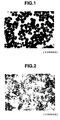
- Fig. 1 is an electron micrograph ( ⁇ 20,000) showing a particle structure of spherical magnetite particles used in Example 1.
- Fig. 2 is an electron micrograph ( ⁇ 20,000) showing a particle structure of carbon black particles used in Example 1.
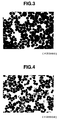
- Fig. 3 is an electron micrograph ( ⁇ 20,000) showing a particle structure of black magnetic composite particles obtained in Example 1.
- Fig. 4 is an electron micrograph ( ⁇ 20,000) showing a particle structure of mixed particles composed of the spherical magnetite particles and the carbon black fine particles, for comparative purpose.
- the black magnetic composite particles according to the present invention comprise magnetic iron oxide particles as core particles having an average particle diameter of 0.055 to 095 ⁇ m, a coating comprising an organosilicon compound which is formed on the surface of each magnetic iron oxide particle, and carbon black fine particles having an average particle size of 0.002 to 0.05 ⁇ m, adhered on at least a part of the coating comprising the organosilicon compound.
- maghemite particles ⁇ -Fe 2 O 3
- a mixture of these particles there may be exemplified magnetite particles ( FeO x •Fe 2 O 3 ; 0 ⁇ X ⁇ 1), maghemite particles ( ⁇ -Fe 2 O 3 ) or a mixture of these particles.
- magnetite particles are preferred.
- the magnetic iron oxide particles as core particles from the viewpoint of a particle shape thereof, there may be exemplified isotropic particles having a ratio of an average particle length (average major diameter) to an average particle breadth (average minor diameter) of usually not less than 1.0 and less than 2.0, preferably 1.0 to 1.8, more preferably 1.0 to 1.5, such as spherical particles, granular particles or polyhedral particles, e.g., hexahedral particles or octahedral particles, or anisotropic particles having an aspect ratio (average major axial diameter/average minor axial diameter; hereinafter referred to merely as "aspect ratio") of not less than 2:1, such as acicular particles, spindle-shaped particles or rice ball-shaped particles.
- the magnetic iron oxide particles having an isotropic shape are preferred. Among them, the spherical particles are more preferred.
- the average particle size (diameter) thereof is 0.055 to 0.95 ⁇ m, preferably 0.065 to 0.75 ⁇ m, more preferably 0.065 to 0.45 ⁇ m.
- the average major axial diameter thereof is 0.055 to 0.95 ⁇ m, preferably 0.065 to 0.75 ⁇ m, more preferably 0.065 to 0.45 ⁇ m, and the aspect ratio (average major axial diameter/average minor axial diameter) thereof is 2:1 to 20:1, preferably 2:1 to 15:1, more preferably 2:1 to 10:1.
- the obtained black magnetic composite particles are coarse particles and are deteriorated in tinting strength.
- the average particle size is less than 0.055 ⁇ m, the intermolecular force between the particles is increased due to the reduction in particle size (fine particle), so that agglomeration of the particles tends to be caused. As a result, it becomes difficult to uniformly coat the surfaces of the magnetic iron oxide particles with the organosilicon compounds, and uniformly adhere the carbon black fine particles on the surface of the coating comprising the organosilicon compounds.
- the particles tend to be entangled with each other, and it also becomes difficult to uniformly coat the surfaces of the magnetic iron oxide particles with the organosilicon compounds, and uniformly adhere the carbon black fine particles on the surface of the coating composed of the organosilicon compounds.
- the geometrical standard deviation value thereof is preferably not more than 2.0, more preferably not more than 1.8, still more preferably not more than 1.6.
- the geometrical standard deviation value thereof is more than 2.0, coarse particles are contained therein, so that the particles are inhibited from being uniformly dispersed. As a result, it also becomes difficult to uniformly coat the surfaces of the magnetic iron oxide particles with the organosilicon compounds, and uniformly adhere the carbon black fine particles on the surface of the coating composed of the organosilicon compounds.
- the lower limit of the geometrical standard deviation value is 1.01. It is industrially difficult to obtain particles having a geometrical standard deviation value of less than 1.01.
- the BET specific surface area of the magnetic iron oxide particles thereof is not less than 0.5 m 2 /g.
- the BET specific surface area is less than 0.5 m 2 /g, the magnetic iron oxide particles may become coarse particles, or the sintering between the particles may be caused, so that the obtained black magnetic composite particles also may become coarse particles and tend to be deteriorated in tinting strength.
- the BET specific surface area of the magnetic iron oxide particles is preferably not less than 1.0 m 2 /g, more preferably 3.0 m 2 /g.
- the upper limit of the BET specific surface area of the magnetic iron oxide particles is usually 70 m 2 /g, preferably 50 m 2 /g, more preferably 20 m 2 /g.
- the fluidity index thereof is about 25 to about 44.
- the spherical particles are excellent in fluidity, for example, the fluidity index thereof is about 30 to about 44.
- the lower limit thereof is usually 18.0 when represented by L* value, and the upper limit thereof is usually 25.0, preferably 24.0 when represented by L* value.
- the lower limit thereof is usually more than 18.0 when represented by L* value, and the upper limit thereof is usually 32, preferably 30 when represented by L* value.
- the L* value exceeds the above-mentioned upper limit, the lightness of the particles is increased, so that it is difficult to obtain black magnetic composite particles having a sufficient blackness.
- the coercive force value thereof is usually about 10 to about 350 Oe, preferably 20 to about 330 Oe;
- the saturation magnetization value in a magnetic field of 10 kOe is usually about 50 to about 91 emu/g, preferably about 60 to about 90 emu/g;
- the residual magnetization value in a magnetic field of 10 kOe is usually about 1 to about 35 emu/g, preferably about 3 to about 30 emu/g.
- the particle shape and particle size of the black magnetic composite particles according to the present invention are considerably varied depending upon those of the magnetic iron oxide particles as core particles.
- the black magnetic composite particles have a similar particle shape to that of the magnetic iron oxide particle as core particle, and a slightly larger particle size than that of the magnetic iron oxide particles as core particles.
- the obtained black magnetic composite particles according to the present invention when the isotropic magnetic iron oxide particles are used as core particles, the obtained black magnetic composite particles according to the present invention, have an average particle size of usually 0.06 to 1.0 ⁇ m, preferably 0.07 to 0.8 ⁇ m, more preferably 0.07 to 0.5 ⁇ m and a ratio of an average particle length to an average particle breadth of usually not less than 1.0 and less than 2.0, preferably 1.0 to 1.8, more preferably 1.0 to 1.5,.
- the anisotropic magnetic iron oxide particles are used as core particles
- the obtained black magnetic composite particles according to the present invention have an average particle size of usually 0.06 to 1.0 ⁇ m, preferably 0.07 to 0.8 ⁇ m, more preferably 0.07 to 0.5 ⁇ m.
- the obtained black magnetic composite particles may be coarse particles, and deteriorated in tinting strength.
- the average particle size thereof is less than 0.06 ⁇ m, the black magnetic composite particles tends to be agglomerated by the increase of intermolecular force due to the reduction in particle size, thereby deteriorating the dispersibility in a binder resin upon production of the magnetic toner.
- the upper limit of the aspect ratio of the obtained black magnetic composite particles according to the present invention is usually 20:1, preferably 18:1, more preferably 15:1.
- the aspect ratio is more than 20:1, the black magnetic composite particles may be entangled with each other in the binder resin, so that the dispersibility in binder resin tends to be deteriorated.
- the geometrical standard deviation value of the black magnetic composite particles according to the present invention is preferably not more than 2.0, more preferably 1.01 to 1.8, still more preferably 1.01 to 1.6.
- the lower limit of the geometrical standard deviation value thereof is preferably 1.01.
- the geometrical standard deviation value thereof is more than 2.0, the tinting strength of the black magnetic composite particles is likely to be deteriorated due to the existence of coarse particles therein. It is industrially difficult to obtain such particles having a geometrical standard deviation of less than 1.01.
- the BET specific surface area of the black magnetic composite particles according to the present invention is usually 1 to 200 m 2 /g, preferably 2 to 150 m 2 /g, more preferably 2.5 to 100 m 2 /g.
- the BET specific surface area thereof is less than 1 m 2 /g, the obtained black magnetic composite particles may be coarse, and the sintering between the black magnetic composite particles is caused, thereby deteriorating the tinting strength.
- the BET specific surface area is more than 200 m 2 /g, the black magnetic composite particles tend to be agglomerated together by the increase in intermolecular force due to the reduction in particle size, thereby deteriorating the dispersibility in a binder resin upon production of the magnetic toner.
- the fluidity index thereof is preferably 45 to 80, more preferably 46 to 80, still more preferably 47 to 80.
- the fluidity index thereof is less than 45, the fluidity of the black magnetic composite particles becomes insufficient, thereby failing to improve the fluidity of the finally obtained magnetic toner. Further, in the production process of the magnetic toner, there tend to be caused defects such as clogging of hopper, etc., thereby deteriorating the handling property or workability.
- the upper limit of the blackness of the black magnetic composite particles is usually 20.0, preferably 19.0, more preferably 18.0 when represented by L* value.
- the upper limit of the blackness of the black magnetic composite particles is usually 20.0, preferably 19.5, more preferably 19.0 when represented by L* value.
- L* value thereof is more than 20.0, the lightness of the obtained black magnetic composite particles becomes high, so that the black magnetic composite particles having a sufficient blackness cannot be obtained.
- the lower limit of the blackness thereof is 15 when represented by L* value.
- the dispersibility in binder resin of the black magnetic composite particles according to the present invention is preferably 4th or 5th rank, more preferably 5th rank when evaluated by the method described hereinafter.
- the percentage of desorption of carbon black fine particles from the black magnetic composite particles according to the present invention is preferably not more than 20 %, more preferably not more than 10 %.
- the desorption percentage of the carbon black fine particles is more than 20 %, the desorbed carbon black fine particles tend to inhibit the black magnetic composite particles from being uniformly dispersed in the binder resin upon production of the magnetic toner.
- the magnetic properties of the black magnetic composite particles according to the present invention can be controlled by appropriately selecting kind and particle shape of the magnetic iron oxide particles as core particles.
- the coercive force of the black magnetic composite particles according to the present invention is usually about 10 to about 350 Oe, preferably about 20 to about 330 Oe;
- the saturation magnetization in a magnetic field of 10 kOe is usually about 50 to about 91 emu/g, preferably about 60 to about 90 emu/g;
- the residual magnetization in a magnetic field of 10 kOe is usually about 1 to about 35 emu/g, preferably about 3 to about 30 emu/g.
- the coating formed on the surfaces of the core particles comprises at least one organosilicon compound selected from the group consisting of (1) organosilane compounds obtained by drying or heat-treating alkoxysilane compounds; (2) polysiloxanes, or modified polysiloxanes selected from the group consisting of (A) polysiloxanes modified with at least one compound selected from the group consisting of polyethers, polyesters and epoxy compounds (hereinafter referred to merely as "modified polysiloxanes"), and (B) polysiloxanes whose molecular terminal is modified with at least one group selected from the group consisting of carboxylic acid groups, alcohol groups and a hydroxyl group; and (3) fluoroalkyl organosilane compounds obtained by drying or heat-treating fluoroalkylsilane compounds.
- organosilicon compound selected from the group consisting of (1) organosilane compounds obtained by drying or heat-treating alkoxysilane compounds
- the organosilane compounds (1) can be produced by drying or heat-treating alkoxysilane compounds represented by the formula (I): R 1 a SiX 4-a wherein R 1 is C 6 H 5 -, (CH 3 ) 2 CHCH 2 - or n-C b H 2b+1 - (wherein b is an integer of 1 to 18); X is CH 3 O- or C 2 H 5 O-; and a is an integer of 0 to 3.
- R 1 a SiX 4-a wherein R 1 is C 6 H 5 -, (CH 3 ) 2 CHCH 2 - or n-C b H 2b+1 - (wherein b is an integer of 1 to 18); X is CH 3 O- or C 2 H 5 O-; and a is an integer of 0 to 3.
- the drying or heat-treatment of the alkoxysilane compounds is conducted, for example, at a temperature of usually 40 to 200°C, preferably 60 to 150°C for usually 10 minutes to 12 hours, preferably 30 minutes to 3 hours.
- alkoxysilane compounds may include methyl triethoxysilane, dimethyl diethoxysilane, tetraethoxysilane, phenyl triethyoxysilane, diphenyl diethoxysilane, methyl trimethoxysilane, dimethyl dimethoxysilane, tetramethoxysilane, phenyl trimethoxysilane, diphenyl dimethoxysilane, isobutyl trimethoxysilane, decyl trimethoxysilane or the like.
- methyl triethoxysilane, phenyl triethyoxysilane, methyl trimethoxysilane, dimethyl dimethoxysilane and isobutyl trimethoxysilane are preferred, and methyl triethoxysilane and methyl trimethoxysilane are more preferred.
- polysiloxanes (2) there may be used those compounds represented by the formula (II): wherein R 2 is H- or CH 3 -, and d is an integer of 15 to 450.
- polysiloxanes having methyl hydrogen siloxane units are preferred.
- modified polysiloxanes (A) there may be used:
- the polysiloxanes modified with the polyethers represented by the formula (III) are preferred.
- terminal-modified polysiloxanes (B) there may be used those represented by the formula (VI): wherein R 13 and R 14 are -OH, R 16 OH or R 17 COOH and may be the same or different; R 15 is -CH 3 or -C 6 H 5 ; R 16 and R 17 are -(-CH 2 -) y -; y is an integer of 1 to 15; w is an integer of 1 to 200; and x is an integer of 0 to 100.
- the polysiloxanes whose terminals are modified with carboxylic acid groups are preferred.
- the fluoroalkyl organosilane compounds (3) may be produced by drying or heat-treating fluoroalkylsilane compounds represented by the formula (VII): CF 3 (CF 2 ) z CH 2 CH 2 (R 18 ) a' SiX 4-a' wherein R 18 is CH 3 -, C 2 H 5 -, CH 3 O- or C 2 H 5 O-; X is CH 3 O- or C 2 H 5 O-; and z is an integer of 0 to 15; and a' is an integer of 0 to 3.
- the drying or the heat-treatment of the fluoroalkylsilane compounds may be conducted, for example, at a temperature of usually 40 to 200°C, preferably 60 to 150°C for usually 10 minutes to 12 hours, preferably 30 minutes to 3 hours.
- fluoroalkylsilane compounds may include trifluoropropyl trimethoxysilane, tridecafluorooctyl trimethoxysilane, heptadecafluorodecyl trimethoxysilane, heptadecafluorodecylmethyl dimethoxysilane, trifluoropropyl triethoxysilane, tridecafluorooctyl triethoxysilane, heptadecafluorodecyl triethoxysilane, heptadecafluorodecylmethyl diethoxysilane or the like.
- trifluoropropyl trimethoxysilane in view of the desorption percentage and the adhering effect of carbon black fine particles, trifluoropropyl trimethoxysilane, tridecafluorooctyl trimethoxysilane and heptadecafluorodecyl trimethoxysilane are preferred, and trifluoropropyl trimethoxysilane and tridecafluorooctyl trimethoxysilane are more preferred.
- the coating amount of the organosilicon compounds is usually 0.02 to 5.0 % by weight, preferably 0.03 to 2.0 % by weight, more preferably 0.05 to 1.5 % by weight (calculated as Si) based on the weight of the acicular hematite particles or the acicular iron oxide hydroxide particles coated with the organosilicon compounds.
- the coating amount of the organosilicon compounds is less than 0.02 % by weight, it becomes difficult to adhere the carbon black fine particles on the surfaces of the magnetic iron oxide particles in such an amount enough to improve the fluidity and blackness of the obtained black magnetic composite particles.
- the coating amount of the organosilicon compounds is more than 5.0 % by weight, a sufficient amount of the carbon black fine particles can be adhered on the surfaces of the magnetic iron oxide particles.
- the use of such unnecessarily large amount of the organosilicon compounds is meaningless because the effect of enhancing the fluidity or blackness of the obtained black magnetic composite particles is already saturated.
- the carbon black fine particles used in the black magnetic composite particles according to the present invention there may be exemplified commercially available carbon black particles such as furnace black, channel black or the like.
- the commercially available carbon black particles usable in the present invention may include MA100, MA7, #1000, #2400B, #30, MA8, MA11, #50, #52, #45, #2200B, MA600, etc. (tradenames; produced by Mitsubishi Chemical Corp.), Seast9H, Seast7H, Seast6, Seast3H, Seast300, SeastFM, etc. (tradenames; produced by Tokai Carbon Co., Ltd.) or the like.
- MA100, MA7, #1000, #2400B and #30 are preferred.
- the average particle size of the carbon black fine particles is usually about 0.002 to about 0.05 ⁇ m, preferably about 0.002 to about 0.035 ⁇ m.
- the carbon black fine particles are too fine to be well handled.
- the average particle size of the carbon black fine particles is more than 0.05 ⁇ m
- the particle size of the carbon black fine particles becomes much larger than that of the magnetic iron oxide particles as core particles, thereby causing insufficient adhesion of the carbon black fine particles onto the coating composed of the organosilicon compounds, and increasing the desorption percentage of the carbon black fine particles.
- the obtained black magnetic composite particles tend to be deteriorated in dispersibility in a binder resin upon the production of magnetic toner.
- the ratio of the average particle size of the magnetic iron oxide particles to that of the carbon black fine particles is preferably not less than 2:1.
- the ratio is less than 2:1, the particle size of the carbon black fine particles becomes considerably larger as compared to that of the magnetic iron oxide particles as core particles, thereby causing insufficient adhesion of the carbon black fine particles onto the coating composed of the organosilicon compounds, and increasing the desorption percentage of the carbon black fine particles.
- the obtained black magnetic composite particles tend to be deteriorated in dispersibility in a binder resin upon the production of magnetic toner.
- the amount of the carbon black fine particles adhered is 1 to 25 parts by weight based on 100 parts by weight of the magnetic iron oxide particles as core particles.
- the amount of the carbon black fine particles adhered is less than 1 part by weight, the amount of the carbon black fine particles adhered is insufficient, so that it becomes difficult to obtain black magnetic composite particles having a sufficient fluidity and blackness .
- the obtained black magnetic composite particles can show a sufficient fluidity and blackness.
- the carbon black fine particles adhered is considerably large, the carbon black fine particles tend to be desorbed from the coating composed of the organosilicon compound. As a result, the obtained black magnetic composite particles tend to be deteriorated in dispersibility in a binder resin upon the production of magnetic toner.
- the surfaces of the magnetic iron oxide particles as core particles may be preliminarily coated with at least one compound selected from the group consisting of hydroxides of aluminum, oxides of aluminum, hydroxides of silicon and oxides of silicon (hereinafter referred to as "coating composed of hydroxides and/or oxides of aluminum and/or silicon"), if necessary.
- the obtained black magnetic composite particles can show a higher dispersibility in a binder resin as compared to in the case where the magnetic iron oxide particles are uncoated with hydroxides and/or oxides of aluminum and/or silicon.
- the coating amount of the hydroxides and/or oxides of aluminum and/or silicon is preferably 0.01 to 50 % by weight (calculated as Al, SiO 2 or a sum of Al and SiO 2 ) based on the weight of the magnetic iron oxide particles as core particles.
- the coating amount of the hydroxides and/or oxides of aluminum and/or silicon is less than 0.01 % by weight, the effect of enhancing the dispersibility of the obtained black magnetic composite particles in a binder resin upon the production of magnetic toner cannot be obtained.
- the coating amount of the hydroxides and/or oxides of aluminum and/or silicon is more than 50 % by weight, the obtained black magnetic composite particles can exhibit a good dispersibility in a binder resin upon the production of magnetic toner.
- the use of such unnecessarily large coating amount of the hydroxides and/or oxides of aluminum and/or silicon is meaningless.
- the particle size, geometrical standard deviation, BET specific surface area, fluidity, blackness L* value and desorption percentage of carbon black fine particles of the black magnetic composite particles wherein the surface of the core particle is coated with the hydroxides and/or oxides of aluminum and/or silicon according to the present invention are substantially the same as those of the black magnetic composite particles wherein the core particle is uncoated with the hydroxides and/or oxides of aluminum and/or silicon according to the present invention.
- the black magnetic composite particles according to the present invention can be produced by the following method.
- (1) octahedral magnetite particles can be produced by passing an oxygen-containing gas through a suspension containing ferrous hydroxide colloid having a pH value of not less than 10, which is obtained by reacting an aqueous ferrous salt solution with an aqueous alkali solution having a concentration of not less than one equivalent based on Fe 2+ in the aqueous ferrous salt solution, thereby precipitating magnetite particles, and then subjecting the obtained magnetite particles to filtering, washing with water and drying (Japanese Patent Publication (KOKOKU) No.
- hexahedral magnetite particles can be produced by passing an oxygen-containing gas through a suspension containing ferrous hydroxide colloid having a pH value of 6.0 to 7.5, which is obtained by reacting an aqueous ferrous salt solution with an aqueous alkali solution having a concentration of not more than one equivalent based on Fe 2+ in the aqueous ferrous salt solution to produce magnetite core particles, further passing an oxygen-containing gas through the obtained aqueous ferrous salt reaction solution containing the magnetite core particles and the ferrous hydroxide colloid, at a pH value of 8.0 to 9.5, to precipitate magnetite particles, and then subjecting the precipitated magnetite particles to filtering, washing with water and drying (Japanese Patent Application Laid-Open (KOKAI) No.
- spherical magnetite particles can be produced by passing an oxygen-containing gas through a suspension containing ferrous hydroxide colloid having a pH value of 6.0 to 7.5, which is obtained by reacting an aqueous ferrous salt solution with an aqueous alkali solution having a concentration of not more than one equivalent based on Fe 2+ in the aqueous ferrous salt solution to produce magnetite core particles, adding alkali hydroxide in an amount of not less than equivalent based on the remaining Fe 2+ to adjust the pH value of the suspension to not less than 10, heat-oxidizing the resultant suspension to precipitate magnetite particles, and then subjecting the precipitated magnetite particles to filtering, washing with water and drying (Japanese Patent Publication (KOKOKU) No. 62-51208(1987).
- the isotropic maghemite particles can be obtained by heating the above-mentioned isotropic magnetite particles in air at 300 to 600°C.
- the anisotropic magnetite particles can be produced by passing an oxygen-containing gas through a suspension containing either ferrous hydroxide colloid, iron carbonate, or an iron-containing precipitate obtained by reacting an aqueous ferrous salt solution with alkali hydroxide and/or alkali carbonate, while appropriately controlling the pH value and temperature of the suspension, to produce acicular, spindle-shaped or rice ball-shaped goethite particles, subjecting the obtained goethite particles to filtering, washing with water and drying, and then reducing the goethite particles in a heat-reducing gas at 300 to 800°C.
- the anisotropic maghemite particles can be produced by heat-oxidizing the above-mentioned anisotropic magnetite particles in an oxygen-containing gas at 300 to 600°C.
- the coating of the magnetic iron oxide particles with the alkoxysilane compounds, the polysiloxanes, the modified polysiloxanes, the terminal-modified polysiloxanes or the fluoroalkylsilane compounds may be conducted by mechanically mixing and stirring the magnetic iron oxide particles together with the alkoxysilane compounds, the polysiloxanes, the modified polysiloxanes, the terminal-modified polysiloxanes or the fluoroalkylsilane compounds; or by mechanically mixing and stirring both the components together while spraying the alkoxysilane compounds, the polysiloxanes, the modified polysiloxanes, the terminal-modified polysiloxanes or the fluoroalkylsilane compounds onto the magnetic iron oxide particles.
- substantially whole amount of the alkoxysilane compounds, the polysiloxanes, the modified polysiloxanes, the terminal-modified polysiloxanes or the fluoroalkylsilane compounds added can be applied onto the surfaces of the magnetic iron oxide particles.
- the magnetic iron oxide particles are preliminarily diaggregated by using a pulverizer.
- a pulverizer As the apparatuses for the mixing and stirring, there may be used an edge runner, a Henschel mixer or the like.
- the conditions for the mixing and stirring such as mixing ratio, linear load, stirring speed or mixing and stirring time, may be appropriately adjusted so as to coat the surfaces of the magnetic iron oxide particles with the alkoxysilane compounds, the polysiloxanes, the modified polysiloxanes, the terminal-modified polysiloxanes or the fluoroalkylsilane compounds as uniformly as possible.
- the mixing and stirring time for the coating treatment is, for example, preferably not less than 20 minutes.
- the amount of the alkoxysilane compounds, the polysiloxanes, the modified polysiloxanes, the terminal-modified polysiloxanes or the fluoroalkylsilane compounds added is preferably 0.15 to 45 parts by weight based on 100 parts by weight of the magnetic iron oxide particles.
- the amount of the organosilicon compounds added is less than 0.15 part by weight, it may become difficult to adhere the carbon black fine particles in such an amount enough to improve the blackness and flowability of the obtained black magnetic composite particles.
- the amount of the organosilicon compounds added is more than 45 parts by weight, a sufficient amount of the carbon black fine particles can be adhered on the surface of the coating, but it is meaningless because the blackness and volume resistivity of the composite particles cannot be further improved by using such an excess amount of the organosilicon compounds.
- the carbon black fine particles are added to the magnetic iron oxide particles coated with the organosilicon compounds, and the resultant mixture is mixed and stirred to adhere the carbon black fine particles on the surfaces of the coating composed of the organosilicon compounds, and then dried.
- the coating compound In the case where the alkoxysilane compounds (1) and the fluoroalkylsilane compounds (3) are used as the coating compound, after the carbon black fine particles are adhered on the surface of the coating, the resultant composite particles are dried or heat-treated, for example, at a temperature of usually 40 to 200°C, preferably 60 to 150°C for usually 10 minutes to 12 hours, preferably 30 minutes to 3 hours, thereby forming a coating composed of the organosilane compounds (1) and the fluoroalkyl organosilane compounds (3), respectively.
- carbon black fine particles are added little by little and slowly, especially about 5 to 60 minutes.
- the conditions for mixing and stirring the magnetic iron oxide particles and the carbon black fine particles coated with the organosilicon compounds may be appropriately adjusted so as to uniformly adhere the carbon black fine particles on the surface of the coating.
- the mixing and stirring time for the adhesion treatment is, for example, preferably not less than 20 minutes.
- the amount of the carbon black fine particles added is preferably 1 to 30 parts by weight based on 100 parts by weight of the magnetic iron oxide particles.
- the amount of the carbon black fine particles added is less than 1 part by weight, it may become difficult to adhere the carbon black fine particles in such an amount enough to improve the blackness and flowability of the obtained composite particles.
- the amount of the carbon black fine particles added is more than 30 parts by weight, a sufficient blackness and flowability of the resultant composite particles can be obtained, but the carbon black fine particles tend to be desorbed from the surface of the coating because of too large amount of the carbon black fine particles adhered, resulting in deteriorated dispersibility in the binder resin upon the production of the magnetic toner.
- the magnetic iron oxide particles may be coated with at least one compound selected from the group consisting of hydroxides of aluminum, oxides of aluminum, hydroxides of silicon and oxides of silicon, if required, prior to mixing and stirring with the alkoxysilane compounds, the polysiloxanes, the modified polysiloxanes, the terminal-modified polysiloxanes or the fluoroalkylsilane compounds.
- the coating of the hydroxides and/or oxides of aluminum and/or silicon may be conducted by adding an aluminum compound, a silicon compound or both the compounds to a water suspension in which the magnetic iron oxide particles are dispersed, followed by mixing and stirring, and further adjusting the pH value of the suspension, if required, thereby coating the surfaces of the magnetic iron oxide particles with at least one compound selected from the group consisting of hydroxides of aluminum, oxides of aluminum, hydroxides of silicon and oxides of silicon.
- the thus obtained particles coated with the hydroxides and/or oxides of aluminum and/or silicon are then filtered out, washed with water, dried and pulverized. Further, the particles coated with the hydroxides and/or oxides of aluminum and/or silicon may be subjected to posttreatments such as deaeration treatment and compaction treatment, if required.
- aluminum compounds there may be exemplified aluminum salts such as aluminum acetate, aluminum sulfate, aluminum chloride or aluminum nitrate, alkali aluminates such as sodium aluminate, alumina sols or the like.
- the amount of the aluminum compound added is 0.01 to 50 % by weight (calculated as Al) based on the weight of the magnetic iron oxide particles.
- the amount of the aluminum compound added is less than 0.01 % by weight, it may be difficult to sufficiently coat the surfaces of the magnetic iron oxide particles with hydroxides and/or oxides of aluminum, thereby failing to achieve the improvement of the dispersibility in the binder resin upon the production of the magnetic toner.
- the amount of the aluminum compound added is more than 50 % by weight, the coating effect is saturated and, therefore, it is meaningless to add such an excess amount of the aluminum compound.
- silicon compounds there may be exemplified #3 water glass, sodium orthosilicate, sodium metasilicate, colloidal silica or the like.
- the amount of the silicon compound added is 0.01 to 50 % by weight (calculated as SiO 2 ) based on the weight of the magnetic iron oxide particles.
- the amount of the silicon compound added is less than 0.01 % by weight, it may be difficult to sufficiently coat the surfaces of the magnetic iron oxide particles with hydroxides and/or oxides of silicon, thereby failing to achieve the improvement of the dispersibility in the binder resin upon the production of the magnetic toner.
- the amount of the silicon compound added is more than 50 % by weight, the coating effect is saturated and, therefore, it is meaningless to add such an excess amount of the silicon compound.
- the total amount of the aluminum and silicon compounds added is preferably 0.01 to 50 % by weight (calculated as a sum of Al and SiO 2 ) based on the weight of the magnetic iron oxide particles.
- the black magnetic toner according to the present invention comprises the black magnetic composite particles, and a binder resin.
- the black magnetic toner may further contain a mold release agent, a colorant, a charge-controlling agent and other additives, if necessary.
- the black magnetic toner according to the present invention has an average particle size of usually 3 to 15 ⁇ m, preferably 5 to 12 ⁇ m.
- the amount of the binder resin used in the black magnetic toner is usually 50 to 900 parts by weight, preferably 50 to 400 parts by weight based on 100 parts by weight of the black magnetic composite particles.
- binder resins there may be used vinyl-based polymers, i.e., homopolymers or copolymers of vinyl-based monomers such as styrene, alkyl acrylates and alkyl methacrylates.
- vinyl-based polymers i.e., homopolymers or copolymers of vinyl-based monomers such as styrene, alkyl acrylates and alkyl methacrylates.
- styrene monomers there may be exemplified styrene and substituted styrenes.
- alkyl acrylate monomers there may be exemplified acrylic acid, methyl acrylate, ethyl acrylate, butyl acrylate or the like.
- the above copolymers contain styrene-based components in an amount of usually 50 to 95 % by weight.
- the above-mentioned vinyl-based polymers may be used in combination with polyester-based resins, epoxy-based resins, polyurethane-based resins or the like, if necessary.
- the fluidity index is usually 70 to 100, preferably 71 to 100, more preferably 72 to 100.
- the fluidity index is less than 70, the black magnetic toner may not show a sufficient fluidity.
- the blackness of the black magnetic toner according to the present invention is usually not more than 20, preferably not more than 19.8, more preferably not more than 19.5 when represented by L* value. When the blackness thereof is more than 20, the lightness of the black magnetic toner may be increased, resulting in insufficient blackness.
- the lower limit of the blackness of the black magnetic toner is usually about 15 when represented by L* value.
- the volume resistivity of the black magnetic toner according to the present invention is usually not less than 1.0 x 10 13 ⁇ •cm, preferably not less than 3.0 x 10 13 ⁇ •cm, more preferably not less than 5.0 x 10 13 ⁇ •cm.
- the upper limit of the volume resistivity is 1.0 x 10 17 ⁇ •cm.
- the coercive force thereof is usually 10 to 350 Oe, preferably 20 to 330 Oe;
- the saturation magnetization value in a magnetic field of 10 kOe is usually 10 to 85 emu/g, preferably 20 to 80 emu/g;
- the residual magnetization in a magnetic field of 10 kOe is usually 1 to 20 emu/g, preferably 2 to 15 emu/g;
- the saturation magnetization in a magnetic field of 1 kOe is usually 7.5 to 65 emu/g, preferably 10 to 60 emu/g;
- the residual magnetization in a magnetic field of 1 kOe is usually 0.5 to 15 emu/g, preferably 1.0 to 13 emu/g.
- the black magnetic toner according to the present invention may be produced by a known method of mixing and kneading a predetermined amount of a binder resin and a predetermined amount of the black magnetic composite particles together, and then pulverizing the mixed and kneaded material into particles. More specifically, the black magnetic composite particles and the binder resin are intimately mixed together with, if necessary, a mold release agent, a colorant, a charge-controlling agent or other additives by using a mixer. The obtained mixture is then melted and kneaded by a heating kneader so as to render the respective components compatible with each other, thereby dispersing the black magnetic composite particles therein. Successively, the molten mixture is cooled and solidified to obtain a resin mixture. The obtained resin mixture is then pulverized and classified, thereby producing a magnetic toner having an aimed particle size.
- the mixers there may be used a Henschel mixer, a ball mill or the like.
- the heating kneaders there may be used a roll mill, a kneader, a twin-screw extruder or the like.
- the pulverization of the resin mixture may be conducted by using pulverizers such as a cutter mill, a jet mill or the like.
- the classification of the pulverized particles may be conducted by known methods such as air classification, etc., as described in Japanese Patent No. 2683142 or the like.
- the other method of producing the black magnetic toner there may be exemplified a suspension poiymerization method or an emulsion polymerization method.
- the suspension polymerization method polymerizable monomers and the black magnetic composite particles are intimately mixed together with, if necessary, a colorant, a polymerization initiator, a cross-linking agent, a charge-controlling agent or the other additives and then the obtained mixture is dissolved and dispersed together so as to obtain a monomer composition.
- the obtained monomer composition is added to a water phase containing a suspension stabilizer while stirring, thereby granulating and polymerizing the composition to form magnetic toner particles having an aimed particle size.
- the monomers and the black magnetic composite particles are dispersed in water together with, if necessary, a colorant, a polymerization initiator or the like and then the obtained dispersion is polymerized while adding an emulsifier thereto, thereby producing magnetic toner particles having an aimed particle size.
- the black magnetic composite particles comprising the magnetic iron oxide particles which have an average particle size of 0.055 to 0.95 ⁇ m and may be coated with at least one compound selected from the group consisting of hydroxides of aluminum, oxides of aluminum, hydroxides of silicon and oxides of silicon; the organosilicon compounds coated on at least a part of the surface of the magnetic iron oxide particle; the carbon black fine particles having an average particle size of 0.002 to 0.05 ⁇ m, which are adhered on the surface of the coating composed of the organosilicon compounds, in which the total amount of the carbon black fine particles adhered to the coating composed of the organosilicon compounds is 1 to 25 parts by weight based on 100 parts by weight of the magnetic iron oxide particles, can show not only excellent fluidity and blackness, but also an excellent dispersibility in a binder resin upon the production of magnetic toner due to less amount of carbon black fine particles desorbed or fallen-off from the surfaces of the particles.
- the reason why the amount of the carbon black fine particles desorbed or fallen-off from the surfaces of the black magnetic composite particles according to the present invention, is small, is considered as follows. That is, the surfaces of the magnetic iron oxide particles and the organosilicon compounds are strongly bonded to each other, so that the carbon black fine particles bonded to the surfaces of the magnetic iron oxide particles through the organosilicon compounds can be prevented from being desorbed from the magnetic iron oxide particles.
- metallosiloxane bonds ( ⁇ Si-O-M wherein M represents a metal atom contained in the black iron oxide particles, such as Si, Al, Fe or the like) are formed between the surfaces of the magnetic iron oxide particles and alkoxy groups contained in the organosilicon compounds onto which the carbon black fine particles are adhered, thereby forming a stronger bond between the organosilicon compounds on which the carbon black fine particles are adhered, and the surfaces of the magnetic iron oxide particles.
- the reason why the black magnetic composite particles according to the present invention can show an excellent dispersibility in a binder resin upon the production of magnetic toner, is considered such that since only a small amount of the carbon black fine particles are desorbed or fallen-off from the surfaces of the black magnetic composite particles, the black magnetic composite particles is free from deterioration in dispersibility due to the desorbed or fallen-off carbon black fine particles, and further since the carbon black fine particles are adhered onto the surfaces of the black magnetic composite particles and, therefore, irregularities are formed on the surfaces of the black magnetic composite particles, the contact between the particles can be suppressed.
- the black magnetic composite particles according to the present invention can show an excellent fluidity, is considered as follows. That is, the carbon black fine particles which are ordinarily agglomerated together due to fineness thereof, are allowed to be uniformly and densely adhered on the surfaces of the magnetic iron oxide particles and, therefore, can be dispersed nearly in the form of primary particles, so that many fine irregularities are formed on the surfaces of the magnetic iron oxide particles.
- the reason why the black magnetic composite particles according to the present invention can show an excellent blackness, is considered such that since the carbon black fine particles are uniformly and densely adhered on the surfaces of the magnetic iron oxide particles, the color tone of the core particles is hidden behind the carbon black fine particles, so that an inherent color tone of carbon black can be exhibited.
- the black magnetic toner produced by using the above black magnetic composite particles can show excellent fluidity and blackness.
- the reason why the black magnetic toner according to the present invention can show an excellent fluidity is considered as follows. That is, the black magnetic composite particles on which a large amount of the carbon black fine particles are uniformly adhered, are blended in the black magnetic toner, so that many fine irregularities are formed on the surface of the black magnetic toner.
- the reason why the black magnetic toner according to the present invention can show an excellent blackness, is considered such that the black magnetic composite particles having an excellent blackness is blended in the black magnetic toner.
- the black magnetic composite particles according to the present invention are excellent not only in fluidity and blackness, but also in dispersibility in a binder resin due to less amount of the carbon black fine particles desorbed or fallen-off from the surfaces thereof, the black magnetic composite particles according to the present invention, are suitable as black magnetic particles for black magnetic toner capable of attaining a high image quality and a high copying speed.
- the black magnetic composite particles according to the present invention are excellent in dispersibility in a binder resin, the particles can show excellent handling property and workability and, therefore, are preferable from an industrial viewpoint.
- the black magnetic toner produced from the above black magnetic composite particles which are excellent in fluidity and blackness can also show excellent fluidity and blackness. Accordingly, the black magnetic toner is suitable as black magnetic toner capable of attaining a high image quality and a high copying speed.
- the black magnetic toner according to the present invention since the black magnetic composite particles contained therein are excellent in dispersibility, it is possible to expose the black magnetic composite particles to the surface of the black magnetic toner independently and separately. As a result, the black magnetic toner can be free from being deteriorated in electric resistance due to the existence of the carbon black fine particles. Accordingly, the black magnetic toner according to the present invention is suitable as a high-resistance or insulated magnetic toner.
- Geometrical standard deviation ⁇ particle size (major axial diameters) corresponding to 84.13 % under integration sieve ⁇ / ⁇ particle size (major axial diameters) (geometrical average diameter) corresponding to 50 % under integration sieve ⁇
- the obtained slurry containing the spherical magnetite particles was passed through a transverse-type sand grinder (tradename "MIGHTY MILL MHG-1.5L", manufactured by Inoue Seisakusho Co., Ltd.) five times at an axis-rotating speed of 2,000 rpm, thereby obtaining a slurry in which the spherical magnetite particles were dispersed.
- a transverse-type sand grinder tradename "MIGHTY MILL MHG-1.5L", manufactured by Inoue Seisakusho Co., Ltd.
- the particles in the obtained slurry which remained on a sieve of 325 meshes (mesh size: 44 ⁇ m) was 0 %.
- the slurry was filtered and washed with water, thereby obtaining a filter cake containing the spherical magnetite particles.
- MPUV-2 Model tradename, manufactured by Matsumoto Chuzo Tekkosho Co., Ltd.
- methyl triethoxysilane 110 g was mixed and diluted with 200 ml of ethanol to obtain a methyl triethoxysilane solution.
- the methyl triethoxysilane solution was added to the deagglomerated spherical magnetite particles under the operation of the edge runner.
- the spherical magnetite particles were continuously mixed and stirred at a linear load of 60 Kg/cm for 60 minutes.
- the obtained black magnetic composite particles were aged at 105°C for 60 minutes by using a drier to evaporate water, ethanol or the like which were remained on surfaces of the composite particles.
- the resultant black magnetic composite particles had an average particle size of 0.24 ⁇ m.
- the black magnetic composite particles showed a geometrical standard deviation value of 1.42, a BET specific surface area value of 10.2 m 2 /g, a fluidity index of 46 and a blackness (L* value) of 18.5.
- the desorption percentage of the carbon black fine particles from the black magnetic composite particles was 7.5 %.
- the coercive force value of the black magnetic composite particles was 61 Oe; the saturation magnetization value in a magnetic field of 10 kOe was 77.3 emu/g; and the residual magnetization value in a magnetic field of 10 kOe was 7.1 emu/g.
- the coating amount of an organosilane compound produced from methyl triethoxysilane was 0.31 % by weight calculated as Si. Since no independent carbon black fine particles were observed on the electron micrograph of Fig. 3, it was determined that a whole amount of the carbon black fine particles were adhered on the coating composed of the organosilane compound produced from methyl triethoxysilane.
- the obtained mixed particles were melt-kneaded at 140°C using a continuous-type twin-screw kneader (T-1), and the obtained kneaded material was cooled, coarsely pulverized and finely pulverized in air. The obtained particles were subjected to classification, thereby producing a black magnetic toner.
- T-1 continuous-type twin-screw kneader
- the obtained black magnetic toner had an average particle size of 9.7 ⁇ m, a dispersibility of 5th rank, a fluidity index of 73, a blackness (L* value) of 18.3, a volume resistivity of 1.0 ⁇ 10 14 ⁇ •cm, a coercive force value of 60 Oe, a saturation magnetization value (in a magnetic field of 10 kOe) of 32.6 emu/g, a residual magnetization value (in a magnetic field of 10 kOe) of 4.3 emu/g, a saturation magnetization value (in a magnetic field of 1 kOe) of 25.9 emu/g, and a residual magnetization value (in a magnetic field of 1 kOe) of 3.5 emu/g.
- the obtained slurry containing the spherical magnetite particles was passed through a transverse-type sand grinder (tradename "MIGHTY MILL MHG-1.5L", manufactured by Inoue Seisakusho Co., Ltd.) five times at an axis-rotating speed of 2,000 rpm, thereby obtaining a slurry in which the spherical magnetite particles were dispersed.
- a transverse-type sand grinder tradename "MIGHTY MILL MHG-1.5L", manufactured by Inoue Seisakusho Co., Ltd.
- the particles in the obtained slurry which remained on a sieve of 325 meshes (mesh size: 44 ⁇ m) was 0 %.
- the slurry was filtered and washed with water, thereby obtaining a filter cake containing the spherical magnetite particles.
- MPUV-2 Model tradename, manufactured by Matsumoto Chuzo Tekkosho Co., Ltd.
- methyl hydrogen polysiloxane (tradename: "TSF484", produced by TOSHIBA SILICONE CO., LTD.) were added to the deagglomerated spherical magnetite particles under the operation of the edge runner.
- the spherical magnetite particles were continuously mixed and stirred at a linear load of 60 Kg/cm for 60 minutes.
- the obtained black magnetic composite particles were dried at 105°C for 60 minutes by using a drier to evaporate water or the like which were remained on surfaces of the composite particles.
- the obtained black magnetic composite particles had an average particle size of 0.24 ⁇ m.
- the black magnetic composite particles had a geometrical standard deviation value of 1.42, a BET specific surface area value of 9.8 m 2 /g, a fluidity index of 48 and a blackness (L* value) of 18.2.
- the desorption percentage of the carbon black fine particles from the black magnetic composite particles was 6.5 %.
- the coercive force value of the black magnetic composite particles was 59 Oe; the saturation magnetization value in a magnetic field of 10 kOe was 76.8 emu/g; and the residual magnetization value in a magnetic field of 10 kOe was 7.0 emu/g.
- the coating amount of methyl hydrogen polysiloxane was 0.44 % by weight calculated as Si. Since no independent carbon black fine particles were observed on the electron micrograph, it was determined that a whole amount of the carbon black fine particles were adhered on the coating composed of methyl hydrogen polysiloxane.
- the obtained mixed particles were melt-kneaded at 140°C using a continuous-type twin-screw kneader (T-1), and the obtained kneaded material was cooled, coarsely pulverized and finely pulverized in air. The obtained particles were subjected to classification, thereby producing a black magnetic toner.
- T-1 continuous-type twin-screw kneader
- the obtained black magnetic toner had an average particle size of 9.7 ⁇ m, a dispersibility of 5th rank, a fluidity index of 72, a blackness (L* value) of 18.1, a volume resistivity of 1.2 ⁇ 10 14 ⁇ •cm, a coercive force value of 59 Oe, a saturation magnetization value (in a magnetic field of 10 kOe) of 32.4 emu/g, a residual magnetization value (in a magnetic field of 10 kOe) of 4.1 emu/g, a saturation magnetization value (in a magnetic field of 1 kOe) of 25.7 emu/g, and a residual magnetization value (in a magnetic field of 1 kOe) of 3.4 emu/g.
- the obtained slurry containing the spherical magnetite particles was passed through a transverse-type sand grinder (tradename "MIGHTY MILL MHG-1.5L", manufactured by Inoue Seisakusho Co., Ltd.) five times at an axis-rotating speed of 2,000 rpm, thereby obtaining a slurry in which the spherical magnetite particles were dispersed.
- a transverse-type sand grinder tradename "MIGHTY MILL MHG-1.5L", manufactured by Inoue Seisakusho Co., Ltd.
- the particles in the obtained slurry which remained on a sieve of 325 meshes (mesh size: 44 ⁇ m) was 0 %.
- the slurry was filtered and washed with water, thereby obtaining a filter cake containing the spherical magnetite particles.
- MPUV-2 Model tradename, manufactured by Matsumoto Chuzo Tekkosho Co., Ltd.
- the obtained black magnetic composite particles were aged at 105°C for 60 minutes by using a drier to evaporate water or the like which were remained on surfaces of the composite particles.
- the obtained black magnetic composite particles had an average particle size of 0.24 ⁇ m.
- the black magnetic composite particles showed a geometrical standard deviation value of 1.42, a BET specific surface area value of 8.6 m 2 /g, a fluidity index of 48 and a blackness (L* value) of 18.4.
- the desorption percentage of the carbon black fine particles from the black magnetic composite particles was 6.8 %.
- the coercive force value of the black magnetic composite particles was 61 Oe; the saturation magnetization value in a magnetic field of 10 kOe was 76.8 emu/g; and the residual magnetization value in a magnetic field of 10 kOe was 6.9 emu/g.
- the coating amount of a fluorine-containing organosilane compound produced from tridecafluorooctyl trimethoxysilane was 0.13 % by weight calculated as Si.
- the obtained mixed particles were melt-kneaded at 140°C using a continuous-type twin-screw kneader (T-1), and the obtained kneaded material was cooled, coarsely pulverized and finely pulverized in air. The obtained particles were subjected to classification, thereby producing a black magnetic toner.
- T-1 continuous-type twin-screw kneader
- the obtained black magnetic toner had an average particle size of 10.1 ⁇ m, a dispersibility of 5th rank, a fluidity index of 75, a blackness (L* value) of 18.5, a volume resistivity of 1.3 ⁇ 10 14 ⁇ •cm, a coercive force value of 58 Oe, a saturation magnetization value (in a magnetic field of 10 kOe) of 32.4 emu/g, a residual magnetization value (in a magnetic field of 10 kOe) of 4.2 emu/g, a saturation magnetization value (in a magnetic field of 1 kOe) of 25.7 emu/g, and a residual magnetization value (in a magnetic field of 1 kOe) of 3.4 emu/g.
- Core particles 1 to 4 are Core particles 1 to 4:
- Example 2 Various magnetic iron oxide particles were prepared by known methods. The same procedure as defined in Example 1 was conducted by using the thus prepared particles, thereby obtaining deagglomerated magnetic iron oxide particles as core particles.
- Example 2 The same procedure as defined in Example 1 was conducted by using 20 kg of the deagglomerated octahedral magnetite particles (core particles 1) and 150 liters of water, thereby obtaining a slurry containing the octahedral magnetite particles.
- the pH value of the obtained re-dispersed slurry containing the octahedral magnetite particles was adjusted to 4.0, and then the concentration of the slurry was adjusted to 98 g/liter by adding water thereto.
- the pH value of the slurry was adjusted to 7.5 by adding acetic acid. After further allowing the slurry to stand for 30 minutes, the slurry was subjected to filtration, washing with water, drying and pulverization, thereby obtaining the octahedral magnetite particles coated with hydroxides of aluminum and oxides of silicon.
- Example 2 The same procedure as defined in Example 1 was conducted except that kind of particles to be treated, addition or non-addition of an alkoxysilane compound in the coating treatment with alkoxysilane compound, kind and amount of the alkoxysilane compound added, treating conditions of edge runner in the coating treatment, kind and amount of carbon black fine particles adhered, and treating conditions of edge runner used in the adhering process of the carbon black fine particles, were varied, thereby obtaining black magnetic composite particles.
- the black magnetic composite particles obtained in Examples 7 to 14 were observed by an electron microscope. As a result, almost no independent carbon black fine particles were recognized. Therefore, it was confirmed that a substantially whole amount of the carbon black fine particles were adhered on the coating composed of organosilane compound produced from the alkoxysilane compound.
- Example 2 The same procedure as defined in Example 2 was conducted by using the black magnetic composite particles obtained in Examples 7 to 14, the magnetic iron oxide particles as core particles 1 to 4, the mixed particles composed of the magnetic iron oxide particles and the carbon black fine particles used in Comparative Example 1 and the black magnetic composite particles obtained in Comparative Examples 2 to 5, thereby obtaining black magnetic toners.
- Example 3 The same procedure as defined in Example 3 was conducted except that kind of particles to be treated, addition or non-addition of a polysiloxane or modified polysiloxane, kind and amount of the polysiloxane or modified polysiloxane, treating conditions of edge runner in the coating treatment, kind and amount of carbon black fine particles adhered, and treating conditions of edge runner used in the adhering process of the carbon black fine particles, were varied, thereby obtaining black magnetic composite particles.
- the black magnetic composite particles obtained in Examples 23 to 46 were observed by an electron microscope. As a result, almost no independent carbon black fine particles were recognized. Therefore, it was confirmed that a substantially whole amount of the carbon black fine particles were adhered on the coating composed of polysiloxane or modified polysiloxane.
- Example 4 The same procedure as defined in Example 4 was conducted by using the black magnetic composite particles obtained in Examples 47 to 70, and the black magnetic composite particles obtained in Comparative Examples 15 to 23, thereby obtaining black magnetic toners.
- Example 5 The same procedure as defined in Example 5 was conducted except that kind of particles to be treated, addition or non-addition of a fluoroalkyl organosilane compound, kind and amount of the fluoroalkyl organosilane compound added, treating conditions of edge runner in the coating treatment, kind and amount of carbon black fine particles adhered, and treating conditions of edge runner used in the adhering process of the carbon black fine particles, were varied, thereby obtaining black magnetic composite particles.
- the black magnetic composite particles obtained in Examples 71 to 78 were observed by an electron microscope. As a result, almost no independent carbon black fine particles were recognized. Therefore, it was confirmed that a substantially whole amount of the carbon black fine particles were adhered on the coating composed of a fluorine-containing organosilane compound produced from the fluoroalkyl organosilane compound.
- Example 6 The same procedure as defined in Example 6 was conducted by using the black magnetic composite particles obtained in Examples 71 to 78, and the black magnetic composite particles obtained in Comparative Examples 33 to 35, thereby obtaining black magnetic toners.
Landscapes
- Physics & Mathematics (AREA)
- General Physics & Mathematics (AREA)
- Chemical & Material Sciences (AREA)
- Inorganic Chemistry (AREA)
- Spectroscopy & Molecular Physics (AREA)
- Chemical Kinetics & Catalysis (AREA)
- Developing Agents For Electrophotography (AREA)
Priority Applications (2)
| Application Number | Priority Date | Filing Date | Title |
|---|---|---|---|
| US10/073,043 US6562532B2 (en) | 1998-02-17 | 2002-02-12 | Black magnetic toner and black magnetic composite particles therefor |
| US10/141,959 US6638675B2 (en) | 1998-02-17 | 2002-05-10 | Black magnetic toner |
Applications Claiming Priority (2)
| Application Number | Priority Date | Filing Date | Title |
|---|---|---|---|
| JP5282698 | 1998-02-17 | ||
| JP5282698 | 1998-02-17 |
Publications (2)
| Publication Number | Publication Date |
|---|---|
| EP0936507A2 true EP0936507A2 (de) | 1999-08-18 |
| EP0936507A3 EP0936507A3 (de) | 1999-11-17 |
Family
ID=12925667
Family Applications (1)
| Application Number | Title | Priority Date | Filing Date |
|---|---|---|---|
| EP99301117A Withdrawn EP0936507A3 (de) | 1998-02-17 | 1999-02-16 | Schwarzes teilchenförmiges magnetisierbares Verbundmaterial und schwarzer magnetischer Toner das dieses enthält |
Country Status (2)
| Country | Link |
|---|---|
| EP (1) | EP0936507A3 (de) |
| KR (1) | KR100585399B1 (de) |
Cited By (14)
| Publication number | Priority date | Publication date | Assignee | Title |
|---|---|---|---|---|
| EP0957474A1 (de) * | 1998-05-15 | 1999-11-17 | Toda Kogyo Corporation | Magnetisches Aufzeichnungsmedium |
| EP0982715A1 (de) * | 1998-08-28 | 2000-03-01 | Toda Kogyo Corp. | Schwarze plättchenförmige Kompositteilchen vom Magnetoplumbittyp und diese enthaltendes magnetisches Aufzeichnungsmedium |
| EP1063639A1 (de) * | 1999-06-24 | 2000-12-27 | Toda Kogyo Corporation | Magnetische Kompositteilchen,Verfahren zur Herstellung und diese enthaltendes magnetisches Aufzeichnungsmedium |
| EP1076267A1 (de) * | 1999-08-11 | 2001-02-14 | Toda Kogyo Corporation | Schwarzer magnetischer Toner und hierzu verwendete schwarze magnetische Teilchenzusammensetzung |
| US6294242B1 (en) | 1998-05-15 | 2001-09-25 | Toda Kogyo Corporation | Magnetic recording medium |
| EP1168087A1 (de) * | 2000-06-26 | 2002-01-02 | Toda Kogyo Corporation | Magnetische zusammengesetzte Teilchen für schwarze magnetische Toner und schwarze magnetische Toner worin sie eingesetzt werden |
| US6379855B1 (en) | 1998-02-17 | 2002-04-30 | Toda Kogyo Corporation | Black magnetic toner and black magnetic composite particles therefor |
| US6531211B1 (en) | 1998-08-28 | 2003-03-11 | Toda Kogyo Corporation | Black plate-shaped ferrite composite particles with magnet oplumbite structure and magnetic recording medium using the same |
| EP1207433A3 (de) * | 2000-11-20 | 2003-10-15 | Ricoh Company, Ltd. | Toner zur Entwicklung elektrostatischer Bilder, Bilderzeugungsverfahren und Bilderzeugungsvorrichtung |
| EP1199607A3 (de) * | 2000-10-20 | 2003-10-15 | Ricoh Company, Ltd. | Zwei-Komponentenentwickler, Bilderzeugungsvorrichtung und Bilderzeugungsverfahren |
| US6821618B2 (en) | 2000-12-22 | 2004-11-23 | Toda Kogyo Corporation | Magnetic recording medium and process for producing the same |
| US6863966B1 (en) * | 1999-11-15 | 2005-03-08 | Toda Kogyo Corporation | Black magnetic acicular composite particles for magnetic recording medium and magnetic recording medium using the same |
| US7122286B2 (en) * | 2000-04-05 | 2006-10-17 | Ricoh Company, Ltd. | Toner for development of electrostatic latent images, method of forming images, image formation apparatus, toner container containing the toner therein, and image formation apparatus equipped with the toner container |
| US7592115B2 (en) * | 2005-05-25 | 2009-09-22 | Fuji Xerox Co., Ltd. | Carrier for electrostatic latent image developer, production method thereof, electrostatic latent image developer, and image-forming device |
Families Citing this family (1)
| Publication number | Priority date | Publication date | Assignee | Title |
|---|---|---|---|---|
| KR102094296B1 (ko) * | 2018-07-05 | 2020-03-27 | (주)제니스월드 | 정전척용 흑색 세라믹 페이스트 조성물 및 이를 이용한 정전척 |
Family Cites Families (4)
| Publication number | Priority date | Publication date | Assignee | Title |
|---|---|---|---|---|
| JPS59224102A (ja) * | 1983-06-03 | 1984-12-17 | Ricoh Co Ltd | 磁性粉の表面処理方法 |
| DE3841848A1 (de) * | 1988-12-13 | 1990-06-21 | Bayer Ag | Anorganische pigmente mit verbesserten eigenschaften |
| JP3009695B2 (ja) * | 1990-01-26 | 2000-02-14 | 戸田工業株式会社 | 鉄を主成分とする磁性粒子粉末及びその製造法 |
| DE69806560T2 (de) * | 1997-10-31 | 2002-11-28 | Toda Kogyo Corp | Schwarze Verbundpartikel auf der Basis von Eisen, Verfahren zu dessen Herstellung, diese enthaltende Farbe und Kautschuk oder Harz |
-
1999
- 1999-02-16 EP EP99301117A patent/EP0936507A3/de not_active Withdrawn
- 1999-02-18 KR KR1019990005423A patent/KR100585399B1/ko not_active Expired - Fee Related
Cited By (15)
| Publication number | Priority date | Publication date | Assignee | Title |
|---|---|---|---|---|
| US6379855B1 (en) | 1998-02-17 | 2002-04-30 | Toda Kogyo Corporation | Black magnetic toner and black magnetic composite particles therefor |
| EP0957474A1 (de) * | 1998-05-15 | 1999-11-17 | Toda Kogyo Corporation | Magnetisches Aufzeichnungsmedium |
| US6294242B1 (en) | 1998-05-15 | 2001-09-25 | Toda Kogyo Corporation | Magnetic recording medium |
| EP0982715A1 (de) * | 1998-08-28 | 2000-03-01 | Toda Kogyo Corp. | Schwarze plättchenförmige Kompositteilchen vom Magnetoplumbittyp und diese enthaltendes magnetisches Aufzeichnungsmedium |
| US6531211B1 (en) | 1998-08-28 | 2003-03-11 | Toda Kogyo Corporation | Black plate-shaped ferrite composite particles with magnet oplumbite structure and magnetic recording medium using the same |
| EP1063639A1 (de) * | 1999-06-24 | 2000-12-27 | Toda Kogyo Corporation | Magnetische Kompositteilchen,Verfahren zur Herstellung und diese enthaltendes magnetisches Aufzeichnungsmedium |
| EP1076267A1 (de) * | 1999-08-11 | 2001-02-14 | Toda Kogyo Corporation | Schwarzer magnetischer Toner und hierzu verwendete schwarze magnetische Teilchenzusammensetzung |
| US6863966B1 (en) * | 1999-11-15 | 2005-03-08 | Toda Kogyo Corporation | Black magnetic acicular composite particles for magnetic recording medium and magnetic recording medium using the same |
| US7122286B2 (en) * | 2000-04-05 | 2006-10-17 | Ricoh Company, Ltd. | Toner for development of electrostatic latent images, method of forming images, image formation apparatus, toner container containing the toner therein, and image formation apparatus equipped with the toner container |
| US6475687B2 (en) | 2000-06-26 | 2002-11-05 | Toda Kogyo Corporation | Magnetic composite particles for black magnetic toner and black magnetic toner using the same |
| EP1168087A1 (de) * | 2000-06-26 | 2002-01-02 | Toda Kogyo Corporation | Magnetische zusammengesetzte Teilchen für schwarze magnetische Toner und schwarze magnetische Toner worin sie eingesetzt werden |
| EP1199607A3 (de) * | 2000-10-20 | 2003-10-15 | Ricoh Company, Ltd. | Zwei-Komponentenentwickler, Bilderzeugungsvorrichtung und Bilderzeugungsverfahren |
| EP1207433A3 (de) * | 2000-11-20 | 2003-10-15 | Ricoh Company, Ltd. | Toner zur Entwicklung elektrostatischer Bilder, Bilderzeugungsverfahren und Bilderzeugungsvorrichtung |
| US6821618B2 (en) | 2000-12-22 | 2004-11-23 | Toda Kogyo Corporation | Magnetic recording medium and process for producing the same |
| US7592115B2 (en) * | 2005-05-25 | 2009-09-22 | Fuji Xerox Co., Ltd. | Carrier for electrostatic latent image developer, production method thereof, electrostatic latent image developer, and image-forming device |
Also Published As
| Publication number | Publication date |
|---|---|
| EP0936507A3 (de) | 1999-11-17 |
| KR100585399B1 (ko) | 2006-05-30 |
| KR19990072739A (ko) | 1999-09-27 |
Similar Documents
| Publication | Publication Date | Title |
|---|---|---|
| CN101802721B (zh) | 磁性调色剂 | |
| EP0952494B1 (de) | Schwarze, nicht-magnetische Kompositteilchen für schwarze Toner und diese Teilchen enthaltende schwarze Toner | |
| US6638675B2 (en) | Black magnetic toner | |
| KR100585399B1 (ko) | 흑색 자성 복합체 입자 및 이를 사용하는 흑색 자성 토너 | |
| US6379855B1 (en) | Black magnetic toner and black magnetic composite particles therefor | |
| US6251555B1 (en) | Black magnetic composite particles for black magnetic toner and black magnetic toner using the same | |
| US6475687B2 (en) | Magnetic composite particles for black magnetic toner and black magnetic toner using the same | |
| EP0945766B1 (de) | Schwarze nicht-magnetische zusammengesetzte Teilchen für schwarze Toner und schwarze Toner, worin sie eingesetzt werden | |
| EP1076267A1 (de) | Schwarzer magnetischer Toner und hierzu verwendete schwarze magnetische Teilchenzusammensetzung | |
| JP2000010344A (ja) | 黒色トナ―用黒色複合非磁性粒子粉末及び該黒色複合非磁性粒子粉末を用いた黒色トナ― | |
| US20030175518A1 (en) | Magnetic composite particles for magnetic color toner, magnetic color toner using the same, method for developing magnetic latent image using the toner, and method for developing electrostatic image using the toner | |
| US6838218B2 (en) | Black toner | |
| JP3664216B2 (ja) | 黒色磁性トナー用黒色磁性粒子粉末及び該黒色磁性粒子粉末を用いた黒色磁性トナー | |
| US6562532B2 (en) | Black magnetic toner and black magnetic composite particles therefor | |
| EP1076266A1 (de) | Schwarzer Toner | |
| JPH10171157A (ja) | 磁性トナー用磁性酸化鉄粒子粉末及び該磁性酸化鉄粒子粉末を用いた磁性トナー | |
| JP2000003073A (ja) | 黒色磁性トナ―用黒色複合磁性粒子粉末及び該黒色複合磁性粒子粉末を用いた黒色磁性トナ― | |
| EP0982715A1 (de) | Schwarze plättchenförmige Kompositteilchen vom Magnetoplumbittyp und diese enthaltendes magnetisches Aufzeichnungsmedium | |
| US20020182525A1 (en) | Black toner | |
| US20020045700A1 (en) | Non-magnetic composite particles for black toner and black toner using the same | |
| JPH10171158A (ja) | 球状を呈した磁性トナー用磁性酸化鉄粒子粉末及び該磁性酸化鉄粒子粉末を用いた磁性トナー | |
| JP2002080224A (ja) | 黒色磁性トナー用黒色磁性粒子粉末及び該黒色磁性粒子粉末を用いた黒色磁性トナー | |
| JP4328928B2 (ja) | 黒色磁性トナー用黒色複合磁性粒子粉末及び該黒色複合磁性粒子粉末を用いた黒色磁性トナー | |
| JP2000356864A (ja) | 黒色磁性トナー用黒色複合磁性粒子粉末及び該黒色複合磁性粒子粉末を用いた黒色磁性トナー | |
| JPH11338191A (ja) | 黒色トナ―用黒色複合非磁性粒子粉末及び該黒色複合非磁性粒子粉末を用いた黒色トナ― |
Legal Events
| Date | Code | Title | Description |
|---|---|---|---|
| PUAI | Public reference made under article 153(3) epc to a published international application that has entered the european phase |
Free format text: ORIGINAL CODE: 0009012 |
|
| AK | Designated contracting states |
Kind code of ref document: A2 Designated state(s): DE FR GB LU NL |
|
| AX | Request for extension of the european patent |
Free format text: AL;LT;LV;MK;RO;SI |
|
| PUAL | Search report despatched |
Free format text: ORIGINAL CODE: 0009013 |
|
| AK | Designated contracting states |
Kind code of ref document: A3 Designated state(s): AT BE CH CY DE DK ES FI FR GB GR IE IT LI LU MC NL PT SE |
|
| AX | Request for extension of the european patent |
Free format text: AL;LT;LV;MK;RO;SI |
|
| RIC1 | Information provided on ipc code assigned before grant |
Free format text: 6C 09C 1/24 A, 6C 09C 3/12 B |
|
| 17P | Request for examination filed |
Effective date: 20000510 |
|
| AKX | Designation fees paid |
Free format text: DE FR GB LU NL |
|
| RAP1 | Party data changed (applicant data changed or rights of an application transferred) |
Owner name: TODA KOGYO CORPORATION |
|
| 17Q | First examination report despatched |
Effective date: 20020212 |
|
| GRAH | Despatch of communication of intention to grant a patent |
Free format text: ORIGINAL CODE: EPIDOS IGRA |
|
| STAA | Information on the status of an ep patent application or granted ep patent |
Free format text: STATUS: THE APPLICATION IS DEEMED TO BE WITHDRAWN |
|
| 18D | Application deemed to be withdrawn |
Effective date: 20030701 |