EP0937748B1 - Compositions réticulables de polyéther fluoré - Google Patents
Compositions réticulables de polyéther fluoré Download PDFInfo
- Publication number
- EP0937748B1 EP0937748B1 EP99301306A EP99301306A EP0937748B1 EP 0937748 B1 EP0937748 B1 EP 0937748B1 EP 99301306 A EP99301306 A EP 99301306A EP 99301306 A EP99301306 A EP 99301306A EP 0937748 B1 EP0937748 B1 EP 0937748B1
- Authority
- EP
- European Patent Office
- Prior art keywords
- curable composition
- composition according
- group
- organic
- groups
- Prior art date
- Legal status (The legal status is an assumption and is not a legal conclusion. Google has not performed a legal analysis and makes no representation as to the accuracy of the status listed.)
- Expired - Lifetime
Links
Images


Classifications
-
- C—CHEMISTRY; METALLURGY
- C08—ORGANIC MACROMOLECULAR COMPOUNDS; THEIR PREPARATION OR CHEMICAL WORKING-UP; COMPOSITIONS BASED THEREON
- C08G—MACROMOLECULAR COMPOUNDS OBTAINED OTHERWISE THAN BY REACTIONS ONLY INVOLVING UNSATURATED CARBON-TO-CARBON BONDS
- C08G65/00—Macromolecular compounds obtained by reactions forming an ether link in the main chain of the macromolecule
- C08G65/02—Macromolecular compounds obtained by reactions forming an ether link in the main chain of the macromolecule from cyclic ethers by opening of the heterocyclic ring
- C08G65/32—Polymers modified by chemical after-treatment
- C08G65/329—Polymers modified by chemical after-treatment with organic compounds
- C08G65/336—Polymers modified by chemical after-treatment with organic compounds containing silicon
-
- C—CHEMISTRY; METALLURGY
- C08—ORGANIC MACROMOLECULAR COMPOUNDS; THEIR PREPARATION OR CHEMICAL WORKING-UP; COMPOSITIONS BASED THEREON
- C08G—MACROMOLECULAR COMPOUNDS OBTAINED OTHERWISE THAN BY REACTIONS ONLY INVOLVING UNSATURATED CARBON-TO-CARBON BONDS
- C08G65/00—Macromolecular compounds obtained by reactions forming an ether link in the main chain of the macromolecule
- C08G65/002—Macromolecular compounds obtained by reactions forming an ether link in the main chain of the macromolecule from unsaturated compounds
- C08G65/005—Macromolecular compounds obtained by reactions forming an ether link in the main chain of the macromolecule from unsaturated compounds containing halogens
- C08G65/007—Macromolecular compounds obtained by reactions forming an ether link in the main chain of the macromolecule from unsaturated compounds containing halogens containing fluorine
Definitions
- This invention relates to curable compositions of the condensation curing type which yield fluorine-modified silicone rubber.
- Silicone rubber compositions of the condensation curing type comprising an organopolysiloxane terminated with Si-OH groups as a base polymer and a silicon compound having a hydrolyzable group such as vinyltriacetoxysilane and vinyltriisopropenoxysilane as a crosslinking agent are used in a variety of applications.
- Such curable silicone rubber compositions of the one package type cure through the mechanism that condensation reaction takes place between SiX groups (wherein X is typically acetoxy or isopropenoxy) in the crosslinking agent and Si-OH groups at the terminus of the base polymer to form siloxane bonds and then, excessive Si-X groups undergo hydrolytic condensation reaction under the action of moisture in the ambient atmosphere.
- a fluorine-modified silicone rubber composition of the condensation curing type comprising an oily base polymer in the form of a fluorinated polyether having Si-OCH 3 groups incorporated at its terminus. More particularly, this composition contains a compound of the following formula as the main component and cures through hydrolytic condensation of Si-OCH 3 groups with moisture in the ambient atmosphere.
- the resulting fluorine-modified silicone rubber is superior with respect to solvent resistance, chemical resistance, and stain resistance, as compared with prior art silicon rubber based on dimethylpolysiloxane.
- This silicone rubber however, has the drawbacks that its moisture permeability is low because it is a polymer having a high fluorine content and that curing to the depth takes a long time because moisture in the ambient atmosphere is requisite for curing.
- EP-A-0745604 discloses deep-portion curable compositions comprising
- the aim herein is to provide new and useful curable compositions of the condensation curing type, typically fluorine-modified silicone rubber compositions, which are curable at room temperature preferably without any need for moisture.
- a novel fluorinated polyether having Si-OH groups at both ends is obtained by subjecting a fluorinated polyether having ethylenically unsaturated groups at both ends and an organic silicon compound having at least two Si-H groups in a molecule to addition reaction (or hydrosilylation reaction) in the presence of a catalyst to produce a fluorinated polyether having Si-H groups at both ends, then subjecting the fluorinated polyether having Si-H groups at both ends and H 2 O to dehydrogenation reaction in the presence of a catalyst to convert the Si-H groups to Si-OH groups; or by subjecting a fluorinated polyether having ethylenically unsaturated groups at both ends and an organic silicon compound having both Si-H and Si-X groups in a molecule (wherein X is a hydrolyzable group) to addition reaction to produce a fluorinated polyether having Si-X groups at both ends, then effecting hydrolysis to convert the Si-X groups to Si-OH groups.
- a curable composition comprising (A) a fluorinated organic silicon compound of the following general formula (1), (B) an organic silicon compound of the following general formula (5), (6) or (7), and (C) a condensation accelerator.
- A a fluorinated organic silicon compound of the following general formula (1)
- B an organic silicon compound of the following general formula (5), (6) or (7)
- C a condensation accelerator.
- Rf is a divalent fluorinated polyether group.
- R 1 is a substituted or unsubstituted divalent hydrocarbon group which may be separated by at least one atom selected from the group consisting of oxygen, nitrogen, silicon and sulfur atoms, and which may contain an amide or sulfonamide bond.
- Z is a group of the following general formula (2), (3) or (4): wherein R 2 , R 3 , and R 4 are independently monovalent organic groups, letters b and c each are equal to 1, 2 or 3, and d is an integer of 0 to 3. (YO) e SiR 5 4-e
- R 5 is a monovalent organic group.
- R 1 and Rf are as defined above and Rf 2 is a monovalent fluorinated polyether group. Letter e is equal to 2 or 3, f is equal to 1, 2 or 3, and g is equal to 2 or 3.
- R 5 has the meaning Rf 2 -R 1 -.
- the fluorinated organic silicon compound as component (A) of the curable composition according to the invention is a fluorinated polyether having Si-OH groups at both ends as represented by the above formula (1).
- Rf represents divalent fluorinated polyether groups, for example, groups of the following formula: -(Rf'-O) q - wherein Rf' is a straight or branched perfluoroalkylene group having 1 to 6 carbon atoms, preferably 1 to 3 carbon atoms, and q is an integer of 1 to 200, preferably 2 to 150, more preferably 2 to 100.
- Examples of the recurring units represented by -(Rf'-O)- include -CF 2 O-, -CF 2 CF 2 O-, -CF 2 CF 2 CF 2 O-, -C(CF 3 )FCF 2 O-, -CF 2 CF 2 CF 2 CF 2 O-, -CF 2 CF 2 CF 2 CF 2 O-, and -C(CF 3 ) 2 O-, with -CF 2 O-, -CF 2 CF 2 O-, -CF 2 CF 2 CF 2 O-, and -C(CF 3 )FCF 2 O- being preferred.
- the perfluoropolyether structure may consist of recurring units -(Rf'-O)- of one type or two or more different types.
- Rf' Illustrative examples of Rf' are given below.
- -C 4 F 8 - -C 6 F 12 - -CF 2 CF 2 OCF 2 (CF 2 ) 2 CF 2 OCF 2 CF 2 - -CF 2 (OCF 2 CF 2 ) n (OCF 2 ) m OCF 2 - n 5 to 50, e.g., 8.
- m 1 to 10, e.g., 2.
- -CF 2 CF 2 (OCF 2 CF 2 CF 2 ) n OCF 2 CF 2 - n 5 to 100, e.g. , 10.
- R 1 is a divalent hydrocarbon group, specifically a substituted or unsubstituted divalent hydrocarbon group which may be separated by at least one atom selected from among oxygen, nitrogen, silicon and sulfur atoms, and which may contain an amide or sulfonamide bond.
- the divalent hydrocarbon groups are preferably those of 2 to 20 carbon atoms.
- Examples of the substituted or unsubstituted divalent hydrocarbon group which is not separated by an oxygen, nitrogen, silicon or sulfur atom, and which does not contain an amide or sulfonamide bond include alkylene groups such as ethylene, propylene, methylethylene, butylene, and hexamethylene; cycloalkylene groups such as cyclohexylene; arylene groups such as phenylene, tolylene, xylylene, naphthylene, and biphenylene; combinations of the alkylene groups with the arylene groups; and substituted ones of the alkylene and arylene groups in which some or all of the hydrogen atoms are replaced by halogen atoms.
- the oxygen atom may intervene in the form of -O-
- the silicon atom may intervene in the form of -SiR'R"- wherein R' and R" each are alkyl of 1 to 10 carbon atoms or aryl
- the sulfur atom may intervene in the form of -S-.
- the amide group may intervene in the form of -CONR- wherein R is as defined above
- the sulfonamide group may intervene in the form of -SO 2 NR- wherein R is as defined above.
- Z is a group of the above formula (2), (3) or (4).
- R 2 , R 3 , and R 4 which may be the same or different, are monovalent organic groups, letters b and c each are equal to 1, 2 or 3, and d is an integer of 0 to 3.
- the organic groups represented by R 2 , R 3 , and R 4 include substituted or unsubstituted monovalent hydrocarbon groups, preferably of 1 to 12 carbon atoms, for example, alkyl groups such as methyl, ethyl, propyl, isopropyl, butyl, isobutyl, tert-butyl, pentyl, neopentyl, hexyl, heptyl, octyl, nonyl, and decyl; cycloalkyl groups such as cyclopentyl, cyclohexyl, and cycloheptyl; aryl groups such as phenyl, tolyl, xylyl, and naphthyl; aralkyl groups such as benzyl, phenylethyl, and phenylpropyl; and substituted ones of these groups in which some or all of the hydrogen atoms are replaced by halogen atoms (e.g.
- the organic silicon compound as component (B) of the curable composition according to the invention is a compound having in a molecule at least two Si-OY groups capable of condensation reaction with Si-OH groups without a need for moisture, as represented by the above general formula (5), (6) or (7).
- Y is a monovalent organic group selected from the following groups. These groups form Si-OY groups which undergo condensation reaction with Si-OH groups.
- R 5 represents monovalent organic groups, preferably substituted or unsubstituted monovalent hydrocarbon groups, especially of 1 to 12 carbon atoms, for example, alkyl groups such as methyl, ethyl, propyl, isopropyl, butyl, isobutyl, tert-butyl, pentyl, neopentyl, hexyl, heptyl, octyl, nonyl, and decyl; cycloalkyl groups such as cyclopentyl, cyclohexyl, and cycloheptyl; aryl groups such as phenyl, tolyl, xylyl, and naphthyl; aralkyl groups such as benzyl, phenylethyl, and phenylpropyl; alkenyl groups such as vinyl, allyl, propenyl, and butenyl; and substituted ones of these groups in which some or all of the hydrogen
- R 5 may also be is a group of the general formula (8).
- Rf 2 is a monovalent fluorinated polyether group, examples of which include the groups represented by Rf which are blocked at one end with CF 3 O-, CF 3 CF 2 O-, CF 3 CF 2 CF 2 O-, (CF 3 ) 2 CFO-, CF 3 CF 2 CF 2 CF 2 O- or the like.
- R 1 is as defined above.
- R 1 and Rf are as defined above. Letter e is equal to 2 or 3, f is equal to 1, 2 or 3, and g is equal to 2 or 3.
- the organic silicon compounds (B) function as a crosslinking agent and may be used alone or in admixture of two or more.
- An appropriate blending ratio of components (A) and (B) is such that the ratio of the moles of Si-OY groups in component (B) to the moles of Si-OH groups in component (A), that is, Si-OY/Si-OH, may range from 0.2 to 5.0, preferably from 0.5 to 3.0.
- the condensation accelerator (C) has the function of accelerating the condensation reaction between Si-OH groups and Si-OY groups.
- exemplary accelerators include metal salts or amine salts of organic carboxylic acids such as lead 2-ethyloctoate, dibutyltin dimethoxide, dibutyltin diacetate, dibutyltin dilaurate, butyltin tri-2-ethylhexoate, iron 2-ethylhexoate, cobalt 2-ethylhexoate, manganese 2-ethylhexoate, zinc 2-ethylhexoate, stannous caprylate, tin naphthenate, tin oleate, tin butyrate, titanium naphthenate, zinc naphthenate, cobalt naphthenate, zinc stearate, ammonium trifluoroacetate, and the diethylamine salt of trifluoroacetic acid; organic acids such as para-tolu
- tin compounds titanium compounds, organic acids, and guanidyl compounds are preferred.
- guanidyl compounds are especially preferred because they assist in rapidly curing the composition and improve the adhesion of cured composition.
- These accelerators may be used alone or in admixture of two or more.
- An appropriate amount of the curing accelerator (C) used is usually about 0.01 to about 5 parts, preferably about 0.05 to about 2 parts by weight per 100 parts by weight of components (A) and (B) combined.
- additives may be added to the composition for the purpose of adjusting the physical properties of cured composition and other purposes.
- Such additives include storage stabilizers such as methyltrimethoxysilane, methyltripropenoxysilane, vinyltributanoximesilane and methyltriacetoxysilane; reinforcing fillers such as fumed silica, precipitated silica, titanium dioxide, aluminum oxide, quartz flour, carbon powder, talc, and bentonite; fibrous fillers such as asbestos, glass fibers, and organic fibers; colorants such as pigments and dyestuffs; heat resistance modifiers such as red iron oxide and cerium oxide; freeze resistance modifiers; dehydrating agents; rust-preventing agents; tackifiers such as ⁇ -(3,4-epoxycyclohexyl)ethyltrimethoxysilane, ⁇ -glycidoxypropyltriethoxysilane, ⁇ -methacryloxypropyltrimethoxysilane, ⁇ -me
- the curable composition of the invention may be formulated to either one or two package type.
- the composition of the one package type may be prepared by uniformly mixing components (A) to (C) and optional additives in a dry atmosphere.
- one package is a liquid containing component (A) and the other package is a liquid containing components (B) and (C) wherein these two liquids are mixed on use.
- an applicator comprising a pair of cartridges and equipped with a nozzle having a mixer built-in is useful.
- the cartridges are filled e.g. with equal volumes of the two liquids.
- the two liquids are mixed, e.g. at 1:1, and extruded through the nozzle.
- the two package type has the advantage of ease of operation.
- the temperature during mixing may range from room temperature to about 60°C.
- Cured products resulting from the curable compositions of the invention are useful, for example, as automotive oil seals, sealing members for chemical equipment, sealing members for electric and electronic parts, and potting compounds.
- compositions are curable at room temperature even in the absence of moisture and fully cure to the depth.
- Composition 1 was prepared by mixing 100 parts of a fluorinated organic silicon compound of formula (9) shown below, 30.9 parts of an organic silicon compound of formula (10) shown below, 0.6 part of dibutyltin dimethoxide, 19.6 parts of ground silica having a mean particle size of 1.5 ⁇ m, and 0.57 part of N- ⁇ -(aminoethyl)- ⁇ -aminopropyltrimethoxysilane in a mixer, followed by vacuum deaeration.
- Composition 1 was worked into a sheet of 2 mm thick, which was cured at room temperature (25°C) for 7 days.
- the cured rubber sheet was measured for physical properties, finding a hardness of 25 on JIS-A hardness scale, a tensile strength of 16.3 kgf/cm 2 , and an elongation of 280%.
- Composition 1 was also cured to an aluminum plate at 25°C for 7 days whereupon the cured composition firmly adhered to the aluminum plate.
- Composition 2 was cured as in Example 1.
- the cured rubber sheet was measured for physical properties, finding a JIS-A hardness of 43, a tensile strength of 45 kgf/cm 2 , and an elongation of 180%.
- the cured product of Composition 1 obtained in Example 1 was immersed in a mixture of 85 vol% cyclohexanone and 15 vol% 2,2,4-trimethylpentane at 25°C for 3 days for examining a swelling factor. A weight change of +2.4% and a volume change of +5.9% were found. It is thus evident that the fluorine-modified silicone rubber resulting from the composition of the invention has excellent solvent resistance.
- Composition 4 was prepared by mixing 100 parts of a fluorinated organic silicon compound of formula (12) shown below, 30.9 parts of the organic silicon compound of formula (10), 0.6 part of dibutyltin dimethoxide, 19.6 parts of ground silica having a mean particle size of 1.5 ⁇ m, and 0.57 part of N- ⁇ -(aminoethyl)- ⁇ -aminopropyltrimethoxysilane in a mixer, followed by vacuum deaeration.
- a fluorinated organic silicon compound of formula (12) shown below 30.9 parts of the organic silicon compound of formula (10), 0.6 part of dibutyltin dimethoxide, 19.6 parts of ground silica having a mean particle size of 1.5 ⁇ m, and 0.57 part of N- ⁇ -(aminoethyl)- ⁇ -aminopropyltrimethoxysilane in a mixer, followed by vacuum deaeration.
- Composition 4 was worked into a sheet of 2 mm thick, which was cured at room temperature (25°C) for 7 days.
- the cured rubber sheet was measured for physical properties, finding a JIS-A hardness of 23, a tensile strength of 14.2 kgf/cm 2 , and an elongation of 320%.
- Composition 5 was cured as in Example 4.
- the cured rubber sheet was measured for physical properties, finding a JIS-A hardness of 40, a tensile strength of 38 kgf/cm 2 , and an elongation of 240%.
- composition 6 was prepared by mixing 100 parts of the fluorinated organic silicon compound of formula (12), 19.6 parts of an organic silicon compound of formula (13) shown below, 0.6 part of dibutyltin dilaurate, 0.54 part of N- ⁇ -(aminoethyl)- ⁇ -aminopropyltriethoxysilane, 18.0 parts of ground silica having a mean particle size of 1.5 ⁇ m, and 9.6 parts of fumed silica having a specific surface area of 200 m 2 /g and trimethylsilyl-treated on the surface in a mixer, followed by deaeration.
- Composition 6 was cured as in Example 4.
- the cured rubber sheet was measured for physical properties, finding a JIS-A hardness of 32, a tensile strength of 35 kgf/cm 2 , and an elongation of 310%.
- Composition 7 was prepared by mixing 100 parts of a fluorinated organic silicon compound of formula (14) shown below, 13.5 parts of the organic silicon compound of formula (13), 0.6 part of dibutyltin dilaurate, 0.54 part of N- ⁇ -(aminoethyl)- ⁇ -aminopropyltriethoxysilane, 18.0 parts of ground silica having a mean particle size of 1.5 ⁇ m, and 9.6 parts of fumed silica having a specific surface area of 200 m 2 /g and trimethylsilyl-treated on the surface in a mixer, followed by deaeration.
- a fluorinated organic silicon compound of formula (14) shown below 13.5 parts of the organic silicon compound of formula (13), 0.6 part of dibutyltin dilaurate, 0.54 part of N- ⁇ -(aminoethyl)- ⁇ -aminopropyltriethoxysilane, 18.0 parts of ground silica having a mean particle size of 1.5 ⁇
- Composition 7 was cured as in Example 4.
- the cured rubber sheet was measured for physical properties, finding a JIS-A hardness of 25, a tensile strength of 34 kgf/cm 2 , and an elongation of 380%.
- a glass test tube having a diameter of 20 mm and a length of 100 mm was filled with Composition 5 of Example 5, which was allowed to stand at 25°C for 3 days for curing.
- the cured rubber piece was taken out of the tube and examined for curing to find that the piece was fully cured over its entire length from the top surface to the bottom of 100 mm.
- the rubber piece was measured for JIS-A hardness at positions near the top and the bottom. The results are shown below. JIS-A hardness Near the top 38 Near the bottom 37
- this composition was examined for depth curing by introducing it into a test tube and allowing to stand at 25°C for 3 days. Only a surface portion extending from the exposed surface to about 1 mm cured.
- the composition of the invention is improved in depth curing.
- a 10-liter flask equipped with a stirrer, thermometer and condenser was charged with 2,000 g of a compound of formula (i) shown below, 320 g of 1,1,3,3-tetramethyldisiloxane, and 4,000 g of 1,3-bistrifluoromethylbenzene, which were heated at 80°C with stirring.
- To the flask was added 0.3 g of a toluene solution containing a complex of chloroplatinic acid with 1,3-divinyl-1,1,3,3-tetramethyldisiloxane (in a concentration of 0.5% by weight calculated as platinum metal). Thereafter, agitation was continued for 4 hours at 75 to 85°C for reaction to take place.
- the lower layer was taken out and stripped at 100°C and 5 mmHg. There was obtained an oily substance having a specific gravity of 1.84, a refractive index of 1.317, and a viscosity of 75,900 centipoise, all measured at 25°C.
- a 1-liter flask equipped with a stirrer, condenser, dropping funnel, and thermometer was charged with 1,000 g of the compound of formula (i) and heated at 60°C.
- a toluene solution containing a complex of chloroplatinic acid with 1,3-divinyl-1,1,3,3-tetramethyldisiloxane in a concentration of 0.5% by weight calculated as platinum metal.
- a mixture of 1.7 g of chlorodimethylsilane and 3.4 g of 1,3-bistrifluoromethylbenzene was added dropwise from the dropping funnel over about 10 minutes.
- the solution was ripened for one hour at 60°C and then stripped at 100°C and 5 mmHg. There was obtained a clear, light brown, oily substance.
Landscapes
- Chemical & Material Sciences (AREA)
- Health & Medical Sciences (AREA)
- Chemical Kinetics & Catalysis (AREA)
- Medicinal Chemistry (AREA)
- Polymers & Plastics (AREA)
- Organic Chemistry (AREA)
- General Chemical & Material Sciences (AREA)
- Compositions Of Macromolecular Compounds (AREA)
- Sealing Material Composition (AREA)
- Silicon Polymers (AREA)
Claims (18)
- Composition durcissable comprenant(A) un composé de silicium organique fluoré de la formule générale (1) qui suit:
et Z est un groupe de la formule générale (2), (3) ou (4) qui suit: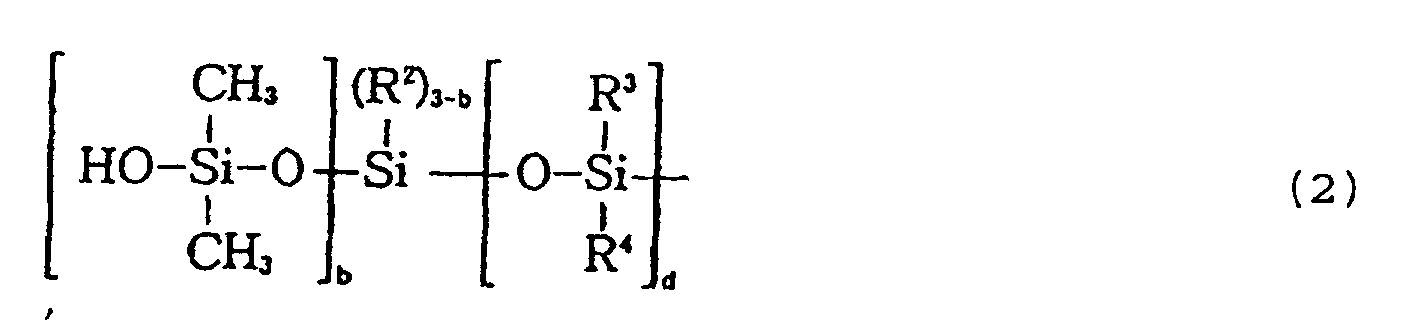
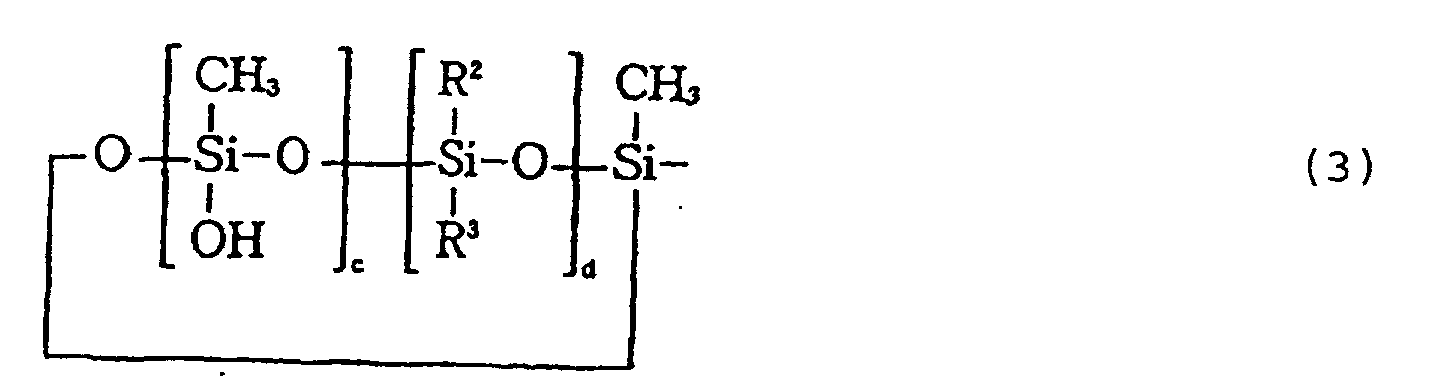 où R2, R3, et R4 sont indépendamment des groupes organiques monovalents, chacun de b et c est 1, 2 ou 3, et d est un entier de 0 à 3.
 (B) un composé de silicium organique de la formule générale (5), (6) ou (7) qui suit:
 où Y est un groupe organique monovalent sélectionné dans le groupe consistant en CH3-, C2H5-, C3H7-, CF3CH2-, CH3CO- , CH2=C (CH3) -, CH3CH2C (CH3) =N- ,
 (CH3)2N-, (C2H5)2N-, CH2=C (OC2H5)-, et (CH3)2C=C(OC8H17)-, R5 est un groupe organique monovalent, R1 et Rf sont tels que définis ci-dessus, Rf2 est un groupe polyéther fluoré monovalent, e est égal à 2 ou 3, f est égal à 1, 2 ou 3, g est égal à 2 ou 3, et où, dans les formules (5) et (7), R5 a la signification
 (c) un accélarateur de condensation.
- Composition durcissable selon la revendication 1, Rf étant un groupe de la formule
- Composition durcissable selon la revendication 2, où Rf' a 1 à 3 atomes de carbone et q est un entier de 2 à 150.
- Composition durcissable selon l'une des revendications 2 ou 3, où q est un entier de 2 à 100.
- Composition durcissable selon l'une quelconque des revendications précédentes, où Rf est -CF2O-, -CF2CF2O-, CF2CF2CF2O- ou -C(CF3)FCF2O-.
- Composition durcissable selon l'une quelconque des revendications précédentes où R1 a 2 à 20 atomes de carbone et est alkylène, cycloalkylène, arylène, ou une combinaison d'alkylène et d'arylène, où une partie ou la totalité des atomes d'hydrogène sont facultativement remplacés par des atomes d'halogène.
- Composition durcissable selon l'une quelconque des revendications précédentes, où le groupe hydrocarbure divalent de R1 est interrompu par au moins l'un de -O-; -NR-, où R est hydrogène, alkyle ou aryle C1-10; -N=; -SiR'R''-, où R' et R" sont chacun indépendamment alkyle ou aryle C1-10; et -S-.
- Composition durcissable selon l'une quelconque des revendications précédentes, où R2, R3 et R4 sont des groupes hydrocarbure monovalents C1-12 indépendamment sélectionnés parmi cycloalkyle, aryle, aralkyle et alkyle, où certains ou la totalité des atomes d'hydrogène sont facultativement remplacés par des atomes d'halogène.
- Composition durcissable selon l'une quelconque des revendications précédentes, où R5 est un groupe hydrocarbure monovalent C1-12 sélectionné parmi cycloalkyle, aryle, aralkyle et alcényle, où certains ou la totalité des atomes d'hydrogène sont facultativement remplacés par des atomes d'halogène.
- Composition durcissable selon l'une quelconque des revendications 1 à 8, où R5 est un groupe de la formule (8):
- Composition durcissable selon l'une quelconque des revendications précédentes, où Rf2 est un groupe polyéther fluoré monovalent qui est bloqué à une extrémité par CF3O-, CF3CF2O-, CF3CF2CF2O-, (CF3)2CFO- ou CF3CF2CF2CF2O-.
- Composition durcissable selon l'une quelconque des revendications précédentes, où l'accélérateur de condensation est un ou plusieurs d'un sel de métal ou d'un sel d'amine d'un acide carboxylique organique, un acide organique, un ester d'un acide titanique organique, un composé de titane organique, un alcoxysilane aminoalkyle substitué, un composé d'amine ou son sel, un sel d'un métal alcalin et d'un acide gras inférieur, une dialkyl hydroxylamine ou un composé de guanidyle.
- Composition durcissable selon la revendication 12, où l'accélérateur de condensation est un ou plusieurs d'un sel d'étain d'un acide carboxylique organique, un ester d'un acide titanique organique, un composé de titane organique, un acide organique ou un composé de guanidyle.
- Composition durcissable selon la revendication 13 où l'accélérateur de condensation est un ou plusieurs de diméthoxyde de dibutylétain, diacétate de dibutylétain, dilaurate de dibutylétain, tri-2-éthylhexoate de butylétain, naphténate d'étain, oléate d'étain, butyrate d'étain, naphténate de titane, naphténate de zinc, acide paratoluènesulfonique, acide trifluoroacétique, acide trichloroacétique, acide picrique, tétrabutyl titanate, tétra-2-éthylhexyl titanate, triéthanolamine titanate, tétra(isopropényl-oxy)titanate, organosiloxytitane, β-carbonyltitane, tétraméthylguanidine ou un silane ou siloxane ayant un groupe guanidyle comme montré ci-dessous:


- Méthode de préparation d'une composition durcissable selon l'une quelconque des revendications précédentes comprenant l'étape de mélanger uniformément les composés (A) à (C) dans une atmosphère sèche.
- Méthode de préparation d'une composition durcissable selon l'une quelconque des revendications 1 à 14 comprenant l'étape de mélanger un premier et un second liquide, le premier et le second liquide étant contenus dans un premier et un second paquet respectivement avant mélange, où le premier liquide comprend le composant (A) et le second liquide comprend un mélange des composants (B) et (C).
- Méthode comprenant le durcissement d'une composition durcissable selon l'une quelconque des revendications 1-14.
- Méthode selon la revendication 17, où le durcissement a lieu à température ambiante.
Applications Claiming Priority (2)
| Application Number | Priority Date | Filing Date | Title |
|---|---|---|---|
| JP5749698 | 1998-02-23 | ||
| JP05749698A JP3712031B2 (ja) | 1998-02-23 | 1998-02-23 | 硬化性組成物 |
Publications (3)
| Publication Number | Publication Date |
|---|---|
| EP0937748A2 EP0937748A2 (fr) | 1999-08-25 |
| EP0937748A3 EP0937748A3 (fr) | 1999-12-01 |
| EP0937748B1 true EP0937748B1 (fr) | 2004-05-06 |
Family
ID=13057346
Family Applications (1)
| Application Number | Title | Priority Date | Filing Date |
|---|---|---|---|
| EP99301306A Expired - Lifetime EP0937748B1 (fr) | 1998-02-23 | 1999-02-23 | Compositions réticulables de polyéther fluoré |
Country Status (4)
| Country | Link |
|---|---|
| US (1) | US6218499B1 (fr) |
| EP (1) | EP0937748B1 (fr) |
| JP (1) | JP3712031B2 (fr) |
| DE (1) | DE69916913T2 (fr) |
Families Citing this family (25)
| Publication number | Priority date | Publication date | Assignee | Title |
|---|---|---|---|---|
| US6613860B1 (en) * | 2000-10-12 | 2003-09-02 | 3M Innovative Properties Company | Compositions comprising fluorinated polyether silanes for rendering substrates oil and water repellent |
| EP1225187B1 (fr) | 2001-01-19 | 2009-05-27 | 3M Innovative Properties Company | Composant fluorovinyl oligomére contenant des groupes silane, compositions liquides et méthode de revêtement |
| ATE358143T1 (de) | 2001-01-19 | 2007-04-15 | 3M Innovative Properties Co | Wasserlösliche oder wasserdispergierbare fluorochemische silane um substrate öl- und wasserabstossend zu machen |
| US6649272B2 (en) | 2001-11-08 | 2003-11-18 | 3M Innovative Properties Company | Coating composition comprising fluorochemical polyether silane polycondensate and use thereof |
| US6716534B2 (en) | 2001-11-08 | 2004-04-06 | 3M Innovative Properties Company | Coating composition comprising a fluorochemical polyether silane partial condensate and use thereof |
| ATE346884T1 (de) | 2002-06-03 | 2006-12-15 | 3M Innovative Properties Co | Fluor-silan-oligomerzusammensetzung |
| US7652115B2 (en) * | 2003-09-08 | 2010-01-26 | 3M Innovative Properties Company | Fluorinated polyether isocyanate derived silane compositions |
| US7141537B2 (en) * | 2003-10-30 | 2006-11-28 | 3M Innovative Properties Company | Mixture of fluorinated polyethers and use thereof as surfactant |
| US7803894B2 (en) * | 2003-12-05 | 2010-09-28 | 3M Innovatie Properties Company | Coating compositions with perfluoropolyetherisocyanate derived silane and alkoxysilanes |
| DE102004046179A1 (de) * | 2004-09-23 | 2006-03-30 | Wacker Chemie Ag | Vernetzbare Massen auf der Basis von Organosiliciumverbindungen |
| JPWO2006095639A1 (ja) * | 2005-03-09 | 2008-08-14 | 株式会社スリーボンド | 色素増感型太陽電池用シール剤組成物 |
| JP4520366B2 (ja) * | 2005-06-03 | 2010-08-04 | 信越化学工業株式会社 | シラノール基含有重合体およびその製造方法 |
| JP5338024B2 (ja) * | 2006-10-19 | 2013-11-13 | 信越化学工業株式会社 | 硬化性組成物 |
| US7727773B2 (en) * | 2006-10-31 | 2010-06-01 | Semiconductor Energy Laboratory Co., Ltd | Method of manufacturing an analytical sample and method of analyzing an analytical sample |
| US7847015B2 (en) * | 2006-11-15 | 2010-12-07 | Shin-Etsu Chemical Co., Ltd. | Coating composition |
| US7897482B2 (en) * | 2007-05-31 | 2011-03-01 | Semiconductor Energy Laboratory Co., Ltd. | Semiconductor device and manufacturing method thereof |
| US8304571B2 (en) * | 2009-07-17 | 2012-11-06 | Shin-Etsu Chemical Co., Ltd. | Perfluoropolyether-modified polysiloxane, a method for preparing the same and a defoaming agent comprising the same |
| US10113067B2 (en) * | 2013-10-04 | 2018-10-30 | Luna Innovations Incorporated | Transparent hydrophobic coating materials with improved durability and methods of making same |
| CN110431145B (zh) * | 2017-03-17 | 2023-05-30 | 大金工业株式会社 | 含全氟(聚)醚基的硅烷化合物 |
| EP3705529A4 (fr) * | 2017-10-31 | 2021-09-01 | Daikin Industries, Ltd. | Composition durcissable |
| WO2019088110A1 (fr) | 2017-10-31 | 2019-05-09 | ダイキン工業株式会社 | Composition durcissable |
| US11629254B2 (en) * | 2017-10-31 | 2023-04-18 | Daikin Industries, Ltd. | Curable composition |
| TWI790308B (zh) * | 2017-11-07 | 2023-01-21 | 日商住友化學股份有限公司 | 包含具有全氟聚醚結構的化合物的組成物、表面處理樹脂基材及其製造方法 |
| KR20220117918A (ko) * | 2019-12-19 | 2022-08-24 | 모멘티브 파포만스 마테리아루즈 쟈판 고도가이샤 | 경화성 조성물 |
| CN114746479B (zh) * | 2019-12-19 | 2024-06-07 | 迈图高新材料日本合同公司 | 固化性组合物 |
Family Cites Families (3)
| Publication number | Priority date | Publication date | Assignee | Title |
|---|---|---|---|---|
| US4973623A (en) * | 1989-05-26 | 1990-11-27 | Dow Corning Corporation | Fast curing oximo-ethoxy functional siloxane sealants |
| JP2782406B2 (ja) * | 1993-02-09 | 1998-07-30 | 信越化学工業株式会社 | 室温硬化性組成物 |
| EP0745604A3 (fr) | 1995-05-29 | 1998-07-29 | Shin-Etsu Chemical Co., Ltd. | Composition de fluoropolymères durcissable à température ambiante; composés organosiliciques contenant du fluor, procédé pour les préparer et composition de silicone durcissable à température ambiante les contenant |
-
1998
- 1998-02-23 JP JP05749698A patent/JP3712031B2/ja not_active Expired - Fee Related
-
1999
- 1999-02-23 EP EP99301306A patent/EP0937748B1/fr not_active Expired - Lifetime
- 1999-02-23 US US09/255,861 patent/US6218499B1/en not_active Expired - Lifetime
- 1999-02-23 DE DE69916913T patent/DE69916913T2/de not_active Expired - Lifetime
Also Published As
| Publication number | Publication date |
|---|---|
| DE69916913T2 (de) | 2005-04-21 |
| JP3712031B2 (ja) | 2005-11-02 |
| US6218499B1 (en) | 2001-04-17 |
| DE69916913D1 (de) | 2004-06-09 |
| EP0937748A3 (fr) | 1999-12-01 |
| EP0937748A2 (fr) | 1999-08-25 |
| JPH11236509A (ja) | 1999-08-31 |
Similar Documents
| Publication | Publication Date | Title |
|---|---|---|
| US6218499B1 (en) | Curable compositions | |
| US4302571A (en) | Room temperature-curable polyoxyalkylene polyether compositions | |
| US5705591A (en) | Room temperature curable fluoropolymer composition; and fluorine-containing organosilicon compounds, a method of producing the same, and room temperature curable silicone composition containing the same | |
| US4323488A (en) | Method for the preparation of silicone-modified polyoxyalkylene polyethers and room temperature-curable compositions therewith | |
| EP0586240B1 (fr) | Polydiorganosiloxane à groupes terminaux alkoxy et élastomères de silicone vulcanisables à température ambiante à partir de ceci | |
| JP5951807B2 (ja) | 有機ケイ素化合物に基づく架橋性組成物 | |
| EP0718340A2 (fr) | Polymères organiques contenant des groupes silyle | |
| EP0332400B1 (fr) | Composition d'organopolysiloxane photodurcissable | |
| CN114746479A (zh) | 固化性组合物 | |
| EP0389235B1 (fr) | Masses d'étanchéité à base de siloxanes à durcissement neutre | |
| EP3705527A1 (fr) | Composition durcissable | |
| JPH06234923A (ja) | 室温硬化性組成物 | |
| US4764577A (en) | Curable polymeric composition | |
| JP3617568B2 (ja) | 室温硬化性組成物 | |
| JPH0977777A (ja) | 含フッ素有機ケイ素化合物及びその製造方法並びにそれを含有する室温硬化性シリコーン組成物 | |
| US6710119B2 (en) | Room temperature rapid curing organopolysiloxane composition | |
| JP3772989B2 (ja) | 硬化性組成物 | |
| JP3232221B2 (ja) | 室温硬化性フッ素ポリマー系組成物 | |
| JP3925604B2 (ja) | (メタ)アクリロキシ基含有オルガノポリシロキサンの製造方法 | |
| JP2811140B2 (ja) | 室温硬化性組成物 | |
| EP0641829A2 (fr) | Compositions durcissables | |
| JP2816930B2 (ja) | 室温硬化性オルガノポリシロキサン組成物 | |
| JP3350347B2 (ja) | 室温硬化性組成物 | |
| JP5338024B2 (ja) | 硬化性組成物 | |
| JPH0649348A (ja) | 常温硬化性ポリエーテル組成物 |
Legal Events
| Date | Code | Title | Description |
|---|---|---|---|
| PUAI | Public reference made under article 153(3) epc to a published international application that has entered the european phase |
Free format text: ORIGINAL CODE: 0009012 |
|
| AK | Designated contracting states |
Kind code of ref document: A2 Designated state(s): DE FR GB |
|
| AX | Request for extension of the european patent |
Free format text: AL;LT;LV;MK;RO;SI |
|
| PUAL | Search report despatched |
Free format text: ORIGINAL CODE: 0009013 |
|
| AK | Designated contracting states |
Kind code of ref document: A3 Designated state(s): AT BE CH CY DE DK ES FI FR GB GR IE IT LI LU MC NL PT SE |
|
| AX | Request for extension of the european patent |
Free format text: AL;LT;LV;MK;RO;SI |
|
| RIC1 | Information provided on ipc code assigned before grant |
Free format text: 6C 08K 5/54 A, 6C 08L 71/02 B |
|
| 17P | Request for examination filed |
Effective date: 20000229 |
|
| AKX | Designation fees paid |
Free format text: DE FR GB |
|
| 17Q | First examination report despatched |
Effective date: 20020404 |
|
| GRAP | Despatch of communication of intention to grant a patent |
Free format text: ORIGINAL CODE: EPIDOSNIGR1 |
|
| GRAS | Grant fee paid |
Free format text: ORIGINAL CODE: EPIDOSNIGR3 |
|
| GRAA | (expected) grant |
Free format text: ORIGINAL CODE: 0009210 |
|
| AK | Designated contracting states |
Kind code of ref document: B1 Designated state(s): DE FR GB |
|
| REG | Reference to a national code |
Ref country code: GB Ref legal event code: FG4D |
|
| REF | Corresponds to: |
Ref document number: 69916913 Country of ref document: DE Date of ref document: 20040609 Kind code of ref document: P |
|
| ET | Fr: translation filed | ||
| PLBE | No opposition filed within time limit |
Free format text: ORIGINAL CODE: 0009261 |
|
| STAA | Information on the status of an ep patent application or granted ep patent |
Free format text: STATUS: NO OPPOSITION FILED WITHIN TIME LIMIT |
|
| 26N | No opposition filed |
Effective date: 20050208 |
|
| PGFP | Annual fee paid to national office [announced via postgrant information from national office to epo] |
Ref country code: GB Payment date: 20070221 Year of fee payment: 9 |
|
| GBPC | Gb: european patent ceased through non-payment of renewal fee |
Effective date: 20080223 |
|
| PG25 | Lapsed in a contracting state [announced via postgrant information from national office to epo] |
Ref country code: GB Free format text: LAPSE BECAUSE OF NON-PAYMENT OF DUE FEES Effective date: 20080223 |
|
| REG | Reference to a national code |
Ref country code: FR Ref legal event code: PLFP Year of fee payment: 18 |
|
| PGFP | Annual fee paid to national office [announced via postgrant information from national office to epo] |
Ref country code: DE Payment date: 20160216 Year of fee payment: 18 |
|
| PGFP | Annual fee paid to national office [announced via postgrant information from national office to epo] |
Ref country code: FR Payment date: 20160108 Year of fee payment: 18 |
|
| REG | Reference to a national code |
Ref country code: DE Ref legal event code: R119 Ref document number: 69916913 Country of ref document: DE |
|
| REG | Reference to a national code |
Ref country code: FR Ref legal event code: ST Effective date: 20171031 |
|
| PG25 | Lapsed in a contracting state [announced via postgrant information from national office to epo] |
Ref country code: DE Free format text: LAPSE BECAUSE OF NON-PAYMENT OF DUE FEES Effective date: 20170901 Ref country code: FR Free format text: LAPSE BECAUSE OF NON-PAYMENT OF DUE FEES Effective date: 20170228 |