EP0938472B1 - 15-fluoro prostaglandines utilisees en tant qu'hypotenseurs oculaires - Google Patents
15-fluoro prostaglandines utilisees en tant qu'hypotenseurs oculaires Download PDFInfo
- Publication number
- EP0938472B1 EP0938472B1 EP97950592A EP97950592A EP0938472B1 EP 0938472 B1 EP0938472 B1 EP 0938472B1 EP 97950592 A EP97950592 A EP 97950592A EP 97950592 A EP97950592 A EP 97950592A EP 0938472 B1 EP0938472 B1 EP 0938472B1
- Authority
- EP
- European Patent Office
- Prior art keywords
- alkyl
- acyl
- double bond
- compound
- carbons
- Prior art date
- Legal status (The legal status is an assumption and is not a legal conclusion. Google has not performed a legal analysis and makes no representation as to the accuracy of the status listed.)
- Expired - Lifetime
Links
- 0 O[C@](C1)[C@](CC[C@](COc2cccc(Cl)c2)F)[C@](CCC=CCC*I)[C@]1O Chemical compound O[C@](C1)[C@](CC[C@](COc2cccc(Cl)c2)F)[C@](CCC=CCC*I)[C@]1O 0.000 description 4
- GODHXMJOBMZZTB-MYUHVVNZSA-N CC(CO)[F][C@H](CC[C@@H]([C@@H](C1)O)[C@@H](CC2)[C@H]1OC2O)COc1cc(Cl)ccc1 Chemical compound CC(CO)[F][C@H](CC[C@@H]([C@@H](C1)O)[C@@H](CC2)[C@H]1OC2O)COc1cc(Cl)ccc1 GODHXMJOBMZZTB-MYUHVVNZSA-N 0.000 description 1
- BELMRMRTYGYKPS-DWHWZOKSSA-N CO/C=C\C[C@@H]([C@H](C1)O)C2(C(C[C@H](COc3cccc(Cl)c3)F)C2)[C@@H]1OC1OCCCC1 Chemical compound CO/C=C\C[C@@H]([C@H](C1)O)C2(C(C[C@H](COc3cccc(Cl)c3)F)C2)[C@@H]1OC1OCCCC1 BELMRMRTYGYKPS-DWHWZOKSSA-N 0.000 description 1
- RNWFEEVSBCVCAB-ZVVPXNHBSA-N OC(C1)O[C@@H](C2)[C@H]1[C@@H](CC[C@H](COc1cccc(Cl)c1)F)[C@@H]2OC1OCCCC1 Chemical compound OC(C1)O[C@@H](C2)[C@H]1[C@@H](CC[C@H](COc1cccc(Cl)c1)F)[C@@H]2OC1OCCCC1 RNWFEEVSBCVCAB-ZVVPXNHBSA-N 0.000 description 1
Classifications
-
- A—HUMAN NECESSITIES
- A61—MEDICAL OR VETERINARY SCIENCE; HYGIENE
- A61K—PREPARATIONS FOR MEDICAL, DENTAL OR TOILETRY PURPOSES
- A61K31/00—Medicinal preparations containing organic active ingredients
- A61K31/557—Eicosanoids, e.g. leukotrienes or prostaglandins
- A61K31/5575—Eicosanoids, e.g. leukotrienes or prostaglandins having a cyclopentane, e.g. prostaglandin E2, prostaglandin F2-alpha
-
- A—HUMAN NECESSITIES
- A61—MEDICAL OR VETERINARY SCIENCE; HYGIENE
- A61P—SPECIFIC THERAPEUTIC ACTIVITY OF CHEMICAL COMPOUNDS OR MEDICINAL PREPARATIONS
- A61P27/00—Drugs for disorders of the senses
- A61P27/02—Ophthalmic agents
-
- A—HUMAN NECESSITIES
- A61—MEDICAL OR VETERINARY SCIENCE; HYGIENE
- A61P—SPECIFIC THERAPEUTIC ACTIVITY OF CHEMICAL COMPOUNDS OR MEDICINAL PREPARATIONS
- A61P27/00—Drugs for disorders of the senses
- A61P27/02—Ophthalmic agents
- A61P27/06—Antiglaucoma agents or miotics
-
- C—CHEMISTRY; METALLURGY
- C07—ORGANIC CHEMISTRY
- C07C—ACYCLIC OR CARBOCYCLIC COMPOUNDS
- C07C405/00—Compounds containing a five-membered ring having two side-chains in ortho position to each other, and having oxygen atoms directly attached to the ring in ortho position to one of the side-chains, one side-chain containing, not directly attached to the ring, a carbon atom having three bonds to hetero atoms with at the most one bond to halogen, and the other side-chain having oxygen atoms attached in gamma-position to the ring, e.g. prostaglandins ; Analogues or derivatives thereof
Definitions
- the present invention relates to compounds for the treatment of glaucoma and ocular hypertension.
- the present invention relates to the use of certain 15-fluoro analogs of F series prostaglandins to treat glaucoma and ocular hypertension.
- Glaucoma is a progressive disease which leads to optic nerve damage, and, ultimately, total loss of vision.
- the causes of this disease have been the subject of extensive studies for many years, but are still not fully understood.
- the principal symptom of and/or risk factor for the disease is elevated intraocular pressure or ocular hypertension due to excess aqueous humor in the anterior chamber of the eye.
- IOP elevated intraocular pressure
- beta-blockers and carbonic anhydrase inhibitors can be at least partially controlled by administering drugs which either reduce the production of aqueous humor within the eye, such as beta-blockers and carbonic anhydrase inhibitors, or increase the flow of aqueous humor out of the eye, such as miotics and sympathomimetics.
- Glaucoma Most types of drugs conventionally used to treat glaucoma have potentially serious side effects.
- Miotics such as pilocarpine can cause blurring of vision and other visual side effects, which may lead either to decreased patient compliance or to termination of therapy.
- Systemically administered carbonic anhydrase inhibitors can also cause serious side effects, such as nausea, dyspepsia, fatigue, and metabolic acidosis, which side effects can affect patient compliance and/or necessitate the termination of treatment.
- Some beta-blockers have increasingly become associated with serious pulmonary side effects attributable to their effects on beta-2 receptors in pulmonary tissue. Sympathomimetics may cause tachycardia, arrhythmia and hypertension. There is therefore a continuing need for therapies which control the elevated intraocular pressure associated with glaucoma.
- Prostaglandins which are metabolite derivatives of arachidonic acid, have recently been pursued for possible efficacy in lowering IOP.
- Arachidonic acid in the body is converted to prostaglandin G 2 , which is subsequently converted to prostaglandin H 2 .
- Other naturally occurring prostaglandins are derivatives of prostaglandin H 2 .
- a number of different types of prostaglandins have been discovered including A, B, D, E, F, G, I and J-Series prostaglandins (EP 0 561 073 A1).
- Of interest in the present invention are compounds which are believed to exhibit IOP lowering effects similar to those exhibited by PGF 2 ⁇ (an F-series prostaglandin):
- the present invention is directed to compositions and their use in the manufacture of a medicament for treating IOP and ocular hypertension.
- the present invention provides 15-fluoro prostaglandin analogs believed to have functional PGF 2 ⁇ receptor agonist activity, and their use in the manufacture of a medicament for treating glaucoma and ocular hypertension.
- the mechanism of action by which PGF 2 ⁇ type prostaglandins lower IOP is not well understood. While the mechanism of action of the compounds of the present invention is not fully understood, the inventors theorize that such compounds exhibit enhanced FP receptor selectivity as a consequence of their decreased activity at the EP receptor site. While bound by no such theory, it is possible that an improved therapeutic index may result from a relative reduction of EP-mediated side-effects.
- 15-fluoro substituted PGF 2 ⁇ analogs of the present invention exhibit an improved therapeutic profile in the treatment of glaucoma and ocular hypertension when compared to natural prostaglandins and many of their known analogs.
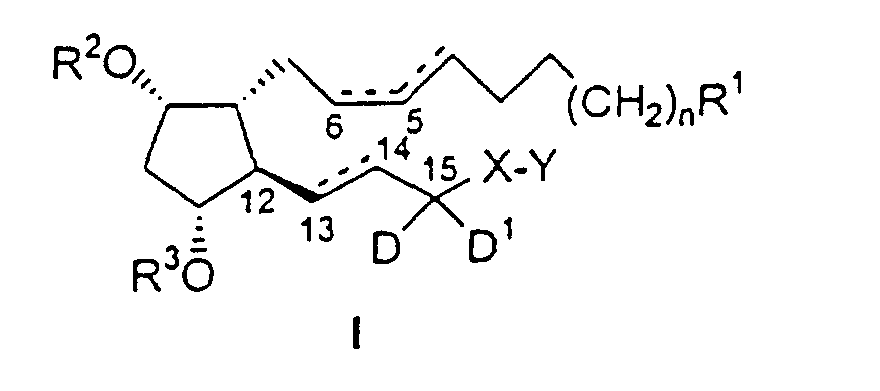
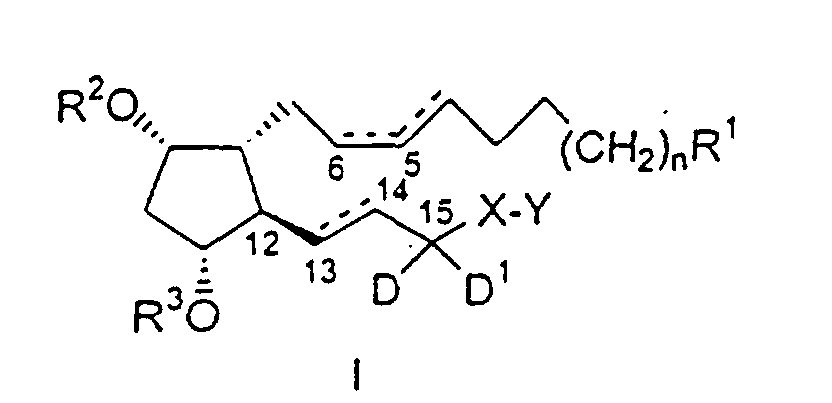
- the substituted PGF 2 ⁇ analogs of the present invention have the following formula I : wherein:
- the term "pharmaceutically acceptable ester” means any ester that would be suitable for therapeutic administration to a patient by any conventional means without significant deleterious health consequences; and "ophthalmically acceptable ester” means any pharmaceutically acceptable ester that would be suitable for ophthalmic application, i.e. non-toxic and non-irritating.
- ophthalmically acceptable esters are alkyl esters. Most preferred are C 2 -C 4 alkyl esters, and especially isopropyl esters.
- the individual enantiomers can be enantioselectively synthesized from the appropriate enantiomerically pure or enriched starting material by means such as those described below. Alternatively, they may be enantioselectively synthesized from racemic/non-racemic or achiral starting materials (Asymmetric Synthesis by J. D. Morrison and J. W. Scott, Eds., Academic Press Publishers: New York, 1983-1985 (five volumes) and Principles of Asymmetric Synthesis by R.E. Gawley and J. Aube, Eds., Elsevier Publishers: Amsterdam, 1996).
- racemic and non-racemic mixtures may also be isolated from racemic and non-racemic mixtures by a number of known methods, e.g. by purification of a sample by chiral HPLC ( A Practical Guide to Chiral Separations by HPLC, G. Subramanian, Ed., VCH Publishers: New York, 1994; Chiral Separations by HPLC, A.M. Krstulovic, Ed., Ellis Horwood Ltd. Publishers, 1989), or by enantioselective hydrolysis of a carboxylic acid ester sample by an enzyme (Ohno, M.; Otsuka, M. Organic Reactions, volume 37, page 1 (1989)).
- racemic and non-racemic mixtures may be obtained by several means, including without limitation, nonenantioselective synthesis, partial resolution or even mixing samples having different enantiomeric ratios.
- wavy line attachments indicate either the alpha ( ⁇ ) or beta ( ⁇ ) configuration.
- a hatched line indicates the ⁇ configuration.
- a solid triangular line indicates the ⁇ configuration.
- Dashed lines on bonds, e.g. between carbons 13 and 14, indicate a single or double bond.
- Two solid lines between carbons indicate a double bond of the specified configuration.
- Patent Number 4,321,275 which is incorporated by this reference
- THF tetrahydrofuran
- a solution of -(+)-B-chlorodiisopinocampheylborane (2.59 g, 8.1 mmol) in THF (37 mL) was added.
- the reaction was warmed to room temperature, and, after 1 additional h, saturated sodium bicarbonate (30 mL) was added.
- the solution was extracted with ethyl acetate (3 x 30 mL), dried (MgSO 4 ), and filtered, and the residue was dissolved in 150 mL of 1:2 acetonitrile:hexane.
- the 15-fluoro PGF's of the present invention may be formulated in various pharmaceutical compositions for administering to humans and other animals as a treatment of glaucoma or ocular hypertension.
- pharmaceutically effective amount refers to that amount of a compound of the present invention which lowers IOP when administered to a patient, especially a mammal.
- the preferred route of administration is topical.
- the compounds of the present invention can be administered as solutions, suspensions, or emulsions (dispersions) in an ophthalmically acceptable vehicle.
- ophthalmically acceptable vehicle refers to any substance or combination of substances which are non-reactive with the compounds and suitable for administration to a patient. Solubilizers and stabilizers are deemed to be non-reactive.
- Preferred are aqueous vehicles suitable for topical application to the patient's eyes.
- the compounds of the present invention are generally formulated as between 0.00003 to 0.5 percent by weight (wt%) solutions in water at a pH between 4.5 to 8.0.
- the compounds are preferably formulated as between 0.0005 to 0.03 wt% and, most preferably, between 0.001 and 0.01 wt%. While the precise regimen is left to the discretion of the clinician, it is recommended that the resulting solution be topically applied by placing one drop in each eye one or two times a day.
- ingredients which may be desirable to use in the ophthalmic preparations of the present invention include preservatives, co-solvents and viscosity building agents.
- Ophthalmic products are typically packaged in multidose form. Preservatives are thus required to prevent microbial contamination during use. Suitable preservatives include: benzalkonium chloride, thimerosal, chlorobutanol, methyl paraben, propyl paraben, phenylethyl alcohol, edetate disodium, sorbic acid, Onamer M, or other agents known to those skilled in the art. Such preservatives are typically employed at a level between 0.001% and 1.0% by weight.
- co-solvents include: Polysorbate 20, 60 and 80; Pluronic F-68, F-84 and P-103; CREMOPHORE® EL (polyoxyl 35 castor oil) cyclodextrin; or other agents known to those skilled in the art.
- co-solvents are typically employed at a level between 0.01% and 2% by weight.
- Viscosity Agents :
- Viscosity greater than that of simple aqueous solutions may be desirable to increase ocular absorption of the active compound, to decrease variability in dispensing the formulations, to decrease physical separation of components of a suspension or emulsion of formulation and/or otherwise to improve the ophthalmic formulation.
- Such viscosity building agents include, for example, polyvinyl alcohol, polyvinyl pyrrolidone, methyl cellulose, hydroxy propyl methylcellulose, hydroxyethyl cellulose, carboxymethyl cellulose, hydroxy propyl cellulose, chondroitin sulfate and salts thereof, hyaluronic acid and salts thereof, and other agents known to those skilled in the art. Such agents are typically employed at a level between 0.01% and 2% by weight.
- Preferred formulations of 15-Fluoroprostaglandin analogs of the present invention include the following Examples 5-8:
Landscapes
- Health & Medical Sciences (AREA)
- Chemical & Material Sciences (AREA)
- Organic Chemistry (AREA)
- Animal Behavior & Ethology (AREA)
- Pharmacology & Pharmacy (AREA)
- Veterinary Medicine (AREA)
- Public Health (AREA)
- Medicinal Chemistry (AREA)
- General Health & Medical Sciences (AREA)
- Life Sciences & Earth Sciences (AREA)
- Ophthalmology & Optometry (AREA)
- Bioinformatics & Cheminformatics (AREA)
- Engineering & Computer Science (AREA)
- Nuclear Medicine, Radiotherapy & Molecular Imaging (AREA)
- General Chemical & Material Sciences (AREA)
- Chemical Kinetics & Catalysis (AREA)
- Epidemiology (AREA)
- Pharmaceuticals Containing Other Organic And Inorganic Compounds (AREA)
- Organic Low-Molecular-Weight Compounds And Preparation Thereof (AREA)
Claims (25)
- Utilisation, dans la production d'un médicament destiné au traitement du glaucome ou de l'hypertension oculaire chez un patient, d'un composé de formule I :dans laquelle :
- R1
- représente un groupe CO2R, CONR4R5, CH2OR6 ou CH2NR7R8 ;
dans lequel
R représente H ou un groupement du type sel cationique, ou un groupement CO2R consistant en un groupement ester acceptable du point de vue ophtalmique ; R4 et R5 sont identiques ou différents et représentent H ou un groupe alkyle ; R6 représente H, un groupe acyle ou alkyle ; R7 et R8 sont identiques ou différents et représentent H, un groupe acyle ou alkyle ; sous réserve que, si l'un des groupes R7 et R8 représente un groupe acyle, alors l'autre représente H ou un groupe alkyle ; - n
- est égal à 0 ou 2 ;
- ----
- représente une liaison simple ou une double liaison non cumulée, sous réserve qu'une double liaison entre les atomes de carbone 4 et 5 ne puisse avoir la configuration trans ; et qu'une double liaison entre les atomes de carbone 13 et 14 ne puisse avoir la configuration cis ;
- R2 et R3
- sont identiques ou différents et représentent H, un groupe alkyle ou acyle ;
- D et D1
- sont différents et représentent H et un atome de fluor ;
- X
- représente un groupe (CH2)q ou (CH2)qO dans lequel q a une valeur de 1 à 6 ; et
- Y
- représente un noyau phényle facultativement substitué avec des substituants alkyle, halogéno, trihalogénométhyle, alkoxy, acyle, acyloxy, amino, alkylamino, acylamino ou hydroxy ; ou
- X-Y
- représente un groupe (CH2)pY1 dans lequel p a une
valeur de 0 à 6 ; et
- Y1
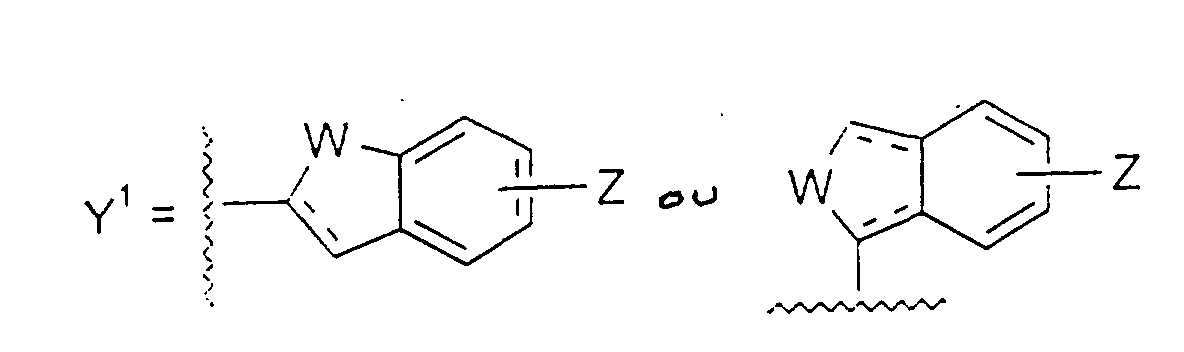
- représente un groupe :
dans lequel :

- W
- représente un groupe CH2, O, S(O)m, NR9, CH2CH2, CH=CH, CH2O, CH2S(O)m, CH=N ou CH2NR9, dans lequel m a une valeur de 0 à 2, et R9 représente H, un groupe alkyle ou acyle ;
- Z
- représente H, un groupe alkyle, alkoxy, acyle, acyloxy, halogéno, trihalogénométhyle, amino, alkylamino, acylamino ou hydroxy ; et
- ----
- représente une liaison simple ou une double liaison.
- Utilisation suivant la revendication 1, dans laquelle le médicament est apte à l'administration topique.
- Utilisation suivant la revendication 1 ou la revendication 2, dans laquelle le médicament peut être administré sous forme d'une solution, d'une suspension ou d'une émulsion.
- Utilisation suivant l'une quelconque des revendications précédentes, dans laquelle :
- R1
- représente un groupe CO2R, dans lequel R représente H ; ou un groupement CO2R consistant en un groupement ester acceptable du point de vue ophtalmique, dans lequel R représente un groupe alkyle ;
- n
- est égal à 0 ;
- ----
- représente une liaison simple ou une double liaison non cumulée, sous réserve qu'une double liaison entre les atomes de carbone 4 et 5 ne puisse avoir la configuration trans ; et qu'une double liaison entre les atomes de carbone 13 et 14 ne puisse avoir la configuration cis.
- R2 et R3
- représentent H ;
- D
- représente le fluor en configuration alpha (α), et D1 représente H en configuration bêta (β) ;
- X
- représente un groupe CH2O ou CH2CH2 ; et
- Y
- représente un groupe phényle, facultativement substitué avec des substituants halogéno ou trihalogénométhyle.
- Utilisation suivant l'une quelconque des revendications précédentes, dans laquelle la concentration du composé est comprise dans l'intervalle de 0,00003 à 0,5 % en poids.
- Utilisation suivant l'une quelconque des revendications précédentes, dans laquelle la concentration du composé est comprise dans l'intervalle de 0,0005 à 0,03 % en poids.
- Utilisation suivant l'une quelconque des revendications précédentes, dans laquelle la concentration du composé est comprise dans l'intervalle de 0,001 à 0,01 % en poids.
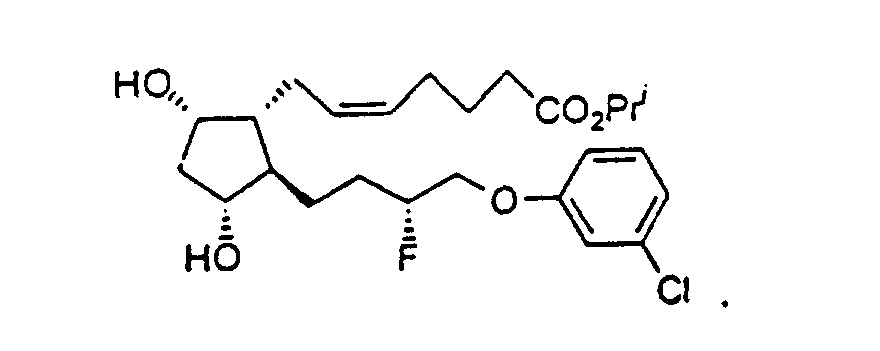
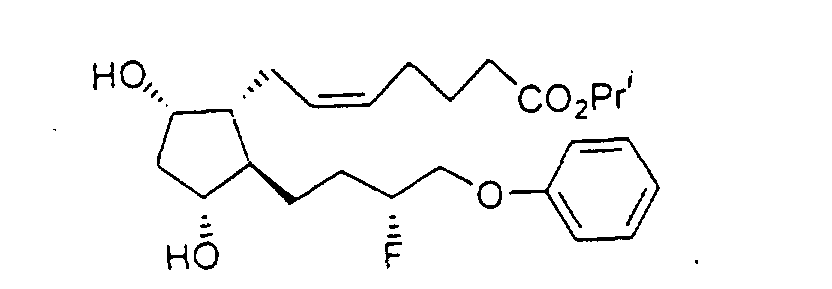
- Utilisation suivant l'une quelconque des revendications précédentes, dans laquelle le composé est le suivant :
- Utilisation suivant l'une quelconque des revendications précédentes, dans laquelle le composé est le suivant :

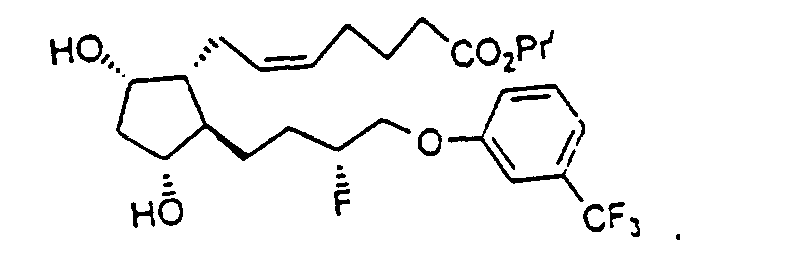
- Utilisation suivant l'une quelconque des revendications précédentes, dans laquelle le composé est le suivant :
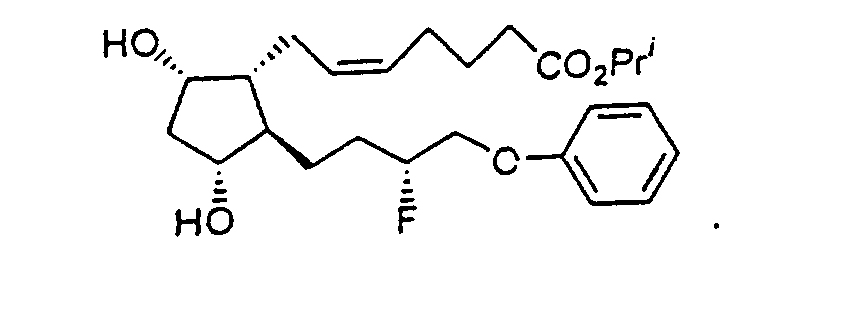
- Utilisation suivant l'une quelconque des revendications précédentes, dans laquelle le composé est le suivant :
- Composé de formule I :dans laquelle :
- R1
- représente un groupe CO2R, CONR4R5, CH2OR6 ou CH2NR7R8 ;
dans lequel
R représente H ou un groupement du type sel cationique, ou un groupement CO2R consistant en un groupement ester pharmaceutiquement acceptable ; R4 et R5 sont identiques ou différents et représentent H ou un groupe alkyle ; R6 représente H, un groupe acyle ou alkyle ; R7 et R8 sont identiques ou différents et représentent H, un groupe acyle ou alkyle ; sous réserve que, si l'un des groupes R7 et R8 représente un groupe acyle, alors l'autre représente H ou un groupe alkyle ; - n
- est égal à 0 ou 2 ;
- ----
- représente une liaison simple ou une double liaison non cumulée, sous réserve qu'une double liaison entre les atomes de carbone 4 et 5 ne puisse avoir la configuration trans ; et qu'une double liaison entre les atomes de carbone 13 et 14 ne puisse avoir la configuration cis;
- R2 et R3
- sont identiques ou différents et représentent H, un groupe alkyle ou acyle ;
- D et D1
- sont différents et représentent H et un atome de fluor ;
- X
- représente un groupe (CH2)q ou (CH2)qO dans lequel q a une valeur de 1 à 6 ; et
- Y
- représente un noyau phényle facultativement substitué avec des substituants alkyle, halogéno, trihalogénométhyle, alkoxy, acyle, acyloxy, amino, alkylamino, acylamino ou hydroxy ; ou
- X-Y
- représente un groupe (CH2)pY1 dans lequel p a une
valeur de 0 à 6 ; et
- Y1
- représente un groupe :
dans lequel :
- W
- représente un groupe CH2, O, S(O)m, NR9, CH2CH2, CH=CH, CH2O, CH2S(O)m, CH=N ou CH2NR9, dans lequel m a une valeur de 0 à 2, et R9 représente H, un groupe alkyle ou acyle ;
- Z
- représente H, un groupe alkyle, alkoxy, acyle, acyloxy, halogéno, trihalogénométhyle, amino, alkylamino, acylamino ou hydroxy ; et
- ----
- représente une liaison simple ou une double liaison.
- Composé suivant la revendication 12, dans lequel :
- R1
- représente un groupe CO2R, dans lequel R représente H ; ou un groupe CO2R consistant en un groupement ester pharmaceutiquement acceptable ;
- n
- est égal à 0 ;
- ----
- représente une liaison simple ou une double liaison non cumulée, sous réserve qu'une double liaison entre les atomes de carbone 4 et 5 ne puisse avoir la configuration trans, et qu'une double liaison entre les atomes de carbone 13 et 14 ne puisse avoir la configuration cis.
- R2 et R3
- représentent H ;
- D
- représente le fluor en configuration alpha (α) et D1 représente H en configuration bêta (β) ;
- X
- représente un groupe CH2O ou CH2CH2 ; et
- Y
- représente un groupe phényle, facultativement substitué avec des substituants halogéno ou trihalogénométhyle.
- Composé suivant la revendication 13, dans lequel le groupement ester pharmaceutiquement acceptable est un groupement ester alkylique d'acide carboxylique.
- Composé suivant la revendication 14, répondant à la formule :

- Composé suivant la revendication 14, répondant à la formule :
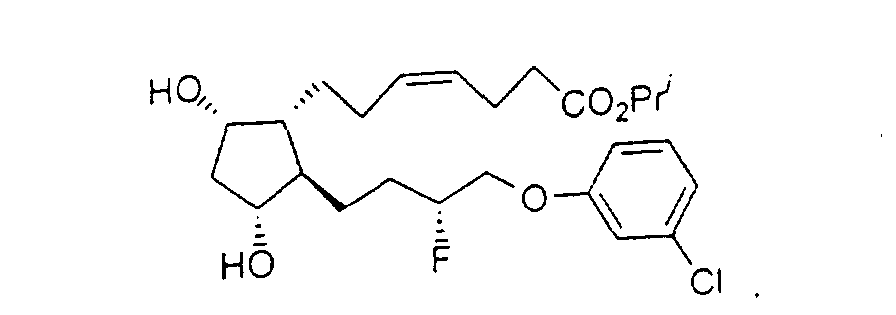
- Composé suivant la revendication 14, répondant à la formule :
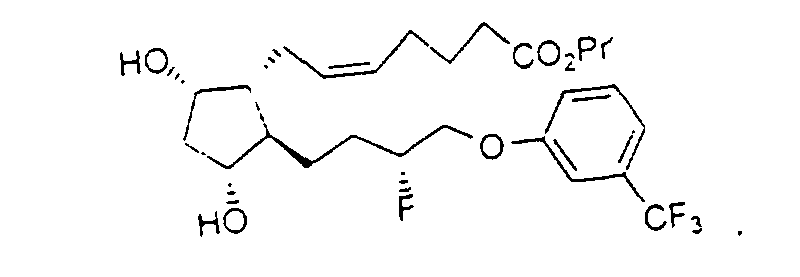
- Composé suivant la revendication 14, répondant à la formule :
- Composition ophtalmique topique pour le traitement du glaucome et de l'hypertension oculaire, comprenant un composé de formule I :dans laquelle :

- R1
- représente un groupe CO2R, CONR4R5, CH2OR6 ou CH2NR7R8 ;
dans lequel
R représente H ou un groupement du type sel cationique, ou un groupement CO2R consistant en un groupement ester acceptable du point de vue ophtalmique ; R4 et R5 sont identiques ou différents et représentent H ou un groupe alkyle ; R6 représente H, un groupe acyle ou alkyle ; R7 et R8 sont identiques ou différents et représentent H, un groupe acyle ou alkyle ; sous réserve que, si l'un des groupes R7 et R8 représente un groupe acyle, alors l'autre représente H ou un groupe alkyle ; - n
- est égal à 0 ou 2 ;
- ----
- représente une liaison simple ou une double liaison non cumulée, sous réserve qu'une double liaison entre les atomes de carbone 4 et 5 ne puisse avoir la configuration trans ; et qu'une double liaison entre les atomes de carbone 13 et 14 ne puisse avoir la configuration cis ;
- R2 et R3
- sont identiques ou différents et représentent H, un groupe alkyle ou acyle ;
- D et D1
- sont différents et représentent H et un atome de fluor ;
- X
- représente un groupe (CH2)q ou (CH2)qO dans lequel q a une valeur de 1 à 6 ; et
- Y
- représente un noyau phényle facultativement substitué avec des substituants alkyle, halogéno, trihalogénométhyle, alkoxy, acyle, acyloxy, amino, alkylamino, acylamino ou hydroxy ; ou
- X-Y
- représente un groupe (CH2)pY1 dans lequel p a une
valeur de 0 à 6 ; et
- Y1
- représente un groupe :
dans lequel :
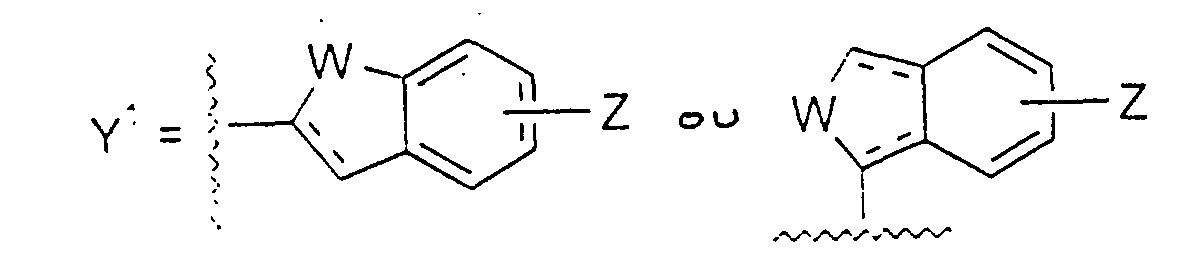
- W
- représente un groupe CH2, O, S(O)m, NR9, CH2CH2, CH=CH, CH2O, CH2S (O)m, CH=N ou CH2NR9, dans lequel m a une valeur de 0 à 2, et R9 représente H, un groupe alkyle ou acyle ;
- Z
- représente H, un groupe alkyle, alkoxy, acyle, acyloxy, halogéno, trihalogénométhyle, amino, alkylamino, acylamino ou hydroxy ; et
- ----
- représente une liaison simple ou une double liaison ; et
- Composition suivant la revendication 19, dans laquelle :
- R1
- représente un groupe CO2R, dans lequel R représente H ; ou un groupe CO2R consistant en un groupement ester acceptable du point de vue ophtalmique ;
- n
- est égal à 0 ;
- ----
- représente une liaison simple ou une double liaison non cumulée, sous réserve qu'une double liaison entre les atomes de carbone 4 et 5 ne puisse avoir la configuration trans, et qu'une double liaison entre les atomes de carbone 13 et 14 ne puisse avoir la configuration cis.
- R2 et R3
- représentent H ;
- D
- représente le fluor en configuration alpha (α) et D1 représente H en configuration bêta (β) ;
- X
- représente un groupe CH2O ou CH2CH2 ; et
- Y
- représente un groupe phényle, facultativement substitué avec des substituants halogéno ou trihalogénométhyle.
- Composition suivant la revendication 20, dans laquelle le groupement ester acceptable du point de vue ophtalmique est un groupement ester alkylique d'acide carboxylique ayant 1 à 6 atomes de carbone.
- Composition suivant la revendication 21, dans laquelle le composé est le suivant :
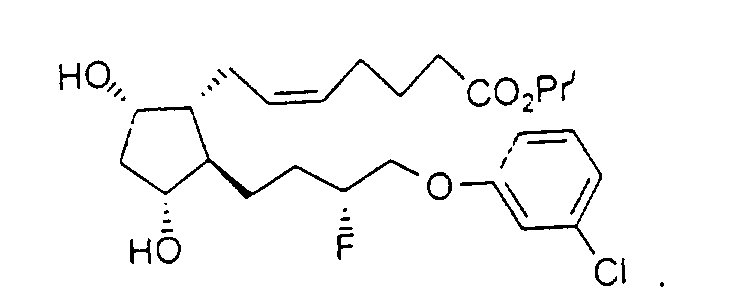
- Composition suivant la revendication 21, dans laquelle le composé est le suivant :
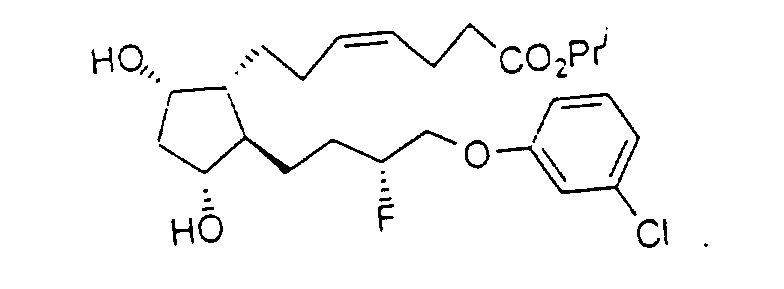
- Composition suivant la revendication 21, dans laquelle le composé est le suivant :

- Composition suivant la revendication 21, dans laquelle le composé est le suivant :

Applications Claiming Priority (3)
| Application Number | Priority Date | Filing Date | Title |
|---|---|---|---|
| US3051996P | 1996-11-12 | 1996-11-12 | |
| US30519P | 1996-11-12 | ||
| PCT/US1997/020671 WO1998021181A2 (fr) | 1996-11-12 | 1997-11-07 | 15-fluoro prostaglandines utilisees en tant qu'hypotenseurs oculaires |
Publications (2)
| Publication Number | Publication Date |
|---|---|
| EP0938472A2 EP0938472A2 (fr) | 1999-09-01 |
| EP0938472B1 true EP0938472B1 (fr) | 2001-06-27 |
Family
ID=21854596
Family Applications (1)
| Application Number | Title | Priority Date | Filing Date |
|---|---|---|---|
| EP97950592A Expired - Lifetime EP0938472B1 (fr) | 1996-11-12 | 1997-11-07 | 15-fluoro prostaglandines utilisees en tant qu'hypotenseurs oculaires |
Country Status (9)
| Country | Link |
|---|---|
| US (1) | US6649653B1 (fr) |
| EP (1) | EP0938472B1 (fr) |
| JP (1) | JP4248022B2 (fr) |
| AT (1) | ATE202557T1 (fr) |
| AU (1) | AU5355498A (fr) |
| CA (1) | CA2269855A1 (fr) |
| DE (1) | DE69705421T2 (fr) |
| ES (1) | ES2159889T3 (fr) |
| WO (1) | WO1998021181A2 (fr) |
Cited By (1)
| Publication number | Priority date | Publication date | Assignee | Title |
|---|---|---|---|---|
| EP0930296B2 (fr) † | 1996-09-17 | 2005-11-02 | Asahi Glass Company Ltd. | Derives de prostaglandine fluores et medicaments |
Families Citing this family (16)
| Publication number | Priority date | Publication date | Assignee | Title |
|---|---|---|---|---|
| JP3480549B2 (ja) * | 1996-12-26 | 2003-12-22 | 参天製薬株式会社 | ジフルオロプロスタグランジン誘導体およびその用途 |
| JP4834224B2 (ja) | 1999-03-05 | 2011-12-14 | デューク ユニバーシティ | C16不飽和fp−選択的プロスタグランジン類縁体 |
| US6894175B1 (en) | 1999-08-04 | 2005-05-17 | The Procter & Gamble Company | 2-Decarboxy-2-phosphinico prostaglandin derivatives and methods for their preparation and use |
| US20020172693A1 (en) | 2000-03-31 | 2002-11-21 | Delong Michell Anthony | Compositions and methods for treating hair loss using non-naturally occurring prostaglandins |
| US20020037914A1 (en) | 2000-03-31 | 2002-03-28 | Delong Mitchell Anthony | Compositions and methods for treating hair loss using C16-C20 aromatic tetrahydro prostaglandins |
| US20020013294A1 (en) | 2000-03-31 | 2002-01-31 | Delong Mitchell Anthony | Cosmetic and pharmaceutical compositions and methods using 2-decarboxy-2-phosphinico derivatives |
| GB0112699D0 (en) * | 2001-05-24 | 2001-07-18 | Resolution Chemicals Ltd | Process for the preparation of prostglandins and analogues thereof |
| US8455513B2 (en) | 2007-01-10 | 2013-06-04 | Aerie Pharmaceuticals, Inc. | 6-aminoisoquinoline compounds |
| US8450344B2 (en) | 2008-07-25 | 2013-05-28 | Aerie Pharmaceuticals, Inc. | Beta- and gamma-amino-isoquinoline amide compounds and substituted benzamide compounds |
| EP3053913B1 (fr) | 2009-05-01 | 2018-03-07 | Aerie Pharmaceuticals, Inc. | Inhibiteurs à double mécanisme pour le traitement d'une maladie |
| DK3811943T3 (da) | 2013-03-15 | 2023-04-03 | Aerie Pharmaceuticals Inc | Forbindelse til anvendelse til behandling af øjenlidelser |
| CN103601708B (zh) * | 2013-12-11 | 2015-06-17 | 武汉武药科技有限公司 | 一种前列素药物杂质的制备方法 |
| US9643927B1 (en) | 2015-11-17 | 2017-05-09 | Aerie Pharmaceuticals, Inc. | Process for the preparation of kinase inhibitors and intermediates thereof |
| KR102568079B1 (ko) | 2016-08-31 | 2023-08-17 | 에어리 파마슈티컬즈, 인코포레이티드 | 안과용 조성물 |
| KR20190135027A (ko) | 2017-03-31 | 2019-12-05 | 에어리 파마슈티컬즈, 인코포레이티드 | 아릴 시클로프로필-아미노-이소퀴놀리닐 아미드 화합물 |
| AU2019337703B2 (en) | 2018-09-14 | 2023-02-02 | Aerie Pharmaceuticals, Inc. | Aryl cyclopropyl-amino-isoquinolinyl amide compounds |
Family Cites Families (13)
| Publication number | Priority date | Publication date | Assignee | Title |
|---|---|---|---|---|
| US4425359A (en) | 1975-03-12 | 1984-01-10 | Farmitalia Carlo Erba | Fluoro-prostaglandins and process for their preparation |
| AU501803B2 (en) * | 1975-03-21 | 1979-06-28 | Farmitalia Carlo Erba S.P.A. | Fluoro-prostaglandins |
| US4599353A (en) | 1982-05-03 | 1986-07-08 | The Trustees Of Columbia University In The City Of New York | Use of eicosanoids and their derivatives for treatment of ocular hypertension and glaucoma |
| GB8324004D0 (en) * | 1983-09-07 | 1983-10-12 | Erba Farmitalia | 16-fluoro-16 17-didehydro prostanoids |
| SU1256394A1 (ru) * | 1984-04-24 | 1987-06-07 | Институт Органического Синтеза Ан Латвсср | Производные 15( @ + @ )-фтор-11,15-дидезоксипростагландина @ ,обладающие антиагрегационной активностью |
| DE3850676T2 (de) | 1987-09-18 | 1994-11-03 | Ueno Seiyaku Oyo Kenkyujo Kk | Hypotensive okulare Mittel. |
| US5321128A (en) | 1988-09-06 | 1994-06-14 | Kabi Pharmacia Ab | Prostaglandin derivatives for the treatment of glaucoma or ocular hypertension |
| CA2030345C (fr) | 1989-11-22 | 1998-12-08 | Ryuji Ueno | Utilisation d'un compose de 15-ceto-prostaglandines pour l'amelioration des fonctions encephaliques |
| DE69232150T2 (de) | 1992-03-19 | 2002-03-07 | R-Tech Ueno, Ltd. | Behandlung von Augenhochdruck mit Betablockern und Prostansäurederivaten |
| DE4229050A1 (de) | 1992-08-31 | 1994-03-03 | Schering Ag | Neue 9-Chlor-Prostaglandin-Ester und -amide |
| US5510383A (en) | 1993-08-03 | 1996-04-23 | Alcon Laboratories, Inc. | Use of cloprostenol, fluprostenol and their salts and esters to treat glaucoma and ocular hypertension |
| JPH0770054A (ja) | 1993-08-30 | 1995-03-14 | R Tec Ueno:Kk | 生化学的拮抗および疾患処置剤 |
| JPH1087607A (ja) | 1996-09-17 | 1998-04-07 | Asahi Glass Co Ltd | 含フッ素プロスタグランジン誘導体の製造方法 |
-
1997
- 1997-11-07 DE DE69705421T patent/DE69705421T2/de not_active Expired - Fee Related
- 1997-11-07 AT AT97950592T patent/ATE202557T1/de not_active IP Right Cessation
- 1997-11-07 EP EP97950592A patent/EP0938472B1/fr not_active Expired - Lifetime
- 1997-11-07 AU AU53554/98A patent/AU5355498A/en not_active Abandoned
- 1997-11-07 JP JP52280298A patent/JP4248022B2/ja not_active Expired - Fee Related
- 1997-11-07 WO PCT/US1997/020671 patent/WO1998021181A2/fr not_active Ceased
- 1997-11-07 US US09/284,432 patent/US6649653B1/en not_active Expired - Fee Related
- 1997-11-07 CA CA002269855A patent/CA2269855A1/fr not_active Abandoned
- 1997-11-07 ES ES97950592T patent/ES2159889T3/es not_active Expired - Lifetime
Cited By (1)
| Publication number | Priority date | Publication date | Assignee | Title |
|---|---|---|---|---|
| EP0930296B2 (fr) † | 1996-09-17 | 2005-11-02 | Asahi Glass Company Ltd. | Derives de prostaglandine fluores et medicaments |
Also Published As
| Publication number | Publication date |
|---|---|
| AU5355498A (en) | 1998-06-03 |
| ATE202557T1 (de) | 2001-07-15 |
| JP2001505556A (ja) | 2001-04-24 |
| EP0938472A2 (fr) | 1999-09-01 |
| DE69705421T2 (de) | 2002-05-16 |
| DE69705421D1 (de) | 2001-08-02 |
| WO1998021181A2 (fr) | 1998-05-22 |
| WO1998021181A3 (fr) | 1998-07-16 |
| JP4248022B2 (ja) | 2009-04-02 |
| ES2159889T3 (es) | 2001-10-16 |
| CA2269855A1 (fr) | 1998-05-22 |
| US6649653B1 (en) | 2003-11-18 |
Similar Documents
| Publication | Publication Date | Title |
|---|---|---|
| US6344478B2 (en) | Use of cloprostenol and fluprostenol analogues to treat glaucoma and ocular hypertension | |
| US6232344B1 (en) | 13-Oxa prostaglandins for the treatment of glaucoma and ocular hypertension | |
| US5889052A (en) | Use of cloprostenol and fluprostenol analogues to treat glaucoma and ocular hypertension | |
| US6025392A (en) | substituted tetrahydrofuran analogs of prostaglandins as ocular hypotensives | |
| US6353000B1 (en) | 11-halo prostaglandins for the treatment of glaucoma or ocular hypertension | |
| EP0938472B1 (fr) | 15-fluoro prostaglandines utilisees en tant qu'hypotenseurs oculaires | |
| US6353014B1 (en) | 15-ketal postaglandins for the treatment of glaucoma or ocular hypertension | |
| US6235779B1 (en) | Use of cis-Δ4 analogs of prostaglandins as ocular hypotensives | |
| EP0783308A1 (fr) | Utilisation de derives de la 9-desoxy prostaglandine pour traiter le glaucome | |
| US5866602A (en) | Keto-substituted tetrahydrofuran analogs of prostaglandins as ocular hypotensives | |
| US5814660A (en) | 9-oxa prostaglandin analogs as ocular hypotensives | |
| US6531614B2 (en) | Method of prostaglandin synthesis | |
| US6417228B1 (en) | 13-Aza prostaglandins for the treatment of glaucoma and ocular hypertension | |
| US6680339B2 (en) | 15-fluoro prostaglandins as ocular hypotensives | |
| US6160013A (en) | 14-aza prostaglandins for the treatment of glaucoma and ocular hypertension | |
| US6211226B1 (en) | 11-Aza prostaglandins for the treatment of glaucoma and ocular hypertension | |
| US6096783A (en) | Cyclobutane prostaglandin analogues as ocular hypotensive agents | |
| MXPA99004409A (en) | Cis |
Legal Events
| Date | Code | Title | Description |
|---|---|---|---|
| PUAI | Public reference made under article 153(3) epc to a published international application that has entered the european phase |
Free format text: ORIGINAL CODE: 0009012 |
|
| 17P | Request for examination filed |
Effective date: 19990610 |
|
| AK | Designated contracting states |
Kind code of ref document: A2 Designated state(s): AT BE CH DE DK ES FI FR GB GR IE IT LI LU MC NL PT SE |
|
| GRAG | Despatch of communication of intention to grant |
Free format text: ORIGINAL CODE: EPIDOS AGRA |
|
| 17Q | First examination report despatched |
Effective date: 20000811 |
|
| GRAG | Despatch of communication of intention to grant |
Free format text: ORIGINAL CODE: EPIDOS AGRA |
|
| GRAG | Despatch of communication of intention to grant |
Free format text: ORIGINAL CODE: EPIDOS AGRA |
|
| GRAH | Despatch of communication of intention to grant a patent |
Free format text: ORIGINAL CODE: EPIDOS IGRA |
|
| GRAH | Despatch of communication of intention to grant a patent |
Free format text: ORIGINAL CODE: EPIDOS IGRA |
|
| GRAA | (expected) grant |
Free format text: ORIGINAL CODE: 0009210 |
|
| AK | Designated contracting states |
Kind code of ref document: B1 Designated state(s): AT BE CH DE DK ES FI FR GB GR IE IT LI LU MC NL PT SE |
|
| PG25 | Lapsed in a contracting state [announced via postgrant information from national office to epo] |
Ref country code: NL Free format text: LAPSE BECAUSE OF FAILURE TO SUBMIT A TRANSLATION OF THE DESCRIPTION OR TO PAY THE FEE WITHIN THE PRESCRIBED TIME-LIMIT Effective date: 20010627 Ref country code: LI Free format text: LAPSE BECAUSE OF FAILURE TO SUBMIT A TRANSLATION OF THE DESCRIPTION OR TO PAY THE FEE WITHIN THE PRESCRIBED TIME-LIMIT Effective date: 20010627 Ref country code: FI Free format text: LAPSE BECAUSE OF FAILURE TO SUBMIT A TRANSLATION OF THE DESCRIPTION OR TO PAY THE FEE WITHIN THE PRESCRIBED TIME-LIMIT Effective date: 20010627 Ref country code: CH Free format text: LAPSE BECAUSE OF FAILURE TO SUBMIT A TRANSLATION OF THE DESCRIPTION OR TO PAY THE FEE WITHIN THE PRESCRIBED TIME-LIMIT Effective date: 20010627 Ref country code: AT Free format text: LAPSE BECAUSE OF FAILURE TO SUBMIT A TRANSLATION OF THE DESCRIPTION OR TO PAY THE FEE WITHIN THE PRESCRIBED TIME-LIMIT Effective date: 20010627 |
|
| REF | Corresponds to: |
Ref document number: 202557 Country of ref document: AT Date of ref document: 20010715 Kind code of ref document: T |
|
| REG | Reference to a national code |
Ref country code: CH Ref legal event code: EP |
|
| REG | Reference to a national code |
Ref country code: IE Ref legal event code: FG4D |
|
| REF | Corresponds to: |
Ref document number: 69705421 Country of ref document: DE Date of ref document: 20010802 |
|
| ITF | It: translation for a ep patent filed | ||
| PG25 | Lapsed in a contracting state [announced via postgrant information from national office to epo] |
Ref country code: SE Free format text: LAPSE BECAUSE OF FAILURE TO SUBMIT A TRANSLATION OF THE DESCRIPTION OR TO PAY THE FEE WITHIN THE PRESCRIBED TIME-LIMIT Effective date: 20010927 Ref country code: PT Free format text: LAPSE BECAUSE OF FAILURE TO SUBMIT A TRANSLATION OF THE DESCRIPTION OR TO PAY THE FEE WITHIN THE PRESCRIBED TIME-LIMIT Effective date: 20010927 Ref country code: DK Free format text: LAPSE BECAUSE OF FAILURE TO SUBMIT A TRANSLATION OF THE DESCRIPTION OR TO PAY THE FEE WITHIN THE PRESCRIBED TIME-LIMIT Effective date: 20010927 |
|
| PG25 | Lapsed in a contracting state [announced via postgrant information from national office to epo] |
Ref country code: GR Free format text: LAPSE BECAUSE OF FAILURE TO SUBMIT A TRANSLATION OF THE DESCRIPTION OR TO PAY THE FEE WITHIN THE PRESCRIBED TIME-LIMIT Effective date: 20010928 |
|
| REG | Reference to a national code |
Ref country code: ES Ref legal event code: FG2A Ref document number: 2159889 Country of ref document: ES Kind code of ref document: T3 |
|
| PG25 | Lapsed in a contracting state [announced via postgrant information from national office to epo] |
Ref country code: MC Free format text: LAPSE BECAUSE OF NON-PAYMENT OF DUE FEES Effective date: 20011107 Ref country code: LU Free format text: LAPSE BECAUSE OF NON-PAYMENT OF DUE FEES Effective date: 20011107 Ref country code: IE Free format text: LAPSE BECAUSE OF FAILURE TO SUBMIT A TRANSLATION OF THE DESCRIPTION OR TO PAY THE FEE WITHIN THE PRESCRIBED TIME-LIMIT Effective date: 20011107 |
|
| ET | Fr: translation filed | ||
| NLV1 | Nl: lapsed or annulled due to failure to fulfill the requirements of art. 29p and 29m of the patents act | ||
| REG | Reference to a national code |
Ref country code: CH Ref legal event code: PL |
|
| REG | Reference to a national code |
Ref country code: GB Ref legal event code: IF02 |
|
| PLBE | No opposition filed within time limit |
Free format text: ORIGINAL CODE: 0009261 |
|
| STAA | Information on the status of an ep patent application or granted ep patent |
Free format text: STATUS: NO OPPOSITION FILED WITHIN TIME LIMIT |
|
| 26N | No opposition filed | ||
| REG | Reference to a national code |
Ref country code: IE Ref legal event code: MM4A |
|
| PGFP | Annual fee paid to national office [announced via postgrant information from national office to epo] |
Ref country code: ES Payment date: 20081126 Year of fee payment: 12 |
|
| PGFP | Annual fee paid to national office [announced via postgrant information from national office to epo] |
Ref country code: IT Payment date: 20081126 Year of fee payment: 12 |
|
| PGFP | Annual fee paid to national office [announced via postgrant information from national office to epo] |
Ref country code: FR Payment date: 20081117 Year of fee payment: 12 |
|
| PGFP | Annual fee paid to national office [announced via postgrant information from national office to epo] |
Ref country code: DE Payment date: 20081223 Year of fee payment: 12 |
|
| PGFP | Annual fee paid to national office [announced via postgrant information from national office to epo] |
Ref country code: GB Payment date: 20081128 Year of fee payment: 12 |
|
| PGFP | Annual fee paid to national office [announced via postgrant information from national office to epo] |
Ref country code: BE Payment date: 20090128 Year of fee payment: 12 |
|
| BERE | Be: lapsed |
Owner name: *ALCON LABORATORIES INC. Effective date: 20091130 |
|
| GBPC | Gb: european patent ceased through non-payment of renewal fee |
Effective date: 20091107 |
|
| REG | Reference to a national code |
Ref country code: FR Ref legal event code: ST Effective date: 20100730 |
|
| PG25 | Lapsed in a contracting state [announced via postgrant information from national office to epo] |
Ref country code: FR Free format text: LAPSE BECAUSE OF NON-PAYMENT OF DUE FEES Effective date: 20091130 Ref country code: BE Free format text: LAPSE BECAUSE OF NON-PAYMENT OF DUE FEES Effective date: 20091130 |
|
| PG25 | Lapsed in a contracting state [announced via postgrant information from national office to epo] |
Ref country code: DE Free format text: LAPSE BECAUSE OF NON-PAYMENT OF DUE FEES Effective date: 20100601 |
|
| PG25 | Lapsed in a contracting state [announced via postgrant information from national office to epo] |
Ref country code: GB Free format text: LAPSE BECAUSE OF NON-PAYMENT OF DUE FEES Effective date: 20091107 |
|
| REG | Reference to a national code |
Ref country code: ES Ref legal event code: FD2A Effective date: 20110329 |
|
| PG25 | Lapsed in a contracting state [announced via postgrant information from national office to epo] |
Ref country code: IT Free format text: LAPSE BECAUSE OF NON-PAYMENT OF DUE FEES Effective date: 20091107 |
|
| PG25 | Lapsed in a contracting state [announced via postgrant information from national office to epo] |
Ref country code: ES Free format text: LAPSE BECAUSE OF NON-PAYMENT OF DUE FEES Effective date: 20110316 |
|
| PG25 | Lapsed in a contracting state [announced via postgrant information from national office to epo] |
Ref country code: ES Free format text: LAPSE BECAUSE OF NON-PAYMENT OF DUE FEES Effective date: 20091108 |