EP0944252A1 - Datenverarbeitungsgerät und -verfahren, digital Signaldemodulationsgerät und -verfahren, und Darstellungsmedium - Google Patents
Datenverarbeitungsgerät und -verfahren, digital Signaldemodulationsgerät und -verfahren, und Darstellungsmedium Download PDFInfo
- Publication number
- EP0944252A1 EP0944252A1 EP99302028A EP99302028A EP0944252A1 EP 0944252 A1 EP0944252 A1 EP 0944252A1 EP 99302028 A EP99302028 A EP 99302028A EP 99302028 A EP99302028 A EP 99302028A EP 0944252 A1 EP0944252 A1 EP 0944252A1
- Authority
- EP
- European Patent Office
- Prior art keywords
- program
- picture
- display
- epg
- receiving
- Prior art date
- Legal status (The legal status is an assumption and is not a legal conclusion. Google has not performed a legal analysis and makes no representation as to the accuracy of the status listed.)
- Withdrawn
Links
Images








Classifications
-
- H—ELECTRICITY
- H04—ELECTRIC COMMUNICATION TECHNIQUE
- H04N—PICTORIAL COMMUNICATION, e.g. TELEVISION
- H04N21/00—Selective content distribution, e.g. interactive television or video on demand [VOD]
- H04N21/40—Client devices specifically adapted for the reception of or interaction with content, e.g. set-top-box [STB]; Operations thereof
- H04N21/43—Processing of content or additional data, e.g. demultiplexing additional data from a digital video stream; Elementary client operations, e.g. monitoring of home network or synchronising decoder's clock; Client middleware
- H04N21/431—Generation of visual interfaces for content selection or interaction; Content or additional data rendering
- H04N21/4312—Generation of visual interfaces for content selection or interaction; Content or additional data rendering involving specific graphical features, e.g. screen layout, special fonts or colors, blinking icons, highlights or animations
- H04N21/4316—Generation of visual interfaces for content selection or interaction; Content or additional data rendering involving specific graphical features, e.g. screen layout, special fonts or colors, blinking icons, highlights or animations for displaying supplemental content in a region of the screen, e.g. an advertisement in a separate window
-
- H—ELECTRICITY
- H04—ELECTRIC COMMUNICATION TECHNIQUE
- H04N—PICTORIAL COMMUNICATION, e.g. TELEVISION
- H04N5/00—Details of television systems
- H04N5/44—Receiver circuitry for the reception of television signals according to analogue transmission standards
- H04N5/445—Receiver circuitry for the reception of television signals according to analogue transmission standards for displaying additional information
-
- H—ELECTRICITY
- H04—ELECTRIC COMMUNICATION TECHNIQUE
- H04N—PICTORIAL COMMUNICATION, e.g. TELEVISION
- H04N21/00—Selective content distribution, e.g. interactive television or video on demand [VOD]
- H04N21/40—Client devices specifically adapted for the reception of or interaction with content, e.g. set-top-box [STB]; Operations thereof
- H04N21/43—Processing of content or additional data, e.g. demultiplexing additional data from a digital video stream; Elementary client operations, e.g. monitoring of home network or synchronising decoder's clock; Client middleware
- H04N21/434—Disassembling of a multiplex stream, e.g. demultiplexing audio and video streams, extraction of additional data from a video stream; Remultiplexing of multiplex streams; Extraction or processing of SI; Disassembling of packetised elementary stream
- H04N21/4348—Demultiplexing of additional data and video streams
-
- H—ELECTRICITY
- H04—ELECTRIC COMMUNICATION TECHNIQUE
- H04N—PICTORIAL COMMUNICATION, e.g. TELEVISION
- H04N21/00—Selective content distribution, e.g. interactive television or video on demand [VOD]
- H04N21/40—Client devices specifically adapted for the reception of or interaction with content, e.g. set-top-box [STB]; Operations thereof
- H04N21/43—Processing of content or additional data, e.g. demultiplexing additional data from a digital video stream; Elementary client operations, e.g. monitoring of home network or synchronising decoder's clock; Client middleware
- H04N21/44—Processing of video elementary streams, e.g. splicing a video clip retrieved from local storage with an incoming video stream or rendering scenes according to encoded video stream scene graphs
- H04N21/4402—Processing of video elementary streams, e.g. splicing a video clip retrieved from local storage with an incoming video stream or rendering scenes according to encoded video stream scene graphs involving reformatting operations of video signals for household redistribution, storage or real-time display
- H04N21/440263—Processing of video elementary streams, e.g. splicing a video clip retrieved from local storage with an incoming video stream or rendering scenes according to encoded video stream scene graphs involving reformatting operations of video signals for household redistribution, storage or real-time display by altering the spatial resolution, e.g. for displaying on a connected PDA
- H04N21/440272—Processing of video elementary streams, e.g. splicing a video clip retrieved from local storage with an incoming video stream or rendering scenes according to encoded video stream scene graphs involving reformatting operations of video signals for household redistribution, storage or real-time display by altering the spatial resolution, e.g. for displaying on a connected PDA for performing aspect ratio conversion
-
- H—ELECTRICITY
- H04—ELECTRIC COMMUNICATION TECHNIQUE
- H04N—PICTORIAL COMMUNICATION, e.g. TELEVISION
- H04N21/00—Selective content distribution, e.g. interactive television or video on demand [VOD]
- H04N21/40—Client devices specifically adapted for the reception of or interaction with content, e.g. set-top-box [STB]; Operations thereof
- H04N21/47—End-user applications
-
- H—ELECTRICITY
- H04—ELECTRIC COMMUNICATION TECHNIQUE
- H04N—PICTORIAL COMMUNICATION, e.g. TELEVISION
- H04N21/00—Selective content distribution, e.g. interactive television or video on demand [VOD]
- H04N21/40—Client devices specifically adapted for the reception of or interaction with content, e.g. set-top-box [STB]; Operations thereof
- H04N21/47—End-user applications
- H04N21/482—End-user interface for programme selection
-
- H—ELECTRICITY
- H04—ELECTRIC COMMUNICATION TECHNIQUE
- H04N—PICTORIAL COMMUNICATION, e.g. TELEVISION
- H04N21/00—Selective content distribution, e.g. interactive television or video on demand [VOD]
- H04N21/80—Generation or processing of content or additional data by content creator independently of the distribution process; Content per se
- H04N21/83—Generation or processing of protective or descriptive data associated with content; Content structuring
- H04N21/84—Generation or processing of descriptive data, e.g. content descriptors
-
- H—ELECTRICITY
- H04—ELECTRIC COMMUNICATION TECHNIQUE
- H04N—PICTORIAL COMMUNICATION, e.g. TELEVISION
- H04N7/00—Television systems
- H04N7/08—Systems for the simultaneous or sequential transmission of more than one television signal, e.g. additional information signals, the signals occupying wholly or partially the same frequency band, e.g. by time division
Definitions
- the present invention relates to an information processing apparatus and method, a digital signal demodulation apparatus and method, and a providing medium.
- the invention relates to an information processing-apparatus and method, a digital signal demodulation apparatus and method, and a providing medium in which an EPG that does not cause a viewer to have any difficulty watching a program can be displayed on a monitor.
- EPG data includes program titles etc. of each channel corresponding to broadcast hours.
- an EPG as shown in Fig. 1 that is, what is called a program table, is displayed on the entire screen of a monitor (not shown).
- a user can find a desired program by referring to the EPG that is displayed on the monitor.
- the titles of programs that will be broadcast from 3 hours to 5 hours (2-hour period) on channel 101 to channel 108 (8 channels) are displayed.
- an EPG may be displayed on the entire screen of a monitor as shown in Fig. 1 or in the bottom half of a picture of a program being broadcast as shown in Fig. 2. If the EPG of Fig. 1, for example, is displayed, a user cannot see a picture of a program while referring to the EPG. Even if an attempt to record the program is being made, actually the EPG being displayed on the monitor is recorded as it is. Eventually, the user cannot watch a picture he has missed.
- EPG of Fig. 2 is displayed, although a user can watch a top-half picture of a program, he cannot enjoy the program because the bottom half of the picture is cut out. Further, since EPG data is transmitted, for example, for channels corresponding to each transponder, a picture may be disconnected because of reasons on the transmission side when switching is made from an EPG currently referred to to an EPG of channels corresponding to another transponder. Therefore, the user may miss a picture of a program.
- the present invention has been made in view of the above circumstances, and an object of the invention is therefore to display an EPG on a monitor without causing a user to have any difficulty watching a program as well as to prevent recording of the EPG.
- an information processing apparatus comprising receiving means for receiving an EPG including prescribed text information, control information for controlling the prescribed text information, and a program table indicating a broadcast schedule of programs; extracting means for extracting the prescribed text information, the control information, and the program table from the EPG received by the receiving means; display control means for controlling display so as to display the prescribed text information together with the program table in accordance with the control information that has been extracted by the extracting means; reducing means for reducing a picture of a program in accordance with a picture that is controlled by the display control means; and combining means for combining the picture controlled by the display control means with a picture reduced by the reducing means.
- an information processing method comprising a receiving step of receiving an EPG including prescribed text information, control information for controlling the prescribed text information, and a program table indicating a broadcast schedule of programs; an extracting step of extracting the prescribed text information, the control information, and the program table from the EPG received by the receiving step; a display control step of controlling display so as to display the prescribed text information together with the program table in accordance with the control information that has been extracted by the extracting step; a reducing step of reducing a picture of a program in accordance with a picture that is controlled by the display control step; and a combining step of combining the picture controlled by the display control step with a picture reduced by the reducing step.
- a providing medium for providing a computer-readable program for execution of a process comprising a receiving step of receiving an EPG including prescribed text information, control information for controlling the prescribed text information, and a program table indicating a broadcast schedule of programs; an extracting step of extracting the prescribed text information, the control information, and the program table from the EPG received by the receiving step; a display control step of controlling display so as to display the prescribed text information together with the program table in accordance with the control information that has been extracted by the extracting step; a reducing step of reducing a picture of a program in accordance with a picture that is controlled by the display control step; and a combining step of combining the picture controlled by the display control step with a picture reduced by the reducing step.
- a digital signal demodulation apparatus comprising receiving means for receiving an EPG signal including a program table indicating a broadcast schedule of programs and explanatory information that explains contents of the programs by text, and a picture signal of a program; reducing means for reducing the picture of the program when an instruction to display the program table has been made; and display control means for displaying one of the program table and the explanatory information so that it is located above or below the reduced picture of the program, and for displaying the other of the program table and the explanatory information so that it is located on the right or left of the reduced picture of the program.
- a digital signal demodulation method comprising a receiving step of receiving an EPG signal including a program table indicating a broadcast schedule of programs and explanatory information that explains contents of the programs by text, and a picture signal of a program; a reducing step of reducing the picture of the program when an instruction to display the program table has been made; and a display control step of displaying one of the program table and the explanatory information so that it is located above or below the reduced picture of the program, and for displaying the other of the program table and the explanatory information so that it is located on the right or left of the reduced picture of the program.
- a providing medium for providing a program for causing an information processing apparatus to execute a process comprising a receiving step of receiving an EPG signal including a program table indicating a broadcast schedule of programs and explanatory information that explains contents of the programs by text, and a picture signal of a program; a reducing step of reducing the picture of the program when an instruction to display the program table has been made; and a display control step of displaying one of the program table and the explanatory information so that it is located above or below the reduced picture of the program, and for displaying the other of the program table and the explanatory information so that it is located on the right or left of the reduced picture of the program.
- a digital signal demodulation apparatus comprising receiving means for receiving, on a predetermined channel, an EPG including a program table for only the predetermined channel that indicates a broadcast schedule of programs of the predetermined channel, and for receiving a picture signal of a program of each channel; storing means for storing the EPG of each channel that has been received by the receiving means; reducing means for reducing the picture of the program when an instruction to display the program table has been made; and display control means for displaying the program table stored in the storing means so that it is combined with a picture that has been reduced by the reducing means when the instruction to display the program table has been made.
- a digital signal demodulation method comprising a receiving step of receiving, on a predetermined channel, an EPG including a program table for only the predetermined channel that indicates a broadcast schedule of programs of the predetermined channel, and for receiving a picture signal of a program of each channel; a storing step of storing the EPG of each channel that has been received by the receiving step; a reducing step of reducing the picture of the program when an instruction to display the program table has been made; and a display control step of displaying the program table stored by the storing step so that it is combined with a picture that has been reduced by the reducing step when the instruction to display the program table has been made.
- a providing medium for providing a program for causing an information processing apparatus to execute a process comprising a receiving step of receiving, on a predetermined channel, an EPG including a program table for only the predetermined channel that indicates a broadcast schedule of programs of the predetermined channel, and for receiving a picture signal of a program of each channel; a storing step of storing the EPG of each channel that has been received by the receiving step; a reducing step of reducing the picture of the program when an instruction to display the program table has been made; and a display control step of displaying the program table stored by the storing step so that it is combined with a picture that has been reduced by the reducing step when the instruction to display the program table has been made.
- an EPG including prescribed text information, control information for controlling the prescribed text information, and a program table indicating a broadcast schedule of programs is received on a predetermined channel, the prescribed text information, the control information, and the program table are extracted from the received EPG, display is so controlled that the prescribed text information is displayed together with the program table in accordance with the extracted control information, a picture of a program is reduced in accordance with a controlled display picture, and the controlled picture is combined with the reduced picture.
- an EPG signal including a program table indicating a broadcast schedule of programs and explanatory information that explains contents of the programs by text, and a picture signal of a program are received, the picture of the program is reduced when an instruction to display the program table has been made, and one of the program table and the explanatory information is displayed so as to be located above or below the reduced picture of the program, and the other of the program table and the explanatory information is displayed so as to be located on the right or left of the reduced picture of the program.
- an EPG including a program table for only a predetermined channel that indicates a broadcast schedule of programs of the predetermined channel is received on the predetermined channel and a picture signal of a program of each channel is received, the received EPG of each channel is stored, the picture of the program is reduced when an instruction to display the program table has been made, and the stored program table is displayed so as to be combined with the reduced picture when the instruction to display the program table has been made.
- An information processing apparatus comprises receiving means (e.g., a tuner 41 shown in Fig. 4) for receiving an EPG including prescribed text information, control information for controlling the prescribed text information, and a program table indicating a broadcast schedule of programs; extracting means (e.g., a control CPU 44 shown in Fig. 4) for extracting the prescribed text information, the control information, and the program table from the EPG received by the receiving means; display control means (e.g., the control CPU 44 and an OSD control section 49 shown in Fig.
- receiving means e.g., a tuner 41 shown in Fig. 4
- extracting means e.g., a control CPU 44 shown in Fig. 4
- display control means e.g., the control CPU 44 and an OSD control section 49 shown in Fig.
- reducing means e.g., a display size converter 81 shown in Fig. 5
- combining means e.g., a display processor 48 shown in Fig. 4
- a digital signal demodulation apparatus recited according to a second aspect of the invention comprises receiving means (e.g., the tuner 41 shown in Fig. 4) for receiving an EPG signal including a program table indicating a broadcast schedule of programs and explanatory information that explains contents of the programs by text, and a picture signal of a program; reducing means (e.g., the display size converter 81 shown in Fig. 5) for reducing the picture of the program when an instruction to display the program table has been made; and display control means (e.g., the control CPU 44 and the OSD control section 49 shown in Fig.
- receiving means e.g., the tuner 41 shown in Fig. 4
- an EPG signal including a program table indicating a broadcast schedule of programs and explanatory information that explains contents of the programs by text, and a picture signal of a program
- reducing means e.g., the display size converter 81 shown in Fig. 5
- display control means e.g., the control CPU 44 and the
- a digital signal demodulation apparatus comprises receiving means (e.g., the tuner 41 shown in Fig. 4) for receiving, on a predetermined channel, an EPG including a program table for only the predetermined channel that indicates a broadcast schedule of programs of the predetermined channel, and for receiving a picture signal of a program of each channel; storing means (e.g., an EPG data memory 51 shown in Fig. 4) for storing the EPG of each channel that has been received by the receiving means; reducing means (e.g., the display size converter 81 shown in Fig. 5) for reducing the picture of the program when an instruction to display the program table has been made; and display control means (e.g., the display processor 48 shown in Fig. 4) for displaying the program table stored in the storing means so that it is combined with a picture that has been reduced by the reducing means when the instruction to display the program table has been made.
- receiving means e.g., the tuner 41 shown in Fig. 4
- storing means e.g
- Fig. 3 shows an example configuration of a transmitting apparatus 1 that constitutes a transmission/reception system to which an information processing apparatus according to the invention is applied.
- a program generation section 11 generates data (audio data and video data) of a program to be broadcast.
- a main system processor 12 supplies an encoder 13 with program data that is supplied from the program generation section 11 and makes the encoder 13 encode the program data. Further, the main system processor 12 generates a reference clock signal, time information, etc. and supplies those to a system information processor 15, an operation system processor 16, an EPG system processor 17, a multiplexer 14, etc.
- the encoder 13 encodes the program data that is supplied from the program generation section 11 via the main system processor 12 according to, for example, the MPEG scheme and outputs encoded data to the multiplexer 14.
- the system information processor 15 generates system information that is necessary for decoding of a transmission signal and outputs it to the multiplexer 14.
- the operation system processor 16 processes an instruction corresponding to an input from a keyboard, a mouse (both not shown), or the like and outputs a processing result to the main system processor 12 when necessary.
- An EPG data supply section 18 generates EPG data and outputs it to an editing section 19.
- the editing section 19 generates a program flag indicating that situation and inserts it in the EPG data.
- the editing section 19 adds program text information (e.g., information such as performers and an outline of the program) and channel text information (e.g., program advertisement information such as a broadcast schedule of special programs) to the EPG data.
- program text information e.g., information such as performers and an outline of the program
- channel text information e.g., program advertisement information such as a broadcast schedule of special programs
- the EPG system processor 17 processes the EPG data that is supplied from the editing section 19, in synchronism with a signal that is supplied from the main system processor 12, and outputs processed data to the multiplexer 14.
- the multiplexer 14 combines the program data (audio data and video data) that is supplied from the encoder 13 and the EPG data that is supplied from the EPG system processor 17 into a transport stream, and transmits it to a satellite (not shown).
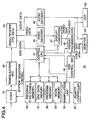
- Fig. 4 shows an example configuration of a receiving apparatus 31 for receiving data that is transmitted from the transmitting apparatus 1 of Fig. 3 via a satellite.
- the receiving apparatus 31 receives, with a tuner 41, radio waves that are transmitted from the satellite and outputs a reception signal to a demodulation section 42.
- the demodulation section 42 demodulates the signal supplied from the tuner 41 and outputs a demodulation signal to a demultiplexer 43.
- the demultiplexer 43 extracts not only audio data and video data that constitute program data but also EPG data from the data that is input from the demodulation section 42.
- the demultiplexer 43 supplies the audio data to an audio decoder 46, the video data to a video decoder 45, and the EPG data to a control CPU 44.
- the audio decoder 46 decodes the input audio data and outputs decoded data to, for example, a VCR (video cassette recorder) 63 and a monitor 62 that are connected to the receiving apparatus 31.
- the video decoder 45 decodes the input video data and outputs decoded data to a display converter 47.
- the display converter 47 reduces the size of a picture that is based on the video data supplied from the video decoder 45 to a prescribed size in accordance with a control of the control CPU 44, and outputs resulting data to a display processor 48.
- the display converter 47 also outputs a video data signal that has not been subjected to picture size reduction to the VCR 63.
- an OSD control section 49 generates OSD (on-screen display) data to be superimposed on video data and outputs it to the display processor 48.
- the display processor 48 combines the OSD data that is supplied from the OSD control section 49 with the video data that is supplied from the display converter 47, and outputs resulting data to the monitor 62.
- a program flag symbol memory 50 stores, in accordance with a program flag, data of symbols (feature recognition information) to be superimposed on an EPG.
- An EPG data memory 51 stores the EPG data that has been supplied from the demultiplexer 43 to the control CPU 44.
- a program memory 52 stores programs that are necessary for the control CPU 44 to execute various processes.
- a work memory 53 stores, when necessary, data, programs, etc. that are necessary for the control CPU 44 to execute various processes.
- a manipulation unit 54 captures an infrared signal that is input from a remote controller 61 and an input from buttons, switches, and the like (not shown) that are provided on the main body of the receiving apparatus 31, and outputs a resulting detection signal to the control CPU 44.
- FIG. 5 shows an example configuration of the display converter 47.
- a display size converter 81 reduces the size of one picture that is formed by a luminance signal Y and color difference signals Cb (B - Y) and Cr (R - Y) that are supplied from the video decoder 45 to a prescribed size in accordance with an instruction that is supplied from the control CPU 44, and outputs resulting data to a video encoder 82.
- the video encoder 82 converts the video data that is input from the display size converter 81 to video data of, for example, the NTSC scheme and outputs it to a D/A converter 83.
- the D/A converter 83 D/A-converts the input video data and outputs resulting data to the display processor 48.
- the display processor 48 processes the input video data, combines it with symbols (figures) corresponding to the EPG that is supplied from the OSD control section 49 as described above, and outputs resulting data to the monitor 62.
- the video data that is input from the video decoder 45 is converted to video data of the NTSC scheme by a video encoder 84, converted to an analog signal by a D/A converter 85, and then supplied to the VCR 63.
- An SDRAM 91 is also connected to the display converter 47.
- the SDRAM 91 is a memory for temporarily storing picture data when the display size converter 81 changes the display size.
- Program data that has been generated by the program generation section 11 is supplied to the encoder 13 via the main system processor 12 and encoded there.
- the EPG data supply section 18 generates, for each transponder of a satellite, EPG data of corresponding channels, for example, broadcast-scheduled programs of two weeks, and outputs the generated EPG data to the editing section 19.
- the editing section 19 executes an editing process on the EPG data. Where a scroll speed of program text information or channel text information is specified, the editing section 19 adds not only the text information but also scroll speed information to the EPG data.
- the EPG system processor 17 processes the EPG data that is supplied from the editing section 19 so that it will comply with a predetermined format and outputs processed data to the multiplexer 14.
- the multiplexer 14 packetizes each of the program data that is supplied from the encoder 13 and the EPG data that is supplied from the EPG system processor 17, combines packetized data into a transport stream, and transmits it to a satellite.
- the control CPU 44 controls the tuner 41 in accordance with an instruction from the remote controller 61 or the manipulation unit 54, to have it receive a signal coming from a prescribed transponder of the satellite.
- the demodulation section 42 demodulates a signal that is output from the tuner 41 and outputs a demodulation signal to the demultiplexer 43.
- the demultiplexer 43 extracts audio data, video data, and EPG data from the data that is supplied from the demodulation section 42, and outputs those data to the audio decoder 46, the video decoder 45, and the control CPU 44, respectively.
- the EPG data that is supplied from the demultiplexer 43 is stored in the EPG data memory 51 by the control CPU 44.
- the audio data that has been input to the audio decoder 46 is decoded on an audio packet basis and output to the VCR 63 and the monitor 62.
- the video data that has been input to the video decoder 45 is decoded on a video packet basis and output to the display converter 47.
- the video data that has been decoded by the video decoder 45 is supplied to the display size converter 81 and the video encoder 84 of the display converter 47.
- the video data that has been input to the display size converter 81 of the display converter 47 is stored in the SDRAM 91 and its size is changed to a display size corresponding to an instruction that is supplied from the control CPU 44.
- Video data whose size has been converted to the prescribed size is converted to video data of the NTSC scheme by the video encoder 82, D/A-converted by the D/A converter 83, and then input to the display processor 48.
- the control CPU 44 when receiving a prescribed instruction from the remote controller 61 or the manipulation unit 54, the control CPU 44 reads out the EPG data that is stored in the EPG data memory 51 and outputs read-out data to the OSD control section 49.
- the OSD control section 49 converts the input EPG data to picture data and outputs it to the display processor 48.
- the display processor 48 outputs the picture data that is supplied from the OSD control section 49 to the monitor 62 singly or after superimposing it on the video picture data that is supplied from the display converter 47.
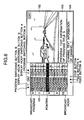
- a picture shown in Fig. 6 is displayed on the monitor 62.
- an EPG 101 that is long in the vertical direction is displayed on the left side and a reduced picture 102 is displayed in a top-right area.
- the picture 102 is a picture of a program that has been reduced in such a manner that the aspect ratio (e.g., 9:16) of the program picture is maintained, and hence the entire program picture is displayed.
- Program text information of a program in the EPG 101 indicated by a pointer is displayed in a display area 103 that is under the program picture 102. Further, channel text information of the selected channel is displayed in a display area 104 under the display area 103.
- An EPG may be displayed in display formed other than the display form shown in Fig. 6, such as display forms shown in Figs. 7A-7C and 8A-8B.
- a display form is specified in advance for each EPG.
- the video data that has been input to the video encoder 84 of the display converter 47 is encoded into video data of the NTSC scheme without being subjected to display size changing, and output to the D/A converter 85.
- the D/A converter 85 D/A-converts the input video data and outputs a resulting signal directly to the VCR 63.
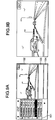
- EPG picture data and video data have been combined together and picture data corresponding to, for example, a picture shown in Fig. 9A is output to the monitor 62, picture data corresponding to a picture shown in Fig. 9B (i.e., only a program picture not including the EPG) is output to the VCR 63.
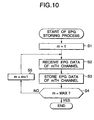
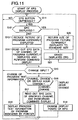
- step S1 the control CPU 44 sets variable m that is managed by itself at 1.
- step S2 the control CPU 44 acquires EPG data of the first channel from the demultiplexer 43.
- step S3 the control CPU 44 stores the EPG data that has been acquired at step S2 in the EPG data memory 51.
- step S4 it is judged whether EPG data corresponding to the maximum number (n) of channels that can be stored by the EPG data memory 51 have been stored there. If EPG data of n channels have not been stored yet, the process goes to step S5, where "1" is added to variable m. The process then returns to step S2 to execute step S2 and the following steps repeatedly until EPG data of n channel have been stored, that is, m becomes equal to n.
- step S4 If it is judged at step S4 that EPG data of n channels have been stored, the EPG data storing process is finished.
- step S11 the control CPU 44 waits for input, via the manipulation unit 54, of an EPG display instruction signal that is to be output from the remote controller 61 when an EPG button (not shown) on the remote controller 61 is depressed.
- step S12 the process goes to step S12, where it is judged whether an EPG is already displayed on the monitor 62.
- step S12 If it is judged at step S12 that no EPG is displayed on the monitor 62, the process goes to step S13, where the control CPU 44 controls the display size converter 81 of the display converter 47 to have it reduce the picture of a program currently displayed on the monitor 62 in such a manner that its aspect ratio (9:16) is maintained and output a resulting picture to the display processor 48.
- the control CPU 44 reads out EPG data of the channel of the program currently displayed from the EPG data memory 51, and controls the OSD control section 49 and the display processor 48 to have them combine the EPG data with the picture of the program that has been reduced at step S13 and display a combined picture on the monitor 62.
- step S15 it is judged whether a request for changing the channel that corresponds to an EPG program table, the display hours, or the program whose program text information is to be displayed has been made. If no request for such a change has been made, the process returns to step S11 to execute step S11 and the following steps repeatedly until a request for a change is made.
- step S15 If it is judged at step S15 that a request for changing the channel that corresponds to an EPG program table, the display hours, or the program whose program text information is to be displayed has been made, the process goes to step S16, where it is judged whether the change request is a request for changing the channel, the display hours, or the program whose program text information is to be displayed. If a channel change has been requested, the process goes to step S17, where the control CPU 44 reads out EPG data of the channel corresponding to the request from the EPG data memory 51, and controls the OSD control section 49 and the display processor 48 to have them combine the EPG data with the picture of the program and display a combined picture on the monitor 62.
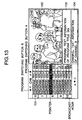
- Figs. 12 and 13 show EPGs in which the channel has been changed in accordance with a manipulation on the remote controller 61.
- a program table of channel 8 is displayed as an EPG 101 in place of the program table of channel 7 as shown in Fig. 12.
- Channel text information of channel 8 is displayed in the display area 104.
- the pointer is automatically moved to a program title GG in the EPG 101 and program text information of the program title GG is displayed in the display area 103.
- step S16 if it is judged at step S16 that a display hour change has been requested, the process goes to step S18, where the control CPU 44 reads out EPG data of display hours corresponding to the request from the EPG data memory 51 and controls the OSD control section 49 and the display processor 48 to have them combine the EPG data with the program picture and display a combined picture on the monitor 62.
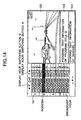
- Fig. 14 shows an EPG in which the display hours that correspond to the program table of the EPG have been changed in accordance with a manipulation on the remote controller 61. If, for example, the display hour switching button A (top-left position) in the EPG 101 is depressed in a state that the picture of Fig. 6 is displayed on the monitor 62, a program table from 7 hours to 11 hours is displayed in the EPG 101 in place of the program table from 6 hours to 10 hours, as shown in Fig. 14.
- step S16 if it is judged at step S16 that a change of the program whose program text information is to be displayed in the display area 103 has been requested, the process goes to step S19, where the control CPU 44 reads out EPG data of program text information of the program corresponding to the request and controls the OSD control section 49 and the display processor 48 to have them combine the EPG data with the program picture and display a combined picture on the monitor 62.
- Fig. 15 shows an EPG in which the program whose program text information is to be displayed in the display section 103 has been changed in accordance with a manipulation on the remote controller 61. As shown in Fig. 15, if the pointer has been moved to a program title D in the EPG 101 in a state that the picture of Fig. 6 is displayed on the monitor 62, the program text information of the program title D is displayed in the display area 103.
- step S17, S18, or S19 the process returns to step S11 to execute step S11 and the following steps repeatedly.
- step S12 If it is judged at step S12 that an EPG is already displayed on the monitor 62, the process goes to step S20, where the size of the picture of a program that is displayed at this time point is returned to the standard size. At step S21, the displayed EPG is erased. When the EPG has been erased from the monitor 62, the process returns to step S11 to execute step S11 and the following steps again.
- Figs. 16A-16D show pictures to be displayed on the monitor 62 as the above EPG display process is executed. If the EPG button is depressed (step S11) in a state that a picture of Fig. 16A is displayed on the monitor 62, a program picture is reduced in such a manner that its aspect ratio is maintained as shown in Fig. 16B (step S13). A reduced picture is combined with an EPG picture (step S14), and a picture as shown in Fig. 16C is displayed on the monitor 62. If the EPG button is depressed in a state that the EPG picture as shown in Fig. 16C is displayed on the monitor 62 (step S12), the size of the program picture that is currently displayed is returned to the standard size (step S20) as shown in Fig. 16D and the displayed EPG is erased (step S21).
- step S31 it is judged whether the scroll speed information of the channel text information of the channel currently selected (in this case, channel 7) exists in the EPG data. If scroll speed information exists, the process goes to step S32, where the scroll speed is determined based on the scroll speed information.
- step S33 it is judged whether scrolling should be performed automatically at the speed determined at step S32. If scrolling should be performed automatically, the process goes to step S34, where the channel text information is displayed in the display area 104 while being scrolled automatically.
- Figs. 18A and 18B show how scrolling is performed in the display areas 103 and 104.
- the scrolling is suspended and text information at this time point continues to be displayed in the display area 104. If the feed button A in the picture of Fig. 6 is manipulated in this state, the text information restarts to move forward. If the feed button B in the picture of Fig. 6 is manipulated, the text information restarts to be displayed backward.
- the text information is displayed in the display area 104 in a manual/continuous manner or a manual/sequential manner.
- step S31 If it is judged at step S31 that scroll speed information of the channel text information of the selected channel (in this case, channel 7) does not exist in the EPG data, the process goes to step S36, where the scroll speed is determined as being a speed specified by the receiving apparatus. Then, the process goes to step S33 to execute steps S33-S35.
- step S37 it is judged whether scroll speed information of the program text information of the program indicated by the pointer in the picture of Fig. 6 exists in the EPG data.
- steps S38-S42 are similar to steps S32-S36, respectively. That is, the program text information is displayed in the display area 103 while being scrolled automatically or manually.
- broadcasters can attempt to give users a strong impression by causing unique characters (e.g., large or colored characters) or specifying a scroll speed (e.g., employing a slow scroll speed).
- unique characters e.g., large or colored characters
- scroll speed e.g., employing a slow scroll speed
- system means the entire apparatus that is constituted of a plurality of apparatuses, means, etc.
- the providing medium that provides users with a computer program for execution of the above process includes not only recording media such as a magnetic disk and a CD-ROM but also communication media such as a network and a satellite.
- an EPG including prescribed text information, control information for controlling the prescribed text information, and a program table indicating a broadcast schedule of programs is received on a predetermined channel, the prescribed --text information, the control information, and the program table are extracted from the received EPG, display is so controlled that the prescribed text information is displayed together with the program table in accordance with the extracted control information, a picture of a program is reduced in accordance with a controlled display picture, and the controlled picture is combined with the reduced picture. Therefore, a large quantity of information can be displayed in an EPG.
- an EPG signal including a program table indicating a broadcast schedule of programs and explanatory information that explains contents of the programs by text, and a picture signal of a program are received, the picture of the program is reduced when an instruction to display the program table has been made, and one of the program table and the explanatory information is displayed so as to be located above or below the reduced picture of the program, and the other of the program table and the explanatory information is displayed so as to be located on the right or left of the reduced picture of the program. Therefore, a user can watch a picture of a program while referring to an EPG.
- an EPG including a program table for only a predetermined channel that indicates a broadcast schedule of programs of the predetermined channel is received on the predetermined channel and a picture signal of a program of each channel is received, the received EPG of each channel is stored, the picture of the program is reduced when an instruction to display the program table has been made, and the stored program table is displayed so as to be combined with the reduced picture when the instruction to display the program table has been made. Therefore, a picture is not disconnected even in, for example, displaying an EPG of a channel corresponding to another transponder in place of an EPG currently referred to.
Landscapes
- Engineering & Computer Science (AREA)
- Multimedia (AREA)
- Signal Processing (AREA)
- Business, Economics & Management (AREA)
- Marketing (AREA)
- Human Computer Interaction (AREA)
- Two-Way Televisions, Distribution Of Moving Picture Or The Like (AREA)
- Television Systems (AREA)
Applications Claiming Priority (2)
| Application Number | Priority Date | Filing Date | Title |
|---|---|---|---|
| JP10066813A JPH11266413A (ja) | 1998-03-17 | 1998-03-17 | 情報処理装置および方法、デジタル信号復調装置および方法、並びに提供媒体 |
| JP6681398 | 1998-03-17 |
Publications (1)
| Publication Number | Publication Date |
|---|---|
| EP0944252A1 true EP0944252A1 (de) | 1999-09-22 |
Family
ID=13326682
Family Applications (1)
| Application Number | Title | Priority Date | Filing Date |
|---|---|---|---|
| EP99302028A Withdrawn EP0944252A1 (de) | 1998-03-17 | 1999-03-16 | Datenverarbeitungsgerät und -verfahren, digital Signaldemodulationsgerät und -verfahren, und Darstellungsmedium |
Country Status (4)
| Country | Link |
|---|---|
| EP (1) | EP0944252A1 (de) |
| JP (1) | JPH11266413A (de) |
| KR (1) | KR19990077887A (de) |
| CN (1) | CN1238639A (de) |
Cited By (4)
| Publication number | Priority date | Publication date | Assignee | Title |
|---|---|---|---|---|
| WO2001030072A1 (en) * | 1999-10-22 | 2001-04-26 | Fujitsu Limited | Tv set |
| FR2805698A1 (fr) * | 2000-02-25 | 2001-08-31 | Thomson Multimedia Sa | Selection binaire d'un programme dans une liste |
| CN100391258C (zh) * | 2003-12-31 | 2008-05-28 | 北京宽视软件技术有限公司 | 一种数字电视系统图文电子节目指南信息混合显示方法 |
| EP2293549B1 (de) * | 2000-02-11 | 2017-03-22 | TiVo Solutions Inc. | Fernsehprogramminformationanzeige mit einer dynamisch eingestellten Bildschirmrollgeschwindigkeit |
Families Citing this family (14)
| Publication number | Priority date | Publication date | Assignee | Title |
|---|---|---|---|---|
| JP2001268468A (ja) * | 2000-03-22 | 2001-09-28 | Sanyo Electric Co Ltd | 映像表示装置 |
| JP4258261B2 (ja) | 2002-04-22 | 2009-04-30 | パナソニック株式会社 | 番組詳細情報表示装置及びその方法 |
| JP3851217B2 (ja) | 2002-05-09 | 2006-11-29 | 三洋電機株式会社 | ディジタル放送受信装置 |
| JP4000454B2 (ja) * | 2002-05-13 | 2007-10-31 | ソニー株式会社 | 受信装置および受信方法 |
| KR20040003601A (ko) * | 2002-07-03 | 2004-01-13 | 엘지전자 주식회사 | Epg 표시 방법 |
| JP2004056462A (ja) | 2002-07-19 | 2004-02-19 | Sony Corp | 映像検索支援方法及び映像検索支援装置、並びに放送受信装置 |
| JP4478863B2 (ja) | 2003-11-19 | 2010-06-09 | ソニー株式会社 | 表示装置、双方向通信システムおよび表示情報利用方法 |
| KR100569450B1 (ko) * | 2004-05-04 | 2006-04-07 | 주식회사 대우일렉트로닉스 | 데이터 방송의 단축키 표시 장치 및 그 방법 |
| JP3729417B1 (ja) * | 2004-09-07 | 2005-12-21 | ソニー株式会社 | 情報処理装置および方法、並びにプログラム |
| KR100599156B1 (ko) | 2004-09-15 | 2006-07-12 | 삼성전자주식회사 | 메세지 표시 방법 |
| JP2008160525A (ja) * | 2006-12-25 | 2008-07-10 | Mitsubishi Electric Corp | 電子番組情報出力装置及び電子番組情報出力方法 |
| CN101453581B (zh) * | 2007-11-29 | 2010-08-18 | 中兴通讯股份有限公司 | 一种移动电视终端 |
| JP5405096B2 (ja) * | 2008-12-17 | 2014-02-05 | 三菱電機株式会社 | 放送受信装置 |
| CN105263522B (zh) * | 2013-05-31 | 2019-03-22 | 赛特瑞恩股份有限公司 | 可中和乙肝病毒的结合分子 |
Citations (4)
| Publication number | Priority date | Publication date | Assignee | Title |
|---|---|---|---|---|
| WO1996007270A1 (en) * | 1994-08-31 | 1996-03-07 | Yuen Henry C | Method and apparatus for displaying television programs and related text |
| US5559550A (en) * | 1995-03-01 | 1996-09-24 | Gemstar Development Corporation | Apparatus and methods for synchronizing a clock to a network clock |
| EP0746119A2 (de) * | 1995-05-30 | 1996-12-04 | Mitsubishi Denki Kabushiki Kaisha | Satellitenkommunikationsanordnung für Informationsübertragung von einer Informationszentrale zu einem Satellitenempfängerendgerät mit der Nachricht zugeordnetem Identifizierer |
| EP0766470A2 (de) * | 1995-09-29 | 1997-04-02 | Matsushita Electric Industrial Co., Ltd. | Fernsehempfänger für Videotext |
-
1998
- 1998-03-17 JP JP10066813A patent/JPH11266413A/ja not_active Withdrawn
-
1999
- 1999-03-15 KR KR1019990008648A patent/KR19990077887A/ko not_active Withdrawn
- 1999-03-16 EP EP99302028A patent/EP0944252A1/de not_active Withdrawn
- 1999-03-17 CN CN99105882A patent/CN1238639A/zh active Pending
Patent Citations (4)
| Publication number | Priority date | Publication date | Assignee | Title |
|---|---|---|---|---|
| WO1996007270A1 (en) * | 1994-08-31 | 1996-03-07 | Yuen Henry C | Method and apparatus for displaying television programs and related text |
| US5559550A (en) * | 1995-03-01 | 1996-09-24 | Gemstar Development Corporation | Apparatus and methods for synchronizing a clock to a network clock |
| EP0746119A2 (de) * | 1995-05-30 | 1996-12-04 | Mitsubishi Denki Kabushiki Kaisha | Satellitenkommunikationsanordnung für Informationsübertragung von einer Informationszentrale zu einem Satellitenempfängerendgerät mit der Nachricht zugeordnetem Identifizierer |
| EP0766470A2 (de) * | 1995-09-29 | 1997-04-02 | Matsushita Electric Industrial Co., Ltd. | Fernsehempfänger für Videotext |
Cited By (4)
| Publication number | Priority date | Publication date | Assignee | Title |
|---|---|---|---|---|
| WO2001030072A1 (en) * | 1999-10-22 | 2001-04-26 | Fujitsu Limited | Tv set |
| EP2293549B1 (de) * | 2000-02-11 | 2017-03-22 | TiVo Solutions Inc. | Fernsehprogramminformationanzeige mit einer dynamisch eingestellten Bildschirmrollgeschwindigkeit |
| FR2805698A1 (fr) * | 2000-02-25 | 2001-08-31 | Thomson Multimedia Sa | Selection binaire d'un programme dans une liste |
| CN100391258C (zh) * | 2003-12-31 | 2008-05-28 | 北京宽视软件技术有限公司 | 一种数字电视系统图文电子节目指南信息混合显示方法 |
Also Published As
| Publication number | Publication date |
|---|---|
| CN1238639A (zh) | 1999-12-15 |
| KR19990077887A (ko) | 1999-10-25 |
| JPH11266413A (ja) | 1999-09-28 |
Similar Documents
| Publication | Publication Date | Title |
|---|---|---|
| EP0944253A1 (de) | Empfangsgerät und -verfahren zur elektronischen Programmführung und Darstellungsmedium | |
| KR100542639B1 (ko) | Epg송신장치 및 방법, epg수신장치 및 방법, epg송수신시스템 및 방법과 제공매체 | |
| KR100380849B1 (ko) | 텔레비전 수상기 내의 오디오-만의 프로그램을 처리하기 위한 시스템 및 방법 | |
| JP2000516428A (ja) | テレビジョン番組間の移動 | |
| US20020087982A1 (en) | Electronic program guide with rapid time advancement feature | |
| KR100405617B1 (ko) | 전자 프로그램 가이드 상의 현재 시간의 그래픽 디스플레이 | |
| KR19990077887A (ko) | 정보처리장치 및 방법, 디지털신호복조장치 및 방법과 제공매체 | |
| JPH11261917A (ja) | 情報処理装置および方法、並びに提供媒体 | |
| US7797714B1 (en) | Information processing apparatus for searching broadcast program and method therefore | |
| JP3091903U (ja) | ディジタル放送受信記録装置 | |
| JP4725609B2 (ja) | 情報処理装置および方法 | |
| JP2000270277A (ja) | テレビジョン受像機 | |
| JP2003513551A (ja) | テレビ番組配信システムにおけるテレビジョン受信器のためのシステムおよびユーザ・インターフェース | |
| US7657909B1 (en) | Information receiving apparatus and method for receiving headline information | |
| JP2006115228A (ja) | 番組表搭載デジタル放送受信機 | |
| JP4178581B2 (ja) | 情報処理装置および方法、並びに記録媒体 | |
| JP2000152114A (ja) | まだら放送内容表示装置及びその表示方法 | |
| JPH11284922A (ja) | 情報処理装置および方法、並びに提供媒体 | |
| KR100290871B1 (ko) | 디지털 티브이의 캡션정보 저장/재생 장치 및 방법 | |
| JPH08140065A (ja) | 文字放送受信装置 | |
| JP4026148B2 (ja) | 番組表搭載デジタル放送受信機 | |
| JP2001024959A (ja) | デジタル放送受信装置 | |
| JP2001223955A (ja) | 電子機器及び電子機器の動作設定方法 | |
| US20080244651A1 (en) | Broadcast receiving apparatus and broadcast reception method | |
| JPH11284923A (ja) | 情報処理装置および方法、並びに提供媒体 |
Legal Events
| Date | Code | Title | Description |
|---|---|---|---|
| PUAI | Public reference made under article 153(3) epc to a published international application that has entered the european phase |
Free format text: ORIGINAL CODE: 0009012 |
|
| AK | Designated contracting states |
Kind code of ref document: A1 Designated state(s): DE FR GB |
|
| AX | Request for extension of the european patent |
Free format text: AL;LT;LV;MK;RO;SI |
|
| 17P | Request for examination filed |
Effective date: 20000223 |
|
| AKX | Designation fees paid |
Free format text: DE FR GB |
|
| STAA | Information on the status of an ep patent application or granted ep patent |
Free format text: STATUS: THE APPLICATION HAS BEEN WITHDRAWN |
|
| 18W | Application withdrawn |
Effective date: 20030122 |