EP0948031A2 - Ligne de fabrication de semiconducteur avec fonction de prévention de contamination - Google Patents
Ligne de fabrication de semiconducteur avec fonction de prévention de contamination Download PDFInfo
- Publication number
- EP0948031A2 EP0948031A2 EP99106561A EP99106561A EP0948031A2 EP 0948031 A2 EP0948031 A2 EP 0948031A2 EP 99106561 A EP99106561 A EP 99106561A EP 99106561 A EP99106561 A EP 99106561A EP 0948031 A2 EP0948031 A2 EP 0948031A2
- Authority
- EP
- European Patent Office
- Prior art keywords
- line
- wafer
- cassette
- semiconductor fabrication
- isolation
- Prior art date
- Legal status (The legal status is an assumption and is not a legal conclusion. Google has not performed a legal analysis and makes no representation as to the accuracy of the status listed.)
- Ceased
Links
Images





Classifications
-
- H—ELECTRICITY
- H10—SEMICONDUCTOR DEVICES; ELECTRIC SOLID-STATE DEVICES NOT OTHERWISE PROVIDED FOR
- H10P—GENERIC PROCESSES OR APPARATUS FOR THE MANUFACTURE OR TREATMENT OF DEVICES COVERED BY CLASS H10
- H10P95/00—Generic processes or apparatus for manufacture or treatments not covered by the other groups of this subclass
-
- H—ELECTRICITY
- H10—SEMICONDUCTOR DEVICES; ELECTRIC SOLID-STATE DEVICES NOT OTHERWISE PROVIDED FOR
- H10P—GENERIC PROCESSES OR APPARATUS FOR THE MANUFACTURE OR TREATMENT OF DEVICES COVERED BY CLASS H10
- H10P72/00—Handling or holding of wafers, substrates or devices during manufacture or treatment thereof
- H10P72/30—Handling or holding of wafers, substrates or devices during manufacture or treatment thereof for conveying, e.g. between different workstations
- H10P72/32—Handling or holding of wafers, substrates or devices during manufacture or treatment thereof for conveying, e.g. between different workstations between different workstations
- H10P72/3216—Handling or holding of wafers, substrates or devices during manufacture or treatment thereof for conveying, e.g. between different workstations between different workstations using a general scheme of a conveying path within a factory
-
- H—ELECTRICITY
- H10—SEMICONDUCTOR DEVICES; ELECTRIC SOLID-STATE DEVICES NOT OTHERWISE PROVIDED FOR
- H10P—GENERIC PROCESSES OR APPARATUS FOR THE MANUFACTURE OR TREATMENT OF DEVICES COVERED BY CLASS H10
- H10P72/00—Handling or holding of wafers, substrates or devices during manufacture or treatment thereof
- H10P72/06—Apparatus for monitoring, sorting, marking, testing or measuring
- H10P72/0604—Process monitoring, e.g. flow or thickness monitoring
-
- H—ELECTRICITY
- H10—SEMICONDUCTOR DEVICES; ELECTRIC SOLID-STATE DEVICES NOT OTHERWISE PROVIDED FOR
- H10P—GENERIC PROCESSES OR APPARATUS FOR THE MANUFACTURE OR TREATMENT OF DEVICES COVERED BY CLASS H10
- H10P72/00—Handling or holding of wafers, substrates or devices during manufacture or treatment thereof
- H10P72/06—Apparatus for monitoring, sorting, marking, testing or measuring
- H10P72/0612—Production flow monitoring, e.g. for increasing throughput
Definitions
- This invention relates to a semiconductor fabrication line and, more particularly, to a semiconductor fabrication line with a contamination preventing function.
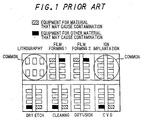
- FIG.1 shows an example of the equipment concentration layout type of fabrication line.
- this equipment concentration layout type has the processes of lithography, film forming 1, film forming 2, ion implantation, CVD, diffusion, cleaning and dry etch.
- Equipment for a material that may cause contamination is indicated hatched, equipment for another material that may cause contamination is indicated blacked, and part that common equipment is available is indicated 'common'. Namely, the lithography process and the ion implantation process are in common use.
- a bay for a same kind of process where equipment is disposed is formed and a wafer is transported between bays using a common carrier, i.e., a cassette and a carrying mechanism. Therefore, it is apt to incur a cross-contamination.
- FIG.2 shows an example of the equipment distribution layout type of fabrication line.
- Equipment for a material that may cause contamination is indicated hatched.
- This equipment-distribution layout type has the processes of base 1, base 2, gate, gate wiring, diffusion region, interlayer film, contact, interlayer film, capacitor, interlayer film, wiring, interlayer film, wiring and upper part.
- a bay is formed for each process unit and equipments are disposed nearly in the order of process. Therefore, though it does not incur such cross-contamination that the equipment concentration layout type does, the number of equipments increases so much.
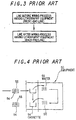
- FIG.3 shows an example that the semiconductor fabrication process is separated into two lines, a line before the wiring process (front-end line) and a line after the wiring process (back-end line).
- different lines may be provided for before and after the wiring process, so as to avoid the wiring material to contaminate the pre-wiring process.
- FIG.4 shows an example of conventional method of using a carrier in semiconductor fabrication equipment.
- this method of using a carrier after wafers 55 coming loaded on a cassette 54 are unloaded from the wafer unloading side of equipment 50, then the cassette 54 is moved to the wafer loading side and is set there. After completing the process, the wafers 55 are loaded on the selfsame cassette 54, then forwarded to the next process. Also, while the wafers 55 are processed through the processing, the cassette 54 may be cleaned and then set to the loading side.
- the equipment for film-forming/processing the contamination causing material exists in the line. Therefore, it is impossible to reduce to zero the probability that the contaminator adheres to any part (front and rear, surfaces of wafer, carrier, carrying mechanism etc.) thereby causing a line-contamination, namely, the risk of contamination occurrence is always underlying. Also, since it is necessary to monitor always the contamination inside and outside specific equipment, there is a problem that the contamination control is complicated.
- a semiconductor fabrication line for fabricating a semiconductor device comprises:
- a wafer transfer mechanism for carrying a wafer in a semiconductor fabrication process comprises:
- FIG.5 is an illustration showing a semiconductor fabrication line in the first preferred embodiment according to the invention.
- This line is composed of a mainstream line 1 to conduct a normal semiconductor fabrication process, an isolation line 3, which is isolated from the mainstream line 1, to conduct a semiconductor fabrication process for contamination causing material, and a wafer transferring mechanism 2 to transfer wafers 5 between the mainstream line 1 and isolation line 3.
- a mainstream-line cassette 4a and an isolation-line cassette 4b are provided as a cassette to carry the wafers 5.
- a relay water support 6 may be used to transfer the cassette from the mainstream-line cassette 4a to the isolation-line cassette 4b.
- the wafers 5 transferred into the isolation line 3 are processed in equipments 7, 8 and 9 that are disposed in the isolation line 3. While the equipments 7, 8 are to conduct an individual-processing using a material, the equipment 9 is to conduct a final-stage processing in the isolation line 3 and is common equipment that wafers processed through the individual processing are processed together. Also, a wafer transfer common part 10 is a common part that the wafers 5 processed in the equipment 9 are transferred.
- Codes A to I indicate directions that the wafer and cassette are transferred.
- the mainstream-line cassette 4a and the wafers 5 loaded on the mainstream-line cassette 4a are transferred together to the wafer transferring mechanism 2 in direction A.
- the wafer transferring mechanism 2 After separating the mainstream-line cassette 4a and the wafers 5, the wafers 5 are transferred to the relay wafer support 6 in direction B, further transferred from the relay wafer support 6 to the isolation-line cassette 4b set in advance in direction C.
- the wafers 5 transferred to the isolation-line cassette 4b are transferred to the equipment 7 in direction D, processed therein, further transferred to the equipment 8 in direction E, processed therein.
- the equipments 7, 8 are individual-processing equipments using the contamination causing material.
- the wafers 5 processed in the equipment 8 are transferred to the equipment 9 in direction F, processed through a common processing such as film-forming and cleaning in the equipment 9.
- the isolation-line cassette 4b and the wafers 5 are separated.
- the wafers 5 separated are transferred to the wafer transfer common part 10 in direction G, loaded on the mainstream-line cassette 4a set moving in directions J, K. Then, they are moved to the wafer transferring mechanism 2 in direction H, returned to the mainstream line 1 in direction I.
- the isolation-line cassette 4b separated after completing the final process in the equipment 9 is moved to the wafer transferring mechanism 2 in direction L, set there to load a next wafer.
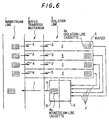
- FIG.6 is an illustration showing a semiconductor fabrication line in the second preferred embodiment according to the invention.
- This line is provided as a case that the number of contamination causing material is multiple and therefore multiple individual lines using the contamination causing materials are provided in the isolation line 3.
- the wafers 5 and the mainstream-line cassette 4a in the mainstream line 1 are transferred to the wafers transferring mechanism 2 in direction A.
- the wafers 5 are loaded on the isolation-line cassette 4b, transferred to the isolation line 3 indirection D, processed through the individual processing using the contamination causing material in each of the individual lines a-d in the isolation line 3. transferred to the equipment 9 in direction F, processed through the common processing therein.
- the wafers 5 are transferred to the wafer transfer common part 10, loaded on the mainstream-line cassette 4a set in advance. Then, the wafers 5 and the mainstream-line cassette 4a are moved to the wafer transferring mechanism 2 in direction H, further returned to the mainstream line 1 in direction I.
- the isolation line 3 is provided in the semiconductor fabrication line, and the process to film form or process a line-contamination causing material, e.g., Co, Pt, Ir etc., is conducted in the isolation line 3 separated from the mainstream line 1.
- a line-contamination causing material e.g., Co, Pt, Ir etc.
- she isolation line 3 may be single as shown in FIG.5 or have the individual lines a-d for the respective contamination causing materials. In the latter case, it should be noted that the wafers 5 are used within only each of the individual lines a-d and are not taken outside.
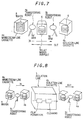
- FIG.7 is a perspective view showing a wafer transferring mechanism in the first preferred embodiment.
- a transferring robot 11a is used to transfer the wafers 5 from the mainstream-line cassette 4a to the relay wafer support 6, and a transferring robot 11b is used to transfer the wafers 5 from the relay wafer support 6 to the isolation-line cassette 4b.
- the transferring robots 11a, 11b are provided with arms 11a' and 11b', respectively, and by moving to right and left the arms 11a' and 11b', the wafers 5 are transferred.
- known techniques are used to operate the transferring robots 11a, 11b with the arms 11a, 11b.
- the transferring robots 11a, 11b which conduct the transporting between the mainstream line 1 and the isolation line 3, themselves may incur a contamination. This can be a contamination caused by particles etc. attaching to them. In this case, it is necessary to clean occasionally the transferring robots 11a, 11b themselves.
- IN and OUT of wafer to the isolation line 3 are indicated by arrows in FIG.7. Namely, in this embodiment, the IN side incoming to the isolation line 3 is placed at the same side as the OUT side outgoing from the isolation line 3.
- FIG.8 is a perspective view showing a water transferring mechanism in the second preferred embodiment.
- transferring robots 11c and 11d are used as the wafer transferring mechanism 2.
- the wafers 5 are transferred from the mainstream-line cassette 4a to the isolation-line cassette 4b, processed through the film-forming and cleaning in the isolation line 3.
- the transferring robot 11d the wafers 5 are transferred from the isolation line cassette 4b to the mainstream-line cassette 4a.
- the isolation-line cassette 4b may be omitted, because the wafer is cleaned at the final stage of the isolation line 3. Namely, the IN side incoming to the isolation line 3 is placed at the opposite side of the OUT side outgoing from the isolation line 3.
- FIG.9 is a perspective view showing a wafer transferring mechanism in the third preferred embodiment.
- the IN side is placed at the same side as the OUT side.
- a single transferring robot 11e is used.
- the transferring robot 11e is provided with two arms 11e' and 11e''.
- the am 11e' is used for IN to the isolation line 3, and the arm 11e'' is used for OUT from the isolation line 3.
- the IN side is placed at the same side as the OUT side.
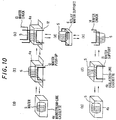
- FIG.10 is a perspective view showing the details of the wafer transferring mechanism 2 using the relay wafer support 6 in the first embodiment in FIG. 7.
- the wafers 5 are transferred from the mainstream-line cassette 4a to the isolation-line cassette 4b.
- the wafers 5 are loaded on the mainstream-line cassette 4a.
- the wafers 5 are pushed up by a wafer push-up 12 from beneath.
- the wafers 5 pushed up as shown in FIG.10 (c) are gripped by a wafer chuck 13, loaded on the relay wafer support 6 as shown in FIG.10 (d).
- the wafers 5 are gripped by a wafer chuck 14 as shown in FIG. 10 (e), put on a wafer support 15 of the isolation-line cassette 4b as shown in FIG.10 (f). Operating as described above, the wafers 5 can be loaded on the isolation-line cassette 4b.
- the relay wafer support 6 is provided intended to prevent the contamination due to the transferring robot, which is not shown in FIG.10, used to transfer the wafers 5.
- mainstream line-to-isolation line wafer transfer mechanism is provided between the mainstream line 1 and the isolation line 3 so as not to take out the contaminant in the isolation line 3 into the mainstream line 1.
- the wafers 5 are transferred from the mainstream line 1 to the mainstream-line cassette 4a set at the loading side of "mainstream line-to-isolation line wafer transfer mechanism", further transferred from there to the isolation-line cassette 4b by the transferring robot 11.
- the transfer relay wafer support 6 can be used not to contaminate the mainstream-line cassette 4a through the transferring robot 11.
- the wafers 5 transferred to the isolation-line cassette 4b are transported by the carrier mechanism for the isolation line 3 to the target processing equipment, processed through the process such as film-forming and processing in the isolation line 3.
- the wafers 5 are transferred to the mainstream-line cassette 4a.
- the isolation-line cassette 4b used since loaded into the equipment is returned to the water receiving port of the isolation line 3 on the side of "mainstream line-to-isolation line wafer transfer mechanism".
- the water taking-out side of the film-forming or cleaning equipment in the final-stage process is isolated completely from the isolation line 3, and is kept in as low contamination state as the mainstream line 1.
- the wafers 5 can be returned to the mainstream-line cassette 4a by connecting the water taking-out side directly with the wafer sending-out side to the mainstream line 1 or through a carrier with cleanness equal to that of the mainstream line 1, in "mainstream line-to-isolation line wafer transfer mechanism". Then, returning the wafers 5 to the mainstream line 1, the process is forwarded. Meanwhile, at any part or multiple parts of the water transfer process, the cassette may be cleaned.
- the positional relationship between the mainstream line 1 and the isolation line 3 may be horizontal as described above, the wafers can be transferred by only using a simple transferring robot when the isolation line 3 is disposed below the mainstream line 1 to carry the wafers vertically.
- FIGS.11 to 16 the actual processing performed in the isolation line 3 is explained below. Numerals used in FIGS.11 to 16 indicate the order of the processing.
- FIG.11 shows an example that CMP equipment is used.
- a material targeted to CMP is interlayer dielectric film. Contamination desired to avoid is contamination by the material itself and slurry. and metal contamination (K, Na etc.) included in slurry solution.
- CMP processing and post-cleaning cleaning of back face
- the wafers are returned to the mainstream line.
- FIG.12 also shows an example that CMP equipment is used.
- a material targeted to CMP is one used to metal wiring, e.g., Cu, Al, W etc. Contamination desired to avoid is contamination by the material itself and slurry, and metal contamination included in slurry solution.
- CMP film-forming of wiring material
- CMP cleaning after CMP. formation of interlayer dielectric film, resist coating, lithography, dry-etching of interlayer dielectric film, resist removal, formation of barrier film/interlayer dielectric film, and cleaning of back face are conducted.
- the wafers are returned to the mainstream line.
- the processed wafer may be returned from the cleaning after CMP to the block of the transferring.
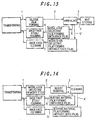
- FIG.13 shows an example that silicide wiring is formed.
- a silicide material used is Co, Ti, Ni.
- the isolation line has the individual lines for the respective materials. If the interaction of materials is little, the process can be in common use. After the transferring of wafer, formation of silicide film, annealing, wet etching, and annealing are conducted. Then, separating into back face etch and cleaning after formation of interlayer dielectric film (with back face) and back face cleaning after formation of interlayer dielectric film (without back face), finally the wafers are returned together to the mainstream line.
- FIG.14 shows an example that contact on silicide wiring is formed.
- a silicide material used is Co, Ti, Ni.
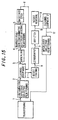
- FIGS.15 and 16 show examples of capacitor formation process.
- a capacitive dielectric material used for high permittivity film is Ta, BST (Ba, Sr, Ti), and a capacitive dielectric material used for ferroelectric film is PZT (Pb, Zr, Ti), SBT (Sr, Bi, Ta) etc.
- an electrode material used is Ru, Pt, Ir, poly-Si etc.
- FIG.15 shows an example that electrode in capacitor formation process is of a non-contaminative material (poly-Si etc.).
- a non-contaminative material poly-Si etc.
- FIG.16 shows an example that electrode in capacitor formation process is of a contaminative material (Ru, Pt, Ir etc.).
- a contaminative material Ru, Pt, Ir etc.
- the film-formation and processing Of contamination causing material is conducted in the isolation line and after processing, the contamination causing material appearing on the wafer surface is covered with film, optionally further cleaning, then the wafers are returned to the mainstream line. Therefore, the contamination causing material does not contaminate a wafer processed in another process in the mainstream line, therefore the contamination can be prevented.
- a material that is used to fabricate a semiconductor device and may influence badly another part of the semiconductor device can be prevented completely and simply from being the contaminant to the semiconductor device in the semiconductor fabrication line. So, the excessive equipment investment can be avoided.
- this invention provides the wafer transfer mechanism between the mainstream line and the isolation line to avoid the propagation of contamination, for the semiconductor fabrication line with contamination causing material isolation line. Namely, since the process relating to the contamination causing material is conducted in the isolation line, the isolation line except the processes of film-covering and cleaning in the final stage is not required of any special consideration about the concerned contamination causing material. So, for example, the contamination through carrier can be prevented easily and simply.
Landscapes
- Container, Conveyance, Adherence, Positioning, Of Wafer (AREA)
- Thin Film Transistor (AREA)
Applications Claiming Priority (2)
| Application Number | Priority Date | Filing Date | Title |
|---|---|---|---|
| JP8619998 | 1998-03-31 | ||
| JP08619998A JP3196719B2 (ja) | 1998-03-31 | 1998-03-31 | 汚染防御用隔離ラインを有する半導体製造ライン、ウエハ搬送機構および半導体の製造方法 |
Publications (2)
| Publication Number | Publication Date |
|---|---|
| EP0948031A2 true EP0948031A2 (fr) | 1999-10-06 |
| EP0948031A3 EP0948031A3 (fr) | 2004-06-09 |
Family
ID=13880121
Family Applications (1)
| Application Number | Title | Priority Date | Filing Date |
|---|---|---|---|
| EP99106561A Ceased EP0948031A3 (fr) | 1998-03-31 | 1999-03-30 | Ligne de fabrication de semiconducteur avec fonction de prévention de contamination |
Country Status (5)
| Country | Link |
|---|---|
| US (1) | US6322597B1 (fr) |
| EP (1) | EP0948031A3 (fr) |
| JP (1) | JP3196719B2 (fr) |
| KR (1) | KR100319998B1 (fr) |
| TW (1) | TW505970B (fr) |
Cited By (1)
| Publication number | Priority date | Publication date | Assignee | Title |
|---|---|---|---|---|
| WO2002080238A1 (fr) * | 2001-03-28 | 2002-10-10 | Kabushiki Kaisha Toshiba | Dispositif et systeme de traitement d'appareil a semi-conducteurs |
Families Citing this family (16)
| Publication number | Priority date | Publication date | Assignee | Title |
|---|---|---|---|---|
| DE69940074D1 (de) | 1998-09-14 | 2009-01-22 | Panasonic Corp | Verfahren zur herstellung einer halbleitervorrichtung |
| JP4060526B2 (ja) * | 2000-12-13 | 2008-03-12 | 株式会社日立国際電気 | 半導体装置の製造方法 |
| JP2003297848A (ja) | 2002-04-01 | 2003-10-17 | Matsushita Electric Ind Co Ltd | 半導体装置の製造方法 |
| JP2004103761A (ja) | 2002-09-09 | 2004-04-02 | Renesas Technology Corp | 半導体装置製造ライン |
| TW200525601A (en) * | 2004-01-07 | 2005-08-01 | Trecenti Technologies Inc | Semiconductor manufacturing system, work manufacturing system, and conveyance system |
| US9339900B2 (en) | 2005-08-18 | 2016-05-17 | Futrfab, Inc. | Apparatus to support a cleanspace fabricator |
| US8229585B2 (en) | 2005-09-18 | 2012-07-24 | Flitsch Frederick A | Methods and apparatus for vertically orienting substrate processing tools in a clean space |
| US10627809B2 (en) | 2005-06-18 | 2020-04-21 | Frederick A. Flitsch | Multilevel fabricators |
| US9159592B2 (en) | 2005-06-18 | 2015-10-13 | Futrfab, Inc. | Method and apparatus for an automated tool handling system for a multilevel cleanspace fabricator |
| US10651063B2 (en) | 2005-06-18 | 2020-05-12 | Frederick A. Flitsch | Methods of prototyping and manufacturing with cleanspace fabricators |
| US7513822B2 (en) | 2005-06-18 | 2009-04-07 | Flitsch Frederick A | Method and apparatus for a cleanspace fabricator |
| US11024527B2 (en) | 2005-06-18 | 2021-06-01 | Frederick A. Flitsch | Methods and apparatus for novel fabricators with Cleanspace |
| US9457442B2 (en) * | 2005-06-18 | 2016-10-04 | Futrfab, Inc. | Method and apparatus to support process tool modules in a cleanspace fabricator |
| US9059227B2 (en) | 2005-06-18 | 2015-06-16 | Futrfab, Inc. | Methods and apparatus for vertically orienting substrate processing tools in a clean space |
| US7467024B2 (en) * | 2005-08-26 | 2008-12-16 | Flitsch Frederick A | Method and apparatus for an elevator system for a multilevel cleanspace fabricator |
| JP2007317944A (ja) * | 2006-05-26 | 2007-12-06 | Toshiba Corp | 局所クリーン化ロボット搬送工場及びロボット搬送式製造方法 |
Family Cites Families (18)
| Publication number | Priority date | Publication date | Assignee | Title |
|---|---|---|---|---|
| DE2951708A1 (de) | 1979-12-19 | 1981-07-02 | Schering Ag Berlin Und Bergkamen, 1000 Berlin | Verfahren und vorrichtung zur automatischen regelung von teilstromstaerken eines gleichrichters |
| US4433951A (en) | 1981-02-13 | 1984-02-28 | Lam Research Corporation | Modular loadlock |
| US4861222A (en) * | 1984-03-09 | 1989-08-29 | Tegal Corporation | Cassette elevator for use in a modular article processing machine |
| US4722659A (en) * | 1986-05-16 | 1988-02-02 | Thermco Systems, Inc. | Semiconductor wafer carrier transport apparatus |
| JPH01102842A (ja) * | 1987-10-14 | 1989-04-20 | Shimadzu Corp | イオン注入装置用エンドステーション |
| US5161233A (en) | 1988-05-17 | 1992-11-03 | Dai Nippon Printing Co., Ltd. | Method for recording and reproducing information, apparatus therefor and recording medium |
| US5404894A (en) * | 1992-05-20 | 1995-04-11 | Tokyo Electron Kabushiki Kaisha | Conveyor apparatus |
| US5366670A (en) | 1993-05-20 | 1994-11-22 | Giner, Inc. | Method of imparting corrosion resistance to reinforcing steel in concrete structures |
| US6728113B1 (en) | 1993-06-24 | 2004-04-27 | Polychip, Inc. | Method and apparatus for non-conductively interconnecting integrated circuits |
| US5344365A (en) | 1993-09-14 | 1994-09-06 | Sematech, Inc. | Integrated building and conveying structure for manufacturing under ultraclean conditions |
| WO1995025148A1 (fr) | 1994-03-17 | 1995-09-21 | Hitachi Maxell, Ltd. | Luminophore, composition de luminophore, porteur de marque fluorescente et lecteur de caracteres optiques |
| US5486080A (en) * | 1994-06-30 | 1996-01-23 | Diamond Semiconductor Group, Inc. | High speed movement of workpieces in vacuum processing |
| US5605615A (en) | 1994-12-05 | 1997-02-25 | Motorola, Inc. | Method and apparatus for plating metals |
| JPH0927532A (ja) * | 1995-07-10 | 1997-01-28 | Nikon Corp | 基板の搬送方法 |
| JP3150620B2 (ja) * | 1995-08-05 | 2001-03-26 | 株式会社日立国際電気 | 基板処理装置 |
| JPH0992704A (ja) * | 1995-09-21 | 1997-04-04 | Nakajima:Kk | 半導体用シリコンウェハーの移し替え装置 |
| US6051286A (en) | 1997-02-12 | 2000-04-18 | Applied Materials, Inc. | High temperature, high deposition rate process and apparatus for depositing titanium layers |
| JP2000051858A (ja) | 1998-08-10 | 2000-02-22 | Osamu Miyake | 電解イオン水生成器 |
-
1998
- 1998-03-31 JP JP08619998A patent/JP3196719B2/ja not_active Expired - Fee Related
-
1999
- 1999-03-30 US US09/281,283 patent/US6322597B1/en not_active Expired - Lifetime
- 1999-03-30 EP EP99106561A patent/EP0948031A3/fr not_active Ceased
- 1999-03-31 TW TW088105104A patent/TW505970B/zh not_active IP Right Cessation
- 1999-03-31 KR KR1019990011155A patent/KR100319998B1/ko not_active Expired - Fee Related
Cited By (2)
| Publication number | Priority date | Publication date | Assignee | Title |
|---|---|---|---|---|
| WO2002080238A1 (fr) * | 2001-03-28 | 2002-10-10 | Kabushiki Kaisha Toshiba | Dispositif et systeme de traitement d'appareil a semi-conducteurs |
| US7141120B2 (en) | 2001-03-28 | 2006-11-28 | Kabushiki Kaisha Toshiba | Manufacturing apparatus of semiconductor device having introducing section and withdrawing section |
Also Published As
| Publication number | Publication date |
|---|---|
| EP0948031A3 (fr) | 2004-06-09 |
| JPH11283892A (ja) | 1999-10-15 |
| US6322597B1 (en) | 2001-11-27 |
| KR100319998B1 (ko) | 2002-01-10 |
| JP3196719B2 (ja) | 2001-08-06 |
| TW505970B (en) | 2002-10-11 |
| KR19990078434A (ko) | 1999-10-25 |
Similar Documents
| Publication | Publication Date | Title |
|---|---|---|
| US6322597B1 (en) | Semiconductor fabrication line with contamination preventing function | |
| US6270306B1 (en) | Wafer aligner in center of front end frame of vacuum system | |
| EP0756316B1 (fr) | Dispositif de traitement sous vide et ligne de fabrication de semi-conducteurs utilisant ce dispositif | |
| US7371683B2 (en) | Method for carrying object to be processed | |
| US20080138176A1 (en) | Apparatus for manufacturing semiconductor device | |
| EP0935279A2 (fr) | Dispositif et méthode pour sas de chargement dans la fabrication de semiconducteur | |
| JP2014060412A (ja) | 半導体製造装置 | |
| US7398801B2 (en) | Apparatus and method for processing wafers | |
| JP2688555B2 (ja) | マルチチャンバシステム | |
| US20100189532A1 (en) | Inline-type wafer conveyance device | |
| US20040165973A1 (en) | Apparatus and method for processing wafers | |
| US20070231763A1 (en) | Vertical Type of Thermal Processing Apparatus and Method of Using the Same | |
| JP3438826B2 (ja) | 処理装置及びその使用方法 | |
| JP4359109B2 (ja) | 基板処理装置および基板処理方法 | |
| JP4369159B2 (ja) | 真空処理装置 | |
| JP3469230B2 (ja) | 真空処理装置 | |
| JP3512404B2 (ja) | 真空処理装置および試料の真空処理方法 | |
| JP2004281580A (ja) | 搬送装置及び搬送方法 | |
| JP3145376B2 (ja) | 真空処理装置用の基板搬送方法 | |
| JP2007208284A (ja) | 真空処理装置における真空処理方法 | |
| JP3145375B2 (ja) | 真空処理装置および真空処理方法 | |
| US20040188018A1 (en) | Wafer protection system | |
| JP3145359B2 (ja) | 真空処理装置及び基板の真空処理方法 | |
| KR100859784B1 (ko) | 기판 처리 장치 및 기판 처리 방법 | |
| JPH07288238A (ja) | マルチチャンバプロセス装置 |
Legal Events
| Date | Code | Title | Description |
|---|---|---|---|
| PUAI | Public reference made under article 153(3) epc to a published international application that has entered the european phase |
Free format text: ORIGINAL CODE: 0009012 |
|
| AK | Designated contracting states |
Kind code of ref document: A2 Designated state(s): AT BE CH CY DE DK ES FI FR GB GR IE IT LI LU MC NL PT SE |
|
| AX | Request for extension of the european patent |
Free format text: AL;LT;LV;MK;RO;SI |
|
| RAP1 | Party data changed (applicant data changed or rights of an application transferred) |
Owner name: NEC ELECTRONICS CORPORATION |
|
| PUAL | Search report despatched |
Free format text: ORIGINAL CODE: 0009013 |
|
| AK | Designated contracting states |
Kind code of ref document: A3 Designated state(s): AT BE CH CY DE DK ES FI FR GB GR IE IT LI LU MC NL PT SE |
|
| AX | Request for extension of the european patent |
Extension state: AL LT LV MK RO SI |
|
| 17P | Request for examination filed |
Effective date: 20040427 |
|
| 17Q | First examination report despatched |
Effective date: 20040813 |
|
| AKX | Designation fees paid |
Designated state(s): DE FR NL |
|
| APBN | Date of receipt of notice of appeal recorded |
Free format text: ORIGINAL CODE: EPIDOSNNOA2E |
|
| APBR | Date of receipt of statement of grounds of appeal recorded |
Free format text: ORIGINAL CODE: EPIDOSNNOA3E |
|
| APAF | Appeal reference modified |
Free format text: ORIGINAL CODE: EPIDOSCREFNE |
|
| APBT | Appeal procedure closed |
Free format text: ORIGINAL CODE: EPIDOSNNOA9E |
|
| STAA | Information on the status of an ep patent application or granted ep patent |
Free format text: STATUS: THE APPLICATION HAS BEEN REFUSED |
|
| 18R | Application refused |
Effective date: 20090303 |
|
| RAP1 | Party data changed (applicant data changed or rights of an application transferred) |
Owner name: RENESAS ELECTRONICS CORPORATION |