EP0948061A2 - Thermoelektrische Umwandlungssubstanz vom p-Typ und Herstellungsverfahren dafür - Google Patents
Thermoelektrische Umwandlungssubstanz vom p-Typ und Herstellungsverfahren dafür Download PDFInfo
- Publication number
- EP0948061A2 EP0948061A2 EP99302011A EP99302011A EP0948061A2 EP 0948061 A2 EP0948061 A2 EP 0948061A2 EP 99302011 A EP99302011 A EP 99302011A EP 99302011 A EP99302011 A EP 99302011A EP 0948061 A2 EP0948061 A2 EP 0948061A2
- Authority
- EP
- European Patent Office
- Prior art keywords
- substance
- thermoelectric converting
- raw material
- sintering
- cosb
- Prior art date
- Legal status (The legal status is an assumption and is not a legal conclusion. Google has not performed a legal analysis and makes no representation as to the accuracy of the status listed.)
- Granted
Links
Images


Classifications
-
- H—ELECTRICITY
- H10—SEMICONDUCTOR DEVICES; ELECTRIC SOLID-STATE DEVICES NOT OTHERWISE PROVIDED FOR
- H10N—ELECTRIC SOLID-STATE DEVICES NOT OTHERWISE PROVIDED FOR
- H10N10/00—Thermoelectric devices comprising a junction of dissimilar materials, i.e. devices exhibiting Seebeck or Peltier effects
- H10N10/80—Constructional details
- H10N10/85—Thermoelectric active materials
- H10N10/851—Thermoelectric active materials comprising inorganic compositions
- H10N10/853—Thermoelectric active materials comprising inorganic compositions comprising arsenic, antimony or bismuth
-
- H—ELECTRICITY
- H10—SEMICONDUCTOR DEVICES; ELECTRIC SOLID-STATE DEVICES NOT OTHERWISE PROVIDED FOR
- H10N—ELECTRIC SOLID-STATE DEVICES NOT OTHERWISE PROVIDED FOR
- H10N10/00—Thermoelectric devices comprising a junction of dissimilar materials, i.e. devices exhibiting Seebeck or Peltier effects
- H10N10/80—Constructional details
- H10N10/85—Thermoelectric active materials
- H10N10/851—Thermoelectric active materials comprising inorganic compositions
- H10N10/855—Thermoelectric active materials comprising inorganic compositions comprising compounds containing boron, carbon, oxygen or nitrogen
-
- H—ELECTRICITY
- H10—SEMICONDUCTOR DEVICES; ELECTRIC SOLID-STATE DEVICES NOT OTHERWISE PROVIDED FOR
- H10N—ELECTRIC SOLID-STATE DEVICES NOT OTHERWISE PROVIDED FOR
- H10N10/00—Thermoelectric devices comprising a junction of dissimilar materials, i.e. devices exhibiting Seebeck or Peltier effects
- H10N10/80—Constructional details
- H10N10/85—Thermoelectric active materials
- H10N10/851—Thermoelectric active materials comprising inorganic compositions
- H10N10/8556—Thermoelectric active materials comprising inorganic compositions comprising compounds containing germanium or silicon
Definitions
- the present invention relates to a p-type semiconductor substance having a thermoelectric converting property for use in a thermoelectric converting module, and more particularly to a p-type thermoelectric converting substance mainly consisting of a substance represented by a chemical formula of CoSb 3 and a small amount of Sn or Ge serving as an additive for controlling the conductivity of the substance to p-type.
- the present invention also relates to a method of manufacturing such a thermoelectric converting substance.
- thermoelectric converting substance such as Bi 2 Te 3 , Bi 2 Sb 8 Te 15 and BiTe 2 Se as a thermoelectric converting substance.
- antimony compounds generally expressed as TSb 3 (T: Co, Ir, Ru)
- CoSb 3 has been known as the thermoelectric converting substance.
- CoSb 3 thermoelectric converting substance can be used in a temperature range up to about 600°C.
- the above mentioned telluric compounds generally expressed by Bi-Te have a relatively high performance index Z of about 3 ⁇ 10 -3 [I/k] at the room temperature, but the performance index is decreased in a temperature range higher than 300°C. Furthermore, the thermoelectric converting substance mainly consisting of the above mentioned telluric compound has a low melting point and a poor chemical stability, and moreover its thermoelectric converting property might be largely varied depending upon a deviation in composition.
- CoSb 3 can operate satisfactorily over a much wider temperature range than Bi-Ti series compounds.
- thermoelectric converting compound semiconductor CoSb 3 has been described in L. D. Dudkin and N. Kh. Abrikosov, Sov. Phys. Solid State, 1(1959), pp. 126-133. In such a compound semiconductor, however, there is a problem in obtaining a thermoelectric converting substance having a p-type conductivity.
- thermoelectric converting substance becomes n-type.
- the present invention has for its object to provide a novel and useful p-type thermoelectric converting substance mainly consisting of CoSb 3 , which can remove or at least mitigate the above mentioned drawbacks of the known substance, has a higher performance over a wide temperature range, has a higher electric conductivity, has a chemical stability, and has s small variation in chemical composition.
- thermoelectric converting substance used as a p-type semiconductor in a thermoelectric converting module is mainly consisting of a substance expressed by a chemical formula of CoSb x Sn y (2.7 ⁇ x ⁇ 3.4, 0 ⁇ y ⁇ 0.4, x+y>3), and contains an oxygen by an amount z of 2(x+y-3) ⁇ z.
- thermoelectric converting substance used as a p-type semiconductor in a thermoelectric converting module is mainly consisting of a substance expressed by a chemical formula of CoSb x Ge y (2.7 ⁇ x ⁇ 3.4, 0 ⁇ y ⁇ 0.4, x+y>3), and contains an oxygen by an amount z of 2(x+y-3) ⁇ z.
- thermoelectric converting substance it is preferable to limit said amount of oxygen z such that an amount of the oxygen is not higher than 0.1 molecules per 1 molecule of Co in order to improve the electrical conductivity. That is to say, a molecular ratio of O/Co is preferably set to be equal to or smaller than 0.1.
- the p-type thermoelectric substance may be preferably formed by a sintered body which can be easily and efficiently manufactured by a typical sintering process.
- the substance is essentially consisting of CoSb x Sn y (2.7 ⁇ x ⁇ 3.4, 0 ⁇ y ⁇ 0.4, x+y>3) or CoSb x Ge y (2.7 ⁇ x ⁇ 3.4, 0 ⁇ y ⁇ 0.4, x+y>3) and an amount of oxygen z is limited to 2(x+y-3) ⁇ z. If an amount of oxygen z is higher than 2(x+y-3), Sn or Ge serving as a dopant for controlling the conductivity type into p-type, i.e. acceptor is selectively oxidized and the substance could no more show the p-type conductivity stably.
- the compound semiconductor CoSb 3 deviating from stoichiometry shows the n-type conductivity due to a lack of antimony Sb
- impurities Sn or Ge serving as dopant when introduced into lattice defect sites, the substance shows the p-type conductivity.
- an amount of oxygen z is higher that 2(x+y-3)
- the dopant is oxidized to produce SnO 2 or GeO 2 and such oxidized dopant could not enter into the defect sites, and thus the substance could no more reveal the p-type conductivity.
- an amount of Sb is limited to 2.7 ⁇ x ⁇ 3.4
- an amount of Sn or Ge is limited to 0 ⁇ y ⁇ 0.4
- a sum of these amounts is set to be larger than 3 (x+y>3). If amounts of Sb and Sn deviate from these ranges, the electrical conductivity and Seebeck coefficient might be lowered and the substance could not have a good performance as the p-type semiconductor for the thermoelectric conversion module.
- the present invention also relates to a method of manufacturing the above mentioned p-type thermoelectric converting substance.
- a method of manufacturing a p-type thermoelectric converting substance comprises the steps of:
- said sintering may be preferably carried out under a hydrogen atmosphere.
- a method of manufacturing a p-type thermoelectric converting substance comprises the steps of:
- said sintering may be carried out under an inert gas atmosphere such as nitrogen and argon atmosphere. Furthermore, said sintering may be carried out under a reducing atmosphere such as a hydrogen atmosphere. It is also possible to perform the sintering in high vacuum.
- the raw material powder containing a smaller amount of oxygen is sintered in the non-oxidizing atmosphere or the raw material powder is sintered in a reducing atmosphere to reduce an amount of oxygen during the manufacturing process. Then, undesired oxidation of Sn or Ge serving as a dopant is limited, and a control of dopant can be performed precisely and stably. In this manner, according to the invention, it is possible to manufacture the p-type thermoelectric converting substance having an excellent thermoelectric converting properties in an efficient and stable manner.
- said raw material powder may be preferably prepared by mixing given amounts of Co, Sb and Sn particles, melting the particles to obtain an alloy ingot, and grinding the alloy ingot into said raw material powder. Further, said alloy ingot may be preferably ground such that an average diameter of the raw material powder is smaller than 100 ⁇ m. Moreover, said sintering may be preferably carried out at a temperature in a range of 600-800°C.
- thermoelectric converting substance according invention p-type thermoelectric converting substance according invention
- comparative examples are manufactured by the following process.
- the alloy powder thus obtained is cast into a desired shape under a pressure of 7 Ton/cm 2 to form a mold, and finally the thus obtained mold is heated or sintered at a temperature in a range of 600-800°C for 48 hours under a nitrogen gas atmosphere (non-oxidizing atmosphere) or a hydrogen gas atmosphere (reducing atmosphere) to obtain a final thermoelectric converting substance.
- thermoelectric converting substance contains Sn as a dopant for controlling the conductivity type to p-type, and the thermoelectric converting substance containing Ge may be equally manufactured by the above mentioned process.
- the raw material powder may be prepared by mixing powders of respective materials with such a ratio that a desired composition ratio can be obtained.
- the ingot is powdered, and the thus obtained powder is mixed with a powder of a remaining raw material such that a desired composition ratio can be attained.
- Table 1 represents composition of raw material powder, composition of sintered body, sintering temperature and sintering atmosphere of various samples. It should be noted that in this table I, the composition is expressed on the basis of a unit amount of Co. Samples 1-7 and 16-18 are embodiments of the thermoelectric converting substance according to the invention, and samples 8-15 are comparative examples.
- an amount of oxygen contained in sintered bodies is lowered materially as compared to that in raw material powders prior to the sintering. This is due to a fact that when the raw material powder is sintered in the non-oxidizing atmosphere, no oxygen is newly introduced and a certain amount of oxygen adhered to the surface of sintered body is removed during the sintering. An amount of oxygen adhered onto the surface of sintered body is dependent upon a grain size of the powder and a surface area of the sintered body, but as long as the sintering is performed under the non-oxidizing atmosphere, an amount of oxygen contained in the sintered body does not exceed that of the molded body before sintering.
- thermoelectric converting substance according to the invention may contain Ge instead of Sn.
- samples 16-18 the relationship between chemical compositions of various powders and chemical compositions of sintered substances manufactured from such powders. From this, it can be understood that according to the invention, when a raw material powder has a larger amount of oxygen, the sintering may be performed under the reducing atmosphere such as a hydrogen gas. For instance, in samples 17 and 18, even if starting material powders contain oxygen by an amount which does not satisfy the condition of 2(x+y-3) ⁇ z, it is possible to obtain the thermoelectric converting substances which satisfy the condition according to the invention by sintering the powders under the reducing atmosphere. This can be also true when Ge is used instead of Sn.
- Fig. 1 is a graph showing results of the X-ray photoelectron spectroscopy (XPS) of the chemical bonding condition of Sn in various sintered substances shown in the Table 1.
- XPS X-ray photoelectron spectroscopy
- Fig. 2 is a graph representing results of the X-ray photoelectron spectroscopy investigating the existing condition of Sn in various sintered substances of the Table 1.
- curves A, B and C show spectra showing the 3d condition of Sn of the samples 2, 8 and 16, respectively.
- the p-type thermoelectric converting substance according to the invention is essentially consisting of a substance expressed by a chemical formula of CoSb x Sn y (2.7 ⁇ x ⁇ 3.4, 0 ⁇ y ⁇ 0.4, x+y>3) and contains oxygen by a limited amount z of 2(x+y-3) ⁇ z.
- Sb is not oxidized and there is not produced Sb defect site. Therefore, the substance reveals the p-type conductivity in a stable manner.
- thermoelectric converting substance is mainly consisting of a substance expressed by a chemical formula of CoSb x Ge y (2.7 ⁇ x ⁇ 3.4, O ⁇ y ⁇ 0.4, x+y>3) and contains oxygen by a limited amount z of 2(x+y-3) ⁇ z, although Ge is oxidized, Sb is not oxidized and there is not produced defect site of Sb. Also in this substance, the p-type conductivity can be attained stably.
- Fig. 3 shows the temperature dependency of the Seebeck coefficient representing the thermoelectric conversion efficiency of several comparative samples.
- Fig. 4 illustrates the temperature dependency of the Seebeck coefficient of several samples according to the invention.
- chemical compositions and amounts of oxygen are denoted for respective curves. It should be noted that when the Seebeck coefficient is positive, a substance shows the p-conductivity type, but it is negative, a substance is of the n-conductivity type.
- Fig. 5 shows the temperature dependency of Seebeck coefficient of a comparative example and an embodiment of the invention in which Ge is used as dopant.
- a curve denoted by a circle represents the temperature dependency of the embodiment according to the invention, and the remaining curves show the temperature dependency of the comparative example. From the graphs shown in Fig. 5, it can be seen that the sintered body according to the invention reveals the p-type conductivity stably over the whole temperature range, but the conductivity type of the comparative example is inverted depending upon the temperature.
- Sn or Ge serving as the dopant for controlling the conductivity is existent in the metal condition or even if the metal Sn or Ge is not existent, since no defect side of Sb is existent, and therefore the substance shows the p-type conductivity stable over a wide temperature range.
- the p-conductivity type substance has an excellent property.
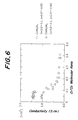
- Fig. 6 shows a relationship between a molecular ratio of O/Co and the electrical conductivity. Wen a molecular ratio of O/Co is smaller than 0.1, the electrical conductivity is abruptly increased. This is due to the fact that the doping efficiency is increased in accordance with an increase in the solid solubility of Sn or Ge into the host body of CoSb 3 , and that an amount of oxide of Sn or Ge is decreased, said oxide affecting the electrical conductivity.
- the sintering under the reducing atmosphere can easily reduce the molecular ratio O/Co not larger than 0.1 in regardless of an mount of oxygen contained in the raw material.
- thermoelectric converting substance by limiting an amount of oxygen with respect to Sb and Sn or Sb and Ge, the substance can reveal the p-conductivity type stably over a wide temperature range, and by limiting an amount of oxygen with respect to Co, the thermoelectric property, particularly the electric conductivity can be improved.
- thermoelectric converting substance which reveals the p-conductivity type over a side temperature range and has the superior thermoelectric converting property by means of the widely used sintering process. Therefore, the p-conductivity type thermoelectric converting substance having the higher performance can be manufactured efficiently at a lower cost. In this manner, the industrial benefit of the method according to the invention is very large.
- the basic structure of the substance according to the invention is of the cubic crystalline structure of CoSb 3 , and thus p-type substance and n-type substance have the same crystalline structure. Therefore, when the thermoelectric converting module is formed by such substances, p-n junction can be formed easily by molding powder materials, because these substances can be recognized as the same material in the thermal stability and thermal expansion. Further, these substances are chemically stable over a wide temperature range higher than 300°C, are scarcely degraded, and have good molding property and heat resistant property. Therefore, the thermoelectric converting module can be manufactured economically.
Landscapes
- Chemical & Material Sciences (AREA)
- Inorganic Chemistry (AREA)
- Powder Metallurgy (AREA)
Applications Claiming Priority (2)
| Application Number | Priority Date | Filing Date | Title |
|---|---|---|---|
| JP06529898A JP3562296B2 (ja) | 1998-03-16 | 1998-03-16 | P型熱電変換材料およびその製造方法 |
| JP6529898 | 1998-03-16 |
Publications (3)
| Publication Number | Publication Date |
|---|---|
| EP0948061A2 true EP0948061A2 (de) | 1999-10-06 |
| EP0948061A3 EP0948061A3 (de) | 1999-12-29 |
| EP0948061B1 EP0948061B1 (de) | 2003-12-03 |
Family
ID=13282885
Family Applications (1)
| Application Number | Title | Priority Date | Filing Date |
|---|---|---|---|
| EP99302011A Expired - Lifetime EP0948061B1 (de) | 1998-03-16 | 1999-03-16 | Thermoelektrische Umwandlungssubstanz vom p-Typ und Herstellungsverfahren dafür |
Country Status (4)
| Country | Link |
|---|---|
| US (1) | US6235981B1 (de) |
| EP (1) | EP0948061B1 (de) |
| JP (1) | JP3562296B2 (de) |
| DE (1) | DE69913230T2 (de) |
Cited By (2)
| Publication number | Priority date | Publication date | Assignee | Title |
|---|---|---|---|---|
| WO2005057673A1 (en) * | 2003-12-08 | 2005-06-23 | E.I. Dupont De Nemours And Company | A method of preparation for the high performance thermoelectric material inidum-cobalt-antimony |
| WO2005104255A3 (en) * | 2004-04-14 | 2005-12-01 | Du Pont | High performance thermoelectric materials and their method of preparation |
Families Citing this family (4)
| Publication number | Priority date | Publication date | Assignee | Title |
|---|---|---|---|---|
| US7371960B2 (en) | 2003-12-08 | 2008-05-13 | E.I. Du Pont De Nemours And Company | Figure of merit in Ytterbium-Aluminum-Manganese intermetallic thermoelectric and method of preparation |
| US7465871B2 (en) | 2004-10-29 | 2008-12-16 | Massachusetts Institute Of Technology | Nanocomposites with high thermoelectric figures of merit |
| US8865995B2 (en) * | 2004-10-29 | 2014-10-21 | Trustees Of Boston College | Methods for high figure-of-merit in nanostructured thermoelectric materials |
| JP5787605B2 (ja) * | 2011-04-28 | 2015-09-30 | 富士通コンポーネント株式会社 | 多層基板 |
Family Cites Families (6)
| Publication number | Priority date | Publication date | Assignee | Title |
|---|---|---|---|---|
| US5610366A (en) * | 1993-08-03 | 1997-03-11 | California Institute Of Technology | High performance thermoelectric materials and methods of preparation |
| JPH08186294A (ja) * | 1994-12-28 | 1996-07-16 | Kakuei Matsubara | 熱電材料 |
| JPH0964422A (ja) * | 1995-08-29 | 1997-03-07 | Matsushita Electric Ind Co Ltd | n型熱電材料およびこれを用いた熱電効果素子 |
| JP3541549B2 (ja) * | 1996-03-19 | 2004-07-14 | 日産自動車株式会社 | 高温用熱電材料およびその製造方法 |
| JPH09260729A (ja) | 1996-03-19 | 1997-10-03 | Nissan Motor Co Ltd | 熱電変換材料およびその製造方法 |
| JPH10102160A (ja) * | 1996-09-27 | 1998-04-21 | Chichibu Onoda Cement Corp | 三アンチモン化コバルト系複合材料の製造方法 |
-
1998
- 1998-03-16 JP JP06529898A patent/JP3562296B2/ja not_active Expired - Fee Related
-
1999
- 1999-03-16 EP EP99302011A patent/EP0948061B1/de not_active Expired - Lifetime
- 1999-03-16 US US09/270,102 patent/US6235981B1/en not_active Expired - Fee Related
- 1999-03-16 DE DE69913230T patent/DE69913230T2/de not_active Expired - Lifetime
Cited By (4)
| Publication number | Priority date | Publication date | Assignee | Title |
|---|---|---|---|---|
| WO2005057673A1 (en) * | 2003-12-08 | 2005-06-23 | E.I. Dupont De Nemours And Company | A method of preparation for the high performance thermoelectric material inidum-cobalt-antimony |
| US7462217B2 (en) | 2003-12-08 | 2008-12-09 | E.I. Du Pont De Nemours And Company | Method of preparation for the high performance thermoelectric material indium-cobalt-antimony |
| WO2005104255A3 (en) * | 2004-04-14 | 2005-12-01 | Du Pont | High performance thermoelectric materials and their method of preparation |
| US7723607B2 (en) | 2004-04-14 | 2010-05-25 | E.I. Du Pont De Nemours And Company | High performance thermoelectric materials and their method of preparation |
Also Published As
| Publication number | Publication date |
|---|---|
| EP0948061A3 (de) | 1999-12-29 |
| JP3562296B2 (ja) | 2004-09-08 |
| US6235981B1 (en) | 2001-05-22 |
| DE69913230T2 (de) | 2004-11-25 |
| DE69913230D1 (de) | 2004-01-15 |
| EP0948061B1 (de) | 2003-12-03 |
| JPH11261115A (ja) | 1999-09-24 |
Similar Documents
| Publication | Publication Date | Title |
|---|---|---|
| US5108515A (en) | Thermoelectric material and process for production thereof | |
| US7365265B2 (en) | Thermoelectric materials comprising nanoscale inclusions to enhance seebeck coefficient | |
| US5246504A (en) | Thermoelectric material | |
| WO2004090998A2 (en) | Pb-ge-te-compounds for thermoelectric generators or peltier arrangements | |
| Yamashita et al. | High performance n-type bismuth telluride with highly stable thermoelectric figure of merit | |
| JP4888685B2 (ja) | 熱電材料及びその製造方法 | |
| EP0948061B1 (de) | Thermoelektrische Umwandlungssubstanz vom p-Typ und Herstellungsverfahren dafür | |
| JP2000261047A (ja) | 熱電変換用半導体材料およびその製造方法 | |
| JP4504523B2 (ja) | 熱電材料およびその製造方法 | |
| JPH09260729A (ja) | 熱電変換材料およびその製造方法 | |
| JPH09321347A (ja) | 熱電変換材料、及び、その製造方法 | |
| JP3580778B2 (ja) | 熱電変換素子及びその製造方法 | |
| KR102339248B1 (ko) | 파마티나이트 열전재료 및 이의 제조 방법 | |
| JP2018059160A (ja) | Mg2 Si(1−x)Snx系多結晶体、その焼結体およびその製造方法 | |
| JP2000261048A (ja) | 熱電変換用半導体材料およびその製造方法 | |
| JPH0856020A (ja) | 熱電材料および熱電素子 | |
| JP2000261044A (ja) | 熱電変換材料とその製造方法 | |
| JP2009111357A (ja) | 熱電材料及びその製造方法 | |
| JP2879152B2 (ja) | 熱電材料の製造法 | |
| JP2000261043A (ja) | 熱電変換材料とその製造方法 | |
| JP3580783B2 (ja) | 熱電素子の製造方法及び熱電素子 | |
| JP4601206B2 (ja) | 熱電素子の製造方法 | |
| JP2750416B2 (ja) | 熱電材料の製造方法 | |
| JP2000261046A (ja) | 熱電変換材料とその製造方法 | |
| JP2007235083A (ja) | 熱電材料及びその製造方法 |
Legal Events
| Date | Code | Title | Description |
|---|---|---|---|
| PUAI | Public reference made under article 153(3) epc to a published international application that has entered the european phase |
Free format text: ORIGINAL CODE: 0009012 |
|
| AK | Designated contracting states |
Kind code of ref document: A2 Designated state(s): DE FR GB |
|
| AX | Request for extension of the european patent |
Free format text: AL;LT;LV;MK;RO;SI |
|
| PUAL | Search report despatched |
Free format text: ORIGINAL CODE: 0009013 |
|
| AK | Designated contracting states |
Kind code of ref document: A3 Designated state(s): AT BE CH CY DE DK ES FI FR GB GR IE IT LI LU MC NL PT SE |
|
| AX | Request for extension of the european patent |
Free format text: AL;LT;LV;MK;RO;SI |
|
| 17P | Request for examination filed |
Effective date: 20000414 |
|
| AKX | Designation fees paid |
Free format text: DE FR GB |
|
| 17Q | First examination report despatched |
Effective date: 20020607 |
|
| GRAH | Despatch of communication of intention to grant a patent |
Free format text: ORIGINAL CODE: EPIDOS IGRA |
|
| GRAS | Grant fee paid |
Free format text: ORIGINAL CODE: EPIDOSNIGR3 |
|
| RAP1 | Party data changed (applicant data changed or rights of an application transferred) |
Owner name: NISSAN MOTOR COMPANY LIMITED |
|
| GRAA | (expected) grant |
Free format text: ORIGINAL CODE: 0009210 |
|
| AK | Designated contracting states |
Kind code of ref document: B1 Designated state(s): DE FR GB |
|
| PG25 | Lapsed in a contracting state [announced via postgrant information from national office to epo] |
Ref country code: FR Free format text: LAPSE BECAUSE OF FAILURE TO SUBMIT A TRANSLATION OF THE DESCRIPTION OR TO PAY THE FEE WITHIN THE PRESCRIBED TIME-LIMIT Effective date: 20031203 |
|
| REG | Reference to a national code |
Ref country code: GB Ref legal event code: FG4D |
|
| REF | Corresponds to: |
Ref document number: 69913230 Country of ref document: DE Date of ref document: 20040115 Kind code of ref document: P |
|
| PG25 | Lapsed in a contracting state [announced via postgrant information from national office to epo] |
Ref country code: GB Free format text: LAPSE BECAUSE OF NON-PAYMENT OF DUE FEES Effective date: 20040316 |
|
| PLBE | No opposition filed within time limit |
Free format text: ORIGINAL CODE: 0009261 |
|
| STAA | Information on the status of an ep patent application or granted ep patent |
Free format text: STATUS: NO OPPOSITION FILED WITHIN TIME LIMIT |
|
| GBPC | Gb: european patent ceased through non-payment of renewal fee |
Effective date: 20040316 |
|
| 26N | No opposition filed |
Effective date: 20040906 |
|
| EN | Fr: translation not filed | ||
| PGFP | Annual fee paid to national office [announced via postgrant information from national office to epo] |
Ref country code: DE Payment date: 20110309 Year of fee payment: 13 |
|
| REG | Reference to a national code |
Ref country code: DE Ref legal event code: R119 Ref document number: 69913230 Country of ref document: DE Effective date: 20121002 |
|
| PG25 | Lapsed in a contracting state [announced via postgrant information from national office to epo] |
Ref country code: DE Free format text: LAPSE BECAUSE OF NON-PAYMENT OF DUE FEES Effective date: 20121002 |