EP0949363A2 - Verfahren zur Herstellung von Polytrimethylenterephthalatgarnen - Google Patents
Verfahren zur Herstellung von Polytrimethylenterephthalatgarnen Download PDFInfo
- Publication number
- EP0949363A2 EP0949363A2 EP98308694A EP98308694A EP0949363A2 EP 0949363 A2 EP0949363 A2 EP 0949363A2 EP 98308694 A EP98308694 A EP 98308694A EP 98308694 A EP98308694 A EP 98308694A EP 0949363 A2 EP0949363 A2 EP 0949363A2
- Authority
- EP
- European Patent Office
- Prior art keywords
- yarn
- filaments
- roll
- drawn
- heated
- Prior art date
- Legal status (The legal status is an assumption and is not a legal conclusion. Google has not performed a legal analysis and makes no representation as to the accuracy of the status listed.)
- Granted
Links
- 229920002215 polytrimethylene terephthalate Polymers 0.000 title claims abstract description 37
- -1 poly(trimethylene terephthalate) Polymers 0.000 title claims abstract description 10
- 238000000034 method Methods 0.000 title claims description 38
- 238000004804 winding Methods 0.000 claims abstract description 10
- 230000009477 glass transition Effects 0.000 claims abstract description 9
- 230000032683 aging Effects 0.000 claims abstract description 5
- 239000004744 fabric Substances 0.000 claims abstract description 5
- 238000004519 manufacturing process Methods 0.000 claims abstract description 5
- 238000002425 crystallisation Methods 0.000 claims abstract description 4
- 230000008025 crystallization Effects 0.000 claims abstract description 4
- 229920000642 polymer Polymers 0.000 claims description 20
- 238000001125 extrusion Methods 0.000 claims description 10
- 239000000155 melt Substances 0.000 claims description 7
- 238000001816 cooling Methods 0.000 claims description 4
- 239000011248 coating agent Substances 0.000 claims description 2
- 238000000576 coating method Methods 0.000 claims description 2
- 125000003258 trimethylene group Chemical group [H]C([H])([*:2])C([H])([H])C([H])([H])[*:1] 0.000 claims 1
- 230000001939 inductive effect Effects 0.000 abstract 1
- 238000002788 crimping Methods 0.000 description 18
- NLKNQRATVPKPDG-UHFFFAOYSA-M potassium iodide Chemical compound [K+].[I-] NLKNQRATVPKPDG-UHFFFAOYSA-M 0.000 description 12
- 239000011347 resin Substances 0.000 description 8
- 229920005989 resin Polymers 0.000 description 8
- 238000012360 testing method Methods 0.000 description 8
- 239000000049 pigment Substances 0.000 description 7
- 239000003039 volatile agent Substances 0.000 description 7
- 150000001875 compounds Chemical class 0.000 description 6
- 238000001914 filtration Methods 0.000 description 6
- 239000012141 concentrate Substances 0.000 description 5
- 238000009987 spinning Methods 0.000 description 5
- 239000000654 additive Substances 0.000 description 4
- GBRBMTNGQBKBQE-UHFFFAOYSA-L copper;diiodide Chemical compound I[Cu]I GBRBMTNGQBKBQE-UHFFFAOYSA-L 0.000 description 4
- 238000010438 heat treatment Methods 0.000 description 4
- 238000010791 quenching Methods 0.000 description 4
- 239000003381 stabilizer Substances 0.000 description 4
- 230000003750 conditioning effect Effects 0.000 description 3
- 239000006185 dispersion Substances 0.000 description 3
- 238000009472 formulation Methods 0.000 description 3
- 239000004816 latex Substances 0.000 description 3
- 229920000126 latex Polymers 0.000 description 3
- 239000000203 mixture Substances 0.000 description 3
- 238000010998 test method Methods 0.000 description 3
- 239000004594 Masterbatch (MB) Substances 0.000 description 2
- GWEVSGVZZGPLCZ-UHFFFAOYSA-N Titan oxide Chemical compound O=[Ti]=O GWEVSGVZZGPLCZ-UHFFFAOYSA-N 0.000 description 2
- 230000015556 catabolic process Effects 0.000 description 2
- 238000006731 degradation reaction Methods 0.000 description 2
- 230000000694 effects Effects 0.000 description 2
- 239000000463 material Substances 0.000 description 2
- 239000000047 product Substances 0.000 description 2
- XLYOFNOQVPJJNP-UHFFFAOYSA-N water Substances O XLYOFNOQVPJJNP-UHFFFAOYSA-N 0.000 description 2
- 239000012463 white pigment Substances 0.000 description 2
- 229910000906 Bronze Inorganic materials 0.000 description 1
- 239000002253 acid Substances 0.000 description 1
- 230000000845 anti-microbial effect Effects 0.000 description 1
- 239000010974 bronze Substances 0.000 description 1
- 229910052799 carbon Inorganic materials 0.000 description 1
- 239000006229 carbon black Substances 0.000 description 1
- 239000007795 chemical reaction product Substances 0.000 description 1
- 239000003086 colorant Substances 0.000 description 1
- 230000000052 comparative effect Effects 0.000 description 1
- 238000010276 construction Methods 0.000 description 1
- KUNSUQLRTQLHQQ-UHFFFAOYSA-N copper tin Chemical compound [Cu].[Sn] KUNSUQLRTQLHQQ-UHFFFAOYSA-N 0.000 description 1
- 230000001419 dependent effect Effects 0.000 description 1
- 230000006866 deterioration Effects 0.000 description 1
- 238000000113 differential scanning calorimetry Methods 0.000 description 1
- 238000001938 differential scanning calorimetry curve Methods 0.000 description 1
- 239000013538 functional additive Substances 0.000 description 1
- 239000011521 glass Substances 0.000 description 1
- 238000009940 knitting Methods 0.000 description 1
- 239000003550 marker Substances 0.000 description 1
- 238000002074 melt spinning Methods 0.000 description 1
- 238000002156 mixing Methods 0.000 description 1
- 239000008188 pellet Substances 0.000 description 1
- 230000006641 stabilisation Effects 0.000 description 1
- 238000011105 stabilization Methods 0.000 description 1
- 229920002994 synthetic fiber Polymers 0.000 description 1
- 239000012209 synthetic fiber Substances 0.000 description 1
- 239000004408 titanium dioxide Substances 0.000 description 1
- 238000009732 tufting Methods 0.000 description 1
- 238000009941 weaving Methods 0.000 description 1
Images
Classifications
-
- D—TEXTILES; PAPER
- D01—NATURAL OR MAN-MADE THREADS OR FIBRES; SPINNING
- D01D—MECHANICAL METHODS OR APPARATUS IN THE MANUFACTURE OF ARTIFICIAL FILAMENTS, THREADS, FIBRES, BRISTLES OR RIBBONS
- D01D5/00—Formation of filaments, threads, or the like
- D01D5/12—Stretch-spinning methods
- D01D5/16—Stretch-spinning methods using rollers, or like mechanical devices, e.g. snubbing pins
-
- D—TEXTILES; PAPER
- D01—NATURAL OR MAN-MADE THREADS OR FIBRES; SPINNING
- D01F—CHEMICAL FEATURES IN THE MANUFACTURE OF ARTIFICIAL FILAMENTS, THREADS, FIBRES, BRISTLES OR RIBBONS; APPARATUS SPECIALLY ADAPTED FOR THE MANUFACTURE OF CARBON FILAMENTS
- D01F6/00—Monocomponent artificial filaments or the like of synthetic polymers; Manufacture thereof
- D01F6/58—Monocomponent artificial filaments or the like of synthetic polymers; Manufacture thereof from homopolycondensation products
- D01F6/62—Monocomponent artificial filaments or the like of synthetic polymers; Manufacture thereof from homopolycondensation products from polyesters
-
- Y—GENERAL TAGGING OF NEW TECHNOLOGICAL DEVELOPMENTS; GENERAL TAGGING OF CROSS-SECTIONAL TECHNOLOGIES SPANNING OVER SEVERAL SECTIONS OF THE IPC; TECHNICAL SUBJECTS COVERED BY FORMER USPC CROSS-REFERENCE ART COLLECTIONS [XRACs] AND DIGESTS
- Y10—TECHNICAL SUBJECTS COVERED BY FORMER USPC
- Y10S—TECHNICAL SUBJECTS COVERED BY FORMER USPC CROSS-REFERENCE ART COLLECTIONS [XRACs] AND DIGESTS
- Y10S57/00—Textiles: spinning, twisting, and twining
- Y10S57/908—Jet interlaced or intermingled
Definitions
- the present invention relates to poly(trimethylene terephthalate) (PTT) yarn, and more particularly to a method of producing bulked continuous filament PTT yarn useful in the fabrication of carpets and pile fabrics.
- PTT poly(trimethylene terephthalate)
- the PTT filaments cannot be combined with other filaments, e.g., so as to provide a multicomponent finished product.
- EP 0 745 711 A1 discloses a process for forming bulked continuous filament PTT yarn wherein PTT polymer is melt spun through a spinneret into filaments, cooled with cold air, converged into a yarn, coated with a spin finish, drawn a first time between a feed roll and a first draw roll to achieve a draw ratio of 1.05 to 2, then drawn a second time between the first draw roll and a second draw roll to achieve a draw ratio of at least 2.2 times that of the first draw ratio, and then wound up.
- the drawn yarn can be textured before or after being wound up. Carpets fabricated in accordance with this invention have reasonably good stain resistance; however, their wear characteristics are only fair.
- the present invention is directed to a process for producing bulked continuous filament PTT yarns wherein the yarns can be combined with other types of yarns in a two stage process, and wherein carpets made from such yarns have unexpectedly improved wear resistance.
- filaments of melt-spun PTT polymer are cooled and coated with a spin finish and then drawn in a first step between an unheated feed roll and a tension roll rotated at a speed such that the PTT filaments are tensioned but not permanently stretched, and in a second step between the tension roll and a draw roller rotated at a speed such that the PTT filaments are drawn to a draw ratio of 1.25 to 4.0.
- the drawn filaments are then wound up on a winding device and thereafter textured using a mechanical crimp texturing unit where a single end of a drawn filament bundle can be textured or multiple ends of a drawn filament bundle can be cotextured.
- carpet produced from the yarn of the present invention has superior wear resistance as compared to PTT yarn produced by conventional two-step processes.
- inventive method includes the steps of:
- the denier of the individual drawn filament bundle is preferably between 150 and 800.
- the texturing of the drawn filaments via a separate process occurs in a mechanical crimp texturing unit wherein a single end of a drawn filament bundle can be textured, or multiple ends of a drawn filament bundle are co-textured.
- the denier of the textured yarn can be up to 7000.
- step (c) can be alternately or additionally applied prior to the texturing process, and the textured filaments can be entangled before being wound up. Such entanglement can be in single or multiple stages to create certain desired styling effects.
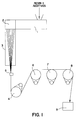
- PTT pellet resin As indicated in Fig. 1, according to the present invention PTT pellet resin, together with optional additives, is fed into the throat of an extrusion device 1 where the input material is heated and mixed, and pumped through a spinneret 2.
- the continuous PTT filaments emerging from the spinneret are pulled by an unheated feed roller 4 through a quench chamber 3 and a spin finish applicator 5. After passing around feed roller 4, the PTT filaments extend to a heated roller 6, a heated draw roller 7, a fourth roller 8 and a winding device 9.
- Mixing devices can be incorporated in the extrusion system to assist in the production of a homogenized melt.
- the temperatures of the heating devices of the extrusion system are adjusted to give a melt temperature of between 240°C and 270°C, with a preferable melt temperature of 245°-260°C.
- Filament cross-sections are preferably trilobal, although other types of cross-sections may be suitably used.
- a forced flow exhaust system is located close to the spinneret face to remove any volatiles generated from the working environment. This exhaust system may cause some cooling of the spun filaments. Further cooling of the spun filaments occurs in the quench chamber containing chilled air at a temperature of between 5° and 20°C, and preferably between 10° and 15°C.
- Spin finish is applied using a suitable device, such as a kiss roll or a metered finish applicator.
- the primary purpose of the spin finish is to promote bundle cohesion and reduce surface friction so as to assist in any further yarn processing steps such as texturing and yarn twisting.
- Functional additives may be incorporated into the spin finish, such as stain resistance additives and anti-soiling additives including fluorochemicals.
- the yarn denier is fed around a first unheated roll to control yarn denier.
- the yarn is then fed to a second roll which is heated to a temperature of between 45°C and 150°C.
- the actual roll temperature used is dependent on the yarn contact time on the roll.
- the contact time/roll temperature used should be adjusted so that crystallization of the PTT polymer is not significantly induced.
- the yarn is tensioned, but not so that the yarn is permanently stretched.
- the second roll can be rotated at a 2% greater speed than the first roll.
- the yarn is then fed to a third roll that is heated to give a yarn temperature above the glass transition temperature and preferably between 100°C and 200°C.
- the measured glass transition temperature of the yarn will depend on the method used to determine it.
- the method used to determine the glass transition temperature in this invention is by use of differential scanning calorimetry at a heating rate of 10°C/minute.
- the glass transition temperature is the midpoint of the inflexion relating to the glass transition of the differential scanning calorimetry curve.
- the actual roll temperature used shall again depend on the yarn contact time on the roll.
- the speed of the third roll will be set faster than that of the second roll to give a yarn draw ratio between the second and third rolls of at least 1.25, but lower than that required to break the yarn under the conditions used.
- the drawn yarn is wound up using a suitable winding device.
- the denier of the drawn yarn is preferably in the range of 150 to 800 with a tenacity of at least 2.5 g/denier and a % elongation of less than 60%.
- the drawn yarn denier is selected based on the number and size of the filament bundles needed to give the desired textured yarn denier and filament count.
- the drawn yarn produced is then textured using a mechanical crimp texturing unit to give a random 2-dimensional rectilinear crimp familiar to those ordinarily skilled in the art, without additional drawing of the yarn.
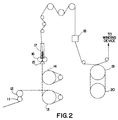
- An example of a suitable unit is illustrated in Fig. 2.
- the yarn is fed around a pair of pretension rolls 11,12 to a heated roll 13 prior to being fed to another heated roll 14 under sufficient tension to control the feed rate but not enough to draw the yarn.
- the heated yarn is fed through an infeed guide 15 and between a set of crimp rolls 16.
- the yarn is forced into the stuffing chamber and then pulled out of the stuffing chamber and passed around a set of stationary or rotating guides.
- the textured yarn is entangled through an entangler unit 18 and around a set of unheated rolls 19,20 before being wound up by a suitable winding device. Heating of the yarn is necessary immediately prior to crimping, for example by feeding the yarn over one or more heated rolls, in order to attain crimp memory once it is crimped.
- the yarn temperature prior to crimping should be greater than the glass transition temperature of the polymer but less than 220°C, but preferably between 100° and 200°C. The actual yarn temperature used will depend on the yarn contact time.
- a single drawn filament yarn may be textured or two or more drawn yarn bundles maybe cotextured.
- the textured yarn may be entangled together. If multiple drawn yarns are cotextured, then these yarns may be different colors or one or more of the components may be suitably functionalized to give the desired textured end product performance.
- a set of rolls can be used in place of a single roll at any stage in the present invention.
- the textured yarn is ideally used to produce a carpet using methods of manufacture known to those ordinarily skilled in the art, including tufting, weaving, bonding, needle-loom and knitting. Pages 134 to 140 of "Synthetic Fiber Materials," edited by H. Brody, published by Longman, 1994, gives detailed descriptions of these methods, the disclosure of which is incorporated by reference.
- a PTT resin with an intrinsic viscosity of 0.9 was dried to less than 50 ppm moisture content and was spun using a single screw extrusion system of design known to those of ordinary skill in the art.
- the molten polymer was pumped to a spin pack of setpoint temperature of 257°C containing melt filtration media and then to a 70 hole spinneret with trilobal shaped holes.
- An exhaust system was located in close proximity to the spinneret to remove any volatiles from the work environment.
- the 70 filaments were cooled by chilled air at 13°C and at a velocity of 0.6 m/sec before being separated into two filament bundles and spin finish was applied.
- the undrawn yarn was wound up on a Leesona 959 winder to produce a denier of 1850/30Y.
- the tenacity within 15 minutes of the yarn being produced was 0.6 g/denier and the % elongation was 450%. After 2 hours of conditioning at 70°F and 50% RH, the yarn tenacity had dropped to 0.4 g/denier and the % elongation was 4 %. 4 ends of the yarn were mechanically crimped using one stage drawing at a draw ratio of 3.2. The yarn was drawn between two heated rolls, the first one set at 66°C and the second roll at 150°C. The maximum take-up speed that could be achieved was 400 m/minute. During the crimping process frequent yarn breakage were experienced and an unacceptable level of filament breakages occurred. A yarn denier of 2710 was obtained.
- the tenacity of the textured yarn was 1.7 g/denier with a % elongation at break of 53%.
- the textured yarn was tufted into 1/10 inch gauge, 3/16 inch pile height level loop carpet having 20 oz. of yarn per sq. yd. of carpet.
- the tufted carpet was backed with a standard latex backing. The carpet was subjected to the wear test described above. The grade of the worn carpet was 2.5.
- a PTT resin with an intrinsic viscosity of 0.9 was dried to less than 50 ppm moisture content and was spun using a single screw extrusion system of design known to those of ordinary skill in the art.
- the molten polymer was pumped to a spin pack of a setpoint temperature of 243°C containing melt filtration media to a 34 hole spinneret with trilobal shaped holes.
- the melt temperature of the polymer prior to the spin pack was 250°C.
- An exhaust system was located in close proximity to the spinneret to remove any volatiles from the work environment.
- the molten filaments emerging from the die were cooled with air at 16°C of velocity of 0.6 m/sec.
- a spin finish was applied to the cooled filaments before being fed to unheated roll 1.
- the yarn was fed to roll 2 set at 54°C, run at a speed 1% greater than that of roll 1, before being drawn at a 3.33 draw ratio to roll 3 set at a temperature of 149°F.
- the yarn was then wound up using a tension-driven Leesona 959 winder.
- the drawn yarn had a denier of 714 with a tenacity of 2.7 g/denier and a % elongation at break of 49%. No degradation of properties occurred in the yarn after conditioning the yarn for 24 hours at 70°F and 50% RH.
- Yarn was spun per Example 2 except the denier was also adjusted to 590/34Y by changing the spin pump speed.
- the drawn yarn tenacity was 2.7 g/denier with a % elongation of 39%. No degradation of properties occurred in the yarn after conditioning the yarn for 24 ours at 70°F and 50% RH. 4 ends of this yarn were co-textured together via a mechanical crimping process without further drawing to produce a 2-dimensional rectilinear crimp with a denier of 2360. No yarn or filament breakages occurred during the yarn crimping process.
- the textured yarn tenacity was 1.5 g/denier and % elongation was 46%.
- a carbon black pigment dispersion and a titanium dioxide pigment dispersion were further dispersed together in a PTT resin with an intrinsic viscosity of 0.9 that had been dried to less than 50 ppm on a twin-screw extruder.
- the two pigment dispersions were produced by dispersing the pigments in a PTT resin also of an intrinsic viscosity of 0.9.
- the compound produced was dried to less than 50 ppm moisture content and spun using a single screw extrusion system of design known to those of ordinary skill in the art.
- the molten polymer was pumped to a spin pack of a setpoint temperature of 254°C containing melt filtration media to a 34 hole spinneret with trilobal shaped holes.
- the melt temperature of the polymer prior to the spin pack was 259°C.
- An exhaust system was located in close proximity to the spinneret to remove any volatiles from the work environment.
- the molten filaments emerging from the die were cooled with air at 16°C of velocity of 0.6 m/sec.
- a spin finish was applied to the cooled filaments before being fed to unheated roll 1.
- the yarn was fed to roll 2 set at 54°C and set at a speed 1 % greater than roll 1 before being drawn at a 3.2 draw ratio to roll 3 set at a temperature of 149°C.
- the drawn yarn had a denier of 340 and a tenacity of 2.9 g/denier with a % elongation of 44%.
- Example 4 8 drawn yarn ends produced per Example 4 were co-textured using a mechanical crimping process familiar to those ordinarily skilled in the art without further drawing.
- the yarn was tensioned around two heated rolls prior to crimping.
- the first roll was heated to 68°C and the second roll was heated to 107°C.
- the yarn was heated by feeding it around two heated rolls prior to crimping.
- the first roll was heated to 68°C and the second roll was heated to 107°C.
- the processing speed was 800 m/minute.
- the denier of the textured yarn was 3000.
- the yarn had a tenacity of 2.0 g/denier, a % elongation of 49 % and a % shrinkage of 5 %.
- Example 4 drawn yarn ends produced per Example 4 were co-textured using a mechanical crimping process similar to that used in Example 5 with the yarn heated to the same temperatures in the manner described in Example 5.
- the denier of the textured yarn was 785. No yarn or filament breakages occurred during the yarn crimping process.
- the textured yarn tenacity was 1.7 g/denier and the % elongation was 39%.
- a white pigment that had been dispersed in a PA6 carrier to form a masterbatch concentrate was further dispersed in a PTT resin with an intrinsic viscosity of 0.9 that had been dried to less than 50 ppm on a twin-screw extruder.
- the white pigment masterbatch concentrate contained a copper iodide/potassium iodide based stabilizer.
- the compound produced was dried to less than 50 ppm moisture content and spun using a single screw extrusion system of design known to those of ordinary skill in the art.
- the molten polymer was pumped to a spin pack of a setpoint temperature of 254°C containing 20 micron melt filtration media to a 30 hole spinneret with trilobal shaped holes.
- the melt temperature of the polymer prior to the spin pack was 258°C.
- An exhaust system was located in close proximity to the spinneret to remove any volatiles from the work environment.
- the molten filaments emerging from the die were cooled with air at 16°C of velocity of 0.6 m/sec.
- a spin finish was applied to the cooled filaments before being fed to unheated roll 1.
- the yarn was fed to roll 2 set at 66°C and set at a speed 1 % greater than roll 1 before being drawn at a 3.2 draw ratio to roll 3 set at a temperature of 121°C.
- the yarn was relaxed before winding the yarn up on a tube.
- the drawn yarn had a denier of 300 and a tenacity of 2.8 g/denier with a % elongation of 40%.
- the yarn was spun and drawn continuously for a period of at least 18 hours without filament breakage or process interruption.
- a bronze-colored solution-dyed yarn was produced in a similar manner to Example 7 of similar denier, filament and cross-section shape.
- the pigments in the formulated bronze color were predispersed in a PA6 carrier prior to producing the compound for spinning.
- the formulation did not contain a copper iodide/potassium iodide based stabilizer.
- the drawn yarn had a tenacity of 2.8 g/denier with a % elongation of 38%.
- a black solution-dyed yarn was produced in a similar manner to Example 7 of similar denier, filament and cross-section shape.
- the pigments in the formulated color were predispersed in a PA6 carrier prior to producing the compound for spinning.
- the formulation did not contain a copper iodide/potassium iodide based stabilizer.
- the drawn yarn had a tenacity of 2.8 g/denier with a % elongation of 43%.
- a blue solution-dyed yarn was produced in a similar manner to Example 7 of similar denier, filament and cross-section shape.
- the pigments in the formulated color were predispersed in a PTT carrier prior to producing the compound for spinning.
- the formulation did not contain a copper iodide/potassium iodide based stabilizer.
- the drawn yarn had a tenacity of 2.8 g/denier with a % elongation of 42%.
- Example 9 Two ends of the drawn yarn produced in Example 9 were cotextured together using a mechanical crimping unit without further drawing similar to that used in Example 5 with the yarn heated to the same temperatures in the manner described in Example 5. No yarn or filament breakages occurred during the yarn crimping process.
- the textured yarn produced had a denier of 716 with a tenacity of 1.4 g/denier and % elongation of 32%.
- Example 7 Eight ends of yarn produced in Example 7 were co-textured together using a mechanical crimping unit without further drawing similar to that used in Example 5 with the yarn heated to the same temperatures in the manner described in Example 5. No yarn or filament breakage occurred during the yarn crimping process.
- the textured yarn product had a denier of 2645 with a tenacity of 2.0 g/denier and a % elongation at break of 44%.
- Carpet was made from the yarn in a manner similar to Example 12. The carpet was subjected to the wear test described above. The grade of the worn carpet was 4.
- This example demonstrates the effect of two-stage drawing on yarn performance.
- An off-white formulated color concentrate with a PTT carrier was produced on a twin-screw extruder.
- the off-white color concentrate was letdown at the desired level in a PTT resin with an intrinsic viscosity of 0.9, also in a twin-screw extruder.
- Both the color concentrate and the PTT resin had been dried to a water content of less than 50 ppm.
- the compound produced was then further dried to less than 50 ppm water content and spun using a single screw extrusion system of a design known to those ordinarily skilled in the art.
- the molten polymer was pumped to a spin pack with a setpoint temperature of 254°C containing melt filtration media and a 30 hole spinneret with trilobal shaped holes.
- the melt temperature of the polymer prior to the spin pack was 251°C.
- An exhaust system was located in close proximity to the spinneret to remove any volatiles from the work environment.
- the molten filaments were cooled in a quench stack with air at 16°C of velocity of 0.6 m/sec.
- a spin finish was applied to the cooled filaments before being fed to an unheated roll 1.
- the yarn was fed to a second roll set at 65°C run at a speed 10 % greater than that of roll 1.
- the yarn was fed to a third roll set at 121°C at a speed 309 % faster than roll 2.
- the drawn yarn was wound up on a tube.
- the yarn had a denier of 560/30Y, with a tenacity of 3.0 g/denier and a % elongation at break of 39%.
- the yarn was tensioned and heated around two heated rolls prior to crimping.
- the first roll was set at a temperature of 66°C and the second roll was set at a temperature of 238°C, with a speed difference between roll 1 and roll 2 of 1%.
- the textured yarn ends were entangled together before being wound up.
- the denier of the textured yarn was 2560 with a tenacity of 2.1 g/denier and a % elongation at break of 45 %.
- the textured yarn was tufted into 1/10 inch gauge, 3/16 inch pile height level loop construction carpet having a face yarn weight of approximately 24 oz. per sq. yd. of carpet.
- the tufted carpet was backed with a standard latex backing.
- the carpet was subjected to the wear test described above.
- the grade of the worn carpet was 3.0. This was lower than expected, considering the high denier per filament of the yarn and heavy carpet weight.
Landscapes
- Engineering & Computer Science (AREA)
- Textile Engineering (AREA)
- Mechanical Engineering (AREA)
- Chemical & Material Sciences (AREA)
- Chemical Kinetics & Catalysis (AREA)
- General Chemical & Material Sciences (AREA)
- Yarns And Mechanical Finishing Of Yarns Or Ropes (AREA)
- Artificial Filaments (AREA)
- Polyesters Or Polycarbonates (AREA)
- Organic Low-Molecular-Weight Compounds And Preparation Thereof (AREA)
Applications Claiming Priority (4)
| Application Number | Priority Date | Filing Date | Title |
|---|---|---|---|
| US8119498P | 1998-04-09 | 1998-04-09 | |
| US81194P | 1998-04-09 | ||
| US09/111,593 US6109015A (en) | 1998-04-09 | 1998-07-07 | Process for making poly(trimethylene terephthalate) yarn |
| US111593 | 1998-07-07 |
Publications (3)
| Publication Number | Publication Date |
|---|---|
| EP0949363A2 true EP0949363A2 (de) | 1999-10-13 |
| EP0949363A3 EP0949363A3 (de) | 1999-12-29 |
| EP0949363B1 EP0949363B1 (de) | 2003-09-24 |
Family
ID=26765311
Family Applications (1)
| Application Number | Title | Priority Date | Filing Date |
|---|---|---|---|
| EP98308694A Expired - Lifetime EP0949363B1 (de) | 1998-04-09 | 1998-10-23 | Verfahren zur Herstellung von Polytrimethylenterephthalatgarnen |
Country Status (6)
| Country | Link |
|---|---|
| US (1) | US6109015A (de) |
| EP (1) | EP0949363B1 (de) |
| AT (1) | ATE250679T1 (de) |
| CA (1) | CA2252138C (de) |
| DE (1) | DE69818424T2 (de) |
| GB (1) | GB2336124B (de) |
Cited By (12)
| Publication number | Priority date | Publication date | Assignee | Title |
|---|---|---|---|---|
| US6284370B1 (en) | 1997-11-26 | 2001-09-04 | Asahi Kasei Kabushiki Kaisha | Polyester fiber with excellent processability and process for producing the same |
| WO2001068962A3 (en) * | 2000-03-15 | 2002-01-31 | Shell Oil Co | Poly(trimethylene) terephthalate textile staple production |
| WO2002031244A3 (en) * | 2000-10-11 | 2002-07-25 | Shell Int Research | A process for making high stretch and elastic knitted fabrics from polytrimethylene terephthalate |
| FR2835261A1 (fr) * | 2002-01-31 | 2003-08-01 | Rieter Icbt | Dispositif de cablage et de fixation en continu de fils suivi d'un traitement thermique complementaire |
| WO2003071013A1 (en) * | 2002-02-20 | 2003-08-28 | Shell Internationale Research Maatschappij B.V. | A process for making stable polytrimethylene terephthalate packages |
| KR100415731B1 (ko) * | 2001-12-27 | 2004-01-24 | 주식회사 효성 | 폴리트리메틸렌테레프탈레이트 벌키 연속 필라멘트 및카페트의 제조방법 |
| US6692671B2 (en) | 1997-11-26 | 2004-02-17 | Asahi Kasei Kabushiki Kaisha | Process for producing a polyester fiber |
| BE1014787A3 (fr) * | 2001-05-14 | 2004-04-06 | Hyosung Corp | Procede de preparation d'une moquette constituee de poly(terephtalate de trimethylene). |
| BE1014786A3 (fr) * | 2001-05-14 | 2004-04-06 | Hyosung Corp | Fil pour moquette bcf de poly(terephtalate de trimethylene) a coupe transversale non circulaire et procede de preparation de celui-ci. |
| US6740276B2 (en) | 2001-06-29 | 2004-05-25 | E. I. Du Pont De Nemours And Company | Process for preparing pigmented shaped articles comprising poly (trimethylene terephthalate) |
| EP1514959A1 (de) * | 2002-09-05 | 2005-03-16 | Nan Ya Plastics Corporation | Verfahren zur Herstellung von Polyestergarnen |
| EP1270483A4 (de) * | 2000-03-17 | 2006-03-29 | Asahi Chemical Ind | Strechgarnspule |
Families Citing this family (26)
| Publication number | Priority date | Publication date | Assignee | Title |
|---|---|---|---|---|
| EP1183409B1 (de) | 2000-03-03 | 2005-11-16 | E.I. Du Pont De Nemours And Company | Polytrimethylenterephthalatgarn |
| US6287688B1 (en) | 2000-03-03 | 2001-09-11 | E. I. Du Pont De Nemours And Company | Partially oriented poly(trimethylene terephthalate) yarn |
| WO2001088237A1 (en) * | 2000-05-18 | 2001-11-22 | Asahi Kasei Kabushiki Kaisha | Dyed yarn |
| US6885730B1 (en) * | 2000-07-19 | 2005-04-26 | Paradyne Corporation | System and method for subscriber loop testing |
| AU2001285303A1 (en) * | 2000-08-28 | 2002-03-13 | Prisma Fibers, Inc. | Process for making poly (trimethylene terephthalate) yarn |
| US20030175522A1 (en) * | 2002-03-13 | 2003-09-18 | Kurian Joseph Varapadavil | Poly(trimethylene terephthalate) carpets |
| US20030197303A1 (en) * | 2002-04-18 | 2003-10-23 | Hoe Hin Chuah | Process for preparing poly(trimethylene terephthalate) staple fibers for conversion into carpets |
| US20030111171A1 (en) * | 2002-09-09 | 2003-06-19 | Casey Paul Karol | Poly(trimethylene) terephthalate texile staple production |
| US7578957B2 (en) * | 2002-12-30 | 2009-08-25 | E. I. Du Pont De Nemours And Company | Process of making staple fibers |
| US20060197253A1 (en) * | 2003-03-27 | 2006-09-07 | Hoe Hin Chuah | Process for preparing poly(trimethylene terephthalate) staple fibers for conversion into carpets |
| CN1333118C (zh) * | 2003-09-03 | 2007-08-22 | 南亚塑胶工业股份有限公司 | 聚酯纤维及其制法 |
| US20050147784A1 (en) * | 2004-01-06 | 2005-07-07 | Chang Jing C. | Process for preparing poly(trimethylene terephthalate) fiber |
| DE602006013862D1 (de) * | 2005-09-28 | 2010-06-02 | Toray Industries | Polyesterfaser und sie enthaltendes textilerzeugnis |
| US20070128459A1 (en) * | 2005-12-07 | 2007-06-07 | Kurian Joseph V | Poly(trimethylene terephthalate)/poly(alpha-hydroxy acid) films |
| US7666501B2 (en) * | 2005-12-07 | 2010-02-23 | E. I. Du Pont De Nemours And Company | Poly(trimethylene terephthalate)/poly(alpha-hydroxy acid) bi-constituent filaments |
| US20070129503A1 (en) * | 2005-12-07 | 2007-06-07 | Kurian Joseph V | Poly(trimethylene terephthalate)/poly(alpha-hydroxy acid) molded, shaped articles |
| US20120292367A1 (en) | 2006-01-31 | 2012-11-22 | Ethicon Endo-Surgery, Inc. | Robotically-controlled end effector |
| US20080135662A1 (en) * | 2006-12-06 | 2008-06-12 | Chang Jing C | Melt-spun elastoester multifilament yarns |
| US9809907B2 (en) * | 2007-01-02 | 2017-11-07 | Mohawk Carpet, Llc | Carpet fiber polymeric blend |
| CN104583472B (zh) | 2012-08-23 | 2017-04-19 | 欧瑞康纺织有限及两合公司 | 用于制造卷曲长丝的熔融纺丝方法和熔融纺丝设备 |
| LU92889B1 (fr) * | 2014-04-01 | 2016-03-30 | Kordsa Global Endustriyel Iplik Ve Kord Bezi Sanay | Système pour une production industrielle de fil à partir d'un matériau composite de poly(naphtalate d'éthylène) |
| US10767281B2 (en) | 2016-03-25 | 2020-09-08 | Aladdin Manufacturing Corporation | Polyester fiber blends and methods of manufacturing same |
| WO2021118985A1 (en) | 2019-12-10 | 2021-06-17 | Dupont Industrial Biosciences Usa, Llc | Carpet made from self-bulking ptt-containing bicomponent fibers |
| MX2022013968A (es) | 2020-07-02 | 2022-11-30 | Dupont Ind Biosciences Usa Llc | Metodo para producir fibras bicomponentes y articulos que las comprenden. |
| JP2021050462A (ja) * | 2020-12-23 | 2021-04-01 | 伊澤タオル株式会社 | タオル地 |
| JP7277680B1 (ja) * | 2021-10-19 | 2023-05-19 | 帝人フロンティア株式会社 | ポリトリメチレンテレフタレート繊維およびその製造方法 |
Family Cites Families (6)
| Publication number | Priority date | Publication date | Assignee | Title |
|---|---|---|---|---|
| GB1254826A (en) * | 1969-03-12 | 1971-11-24 | Fiber Industries Inc | Improvements in polyalkylene filaments, staple fibre and yarns |
| US3681188A (en) * | 1971-02-19 | 1972-08-01 | Du Pont | Helically crimped fibers of poly(trimethylene terephthalate) having asymmetric birefringence |
| DE3823538A1 (de) * | 1988-07-12 | 1990-02-01 | Davy Mckee Ag | Verfahren zur herstellung von pbt-teppichgarn |
| TW288052B (de) * | 1994-06-30 | 1996-10-11 | Du Pont | |
| US5939166A (en) * | 1994-08-31 | 1999-08-17 | E. I. Du Pont De Nemours And Company | Moisture stable tuftstring carpet |
| BR9602162A (pt) * | 1995-05-08 | 1997-12-30 | Shell Int Research | Processo para a preparação de fio de fibra de poli(teraftalato de trimetileno) e tapete |
-
1998
- 1998-07-07 US US09/111,593 patent/US6109015A/en not_active Expired - Fee Related
- 1998-10-23 EP EP98308694A patent/EP0949363B1/de not_active Expired - Lifetime
- 1998-10-23 DE DE69818424T patent/DE69818424T2/de not_active Expired - Fee Related
- 1998-10-23 GB GB9823318A patent/GB2336124B/en not_active Expired - Fee Related
- 1998-10-23 AT AT98308694T patent/ATE250679T1/de not_active IP Right Cessation
- 1998-10-26 CA CA002252138A patent/CA2252138C/en not_active Expired - Fee Related
Cited By (17)
| Publication number | Priority date | Publication date | Assignee | Title |
|---|---|---|---|---|
| US6284370B1 (en) | 1997-11-26 | 2001-09-04 | Asahi Kasei Kabushiki Kaisha | Polyester fiber with excellent processability and process for producing the same |
| US6692671B2 (en) | 1997-11-26 | 2004-02-17 | Asahi Kasei Kabushiki Kaisha | Process for producing a polyester fiber |
| WO2001068962A3 (en) * | 2000-03-15 | 2002-01-31 | Shell Oil Co | Poly(trimethylene) terephthalate textile staple production |
| JP2003527497A (ja) * | 2000-03-15 | 2003-09-16 | シエル・インターナシヨナル・リサーチ・マートスハツペイ・ベー・ヴエー | ポリ(トリメチレン)テレフタレート織物ステープル製造 |
| EP1270483A4 (de) * | 2000-03-17 | 2006-03-29 | Asahi Chemical Ind | Strechgarnspule |
| WO2002031244A3 (en) * | 2000-10-11 | 2002-07-25 | Shell Int Research | A process for making high stretch and elastic knitted fabrics from polytrimethylene terephthalate |
| US6702864B2 (en) | 2000-10-11 | 2004-03-09 | Shell Oil Company | Process for making high stretch and elastic knitted fabrics from polytrimethylene terephthalate |
| BE1014787A3 (fr) * | 2001-05-14 | 2004-04-06 | Hyosung Corp | Procede de preparation d'une moquette constituee de poly(terephtalate de trimethylene). |
| BE1014786A3 (fr) * | 2001-05-14 | 2004-04-06 | Hyosung Corp | Fil pour moquette bcf de poly(terephtalate de trimethylene) a coupe transversale non circulaire et procede de preparation de celui-ci. |
| US6740276B2 (en) | 2001-06-29 | 2004-05-25 | E. I. Du Pont De Nemours And Company | Process for preparing pigmented shaped articles comprising poly (trimethylene terephthalate) |
| KR100415731B1 (ko) * | 2001-12-27 | 2004-01-24 | 주식회사 효성 | 폴리트리메틸렌테레프탈레이트 벌키 연속 필라멘트 및카페트의 제조방법 |
| WO2003064741A3 (fr) * | 2002-01-31 | 2004-04-15 | Rieter Icbt | Dispositif de cablage et de fixation en continu de fils suivi d'un traitement thermique complementaire |
| US6986242B2 (en) | 2002-01-31 | 2006-01-17 | Rieter Textile Machinery France | Device for the continuous cabling and setting of yarns followed by additional heat treatment |
| FR2835261A1 (fr) * | 2002-01-31 | 2003-08-01 | Rieter Icbt | Dispositif de cablage et de fixation en continu de fils suivi d'un traitement thermique complementaire |
| WO2003071013A1 (en) * | 2002-02-20 | 2003-08-28 | Shell Internationale Research Maatschappij B.V. | A process for making stable polytrimethylene terephthalate packages |
| US7022273B2 (en) | 2002-02-20 | 2006-04-04 | Shell Oil Company | Process for making stable polytrimethylene terephthalate packages |
| EP1514959A1 (de) * | 2002-09-05 | 2005-03-16 | Nan Ya Plastics Corporation | Verfahren zur Herstellung von Polyestergarnen |
Also Published As
| Publication number | Publication date |
|---|---|
| GB2336124B (en) | 2002-11-13 |
| CA2252138A1 (en) | 1999-10-09 |
| DE69818424D1 (de) | 2003-10-30 |
| EP0949363B1 (de) | 2003-09-24 |
| GB9823318D0 (en) | 1998-12-23 |
| DE69818424T2 (de) | 2004-07-01 |
| US6109015A (en) | 2000-08-29 |
| GB2336124A (en) | 1999-10-13 |
| ATE250679T1 (de) | 2003-10-15 |
| CA2252138C (en) | 2002-08-20 |
| EP0949363A3 (de) | 1999-12-29 |
Similar Documents
| Publication | Publication Date | Title |
|---|---|---|
| EP0949363B1 (de) | Verfahren zur Herstellung von Polytrimethylenterephthalatgarnen | |
| EP0745711B1 (de) | Verfahren zur Herstellung von Polypropylenterephthalatgarnen | |
| JP3769013B2 (ja) | 中空ナイロンフィラメント、中空ナイロン糸、およびその製造法 | |
| US6113825A (en) | Process for preparing poly(trimethylene terephthalate) carpet yarn | |
| US8153253B2 (en) | Conjugate fiber-containing yarn | |
| MXPA97007067A (en) | Two-component polyamide / polyolefine fibers, novedosas and methods for elaborating | |
| EP1781850A2 (de) | Selbstcrimpende, vollständig gezogene garne mit hohem volumen und herstellungsverfahren dafür | |
| US6315934B1 (en) | Process for preparing poly(thimethylene therephthalate) carpet yarn | |
| EP0028844B1 (de) | Polypropylen-Filamentgarn und Verfahren zu dessen Herstellung | |
| US7029611B2 (en) | Process of making poly(trimethylene terephthalate) bulked continuous filament carpet yarn | |
| TW202129105A (zh) | 由自膨化性含ptt之雙組分纖維製成的地毯 | |
| JPS59130309A (ja) | 異収縮混繊糸の製造方法 | |
| WO2002018684A1 (en) | Process for making poly (trimethylene terephthalate) yarn | |
| US6503622B1 (en) | Texturized, combined polyester multifilament yarn and process for producing same | |
| US20030197303A1 (en) | Process for preparing poly(trimethylene terephthalate) staple fibers for conversion into carpets | |
| JP5964437B2 (ja) | ポリ(トリメチレンアリーレート)繊維、その作製方法、およびそれから作製された布地 | |
| JPH0959838A (ja) | 紡績糸 | |
| US20240426030A1 (en) | Polyester elastic conjugated yarn, preparation method thereof, and yarn comprising the same | |
| US20060197253A1 (en) | Process for preparing poly(trimethylene terephthalate) staple fibers for conversion into carpets | |
| JP4571095B2 (ja) | 原着ポリ乳酸仮撚糸及びその製造方法並びにカーペット | |
| JP3395246B2 (ja) | 人工芝用原糸 | |
| JP2014526621A (ja) | ポリ(トリメチレンアリーレート)繊維、その作製方法、およびそれから作製された布地 | |
| JP2003239146A (ja) | カットパイル織編物用ポリエステル複合仮撚加工糸およびその製造方法 | |
| JP3164411B2 (ja) | ポリアミド捲縮加工糸およびその製造方法 | |
| US3677880A (en) | Synthetic conjugate filament fibers and a process for the manufacture of the same |
Legal Events
| Date | Code | Title | Description |
|---|---|---|---|
| PUAI | Public reference made under article 153(3) epc to a published international application that has entered the european phase |
Free format text: ORIGINAL CODE: 0009012 |
|
| AK | Designated contracting states |
Kind code of ref document: A2 Designated state(s): AT BE CH DE DK ES FI FR GR IE IT LI LU NL PT SE |
|
| AX | Request for extension of the european patent |
Free format text: AL;LT;LV;MK;RO;SI |
|
| PUAL | Search report despatched |
Free format text: ORIGINAL CODE: 0009013 |
|
| AK | Designated contracting states |
Kind code of ref document: A3 Designated state(s): AT BE CH CY DE DK ES FI FR GB GR IE IT LI LU MC NL PT SE |
|
| AX | Request for extension of the european patent |
Free format text: AL;LT;LV;MK;RO;SI |
|
| 17P | Request for examination filed |
Effective date: 20000228 |
|
| AKX | Designation fees paid |
Free format text: AT BE CH DE DK ES FI FR GR IE IT LI LU NL PT SE |
|
| 17Q | First examination report despatched |
Effective date: 20020801 |
|
| GRAH | Despatch of communication of intention to grant a patent |
Free format text: ORIGINAL CODE: EPIDOS IGRA |
|
| GRAS | Grant fee paid |
Free format text: ORIGINAL CODE: EPIDOSNIGR3 |
|
| GRAA | (expected) grant |
Free format text: ORIGINAL CODE: 0009210 |
|
| RAP1 | Party data changed (applicant data changed or rights of an application transferred) |
Owner name: PRISMA FIBERS, INC |
|
| AK | Designated contracting states |
Kind code of ref document: B1 Designated state(s): AT BE CH DE DK ES FI FR GR IE IT LI LU NL PT SE |
|
| PG25 | Lapsed in a contracting state [announced via postgrant information from national office to epo] |
Ref country code: LI Free format text: LAPSE BECAUSE OF FAILURE TO SUBMIT A TRANSLATION OF THE DESCRIPTION OR TO PAY THE FEE WITHIN THE PRESCRIBED TIME-LIMIT Effective date: 20030924 Ref country code: FI Free format text: LAPSE BECAUSE OF FAILURE TO SUBMIT A TRANSLATION OF THE DESCRIPTION OR TO PAY THE FEE WITHIN THE PRESCRIBED TIME-LIMIT Effective date: 20030924 Ref country code: CH Free format text: LAPSE BECAUSE OF FAILURE TO SUBMIT A TRANSLATION OF THE DESCRIPTION OR TO PAY THE FEE WITHIN THE PRESCRIBED TIME-LIMIT Effective date: 20030924 Ref country code: AT Free format text: LAPSE BECAUSE OF FAILURE TO SUBMIT A TRANSLATION OF THE DESCRIPTION OR TO PAY THE FEE WITHIN THE PRESCRIBED TIME-LIMIT Effective date: 20030924 |
|
| RIN1 | Information on inventor provided before grant (corrected) |
Inventor name: STUDHOLME, MATTHEW B. Inventor name: ROARK, MILTON K. |
|
| REG | Reference to a national code |
Ref country code: CH Ref legal event code: EP |
|
| PGFP | Annual fee paid to national office [announced via postgrant information from national office to epo] |
Ref country code: NL Payment date: 20031027 Year of fee payment: 6 Ref country code: FR Payment date: 20031027 Year of fee payment: 6 |
|
| PGFP | Annual fee paid to national office [announced via postgrant information from national office to epo] |
Ref country code: SE Payment date: 20031028 Year of fee payment: 6 |
|
| PGFP | Annual fee paid to national office [announced via postgrant information from national office to epo] |
Ref country code: DK Payment date: 20031029 Year of fee payment: 6 Ref country code: GR Payment date: 20031029 Year of fee payment: 6 |
|
| REG | Reference to a national code |
Ref country code: IE Ref legal event code: FG4D |
|
| PGFP | Annual fee paid to national office [announced via postgrant information from national office to epo] |
Ref country code: DE Payment date: 20031030 Year of fee payment: 6 Ref country code: CH Payment date: 20031030 Year of fee payment: 6 Ref country code: IE Payment date: 20031030 Year of fee payment: 6 |
|
| REF | Corresponds to: |
Ref document number: 69818424 Country of ref document: DE Date of ref document: 20031030 Kind code of ref document: P |
|
| PGFP | Annual fee paid to national office [announced via postgrant information from national office to epo] |
Ref country code: LU Payment date: 20031112 Year of fee payment: 6 |
|
| PGFP | Annual fee paid to national office [announced via postgrant information from national office to epo] |
Ref country code: ES Payment date: 20031128 Year of fee payment: 6 |
|
| PGFP | Annual fee paid to national office [announced via postgrant information from national office to epo] |
Ref country code: BE Payment date: 20031211 Year of fee payment: 6 |
|
| PG25 | Lapsed in a contracting state [announced via postgrant information from national office to epo] |
Ref country code: SE Free format text: LAPSE BECAUSE OF FAILURE TO SUBMIT A TRANSLATION OF THE DESCRIPTION OR TO PAY THE FEE WITHIN THE PRESCRIBED TIME-LIMIT Effective date: 20031224 Ref country code: GR Free format text: LAPSE BECAUSE OF FAILURE TO SUBMIT A TRANSLATION OF THE DESCRIPTION OR TO PAY THE FEE WITHIN THE PRESCRIBED TIME-LIMIT Effective date: 20031224 Ref country code: DK Free format text: LAPSE BECAUSE OF FAILURE TO SUBMIT A TRANSLATION OF THE DESCRIPTION OR TO PAY THE FEE WITHIN THE PRESCRIBED TIME-LIMIT Effective date: 20031224 |
|
| PG25 | Lapsed in a contracting state [announced via postgrant information from national office to epo] |
Ref country code: ES Free format text: LAPSE BECAUSE OF FAILURE TO SUBMIT A TRANSLATION OF THE DESCRIPTION OR TO PAY THE FEE WITHIN THE PRESCRIBED TIME-LIMIT Effective date: 20040104 |
|
| REG | Reference to a national code |
Ref country code: CH Ref legal event code: PL |
|
| ET | Fr: translation filed | ||
| PLBE | No opposition filed within time limit |
Free format text: ORIGINAL CODE: 0009261 |
|
| STAA | Information on the status of an ep patent application or granted ep patent |
Free format text: STATUS: NO OPPOSITION FILED WITHIN TIME LIMIT |
|
| 26N | No opposition filed |
Effective date: 20040625 |
|
| PG25 | Lapsed in a contracting state [announced via postgrant information from national office to epo] |
Ref country code: LU Free format text: LAPSE BECAUSE OF NON-PAYMENT OF DUE FEES Effective date: 20041023 |
|
| PG25 | Lapsed in a contracting state [announced via postgrant information from national office to epo] |
Ref country code: IE Free format text: LAPSE BECAUSE OF NON-PAYMENT OF DUE FEES Effective date: 20041025 |
|
| PG25 | Lapsed in a contracting state [announced via postgrant information from national office to epo] |
Ref country code: BE Free format text: LAPSE BECAUSE OF NON-PAYMENT OF DUE FEES Effective date: 20041031 |
|
| BERE | Be: lapsed |
Owner name: *PRISMA FIBERS INC. Effective date: 20041031 |
|
| PG25 | Lapsed in a contracting state [announced via postgrant information from national office to epo] |
Ref country code: NL Free format text: LAPSE BECAUSE OF NON-PAYMENT OF DUE FEES Effective date: 20050501 |
|
| PG25 | Lapsed in a contracting state [announced via postgrant information from national office to epo] |
Ref country code: DE Free format text: LAPSE BECAUSE OF NON-PAYMENT OF DUE FEES Effective date: 20050503 |
|
| PG25 | Lapsed in a contracting state [announced via postgrant information from national office to epo] |
Ref country code: FR Free format text: LAPSE BECAUSE OF NON-PAYMENT OF DUE FEES Effective date: 20050630 |
|
| NLV4 | Nl: lapsed or anulled due to non-payment of the annual fee |
Effective date: 20050501 |
|
| REG | Reference to a national code |
Ref country code: IE Ref legal event code: MM4A |
|
| REG | Reference to a national code |
Ref country code: FR Ref legal event code: ST |
|
| PG25 | Lapsed in a contracting state [announced via postgrant information from national office to epo] |
Ref country code: IT Free format text: LAPSE BECAUSE OF NON-PAYMENT OF DUE FEES Effective date: 20051023 |
|
| BERE | Be: lapsed |
Owner name: *PRISMA FIBERS INC. Effective date: 20041031 |
|
| PG25 | Lapsed in a contracting state [announced via postgrant information from national office to epo] |
Ref country code: PT Free format text: LAPSE BECAUSE OF NON-PAYMENT OF DUE FEES Effective date: 20040224 |