EP0953009B1 - Procede de preparation de microgels polymeres - Google Patents
Procede de preparation de microgels polymeres Download PDFInfo
- Publication number
- EP0953009B1 EP0953009B1 EP98900250A EP98900250A EP0953009B1 EP 0953009 B1 EP0953009 B1 EP 0953009B1 EP 98900250 A EP98900250 A EP 98900250A EP 98900250 A EP98900250 A EP 98900250A EP 0953009 B1 EP0953009 B1 EP 0953009B1
- Authority
- EP
- European Patent Office
- Prior art keywords
- process according
- monomer
- monomers
- cross
- group
- Prior art date
- Legal status (The legal status is an assumption and is not a legal conclusion. Google has not performed a legal analysis and makes no representation as to the accuracy of the status listed.)
- Expired - Lifetime
Links
- 238000004519 manufacturing process Methods 0.000 title 1
- 239000000178 monomer Substances 0.000 claims abstract description 88
- 238000000034 method Methods 0.000 claims abstract description 54
- 230000008569 process Effects 0.000 claims abstract description 37
- 239000003431 cross linking reagent Substances 0.000 claims abstract description 35
- 125000005262 alkoxyamine group Chemical group 0.000 claims abstract description 34
- 239000000203 mixture Substances 0.000 claims abstract description 25
- 238000002360 preparation method Methods 0.000 claims abstract description 16
- 150000001993 dienes Chemical class 0.000 claims abstract description 8
- -1 hydroxy, amino, substituted amino Chemical group 0.000 claims description 39
- 125000000524 functional group Chemical group 0.000 claims description 19
- MYRTYDVEIRVNKP-UHFFFAOYSA-N 1,2-Divinylbenzene Chemical compound C=CC1=CC=CC=C1C=C MYRTYDVEIRVNKP-UHFFFAOYSA-N 0.000 claims description 18
- PPBRXRYQALVLMV-UHFFFAOYSA-N Styrene Chemical compound C=CC1=CC=CC=C1 PPBRXRYQALVLMV-UHFFFAOYSA-N 0.000 claims description 12
- 150000001875 compounds Chemical class 0.000 claims description 10
- 238000004132 cross linking Methods 0.000 claims description 9
- 239000003999 initiator Substances 0.000 claims description 9
- 239000004593 Epoxy Substances 0.000 claims description 8
- 125000000217 alkyl group Chemical group 0.000 claims description 8
- 125000001424 substituent group Chemical group 0.000 claims description 8
- NIXOWILDQLNWCW-UHFFFAOYSA-M Acrylate Chemical compound [O-]C(=O)C=C NIXOWILDQLNWCW-UHFFFAOYSA-M 0.000 claims description 7
- CERQOIWHTDAKMF-UHFFFAOYSA-M Methacrylate Chemical compound CC(=C)C([O-])=O CERQOIWHTDAKMF-UHFFFAOYSA-M 0.000 claims description 7
- 229920001577 copolymer Polymers 0.000 claims description 6
- 125000004122 cyclic group Chemical group 0.000 claims description 5
- 229910052739 hydrogen Inorganic materials 0.000 claims description 5
- 239000001257 hydrogen Substances 0.000 claims description 5
- 125000005647 linker group Chemical group 0.000 claims description 5
- 150000001336 alkenes Chemical class 0.000 claims description 4
- 125000001475 halogen functional group Chemical group 0.000 claims description 4
- NLHHRLWOUZZQLW-UHFFFAOYSA-N Acrylonitrile Chemical compound C=CC#N NLHHRLWOUZZQLW-UHFFFAOYSA-N 0.000 claims description 3
- BLRPTPMANUNPDV-UHFFFAOYSA-N Silane Chemical compound [SiH4] BLRPTPMANUNPDV-UHFFFAOYSA-N 0.000 claims description 3
- 239000012634 fragment Substances 0.000 claims description 3
- 125000004051 hexyl group Chemical group [H]C([H])([H])C([H])([H])C([H])([H])C([H])([H])C([H])([H])C([H])([H])* 0.000 claims description 3
- FQPSGWSUVKBHSU-UHFFFAOYSA-N methacrylamide Chemical compound CC(=C)C(N)=O FQPSGWSUVKBHSU-UHFFFAOYSA-N 0.000 claims description 3
- 229920006395 saturated elastomer Polymers 0.000 claims description 3
- 229910000077 silane Inorganic materials 0.000 claims description 3
- 125000000547 substituted alkyl group Chemical group 0.000 claims description 3
- 230000003313 weakening effect Effects 0.000 claims description 3
- UFHFLCQGNIYNRP-UHFFFAOYSA-N Hydrogen Chemical compound [H][H] UFHFLCQGNIYNRP-UHFFFAOYSA-N 0.000 claims description 2
- 125000002768 hydroxyalkyl group Chemical group 0.000 claims description 2
- HRPVXLWXLXDGHG-UHFFFAOYSA-N Acrylamide Chemical compound NC(=O)C=C HRPVXLWXLXDGHG-UHFFFAOYSA-N 0.000 claims 1
- 150000001252 acrylic acid derivatives Chemical class 0.000 claims 1
- 150000002431 hydrogen Chemical class 0.000 claims 1
- 150000002734 metacrylic acid derivatives Chemical class 0.000 claims 1
- FZHAPNGMFPVSLP-UHFFFAOYSA-N silanamine Chemical compound [SiH3]N FZHAPNGMFPVSLP-UHFFFAOYSA-N 0.000 claims 1
- PXQLVRUNWNTZOS-UHFFFAOYSA-N sulfanyl Chemical class [SH] PXQLVRUNWNTZOS-UHFFFAOYSA-N 0.000 claims 1
- DXIJHCSGLOHNES-UHFFFAOYSA-N 3,3-dimethylbut-1-enylbenzene Chemical compound CC(C)(C)C=CC1=CC=CC=C1 DXIJHCSGLOHNES-UHFFFAOYSA-N 0.000 description 21
- UHOVQNZJYSORNB-UHFFFAOYSA-N Benzene Chemical compound C1=CC=CC=C1 UHOVQNZJYSORNB-UHFFFAOYSA-N 0.000 description 15
- 229920000642 polymer Polymers 0.000 description 15
- 150000003254 radicals Chemical class 0.000 description 15
- OKKJLVBELUTLKV-UHFFFAOYSA-N Methanol Chemical compound OC OKKJLVBELUTLKV-UHFFFAOYSA-N 0.000 description 12
- KAKZBPTYRLMSJV-UHFFFAOYSA-N Butadiene Chemical compound C=CC=C KAKZBPTYRLMSJV-UHFFFAOYSA-N 0.000 description 10
- 238000000569 multi-angle light scattering Methods 0.000 description 9
- 230000009257 reactivity Effects 0.000 description 9
- LYCAIKOWRPUZTN-UHFFFAOYSA-N ethylene glycol Natural products OCCO LYCAIKOWRPUZTN-UHFFFAOYSA-N 0.000 description 8
- 239000002904 solvent Substances 0.000 description 8
- 238000006243 chemical reaction Methods 0.000 description 7
- 125000002496 methyl group Chemical group [H]C([H])([H])* 0.000 description 7
- AVXURJPOCDRRFD-UHFFFAOYSA-N Hydroxylamine Chemical compound ON AVXURJPOCDRRFD-UHFFFAOYSA-N 0.000 description 6
- 239000004793 Polystyrene Substances 0.000 description 6
- 229920001400 block copolymer Polymers 0.000 description 6
- WGCNASOHLSPBMP-UHFFFAOYSA-N hydroxyacetaldehyde Natural products OCC=O WGCNASOHLSPBMP-UHFFFAOYSA-N 0.000 description 6
- 229920002223 polystyrene Polymers 0.000 description 6
- 230000035484 reaction time Effects 0.000 description 6
- 238000001542 size-exclusion chromatography Methods 0.000 description 6
- 239000007787 solid Substances 0.000 description 6
- WJGXRWDDBFOGEK-UHFFFAOYSA-N 1-methoxy-2,2,6,6-tetramethylpiperidine Chemical compound CON1C(C)(C)CCCC1(C)C WJGXRWDDBFOGEK-UHFFFAOYSA-N 0.000 description 5
- OZAIFHULBGXAKX-UHFFFAOYSA-N 2-(2-cyanopropan-2-yldiazenyl)-2-methylpropanenitrile Chemical compound N#CC(C)(C)N=NC(C)(C)C#N OZAIFHULBGXAKX-UHFFFAOYSA-N 0.000 description 5
- OZAIFHULBGXAKX-VAWYXSNFSA-N AIBN Substances N#CC(C)(C)\N=N\C(C)(C)C#N OZAIFHULBGXAKX-VAWYXSNFSA-N 0.000 description 5
- 238000010539 anionic addition polymerization reaction Methods 0.000 description 5
- STVZJERGLQHEKB-UHFFFAOYSA-N ethylene glycol dimethacrylate Substances CC(=C)C(=O)OCCOC(=O)C(C)=C STVZJERGLQHEKB-UHFFFAOYSA-N 0.000 description 5
- 238000010526 radical polymerization reaction Methods 0.000 description 5
- INQDDHNZXOAFFD-UHFFFAOYSA-N 2-[2-(2-prop-2-enoyloxyethoxy)ethoxy]ethyl prop-2-enoate Chemical compound C=CC(=O)OCCOCCOCCOC(=O)C=C INQDDHNZXOAFFD-UHFFFAOYSA-N 0.000 description 4
- WYURNTSHIVDZCO-UHFFFAOYSA-N Tetrahydrofuran Chemical compound C1CCOC1 WYURNTSHIVDZCO-UHFFFAOYSA-N 0.000 description 4
- HEDRZPFGACZZDS-MICDWDOJSA-N Trichloro(2H)methane Chemical compound [2H]C(Cl)(Cl)Cl HEDRZPFGACZZDS-MICDWDOJSA-N 0.000 description 4
- 239000000654 additive Substances 0.000 description 4
- 125000002947 alkylene group Chemical group 0.000 description 4
- 125000002344 aminooxy group Chemical group [H]N([H])O[*] 0.000 description 4
- 230000015572 biosynthetic process Effects 0.000 description 4
- 125000002887 hydroxy group Chemical group [H]O* 0.000 description 4
- 229920002521 macromolecule Polymers 0.000 description 4
- 229920001515 polyalkylene glycol Polymers 0.000 description 4
- 239000000047 product Substances 0.000 description 4
- 125000006850 spacer group Chemical group 0.000 description 4
- 239000003643 water by type Substances 0.000 description 4
- WEERVPDNCOGWJF-UHFFFAOYSA-N 1,4-bis(ethenyl)benzene Chemical compound C=CC1=CC=C(C=C)C=C1 WEERVPDNCOGWJF-UHFFFAOYSA-N 0.000 description 3
- MUZDXNQOSGWMJJ-UHFFFAOYSA-N 2-methylprop-2-enoic acid;prop-2-enoic acid Chemical compound OC(=O)C=C.CC(=C)C(O)=O MUZDXNQOSGWMJJ-UHFFFAOYSA-N 0.000 description 3
- RTZKZFJDLAIYFH-UHFFFAOYSA-N Diethyl ether Chemical compound CCOCC RTZKZFJDLAIYFH-UHFFFAOYSA-N 0.000 description 3
- 238000004458 analytical method Methods 0.000 description 3
- 230000008901 benefit Effects 0.000 description 3
- 125000004386 diacrylate group Chemical group 0.000 description 3
- 150000002148 esters Chemical class 0.000 description 3
- 125000004435 hydrogen atom Chemical class [H]* 0.000 description 3
- 125000004356 hydroxy functional group Chemical group O* 0.000 description 3
- 238000001556 precipitation Methods 0.000 description 3
- 238000003786 synthesis reaction Methods 0.000 description 3
- VZCYOOQTPOCHFL-UHFFFAOYSA-N trans-butenedioic acid Natural products OC(=O)C=CC(O)=O VZCYOOQTPOCHFL-UHFFFAOYSA-N 0.000 description 3
- 125000000391 vinyl group Chemical group [H]C([*])=C([H])[H] 0.000 description 3
- 229920002818 (Hydroxyethyl)methacrylate Polymers 0.000 description 2
- HSOOIVBINKDISP-UHFFFAOYSA-N 1-(2-methylprop-2-enoyloxy)butyl 2-methylprop-2-enoate Chemical compound CC(=C)C(=O)OC(CCC)OC(=O)C(C)=C HSOOIVBINKDISP-UHFFFAOYSA-N 0.000 description 2
- JHWGFJBTMHEZME-UHFFFAOYSA-N 4-prop-2-enoyloxybutyl prop-2-enoate Chemical compound C=CC(=O)OCCCCOC(=O)C=C JHWGFJBTMHEZME-UHFFFAOYSA-N 0.000 description 2
- OKTJSMMVPCPJKN-UHFFFAOYSA-N Carbon Chemical compound [C] OKTJSMMVPCPJKN-UHFFFAOYSA-N 0.000 description 2
- HEDRZPFGACZZDS-UHFFFAOYSA-N Chloroform Chemical compound ClC(Cl)Cl HEDRZPFGACZZDS-UHFFFAOYSA-N 0.000 description 2
- VZCYOOQTPOCHFL-OWOJBTEDSA-N Fumaric acid Chemical compound OC(=O)\C=C\C(O)=O VZCYOOQTPOCHFL-OWOJBTEDSA-N 0.000 description 2
- RRHGJUQNOFWUDK-UHFFFAOYSA-N Isoprene Chemical compound CC(=C)C=C RRHGJUQNOFWUDK-UHFFFAOYSA-N 0.000 description 2
- OFOBLEOULBTSOW-UHFFFAOYSA-N Propanedioic acid Natural products OC(=O)CC(O)=O OFOBLEOULBTSOW-UHFFFAOYSA-N 0.000 description 2
- DAKWPKUUDNSNPN-UHFFFAOYSA-N Trimethylolpropane triacrylate Chemical compound C=CC(=O)OCC(CC)(COC(=O)C=C)COC(=O)C=C DAKWPKUUDNSNPN-UHFFFAOYSA-N 0.000 description 2
- HVVWZTWDBSEWIH-UHFFFAOYSA-N [2-(hydroxymethyl)-3-prop-2-enoyloxy-2-(prop-2-enoyloxymethyl)propyl] prop-2-enoate Chemical compound C=CC(=O)OCC(CO)(COC(=O)C=C)COC(=O)C=C HVVWZTWDBSEWIH-UHFFFAOYSA-N 0.000 description 2
- 150000003926 acrylamides Chemical class 0.000 description 2
- YLFIGGHWWPSIEG-UHFFFAOYSA-N aminoxyl Chemical compound [O]N YLFIGGHWWPSIEG-UHFFFAOYSA-N 0.000 description 2
- 238000000149 argon plasma sintering Methods 0.000 description 2
- 125000003118 aryl group Chemical group 0.000 description 2
- 125000000484 butyl group Chemical group [H]C([*])([H])C([H])([H])C([H])([H])C([H])([H])[H] 0.000 description 2
- 229910052799 carbon Inorganic materials 0.000 description 2
- 125000004432 carbon atom Chemical group C* 0.000 description 2
- 125000003178 carboxy group Chemical group [H]OC(*)=O 0.000 description 2
- 239000008199 coating composition Substances 0.000 description 2
- 238000007334 copolymerization reaction Methods 0.000 description 2
- 125000004093 cyano group Chemical group *C#N 0.000 description 2
- 238000000354 decomposition reaction Methods 0.000 description 2
- 238000009826 distribution Methods 0.000 description 2
- 239000003937 drug carrier Substances 0.000 description 2
- 125000001495 ethyl group Chemical group [H]C([H])([H])C([H])([H])* 0.000 description 2
- 238000004128 high performance liquid chromatography Methods 0.000 description 2
- 229920001519 homopolymer Polymers 0.000 description 2
- 125000000959 isobutyl group Chemical group [H]C([H])([H])C([H])(C([H])([H])[H])C([H])([H])* 0.000 description 2
- 125000001449 isopropyl group Chemical group [H]C([H])([H])C([H])(*)C([H])([H])[H] 0.000 description 2
- VZCYOOQTPOCHFL-UPHRSURJSA-N maleic acid Chemical compound OC(=O)\C=C/C(O)=O VZCYOOQTPOCHFL-UPHRSURJSA-N 0.000 description 2
- 239000011976 maleic acid Substances 0.000 description 2
- 239000000463 material Substances 0.000 description 2
- 229920000058 polyacrylate Polymers 0.000 description 2
- 125000001436 propyl group Chemical group [H]C([*])([H])C([H])([H])C([H])([H])[H] 0.000 description 2
- 238000000746 purification Methods 0.000 description 2
- 239000011541 reaction mixture Substances 0.000 description 2
- 230000009467 reduction Effects 0.000 description 2
- 238000000518 rheometry Methods 0.000 description 2
- 150000003839 salts Chemical class 0.000 description 2
- 229920006301 statistical copolymer Polymers 0.000 description 2
- 239000000126 substance Substances 0.000 description 2
- 125000000999 tert-butyl group Chemical group [H]C([H])([H])C(*)(C([H])([H])[H])C([H])([H])[H] 0.000 description 2
- 150000003573 thiols Chemical class 0.000 description 2
- 229940096522 trimethylolpropane triacrylate Drugs 0.000 description 2
- XLYOFNOQVPJJNP-UHFFFAOYSA-N water Chemical compound O XLYOFNOQVPJJNP-UHFFFAOYSA-N 0.000 description 2
- 0 *C(*)(*)N(C(*)(*)*)O* Chemical compound *C(*)(*)N(C(*)(*)*)O* 0.000 description 1
- MYWOJODOMFBVCB-UHFFFAOYSA-N 1,2,6-trimethylphenanthrene Chemical compound CC1=CC=C2C3=CC(C)=CC=C3C=CC2=C1C MYWOJODOMFBVCB-UHFFFAOYSA-N 0.000 description 1
- AZUYLZMQTIKGSC-UHFFFAOYSA-N 1-[6-[4-(5-chloro-6-methyl-1H-indazol-4-yl)-5-methyl-3-(1-methylindazol-5-yl)pyrazol-1-yl]-2-azaspiro[3.3]heptan-2-yl]prop-2-en-1-one Chemical compound ClC=1C(=C2C=NNC2=CC=1C)C=1C(=NN(C=1C)C1CC2(CN(C2)C(C=C)=O)C1)C=1C=C2C=NN(C2=CC=1)C AZUYLZMQTIKGSC-UHFFFAOYSA-N 0.000 description 1
- 238000001644 13C nuclear magnetic resonance spectroscopy Methods 0.000 description 1
- 238000005160 1H NMR spectroscopy Methods 0.000 description 1
- OEPOKWHJYJXUGD-UHFFFAOYSA-N 2-(3-phenylmethoxyphenyl)-1,3-thiazole-4-carbaldehyde Chemical compound O=CC1=CSC(C=2C=C(OCC=3C=CC=CC=3)C=CC=2)=N1 OEPOKWHJYJXUGD-UHFFFAOYSA-N 0.000 description 1
- AEPWOCLBLLCOGZ-UHFFFAOYSA-N 2-cyanoethyl prop-2-enoate Chemical compound C=CC(=O)OCCC#N AEPWOCLBLLCOGZ-UHFFFAOYSA-N 0.000 description 1
- IGAWKPMXUGZZIH-UHFFFAOYSA-N 2-prop-2-enoyloxyethyl 2-methylprop-2-enoate Chemical compound CC(=C)C(=O)OCCOC(=O)C=C IGAWKPMXUGZZIH-UHFFFAOYSA-N 0.000 description 1
- KGIGUEBEKRSTEW-UHFFFAOYSA-N 2-vinylpyridine Chemical compound C=CC1=CC=CC=N1 KGIGUEBEKRSTEW-UHFFFAOYSA-N 0.000 description 1
- FQMIAEWUVYWVNB-UHFFFAOYSA-N 3-prop-2-enoyloxybutyl prop-2-enoate Chemical compound C=CC(=O)OC(C)CCOC(=O)C=C FQMIAEWUVYWVNB-UHFFFAOYSA-N 0.000 description 1
- DCXJOVUZENRYSH-UHFFFAOYSA-N 4,4-dimethyloxazolidine-N-oxyl Chemical compound CC1(C)COCN1[O] DCXJOVUZENRYSH-UHFFFAOYSA-N 0.000 description 1
- XOJWAAUYNWGQAU-UHFFFAOYSA-N 4-(2-methylprop-2-enoyloxy)butyl 2-methylprop-2-enoate Chemical compound CC(=C)C(=O)OCCCCOC(=O)C(C)=C XOJWAAUYNWGQAU-UHFFFAOYSA-N 0.000 description 1
- DBCAQXHNJOFNGC-UHFFFAOYSA-N 4-bromo-1,1,1-trifluorobutane Chemical compound FC(F)(F)CCCBr DBCAQXHNJOFNGC-UHFFFAOYSA-N 0.000 description 1
- KFDVPJUYSDEJTH-UHFFFAOYSA-N 4-ethenylpyridine Chemical compound C=CC1=CC=NC=C1 KFDVPJUYSDEJTH-UHFFFAOYSA-N 0.000 description 1
- QTNFIJRJWJSZLN-UHFFFAOYSA-N 4-methoxy-2,2,6,6-tetramethyl-3h-pyridin-1-ium 1-oxide Chemical class COC1=CC(C)(C)[N+](=O)C(C)(C)C1 QTNFIJRJWJSZLN-UHFFFAOYSA-N 0.000 description 1
- BEXZDGOYQDOBRH-UHFFFAOYSA-N 4-prop-2-enoyloxybutyl 2-methylprop-2-enoate Chemical group CC(=C)C(=O)OCCCCOC(=O)C=C BEXZDGOYQDOBRH-UHFFFAOYSA-N 0.000 description 1
- FIHBHSQYSYVZQE-UHFFFAOYSA-N 6-prop-2-enoyloxyhexyl prop-2-enoate Chemical compound C=CC(=O)OCCCCCCOC(=O)C=C FIHBHSQYSYVZQE-UHFFFAOYSA-N 0.000 description 1
- 239000004971 Cross linker Substances 0.000 description 1
- 244000043261 Hevea brasiliensis Species 0.000 description 1
- WOBHKFSMXKNTIM-UHFFFAOYSA-N Hydroxyethyl methacrylate Chemical compound CC(=C)C(=O)OCCO WOBHKFSMXKNTIM-UHFFFAOYSA-N 0.000 description 1
- DGAQECJNVWCQMB-PUAWFVPOSA-M Ilexoside XXIX Chemical compound C[C@@H]1CC[C@@]2(CC[C@@]3(C(=CC[C@H]4[C@]3(CC[C@@H]5[C@@]4(CC[C@@H](C5(C)C)OS(=O)(=O)[O-])C)C)[C@@H]2[C@]1(C)O)C)C(=O)O[C@H]6[C@@H]([C@H]([C@@H]([C@H](O6)CO)O)O)O.[Na+] DGAQECJNVWCQMB-PUAWFVPOSA-M 0.000 description 1
- WHNWPMSKXPGLAX-UHFFFAOYSA-N N-Vinyl-2-pyrrolidone Chemical compound C=CN1CCCC1=O WHNWPMSKXPGLAX-UHFFFAOYSA-N 0.000 description 1
- VIGMAPZYSWAUDT-UHFFFAOYSA-N N[SiH2]O Chemical compound N[SiH2]O VIGMAPZYSWAUDT-UHFFFAOYSA-N 0.000 description 1
- MWUXSHHQAYIFBG-UHFFFAOYSA-N Nitric oxide Chemical compound O=[N] MWUXSHHQAYIFBG-UHFFFAOYSA-N 0.000 description 1
- 239000004698 Polyethylene Substances 0.000 description 1
- 229920001328 Polyvinylidene chloride Polymers 0.000 description 1
- QYTDEUPAUMOIOP-UHFFFAOYSA-N TEMPO Chemical group CC1(C)CCCC(C)(C)N1[O] QYTDEUPAUMOIOP-UHFFFAOYSA-N 0.000 description 1
- OKKRPWIIYQTPQF-UHFFFAOYSA-N Trimethylolpropane trimethacrylate Chemical compound CC(=C)C(=O)OCC(CC)(COC(=O)C(C)=C)COC(=O)C(C)=C OKKRPWIIYQTPQF-UHFFFAOYSA-N 0.000 description 1
- BZHJMEDXRYGGRV-UHFFFAOYSA-N Vinyl chloride Chemical compound ClC=C BZHJMEDXRYGGRV-UHFFFAOYSA-N 0.000 description 1
- 239000002253 acid Substances 0.000 description 1
- NIXOWILDQLNWCW-UHFFFAOYSA-N acrylic acid group Chemical group C(C=C)(=O)O NIXOWILDQLNWCW-UHFFFAOYSA-N 0.000 description 1
- 150000008360 acrylonitriles Chemical class 0.000 description 1
- 239000000853 adhesive Substances 0.000 description 1
- 230000001070 adhesive effect Effects 0.000 description 1
- 125000001931 aliphatic group Chemical group 0.000 description 1
- 125000004453 alkoxycarbonyl group Chemical group 0.000 description 1
- 125000005250 alkyl acrylate group Chemical group 0.000 description 1
- 150000001408 amides Chemical group 0.000 description 1
- 150000001450 anions Chemical class 0.000 description 1
- 239000012298 atmosphere Substances 0.000 description 1
- AOJOEFVRHOZDFN-UHFFFAOYSA-N benzyl 2-methylprop-2-enoate Chemical compound CC(=C)C(=O)OCC1=CC=CC=C1 AOJOEFVRHOZDFN-UHFFFAOYSA-N 0.000 description 1
- 125000001797 benzyl group Chemical group [H]C1=C([H])C([H])=C(C([H])=C1[H])C([H])([H])* 0.000 description 1
- GCTPMLUUWLLESL-UHFFFAOYSA-N benzyl prop-2-enoate Chemical compound C=CC(=O)OCC1=CC=CC=C1 GCTPMLUUWLLESL-UHFFFAOYSA-N 0.000 description 1
- 239000011230 binding agent Substances 0.000 description 1
- 238000012661 block copolymerization Methods 0.000 description 1
- 238000010504 bond cleavage reaction Methods 0.000 description 1
- 125000002837 carbocyclic group Chemical group 0.000 description 1
- 239000011203 carbon fibre reinforced carbon Substances 0.000 description 1
- 238000012512 characterization method Methods 0.000 description 1
- 239000003153 chemical reaction reagent Substances 0.000 description 1
- 239000003795 chemical substances by application Substances 0.000 description 1
- YACLQRRMGMJLJV-UHFFFAOYSA-N chloroprene Chemical compound ClC(=C)C=C YACLQRRMGMJLJV-UHFFFAOYSA-N 0.000 description 1
- 238000000576 coating method Methods 0.000 description 1
- 239000002537 cosmetic Substances 0.000 description 1
- 238000002425 crystallisation Methods 0.000 description 1
- 230000008025 crystallization Effects 0.000 description 1
- NXPWOPDTJWULCU-UHFFFAOYSA-N cyclopenta-1,3-diene;ethenyl acetate Chemical compound C1C=CC=C1.CC(=O)OC=C NXPWOPDTJWULCU-UHFFFAOYSA-N 0.000 description 1
- 238000007405 data analysis Methods 0.000 description 1
- 238000013480 data collection Methods 0.000 description 1
- 230000007423 decrease Effects 0.000 description 1
- 230000007812 deficiency Effects 0.000 description 1
- 239000003085 diluting agent Substances 0.000 description 1
- 238000010494 dissociation reaction Methods 0.000 description 1
- 230000005593 dissociations Effects 0.000 description 1
- 230000000694 effects Effects 0.000 description 1
- 125000003700 epoxy group Chemical group 0.000 description 1
- 239000006260 foam Substances 0.000 description 1
- 238000009472 formulation Methods 0.000 description 1
- 239000001530 fumaric acid Substances 0.000 description 1
- 229910052736 halogen Inorganic materials 0.000 description 1
- 150000002367 halogens Chemical group 0.000 description 1
- 238000010438 heat treatment Methods 0.000 description 1
- 125000000623 heterocyclic group Chemical group 0.000 description 1
- 230000006872 improvement Effects 0.000 description 1
- 238000011065 in-situ storage Methods 0.000 description 1
- 230000000977 initiatory effect Effects 0.000 description 1
- 238000003780 insertion Methods 0.000 description 1
- 230000037431 insertion Effects 0.000 description 1
- 230000003993 interaction Effects 0.000 description 1
- 238000005461 lubrication Methods 0.000 description 1
- FPYJFEHAWHCUMM-UHFFFAOYSA-N maleic anhydride Chemical compound O=C1OC(=O)C=C1 FPYJFEHAWHCUMM-UHFFFAOYSA-N 0.000 description 1
- 239000011159 matrix material Substances 0.000 description 1
- 125000005395 methacrylic acid group Chemical class 0.000 description 1
- KKFHAJHLJHVUDM-UHFFFAOYSA-N n-vinylcarbazole Chemical compound C1=CC=C2N(C=C)C3=CC=CC=C3C2=C1 KKFHAJHLJHVUDM-UHFFFAOYSA-N 0.000 description 1
- 229920003052 natural elastomer Polymers 0.000 description 1
- 229920001194 natural rubber Polymers 0.000 description 1
- 125000001971 neopentyl group Chemical group [H]C([*])([H])C(C([H])([H])[H])(C([H])([H])[H])C([H])([H])[H] 0.000 description 1
- 125000000449 nitro group Chemical group [O-][N+](*)=O 0.000 description 1
- 150000002832 nitroso derivatives Chemical class 0.000 description 1
- 238000012705 nitroxide-mediated radical polymerization Methods 0.000 description 1
- JRZJOMJEPLMPRA-UHFFFAOYSA-N olefin Natural products CCCCCCCC=C JRZJOMJEPLMPRA-UHFFFAOYSA-N 0.000 description 1
- 238000005580 one pot reaction Methods 0.000 description 1
- 239000003960 organic solvent Substances 0.000 description 1
- 230000003647 oxidation Effects 0.000 description 1
- 238000007254 oxidation reaction Methods 0.000 description 1
- 125000001147 pentyl group Chemical group C(CCCC)* 0.000 description 1
- 125000001997 phenyl group Chemical group [H]C1=C([H])C([H])=C(*)C([H])=C1[H] 0.000 description 1
- WZESLRDFSNLECD-UHFFFAOYSA-N phenyl prop-2-eneperoxoate Chemical compound C=CC(=O)OOC1=CC=CC=C1 WZESLRDFSNLECD-UHFFFAOYSA-N 0.000 description 1
- 230000000704 physical effect Effects 0.000 description 1
- 239000004597 plastic additive Substances 0.000 description 1
- 229920000075 poly(4-vinylpyridine) Polymers 0.000 description 1
- 229920000233 poly(alkylene oxides) Polymers 0.000 description 1
- 229920000515 polycarbonate Polymers 0.000 description 1
- 239000004417 polycarbonate Substances 0.000 description 1
- 229920000573 polyethylene Polymers 0.000 description 1
- 238000006116 polymerization reaction Methods 0.000 description 1
- 229920005862 polyol Polymers 0.000 description 1
- 150000003077 polyols Chemical group 0.000 description 1
- 239000000843 powder Substances 0.000 description 1
- 239000002244 precipitate Substances 0.000 description 1
- KCTAWXVAICEBSD-UHFFFAOYSA-N prop-2-enoyloxy prop-2-eneperoxoate Chemical compound C=CC(=O)OOOC(=O)C=C KCTAWXVAICEBSD-UHFFFAOYSA-N 0.000 description 1
- 230000005855 radiation Effects 0.000 description 1
- 238000001226 reprecipitation Methods 0.000 description 1
- 229920005989 resin Polymers 0.000 description 1
- 239000011347 resin Substances 0.000 description 1
- 230000004044 response Effects 0.000 description 1
- 230000002441 reversible effect Effects 0.000 description 1
- 230000007017 scission Effects 0.000 description 1
- 125000000467 secondary amino group Chemical class [H]N([*:1])[*:2] 0.000 description 1
- 238000000926 separation method Methods 0.000 description 1
- 238000007086 side reaction Methods 0.000 description 1
- 229910052708 sodium Inorganic materials 0.000 description 1
- 239000011734 sodium Substances 0.000 description 1
- 239000012453 solvate Substances 0.000 description 1
- 241000894007 species Species 0.000 description 1
- 125000004079 stearyl group Chemical group [H]C([*])([H])C([H])([H])C([H])([H])C([H])([H])C([H])([H])C([H])([H])C([H])([H])C([H])([H])C([H])([H])C([H])([H])C([H])([H])C([H])([H])C([H])([H])C([H])([H])C([H])([H])C([H])([H])C([H])([H])C([H])([H])[H] 0.000 description 1
- 238000006467 substitution reaction Methods 0.000 description 1
- 239000000725 suspension Substances 0.000 description 1
- YLQBMQCUIZJEEH-UHFFFAOYSA-N tetrahydrofuran Natural products C=1C=COC=1 YLQBMQCUIZJEEH-UHFFFAOYSA-N 0.000 description 1
- 229920001187 thermosetting polymer Polymers 0.000 description 1
- RSPCKAHMRANGJZ-UHFFFAOYSA-N thiohydroxylamine Chemical group SN RSPCKAHMRANGJZ-UHFFFAOYSA-N 0.000 description 1
Classifications
-
- A—HUMAN NECESSITIES
- A61—MEDICAL OR VETERINARY SCIENCE; HYGIENE
- A61K—PREPARATIONS FOR MEDICAL, DENTAL OR TOILETRY PURPOSES
- A61K47/00—Medicinal preparations characterised by the non-active ingredients used, e.g. carriers or inert additives; Targeting or modifying agents chemically bound to the active ingredient
- A61K47/30—Macromolecular organic or inorganic compounds, e.g. inorganic polyphosphates
- A61K47/32—Macromolecular compounds obtained by reactions only involving carbon-to-carbon unsaturated bonds, e.g. carbomers, poly(meth)acrylates, or polyvinyl pyrrolidone
-
- A—HUMAN NECESSITIES
- A61—MEDICAL OR VETERINARY SCIENCE; HYGIENE
- A61K—PREPARATIONS FOR MEDICAL, DENTAL OR TOILETRY PURPOSES
- A61K9/00—Medicinal preparations characterised by special physical form
- A61K9/06—Ointments; Bases therefor; Other semi-solid forms, e.g. creams, sticks, gels
-
- C—CHEMISTRY; METALLURGY
- C08—ORGANIC MACROMOLECULAR COMPOUNDS; THEIR PREPARATION OR CHEMICAL WORKING-UP; COMPOSITIONS BASED THEREON
- C08F—MACROMOLECULAR COMPOUNDS OBTAINED BY REACTIONS ONLY INVOLVING CARBON-TO-CARBON UNSATURATED BONDS
- C08F112/00—Homopolymers of compounds having one or more unsaturated aliphatic radicals, each having only one carbon-to-carbon double bond, and at least one being terminated by an aromatic carbocyclic ring
- C08F112/02—Monomers containing only one unsaturated aliphatic radical
- C08F112/04—Monomers containing only one unsaturated aliphatic radical containing one ring
- C08F112/06—Hydrocarbons
- C08F112/12—Monomers containing a branched unsaturated aliphatic radical or a ring substituted by an alkyl radical
-
- C—CHEMISTRY; METALLURGY
- C08—ORGANIC MACROMOLECULAR COMPOUNDS; THEIR PREPARATION OR CHEMICAL WORKING-UP; COMPOSITIONS BASED THEREON
- C08F—MACROMOLECULAR COMPOUNDS OBTAINED BY REACTIONS ONLY INVOLVING CARBON-TO-CARBON UNSATURATED BONDS
- C08F293/00—Macromolecular compounds obtained by polymerisation on to a macromolecule having groups capable of inducing the formation of new polymer chains bound exclusively at one or both ends of the starting macromolecule
- C08F293/005—Macromolecular compounds obtained by polymerisation on to a macromolecule having groups capable of inducing the formation of new polymer chains bound exclusively at one or both ends of the starting macromolecule using free radical "living" or "controlled" polymerisation, e.g. using a complexing agent
-
- C—CHEMISTRY; METALLURGY
- C08—ORGANIC MACROMOLECULAR COMPOUNDS; THEIR PREPARATION OR CHEMICAL WORKING-UP; COMPOSITIONS BASED THEREON
- C08F—MACROMOLECULAR COMPOUNDS OBTAINED BY REACTIONS ONLY INVOLVING CARBON-TO-CARBON UNSATURATED BONDS
- C08F4/00—Polymerisation catalysts
-
- C—CHEMISTRY; METALLURGY
- C09—DYES; PAINTS; POLISHES; NATURAL RESINS; ADHESIVES; COMPOSITIONS NOT OTHERWISE PROVIDED FOR; APPLICATIONS OF MATERIALS NOT OTHERWISE PROVIDED FOR
- C09D—COATING COMPOSITIONS, e.g. PAINTS, VARNISHES OR LACQUERS; FILLING PASTES; CHEMICAL PAINT OR INK REMOVERS; INKS; CORRECTING FLUIDS; WOODSTAINS; PASTES OR SOLIDS FOR COLOURING OR PRINTING; USE OF MATERIALS THEREFOR
- C09D7/00—Features of coating compositions, not provided for in group C09D5/00; Processes for incorporating ingredients in coating compositions
- C09D7/40—Additives
- C09D7/65—Additives macromolecular
-
- C—CHEMISTRY; METALLURGY
- C08—ORGANIC MACROMOLECULAR COMPOUNDS; THEIR PREPARATION OR CHEMICAL WORKING-UP; COMPOSITIONS BASED THEREON
- C08L—COMPOSITIONS OF MACROMOLECULAR COMPOUNDS
- C08L47/00—Compositions of homopolymers or copolymers of compounds having one or more unsaturated aliphatic radicals, at least one having two or more carbon-to-carbon double bonds; Compositions of derivatives of such polymers
Definitions
- the present invention relates to a process for the preparation of microgels and to a composition for use in such a process.
- Microgels are macromolecules which possess a combination of very high molecular weight and a solubility and viscosity similar to linear or branched polymers of relatively low molecular weight. Microgels are an intermediate structure between conventional linear or branched polymers such as polyethylene or polycarbonate and networks such as vulcanised natural rubber. The dimensions of microgels are compatible with high molecular weight linear polymers but their internal structure resembles a network.
- microgels make them particularly useful in a wide range of applications such as in additives, in advanced material formulations for foams or fibres, in coating compositions, binders and redispersible latexes.
- Microgels may also be used to improve the ease of processing and to improve the structural strength and dimensional stability of the final products.
- a further potential use for microgels is as additives for high impact polymers.
- Microgels embedded in a matrix of conventional linear polymer may act to stabilise the whole structure by distributing mechanical tension. Microgels are also useful in biological systems and as pharmaceutical carriers.
- microgels A number of methods have been used for the preparation of microgels, however these methods generally have a number of serious deficiencies. For example, extreme care is required in preparing microgels as the multiple double bonds present within these systems may readily undergo intermolecular reactions which can lead to intractable networks. Other procedures such as those described by OKay,O- and Funke,W. in MACROMOLECULES , 1990, 23 at 2623-2628 require high purity solvent and reagents as well as an inert atmosphere and are complicated by undesirable side reactions. Despite the unique properties of microgels the difficulties in preparing them have limited their potential and commercial use.
- a process for preparation of a microgel comprising reacting an alkoxyamine with an unsaturated monomer composition comprising a cross-linking agent comprising at least two double bonds and optionally one or more further monomer selected from mono-unsaturated monomers and conjugated dienes.
- the invention provides a process for the preparation of a microgel polymer including the free radical polymerization of a composition including:
- the microgel prepared by this aspect of the invention generally has linear arms which are linked via the cross-linking agent to provide a core in the form of a cross-linked network.
- This type of microgel may conveniently be referred to as a star microgel.
- the process of the invention may be carried out using various additives such as solvent, promoters or radical species.
- the efficiency of the process may be improved by the addition of nitroxide radical species such as TEMPO (tetramethyl-1-oxyl radical) or other nitroxide radical which is hereinafter described. It is believed that the nitroxide radical enables the molecular weight distribution to be controlled and provides rate enhancement in many cases.
- nitroxide radicals in the process of the invention is particularly preferred when, in the alkoxy amine of Formula I n is zero or less than about 5. Radical initiators such as AIBN may also be used to provide rate enhancement.
- the alkoxyamine used in the present invention is preferably of Formula I wherein -(A) n X is a radical species capable of polymerising in the presence of the monomer component comprising the cross-linking agent.
- the groups R 1 , R 2 , R 5 and R 6 are the same or different straight chain or branched substituted or unsubstituted alkyl groups of a chain length sufficient to provide steric hindrance and weakening of the O-(A) n X bond
- R 3 and R 4 are the same or different straight chain or branched alkyl or substituted alkyl groups or R 3 CNCR 4 may be part of a cyclic structure which may have fused with it another saturated or aromatic ring. Mixtures of alkoxyamines may be used if desired.
- the unit A is a monomer unit which, when there is more than one A, may be the same or different; n is zero or greater than zero; and X is an initiator fragment residue.
- the proportion of components used in the process of the invention will generally depend on the desired properties of the microgel and the intended application.
- the microgel is prepared using up to 60 mole percent of cross-linking agent based on moles of polymerizable components. More preferably the cross-linking agent will comprise up to 50 mole % of the total of the polymerizable components.
- the alkoxyamine will compose from about 5 to about 95 mole % of the polymerizable components.
- the present invention allows a higher proportion of cross-linking agent than has previously been possible for microgel compositions.
- Prior art microgels have generally been restricted to using no more than several mole percent of cross-linking agent.
- the ability to use high concentrations of cross-linking agent enables microgels to be prepared with a high density conferring significant advantages in rheology control. Accordingly it is preferred that the process of the invention use at least 5 mole percent of cross-linking agent based on total of the polymerizable components and most preferably from 10 to 50%.
- the alkoxyamine contains from zero to 5 monomeric units (ie. n is from 0 to 5) then it is particularly preferred that the monomer composition include a further monomer such as a mono-unsaturated monomer or conjugated diene monomer. As the number of monomer units decreases the improvement provided by using a mono-unsaturated monomer increases. When n is 0 or 1 a further monomer is typically used.
- the mono-unsaturated monomer will be present in up to 80 mole % based on the total number of moles of polymerizable components and more preferably from 10 to 80%.
- the alkoxyamine is typically present in an amount of at least 5 mole % and preferably in an amount of from 5 to 60%.
- the number of monomeric units (A) in the alkoxyamine is at least 3 and more preferably at least 5.
- the alkoxyamine will typically comprise from 50 to 95 mole % of the total polymerizable component and the mono-unsaturated monomer may comprise from 0 to 45 mole %.
- the one or more further monomers when used in the process of the invention may be any well known mono-unsaturated monomer such as an alkene, acrylate, methacrylate, styrene or styrenic monomer, acrylonitrile or substituted acrylonitrile, or a conjugated diene monomer such as butadiene, isoprene, chloroprene, cyclopentadiene vinyl acetate, vinylidene chloride and polyvinylidene dichloride.
- mono-unsaturated monomer such as an alkene, acrylate, methacrylate, styrene or styrenic monomer, acrylonitrile or substituted acrylonitrile, or a conjugated diene monomer such as butadiene, isoprene, chloroprene, cyclopentadiene vinyl acetate, vinylidene chloride and polyvinylidene dichloride.
- the properties of the microgel and its reactivity in subsequent applications may be controlled by the choice of monomers and their functional groups.
- monomers include C 1 to C 10 alkenes, alkylacrylates, alkylmethacrylates, hydroxyalkylacrylates, hydroxyalkylmethacylates, haloalkylacrylates, haloalkylmethacrylates, alkoxyalkylacrylates, alkoxyalkylmethacrylates, optionally mono N-substituted or di-N-substituted aminoalkylmethacrylates, cycloalkylaerylates, cycloalkylmethacrylates, phenoxyacrylate, phenoxymethacylate, alkylene glycolacrylate, alkylene glycol methacrylate, polyalkyleneglycolacrylate, polyalkyleneglycolmethacrylate, acrylamides, methacrylamides, derivatives of acrylamides and methacylamides, esters of fumaric acid,
- R 1 , R 2 , R 5 and R 6 are methyl, ethyl, propyl, butyl, isopropyl, isobutyl, t-butyl, neopentyl, benzyl or the like.
- Suitable groups for R 3 and/or R 4 are methyl, ethyl, propyl, butyl, isopropyl, isobutyl, t-butyl, pentyl, octadecyl or the like, of if R 3 CNCR 4 is part of a cyclic structure this cyclic structure may be
- the cyclic structure may be substituted.
- nitroxide radical of Formula II does not initiate any substantial free radical polymerization of the unsaturated monomers itself.
- the weakening of the O-X bond is generally achieved at moderate temperatures to provide free radical polymerization.
- Suitable nitroxides include the following:
- initiator fragment residue examples include radicals of formula: wherein R, R' and R", are independently selected from the group consisting of hydrogen, alkyl, phenyl, cyano, carboxcylic acid, carboxcylic groups and substituted groups thereof and wherein two of R, R' and R" may together form an aliphatic or aromatic ring.
- Alkoxy amines such as those of Formula I can be manufactured by heating a nitroxide radical of Formula II in the presence of a stoichiometric amount of a carbon centred free radical X, where X may be generated by any of the methods well known in the art e.g. by the decomposition of an azo compound, by scission of an alkoxy radical or by H atom abstraction from a suitable monomeric or polymeric compound or by addition of a free radical to an olefin. More specifically X can be generated by the thermal or photochemical dissociation of X-X, or X-Z-X or X-Z-Z-X where Z is a group which in its uncombined form is a small stable molecule e.g. CO 2 or N 2 .
- the alkoxyamine so formed may be isolated and purified for later use or it may be used without further purification for the initiation of polymerization.
- nitroxides of Formula II may be readily prepared by the oxidation of the appropriate secondary amine or hydroxylamine, reduction of the appropriate nitro or nitroso compound, or by the addition of free radicals to nitrones.
- the alkoxyamine initiators can either by prepared or generated in situ by the addition of a source of free radicals to a suitable nitroxide either in the presence of an unsaturated monomer or with the monomer being added after the free radicals have reacted with the nitroxide.
- the group -(A) n X is an oligomer preferably of at least 3 monomer units but typically having at least 5 monomer units (ie. n ⁇ 5).
- the molecular weight of the oligomer group (A) n is preferably at least 1000.
- the oligomer may be a homopolymer or a copolymer. When the oligomer is a copolymer it may be a statistical or a block copolymer.
- the monomers used in preparing the oligomer may include one or more functional groups in addition to the double bond. These additional functional groups may be selected to confer the desired polarity or reactivity on the arms of the star type microgel. Examples of additional functional groups include halo, amino, hydroxy, carboxyl, mercapto, substituted amino, silane groups and epoxy. Hydroxy functional groups such as in the monomer hydroxyethyl methacrylate are particularly preferred.
- a monomer which includes the additional functional group or groups may form a homopolymer or a comonomer of a statistical or block copolymer.
- oligomer When -(A) n X is an oligomer the oligomer may be prepared by any suitable method known in the art. In many instances it is preferred to use the nitroxide radical to prepare the oligomer from monomer units. For example an oligomer may be derived from monomer A by insertion of further monomer units between nitroxide radical of Formula II and the monomer. by a reversible termination process. The process is called controlled-growth free radical polymerization in the present specification.
- Statistical copolymers may be prepared by using a mixture of monomers and block copolymers may be prepared by changing the monomer.
- Such an oligomer may be prepared using the mono-unsaturated monomers and butadiene monomers listed above.
- An aminoxy capped oligomer may also be prepared by anionic polymerization.
- oligomers derived from anionic polymerization such as poly(styryllithium) may be reacted with a pryridinium salt such as 1-oxo-4-methoxy-2,2,6,6-tetramethylpyridinium salt (OAS) to provide the corresponding nitroxyl radical (MTEMPO).
- OAS 1-oxo-4-methoxy-2,2,6,6-tetramethylpyridinium salt
- MTEMPO nitroxyl radical
- an oligomer may be prepared by anionic polymerization and the oligomer anion reacted with AIBN which may subsequently be substituted with a nitroxide.
- AIBN terminated oligomers following anionic polymerization is described by Vinchon et al "Preparation de Promoteurs Azoiques Macromole Less Par Voie Anionique. European Polymer Journal , 12 pp. 317-321. This paper prepares a block copolymer of styrene and methylmethacralate and a copolymer of styrene and vinyl chloride which may be utilised in the process of the present invention.
- the oligomer used in the present invention will have a molecular weight of at least 1000 and more preferably from 3000 to 15000.
- the nitrosyl radical portion of Formula I may, for example, be provided by PROPOXYL (2,2,5,5-tetramethyl-1-pyrrolidinyloxy) and derivatives thereof, TEMPO (2,2,6,6-tetramethyl-1-piperidinyloxy) and derivatives thereof and DOXYL (4,4-dimethyl-1-oxazolidinyloxy) and derivatives thereof.
- suitable nitroxide radicals are provided in US Patent 4,581,429 (Solomon et al) the contents of which are herein incorporated by reference.
- the cross-linking agent used in the process of the invention preferably contains two or more double carbon-carbon bonds.
- Other functional groups such as hydroxyl, carboxyl, ester, amide amino, substituted amino, mercapto, silane and epoxy or the like may be present if desired.
- suitable cross-linking agents include divinyl benzene and derivatives of divinyl benzene and monomers containing two or more acrylate or methacrylate functional groups.
- Examples of such polyacrylate compounds include polyols substituted with two or more double bonds derived from acrylic or methacrylic acids
- Examples of di-and tri-acrylate compounds include compounds of formula III: wherein R 7 and R 8 are independently selected from hydrogen, halogen C 1 to C 6 alkyl preferably methyl and substituted C 1 to C 6 alkyl such as C 1 to C 6 hydroxyalkyl; Y 1 and Y 2 are independently selected from NR 9 and O where R 9 is independently selected from hydrogen and alkyl; and
- Q is a linking group which may be any linking group known in the art.
- Preferred linking groups include alkylene (preferably of 1 to 12 carbon atoms) a carbocyclic or heterocyclic group or polyaklylene oxide and wherein the groups may optionally be substituted with one or more substituents selected from halo, hydroxy, amino, substituted amino, silane, epoxy, acrylate or methacrylate.
- Q is alkylene of 1 to 10 carbon atoms or a polyalkylene oxide and optionally include a substituent selected from hydroxy, amino silane, epoxy and acrylate or methacrylate.
- R 7 and R 8 are substituted alkyl suitable substituents include hydroxy, halo, amino, substituted amino, thiol, silane and epoxy.
- Preferred polyacrylate compounds include trimethylol propane triacrylate, trimethylol propane trimethacrylate, pentaerythritol tetraacrylate, pentaaerythritol tetramethacrylate, alkylene glycol diacrylates, alkylene glycol dimethacrylates, diacrylates of polyalkylene glycols, dimethacrylates of polyalkylene glycols diacrylates of polyoxyalkyleneglycol, dimethacrylates of polyoxyalkyleneglycol, 2-cyanoethylacrylate, alkylene glycol acrylate methacrylate, polyalkyleneglycol acrylate methacrylate, polyoxyalkylene glycol acrylate methacrylate.
- cross-linking agents include divinyl benzene, ethylene glycol dimethacrylate, butanediol dimethacrylate, triethylene glycol diacrylate, 1,6-hexanediol diacrylate, trimethylolpropane triacrylate, triethylene glycol diacrylate, pentaerythritol triacrylate, 1,3-butylene glycol diacrylate and ethylene glycol acrylate methacrylate.
- cross-linking agent may be used to control the architecture and chemical properties of the cross-linked network which constitutes the core of the star type microgel.
- Three general types of cross-linking agents may be used depending on the properties required.
- the unsaturated groups in the cross-linking monomer are equivalent their relative reactivity is determined by statical considerations. A greater degree of control is provided when the unsaturated groups have different reactivities. Without wishing to be bound by theory we believe the greater control provided by using unsaturated group of different reactivities occurs due to the occurrence of chain growth at one of the double bonds prior to completion of cross-linking.
- the other type of cross-linking agent which may be used includes additional functional groups which may be selected to provide the desired interaction with solvents or other species or the reactivity of the microgel. These three groups of cross-linkers will be discussed in more detail.
- cross-linking agents in which the vinyl groups are equivalent include divinyl benzene and compounds of Formula III wherein R 7 and R 8 are the same and Q is unsubstituted or has symmetrical substitution.
- Other commercially available monomers of this type include alkylene glycol diacrylates and dimethacrylates such as butane diol diacrylate or butane diol dimethacrylate.
- Examples of the second group of cross-linking agents in which the vinyl groups have distinct reactivities include compounds wherein R 7 and R 8 are different and/or Y 1 and Y 2 are different.
- Such cross-linking agents include with two different unsaturated groups selected from acrylate, methacrylate, acylamide and methacrylamide.
- the two different saturated groups may be linked for example by alkylene glycol or polyalkylene glycol linking groups.
- Particularly preferred cross-linking agents will distinct vinyl groups include the following:
- a third group of cross-linking agents which are useful in the invention are compounds which in addition to at least two unsaturated groups further include one or more other functional groups such as hydroxyl, mercapto, amine, halo amido and alkoxy carbonyl.
- Substituted compounds of this general type are particularly useful in producing star type microgels having a hydrophilic core or a core including reactive groups.
- Specific examples of such cross-linking agents include hydroxy substituted compounds such as pentaerythritol triacrylate and compounds of Formula III wherein Q includes one or more substituents selected from hydroxyl, amino, substituted amino, silane, epoxy acrylate, alkylene acrylate, methacrylate and alkylene methacrylate.
- the invention may use mixtures of cross-linking agents.
- cross-linking agents from different classes such as divinyl benzene and diacrylates or dimethacrylates may provide advantages.
- combinations of symmetrical cross-linking agents and cross-linking agents having double bonds of different reactivities can be used to control cross-linking density.
- the process of the invention may be conducted in the present of a solvent if desired.
- the process may, for example, be conducted in solution, in bulk or in suspension.
- the reaction is preferably conducted in a suitable solvent for the oligomer and theta-solvents are particularly preferred.
- the crosslinking reaction is highly efficient when a mixture of crosslinking agent and a monomer containing one unsaturated group is employed and believe the role of the monomer is to act as a spacing unit. It is also preferred that the spacing monomer solvate the arms of the star-type microgel which are derived from the oligomer.
- the monomer diluent acts as a spacer monomer to control cross-linking density and to improve the efficiency of cross-linking. In some systems it may be difficult to obtain efficient cross-linking and microgel formation in the absence of a suitable monomer such as a mono-unsaturated monomer.
- the spacer monomer may comprise a monomer having one or more additional functional groups to provide a means for controlling the reactivity or chemical properties of the microgel.
- the spacer monomer comprises at least two types of monomers including a monomer which provides a relatively inert monomer unit and a functionalised monomer incorporating one or more additional functional groups such as hydroxyl, carboxyl, amides, amino substituted amino, thiol silane, epoxy or the like.
- the spacing monomer may be the same or different from the monomer used in preparing the oligomer however in many cases it is convenient to use the same monomer.
- the spacer monomer is typically in the range of from 0 to 70 mole % of the polymerizable components and preferably from 5 to 70 mole %.
- the process of the present invention generally has the significant advantage over prior art processes for forming microgels that it allows oligomer arms to be incorporated much more efficiently so that the proportion of unreacted residual monomer in the resulting microgel is reduced.
- the microgel prepared in accordance with the process of the invention generally has a number average molecular weight of at least about 10 4 .
- the molecular weight is in the range of from about 10 4 to about 10 7 and most preferably from about 10 5 to about 10 7 .
- microgels prepared according to the process of the invention have a range of applications.
- microgels are particularly useful as rheology control agents in solvent-borne and waterborne coatings.
- microgels of the present invention allow the compromise to be more effectively met by providing a polymer of high molecular weight, and hence providing good durability while at the same time providing the solubility to enable a high solids content to be achieved.
- the microgels also allow a reduction in solvent content to be achieved without the problems of saging which recur with lower molecular weight resins.
- microgels of the invention may be used in thermosetting or radiation curable compositions.
- Such compositions will generally comprise a microgel which comprises pendant functional groups which may be provided by using a monomer, alkoxyamine or cross-linking agent which has the appropriate functional group such as a hydroxy, amino, carboxyl mercapto, substituted amino, silane or epoxy group.
- the cross-linking agent will contain functional groups which are reactive with the pendant functional group of the microgel under the curing conditions.
- microgels of the invention may also be used in adhesives and cosmetics.
- microgels prepared according to the invention are also useful as plastic additives to improve impact resistance and to provide internal lubrication.
- the microgel prepared according to the invention is also useful as a pharmaceutical carrier particularly when prepared using polar functional groups which may facilitate association of the microgel with the pharmaceutical.
- Tetramethylpiperidine-1-oxyl radical (TEMPO) and tert-butylstyrene (TBS) were obtained from Sigma Aidrich. TBS was distilled just prior to the reaction. Purification of 1,4-divinylbenzene (DVB) was carried out by the method of Wiley et al, J. Polymer Science A-1, 6, 1065 (1968). Benzene was refluxed over sodium for 16h and then distilled prior to use.
- TEMPO Tetramethylpiperidine-1-oxyl radical
- TBS tert-butylstyrene
- Size exclusion chromatography was carried out using a Waters 510 HPLC pump in conjunction with the Wyatt Technology Dawn F multi angle laser light scattering (MALLS) instrument and Waters 410 differential refractometer (DRI) on-line detectors.
- Wyatt Technology ASTRA and EASI software and Waters BASELINE packages were employed for data collection and analysis.
- a series of Waters ultrastyragel columns (10E 3 , 10E 3 , 10E 5 A) were used for the separation of the polymers using HPLC grade tetrahydrofuran at a flow rate of 1.0 ml/min.
- the molar ratio of initiator to nitroxide has a significant effect on these type of reactions and this ratio determines the proportion of product in the reaction mixture.
- the major trapped product from the mixture was identified as the alkoxyamine 1 which incorporates a unit of TBS. This is unusual as it represents the trapping of the second formed carbon centred radical.
- the alkoxyamine 3 from the direct trapping of the cyanoisopropyl radical is the major product formed when a high TEMPO concentration relative to AIBN is utilized.
- MALLS is a means of absolute molecular weight determination, and consequently is not reliant on standards or affected by variance in architecture.
- the light scattering signal is proportional to molecular weight, hence higher molecular weights afford a larger light scattering response. Consequently, the multimodual distribution observed via the DRI detector is not as obvious using MALLS> Also, the multimodal nature of the sample is consistent with reported free radically derived microgels.
- TBS and the alkoxyamine ( 1 ) prepared by the method of Example 1a were dissolved in benzene, degassed 3 times under freeze-thraw conditions and sealed under vacuum. The mixture was heated at 130°C for the desired time to afford poly(tert-butylstyrene) of narrow polydisperity as a white solid after precipitation from methanol.
- aminoxy terminated poly (TBS) 2 was heated at 130°C in the presence of TBS and DVB in benzene to afford a white powder on precipitation from methanol.
- TBS aminoxy terminated poly
- This copolymer demonstrated similar solubility and multi-modal SEC to the microgel derived from 1. Again, the characteristic higher molecular weight was evident from the SEC-MALLS analysis, displaying a molecular weight in the order of 10 5 being considerably higher than that determined with respect to polystyrene standards.
- microgels The synthesis of the microgels is the first report of a living free radical technique being applied to the preparation of crosslinked polymeric networks.
- the ability to use this technique in these systems provides control previously not available and broadens the range of monomers which can be incorporated into star branched systems currently limited by the problems associated with anionic polymerization.
- Example 1 The procedure of Example 1 was repeated using the mixture of cross-linking agent and tert -butylstyrene in the proportions listed in Table 1.
- Example 2 The procedure of Example 2 was repeated using divinyl monomers and tert-butyl styrene on a 30 : 70 molar ratio. Details of the microgel obtained are provided in Table 2 below.
- This Example demonstrates the preparation of a microgel from an oligomer which is a block copolymer including a monomer with an additional functional group.
- This example demonstrates the preparation of an alkoxyamine containing an oligomer which is a block copolymer.
- the above prepared alkoxyamine may be used to prepare a microgel by the method of Example 2(b).
- Example 2 The procedure of Example 2 was repeated using divinyl benzene and styrene. Details of microgel obtained are provided on Table 3.
Landscapes
- Chemical & Material Sciences (AREA)
- Health & Medical Sciences (AREA)
- Medicinal Chemistry (AREA)
- Organic Chemistry (AREA)
- Chemical Kinetics & Catalysis (AREA)
- Polymers & Plastics (AREA)
- Life Sciences & Earth Sciences (AREA)
- Pharmacology & Pharmacy (AREA)
- Public Health (AREA)
- Veterinary Medicine (AREA)
- Engineering & Computer Science (AREA)
- Epidemiology (AREA)
- Animal Behavior & Ethology (AREA)
- General Health & Medical Sciences (AREA)
- Materials Engineering (AREA)
- Wood Science & Technology (AREA)
- Inorganic Chemistry (AREA)
- Addition Polymer Or Copolymer, Post-Treatments, Or Chemical Modifications (AREA)
- Macromonomer-Based Addition Polymer (AREA)
- Medicinal Preparation (AREA)
- Polymerization Catalysts (AREA)
- Graft Or Block Polymers (AREA)
- Paints Or Removers (AREA)
Abstract
Claims (14)
- Procédé de préparation d'un micro-gel comprenant la mise en réaction d'une alcoxyamine avec une composition monomère insaturée comprenant un agent de réticulation comprenant au moins deux doubles liaisons et éventuellement un ou plusieurs autres monomères choisis parmi les monomères mono-insaturés et les monomères diènes conjugués.
- Procédé selon la revendication 1, dans lequel l'alcoxyamine est de la formule Idans laquelle R1, R2, R5 et R6 sont indépendamment choisis dans le groupe consistant en groupes alkyle substitués ou non-substitués à chaíne droite ou ramifiée, d'une longueur de chaíne suffisante pour fournir un encombrement stérique et un affaiblissement de la liaison O-(A)nX ;

R3 et R4 sont indépendamment choisis parmi des groupes alkyle substitués ou des groupes alkyle à chaíne droite ou à chaíne ramifiée ou R3CNR4 peut faire partie d'une structure cyclique qui peut être fusionnée dans un autre substituant cyclique aromatique ou saturé ;
A est une unité monomère qui, lorsqu'il y a plusieurs A, peut être identique ou différente ;
n est égal à zéro ou supérieur à zéro, et
X est un résidu de fragment d'initiateur. - Procédé selon la revendication 2, dans lequel n est inférieur à 5 et ladite composition monomère comprend ledit ou lesdits autres monomère(s) choisi(s) parmi les monomères mono-insaturés et les monomères diènes conjugués et dans lequel la composition comprend en outre éventuellement un radical nitroxyde en plus de l'alcoxyamine.
- Procédé selon la revendication 2, dans lequel n est au moins égal à 5.
- Procédé selon la revendication 2, dans lequel, dans l'alcoxyamine, le radical (A)nX est un radical oligomère ayant une masse moléculaire de 1000 à 15000.
- Procédé selon la revendication 1, dans lequel le monomère de réticulation est choisi dans le groupe consistant en divinyl-benzène, des dérivés de divinyl-benzène et des composés de la formule III :dans laquelle R7 et R8 sont indépendamment choisis dans le groupe consistant en hydrogène, en alkyle en C1 à C6, et en hydroxyalkyle en C1 à C6 ; Y1 et Y2 sont indépendamment choisis entre NR9 et O dans lequel R9 est indépendamment choisi parmi l'hydrogène et l'alkyle ; et
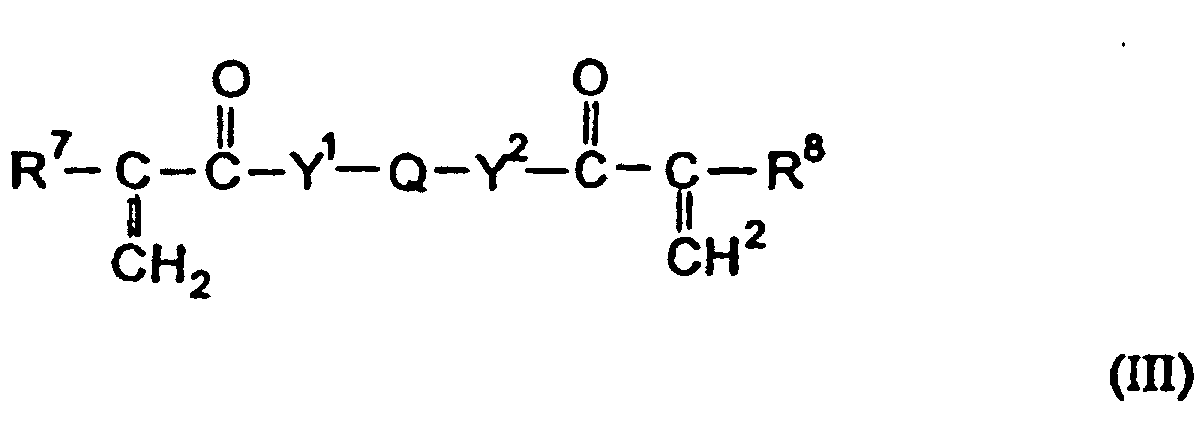
Q est un groupe de liaison éventuellement substitué par un ou plusieurs substituants choisis dans le groupe consistant en hydroxy, amino, amino substitué, époxy, silane, acrylate, acrylate d'alcylène, méthacrylate et méthacrylate d'alcylène. - Procédé selon la revendication 6, dans lequel le monomère de réticulation est de la formule III et dans lequel, dans au moins une des paires de substituant R7, R8 et Y1, Y2, un des substituants de la paire est différent de l'autre substituant de ladite paire.
- Procédé selon la revendication 1, dans lequel l'agent de réticulation comprend deux groupes insaturés différents choisis dans le groupe consistant en acrylate, méthacrylate, acrylamide et méthacrylamide.
- Procédé selon la revendication 1, dans lequel l'agent de réticulation est présent dans une quantité de 5 à 60 pour cent en moles, sur la base du total des composants polymérisables.
- Procédé selon la revendication 3, dans lequel l'alcoxyamine est présente dans une quantité d'au moins 5% en moles et l'autre monomère est présent dans une quantité allant jusqu'à 80% en moles (de préférence de 10 à 80%), sur la base du nombre total de moles de composition polymérisable.
- Procédé selon la revendication 4, dans lequel l'alcoxyamine est présente dans une quantité de 50 à 95% du composant polymérisable total et la composition monomère comprend éventuellement jusqu'à 45% de l'autre monomère choisi parmi les monomères mono-insaturés et les monomères diènes conjugués.
- Procédé selon la revendication 2, dans lequel n est égal à 1 ou plus et les unités de monomère (A) sont dérivées d'un ou plusieurs monomères choisis dans le groupe consistant en alcènes, acrylates, méthacrylates, styrène ou monomères styréniques et acrylonitrile ou acrylnitrile substitué, diènes conjugués, dans lesquels les monomères peuvent éventuellement être substitués par un ou plusieurs groupes fonctionnels choisis parmi les groupes halo, hydroxy, amino, carboxyle, mercapto, amino substitué, silane et époxy.
- Procédé selon la revendication 4, dans lequel l'oligomère (A)n est un copolymère séquencé ou statistique et au moins une desdites unités monomères a un groupe fonctionnel polaire.
- Procédé selon la revendication 1 dans lequel le microgel a une masse moléculaire d'au moins 104.
Applications Claiming Priority (3)
| Application Number | Priority Date | Filing Date | Title |
|---|---|---|---|
| AUPO4607A AUPO460797A0 (en) | 1997-01-15 | 1997-01-15 | Polymerisation process |
| AUPO460797 | 1997-01-15 | ||
| PCT/AU1998/000015 WO1998031739A1 (fr) | 1997-01-15 | 1998-01-15 | Procede de preparation de microgels polymeres |
Publications (3)
| Publication Number | Publication Date |
|---|---|
| EP0953009A1 EP0953009A1 (fr) | 1999-11-03 |
| EP0953009A4 EP0953009A4 (fr) | 2001-04-25 |
| EP0953009B1 true EP0953009B1 (fr) | 2004-12-01 |
Family
ID=3798911
Family Applications (1)
| Application Number | Title | Priority Date | Filing Date |
|---|---|---|---|
| EP98900250A Expired - Lifetime EP0953009B1 (fr) | 1997-01-15 | 1998-01-15 | Procede de preparation de microgels polymeres |
Country Status (9)
| Country | Link |
|---|---|
| US (1) | US6300443B1 (fr) |
| EP (1) | EP0953009B1 (fr) |
| JP (1) | JP2001508489A (fr) |
| AU (1) | AUPO460797A0 (fr) |
| CA (1) | CA2277952C (fr) |
| DE (1) | DE69827926T2 (fr) |
| ES (1) | ES2234090T3 (fr) |
| NZ (1) | NZ336779A (fr) |
| WO (1) | WO1998031739A1 (fr) |
Families Citing this family (20)
| Publication number | Priority date | Publication date | Assignee | Title |
|---|---|---|---|---|
| AUPP337298A0 (en) * | 1998-05-07 | 1998-05-28 | University Of Melbourne, The | Process for microgel preparation |
| DE69917311T2 (de) | 1998-07-10 | 2004-12-09 | E.I. Du Pont De Nemours And Co., Wilmington | Mikrogele und verfahren zu deren herstellung |
| EP1083186B1 (fr) | 1999-09-07 | 2009-01-28 | Bayer MaterialScience AG | Oligomères et polymères téléchéliques |
| AUPQ679400A0 (en) * | 2000-04-07 | 2000-05-11 | Commonwealth Scientific And Industrial Research Organisation | Microgel synthesis |
| US7064151B1 (en) | 2000-04-07 | 2006-06-20 | E. I. Du Pont De Nemours And Company | Process of microgel synthesis and products produced therefrom |
| BR0110854B1 (pt) * | 2000-05-19 | 2017-10-24 | Ciba Specialty Chemicals Holdings Inc | Method for reducing the polypropylene molecular weight, propylene copolymers or polypropylene mixtures, as a compound |
| US7030196B2 (en) | 2000-05-19 | 2006-04-18 | Ciba Specialty Chemicals Corporation | Process for reducing the molecular weight of polypropylene |
| ATE321095T1 (de) * | 2000-05-30 | 2006-04-15 | Ciba Sc Holding Ag | Molekulargewichtsmodifizierung von thermoplastischen polymeren |
| WO2003031480A2 (fr) * | 2001-10-12 | 2003-04-17 | Carnegie Mellon University | Processus de commande de sequence de monomeres dans des polymerisations |
| FR2843314B1 (fr) | 2002-08-06 | 2004-09-24 | Rhodia Chimie Sa | Synthese de microgels statistiques par polymerisation radicalaire controlee |
| AU2002953369A0 (en) * | 2002-11-27 | 2003-01-09 | The University Of Melbourne | Free radical polymerisation process for microgel preparation |
| AU2002953359A0 (en) * | 2002-11-27 | 2003-01-09 | The University Of Melbourne | Microgel composition |
| JP3999746B2 (ja) * | 2003-05-19 | 2007-10-31 | ローム アンド ハース カンパニー | ポリマーナノ粒子の高固形分調製方法 |
| US7504466B2 (en) * | 2004-11-04 | 2009-03-17 | Rohm And Haas Company | High solids preparation of crosslinked polymer particles |
| JP4556658B2 (ja) * | 2004-12-16 | 2010-10-06 | 横浜ゴム株式会社 | 変性ポリマー及びそれを含むポリマー組成物 |
| FR2911877B1 (fr) * | 2007-01-29 | 2009-04-10 | Arkema France | Procede de preparation de particules de microgel par polymerisation radicalaire controlee en dispersion aqueuse mettant en oeuvre des agents de controle nitroxydes |
| FR2917415B1 (fr) * | 2007-06-14 | 2012-10-12 | Rhodia Recherches Et Tech | Microgel polymerique comprenant des unites cationiques |
| FR2937336B1 (fr) * | 2008-10-22 | 2011-06-10 | Rhodia Operations | Composition pour les soins menagers comprenant un nanogel cationique |
| US8685900B2 (en) * | 2009-04-03 | 2014-04-01 | Halliburton Energy Services, Inc. | Methods of using fluid loss additives comprising micro gels |
| TWI830468B (zh) * | 2022-10-28 | 2024-01-21 | 南亞塑膠工業股份有限公司 | 含乙烯基芳香脂環族共聚合物、樹脂組成物及其製品 |
Family Cites Families (9)
| Publication number | Priority date | Publication date | Assignee | Title |
|---|---|---|---|---|
| US4414357A (en) * | 1979-11-27 | 1983-11-08 | Glasurit America, Inc. | Polyester or alkyd resin composition containing acrylic microgels |
| DE3111132C2 (de) * | 1981-03-21 | 1985-01-24 | Henkel KGaA, 4000 Düsseldorf | Klebstoffe und Dichtungsmassen |
| AU563372B2 (en) | 1982-12-16 | 1987-07-09 | Celanese Corporation | Crosslinked microgel particles |
| US4539348A (en) * | 1982-12-16 | 1985-09-03 | Celanese Corporation | Water-swellable crosslinked polymeric microgel particles and aqueous dispersions of organic film-forming resins containing the same |
| DE3486145T2 (de) * | 1983-07-11 | 1993-09-23 | Commw Scient Ind Res Org | Verfahren zur polymerisation und nach diesem verfahren hergestellte polymere. |
| DE3432149A1 (de) * | 1984-05-25 | 1985-11-28 | Nippon Paint Co., Ltd., Osaka | Beschichtungszusammensetzungen fuer deckschichten |
| DE3542512A1 (de) * | 1985-12-02 | 1987-06-04 | Henkel Kgaa | Dichtungs- und klebmittel, vergussmassen und ueberzugsmittel auf basis von methacrylsaeureestern |
| US4666962A (en) * | 1986-04-04 | 1987-05-19 | Ciba-Geigy Corporation | Compositions stabilized with substituted aminoxy-propanoates |
| FR2724843A1 (fr) * | 1994-09-28 | 1996-03-29 | Lvmh Rech | Vernis a ongles contenant des microgels |
-
1997
- 1997-01-15 AU AUPO4607A patent/AUPO460797A0/en not_active Abandoned
-
1998
- 1998-01-15 EP EP98900250A patent/EP0953009B1/fr not_active Expired - Lifetime
- 1998-01-15 WO PCT/AU1998/000015 patent/WO1998031739A1/fr not_active Ceased
- 1998-01-15 JP JP53340198A patent/JP2001508489A/ja not_active Ceased
- 1998-01-15 US US09/341,583 patent/US6300443B1/en not_active Expired - Fee Related
- 1998-01-15 CA CA002277952A patent/CA2277952C/fr not_active Expired - Fee Related
- 1998-01-15 DE DE69827926T patent/DE69827926T2/de not_active Expired - Fee Related
- 1998-01-15 NZ NZ336779A patent/NZ336779A/xx unknown
- 1998-01-15 ES ES98900250T patent/ES2234090T3/es not_active Expired - Lifetime
Also Published As
| Publication number | Publication date |
|---|---|
| JP2001508489A (ja) | 2001-06-26 |
| US6300443B1 (en) | 2001-10-09 |
| EP0953009A1 (fr) | 1999-11-03 |
| EP0953009A4 (fr) | 2001-04-25 |
| AUPO460797A0 (en) | 1997-02-06 |
| DE69827926T2 (de) | 2005-12-22 |
| ES2234090T3 (es) | 2005-06-16 |
| CA2277952A1 (fr) | 1998-07-23 |
| DE69827926D1 (de) | 2005-01-05 |
| NZ336779A (en) | 2001-01-26 |
| WO1998031739A1 (fr) | 1998-07-23 |
| CA2277952C (fr) | 2006-10-10 |
Similar Documents
| Publication | Publication Date | Title |
|---|---|---|
| EP0953009B1 (fr) | Procede de preparation de microgels polymeres | |
| US6545095B1 (en) | Process for microgel preparation | |
| Konkolewicz et al. | Hyperbranched alternating block copolymers using thiol–yne chemistry: materials with tuneable properties | |
| Hadjichristidis et al. | 6.03-Polymers with star-related structures: Synthesis, properties, and applications | |
| AU599866B2 (en) | Enhanced livingness of polymerization using silylated oxyanions | |
| AU746495B2 (en) | Microgels and process for their preparation | |
| Deng et al. | Facile synthesis of controlled‐structure primary amine‐based methacrylamide polymers via the reversible addition‐fragmentation chain transfer process | |
| EP0887362B1 (fr) | Polymères blocs préparés par polymérisation par un radical libre stable | |
| Deane et al. | Synthesis and characterization of waterborne pyrrolidone-functional diblock copolymer nanoparticles prepared via surfactant-free RAFT emulsion polymerization | |
| KR20010090759A (ko) | 알콕시아민의 존재하에 조절된 라디칼 중합에 의한 다정중합체 | |
| KR950701354A (ko) | 거대단량체 연쇄이동제를 이용한 가교결합성 중합체의 제법(preparing crosslinkable polymers employing macromonomer chain transfer agents) | |
| WO2017034660A1 (fr) | Synthèse pratique de polymères auto-cicatrisants multiphases à partir de matières premières monomères | |
| Dai et al. | Preparation of monodisperse poly (methyl methacrylate) particles by radiation-induced dispersion polymerization using vinyl terminus polysiloxane macromonomer as a polymerizable stabilizer | |
| JP7144064B2 (ja) | 分岐ポリマー | |
| AU727232B2 (en) | A process for preparing polymeric microgels | |
| White et al. | Synthesis of 3-alkylated-1-vinyl-2-pyrrolidones and preliminary kinetic studies of their photopolymerizations | |
| Floyd et al. | Complex Polymeric Architectures Synthesized through RAFT Polymerization | |
| WO1998046655A1 (fr) | Polymere methacrylique possedant un groupe fonctionnel terminal, et composition a base de ce polymere | |
| David et al. | Poly (N-isopropylacrylamide)/poly [(N-acetylimino) ethylene] thermosensitive block and graft copolymers | |
| MXPA99006502A (en) | A process for preparing polymeric microgels | |
| US6258905B1 (en) | Stabilized, unimolecular initiators for hydrocarbon polymerization | |
| Matuszewska-Czerwik et al. | Template photopolymerization of methacrylic acid in water—V. Low molecular weight templates | |
| AU757416B2 (en) | Process for microgel preparation | |
| JP2622676B2 (ja) | 新規なマクロモノマー及びその製造法 | |
| DUPRE | Reversible addition-fragmentation chain-transfer polymerization of acyclic N-vinylamides |
Legal Events
| Date | Code | Title | Description |
|---|---|---|---|
| PUAI | Public reference made under article 153(3) epc to a published international application that has entered the european phase |
Free format text: ORIGINAL CODE: 0009012 |
|
| 17P | Request for examination filed |
Effective date: 19990720 |
|
| AK | Designated contracting states |
Kind code of ref document: A1 Designated state(s): BE DE ES FR GB IT NL SE |
|
| A4 | Supplementary search report drawn up and despatched |
Effective date: 20010308 |
|
| AK | Designated contracting states |
Kind code of ref document: A4 Designated state(s): BE DE ES FR GB IT NL SE |
|
| 17Q | First examination report despatched |
Effective date: 20030926 |
|
| GRAP | Despatch of communication of intention to grant a patent |
Free format text: ORIGINAL CODE: EPIDOSNIGR1 |
|
| GRAS | Grant fee paid |
Free format text: ORIGINAL CODE: EPIDOSNIGR3 |
|
| GRAA | (expected) grant |
Free format text: ORIGINAL CODE: 0009210 |
|
| AK | Designated contracting states |
Kind code of ref document: B1 Designated state(s): BE DE ES FR GB IT NL SE |
|
| REG | Reference to a national code |
Ref country code: GB Ref legal event code: FG4D |
|
| REF | Corresponds to: |
Ref document number: 69827926 Country of ref document: DE Date of ref document: 20050105 Kind code of ref document: P |
|
| PGFP | Annual fee paid to national office [announced via postgrant information from national office to epo] |
Ref country code: SE Payment date: 20050114 Year of fee payment: 8 |
|
| PGFP | Annual fee paid to national office [announced via postgrant information from national office to epo] |
Ref country code: ES Payment date: 20050119 Year of fee payment: 8 |
|
| PGFP | Annual fee paid to national office [announced via postgrant information from national office to epo] |
Ref country code: BE Payment date: 20050127 Year of fee payment: 8 |
|
| PGFP | Annual fee paid to national office [announced via postgrant information from national office to epo] |
Ref country code: NL Payment date: 20050131 Year of fee payment: 8 |
|
| REG | Reference to a national code |
Ref country code: SE Ref legal event code: TRGR |
|
| REG | Reference to a national code |
Ref country code: ES Ref legal event code: FG2A Ref document number: 2234090 Country of ref document: ES Kind code of ref document: T3 |
|
| PLBE | No opposition filed within time limit |
Free format text: ORIGINAL CODE: 0009261 |
|
| STAA | Information on the status of an ep patent application or granted ep patent |
Free format text: STATUS: NO OPPOSITION FILED WITHIN TIME LIMIT |
|
| 26N | No opposition filed |
Effective date: 20050902 |
|
| ET | Fr: translation filed | ||
| PG25 | Lapsed in a contracting state [announced via postgrant information from national office to epo] |
Ref country code: SE Free format text: LAPSE BECAUSE OF NON-PAYMENT OF DUE FEES Effective date: 20060116 Ref country code: ES Free format text: LAPSE BECAUSE OF NON-PAYMENT OF DUE FEES Effective date: 20060116 |
|
| PG25 | Lapsed in a contracting state [announced via postgrant information from national office to epo] |
Ref country code: BE Free format text: LAPSE BECAUSE OF NON-PAYMENT OF DUE FEES Effective date: 20060131 |
|
| PGFP | Annual fee paid to national office [announced via postgrant information from national office to epo] |
Ref country code: IT Payment date: 20060131 Year of fee payment: 9 |
|
| PG25 | Lapsed in a contracting state [announced via postgrant information from national office to epo] |
Ref country code: NL Free format text: LAPSE BECAUSE OF NON-PAYMENT OF DUE FEES Effective date: 20060801 |
|
| EUG | Se: european patent has lapsed | ||
| NLV4 | Nl: lapsed or anulled due to non-payment of the annual fee |
Effective date: 20060801 |
|
| PGFP | Annual fee paid to national office [announced via postgrant information from national office to epo] |
Ref country code: DE Payment date: 20070125 Year of fee payment: 10 |
|
| REG | Reference to a national code |
Ref country code: ES Ref legal event code: FD2A Effective date: 20060116 |
|
| BERE | Be: lapsed |
Owner name: THE *UNIVERSITY OF MELBOURNE Effective date: 20060131 |
|
| PGFP | Annual fee paid to national office [announced via postgrant information from national office to epo] |
Ref country code: GB Payment date: 20071220 Year of fee payment: 11 Ref country code: FR Payment date: 20070105 Year of fee payment: 10 |
|
| PG25 | Lapsed in a contracting state [announced via postgrant information from national office to epo] |
Ref country code: DE Free format text: LAPSE BECAUSE OF NON-PAYMENT OF DUE FEES Effective date: 20080801 |
|
| REG | Reference to a national code |
Ref country code: FR Ref legal event code: ST Effective date: 20081029 |
|
| PG25 | Lapsed in a contracting state [announced via postgrant information from national office to epo] |
Ref country code: FR Free format text: LAPSE BECAUSE OF NON-PAYMENT OF DUE FEES Effective date: 20080131 |
|
| GBPC | Gb: european patent ceased through non-payment of renewal fee |
Effective date: 20090115 |
|
| PG25 | Lapsed in a contracting state [announced via postgrant information from national office to epo] |
Ref country code: IT Free format text: LAPSE BECAUSE OF NON-PAYMENT OF DUE FEES Effective date: 20070115 |
|
| PG25 | Lapsed in a contracting state [announced via postgrant information from national office to epo] |
Ref country code: GB Free format text: LAPSE BECAUSE OF NON-PAYMENT OF DUE FEES Effective date: 20090115 |