EP0957356A1 - Procédé de fabrication d'un électrode en platine - Google Patents
Procédé de fabrication d'un électrode en platine Download PDFInfo
- Publication number
- EP0957356A1 EP0957356A1 EP99201326A EP99201326A EP0957356A1 EP 0957356 A1 EP0957356 A1 EP 0957356A1 EP 99201326 A EP99201326 A EP 99201326A EP 99201326 A EP99201326 A EP 99201326A EP 0957356 A1 EP0957356 A1 EP 0957356A1
- Authority
- EP
- European Patent Office
- Prior art keywords
- platinum
- ink
- sintering
- platinum electrode
- degrees
- Prior art date
- Legal status (The legal status is an assumption and is not a legal conclusion. Google has not performed a legal analysis and makes no representation as to the accuracy of the status listed.)
- Withdrawn
Links
- BASFCYQUMIYNBI-UHFFFAOYSA-N platinum Chemical compound [Pt] BASFCYQUMIYNBI-UHFFFAOYSA-N 0.000 title claims abstract description 118
- 229910052697 platinum Inorganic materials 0.000 title claims abstract description 58
- 238000004519 manufacturing process Methods 0.000 title claims abstract description 16
- 238000005245 sintering Methods 0.000 claims abstract description 24
- OKTJSMMVPCPJKN-UHFFFAOYSA-N Carbon Chemical compound [C] OKTJSMMVPCPJKN-UHFFFAOYSA-N 0.000 claims abstract description 21
- 229910052799 carbon Inorganic materials 0.000 claims abstract description 15
- 239000000919 ceramic Substances 0.000 claims abstract description 14
- 239000000843 powder Substances 0.000 claims abstract description 12
- 239000000203 mixture Substances 0.000 claims abstract description 10
- 238000000280 densification Methods 0.000 abstract 1
- MCMNRKCIXSYSNV-UHFFFAOYSA-N Zirconium dioxide Chemical compound O=[Zr]=O MCMNRKCIXSYSNV-UHFFFAOYSA-N 0.000 description 24
- 239000000976 ink Substances 0.000 description 17
- QVGXLLKOCUKJST-UHFFFAOYSA-N atomic oxygen Chemical compound [O] QVGXLLKOCUKJST-UHFFFAOYSA-N 0.000 description 10
- 229910052760 oxygen Inorganic materials 0.000 description 10
- 239000001301 oxygen Substances 0.000 description 10
- 239000007772 electrode material Substances 0.000 description 3
- 238000000034 method Methods 0.000 description 3
- 239000007789 gas Substances 0.000 description 2
- 239000000463 material Substances 0.000 description 2
- 239000002245 particle Substances 0.000 description 2
- 239000001856 Ethyl cellulose Substances 0.000 description 1
- ZZSNKZQZMQGXPY-UHFFFAOYSA-N Ethyl cellulose Chemical compound CCOCC1OC(OC)C(OCC)C(OCC)C1OC1C(O)C(O)C(OC)C(CO)O1 ZZSNKZQZMQGXPY-UHFFFAOYSA-N 0.000 description 1
- PNEYBMLMFCGWSK-UHFFFAOYSA-N aluminium oxide Inorganic materials [O-2].[O-2].[O-2].[Al+3].[Al+3] PNEYBMLMFCGWSK-UHFFFAOYSA-N 0.000 description 1
- 229910010293 ceramic material Inorganic materials 0.000 description 1
- 238000005056 compaction Methods 0.000 description 1
- 239000004020 conductor Substances 0.000 description 1
- 230000007423 decrease Effects 0.000 description 1
- 239000003792 electrolyte Substances 0.000 description 1
- 229920001249 ethyl cellulose Polymers 0.000 description 1
- 235000019325 ethyl cellulose Nutrition 0.000 description 1
- 238000003475 lamination Methods 0.000 description 1
- 239000010665 pine oil Substances 0.000 description 1
- 239000011369 resultant mixture Substances 0.000 description 1
Images
Classifications
-
- B—PERFORMING OPERATIONS; TRANSPORTING
- B22—CASTING; POWDER METALLURGY
- B22F—WORKING METALLIC POWDER; MANUFACTURE OF ARTICLES FROM METALLIC POWDER; MAKING METALLIC POWDER; APPARATUS OR DEVICES SPECIALLY ADAPTED FOR METALLIC POWDER
- B22F7/00—Manufacture of composite layers, workpieces, or articles, comprising metallic powder, by sintering the powder, with or without compacting wherein at least one part is obtained by sintering or compression
- B22F7/02—Manufacture of composite layers, workpieces, or articles, comprising metallic powder, by sintering the powder, with or without compacting wherein at least one part is obtained by sintering or compression of composite layers
Definitions
- This invention relates to a method of manufacturing a platinum electrode.
- Electrodes such as for measuring oxygen in exhaust gases, use platinum as the electrode material because the platinum has high current density and good durability in high temperature environments where it is exposed to vehicle exhausts gases.
- Some of these sensors are manufactured using electrolyte and ceramic materials that can be sintered at temperatures as low is 1300 degrees C. Sensors that are manufactured from laminated stacks of alumina, however, require sintering at higher temperatures, for example, around 1500 agrees C.
- a platinum electrode material is sintered at 1500 degrees C, challenges develop that don't occur during sintering at 1300 degrees C. Primarily, the platinum electrode material tends to sinter and densify, which decreases its current carrying capacity and its porosity. If the platinum electrode sintered at 1500 degrees C is used as an oxygen pump for an oxygen sensor, not as much oxygen can be transported through the platinum, lowering its efficiency.
- One method for improving the efficiency of the platinum is to add ceramic powder to the platinum ink that is used to form the electrode.
- the ceramic powder is preferably zirconia. This technique has been found to increase the current density of the electrode sintered at 1500 degrees C, for example, from about 1 mA/cm 2 to 5 to 7 mA/cm 2 - when operated at 750 degrees C. But 5 mA/cm 2 is still a very inefficient current density.
- this invention provides an method of manufacturing a platinum electrode that has high porosity and high current density even when sintered at temperatures of 1500 degrees C and higher.
- high current density means a current density above 10 mA/cm 2 .
- this invention recognizes that the addition of small particles of a high temperature fugitive material to the platinum ink prevents loss of porosity of the platinum during lamination and high temperature sintering.
- An example appropriate fugitive material is carbon, which oxidizes during the sintering process leaving small voids in the platinum.
- the voids left by the carbon during sintering guarantee increased porosity of the platinum compared to electrodes formed without the carbon particulates. These voids act as oxygen transfer points used, for example, when the electrode is the conductive material of an oxygen pump in an oxygen sensor.
- this invention provides a method of manufacturing a platinum electrode comprising the steps of: adding platinum, ceramic, and carbon powders to a vehicle to achieve a printable ink, printing the ink on a body, and sintering the body, wherein the carbon is removed during sintering, wherein a superior porous platinum electrode is achieved.
- Platinum and zirconia powders of a known type for producing printable platinum inks are mixed with the resultant mixture being 88 percent by weight platinum and 12 percent by weight zirconia. Carbon powder having an average particle size of 0.3 microns is added to the mixture so that the total powder mixture is 51 percent by volume carbon. The powder mixture is next added to an organic vehicle to form a printable ink, which is about 60 percent by weight pine oil and approximately 2% by weight ethyl cellulose. The remainder of the ink comprises the platinum, zirconia and carbon powder mixture.
- the ink is printed on a green zirconia body formed by roll compaction.
- the combination of the green body and printed ink is then fired at 1510 degrees C.
- the resultant electrode had a current density of 22 mA/cm 2 at 750 degrees C and 74 mA/cm 2 at 850 degrees C.
- a platinum electrode is formed as in example one, except the green zirconia body is laminated to another green zirconia body after printing of the ink and before sintering.
- the resultant electrode had a current density of 22 mA/cm 2 at 750 degrees C and 64 mA/cm 2 at 850 degrees C.
- a platinum electrode is formed as in example one, except that the green body to which the ink is printed is tape cast.
- the resultant electrode had a current density of 10 mA/cm 2 at 750 degrees C and 58 mA/cm 2 at 850 degrees C.
- a platinum electrode is formed as in example three, except the green zirconia body is laminated to another green zirconia body after printing of the ink and before sintering.
- the resultant platinum electrode had a current density of 10 mA/cm 2 at 750 C and 78 mA/cm 2 at 850 degrees C.
- a platinum electrode is formed as in example one, except that it is fired at 1485 degrees C.
- the electrode had a current density of 34 mA/cm 2 at 750 degrees C and 68 mA/cm 2 at 850 degrees C.
- a platinum electrode is formed as in example two, except that it is fired at 1485 degrees C.
- the resultant electrode had a current density of 33 mA/cm 2 at 750 degrees C and 69 mA/cm 2 at 850 degrees C.
- the ink was printed in three passes.
- current densities as high as 43 mA/cm 2 were achieved at 750 degrees C and as high as 86 mA/cm 2 were achieved in 850 degrees C.
- the above examples compare to a platinum electrode formed from platinum powder and an organic vehicle, which carries a current density of about 1 mA/cm 2 after sintering at 1510 degrees C.
- the above examples also compare to an electrode made with platinum and zirconia powders (no carbon powder) combined with an organic vehicle. After sintering at 1510 degrees C, the electrode yielded a current density ranging from 5 to 7 mA/cm 2 .
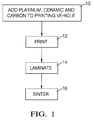
- step 10 the platinum, ceramic and carbon powders are added to an organic vehicle.
- step 12 the resultant ink is printed on a green body.
- step 14 the green body is laminated to one or more additional green bodies in a known manner as appropriate to construct the desired device, for example, an oxygen sensor.
- An example suitable oxygen sensor is described United States patent number 5,329,806. Because the details of the particular the oxygen sensor with which this invention is used are not central to this invention, they will not been repeated here.
- the laminated assembly is sintered to yield the resultant sensor with one or more example platinum electrodes according to this invention thereon
- the amounts of platinum, ceramic and carbon used to form the platinum electrode can be varied.
- the range of ceramic is typically 3 to 30 percent by weight of the total platinum and ceramic mixture.
- the range of the carbon is preferably 20 to 60 percent by volume of the platinum, ceramic and carbon powder mixture.
- zirconia is the ceramic used above, any ceramic or mixture of ceramics suitable for use in platinum inks can be used.
Landscapes
- Chemical & Material Sciences (AREA)
- Engineering & Computer Science (AREA)
- Composite Materials (AREA)
- Manufacturing & Machinery (AREA)
- Materials Engineering (AREA)
- Mechanical Engineering (AREA)
- Electrodes For Compound Or Non-Metal Manufacture (AREA)
- Measuring Oxygen Concentration In Cells (AREA)
Applications Claiming Priority (2)
| Application Number | Priority Date | Filing Date | Title |
|---|---|---|---|
| US75585 | 1998-05-11 | ||
| US09/075,585 US5887240A (en) | 1998-05-11 | 1998-05-11 | Method of manufacturing a platinum electrode |
Publications (1)
| Publication Number | Publication Date |
|---|---|
| EP0957356A1 true EP0957356A1 (fr) | 1999-11-17 |
Family
ID=22126731
Family Applications (1)
| Application Number | Title | Priority Date | Filing Date |
|---|---|---|---|
| EP99201326A Withdrawn EP0957356A1 (fr) | 1998-05-11 | 1999-04-28 | Procédé de fabrication d'un électrode en platine |
Country Status (3)
| Country | Link |
|---|---|
| US (1) | US5887240A (fr) |
| EP (1) | EP0957356A1 (fr) |
| JP (1) | JP3167984B2 (fr) |
Families Citing this family (11)
| Publication number | Priority date | Publication date | Assignee | Title |
|---|---|---|---|---|
| US5887240A (en) * | 1998-05-11 | 1999-03-23 | General Motors Corporation | Method of manufacturing a platinum electrode |
| US6365036B1 (en) | 2000-03-06 | 2002-04-02 | Delphi Technologies, Inc. | Electrode ink formulation for oxygen sensor |
| US7894870B1 (en) | 2004-02-13 | 2011-02-22 | Glysens, Incorporated | Hermetic implantable sensor |
| JP4182442B2 (ja) | 2006-04-27 | 2008-11-19 | ソニー株式会社 | 画像データの処理装置、画像データの処理方法、画像データの処理方法のプログラム及び画像データの処理方法のプログラムを記録した記録媒体 |
| EP3906842A1 (fr) | 2011-07-26 | 2021-11-10 | Glysens Incorporated | Capteur à logement hermétique implantable dans tissu |
| US10561353B2 (en) | 2016-06-01 | 2020-02-18 | Glysens Incorporated | Biocompatible implantable sensor apparatus and methods |
| US10660550B2 (en) | 2015-12-29 | 2020-05-26 | Glysens Incorporated | Implantable sensor apparatus and methods |
| US10638962B2 (en) | 2016-06-29 | 2020-05-05 | Glysens Incorporated | Bio-adaptable implantable sensor apparatus and methods |
| US10638979B2 (en) | 2017-07-10 | 2020-05-05 | Glysens Incorporated | Analyte sensor data evaluation and error reduction apparatus and methods |
| US11278668B2 (en) | 2017-12-22 | 2022-03-22 | Glysens Incorporated | Analyte sensor and medicant delivery data evaluation and error reduction apparatus and methods |
| US11255839B2 (en) | 2018-01-04 | 2022-02-22 | Glysens Incorporated | Apparatus and methods for analyte sensor mismatch correction |
Citations (5)
| Publication number | Priority date | Publication date | Assignee | Title |
|---|---|---|---|---|
| US4296148A (en) * | 1978-12-06 | 1981-10-20 | Robert Bosch Gmbh | Method to apply multiple layers, including an electrode layer, on a sintered or pre-sintered ion conductive solid electrolyte body |
| US4347113A (en) * | 1979-04-05 | 1982-08-31 | Robert Bosch Gmbh | Oxygen content exhaust gas sensor, and method of its manufacture |
| US5137615A (en) * | 1988-03-18 | 1992-08-11 | Robert Bosch Gmbh | Sensor element for limiting current sensors for determination of the λ value of gas mixtures |
| US5545301A (en) * | 1993-04-23 | 1996-08-13 | Robert Bosch Gmbh | Sensor element for the determination of concentration of gas constituent(s) |
| US5887240A (en) * | 1998-05-11 | 1999-03-23 | General Motors Corporation | Method of manufacturing a platinum electrode |
Family Cites Families (7)
| Publication number | Priority date | Publication date | Assignee | Title |
|---|---|---|---|---|
| US3943006A (en) * | 1973-12-27 | 1976-03-09 | Energy Research Corporation | Method of making a fuel cell electrode |
| US4379772A (en) * | 1980-10-31 | 1983-04-12 | Diamond Shamrock Corporation | Method for forming an electrode active layer or sheet |
| US4518705A (en) * | 1980-10-31 | 1985-05-21 | Eltech Systems Corporation | Three layer laminate |
| US4374761A (en) * | 1980-11-10 | 1983-02-22 | Aluminum Company Of America | Inert electrode formulations |
| CH654031A5 (de) * | 1983-02-10 | 1986-01-31 | Alusuisse | Verfahren zur herstellung von festkoerperkathoden. |
| JP3613654B2 (ja) * | 1996-12-20 | 2005-01-26 | トヨタ自動車株式会社 | 燃料電池用の電極および発電層の製造方法 |
| JPH10189005A (ja) * | 1996-12-20 | 1998-07-21 | Toyota Motor Corp | 燃料電池用の電極および発電層の製造方法 |
-
1998
- 1998-05-11 US US09/075,585 patent/US5887240A/en not_active Expired - Fee Related
-
1999
- 1999-04-28 EP EP99201326A patent/EP0957356A1/fr not_active Withdrawn
- 1999-05-11 JP JP13003099A patent/JP3167984B2/ja not_active Expired - Fee Related
Patent Citations (5)
| Publication number | Priority date | Publication date | Assignee | Title |
|---|---|---|---|---|
| US4296148A (en) * | 1978-12-06 | 1981-10-20 | Robert Bosch Gmbh | Method to apply multiple layers, including an electrode layer, on a sintered or pre-sintered ion conductive solid electrolyte body |
| US4347113A (en) * | 1979-04-05 | 1982-08-31 | Robert Bosch Gmbh | Oxygen content exhaust gas sensor, and method of its manufacture |
| US5137615A (en) * | 1988-03-18 | 1992-08-11 | Robert Bosch Gmbh | Sensor element for limiting current sensors for determination of the λ value of gas mixtures |
| US5545301A (en) * | 1993-04-23 | 1996-08-13 | Robert Bosch Gmbh | Sensor element for the determination of concentration of gas constituent(s) |
| US5887240A (en) * | 1998-05-11 | 1999-03-23 | General Motors Corporation | Method of manufacturing a platinum electrode |
Also Published As
| Publication number | Publication date |
|---|---|
| JP3167984B2 (ja) | 2001-05-21 |
| US5887240A (en) | 1999-03-23 |
| JPH11335885A (ja) | 1999-12-07 |
Similar Documents
| Publication | Publication Date | Title |
|---|---|---|
| JP5469795B2 (ja) | サーメット電解質を用いたアノード支持固体酸化物燃料電池 | |
| US5762737A (en) | Porous ceramic and process thereof | |
| US4585499A (en) | Method of producing ceramics | |
| US5887240A (en) | Method of manufacturing a platinum electrode | |
| JP2008519404A (ja) | 電気化学的電池構造体および制御粉末法によるその製造方法 | |
| JPH07270375A (ja) | 複合タイル製検出素子を含む排気ガスセンサーおよびその製造方法 | |
| JPH08509570A (ja) | 改善された固体電解質/電極境界面を有する耐熱性燃料セルおよびこの境界面の製造法 | |
| JP2007529852A5 (fr) | ||
| US7169724B2 (en) | Alumina sintered body and method for producing the same | |
| JP4061125B2 (ja) | 酸素センサ素子の製造方法 | |
| JPH03261676A (ja) | セラミックグリーンシート並びにそれを用いた電気化学的素子の製造方法 | |
| JP3150807B2 (ja) | 固体電解質型燃料電池スタックの接合材およびその製造方法 | |
| JP2848551B2 (ja) | 固体電解質型燃料電池の電解質膜製造方法 | |
| JP3336171B2 (ja) | 固体電解質型燃料電池セル | |
| JP3447019B2 (ja) | 固体電解質型燃料電池用セパレータ材料及びその製造方法 | |
| JP4012846B2 (ja) | 燃料電池セルの製造方法 | |
| KR100833626B1 (ko) | 서멧 전해질을 사용하는 애노드 지지된 고체 산화물 연료 전지 | |
| TW202529305A (zh) | 電化學電池及其製造方法 | |
| US20070042225A1 (en) | Supported ceramic membranes and electrochemical cells including the same | |
| JP2001099810A (ja) | 窒素酸化物ガスセンサ | |
| KR100413783B1 (ko) | 센서 가열용 세라믹 히터 | |
| JP2003089576A (ja) | ジルコニア質焼結体及び酸素センサ | |
| EP1226428A1 (fr) | Structure de detecteur de gaz et procede d'utilisation associe | |
| JP2000292405A (ja) | 酸素センサ素子およびその製造方法 | |
| JP2002168828A (ja) | 酸素センサ |
Legal Events
| Date | Code | Title | Description |
|---|---|---|---|
| PUAI | Public reference made under article 153(3) epc to a published international application that has entered the european phase |
Free format text: ORIGINAL CODE: 0009012 |
|
| AK | Designated contracting states |
Kind code of ref document: A1 Designated state(s): DE FR GB |
|
| AX | Request for extension of the european patent |
Free format text: AL;LT;LV;MK;RO;SI |
|
| 17P | Request for examination filed |
Effective date: 20000517 |
|
| AKX | Designation fees paid |
Free format text: DE FR GB |
|
| 17Q | First examination report despatched |
Effective date: 20020816 |
|
| STAA | Information on the status of an ep patent application or granted ep patent |
Free format text: STATUS: THE APPLICATION IS DEEMED TO BE WITHDRAWN |
|
| 18D | Application deemed to be withdrawn |
Effective date: 20031101 |