EP0958271B1 - Procede de preparation d'aldehydes par hydroformylation - Google Patents
Procede de preparation d'aldehydes par hydroformylation Download PDFInfo
- Publication number
- EP0958271B1 EP0958271B1 EP97954759A EP97954759A EP0958271B1 EP 0958271 B1 EP0958271 B1 EP 0958271B1 EP 97954759 A EP97954759 A EP 97954759A EP 97954759 A EP97954759 A EP 97954759A EP 0958271 B1 EP0958271 B1 EP 0958271B1
- Authority
- EP
- European Patent Office
- Prior art keywords
- formula
- rhodium
- compound
- aqueous phase
- sulfonated
- Prior art date
- Legal status (The legal status is an assumption and is not a legal conclusion. Google has not performed a legal analysis and makes no representation as to the accuracy of the status listed.)
- Expired - Lifetime
Links
- 150000001299 aldehydes Chemical class 0.000 title claims abstract description 8
- 238000004519 manufacturing process Methods 0.000 title claims description 4
- 238000007037 hydroformylation reaction Methods 0.000 title description 21
- 150000001875 compounds Chemical class 0.000 claims abstract description 79
- 239000010948 rhodium Substances 0.000 claims abstract description 51
- 239000003054 catalyst Substances 0.000 claims abstract description 47
- 229910052703 rhodium Inorganic materials 0.000 claims abstract description 46
- MHOVAHRLVXNVSD-UHFFFAOYSA-N rhodium atom Chemical compound [Rh] MHOVAHRLVXNVSD-UHFFFAOYSA-N 0.000 claims abstract description 46
- QQONPFPTGQHPMA-UHFFFAOYSA-N Propene Chemical compound CC=C QQONPFPTGQHPMA-UHFFFAOYSA-N 0.000 claims abstract description 37
- 239000008346 aqueous phase Substances 0.000 claims abstract description 35
- -1 aliphatic olefin Chemical class 0.000 claims abstract description 26
- 238000006243 chemical reaction Methods 0.000 claims abstract description 25
- 229910052739 hydrogen Inorganic materials 0.000 claims abstract description 21
- 239000001257 hydrogen Substances 0.000 claims abstract description 21
- 229920001223 polyethylene glycol Polymers 0.000 claims abstract description 16
- UGFAIRIUMAVXCW-UHFFFAOYSA-N Carbon monoxide Chemical compound [O+]#[C-] UGFAIRIUMAVXCW-UHFFFAOYSA-N 0.000 claims abstract description 11
- 239000002202 Polyethylene glycol Substances 0.000 claims abstract description 11
- 229910002091 carbon monoxide Inorganic materials 0.000 claims abstract description 11
- QGZKDVFQNNGYKY-UHFFFAOYSA-O Ammonium Chemical compound [NH4+] QGZKDVFQNNGYKY-UHFFFAOYSA-O 0.000 claims abstract description 8
- 125000001453 quaternary ammonium group Chemical group 0.000 claims abstract description 7
- PTFCDOFLOPIGGS-UHFFFAOYSA-N Zinc dication Chemical compound [Zn+2] PTFCDOFLOPIGGS-UHFFFAOYSA-N 0.000 claims abstract description 6
- RIOQSEWOXXDEQQ-UHFFFAOYSA-N triphenylphosphine Chemical class C1=CC=CC=C1P(C=1C=CC=CC=1)C1=CC=CC=C1 RIOQSEWOXXDEQQ-UHFFFAOYSA-N 0.000 claims abstract description 6
- 125000001997 phenyl group Chemical group [H]C1=C([H])C([H])=C(*)C([H])=C1[H] 0.000 claims abstract description 5
- DDFNIWBATAORBX-UHFFFAOYSA-N 3-bis(3-sulfophenyl)phosphanylbenzenesulfonic acid;sodium Chemical compound [Na].[Na].[Na].OS(=O)(=O)C1=CC=CC(P(C=2C=C(C=CC=2)S(O)(=O)=O)C=2C=C(C=CC=2)S(O)(=O)=O)=C1 DDFNIWBATAORBX-UHFFFAOYSA-N 0.000 claims abstract description 4
- 125000004435 hydrogen atom Chemical class [H]* 0.000 claims abstract 2
- 238000000034 method Methods 0.000 claims description 41
- UFHFLCQGNIYNRP-UHFFFAOYSA-N Hydrogen Chemical compound [H][H] UFHFLCQGNIYNRP-UHFFFAOYSA-N 0.000 claims description 11
- 125000004432 carbon atom Chemical group C* 0.000 claims description 10
- 229910001413 alkali metal ion Inorganic materials 0.000 claims description 9
- 150000002431 hydrogen Chemical class 0.000 claims description 8
- WCYWZMWISLQXQU-UHFFFAOYSA-N methyl Chemical group [CH3] WCYWZMWISLQXQU-UHFFFAOYSA-N 0.000 claims description 6
- 229910001420 alkaline earth metal ion Inorganic materials 0.000 claims description 4
- 125000004805 propylene group Chemical group [H]C([H])([H])C([H])([*:1])C([H])([H])[*:2] 0.000 claims description 3
- 238000002360 preparation method Methods 0.000 abstract description 3
- VXNZUUAINFGPBY-UHFFFAOYSA-N 1-Butene Chemical compound CCC=C VXNZUUAINFGPBY-UHFFFAOYSA-N 0.000 abstract description 2
- 125000000217 alkyl group Chemical group 0.000 abstract description 2
- IAQRGUVFOMOMEM-UHFFFAOYSA-N butene Natural products CC=CC IAQRGUVFOMOMEM-UHFFFAOYSA-N 0.000 abstract description 2
- 125000002496 methyl group Chemical group [H]C([H])([H])* 0.000 abstract description 2
- 125000001624 naphthyl group Chemical group 0.000 abstract description 2
- YWAKXRMUMFPDSH-UHFFFAOYSA-N pentene Chemical compound CCCC=C YWAKXRMUMFPDSH-UHFFFAOYSA-N 0.000 abstract description 2
- OKTJSMMVPCPJKN-UHFFFAOYSA-N Carbon Chemical compound [C] OKTJSMMVPCPJKN-UHFFFAOYSA-N 0.000 abstract 1
- 229910052783 alkali metal Inorganic materials 0.000 abstract 1
- 150000001340 alkali metals Chemical class 0.000 abstract 1
- 229910052799 carbon Inorganic materials 0.000 abstract 1
- 125000002887 hydroxy group Chemical group [H]O* 0.000 abstract 1
- JRZJOMJEPLMPRA-UHFFFAOYSA-N olefin Natural products CCCCCCCC=C JRZJOMJEPLMPRA-UHFFFAOYSA-N 0.000 abstract 1
- 239000004711 α-olefin Substances 0.000 abstract 1
- 239000000203 mixture Substances 0.000 description 18
- 239000012074 organic phase Substances 0.000 description 18
- 239000012071 phase Substances 0.000 description 12
- 150000001336 alkenes Chemical class 0.000 description 11
- 239000007795 chemical reaction product Substances 0.000 description 11
- 125000004437 phosphorous atom Chemical group 0.000 description 11
- 239000002904 solvent Substances 0.000 description 11
- XLYOFNOQVPJJNP-UHFFFAOYSA-N water Substances O XLYOFNOQVPJJNP-UHFFFAOYSA-N 0.000 description 11
- 230000015572 biosynthetic process Effects 0.000 description 9
- 239000003153 chemical reaction reagent Substances 0.000 description 9
- 238000005191 phase separation Methods 0.000 description 9
- ZTQSAGDEMFDKMZ-UHFFFAOYSA-N Butyraldehyde Chemical compound CCCC=O ZTQSAGDEMFDKMZ-UHFFFAOYSA-N 0.000 description 8
- XYFCBTPGUUZFHI-UHFFFAOYSA-N Phosphine Chemical compound P XYFCBTPGUUZFHI-UHFFFAOYSA-N 0.000 description 8
- ZUOUZKKEUPVFJK-UHFFFAOYSA-N diphenyl Chemical compound C1=CC=CC=C1C1=CC=CC=C1 ZUOUZKKEUPVFJK-UHFFFAOYSA-N 0.000 description 6
- 150000003003 phosphines Chemical group 0.000 description 6
- 229910052698 phosphorus Inorganic materials 0.000 description 6
- 239000000047 product Substances 0.000 description 6
- AMIMRNSIRUDHCM-UHFFFAOYSA-N Isopropylaldehyde Chemical compound CC(C)C=O AMIMRNSIRUDHCM-UHFFFAOYSA-N 0.000 description 5
- 229920002565 Polyethylene Glycol 400 Polymers 0.000 description 5
- 150000005840 aryl radicals Chemical class 0.000 description 5
- 239000007789 gas Substances 0.000 description 5
- 238000003786 synthesis reaction Methods 0.000 description 5
- RTZKZFJDLAIYFH-UHFFFAOYSA-N Diethyl ether Chemical compound CCOCC RTZKZFJDLAIYFH-UHFFFAOYSA-N 0.000 description 4
- 229920002582 Polyethylene Glycol 600 Polymers 0.000 description 4
- 229910000073 phosphorus hydride Inorganic materials 0.000 description 4
- 239000011541 reaction mixture Substances 0.000 description 4
- 238000000926 separation method Methods 0.000 description 4
- 229920000604 Polyethylene Glycol 200 Polymers 0.000 description 3
- 125000003118 aryl group Chemical group 0.000 description 3
- 235000010290 biphenyl Nutrition 0.000 description 3
- 239000004305 biphenyl Substances 0.000 description 3
- 229910017052 cobalt Inorganic materials 0.000 description 3
- 239000010941 cobalt Substances 0.000 description 3
- GUTLYIVDDKVIGB-UHFFFAOYSA-N cobalt atom Chemical compound [Co] GUTLYIVDDKVIGB-UHFFFAOYSA-N 0.000 description 3
- 230000000052 comparative effect Effects 0.000 description 3
- 238000004821 distillation Methods 0.000 description 3
- 150000003242 quaternary ammonium salts Chemical class 0.000 description 3
- 150000003254 radicals Chemical class 0.000 description 3
- LYCAIKOWRPUZTN-UHFFFAOYSA-N Ethylene glycol Chemical compound OCCO LYCAIKOWRPUZTN-UHFFFAOYSA-N 0.000 description 2
- 150000001298 alcohols Chemical class 0.000 description 2
- 238000001816 cooling Methods 0.000 description 2
- 239000000839 emulsion Substances 0.000 description 2
- 238000002474 experimental method Methods 0.000 description 2
- 238000007654 immersion Methods 0.000 description 2
- 239000003446 ligand Substances 0.000 description 2
- 239000007788 liquid Substances 0.000 description 2
- 229910052751 metal Inorganic materials 0.000 description 2
- 239000002184 metal Substances 0.000 description 2
- 238000002156 mixing Methods 0.000 description 2
- 229920002523 polyethylene Glycol 1000 Polymers 0.000 description 2
- 229940068918 polyethylene glycol 400 Drugs 0.000 description 2
- 150000003283 rhodium Chemical class 0.000 description 2
- 150000003284 rhodium compounds Chemical class 0.000 description 2
- SVOOVMQUISJERI-UHFFFAOYSA-K rhodium(3+);triacetate Chemical compound [Rh+3].CC([O-])=O.CC([O-])=O.CC([O-])=O SVOOVMQUISJERI-UHFFFAOYSA-K 0.000 description 2
- 238000005204 segregation Methods 0.000 description 2
- 239000000126 substance Substances 0.000 description 2
- 238000006277 sulfonation reaction Methods 0.000 description 2
- 230000007306 turnover Effects 0.000 description 2
- CRSBERNSMYQZNG-UHFFFAOYSA-N 1 -dodecene Natural products CCCCCCCCCCC=C CRSBERNSMYQZNG-UHFFFAOYSA-N 0.000 description 1
- LIKMAJRDDDTEIG-UHFFFAOYSA-N 1-hexene Chemical compound CCCCC=C LIKMAJRDDDTEIG-UHFFFAOYSA-N 0.000 description 1
- IEQAICDLOKRSRL-UHFFFAOYSA-N 2-[2-[2-[2-[2-[2-[2-[2-[2-[2-[2-[2-[2-[2-[2-[2-[2-[2-[2-[2-[2-[2-(2-dodecoxyethoxy)ethoxy]ethoxy]ethoxy]ethoxy]ethoxy]ethoxy]ethoxy]ethoxy]ethoxy]ethoxy]ethoxy]ethoxy]ethoxy]ethoxy]ethoxy]ethoxy]ethoxy]ethoxy]ethoxy]ethoxy]ethoxy]ethanol Chemical compound CCCCCCCCCCCCOCCOCCOCCOCCOCCOCCOCCOCCOCCOCCOCCOCCOCCOCCOCCOCCOCCOCCOCCOCCOCCOCCOCCO IEQAICDLOKRSRL-UHFFFAOYSA-N 0.000 description 1
- BMTDZORNBFQUEA-UHFFFAOYSA-K 2-ethylhexanoate;rhodium(3+) Chemical compound [Rh+3].CCCCC(CC)C([O-])=O.CCCCC(CC)C([O-])=O.CCCCC(CC)C([O-])=O BMTDZORNBFQUEA-UHFFFAOYSA-K 0.000 description 1
- ZBMZOFSLQIPSPW-UHFFFAOYSA-N 3-bis(3-sulfophenyl)phosphanylbenzenesulfonic acid Chemical compound OS(=O)(=O)C1=CC=CC(P(C=2C=C(C=CC=2)S(O)(=O)=O)C=2C=C(C=CC=2)S(O)(=O)=O)=C1 ZBMZOFSLQIPSPW-UHFFFAOYSA-N 0.000 description 1
- LZZYPRNAOMGNLH-UHFFFAOYSA-M Cetrimonium bromide Chemical compound [Br-].CCCCCCCCCCCCCCCC[N+](C)(C)C LZZYPRNAOMGNLH-UHFFFAOYSA-M 0.000 description 1
- SNRUBQQJIBEYMU-UHFFFAOYSA-N Dodecane Natural products CCCCCCCCCCCC SNRUBQQJIBEYMU-UHFFFAOYSA-N 0.000 description 1
- 241001481828 Glyptocephalus cynoglossus Species 0.000 description 1
- OAICVXFJPJFONN-UHFFFAOYSA-N Phosphorus Chemical compound [P] OAICVXFJPJFONN-UHFFFAOYSA-N 0.000 description 1
- ZLMJMSJWJFRBEC-UHFFFAOYSA-N Potassium Chemical compound [K] ZLMJMSJWJFRBEC-UHFFFAOYSA-N 0.000 description 1
- FKNQFGJONOIPTF-UHFFFAOYSA-N Sodium cation Chemical compound [Na+] FKNQFGJONOIPTF-UHFFFAOYSA-N 0.000 description 1
- CIUQDSCDWFSTQR-UHFFFAOYSA-N [C]1=CC=CC=C1 Chemical compound [C]1=CC=CC=C1 CIUQDSCDWFSTQR-UHFFFAOYSA-N 0.000 description 1
- NTDQECXVEKMBFD-UHFFFAOYSA-K [Rh+3].CCC([O-])=O.CCC([O-])=O.CCC([O-])=O Chemical compound [Rh+3].CCC([O-])=O.CCC([O-])=O.CCC([O-])=O NTDQECXVEKMBFD-UHFFFAOYSA-K 0.000 description 1
- ZDZHCHYQNPQSGG-UHFFFAOYSA-N binaphthyl group Chemical group C1(=CC=CC2=CC=CC=C12)C1=CC=CC2=CC=CC=C12 ZDZHCHYQNPQSGG-UHFFFAOYSA-N 0.000 description 1
- 238000009835 boiling Methods 0.000 description 1
- VVDUCPQZFYLJDA-UHFFFAOYSA-K butanoate;rhodium(3+) Chemical compound [Rh+3].CCCC([O-])=O.CCCC([O-])=O.CCCC([O-])=O VVDUCPQZFYLJDA-UHFFFAOYSA-K 0.000 description 1
- 239000012043 crude product Substances 0.000 description 1
- 238000000354 decomposition reaction Methods 0.000 description 1
- 230000003247 decreasing effect Effects 0.000 description 1
- MTHSVFCYNBDYFN-UHFFFAOYSA-N diethylene glycol Chemical compound OCCOCCO MTHSVFCYNBDYFN-UHFFFAOYSA-N 0.000 description 1
- 229940069096 dodecene Drugs 0.000 description 1
- 238000004508 fractional distillation Methods 0.000 description 1
- 125000000524 functional group Chemical group 0.000 description 1
- 238000005984 hydrogenation reaction Methods 0.000 description 1
- 125000004029 hydroxymethyl group Chemical group [H]OC([H])([H])* 0.000 description 1
- 239000000463 material Substances 0.000 description 1
- 229910021645 metal ion Inorganic materials 0.000 description 1
- 150000002739 metals Chemical class 0.000 description 1
- 239000003921 oil Substances 0.000 description 1
- 238000006053 organic reaction Methods 0.000 description 1
- 239000003960 organic solvent Substances 0.000 description 1
- 230000020477 pH reduction Effects 0.000 description 1
- 230000000737 periodic effect Effects 0.000 description 1
- AQSJGOWTSHOLKH-UHFFFAOYSA-N phosphite(3-) Chemical group [O-]P([O-])[O-] AQSJGOWTSHOLKH-UHFFFAOYSA-N 0.000 description 1
- 239000011574 phosphorus Substances 0.000 description 1
- 239000003495 polar organic solvent Substances 0.000 description 1
- 229920001515 polyalkylene glycol Polymers 0.000 description 1
- 229920000151 polyglycol Polymers 0.000 description 1
- 239000010695 polyglycol Substances 0.000 description 1
- 238000005086 pumping Methods 0.000 description 1
- 238000011084 recovery Methods 0.000 description 1
- VXNYVYJABGOSBX-UHFFFAOYSA-N rhodium(3+);trinitrate Chemical compound [Rh+3].[O-][N+]([O-])=O.[O-][N+]([O-])=O.[O-][N+]([O-])=O VXNYVYJABGOSBX-UHFFFAOYSA-N 0.000 description 1
- YWFDDXXMOPZFFM-UHFFFAOYSA-H rhodium(3+);trisulfate Chemical compound [Rh+3].[Rh+3].[O-]S([O-])(=O)=O.[O-]S([O-])(=O)=O.[O-]S([O-])(=O)=O YWFDDXXMOPZFFM-UHFFFAOYSA-H 0.000 description 1
- 229930195734 saturated hydrocarbon Natural products 0.000 description 1
- 239000011734 sodium Substances 0.000 description 1
- 229910001415 sodium ion Inorganic materials 0.000 description 1
- 238000003756 stirring Methods 0.000 description 1
- 125000001424 substituent group Chemical group 0.000 description 1
- 125000001273 sulfonato group Chemical group [O-]S(*)(=O)=O 0.000 description 1
- 230000008542 thermal sensitivity Effects 0.000 description 1
- ZIBGPFATKBEMQZ-UHFFFAOYSA-N triethylene glycol Chemical compound OCCOCCOCCO ZIBGPFATKBEMQZ-UHFFFAOYSA-N 0.000 description 1
- HRXKRNGNAMMEHJ-UHFFFAOYSA-K trisodium citrate Chemical class [Na+].[Na+].[Na+].[O-]C(=O)CC(O)(CC([O-])=O)C([O-])=O HRXKRNGNAMMEHJ-UHFFFAOYSA-K 0.000 description 1
- SOBHUZYZLFQYFK-UHFFFAOYSA-K trisodium;hydroxy-[[phosphonatomethyl(phosphonomethyl)amino]methyl]phosphinate Chemical compound [Na+].[Na+].[Na+].OP(O)(=O)CN(CP(O)([O-])=O)CP([O-])([O-])=O SOBHUZYZLFQYFK-UHFFFAOYSA-K 0.000 description 1
- 238000004065 wastewater treatment Methods 0.000 description 1
- 238000009736 wetting Methods 0.000 description 1
Classifications
-
- C—CHEMISTRY; METALLURGY
- C07—ORGANIC CHEMISTRY
- C07C—ACYCLIC OR CARBOCYCLIC COMPOUNDS
- C07C45/00—Preparation of compounds having >C = O groups bound only to carbon or hydrogen atoms; Preparation of chelates of such compounds
- C07C45/49—Preparation of compounds having >C = O groups bound only to carbon or hydrogen atoms; Preparation of chelates of such compounds by reaction with carbon monoxide
- C07C45/50—Preparation of compounds having >C = O groups bound only to carbon or hydrogen atoms; Preparation of chelates of such compounds by reaction with carbon monoxide by oxo-reactions
Definitions
- the present invention relates to a process for the preparation of aldehydes by reacting propene with hydrogen and carbon monoxide at elevated Pressure in the presence of a rhodium and sulfonated triarylphosphine as a catalyst containing aqueous phase.
- the rhodium catalyst in Form of modified hydridorhodium carbonyls used the additional and possibly contain ligands used in excess. Tried and tested have tertiary phosphines or phosphites as ligands. Your application enables reduce the reaction pressure to values below 30 MPa.
- the separation of the reaction products poses problems in this process and the recovery of the homogeneous dissolved catalysts in the reaction product on.
- the reaction product is generally distilled from the Reaction mixture.
- this route can be used because of the thermal Sensitivity of the aldehydes and alcohols formed only in the hydroformylation lower olefins, i.e. Olefins with up to about 5 carbon atoms in the molecule, be followed.
- the catalyst is separated off thermally by application in Avoid water soluble catalyst systems.
- Such catalysts are e.g. described in DE-PS 26 27 354.
- the solubility of the rhodium complex compounds is here by using sulfonated triarylphosphines Complex component reached.
- the separation of the catalyst from the reaction product after the hydroformylation reaction has ended in this process variant simply by separating the aqueous and organic phases, i.e. without distillation and thus without additional thermal process steps.
- Another feature of this procedure is that with high selectivity from terminal Olefins n-aldehydes and only to a very minor extent iso-aldehydes become.
- water-soluble rhodium complex compounds also carboxylated triarylphosphines used.
- EP-A1-0 805 139 describes a hydroformylation process for higher olefins known in a polar organic solvent, for example in a Polyalkylene glycol, in the presence of mono-sulfonated tertiary organic phosphines is carried out.
- a polar organic solvent for example in a Polyalkylene glycol
- the crude product extracted with water, leaving the organic reaction product and the rhodium compound, the monosulfonated phosphine and the polar organic Transfer solvent into the aqueous phase.
- water removal and the acidification remains the polar, organic solvent containing the Rhodium compound and the monosulfonated phosphine, back, which subsequently can be returned to the reactor.
- Very high sales are both according to DE 31 35 127 A1 and according to DE 34 12 335 using quaternary ammonium salts that have a long chain Have alkyl, obtained while non-ionic substances based on polyethylene glycol lead to comparatively low sales.
- quaternary ammonium salts as an amphiphilic reagent or solubilizer is because of the poor biodegradability of these compounds not without problems. So the presence of quaternary ammonium salts difficulties in wastewater treatment
- Amphiphilic reagents and solubilizers serve to facilitate mass transfer between the individual phases and thus the miscibility of the aqueous catalyst phase and organic phase.
- An increase in miscibility of aqueous catalyst phase and organic phase goes with an increased Solubility of organic phase in aqueous phase and of aqueous Phase in organic phase.
- increasingly amphiphilic reagent and solubilizer as well as rhodium and water-soluble Phosphine get into the organic phase and after phase separation are carried out with the organic phase.
- miscibility of the aqueous catalyst phase and organic phase it is also to be expected that with increasing miscibility of the aqueous catalyst phase and organic phase the segregation required for phase separation due to the formation of emulsions or solutions no more or not takes place to a sufficient extent.
- a corresponding increase in miscibility is especially when the addition of amphiphilic reagents is increased and solution brokers to be expected.
- This object is achieved by a process for the production of aldehydes. It is characterized in that propene in the presence of a rhodium and sulfonated triarylphosphine as catalyst and from 1 to 15% by weight of a compound of the formula (1) R (OCH 2 CH 2 ) n OR 1 containing aqueous phase, the triarylphosphines contain at least three - (SO 3 ) M radicals, in which M is identical or different and M represents H, an alkali metal ion, an ammonium ion, a quaternary ammonium ion, a 1 ⁇ 2 alkaline earth metal ion or 1 ⁇ 2 zinc ion, and wherein in the formula (1) R represents hydrogen, a straight-chain or branched alkyl radical having 1 to 4 carbon atoms or a hydroxyalkyl radical having 1 to 4 carbon atoms, R 1 represents hydrogen or a methyl radical and n represents an integer from 3 to 50, with hydrogen and carbon mon
- the aqueous phase containing the catalyst and the compound of the formula (1) R (OCH 2 CH 2 ) OR 1 can be prepared in a comparatively simple manner by adding a water-soluble rhodium salt, the sulfonated triarylphosphines and the compound of the formula (1) in water solves.
- Suitable rhodium salts are, without claiming to be complete: rhodium (III) sulfate, Rhodium (III) nitrate, rhodium (III) carboxylates such as rhodium acetate, rhodium propionate, Rhodium butyrate, rhodium 2-ethylhexanoate.
- Sulfonated triarylphosphines are understood to mean phosphines having one or two phosphorus atoms, each having three aryl radicals, the aryl radicals being the same or different and for a phenyl, naphthyl, biphenyl, phenylnaphthyl or binaphthyl radical, in particular phenyl, biphenyl or Binaphthyl radical, the aryl radicals are connected to the phosphorus atom directly or via a - (CH 2 ) x group, where x is an integer from 1 to 4, in particular 1 to 2, preferably 1, and at least three - (SO 3 ) M contain radicals, in which M is identical or different and stands for H, an alkali metal ion, an ammonium ion, a quaternary ammonium ion, a 1 ⁇ 2 alkaline earth metal ion or 1 ⁇ 2 zinc ion, in particular an alkali metal i
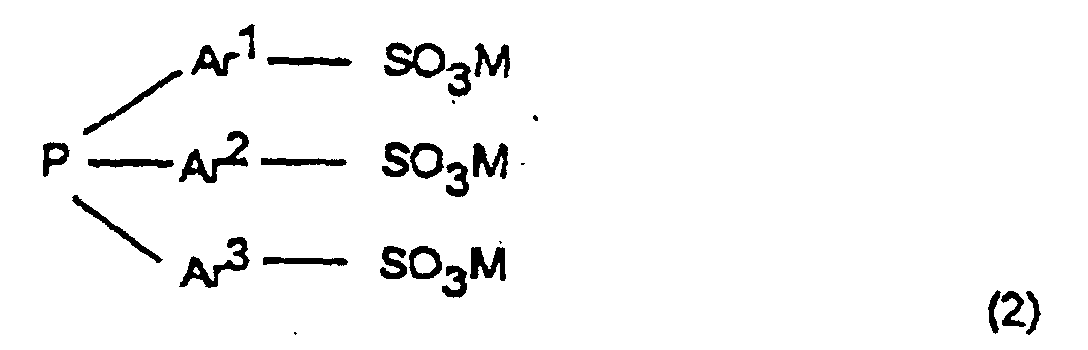
- the sulfonated triarylphosphines having a phosphorus atom are compounds of the formula (2) in which Ar 1 , Ar 2 and Ar 3 are identical or different and each represent a phenyl or naphthyl radical, in particular a phenyl radical, and M is identical or different, in particular the same, and for an alkali metal ion, an ammonium ion, a quaternary ammonium ion or a 1 / 2 earth potassium metal ion or 1/2 zinc ion, in particular an alkali metal ion or ammonium ion, preferably an alkali metal ion, particularly preferably a sodium ion.
- Trisodium tri (m-sulfophenyl) phosphine is particularly suitable as sulfonated triarylphosphine.
- This trisodium salt of tri (meta-sulfophenyl) phosphine contains also due to its production by sulfonation of triphenylphosphine Proportions of mono- and disulfonated compounds.
- trisodium tri (m-sulfophenyl) phosphine corresponds to the following formula:
- the sulfonated triarylphosphines with two phosphorus atoms can contain, for example, a radical - (CH 2 ) x -Ar-Ar- (CH 2 ) x -, where x is an integer from 1 to 4, in particular 1 to 2, preferably 1, Ar -Ar means biphenyl or binaphthyl, the - (CH 2 ) x group with one bond in each case ortho to the aryl-aryl bond Ar-Ar connecting the two aryl radicals and with the other bond each having a phosphorus atom, the has two further, identical or different aryl radicals, in particular phenyl radicals.
- triarylphosphines containing two phosphorus atoms have at least three -SO 3 M residues, in particular four to eight -SO 3 M residues, in which M has the meaning given above.
- the -SO 3 M residues are usually located on the aryl residues of the residue - (CH 2 ) x -Ar-Ar- (CH 2 ) x - and on the two other aryl residues that are connected to the phosphorus.
- each m 1 and m 2 independently of one another represents 0 or 1, the compound of the formula (3) containing three to six -SO 3 M groups.
- each m 3 , m 4 , m 5 and m 6 independently of one another represents 0 or 1, the compound of the formula (4) containing four to eight, in particular five to six, -SO 3 M groups.
- a compound of formula (3) or (4) which contains, for example, three SO 3 M groups also contains compounds with only two -SO 3 M groups but also compounds with four or five -SO 3 M groups.
- a compound of formula (3) or (4) with, for example, five -SO 3 M groups usually also contains compounds with only three or four -SO 3 M groups, but also compounds with six or seven -SO 3 M groups.
- the sulfonated triarylphosphines described above have due to their Sulfonate residues sufficient solubility to carry out the process in water.
- the rhodium and the compounds of the formula (2) are used as catalysts and the aqueous phase containing the compound of the formula (1) is usually in an amount of 2x10 -6 to 5x10 -2 , in particular 5x10 -5 to 5x10 -2 , preferably 1x10 - 4 to 1x10 -3 moles of rhodium per mole of olefinic compound.
- the amount of rhodium also depends on the type of olefinic compound to be hydroformylated. Although lower catalyst concentrations are possible, they may not prove to be particularly useful in individual cases, since the reaction rate may be too slow and therefore not economical enough.
- the upper catalyst concentration can be up to 1x10 -1 mol of rhodium per mol of olefinic compound. Comparatively high rhodium concentrations have no particular advantages.
- the rhodium and sulfonated triarylphosphines are used as catalysts and the aqueous phase containing the compound of the formula (1) R (OCH 2 CH 2 ) n OR 1 and the olefinic compound are usually used in a volume ratio of 10: 1 to 1:10, in particular 5: 1 to 1: 5, preferably 2: 1 to 1: 2.
- Rhodium and sulfonated triarylphosphines are used in a molar ratio of 1: 5 to 1: 2000 on.
- a sulfonated triarylphosphine with a phosphorus atom for example a compound of formula (2)
- rhodium is usually used and sulfonated triarylphosphine in a molar ratio of 1:10 to 1: 1000, in particular 1:50 to 1: 200, preferably 1:80 to 1: 120.
- Triarylphosphine usually in a molar ratio of 1: 5 to 1: 100, in particular 1: 5 to 1:50, preferably 1: 8 to 1:15.
- the aqueous phase contains 20 to 2000 ppm rhodium. If you have a sulfonated Triarylphosphine with a phosphorus atom, for example compounds of the formula (2) is used, an aqueous phase is used in most cases, the 100th contains up to 1000, in particular 200 to 500, preferably 300 to 400 ppm of rhodium. If you have a sulfonated triarylphosphine with two phosphorus atoms, for example Most of the compounds of formula (3) and / or (4) are used Cases an aqueous phase, the 20 to 500, in particular 30 to 150, preferred Contains 40 to 100 ppm rhodium.
- the reaction of propene is carried out in the presence of a 1 to 15, in particular 3 to 10 % By weight of the compound of the formula (1) containing aqueous phase.
- the compounds of the formula (1) are R (OCH 2 CH 2 ) n OR 1 , in which R is hydrogen, a straight-chain or branched alkyl radical having 1 to 4 carbon atoms or a hydroxyalkyl radical 1 to 4 carbon atoms, in particular hydrogen, an alkyl radical with 1 to 2 carbon atoms or a hydroxyalkyl radical with 1 to 3 carbon atoms, preferably hydrogen, methyl, hydroxymethyl or hydroxypropyl and R 1 for hydrogen or a methyl radical, in particular hydrogen, is a substance is sufficient to dissolve in water.
- R 1 represents hydrogen
- compounds of the formula R (OCH 2 CH 2 ) n OH polyethylene glycol of the formula H (OCH 2 CH 2 ) n OH with an average molecular weight of approximately 200 (PEG 200), 400 (PEG 400 ), 600 (PEG 600) or 1000 (PEG 1000), compounds of the formula CH 3 (OCH 2 CH 2 ) n OH with an average molecular weight of approximately 350 (M 350), 500 (M 500) or 750 (M 750) or compounds of the formula CH 3 CHOHCH 2 (OCH 2 CH 2 ) n OH with an average molecular weight of approximately 300 (300 PR), 450 (450 PR), 600 (600 PR) or 1000 (1000PR), in particular polyethylene glycol with an average Molecular weight of approximately 400 (PEG 400) and 600 (PEG 600), a compound of the formula CH 3 (OCH 2 CH 2 ) n OH with an average molecular weight of 500 (M 500) or a compound of the formula CH 3 CHOHCH 2 (OCH
- PEG 200 it is a mixture of polyethylene glycols of the formula H (OCH 2 CH 2 ) n OH, where n is an integer from 3 to 6
- PEG 400 it is a mixture of polyethylene glycols of the formula H (OCH 2 CH 2 ) n OH, in which n is an integer from 7 to 10
- under PEG 600 a mixture of polyethylene glycols of the formula H (OCH 2 CH 2 ) n OH, in which n is an integer from 11 to 16
- PEG 1000 a mixture of polyethylene glycols of the formula H (OCH 2 CH 2 ) n OH, where n is an integer from 15 to 30, to understand.
- a corresponding average molecular weight of approximately 200 (PEG 200), approximately 400 (PEG 400), approximately 600 (PEG 600) or approximately 1000 can be assigned to each of these mixtures.
- M 350 is a mixture of compounds of the formula CH 3 (OCH 2 CH 2 ) n OH, where n is an integer from 5 to 9
- M 500 is a mixture of compounds of the formula CH 3 (OCH 2 CH 2 ) n OH, in which n is an integer from 9 to 13
- M 750 is a mixture of compounds of the formula CH 3 (OCH 2 CH 2 ) n OH, in which n is an integer from 12 to 20
- a corresponding average molecular weight of approximately 350 (M 350), approximately 500 (M 500) and 750 (M 750) is to be assigned to each of these mixtures.
- n is an integer from 3 to 50, in particular 4 to 30, preferably 5 to 20, particularly preferably 6 to 12 , is to be used as a compound of formula (1).
- Any mixtures of the compounds of formula (1) namely Polyethylene glycols, polyethylene glycol ether (half ether) and polyethylene glycol diether deploy.
- the wetting is carried out in the presence of hydrogen and carbon monoxide.
- the molar ratio of hydrogen to carbon monoxide can be chosen within wide limits and is usually 1:10 to 10: 1, in particular 5: 1 to 1: 5, preferably 2: 1 to 1: 2, particularly preferably 1.2: 1 to 1: 1.2. Designed to be particularly simple the process when you have hydrogen and carbon monoxide in a molar ratio 1: 1 or approximately 1: 1.
- aqueous phase and carbon monoxide / hydrogen is provided. This can be done, for example, by vigorous stirring and / or pumping around organic and aqueous phase can be effected.
- organic phase usually the olefinic compound, the aldehydes produced and minor Portions of the aqueous phase, while the aqueous phase is usually rhodium, the sulfonated triarylphosphines, the compound of formula (1), water and minor Contains portions of the organic phase.
- the hydroformylation mixture is passed through after completion of the reaction Depressurization freed of carbon monoxide and hydrogen and the reaction product, optionally after cooling, of which the catalyst and the compound of the formula (1) containing aqueous phase separated by phase separation.
- the aqueous phase containing the catalyst and the compound of formula (1) can be returned to the process according to the invention while the separated organic phase containing the reaction product, for example is worked up by fractional distillation.
- the process can be carried out continuously and discontinuously.
- the reaction apparatus used for the continuous hydroformylation of propene consists of a reactor (volume 11), one downstream of the reactor High-pressure separator and a downstream of the high-pressure separator Phase separation vessel. During the hydroformylation are in the reactor aqueous catalyst solution, unreacted propene, reaction products and Synthesis gas. A stirrer installed in the reactor ensures thorough mixing.
- Propene and water are passed through an immersion tube protruding into the reactor added.
- the water addition serves to reduce the water content with the hydroformylation product discharged and removed from the aqueous catalyst solution, to complete.
- the reaction mixture is passed through an immersion tube immersed in the reactor removed from the reactor and fed to a high pressure separator.
- the reaction mixture is separated in the high-pressure separator gaseous and liquid components.
- the gaseous, essentially unreacted Syngas containing small amounts of propene and reaction products Components are removed from the high-pressure separator and in a downstream one further separator after cooling of the organic products separated.
- the unreacted synthesis gas freed from the organic components is fed back after recompression of the reaction.
- the liquid, essentially the aqueous catalyst solution and the reaction mixture Containing components are removed from the high pressure separator and the phase separation vessel connected downstream of the high-pressure separator.
- the lower, the aqueous catalyst solution containing phase, is derived from the phase separation vessel and by means of a Pump returned to the reactor. In this way, the aqueous catalyst solution led in a circle.
- the total catalyst solution is 850 ml, ie 200 ml of catalyst solution are in the circuit system (high pressure separator, phase separation vessel and lines) connected to the reactor. 83.5 g of propene per hour and 0.0955 standard cubic meters of synthesis gas are fed continuously to the reactor. The pressure is 50 bar and the reaction temperature is 122 ° C. The contents of the reactor are mixed vigorously using the stirrer. The mean residence time of the catalyst solution is 0.43 h -1 . The catalyst solution separated off in the phase separation vessel (1.5 l / h) is fed back to the reactor.
- the propene conversion is 90%. This corresponds to a productivity of 0.2 kg of crude hydroformylation product per I catalyst solution and hour (0.2 kg / (l Cat x h). The ratio of n-butyraldehyde to 2-methylpropanal is 93: 7.
- the propene turnover is now 95% to 96%. That corresponds to productivity of 0.25 kg of crude hydroformylation product per liter of catalyst solution and hour (0.25 kg / (I Kat x h).
- the ratio of n-butyraldehyde to 2-methylpropanal is 91:. 9
Landscapes
- Chemical & Material Sciences (AREA)
- Organic Chemistry (AREA)
- Chemical Kinetics & Catalysis (AREA)
- Organic Low-Molecular-Weight Compounds And Preparation Thereof (AREA)
- Low-Molecular Organic Synthesis Reactions Using Catalysts (AREA)
- Catalysts (AREA)
- Pharmaceuticals Containing Other Organic And Inorganic Compounds (AREA)
Claims (28)
- Procédé pour la préparation d'aldéhydes, caractérisé en ce qu'on transforme du propylène en présence d'une phase aqueuse contenant du rhodium et des triarylphosphines sulfonées comme catalyseur et 1 à 15% en poids d'un composé de formule (1) R(OCH2CH2)nOR1, les triarylphosphines contenant au moins trois radicaux -(SO3)M, dans lesquels M est identique ou différent et M représente H, un ion de métal alcalin, un ion d'ammonium, un ion d'ammonium quaternaire, un 1/2 ion de métal alcalino-terreux ou 1/2 ion de zinc, et, dans la formule (1), R représentant un hydrogène, un radical alkyle linéaire ou ramifié comprenant 1 à 4 atomes de carbone ou un radical hydroxyalkyle comprenant 1 à 4 atomes de carbone, R1 représentant un hydrogène ou un radical méthyle et n représentant un nombre entier de 3 à 50, avec de l'hydrogène et du monoxyde de carbone à 20 jusqu'à 170°C et 1 à 300 bars.
- Procédé selon la revendication 1, caractérisé en ce qu'on utilise comme triarylphosphines sulfonées des composés de formule (2)dans laquelle Ar1, Ar2 et Ar3 sont identiques ou différents et signifient à chaque fois un radical phényle ou naphtyle, et M est identique ou différent et représente un ion de métal alcalin, un ion d'ammonium, un ion d'ammonium quaternaire ou un 1/2 ion de métal alcalino-terreux ou un 1/2 ion de zinc.
- Procédé selon les revendications 1 ou 2, caractérisé en ce qu'on utilise une triphénylphosphine trisulfonée comme triarylphosphines sulfonées.
- Procédé selon les revendications 1 ou 2, caractérisé en ce qu'on utilise de la tri(m-sulfophényl)phosphine trisodique comme triarylphosphine sulfonée.
- Procédé selon l'une quelconque ou plusieurs des revendications 1 à 4, caractérisé en ce qu'on utilise la phase aqueuse correspondant à une quantité de 2x10⁻⁶ à 5x10⁻² mole de rhodium par mole de composé oléfinique.
- Procédé selon l'une quelconque ou plusieurs des revendications 1 à 5, caractérisé en ce qu'on utilise le rhodium et les triarylphosphines sulfonées de formule (2) dans un rapport molaire de 1:10 à 1:1000.
- Procédé selon l'une quelconque ou plusieurs des revendications 1 à 6, caractérisé en ce qu'on utilise le rhodium et les triarylphosphines sulfonées de formule (2) dans un rapport molaire de 1:50 à 1:200.
- Procédé selon l'une quelconque ou plusieurs des revendications 1 à 7, caractérisé en ce que la phase aqueuse contient 100 à 1000 ppm de rhodium dans le cas de l'utilisation de triarylphosphines sulfonées de formule (2).
- Procédé selon l'une quelconque ou plusieurs des revendications 1 à 8, caractérisé en ce que la phase aqueuse contient 200 à 500 ppm de rhodium dans le cas de l'utilisation de triarylphosphines sulfonées de formule (2).
- Procédé selon l'une quelconque ou plusieurs des revendications 1 à 9, caractérisé en ce que la phase aqueuse contient 300 à 400 ppm de rhodium dans le cas de l'utilisation de triarylphosphines sulfonées de formule (2).
- Procédé selon l'une quelconque ou plusieurs des revendications 1 à 10, caractérisé en ce qu'on utilise comme triarylphosphines sulfonées des composés de formule (3)dans laquelle m1 et m2 représentent, indépendamment l'un de l'autre, 0 ou 1 et les composés de formule (3) présentent trois à six groupements -SO3M, M présentant la signification susmentionnée.

- Procédé selon l'une quelconque ou plusieurs des revendications 1 à 11, caractérisé en ce qu'on utilise comme triarytphosphines sulfonées des composés de formule (4)dans laquelle m3, m4, m5 et m6 représentent, indépendamment l'un de l'autre, 0 ou 1 et les composés de formule (4) présentent quatre à huit groupements -SO3M, M présentant la signification susmentionnée.

- Procédé selon l'une quelconque ou plusieurs des revendications 1 à 12, caractérisé en ce qu'on utilise le rhodium et les triarylphosphines sulfonées de formule (3) ou (4) dans un rapport molaire de 1:5 à 1:100.
- Procédé selon l'une quelconque ou plusieurs des revendications 1 à 13, caractérisé en ce qu'on utilise le rhodium et les triarylphosphines sulfonées de formule (3) ou (4) dans un rapport molaire de 1:5 à 1:50.
- Procédé selon l'une quelconque ou plusieurs des revendications 1 à 14, caractérisé en ce qu'on utilise le rhodium et les triarylphosphines sutfonées de formule (3) ou (4) dans un rapport molaire de 1:8 à 1:15.
- Procédé selon l'une quelconque ou plusieurs des revendications 1 à 15, caractérisé en ce que la phase aqueuse contient 20 à 500 ppm de rhodium dans le cas de l'utilisation de triarylphosphines sulfonées de formule (3) ou (4).
- Procédé selon l'une quelconque ou plusieurs des revendications 1 à 16, caractérisé en ce que la phase aqueuse contient 30 à 150 ppm de rhodium dans le cas de l'utilisation de triarylphosphines sulfonées de formule (3) où (4).
- Procédé selon l'une quelconque ou plusieurs des revendications 1 à 17, caractérisé en ce que la phase aqueuse contient 40 à 100 ppm de rhodium dans le cas de l'utilisation de triarylphosphines sulfonées de formule (3) ou (4).
- Procédé selon l'une quelconque ou plusieurs des revendications 1 à 18, caractérisé en ce qu'on transforme du propylène comme composé oléfinique en présence d'une phase aqueuse contenant 3 à 10% en poids du composé de formule (1).
- Procédé selon l'une quelconque ou plusieurs des revendications 1 à 19, caractérisé en ce qu'on utilise un polyéthylèneglycot de formule H(OCH2CH2)nOH dans laquelle n représente un nombre entier de 3 a 50 comme composé de formule (1).
- Procédé selon l'une quelconque ou plusieurs des revendications 1 à 20, caractérisé en ce qu'on utilise un polyétnylèneglycol de formule H(OCH2CH2)nOH dans laquelle n représente un nombre entier de 4 à 30 comme composé de formule (1).
- Procédé selon l'une quelconque ou plusieurs des revendications 1 à 21, caractérisé en ce qu'on utilise un polyéthylèneglycol de formule H(OCH2CH2)nOH dans laquelle n représente un nombre entier de 6 à 12 comme composé de formule (1).
- Procédé selon l'une quelconque ou plusieurs des revendications 1 à 22, caractérisé en ce qu'on utilise un composé de formule R(OCH2CH2)nOH dans laquelle R représente un radical méthyle ou un radical β-hydroxypropyle et n représente un nombre entier de 3 à 50 comme composés de formule (1).
- Procédé selon l'une quelconque ou plusieurs des revendications 1 à 23, caractérisé en ce qu'on utilise un composé de formule R(OCH2CH2)nOH dans laquelle R représente un radical méthyle ou un radical β-hydroxypropyle et n représente un nombre entier de 4 à 30 comme composés de formule (1).
- Procédé selon l'une quelconque ou plusieurs des revendications 1 à 24, caractérisé en ce qu'on effectue la transformation à 50 jusqu'à 150°C,
- Procédé selon l'une quelconque ou plusieurs des revendications 1 à 25, caractérisé en ce qu'on effectue la transformation à 100 jusqu'à 140°C.
- Procédé selon l'une quelconque ou plusieurs des revendications 1 à 26, caractérisé en ce qu'on effectue la transformation à 20 jusqu'à 150 bars.
- Procédé selon l'une quelconque ou plusieurs des revendications 1 à 27, caractérisé en ce qu'on effectue la transformation à 30 jusqu'à 80 bars.
Priority Applications (1)
| Application Number | Priority Date | Filing Date | Title |
|---|---|---|---|
| EP01122277A EP1160234B1 (fr) | 1997-01-13 | 1997-12-30 | Procédé pour la préparation d' aldéhydes par hydroformylation |
Applications Claiming Priority (3)
| Application Number | Priority Date | Filing Date | Title |
|---|---|---|---|
| DE19700805 | 1997-01-13 | ||
| DE19700805A DE19700805C1 (de) | 1997-01-13 | 1997-01-13 | Verfahren zur Herstellung von Aldehyden durch Hydroformylierung olefinischer Verbindungen mit 3 bis 5 Kohlenstoffatomen in Anwesenheit einer Rhodium und sulfonierte Triarylphosphine als Katalysator enthhaltenden wäßrigen Phase |
| PCT/EP1997/007315 WO1998030527A1 (fr) | 1997-01-13 | 1997-12-30 | Procede de preparation d'aldehydes par hydroformylation |
Related Child Applications (1)
| Application Number | Title | Priority Date | Filing Date |
|---|---|---|---|
| EP01122277A Division EP1160234B1 (fr) | 1997-01-13 | 1997-12-30 | Procédé pour la préparation d' aldéhydes par hydroformylation |
Publications (2)
| Publication Number | Publication Date |
|---|---|
| EP0958271A1 EP0958271A1 (fr) | 1999-11-24 |
| EP0958271B1 true EP0958271B1 (fr) | 2003-05-28 |
Family
ID=7817211
Family Applications (2)
| Application Number | Title | Priority Date | Filing Date |
|---|---|---|---|
| EP01122277A Expired - Lifetime EP1160234B1 (fr) | 1997-01-13 | 1997-12-30 | Procédé pour la préparation d' aldéhydes par hydroformylation |
| EP97954759A Expired - Lifetime EP0958271B1 (fr) | 1997-01-13 | 1997-12-30 | Procede de preparation d'aldehydes par hydroformylation |
Family Applications Before (1)
| Application Number | Title | Priority Date | Filing Date |
|---|---|---|---|
| EP01122277A Expired - Lifetime EP1160234B1 (fr) | 1997-01-13 | 1997-12-30 | Procédé pour la préparation d' aldéhydes par hydroformylation |
Country Status (14)
| Country | Link |
|---|---|
| US (1) | US6211414B1 (fr) |
| EP (2) | EP1160234B1 (fr) |
| JP (1) | JP2002508741A (fr) |
| KR (1) | KR100548975B1 (fr) |
| CN (1) | CN1136179C (fr) |
| AT (2) | ATE241581T1 (fr) |
| AU (1) | AU5985898A (fr) |
| DE (3) | DE19700805C1 (fr) |
| DK (1) | DK0958271T3 (fr) |
| ES (1) | ES2197387T3 (fr) |
| PT (1) | PT958271E (fr) |
| TW (1) | TW466231B (fr) |
| WO (1) | WO1998030527A1 (fr) |
| ZA (1) | ZA98211B (fr) |
Families Citing this family (7)
| Publication number | Priority date | Publication date | Assignee | Title |
|---|---|---|---|---|
| DE19740672A1 (de) * | 1997-09-16 | 1999-03-18 | Hoechst Ag | Verfahren zur Herstellung von Aldehyden durch Hydroformylierung |
| DE19940249A1 (de) * | 1999-08-25 | 2001-03-01 | Celanese Chem Europe Gmbh | Verfahren zur Herstellung von Aldehyden |
| US7649112B2 (en) | 2005-07-25 | 2010-01-19 | Saudi Basic Industries Corporation | Integrated plant for producing 2-ethyl-hexanol and methacrylic acid and a method based thereon |
| DE102008044783B4 (de) | 2008-08-28 | 2012-05-16 | Oxea Gmbh | Verfahren zur Gewinnung von aliphatischen C3- bis C10- Aldehyden aus Hochsiedern durch thermische Behandlung |
| KR101559082B1 (ko) | 2013-12-18 | 2015-10-08 | 한화케미칼 주식회사 | 올레핀계 화합물의 하이드로포밀화 반응용 수용성 촉매 조성물 |
| DE102017206200A1 (de) * | 2017-04-11 | 2018-10-11 | Evonik Degussa Gmbh | Verfahren zur Hydroformylierung von Pentensäureestern |
| CN117531544B (zh) * | 2024-01-09 | 2024-03-15 | 山东海科创新研究院有限公司 | 一种非均相催化剂及其制备方法和应用 |
Family Cites Families (6)
| Publication number | Priority date | Publication date | Assignee | Title |
|---|---|---|---|---|
| US3404188A (en) * | 1963-11-01 | 1968-10-01 | Union Carbide Corp | Process for the preparation of polyhydric alcohols |
| FR2314910A1 (fr) * | 1975-06-20 | 1977-01-14 | Rhone Poulenc Ind | Procede d'hydroformylation des olefines |
| GB2085874B (en) * | 1980-09-04 | 1984-08-08 | Johnson Matthey Plc | Hydroformylation of olefins |
| US5091350A (en) * | 1984-03-26 | 1992-02-25 | Hoechst Aktiengesellschaft | Process for hydroformylation with rhodium catalysts and the separation of rhodium therefrom |
| DE3412335A1 (de) * | 1984-04-03 | 1985-10-10 | Ruhrchemie Ag, 4200 Oberhausen | Verfahren zur herstellung von aldehyden |
| US4731486A (en) * | 1986-11-18 | 1988-03-15 | Union Carbide Corporation | Hydroformylation using low volatile phosphine ligands |
-
1997
- 1997-01-13 DE DE19700805A patent/DE19700805C1/de not_active Expired - Fee Related
- 1997-12-30 WO PCT/EP1997/007315 patent/WO1998030527A1/fr not_active Ceased
- 1997-12-30 JP JP53051298A patent/JP2002508741A/ja not_active Ceased
- 1997-12-30 DE DE59712299T patent/DE59712299D1/de not_active Expired - Fee Related
- 1997-12-30 AT AT97954759T patent/ATE241581T1/de not_active IP Right Cessation
- 1997-12-30 EP EP01122277A patent/EP1160234B1/fr not_active Expired - Lifetime
- 1997-12-30 DE DE59710186T patent/DE59710186D1/de not_active Expired - Fee Related
- 1997-12-30 PT PT97954759T patent/PT958271E/pt unknown
- 1997-12-30 DK DK97954759T patent/DK0958271T3/da active
- 1997-12-30 CN CNB971819386A patent/CN1136179C/zh not_active Expired - Fee Related
- 1997-12-30 AT AT01122277T patent/ATE294769T1/de not_active IP Right Cessation
- 1997-12-30 KR KR1019997006361A patent/KR100548975B1/ko not_active Expired - Fee Related
- 1997-12-30 ES ES97954759T patent/ES2197387T3/es not_active Expired - Lifetime
- 1997-12-30 EP EP97954759A patent/EP0958271B1/fr not_active Expired - Lifetime
- 1997-12-30 AU AU59858/98A patent/AU5985898A/en not_active Abandoned
- 1997-12-30 US US09/341,835 patent/US6211414B1/en not_active Expired - Fee Related
-
1998
- 1998-01-09 TW TW087100257A patent/TW466231B/zh not_active IP Right Cessation
- 1998-01-12 ZA ZA98211A patent/ZA98211B/xx unknown
Also Published As
| Publication number | Publication date |
|---|---|
| DE59710186D1 (de) | 2003-07-03 |
| KR20000070136A (ko) | 2000-11-25 |
| EP0958271A1 (fr) | 1999-11-24 |
| KR100548975B1 (ko) | 2006-02-03 |
| ZA98211B (en) | 1998-10-19 |
| HK1025309A1 (en) | 2000-11-10 |
| US6211414B1 (en) | 2001-04-03 |
| EP1160234B1 (fr) | 2005-05-04 |
| WO1998030527A1 (fr) | 1998-07-16 |
| DK0958271T3 (da) | 2003-09-15 |
| CN1248964A (zh) | 2000-03-29 |
| ES2197387T3 (es) | 2004-01-01 |
| JP2002508741A (ja) | 2002-03-19 |
| ATE294769T1 (de) | 2005-05-15 |
| TW466231B (en) | 2001-12-01 |
| AU5985898A (en) | 1998-08-03 |
| CN1136179C (zh) | 2004-01-28 |
| ATE241581T1 (de) | 2003-06-15 |
| PT958271E (pt) | 2003-08-29 |
| DE19700805C1 (de) | 1998-08-06 |
| EP1160234A1 (fr) | 2001-12-05 |
| DE59712299D1 (de) | 2005-06-09 |
Similar Documents
| Publication | Publication Date | Title |
|---|---|---|
| DE2627354C3 (de) | Verfahren zur Herstellung von Aldehyden | |
| DE3017682C2 (fr) | ||
| EP0695734B1 (fr) | Procédé pour la préparation d'aldéhydes | |
| DE3135127A1 (de) | Katalytisches verfahren | |
| DE3232557C2 (fr) | ||
| EP0157316B1 (fr) | Procédé de préparation d'aldéhydes | |
| EP0163234B1 (fr) | Procédé de préparation d'aldéhydes | |
| EP0246475B1 (fr) | Procédé de préparation d'aldéhydes | |
| EP0158246A2 (fr) | Procédé de production d'aldéhydes | |
| DE19700805C1 (de) | Verfahren zur Herstellung von Aldehyden durch Hydroformylierung olefinischer Verbindungen mit 3 bis 5 Kohlenstoffatomen in Anwesenheit einer Rhodium und sulfonierte Triarylphosphine als Katalysator enthhaltenden wäßrigen Phase | |
| DE3726128A1 (de) | Verfahren zur herstellung von aldehyden | |
| DE3546123A1 (de) | Verfahren zur herstellung von aldehyden | |
| EP0269011A1 (fr) | Procédé de préparation d'aldéhydes | |
| DE19700804C1 (de) | Verfahren zur Herstellung von Aldehyden durch Hydroformylierung olefinischer Verbindungen mit 6 bis 16 Kohlenstoffatomen in Anwesenheit einer Rhodium und sulfonierte Triarylphosphine als Katalysator enthaltenden wäßrigen Phase | |
| DE4242723A1 (de) | Verfahren zur Herstellung von Aldehyden | |
| EP1017492B1 (fr) | Procede de preparation d'aldehydes par hydroformylation | |
| EP0160249B1 (fr) | Procédé de préparation d'aldéhydes | |
| EP0186075B1 (fr) | Procédé de préparation de 8- et 9-formyl-tricyclo-(5,2,1,0, 2,6)-décène-3 | |
| EP1017660B1 (fr) | Procede de production d'aldehydes par hydroformylation en presence d'ether couronne | |
| DE1955828C2 (de) | Verfahren zur Herstellung von Alkoholen und Aldehyden | |
| WO1997049490A1 (fr) | Catalyseur et procede pour la preparation d'aldehydes en presence de ce catalyseur | |
| DE1955828B1 (de) | Verfahren zur Herstellung von Alkoholen und/oder Aldehyden |
Legal Events
| Date | Code | Title | Description |
|---|---|---|---|
| PUAI | Public reference made under article 153(3) epc to a published international application that has entered the european phase |
Free format text: ORIGINAL CODE: 0009012 |
|
| 17P | Request for examination filed |
Effective date: 19990813 |
|
| AK | Designated contracting states |
Kind code of ref document: A1 Designated state(s): AT BE CH DE DK ES FI FR GB GR IE IT LI LU NL PT SE |
|
| RAP1 | Party data changed (applicant data changed or rights of an application transferred) |
Owner name: CELANESE CHEMICALS EUROPE GMBH |
|
| 17Q | First examination report despatched |
Effective date: 20010420 |
|
| GRAH | Despatch of communication of intention to grant a patent |
Free format text: ORIGINAL CODE: EPIDOS IGRA |
|
| GRAH | Despatch of communication of intention to grant a patent |
Free format text: ORIGINAL CODE: EPIDOS IGRA |
|
| GRAA | (expected) grant |
Free format text: ORIGINAL CODE: 0009210 |
|
| AK | Designated contracting states |
Designated state(s): AT BE CH DE DK ES FI FR GB GR IE IT LI LU NL PT SE |
|
| REG | Reference to a national code |
Ref country code: GB Ref legal event code: FG4D Free format text: NOT ENGLISH |
|
| REG | Reference to a national code |
Ref country code: CH Ref legal event code: NV Representative=s name: BARMAG GMBH ENGINEERING AND MANUFACTURING Ref country code: CH Ref legal event code: EP |
|
| REG | Reference to a national code |
Ref country code: SE Ref legal event code: TRGR |
|
| REG | Reference to a national code |
Ref country code: IE Ref legal event code: FG4D Free format text: GERMAN |
|
| REF | Corresponds to: |
Ref document number: 59710186 Country of ref document: DE Date of ref document: 20030703 Kind code of ref document: P |
|
| REG | Reference to a national code |
Ref country code: GR Ref legal event code: EP Ref document number: 20030402895 Country of ref document: GR |
|
| REG | Reference to a national code |
Ref country code: DK Ref legal event code: T3 |
|
| GBT | Gb: translation of ep patent filed (gb section 77(6)(a)/1977) | ||
| REG | Reference to a national code |
Ref country code: ES Ref legal event code: FG2A Ref document number: 2197387 Country of ref document: ES Kind code of ref document: T3 |
|
| ET | Fr: translation filed | ||
| PLBE | No opposition filed within time limit |
Free format text: ORIGINAL CODE: 0009261 |
|
| STAA | Information on the status of an ep patent application or granted ep patent |
Free format text: STATUS: NO OPPOSITION FILED WITHIN TIME LIMIT |
|
| 26N | No opposition filed |
Effective date: 20040302 |
|
| PGFP | Annual fee paid to national office [announced via postgrant information from national office to epo] |
Ref country code: PT Payment date: 20061129 Year of fee payment: 10 |
|
| PGFP | Annual fee paid to national office [announced via postgrant information from national office to epo] |
Ref country code: SE Payment date: 20061213 Year of fee payment: 10 Ref country code: AT Payment date: 20061213 Year of fee payment: 10 Ref country code: DK Payment date: 20061213 Year of fee payment: 10 |
|
| PGFP | Annual fee paid to national office [announced via postgrant information from national office to epo] |
Ref country code: CH Payment date: 20061214 Year of fee payment: 10 Ref country code: FI Payment date: 20061214 Year of fee payment: 10 |
|
| PGFP | Annual fee paid to national office [announced via postgrant information from national office to epo] |
Ref country code: NL Payment date: 20061215 Year of fee payment: 10 Ref country code: LU Payment date: 20061215 Year of fee payment: 10 |
|
| PGFP | Annual fee paid to national office [announced via postgrant information from national office to epo] |
Ref country code: GB Payment date: 20061221 Year of fee payment: 10 |
|
| PGFP | Annual fee paid to national office [announced via postgrant information from national office to epo] |
Ref country code: IE Payment date: 20061222 Year of fee payment: 10 |
|
| PGFP | Annual fee paid to national office [announced via postgrant information from national office to epo] |
Ref country code: ES Payment date: 20061228 Year of fee payment: 10 |
|
| PGFP | Annual fee paid to national office [announced via postgrant information from national office to epo] |
Ref country code: GR Payment date: 20061229 Year of fee payment: 10 |
|
| PGFP | Annual fee paid to national office [announced via postgrant information from national office to epo] |
Ref country code: IT Payment date: 20061231 Year of fee payment: 10 Ref country code: DE Payment date: 20061231 Year of fee payment: 10 |
|
| PGFP | Annual fee paid to national office [announced via postgrant information from national office to epo] |
Ref country code: BE Payment date: 20070118 Year of fee payment: 10 |
|
| PGFP | Annual fee paid to national office [announced via postgrant information from national office to epo] |
Ref country code: FR Payment date: 20061212 Year of fee payment: 10 |
|
| BERE | Be: lapsed |
Owner name: *CELANESE CHEMICALS EUROPE G.M.B.H. Effective date: 20071231 |
|
| REG | Reference to a national code |
Ref country code: PT Ref legal event code: MM4A Free format text: LAPSE DUE TO NON-PAYMENT OF FEES Effective date: 20080630 |
|
| PG25 | Lapsed in a contracting state [announced via postgrant information from national office to epo] |
Ref country code: FI Free format text: LAPSE BECAUSE OF NON-PAYMENT OF DUE FEES Effective date: 20071230 |
|
| REG | Reference to a national code |
Ref country code: CH Ref legal event code: PL |
|
| REG | Reference to a national code |
Ref country code: DK Ref legal event code: EBP |
|
| EUG | Se: european patent has lapsed | ||
| GBPC | Gb: european patent ceased through non-payment of renewal fee |
Effective date: 20071230 |
|
| PG25 | Lapsed in a contracting state [announced via postgrant information from national office to epo] |
Ref country code: AT Free format text: LAPSE BECAUSE OF NON-PAYMENT OF DUE FEES Effective date: 20071230 |
|
| NLV4 | Nl: lapsed or anulled due to non-payment of the annual fee |
Effective date: 20080701 |
|
| PG25 | Lapsed in a contracting state [announced via postgrant information from national office to epo] |
Ref country code: PT Free format text: LAPSE BECAUSE OF NON-PAYMENT OF DUE FEES Effective date: 20080630 Ref country code: BE Free format text: LAPSE BECAUSE OF NON-PAYMENT OF DUE FEES Effective date: 20071231 |
|
| REG | Reference to a national code |
Ref country code: IE Ref legal event code: MM4A |
|
| PG25 | Lapsed in a contracting state [announced via postgrant information from national office to epo] |
Ref country code: SE Free format text: LAPSE BECAUSE OF NON-PAYMENT OF DUE FEES Effective date: 20071231 Ref country code: LI Free format text: LAPSE BECAUSE OF NON-PAYMENT OF DUE FEES Effective date: 20071231 Ref country code: IE Free format text: LAPSE BECAUSE OF NON-PAYMENT OF DUE FEES Effective date: 20071231 Ref country code: DE Free format text: LAPSE BECAUSE OF NON-PAYMENT OF DUE FEES Effective date: 20080701 Ref country code: CH Free format text: LAPSE BECAUSE OF NON-PAYMENT OF DUE FEES Effective date: 20071231 |
|
| REG | Reference to a national code |
Ref country code: FR Ref legal event code: ST Effective date: 20081020 |
|
| PG25 | Lapsed in a contracting state [announced via postgrant information from national office to epo] |
Ref country code: NL Free format text: LAPSE BECAUSE OF NON-PAYMENT OF DUE FEES Effective date: 20080701 |
|
| PG25 | Lapsed in a contracting state [announced via postgrant information from national office to epo] |
Ref country code: GB Free format text: LAPSE BECAUSE OF NON-PAYMENT OF DUE FEES Effective date: 20071230 |
|
| PG25 | Lapsed in a contracting state [announced via postgrant information from national office to epo] |
Ref country code: DK Free format text: LAPSE BECAUSE OF NON-PAYMENT OF DUE FEES Effective date: 20080102 |
|
| REG | Reference to a national code |
Ref country code: ES Ref legal event code: FD2A Effective date: 20071231 |
|
| PG25 | Lapsed in a contracting state [announced via postgrant information from national office to epo] |
Ref country code: FR Free format text: LAPSE BECAUSE OF NON-PAYMENT OF DUE FEES Effective date: 20071231 Ref country code: ES Free format text: LAPSE BECAUSE OF NON-PAYMENT OF DUE FEES Effective date: 20071231 |
|
| PG25 | Lapsed in a contracting state [announced via postgrant information from national office to epo] |
Ref country code: GR Free format text: LAPSE BECAUSE OF NON-PAYMENT OF DUE FEES Effective date: 20080702 |
|
| PG25 | Lapsed in a contracting state [announced via postgrant information from national office to epo] |
Ref country code: LU Free format text: LAPSE BECAUSE OF NON-PAYMENT OF DUE FEES Effective date: 20071230 Ref country code: IT Free format text: LAPSE BECAUSE OF NON-PAYMENT OF DUE FEES Effective date: 20071230 |