EP0960227B1 - Verfahren und vorrichtung zur herstellung von textilen produkten und erhaltene textile produkte - Google Patents
Verfahren und vorrichtung zur herstellung von textilen produkten und erhaltene textile produkte Download PDFInfo
- Publication number
- EP0960227B1 EP0960227B1 EP98909446A EP98909446A EP0960227B1 EP 0960227 B1 EP0960227 B1 EP 0960227B1 EP 98909446 A EP98909446 A EP 98909446A EP 98909446 A EP98909446 A EP 98909446A EP 0960227 B1 EP0960227 B1 EP 0960227B1
- Authority
- EP
- European Patent Office
- Prior art keywords
- loops
- substrate
- filaments
- product
- support
- Prior art date
- Legal status (The legal status is an assumption and is not a legal conclusion. Google has not performed a legal analysis and makes no representation as to the accuracy of the status listed.)
- Expired - Lifetime
Links
- 239000004753 textile Substances 0.000 title claims abstract description 22
- 238000000034 method Methods 0.000 title claims description 52
- 238000004519 manufacturing process Methods 0.000 claims abstract description 13
- 239000000047 product Substances 0.000 claims description 64
- 239000000758 substrate Substances 0.000 claims description 51
- 239000000463 material Substances 0.000 claims description 17
- 238000010438 heat treatment Methods 0.000 claims description 10
- 229910000278 bentonite Inorganic materials 0.000 claims description 9
- 239000000440 bentonite Substances 0.000 claims description 9
- SVPXDRXYRYOSEX-UHFFFAOYSA-N bentoquatam Chemical compound O.O=[Si]=O.O=[Al]O[Al]=O SVPXDRXYRYOSEX-UHFFFAOYSA-N 0.000 claims description 9
- 238000012546 transfer Methods 0.000 claims description 8
- 238000009825 accumulation Methods 0.000 claims description 7
- 239000003292 glue Substances 0.000 claims description 7
- 230000008018 melting Effects 0.000 claims description 5
- 238000002844 melting Methods 0.000 claims description 5
- 239000012467 final product Substances 0.000 claims description 2
- 239000004744 fabric Substances 0.000 claims 1
- 239000004576 sand Substances 0.000 claims 1
- 239000007787 solid Substances 0.000 claims 1
- 230000001052 transient effect Effects 0.000 claims 1
- 239000000835 fiber Substances 0.000 description 63
- 230000008569 process Effects 0.000 description 20
- 239000000843 powder Substances 0.000 description 10
- 229920001944 Plastisol Polymers 0.000 description 8
- 239000004999 plastisol Substances 0.000 description 8
- 239000000853 adhesive Substances 0.000 description 7
- 230000001070 adhesive effect Effects 0.000 description 7
- 239000004800 polyvinyl chloride Substances 0.000 description 7
- 229920000915 polyvinyl chloride Polymers 0.000 description 7
- NIXOWILDQLNWCW-UHFFFAOYSA-N acrylic acid group Chemical group C(C=C)(=O)O NIXOWILDQLNWCW-UHFFFAOYSA-N 0.000 description 3
- 238000005304 joining Methods 0.000 description 3
- 210000000056 organ Anatomy 0.000 description 3
- 238000012549 training Methods 0.000 description 3
- 229920006397 acrylic thermoplastic Polymers 0.000 description 2
- 239000006260 foam Substances 0.000 description 2
- 238000001879 gelation Methods 0.000 description 2
- 239000004746 geotextile Substances 0.000 description 2
- 239000012943 hotmelt Substances 0.000 description 2
- 229920003229 poly(methyl methacrylate) Polymers 0.000 description 2
- 238000002360 preparation method Methods 0.000 description 2
- 239000011347 resin Substances 0.000 description 2
- 229920005989 resin Polymers 0.000 description 2
- ISXSCDLOGDJUNJ-UHFFFAOYSA-N tert-butyl prop-2-enoate Chemical compound CC(C)(C)OC(=O)C=C ISXSCDLOGDJUNJ-UHFFFAOYSA-N 0.000 description 2
- 229920001169 thermoplastic Polymers 0.000 description 2
- 239000004416 thermosoftening plastic Substances 0.000 description 2
- 239000004831 Hot glue Substances 0.000 description 1
- 229920001410 Microfiber Polymers 0.000 description 1
- 239000004743 Polypropylene Substances 0.000 description 1
- 229920005830 Polyurethane Foam Polymers 0.000 description 1
- 241001125929 Trisopterus luscus Species 0.000 description 1
- 230000009471 action Effects 0.000 description 1
- 230000003213 activating effect Effects 0.000 description 1
- 230000004913 activation Effects 0.000 description 1
- 238000004026 adhesive bonding Methods 0.000 description 1
- 238000009960 carding Methods 0.000 description 1
- 239000004927 clay Substances 0.000 description 1
- 230000000295 complement effect Effects 0.000 description 1
- 239000002131 composite material Substances 0.000 description 1
- 230000008021 deposition Effects 0.000 description 1
- 238000009826 distribution Methods 0.000 description 1
- 229940082150 encore Drugs 0.000 description 1
- 239000010408 film Substances 0.000 description 1
- 238000009408 flooring Methods 0.000 description 1
- 230000004927 fusion Effects 0.000 description 1
- 239000011521 glass Substances 0.000 description 1
- 230000012010 growth Effects 0.000 description 1
- 239000013529 heat transfer fluid Substances 0.000 description 1
- 230000001678 irradiating effect Effects 0.000 description 1
- 239000012948 isocyanate Substances 0.000 description 1
- 150000002513 isocyanates Chemical class 0.000 description 1
- 239000007788 liquid Substances 0.000 description 1
- 238000012423 maintenance Methods 0.000 description 1
- 239000002184 metal Substances 0.000 description 1
- 239000003658 microfiber Substances 0.000 description 1
- 230000005012 migration Effects 0.000 description 1
- 238000013508 migration Methods 0.000 description 1
- 230000002093 peripheral effect Effects 0.000 description 1
- ISWSIDIOOBJBQZ-UHFFFAOYSA-N phenol group Chemical group C1(=CC=CC=C1)O ISWSIDIOOBJBQZ-UHFFFAOYSA-N 0.000 description 1
- 239000002985 plastic film Substances 0.000 description 1
- 229920006255 plastic film Polymers 0.000 description 1
- 229920001200 poly(ethylene-vinyl acetate) Polymers 0.000 description 1
- 229920000728 polyester Polymers 0.000 description 1
- -1 polypropylene Polymers 0.000 description 1
- 229920001155 polypropylene Polymers 0.000 description 1
- 239000011496 polyurethane foam Substances 0.000 description 1
- 230000001737 promoting effect Effects 0.000 description 1
- 230000000717 retained effect Effects 0.000 description 1
- 238000007789 sealing Methods 0.000 description 1
- 230000035945 sensitivity Effects 0.000 description 1
Images

Classifications
-
- D—TEXTILES; PAPER
- D06—TREATMENT OF TEXTILES OR THE LIKE; LAUNDERING; FLEXIBLE MATERIALS NOT OTHERWISE PROVIDED FOR
- D06N—WALL, FLOOR, OR LIKE COVERING MATERIALS, e.g. LINOLEUM, OILCLOTH, ARTIFICIAL LEATHER, ROOFING FELT, CONSISTING OF A FIBROUS WEB COATED WITH A LAYER OF MACROMOLECULAR MATERIAL; FLEXIBLE SHEET MATERIAL NOT OTHERWISE PROVIDED FOR
- D06N3/00—Artificial leather, oilcloth or other material obtained by covering fibrous webs with macromolecular material, e.g. resins, rubber or derivatives thereof
- D06N3/007—Artificial leather, oilcloth or other material obtained by covering fibrous webs with macromolecular material, e.g. resins, rubber or derivatives thereof characterised by mechanical or physical treatments
- D06N3/0072—Slicing; Manufacturing two webs at one time
-
- D—TEXTILES; PAPER
- D04—BRAIDING; LACE-MAKING; KNITTING; TRIMMINGS; NON-WOVEN FABRICS
- D04H—MAKING TEXTILE FABRICS, e.g. FROM FIBRES OR FILAMENTARY MATERIAL; FABRICS MADE BY SUCH PROCESSES OR APPARATUS, e.g. FELTS, NON-WOVEN FABRICS; COTTON-WOOL; WADDING ; NON-WOVEN FABRICS FROM STAPLE FIBRES, FILAMENTS OR YARNS, BONDED WITH AT LEAST ONE WEB-LIKE MATERIAL DURING THEIR CONSOLIDATION
- D04H11/00—Non-woven pile fabrics
- D04H11/08—Non-woven pile fabrics formed by creation of a pile on at least one surface of a non-woven fabric without addition of pile-forming material, e.g. by needling, by differential shrinking
-
- Y—GENERAL TAGGING OF NEW TECHNOLOGICAL DEVELOPMENTS; GENERAL TAGGING OF CROSS-SECTIONAL TECHNOLOGIES SPANNING OVER SEVERAL SECTIONS OF THE IPC; TECHNICAL SUBJECTS COVERED BY FORMER USPC CROSS-REFERENCE ART COLLECTIONS [XRACs] AND DIGESTS
- Y10—TECHNICAL SUBJECTS COVERED BY FORMER USPC
- Y10T—TECHNICAL SUBJECTS COVERED BY FORMER US CLASSIFICATION
- Y10T156/00—Adhesive bonding and miscellaneous chemical manufacture
- Y10T156/10—Methods of surface bonding and/or assembly therefor
- Y10T156/1052—Methods of surface bonding and/or assembly therefor with cutting, punching, tearing or severing
- Y10T156/1059—Splitting sheet lamina in plane intermediate of faces
-
- Y—GENERAL TAGGING OF NEW TECHNOLOGICAL DEVELOPMENTS; GENERAL TAGGING OF CROSS-SECTIONAL TECHNOLOGIES SPANNING OVER SEVERAL SECTIONS OF THE IPC; TECHNICAL SUBJECTS COVERED BY FORMER USPC CROSS-REFERENCE ART COLLECTIONS [XRACs] AND DIGESTS
- Y10—TECHNICAL SUBJECTS COVERED BY FORMER USPC
- Y10T—TECHNICAL SUBJECTS COVERED BY FORMER US CLASSIFICATION
- Y10T156/00—Adhesive bonding and miscellaneous chemical manufacture
- Y10T156/10—Methods of surface bonding and/or assembly therefor
- Y10T156/1052—Methods of surface bonding and/or assembly therefor with cutting, punching, tearing or severing
- Y10T156/1084—Methods of surface bonding and/or assembly therefor with cutting, punching, tearing or severing of continuous or running length bonded web
-
- Y—GENERAL TAGGING OF NEW TECHNOLOGICAL DEVELOPMENTS; GENERAL TAGGING OF CROSS-SECTIONAL TECHNOLOGIES SPANNING OVER SEVERAL SECTIONS OF THE IPC; TECHNICAL SUBJECTS COVERED BY FORMER USPC CROSS-REFERENCE ART COLLECTIONS [XRACs] AND DIGESTS
- Y10—TECHNICAL SUBJECTS COVERED BY FORMER USPC
- Y10T—TECHNICAL SUBJECTS COVERED BY FORMER US CLASSIFICATION
- Y10T156/00—Adhesive bonding and miscellaneous chemical manufacture
- Y10T156/17—Surface bonding means and/or assemblymeans with work feeding or handling means
- Y10T156/1798—Surface bonding means and/or assemblymeans with work feeding or handling means with liquid adhesive or adhesive activator applying means
Definitions
- the present invention relates to a improved process for manufacturing textile products from "topped-glued" type directly from fibers and / or filaments.
- the invention also relates to a device for the implementation of the process, as well as the products obtained by said process.
- the so-called "coated-glued” products are products which are made from a textile tablecloth, and preferably from a sheet already made up of threads, or possibly from a fibrous web, which is subjected to a succession of folds in order to form folds which can be assimilated in the direction of advance from tablecloth to curls.
- This folded tablecloth is then simply attached to a support by gluing. We obtain thus a product where the threads and / or fibers do not pass through the support, unlike tufted products, which are in the form of a succession of loops crossing the support.
- the first family is the best known and understands processes using a hand-held machine which are fixed blades. A sheet of thread is pushed by these blades successively on a first folder and then on a second folder which is parallel to the first in order to form by folding a succession of loops. Then, these loops are secured to a support, which is preferably previously coated with a glue such as polyvinyl chloride plastisol, on which loops will be dropped, the whole as well constituted by the support and the integral loops being then subjected to a heat treatment, for example a passage through an infrared oven.
- a glue such as polyvinyl chloride plastisol
- the loops can be held between two front supports that a hot melt adhesive does not pass through said supports in order to impregnate the bases of the loops.
- Another alternative is to offer the use of stretched cables to replace the blades mentioned above.
- successive folds are formed by means of a rotary system, pushing the threads and / or fibers of the sheet successively in growths present on a grooved cylinder.
- the folds are created under the action of a folding organ like a blade or a roller themselves grooved.
- a support preferably beforehand coated with glue, placed on the succession of loops obtained by folding.
- the whole support / integral loops is subjected to a treatment before they are removed from the grooved cylinder.
- the technique described consists in subjecting fibers and / or filaments "transverse looping” accompanied by a “stretching” and to obtain an accumulation of fibers and / or filaments in the form of a wavy “pseudo-thread" in which the fibers and / or filaments are parallelized.
- This step is generally called “step of (pre) looping "and should not be equated with folding.
- each fiber or filament is in principle involved in at least one loop.
- the pseudo-wire is then transported using of these transport components constituted either by the needles, either by the transfer elements, in the form transverse rows of loops, to a support to which the loops are joined.
- the first set is intended for perform a ripple step using a device constituted by the interpenetration of a first set of inverter discs with a first set of inverter fingers
- the second set is intended to achieve the classic subsequent step called the pre-closing step at using a device made up of interpenetration a second set of discs called looping discs with a second set of fingers called looping fingers, this second assembly being arranged downstream of the corrugation device relative to the direction of advance of the veil.
- the gauge of ripple device is a multiple of the gauge of the pre-loop device.
- the products offered in this document are mainly in the form of products tufted.
- the production speed which can express themselves as the product of the advance by stroke of the substrate (in mm) by the beat rate of the needles (in strokes per minute) reaches an order of magnitude of 1.5 to 4.5 m / min, which is entirely admissible to achieve tufted products but is still too weak in the case of a production comparable to a line needling, the production speed of which can reach an order of 15 m / min.
- the gauge of a so-called verticalization device may hardly be less than 1/10 inch, or 2.54 mm, unless it allows the realization of very precise and therefore relatively expensive, and which would deprive the so-called verticalization process of possibility of making inexpensive products.
- the present invention aims to provide a solution to existing limitations, and more particularly with regard to productivity, in the processes used in the technique known as verticalization as described in the documents WO91 / 00382 and WO96 / 10667.
- the present invention aims more particularly to allow the realization of products so-called "coated-glued” which may have a similar appearance of those known in the state of the art while allowing a very high productivity during the implementation process work.
- the present invention aims as complementary to allow the realization of products of type "coated-glued" fine gauge, that is to say having a gauge less than 1/10 of an inch.
- the present invention aims to allow the realization of new products that were currently impossible to achieve using the technique described as is in publications of the Applicant, and more particularly in publications WO91 / 00382 and WO96 / 10667.
- the present invention relates to a process for producing a textile product of the "topped-glued" type from fibers and / or filaments flowing in the direction of advance in the form of a veil, this process comprising at least one step called the pre-looping step in which the fibers and / or filaments undergo individually looped transversely to advance management, possibly accompanied by a transverse stretching.
- the transverse looping accompanied by stretching is carried out for each individual fiber or filament using elements rotary or looper discs spaced apart and arranged on a transverse axis with respect to the direction of advance of the veil and between which are arranged looping fingers. This allows each fiber or filament to be involved in at least one pre-loop step and allows the parallelization of these fibers and / or filaments elementary.
- the present process is characterized by that we carry out a confinement of the material under form of loops formed by fibers and / or filaments particularly well parallelized and that this confinement is produced directly on a support without there intervention of transport devices such as needles or transfer elements.
- This confinement is obtained after a first transitional stage linked to the start of a product line and during which the first loops obtained by the pre-looping step of the fibers and / or filaments individual randomly form a stop.
- the containment comes in the form of an accumulation of loops, made up of fibers and / or filaments one behind the other.
- the positioning of successive loops takes place essentially vertically using a detaching element, which guides the material to the support while holding it by tie-down.
- the support can be directly the substrate end of the product we want to make, and in fact consisting of a fiber mat, a plastic film, a PVC type backing, ....
- the material confined could be seized by an intermediate element such as a spiked mat, a brush, or a stand velcro ®, whose role is to maintain the wavy shape loops while the free end of the material is secured to a substrate.
- an intermediate element such as a spiked mat, a brush, or a stand velcro ®, whose role is to maintain the wavy shape loops while the free end of the material is secured to a substrate.
- This attachment to the substrate is done at using an adhesive whose viscosity is designed to allow a drive of fibers and / or filaments material with the substrate while performing an effective bonding.
- plastisols i.e. resins (acrylics, isocyanates, styrene-butanian, phenolic, etc.), or thermoplastics in the form of hot melt, film or powder (polyesters, polypropylene, EVA PVC, etc.), i.e. foams (PVC, acrylics, etc.), either by performing a direct adhesion by fusion of the verticalized fiber on the substrate.
- the means used to provide calories necessary for this are preferably brought by an oven infrared, a calender or a heating drum or heating blades which are in the form of flat metal parts with resistors electrical or heat transfer fluid conduits.
- the substrate feed rate can either be uniform, or be done in spurts, so that we obtain a containment of the textile material more marked on this support.
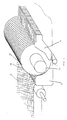
- This device essentially includes a game of discs called “looping discs” marked 11 and carried on a transverse common axis 13 driven in continuous rotation at a peripheral speed preferably equal to the speed of entry of the web 0.
- the discs looper 11 are provided on their periphery with a toothing 15 having an appropriate angle to the tangent and which allows the training of the entry veil. Between each of the discs are arranged with sulking fingers 21 the end of which is essentially so tangential to the discs.
- This device allows to carry out the so-called “pre-looping step”, which consists in subjecting the fibers and / or filaments individually a transverse looping accompanied by a stretching, in order to parallelize them correctly.
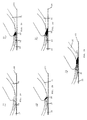
- FIG. 2a describes the step in which the veil 0 consisting of fibers and / or individual 10 filaments have just been introduced between looping discs 11 and looping fingers 21.
- the fibers and / or filaments 10 individually undergo the step of pre-loop already described and which corresponds to a loop individual transversal possibly accompanied by drawing.
- the fibers and / or filaments 10 parallelized are brought to the fingertips looper 21.
- Figure 2b shows that the fibers and / or filaments 10 which continue to be entrained by the rotating looper discs 11 are next blocked by the presence of detaching feet 31 against which they start to accumulate behind each others in order to form a stop (or "plug") 20.
- the fibers and / or filaments are strongly inclined and can even appear, at the limit, almost horizontal.
- Figure 2c shows that this stop or "plug" 20 tends to expand downward direction of a substrate 100.
- FIG. 2d shows that the "plug" 20 consisting of the accumulation of fibers and / or filaments parallelized and wavy ends up reaching such a volume that it comes into contact naturally with the substrate 100 placed just under the looping fingers 21.
- the fibers and / or filaments originating directly from the pre-loop stage condense during a step called “containment step", this time vertically, against the obstacle constituted by the "plug".
- Figure 2e shows that the "plug" 20 is driven by substrate 100, aided in this by rotation looping discs 11 and by the pressure exerted by the fibers and / or filaments 10 parallelized which continue to come from looping fingers 21.
- This phase shows that the fibers and / or filaments are then deposited regularly on the substrate 100 without there being any more of accumulation in the form of a "plug". In this case, these fibers and / or filaments are arranged so essentially vertical.
- the detaching feet 31 prefferably have a particular form to facilitate this step.
- the detaching feet are arranged so that they can be made a funnel 41 between said feet and the substrate 100 which continues to flow.
- the feet detachers 31 no longer have the function of detaching the fibers and / or filaments of the looping fingers, but rather the function of promoting the joining of said fibers and / or filaments on the substrate.
- the rounded part of detaching feet will also guide the fibers and / or filaments confined to the substrate, while its oblique part, located at a distance from the substrate slightly less than the looping height, will exert a pressure of the fibers and / or filaments parallelized so to force them to adhere to the support.
- the tension present within the fibers and / or filaments by the time they are confined to the feet detachers is less than that prevailing within the material undergoing the pre-looping step, which allows easy training of parallel fibers and / or filaments with the substrate. Indeed, if the tension undergone by fibers and / or filaments at the end of the looping fingers during the pre-loop step was less than the reaction pressure exerted by the "plug" or stop in the funnel formed by the detaching feet 31 and the substrate 100, the fibers and / or filaments 10 would start then to accumulate between the looping discs 11 and the looper fingers 21, and this until the entry of the veil. Of this fact, there would be no automatic training of the material with the substrate.
- This tension mainly depends on the orientation of the fibers and / or filaments in the veil the entrance to the verticalization device.
- the substrate 100 be previously coated with an adhesive whose viscosity has been chosen so as to allow the entrainment of fibers and / or filaments 10 with the substrate while producing a effective bonding.
- Activation devices and methods can be chosen from the devices or processes by contact, such as calenders, heating blades, etc., devices or processes working with hot air such as ovens, forced air devices, etc., or possibly the devices or processes working by irradiating, infrared energy, ....
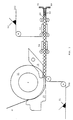
- Figure 3 shows an embodiment preferred for the implementation of the method according to the present invention with a view to producing coated-glued products of sandwich type.
- This figure shows a disc looper 11 on which a looper finger 21 is superimposed in the extension of which is placed a detaching foot 31.
- a veil 0 of adequately oriented fibers is driven by a succession of looping discs 11.
- a plastisol deposition is carried out using a doctor blade 51 in order to secure the loops made up of fibers and / or filaments from the pre-looping stage and from the step of confinement to the substrate 100. Then, the product obtained is subjected to a heat treatment at using hot plates 54 in order to obtain a plastisol gelation. A second substrate 102 also coated with a plastisol deposited using a doctor blade 52 is then deposited on the product constituted by the first substrate 100 and the loops secured in order to create a sandwich product 60. This sandwich product 60 is again heat treated with plates heaters 56 in order to obtain the gelation of plastisol present on the second substrate 102. Finally, a blade 58 split the sandwich product 60 in two by slitting so to obtain two velvet type products 70 and 80.
- the present invention enables a series of products which it was not possible to obtain in using the methods and / or devices as described in the Applicant's previous requests.
- a first large family includes the floor, wall or automobile coverings.
- the glues used will mainly be plastisols, PVC or acrylic while the substrates can be woven, non-woven or glass mats (in the specific case of the slab).
- low-rise products but high density of flocked type velvet can be also made for gauges less than 1/16 ".
- the adhesives used are preferably thermoplastics.
- the device used for implementing the method according to the present invention does not include any sensitive organ such as needles or transfer elements which perform reciprocating movements. Therefore, we can even use coarse natural fibers.
- the second large family includes upholstery such as seat upholstery, hangings, etc.
- the gauges are particularly weak, of the order of 1/32 ", and the preferably very fine fibers used. The use of microfibers is even possible.
- the third large family relates to technical textiles which have a structure in form sandwich and which are therefore not split.
- geotextiles that can be used as a structure draining or as a structure with inclusion of powders bentonite type.
- figure 4 describes how to produce a product more precisely composite geotextile with inclusion of clay powder bentonite type.
- a device is introduced into this device veil made in the present case of fibers of a title high, for example greater than 80 dtex, possibly mixed with finer fibers, for example a title of 17 dtex which aim to facilitate the carding the veil.
- the veil 0 is entrained between the succession of discs 11 and pouting fingers 21 with a view to carry out the pre-looping and containment stages as as described in more detail in Figure 2.
- a substrate 104 is brought to the point of stain removal of fibers using a heating blade 61.
- the substrate is preferably made of fibers having a melting point higher than the melting point of the fibers present in the loops from the pre-looping steps and containment.
- This heating blade 61 allows reach a temperature that is higher than the melting temperature of the loops, which by contact adhere directly to substrate 104 in order to obtain a product 60.
- bentonite powder is deposited using conventional means 63 on the product 60 constituted by the substrate secured to the loops.
- the whole then goes on a table vibrating 65 in order to promote the migration of the powder of bentonite- within product 60 to obtain a the most homogeneous distribution possible. This is in particular possible due to high fiber content present in the loops and their resilience important, which prevents them from being crushed under the powder pressure.
- the height of the loops is also chosen according to the weight of the powder to be deposited so to get a space on the top of the product which is free of powder, so that it can be deposit with a second heating blade 67 a second substrate 105.
Landscapes
- Engineering & Computer Science (AREA)
- Textile Engineering (AREA)
- Treatment Of Fiber Materials (AREA)
- Nonwoven Fabrics (AREA)
- Chemical Or Physical Treatment Of Fibers (AREA)
- Manufacturing Of Multi-Layer Textile Fabrics (AREA)
- Laminated Bodies (AREA)
- Preliminary Treatment Of Fibers (AREA)
- Knitting Of Fabric (AREA)
Claims (17)
- Verfahren zur Herstellung eines textilen Produktes von der bahnförmig-geklebten Art ausgehend von Fasern und / oder Filamenten, die in der Form eines Flors in der Vorschubrichtung umlaufen, wobei dieses Verfahren mindestens eine Stufe aufweist, die "Vorkräuselschritt" genannt wird und in welcher die Fasern und / oder Filamente einzeln in Bezug auf die Richtung der Vorwärtsbewegung des Flors ein querverlaufendes Kräuseln erfahren, ggf. begleitet von einem querverlaufenden Strecken, dadurch gekennzeichnet, dass es alsdann eine Stufe der Einschließung der parallel gelegten Fasern und / oder Filamenten in der Form von Schleifen aufweist, wobei diese letzte Stufe der Einschließung mit Hilfe eines Abnehmerelements direkt auf einem Träger vor sich geht, ohne dass Transportorgane wie Nadeln oder Übertragungselemente eingreifen würden.
- Verfahren gemäß Anspruch 1, dadurch gekennzeichnet, dass nach der ersten vorübergehenden Stufe, die an das Anfahren einer Linie gebunden ist und im Verlaufe welcher die ersten Schleifen, die mit Hilfe des Vorkräuselschritts erzielt werden, zufällig einen Stopp bilden, die Einschließung unter der Form einer Ansammlung von aufeinanderfolgenden Schleifen erzielt wird. Diese positionieren sich auf eine im Wesentlichen vertikale Art auf dem besagten Träger.
- Verfahren gemäß Anspruch 2, dadurch gekennzeichnet, dass das Positionieren der aufeinanderfolgenden Schleifen ebenfalls mit Hilfe eines Abnehmerelements durchgeführt wird, welches das Leiten des Materials bis zum Träger erlaubt und dieses dabei durch Spanner unterstützt.
- Verfahren gemäß irgendeinem der vorhergehenden Ansprüche, dadurch gekennzeichnet, dass der Träger das Substrat des Fertigproduktes ist.
- Verfahren gemäß irgendeinem der Ansprüche 1 bis 3, dadurch gekennzeichnet, dass der Träger ein Zwischenelement darstellt, wie z.B. einen Nagelgurt, eine Bürste oder auch einen Velcro® Träger, dessen Rolle darin besteht, die gewellte Form der Schleifen beizubehalten während das freie Ende des Materials mit einem Substrat verbunden wird.
- Verfahren gemäß Anspruch 4 oder 5, dadurch gekennzeichnet, dass die Herstellung der Verbindung der Schleifen mit dem Träger vermittels eines Klebers vollzogen wird, dessen Viskosität es erlaubt, die Schleifen mit dem Substrat anzutreiben während gleichzeitig eine wirkungsvolle Verklebung bewerkstelligt wird.
- Verfahren gemäß Anspruch 4 oder 5, dadurch gekennzeichnet, dass die Herstellung der Verbindung der Schleifen mit dem Träger mit Hilfe eines heizenden Hilfsmittels vollzogen wird, wie z.B. eines Ofens, eines Kalanders, einer Trommel oder eines Heizblattes, um durch Schmelzen ein Anhaften der Schleifen an das Substrat zu erzielen.
- Verfahren gemäß irgendeinem der vorhergehenden Ansprüche, dadurch gekennzeichnet, dass die Vorschubgeschwindigkeit des Trägers entweder gleichmäßig ist oder stoßweise durchgeführt wird.
- Verfahren gemäß irgendeinem der vorhergehenden Ansprüche, dadurch gekennzeichnet, dass man auf das Produkt ein zweites Substrat ablegt, welches das Basissubstrat und die verbundenen Schleifen umfasst, um ein Sandwichprodukt zu verwirklichen.
- Verfahren gemäß Anspruch 9, dadurch gekennzeichnet, dass man ein Schlitzen des Sandwichproduktes vornimmt, um zwei Produkte zu erzielen, die in der Form von Samt vorliegen.
- Verfahren gemäß dem Anspruch 9, dadurch gekennzeichnet, dass man ein pulverförmiges Material, wie z.B. Bentonit, Kreide oder Sand, in die aus den zwei Substraten bestehende Sandwichstruktur einführt, ggf. begleitet von festen Elementen, wie Rohren oder Kabeln.
- Vorrichtung zur Bewerkstelligung des Verfahrens gemäß irgendeinem der vorhergehenden Ansprüche, die aufweist: einen Satz Scheiben (11), die von einer gemeinsamen Querachse (13) getragen und in eine kontinuierliche Rotation versetzt werden und die an ihrem Umfang mit einer Verzahnung (15) versehen sind, welche einen Winkel gegenüber der Tangente aufweist und zwischen welchen Kräuselfinger (21) angeordnet sind, deren Spitzen sich im Wesentlichen tangentiell gegenüber den Scheiben zeigen, dadurch gekennzeichnet, dass sie darüber hinaus in der Verlängerung jedes Kräuselfingers (21) einen Abnehmerfuss (31) aufweist.
- Produkt, das nach dem Verfahren gemäß irgendeinem der Ansprüche 1 bis 11 oder der Vorrichtung gemäß Anspruch 12 erzielt worden ist, dadurch gekennzeichnet, dass es ein erstes Substrat umfasst, mit welchem Schleifen aus parallel gelegten Fasern und / oder Filamenten verbunden sind, ohne dass es ein Durchqueren der Schleifen in das Substrat geben würde, und die Schleifen ggf. im Verlauf einer späteren Stufe geschert werden können, wobei die Lehre kleiner als 1/10 Zoll ist, vorzugsweise kleiner als 1/16 Zoll.
- Produkt gemäß Anspruch 13, dadurch gekennzeichnet, dass die Lehre kleiner als 1/32 Zoll ist.
- Produkt gemäß Anspruch 13 oder 14, dadurch gekennzeichnet, dass die Schleifen mit dem Substrat verbunden werden, sei es durch Schmelzen, sei es mit Hilfe eines Klebers.
- Produkt gemäß irgendeinem der Ansprüche 13 bis 15, dadurch gekennzeichnet, dass man ein zweites Substrat über dem Ganze aus dem ersten Substrat und den damit verbundenen Schleifen anordnet, um eine Sandwichstruktur zu verwirklichen.
- Produkt gemäß Anspruch 16, dadurch gekennzeichnet, dass es in der durch die zwei Substrate gebildeten Sandwichstruktur ein pulverförmiges Material enthält, wie etwa Bentonit, das zwischen den beiden Substraten eingeschlossen ist.
Priority Applications (1)
| Application Number | Priority Date | Filing Date | Title |
|---|---|---|---|
| EP98909446A EP0960227B1 (de) | 1997-02-14 | 1998-02-11 | Verfahren und vorrichtung zur herstellung von textilen produkten und erhaltene textile produkte |
Applications Claiming Priority (4)
| Application Number | Priority Date | Filing Date | Title |
|---|---|---|---|
| EP97870019A EP0859077A1 (de) | 1997-02-14 | 1997-02-14 | Verfahren und Vorrichtung zur Herstellung von textilen Produkten und erhaltene textile Produkte |
| EP97870019 | 1997-02-14 | ||
| PCT/EP1998/000770 WO1998036119A1 (fr) | 1997-02-14 | 1998-02-11 | Procede et dispositif de fabrication de produits textiles et produits textiles obtenus |
| EP98909446A EP0960227B1 (de) | 1997-02-14 | 1998-02-11 | Verfahren und vorrichtung zur herstellung von textilen produkten und erhaltene textile produkte |
Publications (2)
| Publication Number | Publication Date |
|---|---|
| EP0960227A1 EP0960227A1 (de) | 1999-12-01 |
| EP0960227B1 true EP0960227B1 (de) | 2002-06-26 |
Family
ID=8230977
Family Applications (2)
| Application Number | Title | Priority Date | Filing Date |
|---|---|---|---|
| EP97870019A Withdrawn EP0859077A1 (de) | 1997-02-14 | 1997-02-14 | Verfahren und Vorrichtung zur Herstellung von textilen Produkten und erhaltene textile Produkte |
| EP98909446A Expired - Lifetime EP0960227B1 (de) | 1997-02-14 | 1998-02-11 | Verfahren und vorrichtung zur herstellung von textilen produkten und erhaltene textile produkte |
Family Applications Before (1)
| Application Number | Title | Priority Date | Filing Date |
|---|---|---|---|
| EP97870019A Withdrawn EP0859077A1 (de) | 1997-02-14 | 1997-02-14 | Verfahren und Vorrichtung zur Herstellung von textilen Produkten und erhaltene textile Produkte |
Country Status (14)
| Country | Link |
|---|---|
| US (2) | US6432234B1 (de) |
| EP (2) | EP0859077A1 (de) |
| JP (1) | JP2001511854A (de) |
| KR (1) | KR20000071006A (de) |
| CN (1) | CN1098378C (de) |
| AT (1) | ATE219798T1 (de) |
| AU (1) | AU733027B2 (de) |
| BR (1) | BR9814802A (de) |
| CA (1) | CA2279392A1 (de) |
| CZ (1) | CZ301633B6 (de) |
| DE (1) | DE69806228T2 (de) |
| ES (1) | ES2176983T3 (de) |
| TR (1) | TR199901863T2 (de) |
| WO (1) | WO1998036119A1 (de) |
Families Citing this family (20)
| Publication number | Priority date | Publication date | Assignee | Title |
|---|---|---|---|---|
| WO2000060155A1 (fr) * | 1999-04-06 | 2000-10-12 | Sai Automotive Sommer Industrie | Dispositif et procede de fabrication de produits textiles a partir de fibres et/ou filaments |
| PT1194627E (pt) | 1999-07-12 | 2005-08-31 | Tarkett Sommer Sa | Processo e dispositivo que permite a orientacao de fibras e/ou filamentos individuais presentes numa velo |
| FR2813772B1 (fr) * | 2000-09-12 | 2003-03-21 | Tissavel Sa | Pinceau dont les poils sont formes a partir d'une bande tissee ou tricotee de type fourrure |
| PL367463A1 (en) * | 2001-07-18 | 2005-02-21 | Tarkett Sommer S.A. | Method and device for making meshed textile products directly from fibres and/or filaments and resulting products |
| US7255797B2 (en) * | 2003-08-13 | 2007-08-14 | Truox, Inc. | Composition including potassium monopersulfate and a halogen |
| EP3919543A3 (de) | 2005-04-22 | 2022-03-16 | Mitsubishi Chemical Corporation | Aus einer biomassenressource gewonnenes polyester und herstellungsverfahren dafür |
| US8287983B2 (en) | 2007-09-20 | 2012-10-16 | Carl Freudenberg Kg | Velour needle-punched nonwoven material and use thereof |
| PL2050850T3 (pl) * | 2007-09-20 | 2009-11-30 | Freudenberg Carl Kg | Welurowa włóknina igłowana i jej zastosowanie |
| DE102013208906A1 (de) * | 2013-05-14 | 2014-11-20 | TRüTZSCHLER GMBH & CO. KG | Anlage zum Herstellen eines textilen bahnförmigen Guts sowie Verfahren zum Herstellen eines textilen bahnförmigen Guts |
| FR3041001B1 (fr) * | 2015-09-10 | 2017-10-13 | Faurecia Automotive Ind | Procede de fabrication d'un revetement interieur, notamment d'un revetement de sol pour un vehicule automobile |
| FR3066769B1 (fr) * | 2017-05-24 | 2020-04-03 | Faurecia Automotive Industrie | Dispositif perfectionne de fabrication d'un revetement interieur, notamment d'un revetement de sol pour un vehicule automobile |
| FR3067365B1 (fr) * | 2017-06-07 | 2020-08-28 | Faurecia Automotive Ind | Dispositif de fabrication d’un revetement interieur, notamment pour un vehicule automobile, a haute densite de velours |
| FR3073232B1 (fr) * | 2017-11-09 | 2019-11-29 | Faurecia Automotive Industrie | Procede de fabrication d'un revetement, notamment d'un revetement de sol pour vehicule automobile |
| FR3073530B1 (fr) * | 2017-11-16 | 2019-11-29 | Faurecia Automotive Industrie | Procede de conception d'une installation pour fabrication d'un revetement, installation et procede de fabrication associes |
| FR3081886B1 (fr) * | 2018-06-01 | 2020-08-28 | Faurecia Automotive Ind | Outillage destine a etre monte sur un arbre rotatif, procede de fabrication, dispositif de bouclage et dispositif de fabrication d'un revetement textile pour vehicule associes |
| FR3083806B1 (fr) * | 2018-07-16 | 2020-10-02 | Faurecia Automotive Ind | Procede de formation d'une couche fibreuse pour une piece d'equipement de vehicule automobile, installation et piece d'equipement associees |
| FR3094991B1 (fr) | 2019-04-10 | 2021-05-14 | Faurecia Automotive Ind | Peigne de fabrication comportant un élément élastique comprimé par des dents longitudinales entre une cale supérieure et une cale inférieure, et procédé d’assemblage associé |
| FR3100546B1 (fr) * | 2019-09-10 | 2021-09-17 | Faurecia Automotive Ind | Dispositif de fabrication de revêtement intérieur à motif pour véhicule automobile |
| CN113398659B (zh) * | 2021-07-16 | 2023-02-28 | 江苏康隆迪超净科技有限公司 | 一种用于工业固废处理的ptfe过滤袋滤料加工装置及其使用方法 |
| FR3128722B1 (fr) | 2021-10-29 | 2023-09-22 | Faurecia Automotive Ind | Procédé de fabrication de revêtements intérieurs à partir d’une structure sandwiche |
Family Cites Families (7)
| Publication number | Priority date | Publication date | Assignee | Title |
|---|---|---|---|---|
| US3755051A (en) | 1970-10-05 | 1973-08-28 | Kimberly Clark Co | High-loft, nonwoven paneling material and covering |
| US3705063A (en) * | 1970-10-05 | 1972-12-05 | Kimberly Clark Co | Method of producing high-loft,nonwoven paneling material and covering |
| DE2211023C3 (de) * | 1972-03-08 | 1975-07-17 | Cikalon-Vliesstoffwerk Gmbh, 4152 Kempen | Verfahren zur Herstellung von Polvliesen |
| FR2649130B1 (fr) | 1989-06-30 | 1991-10-04 | Sommer Sa | Procede et dispositif de fabrication de produits textiles a partir de fibres et/ou filaments et produits obtenus |
| IT1247010B (it) * | 1991-05-14 | 1994-12-12 | Grazia Maria Frosini | Procedimento per la fabbricazione di manufatti agugliati riciclabili |
| WO1996010667A1 (fr) | 1994-09-30 | 1996-04-11 | Sommer S.A. | Procede et dispositif de fabrication de produits textiles a partir de fibres et/ou de filaments, et produits obtenus |
| US6012205A (en) * | 1995-08-01 | 2000-01-11 | N.S.C. N.Schlumberger | Method and device for making textile products |
-
1997
- 1997-02-14 EP EP97870019A patent/EP0859077A1/de not_active Withdrawn
-
1998
- 1998-02-11 ES ES98909446T patent/ES2176983T3/es not_active Expired - Lifetime
- 1998-02-11 KR KR1019997007272A patent/KR20000071006A/ko not_active Withdrawn
- 1998-02-11 WO PCT/EP1998/000770 patent/WO1998036119A1/fr not_active Ceased
- 1998-02-11 CN CN98802155A patent/CN1098378C/zh not_active Expired - Fee Related
- 1998-02-11 TR TR1999/01863T patent/TR199901863T2/xx unknown
- 1998-02-11 CA CA002279392A patent/CA2279392A1/fr not_active Abandoned
- 1998-02-11 DE DE69806228T patent/DE69806228T2/de not_active Expired - Fee Related
- 1998-02-11 EP EP98909446A patent/EP0960227B1/de not_active Expired - Lifetime
- 1998-02-11 BR BR9814802-8A patent/BR9814802A/pt not_active IP Right Cessation
- 1998-02-11 US US09/355,381 patent/US6432234B1/en not_active Expired - Fee Related
- 1998-02-11 JP JP53533798A patent/JP2001511854A/ja not_active Ceased
- 1998-02-11 CZ CZ0240399A patent/CZ301633B6/cs not_active IP Right Cessation
- 1998-02-11 AT AT98909446T patent/ATE219798T1/de not_active IP Right Cessation
- 1998-02-11 AU AU63976/98A patent/AU733027B2/en not_active Ceased
-
2002
- 2002-06-05 US US10/163,051 patent/US6817396B2/en not_active Expired - Fee Related
Also Published As
| Publication number | Publication date |
|---|---|
| AU6397698A (en) | 1998-09-08 |
| ES2176983T3 (es) | 2002-12-01 |
| BR9814802A (pt) | 2000-09-05 |
| JP2001511854A (ja) | 2001-08-14 |
| CZ301633B6 (cs) | 2010-05-12 |
| ATE219798T1 (de) | 2002-07-15 |
| CN1246165A (zh) | 2000-03-01 |
| CA2279392A1 (fr) | 1998-08-20 |
| CN1098378C (zh) | 2003-01-08 |
| US6817396B2 (en) | 2004-11-16 |
| EP0859077A1 (de) | 1998-08-19 |
| EP0960227A1 (de) | 1999-12-01 |
| DE69806228T2 (de) | 2003-02-06 |
| US20020153082A1 (en) | 2002-10-24 |
| CZ240399A3 (cs) | 2000-05-17 |
| KR20000071006A (ko) | 2000-11-25 |
| TR199901863T2 (xx) | 2000-02-21 |
| AU733027B2 (en) | 2001-05-03 |
| WO1998036119A1 (fr) | 1998-08-20 |
| US6432234B1 (en) | 2002-08-13 |
| DE69806228D1 (de) | 2002-08-01 |
Similar Documents
| Publication | Publication Date | Title |
|---|---|---|
| EP0859077A1 (de) | Verfahren und Vorrichtung zur Herstellung von textilen Produkten und erhaltene textile Produkte | |
| EP3448648B1 (de) | Verbesserte hakenförmige befestigungsvorrichtung und verfahren | |
| EP3347515B1 (de) | Verfahren zur herstellung einer innenverkleidung insbesondere als bodenbelag für ein fahrzeug | |
| EP1117860B1 (de) | Verfahren zur herstellung von komplexen vliesen und hergestellte vliese | |
| FR3056438B1 (fr) | Procede de realisation de pieces en materiau composite par impregnation d'une preforme particuliere. | |
| WO2007125248A2 (fr) | Procede de fabrication de non-tisse en trois dimensions, ligne de fabrication pour la mise en oeuvre de ce procede et produit non-tisse en trois dimensions obtenu | |
| CH629700A5 (fr) | Procede de production d'une feuille de resine renforcee de fibre de verre. | |
| FR2916209A1 (fr) | Armature textile de renforcement et son procede de realisation | |
| FR2799214A1 (fr) | Procede pour la realisation de nappes non tissees dont la cohesion est obtenue par l'action de jets de fluide | |
| FR2649130A1 (fr) | Procede et dispositif de fabrication de produits textiles a partir de fibres et/ou filaments et produits obtenus | |
| FR2626294A1 (fr) | Procede de fabrication d'une structure fibreuse tridimensionnelle en vue de la realisation ulterieure d'une piece en un materiau composite et machine pour sa mise en oeuvre | |
| FR2734847A1 (fr) | Armature textile utilisable pour la realisation de materiaux composites | |
| FR3019492A1 (fr) | Nappe ou ruban a boucles en forme de stratifie comportant des motifs imprimes | |
| BE1015008A3 (fr) | Plaque de base a interstice pour une enduction uniforme d'envers de tapis. | |
| EP4174227B1 (de) | Verfahren und vorrichtung zur herstellung von innenbeschichtungen aus einer sandwichstruktur | |
| EP0329577B1 (de) | Verfahren zum Herstellen von Mustern auf Nadelbehandelten nichtgewebten Stoffen durch Prägen | |
| EP0489639B1 (de) | Fasermatte für Pressteile | |
| FR3101645A1 (fr) | Procédé de fabrication d’un revêtement intérieur bicolore pour véhicule automobile | |
| FR3101276A1 (fr) | Procédé de réalisation d’une pièce en materiau composite de type sandwich par aiguilletage | |
| LU84387A1 (fr) | Appareil pour la fabrication de tissus a poils lies par un adhesif a chaud | |
| FR3083806A1 (fr) | Procede de formation d'une couche fibreuse pour une piece d'equipement de vehicule automobile, installation et piece d'equipement associees | |
| FR3118071A1 (fr) | Revêtement intérieur à motif, notamment pour un véhicule | |
| EP3868936A1 (de) | Verfahren zur herstellung einer beschichtung mit verbessertem aussehen, insbesondere eines bodenbelags eines kraftfahrzeugs | |
| EP0233433A1 (de) | Verfahren zur Herstellung eines aus synthetischen Fasern bestehenden Materials, und damit hergestelltes Material | |
| FR3100546A1 (fr) | Dispositif de fabrication de revêtement intérieur à motif pour véhicule automobile |
Legal Events
| Date | Code | Title | Description |
|---|---|---|---|
| PUAI | Public reference made under article 153(3) epc to a published international application that has entered the european phase |
Free format text: ORIGINAL CODE: 0009012 |
|
| 17P | Request for examination filed |
Effective date: 19990722 |
|
| AK | Designated contracting states |
Kind code of ref document: A1 Designated state(s): AT BE CH DE DK ES FR GB IT LI LU NL |
|
| AX | Request for extension of the european patent |
Free format text: SI PAYMENT 19990715 |
|
| 17Q | First examination report despatched |
Effective date: 20001006 |
|
| GRAG | Despatch of communication of intention to grant |
Free format text: ORIGINAL CODE: EPIDOS AGRA |
|
| GRAG | Despatch of communication of intention to grant |
Free format text: ORIGINAL CODE: EPIDOS AGRA |
|
| GRAH | Despatch of communication of intention to grant a patent |
Free format text: ORIGINAL CODE: EPIDOS IGRA |
|
| GRAH | Despatch of communication of intention to grant a patent |
Free format text: ORIGINAL CODE: EPIDOS IGRA |
|
| GRAA | (expected) grant |
Free format text: ORIGINAL CODE: 0009210 |
|
| AK | Designated contracting states |
Kind code of ref document: B1 Designated state(s): AT BE CH DE DK ES FR GB IT LI LU NL |
|
| AX | Request for extension of the european patent |
Free format text: SI PAYMENT 19990715 |
|
| PG25 | Lapsed in a contracting state [announced via postgrant information from national office to epo] |
Ref country code: AT Free format text: LAPSE BECAUSE OF FAILURE TO SUBMIT A TRANSLATION OF THE DESCRIPTION OR TO PAY THE FEE WITHIN THE PRESCRIBED TIME-LIMIT Effective date: 20020626 |
|
| REF | Corresponds to: |
Ref document number: 219798 Country of ref document: AT Date of ref document: 20020715 Kind code of ref document: T |
|
| REG | Reference to a national code |
Ref country code: GB Ref legal event code: FG4D Free format text: NOT ENGLISH |
|
| REG | Reference to a national code |
Ref country code: CH Ref legal event code: EP |
|
| REF | Corresponds to: |
Ref document number: 69806228 Country of ref document: DE Date of ref document: 20020801 |
|
| GBT | Gb: translation of ep patent filed (gb section 77(6)(a)/1977) |
Effective date: 20020813 |
|
| PG25 | Lapsed in a contracting state [announced via postgrant information from national office to epo] |
Ref country code: DK Free format text: LAPSE BECAUSE OF FAILURE TO SUBMIT A TRANSLATION OF THE DESCRIPTION OR TO PAY THE FEE WITHIN THE PRESCRIBED TIME-LIMIT Effective date: 20020926 |
|
| REG | Reference to a national code |
Ref country code: ES Ref legal event code: FG2A Ref document number: 2176983 Country of ref document: ES Kind code of ref document: T3 |
|
| PGFP | Annual fee paid to national office [announced via postgrant information from national office to epo] |
Ref country code: FR Payment date: 20030117 Year of fee payment: 6 |
|
| PGFP | Annual fee paid to national office [announced via postgrant information from national office to epo] |
Ref country code: NL Payment date: 20030121 Year of fee payment: 6 |
|
| PGFP | Annual fee paid to national office [announced via postgrant information from national office to epo] |
Ref country code: LU Payment date: 20030130 Year of fee payment: 6 |
|
| PGFP | Annual fee paid to national office [announced via postgrant information from national office to epo] |
Ref country code: GB Payment date: 20030205 Year of fee payment: 6 |
|
| PGFP | Annual fee paid to national office [announced via postgrant information from national office to epo] |
Ref country code: BE Payment date: 20030214 Year of fee payment: 6 |
|
| PG25 | Lapsed in a contracting state [announced via postgrant information from national office to epo] |
Ref country code: LI Free format text: LAPSE BECAUSE OF NON-PAYMENT OF DUE FEES Effective date: 20030228 Ref country code: CH Free format text: LAPSE BECAUSE OF NON-PAYMENT OF DUE FEES Effective date: 20030228 |
|
| PGFP | Annual fee paid to national office [announced via postgrant information from national office to epo] |
Ref country code: DE Payment date: 20030228 Year of fee payment: 6 |
|
| PGFP | Annual fee paid to national office [announced via postgrant information from national office to epo] |
Ref country code: ES Payment date: 20030311 Year of fee payment: 6 |
|
| PLBE | No opposition filed within time limit |
Free format text: ORIGINAL CODE: 0009261 |
|
| STAA | Information on the status of an ep patent application or granted ep patent |
Free format text: STATUS: NO OPPOSITION FILED WITHIN TIME LIMIT |
|
| 26N | No opposition filed |
Effective date: 20030327 |
|
| REG | Reference to a national code |
Ref country code: CH Ref legal event code: PL |
|
| PG25 | Lapsed in a contracting state [announced via postgrant information from national office to epo] |
Ref country code: LU Free format text: LAPSE BECAUSE OF NON-PAYMENT OF DUE FEES Effective date: 20040211 Ref country code: GB Free format text: LAPSE BECAUSE OF NON-PAYMENT OF DUE FEES Effective date: 20040211 |
|
| PG25 | Lapsed in a contracting state [announced via postgrant information from national office to epo] |
Ref country code: ES Free format text: LAPSE BECAUSE OF NON-PAYMENT OF DUE FEES Effective date: 20040212 |
|
| PG25 | Lapsed in a contracting state [announced via postgrant information from national office to epo] |
Ref country code: BE Free format text: LAPSE BECAUSE OF NON-PAYMENT OF DUE FEES Effective date: 20040228 |
|
| BERE | Be: lapsed |
Owner name: S.A. *TARKETT SOMMER Effective date: 20040228 |
|
| PG25 | Lapsed in a contracting state [announced via postgrant information from national office to epo] |
Ref country code: NL Free format text: LAPSE BECAUSE OF NON-PAYMENT OF DUE FEES Effective date: 20040901 Ref country code: DE Free format text: LAPSE BECAUSE OF NON-PAYMENT OF DUE FEES Effective date: 20040901 |
|
| GBPC | Gb: european patent ceased through non-payment of renewal fee |
Effective date: 20040211 |
|
| PG25 | Lapsed in a contracting state [announced via postgrant information from national office to epo] |
Ref country code: FR Free format text: LAPSE BECAUSE OF NON-PAYMENT OF DUE FEES Effective date: 20041029 |
|
| NLV4 | Nl: lapsed or anulled due to non-payment of the annual fee |
Effective date: 20040901 |
|
| REG | Reference to a national code |
Ref country code: FR Ref legal event code: ST |
|
| PG25 | Lapsed in a contracting state [announced via postgrant information from national office to epo] |
Ref country code: IT Free format text: LAPSE BECAUSE OF NON-PAYMENT OF DUE FEES Effective date: 20050211 |
|
| REG | Reference to a national code |
Ref country code: ES Ref legal event code: FD2A Effective date: 20040212 |