EP0964285A1 - Aspherische ophthalmische Linse - Google Patents
Aspherische ophthalmische Linse Download PDFInfo
- Publication number
- EP0964285A1 EP0964285A1 EP99111333A EP99111333A EP0964285A1 EP 0964285 A1 EP0964285 A1 EP 0964285A1 EP 99111333 A EP99111333 A EP 99111333A EP 99111333 A EP99111333 A EP 99111333A EP 0964285 A1 EP0964285 A1 EP 0964285A1
- Authority
- EP
- European Patent Office
- Prior art keywords
- curvature
- lens
- meridional
- aspherical
- ophthalmic lens
- Prior art date
- Legal status (The legal status is an assumption and is not a legal conclusion. Google has not performed a legal analysis and makes no representation as to the accuracy of the status listed.)
- Withdrawn
Links
- 230000003287 optical effect Effects 0.000 claims abstract description 112
- 230000007423 decrease Effects 0.000 claims abstract description 26
- 230000002093 peripheral effect Effects 0.000 claims description 37
- 238000003384 imaging method Methods 0.000 claims 2
- 201000009310 astigmatism Diseases 0.000 description 73
- 230000000052 comparative effect Effects 0.000 description 28
- 230000004438 eyesight Effects 0.000 description 14
- 230000003313 weakening effect Effects 0.000 description 8
- 206010020675 Hypermetropia Diseases 0.000 description 7
- 201000006318 hyperopia Diseases 0.000 description 7
- 230000004305 hyperopia Effects 0.000 description 7
- 208000001491 myopia Diseases 0.000 description 7
- 230000004379 myopia Effects 0.000 description 7
- 230000000694 effects Effects 0.000 description 5
- 230000000750 progressive effect Effects 0.000 description 4
- 206010002945 Aphakia Diseases 0.000 description 3
- 230000003247 decreasing effect Effects 0.000 description 3
- 238000013459 approach Methods 0.000 description 1
- 238000004519 manufacturing process Methods 0.000 description 1
- 238000012986 modification Methods 0.000 description 1
- 230000004048 modification Effects 0.000 description 1
- 201000010041 presbyopia Diseases 0.000 description 1
- 208000014733 refractive error Diseases 0.000 description 1
- 230000000007 visual effect Effects 0.000 description 1
Images




Classifications
-
- G—PHYSICS
- G02—OPTICS
- G02C—SPECTACLES; SUNGLASSES OR GOGGLES INSOFAR AS THEY HAVE THE SAME FEATURES AS SPECTACLES; CONTACT LENSES
- G02C7/00—Optical parts
- G02C7/02—Lenses; Lens systems ; Methods of designing lenses
Definitions
- the present invention relates to an aspherical ophthalmic lens, and more particularly relates to a positive ophthalmic lens for correcting of hypermetropia and a negative ophthalmic lens for correcting myopia, both lenses having aspherical front and back lens surfaces.
- a spherical surface is conventionally employed in the "first" or front surface (i.e., the objectwise refractive surface when worn) to simplify fabrication.
- toric surfaces as well as spherical surfaces are employed on the "second" or back surface (i.e., the refractive surface closest to the eye, or the "eyewise” surface when worn) to correct astigmatism and the like.
- a toric surface is specified by a first longitude having a maximum radius of curvature, and a second longitude orthogonal to the first longitude and having a minimum radius of curvature.
- spherical lens wherein the first surface is formed in a spherical surface shape and the second surface is formed in a spherical surface shape or a toric surface shape shall hereinafter be called a "spherical lens.”
- the refractive power of an ophthalmic lens is generally expressed in a unit called the diopter (hereinafter denoted by "D").
- the refractive power of the first surface of an ophthalmic lens is called the base curve.
- the curvature corresponding to the base curve is referred to as the base curve curvature.
- the power of an ophthalmic lens is specified principally by the refractive power of the first surface and the refractive power of the second surface. Consequently, the base curve required to obtain an ophthalmic lens having a predetermined power can assume various values depending upon the selective combination of the refractive power of the first surface and the refractive power of the second surface. Nevertheless, in actual design, the value of the base curve is limited to a specified range in accordance with the power of the ophthalmic lens to ensure the required optical performance of the ophthalmic lens and. Such limitation is also needed to minimize astigmatism that acts upon the eye when viewing through a lateral part of the lens remote from the optical axis.
- Tscherning's ellipse The generally known solution for minimizing astigmatism in an ophthalmic lens is the so-called Tscherning's ellipse, which is a thin-lens solution.
- Tscherning's ellipse Since the center of an actual ophthalmic lens has thickness, the actual solution as determined by ray tracing differs slightly from Tscherning's ellipse. Nevertheless, the actual solution for an ophthalmic lens does not appear to deviate significantly from Tscherning's ellipse.
- An ophthalmic lens having positive power and used principally to correct hypermetropia and presbyopia has several drawbacks.
- One drawback is that the thickness at the center of the ophthalmic lens increases as the power of the ophthalmic lens strengthens.
- Another drawback is that the protrusion of the convex surface at the center increases as the curvature increases.
- the base curve is properly defined from the standpoint of optical performance, which decreases dramatically if the base curve departs greatly from the curve derived from Tscherning's ellipse. In other words, the selection of the base curve largely controls optical performance.
- Japanese Patent Application Kokai No. Sho 52-136644, Japanese Patent Application Kokoku No. Sho 60-15248 (corresponding to U.S. Patent No. 4,181,409) and Japanese Patent Application Kokai No. Sho 58-24112 (corresponding to U.S. Patent No. 4,504,128) propose ophthalmic lenses having positive power for correcting hypermetropia and that improve the external appearance in this type of ophthalmic lens.
- the lenses disclosed therein have an aspherical first surface.
- the ophthalmic lens disclosed in Japanese Patent Application Kokai No. Sho 52-136644 has a quadratic curve, such as an ellipse, parabola or hyperbola, as the meridional line.
- the first surface is aspherical and is specified by rotating this meridional line.
- the ophthalmic lens disclosed in Japanese Patent Application Kokoku No. Sho 60-15248 has a strong positive power for aphakia.
- the first surface is formed in a rotational aspherical surface shape based on the curve of a tenth order function of the radius r.
- the ophthalmic lens disclosed in Japanese Patent Application Kokai No. Sho 58-24112 also has a strong positive power for aphakia.
- a correction term is added to the basic quadratic curve and the first surface is formed in a rotational aspherical surface shape based on that curve.
- the curvature of the meridional line decreases nearly monotonically and acceleratedly outwardly from the rotational axis (generally the geometric center of the lens) toward the peripheral edge of the lens.
- the lens power at the peripheral part drops significantly as compared to the center part.
- the effective range of the visual field prescribed for the eye of the wearer narrows.
- an aspherical surface having strong changes in curvature is employed to achieve thinness (flatness) of the lens.
- the range of the effective field of vision has a relatively small diameter of approximately 30 mm to at most 40 mm on the lens.
- the conventional ophthalmic lenses discussed above do not sufficiently take into consideration patients who require a prescription for astigmatism.
- the second surface is normally toric. In this case, even if the optical performance in one of the longitudinal directions that specifies the toric surface is satisfied by the aspherization of the first surface, optical performance in the other longitudinal direction cannot be satisfied.
- edge thickness i.e., thickness at the peripheral edge of the lens
- the ophthalmic lens disclosed in Japanese Patent Application Kokai No. Sho 53-94947 is divided into a center portion of the first surface and a peripheral portion outside thereof. Furthermore, the center portion comprises a single spherical surface, and the outer peripheral portion comprises a torus having a curvature larger than the curvature of the spherical surface of the center portion thereof. In this case, there is a large spherical portion in the center part. Accordingly, the curvature of the torus of the outer peripheral portion with respect to the curvature of the spherical surface of the center portion cannot be changed dramatically to avoid suffering large losses in optical performance in the outer peripheral portion. As a result, the lens still has a large lens edge thickness and thus cannot be made sufficiently thin (i.e., flat).
- the first surface is aspherical as specified by a special function.
- the first surface with respect to a spherical surface having the vertex curvature of the first surface of the ophthalmic lens first protrudes objectwise toward the peripheral edge along the meridional line from the optical center thereof, and then falls back eyewise.
- the problem with this ophthalmic lens lies in the unique aspherical surface shape of the first surface.
- the lens has an undesirable external appearance since remarkably uneven reflections occur in the undulating first surface.
- the present invention relates to an aspherical ophthalmic lens, and more particularly relates to a positive ophthalmic lens for correcting of hypermetropia and a negative ophthalmic lens for correcting myopia, both lenses having aspherical front and back lens surfaces.
- a first aspect of the invention is a positive ophthalmic lens having superior optical performance, a thin lens center thickness, and a good external appearance.
- the lens has an optical center and a meridional line, and comprises an objectwise first aspherical surface with a first meridional curvature and a first sagittal curvature, and an eyewise second aspherical surface with a second meridional curvature and a second sagittal curvature.
- the first and second meridional curvatures are given as ⁇ m
- the first and second sagittal curvatures are given as ⁇ s
- the value of Z monotonically decreases in a range from the optical center to a distance of at least 20 mm along the meridional line.
- a second aspect of the invention is a negative ophthalmic lens similar to the positive ophthalmic lens described above, except that the value of Z monotonically increases in a range from the optical center to a distance of at least 20 mm along the meridional line.
- a third and a fourth aspect of the invention is a positive or negative ophthalmic lens as described above, wherein curvature differential Z for the objectwise first aspherical surface and said eyewise second aspherical surface satisfies the following condition: wherein ⁇ o is a surface curvature at the optical center in units of inverse meters, n is a refractive index of an optical material forming the ophthalmic lens, and h is a distance in units of meters along the meridional line extending outwardly from the optical center.
- the present invention relates to an aspherical ophthalmic lens, and more particularly relates to a positive ophthalmic lens for correcting of hypermetropia and a negative ophthalmic lens for correcting myopia, bath lenses having aspherical front and back lens surfaces.
- The, present invention takes the aforementioned problems associated with conventional ophthalmic lenses into consideration, and has the goal of providing an ophthalmic lens having superior optical performance and an aesthetically pleasing appearance.
- the lens In the case of the positive lens of the present invention, the lens has a thin center thickness.
- the lens In the case of the negative lens of the present invention, the lens has a thin edge thickness.
- the optimal base curve in a spherical lens is generally close to the curve derived from Tscherning's ellipse.
- an ophthalmic lens that employs this optimal base curve sufficiently satisfactory optical performance is obtained as long as a prescription for astigmatism is not required.
- the center thickness thereof increases and the protrusion of the convex surface at the center increases as the curvature increases. This leads to a poor external appearance of the lens.
- the edge thickness increases and the projection of the lens peripheral edge increases, since the curvature of the second surface increases. This, too, leads to a poor external appearance of the lens.
- the optimal base curve from the viewpoint of optical performance for a predetermined lens power is uniquely determined. Nevertheless, if this optimal base curve is employed in an ophthalmic lens having positive power, the center thickness of the lens increases, the weight of the lens increases, and the projection of the convex surface at the center of the lens increases. These effects all serve to degrade the external appearance of the lens.
- a base curve weaker (lower) than the optically optimal base curve must be employed. Nevertheless, employing such a base curve sacrifices optical performance, as discussed above. Accordingly, it is preferable to improve the external appearance of the lens while ensuring superior optical performance by employing a base curve weaker than the optically optimal base curve while introducing an aspherical surface.
- the value of and the change in curvature differential Z ⁇ m - ⁇ s between curvature ⁇ m in the meridional direction and curvature ⁇ s in the sagittal direction along the meridional line from the optical center of the first surface (objectwise refractive surface) and the second surface (eyewise refractive surface) becomes critical.
- the sagittal curvature indicates the curvature in the direction of the line of intersection between the lens surface and the plane orthogonal to the meridional line.
- the curvature in the meridional direction and the curvature in the sagittal direction are the same.
- one aspect of the present invention employs an aspherical surface shape specified by the value of curvature differential Z with respect the first surface, and aspherizes the refractive surface along at least one of the two longitudes that specify the toric surface of the second surface, particularly in the case wherein a prescription for astigmatism is required.
- a positive ophthalmic lens for correcting hypermetropia is realized having superior optical performance, a thin center thickness, and a good appearance.
- the optimal base curve from the viewpoint of optical performance determined in this manner is employed in an ophthalmic lens having negative power, the edge thickness of the lens increases and the projection of the lens peripheral part increases. These effects all serve to degrade the external appearance of the lens.
- a base curve weaker (lower) than the optically optimal base curve must be employed. Nevertheless, employing such a base curve sacrifices optical performance, as discussed above. Accordingly, it is preferable to improve the external appearance while ensuring superior optical performance in a negative ophthalmic lens by employing a base curve weaker than the optically optimal base curve while introducing an aspherical surface.
- another aspect of the present invention employs an aspherical surface specified by the value of curvature differential Z, as mentioned above, with respect to the first surface, and aspherizes the refractive surface along at least one of the two longitudes that specify the toric surface of the second surface, particularly in the case wherein a prescription for astigmatism is required.
- a negative ophthalmic lens for correcting myopia is realized having superior optical performance, a thin edge thickness, and a good appearance.
- Comparative Examples are provided to facilitate the discussion of first and second Working Examples of the present invention.
- First set forth are Comparative Examples 1-2 and Working Example 1 pertaining to the positive ophthalmic lens of the present invention.
- Comparative Examples 3-4 and Working Example 2 pertaining to the negative ophthalmic lens of the present invention.
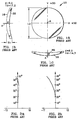
- opthalmic lens 10 is a first Comparative Example and comprises a first surface (i.e, a front or objectwise refractive surface) 16 that is spherical, and a second surface (i.e., a back or eyewise refractive surface) 20 that is toric.
- Surfaces 16 and 20 are arranged along optical axis A.
- the optical axis indicates the optical center of the lens.
- Lens 10 has a spherical power of +5.0D, a base curve of 9.5D and an astigmatism power of -2D, and implements the prior art in a design at infinity.
- the refractive power in the H-direction namely the first longitudinal direction (which is the horizontal direction in FIG. 1a) is +5D.
- the radius of curvature of surface 16 is 52.631 mm (corresponding to a base curve of 9.5D).
- the radius of curvature of the first longitude of second surface 20 is 99.879 mm, and the radius of curvature of the second longitude of second surface 20 is 71.429 mm.
- the lens diameter LD is 70 mm, and the refractive index of the lens is 1.50.
- the lens center thickness d in the H-direction is 8.0 mm, and the total height TH in the H-direction is 14.3 mm.
- the lens center thickness d in the V-direction is 8.0 mm, and the total height TH in the V-direction is 17.2 mm.
- the edge thickness of lens 10 in the H-direction is 1.0 mm, and the edge thickness of the lens in the V-direction is 3.8 mm.
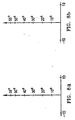
- the vertical axis represents the angle of the field of vision (unit: °)
- the horizontal axis represents the astigmatism (unit: D, the difference between the meridional image plane and the sagittal image plane) based on the on-axis refractive power of the lens.
- the astigmatism in the H-direction (FIG. 2a) is comparatively satisfactorily corrected, while the astigmatism in the V-direction (FIG. 2b) precipitously increases as the angle of the field of vision increases.
- the curve in the H-direction is comparatively close to the optimal curve, the curve in the V-direction deviates greatly from the optimal curve. This trend increases as the astigmatism power increases.
- the lens center thickness d increases, the curvature strengthens, and the protrusion of the convex surface at the center of the lens increases. Consequently, the external appearance of the lens degrades.
- optical performance of lens 10 along one longitudinal direction is satisfactory to some extent.
- optical performance along the other longitudinal direction deteriorates as the angle of the field of vision increases.
- optical performance along each longitudinal direction decreases remarkably as the astigmatism power increases, patents requiring a prescription for astigmatism are not sufficiently taken into consideration.
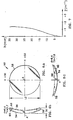
- ophthalmic lens 30 is a second Comparative Example comprising a spherical power of +5.0D, a base curve of 6.0D and an astigmatism power of -2D, and implements the prior art in a design at infinity.
- Lens 30 is the same as lens 10 (FIG. 1a), except that the former includes an arc 40 having a curvature corresponding to the base curve.
- First surface 16 is aspherical surface.
- the refractive power of lens 30 in the H-direction is +5D
- the refractive power in the V-direction is +3D.
- the radius of curvature at first surface 16 is 83.333 mm (corresponding to a base curve of 6.0D).
- the radius of curvature of the first longitude of second surface 20 is 432.198 mm.
- the radius of curvature of the second longitude of second surface 20 is 158.384 mm.
- the lens diameter LD is 70 mm, and the refractive index of the lens is 1.50.
- the lens center thickness d in the H-direction is 6.4 mm, and the total height TH in the H-direction is 7.8 mm.
- the lens center thickness d in the V-direction is 6.4 mm, and the total height TH in I the V-direction is 10.3 mm.
- the edge thickness of the lens in the H-direction is 1.0 mm, and the edge thickness of the lens in the V-direction is 3.5 mm.
- the horizontal axis is the value of curvature differential Z (unit: m -1 ) and the vertical axis is the distance h (unit: mm) from optical axis A along the meridional line.
- Table 1 below sets forth the data corresponding to FIG. 4.
- the precise values of curvature differential Z are shown corresponding to specific values of curvature ⁇ m in the meridional direction, curvature ⁇ s in the sagittal direction, and distance h.
- the value of curvature differential Z decreases gradually along the meridional line from optical axis A, and the rate of decrease drops at a distance of approximately 20 - 25 mm from the optical axis.
- First surface 16 of lens 30 has a vertex curvature corresponding to the base curve in the vicinity of optical axis A.
- the curvature toward the peripheral edge of lens 30 from optical axis A along the meridional line decreases (i.e., the radius of curvature increases).
- first surface 16 protrudes frontward (objectwise) from arc 40.
- the base curve of first surface 16 is weakened (lowered) more than in lens 10 (FIG. 1) and is aspherized.
- the lens center thickness and total height in the H-direction and V-direction are greatly decreased as compared to that of lens 10, thus improving the external appearance of the lens.
- a lightweight lens 30 is realized.
- ophthalmic lens 30 as described above the lens center thickness d is thinner and the projection of the convex surface at the center of the lens is also reduced as compared with lens 10. In other words, by weakening the base curve and aspherizing first surface 40, the external appearance of the lens is improved and a thinner lens is realized.
- lens 30 Since second surface 20 of lens 30 employs a conventional toric surface, the optical performance along one longitudinal direction (the H-direction) is extremely satisfactoxy. However, the optical performance along the other longitudinal direction (the V-direction) deteriorates as the angle of the field of vision increases. Moreover, as the astigmatism power increases, the optical performance along the V-direction decreases remarkably In other words, lens 30 has the disadvantage in that patients requiring a prescription for astigmatism are still not taken sufficiently into consideration.
- ophthalmic lens 50 represents a first Working Example (i.e., Working Example 1) of the present invention, and comprises a peripheral edge 52, first surface 54 and a second surface 56.
- First surface 54 is aspherical with the base curve made lower than in lens 10 (FIG. 1a), the same as in lens 30 (FIG. 3a).
- First surface 54 is the same configuration as first surface 16 in lens 30. (Comparative Example 2).
- second surface 56 is toric, aspherized along the second longitudinal direction (i.e., the vertical direction in FIG. 6a).
- Lens 50 of the present Working Example has a spherical power of +5.0D, a base curve of 6.0D and an astigmatism power of -2D, and implements the present invention for a design at infinity.
- Lens 50 also includes an arc 60 having a curvature corresponding to the base curve, and an arc 62 having the vertex curvature of the second longitude of the second surface (on-axis curvature).
- the refractive power in the H-direction is +5D
- the refractive power in the V-direction is +3D.
- the radius of curvature of first surface 54 is 83.333 mm (corresponding to a base curve of 6.0D).
- the radius of curvature of the first longitude of second surface 56 is 432.198 mm.
- the radius of curvature of the second longitude of second surface 56 is 158.384 mm.
- the lens diameter LD is 70 mm, and the refractive index of the lens is 1.50.
- the lens center thickness d in the H-direction is 6.4 mm, and the total height TH in the H-direction is 7.8 mm.
- the lens center thickness d in the V-direction is 6.4 mm, and the total height TH in the V-direction is 9.7 mm.
- the edge thickness of lens 50 in the H-direction at edge 52 is 1.0 mm, and the edge thickness of the lens in the V-direction at edge 52 is 3.0 mm.
- Table 2 below sets forth the data corresponding to FIG. 7, wherein the precise values of curvature differential Z of the aspherical surface of the second longitude of the second surface 56 are shown corresponding to specific values of curvature ⁇ m in the meridional direction, curvature ⁇ s in the sagittal direction, and distance h.
- the value of curvature differential Z decreases gradually along the meridional line from optical axis A, and the rate of decrease drops at a distance of approximately 20 - 25 mm from optical axis A. Subsequently, Z decreases monotonically and then increases as it approaches the peripheral edge along the meridional line from optical axis A.
- curvature differential Z between curvature ⁇ m in the meridional direction and curvature ⁇ s in the sagittal direction must decrease monotonically at least in the range of the distance up to 20 mm along the meridional line from the optical center of the lens.
- first surface 54 of lens 50 of the present Working Example is specified by curvature differential Z shown in FIG. 4 and in Table 1.
- Surface 54 has a vertex curvature corresponding to the base curve in the vicinity of optical axis A, the same as in lens 30. However, the curvature toward peripheral edge from the optical axis along the meridional line decreases (radius of curvature increases). As a result, surface 54 protrudes frontward (objectwise) from arc 60.
- the second longitudinal direction of second surface 56 of the present Working Example is also an aspherical surface.
- the aspherical shape of second surface 56 of lens 50 of the present Working Example is specified by curvature differential Z shown in Fig. 7 and in Table 2.
- second surface 56 along the second longitudinal direction has a vertex curvature in the vicinity of optical axis A, but the curvature from the optical axis along the meridional line toward peripheral edge 52 decreases (i.e., the radius of curvature increases).
- second surface 56 along the second longitudinal direction protrudes frontward (objectwise) of arc 62 having a vertex curvature. Furthermore, second surface 56 along the first longitudinal direction is formed in an arc shape, the same as in lens 30.
- first surface 54 in lens 50 of the present Working Example is made weaker than that of lens 10 and is aspherized.
- second longitudinal direction of second surface 56 is also aspherical surface. Consequently, as in lens 30, the lens center thickness and total height in the H-direction and V-direction in lens 50 are greatly reduced, thus improving the external appearance of the lens. Moreover, since an aspherized toric surface is employed in second surface 56, the total height in the V-direction is smaller than in lens 30.
- lens 50 of the present Working Example the lens center thickness is thinner and the protrusion of the convex surface at the center of the lens is smaller as compared with lens 10. In other words, the external appearance is improved and a thinner lens is realized.
- the base curve of first surface 54 is weakened and aspherized, and an aspherized toric surface is employed in second surface 56. Consequently, the optical performance along each of the longitudinal directions is extremely satisfactory, and there is no large drop in optical performance along each longitudinal direction, even if the astigmatism power increases.
- Working Example 1 of the present invention weakens and aspherizes the base curve of the first surface.
- an aspherical ophthalmic lens can be realized that has a desirable external appearance while having a superior optical performance.
- the specific value of curvature differential Z in the objectwise surface and eyewise surface satisfy the following condition (A).
- ⁇ o is the curvature (unit: m -1 ) of the optical center of the given surface
- n is the refractive index of the optical material that forms the ophthalmic lens
- h is the distance (unit: m) along the meridional line from the optical center of the lens.
- second surface 56 is aspherized.
- surface 56 along both longitudes may be aspherized.
- second surface 56 is an aspherized toric.
- second surface 56 can also be formed in a rotationally symmetric aspherical shape if a prescription for astigmatism is not required.
- the present invention can also be applied to a progressive power lens by forming second surface 56 in an aspherized progressive power surface shape.
- ophthalmic lens 70 is a third Comparative Example and comprising a first surface 76 that is spherical and a second surface 80 that is toric. Surfaces 76 and 80 are arranged along optical axis A. Lens 70 has a spherical power of -5.0D, a base curve of 3.0D) and an astigmatism power of -2D, and implements the prior art in a design at infinity.
- the refractive power in the H-direction is -5D and the refractive power in the V-direction is -7D.
- the radius of curvature of first surface 76 is 166.666 mm (corresponding to a base curve of 3D).
- the radius of curvature of the first longitude of second surface 80 is 62.430 mm.
- the radius of curvature of the second longitude of second surface 80 is 49.955 mm.
- the lens diameter LD is 80 mm
- the refractive index of the lens is 1.50
- the center thickness of the lens is 1.5 mm.
- the lens edge thickness ED in the H-direction is 11.1 mm
- total height TH in the H-direction is 16.0 mm.
- the lens edge thickness ED in the V-direction is 16.7 mm
- total height TH in the V-direction is 21.5 mm.
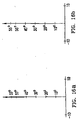
- the astigmatism in the H-direction (FIG. 10a) is comparatively satisfactorily corrected, while the astigmatism in the V-direction (FIG. 10b) precipitously increases as the angle of the field of vision increases.
- the curve in the H-direction is comparatively close to the optically optimal curve, the curve in the V-direction deviates greatly from the optically optimal curve. This trend increases as the astigmatism power increases.
- the lens edge thickness increases, the curvature of the second surface strengthens, and the projection of the lens peripheral edge increases. Consequently, the external appearance of the lens degrades.
- lens 70 the optical performance along one longitudinal direction (H-direction) is satisfactory to some extent,
- the optical performance along the V-direction deteriorates as the angle of the field of vision increases.
- optical performance along each longitudinal direction decreases remarkably as the astigmatism power increases, patients requiring a prescription for astigmatism are not sufficiently taken into consideration.
- ophthalmic lens 90 is a fourth Comparative Example.
- second surface 80 is toric, the same as lens 70 of Comparative Example 3.
- first surface 76 is aspherical wherein the base curve is made lower than in lens 70.
- Lens 90 has a spherical power of -5.0D, a base curve of 1.5D and an astigmatism power of -2D, and implements the prior art in a design at infinity.
- Lens 90 is the same as lens 70 (FIG. 9), except that the former includes an arc 94 having a curvature corresponding to the base curve.
- the first surface 76 is an aspherical surface.
- the refractive power of lens 90 in the H-direction is -5D
- the refractive power in the V-direction is -7D.
- the radius of curvature of first surface 76 is 333.333 mm (corresponding to a base curve of 1.5D).
- the radius of curvature of the first longitude of second surface 80 is 76.896 mm.
- the radius of curvature of the second longitude of second surface 80 is 58.808 mm.
- lens diameter LD is 80 mm
- the refractive index of the lens is 1.50
- the lens center thickness is 1.5 mm.
- lens edge thickness ED in the H-direction is 9.7 mm
- total height TH in the H-direction is 12.7 mm
- the lens edge thickness ED in the V-direction is 14.2 mm
- total height TH in the V-direction is 17.2 mm.
- Table 3 below sets forth the data corresponding to FIG. 12, wherein the precise values of curvature differential Z are shown corresponding to specific values of curvature ⁇ m in the meridional direction, curvature ⁇ s in the sagittal direction, and distance h.
- the value of curvature differential Z increases monotonically in the range up to a distance of approximately 20 mm from optical axis A along the meridional line, and decreases monotonically up to the peripheral edge along the meridional line outside of that range.
- First surface 76 of lens 90 has a vertex curvature corresponding to the base curves in the vicinity of optical axis A.
- the curvature toward the peripheral edge of lens 90 from the optical axis along the meridional line increases (i.e., the radius of curvature decreases).
- first surface 76 does not protrude frontward (objectwise) from arc 94 having a curvature corresponding to the base curve, and then falls back rearward (eyewise) to some extent more than arc 94 at the peripheral edge.
- the base curve of first surface 76 is weakened (lowered) more than in lens 70 (FIG. 9a) and is aspherized.
- the lens edge thickness and total height in the H-direction and V-direction are greatly decreased as compared with lens 70, thus improving the external appearance of the lens.
- the lens edge thickness is thinner and the projection of the lens peripheral edge is also reduced, as compared with lens 70.
- the external appearance of lens 90 improves and a thinner lens is realized.
- second surface 80 of lens 90 employs a conventional toric surface, the optical performance along one longitudinal direction (H-direction) is extremely satisfactory.
- the optical performance along the other longitudinal direction (V-direction) deteriorates as the angle of the field of vision increases.
- the optical performance along the V-direction decreases remarkably. In other words, it has the disadvantage that patients requiring a prescription for astigmatism are still not taken sufficiently into consideration.
- ophthalmic lens 110 represents a second Working Example (Working Example 2) of the present invention and comprises a peripheral edge 112, a first surface 114 and a second surface 116.
- First surface 114 is aspherical with the base curve made lower than lens 70 (FIG. 9a), i.e., as in lens 90 (FIG. 11a).
- First surface 114 is the same configuration as first surface 76 in lens 90 (Comparative Example 4).
- second surface 116 is toric, aspherized along the second longitudinal direction (i.e., the vertical direction in FIG. 14a).
- Lens 110 of the present Working Example has a spherical power of -5.0D, a base curve of 1.5D and an astigmatism power of -2D, and implements the present invention for a design at infinity.
- Lens 110 also includes an arc 118 having a curvature corresponding to the base curve, and an arc 120 having the vertex curvature of the second longitude of second surface 116 (on-axis curvature).
- the refractive power in the H-direction is -5D
- the refractive power in the V-direction is -7D.
- the vertex radius of curvature of first surface 114 is 333.333 mm (corresponding to a base curve of 1.5D).
- the radius of curvature of the first longitude of second surface 116 is 76.896 mm.
- the vertex radius of curvature (on-axis curvature) of the second longitude second surface 116 is 58.808 mm.
- the lens diameter LD is 80 mm, the refractive index of the lens is 1.50, and the lens center thickness is 1.5 mm.
- lens edge thickness ED in the H-direction is 9.7 mm
- total height TH in the H-direction is 12.7 mm
- the lens edge thickness ED in the V-direction is 15.2 mm
- total height TH in the V-direction is 19.1 mm.
- Table 4 below sets forth the data corresponding to FIG. 15, wherein the precise values of curvature differential Z are shown corresponding to specific values of curvature ⁇ m in the meridional direction, curvature ⁇ s in the sagittal direction, and distance h. Referring to FIG. 15 and Table 4, the value of curvature differential Z increases monotonically along the meridional line from optical axis A up to peripheral edge 112.
- first surface 114 of lens 110 in the present Working Example is specified by curvature differential Z shown in FIG. 12 and in Table 3.
- surface 114 has a vertex curvature corresponding to the base curve in the vicinity of optical axis A, the same as in lens 90, the curvature toward peripheral edge 112 from the optical axis along the meridional line increases (i.e., the radius of curvature decreases).
- the second longitudinal direction of second surface 116 is an aspherical surface.
- second surface 116 along the second longitudinal direction unlike lens 90, has a vertex curvature in the vicinity of optical axis A, but the curvature from the optical axis along the meridional line toward peripheral edge 112 increases (i.e., the radius of curvature decreases).
- second surface 116 along the second longitudinal direction of second surface 116 does not protrude frontward (objectwise) from arc 120, and also falls back rearward (eyewise) to some extent more than arc 118 at peripheral edge 112.
- second surface 116 along the first longitudinal direction is formed in an arc shape, the same as in lens 90.
- the lens edge thickness and total height in the H-direction and V-direction are greatly reduced as compared with lens 70. This improves the external appearance of lens 110.
- the second longitudinal direction, namely the V-direction, of second surface 116 is an aspherical surface, the edge thickness and total height in the V-direction is slightly larger than that of lens 90.
- lens edge thickness is thinner and the projection of the lens peripheral edge is reduced as compared to that of lens 70.
- the external appearance is improved and a thinner lens is realized, substantially the same as in lens 90.
- the base curve of first surface 114 is weakened and aspherized, and an aspherized toric surface is employed in second surface 116.
- the value of curvature differential Z in the second longitudinal direction of the second surface, as shown in FIG. 15, is substantially the same along the meridional line in the range of a distance of 0 to 5 mm from optical axis A, and increases monotonically along the meridional line in the range of a distance of 5 mm from optical axis A to the peripheral edge. Nevertheless, if it is desired to reduce the lens edge thickness even though optical performance is somewhat sacrificed in lens 110, the value of curvature differential Z should be set so that it switches from increasing to decreasing.
- the design concept may be one in which, for example, sufficient optical performance is maintained in the range of up to a distance of approximately 20 mm outward from optical axis A along the meridional line and optical performance outside of this range is not especially an issue.
- the value of curvature differential Z should be set so that it is substantially the same along the meridional line in the range of a distance of 0 to 5 mm from optical axis A, and increases along the meridional line in the range of a distance of 5 to 20 mm from optical axis A, and then decreases up to the peripheral edge along the meridional line outside of that range.
- the curvature differential Z must be substantially the same along the meridional line in the range of a distance of 0 to 5 mm from the optical center (optical axis A) of the lens, and increase monotonically along the meridional line in the range of a distance of 5 to 20 mm from the optical center of the lens.
- the specific value of curvature differential Z in the objectwise surface and eyewise surface satisfy the following condition (A).
- ⁇ o is the curvature (unit: m -1 ) of the optical center of the given surface
- n is the refractive index of the optical material that forms the ophthalmic lens
- h is the distance (unit: m) along the meridional line from the optical center of the lens.
- second surface 116 is aspherized
- surface 116 along both longitudes may be aspherized.
- second surface 116 is an aspherized toric.
- second surface 116 can also be formed in a rotationally symmetric aspherical shape if a prescription for astigmatism is not required.
- the present invention can also be applied to a progressive power lens by forming second surface 116 in an aspherized progressive power surface shape.
- a first aspect of the present invention is a positive ophthalmic lens for the correction of hypermetropia, having a superior optical performance, a thin lens center thickness and good appearance, even for patients requiring a prescription for astigmatism.
- a second aspect of the present invention is a negative ophthalmic lens for the correction of myopia, having a superior optical performance, a thin lens edge thickness and good appearance, even for patients requiring a prescription for astigmatism.
- an ophthalmic lens by weakening the base curve and making the first surface and second surface a special aspherical surface shape, an ophthalmic lens can be realized having superior optical performance and an aesthetically pleasing appearance,
- a thin lens center thickness can be obtained
- a thin lens edge thickness can be obtained.
- the effect of the present invention can be further satisfactorily realized.
Landscapes
- Health & Medical Sciences (AREA)
- Ophthalmology & Optometry (AREA)
- Physics & Mathematics (AREA)
- General Health & Medical Sciences (AREA)
- General Physics & Mathematics (AREA)
- Optics & Photonics (AREA)
- Eyeglasses (AREA)
Applications Claiming Priority (8)
| Application Number | Priority Date | Filing Date | Title |
|---|---|---|---|
| JP17808598 | 1998-06-10 | ||
| JP17808498 | 1998-06-10 | ||
| JP17808498 | 1998-06-10 | ||
| JP17808598 | 1998-06-10 | ||
| JP13005399 | 1999-05-11 | ||
| JP13005499 | 1999-05-11 | ||
| JP13005399 | 1999-05-11 | ||
| JP13005499 | 1999-05-11 |
Publications (1)
| Publication Number | Publication Date |
|---|---|
| EP0964285A1 true EP0964285A1 (de) | 1999-12-15 |
Family
ID=27471505
Family Applications (1)
| Application Number | Title | Priority Date | Filing Date |
|---|---|---|---|
| EP99111333A Withdrawn EP0964285A1 (de) | 1998-06-10 | 1999-06-10 | Aspherische ophthalmische Linse |
Country Status (1)
| Country | Link |
|---|---|
| EP (1) | EP0964285A1 (de) |
Cited By (4)
| Publication number | Priority date | Publication date | Assignee | Title |
|---|---|---|---|---|
| ES2323935A1 (es) * | 2009-03-30 | 2009-07-27 | Indo Internacional S.A. | Lente oftalmica acabada y procedimiento correspondientes. |
| US8998415B2 (en) | 2001-05-23 | 2015-04-07 | Amo Groningen B.V. | Methods of obtaining ophthalmic lenses providing the eye with reduced aberrations |
| EP3153909A1 (de) * | 2015-10-09 | 2017-04-12 | ESSILOR INTERNATIONAL (Compagnie Générale d'Optique) | Verfahren zur bestimmung eines verwendungsindexwerts für monofokale ophthalmische linse |
| CN113671607A (zh) * | 2020-12-14 | 2021-11-19 | 明月镜片股份有限公司 | 一种双面非球面镜片及其设计方法 |
Citations (8)
| Publication number | Priority date | Publication date | Assignee | Title |
|---|---|---|---|---|
| US4613217A (en) * | 1980-05-02 | 1986-09-23 | Carl-Zeiss-Stiftung, Heidenheim/Brenz | Spectacle lens having astigmatic power |
| EP0379976A2 (de) * | 1989-01-21 | 1990-08-01 | Seiko Epson Corporation | Asphärische ophthalmische Linse |
| US5235357A (en) * | 1990-11-08 | 1993-08-10 | American Optical Corporation | Spectacle lenses having an inside-out conicoidal front surface and method for forming same |
| US5353072A (en) * | 1992-01-31 | 1994-10-04 | Asahi Kogaku Kogyo Kabushiki Kaisha | Aspherical spectacle lens |
| US5550600A (en) * | 1994-06-23 | 1996-08-27 | Nikon Corporation | Ophthalmic lens having a negative refractive power |
| US5610670A (en) * | 1994-06-23 | 1997-03-11 | Nikon Corporation | Opthalmic lens having a positive refractive power |
| DE19540186A1 (de) * | 1995-10-28 | 1997-04-30 | Rodenstock Optik G | Einstärken-Brillenglas mit zwei asphärischen Flächen |
| EP0886166A2 (de) * | 1997-06-19 | 1998-12-23 | Hoya Corporation | Aspherische Brillenlinse |
-
1999
- 1999-06-10 EP EP99111333A patent/EP0964285A1/de not_active Withdrawn
Patent Citations (8)
| Publication number | Priority date | Publication date | Assignee | Title |
|---|---|---|---|---|
| US4613217A (en) * | 1980-05-02 | 1986-09-23 | Carl-Zeiss-Stiftung, Heidenheim/Brenz | Spectacle lens having astigmatic power |
| EP0379976A2 (de) * | 1989-01-21 | 1990-08-01 | Seiko Epson Corporation | Asphärische ophthalmische Linse |
| US5235357A (en) * | 1990-11-08 | 1993-08-10 | American Optical Corporation | Spectacle lenses having an inside-out conicoidal front surface and method for forming same |
| US5353072A (en) * | 1992-01-31 | 1994-10-04 | Asahi Kogaku Kogyo Kabushiki Kaisha | Aspherical spectacle lens |
| US5550600A (en) * | 1994-06-23 | 1996-08-27 | Nikon Corporation | Ophthalmic lens having a negative refractive power |
| US5610670A (en) * | 1994-06-23 | 1997-03-11 | Nikon Corporation | Opthalmic lens having a positive refractive power |
| DE19540186A1 (de) * | 1995-10-28 | 1997-04-30 | Rodenstock Optik G | Einstärken-Brillenglas mit zwei asphärischen Flächen |
| EP0886166A2 (de) * | 1997-06-19 | 1998-12-23 | Hoya Corporation | Aspherische Brillenlinse |
Cited By (12)
| Publication number | Priority date | Publication date | Assignee | Title |
|---|---|---|---|---|
| US8998415B2 (en) | 2001-05-23 | 2015-04-07 | Amo Groningen B.V. | Methods of obtaining ophthalmic lenses providing the eye with reduced aberrations |
| US9504377B2 (en) | 2001-05-23 | 2016-11-29 | Amo Groningen B.V. | Methods of obtaining ophthalmic lenses providing the eye with reduced aberrations |
| ES2323935A1 (es) * | 2009-03-30 | 2009-07-27 | Indo Internacional S.A. | Lente oftalmica acabada y procedimiento correspondientes. |
| ES2323935B1 (es) * | 2009-03-30 | 2010-07-07 | Indo Internacional S.A. | Lente oftalmica acabada y procedimientos correspondientes. |
| EP3153909A1 (de) * | 2015-10-09 | 2017-04-12 | ESSILOR INTERNATIONAL (Compagnie Générale d'Optique) | Verfahren zur bestimmung eines verwendungsindexwerts für monofokale ophthalmische linse |
| WO2017060480A1 (en) * | 2015-10-09 | 2017-04-13 | Essilor International (Compagnie Générale d'Optique) | Method for determining an usage index value for an single-vision ophthalmic lens |
| CN108139601A (zh) * | 2015-10-09 | 2018-06-08 | 依视路国际公司 | 确定单光眼科镜片的使用指数值的方法 |
| US10678066B2 (en) | 2015-10-09 | 2020-06-09 | Essilor International | Method for determining an usage index value for an single-vision ophthalmic lens |
| CN108139601B (zh) * | 2015-10-09 | 2021-02-26 | 依视路国际公司 | 确定单光眼科镜片的使用指数值的方法 |
| EP3360003B1 (de) * | 2015-10-09 | 2025-08-20 | Essilor International | Verfahren zur bestimmung eines verwendungsindexwerts für monofokale ophthalmische linse |
| CN113671607A (zh) * | 2020-12-14 | 2021-11-19 | 明月镜片股份有限公司 | 一种双面非球面镜片及其设计方法 |
| CN113671607B (zh) * | 2020-12-14 | 2022-10-25 | 明月镜片股份有限公司 | 一种双面非球面镜片及其设计方法 |
Similar Documents
| Publication | Publication Date | Title |
|---|---|---|
| US6199982B1 (en) | Presbyopia correction contact lens | |
| US8042942B2 (en) | Progressive-power lens | |
| AU715443B2 (en) | Decentered noncorrective lens for eyewear | |
| EP2955566B1 (de) | Torische Linse | |
| JP4228966B2 (ja) | 眼鏡レンズ | |
| AU716474C (en) | Decentered noncorrective lens for eyewear | |
| US7819523B2 (en) | Ocular lens | |
| JPWO1997019382A1 (ja) | 累進多焦点レンズ、眼鏡レンズおよび累進多焦点レンズの製造方法 | |
| JPH11242193A (ja) | アディションと屈折異常により変化する球面収差を有する多焦点眼科レンズ | |
| JP2010009071A (ja) | 2つの非球面、特にプログレッシブ表面を有するプログレッシブメガネレンズ及びそのメガネレンズを算出する方法 | |
| US6412948B2 (en) | Progressive power multifocal lens | |
| JP2001318346A (ja) | 累進多焦点レンズ | |
| US5550600A (en) | Ophthalmic lens having a negative refractive power | |
| JP5017542B2 (ja) | 非球面眼鏡レンズ及び非球面眼鏡レンズの製造方法 | |
| EP2498119B1 (de) | Gleitsichtglas und Verfahren zum Entwerfen von Gleitsichtglas | |
| JPH0812339B2 (ja) | 眼鏡レンズ | |
| JP4036921B2 (ja) | 眼鏡レンズ | |
| JP2001318344A (ja) | 累進多焦点レンズ | |
| JP2000047144A (ja) | 眼鏡レンズ | |
| JPH085967A (ja) | 非球面眼鏡レンズ | |
| JP2001027744A (ja) | 非球面眼鏡レンズ | |
| JP2003214986A (ja) | 眼鏡レンズの度数の決定方法、眼鏡レンズ及び計算機プログラム | |
| JPH10301066A (ja) | 多焦点眼鏡レンズ | |
| JPH0862497A (ja) | 老視用眼鏡レンズ | |
| JPH10301065A (ja) | 多焦点眼鏡レンズ |
Legal Events
| Date | Code | Title | Description |
|---|---|---|---|
| PUAI | Public reference made under article 153(3) epc to a published international application that has entered the european phase |
Free format text: ORIGINAL CODE: 0009012 |
|
| AK | Designated contracting states |
Kind code of ref document: A1 Designated state(s): DE FR GB |
|
| AX | Request for extension of the european patent |
Free format text: AL;LT;LV;MK;RO;SI |
|
| 17P | Request for examination filed |
Effective date: 20000614 |
|
| AKX | Designation fees paid |
Free format text: DE FR GB |
|
| 17Q | First examination report despatched |
Effective date: 20020614 |
|
| STAA | Information on the status of an ep patent application or granted ep patent |
Free format text: STATUS: THE APPLICATION IS DEEMED TO BE WITHDRAWN |
|
| 18D | Application deemed to be withdrawn |
Effective date: 20021025 |