EP0965610A1 - Mikroporöse membran und verfahren zu deren herstellung - Google Patents
Mikroporöse membran und verfahren zu deren herstellung Download PDFInfo
- Publication number
- EP0965610A1 EP0965610A1 EP98905780A EP98905780A EP0965610A1 EP 0965610 A1 EP0965610 A1 EP 0965610A1 EP 98905780 A EP98905780 A EP 98905780A EP 98905780 A EP98905780 A EP 98905780A EP 0965610 A1 EP0965610 A1 EP 0965610A1
- Authority
- EP
- European Patent Office
- Prior art keywords
- weight
- copolymer
- polymer
- microporous membrane
- liquid
- Prior art date
- Legal status (The legal status is an assumption and is not a legal conclusion. Google has not performed a legal analysis and makes no representation as to the accuracy of the status listed.)
- Withdrawn
Links
- 239000012982 microporous membrane Substances 0.000 title claims abstract description 76
- 238000004519 manufacturing process Methods 0.000 title claims abstract description 13
- 229920001577 copolymer Polymers 0.000 claims abstract description 74
- 239000012071 phase Substances 0.000 claims abstract description 73
- 229920001519 homopolymer Polymers 0.000 claims abstract description 71
- 150000001336 alkenes Chemical class 0.000 claims abstract description 69
- JRZJOMJEPLMPRA-UHFFFAOYSA-N olefin Natural products CCCCCCCC=C JRZJOMJEPLMPRA-UHFFFAOYSA-N 0.000 claims abstract description 68
- 238000000034 method Methods 0.000 claims abstract description 57
- 229920000642 polymer Polymers 0.000 claims abstract description 52
- 239000002904 solvent Substances 0.000 claims abstract description 49
- 238000001816 cooling Methods 0.000 claims abstract description 46
- 238000005191 phase separation Methods 0.000 claims abstract description 44
- 239000007791 liquid phase Substances 0.000 claims abstract description 34
- 229920001400 block copolymer Polymers 0.000 claims abstract description 31
- PPBRXRYQALVLMV-UHFFFAOYSA-N Styrene Chemical compound C=CC1=CC=CC=C1 PPBRXRYQALVLMV-UHFFFAOYSA-N 0.000 claims abstract description 28
- 229920000578 graft copolymer Polymers 0.000 claims abstract description 28
- 230000008569 process Effects 0.000 claims abstract description 23
- 239000007788 liquid Substances 0.000 claims abstract description 20
- KAKZBPTYRLMSJV-UHFFFAOYSA-N Butadiene Chemical class C=CC=C KAKZBPTYRLMSJV-UHFFFAOYSA-N 0.000 claims abstract description 19
- 229920002587 poly(1,3-butadiene) polymer Polymers 0.000 claims abstract description 15
- RRHGJUQNOFWUDK-UHFFFAOYSA-N Isoprene Chemical class CC(=C)C=C RRHGJUQNOFWUDK-UHFFFAOYSA-N 0.000 claims abstract description 10
- VVQNEPGJFQJSBK-UHFFFAOYSA-N Methyl methacrylate Chemical compound COC(=O)C(C)=C VVQNEPGJFQJSBK-UHFFFAOYSA-N 0.000 claims abstract description 9
- XTXRWKRVRITETP-UHFFFAOYSA-N Vinyl acetate Chemical compound CC(=O)OC=C XTXRWKRVRITETP-UHFFFAOYSA-N 0.000 claims abstract description 9
- BZHJMEDXRYGGRV-UHFFFAOYSA-N Vinyl chloride Chemical compound ClC=C BZHJMEDXRYGGRV-UHFFFAOYSA-N 0.000 claims abstract description 9
- 229920000098 polyolefin Polymers 0.000 claims abstract description 9
- 239000011148 porous material Substances 0.000 claims description 80
- 239000012528 membrane Substances 0.000 claims description 56
- 229920002959 polymer blend Polymers 0.000 claims description 28
- 230000000737 periodic effect Effects 0.000 claims description 8
- 239000011800 void material Substances 0.000 claims description 7
- 229920000359 diblock copolymer Polymers 0.000 claims description 6
- 229920000573 polyethylene Polymers 0.000 claims description 6
- VGGSQFUCUMXWEO-UHFFFAOYSA-N Ethene Chemical compound C=C VGGSQFUCUMXWEO-UHFFFAOYSA-N 0.000 claims description 5
- 239000005977 Ethylene Substances 0.000 claims description 5
- 239000002826 coolant Substances 0.000 claims description 5
- 235000012438 extruded product Nutrition 0.000 claims description 5
- 238000002844 melting Methods 0.000 claims description 5
- 230000008018 melting Effects 0.000 claims description 5
- 150000002148 esters Chemical class 0.000 claims description 3
- 229920001155 polypropylene Polymers 0.000 claims description 3
- 239000002253 acid Substances 0.000 claims 2
- 229920001384 propylene homopolymer Polymers 0.000 claims 2
- 230000035699 permeability Effects 0.000 abstract description 25
- 238000005325 percolation Methods 0.000 abstract description 16
- 239000000203 mixture Substances 0.000 abstract description 10
- 239000012530 fluid Substances 0.000 abstract description 9
- 238000000926 separation method Methods 0.000 abstract description 9
- 239000010419 fine particle Substances 0.000 abstract description 5
- 239000000243 solution Substances 0.000 description 39
- 229920001903 high density polyethylene Polymers 0.000 description 19
- 229940063583 high-density polyethylene Drugs 0.000 description 19
- 239000004700 high-density polyethylene Substances 0.000 description 19
- BJQHLKABXJIVAM-UHFFFAOYSA-N bis(2-ethylhexyl) phthalate Chemical compound CCCCC(CC)COC(=O)C1=CC=CC=C1C(=O)OCC(CC)CCCC BJQHLKABXJIVAM-UHFFFAOYSA-N 0.000 description 18
- YMWUJEATGCHHMB-UHFFFAOYSA-N Dichloromethane Chemical compound ClCCl YMWUJEATGCHHMB-UHFFFAOYSA-N 0.000 description 15
- XLYOFNOQVPJJNP-UHFFFAOYSA-N water Substances O XLYOFNOQVPJJNP-UHFFFAOYSA-N 0.000 description 15
- 239000000463 material Substances 0.000 description 11
- ZVFDTKUVRCTHQE-UHFFFAOYSA-N Diisodecyl phthalate Chemical compound CC(C)CCCCCCCOC(=O)C1=CC=CC=C1C(=O)OCCCCCCCC(C)C ZVFDTKUVRCTHQE-UHFFFAOYSA-N 0.000 description 10
- -1 polyethylenes Polymers 0.000 description 10
- 238000010438 heat treatment Methods 0.000 description 9
- 239000012046 mixed solvent Substances 0.000 description 7
- 239000004698 Polyethylene Substances 0.000 description 6
- 238000004090 dissolution Methods 0.000 description 6
- LIKMAJRDDDTEIG-UHFFFAOYSA-N 1-hexene Chemical compound CCCCC=C LIKMAJRDDDTEIG-UHFFFAOYSA-N 0.000 description 5
- 239000011557 critical solution Substances 0.000 description 5
- 230000000694 effects Effects 0.000 description 5
- 238000010587 phase diagram Methods 0.000 description 5
- 239000000843 powder Substances 0.000 description 5
- 238000007493 shaping process Methods 0.000 description 5
- VXNZUUAINFGPBY-UHFFFAOYSA-N 1-Butene Chemical compound CCC=C VXNZUUAINFGPBY-UHFFFAOYSA-N 0.000 description 4
- LFQSCWFLJHTTHZ-UHFFFAOYSA-N Ethanol Chemical compound CCO LFQSCWFLJHTTHZ-UHFFFAOYSA-N 0.000 description 4
- 230000000052 comparative effect Effects 0.000 description 4
- 230000007547 defect Effects 0.000 description 4
- 238000000605 extraction Methods 0.000 description 4
- 238000005227 gel permeation chromatography Methods 0.000 description 4
- 238000005984 hydrogenation reaction Methods 0.000 description 4
- 229940057995 liquid paraffin Drugs 0.000 description 4
- 238000001878 scanning electron micrograph Methods 0.000 description 4
- ZWEHNKRNPOVVGH-UHFFFAOYSA-N 2-Butanone Chemical compound CCC(C)=O ZWEHNKRNPOVVGH-UHFFFAOYSA-N 0.000 description 3
- 235000014653 Carica parviflora Nutrition 0.000 description 3
- 241000243321 Cnidaria Species 0.000 description 3
- RTZKZFJDLAIYFH-UHFFFAOYSA-N Diethyl ether Chemical compound CCOCC RTZKZFJDLAIYFH-UHFFFAOYSA-N 0.000 description 3
- 239000003990 capacitor Substances 0.000 description 3
- 210000003850 cellular structure Anatomy 0.000 description 3
- 238000002425 crystallisation Methods 0.000 description 3
- 230000008025 crystallization Effects 0.000 description 3
- 238000001035 drying Methods 0.000 description 3
- 239000012456 homogeneous solution Substances 0.000 description 3
- 238000001471 micro-filtration Methods 0.000 description 3
- 238000002156 mixing Methods 0.000 description 3
- VLKZOEOYAKHREP-UHFFFAOYSA-N n-Hexane Chemical compound CCCCCC VLKZOEOYAKHREP-UHFFFAOYSA-N 0.000 description 3
- 238000001330 spinodal decomposition reaction Methods 0.000 description 3
- 238000000108 ultra-filtration Methods 0.000 description 3
- 238000005406 washing Methods 0.000 description 3
- CSCPPACGZOOCGX-UHFFFAOYSA-N Acetone Chemical compound CC(C)=O CSCPPACGZOOCGX-UHFFFAOYSA-N 0.000 description 2
- IJGRMHOSHXDMSA-UHFFFAOYSA-N Atomic nitrogen Chemical compound N#N IJGRMHOSHXDMSA-UHFFFAOYSA-N 0.000 description 2
- IMNFDUFMRHMDMM-UHFFFAOYSA-N N-Heptane Chemical compound CCCCCCC IMNFDUFMRHMDMM-UHFFFAOYSA-N 0.000 description 2
- OFBQJSOFQDEBGM-UHFFFAOYSA-N Pentane Chemical compound CCCCC OFBQJSOFQDEBGM-UHFFFAOYSA-N 0.000 description 2
- 239000004743 Polypropylene Substances 0.000 description 2
- VYPSYNLAJGMNEJ-UHFFFAOYSA-N Silicium dioxide Chemical compound O=[Si]=O VYPSYNLAJGMNEJ-UHFFFAOYSA-N 0.000 description 2
- 230000001413 cellular effect Effects 0.000 description 2
- 230000008859 change Effects 0.000 description 2
- 239000003795 chemical substances by application Substances 0.000 description 2
- DOIRQSBPFJWKBE-UHFFFAOYSA-N dibutyl phthalate Chemical compound CCCCOC(=O)C1=CC=CC=C1C(=O)OCCCC DOIRQSBPFJWKBE-UHFFFAOYSA-N 0.000 description 2
- 238000009826 distribution Methods 0.000 description 2
- 239000003792 electrolyte Substances 0.000 description 2
- 238000013213 extrapolation Methods 0.000 description 2
- 238000001125 extrusion Methods 0.000 description 2
- 238000001914 filtration Methods 0.000 description 2
- 229930195733 hydrocarbon Natural products 0.000 description 2
- 150000002430 hydrocarbons Chemical class 0.000 description 2
- 238000007654 immersion Methods 0.000 description 2
- 239000002243 precursor Substances 0.000 description 2
- 238000002360 preparation method Methods 0.000 description 2
- 239000002994 raw material Substances 0.000 description 2
- 230000000717 retained effect Effects 0.000 description 2
- 238000005096 rolling process Methods 0.000 description 2
- 238000005245 sintering Methods 0.000 description 2
- 239000007787 solid Substances 0.000 description 2
- 239000007784 solid electrolyte Substances 0.000 description 2
- 238000003756 stirring Methods 0.000 description 2
- 239000004094 surface-active agent Substances 0.000 description 2
- VZGDMQKNWNREIO-UHFFFAOYSA-N tetrachloromethane Chemical compound ClC(Cl)(Cl)Cl VZGDMQKNWNREIO-UHFFFAOYSA-N 0.000 description 2
- RELMFMZEBKVZJC-UHFFFAOYSA-N 1,2,3-trichlorobenzene Chemical compound ClC1=CC=CC(Cl)=C1Cl RELMFMZEBKVZJC-UHFFFAOYSA-N 0.000 description 1
- GYWCVOZDFNTGAV-UHFFFAOYSA-N 10-octoxy-10-oxodecanoic acid Chemical compound CCCCCCCCOC(=O)CCCCCCCCC(O)=O GYWCVOZDFNTGAV-UHFFFAOYSA-N 0.000 description 1
- XKGKLYUXFRFGKU-UHFFFAOYSA-N CC.F.F.F Chemical compound CC.F.F.F XKGKLYUXFRFGKU-UHFFFAOYSA-N 0.000 description 1
- MQIUGAXCHLFZKX-UHFFFAOYSA-N Di-n-octyl phthalate Natural products CCCCCCCCOC(=O)C1=CC=CC=C1C(=O)OCCCCCCCC MQIUGAXCHLFZKX-UHFFFAOYSA-N 0.000 description 1
- XOBKSJJDNFUZPF-UHFFFAOYSA-N Methoxyethane Chemical compound CCOC XOBKSJJDNFUZPF-UHFFFAOYSA-N 0.000 description 1
- YSMRWXYRXBRSND-UHFFFAOYSA-N TOTP Chemical compound CC1=CC=CC=C1OP(=O)(OC=1C(=CC=CC=1)C)OC1=CC=CC=C1C YSMRWXYRXBRSND-UHFFFAOYSA-N 0.000 description 1
- 239000006096 absorbing agent Substances 0.000 description 1
- 239000000654 additive Substances 0.000 description 1
- 150000001278 adipic acid derivatives Chemical class 0.000 description 1
- 238000004220 aggregation Methods 0.000 description 1
- 230000002776 aggregation Effects 0.000 description 1
- 238000007605 air drying Methods 0.000 description 1
- 125000000217 alkyl group Chemical group 0.000 description 1
- 239000003963 antioxidant agent Substances 0.000 description 1
- 230000015572 biosynthetic process Effects 0.000 description 1
- ZFMQKOWCDKKBIF-UHFFFAOYSA-N bis(3,5-difluorophenyl)phosphane Chemical compound FC1=CC(F)=CC(PC=2C=C(F)C=C(F)C=2)=C1 ZFMQKOWCDKKBIF-UHFFFAOYSA-N 0.000 description 1
- 239000002981 blocking agent Substances 0.000 description 1
- 229910052799 carbon Inorganic materials 0.000 description 1
- 150000008280 chlorinated hydrocarbons Chemical class 0.000 description 1
- 239000000498 cooling water Substances 0.000 description 1
- 238000000354 decomposition reaction Methods 0.000 description 1
- 238000000280 densification Methods 0.000 description 1
- 230000001419 dependent effect Effects 0.000 description 1
- 230000001687 destabilization Effects 0.000 description 1
- 238000010586 diagram Methods 0.000 description 1
- 239000006185 dispersion Substances 0.000 description 1
- YCZJVRCZIPDYHH-UHFFFAOYSA-N ditridecyl benzene-1,2-dicarboxylate Chemical compound CCCCCCCCCCCCCOC(=O)C1=CC=CC=C1C(=O)OCCCCCCCCCCCCC YCZJVRCZIPDYHH-UHFFFAOYSA-N 0.000 description 1
- 150000002170 ethers Chemical class 0.000 description 1
- 230000008014 freezing Effects 0.000 description 1
- 238000007710 freezing Methods 0.000 description 1
- 239000007789 gas Substances 0.000 description 1
- 238000001879 gelation Methods 0.000 description 1
- 238000007731 hot pressing Methods 0.000 description 1
- 230000002209 hydrophobic effect Effects 0.000 description 1
- 238000005470 impregnation Methods 0.000 description 1
- 150000002576 ketones Chemical class 0.000 description 1
- 239000000314 lubricant Substances 0.000 description 1
- 230000007246 mechanism Effects 0.000 description 1
- 239000000155 melt Substances 0.000 description 1
- 230000004048 modification Effects 0.000 description 1
- 238000012986 modification Methods 0.000 description 1
- 229910052757 nitrogen Inorganic materials 0.000 description 1
- 230000006911 nucleation Effects 0.000 description 1
- 238000010899 nucleation Methods 0.000 description 1
- 150000003021 phthalic acid derivatives Chemical class 0.000 description 1
- 229920001083 polybutene Polymers 0.000 description 1
- 230000000379 polymerizing effect Effects 0.000 description 1
- 229920005606 polypropylene copolymer Polymers 0.000 description 1
- 238000003825 pressing Methods 0.000 description 1
- QQONPFPTGQHPMA-UHFFFAOYSA-N propylene Natural products CC=C QQONPFPTGQHPMA-UHFFFAOYSA-N 0.000 description 1
- 125000004805 propylene group Chemical group [H]C([H])([H])C([H])([*:1])C([H])([H])[*:2] 0.000 description 1
- 229920005604 random copolymer Polymers 0.000 description 1
- 238000001223 reverse osmosis Methods 0.000 description 1
- 150000003329 sebacic acid derivatives Chemical class 0.000 description 1
- 239000000377 silicon dioxide Substances 0.000 description 1
- 229920002545 silicone oil Polymers 0.000 description 1
- 125000003011 styrenyl group Chemical group [H]\C(*)=C(/[H])C1=C([H])C([H])=C([H])C([H])=C1[H] 0.000 description 1
- 239000000126 substance Substances 0.000 description 1
- 125000001424 substituent group Chemical group 0.000 description 1
- 238000010998 test method Methods 0.000 description 1
- 230000009466 transformation Effects 0.000 description 1
- STCOOQWBFONSKY-UHFFFAOYSA-N tributyl phosphate Chemical compound CCCCOP(=O)(OCCCC)OCCCC STCOOQWBFONSKY-UHFFFAOYSA-N 0.000 description 1
- 125000005590 trimellitic acid group Chemical class 0.000 description 1
- JNXDCMUUZNIWPQ-UHFFFAOYSA-N trioctyl benzene-1,2,4-tricarboxylate Chemical compound CCCCCCCCOC(=O)C1=CC=C(C(=O)OCCCCCCCC)C(C(=O)OCCCCCCCC)=C1 JNXDCMUUZNIWPQ-UHFFFAOYSA-N 0.000 description 1
Images


Classifications
-
- H—ELECTRICITY
- H01—ELECTRIC ELEMENTS
- H01M—PROCESSES OR MEANS, e.g. BATTERIES, FOR THE DIRECT CONVERSION OF CHEMICAL ENERGY INTO ELECTRICAL ENERGY
- H01M6/00—Primary cells; Manufacture thereof
- H01M6/14—Cells with non-aqueous electrolyte
- H01M6/18—Cells with non-aqueous electrolyte with solid electrolyte
- H01M6/181—Cells with non-aqueous electrolyte with solid electrolyte with polymeric electrolytes
-
- H—ELECTRICITY
- H01—ELECTRIC ELEMENTS
- H01M—PROCESSES OR MEANS, e.g. BATTERIES, FOR THE DIRECT CONVERSION OF CHEMICAL ENERGY INTO ELECTRICAL ENERGY
- H01M50/00—Constructional details or processes of manufacture of the non-active parts of electrochemical cells other than fuel cells, e.g. hybrid cells
- H01M50/40—Separators; Membranes; Diaphragms; Spacing elements inside cells
- H01M50/409—Separators, membranes or diaphragms characterised by the material
- H01M50/411—Organic material
- H01M50/414—Synthetic resins, e.g. thermoplastics or thermosetting resins
- H01M50/417—Polyolefins
-
- B—PERFORMING OPERATIONS; TRANSPORTING
- B01—PHYSICAL OR CHEMICAL PROCESSES OR APPARATUS IN GENERAL
- B01D—SEPARATION
- B01D67/00—Processes specially adapted for manufacturing semi-permeable membranes for separation processes or apparatus
- B01D67/0002—Organic membrane manufacture
- B01D67/0023—Organic membrane manufacture by inducing porosity into non porous precursor membranes
- B01D67/0025—Organic membrane manufacture by inducing porosity into non porous precursor membranes by mechanical treatment, e.g. pore-stretching
- B01D67/0027—Organic membrane manufacture by inducing porosity into non porous precursor membranes by mechanical treatment, e.g. pore-stretching by stretching
-
- B—PERFORMING OPERATIONS; TRANSPORTING
- B01—PHYSICAL OR CHEMICAL PROCESSES OR APPARATUS IN GENERAL
- B01D—SEPARATION
- B01D67/00—Processes specially adapted for manufacturing semi-permeable membranes for separation processes or apparatus
- B01D67/0002—Organic membrane manufacture
- B01D67/0023—Organic membrane manufacture by inducing porosity into non porous precursor membranes
- B01D67/003—Organic membrane manufacture by inducing porosity into non porous precursor membranes by selective elimination of components, e.g. by leaching
-
- B—PERFORMING OPERATIONS; TRANSPORTING
- B01—PHYSICAL OR CHEMICAL PROCESSES OR APPARATUS IN GENERAL
- B01D—SEPARATION
- B01D71/00—Semi-permeable membranes for separation processes or apparatus characterised by the material; Manufacturing processes specially adapted therefor
- B01D71/06—Organic material
- B01D71/26—Polyalkenes
- B01D71/261—Polyethylene
-
- B—PERFORMING OPERATIONS; TRANSPORTING
- B01—PHYSICAL OR CHEMICAL PROCESSES OR APPARATUS IN GENERAL
- B01D—SEPARATION
- B01D71/00—Semi-permeable membranes for separation processes or apparatus characterised by the material; Manufacturing processes specially adapted therefor
- B01D71/06—Organic material
- B01D71/76—Macromolecular material not specifically provided for in a single one of groups B01D71/08 - B01D71/74
-
- H—ELECTRICITY
- H01—ELECTRIC ELEMENTS
- H01M—PROCESSES OR MEANS, e.g. BATTERIES, FOR THE DIRECT CONVERSION OF CHEMICAL ENERGY INTO ELECTRICAL ENERGY
- H01M50/00—Constructional details or processes of manufacture of the non-active parts of electrochemical cells other than fuel cells, e.g. hybrid cells
- H01M50/40—Separators; Membranes; Diaphragms; Spacing elements inside cells
- H01M50/409—Separators, membranes or diaphragms characterised by the material
- H01M50/411—Organic material
- H01M50/414—Synthetic resins, e.g. thermoplastics or thermosetting resins
- H01M50/42—Acrylic resins
-
- H—ELECTRICITY
- H01—ELECTRIC ELEMENTS
- H01M—PROCESSES OR MEANS, e.g. BATTERIES, FOR THE DIRECT CONVERSION OF CHEMICAL ENERGY INTO ELECTRICAL ENERGY
- H01M50/00—Constructional details or processes of manufacture of the non-active parts of electrochemical cells other than fuel cells, e.g. hybrid cells
- H01M50/40—Separators; Membranes; Diaphragms; Spacing elements inside cells
- H01M50/489—Separators, membranes, diaphragms or spacing elements inside the cells, characterised by their physical properties, e.g. swelling degree, hydrophilicity or shut down properties
- H01M50/491—Porosity
-
- B—PERFORMING OPERATIONS; TRANSPORTING
- B01—PHYSICAL OR CHEMICAL PROCESSES OR APPARATUS IN GENERAL
- B01D—SEPARATION
- B01D2323/00—Details relating to membrane preparation
- B01D2323/08—Specific temperatures applied
- B01D2323/082—Cooling
-
- B—PERFORMING OPERATIONS; TRANSPORTING
- B01—PHYSICAL OR CHEMICAL PROCESSES OR APPARATUS IN GENERAL
- B01D—SEPARATION
- B01D2323/00—Details relating to membrane preparation
- B01D2323/12—Specific ratios of components used
-
- B—PERFORMING OPERATIONS; TRANSPORTING
- B01—PHYSICAL OR CHEMICAL PROCESSES OR APPARATUS IN GENERAL
- B01D—SEPARATION
- B01D2325/00—Details relating to properties of membranes
- B01D2325/02—Details relating to pores or porosity of the membranes
- B01D2325/0283—Pore size
Definitions
- the present invention relates to a microporous membrane suitably used as various filters, ultrafiltration membranes, microfiltration membranes, separators for battery, diaphragms for electrolytic capacitor, electrolyte supports for solid electrolyte battery, etc., and a process for producing the microporous membrane.
- Microporous membranes are used for various purposes, for example, they are used as separators for battery, diaphragms for electrolytic capacitor, various filters, reverse osmosis filtration membranes, ultrafiltration membranes, microfiltration membranes, etc. Important factors in these purposes of use are the pore size and structure homogeneity of the membranes, as well as their permeability to a fluid and their separating properties in separation of fine particles from the fluid, which are dependent on the pore size and the structure homogeneity.
- the pore size of the membrane should be selected depending on the size of a substance to be separated.
- the homogeneity, i.e., the pore size distribution remarkably affects the separating capability of the membrane.
- the permeability to a fluid greatly affects the separation efficiency.
- there is desired a process for stable production of the microporous membrane which permits very free control of the above-mentioned characteristics and absorbs variation of the production conditions.
- a mixing and extraction technique comprising finely dispersing a pore-forming agent composed of different kinds of polymers, in an olefin homopolymer or copolymer, and then extracting the pore-forming agent
- a stretching technique comprising producing a strain such as stretch in an olefin homopolymer or copolymer shaped product having different kinds of solids micro-dispersed therein, and thereby destroying the interface between the different kinds of the solids to produce voids and form a porous film
- a sintering technique comprising sintering olefin homopolymer or copolymer powder to obtain a porous membrane
- a solid-liquid phase separation technique comprising uniformly dissolving an olefin homopolymer or copolymer in a solvent to obtain a one-phase solution, and then subjecting the solution to solid-liquid separation
- the structure of the membrane produced is basically determined by the crystallization of the olefin homopolymer or copolymer.
- a good solvent such as liquid paraffin is used as the solvent and spaces among the crystallites of the non-stretched raw material are extended into pores by stretching. Therefore, it is difficult to afford variety to the structure of the membrane, and only a membrane having a relatively small pore size can be formed.
- said technique is disadvantageous in that a layer having no pores is formed in the non-stretched raw material, resulting in a nonuniform structure after the stretching.
- the porosity is lowered, so that the permeability of the membrane is remarkably deteriorated.
- liquid-liquid phase separation technique there is used a poor solvent which causes liquid-liquid phase separation in definite temperature and concentration ranges when mixed with the olefin homopolymer or copolymer, and a mixture of the olefin homopolymer or copolymer and the solvent is heated to a temperature sufficient to obtain a homogeneous solution. Then, the solution is cooled to undergo liquid-liquid phase separation, after which the structure of the membrane is fixed by crystallization. Therefore, there is formed a membrane having a pore size larger than that attained by the solid-liquid phase separation technique. Since excessive interfacial energy is present between the two phases obtained by the phase separation, the phase separation structure increases in size with time. This fact means that in principle, any of various structures can be formed by controlling the cooling rate. But, on the other hand, the fact is likely to mean a serious defect in view of the destabilization of the quality by the variation of the production conditions.
- Liquid-liquid phase separation in a polymer solution system can be caused by two mechanisms “nucleation and growth” and “spinodal decomposition". At a cooling rate (50 - 100°C/min) in an industrially employed process, the spinodal decomposition is dominant.
- the spinodal decomposition takes place, a concentration fluctuation having a definite periodicity occurs in the solution in the early stages of the phase separation, so that there is formed a two-phase continuous structure in which the phases intercommunicate (are interconnected) with each other to form a network.
- the two-phase continuous structure has high structure homogeneity and pore continuity and hence is advantageous from the viewpoint of permeability and separating properties.
- liquid-liquid phase separation structure is very rapidly coarsened, and hence as disclosed in JP-B-3-29815, a cellular structure containing an aggregate of spherical voids with a diameter of 1 to 20 ⁇ m is formed by the aggregation of structures formed by the phase separation, at a cooling rate (50 - 100°C/min) usually employed in an industrial process.
- liquid-liquid phase separation technique there is a technique comprising, as disclosed in JP-B-59-37292, mixing an olefin homopolymer or copolymer, a solvent and inorganic fine powder of hydrophobic or hydrophilic silica, etc., melt-shaping them, and allowing the inorganic fine powder to absorb a polymer-lean phase formed by phase separation to obtain a microporous membrane.
- This technique is disadvantageous because structure defects such as pinholes are produced if the dispersed state of the inorganic fine powder is not satisfactory.
- said technique has disadvantages such as a long production time and a high cost because the structure defects cause a decrease of the yield and a step of extracting the inorganic fine powder is added besides a step of extracting the solvent.
- the surface of the olefin homopolymer or copolymer microporous membrane has a skin-like structure having pores scattered therein, but the porosity of the surface is not high in some cases. Moreover, in some cases, the surface has a skin-like structure having no pore, depending on a temperature condition for extruding the olefin homopolymer or copolymer solution with an extruder. In this case, the permeability to a liquid is disadvantageously deteriorated. In this case, it is necessary to improve the surface porosity.
- the present invention is intended to provide a microporous membrane which is excellent in permeability to a fluid, separating properties in separation of fine particles from the fluid, and mechanical properties and has a larger pore size and a more homogeneous structure than does a microporous membrane prepared by the solid-liquid phase separation technique, and a production process thereof, by controlling the internal structure and surface structure of said microporous membrane obtained by liquid-liquid phase separation of an olefin homopolymer or copolymer solution.
- the present inventors investigated various methods which make it possible to control the change with time of the liquid-liquid phase separation structure of an olefin homopolymer or copolymer solution, and consequently the present invention has been accomplished by combining employment of an olefin homopolymer or copolymer having a weight average molecular weight of 2 x 10 5 or more; uniform one-phase dissolution and cooling at a cooling rate of 100°C/min or more; and optionally stretching with a stretching residual strain of 100% or less.
- a porous material having a homogeneous two-phase continuous structure can more easily be obtained by adding to the above-mentioned olefin homopolymer or copolymer a block or graft copolymer comprising sequence(s) of at least one kind selected from the group consisting of olefin polymer sequence, hydrogenated butadiene polymer sequence and hydrogenated isoprene polymer sequence, and sequence(s) obtained from at least one component selected from the group consisting of styrene, methyl methacrylate, vinyl acetate and vinyl chloride.
- the present invention is a microporous membrane which has a polymer phase comprising
- This microporous membrane is produced by subjecting a solution consisting of the above-mentioned polymer (A) or polymer mixture (B) and a solvent therefor to liquid-liquid phase separation by cooling, and has a periodic structure size ⁇ m of a combination of the polymer phase and the void of preferably 0.05 to 2 ⁇ m.
- the microporous membrane is produced by uniformly dissolving 10 to 60 parts by weight of above-mentioned polymer (A) or polymer mixture (B) in 90 to 40 parts by weight of a solvent therefor at a temperature of 140°C or higher to obtain a one-phase solution, extruding the solution with an extruder, subjecting the extruded product to liquid-liquid phase separation by rapid cooling to obtain a gel-like shaped product continuously, and then removing the solvent by the use of a volatile liquid without stretching the shaped product or with stretching the shaped product before or after removal of the solvent so that the stretching residual strain may be 100% or less.
- the cooling rate is 100°C/min or more when there is used (A) an olefin homopolymer or copolymer having a weight average molecular weight of 2 x 10 5 or more.
- the cooling rate is 50°C/min or more when there is used (B) a polymer mixture comprising 60 to 99% by weight of an olefin homopolymer or copolymer having a weight average molecular weight of 2 x 10 5 or more, and 40 to 1% by weight of a block or graft copolymer having a weight average molecular weight of 2 x 10 4 to 5 x 10 5 and comprising (a) 20 to 90% by weight of sequence(s) of at least one kind selected from the group consisting of olefin polymer sequence, hydrogenated butadiene polymer sequence and hydrogenated isoprene polymer sequence, and (b) 80 to 10% by weight of sequence(s) obtained from at least one component selected from the group consisting of styrene, methyl meth
- the microporous membrane of the present invention has a homogeneous structure and is excellent in permeability to a fluid, separating properties in separation of fine particles from the fluid, and mechanical properties.
- the present invention also relates to a gel-like shaped product obtained by liquid-liquid phase separation, and as described hereinafter, the gel-like shaped product can be used as a precursor of an oriented film having a high strength and a uniform structure, by stretching by a large factor.
- an oriented film can be suitably used as, for example, a separator for battery.
- the polymer phase forms an isotropic network structure by three-dimensional branching in arbitrary directions, and the voids are formed by surrounding by the polymer phase of the network structure and intercommunicate with one another.
- Such a structure is hereinafter referred to as the percolation structure.
- the aforesaid polymer phase is composed of the olefin homopolymer or copolymer (A) or the polymer mixture (B).
- the isotropic network structure described herein can be expressed also in the words "coral-shaped structure".
- the coral is a pillar-shaped coral, not a table-shaped coral having a large number of cellular pores on the surface.
- the network structure becomes a similar structure when the polymer phase and the voids are interchanged.
- a structure obtained by interchanging the shadowed portions and the blank portions in Fig. 1 is similar to the structure shown in Fig. 1.
- the microporous membrane is produced by subjecting a solution consisting of the olefin homopolymer or copolymer (A) or the polymer mixture (B) and a solvent therefor to liquid-liquid phase separation by cooling.
- the solution referred to here is a homogeneous one-phase solution in which the olefin homopolymer or copolymer or the polymer mixture is dissolved in the solvent therefor.
- the average pore size of the microporous membrane is measured by a half-dry method as described hereinafter.
- the average pore size of the microporous membrane of the present invention ranges from 0.01 to 2 ⁇ m, and within this range, the microporous membrane can be suitably used as, for example, a filter for filtration of a liquid or a gas.
- the ratio between the maximum and average pore sizes of the microporous membrane is preferably 2.0 or less.
- Each void does not have a spherical or oval, cellular shape. In the present invention, each void is expressed by the use of the word "unfixed form" in some cases.
- Each void is surrounded by the polymer phase of the isotropic network structure formed by three-dimensional branching in arbitrary directions, and hence, as can be seen from Fig.
- the membrane has a intercommunicating-pores structure in which the voids intercommunicate directly with one another, so that the water permeability of the membrane is high as described hereinafter.
- the presence of the polymer phase of the isotropic network structure is effective in imparting a high elongation. That is, the polymer structure of the isotropic network structure formed by the liquid-liquid phase separation contributes to performance characteristics of the membrane, such as the high water permeability and the high elongation.
- the skin layer having a large number of pores intercommunicating with internal intercommunicating pores has the following structure: pores having a diameter of 1 ⁇ m or more in the case of approximation to round pores are present in the skin layer in a number per unit area (pore density) of 1.0 x 10 11 /m 2 or more, and these pores intercommunicate with internal intercommunicating pores.
- the term "approximation to round pores” means such approximation that each pore in the surface is replaced with a circle having an area equal to that of the pore.
- the thickness of the skin layer is usually 3 ⁇ m or less.
- the microporous membrane having such structural characteristics has a porosity of 30% or more, a breaking strength of 30 kgf/cm 2 or more, preferably 50 to 500 kgf/cm 2 , a breaking extension of 150% or more, preferably 200 to 700%, and a water permeability of 200 to 60000 liters/m 2 ⁇ hr ⁇ atm.
- the polymer phase and the voids form an isotropic two-phase continuous structure forming the network structure, more particularly, they form the polymer phase of the isotropic network structure by three-dimensional branching in arbitrary directions.
- the voids are formed by surrounding by the polymer phase of the network structure and intercommunicate with one another.
- the periodic structure size ⁇ m of a combination of the polymer phase and the void is preferably 0.05 to 2 ⁇ m.
- Fig. 1 shows a two-dimensional schematic view of the internal structure of the microporous membrane of the present invention, i.e., the percolation structure (quoted from Kobunshi, Vol. 40, the October issue (1991) page 673).
- the periodic structure size ⁇ m was determined by a scanning electron microscope method as described hereinafter. In principle, the thus determined ⁇ m value agrees with a ⁇ m value determined from a scattering peak obtained in subjecting a scanning electron micrograph to Fourier transformation.
- the observation of such a periodic structure size ⁇ m means in itself that the polymer forms "an internal structure in which the polymer phase of the isotropic network structure is formed with repeated three-dimensional branching in arbitrary directions, and the voids are formed by surrounding by the polymer phase of the network structure and intercommunicate with one another".
- the microporous membrane of the present invention comprises (A) an olefin homopolymer or copolymer having a weight average molecular weight of 2 x 10 5 or more, or (B) a polymer mixture comprising 60 to 99% by weight of an olefin homopolymer or copolymer having a weight average molecular weight of 2 x 10 5 or more and 40 to 1% by weight of the above-mentioned block or graft copolymer.
- the weight average molecular weight of the olefin homopolymer or copolymer is less than 2 x 10 5 , the viscosity of the solution is low and hence disadvantageous for producing a gel-like shaped product, and the two-phase continuous structure formed by liquid-liquid phase separation is coarsened, so that no microporous membrane having the percolation structure can be obtained.
- the cellular structure disclosed in JP-B-3-29815 is obtained.
- the weight average molecular weight of the olefin homopolymer or copolymer is preferably 3 x 10 5 or more. The higher the weight average molecular weight, the denser and more homogeneous the percolation structure.
- the weight average molecular weight is preferably 3 x 10 6 or less.
- (B) i.e., the polymer mixture comprising the olefin homopolymer or copolymer and the block or graft copolymer
- the proportion of the block or graft copolymer is less than 1% by weight, the densification of the phase separation structure is not sufficient.
- the proportion is more than 40% by weight, no sufficient strength is exhibited because the miscibility of the block or graft copolymer with the olefin homopolymer or copolymer is low.
- the above-mentioned olefin homopolymer or copolymer may be a mixture of a plurality of olefin homopolymer or copolymers having different weight average molecular weights.
- the olefin homopolymer or copolymer includes, for example, crystalline homopolymers obtained by polymerizing an olefin, such as polyethylenes, polypropylenes, polybutenes, and mixtures thereof; and copolymers of two or more kinds of olefins such as ethylene, propylene, butene, hexene and the like, for example, copolymers of ethylene and 10 parts by mole or less of propylene, 1-butene, 4-methyl-penetene and 1-hexene and copolymers of propylene and 10 parts by mole or less of ethylene, 1-butene, 4-methyl-penetene and 1-hexene.
- High-density polyethylenes and polypropylenes are preferable.
- the block or graft copolymer in the polymer mixture (B) has sequence(s) of at least one kind selected from the group consisting of olefin polymer sequence, hydrogenated butadiene polymer sequence and hydrogenated isoprene polymer sequence.
- the block copolymer is preferably a triblock or lower-order block copolymer, particularly preferably a diblock copolymer.
- the number of side chains is not particularly limited, it is preferably such that the side chains do not deteriorate the crystallinity of the above-mentioned polymer sequence(s).
- Said sequence may be either a main chain or a side chain.
- the portion(s) other than said sequence(s) of the block or graft copolymer should contain a portion(s) having a solubility in solvent higher than that of at least the olefin homopolymer or copolymer so that the block or graft copolymer may have a sufficient surface activity.
- Said portion is preferably a sequence obtained from at least one component selected from the group consisting of styrene, methyl methacrylate, vinyl acetate and vinyl chloride. When obtained from two or more components, this sequence may be either a block copolymer sequence or a random copolymer sequence.
- the block or graft copolymer is present preferentially in the surfaces of pores of the microporous membrane owing to the effect of surface activity, the surface modification of the microporous membrane can also be expected.
- introduction of hydrophilic substituents into the styrene units of the block or graft copolymer is thought of for the purpose of improving the hydrophilicity of the membrane.
- the weight average molecular weight of the above-mentioned block or graft copolymer is preferably 2 x 10 4 to 5 x 10 5 , more preferably 5 x 10 4 to 5 x 10 5 .
- the content, in the block or graft copolymer, of the sequence(s) of at least one kind selected from the group consisting of olefin polymer sequence, hydrogenated butadiene polymer sequence and hydrogenated isoprene polymer sequence should be 20 to 90% by weight, preferably 90 to 40% by weight, from the viewpoint of the miscibility with the olefin homopolymer or copolymer.
- the content of the sequence(s) obtained from at least one component selected from the group consisting of styrene, methyl methacrylate, vinyl acetate and vinyl chloride should be 80 to 10% by weight, preferably 10 to 40% by weight, in order that the block or graft copolymer may have a sufficient surface activity effect.
- additives such as antioxidants, ultraviolet absorbers, lubricants, anti-blocking agents, etc. may be added to the olefin homopolymer or copolymer (A) or the polymer mixture (B) so long as they do not defeat the object of the present invention.
- a starting solution of (A) the olefin homopolymer or copolymer or (B) the polymer mixture of the olefin homopolymer or copolymer and the above-mentioned block or graft copolymer is prepared by dissolving the above-mentioned olefin homopolymer or copolymer or polymer mixture thereof in a solvent therefor by heating.
- the solvent used in the present invention should be a single or mixed solvent which permits preparation of a homogeneous solution by stirring with heating at a temperature (usually 140 to 300°C) lower than the decomposition temperature of the above-mentioned olefin homopolymer or copolymer or polymer mixture thereof, and permits liquid-liquid phase separation at a temperature higher than the melting point of the above-mentioned olefin homopolymer or copolymer or polymer mixture thereof in a cooling procedure.
- the higher the dissolving power of the single or mixed solvent the denser and more homogeneous the section structure composed of the percolation structure.
- Fig. 2 shows an example of phase diagram of a solution consisting of the olefin homopolymer or copolymer and the solvent.
- Fig. 2 is a phase diagram of a solution of a high-density polyethylene (HDPE) with a weight average molecular weight of 2.8 x 10 5 in di(2-ethylhexyl) phthalate.
- the axis of ordinate refers to temperature T (°C) and the axis of abscissa to the weight fraction W PE of HDPE.
- the thick solid line is a cloud point curve
- the medium solid line is a contour line of phase volume ratio R
- the dotted line is a probable spinodal curve
- the circle shows a critical solution point.
- the alternate long and short dash line is a melting point depression curve.
- the phase volume ratio R, the critical solution point and the cloud point curve were determined by the standing method described below.
- a dispersion in di(2-ethylhexyl) phthalate of HDPE weighed so as to have each predetermined HDPE weight fraction W PE was sealed in a sample tube under nitrogen and heated to 240°C together with the sample tube in a high-temperature thermostat (TAMSON BATH TV7000, Netherland) filled with silicone oil to prepare a solution of HDPE in di(2-ethylhexyl) phthalate. After the uniform one-phase state of the solution was visually confirmed, the solution was cooled to an observation temperature, and the phase state was visually observed after standing at this temperature for 10 to 48 hours. When the observation temperature was lower than the cloud point temperature, namely, when the solution was in a two-phase region, liquid-liquid phase separation was observed.
- phase volume ratio R was determined.
- the change with time of the phase volume ratio R was measured and a state at which the phase volume ratio R had converged was regarded as a thermodynamic equilibrium state.
- Contour lines of the phase volume ratio R were drawn in the two-phase region on the basis of phase volume ratio R values at the equilibrium state, and the point on which all the contour lines of the phase volume ratio R had been centered was employed as the critical solution point. No remarkable opacification of the solution was observed in the vicinity of the cloud point because the refractive indexes of HDPE and di(2-ethylhexyl) phthalate were close to each other.
- the solvent used in the present invention includes, for example, single solvents such as phthalic acid esters (e.g. dibutyl phthalate, dioctyl phthalate, diisodecyl phthalate and ditridecyl phthalate), sebacic acid esters (e.g. octyl sebacate), adipic acid esters (e.g. dioctyl adipate), trimellitic acid esters (e.g. trioctyl trimellitate) and phosphoric esters (e.g. tributyl phosphate and tricresyl phosphate), and mixed solvents thereof.
- the alkyl groups may include their various isomers.
- a mixed solvent obtained by mixing the above-exemplified solvent or a non-solvent incapable of dissolving the olefin homopolymer or copolymer for itself and a good solvent such as liquid paraffin, and adjusting the dissolving properties so that liquid-liquid phase separation can be caused at a temperature higher than the melting point of the above-mentioned mixture.
- the dissolution by heating is carried out while stirring at a temperature at which the above-mentioned olefin homopolymer or copolymer or mixed polymer thereof is uniformly dissolved in the solvent to give a solution completely in a one-phase state.
- the dissolution temperature should be higher than the cloud point temperature.
- the dissolution temperature is preferably (the cloud point temperature + 10)°C or higher. While satisfying the above condition, the dissolution temperature may be set in a range of 140°C to 300°C depending on the kinds of the olefin homopolymer or copolymer, the block or graft copolymer and the solvent which are used.
- the concentration of the above-mentioned olefin homopolymer or copolymer (A) or polymer mixture (B) is usually 10 to 60% by weight, preferably 10 to 40% by weight, more preferably 10 to 30% by weight, though a concentration thereof at which the dissolution is possible varies depending on the dissolving properties of the solvent.
- concentration is less than 10% by weight, the viscosity of the solution is low, resulting in a low moldability and a low mechanical strength of a shaped product.
- the concentration is more than 60% by weight, the preparation of a homogeneous solution becomes difficult and the percolation structure becomes difficult to obtain.
- the heated solution of the above-mentioned olefin homopolymer or copolymer or polymer mixture thereof is shaped by extrusion through a die.
- a die can be used. If necessary, a hollow die, T-die, double-cylindrical inflation die, etc. can be used.
- the extrusion temperature is properly set in a range of 140°C to 300°C depending on the kind of the solvent.
- the solution extruded through the die is made into a gel-like material as shaped product by cooling.
- the cooling should be conducted at a cooling rate of 100°C/min or more until at least the gelation temperature is reached.
- the cooling should be conducted at a cooling rate of 50°C/min or more.
- the high-order structure of the gel obtained is dense as in the present invention when the cooling rate is high.
- the cooling rate is low, droplets made of a phase lean in the olefin homopolymer or copolymer grows, so that a coarse gel composed of a large cellular structure is formed.
- a gel-like material having a dense structure can be obtained by the shaping, and the microporous membrane having the percolation structure can be finally obtained.
- the block or graft copolymer acts as a surfactant to prevent the coarsening of the phase separation structure remarkably, so that the gel-like material having a dense structure can be stably prepared even at a relative low cooling rate.
- No gel-like material having a dense structure can be obtained by the shaping at a cooling rate of less than 100°C/min in the case of the above-mentioned solution of the olefin homopolymer or copolymer (A), or at a cooling rate of less than 50°C/min in the case of the solution of (B), i.e., the polymer mixture containing the block or graft copolymer.
- a method for cooling the solution extracted through the die there can be used, for example, a method of bringing the solution into direct contact with a cooling medium such as cold air, cooling water or the like, and a method of bringing the solution into direct contact with a roll cooled with a cooling medium.
- the percolation structure and a non-percolation structure coexist in some cases, for example, when the weight average molecular weight of the olefin homopolymer or copolymer is relatively low, the dissolving power of the solvent is relatively low, the cooling rate is relatively slow, or the amount of the block or graft copolymer added is small.
- the proportion of the percolation structure in a microporous membrane obtained by extracting the solvent from the gel-like material should be preferably 70% or more, more preferably 80% or more, most preferably 90% or more.
- the gel-like material or the microporous membrane, or both can be stretched with a stretching residual strain of 0 to 100%, preferably 10 to 100%, at such a draw ratio that the above-mentioned structural characteristics of the microporous membrane are retained.
- the stretching of the gel-like material or the microporous membrane is conducted at a predetermined ratio by a conventional tenter method, roll method, rolling method, or a combination thereof.
- the stretching may be either uniaxial stretching or biaxial stretching.
- the biaxial stretching may be either lengthwise-and-crosswise simultaneous stretching or lengthwise-and-crosswise successive stretching.
- the term “stretching residual strain” used here means the percentage of an increment in the length of a specimen given by the stretching, based on the length of the specimen before the stretching (the original length).
- the term means the percentage of an increment in the area of a membrane given by the stretching, based on the area of the membrane before the stretching (the original area).
- the draw ratio is 3 or less in the case of the uniaxial stretching, and the draw ratio is 4 or less in terms of area ratio in the case of the biaxial stretching, though these ratios vary depending on conditions.
- the stretching temperature for the gel-like material or the microporous membrane is 50°C or lower, preferably 25°C or lower.
- the surface porosity is not sufficient.
- the gel-like material obtained is washed with a volatile liquid miscible with the solvent to be freed of the solvent.
- a volatile liquid miscible with the solvent there can be used, for example, hydrocarbons such as pentane, hexane, heptane, etc.; chlorinated hydrocarbons such as methylene chloride, carbon tetrachloride, etc.; fluorinated hydrocarbons such as ethane trifluoride, etc.; ethers such as methyl ethyl ether, diethyl ether, etc.; and ketones such as acetone, methyl ethyl ketone, etc.
- the volatile liquids mentioned above are properly selected depending on the kind of the solvent used, and are used singly or as a mixture.
- the washing can be conducted, for example, by immersion in the volatile liquid followed by extraction, showering of the volatile liquid, or a combination thereof.
- the microporous membrane is dried.
- the drying can be conducted by a method such as drying by heating, air-drying with hot air, or contact with a heating roll.
- the resulting microporous membrane can be made hydrophilic by plasma irradiation, impregnation with a surfactant, surface graft, or the like.
- the thus produced microporous membrane has a porosity of 30% or more, a breaking strength of 30 kgf/cm 2 or more, preferably 50 to 500 kgf/cm 2 , a breaking extension of 150% or more, preferably 200 to 700%, and a water permeability of 200 to 60000 liters/m 2 ⁇ hr ⁇ atm.
- the thickness of the microporous membrane of the present invention can be properly chosen depending on purposes, it is usually 20 to 1000 ⁇ m.
- microporous membrane of the present invention and the gel-like shaped material of the present invention obtained in the production process of the microporous membrane are precursors of an oriented film obtained by stretching at a high ratio.
- Such an oriented film has a high strength and a uniform structure, and is suitably used as, for example, a separator for battery.
- a high-density polyethylene having a weight average molecular weight (Mw) of 2.8 x 10 5 and 82.5 parts by weight of di(2-ethylhexyl) phthalate (DOP) were mixed with heating at 230°C in a twin-rotor kneader, shaped into a flat membrane of 400 ⁇ m at 230°C with a hot pressing machine, and then cooled at a cooling rate of 300°C/min by immersion in a water bath at 20°C to obtain a gel-like shaped product.
- the gel-like shaped product was immersed in methylene chloride for 1 hour to extract DOP, and the residue was dried at room temperature.
- the section structure of the resulting membrane was the percolation structure and both sides of the membrane were covered with skin layers, respectively.
- the section structure of the membrane is shown in Fig. 3. This membrane was uniaxially stretched at a draw ratio of 150% at 20°C, followed by relaxation at 20°C. In this case, the residual strain was 20% based on the original length.
- the section structure of the membrane retained the percolation structure and had a ⁇ m of 0.5 ⁇ m, and the surface structure was such that a large number of pores were present in a skin-like structure.
- Example 1 The process of Example 1 was repeated except for changing the cooling rate to 80°C/min. by inserting the flat membrane into a pressing machine adjusted to 20°C.
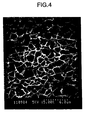
- the section structure of the resulting membrance was coarse because of the low cooling rate and was composed of an aggregate of spherical isolated pores with a diameter of several micrometers.
- the section structure of this membrane is shown in Fig. 4.
- Comparative Example 1 The process of Comparative Example 1 was repeated except for changing the composition as follows: 18 parts by weight of a high-density polyethylene having a Mw of 2.8 x 10 5 , 2 parts by weight of a styrene-hydrogenated butadiene diblock copolymer having a number average molecular weight (Mn) of 8.7 x 10 4 , a styrene content of 25% by weight, a 1,2-linkage content of hydrogenated butadiene polymer sequence of 13% and a hydrogenation rate of 98% or more, and 80 parts by weight of DOP.
- Mn number average molecular weight
- the section structure of the resulting membrance retains the percolation structure in spite of the low cooling rate, and the surface structure was such that a large number of pores were present in a skin-like structure.
- the hollow yarn membrane obtained by the above shaping was immersed in methylene chloride for 1 hr to extract DIDP, and the thus treated membrane was dried at room temperature and then uniaxially stretched at a draw ratio of 150% at 20°C with a tensile tester. In this case, the residual strain was 20% based on the original length.
- the resulting hollow yarn membrane had an inside diameter of 1.20 mm, an outside diameter of 1.81 mm, a porosity of 65%, a maximum pore size of 0.40 ⁇ m, and an average pore size of 0.22 ⁇ m. The ratio of the maximum pore size to the average pore size was 1.82.
- This membrane had a water permeability of 6400 liters/m 2 ⁇ hr ⁇ atm, a breaking strength of 58 kgf/cm 2 , and a breaking extension of 320%.
- the section structure of the membrance was the percolation structure and a large number of spherical pores formed by the stretching were present in the surface.
- Example 3 The process of Example 3 was repeated except for changing the draw ratio to 200%. In this case, the residual strain was 30% based on the original length.
- the resulting hollow yarn membrane had an inside diameter of 1.17 mm, an outside diameter of 1.75 mm, a porosity of 68%, a maximum pore size of 0.46 ⁇ m, and an average pore size of 0.30 ⁇ m. The ratio of the maximum pore size to the average pore size was 1.53.
- This membrane had a water permeability of 8500 liters/m 2 ⁇ hr ⁇ atm, a breaking strength of 64 kgf/cm 2 , and a breaking extension of 270%.
- the structure of the membrane was the same as in Example 3.
- Example 3 The process of Example 3 was repeated except for using a high-density polyethylene having a Mw of 8.0 x 10 5 .
- the residual strain was 18% based on the original length.
- the resulting polyethylene hollow yarn membrane had an inside diameter of 1.10 mm, an outside diameter of 1.73 mm, a porosity of 62%, a maximum pore size of 0.51 ⁇ m, and an average pore size of 0.30 ⁇ m.
- the ratio of the maximum pore size to the average pore size was 1.70.
- This membrane had a water permeability of 7200 liters/m 2 ⁇ hr ⁇ atm, a breaking strength of 68 kgf/cm 2 , and a breaking extension of 300%.
- the structure of the membrane was the same as in Example 3.
- Example 3 The process of Example 3 was repeated except for using DOP as a solvent. In this case, the residual strain was 22% based on the original length.
- the resulting polyethylene hollow yarn membrane had an inside diameter of 1.15 mm, an outside diameter of 1.78 mm, a porosity of 64%, a maximum pore size of 0.86 ⁇ m, and an average pore size of 0.47 ⁇ m. The ratio of the maximum pore size to the average pore size was 1.83.
- This membrane had a water permeability of 8200 liters/m 2 ⁇ hr ⁇ atm, a breaking strength of 63 kgf/cm 2 , and a breaking extension of 480%.
- the structure of the membrane was the same as in Example 3.
- Example 3 The process of Example 3 was repeated except for changing the composition as follows: 18 parts by weight of a high-density polyethylene having a Mw of 4.0 x 10 5 , 2 parts by weight of a styrene-hydrogenated butadiene diblock copolymer having a Mw of 8.7 x 10 4 , a styrene content of 25% by weight, a 1,2-linkage content of hydrogenated butadiene polymer sequence of 13% and a hydrogenation rate of 98% or more, and 80 parts by weight of diisodecyl phthalate (DIDP).
- DIDP diisodecyl phthalate
- the residual strain was 24% based on the original length.
- the resulting polyethylene hollow yarn membrane had an inside diameter of 1.20 mm, an outside diameter of 1.81 mm, a porosity of 65%, a maximum pore size of 0.27 ⁇ m, and an average pore size of 0.14 ⁇ m.
- the ratio of the maximum pore size to the average pore size was 1.93.
- This membrane had a water permeability of 4800 liters/m 2 ⁇ hr ⁇ atm, a breaking strength of 52 kgf/cm 2 , and a breaking extension of 360%.
- the structure of the membrane was the percolation structure and was denser than in Example 3.
- Example 3 The process of Example 3 was repeated except for using liquid paraffin (LP) as a solvent.
- LP liquid paraffin
- the resulting hollow yarn membrane had an inside diameter of 1.17 mm, an outside diameter of 1.87 mm, a porosity of 52%, a maximum pore size of 0.16 ⁇ m, and an average pore size of 0.05 ⁇ m.
- the ratio of the maximum pore size to the average pore size was 3.20.
- This membrane had a water permeability of 20 liters/m 2 ⁇ hr ⁇ atm, a breaking strength of 58 kgf/cm 2 , and a breaking extension of 460%.
- the oriented film had a thickness of 27 ⁇ m, an air permeability of 650 sec/100 cc, a porosity of 57%, a breaking strength of 1120 kgf/cm 2 , and an average pore size of 0.13 ⁇ m.
- the ratio of the maximum pore size to the average pore size was 1.4.
- the oriented film had a thickness of 28 ⁇ m, an air permeability of 48 sec/100 cc, a porosity of 63%, a breaking strength of 680 kgf/cm 2 , and an average pore size of 0.32 ⁇ m.
- the ratio of the maximum pore size to the average pore size was 1.5.
- Example 8 The process of Example 8 was repeated except for changing the composition as follows: 35 parts by weight of a high-density polyethylene having a Mw of 2.8 x 10 5 , 5 parts by weight of a styrene-hydrogenated butadiene diblock copolymer having a Mw of 8.78 x 10 4 , a styrene content of 25% by weight, a 1,2-linkage content of hydrogenated butadiene polymer sequence of 13% and a hydrogenation rate of 98% or more, and 60 parts by weight of DIDP, and conducting the cooling by conventional rollchilling at a rate of 80°C/min.
- the resulting oriented film had a thickness of 25 ⁇ m, an air permeability of 720 sec/100 cc, a porosity of 58%, a breaking strength of 1030 kgf/cm 2 , and an average pore size of 0.10 ⁇ m.
- the ratio of the maximum pore size to the average pore size was 1.2.
- Example 9 The process of Example 9 was repeated except for changing the composition as follows: 35 parts by weight of a high-density polyethylene having a Mw of 2.8 x 10 5 , 5 parts by weight of a styrene-hydrogenated butadiene diblock copolymer having a Mw of 8.78 x 10 4 , a styrene content of 25% by weight, a 1,2-linkage content of hydrogenated butadiene polymer sequence of 13% and a hydrogenation rate of 98% or more, and 60 parts by weight of DIDP, and-conducting the cooling by conventional roll-chilling at a rate of 80°C/min.
- the resulting oriented film had a thickness of 30 ⁇ m, an air permeability of 82 sec/100 cc, a porosity of 60%, a breaking strength of 630 kgf/cm 2 , and an average pore size of 0.27 ⁇ m.
- the ratio of the maximum pore size to the average pore size was 1.3.
- microporous membrane of the present invention is used for various purposes, such as various filters, ultrafiltration membranes, microfiltration membranes, separators for battery, diaphragms for electrolytic capacitor, electrolyte supports for solid electrolyte battery, etc.
Landscapes
- Chemical & Material Sciences (AREA)
- Chemical Kinetics & Catalysis (AREA)
- Electrochemistry (AREA)
- General Chemical & Material Sciences (AREA)
- Engineering & Computer Science (AREA)
- Manufacturing & Machinery (AREA)
- Manufacture Of Porous Articles, And Recovery And Treatment Of Waste Products (AREA)
Applications Claiming Priority (3)
| Application Number | Priority Date | Filing Date | Title |
|---|---|---|---|
| JP6748297 | 1997-03-06 | ||
| JP6748297 | 1997-03-06 | ||
| PCT/JP1998/000917 WO1998039379A1 (fr) | 1997-03-06 | 1998-03-05 | Membrane microporeuse et procede de preparation |
Publications (2)
| Publication Number | Publication Date |
|---|---|
| EP0965610A1 true EP0965610A1 (de) | 1999-12-22 |
| EP0965610A4 EP0965610A4 (de) | 2002-04-24 |
Family
ID=13346249
Family Applications (1)
| Application Number | Title | Priority Date | Filing Date |
|---|---|---|---|
| EP98905780A Withdrawn EP0965610A4 (de) | 1997-03-06 | 1998-03-05 | Mikroporöse membran und verfahren zu deren herstellung |
Country Status (3)
| Country | Link |
|---|---|
| EP (1) | EP0965610A4 (de) |
| AU (1) | AU726539B2 (de) |
| WO (1) | WO1998039379A1 (de) |
Cited By (1)
| Publication number | Priority date | Publication date | Assignee | Title |
|---|---|---|---|---|
| EP1201295A3 (de) * | 2000-10-30 | 2006-08-30 | Sumitomo Chemical Company, Limited | Poröser Film, Separator für Zelle, und Zelle |
Families Citing this family (5)
| Publication number | Priority date | Publication date | Assignee | Title |
|---|---|---|---|---|
| TW581709B (en) * | 1999-10-22 | 2004-04-01 | Asahi Kasei Corp | Heat-resistant microporous film |
| WO2003026779A1 (en) | 2001-08-01 | 2003-04-03 | Asahi Kasei Kabushiki Kaisha | Multilayer microporous film |
| AU2003301399B2 (en) | 2002-10-18 | 2006-07-06 | Asahi Kasei Medical Co., Ltd. | Microporous hydrophilic membrane |
| US7476326B2 (en) | 2003-09-26 | 2009-01-13 | Ahn Chong H | On-chip sample preparation for whole blood analysis |
| JP7639801B2 (ja) * | 2022-10-12 | 2025-03-05 | トヨタ自動車株式会社 | 樹脂多孔質体の製造方法 |
Family Cites Families (10)
| Publication number | Priority date | Publication date | Assignee | Title |
|---|---|---|---|---|
| US4247498A (en) * | 1976-08-30 | 1981-01-27 | Akzona Incorporated | Methods for making microporous products |
| ZA774635B (en) * | 1976-08-30 | 1978-06-28 | Akzona Inc | Microporous products and methods for making same |
| JPS63273651A (ja) * | 1987-04-30 | 1988-11-10 | Toa Nenryo Kogyo Kk | 超高分子量ポリエチレン微多孔膜の製造方法 |
| US4867881A (en) * | 1987-09-14 | 1989-09-19 | Minnesota Minning And Manufacturing Company | Orientied microporous film |
| DE68914156T2 (de) * | 1988-11-10 | 1994-08-25 | Memtec Ltd | Extrusion von hohlfasermembranen. |
| JPH06104736B2 (ja) * | 1989-08-03 | 1994-12-21 | 東燃株式会社 | ポリオレフィン微多孔膜 |
| JPH0653826B2 (ja) * | 1992-05-18 | 1994-07-20 | 東燃株式会社 | ポリエチレン微多孔膜 |
| JP3139199B2 (ja) * | 1993-03-10 | 2001-02-26 | スズキ株式会社 | 自動二輪車のエアークリーナー |
| JP3250894B2 (ja) * | 1993-10-26 | 2002-01-28 | 東燃化学株式会社 | ポリオレフィン微多孔膜の製造方法 |
| EP0816405A3 (de) * | 1994-09-01 | 1998-07-08 | Bridgestone Corporation | Polymer mit Netzwerkstruktur und Verfahren zu seiner Herstellung |
-
1998
- 1998-03-05 WO PCT/JP1998/000917 patent/WO1998039379A1/ja not_active Ceased
- 1998-03-05 AU AU61205/98A patent/AU726539B2/en not_active Ceased
- 1998-03-05 EP EP98905780A patent/EP0965610A4/de not_active Withdrawn
Cited By (1)
| Publication number | Priority date | Publication date | Assignee | Title |
|---|---|---|---|---|
| EP1201295A3 (de) * | 2000-10-30 | 2006-08-30 | Sumitomo Chemical Company, Limited | Poröser Film, Separator für Zelle, und Zelle |
Also Published As
| Publication number | Publication date |
|---|---|
| AU6120598A (en) | 1998-09-22 |
| AU726539B2 (en) | 2000-11-09 |
| EP0965610A4 (de) | 2002-04-24 |
| WO1998039379A1 (fr) | 1998-09-11 |
Similar Documents
| Publication | Publication Date | Title |
|---|---|---|
| AU738323B2 (en) | Microporous membrane | |
| EP1153968B1 (de) | Mikroporöser polyolefinfilm und verfahren zu dessen herstellung | |
| JP3347854B2 (ja) | ポリオレフィン微多孔膜、その製造方法、それを用いた電池用セパレーター及びフィルター | |
| JP4121846B2 (ja) | ポリオレフィン微多孔膜及びその製造方法並びに用途 | |
| KR100530614B1 (ko) | 고투과성 폴리올레핀 미다공막의 제조방법 | |
| JP4195810B2 (ja) | ポリオレフィン微多孔膜及びその製造方法並びに用途 | |
| US20040135274A1 (en) | Microporous membrane | |
| RU2422191C2 (ru) | Микропористые полиолефиновые мембраны и способы их получения | |
| JP3347835B2 (ja) | ポリオレフィン微多孔膜の製造方法 | |
| JP4808935B2 (ja) | ポリエチレン微多孔膜の製造方法並びにその微多孔膜及び用途 | |
| JPH06240036A (ja) | ポリオレフィン微多孔膜及びその製造方法 | |
| JP4234392B2 (ja) | 微多孔膜及びその製造方法並びに用途 | |
| JP2002284918A (ja) | ポリオレフィン微多孔膜及びその製造方法並びに用途 | |
| JP4271750B2 (ja) | 微多孔膜及びその製造方法 | |
| JP3549290B2 (ja) | ポリオレフィン微多孔膜及びその製造方法 | |
| AU726539B2 (en) | Microporous membrane and process for production thereof | |
| JPH09169867A (ja) | 微多孔膜及びその製造方法 | |
| JP3009495B2 (ja) | ポリオレフィン微多孔膜及びその製造方法 | |
| JPH1192587A (ja) | ポリオレフィン微多孔膜の製造方法 | |
| JPH093228A (ja) | ポリオレフィン微多孔膜の製造方法 | |
| JP3641321B2 (ja) | ポリオレフィン微多孔膜の製造方法 | |
| CA2257503C (en) | Method of producing microporous polyolefin membrane | |
| JPWO1998039379A1 (ja) | 微多孔膜及びその製造方法 | |
| JP2657441B2 (ja) | ポリオレフィン微多孔膜の製造方法 | |
| JPH10298340A (ja) | ポリオレフィン微多孔膜の製造方法 |
Legal Events
| Date | Code | Title | Description |
|---|---|---|---|
| PUAI | Public reference made under article 153(3) epc to a published international application that has entered the european phase |
Free format text: ORIGINAL CODE: 0009012 |
|
| 17P | Request for examination filed |
Effective date: 19991005 |
|
| AK | Designated contracting states |
Kind code of ref document: A1 Designated state(s): DE FR GB NL |
|
| RAP1 | Party data changed (applicant data changed or rights of an application transferred) |
Owner name: ASAHI KASEI KABUSHIKI KAISHA |
|
| A4 | Supplementary search report drawn up and despatched |
Effective date: 20020308 |
|
| AK | Designated contracting states |
Kind code of ref document: A4 Designated state(s): DE FR GB NL |
|
| RIC1 | Information provided on ipc code assigned before grant |
Free format text: 7B 01D 71/26 A, 7B 01D 67/00 B |
|
| 17Q | First examination report despatched |
Effective date: 20021120 |
|
| STAA | Information on the status of an ep patent application or granted ep patent |
Free format text: STATUS: THE APPLICATION IS DEEMED TO BE WITHDRAWN |
|
| 18D | Application deemed to be withdrawn |
Effective date: 20030401 |