EP0965886B1 - Matériau à l'halogénure d'argent sensible à la lumière comprenant un support, couche durcissante et couche sensible à la lumière - Google Patents
Matériau à l'halogénure d'argent sensible à la lumière comprenant un support, couche durcissante et couche sensible à la lumière Download PDFInfo
- Publication number
- EP0965886B1 EP0965886B1 EP99111070A EP99111070A EP0965886B1 EP 0965886 B1 EP0965886 B1 EP 0965886B1 EP 99111070 A EP99111070 A EP 99111070A EP 99111070 A EP99111070 A EP 99111070A EP 0965886 B1 EP0965886 B1 EP 0965886B1
- Authority
- EP
- European Patent Office
- Prior art keywords
- light
- layer
- silver halide
- sensitive
- sensitive material
- Prior art date
- Legal status (The legal status is an assumption and is not a legal conclusion. Google has not performed a legal analysis and makes no representation as to the accuracy of the status listed.)
- Expired - Lifetime
Links
- -1 Silver halide Chemical class 0.000 title claims description 145
- 239000000463 material Substances 0.000 title claims description 124
- 229910052709 silver Inorganic materials 0.000 title claims description 113
- 239000004332 silver Substances 0.000 title claims description 113
- 239000010410 layer Substances 0.000 claims description 279
- 229920000642 polymer Polymers 0.000 claims description 87
- 239000002245 particle Substances 0.000 claims description 62
- 230000015572 biosynthetic process Effects 0.000 claims description 48
- 239000002585 base Substances 0.000 claims description 39
- 150000001875 compounds Chemical class 0.000 claims description 38
- 239000003638 chemical reducing agent Substances 0.000 claims description 37
- 239000012790 adhesive layer Substances 0.000 claims description 36
- 239000002243 precursor Substances 0.000 claims description 28
- 229920001477 hydrophilic polymer Polymers 0.000 claims description 27
- 230000002209 hydrophobic effect Effects 0.000 claims description 25
- 239000000203 mixture Substances 0.000 claims description 24
- 229920001600 hydrophobic polymer Polymers 0.000 claims description 18
- 239000001257 hydrogen Substances 0.000 claims description 14
- 229910052739 hydrogen Inorganic materials 0.000 claims description 14
- 239000003086 colorant Substances 0.000 claims description 11
- UFHFLCQGNIYNRP-UHFFFAOYSA-N Hydrogen Chemical compound [H][H] UFHFLCQGNIYNRP-UHFFFAOYSA-N 0.000 claims description 7
- 125000003342 alkenyl group Chemical group 0.000 claims description 7
- 125000004435 hydrogen atom Chemical group [H]* 0.000 claims description 6
- 239000010954 inorganic particle Substances 0.000 claims description 6
- 125000005647 linker group Chemical group 0.000 claims description 6
- 125000002496 methyl group Chemical group [H]C([H])([H])* 0.000 claims description 6
- 229910052783 alkali metal Inorganic materials 0.000 claims description 4
- 125000002947 alkylene group Chemical group 0.000 claims description 4
- 150000001340 alkali metals Chemical class 0.000 claims description 3
- 229920001519 homopolymer Polymers 0.000 claims description 3
- 229910052782 aluminium Inorganic materials 0.000 description 32
- XAGFODPZIPBFFR-UHFFFAOYSA-N aluminium Chemical compound [Al] XAGFODPZIPBFFR-UHFFFAOYSA-N 0.000 description 32
- 239000000243 solution Substances 0.000 description 32
- 239000000839 emulsion Substances 0.000 description 29
- 238000011161 development Methods 0.000 description 28
- 239000006185 dispersion Substances 0.000 description 23
- 239000000975 dye Substances 0.000 description 23
- 238000000034 method Methods 0.000 description 23
- 239000007864 aqueous solution Substances 0.000 description 22
- XLYOFNOQVPJJNP-UHFFFAOYSA-N water Substances O XLYOFNOQVPJJNP-UHFFFAOYSA-N 0.000 description 20
- VYPSYNLAJGMNEJ-UHFFFAOYSA-N Silicium dioxide Chemical compound O=[Si]=O VYPSYNLAJGMNEJ-UHFFFAOYSA-N 0.000 description 19
- 239000011248 coating agent Substances 0.000 description 19
- 238000000576 coating method Methods 0.000 description 19
- OKKJLVBELUTLKV-UHFFFAOYSA-N methanol Natural products OC OKKJLVBELUTLKV-UHFFFAOYSA-N 0.000 description 19
- 150000003839 salts Chemical class 0.000 description 18
- 239000002253 acid Substances 0.000 description 17
- 230000006870 function Effects 0.000 description 17
- 239000004372 Polyvinyl alcohol Substances 0.000 description 16
- 239000003795 chemical substances by application Substances 0.000 description 16
- 229920002451 polyvinyl alcohol Polymers 0.000 description 16
- 239000000049 pigment Substances 0.000 description 15
- 238000002360 preparation method Methods 0.000 description 15
- QAOWNCQODCNURD-UHFFFAOYSA-N Sulfuric acid Chemical compound OS(O)(=O)=O QAOWNCQODCNURD-UHFFFAOYSA-N 0.000 description 14
- HEMHJVSKTPXQMS-UHFFFAOYSA-M Sodium hydroxide Chemical compound [OH-].[Na+] HEMHJVSKTPXQMS-UHFFFAOYSA-M 0.000 description 12
- 230000002378 acidificating effect Effects 0.000 description 12
- 238000010438 heat treatment Methods 0.000 description 12
- 239000006087 Silane Coupling Agent Substances 0.000 description 11
- 230000001235 sensitizing effect Effects 0.000 description 11
- 238000011160 research Methods 0.000 description 10
- KWYUFKZDYYNOTN-UHFFFAOYSA-M Potassium hydroxide Chemical compound [OH-].[K+] KWYUFKZDYYNOTN-UHFFFAOYSA-M 0.000 description 9
- BQCADISMDOOEFD-UHFFFAOYSA-N Silver Chemical compound [Ag] BQCADISMDOOEFD-UHFFFAOYSA-N 0.000 description 9
- 150000002148 esters Chemical class 0.000 description 9
- 239000004094 surface-active agent Substances 0.000 description 9
- 238000006243 chemical reaction Methods 0.000 description 8
- 230000005661 hydrophobic surface Effects 0.000 description 8
- 230000008569 process Effects 0.000 description 8
- 238000007127 saponification reaction Methods 0.000 description 8
- 239000002904 solvent Substances 0.000 description 8
- 239000012670 alkaline solution Substances 0.000 description 7
- 238000007743 anodising Methods 0.000 description 7
- 238000005530 etching Methods 0.000 description 7
- 125000002887 hydroxy group Chemical group [H]O* 0.000 description 7
- 238000006116 polymerization reaction Methods 0.000 description 7
- GGCZERPQGJTIQP-UHFFFAOYSA-N sodium;9,10-dioxoanthracene-2-sulfonic acid Chemical compound [Na+].C1=CC=C2C(=O)C3=CC(S(=O)(=O)O)=CC=C3C(=O)C2=C1 GGCZERPQGJTIQP-UHFFFAOYSA-N 0.000 description 7
- 230000003595 spectral effect Effects 0.000 description 7
- ZWEHNKRNPOVVGH-UHFFFAOYSA-N 2-Butanone Chemical compound CCC(C)=O ZWEHNKRNPOVVGH-UHFFFAOYSA-N 0.000 description 6
- LFQSCWFLJHTTHZ-UHFFFAOYSA-N Ethanol Chemical group CCO LFQSCWFLJHTTHZ-UHFFFAOYSA-N 0.000 description 6
- NBIIXXVUZAFLBC-UHFFFAOYSA-N Phosphoric acid Chemical compound OP(O)(O)=O NBIIXXVUZAFLBC-UHFFFAOYSA-N 0.000 description 6
- GWEVSGVZZGPLCZ-UHFFFAOYSA-N Titan oxide Chemical compound O=[Ti]=O GWEVSGVZZGPLCZ-UHFFFAOYSA-N 0.000 description 6
- 239000000654 additive Substances 0.000 description 6
- 239000003513 alkali Substances 0.000 description 6
- 125000003118 aryl group Chemical group 0.000 description 6
- 239000011230 binding agent Substances 0.000 description 6
- 238000007334 copolymerization reaction Methods 0.000 description 6
- 239000007822 coupling agent Substances 0.000 description 6
- 125000000524 functional group Chemical group 0.000 description 6
- 125000001165 hydrophobic group Chemical group 0.000 description 6
- 239000006224 matting agent Substances 0.000 description 6
- 239000000178 monomer Substances 0.000 description 6
- IOLCXVTUBQKXJR-UHFFFAOYSA-M potassium bromide Chemical compound [K+].[Br-] IOLCXVTUBQKXJR-UHFFFAOYSA-M 0.000 description 6
- 150000003254 radicals Chemical class 0.000 description 6
- SQGYOTSLMSWVJD-UHFFFAOYSA-N silver(1+) nitrate Chemical compound [Ag+].[O-]N(=O)=O SQGYOTSLMSWVJD-UHFFFAOYSA-N 0.000 description 6
- 239000000126 substance Substances 0.000 description 6
- 238000002834 transmittance Methods 0.000 description 6
- NIXOWILDQLNWCW-UHFFFAOYSA-M Acrylate Chemical compound [O-]C(=O)C=C NIXOWILDQLNWCW-UHFFFAOYSA-M 0.000 description 5
- 229910002012 Aerosil® Inorganic materials 0.000 description 5
- NIXOWILDQLNWCW-UHFFFAOYSA-N acrylic acid group Chemical group C(C=C)(=O)O NIXOWILDQLNWCW-UHFFFAOYSA-N 0.000 description 5
- 125000004432 carbon atom Chemical group C* 0.000 description 5
- 230000000694 effects Effects 0.000 description 5
- 229910052736 halogen Inorganic materials 0.000 description 5
- 150000002367 halogens Chemical class 0.000 description 5
- 229910052751 metal Inorganic materials 0.000 description 5
- 239000002184 metal Substances 0.000 description 5
- 230000035945 sensitivity Effects 0.000 description 5
- 125000000391 vinyl group Chemical group [H]C([*])=C([H])[H] 0.000 description 5
- 229920002554 vinyl polymer Polymers 0.000 description 5
- FUGYGGDSWSUORM-UHFFFAOYSA-N 4-hydroxystyrene Chemical compound OC1=CC=C(C=C)C=C1 FUGYGGDSWSUORM-UHFFFAOYSA-N 0.000 description 4
- XEEYBQQBJWHFJM-UHFFFAOYSA-N Iron Chemical compound [Fe] XEEYBQQBJWHFJM-UHFFFAOYSA-N 0.000 description 4
- GRYLNZFGIOXLOG-UHFFFAOYSA-N Nitric acid Chemical compound O[N+]([O-])=O GRYLNZFGIOXLOG-UHFFFAOYSA-N 0.000 description 4
- MUBZPKHOEPUJKR-UHFFFAOYSA-N Oxalic acid Chemical compound OC(=O)C(O)=O MUBZPKHOEPUJKR-UHFFFAOYSA-N 0.000 description 4
- 206010070834 Sensitisation Diseases 0.000 description 4
- CDBYLPFSWZWCQE-UHFFFAOYSA-L Sodium Carbonate Chemical compound [Na+].[Na+].[O-]C([O-])=O CDBYLPFSWZWCQE-UHFFFAOYSA-L 0.000 description 4
- 239000004115 Sodium Silicate Substances 0.000 description 4
- 235000010724 Wisteria floribunda Nutrition 0.000 description 4
- 125000000217 alkyl group Chemical group 0.000 description 4
- 150000001408 amides Chemical class 0.000 description 4
- 235000013877 carbamide Nutrition 0.000 description 4
- 230000005660 hydrophilic surface Effects 0.000 description 4
- 239000003112 inhibitor Substances 0.000 description 4
- 229910052741 iridium Inorganic materials 0.000 description 4
- 150000002504 iridium compounds Chemical class 0.000 description 4
- 229920003145 methacrylic acid copolymer Polymers 0.000 description 4
- 229940117841 methacrylic acid copolymer Drugs 0.000 description 4
- 229910017604 nitric acid Inorganic materials 0.000 description 4
- 235000011007 phosphoric acid Nutrition 0.000 description 4
- 229920000728 polyester Polymers 0.000 description 4
- 239000004814 polyurethane Substances 0.000 description 4
- 229920002635 polyurethane Polymers 0.000 description 4
- 229910052913 potassium silicate Inorganic materials 0.000 description 4
- 235000019353 potassium silicate Nutrition 0.000 description 4
- FBCQUCJYYPMKRO-UHFFFAOYSA-N prop-2-enyl 2-methylprop-2-enoate Chemical compound CC(=C)C(=O)OCC=C FBCQUCJYYPMKRO-UHFFFAOYSA-N 0.000 description 4
- 229910052703 rhodium Inorganic materials 0.000 description 4
- 239000010948 rhodium Substances 0.000 description 4
- 150000003284 rhodium compounds Chemical class 0.000 description 4
- 230000008313 sensitization Effects 0.000 description 4
- 238000000926 separation method Methods 0.000 description 4
- ZUNKMNLKJXRCDM-UHFFFAOYSA-N silver bromoiodide Chemical compound [Ag].IBr ZUNKMNLKJXRCDM-UHFFFAOYSA-N 0.000 description 4
- 159000000000 sodium salts Chemical class 0.000 description 4
- NTHWMYGWWRZVTN-UHFFFAOYSA-N sodium silicate Chemical compound [Na+].[Na+].[O-][Si]([O-])=O NTHWMYGWWRZVTN-UHFFFAOYSA-N 0.000 description 4
- 229910052911 sodium silicate Inorganic materials 0.000 description 4
- 229910052724 xenon Inorganic materials 0.000 description 4
- FHNFHKCVQCLJFQ-UHFFFAOYSA-N xenon atom Chemical compound [Xe] FHNFHKCVQCLJFQ-UHFFFAOYSA-N 0.000 description 4
- JKFYKCYQEWQPTM-UHFFFAOYSA-N 2-azaniumyl-2-(4-fluorophenyl)acetate Chemical compound OC(=O)C(N)C1=CC=C(F)C=C1 JKFYKCYQEWQPTM-UHFFFAOYSA-N 0.000 description 3
- 125000003903 2-propenyl group Chemical group [H]C([*])([H])C([H])=C([H])[H] 0.000 description 3
- OKTJSMMVPCPJKN-UHFFFAOYSA-N Carbon Chemical compound [C] OKTJSMMVPCPJKN-UHFFFAOYSA-N 0.000 description 3
- LYCAIKOWRPUZTN-UHFFFAOYSA-N Ethylene glycol Chemical compound OCCO LYCAIKOWRPUZTN-UHFFFAOYSA-N 0.000 description 3
- PEDCQBHIVMGVHV-UHFFFAOYSA-N Glycerine Chemical compound OCC(O)CO PEDCQBHIVMGVHV-UHFFFAOYSA-N 0.000 description 3
- WMFOQBRAJBCJND-UHFFFAOYSA-M Lithium hydroxide Chemical compound [Li+].[OH-] WMFOQBRAJBCJND-UHFFFAOYSA-M 0.000 description 3
- 239000004677 Nylon Substances 0.000 description 3
- 239000004952 Polyamide Substances 0.000 description 3
- 239000004111 Potassium silicate Substances 0.000 description 3
- 229910021612 Silver iodide Inorganic materials 0.000 description 3
- XSQUKJJJFZCRTK-UHFFFAOYSA-N Urea Natural products NC(N)=O XSQUKJJJFZCRTK-UHFFFAOYSA-N 0.000 description 3
- 150000007513 acids Chemical class 0.000 description 3
- 150000001298 alcohols Chemical class 0.000 description 3
- 229910000147 aluminium phosphate Inorganic materials 0.000 description 3
- 150000001412 amines Chemical class 0.000 description 3
- QVGXLLKOCUKJST-UHFFFAOYSA-N atomic oxygen Chemical compound [O] QVGXLLKOCUKJST-UHFFFAOYSA-N 0.000 description 3
- 229910052799 carbon Inorganic materials 0.000 description 3
- 239000013078 crystal Substances 0.000 description 3
- MTHSVFCYNBDYFN-UHFFFAOYSA-N diethylene glycol Chemical compound OCCOCCO MTHSVFCYNBDYFN-UHFFFAOYSA-N 0.000 description 3
- 239000008151 electrolyte solution Substances 0.000 description 3
- RTZKZFJDLAIYFH-UHFFFAOYSA-N ether Substances CCOCC RTZKZFJDLAIYFH-UHFFFAOYSA-N 0.000 description 3
- 238000011156 evaluation Methods 0.000 description 3
- RBTKNAXYKSUFRK-UHFFFAOYSA-N heliogen blue Chemical compound [Cu].[N-]1C2=C(C=CC=C3)C3=C1N=C([N-]1)C3=CC=CC=C3C1=NC([N-]1)=C(C=CC=C3)C3=C1N=C([N-]1)C3=CC=CC=C3C1=N2 RBTKNAXYKSUFRK-UHFFFAOYSA-N 0.000 description 3
- 230000003993 interaction Effects 0.000 description 3
- GKOZUEZYRPOHIO-UHFFFAOYSA-N iridium atom Chemical compound [Ir] GKOZUEZYRPOHIO-UHFFFAOYSA-N 0.000 description 3
- 125000005395 methacrylic acid group Chemical class 0.000 description 3
- 229920001778 nylon Polymers 0.000 description 3
- 229920002647 polyamide Polymers 0.000 description 3
- 239000005020 polyethylene terephthalate Substances 0.000 description 3
- 229920000139 polyethylene terephthalate Polymers 0.000 description 3
- NLKNQRATVPKPDG-UHFFFAOYSA-M potassium iodide Chemical compound [K+].[I-] NLKNQRATVPKPDG-UHFFFAOYSA-M 0.000 description 3
- NNHHDJVEYQHLHG-UHFFFAOYSA-N potassium silicate Chemical compound [K+].[K+].[O-][Si]([O-])=O NNHHDJVEYQHLHG-UHFFFAOYSA-N 0.000 description 3
- 229940045105 silver iodide Drugs 0.000 description 3
- 229910001961 silver nitrate Inorganic materials 0.000 description 3
- 239000003381 stabilizer Substances 0.000 description 3
- 239000000725 suspension Substances 0.000 description 3
- QGKMIGUHVLGJBR-UHFFFAOYSA-M (4z)-1-(3-methylbutyl)-4-[[1-(3-methylbutyl)quinolin-1-ium-4-yl]methylidene]quinoline;iodide Chemical compound [I-].C12=CC=CC=C2N(CCC(C)C)C=CC1=CC1=CC=[N+](CCC(C)C)C2=CC=CC=C12 QGKMIGUHVLGJBR-UHFFFAOYSA-M 0.000 description 2
- MYWOJODOMFBVCB-UHFFFAOYSA-N 1,2,6-trimethylphenanthrene Chemical compound CC1=CC=C2C3=CC(C)=CC=C3C=CC2=C1C MYWOJODOMFBVCB-UHFFFAOYSA-N 0.000 description 2
- ARXJGSRGQADJSQ-UHFFFAOYSA-N 1-methoxypropan-2-ol Chemical compound COCC(C)O ARXJGSRGQADJSQ-UHFFFAOYSA-N 0.000 description 2
- HZAXFHJVJLSVMW-UHFFFAOYSA-N 2-Aminoethan-1-ol Chemical compound NCCO HZAXFHJVJLSVMW-UHFFFAOYSA-N 0.000 description 2
- WRMNZCZEMHIOCP-UHFFFAOYSA-N 2-phenylethanol Chemical compound OCCC1=CC=CC=C1 WRMNZCZEMHIOCP-UHFFFAOYSA-N 0.000 description 2
- IZSHZLKNFQAAKX-UHFFFAOYSA-N 5-cyclopenta-2,4-dien-1-ylcyclopenta-1,3-diene Chemical group C1=CC=CC1C1C=CC=C1 IZSHZLKNFQAAKX-UHFFFAOYSA-N 0.000 description 2
- DLFVBJFMPXGRIB-UHFFFAOYSA-N Acetamide Chemical compound CC(N)=O DLFVBJFMPXGRIB-UHFFFAOYSA-N 0.000 description 2
- QGZKDVFQNNGYKY-UHFFFAOYSA-N Ammonia Chemical compound N QGZKDVFQNNGYKY-UHFFFAOYSA-N 0.000 description 2
- 229920002284 Cellulose triacetate Polymers 0.000 description 2
- RYGMFSIKBFXOCR-UHFFFAOYSA-N Copper Chemical compound [Cu] RYGMFSIKBFXOCR-UHFFFAOYSA-N 0.000 description 2
- 239000001856 Ethyl cellulose Substances 0.000 description 2
- KRHYYFGTRYWZRS-UHFFFAOYSA-N Fluorane Chemical compound F KRHYYFGTRYWZRS-UHFFFAOYSA-N 0.000 description 2
- YCKRFDGAMUMZLT-UHFFFAOYSA-N Fluorine atom Chemical compound [F] YCKRFDGAMUMZLT-UHFFFAOYSA-N 0.000 description 2
- 108010010803 Gelatin Proteins 0.000 description 2
- DHMQDGOQFOQNFH-UHFFFAOYSA-N Glycine Chemical compound NCC(O)=O DHMQDGOQFOQNFH-UHFFFAOYSA-N 0.000 description 2
- OAKJQQAXSVQMHS-UHFFFAOYSA-N Hydrazine Chemical compound NN OAKJQQAXSVQMHS-UHFFFAOYSA-N 0.000 description 2
- VEXZGXHMUGYJMC-UHFFFAOYSA-N Hydrochloric acid Chemical compound Cl VEXZGXHMUGYJMC-UHFFFAOYSA-N 0.000 description 2
- LRHPLDYGYMQRHN-UHFFFAOYSA-N N-Butanol Chemical compound CCCCO LRHPLDYGYMQRHN-UHFFFAOYSA-N 0.000 description 2
- KDLHZDBZIXYQEI-UHFFFAOYSA-N Palladium Chemical compound [Pd] KDLHZDBZIXYQEI-UHFFFAOYSA-N 0.000 description 2
- ISWSIDIOOBJBQZ-UHFFFAOYSA-N Phenol Chemical compound OC1=CC=CC=C1 ISWSIDIOOBJBQZ-UHFFFAOYSA-N 0.000 description 2
- 239000004698 Polyethylene Substances 0.000 description 2
- 239000002202 Polyethylene glycol Substances 0.000 description 2
- 239000004743 Polypropylene Substances 0.000 description 2
- XUIMIQQOPSSXEZ-UHFFFAOYSA-N Silicon Chemical group [Si] XUIMIQQOPSSXEZ-UHFFFAOYSA-N 0.000 description 2
- NINIDFKCEFEMDL-UHFFFAOYSA-N Sulfur Chemical compound [S] NINIDFKCEFEMDL-UHFFFAOYSA-N 0.000 description 2
- RTAQQCXQSZGOHL-UHFFFAOYSA-N Titanium Chemical compound [Ti] RTAQQCXQSZGOHL-UHFFFAOYSA-N 0.000 description 2
- GSEJCLTVZPLZKY-UHFFFAOYSA-N Triethanolamine Chemical compound OCCN(CCO)CCO GSEJCLTVZPLZKY-UHFFFAOYSA-N 0.000 description 2
- XTXRWKRVRITETP-UHFFFAOYSA-N Vinyl acetate Chemical compound CC(=O)OC=C XTXRWKRVRITETP-UHFFFAOYSA-N 0.000 description 2
- HCHKCACWOHOZIP-UHFFFAOYSA-N Zinc Chemical compound [Zn] HCHKCACWOHOZIP-UHFFFAOYSA-N 0.000 description 2
- XLOMVQKBTHCTTD-UHFFFAOYSA-N Zinc monoxide Chemical compound [Zn]=O XLOMVQKBTHCTTD-UHFFFAOYSA-N 0.000 description 2
- NNLVGZFZQQXQNW-ADJNRHBOSA-N [(2r,3r,4s,5r,6s)-4,5-diacetyloxy-3-[(2s,3r,4s,5r,6r)-3,4,5-triacetyloxy-6-(acetyloxymethyl)oxan-2-yl]oxy-6-[(2r,3r,4s,5r,6s)-4,5,6-triacetyloxy-2-(acetyloxymethyl)oxan-3-yl]oxyoxan-2-yl]methyl acetate Chemical compound O([C@@H]1O[C@@H]([C@H]([C@H](OC(C)=O)[C@H]1OC(C)=O)O[C@H]1[C@@H]([C@@H](OC(C)=O)[C@H](OC(C)=O)[C@@H](COC(C)=O)O1)OC(C)=O)COC(=O)C)[C@@H]1[C@@H](COC(C)=O)O[C@@H](OC(C)=O)[C@H](OC(C)=O)[C@H]1OC(C)=O NNLVGZFZQQXQNW-ADJNRHBOSA-N 0.000 description 2
- 239000000853 adhesive Substances 0.000 description 2
- 230000001070 adhesive effect Effects 0.000 description 2
- 239000002390 adhesive tape Substances 0.000 description 2
- 230000002411 adverse Effects 0.000 description 2
- 125000001931 aliphatic group Chemical group 0.000 description 2
- 125000003545 alkoxy group Chemical group 0.000 description 2
- 235000001014 amino acid Nutrition 0.000 description 2
- 150000001414 amino alcohols Chemical class 0.000 description 2
- 239000010407 anodic oxide Substances 0.000 description 2
- RWZYAGGXGHYGMB-UHFFFAOYSA-N anthranilic acid Chemical compound NC1=CC=CC=C1C(O)=O RWZYAGGXGHYGMB-UHFFFAOYSA-N 0.000 description 2
- XKRFYHLGVUSROY-UHFFFAOYSA-N argon Substances [Ar] XKRFYHLGVUSROY-UHFFFAOYSA-N 0.000 description 2
- 229910052786 argon Inorganic materials 0.000 description 2
- 230000004888 barrier function Effects 0.000 description 2
- 238000009835 boiling Methods 0.000 description 2
- 230000001680 brushing effect Effects 0.000 description 2
- UIZLQMLDSWKZGC-UHFFFAOYSA-N cadmium helium Chemical compound [He].[Cd] UIZLQMLDSWKZGC-UHFFFAOYSA-N 0.000 description 2
- 239000004202 carbamide Substances 0.000 description 2
- 125000003178 carboxy group Chemical group [H]OC(*)=O 0.000 description 2
- 229920002678 cellulose Polymers 0.000 description 2
- 238000006757 chemical reactions by type Methods 0.000 description 2
- IJOOHPMOJXWVHK-UHFFFAOYSA-N chlorotrimethylsilane Chemical compound C[Si](C)(C)Cl IJOOHPMOJXWVHK-UHFFFAOYSA-N 0.000 description 2
- KRVSOGSZCMJSLX-UHFFFAOYSA-L chromic acid Substances O[Cr](O)(=O)=O KRVSOGSZCMJSLX-UHFFFAOYSA-L 0.000 description 2
- 238000007796 conventional method Methods 0.000 description 2
- 229920001577 copolymer Polymers 0.000 description 2
- 229910052802 copper Inorganic materials 0.000 description 2
- 239000010949 copper Substances 0.000 description 2
- 239000003431 cross linking reagent Substances 0.000 description 2
- 238000006114 decarboxylation reaction Methods 0.000 description 2
- ZBCBWPMODOFKDW-UHFFFAOYSA-N diethanolamine Chemical compound OCCNCCO ZBCBWPMODOFKDW-UHFFFAOYSA-N 0.000 description 2
- 229940043237 diethanolamine Drugs 0.000 description 2
- 238000010494 dissociation reaction Methods 0.000 description 2
- 230000005593 dissociations Effects 0.000 description 2
- 229920001249 ethyl cellulose Polymers 0.000 description 2
- 235000019325 ethyl cellulose Nutrition 0.000 description 2
- 229910052731 fluorine Inorganic materials 0.000 description 2
- 239000011737 fluorine Substances 0.000 description 2
- AWJWCTOOIBYHON-UHFFFAOYSA-N furo[3,4-b]pyrazine-5,7-dione Chemical compound C1=CN=C2C(=O)OC(=O)C2=N1 AWJWCTOOIBYHON-UHFFFAOYSA-N 0.000 description 2
- 239000008273 gelatin Substances 0.000 description 2
- 229920000159 gelatin Polymers 0.000 description 2
- 235000019322 gelatine Nutrition 0.000 description 2
- 235000011852 gelatine desserts Nutrition 0.000 description 2
- CPBQJMYROZQQJC-UHFFFAOYSA-N helium neon Chemical compound [He].[Ne] CPBQJMYROZQQJC-UHFFFAOYSA-N 0.000 description 2
- 229910052742 iron Inorganic materials 0.000 description 2
- 230000001788 irregular Effects 0.000 description 2
- FPYJFEHAWHCUMM-UHFFFAOYSA-N maleic anhydride Chemical compound O=C1OC(=O)C=C1 FPYJFEHAWHCUMM-UHFFFAOYSA-N 0.000 description 2
- DZVCFNFOPIZQKX-LTHRDKTGSA-M merocyanine Chemical compound [Na+].O=C1N(CCCC)C(=O)N(CCCC)C(=O)C1=C\C=C\C=C/1N(CCCS([O-])(=O)=O)C2=CC=CC=C2O\1 DZVCFNFOPIZQKX-LTHRDKTGSA-M 0.000 description 2
- BFXIKLCIZHOAAZ-UHFFFAOYSA-N methyltrimethoxysilane Chemical compound CO[Si](C)(OC)OC BFXIKLCIZHOAAZ-UHFFFAOYSA-N 0.000 description 2
- LNOPIUAQISRISI-UHFFFAOYSA-N n'-hydroxy-2-propan-2-ylsulfonylethanimidamide Chemical compound CC(C)S(=O)(=O)CC(N)=NO LNOPIUAQISRISI-UHFFFAOYSA-N 0.000 description 2
- 229920005615 natural polymer Polymers 0.000 description 2
- 150000007524 organic acids Chemical class 0.000 description 2
- 239000003960 organic solvent Substances 0.000 description 2
- 150000001367 organochlorosilanes Chemical class 0.000 description 2
- 230000003647 oxidation Effects 0.000 description 2
- 238000007254 oxidation reaction Methods 0.000 description 2
- 229910052760 oxygen Inorganic materials 0.000 description 2
- 239000001301 oxygen Substances 0.000 description 2
- 230000000149 penetrating effect Effects 0.000 description 2
- 239000005011 phenolic resin Substances 0.000 description 2
- 229920003023 plastic Polymers 0.000 description 2
- 239000004033 plastic Substances 0.000 description 2
- 239000002985 plastic film Substances 0.000 description 2
- 229920006255 plastic film Polymers 0.000 description 2
- 239000004014 plasticizer Substances 0.000 description 2
- BASFCYQUMIYNBI-UHFFFAOYSA-N platinum Chemical compound [Pt] BASFCYQUMIYNBI-UHFFFAOYSA-N 0.000 description 2
- 229920000515 polycarbonate Polymers 0.000 description 2
- 239000004417 polycarbonate Substances 0.000 description 2
- 229920000573 polyethylene Polymers 0.000 description 2
- 229920001223 polyethylene glycol Polymers 0.000 description 2
- 229920006254 polymer film Polymers 0.000 description 2
- 229920001155 polypropylene Polymers 0.000 description 2
- 229920001296 polysiloxane Polymers 0.000 description 2
- 239000000843 powder Substances 0.000 description 2
- 230000009467 reduction Effects 0.000 description 2
- 238000006722 reduction reaction Methods 0.000 description 2
- MHOVAHRLVXNVSD-UHFFFAOYSA-N rhodium atom Chemical compound [Rh] MHOVAHRLVXNVSD-UHFFFAOYSA-N 0.000 description 2
- SONJTKJMTWTJCT-UHFFFAOYSA-K rhodium(iii) chloride Chemical compound [Cl-].[Cl-].[Cl-].[Rh+3] SONJTKJMTWTJCT-UHFFFAOYSA-K 0.000 description 2
- 230000005070 ripening Effects 0.000 description 2
- 239000004065 semiconductor Substances 0.000 description 2
- 229910052710 silicon Inorganic materials 0.000 description 2
- ADZWSOLPGZMUMY-UHFFFAOYSA-M silver bromide Chemical compound [Ag]Br ADZWSOLPGZMUMY-UHFFFAOYSA-M 0.000 description 2
- 229910000029 sodium carbonate Inorganic materials 0.000 description 2
- 235000019795 sodium metasilicate Nutrition 0.000 description 2
- 239000001488 sodium phosphate Substances 0.000 description 2
- 229910000162 sodium phosphate Inorganic materials 0.000 description 2
- 150000005846 sugar alcohols Polymers 0.000 description 2
- 229940124530 sulfonamide Drugs 0.000 description 2
- 150000003456 sulfonamides Chemical class 0.000 description 2
- 229910052717 sulfur Inorganic materials 0.000 description 2
- 239000011593 sulfur Substances 0.000 description 2
- 229920001059 synthetic polymer Polymers 0.000 description 2
- 238000009864 tensile test Methods 0.000 description 2
- 238000005979 thermal decomposition reaction Methods 0.000 description 2
- 150000003568 thioethers Chemical class 0.000 description 2
- 239000004408 titanium dioxide Substances 0.000 description 2
- RYFMWSXOAZQYPI-UHFFFAOYSA-K trisodium phosphate Chemical compound [Na+].[Na+].[Na+].[O-]P([O-])([O-])=O RYFMWSXOAZQYPI-UHFFFAOYSA-K 0.000 description 2
- 229960004418 trolamine Drugs 0.000 description 2
- 150000003672 ureas Chemical class 0.000 description 2
- 229910052725 zinc Inorganic materials 0.000 description 2
- 239000011701 zinc Substances 0.000 description 2
- MTCFGRXMJLQNBG-REOHCLBHSA-N (2S)-2-Amino-3-hydroxypropansäure Chemical compound OC[C@H](N)C(O)=O MTCFGRXMJLQNBG-REOHCLBHSA-N 0.000 description 1
- JNYAEWCLZODPBN-JGWLITMVSA-N (2r,3r,4s)-2-[(1r)-1,2-dihydroxyethyl]oxolane-3,4-diol Chemical compound OC[C@@H](O)[C@H]1OC[C@H](O)[C@H]1O JNYAEWCLZODPBN-JGWLITMVSA-N 0.000 description 1
- JHPBZFOKBAGZBL-UHFFFAOYSA-N (3-hydroxy-2,2,4-trimethylpentyl) 2-methylprop-2-enoate Chemical compound CC(C)C(O)C(C)(C)COC(=O)C(C)=C JHPBZFOKBAGZBL-UHFFFAOYSA-N 0.000 description 1
- BNGXYYYYKUGPPF-UHFFFAOYSA-M (3-methylphenyl)methyl-triphenylphosphanium;chloride Chemical compound [Cl-].CC1=CC=CC(C[P+](C=2C=CC=CC=2)(C=2C=CC=CC=2)C=2C=CC=CC=2)=C1 BNGXYYYYKUGPPF-UHFFFAOYSA-M 0.000 description 1
- TUMNHQRORINJKE-UHFFFAOYSA-N 1,1-diethylurea Chemical compound CCN(CC)C(N)=O TUMNHQRORINJKE-UHFFFAOYSA-N 0.000 description 1
- 150000005206 1,2-dihydroxybenzenes Chemical class 0.000 description 1
- 150000005208 1,4-dihydroxybenzenes Chemical class 0.000 description 1
- KJUGUADJHNHALS-UHFFFAOYSA-N 1H-tetrazole Substances C=1N=NNN=1 KJUGUADJHNHALS-UHFFFAOYSA-N 0.000 description 1
- JVVRJMXHNUAPHW-UHFFFAOYSA-N 1h-pyrazol-5-amine Chemical class NC=1C=CNN=1 JVVRJMXHNUAPHW-UHFFFAOYSA-N 0.000 description 1
- LLCOQBODWBFTDD-UHFFFAOYSA-N 1h-triazol-1-ium-4-thiolate Chemical class SC1=CNN=N1 LLCOQBODWBFTDD-UHFFFAOYSA-N 0.000 description 1
- SMZOUWXMTYCWNB-UHFFFAOYSA-N 2-(2-methoxy-5-methylphenyl)ethanamine Chemical compound COC1=CC=C(C)C=C1CCN SMZOUWXMTYCWNB-UHFFFAOYSA-N 0.000 description 1
- TXBCBTDQIULDIA-UHFFFAOYSA-N 2-[[3-hydroxy-2,2-bis(hydroxymethyl)propoxy]methyl]-2-(hydroxymethyl)propane-1,3-diol Chemical compound OCC(CO)(CO)COCC(CO)(CO)CO TXBCBTDQIULDIA-UHFFFAOYSA-N 0.000 description 1
- AGBXYHCHUYARJY-UHFFFAOYSA-N 2-phenylethenesulfonic acid Chemical compound OS(=O)(=O)C=CC1=CC=CC=C1 AGBXYHCHUYARJY-UHFFFAOYSA-N 0.000 description 1
- PYSRRFNXTXNWCD-UHFFFAOYSA-N 3-(2-phenylethenyl)furan-2,5-dione Chemical compound O=C1OC(=O)C(C=CC=2C=CC=CC=2)=C1 PYSRRFNXTXNWCD-UHFFFAOYSA-N 0.000 description 1
- USGNZHHNWYDCTC-UHFFFAOYSA-N 4-amino-1,4-dihydropyrazol-5-one Chemical class NC1C=NNC1=O USGNZHHNWYDCTC-UHFFFAOYSA-N 0.000 description 1
- PLIKAWJENQZMHA-UHFFFAOYSA-N 4-aminophenol Chemical class NC1=CC=C(O)C=C1 PLIKAWJENQZMHA-UHFFFAOYSA-N 0.000 description 1
- DUFPUPLYCLGLJA-UHFFFAOYSA-N 6-amino-5-hydroxy-1h-pyrimidin-4-one Chemical class NC=1N=CNC(=O)C=1O DUFPUPLYCLGLJA-UHFFFAOYSA-N 0.000 description 1
- HRPVXLWXLXDGHG-UHFFFAOYSA-N Acrylamide Chemical compound NC(=O)C=C HRPVXLWXLXDGHG-UHFFFAOYSA-N 0.000 description 1
- 229910002016 Aerosil® 200 Inorganic materials 0.000 description 1
- 229910000838 Al alloy Inorganic materials 0.000 description 1
- 229930185605 Bisphenol Natural products 0.000 description 1
- KAKZBPTYRLMSJV-UHFFFAOYSA-N Butadiene Chemical group C=CC=C KAKZBPTYRLMSJV-UHFFFAOYSA-N 0.000 description 1
- 239000004970 Chain extender Substances 0.000 description 1
- VEXZGXHMUGYJMC-UHFFFAOYSA-M Chloride anion Chemical compound [Cl-] VEXZGXHMUGYJMC-UHFFFAOYSA-M 0.000 description 1
- 239000004709 Chlorinated polyethylene Substances 0.000 description 1
- FBPFZTCFMRRESA-FSIIMWSLSA-N D-Glucitol Natural products OC[C@H](O)[C@H](O)[C@@H](O)[C@H](O)CO FBPFZTCFMRRESA-FSIIMWSLSA-N 0.000 description 1
- LEVWYRKDKASIDU-QWWZWVQMSA-N D-cystine Chemical compound OC(=O)[C@H](N)CSSC[C@@H](N)C(O)=O LEVWYRKDKASIDU-QWWZWVQMSA-N 0.000 description 1
- SNRUBQQJIBEYMU-UHFFFAOYSA-N Dodecane Natural products CCCCCCCCCCCC SNRUBQQJIBEYMU-UHFFFAOYSA-N 0.000 description 1
- KCXVZYZYPLLWCC-UHFFFAOYSA-N EDTA Chemical compound OC(=O)CN(CC(O)=O)CCN(CC(O)=O)CC(O)=O KCXVZYZYPLLWCC-UHFFFAOYSA-N 0.000 description 1
- 239000004593 Epoxy Chemical class 0.000 description 1
- VGGSQFUCUMXWEO-UHFFFAOYSA-N Ethene Chemical compound C=C VGGSQFUCUMXWEO-UHFFFAOYSA-N 0.000 description 1
- ZZSNKZQZMQGXPY-UHFFFAOYSA-N Ethyl cellulose Chemical compound CCOCC1OC(OC)C(OCC)C(OCC)C1OC1C(O)C(O)C(OC)C(CO)O1 ZZSNKZQZMQGXPY-UHFFFAOYSA-N 0.000 description 1
- 239000005977 Ethylene Substances 0.000 description 1
- WSFSSNUMVMOOMR-UHFFFAOYSA-N Formaldehyde Chemical compound O=C WSFSSNUMVMOOMR-UHFFFAOYSA-N 0.000 description 1
- WHUUTDBJXJRKMK-UHFFFAOYSA-N Glutamic acid Natural products OC(=O)C(N)CCC(O)=O WHUUTDBJXJRKMK-UHFFFAOYSA-N 0.000 description 1
- AVXURJPOCDRRFD-UHFFFAOYSA-N Hydroxylamine Chemical compound ON AVXURJPOCDRRFD-UHFFFAOYSA-N 0.000 description 1
- LJCWONGJFPCTTL-ZETCQYMHSA-N L-4-hydroxyphenylglycine Chemical compound OC(=O)[C@@H](N)C1=CC=C(O)C=C1 LJCWONGJFPCTTL-ZETCQYMHSA-N 0.000 description 1
- XUJNEKJLAYXESH-REOHCLBHSA-N L-Cysteine Chemical compound SC[C@H](N)C(O)=O XUJNEKJLAYXESH-REOHCLBHSA-N 0.000 description 1
- QNAYBMKLOCPYGJ-REOHCLBHSA-N L-alanine Chemical compound C[C@H](N)C(O)=O QNAYBMKLOCPYGJ-REOHCLBHSA-N 0.000 description 1
- CKLJMWTZIZZHCS-REOHCLBHSA-N L-aspartic acid Chemical compound OC(=O)[C@@H](N)CC(O)=O CKLJMWTZIZZHCS-REOHCLBHSA-N 0.000 description 1
- WHUUTDBJXJRKMK-VKHMYHEASA-N L-glutamic acid Chemical compound OC(=O)[C@@H](N)CCC(O)=O WHUUTDBJXJRKMK-VKHMYHEASA-N 0.000 description 1
- COLNVLDHVKWLRT-QMMMGPOBSA-N L-phenylalanine Chemical compound OC(=O)[C@@H](N)CC1=CC=CC=C1 COLNVLDHVKWLRT-QMMMGPOBSA-N 0.000 description 1
- AYFVYJQAPQTCCC-GBXIJSLDSA-N L-threonine Chemical compound C[C@@H](O)[C@H](N)C(O)=O AYFVYJQAPQTCCC-GBXIJSLDSA-N 0.000 description 1
- CERQOIWHTDAKMF-UHFFFAOYSA-N Methacrylic acid Chemical compound CC(=C)C(O)=O CERQOIWHTDAKMF-UHFFFAOYSA-N 0.000 description 1
- VVQNEPGJFQJSBK-UHFFFAOYSA-N Methyl methacrylate Chemical compound COC(=O)C(C)=C VVQNEPGJFQJSBK-UHFFFAOYSA-N 0.000 description 1
- FSVCELGFZIQNCK-UHFFFAOYSA-N N,N-bis(2-hydroxyethyl)glycine Chemical compound OCCN(CCO)CC(O)=O FSVCELGFZIQNCK-UHFFFAOYSA-N 0.000 description 1
- JYXGIOKAKDAARW-UHFFFAOYSA-N N-(2-hydroxyethyl)iminodiacetic acid Chemical compound OCCN(CC(O)=O)CC(O)=O JYXGIOKAKDAARW-UHFFFAOYSA-N 0.000 description 1
- 206010067482 No adverse event Diseases 0.000 description 1
- 229910019142 PO4 Inorganic materials 0.000 description 1
- 235000010627 Phaseolus vulgaris Nutrition 0.000 description 1
- 244000046052 Phaseolus vulgaris Species 0.000 description 1
- 229920003171 Poly (ethylene oxide) Polymers 0.000 description 1
- 239000004642 Polyimide Substances 0.000 description 1
- 239000004793 Polystyrene Substances 0.000 description 1
- 229920001328 Polyvinylidene chloride Polymers 0.000 description 1
- 241000206607 Porphyra umbilicalis Species 0.000 description 1
- 229910021604 Rhodium(III) chloride Inorganic materials 0.000 description 1
- BUGBHKTXTAQXES-UHFFFAOYSA-N Selenium Chemical compound [Se] BUGBHKTXTAQXES-UHFFFAOYSA-N 0.000 description 1
- MTCFGRXMJLQNBG-UHFFFAOYSA-N Serine Natural products OCC(N)C(O)=O MTCFGRXMJLQNBG-UHFFFAOYSA-N 0.000 description 1
- 229910021607 Silver chloride Inorganic materials 0.000 description 1
- VMHLLURERBWHNL-UHFFFAOYSA-M Sodium acetate Chemical compound [Na+].CC([O-])=O VMHLLURERBWHNL-UHFFFAOYSA-M 0.000 description 1
- 229920002125 Sokalan® Polymers 0.000 description 1
- 229920002472 Starch Polymers 0.000 description 1
- 229920000147 Styrene maleic anhydride Polymers 0.000 description 1
- AYFVYJQAPQTCCC-UHFFFAOYSA-N Threonine Natural products CC(O)C(N)C(O)=O AYFVYJQAPQTCCC-UHFFFAOYSA-N 0.000 description 1
- 239000004473 Threonine Substances 0.000 description 1
- ZJCCRDAZUWHFQH-UHFFFAOYSA-N Trimethylolpropane Chemical compound CCC(CO)(CO)CO ZJCCRDAZUWHFQH-UHFFFAOYSA-N 0.000 description 1
- 229920001807 Urea-formaldehyde Polymers 0.000 description 1
- QYKIQEUNHZKYBP-UHFFFAOYSA-N Vinyl ether Chemical class C=COC=C QYKIQEUNHZKYBP-UHFFFAOYSA-N 0.000 description 1
- SJOOOZPMQAWAOP-UHFFFAOYSA-N [Ag].BrCl Chemical compound [Ag].BrCl SJOOOZPMQAWAOP-UHFFFAOYSA-N 0.000 description 1
- WTFDOFUQLJOTJQ-UHFFFAOYSA-N [Ag].C#C Chemical compound [Ag].C#C WTFDOFUQLJOTJQ-UHFFFAOYSA-N 0.000 description 1
- XCFIVNQHHFZRNR-UHFFFAOYSA-N [Ag].Cl[IH]Br Chemical compound [Ag].Cl[IH]Br XCFIVNQHHFZRNR-UHFFFAOYSA-N 0.000 description 1
- HOLVRJRSWZOAJU-UHFFFAOYSA-N [Ag].ICl Chemical compound [Ag].ICl HOLVRJRSWZOAJU-UHFFFAOYSA-N 0.000 description 1
- 230000032900 absorption of visible light Effects 0.000 description 1
- 230000001133 acceleration Effects 0.000 description 1
- 230000021736 acetylation Effects 0.000 description 1
- 238000006640 acetylation reaction Methods 0.000 description 1
- 125000004018 acid anhydride group Chemical group 0.000 description 1
- 239000003929 acidic solution Substances 0.000 description 1
- 150000003926 acrylamides Chemical class 0.000 description 1
- 150000001253 acrylic acids Chemical class 0.000 description 1
- 230000000996 additive effect Effects 0.000 description 1
- 235000004279 alanine Nutrition 0.000 description 1
- 150000001299 aldehydes Chemical class 0.000 description 1
- 150000007824 aliphatic compounds Chemical class 0.000 description 1
- 229910052910 alkali metal silicate Inorganic materials 0.000 description 1
- 229910052784 alkaline earth metal Inorganic materials 0.000 description 1
- 150000004645 aluminates Chemical class 0.000 description 1
- PNEYBMLMFCGWSK-UHFFFAOYSA-N aluminium oxide Inorganic materials [O-2].[O-2].[O-2].[Al+3].[Al+3] PNEYBMLMFCGWSK-UHFFFAOYSA-N 0.000 description 1
- ANBBXQWFNXMHLD-UHFFFAOYSA-N aluminum;sodium;oxygen(2-) Chemical compound [O-2].[O-2].[Na+].[Al+3] ANBBXQWFNXMHLD-UHFFFAOYSA-N 0.000 description 1
- 125000003368 amide group Chemical group 0.000 description 1
- 150000001413 amino acids Chemical class 0.000 description 1
- 229910021529 ammonia Inorganic materials 0.000 description 1
- 150000003863 ammonium salts Chemical class 0.000 description 1
- 229940051880 analgesics and antipyretics pyrazolones Drugs 0.000 description 1
- 125000000129 anionic group Chemical group 0.000 description 1
- 239000002518 antifoaming agent Substances 0.000 description 1
- 239000007900 aqueous suspension Substances 0.000 description 1
- 150000001491 aromatic compounds Chemical class 0.000 description 1
- 125000003710 aryl alkyl group Chemical group 0.000 description 1
- 125000004104 aryloxy group Chemical group 0.000 description 1
- 235000003704 aspartic acid Nutrition 0.000 description 1
- 125000004429 atom Chemical group 0.000 description 1
- 150000003851 azoles Chemical class 0.000 description 1
- 150000003819 basic metal compounds Chemical class 0.000 description 1
- 230000008901 benefit Effects 0.000 description 1
- SRSXLGNVWSONIS-UHFFFAOYSA-N benzenesulfonic acid Chemical compound OS(=O)(=O)C1=CC=CC=C1 SRSXLGNVWSONIS-UHFFFAOYSA-N 0.000 description 1
- 229940092714 benzenesulfonic acid Drugs 0.000 description 1
- OQFSQFPPLPISGP-UHFFFAOYSA-N beta-carboxyaspartic acid Natural products OC(=O)C(N)C(C(O)=O)C(O)=O OQFSQFPPLPISGP-UHFFFAOYSA-N 0.000 description 1
- 230000005540 biological transmission Effects 0.000 description 1
- 235000010338 boric acid Nutrition 0.000 description 1
- 125000005619 boric acid group Chemical class 0.000 description 1
- 125000000484 butyl group Chemical group [H]C([*])([H])C([H])([H])C([H])([H])C([H])([H])[H] 0.000 description 1
- 229910052793 cadmium Inorganic materials 0.000 description 1
- BDOSMKKIYDKNTQ-UHFFFAOYSA-N cadmium atom Chemical compound [Cd] BDOSMKKIYDKNTQ-UHFFFAOYSA-N 0.000 description 1
- 150000001720 carbohydrates Chemical class 0.000 description 1
- 150000007942 carboxylates Chemical class 0.000 description 1
- 239000005018 casein Substances 0.000 description 1
- BECPQYXYKAMYBN-UHFFFAOYSA-N casein, tech. Chemical compound NCCCCC(C(O)=O)N=C(O)C(CC(O)=O)N=C(O)C(CCC(O)=N)N=C(O)C(CC(C)C)N=C(O)C(CCC(O)=O)N=C(O)C(CC(O)=O)N=C(O)C(CCC(O)=O)N=C(O)C(C(C)O)N=C(O)C(CCC(O)=N)N=C(O)C(CCC(O)=N)N=C(O)C(CCC(O)=N)N=C(O)C(CCC(O)=O)N=C(O)C(CCC(O)=O)N=C(O)C(COP(O)(O)=O)N=C(O)C(CCC(O)=N)N=C(O)C(N)CC1=CC=CC=C1 BECPQYXYKAMYBN-UHFFFAOYSA-N 0.000 description 1
- 235000021240 caseins Nutrition 0.000 description 1
- 125000002091 cationic group Chemical group 0.000 description 1
- 239000001913 cellulose Substances 0.000 description 1
- 229920006217 cellulose acetate butyrate Polymers 0.000 description 1
- 229920003086 cellulose ether Polymers 0.000 description 1
- 229910052798 chalcogen Inorganic materials 0.000 description 1
- 150000001787 chalcogens Chemical class 0.000 description 1
- 230000008859 change Effects 0.000 description 1
- 125000004218 chloromethyl group Chemical group [H]C([H])(Cl)* 0.000 description 1
- HGCIXCUEYOPUTN-UHFFFAOYSA-N cis-cyclohexene Natural products C1CCC=CC1 HGCIXCUEYOPUTN-UHFFFAOYSA-N 0.000 description 1
- 230000021615 conjugation Effects 0.000 description 1
- 239000011258 core-shell material Substances 0.000 description 1
- 125000000596 cyclohexenyl group Chemical group C1(=CCCCC1)* 0.000 description 1
- 125000000113 cyclohexyl group Chemical group [H]C1([H])C([H])([H])C([H])([H])C([H])(*)C([H])([H])C1([H])[H] 0.000 description 1
- HCAJEUSONLESMK-UHFFFAOYSA-N cyclohexylsulfamic acid Chemical compound OS(=O)(=O)NC1CCCCC1 HCAJEUSONLESMK-UHFFFAOYSA-N 0.000 description 1
- 235000018417 cysteine Nutrition 0.000 description 1
- XUJNEKJLAYXESH-UHFFFAOYSA-N cysteine Natural products SCC(N)C(O)=O XUJNEKJLAYXESH-UHFFFAOYSA-N 0.000 description 1
- 229960003067 cystine Drugs 0.000 description 1
- 125000002704 decyl group Chemical group [H]C([H])([H])C([H])([H])C([H])([H])C([H])([H])C([H])([H])C([H])([H])C([H])([H])C([H])([H])C([H])([H])C([H])([H])* 0.000 description 1
- 229920005994 diacetyl cellulose Polymers 0.000 description 1
- 150000001991 dicarboxylic acids Chemical class 0.000 description 1
- 125000005442 diisocyanate group Chemical group 0.000 description 1
- 125000003438 dodecyl group Chemical group [H]C([H])([H])C([H])([H])C([H])([H])C([H])([H])C([H])([H])C([H])([H])C([H])([H])C([H])([H])C([H])([H])C([H])([H])C([H])([H])C([H])([H])* 0.000 description 1
- 238000005868 electrolysis reaction Methods 0.000 description 1
- 230000032050 esterification Effects 0.000 description 1
- 238000005886 esterification reaction Methods 0.000 description 1
- 150000002170 ethers Chemical class 0.000 description 1
- 125000005677 ethinylene group Chemical group [*:2]C#C[*:1] 0.000 description 1
- 125000001495 ethyl group Chemical group [H]C([H])([H])C([H])([H])* 0.000 description 1
- DEFVIWRASFVYLL-UHFFFAOYSA-N ethylene glycol bis(2-aminoethyl)tetraacetic acid Chemical compound OC(=O)CN(CC(O)=O)CCOCCOCCN(CC(O)=O)CC(O)=O DEFVIWRASFVYLL-UHFFFAOYSA-N 0.000 description 1
- IFQUWYZCAGRUJN-UHFFFAOYSA-N ethylenediaminediacetic acid Chemical compound OC(=O)CNCCNCC(O)=O IFQUWYZCAGRUJN-UHFFFAOYSA-N 0.000 description 1
- 239000010419 fine particle Substances 0.000 description 1
- 235000013922 glutamic acid Nutrition 0.000 description 1
- 239000004220 glutamic acid Substances 0.000 description 1
- 229960002449 glycine Drugs 0.000 description 1
- 235000013905 glycine and its sodium salt Nutrition 0.000 description 1
- PCHJSUWPFVWCPO-UHFFFAOYSA-N gold Chemical compound [Au] PCHJSUWPFVWCPO-UHFFFAOYSA-N 0.000 description 1
- 229910052737 gold Inorganic materials 0.000 description 1
- 239000010931 gold Substances 0.000 description 1
- 150000004820 halides Chemical class 0.000 description 1
- 125000005843 halogen group Chemical group 0.000 description 1
- 150000002391 heterocyclic compounds Chemical class 0.000 description 1
- 125000000623 heterocyclic group Chemical group 0.000 description 1
- ACCCMOQWYVYDOT-UHFFFAOYSA-N hexane-1,1-diol Chemical compound CCCCCC(O)O ACCCMOQWYVYDOT-UHFFFAOYSA-N 0.000 description 1
- 125000004051 hexyl group Chemical group [H]C([H])([H])C([H])([H])C([H])([H])C([H])([H])C([H])([H])C([H])([H])* 0.000 description 1
- 150000002429 hydrazines Chemical class 0.000 description 1
- 150000002431 hydrogen Chemical class 0.000 description 1
- 230000007062 hydrolysis Effects 0.000 description 1
- 238000006460 hydrolysis reaction Methods 0.000 description 1
- 230000003301 hydrolyzing effect Effects 0.000 description 1
- 150000002460 imidazoles Chemical class 0.000 description 1
- YAMHXTCMCPHKLN-UHFFFAOYSA-N imidazolidin-2-one Chemical compound O=C1NCCN1 YAMHXTCMCPHKLN-UHFFFAOYSA-N 0.000 description 1
- NBZBKCUXIYYUSX-UHFFFAOYSA-N iminodiacetic acid Chemical compound OC(=O)CNCC(O)=O NBZBKCUXIYYUSX-UHFFFAOYSA-N 0.000 description 1
- 150000002473 indoazoles Chemical class 0.000 description 1
- 150000007529 inorganic bases Chemical class 0.000 description 1
- NLYAJNPCOHFWQQ-UHFFFAOYSA-N kaolin Chemical compound O.O.O=[Al]O[Si](=O)O[Si](=O)O[Al]=O NLYAJNPCOHFWQQ-UHFFFAOYSA-N 0.000 description 1
- 239000002346 layers by function Substances 0.000 description 1
- 229910000464 lead oxide Inorganic materials 0.000 description 1
- 239000007788 liquid Substances 0.000 description 1
- WRIRWRKPLXCTFD-UHFFFAOYSA-N malonamide Chemical compound NC(=O)CC(N)=O WRIRWRKPLXCTFD-UHFFFAOYSA-N 0.000 description 1
- QSHDDOUJBYECFT-UHFFFAOYSA-N mercury Chemical compound [Hg] QSHDDOUJBYECFT-UHFFFAOYSA-N 0.000 description 1
- 229910052753 mercury Inorganic materials 0.000 description 1
- FQPSGWSUVKBHSU-UHFFFAOYSA-N methacrylamide Chemical class CC(=C)C(N)=O FQPSGWSUVKBHSU-UHFFFAOYSA-N 0.000 description 1
- 239000005055 methyl trichlorosilane Substances 0.000 description 1
- JLUFWMXJHAVVNN-UHFFFAOYSA-N methyltrichlorosilane Chemical compound C[Si](Cl)(Cl)Cl JLUFWMXJHAVVNN-UHFFFAOYSA-N 0.000 description 1
- 239000003094 microcapsule Substances 0.000 description 1
- 229920003052 natural elastomer Polymers 0.000 description 1
- 229920001194 natural rubber Polymers 0.000 description 1
- 230000003472 neutralizing effect Effects 0.000 description 1
- MGFYIUFZLHCRTH-UHFFFAOYSA-N nitrilotriacetic acid Chemical compound OC(=O)CN(CC(O)=O)CC(O)=O MGFYIUFZLHCRTH-UHFFFAOYSA-N 0.000 description 1
- XKLJHFLUAHKGGU-UHFFFAOYSA-N nitrous amide Chemical class ON=N XKLJHFLUAHKGGU-UHFFFAOYSA-N 0.000 description 1
- 229910000510 noble metal Inorganic materials 0.000 description 1
- 125000002347 octyl group Chemical group [H]C([*])([H])C([H])([H])C([H])([H])C([H])([H])C([H])([H])C([H])([H])C([H])([H])C([H])([H])[H] 0.000 description 1
- 150000007530 organic bases Chemical class 0.000 description 1
- 235000006408 oxalic acid Nutrition 0.000 description 1
- 239000007800 oxidant agent Substances 0.000 description 1
- 230000001590 oxidative effect Effects 0.000 description 1
- YEXPOXQUZXUXJW-UHFFFAOYSA-N oxolead Chemical compound [Pb]=O YEXPOXQUZXUXJW-UHFFFAOYSA-N 0.000 description 1
- 150000004989 p-phenylenediamines Chemical class 0.000 description 1
- 229910052763 palladium Inorganic materials 0.000 description 1
- WXZMFSXDPGVJKK-UHFFFAOYSA-N pentaerythritol Chemical compound OCC(CO)(CO)CO WXZMFSXDPGVJKK-UHFFFAOYSA-N 0.000 description 1
- 150000002989 phenols Chemical class 0.000 description 1
- 125000001997 phenyl group Chemical group [H]C1=C([H])C([H])=C(*)C([H])=C1[H] 0.000 description 1
- WVDDGKGOMKODPV-ZQBYOMGUSA-N phenyl(114C)methanol Chemical compound O[14CH2]C1=CC=CC=C1 WVDDGKGOMKODPV-ZQBYOMGUSA-N 0.000 description 1
- COLNVLDHVKWLRT-UHFFFAOYSA-N phenylalanine Natural products OC(=O)C(N)CC1=CC=CC=C1 COLNVLDHVKWLRT-UHFFFAOYSA-N 0.000 description 1
- NBIIXXVUZAFLBC-UHFFFAOYSA-K phosphate Chemical compound [O-]P([O-])([O-])=O NBIIXXVUZAFLBC-UHFFFAOYSA-K 0.000 description 1
- 239000010452 phosphate Substances 0.000 description 1
- 150000003016 phosphoric acids Chemical class 0.000 description 1
- 239000004597 plastic additive Substances 0.000 description 1
- 229910052697 platinum Inorganic materials 0.000 description 1
- 229920002006 poly(N-vinylimidazole) polymer Polymers 0.000 description 1
- 229920005593 poly(benzyl methacrylate) Polymers 0.000 description 1
- 229920003214 poly(methacrylonitrile) Polymers 0.000 description 1
- 229920003229 poly(methyl methacrylate) Polymers 0.000 description 1
- 229920002037 poly(vinyl butyral) polymer Polymers 0.000 description 1
- 229920002401 polyacrylamide Polymers 0.000 description 1
- 239000004584 polyacrylic acid Substances 0.000 description 1
- 229920002239 polyacrylonitrile Polymers 0.000 description 1
- 229920006289 polycarbonate film Polymers 0.000 description 1
- 229920000570 polyether Polymers 0.000 description 1
- 229920001721 polyimide Polymers 0.000 description 1
- 239000003505 polymerization initiator Substances 0.000 description 1
- 239000004926 polymethyl methacrylate Substances 0.000 description 1
- 229920001451 polypropylene glycol Polymers 0.000 description 1
- 229920002223 polystyrene Polymers 0.000 description 1
- 229920002689 polyvinyl acetate Polymers 0.000 description 1
- 239000011118 polyvinyl acetate Substances 0.000 description 1
- 235000019422 polyvinyl alcohol Nutrition 0.000 description 1
- 229920000915 polyvinyl chloride Polymers 0.000 description 1
- 239000004800 polyvinyl chloride Substances 0.000 description 1
- 239000005033 polyvinylidene chloride Substances 0.000 description 1
- 229920002717 polyvinylpyridine Polymers 0.000 description 1
- 229920000036 polyvinylpyrrolidone Polymers 0.000 description 1
- 239000001267 polyvinylpyrrolidone Substances 0.000 description 1
- 235000013855 polyvinylpyrrolidone Nutrition 0.000 description 1
- 229910052700 potassium Inorganic materials 0.000 description 1
- XAEFZNCEHLXOMS-UHFFFAOYSA-M potassium benzoate Chemical compound [K+].[O-]C(=O)C1=CC=CC=C1 XAEFZNCEHLXOMS-UHFFFAOYSA-M 0.000 description 1
- 235000011118 potassium hydroxide Nutrition 0.000 description 1
- BDERNNFJNOPAEC-UHFFFAOYSA-N propan-1-ol Chemical compound CCCO BDERNNFJNOPAEC-UHFFFAOYSA-N 0.000 description 1
- QLNJFJADRCOGBJ-UHFFFAOYSA-N propionamide Chemical compound CCC(N)=O QLNJFJADRCOGBJ-UHFFFAOYSA-N 0.000 description 1
- 229940080818 propionamide Drugs 0.000 description 1
- 125000001436 propyl group Chemical group [H]C([*])([H])C([H])([H])C([H])([H])[H] 0.000 description 1
- 239000011241 protective layer Substances 0.000 description 1
- 239000008262 pumice Substances 0.000 description 1
- NDGRWYRVNANFNB-UHFFFAOYSA-N pyrazolidin-3-one Chemical class O=C1CCNN1 NDGRWYRVNANFNB-UHFFFAOYSA-N 0.000 description 1
- 238000006479 redox reaction Methods 0.000 description 1
- 229920005989 resin Polymers 0.000 description 1
- 239000011347 resin Substances 0.000 description 1
- 238000007788 roughening Methods 0.000 description 1
- 229910052711 selenium Inorganic materials 0.000 description 1
- 239000011669 selenium Substances 0.000 description 1
- 239000000377 silicon dioxide Substances 0.000 description 1
- 235000012239 silicon dioxide Nutrition 0.000 description 1
- FDNAPBUWERUEDA-UHFFFAOYSA-N silicon tetrachloride Chemical compound Cl[Si](Cl)(Cl)Cl FDNAPBUWERUEDA-UHFFFAOYSA-N 0.000 description 1
- HKZLPVFGJNLROG-UHFFFAOYSA-M silver monochloride Chemical group [Cl-].[Ag+] HKZLPVFGJNLROG-UHFFFAOYSA-M 0.000 description 1
- DILDNVWLJWRKFK-UHFFFAOYSA-M silver;sulfanide Chemical class [SH-].[Ag+] DILDNVWLJWRKFK-UHFFFAOYSA-M 0.000 description 1
- 229910052708 sodium Inorganic materials 0.000 description 1
- 239000011734 sodium Substances 0.000 description 1
- 239000001632 sodium acetate Substances 0.000 description 1
- 235000017281 sodium acetate Nutrition 0.000 description 1
- 229910001388 sodium aluminate Inorganic materials 0.000 description 1
- 235000017550 sodium carbonate Nutrition 0.000 description 1
- 235000011121 sodium hydroxide Nutrition 0.000 description 1
- 235000011008 sodium phosphates Nutrition 0.000 description 1
- 235000019794 sodium silicate Nutrition 0.000 description 1
- 239000007787 solid Substances 0.000 description 1
- 239000000600 sorbitol Substances 0.000 description 1
- 239000008107 starch Substances 0.000 description 1
- 235000019698 starch Nutrition 0.000 description 1
- 239000004575 stone Substances 0.000 description 1
- 150000003440 styrenes Chemical class 0.000 description 1
- 125000005504 styryl group Chemical group 0.000 description 1
- 125000001424 substituent group Chemical group 0.000 description 1
- 125000000547 substituted alkyl group Chemical group 0.000 description 1
- 125000003107 substituted aryl group Chemical group 0.000 description 1
- 238000006467 substitution reaction Methods 0.000 description 1
- IIACRCGMVDHOTQ-UHFFFAOYSA-N sulfamic acid Chemical compound NS(O)(=O)=O IIACRCGMVDHOTQ-UHFFFAOYSA-N 0.000 description 1
- 238000004381 surface treatment Methods 0.000 description 1
- 229920003051 synthetic elastomer Polymers 0.000 description 1
- 229920003002 synthetic resin Polymers 0.000 description 1
- 239000000057 synthetic resin Substances 0.000 description 1
- 239000005061 synthetic rubber Substances 0.000 description 1
- 229910052714 tellurium Inorganic materials 0.000 description 1
- PORWMNRCUJJQNO-UHFFFAOYSA-N tellurium atom Chemical compound [Te] PORWMNRCUJJQNO-UHFFFAOYSA-N 0.000 description 1
- LFQCEHFDDXELDD-UHFFFAOYSA-N tetramethyl orthosilicate Chemical compound CO[Si](OC)(OC)OC LFQCEHFDDXELDD-UHFFFAOYSA-N 0.000 description 1
- ZQZCOBSUOFHDEE-UHFFFAOYSA-N tetrapropyl silicate Chemical compound CCCO[Si](OCCC)(OCCC)OCCC ZQZCOBSUOFHDEE-UHFFFAOYSA-N 0.000 description 1
- 150000003536 tetrazoles Chemical class 0.000 description 1
- 229910052716 thallium Inorganic materials 0.000 description 1
- BKVIYDNLLOSFOA-UHFFFAOYSA-N thallium Chemical compound [Tl] BKVIYDNLLOSFOA-UHFFFAOYSA-N 0.000 description 1
- 150000004867 thiadiazoles Chemical class 0.000 description 1
- 150000003557 thiazoles Chemical class 0.000 description 1
- 150000003556 thioamides Chemical class 0.000 description 1
- 125000003396 thiol group Chemical group [H]S* 0.000 description 1
- 150000003573 thiols Chemical class 0.000 description 1
- 150000003585 thioureas Chemical class 0.000 description 1
- 125000003944 tolyl group Chemical group 0.000 description 1
- 229910052723 transition metal Inorganic materials 0.000 description 1
- 150000003624 transition metals Chemical class 0.000 description 1
- 150000003852 triazoles Chemical class 0.000 description 1
- ZIBGPFATKBEMQZ-UHFFFAOYSA-N triethylene glycol Chemical compound OCCOCCOCCO ZIBGPFATKBEMQZ-UHFFFAOYSA-N 0.000 description 1
- 239000005051 trimethylchlorosilane Substances 0.000 description 1
- WFKWXMTUELFFGS-UHFFFAOYSA-N tungsten Chemical compound [W] WFKWXMTUELFFGS-UHFFFAOYSA-N 0.000 description 1
- 229910052721 tungsten Inorganic materials 0.000 description 1
- 239000010937 tungsten Substances 0.000 description 1
- 229920001567 vinyl ester resin Polymers 0.000 description 1
- 239000011787 zinc oxide Substances 0.000 description 1
- 229910052845 zircon Inorganic materials 0.000 description 1
- GFQYVLUOOAAOGM-UHFFFAOYSA-N zirconium(iv) silicate Chemical compound [Zr+4].[O-][Si]([O-])([O-])[O-] GFQYVLUOOAAOGM-UHFFFAOYSA-N 0.000 description 1
Images


Classifications
-
- G—PHYSICS
- G03—PHOTOGRAPHY; CINEMATOGRAPHY; ANALOGOUS TECHNIQUES USING WAVES OTHER THAN OPTICAL WAVES; ELECTROGRAPHY; HOLOGRAPHY
- G03F—PHOTOMECHANICAL PRODUCTION OF TEXTURED OR PATTERNED SURFACES, e.g. FOR PRINTING, FOR PROCESSING OF SEMICONDUCTOR DEVICES; MATERIALS THEREFOR; ORIGINALS THEREFOR; APPARATUS SPECIALLY ADAPTED THEREFOR
- G03F7/00—Photomechanical, e.g. photolithographic, production of textured or patterned surfaces, e.g. printing surfaces; Materials therefor, e.g. comprising photoresists; Apparatus specially adapted therefor
- G03F7/004—Photosensitive materials
- G03F7/09—Photosensitive materials characterised by structural details, e.g. supports, auxiliary layers
- G03F7/095—Photosensitive materials characterised by structural details, e.g. supports, auxiliary layers having more than one photosensitive layer
- G03F7/0952—Photosensitive materials characterised by structural details, e.g. supports, auxiliary layers having more than one photosensitive layer comprising silver halide or silver salt based image forming systems, e.g. for camera speed exposure
-
- G—PHYSICS
- G03—PHOTOGRAPHY; CINEMATOGRAPHY; ANALOGOUS TECHNIQUES USING WAVES OTHER THAN OPTICAL WAVES; ELECTROGRAPHY; HOLOGRAPHY
- G03F—PHOTOMECHANICAL PRODUCTION OF TEXTURED OR PATTERNED SURFACES, e.g. FOR PRINTING, FOR PROCESSING OF SEMICONDUCTOR DEVICES; MATERIALS THEREFOR; ORIGINALS THEREFOR; APPARATUS SPECIALLY ADAPTED THEREFOR
- G03F7/00—Photomechanical, e.g. photolithographic, production of textured or patterned surfaces, e.g. printing surfaces; Materials therefor, e.g. comprising photoresists; Apparatus specially adapted therefor
- G03F7/004—Photosensitive materials
- G03F7/027—Non-macromolecular photopolymerisable compounds having carbon-to-carbon double bonds, e.g. ethylenic compounds
- G03F7/028—Non-macromolecular photopolymerisable compounds having carbon-to-carbon double bonds, e.g. ethylenic compounds with photosensitivity-increasing substances, e.g. photoinitiators
- G03F7/0285—Silver salts, e.g. a latent silver salt image
-
- Y—GENERAL TAGGING OF NEW TECHNOLOGICAL DEVELOPMENTS; GENERAL TAGGING OF CROSS-SECTIONAL TECHNOLOGIES SPANNING OVER SEVERAL SECTIONS OF THE IPC; TECHNICAL SUBJECTS COVERED BY FORMER USPC CROSS-REFERENCE ART COLLECTIONS [XRACs] AND DIGESTS
- Y10—TECHNICAL SUBJECTS COVERED BY FORMER USPC
- Y10S—TECHNICAL SUBJECTS COVERED BY FORMER USPC CROSS-REFERENCE ART COLLECTIONS [XRACs] AND DIGESTS
- Y10S430/00—Radiation imagery chemistry: process, composition, or product thereof
- Y10S430/1053—Imaging affecting physical property or radiation sensitive material, or producing nonplanar or printing surface - process, composition, or product: radiation sensitive composition or product or process of making binder containing
- Y10S430/1055—Radiation sensitive composition or product or process of making
- Y10S430/106—Binder containing
- Y10S430/11—Vinyl alcohol polymer or derivative
-
- Y—GENERAL TAGGING OF NEW TECHNOLOGICAL DEVELOPMENTS; GENERAL TAGGING OF CROSS-SECTIONAL TECHNOLOGIES SPANNING OVER SEVERAL SECTIONS OF THE IPC; TECHNICAL SUBJECTS COVERED BY FORMER USPC CROSS-REFERENCE ART COLLECTIONS [XRACs] AND DIGESTS
- Y10—TECHNICAL SUBJECTS COVERED BY FORMER USPC
- Y10S—TECHNICAL SUBJECTS COVERED BY FORMER USPC CROSS-REFERENCE ART COLLECTIONS [XRACs] AND DIGESTS
- Y10S430/00—Radiation imagery chemistry: process, composition, or product thereof
- Y10S430/1053—Imaging affecting physical property or radiation sensitive material, or producing nonplanar or printing surface - process, composition, or product: radiation sensitive composition or product or process of making binder containing
- Y10S430/1055—Radiation sensitive composition or product or process of making
- Y10S430/106—Binder containing
- Y10S430/111—Polymer of unsaturated acid or ester
-
- Y—GENERAL TAGGING OF NEW TECHNOLOGICAL DEVELOPMENTS; GENERAL TAGGING OF CROSS-SECTIONAL TECHNOLOGIES SPANNING OVER SEVERAL SECTIONS OF THE IPC; TECHNICAL SUBJECTS COVERED BY FORMER USPC CROSS-REFERENCE ART COLLECTIONS [XRACs] AND DIGESTS
- Y10—TECHNICAL SUBJECTS COVERED BY FORMER USPC
- Y10S—TECHNICAL SUBJECTS COVERED BY FORMER USPC CROSS-REFERENCE ART COLLECTIONS [XRACs] AND DIGESTS
- Y10S430/00—Radiation imagery chemistry: process, composition, or product thereof
- Y10S430/155—Nonresinous additive to promote interlayer adhesion in element
Definitions
- the present invention relates to a silver halide light-sensitive material comprising a support, a hardening layer and a light-sensitive layer.
- US Patent No. 4,629,676 (Hayakawa et al) and European Patent No. 0174634 (Fuji Photo Film Co., Ltd.) disclose an image forming method comprising the steps of imagewise exposing to light a light-sensitive material and heating the light-sensitive material.
- the light-sensitive material comprises a support and a light-sensitive hardening layer containing silver halide, a reducing agent and a polymerizable compound.
- the silver halide is developed by heating the light-sensitive material to form a polymer image.
- the polymerization is initiated by an oxidation radical of the reducing agent (including a radical formed from an oxidation product of the reducing agent).
- the light-sensitive hardening layer preferably comprises a hardening layer and a light-sensitive layer.
- the hardening layer contains a polymerizable compound and a hydrophobic polymer.
- the light-sensitive layer contains silver halide and a hydrophilic polymer.
- the hardening layer or the light-sensitive layer further contains a reducing agent.
- the light-sensitive material can further comprise an image formation accelerating layer containing a base or base precursor provided on the light-sensitive layer.
- a process for the preparation of a lithographic plate comprises the steps of imagewise exposing to light the light-sensitive material, heating the material, removing the light-sensitive layer from the material and removing the unhardened area of the hardening layer with an alkaline etching solution.
- the formed replica image is used as a printing plate.
- the hydrophobic polymer in the hardening layer preferably has an acidic group, which has a function of dissolving the polymer in the etching solution.
- the hardening layer containing a polymerizable compound and a hydrophobic polymer is hydrophobic, while the light-sensitive layer containing silver halide and a hydrophilic polymer is hydrophilic. Accordingly, the adhesion between the two layers is weak.
- the light-sensitive material was sometimes destroyed by separation between the layers while handling the light-sensitive material. The separation was caused when a pressure is applied to the light-sensitive material, for example when the material was cut, the surface of the material was rubbed, the material was rolled or stacked, or the material was taken out from a roll or a stack.
- the silver halide light-sensitive material should be improved in the adhesion between the hardening layer and the light-sensitive layer.
- Japanese Patent Provisional Publication No. 8(1996)-123035 discloses a light-sensitive material containing a hydrophobic polymer having an acidic group in the form of a salt as a binder of a hardening layer.
- Japanese Patent Provisional Publication No. 8(1996)-146600 discloses a process for the preparation of a light-sensitive material in which a coating solution for a hardening layer contains a hydrophobic polymer in a mixture of a good solvent and a poor solvent.
- the boiling point of the poor solvent is higher than that of the good solvent, and the difference between the boiling points is not less than 3°C.
- Japanese Patent Provisional Publication No. 8(1996)-184968 discloses a light-sensitive material comprising a hardening layer containing a hydrophilic polymer having an acidic group and a light-sensitive layer containing a hydrophilic polymer and an aminoalcohol.
- Japanese Patent Provisional Publication No. 8(1996)-194314 discloses a light-sensitive material comprising an adhesive layer provided between a hardening layer and a light-sensitive layer.
- the adhesive layer contains a polymer or an additive proposed in the above-mentioned publications.
- the above-mentioned publications propose modifying a polymer that has been used as a binder of a hardening layer or a light-sensitive layer to enhance the adhesion between the layers. It has been proved that the binder of the hardening layer or the light-sensitive layer has no adverse effects on the light-sensitive material or the image forming system.
- the above-mentioned polyamide, polyester and polyurethane are not obtained by modifying a polymer used in a hardening layer or a light-sensitive layer, but are newly developed to improve the adhesion between the hardening layer and the light-sensitive layer.
- the present inventors have studied methods of improving an adhesion between a hardening layer and light-sensitive layer described in the above-mentioned publications. As a result, the inventors note that each of the methods has some problems.
- An object of the invention is to provide a silver light-sensitive material improved in adhesion between a hardening layer and a light-sensitive layer without causing adverse effects on the light-sensitive material or the image forming system.
- Another object of the invention is to provide a silver halide light-sensitive material in which a light-sensitive layer or an adhesive layer can be easily separated from a hardening layer even though adhesion between the hardening layer and the light-sensitive layer is improved.
- the first embodiment of the present invention is a silver halide light-sensitive material comprising a support, a hardening layer and a light-sensitive layer in order, said light-sensitive layer containing silver halide and a hydrophilic polymer, and said hardening layer or said light-sensitive layer containing a reducing agent, wherein the hardening layer contains a mixture of a polymer (A) and a polymer (B), said mixture containing the polymer (A) in an amount of 5 to 70 wt.% and the polymer (B) in an amount of 30 to 95 wt.%, said polymer (A) comprising repeating units of (A1) in an amount of not less than 95 mol %, and said polymer (B) comprising repeating units of (B1) in an amount of 10 to 90 mol % and repeating units of (B2) in an amount of 10 to 90 mol %: in which each of R 11 , R 12 and R 13 independently is hydrogen or methyl; each of L 11 and L 12 independently is
- the second embodiment of the invention is a silver halide light-sensitive material comprising a support, a hardening layer, an adhesive layer and a light-sensitive layer in order, said hardening layer containing an ethylenically unsaturated polymerizable compound and a hydrophobic polymer, said light-sensitive layer containing silver halide and a hydrophilic polymer, and said hardening layer or said light-sensitive layer containing a reducing agent, wherein the adhesive layer contains particles having a surface including a hydrophilic part and a hydrophobic part.
- the third embodiment of the invention is a silver halide light-sensitive material comprising a support, a hardening layer and a light-sensitive layer in order, said hardening layer containing an ethylenically unsaturated polymerizable compound and a hydrophobic polymer, said light-sensitive layer containing silver halide and a hydrophilic polymer, and said hardening layer or said light-sensitive layer containing a reducing agent, wherein the light-sensitive layer further contains particles having a surface including a hydrophilic part and a hydrophobic part.
- the present inventors have found that adhesion between a hardening layer and a light-sensitive layer is improved by adding the polymer (A) to the hardening layer.
- the polymer (A) should comprise p-hydroxyphenyl repeating units of (A1) in an amount of not less than 95 mol %. Accordingly, the polymer (A) can comprise cross-linkable repeating units in an amount of only 5 mol or less.
- the polymer (A) is used in combination with the polymer (B) according to the first embodiment of the present invention.
- the polymer (B) can comprise carboxylic repeating units of (B1) and cross-linkable repeating units of (B2).
- the carboxylic repeating units of (B1) have a function of dissolving the hardening layer in an alkaline etching solution.
- the cross-linkable repeating units has a function of improving hardness of an obtained replica image. Therefore, the silver light-sensitive material of the first embodiment is improved in adhesion between a hardening layer and a light-sensitive layer without causing adverse effects on the light-sensitive material or the image forming system.
- adhesion between a hardening layer and a light-sensitive layer is also improved by adding particles having a surface including a hydrophilic part and a hydrophobic part to an adhesive layer (the second embodiment of the invention) or the light-sensitive layer (the third embodiment).
- the hydrophilic part has an affinity with the light-sensitive layer
- the hydrophobic part has an affinity with the hardening layer. Accordingly, the adhesion is improved by the particles.
- the particles have another advantage that a light-sensitive layer or an adhesive layer can easily be separated from a hardening layer.
- the light-sensitive layer and the adhesive layer should be removed from the hardening layer to form a replica image.
- a layer containing particles can easily be removed by using a brush. Therefore, the light-sensitive layer or the adhesive layer can easily be separated from the hardening layer according to the second or third embodiment, even though adhesion between the hardening layer and the light-sensitive layer is improved.
- the first embodiment of the present invention uses a mixture of a polymer (A) and a polymer (B) in a hardening layer.
- the mixture contains the polymer (A) in an amount of 5 to 70 wt.%, and more preferably in an amount of 10 to 30 wt.%.
- the polymer (A) comprises repeating units of (A1) in an amount of not less than 95 mol %.
- the polymer (A) preferably is a homopolymer consisting of the repeating units of (A1).
- R 11 is hydrogen or methyl, and preferably is hydrogen.
- the polymer (A) preferably is a poly-p-hydroxystyrene, namely a homopolymer consisting of the repeating nits of (A1) wherein R 11 is hydrogen.
- a commercially available poly-p-hydroxystyrene (Maruzen Oil Co., Ltd.) can be used as the polymer (A).
- a repeating unit other than (A1) preferably is (B1), (B2), (B3) or (B4) described below about the polymer (B).
- the polymer (A) has a weight average molecular weight preferably in the range of 1,000 to 30,000, and more preferably in the range of 2,000 to 20,000.
- the mixture contains a polymer (B) in an amount of 30 to 95 wt.%, and preferably in an amount of 70 to 90 wt.%.
- the polymer (B) comprises repeating units of (B1) in an amount of 10 to 90 mol % and repeating units of (B2) in an amount of 10 to 90 mol %.
- the polymer (B) preferably comprises repeating units of (B1) in an amount of 20 to 70 mol % and repeating units of (B2) in an amount of 30 to 80 mol %.
- each of R 12 and R 13 independently is hydrogen or methyl.
- each of L 11 and L 12 independently is a single bond or a divalent linking group selected from the group consisting of -CO-, -O-, -NH-, an alkylene group and a combination thereof.
- the combined linking groups include an ester bond (-CO-O-) and an amide bond (-CO-NH-).
- Each of L 11 and L 12 preferably is an ester bond (-CO-O-), an amide bond (-CO-NH-) or a single bond.
- L 12 more preferably is an ester bond (-CO-O-) or an amide bond (-CO-NH-).
- M 1 is hydrogen or an alkali metal (e.g., Na, K), and preferably is hydrogen.
- R 14 is an alkenyl group.
- the alkenyl group preferably has 2 to 10 carbon atoms, more preferably has 2 to 6 carbon atoms, and most preferably has 2 to 4 carbon atoms.
- Examples of the alkenyl groups include vinyl and allyl.
- the polymer (B) can further comprise hydrophilic repeating units.
- the ratio of the hydrophilic repeating units is preferably in the range of 0.1 to 80 mol %, more preferably in the range of 0.2 to 50 mol %, and most preferably in the range of 0.5 to 20 mol %.
- Preferred hydrophilic repeating units (B3) and (B4) are shown below.
- each of R 15 and R 16 independently is hydrogen or methyl.
- L 13 is a single bond or a divalent linking group selected from the group consisting of -CO-, -O-, -NH-, an alkylene group and a combination thereof.
- the combined linking groups include an ester bond (-CO-O-) and an amide bond (-CO-NH-).
- L 13 preferably is an ester bond (-CO-O-), an amide bond (-CO-NH-) or a single bond.
- each of R 17 and R 18 independently is hydrogen or an alkyl group having 1 to 6 carbon atoms.
- the polymer (B) has a weight average molecular weight preferably in the range of 1,000 to 500,000.
- the mixture can further contain a polymer other than the polymers (A) and (B) as long as the mixture contains the polymer (A) in an amount of 5 to 70 wt.% and the polymer (B) in an amount of 30 to 95 wt.%
- the second embodiment of the present invention uses particles having a surface including a hydrophilic part and a hydrophobic part in an adhesive layer.
- the third embodiment of the invention uses the particles in a light-sensitive layer.
- the hydrophilic and hydrophobic parts can be present on the surface of the particles at a molecular level (as a hydrophilic group and as a hydrophobic group). Further, the particles can have a hydrophilic area and a hydrophobic areas on their surfaces.
- the particles can be obtained by subjecting (a part of) a surface of hydrophilic particles to a hydrophobic treatment. It is usually difficult to change the surface of the hydrophilic particles into a hydrophobic surface completely. Therefore, the particles having a hydrophilic surface and a hydrophobic surface can easily be obtained by subjecting hydrophilic particles to a conventional hydrophobic treatment.
- the hydrophilic particles preferably are inorganic particles, which usually are hydrophilic. Particles having a hydrophilic surface and a hydrophobic surface can be obtained by subjecting inorganic particles to a hydrophobic treatment.
- the hydrophilic inorganic particles preferably are silica particles. Particles of alumina, titania, zinc oxide or zircon oxide can also be used as the hydrophilic inorganic particles. In the silica particles, hydroxyl of silica functions as a hydrophilic group on the surface.
- the hydrophobic treatment preferably uses a coupling agent.
- the coupling agent reacts with hydroxyl on the surface to form a hydrophobic group.
- a silane coupling agent, an aluminate coupling agent or a titanate coupling agent is preferably used in the hydrophobic treatment.
- a silane coupling agent e.g., an organochlorosilane, an organoalkoxysilane is more preferred.
- the silane coupling agent preferably has a molecular structure in which one, two or three hydrophobic groups are attached to silicon atom.
- the hydrophobic group preferably is an alkyl group, an alkenyl group, an aryl group or an aralkyl group.
- the hydrophobic group can have a substituent group.
- alkyl groups and the substituted alkyl groups include methyl, ethyl, propyl, butyl, hexyl, octyl, decyl, dodecyl, cyclohexyl, chloromethyl, ⁇ -chloropropyl, ⁇ -methacryloyloxypropyl, ⁇ -aminopropyl, ⁇ -glycidyloxypropyl, 3,4-epoxycyclohexylethyl, g-mercaptopropyl and 3,3,3-trifluoropropyl.
- alkenyl groups include vinyl and allyl.
- aryl groups and the substituted aryl groups include phenyl and tolyl.
- one, two, three or four hydroxyl groups are also attached to the silicon atom.
- Two or more silane coupling agents can be used in combination.
- a coupling agent can be condensed to form particles having a surface including a hydrophilic part and a hydrophobic part.
- a silane coupling agent such as an organochlorosilane or an organoalkoxysilane can be reacted in an acidic or alkaline solution to form the particles.
- hydroxyl is partial formed by hydrolysis of the silane coupling agent.
- the formed hydroxyl functions as a hydrophilic group on the surface of the particles.
- the hydrophobic groups partially remain on the surface.
- the silane coupling agent preferably has at least three hydrolyzable groups such as alkoxy groups to form the particles.
- a cross-linked (three dimensional) structure is necessary for the particles. At least three hydrolyzable groups are necessary for the cross-linked structure.
- a silane coupling agent having one or two hydrolyzable groups can be used in combination with a silane coupling agent having four hydrolyzable groups to form the particles.
- Examples of silane coupling agent having four hydrolyzable groups include tetramethoxysilane, tetrapropoxysilane and tetrachlorosilane.
- the particles have an average particle size preferably in the range of 0.005 to 5 ⁇ m, and more preferably in the range of 0.01 to 2 ⁇ m.
- the hydrophobic level of the surface of the particle is preferably not less than 10%, and more preferably not less than 30% according to a transmittance method.
- the transmittance method evaluates a light transmittance of a particle suspension (a relative value where the transmittance of pure water is 100%) as a hydrophobic level.
- a light transmittance of a particle suspension a relative value where the transmittance of pure water is 100%
- 1.0 g of particles and 100 ml of pure water are placed in an extractor flask, shaken and stirred with violence for 5 minutes, and left for 1 minute. A small amount of a suspension is extracted from the bottom of the flask.
- a light transmittance of the suspension is measured at the wavelength of 550 nm to obtain a relative value where the transmittance of pure water is 100%.
- the silver halide light-sensitive material comprises a support, a hardening layer and a light-sensitive layer in the order.
- An adhesive layer can be provided between the hardening layer and the light-sensitive layer.
- An overcoating layer (or an image formation accelerating layer) can be provided on the light-sensitive layer.
- a reducing agent is added to the hardening layer or the light-sensitive layer.
- the components of the above-mentioned layers are preferably uniformly dispersed in the layers without use of microcapsules.
- the light-sensitive material may further have other optional layers such as a strippable layer, an undercoating layer and an intermediate layer.
- Fig. 1 is a sectional view schematically illustrating a preferred embodiment (first embodiment) of a silver halide light-sensitive material.
- the light-sensitive material shown in Fig. 1 comprises an aluminum support (1), a hardening layer (2), a light-sensitive layer (3) and an image formation accelerating layer (4) in that order.
- the hardening layer (2) contains an ethylenically unsaturated polymerizable compound (21), a polymer (A) and a polymer (B).
- the light-sensitive layer (3) contains silver halide (31), a reducing agent (32) and a hydrophilic polymer (33).
- the image formation accelerating layer (4) contains a base precursor (41) and a hydrophilic polymer (42).
- Fig. 2 is a sectional view schematically illustrating another preferred embodiment (second embodiment) of a silver halide light-sensitive material.
- the light-sensitive material shown in Fig. 2 comprises an aluminum support (1), a hardening layer (2), an adhesive layer (5), a light-sensitive layer (3) and an image formation accelerating layer (4) in the order.
- the hardening layer (2) contains an ethylenically unsaturated polymerizable compound (21) and a hydrophobic polymer (22).
- the adhesive layer (5) contains silica particles (51).
- the silica particles (51) themselves are hydrophilic, but partially have hydrophobic surfaces (52).
- the light-sensitive layer (3) contains silver halide (31), a reducing agent (32) and a hydrophilic polymer (33).
- the image formation accelerating layer (4) contains a base precursor (41) and a hydrophilic polymer (42).
- Fig. 3 is a sectional view schematically illustrating a further preferred embodiment (third embodiment) of a silver halide light-sensitive material.
- the light-sensitive material shown in Fig. 3 comprises an aluminum support (1), a hardening layer (2), a light-sensitive layer (3) and an image formation accelerating layer (4) in the order.
- the hardening layer (2) contains an ethylenically unsaturated polymerizable compound (21) and a hydrophobic polymer (22).
- the light-sensitive layer (3) contains silver halide (31), a reducing agent (32), a hydrophilic polymer (33) and silica particles (34).
- the silica particles (34) themselves are hydrophilic, but partially have hydrophobic surfaces (35).
- the image formation accelerating layer (4) contains a base precursor (41) and a hydrophilic polymer (42).
- the support can be made of a paper, a synthetic paper, a paper laminated with a synthetic resin (e.g., polyethylene, polypropylene, polystyrene), a plastic (e.g., polyethylene terephthalate, polycarbonate, polyimide, Nylon, cellulose triacetate) film, a metal (e.g., aluminum, aluminum alloy, zinc, iron, copper) plate or a paper or plastic film laminated with the metal. Further, the metal can be evaporated onto the paper or plastic film to form the support.
- a synthetic resin e.g., polyethylene, polypropylene, polystyrene
- a plastic e.g., polyethylene terephthalate, polycarbonate, polyimide, Nylon, cellulose triacetate
- a metal e.g., aluminum, aluminum alloy, zinc, iron, copper
- the metal can be evaporated onto the paper or plastic film to form the support.
- the support is preferably made of an aluminum plate, a polyethylene terephthalate film, a polycarbonate film, a paper or a synthetic paper.
- a complex sheet can also be used as the support.
- an aluminum sheet can be laminated on the polyethylene terephthalate film.
- the aluminum support is particularly preferred.
- the aluminum support preferably has a thickness in the range of 0.1 to 0.5 mm.
- the aluminum support is preferably treated to form a rough surface (graining treatment) or a hydrophilic surface.
- the treatment for the rough surface can be conducted by an electrochemical graining treatment and/or a mechanical graining treatment.
- a current passes through an aluminum plate in an electrolytic solution of hydrochloric acid or nitric acid.
- the mechanical graining treatment includes a wire brushing method, a ball graining method and a brash graining method.
- the wire brushing method the surface of aluminum plate is scratched with a metal wire.
- the ball graining method the surface of aluminum plate is grained with graining balls and a graining agent.
- the brash graining method the surface is grained with a Nylon brash and a graining agent.
- the grained aluminum plate is then chemically etched with an alkali or an acid.
- An alkali etching method is industrially advantageous.
- the alkali agents include sodium carbonate, sodium aluminate, sodium metasilicate, sodium phosphate, sodium hydroxide, potassium hydroxide and lithium hydroxide.
- the alkali solution preferably has a concentration in the range of 1 to 50 wt.%.
- the temperature of the alkali treatment is preferably in the range of 20 to 100°C.
- the treatment conditions are preferably so adjusted that the amount of the dissolved aluminum is in the range of 5 to 20 g per m 2 .
- the aluminum plate is usually washed with an acid to remove smut from the surface after the alkali etching treatment.
- the acids include nitric acid, sulfuric acid, phosphoric acid, chromic acid, hydrofluoric acid and borofluoric acid.
- the smut removing treatment can also be conducted according to a conventional method after the electrochemical graining treatment.
- an aluminum plate can be treated with 15 to 65 wt.% sulfuric acid at a temperature in the range of 50 to 90°C.
- the surface treated aluminum plate can be subjected to an anodizing treatment or a chemical treatment.
- the anodizing treatment can be conducted according to a conventional method.
- a direct or alternative current passes through an aluminum plate in a solution of an acid to form an anodic oxide layer on the surface of the plate.
- the acids include sulfuric acid, phosphoric acid, chromic acid, oxalic acid, sulfamic acid and benzenesulfonic acid.
- the conditions of the anodizing treatment depend on the contents of the electrolytic solution.
- the concentration of the electrolytic solution is preferably in the range of 1 to 80 wt.%
- the temperature of the solution is preferably in the range of 5 to 70°C
- the current density is preferably in the range of 0.5 to 60 A/dm2
- the voltage is preferably in the range of 1 to 100 v
- the time for the electrolysis is preferably in the range of 10 to 100 seconds.
- the anodizing treatment is preferably conducted in sulfuric acid at a high current density.
- Phosphoric acid is also preferably used for the anodizing treatment.
- the aluminum plate can be treated with an alkali metal silicate.
- the aluminum plate can be immersed in an aqueous solution of sodium silicate.
- An undercoating layer can be provided on the aluminum support to improve the adhesion between the support and the hardening layer or to improve a printing character.
- An undercoating layer can be provided on not only the above-mentioned aluminum support, but also a support having a hydrophobic (or not sufficiently hydrophilic) surface (e.g., a polymer film).
- the components of the undercoating layer include a polymer (e.g., gelatin, casein, polyvinyl alcohol, ethyl cellulose, phenol resin, styrene-maleic anhydride resin, polyacrylic acid), an amine (e.g., monoethanol amine, diethanol amine, triethanol amine, tripropanol amine) and a salt thereof (e.g., chloride, oxalate, phosphate), an monoaminomonocarboxylic acid (e.g., aminoacetic acid, alanine), an oxyamino acid (e.g., serine, threonine, dihydroxyethylglycine), a sulfur containing amino acid (e.g., cysteine, cystine), a monoaminodicarboxylic acid (e.g., aspartic acid, glutamic acid), an aromatic amino acid (e.g., p-hydroxylphenylglycine, phenylalanine,
- hydrophilic fine particles e.g., silica particles
- hydrophilic fine particles are preferably added to a hydrophilic undercoating layer in place of the graining treatment of an aluminum support.
- the hardening layer contains a mixture of a polymer (A) and a polymer (B).
- the hardening layer contains the mixture preferably in an amount of 30 to 95 wt.%, and more preferably in the range of 50 to 90 wt.%.
- the hardening layer preferably further contains an ethylenically unsaturated polymerizable compound.
- the amount of the ethylenically unsaturated polymerizable compound is preferably in the range of 3 to 200 wt.%, and more preferably in the range of 10 to 100 wt.% based on the amount of the mixture of the polymers (A) and (B).
- the hardening layer has a thickness preferably in the range of 0.1 to 20 ⁇ m, and more preferably in the range of 0.3 to 7 ⁇ m.
- the hardening layer contains an ethylenically unsaturated polymerizable compound and a hydrophobic polymer.
- the amount of the hydrophobic polymer is preferably in the range of 30 to 95 wt.%, and more preferably in the range of 50 to 90 wt.% based on the amount of the hardening layer.
- the amount of the ethylenically unsaturated polymerizable compound is preferably in the range of 3 to 200 wt.%, and more preferably in the range of 10 to 100 wt.% based on the amount of the hydrophobic polymer.
- the hardening layer has a thickness preferably in the range of 0.1 to 20 ⁇ m, and more preferably in the range of 0.3 to 7 ⁇ m.
- the adhesive layer is provided to improve adhesion between the hardening (hydrophobic) layer and the light-sensitive (hydrophilic) layer.
- Another intermediate layer (such as a hydrophilic layer containing no silver halide) can also be provided between the hardening layer and the light-sensitive layer so long as the intermediate layer does not inhibit the function of the adhesive layer.
- the adhesive layer contains particles having a surface including a hydrophilic part and a hydrophobic part.
- the adhesive layer preferably further contains a hydrophilic polymer (described below) as a binder.
- the coating amount of the adhesive layer is preferably in the range of 0.01 to 2.5 g per m 2 , more preferably in the range of 0.02 to 2.0 g per m 2 , and most preferably in the range of 0.05 to 1.5 g per m 2 .
- the amount of the hydrophilic polymer is preferably in the range of 1 to 90 wt.%, more preferably in the range of 3 to 50 wt.%, and most preferably in the range of 5 to 30 wt.% based on the amount of he particles.
- the light-sensitive layer contains silver halide and a hydrophilic polymer.
- the coating amount of silver halide is preferably in the range of 0.01 to 5 g per m 2 , more preferably in the range of 0.03 to 1 g per m 2 , and most preferably in the range of 0.05 to 0.3 g per m 2 .
- the light-sensitive layer preferably has a thickness in the range of 0.07 to 13 ⁇ m, and more preferably in the range of 0.2 to 5 ⁇ m.
- the light-sensitive layer of the third embodiment further contains particles having a surface including a hydrophilic part and a hydrophobic part.
- the light-sensitive layer contains the particles preferably in an amount of 1 to 60 wt.%, more preferably in an amount of 3 to 50 wt.%, and most preferably in an amount of 5 to 40 wt.%.
- An overcoating layer has a function of preventing oxygen in the air from permeating into the hardening layer. Oxygen functions as a polymerization inhibitor.
- the overcoating layer can function as a protective layer.
- the overcoating layer can also function as an image formation accelerating layer, which contains a component (e.g., a base, a base precursor, a reducing agent, a heat development accelerator) that accelerates an image forming reaction.
- the overcoating layer or the image formation accelerating layer preferably has a thickness in the range of 0.3 to 20 ⁇ m, more preferably in the range of 0.5 to 7 ⁇ m.
- An intermediate layer can be provided between the layers.
- the intermediate layer can function as an antihalation layer. a filter layer or a barrier layer.
- the antihalation layer or the filter layer is a functional layer containing a dye.
- the barrier layer prevents components from moving between layers when the light-sensitive material is stored.
- the composition of che intermediate layer is determined according to its function.
- the intermediate layer preferably has a thickness of not more than 10 ⁇ m.
- Silver halide is silver chloride, silver bromide, silver iodide, silver chlorobromide, silver chloroiodide, silver iodobromide or silver chloroiodobromide in the form of grains.
- the crystal forms of silver halide grains preferably are cubic or tetradecahedron. Irregular forms and mixed forms as well as the above mentioned regular forms can be used in the silver halide emulsions. Examples of the irregular forms include a potato-like form, a spherical form and a tabular form.
- the tabular form usually has an aspect ratio (diameter per thickness) of 5 or more.
- the silver halide grains may be extremely small grains having a grain diameter (diameter of projected area) of less than 0.01 ⁇ m.
- the grains may also be relatively large grains having a diameter of more 10 ⁇ m.
- a monodispersed emulsion is preferred to a polydispersed emulsion. The monodispersed emulsion is described in US Patent Nos. 3,574,628, 3,655,394 and British Patent No. 1,413,748.
- the individual grains have a homogeneous halogen composition or a heterogeneous halogen composition.
- the composition varies from the outer surface portion to the inside portion.
- the grains may have a multi-layered structure.
- the silver halide grains may be conjugated with other silver halide grains having different halogen composition through epitaxial conjugation.
- the grains may be conjugated with compounds other than the silver halide such as silver rhodanate and lead oxide.
- salts can be added to the silver halide grains.
- the substances include copper, thallium, lead, cadmium, zinc, chalcogens (e.g., sulfur, selenium, tellurium), gold, and noble metals of group VIII (e.g., rhodium, iridium, iron, platinum, palladium).
- the salts are added to the emulsion at the grain formation or after the grain formation according to a conventional process.
- the conventional process is described in US Patent Nos. 1,195,432, 1,191,933, 2,448,060, 2,628,167, 2,950,972, 3,488,709, 3,737,313, 3,772,031, 4,269,927 and Research Disclosure (RD), No. 13,452 (June 1975).
- the silver halide grains can be doped with iridium ion by adding an aqueous solution of an iridium compound to a silver halide emulsion.
- water-soluble iridium compounds include hexachloroiridic(III) salts and hexachloroiridic(IV) salts.
- the silver halide grains can also be doped with rhodium ion by adding an aqueous solution of a rhodium compound to a silver halide emulsion.
- water-soluble rhodium compounds include rhodium ammonium chloride, rhodium trichloride and rhodium chloride.
- the iridium compound or the rhodium compound can be dissolved in a halide solution for forming silver halide grains.
- the aqueous solution of the iridium compound or the rhodium compound can be used before or after the grain formation. Further, the solution can be added to the emulsion between the grain formation and a chemical sensitization. The solution is preferably added at the stage of the grain formation.
- the iridium or rhodium ion is preferably used in an amount of 10 -8 to 10 -3 mol, and more preferably in an amount of 10 -7 to 10 -5 mol based on 1 mol of silver halide.
- Two or more kinds of silver halide grains that differ in halogen composition, crystal habit, grain size, or other features from each other can be used in combination.
- the silver halide is preferably used in the form of an emulsion.
- the silver halide emulsion can be prepared by known processes, which are described in Research Disclosure (RD), No. 17,643, pages 22 to 23 (December 1978), (Emulsion preparation and types); and Research Disclosure, No. 18,716, page 648, (November 1979).
- the silver halide emulsion is generally used after a physical ripening and a chemical sensitization.
- the silver halide grains preferably have a low fogging value.
- additives can be used in the ripening or sensitizing steps.
- the additives are described in Research Disclosure, No. 17,643 and No. 18,716.
- the chemical sensitizer is described in No. 17,643 (page 23) and No. 18,716 (page 648, right column).
- Other additives are also described in Research Disclosure.
- a sensitivity-increasing agent is described in No. 18,716 (page 648, right column).
- An anti-fogging agent and a stabilizer are described in No. 17,643 (pages 24 to 25) and No. 18,716 (page 649, right column), respectively.
- the silver halide emulsion is usually subjected to a spectral sensitization.
- Various spectral sensitizing dyes are known in a conventional silver halide photography. Examples of the sensitizing dyes include cyanine dyes, merocyanine dyes, complex merocyanine dyes, holopolar cyanine dyes, hemicyanine dyes, styryl dyes and hemioxonol dyes.
- the spectral sensitizing dyes can be used to adjust the spectral sensitivity of the light-sensitive material to wavelength of two or more light sources such as various laser beams (e.g., semiconductor laser, helium neon laser, argon ion laser, helium cadmium laser, YAG laser) and a light emission diode.
- various laser beams e.g., semiconductor laser, helium neon laser, argon ion laser, helium cadmium laser, YAG laser
- two or more sensitizing dyes are used for silver halide grains in a light-sensitive layer so that a light-sensitive material can be exposed to two or more light sources.
- a supersensitizer can be added to the emulsion in addition to the sensitizing dye.
- the supersensitizer itself has neither a spectral sensitization effect nor an absorption of visible light, but shows a supersensitizing effect on the sensitizing dye.
- An organic metallic salt can be added to the light-sensitive layer containing silver halide.
- An organic silver salt is particularly preferred.
- organic moieties of the salts include triazoles, tetrazoles, imidazoles, indazoles, thiazoles, thiadiazoles, azaindenes.
- An aliphatic, aromatic or heterocyclic compound having a mercapto group can also be used as the organic moiety.
- silver carboxylates and acetylene silver can be used as the organic silver salt.
- Two or more organic metallic salts can be used in combination.
- the organic silver salt is generally used in an amount of 10 -5 to 10 mol, and preferably 10 -4 to 1 mol based on 1 mol of silver halide.
- the reducing agent has a function of reducing the silver halide or a function of accelerating a hardening reaction of a polymerizable compound or a cross-linkable polymer.
- reducing agents examples include hydrazines, hydroquinones, catechols, p-aminophenols, p-phenylenediamines, 3-pyrazolidones, 3-aminopyrazoles, 4-amino-5-pyrazolones, 5-aminouracils, 4,5-dihydroxy-6-aminopyrimidines, reductones, aminoreductones, o- or p-sulfonamidophenols, o-or p-sulfonamidonaphthols, 2,4-disulfonamidephenols, 2,4-disulfonamidenaphthols, o- or p-acylaminophenols, 2-sulfonamidoindanones, 4-sulfonamido-5-pyrazolones, 3-sulfonamidoindoles, sulfonamidopyrazolobenzimidazoles, sulfonamidopyrazolotriazoles and ⁇
- the reducing agents are described in Japanese Patent Provisional Publication Nos. 61(1986)-183640, 61(1986)-183535, 61(1986)-228441, 62(1987)-70836, 61(1987)-86354, 62(1987)-86355, 62(1987)-206540, 62(1987)-264041, 62(1987)-109437, 63(1988)-254442, 1(1989)-267536, 2(1990)-141756, 2(1990)-141757, 2(1990)-207254, 2(1990)-262662 and 2(1990)-269352.
- the reducing agents are also described in T.
- a reducing agent precursor can be used as the reducing agent.
- the precursor (described in Japanese Patent Provisional Publication No. 62(1987)-210446) can release a reducing agent under heating or in contact with a base.
- the reducing agent When the reducing agent is basic, that is, it forms a salt with an acid, the reducing agent can be used in the form of a salt with an acid.
- the reducing agents can be used singly or in combination. Certain interactions between those reducing agents may be expected where two or more reducing agents are used in combination. One of the interactions is for an acceleration of reduction of silver halide (or an organic silver salt) through so-called superadditivity.
- the other interaction is for a chain reaction between an oxidant of one reducing agent formed by a reduction of silver halide (or an organic silver salt) oxidation-reduction reaction and another reducing agent. The chain reaction induces the polymerization of the polymerizable compound.
- the reducing agent is used in an amount of 0.1 to 10 mol, and more preferably 0.25 to 2.5 mol based on 1 mol of silver halide.
- the light-sensitive material can contain an antifogging agent, a silver development accelerator or a stabilizer.
- these compounds include mercapto compounds (described in Japanese Patent Provisional Publication No. 59(1984)-111636), azoles or azaindenes (described in Research Disclosure No. 17643 (1978), pages 24 to 25), nitrogen-containing carboxylic acids or the phosphoric acids (described in Japanese Patent Provisional Publication No. 59(1984)-168442), acetylene compounds (described in Japanese Patent Provisional Publication No. 62(1987)-87957) and sulfonamides (described in Japanese Patent Provisional Publication No. 61(1987)-178232).
- An aromatic (a carbon or heterocyclic ring) mercapto compound can also be used as an antifogging agent or a silver development accelerator.
- An aromatic heterocyclic mercapto compound, particularly a mercapto triazole derivative is preferred.
- the mercapto compound can be used in the form of a mercapto silver (silver salt).
- These compounds are generally used in an amount of 10 7 to 1 mol based on 1 mol of the silver halide.
- a hydrophilic polymer is used as a binder of a hydrophilic layer, such as an adhesive layer, a light-sensitive layer, an image formation accelerating layer, an overcoating layer and an intermediate layer.
- the hydrophilic polymer has a hydrophilic group or a hydrophilic bond in its molecule.
- the hydrophilic group include carboxyl, hydroxyl (including alcohol and phenol), sulfo, sulfonamido, sulfonimido and amido.
- the hydrophilic bond include urethane bond, ether bond and amido bond.
- Natural or synthetic polymers can be used as the hydrophilic polymer.
- the hydrophilic polymers are described in Japanese Patent Provisional Publication No. 5(1993)-249667.
- Polyvinyl alcohol is a particularly preferred hydrophilic polymer.
- Polyvinyl alcohol preferably has a high saponification degree of not lower than 70 %, more preferably of not lower than 80 %, most preferably of not lower than 95 %.
- the polyvinyl alcohol having the high saponification degree has a very low transmission coefficient of oxygen.
- Polyvinyl alcohol may be denatured by copolymerization with another monomer.
- a copolymer of vinyl acetate and another monomer is saponified to form the denatured polyvinyl alcohol.
- Examples of the monomer copolymerized with the vinyl acetate include ethylene, vinyl higher carboxylate, a higher alkyl vinyl ether, methyl methacrylate and acrylamide.
- Polyvinyl alcohol may also be denatured after the saponification. Hydroxyl in polyvinyl alcohol can be modified by etheration, esterification or acetylation.
- a cross-linked polyvinyl alcohol can also be used.
- the cross-linking agents include aldehydes, methylol compounds, epoxy compounds, diisocyanates, divinyl compounds, dicarboxylic acids and inorganic cross-linking agents (e.g., boric acids).
- the molecular weight of the hydrophilic polymer is preferably in the range of 3,000 to 500,000.
- the polymerizable compound used in the present invention has an ethylenically unsaturated group.
- Examples of the ethylenically unsaturated polymerizable compounds include acrylic acids, salts thereof, acrylic esters, acrylamides, methacrylic acids, salts thereof, methacrylic esters, methacrylamides, maleic anhydride, maleic esters, itaconic esters, styrenes, vinyl ethers, vinyl esters, N-vinyl heterocyclic compounds, allyl ethers, allyl esters, and derivatives thereof.
- Acrylic esters and methacrylic esters are preferred.
- examples of the (meth)acrylic esters include pentaerythritol tetra(meth)acrylate, trimethylolpropane tri(meth)acrylate, dipentaerythritol hexa(meth)acrylate, polyester (meth)acrylate and polyurethane (meth)acrylate.
- Two or more ethylenically unsaturated polymerizable compounds can be used in combination.
- a hydrophobic polymer preferably has a cross-linkable functional group.
- the cross-linkable functional group can be introduced into the main chain or side chain of the polymer molecule.
- the cross-linkable functional group can also be introduced into the polymer by copolymerization.
- polymers having an ethylenically unsaturated bond in its main chain examples include poly-1,4-butadiene, poly-1,4-isoprene and natural or synthetic rubbers.
- polymers having an ethylenically unsaturated bond in its side chain include polymers of acrylic or methacrylic ester or amide having a specific residue, which means R of -COOR (ester) or -CONHR (amide).
- each of R 1 , R 2 and R 3 independently is hydrogen, a halogen atom, an alkyl group, an aryl group, an alkoxy group and aryloxy group.
- the number of the carbon atoms contained in R 1 , R 2 or R 3 is not more than 20.
- R 1 and R 2 or R 3 may be combined to form a ring.
- n is an integer of 1 to 10.
- X is dicyclopentadienyl.
- the cross-linkable polymer is hardened by adding a free radical to the unsaturated bond (or group).
- the free radical functions as a polymerization initiator or a chain extender.
- the polymers are cross-linked with each other directly or by a chain reaction of a polymerizable compound.
- the polymer can also be cross-linked by a reaction of polymer radicals, which are formed by detaching an atom of the polymers (e.g., hydrogen attached to carbon adjacent to the unsaturated bond) by a free radical.
- non-cross-linkable (or weak cross-linkable) hydrophobic polymers examples include polyacrylic esters, polymethacrylic esters (e.g., polymethyl methacrylate, polybenzyl methacrylate), polyacrylamides and polymethacrylamides. These polymers have a saturated aliphatic residue or an aromatic residue in place of the above-mentioned ethylenically unsaturated residue (R).
- non-cross-linkable polymers include polyacrylic esters, polymethacrylic esters, polyvinyl acetate, polyvinyl chloride, polyvinylidene chloride, polyacrylonitrile, polymethacrylonitrile, polyethylene, polyvinyl pyridine, polyvinyl imidazole, polyvinyl butyral, polyvinyl formal, polyvinyl pyrrolidone, chlorinated polyethylene, chlorinated polypropylene, polyesters, polyamides, polyurethanes, polycarbonates, cellulose ether (e.g., ethyl cellulose) and cellulose esters (e.g., triacetyl cellulose, diacetyl cellulose, cellulose acetate butyrate).
- cellulose ether e.g., ethyl cellulose
- cellulose esters e.g., triacetyl cellulose, diacetyl cellulose, cellulose acetate butyrate
- An acidic group is preferably introduced into the above-mentioned hydrophobic (cross-linkable or non-cross-linkable) polymer.
- the acidic functional groups include carboxyl, an acid anhydride group, phenolic hydroxyl, sulfo, sulfonamido and sulfonimido.
- the acidic functional groups can be introduced into the polymer by copolymerization with an acidic monomer.
- the acidic monomers include acrylic acid, methacrylic acid, styrenesulfonic acid and maleic anhydride.
- the amount of the monomer having the acidic functional group is preferably in the range of 1 to 60 mol %, and more preferably in the range of 5 to 40 mol %.
- the molecular weight of the hydrophobic polymer is preferably in the range of 1,000 to 500,000. Two or more polymers may be used in combination.
- the light-sensitive material preferably contains a base or base precursor.
- organic or inorganic bases and their precursors can be used in the light-sensitive material.
- a base precursor is preferred to a base in view of stability of the light-sensitive material.
- An example of the decarboxylation type base precursor is a salt of an organic acid with a base that is decarboxylated under heating (described in Japanese Patent Provisional Publication Nos. 59(1984)-180537, 61(1986)-313431, 63(1988)-316760, 64(1989)-68746).
- An example of the thermal decomposition type base precursor is a urea compound (described in Japanese Patent Provisional Publication No. 63(1988)-96159).
- An example of the reaction type base precursor is a transition metal acetylide (described in Japanese Patent Provisional Publication No. 63(1998)-25208).
- An example of the complex salt-formation type base precursor is a water-insoluble basic metal compound (described in Japanese Patent Provisional Publication No. 1(1989)-3282).
- An example of the dissociation type base precursor is an alkali metal salt of an organic acid (e.g., sodium acetate, sodium salt of a polymer having an acidic group).
- the base precursor preferably releases a base at a temperature in the range of 50 to 200°C, and more preferably in the range of 80 to 160°C.
- the base or the base precursor is preferably used in an amount of preferably 0.1 to 20 mol, and more preferably 0.2 to 10 mol based on 1 mol of silver halide.
- the light-sensitive material can contain a heat development accelerator.
- the heat development accelerator may be added to any layers of the light-sensitive material.
- the heat development accelerator has a function of increasing the plasticity of a polymer (contained in the hardening layer or the light-sensitive layer).
- the accelerator has another function of accelerating the dispersion of the components in the layers when it is dissolved by heat of the development process.
- the heat development accelerator has been known as a plasticizer.
- the known plasticizers are described in Plastic Additives (written in Japanese), pages 21 to 63 (Taisei-sha); Plastics Additives, Second Edition; Hanser Publishers, Chapter 5, pages 251 to 296.
- heat development accelerators examples include polyethers (e.g., polyethylene glycol, polypropylene glycol), polyhydric alcohols (e.g., glycerol, hexanediol), saccharides (e.g., sorbitol), formic esters, ureas (e.g., urea, diethylurea, ethyleneurea), amides (e.g., acetamide, propionamide, malonamide), sulfonamides, urea resins and phenol resins.
- polyethers e.g., polyethylene glycol, polypropylene glycol
- polyhydric alcohols e.g., glycerol, hexanediol
- saccharides e.g., sorbitol
- formic esters ureas (e.g., urea, diethylurea, ethyleneurea)
- amides e.g., acetamide
- the amount of the heat development accelerator is preferably in the range of 0.05 to 2 g per m 2 , and more preferably in the range of 0.1 to 1 g per m 2 .
- the light-sensitive material can contain a colorant.
- the colorant can functions as an antihalation or antiirradiation dye. Further, a hardened image can be colored with the colorant.
- Various known dyes and pigments can be used as the colorant provided that the colorant does not affect the sensitivity and the developing reaction of silver halide.
- the hue of the antihalation or antiirradiation dye is preferably adjusted within the sensitive light region of silver halide.
- the colorants are described in various publications such as Japanese Patent Provisional Publication No. 5(1993)-249667, Handbook of Color Index and New Handbook of Pigments, Nippon Ganryo Gijutsu Kyokai (1970).
- the colorant can be added to an adhesive layer.
- the particles contained in the adhesive layer (of the second embodiment) might scatter light.
- the colorant contained in the adhesive layer can inhibit the scattering of light.
- the amount of the colorant is preferably in the range of 0.01 to 2 g per m 2 , and more preferably in the range of 0.05 to 1 g per m 2 .
- the development stopping agent can be used in the light-sensitive material to obtain a clear image constantly regardless of the temperature and time for the development process.
- the development stopping agent can be a compound having a function of neutralizing a base or reacting with a base to reduce the base concentration in the layer to stop development.
- the agent can also be a compound having a function of mutually reacting with silver or a silver salt to suppress development, after the appropriate development.
- development stopping agents examples include acid precursors capable of releasing acids upon heating, electrophilic compounds capable of undergoing substitution reaction with a coexisting base upon heating, nitrogen-containing heterocyclic compounds, mercapto compounds, and precursors thereof.
- the development stopping agents are described in Japanese Patent Provisional Publication Nos. 62(1987)-253159, 2(1990)-42447 and 2(1990)-262661.
- a surface active agent can be added to a layer of the light-sensitive material.
- Various nonionic, anionic, cationic or fluorine surface active agents can be used.
- the surface active agent is described in Japanese Patent Provisional Publication No. 2(1990)-195356. Sorbitan, polyoxyethylene and a fluorine-containing compound are preferred.
- a matting agent can be added to a back layer, an overcoating layer or an image formation accelerating layer to prevent adhesion of between two light-sensitive materials when the materials are superposed.
- Inorganic or organic solid particles can be used as the matting agent.
- the matting agents include oxides (e.g., silicon dioxide), alkali earth metal salts, natural polymers (e.g., starch, cellulose) and synthetic polymers.
- the average particle size of the matting agent is preferably in the range of 1 to 50 ⁇ m.
- the amount of the matting agent is preferably in the range of 0.01 to 1 g per m2.
- a polymerization inhibitor can be added to the polymerizable layer to prevent a polymerization reaction while storing the light-sensitive material.
- the polymerization inhibitors include nitrosoamines, ureas, thioureas, thioamides, phenols and amines.
- the silver halide light-sensitive is imagewise exposed to light.
- the wavelength of the light corresponds to the spectral sensitivity of silver halide.
- the wavelength is usually within the visible, near ultraviolet and near infrared regions.
- a X-ray and an electron bean can also be used as the light.
- Examples of the light sources include a tungsten lamp, a halogen lamp, a xenon lamp, a xenon flash lamp, a mercury lamp, a carbon arc lamp, various laser means (e.g., semiconductor laser, helium neon laser, argon ion laser, helium cadmium laser), light emitting diode and cathode-ray tube.
- various laser means e.g., semiconductor laser, helium neon laser, argon ion laser, helium cadmium laser
- light emitting diode and cathode-ray tube examples include a tungsten lamp, a halogen lamp, a xenon lamp, a xenon flash lamp, a mercury lamp, a carbon arc lamp, various laser means (e.g., semiconductor laser, helium neon laser, argon ion laser, helium cadmium laser), light emitting diode and cathode-ray tube.
- the amount of the exposure is usually in the range of 0.001 to 1,000 ⁇ J per cm 2 , and preferably in the range of 0.01 to 100 ⁇ J per cm 2 .
- the light-sensitive material can be exposed to light through a transparent support.
- the exposure of silver halide, namely formation of latent image is influenced with the temperature and humidity at the exposing step. Accordingly, the sensitivity depends on the temperature and humidity. Therefore, the temperature and the humidity under the circumstances of the light source and the light-sensitive material are preferably controlled at constant values.
- An image recording apparatus having a controlling device is disclosed in Japanese Patent Provisional Publication Nos. 3(1991)-63143 and 3(1991)-63637.
- the light-sensitive material is developed simultaneously with or after the exposing step.
- the light-sensitive material is preferably heated to develop the silver halide.
- the heat development can be conducted by placing the light-sensitive material on a heated material (e.g., metal plate, block, roller).
- a heated material e.g., metal plate, block, roller.
- the light-sensitive material may be immersed in a heated liquid for the development. Further, the light-sensitive material may be irradiated with an infrared ray.
- the surface of the light-sensitive material may be open to the air while heating the material from the side of the support.
- the surface of the light-sensitive material may be covered with the heating means to prevent the air from penetrating into the layers.
- a layer of the light-sensitive material preferably contains a polymer having a function of prevent the air from penetrating into the layers.
- the heating temperature is preferably in the range of 60 to 200°C, and more preferably in the range of 100 to 150°C.
- the heating time is preferably in the range of 1 to 180 seconds, and more preferably in the range of 5 to 60 seconds.
- a preheat treatment or post-heat treatment can be conducted before or after the heat development.
- the temperature of the preheat is lower than the heat development temperature, and the time is shorter than the development time.
- the post-heat treatment can be conducted after the image is formed, for example after removing the unhardened hardening layer.
- the unhardened area can be selectively removed to form a polymer image based on a difference in the solubility between the hardened area and the unhardened area.
- hydrophilic layers are preferably removed from the light-sensitive material.
- the light-sensitive material is immersed in a solvent (an etching solution) to conduct the removing step.
- a solvent an etching solution
- An alkaline solution is preferably used as the solvent.
- alkaline compound examples include sodium hydroxide, potassium hydroxide, sodium carbonate, sodium silicate, potassium silicate, sodium metasilicate, potassium metasilicate, sodium phosphate, potassium silicate, ammonia and aminoalcohols (e.g., monoethanolamine, diethanolamine, triethanolamine).
- aminoalcohols e.g., monoethanolamine, diethanolamine, triethanolamine.
- the solvent preferably is water.
- An organic solvent can be used in combination with water.
- An alcohol and an ether are preferably used as the organic solvent.
- the alcohols include lower alcohols (e.g., methanol, ethanol, propanol, butanol), alcohols having an aromatic group (e.g., benzyl alcohol, phenethyl alcohol), polyhydric alcohols (e.g., ethylene glycol, diethylene glycol, triethylene glycol, polyethylene glycol) and aminoalcohols described above as the alkaline compounds.
- the ethers are cellosolves.
- the solvent may further contain the other additives such as a surface active agent and a defoaming agent.
- the obtained image can be used as a printing plate, a color proof, a hard copy or a relief image.
- the silver halide light-sensitive material can be used to prepare a hard copy, a relief image or a printing plate.
- the light-sensitive material of the present invention is advantageously used for the preparation of a printing plate.
- a surface of an aluminum plate (according to JIS-A-1050) having the thickness of 0.24 mm was ground using a nylon brush and an aqueous suspension of pumice stone of 400 mesh. The plate was well washed out with water. The aluminum plate was then immersed for etching in 10 wt.% aqueous solution of sodium hydroxide at 70°C for 60 seconds. The plate was washed out with running water, then neutralized with 20 wt.% aqueous solution of nitric acid and washed out with water.
- the obtained aluminum plate was subjected to an electrolytic surface-roughening treatment in 1 wt.% aqueous solution of nitric acid containing 0.5 wt.% aluminum nitrate in an anodically electric amount of 160 coulomb per dm 2 using sine wave alternating-corrugated current under such conditions as an anodic voltage of 12.7 V and a cathodically electric amount ratio to an anodically electric amount of 0.9.
- the center line average height (Ra) of the aluminum plate was 0.6 ⁇ m.
- the aluminum plate was immersed in 1 wt.% aqueous solution of sodium hydroxide at 40°C for 30 seconds. The plate was then immersed in 30 wt.% sulfuric acid at 55°C for 1 minute. Further, the plate was subjected to anodizing treatment in 20 wt.% aqueous solution of sulfuric acid at a current density of 2 A per dm 2 to form an anodic oxide layer having the thickness of 2.5 g per dm 2 . The plate was washed with water and dried to obtain an aluminum support.
- the following coating solution was coated and dried on the support to form a hardening layer having the dry thickness of 1.8 ⁇ m.
- Coating solution of hardening layer Pentaerythritol tetraacrylate 2.0 g Poly-p-hydroxystyrene (Polymer A-1) 1.8 g The following bisphenol compound 0.31 g Propylene glycol monomethyl ether 36.0 g The pigment dispersion (containing 5.4 g of Polymer B-1) 18.0 g
- Gelatin, potassium bromide and water were placed in a vessel and adjusted to pH 9.5 at the room temperature. After the mixture in the vessel was heated to 55°C, the following thioether compound (2.0 ⁇ 10 -3 mol based on the total amount of silver nitrate) was added to the vessel.
- an aqueous solution of silver nitrate and an aqueous solution of potassium bromide containing a rhodium ammonium chloride (the molar ratio of rhodium to the total amount of potassium iodide and silver nitrate is 4 ⁇ 10 -8 mol) were added to the vessel according to a pAg controlled double jet method while keeping the pAg of 9.0 in the reaction vessel to prepare a silver iodobromide emulsion.
- the emulsion was adjusted to pH 6.0 using sulfuric acid.
- a potassium bromide solution containing hexachloroiridate(III) salt (the molar ratio of iridium to silver is 5 ⁇ 10 -7 mol) was twice added to the emulsion at 55°C and pAg 9.3 according to a double jet method to obtain a core-shell type silver iodobromide emulsion having the following composition.
- the grains of the obtained emulsion were monodispersed. In the emulsion, 98% (number) of the grains have a grain size within the range of the average grain size ⁇ 40%.
- the following coating solution was coated and dried on the hardening layer to form a light-sensitive layer having the dry thickness of 1.3 ⁇ m.
- Coating solution of light-sensitive layer 10 Wt.% aqueous solution of polyvinyl alcohol having the saponification degree of 79.5% (PVA-405, Kuraray Co., Ltd.) 10.5 g 0.11 Wt.% methanol solution of the following compound (S-1) 0.41 g 0.11 Wt.% methanol solution of the following compound (S-2) 0.41 g
- the silver halide emulsion 0.50 g 5 Wt.% aqueous solution of the following surface ative agent 0.40 g
- the reducing agent dispersion 1.20 g Water 7.80 g
- aqueous solution of polyvinyl alcohol (PVA-205, Kuraray Co., Ltd.) was dispersed 250 g of powder of the following base precursor by using Dynomill dispersing device.
- the particle size of the base precursor was not larger than about 0.5 ⁇ m.
- Coating solution of image formation accelerating layer 10 Wt.% aqueous solution of polyvinyl alcohol having the saponification degree of 98.5% (PVA-105, Kuraray Co., Ltd.) 200.0 g
- the base precursor dispersion 1.25 g 5 Wt.% aqueous solution of the surface active agent 4.0 g
- the adhesion between the hardening layer and the light-sensitive layer was evaluated in the following manner.
- the light-sensitive material was cut into pieces having the width of 2 cm.
- a commercially available adhesive tape was tightly attached on the surface of a sample piece.
- the tape was peeled form the piece at the range of 40 mm per minute at the direction of 180° by using a tensile testing machine (Tensilone, Orientech Co., Ltd.).
- the light-sensitive material was separated between the hardening layer and the light-sensitive layer.
- the peeling (adhesive) force for the separation was 300 g per 2 cm.
- alkaline solution was prepared and adjusted to pH 13.5.
- Alkaline solution 28 Wt.% aqueous solution of potassium silicate 125.0 g Potassium hydroxide 15.0 g Water 750.0 g
- the silver halide light-sensitive material was exposed to light of 670 nm through a sharp cut interference filter.
- the light source was a xenon flush lump.
- the light emission time was 10 -4 second.
- the exposure (energy on the surface) was 2 ⁇ J per cm 2 .
- the aluminum support of the light-sensitive material was placed on a hot plate.
- the material was conveyed on the plate to heat the material at 155°C for 30 seconds.
- the light-sensitive material was developed.
- the light-sensitive material was washed with water to remove the image formation accelerating layer and the light-sensitive layer.
- the hardening layer was etched with the alkaline solution by a brush in an automatic developing machine.
- the light-sensitive material was well washed with water to form a blue polymer relief image within the exposed area of the hardening layer.
- Silver halide light-sensitive materials were prepared and evaluated in the same manner as in Example 1, except that the mixture of 1.8 g of the Polymer A-1 (poly-p-hydroxystyrene) and 5.4 g of the Polymer B-1 (allyl methacrylate/methacrylic acid copolymer) was changed as is shown in Table 1. The results are set forth in Table 1. Sample No. Polymers in hardening layer Peeling force Formed image A Amount B Amount Ex. 1 A-1 25 wt.% B-1 75 wt.% 300 g A Ex. 2 A-1 22 wt.% B-1 78 wt.% 200 g A Ex. 3 A-1 17 wt.% B-1 83 wt.% 130 g A Ex.
- Example 2 The following coating solution was coated and dried on the support used in Example 1 to form a hardening layer having the dry thickness of 1.8 ⁇ m.
- Particle dispersion Silica particles having hydrophilic and hydrophobic surfaces obtained by hydrolyzing and condensing (dehydrating) methyltrimethoxysilane (average particle size: 0.5 ⁇ m, Tospearl 105, Toshiba Silicone Co., Ltd.) 13.5 g Polyvinyl alcohol having the saponification degree of 79.5% (PVA-405, Kuraray Co., Ltd.) 1.5 g Water 85 g
- Aqueous pigment dispersion Copper phthalocyanine 30 g Water 62.5 g
- the following coating solution was coated and dried on the hardening layer to form an adhesive layer having the dry thickness of 0.82 ⁇ m.
- Coating solution of adhesive layer Water 114.2 g 10 Wt.% aqueous solution of polyvinyl alcohol having the saponification degree of 79.5% (PVA-405, Kuraray Co., Ltd.) 13.0 g
- the particle dispersion 69.4 g The aqueous pigment dispersion 13.0 g 5 Wt.% aqueous solution of the surface active agent used in Example 1 0.2 g
- the coating solution of light-sensitive layer used in Example 1 was coated and dried on the adhesive layer to form a light-sensitive layer having the dry thickness of 1.3 ⁇ m.
- Example 1 The coating solution of image formation accelerating layer used in Example 1 was coated and dried on the light-sensitive layer to form an image formation accelerating layer having the dry thickness of 3.5 ⁇ m.
- the adhesion between the hardening layer and the light-sensitive layer was evaluated in the following manner.
- the light-sensitive material was cut into pieces having the width of 2 cm.
- a commercially available adhesive tape was tightly attached on the surface of a sample piece.
- the tape was peeled form the piece at the range of 40 mm per minute at the direction of 180° by using a tensile testing machine (Tensilone, Orientech Co., Ltd.).
- the light-sensitive material was separated between the hardening layer and the light-sensitive layer.
- the peeling (adhesive) force for the separation was 120 g per 2 cm.
- the silver halide light-sensitive material was exposed to light of 670 nm through a sharp cut interference filter.
- the light source was a xenon flush lump.
- the light emission time was 10 -4 second.
- the exposure (energy on the surface) was 2 ⁇ J per cm 2 .
- the aluminum support of the light-sensitive material was placed on a hot plate.
- the material was conveyed on the plate to heat the material for 30 seconds.
- Thus the light-sensitive material was developed.
- the light-sensitive material was washed with water to remove the image formation accelerating layer and the light-sensitive layer.
- the hardening layer was etched with the alkaline solution used in Example 1 by a brush in an automatic developing machine.
- the light-sensitive material was well washed with water to form a blue polymer relief image within the exposed area of the hardening layer.
- the obtained image was used as a printing plate.
- Several papers should be printed and lost before an ink was sufficiently attached to the plate to print an image of high density.
- the number of the lost paper was counted and evaluated as the attachment of the ink to the plate. The results are set forth in Table 1.
- Silver halide light-sensitive materials were prepared and evaluated in the same manner as in Example 6, except that the particles and the thickness of the adhesive layer were changed as is shown in Table 2.
- the adhesive layer was not provided in the light-sensitive material of Comparison Example 6. The results are set forth in Table 2.
- Sample No. Particles Hydrophobic surface Average size Thickness of layer Peeling force Lost paper Ex. 6 A Present 0.5 ⁇ m 0.82 ⁇ m 120 g 6 Ex. 7 A Present 0.5 ⁇ m 1.64 ⁇ m 520 g 7 Ex. 8 B Present 0.016 ⁇ m 0.20 ⁇ m 90 g 7 Ex. 9 C Present 0.007 ⁇ m 0.20 ⁇ m 210 g 7 Ex. 10 D Present 0.021 ⁇ m 0.20 ⁇ m 90 g 6 Comp.
- Particles A Silica particles made from methyltrimethoxysilane (Tospearl 105, Toshiba Silicone Co., Ltd.)
- Particles B Silica particles surface treated with methyltrichlorosilane (AEROSIL-R972, Japan Aerosil Co., Ltd.)
- Particles C Silica particles surface treated with trimethylchlorosilane (AEROSIL-R812, Japan Aerosil Co., Ltd.)
- Particles D Titanium dioxide particles surface treated with a titanate coupling agent (T805, Japan Aerosil Co., Ltd.)
- Particles X Silica particles not surface treated (AEROSIL-200, Japan Aerosil Co., Ltd.)
- Particles Y Silica particles not surface treated (AEROSIL-200, Japan Aerosil Co., Ltd.)
- Example 6 The following coating solution was coated and dried on the hardening layer formed in Example 6 to form a light-sensitive layer having the dry thickness of 1.3 ⁇ m.
- the silver halide emulsion used in Example 1 0.50 g 5 Wt.% aqueous solution of the surface active agent used in Example 1 0.40 g
- the reducing agent dispersion used in Example 1 1.20 g Water 7.80 g
- the particle dispersion used in Example 6 1.89 g
- Example 1 The coating solution of image formation accelerating layer used in Example 1 was coated and dried on the light-sensitive layer to form an image formation accelerating layer having the dry thickness of 3.5 ⁇ m.
- the obtained light-sensitive material was evaluated in the same manner as in Example 6. The results are set forth in Table 3.
- Silver halide light-sensitive materials were prepared and evaluated in the same manner as in Example 6, except that the particles were changed as is shown in Table 3. The results are set forth in Table 3.
Landscapes
- Physics & Mathematics (AREA)
- General Physics & Mathematics (AREA)
- Engineering & Computer Science (AREA)
- Architecture (AREA)
- Structural Engineering (AREA)
- Spectroscopy & Molecular Physics (AREA)
- Materials For Photolithography (AREA)
- Photosensitive Polymer And Photoresist Processing (AREA)
Claims (15)
- Matériau à halogénure d'argent sensible à la lumière comprenant un support, une couche de durcissement et une couche sensible à la lumière dans l'ordre, ladite couche sensible à la lumière contenant un halogénure d'argent et un polymère hydrophile, et ladite couche de durcissement ou ladite couche sensible à la lumière contenant un agent réducteur, dans lequel la couche de durcissement contient un mélange d'un polymère (A) et d'un polymère (B), ledit mélange contenant le polymère (A) dans une proportion de 5 à 70 % en poids et le polymère (B) dans une proportion de 30 à 95 % en poids, ledit polymère (A) comprenant des motifs de répétition de (A1) dans une proportion d'au moins 95 % en mole, et ledit polymère (B) comprenant des motifs de répétition de (B1) dans une proportion de 10 à 90 % en mole et des motifs de répétition de (B2) dans une proportion de 10 à 90 % en mole :dans lesquels chacun de R11, R12 et R13 est indépendamment un hydrogène ou un méthyle, chacun de L11 et L12 est indépendamment une liaison simple ou un groupement de liaison divalent choisi parmi le groupe constitué de -CO-, -O-, -NH-, un groupement alkylène et une combinaison de ceux-ci, M1 est un hydrogène ou un métal alcalin, et R14 est un groupement alcényle.
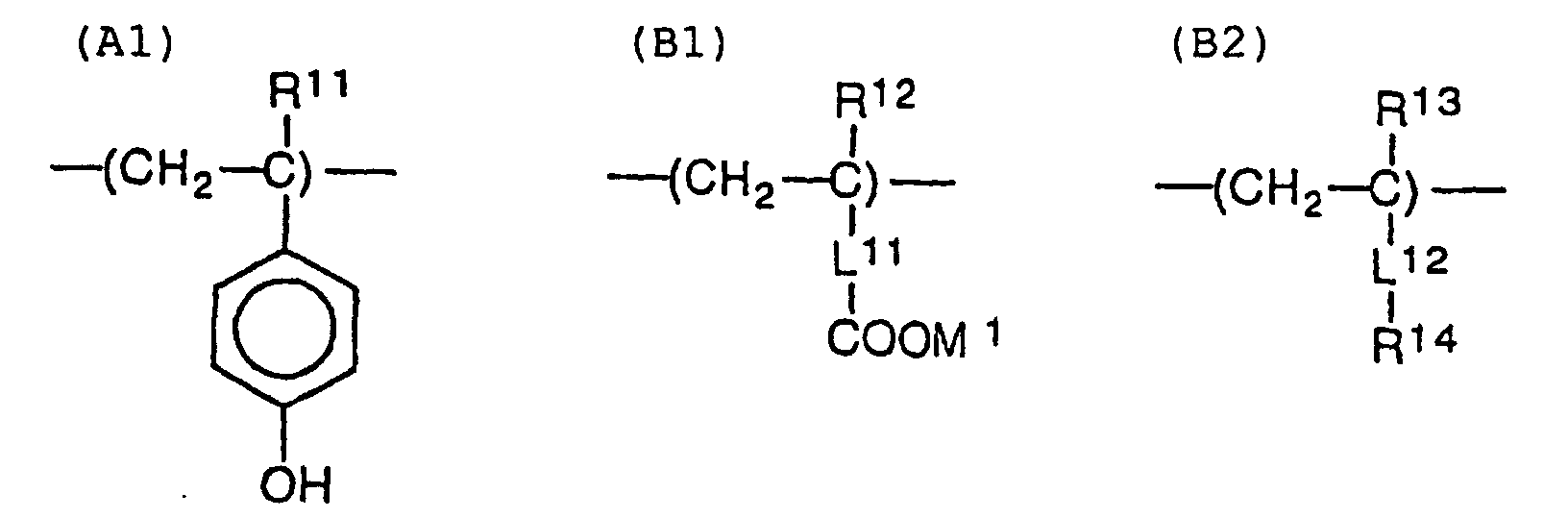
- Matériau à halogénure d'argent sensible à la lumière selon la revendication 1, dans lequel le mélange contient le polymère (A) dans une proportion de 10 à 30 % en poids et le polymère (B) dans une proportion de 70 à 90 % en poids.
- Matériau à halogénure d'argent sensible à la lumière selon la revendication 1, dans lequel le polymère (A) est un homopolymère constitué des motifs de répétition de (A1).
- Matériau à halogénure d'argent sensible à la lumière selon la revendication 1, dans lequel la couche de durcissement contient en outre un composé polymérisable à insaturation éthylénique.
- Matériau à halogénure d'argent sensible à la lumière selon la revendication 1, dans lequel le matériau à halogénure d'argent sensible à la lumière comprend en outre une couche d'accélération de formation d'image contenant une base ou un précurseur de base.
- Matériau à halogénure d'argent sensible à la lumière selon la revendication 5, dans lequel le matériau à halogénure d'argent sensible à la lumière comprend le support, la couche de durcissement, la couche sensible à la lumière et la couche d'accélération de formation d'image dans l'ordre.
- Matériau à halogénure d'argent sensible à la lumière comprenant un support, une couche de durcissement, une couche adhésive et une couche sensible à la lumière dans l'ordre, ladite couche de durcissement contenant un composé polymérisable à insaturation éthylénique et un polymère hydrophobe, ladite couche sensible à la lumière contenant de l'halogénure d'argent et un polymère hydrophile, et ladite couche de durcissement ou ladite couche sensible à la lumière contenant un agent réducteur, dans lequel la couche adhésive contient des particules présentant une surface comprenant une partie hydrophile et une partie hydrophobe.
- Matériau à halogénure d'argent sensible à la lumière selon la revendication 7, dans lequel les particules sont des particules inorganiques présentant une surface comprenant une partie hydrophobe.
- Matériau à halogénure d'argent sensible à la lumière selon la revendication 7, dans lequel la couche adhésive contient en outre un colorant.
- Matériau à halogénure d'argent sensible à la lumière selon la revendication 7, dans lequel le matériau à halogénure d'argent sensible à la lumière comprend en outre une couche d'accélération de formation d'image contenant une base ou un précurseur de base.
- Matériau à halogénure d'argent sensible à la lumière selon la revendication 10, dans lequel le matériau à halogénure d'argent sensible à la lumière comprend le support, la couche de durcissement, la couche adhésive, la couche sensible à la lumière et la couche d'accélération de formation d'image dans l'ordre.
- Matériau à halogénure d'argent sensible à la lumière comprenant un support, une couche de durcissement et une couche sensible à la lumière dans l'ordre, ladite couche de durcissement contenant un composé polymérisable à insaturation éthylénique et un polymère hydrophobe, ladite couche sensible à la lumière contenant de l'halogénure d'argent et un polymère hydrophile, et ladite couche de durcissement ou ladite couche sensible à la lumière contenant un agent réducteur, dans lequel la couche sensible à la lumière contient en outre des particules présentant une surface comprenant une partie hydrophile et une partie hydrophobe.
- Matériau à halogénure d'argent sensible à la lumière selon la revendication 12, dans lequel les particules sont des particules inorganiques présentant une surface comprenant un partie hydrophobe.
- Matériau à halogénure d'argent sensible à la lumière selon la revendication 12, dans lequel le matériau à halogénure d'argent sensible à la lumière comprend en outre une couche d'accélération de formation d'image contenant une base ou un précurseur de base.
- Matériau à halogénure d'argent sensible à la lumière selon la revendication 14, dans lequel le matériau à halogénure d'argent sensible à la lumière comprend le support, la couche de durcissement, la couche sensible à la lumière et la couche d'accélération de formation d'image dans l'ordre.
Applications Claiming Priority (4)
| Application Number | Priority Date | Filing Date | Title |
|---|---|---|---|
| JP10185689A JP2000003045A (ja) | 1998-06-16 | 1998-06-16 | 感光材料 |
| JP18568998 | 1998-06-16 | ||
| JP25322798A JP3810041B2 (ja) | 1998-08-24 | 1998-08-24 | 感光材料 |
| JP25322798 | 1998-08-24 |
Publications (2)
| Publication Number | Publication Date |
|---|---|
| EP0965886A1 EP0965886A1 (fr) | 1999-12-22 |
| EP0965886B1 true EP0965886B1 (fr) | 2003-09-03 |
Family
ID=26503267
Family Applications (1)
| Application Number | Title | Priority Date | Filing Date |
|---|---|---|---|
| EP99111070A Expired - Lifetime EP0965886B1 (fr) | 1998-06-16 | 1999-06-16 | Matériau à l'halogénure d'argent sensible à la lumière comprenant un support, couche durcissante et couche sensible à la lumière |
Country Status (3)
| Country | Link |
|---|---|
| US (2) | US6066432A (fr) |
| EP (1) | EP0965886B1 (fr) |
| DE (1) | DE69910903T2 (fr) |
Families Citing this family (6)
| Publication number | Priority date | Publication date | Assignee | Title |
|---|---|---|---|---|
| US6187510B1 (en) * | 1999-03-09 | 2001-02-13 | Kodak Polychrome Graphics Llc | Digital lithographic printing plate and method of making thereof |
| KR20010051350A (ko) * | 1999-11-01 | 2001-06-25 | 이시마루 기미오, 다께우찌 마사아끼 | 활성 입자, 감광성 수지 조성물 및 패턴 형성 방법 |
| US6593289B1 (en) | 2002-01-15 | 2003-07-15 | Milliken & Co. | Liquid fabric softener formulations comprising hemicyanine red colorants |
| US6638903B2 (en) | 2002-01-15 | 2003-10-28 | Milliken & Company | Non-staining red colorants and liquid fabric softener formulations comprising such non-staining colorants |
| US7270937B2 (en) * | 2003-10-17 | 2007-09-18 | Hynix Semiconductor Inc. | Over-coating composition for photoresist and process for forming photoresist pattern using the same |
| DE102010053763B4 (de) * | 2010-12-08 | 2020-01-02 | Carl Freudenberg Kg | Anordnung |
Family Cites Families (9)
| Publication number | Priority date | Publication date | Assignee | Title |
|---|---|---|---|---|
| US4886739A (en) * | 1988-08-10 | 1989-12-12 | Eastman Kodak Company | Thermally processable imaging element and process |
| JP2590025B2 (ja) * | 1990-11-27 | 1997-03-12 | 富士写真フイルム株式会社 | 感光材料および画像形成方法 |
| US5554482A (en) * | 1994-04-25 | 1996-09-10 | Fuji Photo Film Co., Ltd. | Silver halide light-sensitive material containing base precursor and polyvinyl alcohol |
| JPH086255A (ja) * | 1994-06-22 | 1996-01-12 | Fuji Photo Film Co Ltd | 平版印刷材料 |
| JP3493240B2 (ja) * | 1995-01-17 | 2004-02-03 | 富士写真フイルム株式会社 | 感光材料およびその製造方法 |
| JPH08286366A (ja) * | 1995-04-18 | 1996-11-01 | Fuji Photo Film Co Ltd | 感光材料 |
| JPH1097076A (ja) * | 1996-09-20 | 1998-04-14 | Fuji Photo Film Co Ltd | 感光材料 |
| JPH10111571A (ja) * | 1996-10-03 | 1998-04-28 | Fuji Photo Film Co Ltd | 感光材料 |
| JPH1165122A (ja) * | 1997-08-19 | 1999-03-05 | Fuji Photo Film Co Ltd | 感光材料 |
-
1999
- 1999-06-16 US US09/333,940 patent/US6066432A/en not_active Expired - Fee Related
- 1999-06-16 EP EP99111070A patent/EP0965886B1/fr not_active Expired - Lifetime
- 1999-06-16 DE DE69910903T patent/DE69910903T2/de not_active Expired - Lifetime
-
2000
- 2000-02-29 US US09/515,393 patent/US6132925A/en not_active Expired - Fee Related
Also Published As
| Publication number | Publication date |
|---|---|
| EP0965886A1 (fr) | 1999-12-22 |
| DE69910903D1 (de) | 2003-10-09 |
| US6132925A (en) | 2000-10-17 |
| DE69910903T2 (de) | 2004-07-22 |
| US6066432A (en) | 2000-05-23 |
Similar Documents
| Publication | Publication Date | Title |
|---|---|---|
| US5393651A (en) | Silver halide light-sensitive material comprising polymerizable layer provided on aluminum support | |
| EP0965886B1 (fr) | Matériau à l'halogénure d'argent sensible à la lumière comprenant un support, couche durcissante et couche sensible à la lumière | |
| US5856062A (en) | Light-sensitive material comprising light-sensitive hardening layer provided on support | |
| EP0834769B1 (fr) | Matériau sensible à la lumière à l'halogénure d'argent comprenant un support, couche durcissante et couche sensible à la lumière | |
| US5830630A (en) | Light-sensitive sheet having aluminum alloy support and silver halide light-sensitive material using the same | |
| US5554482A (en) | Silver halide light-sensitive material containing base precursor and polyvinyl alcohol | |
| US5843619A (en) | Silver halide light-sensitive material comprising support, hardening layer and light-sensitive layer | |
| US6136495A (en) | Silver halide light-sensitive material comprising support, hardening layer and light-sensitive layer | |
| US5998086A (en) | Silver halide light-sensitive material comprising support, hardening layer and light-sensitive layer | |
| US6013408A (en) | Silver halide light-sensitive material comprising support, hardening layer and light-sensitive layer | |
| US6156475A (en) | Image forming process using silver halide, reducing agent and polymerizable compound | |
| EP0664487B1 (fr) | Matériau photosensible à base de halogénures d'argent comprenant une couche photopolymérisable et une couche de revêtement, qui contient de l'alcool polyvinylique avec des groupes acides ou un sel de ce composé | |
| JP3493240B2 (ja) | 感光材料およびその製造方法 | |
| JP2000003045A (ja) | 感光材料 | |
| JP2001033973A (ja) | 感光材料 | |
| JP2001033972A (ja) | 感光材料およびその製造方法 | |
| JPH1138634A (ja) | 感光材料 | |
| JP2000056463A (ja) | 感光材料 | |
| JPH1062998A (ja) | 感光性組成物および感光材料 | |
| JP2000105461A (ja) | 感光材料 | |
| JPH07175225A (ja) | 画像形成方法 | |
| JPH08123035A (ja) | 感光材料 | |
| JPH08184968A (ja) | 感光材料 | |
| JP2000066407A (ja) | 感光材料 | |
| JPH10111572A (ja) | 感光材料 |
Legal Events
| Date | Code | Title | Description |
|---|---|---|---|
| PUAI | Public reference made under article 153(3) epc to a published international application that has entered the european phase |
Free format text: ORIGINAL CODE: 0009012 |
|
| AK | Designated contracting states |
Kind code of ref document: A1 Designated state(s): DE GB |
|
| AX | Request for extension of the european patent |
Free format text: AL;LT;LV;MK;RO;SI |
|
| 17P | Request for examination filed |
Effective date: 20000208 |
|
| AKX | Designation fees paid |
Free format text: DE GB |
|
| GRAH | Despatch of communication of intention to grant a patent |
Free format text: ORIGINAL CODE: EPIDOS IGRA |
|
| GRAH | Despatch of communication of intention to grant a patent |
Free format text: ORIGINAL CODE: EPIDOS IGRA |
|
| GRAA | (expected) grant |
Free format text: ORIGINAL CODE: 0009210 |
|
| AK | Designated contracting states |
Kind code of ref document: B1 Designated state(s): DE GB |
|
| REG | Reference to a national code |
Ref country code: GB Ref legal event code: FG4D |
|
| REF | Corresponds to: |
Ref document number: 69910903 Country of ref document: DE Date of ref document: 20031009 Kind code of ref document: P |
|
| PLBE | No opposition filed within time limit |
Free format text: ORIGINAL CODE: 0009261 |
|
| STAA | Information on the status of an ep patent application or granted ep patent |
Free format text: STATUS: NO OPPOSITION FILED WITHIN TIME LIMIT |
|
| 26N | No opposition filed |
Effective date: 20040604 |
|
| REG | Reference to a national code |
Ref country code: GB Ref legal event code: 732E |
|
| PGFP | Annual fee paid to national office [announced via postgrant information from national office to epo] |
Ref country code: GB Payment date: 20100616 Year of fee payment: 12 Ref country code: DE Payment date: 20100519 Year of fee payment: 12 |
|
| GBPC | Gb: european patent ceased through non-payment of renewal fee |
Effective date: 20110616 |
|
| REG | Reference to a national code |
Ref country code: DE Ref legal event code: R119 Ref document number: 69910903 Country of ref document: DE Effective date: 20120103 |
|
| PG25 | Lapsed in a contracting state [announced via postgrant information from national office to epo] |
Ref country code: DE Free format text: LAPSE BECAUSE OF NON-PAYMENT OF DUE FEES Effective date: 20120103 |
|
| PG25 | Lapsed in a contracting state [announced via postgrant information from national office to epo] |
Ref country code: GB Free format text: LAPSE BECAUSE OF NON-PAYMENT OF DUE FEES Effective date: 20110616 |