EP0969540A2 - Brennstoffzelleseparator und Herstellungsverfahren - Google Patents
Brennstoffzelleseparator und Herstellungsverfahren Download PDFInfo
- Publication number
- EP0969540A2 EP0969540A2 EP99110769A EP99110769A EP0969540A2 EP 0969540 A2 EP0969540 A2 EP 0969540A2 EP 99110769 A EP99110769 A EP 99110769A EP 99110769 A EP99110769 A EP 99110769A EP 0969540 A2 EP0969540 A2 EP 0969540A2
- Authority
- EP
- European Patent Office
- Prior art keywords
- separator
- fuel cell
- film
- perishable
- weight
- Prior art date
- Legal status (The legal status is an assumption and is not a legal conclusion. Google has not performed a legal analysis and makes no representation as to the accuracy of the status listed.)
- Withdrawn
Links
Images

Classifications
-
- H—ELECTRICITY
- H01—ELECTRIC ELEMENTS
- H01M—PROCESSES OR MEANS, e.g. BATTERIES, FOR THE DIRECT CONVERSION OF CHEMICAL ENERGY INTO ELECTRICAL ENERGY
- H01M8/00—Fuel cells; Manufacture thereof
- H01M8/02—Details
- H01M8/0202—Collectors; Separators, e.g. bipolar separators; Interconnectors
- H01M8/023—Porous and characterised by the material
- H01M8/0241—Composites
- H01M8/0243—Composites in the form of mixtures
-
- H—ELECTRICITY
- H01—ELECTRIC ELEMENTS
- H01M—PROCESSES OR MEANS, e.g. BATTERIES, FOR THE DIRECT CONVERSION OF CHEMICAL ENERGY INTO ELECTRICAL ENERGY
- H01M2300/00—Electrolytes
- H01M2300/0017—Non-aqueous electrolytes
- H01M2300/0065—Solid electrolytes
- H01M2300/0082—Organic polymers
-
- H—ELECTRICITY
- H01—ELECTRIC ELEMENTS
- H01M—PROCESSES OR MEANS, e.g. BATTERIES, FOR THE DIRECT CONVERSION OF CHEMICAL ENERGY INTO ELECTRICAL ENERGY
- H01M8/00—Fuel cells; Manufacture thereof
- H01M8/02—Details
- H01M8/0202—Collectors; Separators, e.g. bipolar separators; Interconnectors
- H01M8/0204—Non-porous and characterised by the material
- H01M8/0223—Composites
- H01M8/0228—Composites in the form of layered or coated products
-
- H—ELECTRICITY
- H01—ELECTRIC ELEMENTS
- H01M—PROCESSES OR MEANS, e.g. BATTERIES, FOR THE DIRECT CONVERSION OF CHEMICAL ENERGY INTO ELECTRICAL ENERGY
- H01M8/00—Fuel cells; Manufacture thereof
- H01M8/04—Auxiliary arrangements, e.g. for control of pressure or for circulation of fluids
- H01M8/04291—Arrangements for managing water in solid electrolyte fuel cell systems
-
- Y—GENERAL TAGGING OF NEW TECHNOLOGICAL DEVELOPMENTS; GENERAL TAGGING OF CROSS-SECTIONAL TECHNOLOGIES SPANNING OVER SEVERAL SECTIONS OF THE IPC; TECHNICAL SUBJECTS COVERED BY FORMER USPC CROSS-REFERENCE ART COLLECTIONS [XRACs] AND DIGESTS
- Y02—TECHNOLOGIES OR APPLICATIONS FOR MITIGATION OR ADAPTATION AGAINST CLIMATE CHANGE
- Y02E—REDUCTION OF GREENHOUSE GAS [GHG] EMISSIONS, RELATED TO ENERGY GENERATION, TRANSMISSION OR DISTRIBUTION
- Y02E60/00—Enabling technologies; Technologies with a potential or indirect contribution to GHG emissions mitigation
- Y02E60/30—Hydrogen technology
- Y02E60/50—Fuel cells
Definitions
- the present invention relates to a fuel cell separator and a process for producing the same. More particularly, the present invention relates to a fuel cell separator superior in hydrophilicity and water-holding property, as well as to a process for producing the separator.
- Fuel cells are advantageous in that they require substantially no fossil fuel (whose depletion in the near future is feared) and, when used for power generation, generate substantially no noise and are high in energy recovery as compared with other methods for power generation. Therefore, fuel cells are being developed as a power generation plant of relatively small size for buildings and factories.
- a solid polymer type fuel cell operates at lower temperatures than other types of fuel cell do; therefore, it has such characteristics that not only the parts constituting the cell are little corroded, but also the cell can discharge a relatively large electric current for the low temperature operation. Therefore, the solid polymer type fuel cell is drawing attention as a substitute electric source for internal combustion engine of vehicle.
- the separator is generally a flat plate having a plurality of parallel grooves formed at one or both sides, and has a role of transferring the electricity generated at the gas diffusion electrode of fuel cell, to the exterior and also a role of discharging the water formed in the grooves in the course of electricity generation, to reliably use each groove as a path for a reactant gas which is allowed to flow into the fuel cell. Accordingly, the separator for solid polymer type fuel cell is desired to have not only electrical conductivity but also high water-drainability.
- the fuel cell separator there have heretofore been used those subjected to a hydrophilization treatment at least at the surface. Owing to this hydrophilization treatment at least at the surface, the water formed in the course of electricity generation wets the grooves and spread therein, or is allowed to flow to a given position of the path for reactant gas; thereby, the water formed does not remain as droplets in the grooves and does not hinder the diffusion of reactant gas through the path.
- the material for fuel cell separator is molded into a predetermined shape and thereafter the molded material is coated with a hydrophilic material (e.g. a polyacrylonitrile) and a method in which a hydrophilic material is incorporated into the material for fuel cell separator and the resulting material is molded into a predetermined shape.
- a hydrophilic material e.g. a polyacrylonitrile
- the material for fuel cell separator is molded into a predetermined shape and thereafter the molded material is coated with a hydrophilic material (e.g. a polyacrylonitrile)
- a hydrophilic material e.g. a polyacrylonitrile
- the present invention has been completed in order to solve the above-mentioned problems of the prior art and provide (1) a fuel cell separator superior in hydrophilicity and water-holding property and (2) a process for producing such a fuel cell separator.
- a separator for fuel cell having a film on the surface, wherein the film has a water-holdability of 0.3 to 5.0 g per g of the film, or the film has a pore volume of 0.3 to 5.2 cc per g of the film.
- a process for producing a fuel cell separator by applying, onto a base material for fuel cell separator, a conductive coating containing at least a conductive powder and a binder, to form, on the base material, a film made of the conductive coating, wherein the proportions of the conductive powder and the binder are 100 parts by weight of the conductive powder and 1 to 1,000 parts by weight of the binder, or,
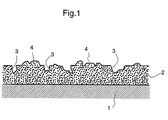
- numeral 1 refers to a base material for fuel cell separator
- numeral 2 refers to a film made of a conductive coating
- numeral 3 is a hole formed by the perishing of a perishable additive
- numeral 4 refers to a surface unevenness caused by secondary particles of conductive powder.
- An example of the present process for producing the present fuel cell separator comprises applying a conductive coating of particular composition onto a base material having a fuel cell separator shape, to form, on the base material, a film made of the conductive coating. Description is made first on the conductive coating of particular composition.
- the conductive coating used in the present invention comprises a conductive powder, a binder and a perishable additive used as necessary.
- the conductive powder includes, for example, a powder of a carbon material typified by natural graphite (e.g. scaly graphite or lumpy graphite), artificial graphite, acetylene black, carbon black, Ketjen black, expanded graphite or the like.
- natural graphite e.g. scaly graphite or lumpy graphite
- artificial graphite e.g. scaly graphite or lumpy graphite
- acetylene black acetylene black
- carbon black Ketjen black
- expanded graphite or the like there is no particular restriction as to the kind of the conductive powder as long as the powder is conductive.
- the conductive powder can have an average particle diameter of, for example, 10 nm to 100 ⁇ m.
- the conductive powder may be subjected, as necessary, to a hydrophilization treatment by control of firing conditions or by using a chemical, a gas or the like. At least one or a combination of these means can be used for the hydrophilization.
- the binder used in the conductive coating may be any binder which can withstand the temperature range in which a fuel cell is operated.
- the binder includes, for example, a liquid or emulsion of thermosetting resin, thermoplastic resin, rubber or the like.
- thermosetting resin includes, for example, polycarobdiimide resin, phenolic resin, furfuryl alcohol resin, epoxy resin, cellulose, urea resin, melamine resin, unsaturated polyester resin, silicone resin, diallyl phthalate resin, resin obtained by using bismaleimide and triazine, polyaminobismaleimide resin and aromatic polyimide resin. These resins can be used singly or in admixture of two or more kinds.
- the thermoplastic resin includes, for example, polyethylene, polystyrene, polypropylene, polymethyl methacrylate, polyethylene terephthalate, polybutylene terephthalate, polyethersulfone, polycarbonate, polyoxamethylene, polyamide, polyimide, polyamideimide, polyvinyl alcohol, polyvinyl chloride, polyphenylsulfone, polyetheretherketone, polysulfone, polyetherketone, polyarylate, polyetherimide, polymethylpentene, fluororesin, polyoxybenzoyl ester resin, liquid crystal polyester resin, aromatic polyester, polyacetal, polyallylsulfone, polybenzimidazole, polyethernitrile, polythioethersulfone and polyphenylene ether. These resins can be used singly or in admixture of two or more kinds.
- the rubber includes, for example, fluororubber, silicone rubber, butyl rubber, chloroprene rubber, nitrile rubber, nitrile-chloroprene rubber, chlorinated butyl rubber, epichlorohydrin rubber, epichlorohydrin-ethylene oxide rubber, epichlorohydrin-ethylene oxide-acryl glycidyl ether terpolymer, urethane rubber, acrylic rubber, ethylene-propylene rubber, styrene rubber, butadiene rubber and natural rubber. These rubbers can be used singly or in admixture of two or more kinds.
- the perishable additive used as necessary in the conductive coating includes, for example, a material which vaporizes when heated, or a material which dissolves in an elutant when immersed therein.
- the perishable additive can be any additive which can be allowed to perish after a film made of the conductive coating has been formed.
- the perishable additive which vaporizes when heated there can be mentioned, for example, a low-molecular weight substance, a wax and a saccharide.
- the material which dissolves in an elutant when immersed therein there can be mentioned, for example, a polyvinyl alcohol, a saccharide and a cellulose derivative.
- the perishable additive is preferably in the form of a powder and the average particle diameter can be, for example, 0.1 to 500 ⁇ m.
- the conductive coating can further contain a stabilizer, an anti-foaming agent, a dispersant, etc.
- the conductive coating used in the present invention can be obtained by mixing the above-mentioned components using a mixer.
- the mixer can be any mixer ordinarily used, such as mixer, homogenizer, stirrer, ball mill or the like, and there is no particular restriction as to the mixer used.
- the proportions of the components when no perishable additive is used are, for example, 100 parts by weight of the conductive powder and 1 to 1,000 parts by weight, preferably 3 to 500 parts by weight of the binder.
- the proportion of the binder is less than 1 part by weight, the adhesion between the film made of the conductive coating and the base material for separator is insufficient and the film tends to peel off.
- the proportion of the binder is more than 1,000 parts by weight, the film is low not only in electrical conductivity but also in water-holding property and there may appear water droplets of such an amount that the paths for reactant gas in separator are blocked.
- the proportions of the components when the perishable additive is used are, for example, 100 parts by weight of the conductive powder, 1 to 1,000 parts by weight, preferably 3 to 500 parts by weight of the binder, and 0.1 to 100 parts by weight of the perishable additive.
- the proportion of the perishable additive is larger, the resulting fuel cell separator has higher water-holding property.
- the proportion of the perishable additive is larger than 100 parts by weight, the film made of the conductive coating has insufficient adhesivity and may easily peel off from the base material.
- a solvent may be used as necessary for viscosity control.
- the solvent there can be mentioned, for example, water, methanol, ethanol, isopropyl alcohol, butanol, toluene, xylylene and methyl ethyl ketone.
- the amount of the solvent used is about 50 to 3,000% by weight based on the total solid content of conductive coating.
- a carbon composite separator material obtained by mixing a carbon material and a binder and molding the resulting mixture into a separator shape for example, a carbon composite separator material obtained by mixing a carbon material and a binder and molding the resulting mixture into a separator shape; a carbon separator material obtained by converting a carbon material (e.g. glassy carbon or graphite) into a separator shape by machining; a metal separator material obtained by converting a metal (e.g. titanium, aluminum or stainless steel) into a separator shape by machining or by pressing; a coated separator material obtained by coating the above-obtained separator material with a noble metal or a carbon material; and a separator material obtained by combining two or more kinds of the above separator materials.
- a carbon composite separator material obtained by mixing a carbon material and a binder and molding the resulting mixture into a separator shape
- a carbon separator material obtained by converting a carbon material e.g. glassy carbon or graphite
- the above base material for fuel cell separator generally has paths for passing a reactant gas therethrough, grooves for draining the water formed in an electricity-generating reaction, etc.
- the above-mentioned conductive coating is applied onto such a base material for fuel cell separator.
- the base material for fuel cell separator may be subjected to a surface-roughening treatment by blasting or by using a chemical or the like, or may be coated with an adhesive such as primer or the like.
- the application of the conductive coating onto the base material for fuel cell separator can be conducted by a known method such as casting, dip coating, spraying, brush coating, screen printing or the like.
- the application is made on part or the whole area of the base material so as to meet the purpose.
- the amount of the conductive coating applied can be determined depending upon the solid content of the conductive coating so that the thickness of the as-dried film made of the conductive coating becomes 1 to 200 ⁇ m, preferably 10 to 100 ⁇ m.
- the solid content of the conductive coating is controlled based on the application method and the desired thickness of the film formed. When the thickness of the film is smaller than 1 ⁇ m or larger than 200 ⁇ m, the film has no sufficient strength and easily peels off from the base material.
- the base material for fuel cell separator onto which the conductive coating has been applied is dried by, for example, placing it in a dryer, to cure the conductive coating and form a film made of the conductive coating.
- the conductive coating may be reapplied onto the film formed, in order to strengthen the film.
- the temperature employed for the above drying can be, for example, 30 to 200°C.
- the base material on which a film made of the conductive coating has been formed becomes a fuel cell separator (1) of the present invention.
- This fuel cell separator (1) has sufficient hydrophilicty and water-holding property mainly at the surface.
- the hydrophilicity and water-holding property of the separator (1) is specifically expressed as "amount of water held per unit weight of film" and is in the range of 0.3 to 3.0 g/g.
- a fuel cell separator (2) having higher hydrophilicty and water-holding property mainly at the surface can be obtained by allowing the perishable additive to perish.
- the hydrophilicity and water-holding property of the separator (2) is specifically expressed as "amount of water held per unit weight of film" and is in the range of 0.3 to 5.0 g/g.
- the means used for allowing the perishable additive to perish can be selected depending upon the kind of the perishable additive used. When there is used a perishable additive which vaporizes when heated, the perishable additive can be allowed to perish by applying a heat sufficient for vaporization. When there is used a perishable additive which dissolves in an elutant when immersed therein, the perishable additive can be allowed to perish by immersion in an appropriate elutant. When there are used two or more kinds of perishable additives, the perishable additives can be allowed to perish by combining the above means.
- the hydrophilicity and water-holding property of the fuel cell separator (2) originate from various unevennesses and cracks at the film surface, that is, (a) the holes formed by the perishing of the perishable additive, (b) the unevennesses and cracks caused by the secondary particles of the conductive powder [explained for the fuel cell separator (1)], and (c) the microcracks caused by film shrinkage taking place at the time of film curing; as the surface unevennesses are more, the hydrophilicity and water-holding property of the separator (2) are superior.
- the fuel cell separators (1) and (2) of the present invention can have satisfactory hydrophilicty at the surface when the amount of water held per unit weight of film is 0.3 g/g or more. As the amount is larger, the water-holding property of the separator (1) or (2) is higher. However, an amount larger than 5 g/g is not preferred because the film of the separator (1) or (2) has too many unevennesses and cracks, and the strength of the film per se and the adhesivity of the film to the base material tend to be low.
- the amount of water held per unit weight of film can also be expressed by pore volume, and the pore volume is in the range of 0.3 to 5.2 cc per g of film.
- the fuel cell separator of the present invention has a resistance of 0.1 to 1,000 ⁇ / ⁇ (square) at the film surface and an electrical conductivity sufficient for use as a separator.
- a conductive substance, a binder and a perishable additive were mixed using a mixer to prepare a conductive coating.
- This coating was applied onto a base material for fuel cell separator.
- Tables 1 to 3 are shown the mixing ratio of the conductive substance, the binder and the perishable additive, the kind and surface roughening (made or not made) of the base material for fuel cell separator, and the method of application of the coating.
- the coating-applied base material was heated from room temperature to 120°C at a temperature elevation rate of 40°C/hr in a drier to dry the coating-applied base material.
- the resulting material was immersed in hot water to elute the perishable additive, followed by drying, whereby was produced a fuel cell separator of the present invention, having a film of 60 ⁇ m in thickness superior in hydrophilicity and water-holding property.
- the fuel cell separator produced above was observed for the section. As shown in Fig. 1, at the surface of or inside the film 2 (made of the conductive coating) formed on the base material 1 for fuel cell separator were seen holes 3 formed by the perishing of the perishable additive and unevennesses 4 caused by secondary particles of the conductive powder.
- Each of the fuel cell separators obtained in Examples 1 to 14 was measured, as follows, for contact angle against water, surface resistance ( ⁇ / ⁇ ), amount of water held per unit weight of film (g/g), pore volume per unit weight of film (cc/g) and adhesion of coating.
- the weight of base material was deducted from the weight of produced separator to calculate a weight (A) of film.
- the separator was placed in water and subjected to vacuum degassing for 1 hour and then taken out of water; the water on the separator surface was removed; thereafter, the weight of the resulting material was measured and the weight of separator was deducted therefrom to calculate an amount (B) of water held by separator.
- Amount of water held per unit weight of film (g/g) was calculated from a formula [(B)/(A)].
- C Bulk density
- D true density
- Figs. 2 and 3 There are seen holes (roughly circular black areas in each Fig.) formed by the perishing of the perishable additive; unevennesses [white (only in circumference) roughly circular areas in each Fig.] caused by the secondary particles of the conductive powder; and 1 to 20 (per 200 ⁇ m x 200 ⁇ m) microcracks (black linear areas in each Fig.) of 10 to 150 ⁇ m in length and 1 to 5 ⁇ m in width.
- a conductive substance and a binder were mixed according to a composition shown in Table 4, 5, 6 or 7 to prepare a conductive coating.
- This coating was applied onto a base material for separator in the same manner as in Examples 1 to 14 to produce a fuel cell separator having a film of 60 ⁇ m in thickness.
- Each separator obtained was measured for contact angle against water, surface resistance ( ⁇ / ⁇ ), amount of water held per unit weight of film (g/g), pore volume per unit weight of film (cc/g) and adhesion of coating, in the same manner as in Examples 1 to 14. Using each separator, a solid polymer type fuel cell was produced.
- Natural graphite and a phenolic resin were mixed.
- the resulting mixture was molded into a separator shape to produce a fuel cell separator.
- the separator was measured for contact angle against water in the same manner as in Examples.
- a solid polymer type fuel cell was produced using the separator and subjected to an electricity-generating test to examine the condition of the water formed in the paths of separator. The results are shown in Table 8.
- a conductive coating was prepared according to a composition shown in Table 9. The coating was applied onto a base material for separator in the same manner as in Examples 1 to 14 to produce a separator having a film of 60 ⁇ m in thickness. Each separator produced was measured, in the same manner as in Examples 1 to 14, for contact angle against water, surface resistance ( ⁇ / ⁇ ), amount of water held per unit weight of film (g/g), pore volume per unit weight of film (cc/g) and adhesion of coating. Using each separator, a solid polymer type fuel cell was produced. The fuel cell was subjected to an electricity-generating test, and the condition of the water formed in the paths of separator was examined in the same manner as in Examples 1 to 14. The results are shown in Table 9.
- Comparative Examples 4 5 6 7 Composition of conductive coating (parts by weight) Conductive powder Carbon black 100 100 100 100 100 Natural graphite Acetylene black Binder Phenolic resin 0.5 1500 0.5 1500 Acrylic resin Perishable additive PVA 5 5 Base material for separator Kind C C C C Surface roughening B B B B Application of coating S S S S Properties of separator Contact angle (°) 30 seconds later * 90 * 106 5 minutes later * 90 * 106 Surface resistance ( ⁇ / ⁇ ) * 10 4 * 8000 Amount of water held per film unit weight (g/g) * 0.08 * 0.03 Pore volume per film unit weight (cc/g) * 0.09 * 0.04 Adhesion of coating 0 10 0 10 Separator condition in electricity generation * B * B
- the fuel cell separator of the present invention has a film made of a conductive coating and thereby has high hydrophilicity and water-holding property. Therefore, in the present fuel cell separator, the plugging of separator grooves (paths for reactant gas) by the water formed during electricity generation can be significantly reduced.
- the film of the separator has a water-holding property, the water trapped in the separator grooves can control the humidity inside the fuel cell, making the external humidifier (which has been essential for conventional fuel cells) unnecessary or significantly small-sized.
Landscapes
- Chemical & Material Sciences (AREA)
- Sustainable Energy (AREA)
- Life Sciences & Earth Sciences (AREA)
- Engineering & Computer Science (AREA)
- Manufacturing & Machinery (AREA)
- Sustainable Development (AREA)
- Composite Materials (AREA)
- Chemical Kinetics & Catalysis (AREA)
- Electrochemistry (AREA)
- General Chemical & Material Sciences (AREA)
- Fuel Cell (AREA)
- Paints Or Removers (AREA)
- Application Of Or Painting With Fluid Materials (AREA)
Applications Claiming Priority (2)
| Application Number | Priority Date | Filing Date | Title |
|---|---|---|---|
| JP15779998 | 1998-06-05 | ||
| JP15779998 | 1998-06-05 |
Publications (2)
| Publication Number | Publication Date |
|---|---|
| EP0969540A2 true EP0969540A2 (de) | 2000-01-05 |
| EP0969540A3 EP0969540A3 (de) | 2002-04-24 |
Family
ID=15657548
Family Applications (1)
| Application Number | Title | Priority Date | Filing Date |
|---|---|---|---|
| EP99110769A Withdrawn EP0969540A3 (de) | 1998-06-05 | 1999-06-04 | Brennstoffzelleseparator und Herstellungsverfahren |
Country Status (2)
| Country | Link |
|---|---|
| EP (1) | EP0969540A3 (de) |
| CA (1) | CA2273619A1 (de) |
Cited By (7)
| Publication number | Priority date | Publication date | Assignee | Title |
|---|---|---|---|---|
| WO2001028020A1 (en) * | 1999-10-08 | 2001-04-19 | Alliedsignal Inc. | Corrosion resistant coated fuel cell bipolar plate with graphite protective barrier and method of making the same |
| EP1329970A3 (de) * | 2002-01-21 | 2003-10-15 | Nisshinbo Industries, Inc. | Verfahren zur Herstellung von Brennstoffzellenseparator, Brennstoffzellenseparatoren, und Polymerelektrolyt-Brennstoffzellen |
| US20060257713A1 (en) * | 2005-05-12 | 2006-11-16 | Elhamid Mahmoud H A | Porous, electrically conductive fluid distribution plate for fuel cells |
| EP1120843A3 (de) * | 2000-01-11 | 2006-12-20 | Nippon Pillar Packing Co., Ltd. | Brennstoffzellenseparator |
| EP1265303A4 (de) * | 2000-03-07 | 2007-01-24 | Matsushita Electric Industrial Co Ltd | Polymer-elektroly-brennstoffzelle und herstellungsverfahren dafür |
| US8029943B2 (en) | 2005-02-28 | 2011-10-04 | GM Global Technology Operations LLC | Method to make conductive hydrophilic fuel cell elements |
| EP4579824A4 (de) * | 2022-08-25 | 2025-12-03 | Arisawa Seisakusho Kk | Brennstoffzellenseparatormaterial, brennstoffzellenseparatorherstellungsverfahren und brennstoffzellenseparator |
Families Citing this family (1)
| Publication number | Priority date | Publication date | Assignee | Title |
|---|---|---|---|---|
| CN1177385C (zh) * | 1999-10-14 | 2004-11-24 | 松下电器产业株式会社 | 高分子电解质型燃料电池 |
Family Cites Families (13)
| Publication number | Priority date | Publication date | Assignee | Title |
|---|---|---|---|---|
| JPS4947100B1 (de) * | 1968-09-06 | 1974-12-13 | ||
| JPS5946763A (ja) * | 1982-09-10 | 1984-03-16 | Kureha Chem Ind Co Ltd | 二層構造のモノポーラ型燃料電池用電極基板の製造方法 |
| JPS60221909A (ja) * | 1984-04-18 | 1985-11-06 | 株式会社 富士電機総合研究所 | 導電性シ−トの製造方法 |
| JPS62122057A (ja) * | 1985-11-22 | 1987-06-03 | Toshiba Battery Co Ltd | ボタン型電池 |
| JPH0695459B2 (ja) * | 1986-07-28 | 1994-11-24 | 三菱電機株式会社 | 燃料電池 |
| JPH0622136B2 (ja) * | 1986-10-22 | 1994-03-23 | 昭和電工株式会社 | 燃料電池セパレータ用炭素板の製造法 |
| JPS63294610A (ja) * | 1987-05-27 | 1988-12-01 | Showa Denko Kk | 導電性成形板およびその製造方法 |
| JP3047335B2 (ja) * | 1991-01-21 | 2000-05-29 | 日東電工株式会社 | 医療用電極 |
| JPH09510571A (ja) * | 1994-02-04 | 1997-10-21 | ザ ダウ ケミカル カンパニー | 触媒金属粒子により被覆された炭素繊維ペーパーを含む電気化学電池 |
| JPH09320577A (ja) * | 1996-05-28 | 1997-12-12 | Furukawa Battery Co Ltd:The | 水素吸蔵合金電極の製造法 |
| JP4049839B2 (ja) * | 1996-11-08 | 2008-02-20 | 昭和電工株式会社 | 帯電防止処理材の製造方法 |
| JPH10326631A (ja) * | 1997-05-27 | 1998-12-08 | Matsushita Electric Ind Co Ltd | 空気電池正極体の製造法 |
| US6103077A (en) * | 1998-01-02 | 2000-08-15 | De Nora S.P.A. | Structures and methods of manufacture for gas diffusion electrodes and electrode components |
-
1999
- 1999-06-04 EP EP99110769A patent/EP0969540A3/de not_active Withdrawn
- 1999-06-04 CA CA002273619A patent/CA2273619A1/en not_active Abandoned
Cited By (9)
| Publication number | Priority date | Publication date | Assignee | Title |
|---|---|---|---|---|
| WO2001028020A1 (en) * | 1999-10-08 | 2001-04-19 | Alliedsignal Inc. | Corrosion resistant coated fuel cell bipolar plate with graphite protective barrier and method of making the same |
| US6864007B1 (en) | 1999-10-08 | 2005-03-08 | Hybrid Power Generation Systems, Llc | Corrosion resistant coated fuel cell plate with graphite protective barrier and method of making the same |
| EP1120843A3 (de) * | 2000-01-11 | 2006-12-20 | Nippon Pillar Packing Co., Ltd. | Brennstoffzellenseparator |
| EP1265303A4 (de) * | 2000-03-07 | 2007-01-24 | Matsushita Electric Industrial Co Ltd | Polymer-elektroly-brennstoffzelle und herstellungsverfahren dafür |
| EP1329970A3 (de) * | 2002-01-21 | 2003-10-15 | Nisshinbo Industries, Inc. | Verfahren zur Herstellung von Brennstoffzellenseparator, Brennstoffzellenseparatoren, und Polymerelektrolyt-Brennstoffzellen |
| US8029943B2 (en) | 2005-02-28 | 2011-10-04 | GM Global Technology Operations LLC | Method to make conductive hydrophilic fuel cell elements |
| US20060257713A1 (en) * | 2005-05-12 | 2006-11-16 | Elhamid Mahmoud H A | Porous, electrically conductive fluid distribution plate for fuel cells |
| US8623573B2 (en) * | 2005-05-12 | 2014-01-07 | GM Global Technology Operations LLC | Porous, electrically conductive fluid distribution plate for fuel cells |
| EP4579824A4 (de) * | 2022-08-25 | 2025-12-03 | Arisawa Seisakusho Kk | Brennstoffzellenseparatormaterial, brennstoffzellenseparatorherstellungsverfahren und brennstoffzellenseparator |
Also Published As
| Publication number | Publication date |
|---|---|
| EP0969540A3 (de) | 2002-04-24 |
| CA2273619A1 (en) | 1999-12-05 |
Similar Documents
| Publication | Publication Date | Title |
|---|---|---|
| US6884535B2 (en) | Fuel cell separator | |
| Haug et al. | Increasing proton exchange membrane fuel cell catalyst effectiveness through sputter deposition | |
| KR101351142B1 (ko) | 미세다공성 층 | |
| CN1255893C (zh) | 聚合物电解质膜燃料电池 | |
| US20090305096A1 (en) | Liquid fuel supply type fuel cell, fuel cell electrode, and methods for manufacturing same | |
| JP5069927B2 (ja) | 燃料電池用膜電極接合体およびその製造方法 | |
| EP0786155B1 (de) | Verteilerelement für den kathodischen reaktanden eines brennstoffzellenstapels | |
| JPWO2001017047A1 (ja) | 高分子電解質型燃料電池 | |
| CN100511787C (zh) | 气体扩散层和使用气体扩散层的燃料电池 | |
| JP2000058083A (ja) | 燃料電池用セパレータ及びその製造方法 | |
| EP0969540A2 (de) | Brennstoffzelleseparator und Herstellungsverfahren | |
| US7592085B2 (en) | Fuel cell | |
| JP2003109606A (ja) | 高分子電解質型燃料電池とその製造方法 | |
| JP3382213B2 (ja) | 高分子電解質型燃料電池用ガス拡散電極の製造方法 | |
| CN101248551B (zh) | 用于燃料电池的多孔导电流体分配板 | |
| EP1329970A2 (de) | Verfahren zur Herstellung von Brennstoffzellenseparator, Brennstoffzellenseparatoren, und Polymerelektrolyt-Brennstoffzellen | |
| US8735016B2 (en) | Hydrophilic, electrically conductive fluid distribution plate for fuel cell | |
| EP1369943A1 (de) | Brennstoffzellenseparator, Produktionsmthode und Festpolymer-Brennstoffzellen | |
| US20080220154A1 (en) | Method of forming fluid flow field plates for electrochemical devices | |
| US20040033413A1 (en) | Polymer electrolyte membrane fuel cell | |
| KR101344216B1 (ko) | 그래핀을 이용한 고분자전해질 연료전지의 분리판 및 이의 제조방법 | |
| US6579639B1 (en) | Polymer electrolyte fuel cell | |
| US20090211522A1 (en) | Use of Variable Frequency Microwaves to Control the Teflon Profile of Gas Diffusion Media | |
| EP2091100B1 (de) | Verfahren zur herstellung eines trennmaterials für eine feststoff-polymer-brennstoffzelle | |
| JP2004152744A (ja) | ガス拡散層およびそれを用いた高分子電解質型燃料電池 |
Legal Events
| Date | Code | Title | Description |
|---|---|---|---|
| PUAI | Public reference made under article 153(3) epc to a published international application that has entered the european phase |
Free format text: ORIGINAL CODE: 0009012 |
|
| AK | Designated contracting states |
Kind code of ref document: A2 Designated state(s): AT BE CH CY DE DK ES FI FR GB GR IE IT LI LU MC NL PT SE Kind code of ref document: A2 Designated state(s): DE FR GB |
|
| AX | Request for extension of the european patent |
Free format text: AL;LT;LV;MK;RO;SI |
|
| PUAL | Search report despatched |
Free format text: ORIGINAL CODE: 0009013 |
|
| RIC1 | Information provided on ipc code assigned before grant |
Free format text: 7H 01M 8/02 A, 7H 01M 2/16 B |
|
| AK | Designated contracting states |
Kind code of ref document: A3 Designated state(s): AT BE CH CY DE DK ES FI FR GB GR IE IT LI LU MC NL PT SE |
|
| AX | Request for extension of the european patent |
Free format text: AL;LT;LV;MK;RO;SI |
|
| 17P | Request for examination filed |
Effective date: 20020722 |
|
| AKX | Designation fees paid |
Free format text: DE FR GB |
|
| 17Q | First examination report despatched |
Effective date: 20021230 |
|
| STAA | Information on the status of an ep patent application or granted ep patent |
Free format text: STATUS: THE APPLICATION IS DEEMED TO BE WITHDRAWN |
|
| 18D | Application deemed to be withdrawn |
Effective date: 20060507 |