EP0973323B1 - Datenübertragungsvorrichtung und -verfahren - Google Patents
Datenübertragungsvorrichtung und -verfahren Download PDFInfo
- Publication number
- EP0973323B1 EP0973323B1 EP98951692A EP98951692A EP0973323B1 EP 0973323 B1 EP0973323 B1 EP 0973323B1 EP 98951692 A EP98951692 A EP 98951692A EP 98951692 A EP98951692 A EP 98951692A EP 0973323 B1 EP0973323 B1 EP 0973323B1
- Authority
- EP
- European Patent Office
- Prior art keywords
- procedure
- communication
- previous
- control information
- modem
- Prior art date
- Legal status (The legal status is an assumption and is not a legal conclusion. Google has not performed a legal analysis and makes no representation as to the accuracy of the status listed.)
- Expired - Lifetime
Links
- 230000006854 communication Effects 0.000 title claims abstract description 303
- 238000004891 communication Methods 0.000 title claims abstract description 302
- 238000000034 method Methods 0.000 title claims abstract description 272
- 230000015654 memory Effects 0.000 claims abstract description 51
- 230000005856 abnormality Effects 0.000 claims abstract 3
- 230000005540 biological transmission Effects 0.000 claims description 30
- 230000004044 response Effects 0.000 claims description 6
- 230000006870 function Effects 0.000 abstract description 20
- 238000012549 training Methods 0.000 description 51
- 238000012545 processing Methods 0.000 description 50
- 230000008859 change Effects 0.000 description 22
- 108091006146 Channels Proteins 0.000 description 20
- 230000009467 reduction Effects 0.000 description 9
- 230000003044 adaptive effect Effects 0.000 description 8
- 238000010586 diagram Methods 0.000 description 8
- 238000007689 inspection Methods 0.000 description 5
- 230000008569 process Effects 0.000 description 4
- 238000011084 recovery Methods 0.000 description 4
- 238000006243 chemical reaction Methods 0.000 description 3
- 238000012937 correction Methods 0.000 description 3
- 230000000977 initiatory effect Effects 0.000 description 3
- 238000004364 calculation method Methods 0.000 description 1
- 238000012790 confirmation Methods 0.000 description 1
- 230000001186 cumulative effect Effects 0.000 description 1
- 238000012217 deletion Methods 0.000 description 1
- 230000037430 deletion Effects 0.000 description 1
- 230000001419 dependent effect Effects 0.000 description 1
- 238000001514 detection method Methods 0.000 description 1
- 230000005484 gravity Effects 0.000 description 1
- 238000009499 grossing Methods 0.000 description 1
- 238000012986 modification Methods 0.000 description 1
- 230000004048 modification Effects 0.000 description 1
- 230000008520 organization Effects 0.000 description 1
- 238000010183 spectrum analysis Methods 0.000 description 1
- 238000010561 standard procedure Methods 0.000 description 1
- 238000012546 transfer Methods 0.000 description 1
- 239000002699 waste material Substances 0.000 description 1
Images







Classifications
-
- H—ELECTRICITY
- H04—ELECTRIC COMMUNICATION TECHNIQUE
- H04N—PICTORIAL COMMUNICATION, e.g. TELEVISION
- H04N1/00—Scanning, transmission or reproduction of documents or the like, e.g. facsimile transmission; Details thereof
- H04N1/32—Circuits or arrangements for control or supervision between transmitter and receiver or between image input and image output device, e.g. between a still-image camera and its memory or between a still-image camera and a printer device
-
- H—ELECTRICITY
- H04—ELECTRIC COMMUNICATION TECHNIQUE
- H04N—PICTORIAL COMMUNICATION, e.g. TELEVISION
- H04N1/00—Scanning, transmission or reproduction of documents or the like, e.g. facsimile transmission; Details thereof
- H04N1/32—Circuits or arrangements for control or supervision between transmitter and receiver or between image input and image output device, e.g. between a still-image camera and its memory or between a still-image camera and a printer device
- H04N1/327—Initiating, continuing or ending a single-mode communication; Handshaking therefor
- H04N1/32789—Details of handshaking
- H04N1/32791—Arrangements for reducing the handshaking procedure or protocol time
-
- H—ELECTRICITY
- H04—ELECTRIC COMMUNICATION TECHNIQUE
- H04N—PICTORIAL COMMUNICATION, e.g. TELEVISION
- H04N1/00—Scanning, transmission or reproduction of documents or the like, e.g. facsimile transmission; Details thereof
- H04N1/32—Circuits or arrangements for control or supervision between transmitter and receiver or between image input and image output device, e.g. between a still-image camera and its memory or between a still-image camera and a printer device
- H04N1/32609—Fault detection or counter-measures, e.g. original mis-positioned, shortage of paper
- H04N1/32614—Fault detection or counter-measures, e.g. original mis-positioned, shortage of paper related to a single-mode communication, e.g. at the transmitter or at the receiver
-
- H—ELECTRICITY
- H04—ELECTRIC COMMUNICATION TECHNIQUE
- H04N—PICTORIAL COMMUNICATION, e.g. TELEVISION
- H04N1/00—Scanning, transmission or reproduction of documents or the like, e.g. facsimile transmission; Details thereof
- H04N1/32—Circuits or arrangements for control or supervision between transmitter and receiver or between image input and image output device, e.g. between a still-image camera and its memory or between a still-image camera and a printer device
- H04N1/327—Initiating, continuing or ending a single-mode communication; Handshaking therefor
-
- H—ELECTRICITY
- H04—ELECTRIC COMMUNICATION TECHNIQUE
- H04N—PICTORIAL COMMUNICATION, e.g. TELEVISION
- H04N1/00—Scanning, transmission or reproduction of documents or the like, e.g. facsimile transmission; Details thereof
- H04N1/32—Circuits or arrangements for control or supervision between transmitter and receiver or between image input and image output device, e.g. between a still-image camera and its memory or between a still-image camera and a printer device
- H04N1/333—Mode signalling or mode changing; Handshaking therefor
- H04N1/33369—Storage of mode or retrieval of prestored mode
Definitions
- the present invention relates to a data communication apparatus and a data communication method, which shortens the time needed for a previous-procedure to be performed prior to data communication using a modem, such as facsimile communication.
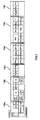
- FIG. 1 is a control signal view for a communication protocol for facsimile communication according to prior art.
- reference character 19a denotes a communication procedure for selecting a modulation mode from among a V34 half-duplex, V34 full duplex, V17 half-duplex, etc.
- Reference character 19b denotes a communication procedure for line probing to check a line and determine various kinds of parameters.
- Reference character 19c denotes a communication procedure for modem training.
- Reference character 19d denotes a communication procedure for setting a modem parameter.
- Reference character 19e denotes a communication procedure for exchanging a facsimile control signal.
- reference character 19f denotes a data communication procedure for the primary channel.
- the upper side in the diagram is a sequence for a caller modem, and the lower side is a sequence on an answer modem, and the sequences progress from left to right.
- the selection of a modulation mode and communication procedure which permit communication between a caller modem and an answer modem, through a V.21 modem (300 bps, full-duplex), is carried out after a line connection is established.
- a facsimile apparatus using a V.34 modem selects a V.34 modem as the modulation mode and facsimile communication as a communication procedure.
- the caller modem transmits a line probing tone.
- the line probing tone is received by the answer modem, a line inspection is carried out, and a training parameter is selected based on the result of the line inspection.
- the caller modem sends training signals based on the training parameter selected under the line probing communication procedure 19b, while the answer modem receives the training signals, learns a filter coefficient for an adaptive equalizer for compensating the line characteristic and checks the reception quality of the training signals.
- modem parameters are negotiated between the caller modem and the answer modem in full-duplex communication at 1200 bps.
- an optimal modem parameter is selected from the modem parameters preset in the apparatus, the result of the line inspection and the inspection of the reception quality of the training signals.
- image data is transmitted from the caller modem in half-duplex communication at 2400 bps to 33. 6 kbps.
- Image data is received by the answer modem.
- image data can transmit in approximately three seconds per a sheet of paper of size A4.
- the caller and answer modes which execute the aforementioned communication protocol, carry out communication in accordance with the training parameter selected under the communication procedure 19b for communication line probing and the modem parameter selected under the communication procedure 19d for selection of a modem parameter.
- the receiver modem executes communication using the filter coefficient that has learned in the modem training 19b. This ensures optimal data communication according to the line quality.
- EP A 0 878 950 shows a similar apparatus to that of the present invention but does not disclose the registration of modem parameters.
- US-A-5 661 568 discloses that several modems with different speeds are provided. A modem and a transmission speed are selected in accordance with the corresponding stored information of the communication mode of the destination and the time for carrying out the previous procedure can be reduced by the selected high speed modem. It is also checked whether a transmission error was included and if so, the abbreviation procedure counter is increased. If the transmission corresponding to the abbreviation protocol succeeds continuously several times, data transmission by the abbreviation protocol is automatically attempted in the next communication.
- US-A-5 303 066 discloses that in accordance with the recorded destination, a shortened procedure, in which the modem training procedure is omitted, is selected.
- an object of the present invention is to provide a data communication apparatus which can shorten time for setting various kinds of parameters of a modem and time for a previous-procedure including time for modem training before the image transmission.
- an object of the present invention is to provide a data communication apparatus such that a supported short previous-procedure function appropriately operates even when a communication error rate is high or line characteristics are changed.
- FIG. 2 is a basic block diagram of a facsimile apparatus to which the present invention is applied.
- reference character 101 is a scanning section for scanning an original image.
- a printing section 102 records and outputs the received image.
- a control section 103 performs the control of the entire apparatus and carries out control to encode and decode image signals and execute a communication protocol.
- a modem 104 implements every modulation and demodulation in a facsimile communication protocol that is specified in T.30 ANEXF of the ITU-T.
- the modem 104 comprises a digital signal processor (DSP) 104a for performing modem's signal processing and an analog front end section 104b serving as both A/D conversion and D/A conversion functions.
- DSP digital signal processor
- a network control unit (NCU) 105 controls dialing and calling to a line 106.
- An operation section 107 comprises various kinds of key input switches, such as dial keys and a start key, and a display unit for displaying information. Various kinds of operations of the apparatus are performed through this operation section 107.
- a memory 108 stores various kinds of information for execution of a short previous-procedure in the case of communicating with a communication destination, which has a short previous-procedure function.
- information like a telephone number and a modem parameter is stored in the memory 108 as shown in FIG. 8 to be described later.
- a modem parameter includes a power reduction value indicative of signal power and a time data indicative of a training time, and performs various selections, such as carrier frequency selection for selectively setting either a high level or a low level, preemphasis filter selection, symbol rate selection for selectively setting five levels of rates that are transmitted for an eye pattern and selection of a training constellation point.
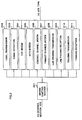
- a modem control section 201 controls interface with the control section 103 and the modem 104 and various modem functions.
- the modem control section 201 comprises a plurality of functional sections to be explained below, and these functions are executed by normal software.
- a tonal transmission functional section 202 transmits various tonal signals in accordance with communication protocols.
- a tonal detecting section 203 identifies a tonal signal sent from a communication destination.
- a V.21 modem 204 is a modem that is conformity with Recommendation V.21 of the ITU-T (300 bps, full-duplex).
- An INFO modem 205 is a modem that is conformity with Recommendation V.34 of the ITU-T (600 bps, full-duplex), and which is used in a start procedure in the communication protocol for line probing and a short previous-procedure.
- a control channel modem functional section 206 is a modem that is specified by Recommendation V.34 of the ITU-T (1200 bps or 2400 bps, full-duplex), and is used in setting a modem parameter for a primary channel modem and in a communication protocol for a facsimile control signal.
- a primary channel modem functional section 207 is a main channel modem, that is specified by Recommendation V.34 of the ITU-T (2400 bps to 33.6 kbps, half-duplex), and is used in communicating image data.
- a line probing transmission functional section 208 transmits line probing tones, which are specified by Recommendation V.34.
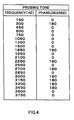
- the line probing tone are combined signals of 21 kinds of tonal signals of 150 Hz to 3750 Hz as shown in FIG. 4.
- a line probing reception functional section 209 receives the line probing tones from a communication destination and carries out a line inspection. More specifically, the line probing reception module functional section 209 performs spectrum analysis on the received signals using the fast Fourier transform algorithm to select the optimal symbol rate and carrier frequency for the primary channel modem 207 and other modem parameters.
- a training transmission functional section 210 transmits training signals for the V.34 modem.
- a training reception functional section 211 receives the training signals from a communication destination and learns a filter coefficient of an adaptive equalizer to compensate line distortion.
- a demodulator 401 converts a received training signal Sp, which has undergone A/D conversion in the analog front end section 104b, to a complex baseband signal Yb from the passband.
- An adaptive equalizer 402 compensates line distortion with respect to the baseband signal Yb and outputs a received signal Yr.
- a decision circuit 403 determines a decision point Yd and outputs it. The decision point Yd is used to determine the amount of shift of a point on an eye pattern of a received signal Yr.
- a subtracter 404 subtracts the decision point Yd from the received signal Yr and outputs an error signal Er. Note that Yb, Yr, Yd and Er are complex signals.
- the error signal Er is supplied to the adaptive equalizer 402.
- the adaptive equalizer 402 learns such an internal filter coefficient as to reduce this error signal Er.
- the learned internal filter coefficient is used as a reception filter coefficient in the primary channel modem 207.
- An absolute value unit 405 computes an absolute value with respect to the error signal Er.
- An LPF 406 is a low-pass for smoothing the output signal Ea of the absolute value unit 405.
- the output signal of the LPF 406 is an EQM signal, which represents the degree of compensation for the line distortion of the adaptive equalizer 402. The smaller this EQM signal is, the more sufficiently the line distortion is compensated.
- An equalization ability analyzing section 407 analyzes the ability of the adaptive equalizer 402 to compensate the line distortion from the EQM signal.
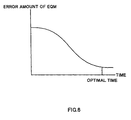
- the equalization ability analyzing section 407 observes the amount of change in the EQM signal from the beginning of training as shown in FIG. 6, and computes the time, at which the absolute value of the amount of change becomes smaller than a given value, as the optimal training time. Also, the equalization analyzing module 407 also computes the ratio (SN) of the training signal power to noise power as a final value of the EQM signal.
- the optimal training time is an absolute value from the origin of the point in the eye pattern.
- the noise power is an error in the point in the eye pattern.
- the optimal training time is used as the training time in executing a short previous-procedure.
- the SN ratio is used in selecting the data transfer rate of the primary channel modem 207. Note that no computation of the optimal training time is executed when a short previous-procedure is carried out.
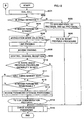
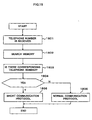
- FIG. 7 is a flowchart illustrating a control operation of a facsimile apparatus according to this embodiment at the time of calling.
- step (hereinafter referred to as ST) 601 calling is initiated in accordance with the telephone number of a transmission destination and a transmission start instruction from the operation section 107. Then, the memory 108 is searched to check if the telephone number of the transmission destination is registered for a short previous-procedure. When registration is not made, the flow proceeds to step S602 to make dialing.
- facsimile communication is carried out in a normal communication protocol based on T.30 ANEXF of the ITU-T.
- step S604 normal communication is performed on the calling side, and registration for various kinds of parameters necessary for executing the short previous-procedure is executed.
- the contents to be registered in the short previous-procedure includes, for example, selection information such as power reduction value and a carrier, and selection information such as optimal training time and non-linear distortion compensation.
- the contents to be registered for a short previous-procedure are stored in the memory 108 in accordance with the memory structure of the short previous-procedure registration memory illustrated in FIG. 8.
- a dial call is made and a communication by short previous-procedure is carried out in a case where the short previous-procedure is registered in ST601.
- a modem parameter in the short previous-procedure registration memory 108 is sent to the transmission destination in the start procedure to execute the transmission operation according to the modem parameter. This eliminates the need for negotiation with the receiver, so that communication time can be reduced.
- ST609 the presence or absence of a communication error is determined. If there is no communication error, the flow proceeds to ST610.
- ST610 the rate of data errors in communication is determined, and when there are not many data errors, the process will be terminated. This error rate decision may be made based on the number of resends in, for example, ECM.
- facsimile apparatuses are often connected one to a single line.
- a control protocol for exchanging the data communication mode need not be executed every time communication is carried out if the previous communication mode is stored in a transmitting apparatus and a receiving apparatus.
- the training time which is set in accordance with the learning time for the filter coefficient of the adaptive equalizer of a receiving apparatus, is generally set to the length that can be adapted for every line.
- the learning time for the filter coefficient can be shorter than the normally set one, so that the training time may be wasted.
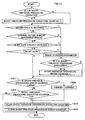
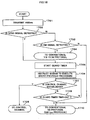
- FIG. 9 presents a flowchart illustrating a control operation for a previous-procedure at the time a facsimile apparatus according to this embodiment receives an incoming signal.
- ST 802 it is detected whether to receive a quick tonal signal (QTS) indicating a short previous-procedure or a call menu signal CM from the caller modem, while sending the ANSam signal.
- QTS quick tonal signal
- ST 803 and ST 804 communication is executed by a short previous-procedure using a registered communication parameter when the QTS signal is detected, while communication is executed by a normal previous-procedure according to the T.30 ANEXF of the ITU-T when the CM signal is detected.
- a short previous-procedure registration flag indicating that the self-apparatus has the short previous-procedure function and the optimal training time are described in the non-standard protocol signal NSF field of the facsimile control signal when communication is carried in the normal protocol.
- the transmitter registers a short previous-procedure for this receiver based on the information in the NSF field.
- the transmitter carries out dial calling and CNG transmission, and waits for incoming a deformed answer tone ANSam to be transmitted from the receiver.
- a control protocol is executed in a conventional G3 protocol (300 bps) when the deformed answer tone ANSam is not detected in ST902.
- a modem parameter corresponding to the receiver destination is registered in the memory 108.
- the short previous-procedure of V.34 is executed. This short previous-procedure will be described later.
- the communication procedure 19a for selecting a modulation mode, the communication procedure 19b for line, the communication procedure 19c for modem training, and the communication procedure 19d for setting a modem parameter are executed to perform control channel reception, after which the facsimile control procedure is executed.
- a storage parameter of storing means is checked in ST915.
- the modem parameter of the memory 108 is erased, and the update for storage parameter is carried out as required. The check for storage parameter and the update therefor will be described later.
- the protocol shifts to V.34 communication protocol directly. Even when the calling is not generated by the memory key operation, the protocol shifts to V.34 communication protocol.
- the reason is that an area for a modem parameter registration is preset in the memory in the case of the dial calling due to the memory key and no parameter storing area is provided in the case of the dial calling due to the normal 10-button keypad operation.
- the communication protocol at the registration of a short previous-procedure is carried out in the normal protocol as recommended by the T.30 ANEXF of the ITU-T, various kinds of modem parameters are registered in the memory 108 of the caller modem, so that communication can be implemented using the registered parameter from the next time.
- FIG. 11 is a control signal chart for a communication protocol at the time of executing a short previous-procedure, and illustrates a communication process from the establishment of a line connection up to communication of image data.
- a communication procedure 10a for initiating a short previous-procedure is performed, after which a communication procedure 10b for modem training is executed in accordance with registered time, and a communication procedure 10c for setting a modem parameter, a communication procedure 10d for a facsimile control signal and a data communication procedure 10e for sending data (image data) will be carried out.
- a caller modem sends a caller number identification signal CNG, and an answer modem sends a deformed answer tone ANSam. After detecting this deformed answer tone ANSam, the caller modem sends a quick tonal signal QTS, and sends tones B and QINFO upon detection of a response signal tone A from the answer modem. After detecting the quick tonal signal QTS from the caller modem, the answer modem sends the tone A and receives the QINFO from the caller modem.
- This quick tonal signal QTS indicates a signal to command shift to the short previous-procedure.
- the quick tonal signal QTS is a repeated pattern of "001100110011".
- the reason why such a tonal signal pattern is used is to permit the receiver to clearly distinguish the received the quick tonal signal QTS from a signal pattern of the flag sequence ("011110") and the tonal signal pattern of the call menu signal CM (2-bit start bits "10,” 8-bit data and stop bit of "1"), which are defined by Recommendation T.30 of the ITU-T.
- the receiver modem can easily discriminate whether the communication is to be implemented in a short previous-procedure or a normal previous-procedure, depending on whether the incoming tonal signal is the quick tonal signal QTS or the call menu signal CM.
- V.21 modem 204 300 bps, full-duplex
- V.21 modem 204 300 bps, full-duplex
- the optimal training time and the selected contents for non-linear distortion compensation can delete signals CM, JM, CJ of communication procedure 10a and the line probing procedure 19b shown in FIG. 1, which are needed in the normal previous-procedure.
- modem training time can be shortened. As a result, time required for previous-procedure can be shortened by amount of time corresponding to the above deletion and the reduction in the modem training time.
- training the calling side apparatus and the answering side apparatus is performed in accordance with the training parameter (INFO0h) of the QINFO sequence and the optimal training time. Since the optimal training time is necessary minimum time registered in advance, this results in time reduction in previous-procedure.
- the MPH for the answer modem is set based on the QINFO-based selection of non-linear distortion compensation and information on the SN ratio computed in the communication procedure 10c for modem training. Therefore, this sequence can also shorten time.
- the facsimile control procedure 10e and the data communication procedure 10f are the same as the normal V.34 communication protocol.
- the communication protocol in the short previous-procedure is carried out in such a manner that the communication procedure for starting the short previous-procedure is executed in an exclusive procedure and the communication procedure for modem training and the subsequent communication procedures are basically performed in accordance with the recommendation for T.30 ANEXF of the ITU-T, thereby realizing the reduction in the entire communication time.
- the communication apparatus on the receiver side, which is equipped with the short previous-procedure, is replaced with another apparatus, which is not equipped with the short previous-procedure.
- the registered destination is a representative telephone, and the kind of destination's apparatus is changed every time when connection is made.
- the communication time zone and an LCR function exert an influence upon the change in the communication path.
- Transoceanic communication is carried out via submarine cable or satellite.
- the present invention has been structured such that requirement on the registration of the modem parameter for a short previous-procedure and the update on the registration are dynamically changeable in accordance with such circumstances. Thereby, a problem in which success of a short previous-procedure is not attained or a bit rate is reduced can be avoided to the greatest extent practicable.
- FIG. 12 is a flowchart explaining the processing when the transmitter fails in the recovery by the modem and a shift to a short previous-procedure cannot be made.
- the transmitter carries out dial calling and CNG transmission, and waits for incoming a deformed answer tone ANSam to be transmitted from the receiver.
- the deformed answer tone ANSam is not detected, this means that the receiver does not support V.34 communication protocol, and the protocol shifts to the conventional G3 protocol.
- a guard timer starts counting for 15 seconds, after which the transmitter executes a short previous-procedure.
- a quick tonal signal QTS is transmitted and a communication procedure 10a for initiating a short previous-procedure is executed.
- a communication procedure 10c for modem training is executed.
- the communication procedure proceeds to a communication procedure 10e for a facsimile control, and V.34 communication protocol is executed.
- the control channel described here is the sequences 10d and 10e shown in FIG. 11.
- the apparatus on the transmitter side is in a signal reception waiting mode of 300 bps, that is, T. 30 NSF/CSI/DIS reception standby state.
- the time-out occurs when a state in which there is no response of a PPh signal from the apparatus on the receiver side is continued and passed for 15 seconds even though the modem proceeds the procedure from the transmission of the QINFO signal to that of the PPh signal and executes recovery processing.
- check processing for the parameter registered in the memory 108 is executed, after which the received NSF or DIS is inspected so as to conform whether or not the apparatus on the receiver side supports V.8 communication protocol.
- the procedure is shift to a conventional G3 protocol.
- the modem parameter of the memory 108 is erased and its update is carried out as required as described later when the short previous-procedure does not succeed within guard time.
- the apparatus when the apparatus on the receiver side is not equipped with the short previous-procedure function, there is a high possibility that NSF signal of 300 bps, DIS signal, etc. will be transmitted. For this reason, the apparatus receives these signals, and executes the G3 communication protocol, thereby continuing communication. This processing can avoid the worst case in which a communication error occurs.
- T.30 protocol it is defined that the transmission of NSF/CSI/DIS is repeated for 35 seconds, and the interval among NSF/CSI/DIS is 3 seconds.
- the length of NSF/CSI/DIS differs, depending on the length of NSF, the length is normally tens of octets and is within the range of 3 to 5 seconds.
- a shift to processing B is carried out to execute normal V.34 protocol when it is determined that the apparatus on the receiver side supports V.8 communication protocol in ST1112.
- Processing B is one that executes V.34 protocol and short previous-procedure registration processing at the same time.
- the shift to processing B makes it possible to acquire the modem parameter again and to improve reduction in communication time by execution of communication in a short previous-procedure in the subsequent communication even if the short previous-procedure does not normally proceed.
- a short previous-procedure is not executed in a next communication and a normal previous-procedure is carried out. If an error in executing the short previous-procedure this time lies in the other reason and not the reason that the receiver does not support the short previous-procedure, no short previous-procedure can be preferably executed in the subsequent communication.
- processing B that is registration processing for a short previous-procedure shown in FIG. 10 is repeated.
- V.34 normal protocol is executed with respect to the receiver, and short previous-procedure registration processing for registering a modem parameter is carried out.
- the short previous-procedure is once registered, after which a short previous-procedure execution counter is incremented every time V.34 protocol is executed.
- the modem parameter stored in the memory 108 is erased.
- the erase of the modem parameter is specifically carried out in the following cases:
- the erase of the modem parameter is carried out when the modem fails in the recovery. That is a case in which ANSam is detected and the quick tonal signal QTS is sent from the apparatus on the transmitter side but the signal does not reach the control channel. This is because communication time at no short previous-procedure execution becomes shorter when an error is generated again at a next short previous-procedure execution time.
- the erase of the modem parameter is carried out when an error is generated in the establishment of control channel. That is a case in which the communication previous-procedure is completed but an image information channel connection ends in failure and a trouble, which is caused at a control signal exchanging time between pages such as MPS after the image information channel. There is a high possibility that both cases will be ascribable to the fact that the modem parameter is not appropriately set.
- the erase of the modem parameter is carried out when a transmission error often occurs during communication so that a bit rate is considerably reduced.
- a line condition is extremely good at a modem parameter setting time but poor in an actual communication.
- transoceanic communication is carried out via submarine cable or satellite, a quality of line often differs between a modem parameter registration time and an actual communication time. In such a case, communication speed in a state that the set modem parameter is not used seems to be improved.
- the determination of the reduction in bit rate may be performed by detecting an error rate in communication and sequentially comparing the detected error with an error rate prestored at a communication start time.
- the erase of the modem parameter is carried out when the transmission bit rate is lower than a reference value.
- 14.4 kbps of V.17 communication protocol is used as a reference value, and the registered modem parameter is erased when the bit rate is less than the reference value. This is because the communication speed in V.17 protocol is faster than the communication speed in V.34 protocol in accordance with the registered modem parameter.
- the memory 108 is erased and the modem parameter is not registered when the aforementioned communication troubles exist.
- the memory 108 When communication error is occurred in communication in which the short previous-procedure is executed, the memory 108 is set to be in a vacant state so as to try register the modem parameter continuously in communication including next and after. As a result, when the short previous-procedure error reaches the fixed value or more, a shift to registration processing of a modem parameter for a short previous-procedure is prohibited such that no short previous-procedure can be executed. While, when the execution of short previous-procedure ends in failure, the above is unfavorable since it takes more time than normal communication.
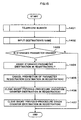
- the error rate is computed at the time when the number of execution times of short previous-procedure reaches 10. While, in the flowchart of FIG. 14, when the number of error times reaches a fixed value or more, the registration function for a modem parameter is stopped even if the number of execution times of short previous-procedure is before 10. Since the first half of processing of FIG. 14 is the same as that of processing of FIG. 13, the explanation will be omitted.
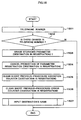
- FIG. 15 is a flowchart showing processing when there is a change in a name of destination address.
- a dial input is carried out and a name of destination is input, after which it is determined whether or not the modem parameter stored in the memory 108 is erased.
- the stored parameter is erased when the determination result in ST1403 is YES.
- the prohibition is cancelled.
- the clear of the short previous-procedure execution counter and that of the short previous-procedure error counter are sequentially executed.
- FIG. 16 is a flowchart showing processing for a case in which a destination's telephone number is changed.
- a telephone number is input and it is determined whether or not there is a change in the telephone number.
- a selective operation is performed. This carries out the erase of the contents of the memory including the parameter automatically when there is the change in the telephone number input by an operator. On the other hand, when there is no change in the telephone number, the operator is urged to input the destination, after which a standby status whether or not the storage parameter is erased is set.
- the change of the telephone number seems to occur in a case where the apparatus on the receiver side is moved or a case where a line is changed. Therefore, the reason why the contents of the memory including the parameter is automatically carried out when there is a change in the telephone number is the need for updating the modem parameter in a next communication.
- FIGS. 15 and 16 Processing of FIGS. 15 and 16 is one, which is related to how the storage parameter registered is processed when there is a change in the apparatus on the destination side where one-touch key etc., is registered. In contrast, processing of FIG. 17 is described on the assumption that there would be a change in a telephone number of the self-apparatus.
- the change in the telephone number of the self-apparatus involves a change in a line to be connected. More specifically, the line is often changed from an analog line to an ISDN. It can be considered that this case carries a change in line characteristics in most cases. In order to deal with such a case, the following processing is carried out.
- a character ID and a numeric ID are continuously input, and it is determined whether or not the input numeric ID is changed.
- the memory clear is automatically executed.
- a manual execution of the memory clear is needed.
- a terminal such as a terminal adapter is newly connected between data communication and a line, or the connected terminal is changed.
- the modem parameters of all destinations be cleared and updated.
- the apparatus transmits a deformed answer signal ANSam to a caller number identification signal CNG incoming from the apparatus on the transmitter side, and detects a quick tonal (QTS) signal sent from the apparatus on the transmitter side.
- a deformed answer signal ANSam to a caller number identification signal CNG incoming from the apparatus on the transmitter side
- QTS quick tonal
- the guard timer starts counting for 15 seconds and instructs the self-modem to execute the short previous-procedure.
- guard time for 15 seconds is provided even in the apparatus on the receiver side. Namely, in the apparatus on the transmitter side, when the communication by previous-procedure does not reach the control channel during 15 seconds, a mode is changed to one that receives NSF/CSI/DIS of 300 bps to proceed G3 protocol. For this reason, there is no meaning in standby time for more than 15 seconds, and the apparatus on the receiver side moves to G3 protocol.
- control information can be deleted from storing means so as to execute an update of control information by parameter registering means.
- This makes it possible to maintain modem control information registered in storing means in an optimal state.
- the update period can be counted from registration time of each destination or all destinations registered may be updated at the same time by a fixed timer.
- the first embodiment explained that the registration of control information to storing means was carried out in one normal communication.
- memory control means for rewriting the modem control information registered in storing means may be provided. Ever time when normal communication pre-protocol is executed to acquire modem control information, modem control information newly acquired may be added, the modem control information registered in storing means may be corrected and recorded again by memory control means.
- an average value of parameters obtained in the plurality of times of communication is calculated and suitable control information is registered instead of the point that registration of control information to storing means is performed one time. This further improves a probability of success of the short previous-procedure.
- the modem parameter can be maintained to have an optimal value.
- suitable communication having short communication time, high communication speed, and a low error rate can be carried out while using the short previous-procedure.
- a rule for a parameter correction for example, there is a method in which the main parameter of each of registered control information and new control information is plotted in a multi-dimensional space and the center of gravity of each parameter is searched so as to obtain its middle point. In this case, it is better to assign weights to data to be appropriately used, depending on the number of execution times of the past short previous-procedure. Further, to improve correction accuracy, the parameter to be used as correction data may be limited to be within a fixed range.
- this data communication apparatus uses a caller telephone number informing service by an exchange, which has recently started, to register a modem parameter on the apparatus on the receiver side in association with the caller telephone number.
- Either the transmitting apparatus or the receiving apparatus registers information such as the modem parameter, the optimal training time and the modulation mode in the memory. But, the transmitting apparatus and the receiving apparatus may both register those information in the memories. This allows the transmitting apparatus and the receiving apparatus to skip the communication protocol 19a of FIG. 19 and start from the communication protocol 19b upon reception of an incoming signal. In this case, the time for the pre-communication protocol is further shortened because such information need not be exchanged in the communication protocol.
- a modem parameter and optimal training time for a modem are stored in association with a destination's telephone number, so that in the subsequent communication, the communication pre-protocol can be performed in accordance with the stored modem parameter and optimal training time. It is therefore possible to largely shorten the time for the pre-communication protocol.
Landscapes
- Engineering & Computer Science (AREA)
- Multimedia (AREA)
- Signal Processing (AREA)
- Communication Control (AREA)
- Facsimile Transmission Control (AREA)
- Telephonic Communication Services (AREA)
Claims (25)
- Datenkommunikationsvorrichtung, die umfasst:eine Speichereinrichtung (108) zum Speichern verschiedener Arten von Modem-Steuerinformationen für jedes Ziel in Verbindung mit einer entsprechenden Betätigungstaste(107);eine Rufeinrichtung (104) zum Erzeugen eines Rufs zu dem Ziel durch einen Sendebefehl von der Betätigungstaste (107), um Kommunikation in Gang zu setzen; undeine Kommunikations-Steuereinrichtung (103) zum Senden eines Übergangs-Mitteilungssignals, das einen Übergang von einer normalen Vorprozedur zu einer kurzen Vorprozedur anzeigt, und zum anschließenden Steuern des Modems auf Basis der verschiedenen Arten von Steuerinformationen, um eine Vorprozedur zu verkürzen und Senden von Daten auszuführen,eine Parameter-Registriereinrichtung zum Speichern verschiedener Arten von Modem-Steuerinformationen, die in der Vorprozedur in Kommunikation mit dem Ziel gewonnen wurden, in Verbindung mit der Betätigungstaste (107),dadurch gekennzeichnet, dass die Kommunikations-Steuereinrichtung (103) das Übergangs-Mitteilungssignal (QTS) an Stelle eines Rufmenüsignals (CM) als Reaktion auf ein Antwortsignal (ANSam) sendet, wobei das Antwortsignal von einer Empfängerseite in Reaktion auf ein gesendetes Rufsignal kommt, das ITU-Empfehlung V.34 entspricht.
- Datenkommunikationsvorrichtung nach Anspruch 1, wobei die Kommunikations-Steuereinrichtung (103) prüft, ob die verschiedenen Arten der Modem-Steuerinformationen in der Speichereinrichtung (108) gespeichert sind oder nicht, bevor sie zu der kurzen Vorprozedur übergeht, und die kurze Vorprozedur nur ausführt, wenn die Steuerinformationen gespeichert sind.
- Datenkommunikationsvorrichtung nach Anspruch 1 oder 2, wobei die Parameter-Registriereinrichtung keine Registrierung von Steuerinformationen für die kurze Vorprozedur ausführt, wenn ein Fehler in der normalen Prozedur erfasst wird.
- Datenkommunikationsvorrichtung nach Anspruch 3, wobei die Parameter-Registriereinrichtung in der normalen Vorprozedur gewonnene Steuerinformationen in der Speichereinrichtung registriert und die Steuerinformationen löscht, so dass Steuerinformationen nicht registriert werden.
- Datenkommunikationsvorrichtung nach einem der Ansprüche 1 bis 4, wobei, wenn die kurze Vorprozedur nicht abläuft, die Kommunikations-Steuereinrichtung (103) zu der normalen Vorprozedur oder zu einer zweiten Kommunikationsprozedur übergeht, die niedrige Kommunikationsgeschwindigkeit aufweist, um Kommunikation nach einer vorgegebenen Zeit fortzusetzen.
- Datenkommunikationsvorrichtung nach Anspruch 5, wobei die zweite Kommunikationsprozedur ein Kommunikationsprotokoll gemäß ITU-Empfehlung T.30 ist und die vorgegebene Zeit die Zeit ist, über die NSF/CSI/DIS-Signale nach T.30 zweimal oder öfter empfangen werden können, bevor zu der zweiten Kommunikationsprozedur übergegangen wird.
- Datenkommunikationsvorrichtung nach einem der Ansprüche 1 bis 6, wobei, wenn die kurze Vorprozedur nicht abläuft, die Kommunikations-Steuereinrichtung (103) mit der Prozedur von der kurzen Vorprozedur zu einer zweiten Kommunikationsprozedur übergeht, die niedrige Kommunikationsgeschwindigkeit aufweist, um Kommunikation fortzusetzen, nachdem die Anzahl wiederholter Versuche der kurzen Vorprozedur einen festgelegten Wert erreicht.
- Datenkommunikationsvorrichtung nach einem der Ansprüche 1 bis 7, die des Weiteren eine Fehlererfassungseinrichtung umfasst, die einen Kommunikationsfehler erfasst, wobei, wenn die Fehlererfassungseinrichtung einen Fehler nach Beginn der Ausführung der kurzen Vorprozedur erfasst, die Kommunikations-Steuereinrichtung (103) Ziel-Informationen in der Speichereinrichtung (108) einerseits beibehält und andererseits nur die entsprechenden verschiedenen Arten von Modem-Steuerinformationen löscht.
- Datenkommunikationsvorrichtung nach Anspruch 5, die des Weiteren eine Parameter-Registriereinrichtung zum Ausführen von Kommunikation in der normalen Vorprozedur bei dem gleichen Ruf umfasst, um verschiedene Arten der in der normalen Vorprozedur gewonnenen Modem-Steuerinformationen neu in der Speichereinrichtung (108) zu speichern, wenn die kurze Vorprozedur nicht abläuft.
- Datenkommunikationsvorrichtung nach Anspruch 8, wobei die Fehlererfassungseinrichtung Abnormalität von Kommunikation feststellt, wenn eine Anzahl von Datensendefehlern bei Kommunikation nach Ausführung der kurzen Vorprozedur oder der normalen Vorprozedur auf einen vorgegebenen Wert oder darüber steigt.
- Datenkommunikationsvorrichtung nach Anspruch 8, wobei die Fehlererfassungseinrichtung Abnormalität von Kommunikation feststellt, wenn eine Anzahl von Datensendefehlern bei Kommunikation nach Ausführung der kurzen Vorprozedur oder der normalen Vorprozedur so hoch ist, dass eine Kommunikations-Bitrate erheblich reduziert wird.
- Datenkommunikationsvorrichtung nach Anspruch 10, die des Weiteren eine Parameter-Registriereinrichtung zum Speichern verschiedener Arten der Modem-Steuerinformationen, die in einer nächsten normalen Vorprozedur gewonnen werden, die in Bezug auf das Ziel ausgeführt wird, in der Speichereinrichtung (108) nach Löschen der Steuerinformationen aus der Speichereinrichtung (108) umfasst.
- Datenkommunikationsvorrichtung nach Anspruch 1 oder 2, wobei, wenn eine Anzahl von Fehlern in der kurzen Vorprozedur oder eine Fehlerzahl auf Basis einer Häufigkeit der Ausführung der kurzen Vorprozedur bezüglich des gleichen Ziels einen vorgegebenen Wert übersteigt oder ihm gleich ist, Ausführung der kurzen Vorprozedur in einem nächsten Kommunikationsvorgang mit dem gleichen Ziel untersagt wird.
- Datenkommunikationsvorrichtung nach Anspruch 13, die des Weiteren einen Fehlerzähler zum Zählen einer Häufigkeit der Erzeugung von Fehlern in der kurzen Vorprozedur umfasst, wobei der Fehlerzähler jedes Mal weiter zählt, wenn verschiedene Arten von Steuerinformationen in der Speichereinrichtung gelöscht werden.
- Datenkommunikationsvorrichtung nach Anspruch 14, die des Weiteren eine Einrichtung umfasst, mit der festgestellt wird, ob die Kommunikation in der kurzen Vorprozedur in Gang gesetzt wird oder nicht, bevor der Fehlerzähler zählen kann, und wobei der Fehlerzähler nicht zählt, wenn ein Ergebnis der Feststellung "nein" ist.
- Datenkommunikationsvorrichtung nach Anspruch 13, wobei die Kommunikations-Steuereinrichtung (103) vor dem Übergang zu der kurzen Vorprozedur prüft, ob verschiedene Arten der Modem-Steuerinformationen in der Speichereinrichtung (108) registriert werden können oder nicht, und keine kurze Vorprozedur ausführt, wenn verschiedene Arten der Modem-Steuerinformationen nicht registriert werden können.
- Datenkommunikationsvorrichtung nach Anspruch 16, die des Weiteren eine Parameter-Registriereinrichtung zum Speichern verschiedener Arten der Modem-Steuerinformationen umfasst, die in der normalen Vorprozedur gewonnen werden, wobei die kurze Vorprozedur untersagt wird, indem das Speichern der verschiedenen Arten der Modem-Steuerinformationen in der Speichereinrichtung (108) untersagt wird.
- Datenkommunikationsvorrichtung nach einem der Ansprüche 1 bis 17, die des Weiteren eine Betätigungseinrichtung zum Ändern des Namens eines Ziels oder der Telefonnummer eines Ziels, die in der Speichereinrichtung (108) gespeichert sind, und eine Speicher-Steuereinrichtung umfasst, die automatisch alle Informationen eines relevanten Informations-Speicherbereiches einschließlich Modem-Steuerinformationen, die in Verbindung mit der Telefonnummer des Ziels gespeichert sind, löscht, wenn die Telefonnummer des Ziels durch die Betätigungseinrichtung geändert wird.
- Datenkommunikationsvorrichtung nach einem der Ansprüche 1 bis 18, die des Weiteren eine Betätigungseinrichtung zum Eingeben eines eindeutigen Identifizierungscodes der Datenkommunikationseinrichtung sowie eine Speicher-Steuereinrichtung umfasst, die automatisch alle Informationen eines relevanten Informations-Speicherbereiches einschließlich Modem-Steuerinformationen, die in Verbindung mit allen Telefonnummern gespeichert sind, löscht, wenn der eindeutige Identifizierungscode durch die Betätigungseinrichtung geändert wird.
- Datenkommunikationsvorrichtung nach Anspruch 18, die des Weiteren eine Parameter-Registriereinrichtung zum Speichern verschiedener Arten der Modem-Steuerinformationen umfasst, die in einer nächsten normalen Vorprozedur gewonnen werden, die in Bezug auf ein Ziel ausgeführt wird, in der Speichereinrichtung (108) speichert.
- Datenkommunikationsvorrichtung nach einem der Ansprüche 1 bis 20, die des Weiteren eine Speicher-Steuereinrichtung umfasst, die automatisch alle Informationen eines relevanten Informations-Speicherbereiches einschließlich Modem-Steuerinformationen, die in Verbindung mit allen Telefonnummern gespeichert sind, löscht, wenn ein Fehler kontinuierlich in der kurzen Vorprozedur auftritt, die in Bezug auf eine Vielzahl von Zielen ausgeführt wird.
- Datenkommunikationsvorrichtung nach einem der Ansprüche 1 bis 21, wobei die Steuerinformationen aus der Speichereinrichtung (108) nach einer vorgegebenen Zeit von der Registrierung von Steuerinformationen in der Speichereinrichtung (108) an gelöscht werden, um eine Aktualisierung von Steuerinformationen durch die Parameter-Registriereinrichtung auszuführen.
- Datenkommunikationsvorrichtung nach einem der Ansprüche 1 bis 22, die des Weiteren eine Speicher-Steuereinrichtung zum Überschreiben der Modem-Steuerinformationen in der Speichereinrichtung (108) umfasst, wobei jedes Mal, wenn eine normale Vorprozedur ausgeführt wird, um Modem-Steuerinformationen zu erfassen, die Speicher-Steuereinrichtung neue Modem-Steuerinformationen hinzufügt, die Modem-Steuerinformationen in der Speichereinrichtung (108) auf Basis der neuen Modem-Steuerinformationen korrigiert und die korrigierten Modem-Steuerinformationen wieder in der Speichereinrichtung (108) aufzeichnet.
- Datenkommunikationsvorrichtung nach einem der Ansprüche 1 bis 23, wobei geeignete Modem-Steuerinformationen auf Basis einer Vielzahl von Modem-Steuerinformationen berechnet werden, die durch eine Vielzahl von Wiederholungen einer normalen Vorprozedur gewonnen werden, und die berechneten Steuerinformationen in der Speichereinrichtung (108) registriert werden.
- Datenkommunikationsverfahren, das die folgenden Schritte umfasst:Speichern verschiedener Arten von Steuerinformationen für jedes Ziel in Verbindung mit einer entsprechenden Betätigungstaste;Erzeugen eines Rufs zu dem Ziel durch einen Sendebefehl von der Betätigungstaste, um Kommunikation in Gang zu setzen; undSenden eines Übergangs-Mitteilungssignals, das einen Übergang von einer normalen Vorprozedur zu einer kurzen Vorprozedur anzeigt, und anschließendes Steuern eines Modems auf Basis der verschiedenen Arten von Steuerinformationen, um eine Vorprozedur zu verkürzen und Datensenden auszuführen,Speichern verschiedener Arten von Modem-Steuerinformationen, die in der Vorprozedur in Kommunikation mit dem Ziel gewonnen werden, in Verbindung mit der Betätigungstaste,gekennzeichnet durchSenden des Übergangs-Mitteilungssignals (QTS) anstelle eines Rufmenüsignals (CM) als Reaktion auf ein Antwortsignal (ANSam), wobei das Antwortsignal von einer Empfängerseite in Reaktion auf ein gesendetes Rufsignal kommt, das ITU-Empfehlung V.34 entspricht.
Applications Claiming Priority (3)
| Application Number | Priority Date | Filing Date | Title |
|---|---|---|---|
| JP31895497A JP3426122B2 (ja) | 1997-11-05 | 1997-11-05 | データ通信装置 |
| JP31895497 | 1997-11-05 | ||
| PCT/JP1998/004978 WO1999023814A1 (en) | 1997-11-05 | 1998-11-05 | Data communication device and data communication method |
Publications (3)
| Publication Number | Publication Date |
|---|---|
| EP0973323A1 EP0973323A1 (de) | 2000-01-19 |
| EP0973323A4 EP0973323A4 (de) | 2003-01-15 |
| EP0973323B1 true EP0973323B1 (de) | 2007-01-17 |
Family
ID=18104851
Family Applications (1)
| Application Number | Title | Priority Date | Filing Date |
|---|---|---|---|
| EP98951692A Expired - Lifetime EP0973323B1 (de) | 1997-11-05 | 1998-11-05 | Datenübertragungsvorrichtung und -verfahren |
Country Status (10)
| Country | Link |
|---|---|
| US (2) | US6449349B1 (de) |
| EP (1) | EP0973323B1 (de) |
| JP (1) | JP3426122B2 (de) |
| KR (1) | KR100339167B1 (de) |
| CN (1) | CN1158852C (de) |
| AT (1) | ATE352168T1 (de) |
| BR (1) | BR9806845A (de) |
| CA (1) | CA2276775C (de) |
| DE (1) | DE69836906T2 (de) |
| WO (1) | WO1999023814A1 (de) |
Families Citing this family (17)
| Publication number | Priority date | Publication date | Assignee | Title |
|---|---|---|---|---|
| JP3426122B2 (ja) * | 1997-11-05 | 2003-07-14 | パナソニック コミュニケーションズ株式会社 | データ通信装置 |
| US6724706B1 (en) * | 1999-02-26 | 2004-04-20 | Matsushita Electric Industrial Co., Ltd. | Digital adaptive equalizer for different quality signals |
| US6819749B1 (en) * | 1999-04-12 | 2004-11-16 | Mindspeed Technologies, Inc. | Method and apparatus for fast V.90 modem startup |
| USRE42661E1 (en) | 1999-04-12 | 2011-08-30 | V-Dot Technologies, Llc | Method and apparatus for fast V.90 modem startup |
| JP3900408B2 (ja) * | 1999-07-27 | 2007-04-04 | コネクサント システムズ, インコーポレイテッド | 保留メカニズムによる、高速接続、クイック再接続および接続 |
| JP2001189805A (ja) | 1999-12-28 | 2001-07-10 | Ricoh Co Ltd | 通信端末装置 |
| CN1157033C (zh) * | 2000-02-17 | 2004-07-07 | 三菱电机株式会社 | 协议转换装置及协议转换方法 |
| US6985566B2 (en) * | 2003-01-28 | 2006-01-10 | Conexant Systems, Inc. | Point of sale modem for high-speed communications |
| US7623273B1 (en) * | 2003-12-22 | 2009-11-24 | Cisco Technology, Inc. | Technique for connecting V.34 fax machines via fax relay gateways which are not adapted to support V.34 fax modulation |
| US7639403B2 (en) * | 2003-12-22 | 2009-12-29 | Cisco Technology, Inc. | Technique for connecting fax machines with advanced capabilities over a network which is not adapted to handle certain protocols |
| KR100620382B1 (ko) * | 2005-01-10 | 2006-09-11 | 삼성전자주식회사 | 통신장치 및 통신방법 |
| JP4463148B2 (ja) * | 2005-05-19 | 2010-05-12 | パナソニック株式会社 | 超音波診断装置 |
| KR100750139B1 (ko) * | 2005-11-22 | 2007-08-21 | 삼성전자주식회사 | 인터넷 팩스의 호 처리 장치 및 방법 |
| JP4780093B2 (ja) * | 2007-11-27 | 2011-09-28 | コニカミノルタビジネステクノロジーズ株式会社 | データ通信システム、アドレス管理装置、データ通信装置、アドレス管理方法およびアドレス管理プログラム |
| US9677653B1 (en) | 2014-10-23 | 2017-06-13 | Hydro-Gear Limited Partnership | Modular drive unit |
| US9743294B1 (en) * | 2017-03-16 | 2017-08-22 | Cognitive Systems Corp. | Storing modem parameters for motion detection |
| JP6889835B2 (ja) * | 2017-07-14 | 2021-06-18 | コニカミノルタ株式会社 | ファクシミリ通信装置およびプログラム |
Family Cites Families (22)
| Publication number | Priority date | Publication date | Assignee | Title |
|---|---|---|---|---|
| JPS58219847A (ja) * | 1982-06-14 | 1983-12-21 | Ricoh Co Ltd | 再送要求機能付データ通信方式 |
| US4621366A (en) * | 1984-02-22 | 1986-11-04 | Universal Data Systems, Inc. | Modem equalizer training using previously stored parameters |
| JP2962513B2 (ja) * | 1989-11-13 | 1999-10-12 | 株式会社リコー | グループ3ファクシミリ装置 |
| JP3015063B2 (ja) | 1990-04-27 | 2000-02-28 | 株式会社リコー | ファクシミリ装置の伝送制御方法 |
| JPH0435460A (ja) | 1990-05-31 | 1992-02-06 | Ricoh Co Ltd | ファクシミリ装置 |
| JP3118263B2 (ja) * | 1991-01-11 | 2000-12-18 | 三洋電機株式会社 | 自動販売機のデータ収集装置 |
| JPH04301963A (ja) * | 1991-03-29 | 1992-10-26 | Canon Inc | データ通信装置及びその制御方法 |
| US6122072A (en) * | 1993-12-06 | 2000-09-19 | Canon Kabushiki Kaisha | Data communication apparatus |
| JPH0832789A (ja) | 1994-07-18 | 1996-02-02 | Canon Inc | ファクシミリ装置 |
| JP3397521B2 (ja) | 1994-07-18 | 2003-04-14 | キヤノン株式会社 | ファクシミリ装置 |
| US6046825A (en) * | 1995-05-12 | 2000-04-04 | Canon Kabushiki Kaisha | Facsimile apparatus controlling communication in accordance with registered execution of the error correction mode |
| JP3145911B2 (ja) | 1995-12-28 | 2001-03-12 | 日本電気株式会社 | ファクシミリ装置 |
| JP3658070B2 (ja) | 1996-02-01 | 2005-06-08 | キヤノン株式会社 | ファクシミリ装置及びファクシミリ通信方法 |
| JP3472035B2 (ja) | 1996-04-19 | 2003-12-02 | キヤノン株式会社 | ファクシミリ装置 |
| JPH09312749A (ja) | 1996-05-20 | 1997-12-02 | Ricoh Co Ltd | ファクシミリ装置の伝送制御方式 |
| JP3140381B2 (ja) * | 1996-10-30 | 2001-03-05 | 松下電送システム株式会社 | データ通信装置 |
| JP3384275B2 (ja) * | 1997-03-25 | 2003-03-10 | 富士ゼロックス株式会社 | 通信端末装置 |
| JPH10336419A (ja) * | 1997-05-30 | 1998-12-18 | Canon Inc | ファクシミリ装置 |
| JP3354443B2 (ja) * | 1997-07-15 | 2002-12-09 | シャープ株式会社 | 通信装置 |
| JP3426122B2 (ja) * | 1997-11-05 | 2003-07-14 | パナソニック コミュニケーションズ株式会社 | データ通信装置 |
| JP3182123B2 (ja) * | 1998-03-09 | 2001-07-03 | 松下電送システム株式会社 | データ送信装置およびデータ通信方法 |
| JP3321081B2 (ja) * | 1998-04-01 | 2002-09-03 | 松下電送システム株式会社 | データ通信方法、およびデータ通信装置 |
-
1997
- 1997-11-05 JP JP31895497A patent/JP3426122B2/ja not_active Expired - Lifetime
-
1998
- 1998-11-05 WO PCT/JP1998/004978 patent/WO1999023814A1/ja not_active Ceased
- 1998-11-05 KR KR1019997006062A patent/KR100339167B1/ko not_active Expired - Fee Related
- 1998-11-05 EP EP98951692A patent/EP0973323B1/de not_active Expired - Lifetime
- 1998-11-05 DE DE69836906T patent/DE69836906T2/de not_active Expired - Lifetime
- 1998-11-05 BR BR9806845-8A patent/BR9806845A/pt not_active IP Right Cessation
- 1998-11-05 CN CNB988016850A patent/CN1158852C/zh not_active Expired - Fee Related
- 1998-11-05 CA CA002276775A patent/CA2276775C/en not_active Expired - Fee Related
- 1998-11-05 AT AT98951692T patent/ATE352168T1/de not_active IP Right Cessation
- 1998-11-05 US US09/331,716 patent/US6449349B1/en not_active Expired - Lifetime
-
2002
- 2002-07-22 US US10/199,125 patent/US6606375B2/en not_active Expired - Lifetime
Also Published As
| Publication number | Publication date |
|---|---|
| HK1023247A1 (en) | 2000-09-01 |
| EP0973323A1 (de) | 2000-01-19 |
| JP3426122B2 (ja) | 2003-07-14 |
| WO1999023814A1 (en) | 1999-05-14 |
| CA2276775C (en) | 2001-10-02 |
| US20020181679A1 (en) | 2002-12-05 |
| DE69836906D1 (de) | 2007-03-08 |
| CN1243632A (zh) | 2000-02-02 |
| ATE352168T1 (de) | 2007-02-15 |
| JPH11146171A (ja) | 1999-05-28 |
| US6449349B1 (en) | 2002-09-10 |
| KR100339167B1 (ko) | 2002-06-01 |
| CN1158852C (zh) | 2004-07-21 |
| BR9806845A (pt) | 2000-03-14 |
| EP0973323A4 (de) | 2003-01-15 |
| CA2276775A1 (en) | 1999-05-14 |
| KR20000069871A (ko) | 2000-11-25 |
| DE69836906T2 (de) | 2007-05-24 |
| US6606375B2 (en) | 2003-08-12 |
Similar Documents
| Publication | Publication Date | Title |
|---|---|---|
| US6426946B1 (en) | Data communication equipment | |
| EP0973323B1 (de) | Datenübertragungsvorrichtung und -verfahren | |
| US6504919B1 (en) | Data transmission apparatus and data reception apparatus | |
| EP0954157B1 (de) | Modemeinrichtung und Datenkommunikationsverfahren | |
| US7075682B1 (en) | Facsimile apparatus | |
| HK1023247B (en) | Data communication device and data communication method | |
| US6493102B1 (en) | Facsimile method and apparatus for communicating and storing receiving station communication information | |
| JP3380514B2 (ja) | データ通信装置及びファクシミリ装置 | |
| JP3806274B2 (ja) | データ送信装置及びデータ送信方法 | |
| JPH07143301A (ja) | ファクシミリ装置 | |
| KR19990042310A (ko) | 복합기의 송신모드 자동설정 방법 | |
| JPH08251381A (ja) | ファクシミリ通信方法 | |
| JPH08251382A (ja) | ファクシミリ通信方法 |
Legal Events
| Date | Code | Title | Description |
|---|---|---|---|
| PUAI | Public reference made under article 153(3) epc to a published international application that has entered the european phase |
Free format text: ORIGINAL CODE: 0009012 |
|
| 17P | Request for examination filed |
Effective date: 19990813 |
|
| AK | Designated contracting states |
Kind code of ref document: A1 Designated state(s): AT DE FR GB IT |
|
| A4 | Supplementary search report drawn up and despatched |
Effective date: 20021203 |
|
| AK | Designated contracting states |
Kind code of ref document: A4 Designated state(s): AT DE FR GB IT |
|
| RIC1 | Information provided on ipc code assigned before grant |
Free format text: 7H 04N 1/327 A |
|
| 17Q | First examination report despatched |
Effective date: 20030729 |
|
| RAP1 | Party data changed (applicant data changed or rights of an application transferred) |
Owner name: PANASONIC COMMUNICATIONS CO., LTD. |
|
| GRAP | Despatch of communication of intention to grant a patent |
Free format text: ORIGINAL CODE: EPIDOSNIGR1 |
|
| GRAS | Grant fee paid |
Free format text: ORIGINAL CODE: EPIDOSNIGR3 |
|
| GRAA | (expected) grant |
Free format text: ORIGINAL CODE: 0009210 |
|
| AK | Designated contracting states |
Kind code of ref document: B1 Designated state(s): AT DE FR GB IT |
|
| PG25 | Lapsed in a contracting state [announced via postgrant information from national office to epo] |
Ref country code: AT Free format text: LAPSE BECAUSE OF FAILURE TO SUBMIT A TRANSLATION OF THE DESCRIPTION OR TO PAY THE FEE WITHIN THE PRESCRIBED TIME-LIMIT Effective date: 20070117 |
|
| REG | Reference to a national code |
Ref country code: GB Ref legal event code: FG4D |
|
| REF | Corresponds to: |
Ref document number: 69836906 Country of ref document: DE Date of ref document: 20070308 Kind code of ref document: P |
|
| REG | Reference to a national code |
Ref country code: HK Ref legal event code: GR Ref document number: 1023247 Country of ref document: HK |
|
| ET | Fr: translation filed | ||
| PLBE | No opposition filed within time limit |
Free format text: ORIGINAL CODE: 0009261 |
|
| STAA | Information on the status of an ep patent application or granted ep patent |
Free format text: STATUS: NO OPPOSITION FILED WITHIN TIME LIMIT |
|
| 26N | No opposition filed |
Effective date: 20071018 |
|
| PGFP | Annual fee paid to national office [announced via postgrant information from national office to epo] |
Ref country code: DE Payment date: 20121031 Year of fee payment: 15 Ref country code: FR Payment date: 20121130 Year of fee payment: 15 |
|
| PGFP | Annual fee paid to national office [announced via postgrant information from national office to epo] |
Ref country code: GB Payment date: 20121031 Year of fee payment: 15 Ref country code: IT Payment date: 20121110 Year of fee payment: 15 |
|
| GBPC | Gb: european patent ceased through non-payment of renewal fee |
Effective date: 20131105 |
|
| REG | Reference to a national code |
Ref country code: FR Ref legal event code: ST Effective date: 20140731 |
|
| REG | Reference to a national code |
Ref country code: DE Ref legal event code: R119 Ref document number: 69836906 Country of ref document: DE Effective date: 20140603 |
|
| PG25 | Lapsed in a contracting state [announced via postgrant information from national office to epo] |
Ref country code: DE Free format text: LAPSE BECAUSE OF NON-PAYMENT OF DUE FEES Effective date: 20140603 Ref country code: IT Free format text: LAPSE BECAUSE OF NON-PAYMENT OF DUE FEES Effective date: 20131105 |
|
| PG25 | Lapsed in a contracting state [announced via postgrant information from national office to epo] |
Ref country code: GB Free format text: LAPSE BECAUSE OF NON-PAYMENT OF DUE FEES Effective date: 20131105 Ref country code: FR Free format text: LAPSE BECAUSE OF NON-PAYMENT OF DUE FEES Effective date: 20131202 |