EP0976531A2 - Systèmes avancés de support de charge formés intégralement - Google Patents
Systèmes avancés de support de charge formés intégralement Download PDFInfo
- Publication number
- EP0976531A2 EP0976531A2 EP99305424A EP99305424A EP0976531A2 EP 0976531 A2 EP0976531 A2 EP 0976531A2 EP 99305424 A EP99305424 A EP 99305424A EP 99305424 A EP99305424 A EP 99305424A EP 0976531 A2 EP0976531 A2 EP 0976531A2
- Authority
- EP
- European Patent Office
- Prior art keywords
- support material
- load support
- integrally formed
- grid structure
- strands
- Prior art date
- Legal status (The legal status is an assumption and is not a legal conclusion. Google has not performed a legal analysis and makes no representation as to the accuracy of the status listed.)
- Granted
Links
- 239000000463 material Substances 0.000 claims abstract description 99
- 238000004519 manufacturing process Methods 0.000 claims description 13
- 229920002725 thermoplastic elastomer Polymers 0.000 claims description 9
- 238000001125 extrusion Methods 0.000 claims description 8
- 229920006149 polyester-amide block copolymer Polymers 0.000 claims description 2
- 229920000642 polymer Polymers 0.000 claims description 2
- 229910003460 diamond Inorganic materials 0.000 claims 1
- 239000010432 diamond Substances 0.000 claims 1
- 238000004080 punching Methods 0.000 claims 1
- 229920000728 polyester Polymers 0.000 abstract description 7
- 229920001169 thermoplastic Polymers 0.000 abstract description 5
- 239000004416 thermosoftening plastic Substances 0.000 abstract description 5
- 239000004952 Polyamide Substances 0.000 abstract description 2
- 229920002647 polyamide Polymers 0.000 abstract description 2
- 229920003225 polyurethane elastomer Polymers 0.000 abstract 1
- 238000000034 method Methods 0.000 description 14
- 229920001971 elastomer Polymers 0.000 description 9
- 239000000806 elastomer Substances 0.000 description 9
- LYCAIKOWRPUZTN-UHFFFAOYSA-N Ethylene glycol Chemical compound OCCO LYCAIKOWRPUZTN-UHFFFAOYSA-N 0.000 description 8
- 230000008569 process Effects 0.000 description 8
- 229910000639 Spring steel Inorganic materials 0.000 description 5
- 239000000047 product Substances 0.000 description 5
- 229910000831 Steel Inorganic materials 0.000 description 4
- 150000002148 esters Chemical group 0.000 description 4
- WGCNASOHLSPBMP-UHFFFAOYSA-N hydroxyacetaldehyde Natural products OCC=O WGCNASOHLSPBMP-UHFFFAOYSA-N 0.000 description 4
- 239000010959 steel Substances 0.000 description 4
- 230000008901 benefit Effects 0.000 description 3
- 230000002860 competitive effect Effects 0.000 description 3
- 125000002887 hydroxy group Chemical group [H]O* 0.000 description 3
- 230000007246 mechanism Effects 0.000 description 3
- 238000011084 recovery Methods 0.000 description 3
- 238000000926 separation method Methods 0.000 description 3
- 238000009941 weaving Methods 0.000 description 3
- KAKZBPTYRLMSJV-UHFFFAOYSA-N Butadiene Chemical compound C=CC=C KAKZBPTYRLMSJV-UHFFFAOYSA-N 0.000 description 2
- 238000006243 chemical reaction Methods 0.000 description 2
- 125000005442 diisocyanate group Chemical group 0.000 description 2
- 239000013536 elastomeric material Substances 0.000 description 2
- 238000006467 substitution reaction Methods 0.000 description 2
- 239000000725 suspension Substances 0.000 description 2
- 238000012546 transfer Methods 0.000 description 2
- JOYRKODLDBILNP-UHFFFAOYSA-N urethane group Chemical group NC(=O)OCC JOYRKODLDBILNP-UHFFFAOYSA-N 0.000 description 2
- 239000002023 wood Substances 0.000 description 2
- 239000004215 Carbon black (E152) Substances 0.000 description 1
- 229920013683 Celanese Polymers 0.000 description 1
- 240000000491 Corchorus aestuans Species 0.000 description 1
- 235000011777 Corchorus aestuans Nutrition 0.000 description 1
- 235000010862 Corchorus capsularis Nutrition 0.000 description 1
- 229920000742 Cotton Polymers 0.000 description 1
- 239000004609 Impact Modifier Substances 0.000 description 1
- OFOBLEOULBTSOW-UHFFFAOYSA-N Malonic acid Chemical compound OC(=O)CC(O)=O OFOBLEOULBTSOW-UHFFFAOYSA-N 0.000 description 1
- DMBHHRLKUKUOEG-UHFFFAOYSA-N N-phenyl aniline Natural products C=1C=CC=CC=1NC1=CC=CC=C1 DMBHHRLKUKUOEG-UHFFFAOYSA-N 0.000 description 1
- 238000005299 abrasion Methods 0.000 description 1
- 239000002253 acid Substances 0.000 description 1
- 125000001931 aliphatic group Chemical group 0.000 description 1
- 229920003231 aliphatic polyamide Polymers 0.000 description 1
- 150000001408 amides Chemical group 0.000 description 1
- 238000013459 approach Methods 0.000 description 1
- 235000010290 biphenyl Nutrition 0.000 description 1
- 239000004305 biphenyl Substances 0.000 description 1
- 125000003178 carboxy group Chemical group [H]OC(*)=O 0.000 description 1
- 230000015556 catabolic process Effects 0.000 description 1
- 238000010924 continuous production Methods 0.000 description 1
- 238000001816 cooling Methods 0.000 description 1
- 239000000498 cooling water Substances 0.000 description 1
- 238000006731 degradation reaction Methods 0.000 description 1
- 230000003292 diminished effect Effects 0.000 description 1
- 150000002009 diols Chemical class 0.000 description 1
- -1 diphenylamine compound Chemical class 0.000 description 1
- 238000006073 displacement reaction Methods 0.000 description 1
- 230000000694 effects Effects 0.000 description 1
- 239000012467 final product Substances 0.000 description 1
- 150000002334 glycols Chemical class 0.000 description 1
- 238000009998 heat setting Methods 0.000 description 1
- 229930195733 hydrocarbon Natural products 0.000 description 1
- 239000002184 metal Substances 0.000 description 1
- 239000000203 mixture Substances 0.000 description 1
- 238000012986 modification Methods 0.000 description 1
- 230000004048 modification Effects 0.000 description 1
- 230000036961 partial effect Effects 0.000 description 1
- ZUOUZKKEUPVFJK-UHFFFAOYSA-N phenylbenzene Natural products C1=CC=CC=C1C1=CC=CC=C1 ZUOUZKKEUPVFJK-UHFFFAOYSA-N 0.000 description 1
- 239000004033 plastic Substances 0.000 description 1
- 229920000233 poly(alkylene oxides) Polymers 0.000 description 1
- 229920006146 polyetheresteramide block copolymer Polymers 0.000 description 1
- 238000012545 processing Methods 0.000 description 1
- 239000002994 raw material Substances 0.000 description 1
- 230000009467 reduction Effects 0.000 description 1
- 238000003303 reheating Methods 0.000 description 1
- 239000007787 solid Substances 0.000 description 1
- 239000007858 starting material Substances 0.000 description 1
- 239000004575 stone Substances 0.000 description 1
- 239000000454 talc Substances 0.000 description 1
- 229910052623 talc Inorganic materials 0.000 description 1
- 238000001029 thermal curing Methods 0.000 description 1
- 238000011144 upstream manufacturing Methods 0.000 description 1
Images
Classifications
-
- B—PERFORMING OPERATIONS; TRANSPORTING
- B29—WORKING OF PLASTICS; WORKING OF SUBSTANCES IN A PLASTIC STATE IN GENERAL
- B29C—SHAPING OR JOINING OF PLASTICS; SHAPING OF MATERIAL IN A PLASTIC STATE, NOT OTHERWISE PROVIDED FOR; AFTER-TREATMENT OF THE SHAPED PRODUCTS, e.g. REPAIRING
- B29C55/00—Shaping by stretching, e.g. drawing through a die; Apparatus therefor
- B29C55/02—Shaping by stretching, e.g. drawing through a die; Apparatus therefor of plates or sheets
- B29C55/04—Shaping by stretching, e.g. drawing through a die; Apparatus therefor of plates or sheets uniaxial, e.g. oblique
-
- B—PERFORMING OPERATIONS; TRANSPORTING
- B29—WORKING OF PLASTICS; WORKING OF SUBSTANCES IN A PLASTIC STATE IN GENERAL
- B29K—INDEXING SCHEME ASSOCIATED WITH SUBCLASSES B29B, B29C OR B29D, RELATING TO MOULDING MATERIALS OR TO MATERIALS FOR MOULDS, REINFORCEMENTS, FILLERS OR PREFORMED PARTS, e.g. INSERTS
- B29K2019/00—Use of rubber not provided for in a single one of main groups B29K2007/00 - B29K2011/00, as moulding material
-
- Y—GENERAL TAGGING OF NEW TECHNOLOGICAL DEVELOPMENTS; GENERAL TAGGING OF CROSS-SECTIONAL TECHNOLOGIES SPANNING OVER SEVERAL SECTIONS OF THE IPC; TECHNICAL SUBJECTS COVERED BY FORMER USPC CROSS-REFERENCE ART COLLECTIONS [XRACs] AND DIGESTS
- Y10—TECHNICAL SUBJECTS COVERED BY FORMER USPC
- Y10T—TECHNICAL SUBJECTS COVERED BY FORMER US CLASSIFICATION
- Y10T428/00—Stock material or miscellaneous articles
- Y10T428/24—Structurally defined web or sheet [e.g., overall dimension, etc.]
- Y10T428/24058—Structurally defined web or sheet [e.g., overall dimension, etc.] including grain, strips, or filamentary elements in respective layers or components in angular relation
-
- Y—GENERAL TAGGING OF NEW TECHNOLOGICAL DEVELOPMENTS; GENERAL TAGGING OF CROSS-SECTIONAL TECHNOLOGIES SPANNING OVER SEVERAL SECTIONS OF THE IPC; TECHNICAL SUBJECTS COVERED BY FORMER USPC CROSS-REFERENCE ART COLLECTIONS [XRACs] AND DIGESTS
- Y10—TECHNICAL SUBJECTS COVERED BY FORMER USPC
- Y10T—TECHNICAL SUBJECTS COVERED BY FORMER US CLASSIFICATION
- Y10T428/00—Stock material or miscellaneous articles
- Y10T428/24—Structurally defined web or sheet [e.g., overall dimension, etc.]
- Y10T428/24058—Structurally defined web or sheet [e.g., overall dimension, etc.] including grain, strips, or filamentary elements in respective layers or components in angular relation
- Y10T428/24074—Strand or strand-portions
-
- Y—GENERAL TAGGING OF NEW TECHNOLOGICAL DEVELOPMENTS; GENERAL TAGGING OF CROSS-SECTIONAL TECHNOLOGIES SPANNING OVER SEVERAL SECTIONS OF THE IPC; TECHNICAL SUBJECTS COVERED BY FORMER USPC CROSS-REFERENCE ART COLLECTIONS [XRACs] AND DIGESTS
- Y10—TECHNICAL SUBJECTS COVERED BY FORMER USPC
- Y10T—TECHNICAL SUBJECTS COVERED BY FORMER US CLASSIFICATION
- Y10T428/00—Stock material or miscellaneous articles
- Y10T428/24—Structurally defined web or sheet [e.g., overall dimension, etc.]
- Y10T428/24058—Structurally defined web or sheet [e.g., overall dimension, etc.] including grain, strips, or filamentary elements in respective layers or components in angular relation
- Y10T428/24074—Strand or strand-portions
- Y10T428/24091—Strand or strand-portions with additional layer[s]
-
- Y—GENERAL TAGGING OF NEW TECHNOLOGICAL DEVELOPMENTS; GENERAL TAGGING OF CROSS-SECTIONAL TECHNOLOGIES SPANNING OVER SEVERAL SECTIONS OF THE IPC; TECHNICAL SUBJECTS COVERED BY FORMER USPC CROSS-REFERENCE ART COLLECTIONS [XRACs] AND DIGESTS
- Y10—TECHNICAL SUBJECTS COVERED BY FORMER USPC
- Y10T—TECHNICAL SUBJECTS COVERED BY FORMER US CLASSIFICATION
- Y10T428/00—Stock material or miscellaneous articles
- Y10T428/24—Structurally defined web or sheet [e.g., overall dimension, etc.]
- Y10T428/24802—Discontinuous or differential coating, impregnation or bond [e.g., artwork, printing, retouched photograph, etc.]
- Y10T428/24826—Spot bonds connect components
-
- Y—GENERAL TAGGING OF NEW TECHNOLOGICAL DEVELOPMENTS; GENERAL TAGGING OF CROSS-SECTIONAL TECHNOLOGIES SPANNING OVER SEVERAL SECTIONS OF THE IPC; TECHNICAL SUBJECTS COVERED BY FORMER USPC CROSS-REFERENCE ART COLLECTIONS [XRACs] AND DIGESTS
- Y10—TECHNICAL SUBJECTS COVERED BY FORMER USPC
- Y10T—TECHNICAL SUBJECTS COVERED BY FORMER US CLASSIFICATION
- Y10T442/00—Fabric [woven, knitted, or nonwoven textile or cloth, etc.]
- Y10T442/10—Scrim [e.g., open net or mesh, gauze, loose or open weave or knit, etc.]
-
- Y—GENERAL TAGGING OF NEW TECHNOLOGICAL DEVELOPMENTS; GENERAL TAGGING OF CROSS-SECTIONAL TECHNOLOGIES SPANNING OVER SEVERAL SECTIONS OF THE IPC; TECHNICAL SUBJECTS COVERED BY FORMER USPC CROSS-REFERENCE ART COLLECTIONS [XRACs] AND DIGESTS
- Y10—TECHNICAL SUBJECTS COVERED BY FORMER USPC
- Y10T—TECHNICAL SUBJECTS COVERED BY FORMER US CLASSIFICATION
- Y10T442/00—Fabric [woven, knitted, or nonwoven textile or cloth, etc.]
- Y10T442/10—Scrim [e.g., open net or mesh, gauze, loose or open weave or knit, etc.]
- Y10T442/184—Nonwoven scrim
Definitions
- the present invention relates to the use of integrally formed polymeric grid structures possessing high structural integrity, elasticity and high tensile strength such that they are capable of being significantly, predictably and repeatedly deformed under stress without breaking, supporting significant load as they approach the limit of their elasticity and returning to substantially original shape when the deforming stress is removed.
- the present invention is suitable for use in load support applications requiring controlled elasticity and high durability such as in seat fabrication for aircraft, automobiles and other means of personal transportation; or in bedding and furniture fabrication or in similar load support systems used in commercial, industrial and recreational applications.
- the present invention is economically superior to known competitive materials possessing comparable performance capabilities, which typically embody steel spring mechanisms and multiple component fabrications to achieve desired mechanical properties.
- the present invention is mechanically and economically superior to known competitive materials embodying polymeric materials possessing elastic properties, which typically fail prematurely at their junction points if fabricated in a mesh or net configuration, or which typically embody substantially more material and substantially more capital and labor intensive processing than the present invention if fabricated in a woven or knitted or sheet configuration.
- Load support systems used in seating, bedding and furniture fabrications and similar applications have evolved over all of recorded history. Initial structures were rigid, fabricated of wood, stone, metal and the like, and were typically covered with some sort of cushioning material to improve comfort in seating or sleeping or to achieve similar effects in other applications. Limited amounts of flexibility were later incorporated in load support systems through use of woven strips and filaments of natural materials such as cotton, jute and the like which were typically fabricated to form sheet like suspension systems mechanically fastened at their perimeter to rigid frames. Various spring steel mechanisms were later incorporated to increase the elasticity of the load support system, to improve its ability to return to substantially original shape when loads were removed, and do so after numerous load cycles, and to improve useful service lives.
- U.S. Patent No. 4,869,554 to Abu-Isa discloses a vehicle seat assembly comprising elastomeric filaments woven into a net configuration and prestretched across a rigid frame.
- U.S. Patent No. 4,469,739 to Gretzinger discloses oriented woven furniture support materials made in part from elastomeric monofilament and in part from yarn. These furniture support materials can be made by weaving the elastomer in a first direction and the yarn in a second direction perpendicular to the first direction. The two series of strands may be bonded or fused at the crossover points. Both the Gretzinger and Abu-Isa processes produce a support material which is not integrally formed and where the junctions are biplanar, being made by strands which cross over each other at intersections.
- U.S. Patent No. 4,469,738 to Himelreich, Jr. discloses a furniture support material in a net configuration including crossed strands of oriented thermoplastic elastomers, such as a copolyetherester, which are bonded to each other at points at which they cross.
- This support material can be made by extrusion through a pair of close fitting concentric tubular dies one or both of which rotate in an opposing direction to the other or by weaving of filaments.
- the Himelreich process produces a biplanar structure in which the nodes, or points at which the strands cross, have a thickness which may be as great as the thickness of both individual strands. Such structures have inherent thickness variation with substantial continuity of each strand at the crossover points, producing biplanar junctions with reduced capability to resist breakage at high and/or repeated load levels. Himelreich does not disclose making such materials in a uniplanar grid configuration.
- U.S. Patent No. 3,252,181 to Hureau discloses a method for extruding polymeric material through reciprocating dies in which the polymeric material is periodically prevented from leaving the die at points which correspond to desired voids or openings and then allowed to leave the die at such points thereby creating an apertured material in a grid configuration which may be substantially uniplanar in cross section.
- Embodiments and methods disclosed by Hureau may be used for producing the integrally formed grid of the present invention.
- U.S. Patent No. 5,114,998 to Golder et al disclosed talc filled thermoplastic polyester compositions which have been modified by the addition of a butadiene-based impact modifier stabilized against degradation by the addition of a diphenylamine compound.
- the polyesters may be copolyetheresters which may be used to produce the present invention.
- the materials of the present invention are manufactured from a continuous process which is inherently different from and economically superior to the weaving process disclosed in U.S. Patent No. 4,469,739 which requires many independent manufacturing steps to convert raw material to final products.
- the materials of the present invention also differ from the furniture support material which is disclosed in U.S. Patent No. 4,469,738.
- the materials of the present invention are formed from starting materials which are uniplanar or substantially uniplanar structures, whereas U.S. Patent No. 4,469,738 discloses use of substantially biplanar structures made in accordance with U.S. Patent No. 2,919,467. Integrally formed polymeric grid structures which are substantially uniplanar may be produced by methods disclosed in U.S. Patent No. 3,252,181.
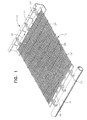
- the figure 1 is a perspective view of a use of the integrally formed polymeric grid as described in the present invention, illustrated as a seat bottom with the schematic frame of the seat partially shown.
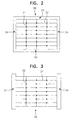
- the figure 2 is an embodiment where a built-in integral frame is required.
- the figure 3 is another embodiment with only two opposite sides integrally framed.
- the present invention relates to a grid which has been extruded in an integral configuration and then stretched in at least one or two directions made from an orientable thermoplastic elastomer.
- the orientable thermoplastic elastomer used in the grid structure of the present invention can be a copolyetherester elastomer, a polyesterurethane elastomer or a polyesteramide elastomer and is preferably a copolyetherester elastomer.
- Each of these classes of polymeric materials are made up of long chain molecules, with two distinct segments alternating along the length of the chain. When processed under the correct temperature and orientation conditions, the resulting material consists of hard crystalline segments that provide high strength and stiffness, and softer amorphous segments that provide elasticity. Thus, these classes of materials are preferred because they can provide the high tensile strength, high modulus of elasticity and high elastic limit required for the support of the described load support systems.
- copolyetheresters are either commercially available or can be prepared by processes which are well known in the art as described, for example, in U.S. Patents Nos. 3,651,014, 3,763,109, 3,766,146 and 5,114,998.
- Commercially available products include Hytrel® from Dupont and Riteflex® (e.g., Riteflex® T640, T655 or T677) from Hoechst Celanese.
- the copolyetherester elastomers which can be used in the present invention consist of a multiplicity of recurring long chain ester units and short chain ester units joined head to tail through ester linkages, said long chain units being represented by the formula and said short chain units being represented by the formula where G is a divalent radical remaining after the removal of the terminal hydroxyl groups from a poly(alkylene oxide)glycol, a long chain polymeric glycol having an average molecular weight in the range from about 600 to 6,000, R is a divalent hydrocarbon radical remaining after removal of the carboxyl groups from dicarboxylic acid having a molecular weight less than about 300, and D is a divalent radical remaining after removal of hydroxyl groups from low molecular weight diols having a molecular weight less than about 250.
- the short chain ester units in the copolyetherester provide about 25 to 95% of the weight of the copolyetherester.
- Thermoplastic polyesterurethane elastomers such as disclosed by Schollenberg in U.S. Patent No. 2,871,218 can be used in the present invention. They may be prepared by reacting a polyester with a diphenyl diisocyanate in the presence of a free glycol.
- the preferred polyester is an essentially linear hydroxyl terminated polyester having a molecular weight between 600 and 1200 and an acid number less than 10.
- the units formed by reaction of the free glycol with the diisocyanate will constitute the short-chain urethane units.
- the units formed by reaction of polyester with diisocyanate constitute the long-chain urethane units.
- Thermoplastic polyetherester amide elastomers such as disclosed by Foy (U.S. Patent No. 4,331,786) and Burtin (U.S. Patent No. 4,207,410), which can be used in the instant invention are represented by the following formula wherein A is a linear saturated aliphatic polyamide sequence, and B is a polyoxyalkylene sequence formed from linear or branched aliphatic polyoxyalkylene glycols.
- the polyamide sequence A consists of a plurality of short-chain amide units.
- the polyoxyalkylene sequence B represents a long-chain unit.
- the grid of the present invention is made from a sheet of polymeric material which is mechanically stretched in at least one direction after the extruded sheet material is transformed from a molten to a solid state.
- the polymeric material may be extruded in a substantially uniplanar sheet form, then punched, dimpled or embossed so as to create controlled yield points when mechanically stretched, and then so stretched to form a finished grid structure with the requisite properties.
- the polymeric material may also be extruded through a reciprocating die so as to create a substantially uniplanar sheet material which is perforated, dimpled or embossed so as to create controlled yield points as described above then stretched as described above.
- the extruded material may be a flat sheet or may be a cylindrical tube which when slit on its longitudinal axis may be opened to form a flat sheet or may be formed in any other manner which is capable of being transformed to a flat sheet prior to mechanical stretching. Further known treatment like thermal curing of the stretched product or other process steps may take place to improve the final properties of the product in use.
- thermoplastic elastomer can be formed into a uniplanar or substantially uniplanar grid configuration using a method as described in U.S. Patent No. 3,252,181 to Hureau whereby a grid is formed by extruding the elastomer through an extrusion die having a narrow extrusion outlet, a comb-like member having a plurality of spaced teeth and arranged to be displaceable in relation to the outlet of the die between a first position in which the teeth of the comb-like member interfere with the narrow elongated outlet of the die, thereby obstructing it at a plurality of areas spaced along the elongated outlet, and a second position in which the teeth of the comb-like member are outside or partially outside of the die outlet and the outlet is unobstructed or partially unobstructed, and intermittently displacing the comb-like member at successive predetermined times from its first position to its second position, and back to its first position.
- the tubular material so formed is then passed over a
- Machine direction orientation of the grid having a plurality of plastic strands formed in a pattern with openings there between is accomplished by reheating the grid to a temperature preferably of about 100 to 350°F and stretching the grid along its longitudinal axis by moving the grid over two or more rolls with high friction surfaces and with the downstream rolls turning at a rate faster than the upstream rolls.
- the degree of stretching imparted to the grid is determined by the relative speeds of the respective rolls.
- the grid is typically stretched from about 1.5 to 6 times its original length. If a grid with only machine direction orientation is desired, the grid is then cooled to room temperature. If transverse direction orientation is also desired, the grid can be cooled and reheated or maintained at a temperature preferably of 100 to 350°F and then stretched from about 1.5 to 6 times its original dimension in the transverse direction. The grid is then cooled to room temperature.
- heat setting is desired to obtain further required properties of the grid material, it can be further heated, prior to cooling and after the last stretching process, at a temperature exceeding by a range of 20 to 150°F the temperature at which the last stretch was made.
- the final product has a modulus at least equal to 20 MegaPascal, preferably 100 MegaPascal, as measured per ASTM D412.
- a minimum amount of material in the machine direction is required. From an economic standpoint, it is preferred to use as little material as possible.
- the preferred structure for providing the minimum amount of material is to use a relatively large number of strands with a relatively small cross-sectional area in the machine direction. This type of structure will retain a large portion of its strength, modulus and recovery properties if a strand is inadvertently damaged during use. If there are few strands of large cross-sectional area, a large portion of the properties are lost if a strand is damaged; on the other hand, if the strands are too small, they can be too easily damaged.
- machine direction strands/meter preferably about 150 to 250 machine direction strands/meter, each with a strand cross-section of about 0.01 to 2.0 mm 2 , preferably about 0.2 to 1.0 mm 2 .
- the main purpose of the transverse direction strands is to prevent the separation of the machine direction strands.
- the separation between transverse direction strands because these provide anchor points or junctions where they intersect with the machine direction strands.
- each section of a machine direction strand between transverse direction strands is isolated from adjacent sections of the same machine direction strands. Therefore, compared to a structure without uniplanar junctions, the transverse direction strands may be separated by a larger distance due to the higher strength and resistance which is shown by this type of junctions.
- transverse direction strands From an economic viewpoint in use as seat and furniture load support systems it is desirable to optimize the number of transverse direction strands, as well as to optimize their cross-sectional area, and it has been found desirable to have a structure containing about 5 to 50 transverse direction strands/meter, preferably about 7 to 20 transverse direction strands/meter.
- the cross-section of these transverse direction strands is desirably about 1 to 10 mm 2 , preferably about 2 to 4 mm 2 .
- a high elastic modulus is desired, so that when the structure is loaded, the transverse direction strands are capable of resisting deformation, and therefore prevent the machine direction strands from separating at the anchor points.
- a integral and uniplanar or substantially uniplanar grid structure include reduced friction in use as compared to a biplanar net structure.
- some type of material may cover the elastomeric support, or it may be used without a cover.
- the elastomeric material support will deflect, along with either the covering material adjacent to the elastomeric material, or the surface of the occupant. Since neither these materials in contact with the elastomeric support are connected and thus are able to slide past one another, friction is created between the two surfaces.
- a biplanar structure due to its inherent thickness variation along its length, is subject to higher frictional forces, and thus tends to be more susceptible to abrasion. This problem is eliminated in a uniplanar structure, resulting in reduced wear and greater durability of both the load support element and the covering material. This is particularly important when a larger number of junctions are included in the grid structure.
- the uniplanar grid structure allows for the repeated transfer of load between machine and cross machine direction strands in the most efficient way, reducing the probability of breakage at the junctions and therefore increasing the life of the product in use.
- breakage of the structure at the crossover points between machine direction and cross machine direction strands is avoided, where breakages are likely to happen especially in case of repeated loads with a very high number of cycles as is the case in use for instance in automotive seat applications.
- the grid structure of this invention allows for transfer of stress on the same plane between the machine direction and the cross machine direction strand, whereby no torsion is induced in the structure by shear or horizontal load applied to the cross machine direction strands as is described above for the biplanar structures.
- This property is advantageous in that use as load support subjects the grids to repeated loads or fatigue wherein increased life in use for the achievable by substantial reduction of stress offset at the junctions.
- the oriented thermoplastic elastomeric grid used in the present invention is useful in the manufacture of seat backs and bottoms intended for use in automobiles as well as conventional household and industrial furniture.
- These materials are also useful as straps or strips to reinforce partial or selected areas of seating and furniture, like for instance mattresses.
- an elastomeric grid 10 of the present invention is illustrated as a seat bottom of a seat 12 having opposed frames 14 and 16.
- the elastomeric grid 10 is attached to opposed elongated members 18 and 20 which are attached to the frames 14 and 16, respectively, by a plurality of hooks 22.
- the elastomeric grid 10 includes a plurality of machine direction strands 24 and a plurality of transverse direction strands 26 which intersect junctions 28.
- an elastomeric integral grid structure 30 of the present invention is illustrated, being formed by thinner strands 31 and 32 running in opposite directions, surrounded by heavier and larger strands 33 and 34, with which they integrally and uniplanarly merge.
- the strands 33 and 34 are advantageously made in the form of a surrounding integral frame which may advantageously be easily stapled, for instance, to furniture seating.
- FIG. 3 it is illustrated a different embodiment 40 where only two integral larger strands or bands 34 are formed in the structure on opposing sides.
- This structure is, for instance, advantageous where stapling or holding elements are required only on two opposing sides.
- the electomeric grid of this invention may, in any of its forms, be advantageously molded or stapled or clamped or otherwise incorporated into seats, bedding, furniture and the like in any known way without altering or limiting in any way the scope of this invention.
Landscapes
- Engineering & Computer Science (AREA)
- Mechanical Engineering (AREA)
- Compositions Of Macromolecular Compounds (AREA)
- Laminated Bodies (AREA)
- Polyurethanes Or Polyureas (AREA)
- Injection Moulding Of Plastics Or The Like (AREA)
Applications Claiming Priority (2)
| Application Number | Priority Date | Filing Date | Title |
|---|---|---|---|
| US124355 | 1998-07-29 | ||
| US09/124,355 US6060407A (en) | 1998-07-29 | 1998-07-29 | Advanced integrally formed load support systems |
Publications (3)
| Publication Number | Publication Date |
|---|---|
| EP0976531A2 true EP0976531A2 (fr) | 2000-02-02 |
| EP0976531A3 EP0976531A3 (fr) | 2001-09-19 |
| EP0976531B1 EP0976531B1 (fr) | 2006-01-04 |
Family
ID=22414380
Family Applications (1)
| Application Number | Title | Priority Date | Filing Date |
|---|---|---|---|
| EP19990305424 Expired - Lifetime EP0976531B1 (fr) | 1998-07-29 | 1999-07-08 | Systèmes avancés de support de charge formés intégralement |
Country Status (4)
| Country | Link |
|---|---|
| US (1) | US6060407A (fr) |
| EP (1) | EP0976531B1 (fr) |
| AT (1) | ATE314922T1 (fr) |
| DE (1) | DE69929283D1 (fr) |
Families Citing this family (2)
| Publication number | Priority date | Publication date | Assignee | Title |
|---|---|---|---|---|
| US20060022506A1 (en) * | 2004-08-02 | 2006-02-02 | Eric Chan | Pressure equalizing mesh |
| US8185985B2 (en) * | 2007-10-26 | 2012-05-29 | Illinois Tool Works Inc. | Load bearing surface |
Family Cites Families (25)
| Publication number | Priority date | Publication date | Assignee | Title |
|---|---|---|---|---|
| CA621569A (en) * | 1961-06-06 | B. Moody Frank | Process for treating shaped articles | |
| US2919467A (en) * | 1955-11-09 | 1960-01-05 | Plastic Textile Access Ltd | Production of net-like structures |
| US2871218A (en) * | 1955-12-01 | 1959-01-27 | Goodrich Co B F | Simulated vulcanizates of polyurethane elastomers |
| US3023192A (en) * | 1958-05-29 | 1962-02-27 | Du Pont | Segmented copolyetherester elastomers |
| FR1310478A (fr) * | 1960-12-28 | 1962-11-30 | Fabrication continue de feuilles et de tubes de structure lacunaire, et notamment réticulée | |
| US3651014A (en) * | 1969-07-18 | 1972-03-21 | Du Pont | Segmented thermoplastic copolyester elastomers |
| US3766146A (en) * | 1971-03-18 | 1973-10-16 | Du Pont | Segmented thermoplastic copolyester elastomers |
| US3763109A (en) * | 1971-08-19 | 1973-10-02 | Du Pont | Segmented thermoplastic copolyesters |
| JPS5830139B2 (ja) * | 1974-03-28 | 1983-06-27 | イ− アイ デユポン デ ニモアス アンド カンパニ− | 伝動ベルト |
| DE2712987C2 (de) * | 1977-03-24 | 1981-09-24 | Chemische Werke Hüls AG, 4370 Marl | Verfahren zur Herstellung von thermoplastischen Polyetheresteramiden mit statistisch in der Polymerkette verteilten Einheiten der Ausgangskomponenten |
| GB1603865A (en) * | 1977-07-08 | 1981-12-02 | Smith & Nephew Plastics | Production of net |
| US5156495B1 (en) * | 1978-10-16 | 1994-08-30 | Plg Res | Plastic material mesh structure |
| FR2466478B2 (fr) * | 1979-10-02 | 1986-03-14 | Ato Chimie | Procede de preparation de copolyetheresteramides aliphatiques elastomeres |
| US4456296A (en) * | 1981-06-11 | 1984-06-26 | Rowland David L | Stackable armchair |
| BR8304291A (pt) * | 1982-08-12 | 1984-03-20 | Du Pont | Material de suporte para mobilario estofado, assento de banco, encosto de banco e sistema de suporte para camas |
| US4469738A (en) * | 1983-01-21 | 1984-09-04 | E. I. Du Pont De Nemours And Company | Oriented net furniture support material |
| US4469739A (en) * | 1983-01-21 | 1984-09-04 | E. I. Du Pont De Nemours And Company | Oriented woven furniture support material |
| DE3316266A1 (de) * | 1983-05-04 | 1984-11-08 | Bayer Ag, 5090 Leverkusen | Elastisches flachgewebe und seine herstellung |
| US4749306A (en) * | 1986-09-05 | 1988-06-07 | Leucadia, Inc. | Formed corrugated plastic net for drainage applications |
| US4869554A (en) * | 1988-05-17 | 1989-09-26 | General Motors Corporation | Elastomeric woven mat seat suspension |
| US5269631A (en) * | 1989-09-14 | 1993-12-14 | Netlon Limited | Plastics material mesh structures |
| US5114998A (en) * | 1990-12-06 | 1992-05-19 | Hoechst Celanese Corp. | Stabilized talc-filled polyester compositions |
| DE4206893A1 (de) * | 1992-03-05 | 1993-09-09 | Norddeutsche Seekabelwerke Ag | Netz, insbesondere abstandshalternetz, oberflaechenschutznetz oder dergleichen |
| JPH0825241B2 (ja) * | 1993-12-01 | 1996-03-13 | 明和樹脂工業株式会社 | ネット吊込部材及びネット吊込部材の製造方法 |
| US5885686A (en) * | 1994-08-26 | 1999-03-23 | Leucadia, Inc. | Bicomponent elastomeric netting |
-
1998
- 1998-07-29 US US09/124,355 patent/US6060407A/en not_active Expired - Fee Related
-
1999
- 1999-07-08 DE DE69929283T patent/DE69929283D1/de not_active Expired - Lifetime
- 1999-07-08 AT AT99305424T patent/ATE314922T1/de not_active IP Right Cessation
- 1999-07-08 EP EP19990305424 patent/EP0976531B1/fr not_active Expired - Lifetime
Also Published As
| Publication number | Publication date |
|---|---|
| ATE314922T1 (de) | 2006-02-15 |
| DE69929283D1 (de) | 2006-03-30 |
| EP0976531A3 (fr) | 2001-09-19 |
| EP0976531B1 (fr) | 2006-01-04 |
| US6060407A (en) | 2000-05-09 |
Similar Documents
| Publication | Publication Date | Title |
|---|---|---|
| EP1082480B1 (fr) | Procede et dispositif de fabrication d`un element de coussin; | |
| DE60030012T2 (de) | Leichterer Notlaufring für Luftreifen | |
| DE4406660B4 (de) | Polster-Netzstruktur, Verfahren zu ihrer Herstellung und Verwendung | |
| US8029067B2 (en) | Cushion body, seat, and method of manufacturing the same | |
| EP3889332B1 (fr) | Corps de structure en forme de filet | |
| KR101556073B1 (ko) | 스트레치 직물 | |
| EP1034211B1 (fr) | Structures rigides a reseau fibreux ayant des proprietes ameliorees de recuperation dimensionnelle apres deformation par pression, leurs procedes de production et articles les utilisant | |
| US20160214310A1 (en) | Load bearing surface | |
| WO2007108862A1 (fr) | Ensemble portant a bord elastomere | |
| WO2025057619A1 (fr) | Structure de type filet tridimensionnel et son procédé de fabrication | |
| EP0976531B1 (fr) | Systèmes avancés de support de charge formés intégralement | |
| JP5966471B2 (ja) | 静粛性と硬さに優れた弾性網状構造体 | |
| JP3344512B2 (ja) | 異繊度網状構造体及びその製法 | |
| US11260781B2 (en) | Suspension arrangement for a seat and method of producing an elongate suspension member for a suspension arrangement for a seat | |
| JP2004244740A (ja) | 敷マット | |
| US6403196B1 (en) | Rigid fiber network structures having improved post-yield dimensional recovery, method of making same, and articles incorporating same | |
| JP3314837B2 (ja) | 異密度網状構造体及びその製造方法 | |
| JP3344511B2 (ja) | 網状構造体及びその製造法 | |
| JP3430443B2 (ja) | クッション用網状構造体、その製法およびクッション製品 | |
| JP3430442B2 (ja) | 網状構造体及びその製法 | |
| JP2013082303A (ja) | 車両用シート | |
| JP2002000408A (ja) | 乗物用座席 | |
| JPH07197366A (ja) | 熱接着性網状構造体及びその製法 | |
| JPH05156561A (ja) | クッション構造体およびその製造方法 | |
| JP2001061605A (ja) | 車両用座席 |
Legal Events
| Date | Code | Title | Description |
|---|---|---|---|
| PUAI | Public reference made under article 153(3) epc to a published international application that has entered the european phase |
Free format text: ORIGINAL CODE: 0009012 |
|
| AK | Designated contracting states |
Kind code of ref document: A2 Designated state(s): AT BE CH CY DE DK ES FI FR GB GR IE IT LI LU MC NL PT SE |
|
| AX | Request for extension of the european patent |
Free format text: AL;LT;LV;MK;RO;SI |
|
| PUAL | Search report despatched |
Free format text: ORIGINAL CODE: 0009013 |
|
| AK | Designated contracting states |
Kind code of ref document: A3 Designated state(s): AT BE CH CY DE DK ES FI FR GB GR IE IT LI LU MC NL PT SE |
|
| AX | Request for extension of the european patent |
Free format text: AL;LT;LV;MK;RO;SI |
|
| 17P | Request for examination filed |
Effective date: 20020211 |
|
| AKX | Designation fees paid |
Free format text: AT BE CH CY DE DK ES FI FR GB GR IE IT LI LU MC NL PT SE |
|
| 17Q | First examination report despatched |
Effective date: 20030122 |
|
| GRAP | Despatch of communication of intention to grant a patent |
Free format text: ORIGINAL CODE: EPIDOSNIGR1 |
|
| GRAS | Grant fee paid |
Free format text: ORIGINAL CODE: EPIDOSNIGR3 |
|
| GRAA | (expected) grant |
Free format text: ORIGINAL CODE: 0009210 |
|
| AK | Designated contracting states |
Kind code of ref document: B1 Designated state(s): AT BE CH CY DE DK ES FI FR GB GR IE IT LI LU MC NL PT SE |
|
| PG25 | Lapsed in a contracting state [announced via postgrant information from national office to epo] |
Ref country code: NL Free format text: LAPSE BECAUSE OF FAILURE TO SUBMIT A TRANSLATION OF THE DESCRIPTION OR TO PAY THE FEE WITHIN THE PRESCRIBED TIME-LIMIT Effective date: 20060104 Ref country code: LI Free format text: LAPSE BECAUSE OF FAILURE TO SUBMIT A TRANSLATION OF THE DESCRIPTION OR TO PAY THE FEE WITHIN THE PRESCRIBED TIME-LIMIT Effective date: 20060104 Ref country code: IT Free format text: LAPSE BECAUSE OF FAILURE TO SUBMIT A TRANSLATION OF THE DESCRIPTION OR TO PAY THE FEE WITHIN THE PRESCRIBED TIME-LIMIT;WARNING: LAPSES OF ITALIAN PATENTS WITH EFFECTIVE DATE BEFORE 2007 MAY HAVE OCCURRED AT ANY TIME BEFORE 2007. THE CORRECT EFFECTIVE DATE MAY BE DIFFERENT FROM THE ONE RECORDED. Effective date: 20060104 Ref country code: FI Free format text: LAPSE BECAUSE OF FAILURE TO SUBMIT A TRANSLATION OF THE DESCRIPTION OR TO PAY THE FEE WITHIN THE PRESCRIBED TIME-LIMIT Effective date: 20060104 Ref country code: CH Free format text: LAPSE BECAUSE OF FAILURE TO SUBMIT A TRANSLATION OF THE DESCRIPTION OR TO PAY THE FEE WITHIN THE PRESCRIBED TIME-LIMIT Effective date: 20060104 Ref country code: BE Free format text: LAPSE BECAUSE OF FAILURE TO SUBMIT A TRANSLATION OF THE DESCRIPTION OR TO PAY THE FEE WITHIN THE PRESCRIBED TIME-LIMIT Effective date: 20060104 Ref country code: AT Free format text: LAPSE BECAUSE OF FAILURE TO SUBMIT A TRANSLATION OF THE DESCRIPTION OR TO PAY THE FEE WITHIN THE PRESCRIBED TIME-LIMIT Effective date: 20060104 |
|
| RBV | Designated contracting states (corrected) |
Designated state(s): AT BE CH CY DE DK ES FI FR GB GR IE IT LI LU MC NL PT SE |
|
| REG | Reference to a national code |
Ref country code: GB Ref legal event code: FG4D |
|
| REG | Reference to a national code |
Ref country code: CH Ref legal event code: EP |
|
| REG | Reference to a national code |
Ref country code: IE Ref legal event code: FG4D |
|
| REF | Corresponds to: |
Ref document number: 69929283 Country of ref document: DE Date of ref document: 20060330 Kind code of ref document: P |
|
| PG25 | Lapsed in a contracting state [announced via postgrant information from national office to epo] |
Ref country code: SE Free format text: LAPSE BECAUSE OF FAILURE TO SUBMIT A TRANSLATION OF THE DESCRIPTION OR TO PAY THE FEE WITHIN THE PRESCRIBED TIME-LIMIT Effective date: 20060404 Ref country code: DK Free format text: LAPSE BECAUSE OF FAILURE TO SUBMIT A TRANSLATION OF THE DESCRIPTION OR TO PAY THE FEE WITHIN THE PRESCRIBED TIME-LIMIT Effective date: 20060404 |
|
| PG25 | Lapsed in a contracting state [announced via postgrant information from national office to epo] |
Ref country code: DE Free format text: LAPSE BECAUSE OF FAILURE TO SUBMIT A TRANSLATION OF THE DESCRIPTION OR TO PAY THE FEE WITHIN THE PRESCRIBED TIME-LIMIT Effective date: 20060405 |
|
| PG25 | Lapsed in a contracting state [announced via postgrant information from national office to epo] |
Ref country code: ES Free format text: LAPSE BECAUSE OF FAILURE TO SUBMIT A TRANSLATION OF THE DESCRIPTION OR TO PAY THE FEE WITHIN THE PRESCRIBED TIME-LIMIT Effective date: 20060415 |
|
| PG25 | Lapsed in a contracting state [announced via postgrant information from national office to epo] |
Ref country code: PT Free format text: LAPSE BECAUSE OF FAILURE TO SUBMIT A TRANSLATION OF THE DESCRIPTION OR TO PAY THE FEE WITHIN THE PRESCRIBED TIME-LIMIT Effective date: 20060605 |
|
| NLV1 | Nl: lapsed or annulled due to failure to fulfill the requirements of art. 29p and 29m of the patents act | ||
| PG25 | Lapsed in a contracting state [announced via postgrant information from national office to epo] |
Ref country code: GB Free format text: LAPSE BECAUSE OF NON-PAYMENT OF DUE FEES Effective date: 20060708 |
|
| PG25 | Lapsed in a contracting state [announced via postgrant information from national office to epo] |
Ref country code: IE Free format text: LAPSE BECAUSE OF NON-PAYMENT OF DUE FEES Effective date: 20060710 |
|
| REG | Reference to a national code |
Ref country code: CH Ref legal event code: PL |
|
| PG25 | Lapsed in a contracting state [announced via postgrant information from national office to epo] |
Ref country code: MC Free format text: LAPSE BECAUSE OF NON-PAYMENT OF DUE FEES Effective date: 20060731 |
|
| PLBE | No opposition filed within time limit |
Free format text: ORIGINAL CODE: 0009261 |
|
| STAA | Information on the status of an ep patent application or granted ep patent |
Free format text: STATUS: NO OPPOSITION FILED WITHIN TIME LIMIT |
|
| 26N | No opposition filed |
Effective date: 20061005 |
|
| EN | Fr: translation not filed | ||
| GBPC | Gb: european patent ceased through non-payment of renewal fee |
Effective date: 20060708 |
|
| PG25 | Lapsed in a contracting state [announced via postgrant information from national office to epo] |
Ref country code: GR Free format text: LAPSE BECAUSE OF FAILURE TO SUBMIT A TRANSLATION OF THE DESCRIPTION OR TO PAY THE FEE WITHIN THE PRESCRIBED TIME-LIMIT Effective date: 20060405 Ref country code: FR Free format text: LAPSE BECAUSE OF FAILURE TO SUBMIT A TRANSLATION OF THE DESCRIPTION OR TO PAY THE FEE WITHIN THE PRESCRIBED TIME-LIMIT Effective date: 20070223 |
|
| PG25 | Lapsed in a contracting state [announced via postgrant information from national office to epo] |
Ref country code: LU Free format text: LAPSE BECAUSE OF NON-PAYMENT OF DUE FEES Effective date: 20060708 |
|
| PG25 | Lapsed in a contracting state [announced via postgrant information from national office to epo] |
Ref country code: FR Free format text: LAPSE BECAUSE OF FAILURE TO SUBMIT A TRANSLATION OF THE DESCRIPTION OR TO PAY THE FEE WITHIN THE PRESCRIBED TIME-LIMIT Effective date: 20060104 Ref country code: CY Free format text: LAPSE BECAUSE OF FAILURE TO SUBMIT A TRANSLATION OF THE DESCRIPTION OR TO PAY THE FEE WITHIN THE PRESCRIBED TIME-LIMIT Effective date: 20060104 |