EP0980193A1 - Beheizbares Flächenelement - Google Patents
Beheizbares Flächenelement Download PDFInfo
- Publication number
- EP0980193A1 EP0980193A1 EP99115384A EP99115384A EP0980193A1 EP 0980193 A1 EP0980193 A1 EP 0980193A1 EP 99115384 A EP99115384 A EP 99115384A EP 99115384 A EP99115384 A EP 99115384A EP 0980193 A1 EP0980193 A1 EP 0980193A1
- Authority
- EP
- European Patent Office
- Prior art keywords
- surface element
- element according
- silicon carbide
- heating conductor
- fiber
- Prior art date
- Legal status (The legal status is an assumption and is not a legal conclusion. Google has not performed a legal analysis and makes no representation as to the accuracy of the status listed.)
- Withdrawn
Links
- 238000010438 heat treatment Methods 0.000 title claims abstract description 25
- HBMJWWWQQXIZIP-UHFFFAOYSA-N silicon carbide Chemical compound [Si+]#[C-] HBMJWWWQQXIZIP-UHFFFAOYSA-N 0.000 claims abstract description 20
- 229910010271 silicon carbide Inorganic materials 0.000 claims abstract description 18
- 239000004020 conductor Substances 0.000 claims abstract description 17
- 238000010411 cooking Methods 0.000 claims abstract description 17
- 239000004917 carbon fiber Substances 0.000 claims abstract description 6
- 239000000919 ceramic Substances 0.000 claims abstract description 6
- 239000003365 glass fiber Substances 0.000 claims abstract description 4
- 229910052582 BN Inorganic materials 0.000 claims abstract description 3
- PZNSFCLAULLKQX-UHFFFAOYSA-N Boron nitride Chemical compound N#B PZNSFCLAULLKQX-UHFFFAOYSA-N 0.000 claims abstract description 3
- 239000000853 adhesive Substances 0.000 claims abstract description 3
- 230000001070 adhesive effect Effects 0.000 claims abstract description 3
- 229920000049 Carbon (fiber) Polymers 0.000 claims description 5
- 239000000835 fiber Substances 0.000 claims description 4
- 230000015572 biosynthetic process Effects 0.000 claims description 3
- 238000005755 formation reaction Methods 0.000 claims description 3
- 230000002787 reinforcement Effects 0.000 claims description 2
- OKTJSMMVPCPJKN-UHFFFAOYSA-N Carbon Chemical compound [C] OKTJSMMVPCPJKN-UHFFFAOYSA-N 0.000 abstract description 8
- 229910052799 carbon Inorganic materials 0.000 abstract description 7
- 239000012783 reinforcing fiber Substances 0.000 abstract 1
- 239000002241 glass-ceramic Substances 0.000 description 10
- XEEYBQQBJWHFJM-UHFFFAOYSA-N Iron Chemical compound [Fe] XEEYBQQBJWHFJM-UHFFFAOYSA-N 0.000 description 8
- 229910052742 iron Inorganic materials 0.000 description 4
- XUIMIQQOPSSXEZ-UHFFFAOYSA-N Silicon Chemical compound [Si] XUIMIQQOPSSXEZ-UHFFFAOYSA-N 0.000 description 3
- 229910052710 silicon Inorganic materials 0.000 description 3
- 239000010703 silicon Substances 0.000 description 3
- 239000000463 material Substances 0.000 description 2
- 239000011159 matrix material Substances 0.000 description 2
- 238000003801 milling Methods 0.000 description 2
- 235000013550 pizza Nutrition 0.000 description 2
- 230000035939 shock Effects 0.000 description 2
- 239000004575 stone Substances 0.000 description 2
- 235000012773 waffles Nutrition 0.000 description 2
- 229910018072 Al 2 O 3 Inorganic materials 0.000 description 1
- 229910052581 Si3N4 Inorganic materials 0.000 description 1
- 229910004298 SiO 2 Inorganic materials 0.000 description 1
- VYPSYNLAJGMNEJ-UHFFFAOYSA-N Silicium dioxide Chemical compound O=[Si]=O VYPSYNLAJGMNEJ-UHFFFAOYSA-N 0.000 description 1
- 235000015173 baked goods and baking mixes Nutrition 0.000 description 1
- 239000011230 binding agent Substances 0.000 description 1
- 238000003763 carbonization Methods 0.000 description 1
- 238000006243 chemical reaction Methods 0.000 description 1
- 230000000694 effects Effects 0.000 description 1
- 238000005516 engineering process Methods 0.000 description 1
- 230000002349 favourable effect Effects 0.000 description 1
- 239000011888 foil Substances 0.000 description 1
- 239000003292 glue Substances 0.000 description 1
- 229910002804 graphite Inorganic materials 0.000 description 1
- 239000010439 graphite Substances 0.000 description 1
- 238000005087 graphitization Methods 0.000 description 1
- 238000009413 insulation Methods 0.000 description 1
- 229910052751 metal Inorganic materials 0.000 description 1
- 239000002184 metal Substances 0.000 description 1
- 238000000034 method Methods 0.000 description 1
- TWNQGVIAIRXVLR-UHFFFAOYSA-N oxo(oxoalumanyloxy)alumane Chemical compound O=[Al]O[Al]=O TWNQGVIAIRXVLR-UHFFFAOYSA-N 0.000 description 1
- 239000005011 phenolic resin Substances 0.000 description 1
- 229920001568 phenolic resin Polymers 0.000 description 1
- 230000000704 physical effect Effects 0.000 description 1
- 239000011148 porous material Substances 0.000 description 1
- 230000001681 protective effect Effects 0.000 description 1
- 230000009257 reactivity Effects 0.000 description 1
- 229920005989 resin Polymers 0.000 description 1
- 239000011347 resin Substances 0.000 description 1
- HQVNEWCFYHHQES-UHFFFAOYSA-N silicon nitride Chemical compound N12[Si]34N5[Si]62N3[Si]51N64 HQVNEWCFYHHQES-UHFFFAOYSA-N 0.000 description 1
- 229910052814 silicon oxide Inorganic materials 0.000 description 1
- 229920001187 thermosetting polymer Polymers 0.000 description 1
- 238000004804 winding Methods 0.000 description 1
Images

Classifications
-
- H—ELECTRICITY
- H05—ELECTRIC TECHNIQUES NOT OTHERWISE PROVIDED FOR
- H05B—ELECTRIC HEATING; ELECTRIC LIGHT SOURCES NOT OTHERWISE PROVIDED FOR; CIRCUIT ARRANGEMENTS FOR ELECTRIC LIGHT SOURCES, IN GENERAL
- H05B3/00—Ohmic-resistance heating
- H05B3/10—Heating elements characterised by the composition or nature of the materials or by the arrangement of the conductor
- H05B3/12—Heating elements characterised by the composition or nature of the materials or by the arrangement of the conductor characterised by the composition or nature of the conductive material
- H05B3/14—Heating elements characterised by the composition or nature of the materials or by the arrangement of the conductor characterised by the composition or nature of the conductive material the material being non-metallic
- H05B3/148—Silicon, e.g. silicon carbide, magnesium silicide, heating transistors or diodes
-
- H—ELECTRICITY
- H05—ELECTRIC TECHNIQUES NOT OTHERWISE PROVIDED FOR
- H05B—ELECTRIC HEATING; ELECTRIC LIGHT SOURCES NOT OTHERWISE PROVIDED FOR; CIRCUIT ARRANGEMENTS FOR ELECTRIC LIGHT SOURCES, IN GENERAL
- H05B3/00—Ohmic-resistance heating
- H05B3/10—Heating elements characterised by the composition or nature of the materials or by the arrangement of the conductor
- H05B3/12—Heating elements characterised by the composition or nature of the materials or by the arrangement of the conductor characterised by the composition or nature of the conductive material
- H05B3/14—Heating elements characterised by the composition or nature of the materials or by the arrangement of the conductor characterised by the composition or nature of the conductive material the material being non-metallic
- H05B3/145—Carbon only, e.g. carbon black, graphite
-
- H—ELECTRICITY
- H05—ELECTRIC TECHNIQUES NOT OTHERWISE PROVIDED FOR
- H05B—ELECTRIC HEATING; ELECTRIC LIGHT SOURCES NOT OTHERWISE PROVIDED FOR; CIRCUIT ARRANGEMENTS FOR ELECTRIC LIGHT SOURCES, IN GENERAL
- H05B3/00—Ohmic-resistance heating
- H05B3/68—Heating arrangements specially adapted for cooking plates or analogous hot-plates
- H05B3/74—Non-metallic plates, e.g. vitroceramic, ceramic or glassceramic hobs, also including power or control circuits
Definitions
- the invention relates to a heatable surface element, especially as a cooking, roasting or baking surface.
- hotplates have a glass ceramic plate as a base for cookware.
- the glass ceramic plate consists of approximately 60% to 70% silicon oxide (SiO 2 ) and approximately 20% aluminum oxide (Al 2 O 3 ).
- This glass ceramic has a high resistance to temperature changes (over 600 K), which allows a cooking zone temperature of around 600 ° C.
- the thermal conductivity of the glass ceramic is poor (2 Wm -1 K). A high thermal conductivity is desirable for cooking zones.
- the object of the invention is a heatable Propose surface element of the type mentioned at the outset, a high one with good thermal conductivity Has resistance to temperature changes.
- the above object is achieved in that the surface element consists predominantly of fiber-reinforced silicon carbide (SiC). It has been shown that fiber-reinforced silicon carbide has a high thermal conductivity of over 100 Wm -1 K and a high thermal shock resistance ( ⁇ 2000 K). In any case, the thermal shock resistance of fiber-reinforced silicon carbide is significantly higher than that of non-fiber-reinforced silicon carbide. Fiber-reinforced silicon carbide can therefore be used instead of glass ceramics for hotplates, whereby it has a significantly higher thermal conductivity than glass ceramics.
- SiC fiber-reinforced silicon carbide
- the high thermal conductivity results in a high one Efficiency.
- Fiber reinforced Silicon carbide Another major advantage of fiber reinforced Silicon carbide is that it comes in shapes let it shape easily and work well in the "green state" leaves. Neither is the case with glass ceramics. By results in the use of fiber-reinforced silicon carbide a high degree of design freedom for the shape of the Surface element.
- the fiber reinforcement preferably consists of Carbon fibers or glass fibers.
- the surface element can be used for cooking, roasting or Baking plates or zones and for cookware and for example for contact grill, waffle iron, "hotter Stone ", pizza heater, kettle or iron use.
- a surface element 1 made of fiber-reinforced silicon carbide is produced approximately as follows:
- Carbon-containing fibers or glass fibers, in fleece or felt form, are impregnated with a thermosetting resin binder, for example phenolic resins, and then pressed into a mold at about 180 ° C.
- the molded body is pressed in its desired shape in a vacuum or under a protective gas at a temperature of about 1000.degree.
- the matrix carbon is partially converted into graphite, which means that the reactivity of the carbon can be minimized.
- the density of the surface element can be increased by repeated carbonization steps. It is typically 0.2 g / cm 3 to 0.8 g / cm 3 .
- the resulting "green body” is easy to machine editable, for example by turning or milling.
- the "green body” is in a high temperature vacuum process with metallic Silicon infiltrates at temperatures of around 1400 ° C.
- the surface element produced in this way consists of a structure of carbon, carbon converted to silicon carbide and pure silicon in the pores of the silicon carbide.
- the thermal conductivity is around 135 Wm -1 K and thus significantly higher than that of pure silicon carbide (75 Wm -1 K).
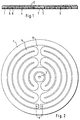
- the surface element 1 has a flat top 2 as Stand for cookware. At the bottom 3 are Wells 4 or grooves provided in the one Heating conductor 5 is embedded. This runs in one multiple winding shape (see Fig. 2).
- the heating conductor 5 has a direct thermal contact with the Surface element 1, which shows the heat flow from the heating conductor 5 the cookware improved.
- the depressions 4 or grooves can be in the "green” state created in the surface element 1 in a milling process become. However, they can also be the shape of the mold, in which the binder-impregnated carbon fibers are pressed become.
- An electrically insulating layer 6 insulates the Heating conductor 5 electrically opposite the surface element 1 and its turns against each other.
- the electric Insulating layer 6 consists, for example, of a Material based on or from a boron nitride ceramic glue.
- the heating conductor 5 can be made of a metal foil or a other heating conductors. in the Embodiment is the heating conductor 5, like that Surface element 1, reinforced with carbon fibers Silicon carbide formed. This has a higher one resistivity than usual resistance wire; nevertheless, the heating conductor 5 can be adjusted accordingly Cross-sectional and longitudinal dimensioning with one for the Hotplate desired resistance, for example 25.2 Ohm for a heating power of about 2.1 kW at the Establish mains voltage of 230 V.
- the surface element 1 and the heating conductor 5 from the im are made of essentially the same material same physical properties, such as same thermal expansion.
- a bottom 3 Recess 7 provided on the surface element 1 . This serves to accommodate one Temperature sensor, which is in the recess 7 by means of a ceramic adhesive can be embedded. At this The arrangement detects the temperature sensor in the Inside of the surface elements 1, which is much better Cookware temperature corresponds to that according to the state of the Technology measured surface temperature on the bottom the cooking zone.
- the surface element 1 is a conventional one Glass ceramic plate corresponding cooking zone cover, under the well-known radiant heater with insulation distance are to be arranged.
- the surface element 1 has the or the underside 3 facing the radiant heater Formations 9 on the surface of the bottom 3 enlarge compared to a flat surface. Thereby is achieved that the proportion of the area element 1 absorbed portion of the radiant heat is increased. This is due to the high thermal conductivity of the Surface element 1 placed on top 2 Cookware passed on.
- the surface element 1 Since the surface element 1 is high on the one hand Resistance to temperature changes and on the other hand high Has thermal conductivity, it is possible to use either conventional cookware to work, the one comparatively high cooking zone surface temperature of about 600 ° C is required for satisfactory cooking results, or to work with cookware, where due to a extremely flat pot bottom a lower temperature of about 250 ° C for a satisfactory cooking result is sufficient.
- the surface element made of fiber-reinforced silicon carbide can also be used as a base for cookware.
- the advantages of high thermal conductivity, high Resistance to temperature changes and light Formability also have an effect here.
- the Surface element can be used as a disc as a pot bottom insert serve. It can also be due to its easy malleability during pressing and because of the light Machinability with a green border and form a frying pan or pot. It is also favorable that such cookware are mechanically and thermally very stable.
- the surface element can also form a baking sheet at the same time the baked goods support and the radiator. Silicon carbide reinforced with carbon fibers used as a resistance heating element.
- the electrical Energy is supplied to the baking sheet via two electrical contacts supplied in the baking tray guide rails of the Oven are designed. For security reasons electrical contacts after closing the oven door released and then the surface element by heated up its own electrical resistance. It there is no need to heat up the oven.
- the surface element can also be heating surfaces for others Form heaters. Such are, for example Kettle, contact grill, waffle iron, "hot stone”, Pizza heating, iron.
Landscapes
- Chemical & Material Sciences (AREA)
- Engineering & Computer Science (AREA)
- Ceramic Engineering (AREA)
- Baking, Grill, Roasting (AREA)
- Resistance Heating (AREA)
- Cookers (AREA)
Abstract
Description
Claims (13)
- Beheizbares Flächenelement, insbesondere als Koch-, Brat- oder Backfläche,
dadurch gekennzeichnet,
daß es überwiegend aus faserverstärktem Siliziumkarbid (SiC) besteht. - Flächenelement nach Anspruch 1,
dadurch gekennzeichnet,
daß die Faserverstärkung von Kohlenstoffasern oder Glasfasern gebildet ist. - Flächenelement nach Anspruch 1 oder 2, das eine Standfläche für Koch- oder Bratgeschirr bildet, unter der ein Heizkörper, insbesondere Strahlungsheizkörper, angeordnet ist,
dadurch gekennzeichnet,
daß die dem Strahlungsheizkörper zugewandte Unterseite(3) des Flächenelements(1) durch Ausformungen(9,10,11) gegenüber einer ebenen Fläche vergrößert ist. - Flächenelement nach Anspruch 3,
dadurch gekennzeichnet,
daß die Unterseite(3) durch pyramidenförmige Formen(10) vergrößert ist. - Flächenelement nach Anspruch 3 oder 4,
dadurch gekennzeichnet,
daß die Unterseite(3) durch Stege(11) vergrößert ist. - Flächenelement nach einem der vorhergehenden Ansprüche,
dadurch gekennzeichnet,
daß ein Heizleiter(5) mit der Unterseite(3) des Flächenelements(1) in wärmeleitender Verbindung steht. - Flächenelement nach Anspruch 6,
dadurch gekennzeichnet,
daß der Heizleiter(5) überwiegend aus faserverstärktem Siliziumkarbid besteht. - Flächenelement nach Anspruch 6 oder 7,
dadurch gekennzeichnet,
daß zwischen den Heizleiter(5) und dem Flächenelement(1) eine elektrisch isolierende Schicht(6) vorgesehen ist. - Flächenelement nach Anspruch 8,
dadurch gekennzeichnet,
daß die Schicht(6) Bornitrid oder ein keramischer Kleber ist. - Flächenelement nach einem der vorhergehenden Ansprüche 6 bis 9,
dadurch gekennzeichnet,
daß das Flächenelement(1) Vertiefungen(4) oder Nuten aufweist, in denen der Heizleiter(5) angeordnet ist. - Flächenelement nach einem der vorhergehenden Ansprüche,
dadurch gekennzeichnet,
daß das Flächenelement(1) eine Ausnehmung(7) für einen Temperatursensor aufweist. - Flächenelement nach einem der vorhergehenden Ansprüche,
dadurch gekennzeichnet,
daß das Flächenelement(1) aufgrund seiner elektrischen Leitfähigkeit selbst einen elektrischen Heizkörper bildet. - Flächenelement nach einem der vorhergehenden Ansprüche,
dadurch gekennzeichnet,
daß das Flächenelement(1) ein Kochgeschirr oder wenigstens den Boden eines Kochgeschirrs bildet.
Applications Claiming Priority (2)
| Application Number | Priority Date | Filing Date | Title |
|---|---|---|---|
| DE19835378 | 1998-08-05 | ||
| DE1998135378 DE19835378A1 (de) | 1998-08-05 | 1998-08-05 | Beheizbares Flächenelement |
Publications (1)
| Publication Number | Publication Date |
|---|---|
| EP0980193A1 true EP0980193A1 (de) | 2000-02-16 |
Family
ID=7876555
Family Applications (1)
| Application Number | Title | Priority Date | Filing Date |
|---|---|---|---|
| EP99115384A Withdrawn EP0980193A1 (de) | 1998-08-05 | 1999-08-04 | Beheizbares Flächenelement |
Country Status (2)
| Country | Link |
|---|---|
| EP (1) | EP0980193A1 (de) |
| DE (1) | DE19835378A1 (de) |
Cited By (5)
| Publication number | Priority date | Publication date | Assignee | Title |
|---|---|---|---|---|
| US7057139B2 (en) | 2003-05-03 | 2006-06-06 | Ceramaspeed Limited | Electric heating assembly |
| CN100434807C (zh) * | 2006-08-01 | 2008-11-19 | 何拱标 | 防水电炉 |
| CN101380202B (zh) * | 2007-09-03 | 2010-06-02 | 张景宏 | 恒温烤盘及具恒温烤盘的锅具 |
| US11397007B2 (en) | 2018-08-21 | 2022-07-26 | Lg Electronics Inc. | Electric heater |
| IT202300015684A1 (it) * | 2023-07-26 | 2025-01-26 | Pasini Tecnologie S R L | Pannello radiante e procedimento per la sua produzione |
Families Citing this family (11)
| Publication number | Priority date | Publication date | Assignee | Title |
|---|---|---|---|---|
| DE10103621C2 (de) * | 2001-01-27 | 2003-01-16 | Ego Elektro Geraetebau Gmbh | Passivierungspaste, Beschichtungsverfahren und Heizelement |
| DE10110789C1 (de) * | 2001-03-06 | 2002-07-04 | Schott Glas | Kochgerät mit einer nicht planaren, mehrdimensional geformten Kochfläche aus Glas- oder Glaskeramik |
| DE10207515B4 (de) * | 2002-02-22 | 2004-12-02 | Schott Ag | Kochsystem mit einer Kochfläche und einer Halterung |
| DE10234432B4 (de) * | 2002-06-27 | 2005-04-21 | Gc-Heat Gebhard & Castiglia Gmbh & Co. Kg | Flexibler elektrischer Heizkörper für Werkzeuge |
| DE10242481C1 (de) * | 2002-09-13 | 2003-12-04 | Schott Glas | Keramisches Kochsystem und Verfahren zur Herstellung derselben |
| DE102009000651A1 (de) * | 2008-10-16 | 2010-05-27 | BSH Bosch und Siemens Hausgeräte GmbH | Hausgerät zur Zubereitung von Lebensmitteln mit einer Heizeinrichtung |
| DE102010036993B3 (de) * | 2010-08-13 | 2012-02-02 | Eisfink Max Maier Gmbh & Co. Kg | Koch- oder Grillplatte |
| DE102011006850A1 (de) * | 2011-04-06 | 2012-10-11 | Schunk Kohlenstofftechnik Gmbh | Verfahren zur Herstellung eines Widerstandsheizelements sowie Widerstandsheizelement |
| KR102159802B1 (ko) | 2018-08-21 | 2020-09-25 | 엘지전자 주식회사 | 전기 히터 |
| DE102019202602A1 (de) * | 2019-02-26 | 2020-08-27 | E.G.O. Elektro-Gerätebau GmbH | Elektrische Heizeinrichtung für ein Kochfeld und Kochfeld |
| WO2026159462A1 (en) * | 2025-01-22 | 2026-07-30 | Pasini Tecnologie S.R.L. | Radiant panel and process for its production |
Citations (3)
| Publication number | Priority date | Publication date | Assignee | Title |
|---|---|---|---|---|
| JPH0195227A (ja) * | 1987-10-02 | 1989-04-13 | Sharp Corp | 電子レンジ用発熱体 |
| JPH02267167A (ja) * | 1989-04-10 | 1990-10-31 | Teijin Ltd | 複合セラミックスシート状成形物及びその製造方法 |
| JPH03101087A (ja) * | 1989-09-13 | 1991-04-25 | Teijin Ltd | セラミックス発熱体 |
-
1998
- 1998-08-05 DE DE1998135378 patent/DE19835378A1/de not_active Withdrawn
-
1999
- 1999-08-04 EP EP99115384A patent/EP0980193A1/de not_active Withdrawn
Patent Citations (3)
| Publication number | Priority date | Publication date | Assignee | Title |
|---|---|---|---|---|
| JPH0195227A (ja) * | 1987-10-02 | 1989-04-13 | Sharp Corp | 電子レンジ用発熱体 |
| JPH02267167A (ja) * | 1989-04-10 | 1990-10-31 | Teijin Ltd | 複合セラミックスシート状成形物及びその製造方法 |
| JPH03101087A (ja) * | 1989-09-13 | 1991-04-25 | Teijin Ltd | セラミックス発熱体 |
Non-Patent Citations (3)
| Title |
|---|
| PATENT ABSTRACTS OF JAPAN vol. 013, no. 305 (M - 849) 13 July 1989 (1989-07-13) * |
| PATENT ABSTRACTS OF JAPAN vol. 015, no. 027 (C - 0797) 22 January 1991 (1991-01-22) * |
| PATENT ABSTRACTS OF JAPAN vol. 015, no. 288 (E - 1092) 22 July 1991 (1991-07-22) * |
Cited By (5)
| Publication number | Priority date | Publication date | Assignee | Title |
|---|---|---|---|---|
| US7057139B2 (en) | 2003-05-03 | 2006-06-06 | Ceramaspeed Limited | Electric heating assembly |
| CN100434807C (zh) * | 2006-08-01 | 2008-11-19 | 何拱标 | 防水电炉 |
| CN101380202B (zh) * | 2007-09-03 | 2010-06-02 | 张景宏 | 恒温烤盘及具恒温烤盘的锅具 |
| US11397007B2 (en) | 2018-08-21 | 2022-07-26 | Lg Electronics Inc. | Electric heater |
| IT202300015684A1 (it) * | 2023-07-26 | 2025-01-26 | Pasini Tecnologie S R L | Pannello radiante e procedimento per la sua produzione |
Also Published As
| Publication number | Publication date |
|---|---|
| DE19835378A1 (de) | 2000-02-10 |
Similar Documents
| Publication | Publication Date | Title |
|---|---|---|
| EP0916899B1 (de) | Keramisches Heizelement als Kochzone in einer Aussparung einer Fläche | |
| DE19835378A1 (de) | Beheizbares Flächenelement | |
| DE69431643T2 (de) | Vorrichtung und Verfahren zum Herstellen von bei hohen Temperaturen leit- und widerstandsfähigen Beschichtungen, Mittel und Gegenstand | |
| EP1983097A1 (de) | Bügelsohle und bügeleisen damit | |
| EP2457412B1 (de) | Heizung, insbesondere hochtemperaturheizung, sowie verfahren zu deren herstellung | |
| EP2295869B1 (de) | Garraumvorrichtung mit Dickschichtheizelement | |
| EP0911586A2 (de) | Anordnung eines keramischen Heizelementes als Kochzone in einer Aussparung einer Kochfläche | |
| DE2229960A1 (de) | Oberflaecheninduktionsheizsystem | |
| DE10127051C2 (de) | Kochfeld | |
| DE69505471T2 (de) | Extraflaches Kochfeld für Einbau | |
| EP2524170A2 (de) | Hausgerätvorrichtung | |
| WO2005032214B1 (de) | Heizelement für gargeräte | |
| EP0035254B1 (de) | Elektrische Heizeinrichtung für Herde oder Kochplatten | |
| EP0859538B1 (de) | Kochgerät mit Glaskeramikkochfläche mit Schnellkochzone | |
| DE102009029464A1 (de) | Garraumvorrichtung mit CNT-Heizelement | |
| EP0866641A2 (de) | Elektrokochplatte | |
| EP1170980A1 (de) | Heizreinrichtung für ein Haushaltsgerät | |
| DE2506931B2 (de) | Aus Glaskeramik bestehende Herdplatte | |
| EP2526343A2 (de) | Hausgerätvorrichtung | |
| DE1690557C3 (de) | Elektrische Massekochplatte | |
| EP1006320A2 (de) | Elektrischer Durchlauferhitzer und Verfahren zu seiner Herstellung | |
| BE1029280B1 (de) | Küchenutensil zum Aufstellen auf ein Induktionskochfeld | |
| DE2760339C3 (de) | Elektrischer Strahlungsheizkörper für Glaskeramikkochplatten | |
| DE10001330A1 (de) | Elektrokochplatte | |
| DE1962568A1 (de) | Elektrisch beheizte Kochplatte |
Legal Events
| Date | Code | Title | Description |
|---|---|---|---|
| PUAI | Public reference made under article 153(3) epc to a published international application that has entered the european phase |
Free format text: ORIGINAL CODE: 0009012 |
|
| AK | Designated contracting states |
Kind code of ref document: A1 Designated state(s): DE ES FR IT |
|
| AX | Request for extension of the european patent |
Free format text: AL;LT;LV;MK;RO;SI |
|
| 17P | Request for examination filed |
Effective date: 20000329 |
|
| RAP1 | Party data changed (applicant data changed or rights of an application transferred) |
Owner name: DIEHL AKO STIFTUNG & CO. KG |
|
| 17Q | First examination report despatched |
Effective date: 20000814 |
|
| AKX | Designation fees paid |
Free format text: DE ES FR IT |
|
| GRAG | Despatch of communication of intention to grant |
Free format text: ORIGINAL CODE: EPIDOS AGRA |
|
| GRAG | Despatch of communication of intention to grant |
Free format text: ORIGINAL CODE: EPIDOS AGRA |
|
| GRAH | Despatch of communication of intention to grant a patent |
Free format text: ORIGINAL CODE: EPIDOS IGRA |
|
| STAA | Information on the status of an ep patent application or granted ep patent |
Free format text: STATUS: THE APPLICATION IS DEEMED TO BE WITHDRAWN |
|
| 18D | Application deemed to be withdrawn |
Effective date: 20020523 |