EP0985541B1 - Vorrichtung zur Erfassung einer Bogenstapelhöhe - Google Patents
Vorrichtung zur Erfassung einer Bogenstapelhöhe Download PDFInfo
- Publication number
- EP0985541B1 EP0985541B1 EP99307372A EP99307372A EP0985541B1 EP 0985541 B1 EP0985541 B1 EP 0985541B1 EP 99307372 A EP99307372 A EP 99307372A EP 99307372 A EP99307372 A EP 99307372A EP 0985541 B1 EP0985541 B1 EP 0985541B1
- Authority
- EP
- European Patent Office
- Prior art keywords
- light
- zone
- lighted area
- detection system
- light source
- Prior art date
- Legal status (The legal status is an assumption and is not a legal conclusion. Google has not performed a legal analysis and makes no representation as to the accuracy of the status listed.)
- Expired - Lifetime
Links
- 239000000463 material Substances 0.000 claims description 42
- 238000001514 detection method Methods 0.000 claims description 29
- 230000007423 decrease Effects 0.000 claims description 15
- 238000000034 method Methods 0.000 claims description 9
- 230000003247 decreasing effect Effects 0.000 description 5
- 238000010586 diagram Methods 0.000 description 5
- 238000012544 monitoring process Methods 0.000 description 3
- 230000008859 change Effects 0.000 description 2
- 230000000694 effects Effects 0.000 description 2
- 230000003760 hair shine Effects 0.000 description 2
- 238000005286 illumination Methods 0.000 description 2
- 230000008569 process Effects 0.000 description 2
- 238000002310 reflectometry Methods 0.000 description 2
- 230000001154 acute effect Effects 0.000 description 1
- 230000032683 aging Effects 0.000 description 1
- 230000003466 anti-cipated effect Effects 0.000 description 1
- 230000008901 benefit Effects 0.000 description 1
- 238000010276 construction Methods 0.000 description 1
- 239000000428 dust Substances 0.000 description 1
- 230000006872 improvement Effects 0.000 description 1
- 238000012986 modification Methods 0.000 description 1
- 230000004048 modification Effects 0.000 description 1
- 230000003287 optical effect Effects 0.000 description 1
- 229920000642 polymer Polymers 0.000 description 1
- 230000007480 spreading Effects 0.000 description 1
Images




Classifications
-
- B—PERFORMING OPERATIONS; TRANSPORTING
- B41—PRINTING; LINING MACHINES; TYPEWRITERS; STAMPS
- B41J—TYPEWRITERS; SELECTIVE PRINTING MECHANISMS, i.e. MECHANISMS PRINTING OTHERWISE THAN FROM A FORME; CORRECTION OF TYPOGRAPHICAL ERRORS
- B41J11/00—Devices or arrangements of selective printing mechanisms, e.g. ink-jet printers or thermal printers, for supporting or handling copy material in sheet or web form
- B41J11/0075—Low-paper indication, i.e. indicating the state when copy material has been used up nearly or completely
-
- B—PERFORMING OPERATIONS; TRANSPORTING
- B41—PRINTING; LINING MACHINES; TYPEWRITERS; STAMPS
- B41J—TYPEWRITERS; SELECTIVE PRINTING MECHANISMS, i.e. MECHANISMS PRINTING OTHERWISE THAN FROM A FORME; CORRECTION OF TYPOGRAPHICAL ERRORS
- B41J13/00—Devices or arrangements of selective printing mechanisms, e.g. ink-jet printers or thermal printers, specially adapted for supporting or handling copy material in short lengths, e.g. sheets
- B41J13/10—Sheet holders, retainers, movable guides, or stationary guides
Definitions
- This invention relates to a sensing system used to sense when a stack of sheet material reaches a critical height, which has particular but not exclusive application in sensing the amount of paper or sheet material in printing apparatus such as computer printers, notably ink jet printers.
- the invention also relates to a method of using such a sensing system.
- a known approach to sensing the height of a stack of sheet material is to rest an actuator on the uppermost surface of the stack. As sheets are either added or removed from the stack, the actuator rides on the stack surface or the uppermost sheet in the stack.
- the actuator is connected mechanically to a device that senses when the stack has reached a critical height. This critical height may either be a maximum or minimum. For example, sensing a maximum height would be important in ascertaining when an output tray of a printer is full. Sensing a minimum height is important when ascertaining when a paper tray is close to being empty.
- a problem with using a mechanical actuator is that there is physical contact of the paper surface, or other such sheet material. Such contact is particularly disadvantageous in output trays used in ink jet printers, since physical contact may smudge or smear the ink used in ink jet printers. However, even in other printers, physical contact may mar the surface of the sheet material, perhaps when the sheet material has a delicate surface, for instance in high gloss papers.
- An object of the present invention is to substantially ameliorate at least some of the problems discussed in relation to the prior art, and it is not necessary that the invention in its broadest aspect should overcome each and every one of the abovementioned problems.
- JP-A-5130298 discloses a sensing system adapted to sense when a stack of sheet material reaches a critical height, the sensing system including:
- a sensing system adapted to sense when a stack of sheet material reaches a critical height, the sensing system including:
- a method of sensing when a stack of sheet material reaches a critical height including the steps of:
- the present invention is based on applying the concept of distance sensing to the problem of detecting the height of a sheet material stack.
- This concept resides in detecting a change in size of a beam area, preferably by detecting reflected light from an illuminated or lighted area as the stack of sheet material changes in height, either increasing or decreasing.
- two light sensors may be used, one of which is biased higher relative to the other light source, leading to a different rate of measuring the illuminated or lighted area.
- the differing rates can provide a cross-over point that can be measured leading to an output signal that the sheet material is at a critical height.
- Figure 1 illustrates mechanical housing 10 of a ink jet printer in which components of an embodiment of the invention are installed.
- the embodiment is described in the context of an ink jet printer, but the invention is applicable in other devices in which sheets of material is processed and printed in some manner, such as laser printers, photocopiers, facsimile machines and the like.
- Other sheet material such as polymer sheet films, photographic or photosensitive sheet film and other sheet material may be used to form the stack of material.
- Figure 2 shows a side view of the housing 10.
- a sensor holder 20 projects forwardly at the front of the housing.
- Figure 3 which is a similar side view of the housing 10, it is apparent that the sensor holder 20 is positioned directly above the path along which freshly-printed paper or sheet material exits the printer.
- the sensor holder 20 is mounted near the carriage wall directly on top of the paper bottom of form (B.O.F.).
- the sensor is mounted to read the bottom of the sheet since, in the embodiment, the bottom part of the sheet does not receive any printing, which arises as a result of the mechanical construction and drive constraints in the printer. It is preferable to monitor the size of the lighted area on part of the sheet that does not receive printing, since there is less likelihood of variations in colour and textural content having an influence on the reflectance readings.
- the sensor housing is mounted on the front wall of the carriage such that a constant distance is maintained between the sensor housing 20 and the base of the output tray 30.
- the printed paper rests in an output tray 30 in which a stack of paper 40 grows as each succeeding sheet is added to the tray 30.
- the sensor holder 20 houses a sensing system (shown in later Figures).
- Figure 4A illustrates a schematic diagram of a sensing system (shown generally as 50).
- the sensing system is adapted to sense when the stack 40 of sheet material in the tray 30 reaches a critical height.
- the sensing system includes a light source in the form of an L.E.D. light source 60.
- the L.E.D. light source 60 shines onto a region on the uppermost sheet of the stack surface 40 to form a lighted area A.
- Light from the L.E.D. light source 60 is divergent and forms a spreading cone of light.
- light from the light source 60 shines directly onto the uppermost sheet.
- the light can take an indirect path towards the stack surface, for example, by being directed by one or more lenses or mirrors, or prisms.
- the light from the light source is of a sufficiently high intensity such that the effect of ambient light on the system is negligible.
- the system may be modified to compensate for changes in ambient lighting conditions if required by the particular parameters of the embodiment.
- Figure 4A shows the L.E.D. light source 60 positioned further from the stack surface 40, whereas Figure 4B shows the stack surface positioned closer to the L.E.D. light source 60.
- the L.E.D. light source 60 Since the L.E.D. light source 60 is divergent, it means that as the distance between the light source and the stack surface decreases, the size of the lighted area A decreases. Similarly, the size of lighted area A increases as the distance between the light source and stack surface increases. This is best seen when comparing Figures 4AA and 4BB, the lighted area A changes in size according to the distance between the light source and the stack surface. Lighted area A decreases in size as the light source is positioned closer to the stack surface.
- a light detection system is provided in the form of a light detector 70.
- the light detector 70 monitors a zone Z on the stack surface 40.
- the zone Z generally overlaps lighted area A.
- changes in size in lighted area A affect the amount of light received by the zone Z.
- the amount of light shining onto zone Z changes according to the distance between the light source and the stack surface.
- zone Z receive full illumination.
- lighted area A decreases in size.
- the amount of light shining on the zone Z varies in accordance with changes in the size of lighted area A.
- the zone Z is positioned in relation to the lighted area A such that, as the distance between the light source and the stack surface decreases, the light shining on said zone recedes across the zone Z back in a direction travelling towards the axis 80 of the divergent beam emanating from the L.E.D. light source 60.
- the edge of the lighted area A is illustrated as travelling from right to left across zone Z).
- the detection system 50 detects when the lighted area A reaches a certain predetermined size. In the embodiment, this is achieved by monitoring the light that is reflected from the zone. It is possible to identify when the lighted area has reached a certain size. This is achieved by monitoring when the light shining on the zone Z has reached a predetermined point on the stack surface. When the light of the zone reaches this predetermined point, it means that the lighted area has reached a predetermined size. Hence, at this predetermined point, the stack surface would have reached a critical maximum height. In this manner, the detection system 50 provides an indication that the stack surface has reached a critical distance (d) from the light source. This indication is given as an electronic signal to an electronic control circuit (not shown) in the ink jet printer, so that no further sheets will be printed until the stack height has been reduced by removing some of the sheets.
- d critical distance
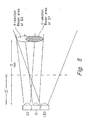
- the detection system includes at least a first light detector D1 and a second light detector D2.
- each detector is an Infra-red reflective detector manufactured by Sharp Corporation, model number GP2S28. It would be well understood that other suitable detectors could also be used.
- the light detectors D1, D2 are mounted side by side as shown in the Figure 5.
- the system is provided with at least two detectors D1, D2, but it is possible that other embodiments may be provided with a larger number of detectors or points of detection.
- the system may be provided with a bank of detectors each of which is sequentially arranged to monitor a different part of the anticipated path of the zone.
- the voltage output of the each detector D1, D2 is proportional to the amount of light from the L.E.D. light source 60 that is reflected back to the detectors from the stack surface. As shown in Figures 4A and 5, the two detectors D1, D2 are arranged such, when the output tray is relatively empty, the field of view of each of the detectors D1, D2 crosses the beam of light emanating from the L.E.D. light source 60.
- Each light detector D1, D2 monitors a different part of the zone Z.
- the predetermined point corresponding to when the stack grows to a maximum height, is reached when each of said detectors detects a predetermined level of light.
- the first light detector D1 monitors a part of the zone Z closer to the axis 80 of the light beam.
- the second light detector D2 monitors another part of the zone Z further away from the axis 80 of the light beam.
- each of the light detectors D1, D2 is faced with an equivalent amount of light reflected from the zone Z directly under each detector.
- the stack surface rises and draws closer to the light detectors D1, D2. Consequently, the amount of light detected by the second detector D2 will gradually decrease in comparison to the amount of light monitored by the first detector D1.
- the second detector D2 which is located further away from the axis 80 of the light beam, will be the first of the two detectors to experience the receding of the circumferential edge of lighted area' A underneath the detector.
- This can also be seen in Figure 5, with reference to areas 51 and 52, corresponding to beam area D1 and D2 respectively.
- 51 and 52 effectively decrease by moving towards the crossover point indicated by the dotted line d. 52 will decrease faster than 51 due to their proximity with regard to LED 50.
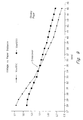
- the second light detector D2 is biased higher than the first light detector D1 to provide the second light detector D2 with an initially higher output voltage.
- the system can be calibrated such that the predetermined point is reached when the voltage output of the second light detector D2 falls to the same level as that of the first light detector D1.
- each detector receives a similar amount of light being reflected up from the surface of the stack.
- detector D2 is biased at higher output load with respect to D1. Therefore, even though the level of light detected by each detector is the same, the output voltage of D2 is greater than D1.
- the output voltage of detector D2 at this point becomes smaller than the output voltage of detector D1.
- the output road R L2 and R L1 are adjusted to 20.85 kOhm and 13 kOhm respectively.
- the analog output voltages are connected to the comparator as shown.
- the voltage (V1) When the stack surface reaches a height of about 34 mm from the light detectors, the voltage (V1) will be greater than the voltage (V2) and the output of the comparator chahges states.
- the states change will be detected by the printer control and displayed on the printer display to direct the user to remove the paper from the output tray.
- the present invention is based on the principle of applying the concept of fixed distance sensing to the problem of detecting the height of sheet material in a pile.
- This concept resides in detecting changes in size in a decreasing, or possibly increasing, lighted area, as the pile of sheet material increases or decreases in height.
- the detection system provides an indication that the pile surface has reached a critical distance from the light source when the detection system detects that the lighted area has reached a certain size. In the embodiment, this is achieved by using a light detector to detect when the light shining on the zone has reached a predetermined point.
- the invention is based on the principle of sensing the height of a stack of sheet material, by detecting changes in the size of a lighted region on the surface of the stack.
- An advantage in monitoring changes in the size of the lighted area, rather than detecting absolute values of reflected light, is that the system is able to be used with a wide range of sheet material that have different reflectance values. For instance, as indicated above, the reflectance of matt, glossy and ultra-glossy materials can vary considerably. Say, for example, it is intended for the maximum stack height to be five centimetres.
- the reflectance will depend on the reflectivity of the sheet material, and hence it would be impossible to identify when the maximum stack height had been reached simply by relying on absolute reflectance values, because such absolute values will vary with the choice of sheet material.
- the system is capable of being adapted for use with a wide range of materials with different reflectances, because the system operates by identifying changes in the size of the lighted area, rather than depending on the reflectance values.
- the embodiment has been described in terms of a stack of sheet material increasing in height as sheets are progressively added to the stack.
- the sensing system senses when the stack reaches a maximum height.
- An example is the output trays of printers that fill up with paper.
- embodiments of the invention may also used for sensing when a stack has decreased to a minimum height. For instance, the height of paper in a paper tray in a printer progressively decreases as paper is used up.
- the sensing system may sense when the tray is close to becoming empty.
- the system is relatively unaffected by dust build-up, temperature variations, process variations and the effect of ageing of the L.E.D. light sources.
- the critical cut-off points for most papers fall within a similar range, regardless of whether plain or glossy paper is used.
- the system functions without moving parts or any physical optical path, each of which could degrade over time.
- the height of the stack can be sensed without an actuator having to physical contact the surface of the sheet material. Since there is no physical contact with the sheet material, printer throughput is not affected.
- the use of the word axis to describe a reference point of the light beam should not be taken to imply that the invention is limited to having the light beam shining absolutely vertically. It is possible for the light source to be positioned to one side of the region on the stack surface, and for the light to shine on the stack surface at an acute angle. In such embodiments, the axis of the beam would generally refer to the central region of the light beam.
- Embodiments of the invention may be used in other devices which contain stacks of sheet material the height of which should remain within acceptable limits, for example, in photocopiers, facsimile machines and any other such devices where sheet material is fed to form a stack.
- the invention is useful for ensuring that the stack does not increase, or decrease, beyond acceptable limits.
Landscapes
- Controlling Sheets Or Webs (AREA)
- Length Measuring Devices By Optical Means (AREA)
- Pile Receivers (AREA)
Claims (12)
- Ein Abtastsystem (50), das angepaßt ist, um abzutasten, wenn ein Stapel (40) eines Blattmaterials eine kritische Höhe erreicht, wobei das Abtastsystem folgende Merkmale umfaßt:eine Lichtquelle (60), die von der Stapeloberfläche beabstandet ist und angepaßt ist, um auf eine Region auf der Stapeloberfläche zu scheinen, um einen beleuchteten Bereich (A) zu bilden, und ein Erfassungssystem (70) zum Erfassen einer Charakteristik des beleuchteten Bereichs, dadurch gekennzeichnet, daß die Lichtquelle und die Stapeloberfläche derart angeordnet sind, daß sich die Größe des beleuchteten Bereichs gemäß der Distanz zwischen der Lichtquelle und der Stapeloberfläche ändert; und dadurch, daß das Erfassungssystem Änderungen der Größe des beleuchteten Bereichs erfaßt und eine Anzeige liefert, daß die Stapeloberfläche eine kritische Distanz von der Lichtquelle erreicht hat, wenn das Erfassungssystem erfaßt, daß der beleuchtete Bereich (A) eine vorbestimmte Größe erreicht hat.
- Ein Abtastsystem gemäß Anspruch 1, bei dem das Erfassungssystem (70) aus einem Lichterfassungssystem besteht, das angeordnet ist und angepaßt ist, um eine Zone (Z) auf der Stapeloberfläche, in der Licht, das als von der Zone reflektiert überwacht wird, gemäß den Änderungen der Größe des beleuchteten Bereichs variiert, derart zu überwachen, daß das Erfassungssystem (70) erfaßt, daß der beleuchtete Bereich die vorbestimmte Größe erreicht hat, wenn das Licht, das auf die Zone scheint, eine vorbestimmten Punkt erreicht hat.
- Ein System gemäß Anspruch 2, bei dem die Zone (Z) im allgemeinen den beleuchteten Bereich (A) überlappt.
- Ein System gemäß Anspruch 3, bei dem die Lichtquelle derart divergent ist, daß sich der beleuchtete Bereich (A) verkleinert und die Zone (Z) fortschreitend weniger Licht empfängt, wenn die Distanz zwischen der Lichtquelle und der Stapeloberfläche abnimmt.
- Ein System gemäß Anspruch 4, bei dem die Zone (Z) in Relation zu dem beleuchteten Bereich (A) derart positioniert ist, daß das Licht, das auf die Zone (Z) scheint, über die Zone zurück hin zu der Achse des divergenten Strahls zurückweicht, wenn die Distanz zwischen der Lichtquelle (60) und der Stapeloberfläche abnimmt.
- Ein System gemäß Anspruch 2, bei dem das Erfassungssystem (70) zumindest einen ersten (D1) und einen zweiten (D2) Lichtdetektor umfaßt, wobei jeder derselben angepaßt ist, um einen unterschiedlichen Teil der Zone (Z) derart zu überwachen, daß der vorbestimmte Punkt erreicht ist, wenn jeder der Detektoren einen vorbestimmten Lichtpegel erfaßt.
- Ein System gemäß Anspruch 6, bei dem der erste Lichtdetektor (D1) angepaßt ist, um einen Teil der Zone in der Nähe der Achse des Lichtstrahls zu überwachen, und der zweite Lichtdetektor (D2) angepaßt ist, um einen anderen Teil der Zone weiter weg von der Achse des Lichtstrahls zu überwachen.
- Ein System gemäß Anspruch 7, bei dem der zweite Lichtdetektor (D2) höher vorgespannt ist als der erste Lichtdetektor (D1), um den zweiten Lichtdetektor mit einer anfänglich höheren Ausgangsspannung derart bereitzustellen, daß der vorbestimmte Punkt erreicht ist, wenn die Spannungsausgabe des zweiten Lichtdetektors schließlich auf denselben Pegel fällt wie die des ersten Lichtdetektors.
- Ein System gemäß Anspruch 1, bei dem die Lichtquelle (60) eine Infrarotquelle ist.
- Ein Tintenstrahldrucker, der ein System (50) gemäß Anspruch 1 einlagert.
- Ein Verfahren zum Feststellen wenn ein Stapel eines Blattmaterials eine kritische Höhe erreicht, wobei das Verfahren folgende Schritte umfaßt:Verwenden einer Lichtquelle (60), um Licht auf die Stapeloberfläche scheinen zu lassen, um einen beleuchteten Bereich (A) derart zu bilden, daß sich die Größe des beleuchteten Bereichs gemäß der Distanz zwischen der Lichtquelle und der Stapeloberfläche ändert;Verwenden eines Erfassungssystems (70), um Änderungen der Größe des beleuchteten Bereichs derart zu erfassen, daß das Erfassungssystem eine Anzeige liefert, daß die Stapeloberfläche eine kritische Distanz von der Lichtquelle erreicht hat, wenn das Erfassungssystem erfaßt, daß der beleuchtete Bereich eine vorbestimmte Größe erreicht hat.
- Ein Verfahren gemäß Anspruch 11, dadurch gekennzeichnet, daß das Erfassungssystem (70) aus einem Lichterfassungssystem besteht, wobei das Verfahren den Schritt des Verwendens des Lichterfassungssystems umfaßt, um eine Zone (Z) auf der Stapeloberfläche, in der Licht, das als von der Zone reflektiert überwacht wird, gemäß Änderungen der Größe des beleuchteten Bereichs (A) variiert, derart überwacht wird, daß das Erfassungssystem erfaßt, daß der beleuchtete Bereich eine vorbestimmte Größe erreicht hat, wenn das Licht, daß auf die Zone scheint, einen vorbestimmten Punkt erreicht hat.
Applications Claiming Priority (3)
| Application Number | Priority Date | Filing Date | Title |
|---|---|---|---|
| SG9803608 | 1998-09-11 | ||
| SG9803608 | 1998-09-11 | ||
| US09/226,978 US6140662A (en) | 1998-09-11 | 1999-01-08 | Sensing system and method |
Publications (3)
| Publication Number | Publication Date |
|---|---|
| EP0985541A2 EP0985541A2 (de) | 2000-03-15 |
| EP0985541A3 EP0985541A3 (de) | 2001-03-21 |
| EP0985541B1 true EP0985541B1 (de) | 2004-04-14 |
Family
ID=26665180
Family Applications (1)
| Application Number | Title | Priority Date | Filing Date |
|---|---|---|---|
| EP99307372A Expired - Lifetime EP0985541B1 (de) | 1998-09-11 | 1999-09-10 | Vorrichtung zur Erfassung einer Bogenstapelhöhe |
Country Status (3)
| Country | Link |
|---|---|
| US (1) | US6140662A (de) |
| EP (1) | EP0985541B1 (de) |
| JP (1) | JP4190670B2 (de) |
Families Citing this family (12)
| Publication number | Priority date | Publication date | Assignee | Title |
|---|---|---|---|---|
| US6585344B2 (en) * | 2001-03-22 | 2003-07-01 | Hewlett-Packard Development Company, L.P. | Systems and methods for automatically detecting a number of remaining sheets of print media |
| US6794669B2 (en) | 2002-07-24 | 2004-09-21 | Lexmark International, Inc. | Media sensing apparatus for detecting an absence of print media |
| US7342689B2 (en) * | 2003-11-12 | 2008-03-11 | Transact Technologies Incorporated | Methods and apparatus for converting full color images to two-color images for printing at a two-color printer |
| US7401878B2 (en) * | 2004-09-30 | 2008-07-22 | Lexmark International, Inc. | Print media detection in an imaging apparatus |
| GB2465372B (en) * | 2008-11-14 | 2013-10-30 | Nicholas James Adkins | Optical displacement transducer |
| US10620575B2 (en) * | 2015-05-08 | 2020-04-14 | Hewlett-Packard Development Company, L.P. | Light projection for a print substrate |
| CN110537091B (zh) | 2017-04-21 | 2022-10-21 | 惠普发展公司,有限责任合伙企业 | 检测打印介质的装置和方法 |
| JP6916302B2 (ja) * | 2017-04-21 | 2021-08-11 | ヒューレット−パッカード デベロップメント カンパニー エル.ピー.Hewlett‐Packard Development Company, L.P. | センサ較正 |
| US10654504B1 (en) | 2019-03-07 | 2020-05-19 | Dishcraft Robotics, Inc. | Dish stacking cart |
| US11198461B2 (en) | 2019-03-07 | 2021-12-14 | Dishcraft Robotics, Inc. | Dish collection and dispensing system |
| US11390308B2 (en) | 2019-03-07 | 2022-07-19 | Dishcraft Robotics, Inc. | Automated dish drop |
| US10974750B2 (en) | 2019-03-07 | 2021-04-13 | Dishcraft Robotics, Inc. | Adjustable dish stacking cart |
Family Cites Families (12)
| Publication number | Priority date | Publication date | Assignee | Title |
|---|---|---|---|---|
| JPS52141256A (en) * | 1976-05-20 | 1977-11-25 | Komatsu Mfg Co Ltd | Apparatus for measuring minute distance |
| DE2906641A1 (de) * | 1979-02-21 | 1980-08-28 | Freudenberg Carl Fa | Verfahren zur optisch-elektrischen messung des abstandes zwischen einer messeinrichtung und einem pruefling |
| JPS5727869A (en) * | 1980-06-30 | 1982-02-15 | Ibm | Stacker for folding paper |
| JPS57145764A (en) * | 1981-03-04 | 1982-09-08 | Nec Corp | Mechanism for detecting full load of paper sheet |
| JPS6079109U (ja) * | 1983-11-08 | 1985-06-01 | オムロン株式会社 | 距離測定装置 |
| US4909426A (en) * | 1988-02-10 | 1990-03-20 | Roll Systems, Inc. | Web feed apparatus |
| JPH05130298A (ja) * | 1991-11-01 | 1993-05-25 | Nec Corp | フアクシミリ装置 |
| JPH06336352A (ja) * | 1993-05-25 | 1994-12-06 | Konica Corp | 用紙残量検出装置 |
| DE19621120C1 (de) * | 1996-05-24 | 1997-05-07 | Leuze Electronic Gmbh & Co | Optoelektronische Vorrichtung |
| FR2756930B1 (fr) * | 1996-12-06 | 1999-01-08 | Schneider Electric Sa | Cellule photoelectrique a traitement differentiel verrouillable |
| US5946541A (en) * | 1997-04-30 | 1999-08-31 | Canon Kabushiki Kaisha | Image forming apparatus that detects a sheet load quantity and controls ejection of the sheets based on that detection |
| JPH11185007A (ja) * | 1997-12-05 | 1999-07-09 | Whitaker Corp:The | 紙残量検出機構 |
-
1999
- 1999-01-08 US US09/226,978 patent/US6140662A/en not_active Expired - Fee Related
- 1999-09-02 JP JP24901099A patent/JP4190670B2/ja not_active Expired - Fee Related
- 1999-09-10 EP EP99307372A patent/EP0985541B1/de not_active Expired - Lifetime
Also Published As
| Publication number | Publication date |
|---|---|
| EP0985541A3 (de) | 2001-03-21 |
| US6140662A (en) | 2000-10-31 |
| EP0985541A2 (de) | 2000-03-15 |
| JP4190670B2 (ja) | 2008-12-03 |
| JP2000088529A (ja) | 2000-03-31 |
Similar Documents
| Publication | Publication Date | Title |
|---|---|---|
| EP0911699B1 (de) | Drucker mit Erfassung der Reflexion des Printmediums | |
| US6140662A (en) | Sensing system and method | |
| US5573236A (en) | Variable sheet guide position sensor | |
| US5550625A (en) | Color image forming apparatus providing registration control for individual color images | |
| US6914684B1 (en) | Method and apparatus for detecting media type | |
| US20060087070A1 (en) | Media tray stack height sensor with continuous height feedback and discrete intermediate and limit states | |
| US5486063A (en) | Method and apparatus for sensing the length of label or tag media by detecting changes in relative thickness | |
| KR100394837B1 (ko) | 지질 판별 센서 및 손상 지폐 분류장치 | |
| EP2843475A1 (de) | Sensorvorrichtung und Bilderzeugungsvorrichtung damit | |
| EP1256851A1 (de) | Bilderzeugungsgerät, welches zwecks Vermeidung eines Blattstaus zur Feststellung der Art des Druckblattes fähig ist | |
| US5754213A (en) | Document production apparatus and method having a noncontact sensor for determining media presence and type | |
| EP0902332B1 (de) | Detektionssystem für das Gewicht von Druckmedien | |
| GB2357754A (en) | Detecting double feed or overlap of print media | |
| US5971392A (en) | Device for calculating sheet number in a sheet feeder and method for calculating the same | |
| US5847405A (en) | Size or position sensing of intermixed sheets in a sheet stacking tray with sheet edge shadow detection | |
| US6497179B1 (en) | Method and apparatus for distinguishing transparent media | |
| EP1523666A1 (de) | Verfahren zur korrektur der variation der empfindlichkeit eines sensors für ein medium | |
| JP7172841B2 (ja) | シート材判別装置及び画像形成装置 | |
| US5859440A (en) | Transparency sheet edge detector system using edge shadow sensing | |
| US20030044189A1 (en) | Transparent recordable medium, image-forming device, and recordable medium type identification device | |
| US6794668B2 (en) | Method and apparatus for print media detection | |
| EP0985615B1 (de) | Gerät und Verfahren zum Messen einer Dimension eines Gegendstandes | |
| JP3362360B2 (ja) | 印刷装置 | |
| US7865094B2 (en) | Image forming apparatus | |
| JP2001139189A (ja) | 紙厚検出装置および印刷装置 |
Legal Events
| Date | Code | Title | Description |
|---|---|---|---|
| PUAI | Public reference made under article 153(3) epc to a published international application that has entered the european phase |
Free format text: ORIGINAL CODE: 0009012 |
|
| AK | Designated contracting states |
Kind code of ref document: A2 Designated state(s): DE FR GB |
|
| AX | Request for extension of the european patent |
Free format text: AL;LT;LV;MK;RO;SI |
|
| RIN1 | Information on inventor provided before grant (corrected) |
Inventor name: LIM, AH PENG Inventor name: PARTHASARATHY, BASKAR |
|
| PUAL | Search report despatched |
Free format text: ORIGINAL CODE: 0009013 |
|
| AK | Designated contracting states |
Kind code of ref document: A3 Designated state(s): AT BE CH CY DE DK ES FI FR GB GR IE IT LI LU MC NL PT SE |
|
| AX | Request for extension of the european patent |
Free format text: AL;LT;LV;MK;RO;SI |
|
| RAP1 | Party data changed (applicant data changed or rights of an application transferred) |
Owner name: HEWLETT-PACKARD COMPANY, A DELAWARE CORPORATION |
|
| 17P | Request for examination filed |
Effective date: 20010528 |
|
| 17Q | First examination report despatched |
Effective date: 20011030 |
|
| AKX | Designation fees paid |
Free format text: DE FR GB |
|
| GRAP | Despatch of communication of intention to grant a patent |
Free format text: ORIGINAL CODE: EPIDOSNIGR1 |
|
| GRAS | Grant fee paid |
Free format text: ORIGINAL CODE: EPIDOSNIGR3 |
|
| GRAA | (expected) grant |
Free format text: ORIGINAL CODE: 0009210 |
|
| AK | Designated contracting states |
Kind code of ref document: B1 Designated state(s): DE FR GB |
|
| REG | Reference to a national code |
Ref country code: GB Ref legal event code: FG4D |
|
| REF | Corresponds to: |
Ref document number: 69916385 Country of ref document: DE Date of ref document: 20040519 Kind code of ref document: P |
|
| ET | Fr: translation filed | ||
| PLBE | No opposition filed within time limit |
Free format text: ORIGINAL CODE: 0009261 |
|
| STAA | Information on the status of an ep patent application or granted ep patent |
Free format text: STATUS: NO OPPOSITION FILED WITHIN TIME LIMIT |
|
| 26N | No opposition filed |
Effective date: 20050117 |
|
| PGFP | Annual fee paid to national office [announced via postgrant information from national office to epo] |
Ref country code: GB Payment date: 20070926 Year of fee payment: 9 |
|
| PGFP | Annual fee paid to national office [announced via postgrant information from national office to epo] |
Ref country code: DE Payment date: 20071031 Year of fee payment: 9 |
|
| PGFP | Annual fee paid to national office [announced via postgrant information from national office to epo] |
Ref country code: FR Payment date: 20070917 Year of fee payment: 9 |
|
| GBPC | Gb: european patent ceased through non-payment of renewal fee |
Effective date: 20080910 |
|
| REG | Reference to a national code |
Ref country code: FR Ref legal event code: ST Effective date: 20090529 |
|
| PG25 | Lapsed in a contracting state [announced via postgrant information from national office to epo] |
Ref country code: DE Free format text: LAPSE BECAUSE OF NON-PAYMENT OF DUE FEES Effective date: 20090401 |
|
| PG25 | Lapsed in a contracting state [announced via postgrant information from national office to epo] |
Ref country code: FR Free format text: LAPSE BECAUSE OF NON-PAYMENT OF DUE FEES Effective date: 20080930 |
|
| PG25 | Lapsed in a contracting state [announced via postgrant information from national office to epo] |
Ref country code: GB Free format text: LAPSE BECAUSE OF NON-PAYMENT OF DUE FEES Effective date: 20080910 |