EP0989149B1 - Naphtalate de polyalkylene, composition a base de cette substance, film correspondant et procede de leur fabrication - Google Patents
Naphtalate de polyalkylene, composition a base de cette substance, film correspondant et procede de leur fabrication Download PDFInfo
- Publication number
- EP0989149B1 EP0989149B1 EP19990913569 EP99913569A EP0989149B1 EP 0989149 B1 EP0989149 B1 EP 0989149B1 EP 19990913569 EP19990913569 EP 19990913569 EP 99913569 A EP99913569 A EP 99913569A EP 0989149 B1 EP0989149 B1 EP 0989149B1
- Authority
- EP
- European Patent Office
- Prior art keywords
- polyalkylene naphthalate
- compound
- film
- film according
- composition
- Prior art date
- Legal status (The legal status is an assumption and is not a legal conclusion. Google has not performed a legal analysis and makes no representation as to the accuracy of the status listed.)
- Expired - Lifetime
Links
Classifications
-
- C—CHEMISTRY; METALLURGY
- C08—ORGANIC MACROMOLECULAR COMPOUNDS; THEIR PREPARATION OR CHEMICAL WORKING-UP; COMPOSITIONS BASED THEREON
- C08G—MACROMOLECULAR COMPOUNDS OBTAINED OTHERWISE THAN BY REACTIONS ONLY INVOLVING UNSATURATED CARBON-TO-CARBON BONDS
- C08G63/00—Macromolecular compounds obtained by reactions forming a carboxylic ester link in the main chain of the macromolecule
- C08G63/02—Polyesters derived from hydroxycarboxylic acids or from polycarboxylic acids and polyhydroxy compounds
- C08G63/12—Polyesters derived from hydroxycarboxylic acids or from polycarboxylic acids and polyhydroxy compounds derived from polycarboxylic acids and polyhydroxy compounds
- C08G63/16—Dicarboxylic acids and dihydroxy compounds
- C08G63/18—Dicarboxylic acids and dihydroxy compounds the acids or hydroxy compounds containing carbocyclic rings
- C08G63/181—Acids containing aromatic rings
- C08G63/185—Acids containing aromatic rings containing two or more aromatic rings
- C08G63/187—Acids containing aromatic rings containing two or more aromatic rings containing condensed aromatic rings
- C08G63/189—Acids containing aromatic rings containing two or more aromatic rings containing condensed aromatic rings containing a naphthalene ring
-
- C—CHEMISTRY; METALLURGY
- C08—ORGANIC MACROMOLECULAR COMPOUNDS; THEIR PREPARATION OR CHEMICAL WORKING-UP; COMPOSITIONS BASED THEREON
- C08L—COMPOSITIONS OF MACROMOLECULAR COMPOUNDS
- C08L67/00—Compositions of polyesters obtained by reactions forming a carboxylic ester link in the main chain; Compositions of derivatives of such polymers
- C08L67/02—Polyesters derived from dicarboxylic acids and dihydroxy compounds
-
- B—PERFORMING OPERATIONS; TRANSPORTING
- B29—WORKING OF PLASTICS; WORKING OF SUBSTANCES IN A PLASTIC STATE IN GENERAL
- B29C—SHAPING OR JOINING OF PLASTICS; SHAPING OF MATERIAL IN A PLASTIC STATE, NOT OTHERWISE PROVIDED FOR; AFTER-TREATMENT OF THE SHAPED PRODUCTS, e.g. REPAIRING
- B29C55/00—Shaping by stretching, e.g. drawing through a die; Apparatus therefor
- B29C55/02—Shaping by stretching, e.g. drawing through a die; Apparatus therefor of plates or sheets
- B29C55/10—Shaping by stretching, e.g. drawing through a die; Apparatus therefor of plates or sheets multiaxial
- B29C55/12—Shaping by stretching, e.g. drawing through a die; Apparatus therefor of plates or sheets multiaxial biaxial
-
- C—CHEMISTRY; METALLURGY
- C08—ORGANIC MACROMOLECULAR COMPOUNDS; THEIR PREPARATION OR CHEMICAL WORKING-UP; COMPOSITIONS BASED THEREON
- C08G—MACROMOLECULAR COMPOUNDS OBTAINED OTHERWISE THAN BY REACTIONS ONLY INVOLVING UNSATURATED CARBON-TO-CARBON BONDS
- C08G63/00—Macromolecular compounds obtained by reactions forming a carboxylic ester link in the main chain of the macromolecule
- C08G63/78—Preparation processes
- C08G63/82—Preparation processes characterised by the catalyst used
-
- C—CHEMISTRY; METALLURGY
- C08—ORGANIC MACROMOLECULAR COMPOUNDS; THEIR PREPARATION OR CHEMICAL WORKING-UP; COMPOSITIONS BASED THEREON
- C08J—WORKING-UP; GENERAL PROCESSES OF COMPOUNDING; AFTER-TREATMENT NOT COVERED BY SUBCLASSES C08B, C08C, C08F, C08G or C08H
- C08J5/00—Manufacture of articles or shaped materials containing macromolecular substances
- C08J5/18—Manufacture of films or sheets
-
- C—CHEMISTRY; METALLURGY
- C08—ORGANIC MACROMOLECULAR COMPOUNDS; THEIR PREPARATION OR CHEMICAL WORKING-UP; COMPOSITIONS BASED THEREON
- C08K—Use of inorganic or non-macromolecular organic substances as compounding ingredients
- C08K3/00—Use of inorganic substances as compounding ingredients
-
- C—CHEMISTRY; METALLURGY
- C08—ORGANIC MACROMOLECULAR COMPOUNDS; THEIR PREPARATION OR CHEMICAL WORKING-UP; COMPOSITIONS BASED THEREON
- C08K—Use of inorganic or non-macromolecular organic substances as compounding ingredients
- C08K3/00—Use of inorganic substances as compounding ingredients
- C08K3/18—Oxygen-containing compounds, e.g. metal carbonyls
- C08K3/20—Oxides; Hydroxides
- C08K3/22—Oxides; Hydroxides of metals
- C08K3/2279—Oxides; Hydroxides of metals of antimony
-
- C—CHEMISTRY; METALLURGY
- C08—ORGANIC MACROMOLECULAR COMPOUNDS; THEIR PREPARATION OR CHEMICAL WORKING-UP; COMPOSITIONS BASED THEREON
- C08K—Use of inorganic or non-macromolecular organic substances as compounding ingredients
- C08K3/00—Use of inorganic substances as compounding ingredients
- C08K3/34—Silicon-containing compounds
- C08K3/36—Silica
-
- C—CHEMISTRY; METALLURGY
- C08—ORGANIC MACROMOLECULAR COMPOUNDS; THEIR PREPARATION OR CHEMICAL WORKING-UP; COMPOSITIONS BASED THEREON
- C08K—Use of inorganic or non-macromolecular organic substances as compounding ingredients
- C08K5/00—Use of organic ingredients
- C08K5/04—Oxygen-containing compounds
- C08K5/09—Carboxylic acids; Metal salts thereof; Anhydrides thereof
- C08K5/098—Metal salts of carboxylic acids
-
- C—CHEMISTRY; METALLURGY
- C08—ORGANIC MACROMOLECULAR COMPOUNDS; THEIR PREPARATION OR CHEMICAL WORKING-UP; COMPOSITIONS BASED THEREON
- C08K—Use of inorganic or non-macromolecular organic substances as compounding ingredients
- C08K5/00—Use of organic ingredients
- C08K5/36—Sulfur-, selenium-, or tellurium-containing compounds
- C08K5/41—Compounds containing sulfur bound to oxygen
- C08K5/42—Sulfonic acids; Derivatives thereof
-
- C—CHEMISTRY; METALLURGY
- C08—ORGANIC MACROMOLECULAR COMPOUNDS; THEIR PREPARATION OR CHEMICAL WORKING-UP; COMPOSITIONS BASED THEREON
- C08K—Use of inorganic or non-macromolecular organic substances as compounding ingredients
- C08K5/00—Use of organic ingredients
- C08K5/49—Phosphorus-containing compounds
-
- C—CHEMISTRY; METALLURGY
- C08—ORGANIC MACROMOLECULAR COMPOUNDS; THEIR PREPARATION OR CHEMICAL WORKING-UP; COMPOSITIONS BASED THEREON
- C08K—Use of inorganic or non-macromolecular organic substances as compounding ingredients
- C08K7/00—Use of ingredients characterised by shape
- C08K7/16—Solid spheres
- C08K7/18—Solid spheres inorganic
-
- G—PHYSICS
- G11—INFORMATION STORAGE
- G11B—INFORMATION STORAGE BASED ON RELATIVE MOVEMENT BETWEEN RECORD CARRIER AND TRANSDUCER
- G11B5/00—Recording by magnetisation or demagnetisation of a record carrier; Reproducing by magnetic means; Record carriers therefor
- G11B5/62—Record carriers characterised by the selection of the material
- G11B5/73—Base layers, i.e. all non-magnetic layers lying under a lowermost magnetic recording layer, e.g. including any non-magnetic layer in between a first magnetic recording layer and either an underlying substrate or a soft magnetic underlayer
- G11B5/739—Magnetic recording media substrates
- G11B5/73923—Organic polymer substrates
- G11B5/73927—Polyester substrates, e.g. polyethylene terephthalate
- G11B5/73929—Polyester substrates, e.g. polyethylene terephthalate comprising naphthalene ring compounds, e.g. polyethylene naphthalate substrates
-
- C—CHEMISTRY; METALLURGY
- C08—ORGANIC MACROMOLECULAR COMPOUNDS; THEIR PREPARATION OR CHEMICAL WORKING-UP; COMPOSITIONS BASED THEREON
- C08G—MACROMOLECULAR COMPOUNDS OBTAINED OTHERWISE THAN BY REACTIONS ONLY INVOLVING UNSATURATED CARBON-TO-CARBON BONDS
- C08G63/00—Macromolecular compounds obtained by reactions forming a carboxylic ester link in the main chain of the macromolecule
- C08G63/78—Preparation processes
- C08G63/82—Preparation processes characterised by the catalyst used
- C08G63/85—Germanium, tin, lead, arsenic, antimony, bismuth, titanium, zirconium, hafnium, vanadium, niobium, tantalum, or compounds thereof
- C08G63/86—Germanium, antimony, or compounds thereof
- C08G63/866—Antimony or compounds thereof
-
- C—CHEMISTRY; METALLURGY
- C08—ORGANIC MACROMOLECULAR COMPOUNDS; THEIR PREPARATION OR CHEMICAL WORKING-UP; COMPOSITIONS BASED THEREON
- C08G—MACROMOLECULAR COMPOUNDS OBTAINED OTHERWISE THAN BY REACTIONS ONLY INVOLVING UNSATURATED CARBON-TO-CARBON BONDS
- C08G63/00—Macromolecular compounds obtained by reactions forming a carboxylic ester link in the main chain of the macromolecule
- C08G63/78—Preparation processes
- C08G63/82—Preparation processes characterised by the catalyst used
- C08G63/87—Non-metals or inter-compounds thereof
-
- C—CHEMISTRY; METALLURGY
- C08—ORGANIC MACROMOLECULAR COMPOUNDS; THEIR PREPARATION OR CHEMICAL WORKING-UP; COMPOSITIONS BASED THEREON
- C08K—Use of inorganic or non-macromolecular organic substances as compounding ingredients
- C08K2201/00—Specific properties of additives
- C08K2201/002—Physical properties
- C08K2201/006—Additives being defined by their surface area
-
- Y—GENERAL TAGGING OF NEW TECHNOLOGICAL DEVELOPMENTS; GENERAL TAGGING OF CROSS-SECTIONAL TECHNOLOGIES SPANNING OVER SEVERAL SECTIONS OF THE IPC; TECHNICAL SUBJECTS COVERED BY FORMER USPC CROSS-REFERENCE ART COLLECTIONS [XRACs] AND DIGESTS
- Y10—TECHNICAL SUBJECTS COVERED BY FORMER USPC
- Y10S—TECHNICAL SUBJECTS COVERED BY FORMER USPC CROSS-REFERENCE ART COLLECTIONS [XRACs] AND DIGESTS
- Y10S428/00—Stock material or miscellaneous articles
- Y10S428/91—Product with molecular orientation
-
- Y—GENERAL TAGGING OF NEW TECHNOLOGICAL DEVELOPMENTS; GENERAL TAGGING OF CROSS-SECTIONAL TECHNOLOGIES SPANNING OVER SEVERAL SECTIONS OF THE IPC; TECHNICAL SUBJECTS COVERED BY FORMER USPC CROSS-REFERENCE ART COLLECTIONS [XRACs] AND DIGESTS
- Y10—TECHNICAL SUBJECTS COVERED BY FORMER USPC
- Y10T—TECHNICAL SUBJECTS COVERED BY FORMER US CLASSIFICATION
- Y10T428/00—Stock material or miscellaneous articles
- Y10T428/25—Web or sheet containing structurally defined element or component and including a second component containing structurally defined particles
- Y10T428/256—Heavy metal or aluminum or compound thereof
-
- Y—GENERAL TAGGING OF NEW TECHNOLOGICAL DEVELOPMENTS; GENERAL TAGGING OF CROSS-SECTIONAL TECHNOLOGIES SPANNING OVER SEVERAL SECTIONS OF THE IPC; TECHNICAL SUBJECTS COVERED BY FORMER USPC CROSS-REFERENCE ART COLLECTIONS [XRACs] AND DIGESTS
- Y10—TECHNICAL SUBJECTS COVERED BY FORMER USPC
- Y10T—TECHNICAL SUBJECTS COVERED BY FORMER US CLASSIFICATION
- Y10T428/00—Stock material or miscellaneous articles
- Y10T428/25—Web or sheet containing structurally defined element or component and including a second component containing structurally defined particles
- Y10T428/256—Heavy metal or aluminum or compound thereof
- Y10T428/257—Iron oxide or aluminum oxide
-
- Y—GENERAL TAGGING OF NEW TECHNOLOGICAL DEVELOPMENTS; GENERAL TAGGING OF CROSS-SECTIONAL TECHNOLOGIES SPANNING OVER SEVERAL SECTIONS OF THE IPC; TECHNICAL SUBJECTS COVERED BY FORMER USPC CROSS-REFERENCE ART COLLECTIONS [XRACs] AND DIGESTS
- Y10—TECHNICAL SUBJECTS COVERED BY FORMER USPC
- Y10T—TECHNICAL SUBJECTS COVERED BY FORMER US CLASSIFICATION
- Y10T428/00—Stock material or miscellaneous articles
- Y10T428/25—Web or sheet containing structurally defined element or component and including a second component containing structurally defined particles
- Y10T428/258—Alkali metal or alkaline earth metal or compound thereof
-
- Y—GENERAL TAGGING OF NEW TECHNOLOGICAL DEVELOPMENTS; GENERAL TAGGING OF CROSS-SECTIONAL TECHNOLOGIES SPANNING OVER SEVERAL SECTIONS OF THE IPC; TECHNICAL SUBJECTS COVERED BY FORMER USPC CROSS-REFERENCE ART COLLECTIONS [XRACs] AND DIGESTS
- Y10—TECHNICAL SUBJECTS COVERED BY FORMER USPC
- Y10T—TECHNICAL SUBJECTS COVERED BY FORMER US CLASSIFICATION
- Y10T428/00—Stock material or miscellaneous articles
- Y10T428/25—Web or sheet containing structurally defined element or component and including a second component containing structurally defined particles
- Y10T428/259—Silicic material
-
- Y—GENERAL TAGGING OF NEW TECHNOLOGICAL DEVELOPMENTS; GENERAL TAGGING OF CROSS-SECTIONAL TECHNOLOGIES SPANNING OVER SEVERAL SECTIONS OF THE IPC; TECHNICAL SUBJECTS COVERED BY FORMER USPC CROSS-REFERENCE ART COLLECTIONS [XRACs] AND DIGESTS
- Y10—TECHNICAL SUBJECTS COVERED BY FORMER USPC
- Y10T—TECHNICAL SUBJECTS COVERED BY FORMER US CLASSIFICATION
- Y10T428/00—Stock material or miscellaneous articles
- Y10T428/31504—Composite [nonstructural laminate]
- Y10T428/31786—Of polyester [e.g., alkyd, etc.]
Definitions
- the present invention relates to a polyalkylene naphthalate, a composition and a film thereof, and production processes therefor. More specifically, it relates to a polyalkylene naphthalate containing an antimony compound and a specific quaternary phosphonium sulfonate compound in specific amounts, a film formed therefrom, and production processes therefor.
- polyethylene naphthalate is widely used in fibers, films, resins and the like due to its excellent physical and chemical properties.
- a polyethylene naphthalate film is used as a base film for a photo film and a magnetic tape, which reconciles cost and properties such as strength, heat resistance and chemical resistance.
- the polyethylene naphthalate film is produced by the same method as that for a polyester film such as a polyethylene terephthalate film.
- Polyester films are generally produced by quenching a film-form polyester melt extruded from an extrusion nozzle on the surface of a rotary cooling drum and stretching it in both longitudinal and transverse directions.
- adhesion between the melt extruded film-form polyester and the surface of the rotary cooling drum must be improved.
- a wire metal electrode to be referred to as “electrostatic wire” hereinafter
- electrostatic casting method to deposit static charge on the surface of a film-form melt
- the methods include, for example, one (JP-B 7-5675) in which a molten polyester film having an AC volume resistivity of 6.5 x 10 8 ⁇ cm or less and containing in the polymer chain 0.1 to 45 mmol% of a quaternary phosphonium sulfonate having an ester-forming functional group based on a dicarboxylic acid component forming the polyester is used.
- a catalyst is generally used for the production of a polyester.
- an antimony compound is widely used because it has high polymerization speed and is excellent in various properties such as the thermal stability of the obtained polyester, the amount of a terminal carboxyl group and softening point.
- the antimony compound is often deposited in the production processes of a polymer and a film and the deposited particles form small protrusions on the surface of a film (JP-A 8-53541).
- JP-A 8-104744 discloses a method of obtaining a film having excellent surface flatness by suppressing the formation of fine irregularities on the surface of the film caused by the deposition of a catalyst component such as an antimony compound and a film having excellent electrostatic adhesion at the time of film formation in the production of a polyethylene naphthalate film.
- a catalyst component such as an antimony compound
- a film having excellent electrostatic adhesion at the time of film formation in the production of a polyethylene naphthalate film.
- a calcium compound. magnesium compound, phosphorus compound and antimony compound are added to polyethylene naphthalate in specific amounts and a specific ratio.
- the deposition of the antimony compound is also connected with film formation stability at the time of film formation.
- the maximum winding speed can be increased and a homogeneous film can be produced stably and industrially advantageously by suppressing the formation of coarse particles caused by the deposition of the antimony compound and by controlling the size and number of the coarse particles if they are formed.
- the inventors of the present invention have found that, when a quaternary phosphonium sulfonate having an ester-forming functional group is added to produce a polyalkylene naphthalate film in the presence of an antimony compound as a catalyst, the number of finely deposited particles considered as reduced antimony in the film increases in proportion to the concentration of the quaternary phosphonium sulfonate.
- the present invention has been accomplished based on the above findings and is a polyalkylene naphthalate for a film, which comprises a naphthalenedicarboxylic acid component as a main dicarboxylic acid component and an aliphatic glycol component as a main glycol component and contains (a) an antimony compound and (b) a quaternary phosphonium sulfonate compound unit having an ester-forming functional group in such amounts which satisfy the following expressions (1) and (2): 0 ⁇ Sb ⁇ 80 0 ⁇ S/Sb ⁇ 0.4 wherein Sb and S are the molar ratios (mmol%) of the antimony compound and the quaternary phosphonium sulfonate compound unit having an ester-forming functional group to the total of all the dicarboxylic acid components forming the polyalkylene naphthalate, respectively.
- the polyalkylene naphthalate of the present invention is a polyester which comprises a naphthalenedicarboxylic acid component as a main dicarboxylic acid component and an aliphatic glycol component as a main glycol component.
- the term "main” means that alkylene naphthalate units account for at least 70 mol%, preferably at least 80 mol% of the total of all the recurring units forming the polyester.
- the polyalkylene naphthalate is substantially linear and has excellent film-forming properties, especially film-forming properties by melt molding.
- naphthalenedicarboxylic acid examples include 2,6-naphthalenedicarboxylic acid, 2,7-naphthalenedicarboxylic acid and the like when a direct esterification method is employed.
- lower alkyl esters of these dicarboxylic acids may be used as a raw material.
- These lower alkyl esters include, for example, dimethyl 2,6-naphthalene dicarboxylate, diethyl 2,6-naphthalene dicarboxylate, dimethyl 2,7-naphthalene dicarboxylate and the like. Of these, dimethyl 2,6-naphthalene dicarboxylate is preferable because it can be acquired easily industrially.
- Illustrative examples of the aliphatic glycol in the present invention include polymethylene glycols having 2 to 10 carbon atoms such as ethylene glycol, propylene glycol, 1,4-butanediol and 1, 4-cyclohexane dimethanol; and alicyclic diols such as cyclohexane dimethanol.
- polymethylene glycols having 2 to 10 carbon atoms such as ethylene glycol, propylene glycol, 1,4-butanediol and 1, 4-cyclohexane dimethanol
- alicyclic diols such as cyclohexane dimethanol.
- ethylene glycol, propylene glycol and 1,4-butanediol are preferable, and ethylene glycol is the most preferable.
- the polyester of the present invention may be a copolymer obtained by copolymerizing a small amount of a comonomer in limits that do not impair the characteristic properties of the polyester.
- This third component is preferably a diol such as diethylene glycol, neopentyl glycol, polyalkylene glycol or 1,4-cyclohexane dimethanol as a glycol component.
- diethylene glycol is preferable.
- the content of the diethylene glycol unit in the polyalkylene naphthalate is preferably 0.4 to 3 wt%, particularly preferably 0.8 to 2 wt%.
- the content of the diethylene glycol unit is smaller than 0.4 wt%, the crystallization of a polymer cannot be suppressed and melting energy becomes large, whereby an unmolten polymer remains at the time of film formation and large protrusions are formed on the surface of the film disadvantageously.
- strength after film formation such as Young's modulus, lowers, resulting in deteriorated durability.
- dicarboxylic acids such as terephthalic acid, isophthalic acid, succinic acid, adipic acid, sebacic acid and phthalic acid
- ester-forming derivatives thereof polyfunctional polycarboxylic acids such as trimellitic acid and pyromellitic acid
- ester-forming derivatives thereof are preferable.
- a terephthalic aid component or an isophthalic acid component is preferably contained in an amount of 20 mol% or less based on the total of all the dicarboxylic acid components to prevent the effect of the present invention from being impaired.
- the amount thereof is particularly preferably 10 mol% or less.
- the polyalkylene naphthalate of the present invention may contain a component derived from an oxycarboxylic acid component such as an aromatic oxyacid component exemplified by hydroxybenzoic acid and an aliphatic oxyacid exemplified by ⁇ -hydroxycaproic acid as long as it does not impair the object of the present invention.
- an oxycarboxylic acid component such as an aromatic oxyacid component exemplified by hydroxybenzoic acid and an aliphatic oxyacid exemplified by ⁇ -hydroxycaproic acid
- the polyalkylene naphthalate of the present invention should contain ethylene-2,6-naphthalate or ethylene-2,7-naphthalate in an amount of at least 80 mol%, preferably at least 90 mol%, based on the total of all the recurring units.
- the polyalkylene naphthalate of the present invention may further contain such additives as an optical stabilizer, antioxidant and light screening agent as required in limits that do not impair physical properties such as surface flatness and dry hot-air degradation resistance.
- the polyalkylene naphthalate of the present invention may be produced by a method known per se. For example, it is preferably produced by subjecting an ester-forming derivative of naphthalenedicarboxylic acid and an aliphatic glycol to an ester interchange reaction while heating them in the presence of an ester interchange catalyst and then to a polycondensation reaction in the presence of a polycondensation catalyst.
- the above polyester preferably has an intrinsic viscosity measured at 35°C in o-chlorophenol of 0.4 to 0.9, particularly preferably 0.45 to 0.75 (the term "intrinsic viscosity" in the following description refers to a value measured at 35° C in o-chlorophenol unless otherwise stated).
- the amount of an antimony compound as a catalyst in the polyalkylene naphthalate of the present invention must satisfy the following expression (1): 0 ⁇ Sb ⁇ 80 wherein Sb is the molar ratio (mmol%) of the antimony compound to the total of all the dicarboxylic acid components, preferably the following expression (1'): 5 ⁇ Sb ⁇ 70
- the amount of Sb is particularly preferably in the range of 10 to 60 mmol%.
- the amount is larger than 80 mmol%, black foreign matter derived from antimony is liable to be formed and the surface flatness of the obtained film is unsatisfactory disadvantageously.
- the amount of Sb is too small, a polymerization reaction does not proceed disadvantageously.
- antimony compound which can be used in the present invention is not particularly limited but antimony trioxide and antimony pentaoxide may be used as the antimony compound. Of these, antimony trioxide is particularly preferable.
- the antimony compound may be added before the start of an ester interchange reaction, during the ester interchange reaction, or after the ester interchange reaction and right before a polycondensation reaction.
- the amount of the quaternary phosphonium sulfonate having an ester-forming functional group must satisfy the following expression (2): 0 ⁇ S/Sb ⁇ 0.4 wherein Sb and S are the molar ratios (mmol%) of the antimony compound and the quaternary phosphonium sulfonate unit having an ester-forming functional group to the total of all the dicarboxylic acid components forming the polyalkylene naphthalate, respectively, preferably the following expression (2'): 0.001 ⁇ S/Sb ⁇ 0.3
- the ratio S/Sb is the most preferably in the range of 0.01 to 0.2.
- the ratio S/Sb is larger than 0.4, black foreign matter derived from antimony is liable to be formed, and the surface flatness of the obtained film is unsatisfactory disadvantageously.
- the ratio is 0, the quaternary phosphonium sulfonate having an ester-forming functional group does not exist, resulting in poor electrostatic adhesion and low film productivity.
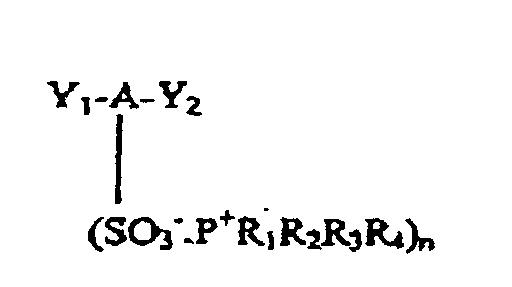
- the quaternary phosphonium sulfonate having an ester-forming functional group which can be used in the present invention is preferably a compound represented by the following formula: wherein A is a group containing an aromatic ring and having 6 to 18 carbon atoms, Y 1 and Y 2 are the same or different and each a hydrogen atom or ester-forming functional group (both Y 1 and Y 2 cannot be a hydrogen atom at the same time), n is 1 or 2, and R 1 , R 2 , R 3 and R 4 are the same or different and each an alkyl group having 1 to 18 carbon atoms, benzyl group or aryl group having 6 to 12 carbon atoms.
- A is a group containing an aromatic ring and having 6 to 18 carbon atoms, preferably a group containing a benzene skeleton, naphthalene skeleton or biphenyl skeleton.
- the hydrogen of the aromatic nucleus of the aromatic ring may be substituted by an alkyl group having 1 to 12 carbon atoms or the like in addition to Y 1 , Y 2 and a quaternary phosphonium sulfonate group.
- Y 1 and Y 2 are each a hydrogen atom or ester-forming functional group but both cannot be a hydrogen atom at the same time.
- the ester-forming functional group include -COOH, -COOR', -OCOR', -(CH 2 ) m OH, - (OCH 2 ) m OH and the like.
- R' is a lower alkyl group having 1 to 4 carbon atoms or phenyl group, and m is an integer of 1 to 10.
- R' is preferably methyl, ethyl, n-propyl, iso-propyl or n-butyl.
- R 1 , R 2 , R 3 and R 4 forming the base portion (P + R 1 R 2 R 3 R 4 ) of a quaternary phosphonium sulfonate are the same or different and each an alkyl group having 1 to 18 carbon atoms, benzyl group, or aryl group having 6 to 12 carbon atoms.
- the alkyl group having 1 to 18 carbon atoms is methyl, ethyl, propyl, butyl, dodecyl, stearyl or the like.
- the aryl group having 6 to 12 carbon atoms is phenyl, naphthyl, biphenyl or the like, for example.
- the quaternary phosphonium sulfonate include tetrabutyl phosphonium 3,5-dicarboxybenzene sulfonate, ethyltributyl phosphonium 3,5-dicarboxybenzene sulfonate, benzyltributyl phosphonium 3,5-dicarboxybenzene sulfonate, phenyltributyl phosphonium 3,5-dicarboxybenzene sulfonate, tetraphenyl phosphonium 3,5-dicarboxybenzene sulfonate, butyltriphenyl phosphonium 3,5-dicarboxybenzene sulfonate, tetrabutyl phosphonium 3,5-dicarboxymethoxybenzene sulfonate, ethyltributyl phosphonium 3,5-dicarboxymethoxybenzene sulfonate, benzyltribut
- the above quaternary phosphonium sulfonate is preferably contained in the polyalkylene naphthalate of the present invention to ensure that the polyalkylene naphthalate should have an AC volume resistivity of 2.0 x 10 8 ⁇ cm or less while it is molten.
- the polyalkylene naphthalate having an AC volume resistivity of 2.0 x 10 8 ⁇ cm or less while it is molten can provide a sufficient amount of charge to adhere closely to the cooling drum which rotates relatively fast and can improve a film-forming speed, which is one of the objects of the present invention.
- the above quaternary phosphonium sulfonate may be contained in the main chain or at the terminal of the polyalkylene naphthalate, that is, copolymerized or simply mixed into the polymer. In any one of the above states, the film-forming speed can be improved.
- the polyalkylene naphthalate preferably has an AC volume resistivity of 2.0 x 10 8 to 6.0 x 10 6 ⁇ cm while it is molten.
- the quaternary phosphonium sulfonate may be added in a desired stage before the synthesis of the above polyalkylene naphthalate is completed. Preferably, it is added before the start of the polycondensation reaction of the polyalkylene naphthalate.
- a polyalkylene naphthalate containing a quaternary phosphonium sulfonate having an ester-forming functional group in a concentration higher than the above concentration is first produced and then blended with a polyalkylene naphthalate containing no quaternary phosphonium sulfonate component in the film production process to control the content of the quaternary phosphonium sulfonate to a predetermined level, and then the resulting blend is molten and formed into a film.
- the polyalkylene naphthalate of the present invention preferably further contains a calcium compound, a magnesium compound and a phosphorus compound in such amounts that satisfy the following expressions (3) to (5): 10 ⁇ (Mg + Ca) ⁇ 120 0.5 ⁇ Mg/Ca ⁇ 10
- Mg + Ca 0.5 ⁇ (Mg + Ca)/P ⁇ 8.0 (5) wherein Mg, Ca and P are the molar ratios (mmol%) of the magnesium compound, the calcium compound and all the phosphorus compounds containing the quaternary phosphonium sulfonate compound unit having an ester-forming functional group to the total of all the dicarboxylic acid components forming the polyalkylene naphthalate, respectively.
- the calcium compound, magnesium compound and phosphorus compound are preferably added in such amounts that satisfy the following expressions (3'), (4') and (5'): 20 ⁇ (Mg + Ca) ⁇ 110 0.5 ⁇ Mg/Ca ⁇ 9 1 ⁇ (Mg + Ca)/P ⁇ 7 wherein Mg, Ca and P are the same as defined in the above expressions (3), (4) and (5).
- the calcium compound and the magnesium compound which can be used in the present invention are preferably oxides, chlorides, carbonates, carboxylates or the like of Ca and Mg, particularly preferablyacetates, that is, calcium acetate and magnesium acetate, respectively.
- the calcium compound and the magnesium compound may be added in any stage of the production process of a polyester.
- the calcium compound and the magnesium compound have the effect of reducing the resistivity of the polyalkylene naphthalate of the present invention when the polymer is molten.
- these compounds may also be used as an ester interchange reaction catalyst when an ester interchange reaction between dimethyl naphthalene dicarboxylate and an aliphatic glycol is carried out in the stage of production.
- timing of adding these compounds is not particularly limited when they do not need to function as an ester interchange reaction catalyst. However, these compounds are preferably added before the intrinsic viscosity of the reaction polymer reaches 0.2 because these compounds can be readily dispersed into the polymer uniformly. As for the addition sequence of these compounds, the compounds may be added at the same time or different times.
- the magnesium compound and the calcium compound soluble in a reaction system are added as ester interchange catalysts in such amounts that the total content of Mg and Ca should become 10 to 120 mmol%, preferably 20 to 110 mmol%, particularly preferably 30 to 100 mmol%, based on the total of all the dicarboxylic acid components to obtain a polyalkylene naphthalene by an ester interchange method.
- the unit "mmol%” in the following description represents the amount of each element in unit of mmol% based on the total of all the dicarboxylic acid components.
- the molar ratio (Mg/Ca) of magnesium to calcium is 0.5 to 10, preferably 0.5 to 9.0, particularly preferably 2.0 to 8.0. When the ratio is smaller than 0.5, the surface flatness of the formed film is unsatisfactory due to the influence of deposited particles of the residual catalyst.
- the phosphorus compound is further added to deactivate part of the ester interchange reaction catalysts.
- the molar ratio of the total amount of the ester interchange reaction catalysts, that is, calcium and magnesium, to the total amount of phosphorus containing the quaternary phosphonium sulfonate having an ester-forming functional group, namely, (Mg + Ca)/P, is in the range of 0.5 to 8.0, preferably 1.0 to 7.0, particularly preferably 2.0 to 7.0.
- the phosphorus compound is preferably added after the ester interchange reaction or esterification reaction is substantially completed.
- the whole amount of the phosphorus compound may be added at a time or divided into two or more parts and added two or more times.
- the phosphorus compound which can be used in the present invention is preferably trimethyl phosphate, triethyl phosphate, tri-n-butyl phosphate, phosphoric acid or the like. Of these, trimethyl phosphate is more preferable.
- a trace amount of other metal compound such as a Zn, Co, Mn, K or Na compound may be contained in limits that do not prevent the object of the present invention.
- the modified polyalkylene naphthalate obtained in the present invention does not contain or hardly contains an undissolved polymer formed by catalysts, has excellent film-forming properties and is particularly useful as a raw material for forming a film for a high-density magnetic recording medium.
- Means of forming the modified polyalkylene naphthalate of the present invention into a film may be a known method.
- a dried polyalkylene naphthalate is molten and extruded into a sheet at a temperature of [Tm] to [Tm + 65]°C (Tm is the melting point °C of a polyalkylene naphthalate) and solidified by quenching to give an unstretched film (or sheet).
- the unstretched film is then stretched by a sequentially biaxially stretching method, which comprises stretching the unstretched film in a longitudinal direction first and then in a transverse direction or in a transverse direction first and then in a longitudinal direction.
- the stretch temperature, stretch ratios and the like are selected according to means and conditions known per se.
- a film having excellent surface flatness can be obtained and a polyalkylene naphthalate which can be easily formed into a film at a high winding speed because of its excellent electrostatic adhesion and which therefore has high productivity can be obtained.
- the inventors of the present invention have conducted further studies on the production of a film from the polyalkylene naphthalate of the present invention and found that when a film is produced from a composition having inert fine particles of specific shape uniformly dispersed in a polymer, the slipperiness and running durability of the film are further improved without impairing surface flatness and surface homogeneity.
- a polyalkylene naphthalate composition for a film which comprises the polyalkylene naphthalate wherein the polyalkylene naphthalate comprises a naphthalenedicarboxylic acid component as amain dicarboxylic acid component and an aliphatic glycol component as a main glycol component, and contains (a) an antimony compound and (b) a quaternary phosphonium sulfonate compound unit having an ester-forming functional group in such amounts that satisfy the following expressions (1) and (2): 0 ⁇ Sb ⁇ 80 0 ⁇ S/Sb ⁇ 0.4 wherein Sb and S are the molar ratios (mmol%) of the antimony compound and the quaternary phosphonium sulfonate compound unit having an ester-forming functional group to the total of all the dicarboxylic acid components forming the polyalkylene naphthalate, respectively, and inert fine particles having an average particle diameter of
- polyalkylene naphthalate composition the types and ratio of the polymer components, antimony compound, quaternary phosphonium sulfonate, magnesium compound, calcium compound and phosphorus compound of the polyalkylene naphthalate have already been described in detail. Therefore, the descriptions of these will be omitted in the following text.
- the inert fine particles will be detailed hereunder.
- the inert fine particles used in the composition of the present invention must have an average particle diameter of 0.01 to 0.5 ⁇ m, preferably 0.03 to 0.4 ⁇ m.
- the average particle diameter is smaller than 0.01 ⁇ m, the obtained film has insufficient slipperiness and abrasion resistance.
- the average particle diameter is larger than 0.5 ⁇ m, the surface roughness becomes too large and the film flatness is impaired, thereby making it impossible to obtain flatness required for the base film of a high-density magnetic recording medium.
- inert fine particles Only one type or two or more different types of inert fine particles may be used. When two or more different types of inert fine particles are used, inert fine particles which differ in kind or particle size may be used, or a combination of inert fine particles different in both kind and particle size may be used.
- the polyalkylene naphthalate composition of the present invention contains inert fine particles of the above size.
- the inert fine particles which can be used herein are inorganic fine particles such as silica, titania, alumina, zirconia, kaolinite or talc, or organic fine particles such as a crosslinked polymer exemplified by crosslinked polystyrene, crosslinked acryl and crosslinked polyesters.
- inert inorganic fine particles with a hydroxyl group having affinity with the polymer on the surface such as silica particles, titania particles and alumina particles, are preferable.
- shapes of these particles are not particularly limited but spherical monodisperse inorganic fine particles are particularly preferable to make the surface of the film flatter and more uniform.
- spherical monodisperse inorganic fine particles When spherical monodisperse inorganic fine particles are used, they preferably have a volume spherical coefficient ( ⁇ ) defined by the following equation (6) of 0.30 to ⁇ /6. This range means that the particles have a spherical shape or a shape close to a spherical shape.
- ⁇ V/d 3 (wherein V is an average volume ( ⁇ m 3 ) calculated from an average particle diameter obtained by a measurement method which will be described hereinafter, and d is the average ( ⁇ m) of the largest diameters on the plane of projection.)
- V can be easily calculated from an average particle diameter.
- d can also be easily obtained by observing particles under a scanning electron microscope, taking photos thereof and analyzing them.
- the spherical monodisperse inorganic fine particles preferably have a pore capacity of 1.0 ml/g or less. When the pore capacity is larger than 1.0 ml/g, the particles are readily cracked, thereby causing cracking in the film formation step and deteriorating the running durability of a product.
- the spherical monodisperse inorganic fine particles preferably have a specific surface area of 100 m 2 /g or less.
- specific surface area is larger than 100 m 2 /g, interaction between particles grows, whereby the agglomeration of particles readily occurs and the dispersibility of the particles deteriorates.
- spherical silica particles having a particle diameter, shape, pore capacity and specific surface area which satisfy the above conditions are particularly effective and preferable.
- the amount of the inert fine particles added is 0.01 to 10 wt%, preferably 0.01 to 5 wt%, particularly preferably 0.02 to 1 wt%, based on the polyalkylene naphthalate.
- this amount is larger than 10 wt%, sufficient dispersibility cannot be obtained.
- the amount is smaller than 0.01 wt%, an effect obtained by adding the particles is not fully developed.
- the inert fine particles contained in the obtained polyalkylene naphthalate composition are uniformly dispersed. Therefore, a film can be obtained that hardly undergoes the cracking of particles contained in the film and has a uniform surface and excellent slipperiness and abrasion resistance when a polyalkylene naphthalate film is stretched.
- the polyalkylene naphthalate obtained in the present invention does not contain or hardly contains an undissolved polymer formed by the catalysts, has excellent film-forming properties and is particularly useful as a raw material for forming a base film for a high-density magnetic recording medium.
- the surface of a film piece is sputtered with aluminum and exposed to differential interference light by an optical microscope so as to observe a 3 mm x 3 mm area at a magnification of 200X.
- the number of particles which can be considered as protrusions formed by the deposition of antimony is counted to evaluate the flatness of the film.
- the number of protrusions formed by the inert fine particles is subtracted from the count. That is, the count of protrusions including those formed by the inert fine particles is obtained by the following method.
- Particles which can be considered as protrusions are marked and counted.
- the surface of the film is removed with an aqueous solution of sodium hydroxide and then the surface of the film is ion-etched stepwise with the sputtering device (1B-2 Ion Coater) of Eiko Engineering Co., Ltd.
- Carbon vapor deposition is carried out in each step, and the marked particles are observed under a scanning electron microscope to find whether any of the marked particles are formed by the inert fine particles.
- the marked particles include those formed by the inert fine particles (such as agglomerates of the inert fine particles), flatness is evaluated from a value obtained by subtracting the number of such particles from the above count.
- polyester film When a polyester film has a magnetic layer and an in-line coating layer, these layers are peeled and removed with strong alkali water or an organic solvent, and then the film is fully washed with distilled water and dried. Even when the polyester film does not have a magnetic layer and the like, it is still fully washed with distilled water to remove substances adhered to the surface and dried.
- the above o-chlorophenol solution is filtered with a G-1 glass filter and the weight of the residue is subtracted from the weight of the sample.
- the filtrate obtained by the filtration with the G-1 glass filter is centrifuged with the super centrifugal separator (55P-7, rotor type RP-30-2) of Hitachi, Ltd. at 30,000 rpm for 1 hour to separate coarse particles contained in the o-chlorophenol solution.
- the deposition of particles is confirmed by measuring the light transmittance of the o-chlorophenol solution before and after centrifugation and checking if the value, 375 ⁇ m, of light transmittance of the solution after centrifugation is higher than or the same as that before centrifugation. After centrifugation, the supernatant is removed by decantation to extract separated particles.
- the thus extracted separated particles (A) are dried under vacuum at 100°C for 8 hours and weighed.
- the obtained separated particles are deposited particles derived from catalyst metal elements.
- the polymer is dried at 180°C, melt extruded at 305°C and solidified by quenching on a casting drum maintained at 40°C to give an unstretched film. Electrostatic adhesion is evaluated from winding speed at which the film can be wound up stably with small thickness non-uniformity by an electrostatic pinning method.
- a sample film piece is fixed on the sample table of a scanning electron microscope and the surface of the film is ion-etched with the sputtering device (1B-2 Ion Coater) of Eiko Engineering Co., Ltd. under the following conditions.
- the sample is placed in a cylinder jar, the degree of vacuum is raised to about 5 x 10 -2 Torr, and ion-etching is carried out at a voltage of 0.90 kV and a current of 5 mA for about 5 minutes. Further, the surface of the film is sputtered with gold by the same device and a 5 ⁇ m x 10 ⁇ m area is observed at a magnification of 5,000X under a scanning electron microscope to observe and evaluate the agglomeration of particles.
- the average particle diameter of particles is measured by the following method.
- Water is added to a dispersion prepared by dispersing inert inorganic particles in a medium to prepare a low-concentration solution and then the average particle diameter of the particles is measured with the centrifugal particle size analyzer (CAPA-500) of Shimadzu Corporation.
- CAA-500 centrifugal particle size analyzer
- Film production stability is evaluated from thickness non-uniformity when a film is produced at a winding speed of 50 m/min. That is, a sample film piece having a width of 2 m is cut out of the obtained film and the thickness of the film is measured with the electron micrometer of Anritsu Denshi Co., Ltd. to obtain changes in thickness and average value so as to evaluate film production stability based on the following criteria.
- Diethylene glycol was added to 100 parts of dimethyl 2,6-naphthalene dicarboxylate and 60 parts of ethylene glycol in the presence of magnesium acetate tetrahydrate and calcium acetate monohydrate as ester interchange reaction catalysts, in such an amount that its content in the polymer became 0.7 wt%.
- Pellets of this modified polyethylene naphthalate were dried at 170°C for 3 hours, supplied to the hopper of an extruder, melt extruded to a thickness of 200 ⁇ m through a 1-mm slit die at a melting temperature of 290°C, subjected to approximately 0.3 sec of surface finishing with a linear electrode, and closely adhered to and solidified on a rotary cooling drum having a surface temperature of 20°C.
- the maximum casting speed at which a cooled film could be produced stably by increasing the speed of the cooling drum gradually without producing surface defects on the film caused by poor adhesion was 50 m/min.
- this unstretched film was preheated at 75°C, stretched to 3.6 times between low-speed and high-speed rolls by heating with a single IR heater having a surface temperature of 900°C from 15 mm above the film and then supplied to a stenter to be stretched to 3.9 times in a transverse direction at 105°C.
- the obtained biaxially oriented film was heat-set at 230°C for 5 seconds to give a 14- ⁇ m-thick heat-set biaxially oriented modified polyethylene naphthalate film.
- the films had a small number of deposited particles and excellent flatness and electrostatic adhesion.
- Modified polyethylene naphthalate films were obtained in the same manner as in Example 1 except that the amounts of tetrabutyl phosphonium 3,5-dicarboxybenzene sulfonate, magnesium acetate, trimethyl phosphate, calcium acetate, diethylene glycol and antimony trioxide were changed as shown in Table 1.
- Table 1 and Table 2 the films had low flatness and a large number of deposited particles.
- Diethylene glycol was added to 100 parts of dimethyl 2,6-naphthalene dicarboxylate and 60 parts of ethylene glycol in the presence of magnesium acetate tetrahydrate and calcium acetate monohydrate as ester interchange reaction catalysts, in such an amount that its content in the polymer became 0.7 wt%.
- Pellets of this polyethylene naphthalate were dried at 170°C for 3 hours, supplied to the hopper of an extruder, melt extruded to a thickness of 200 ⁇ m through a 1-mm slit die at a melting temperature of 290°C, subjected to 0.3 sec of surf ace finishing with a linear electrode, and closely adhered to and solidified on a rotary cooling drum having a surface temperature of 20° C.
- the maximum casting speed at which a cooled film could be produced stably by increasing the speed of the cooling drum gradually without producing surface defects on the film caused by poor adhesion was 50 m/min.
- this unstretched film was preheated at 75° C, stretched to 3.6 times between low-speed and high-speed rolls by heating with a single IR heater having a surface temperature of 900° C from 15 mm above the film and then supplied to a stenter to be stretched to 3.9 times in a transverse direction at 105° C.
- the obtained biaxially oriented film was heat-set at 230° C for 5 seconds to give a 14- ⁇ m-thick heat-set biaxially oriented film.
- Polyethylene naphthalate films were obtained in the same manner as in Example 4 except that the amounts of tetrabutyl phosphonium 3,5-dicarboxybenzene sulfonate, magnesium acetate, trimethyl phosphate, calcium acetate, diethylene glycol and antimony trioxide, and the type, amount and average particle diameter of the inert fine particles to be added were changed as shown in Table 3, Table 4 and Table 5.
- Table 3 Table 4 and Table 5.
- the polyalkylene naphthalate of the present invention has excellent electrostatic adhesion and high-speed winding properties when a film is formed and the obtained film has no thickness non-uniformity and excellent surface flatness.
- a polyalkylene naphthalate which has excellent electrostatic adhesion and is useful for the formation of a film for a magnetic recording medium, especially for high-density magnetic recording medium, can be produced efficiently.
Landscapes
- Chemical & Material Sciences (AREA)
- Health & Medical Sciences (AREA)
- Chemical Kinetics & Catalysis (AREA)
- Medicinal Chemistry (AREA)
- Polymers & Plastics (AREA)
- Organic Chemistry (AREA)
- Engineering & Computer Science (AREA)
- Manufacturing & Machinery (AREA)
- Materials Engineering (AREA)
- Mechanical Engineering (AREA)
- Polyesters Or Polycarbonates (AREA)
- Manufacture Of Macromolecular Shaped Articles (AREA)
Claims (28)
- Composition de naphtalate de polyalkylène pour un film, dans laquelle le naphtalate de polyalkylène est un polyester qui comprend un composant acide naphtalènedicarboxylique en tant que composant acide dicarboxylique et un composant glycolique aliphatique comme composant glycolique, dans laquelle les motifs de naphtalate d'alkylène constituent au moins 70 % molaire du total de tous les motifs répétitifs formant le polyester, et contient (a) un composé d'antimoine et (b) un motif d'un composé sulfonate de phosphonium quaternaire ayant un groupe fonctionnel formant des esters dans des quantités telles que cela satisfait aux expressions suivantes (1) et (2) :dans laquelle A est un groupe contenant un noyau aromatique ayant de 6 à 18 atomes de carbone, Y1 et Y2 sont identiques ou différents et chacun est un hydrogène ou un groupe fonctionnel formant des esters choisi dans le groupe comprenant -COOH, -COOR', -OCOR', -(CH2)mOH et -(OCH2)mOH dans lequel R' est un groupe alkyle inférieur ayant de 1 à 4 atomes de carbone ou un groupe phényle, et m est un nombre entier de 1 à 10, et dans laquelle Y1 et Y2 ne peuvent pas être un atome d'hydrogène tous les deux en même temps, n est 1 ou 2, et R1, R2, R3 et R4 sont identiques ou différents et chacun est un groupe alkyle ayant 1 à 18 atomes de carbone, un groupe benzyle ou un groupe aryle ayant 6 à 12 atomes de carbone.

- Composition de naphtalate de polyalkylène pour un film selon la revendication 1 laquelle contient (a) un composé d'antimoine et (b) un motif de composé sulfonate de phosphonium quaternaire ayant un groupe fonctionnel formant des esters dans des quantités telles que cela satisfait aux expressions (1') et (2') suivantes :
- Composition de naphtalate de polyalkylène pour un film selon la revendication 1 laquelle contient un composé de magnésium, un composé de calcium et un composé phosphoré dans des quantités telles que cela satisfait aux expressions (3), (4) et (5) suivantes :
- Composition de naphtalate de polyalkylène pour un film selon la revendication 1 laquelle contient un composé de magnésium, un composé de calcium et un composé phosphoré dans des quantités telles que cela satisfait aux expressions (3'), (4') et (5') suivantes :
- Composition de naphtalate de polyalkylène pour un film selon la revendication 1, dans laquelle le composant glycolique aliphatique est au moins un composant glycolique choisi dans le groupe comprenant un composant d'éthylèneglycol, un composant de propylèneglycol et un composant de 1,4-butanediol.
- Composition de naphtalate de polyalkylène pour un film selon la revendication 1, dans laquelle le naphtalate de polyalkylène est un naphtalate de polyéthylène.
- Composition de naphtalate de polyalkylène pour un film selon la revendication 1, dans laquelle le naphtalate de polyalkylène contient un composant d'acide téréphtalique et/ou un composant d'acide isophtalique dans une quantité de 20 % molaire ou moins basé sur le total de .tous les composants acides dicarboxyliques.
- Composition de naphtalate de polyalkylène pour un film selon la revendication 1, dans laquelle le naphtalate de polyalkylène contient des motifs d'éthylène-2,6-naphtalate ou des motifs d'éthylène-2,7-naphtalate dans une quantité d'au moins 80 % molaire du total de tous les motifs répétitifs.
- Composition de naphtalate de polyalkylène pour un film selon la revendication 1, dans laquelle le naphtalate de polyalkylène contient des motifs de diéthylèneglycol dans une quantité de 0,4 à 3 % en poids.
- Composition de naphtalate de polyalkylène pour un film selon la revendication 1, comprenant en outre des particules fines inertes ayant un diamètre moyen de particule de 0,01 à 0,5 µm.
- Composition de naphtalate de polyalkylène pour un film selon la revendication 10, dans laquelle les particules fines inertes sont comprises dans une quantité de 0,01 à 10 % en poids basé sur le naphtalate de polyalkylène.
- Composition de naphtalate de polyalkylène pour un film selon la revendication 10, dans laquelle les particules fines inertes sont des particules fines inorganiques.
- Composition de naphtalate de polyalkylène pour un film selon la revendication 10, dans laquelle les particules fines inertes sont des particules de silice, des particules d'oxyde de titane ou des particules d'alumine.
- Composition de naphtalate de polyalkylène pour un film selon la revendication 10, dans laquelle les particules fines inertes sont des particules fines inorganiques sphériques monodispersées ayant une capacité des pores de 1,0 ml/g ou moins et une surface spécifique de 100 m2/g ou moins.
- Composition de naphtalate de polyalkylène pour un film selon la revendication 10, dans laquelle les particules fines inertes sont des particules fines de silice sphérique monodispersées.
- Composition de naphtalate de polyalkylène pour un film selon la revendication 10 qui contient (a) un composé d'antimoine et (b) un motif d'un composé de sulfonate de phosphonium quaternaire ayant un groupe fonctionnel formant des esters dans des quantités telles que cela satisfait aux expressions (1') et (2') suivantes :
- Composition de naphtalate de polyalkylène pour un film selon la revendication 10, dans laquelle le naphtalate de polyalkylène contient un composé de magnésium, un composé de calcium et un composé phosphoré dans des quantités telles que cela satisfait aux expressions (3), (4) et (5) suivantes :
- Composition de naphtalate de polyalkylène pour un film selon la revendication 10, dans laquelle le naphtalate de polyalkylène contient un composé de magnésium, un composé de calcium et un composé phosphoré dans des quantités telles que cela satisfait aux expressions (3'), (4') et (5') suivantes :
- Composition de naphtalate de polyalkylène pour un film selon la revendication 10, dans laquelle le composant glycolique aliphatique est au moins un composant glycolique choisi dans le groupe comprenant un composant d'éthylèneglycol, un composant de propylèneglycol et un composant de 1,4-butanediol.
- Composition de naphtalate de polyalkylène pour un film selon la revendication 10, dans laquelle le naphtalate de polyalkylène est un naphtalate de polyéthylène.
- Composition de naphtalate de polyalkylène pour un film selon la revendication 10, dans laquelle le naphtalate de polyalkylène contient un composant d'acide téréphtalique et/ou un composant d'acide isophtalique dans une quantité de 20 % molaire ou moins basé sur le total de tous les composants acide dicarboxyliques.
- Composition de naphtalate de polyalkylène pour un film selon la revendication 10, dans laquelle le naphtalate de polyalkylène contient des motifs d'éthylène-2,6-naphtalate ou des motifs d'éthylène-2,7-naphtalate dans une quantité d'au moins 80 % molaire du total de tous les motifs répétitifs.
- Composition de naphtalate de polyalkylène pour un film selon la revendication 10, dans laquelle le naphtalate de polyalkylène contient des motifs de diéthylèneglycol dans une quantité de 0,4 à 3 % en poids.
- Procédé de production de la composition de naphtalate de polyalkylène pour un film selon la revendication 1, en soumettant un dérivé formant des esters comprenant l'acide naphtalènedicarboxylique comme composant acide dicarboxylique et un glycol comprenant un glycol aliphatique comme composant glycolique à une réaction d'interestérification et ensuite à une réaction de polycondensation, dans laquelle les motifs de naphtalate de polyalkylène composent au moins 70 % molaire du total de tous les motifs répétitifs formant l'ester, dans lequel (a) un composé d'antimoine et (b) un composé de sulfonate de phophonium quaternaire ayant un groupe fonctionnel formant des esters sont ajoutés avant le début de la réaction de polycondensation dans des quantités telles que cela satisfait aux expressions (1) et (2) suivantes :dans laquelle A est un groupe comprenant un noyau aromatique ayant de 6 à 18 atomes de carbone, Y1 et Y2 sont identiques ou différents et chacun est un hydrogène ou un groupe fonctionnel formant des esters choisi dans le groupe comprenant -COOH, -COOR', -OCOR', -(CH2)mOH et -(OCH2)mOH dans lequel R' est un groupe alkyle inférieur ayant de 1 à 4 atomes de carbone ou un groupe phényle, et m est un nombre entier de 1 à 10, et dans laquelle Y1 et Y2 ne peuvent pas être un atome d'hydrogène tous les deux en même temps, n est 1 ou 2, et R1, R2, R3 et R4 sont identiques ou différents et chacun est un groupe alkyle ayant 1 à 18 atomes de carbone, un groupe benzyle ou un groupe aryle ayant 6 à 12 atomes de carbone.
- Film orienté bi-axialement formé d'une composition de naphtalate de polyalkylène selon la revendication 1.
- Film orienté bi-axialement formé d'une composition de naphtalate de polyalkylène selon la revendication 10.
- Support d'enregistrement magnétique haute densité comprenant un film orienté bi-axialement formé de la composition de naphtalate de polyalkylène selon la revendication 1, en tant que film de base.
- Support d'enregistrement magnétique haute densité comprenant un film orienté bi-axialement formé de la composition de naphtalate de polyalkylène selon la revendication 10, en tant que film de base.
Applications Claiming Priority (5)
| Application Number | Priority Date | Filing Date | Title |
|---|---|---|---|
| JP9961098 | 1998-04-10 | ||
| JP9961098 | 1998-04-10 | ||
| JP12483198 | 1998-05-07 | ||
| JP12483198 | 1998-05-07 | ||
| PCT/JP1999/001846 WO1999052963A1 (fr) | 1998-04-10 | 1999-04-07 | Naphtalate de polyalkylene, composition a base de cette substance, film correspondant et procede de leur fabrication |
Publications (3)
| Publication Number | Publication Date |
|---|---|
| EP0989149A1 EP0989149A1 (fr) | 2000-03-29 |
| EP0989149A4 EP0989149A4 (fr) | 2002-03-20 |
| EP0989149B1 true EP0989149B1 (fr) | 2005-01-26 |
Family
ID=26440729
Family Applications (1)
| Application Number | Title | Priority Date | Filing Date |
|---|---|---|---|
| EP19990913569 Expired - Lifetime EP0989149B1 (fr) | 1998-04-10 | 1999-04-07 | Naphtalate de polyalkylene, composition a base de cette substance, film correspondant et procede de leur fabrication |
Country Status (7)
| Country | Link |
|---|---|
| US (1) | US6228975B1 (fr) |
| EP (1) | EP0989149B1 (fr) |
| JP (1) | JP3420253B2 (fr) |
| KR (1) | KR100515997B1 (fr) |
| DE (1) | DE69923402T2 (fr) |
| TW (1) | TW541239B (fr) |
| WO (1) | WO1999052963A1 (fr) |
Family Cites Families (11)
| Publication number | Priority date | Publication date | Assignee | Title |
|---|---|---|---|---|
| WO1990008171A1 (fr) | 1989-01-10 | 1990-07-26 | Teijin Limited | Film en polyester aromatique et production de ce film |
| JPH0551439A (ja) * | 1991-08-23 | 1993-03-02 | Teijin Ltd | ポリエステルの製造法 |
| JP2915208B2 (ja) * | 1992-06-26 | 1999-07-05 | 帝人株式会社 | ポリエステルの製造法 |
| JP3083702B2 (ja) * | 1993-04-07 | 2000-09-04 | 帝人株式会社 | ポリエチレンナフタレートの製造方法 |
| JP3749551B2 (ja) | 1993-09-20 | 2006-03-01 | 帝人株式会社 | 写真感光材料用ポリエチレンナフタレート組成物 |
| JP3297539B2 (ja) | 1994-08-11 | 2002-07-02 | 帝人株式会社 | ポリエステル及びその製造方法 |
| JP3160161B2 (ja) | 1994-10-06 | 2001-04-23 | 帝人株式会社 | ポリエチレンナフタレートの製造方法 |
| JPH098171A (ja) | 1995-06-15 | 1997-01-10 | Nippon Micron Kk | 半導体パッケージ |
| JP3399767B2 (ja) | 1997-02-13 | 2003-04-21 | 帝人株式会社 | 永久帯電防止性ポリカーボネートフィルム又はシート、及びそれらの製造方法 |
| JP4018804B2 (ja) | 1997-04-25 | 2007-12-05 | 帝人株式会社 | 芳香族ポリエステルの製造方法 |
| EP0874015B1 (fr) * | 1997-04-25 | 2004-02-25 | Teijin Limited | Procédé de production d'un polyester aromatique |
-
1999
- 1999-04-03 TW TW88105390A patent/TW541239B/zh not_active IP Right Cessation
- 1999-04-07 JP JP55147699A patent/JP3420253B2/ja not_active Expired - Lifetime
- 1999-04-07 EP EP19990913569 patent/EP0989149B1/fr not_active Expired - Lifetime
- 1999-04-07 KR KR10-1999-7011536A patent/KR100515997B1/ko not_active Expired - Fee Related
- 1999-04-07 WO PCT/JP1999/001846 patent/WO1999052963A1/fr not_active Ceased
- 1999-04-07 US US09/445,347 patent/US6228975B1/en not_active Expired - Lifetime
- 1999-04-07 DE DE1999623402 patent/DE69923402T2/de not_active Expired - Lifetime
Also Published As
| Publication number | Publication date |
|---|---|
| KR100515997B1 (ko) | 2005-09-21 |
| EP0989149A4 (fr) | 2002-03-20 |
| JP3420253B2 (ja) | 2003-06-23 |
| KR20010013529A (ko) | 2001-02-26 |
| EP0989149A1 (fr) | 2000-03-29 |
| DE69923402T2 (de) | 2005-12-22 |
| TW541239B (en) | 2003-07-11 |
| WO1999052963A1 (fr) | 1999-10-21 |
| US6228975B1 (en) | 2001-05-08 |
| DE69923402D1 (de) | 2005-03-03 |
Similar Documents
| Publication | Publication Date | Title |
|---|---|---|
| EP0261430B1 (fr) | Film en polyester orienté biaxialement | |
| KR100464121B1 (ko) | 방향족폴리에스테르의제조방법 | |
| JP3425764B2 (ja) | 部分エステル化トリメリト酸塩を含有するポリエステルフィルムの製造方法 | |
| EP1146068B1 (fr) | Film en copolymère de triméthylène-2,6-naphtalènedicarboxylate, copolymère de sulfonate de phosphonium quaternaire et compositions le renfermant | |
| JPH08188704A (ja) | ポリエステル組成物 | |
| JP3081104B2 (ja) | ポリエステル及びその製造方法 | |
| EP0989149B1 (fr) | Naphtalate de polyalkylene, composition a base de cette substance, film correspondant et procede de leur fabrication | |
| JP2842982B2 (ja) | ポリエステルの製造方法 | |
| JP3799211B2 (ja) | フィルム用ポリエステル組成物の製造方法 | |
| JP4266484B2 (ja) | フィルム用ポリアルキレンナフタレート、その製造法及びそれからなるフィルム | |
| JP3681574B2 (ja) | ポリアルキレンナフタレート組成物、その製造方法及びフイルム | |
| JP3297539B2 (ja) | ポリエステル及びその製造方法 | |
| JP2004043539A (ja) | ポリエステル組成物およびこの組成物からなるフィルムならびにそれらの製造方法 | |
| JPWO1999052963A1 (ja) | ポリアルキレンナフタレート、その組成物、フィルムおよびそれらの製造方法 | |
| JP3283651B2 (ja) | ポリエステルの製造方法 | |
| JP4076446B2 (ja) | ポリアルキレンナフタレート組成物及びそれからなるフィルム | |
| JP3289476B2 (ja) | オリゴマ量および異物量が少ないポリエステル | |
| JP3075932B2 (ja) | ポリエステルフイルム | |
| JP2002332336A (ja) | ポリアルキレンナフタレート組成物及びそれからなるフィルム | |
| JP3790419B2 (ja) | ポリエステル樹脂組成物、それを用いたフィルムおよびポリエステル樹脂組成物の製造方法 | |
| JP2000080258A (ja) | ポリエステル組成物およびその製造方法、ならびにそれからなるフィルム | |
| CA2094432A1 (fr) | Film de polyesters pour bande magnetique a grande densite d'enregistrement | |
| JP3749660B2 (ja) | ポリエステル樹脂組成物、それを用いたフィルムおよびポリエステル樹脂組成物の製造方法 | |
| JP2002332335A (ja) | ポリアルキレンナフタレート組成物及びそれからなるフィルム | |
| JPH07117199A (ja) | 二軸配向積層ポリエステルフィルム |
Legal Events
| Date | Code | Title | Description |
|---|---|---|---|
| PUAI | Public reference made under article 153(3) epc to a published international application that has entered the european phase |
Free format text: ORIGINAL CODE: 0009012 |
|
| 17P | Request for examination filed |
Effective date: 19991209 |
|
| AK | Designated contracting states |
Kind code of ref document: A1 Designated state(s): DE FR GB NL |
|
| A4 | Supplementary search report drawn up and despatched |
Effective date: 20020206 |
|
| AK | Designated contracting states |
Kind code of ref document: A4 Designated state(s): DE FR GB NL |
|
| RIC1 | Information provided on ipc code assigned before grant |
Free format text: 7C 08G 63/692 A, 7C 08G 63/86 B, 7C 08L 67/02 B, 7C 08K 13/02 B, 7C 08J 5/18 B, 7G 11B 5/84 B, 7G 11B 5/704 B, 7C 08G 63/189 B, 7C 08K 3/22 B, 7C 08K 5/098 B, 7C 08K 5/42 B, 7C 08K 5/49 B, 7C 08K 13/02 J, 7C 08K 3:22 J, 7C 08K 3:36 J, 7C 08K 5:098 J, 7C 08K 5:521 Z |
|
| 17Q | First examination report despatched |
Effective date: 20030221 |
|
| GRAP | Despatch of communication of intention to grant a patent |
Free format text: ORIGINAL CODE: EPIDOSNIGR1 |
|
| GRAS | Grant fee paid |
Free format text: ORIGINAL CODE: EPIDOSNIGR3 |
|
| GRAA | (expected) grant |
Free format text: ORIGINAL CODE: 0009210 |
|
| RIC1 | Information provided on ipc code assigned before grant |
Ipc: 7C 08K 5/49 B Ipc: 7C 08K 5/42 B Ipc: 7C 08K 5/098 B Ipc: 7C 08K 3/22 B Ipc: 7C 08G 63/189 B Ipc: 7G 11B 5/704 B Ipc: 7G 11B 5/84 B Ipc: 7C 08J 5/18 B Ipc: 7C 08K 13/02 B Ipc: 7C 08L 67/02 B Ipc: 7C 08G 63/86 B Ipc: 7C 08G 63/692 A |
|
| AK | Designated contracting states |
Kind code of ref document: B1 Designated state(s): DE FR GB NL |
|
| REG | Reference to a national code |
Ref country code: GB Ref legal event code: FG4D |
|
| RIC1 | Information provided on ipc code assigned before grant |
Ipc: 7C 08K 5/49 B Ipc: 7C 08K 5/42 B Ipc: 7C 08K 5/098 B Ipc: 7C 08K 3/22 B Ipc: 7C 08G 63/189 B Ipc: 7G 11B 5/73 B Ipc: 7G 11B 5/84 B Ipc: 7C 08J 5/18 B Ipc: 7C 08K 13/02 B Ipc: 7C 08L 67/02 B Ipc: 7C 08G 63/86 B Ipc: 7C 08G 63/692 A |
|
| REF | Corresponds to: |
Ref document number: 69923402 Country of ref document: DE Date of ref document: 20050303 Kind code of ref document: P |
|
| PLBE | No opposition filed within time limit |
Free format text: ORIGINAL CODE: 0009261 |
|
| STAA | Information on the status of an ep patent application or granted ep patent |
Free format text: STATUS: NO OPPOSITION FILED WITHIN TIME LIMIT |
|
| ET | Fr: translation filed | ||
| 26N | No opposition filed |
Effective date: 20051027 |
|
| PGFP | Annual fee paid to national office [announced via postgrant information from national office to epo] |
Ref country code: NL Payment date: 20130418 Year of fee payment: 15 |
|
| REG | Reference to a national code |
Ref country code: NL Ref legal event code: V1 Effective date: 20141101 |
|
| PG25 | Lapsed in a contracting state [announced via postgrant information from national office to epo] |
Ref country code: NL Free format text: LAPSE BECAUSE OF NON-PAYMENT OF DUE FEES Effective date: 20141101 |
|
| REG | Reference to a national code |
Ref country code: FR Ref legal event code: PLFP Year of fee payment: 18 |
|
| REG | Reference to a national code |
Ref country code: FR Ref legal event code: PLFP Year of fee payment: 19 |
|
| REG | Reference to a national code |
Ref country code: FR Ref legal event code: PLFP Year of fee payment: 20 |
|
| PGFP | Annual fee paid to national office [announced via postgrant information from national office to epo] |
Ref country code: DE Payment date: 20180523 Year of fee payment: 20 |
|
| PGFP | Annual fee paid to national office [announced via postgrant information from national office to epo] |
Ref country code: FR Payment date: 20180425 Year of fee payment: 20 |
|
| PGFP | Annual fee paid to national office [announced via postgrant information from national office to epo] |
Ref country code: GB Payment date: 20180402 Year of fee payment: 20 |
|
| REG | Reference to a national code |
Ref country code: DE Ref legal event code: R071 Ref document number: 69923402 Country of ref document: DE |
|
| REG | Reference to a national code |
Ref country code: GB Ref legal event code: PE20 Expiry date: 20190406 |
|
| PG25 | Lapsed in a contracting state [announced via postgrant information from national office to epo] |
Ref country code: GB Free format text: LAPSE BECAUSE OF EXPIRATION OF PROTECTION Effective date: 20190406 |