EP1002877B1 - Procédé pour l'amplification génique - Google Patents
Procédé pour l'amplification génique Download PDFInfo
- Publication number
- EP1002877B1 EP1002877B1 EP99121773A EP99121773A EP1002877B1 EP 1002877 B1 EP1002877 B1 EP 1002877B1 EP 99121773 A EP99121773 A EP 99121773A EP 99121773 A EP99121773 A EP 99121773A EP 1002877 B1 EP1002877 B1 EP 1002877B1
- Authority
- EP
- European Patent Office
- Prior art keywords
- nucleic acid
- probe
- probes
- acid region
- pair
- Prior art date
- Legal status (The legal status is an assumption and is not a legal conclusion. Google has not performed a legal analysis and makes no representation as to the accuracy of the status listed.)
- Expired - Lifetime
Links
Images






Classifications
-
- C—CHEMISTRY; METALLURGY
- C12—BIOCHEMISTRY; BEER; SPIRITS; WINE; VINEGAR; MICROBIOLOGY; ENZYMOLOGY; MUTATION OR GENETIC ENGINEERING
- C12N—MICROORGANISMS OR ENZYMES; COMPOSITIONS THEREOF; PROPAGATING, PRESERVING, OR MAINTAINING MICROORGANISMS; MUTATION OR GENETIC ENGINEERING; CULTURE MEDIA
- C12N15/00—Mutation or genetic engineering; DNA or RNA concerning genetic engineering, vectors, e.g. plasmids, or their isolation, preparation or purification; Use of hosts therefor
- C12N15/09—Recombinant DNA-technology
- C12N15/10—Processes for the isolation, preparation or purification of DNA or RNA
-
- C—CHEMISTRY; METALLURGY
- C12—BIOCHEMISTRY; BEER; SPIRITS; WINE; VINEGAR; MICROBIOLOGY; ENZYMOLOGY; MUTATION OR GENETIC ENGINEERING
- C12Q—MEASURING OR TESTING PROCESSES INVOLVING ENZYMES, NUCLEIC ACIDS OR MICROORGANISMS; COMPOSITIONS OR TEST PAPERS THEREFOR; PROCESSES OF PREPARING SUCH COMPOSITIONS; CONDITION-RESPONSIVE CONTROL IN MICROBIOLOGICAL OR ENZYMOLOGICAL PROCESSES
- C12Q1/00—Measuring or testing processes involving enzymes, nucleic acids or microorganisms; Compositions therefor; Processes of preparing such compositions
- C12Q1/68—Measuring or testing processes involving enzymes, nucleic acids or microorganisms; Compositions therefor; Processes of preparing such compositions involving nucleic acids
- C12Q1/6804—Nucleic acid analysis using immunogens
-
- C—CHEMISTRY; METALLURGY
- C12—BIOCHEMISTRY; BEER; SPIRITS; WINE; VINEGAR; MICROBIOLOGY; ENZYMOLOGY; MUTATION OR GENETIC ENGINEERING
- C12Q—MEASURING OR TESTING PROCESSES INVOLVING ENZYMES, NUCLEIC ACIDS OR MICROORGANISMS; COMPOSITIONS OR TEST PAPERS THEREFOR; PROCESSES OF PREPARING SUCH COMPOSITIONS; CONDITION-RESPONSIVE CONTROL IN MICROBIOLOGICAL OR ENZYMOLOGICAL PROCESSES
- C12Q1/00—Measuring or testing processes involving enzymes, nucleic acids or microorganisms; Compositions therefor; Processes of preparing such compositions
- C12Q1/68—Measuring or testing processes involving enzymes, nucleic acids or microorganisms; Compositions therefor; Processes of preparing such compositions involving nucleic acids
- C12Q1/6813—Hybridisation assays
- C12Q1/6816—Hybridisation assays characterised by the detection means
- C12Q1/682—Signal amplification
-
- Y—GENERAL TAGGING OF NEW TECHNOLOGICAL DEVELOPMENTS; GENERAL TAGGING OF CROSS-SECTIONAL TECHNOLOGIES SPANNING OVER SEVERAL SECTIONS OF THE IPC; TECHNICAL SUBJECTS COVERED BY FORMER USPC CROSS-REFERENCE ART COLLECTIONS [XRACs] AND DIGESTS
- Y10—TECHNICAL SUBJECTS COVERED BY FORMER USPC
- Y10T—TECHNICAL SUBJECTS COVERED BY FORMER US CLASSIFICATION
- Y10T436/00—Chemistry: analytical and immunological testing
- Y10T436/14—Heterocyclic carbon compound [i.e., O, S, N, Se, Te, as only ring hetero atom]
- Y10T436/142222—Hetero-O [e.g., ascorbic acid, etc.]
- Y10T436/143333—Saccharide [e.g., DNA, etc.]
Definitions
- the present invention relates to special and novel probes, a gene amplifying method using cross (alternate) binding of the special probes, and a method of directly detecting a target gene and a method of detecting antigen/antibody using the gene amplifying method.
- PCR method a method of amplifying a gene using a DNA polymerase, represented by a polymerase chain reaction method (hereinafter called the "PCR method"), a method of amplifying a gene by hybridizing polymer DNA having previously branched single-stranded DNA (hereinafter called the "branched DNA probe method”), and so on have been developed for detecting a very small amount of target gene.
- PCR method polymerase chain reaction method
- branched DNA probe method a method of amplifying a gene by hybridizing polymer DNA having previously branched single-stranded DNA
- the amplification of gene by the PCR method involves annealing (hybridize) a primer complementary to a target gene (or a primer), and amplifying the gene through rise and fall of temperature using a thermostable DNA polymerase.
- this method takes a long time from amplification to detection of a gene, and is expensive.
- the amplification efficiency and specificity may vary depending on the design of a primer complementary to the target gene.
- the amplification of gene by the branched DNA probe method involves previously synthesizing a branched polymer single-stranded DNA probe, and hybridizing the branched polymer single-stranded DNA probe to a target gene to detect the target gene.
- the hybridization of the branched polymer single-stranded DNA probe to the target gene takes a long time because the branched DNA probe is a polymer.
- the branched polymer single-stranded DNA is limited in size, so that the detection of the target gene is also limited.
- the present invention has been made in view of the problems of the prior art mentioned above, and its object is to provide a method of efficiently amplify a gene without using enzyme or branched DNA.
- a gene amplifying method comprises the steps of providing a plurality of pairs of probes each composed of three or more portions complementary to such portions of the other probe; and hybridizing said pairs of probes such that they cross in alternation to form a double-stranded polymer.
- the pair of probes for use in the gene amplifying method may be two DNA probes, a DNA probe and an RNA probe, two RNA probes, two PNA (Peptide Nucleic Acid or Polyamide Nucleic Acid) probes, a PNA probe and a DNA probe, or a PNA probe and an RNA probe.
- the pair of probes are structured such that complementary portions at three or more sites are each hybridized in a specific manner without fail during one-to-one hybridization.
- a target gene detecting method in a first aspect, comprises the steps of providing a pair of probes, one of which has a gene in one portion thereof complementary to a target gene, hybridizing a plurality of said pairs of probes with the target gene by the gene amplifying method described above to form a double-stranded polymer, and amplifying the probes to detect the target gene.
- An antigen/antibody detecting method comprises the steps of providing a pair of probes, one of which has a gene in one portion thereof complementary to a target gene bound to antigen/antibody, hybridizing a plurality of said pairs of probes with the target gene by the gene amplifying method described above to form a double-stranded polymer, and detecting antigen/antibody.
- the target gene detecting method in a second aspect, comprises the steps of providing a pair of probes and another probe complementary to a gene in a portion of one of said pair of probes and to a target gene, previously hybridizing said other probe to the target gene, hybridizing said pairs of probes with the target gene by the gene amplifying method described above to form a double-stranded polymer, and amplifying the probes to detect the target gene.
- the antigen/antibody detecting method in a second aspect, comprises the steps of providing a pair of probes and another probe complementary to a gene in a portion of one of said pair of probes and to a target gene bound to antigen/antibody, previously hybridizing said other probe to the target gene, and hybridizing said pairs of probes with the target gene by the gene amplifying method described above to form a double-stranded polymer, and detecting the antigen/antibody.
- an intercalating dye such as ethidium bromide, Oligreen, SYBR Green or the like may be bound to the probes amplified by the gene amplifying method to detect an amplified polymer through fluorescence.
- an intercalating die such as ethidium bromide, Oligreen, SYBR Green or the like may be bound to the probes amplified by the gene amplifying method to detect the target gene bound to antigen/antibody or the like through fluorescence.
- a donor fluorescent die and an acceptor fluorescent die utilizing fluorescent resonance energy transfer (FRET) such as radioisotope such as 125 I, 32 P or the like
- FRET fluorescent resonance energy transfer
- light emitting and coloring materials such as digoxigenin, acridine ester or the like, alkali phosphatase for utilizing a light emitting material such as dioxyethane or the like, and fluorescent materials such as 4-methyl umbelliferil phosphate or the like, and biotin for utilizing fluorescent, light emitting, coloring materials or the like bound to avidin, may be previously added to the probes to be amplified by the gene amplifying method to detect the target gene.
- FRET fluorescent resonance energy transfer
- a donor fluorescent die and an acceptor fluorescent die utilizing fluorescent resonance energy transfer (FRET) such as radioisotope such as 125 I, 32 P or the like
- FRET fluorescent resonance energy transfer
- light emitting and coloring materials such as digoxigenin, acridine ester or the like, alkali phosphatase for utilizing a light emitting material such as dioxyethane or the like, and fluorescent materials such as 4-methyl umbelliferil phosphate or the like, and biotin for utilizing fluorescent, light emitting and coloring materials or the like bound to avidin, may be previously added to a pair of probes to be amplified by the gene amplifying method to detect the antigen/antibody.
- FRET fluorescent resonance energy transfer
- Each of said probes according to the present invention is composed of three or more portions complementary to such portions of the other probe.
- the pair of probes may be two DNA probes, a DNA probe and an RNA probe, two RNA probes, two PNA probes, a PNA probe and a DNA probe, or a PNA probe and an RNA probe.
- a double-stranded polymer according to the present invention is formed by using a plurality of the pair of probes, and hybridizing them such that they cross in alternation.
- the DNA probe is composed of single-stranded fragments mainly consisting of phosphoric acid, saccharum and bases (adenine, thymine, guanine and cytosine), while the RNA probe is composed of single-stranded fragments mainly consisting of bases which are adenine, uracil, guanine and cytosine.
- PNA has a structure in which the skeleton of "phosphoric acid and saccharum" in DNA is replaced by an "N-(2-aminoethyl) glycin derivative" and has the same components of bases as DNA and RNA.
- the length of the probes for use in the methods mentioned above ranges from 10 bases to 1,000 bases, and most preferably from 10 bases to 100 bases.
- the pair of probes are not particularly limited in the type of bases in the mutually complementary portions.
- the lengths of the complementary portions existing in one probe may be equal or different.
- the number of probes hybridized to form a double-stranded polymer for use in the methods mentioned above is in a range of 10 2 to 10 15 .
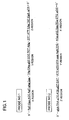
- Fig. 1 is a schematic diagram showing an example of a pair of DNA probes.
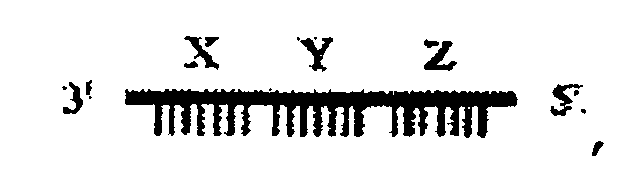
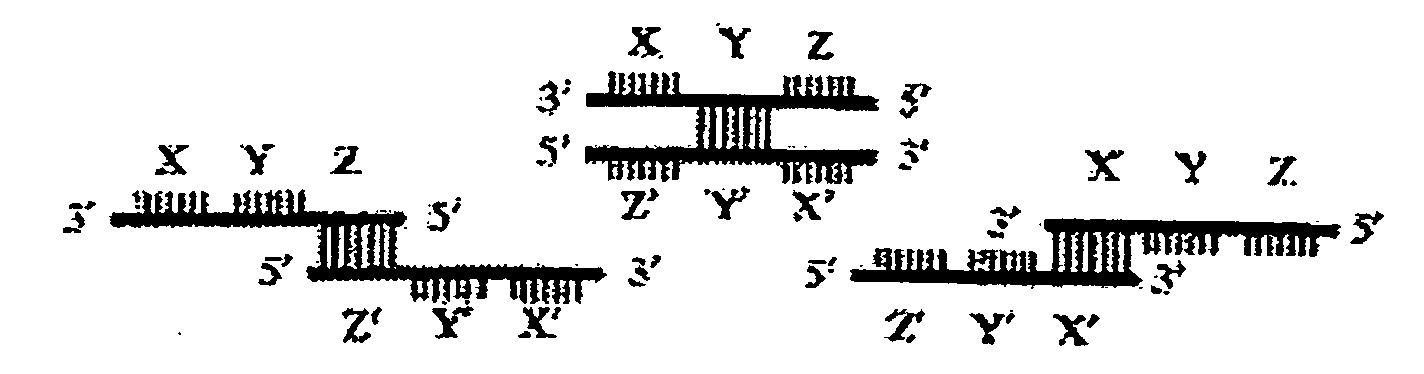
- a DNA probe No. 1 has an X-region, a Y-region and a Z-region
- a DNA probe No. 2 has an X'-region, a Y'-region and a Z'-region.
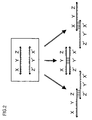
- the DNA probe No. 1 and the DNA probe No. 2 are structured such that when they are hybridized, the X-region is bound only with the X'-region; the Y-region is bound only with the Y'-region; and the Z-region is bound only with the Z'-region (see Fig. 2).
- a pair of DNA probes each composed of three or more portions complementary to such portions of the other DNA probe, according to the present invention, when they are hybridized such that they cross in alternation, the X-region is bound only with the X'-region; the Y-region is bound only with the Y'-region; and the Z-region is bound only with the Z'-region, as shown in Fig. 2, so that the pair of probes are hybridized in alternation in three binding patterns.
- the two probes are bound in alternation.
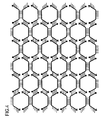
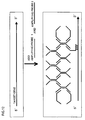
- the DNA probe No. 1 and the DNA probe No.2 are three-dimensionally bound in alternation to produce a polymer, as illustrated in Fig. 3.
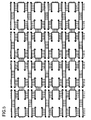
- a plurality of pairs of probes which have been hybridized in alternation in the three binding patterns shown in Fig. 2, can form a double-stranded polymer, one example of which is schematically illustrated in Fig. 3.
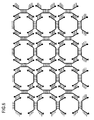
- Fig. 4 illustrates an example of a three-dimensional conceptual structure of the double-stranded polymer of Fig. 3.
- Fig. 5 is a schematic diagram illustrating a plurality of pairs of the DNA probes which have been hybridized in different binding patterns.
- Fig. 6 illustrates an example of a three-dimensional conceptual structure of the schematic diagram of Fig. 5.
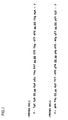
- the hybridization of two DNA probes may be performed such that when a probe No. 3 and a probe No.4 are hybridized, cleaved sites are formed by a restriction enzyme (underlined portions are cleaved by an enzyme called "Hae III"), as shown in Fig. 7.
- a restriction enzyme underlined portions are cleaved by an enzyme called "Hae III"
- a restriction enzyme can be used to prevent the polymer from cross-contamination in a subsequent different experimental operation (see Fig. 8).
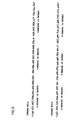
- the hybridization of two DNA probes does not require that the lengths of complementary portions in one probe be uniform, as shown in Fig. 9. Specifically, when a probe No. 5 and a probe No. 6 are hybridized, an X-region and an X'-region are hybridized with 24 bases; a Y-region and a Y'-region hybridize with 22 bases; and a Z-region and a Z'-region hybridize with 20 bases (see Fig. 10).
- one probe is structured such that a portion of gene in the probe is complementary to a target gene.
- a plurality of the pairs of probes are hybridized by the gene amplification method according to the present invention to form a double-stranded polymer which is detected by amplifying the probes.
- a probe complementary to a gene in a portion of one of the probes and a target probe is used, and previously hybridized with the target gene. Then, a plurality of the pairs of probes are hybridized by the gene amplifying method mentioned above to form a double-stranded polymer which is detected by amplifying the probes.
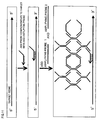
- an antigen/antibody detecting method according to the present invention will be described using a more specific example with reference to Fig. 13.
- one probe is structured such that a gene in a portion thereof is complementary to a target gene bound to antigen/antibody. Then, a plurality of the pairs of probes are hybridized by the gene amplifying method according to the present invention to form a double-stranded polymer to detect the antigen and the antibody.
- Fig. 14 is a photograph showing the results of Example 1 with electrophoresis at 100 volts for 30 minutes using 0.5% agarose gel.
- the agarose gel is a gel which can divide DNA molecules according to the size, and 0.5% agarose gel is generally used to separate DNA molecules of 30,000 - 40,000 base pairs.
- the photograph of Fig. 14 shows a polymer which has grown so much with increasing temperatures that it can no longer migrate with 0.5% agarose gel as a result of an exactly alternate double-stranded polymer formed by the pair of DNA probes depending on the temperature of hybridization.
- 5 ⁇ L of the gene amplifying probe 3 and the gene amplifying probe 4 each prepared to be 10 13 copies/ ⁇ L were added in a sterilized microtube of 0.2 mL, respectively.
- 5 ⁇ L of 20xSSC and 35 ⁇ L of sterilized distilled water were further added to produce a reaction solution A, and the microtube was covered with a lid.
- 2.5 ⁇ L of the gene amplifying probe 3 and the gene amplifying probe 4 each prepared to be 10 13 copies/ ⁇ L were added in a sterilized microtube of 0.2 mL, respectively.
- 5 ⁇ L of 20xSSC and 40 ⁇ L of sterilized distilled water were further added to produce a reaction solution B, and the microtube was covered with a lid.
- the reaction solutions A, B were boiled at 94°C for 30 seconds, and warmed at 62°C for 30 minutes, respectively.
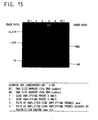
- Fig. 15 is a photograph showing the results of Example 2 with electrophoresis at 100 volts for 30 minutes using 2% agarose gel. The photograph shows that a pair of DNA probes forming a exactly alternate double-stranded polymer is was cleaved to minimum units by the restriction enzyme.
- each of synthetic HCV-RNA prepared to be 10 1 copy/10 ⁇ L, 10 2 copy/10 ⁇ L, 10 3 copy/10 ⁇ L, 10 4 copy/10 ⁇ L, 10 5 copy/10 ⁇ L, 10 6 copy/10 ⁇ L, 10 7 copy/10 ⁇ L, 10 8 copy/10 ⁇ L, 10 9 copy/10 ⁇ L, and 10 10 copy/10 ⁇ L were each added in a sterilized microtube of 0.2 mL.
- 1 ⁇ L each of the HCV-RNA capture probe B, probe C, probe D and probe E prepared to be 10 13 copies/ ⁇ L, 10 ⁇ L of the gene amplifying probe 5 prepared to be 10 13 copies/ ⁇ L, and 25 ⁇ L of 20xSSC were added.
- the respective microtubes were covered with a lid, the ingredients were mixed by a mixer, and warmed at 62 °C for 60 minutes.
- each of the microtubes was covered with a lid, and the ingredients were mixed by a mixer and warmed at 62 °C for 60 minutes.
- the magnetic beads were trapped using a magnet, and supernatant was removed. Then, 50 ⁇ L of 0.5xSSC was added. Immediately, the magnetic beads were trapped using a magnet, and supernatant was removed. Then, 50 ⁇ L of 0.5xSSC was added, and all ingredients were transferred to a flat-bottom 96 well plate. Ultraviolet rays were irradiated from the bottom of the 96 well plate, and an amplified gene, which ended up to emit fluorescence by intercalation of ethidium bromide, was photographed.
- Fig. 16 is a photograph showing the fluorescence by the ethidium bromide produced by irradiating ultraviolet rays from the bottom of the 96 well plate. As can be seen in Fig. 16, the strongest fluorescence was found at 10 10 copies/10 ⁇ L, and the fluorescence became gradually weaker in accordance with the amount of synthetic HCV-RNA.
- 10 ⁇ L of the gene amplifying probe 5 prepared to be 10 11 copies/ ⁇ L, and 20 ⁇ L of the gene amplifying probe 7 were added to each of the microtubes. They were mixed by a pipette, and then heated at 94°C for 30 seconds, and warmed at 62°C for 60 minutes.
- 0.5xSSC including 0.1%-Tween20 was used to wash four times. 100 ⁇ L of "HRP-Streptavidin” was added in each well, and warmed at 37 °C for 20 minutes. After removing the solution in each well by means of suction, 0.5xSSC including 0.1%-Tween20 was used to wash four times.
- Example 4 The results of Example 4 are shown in Table 1 below. Coloring was confirmed in accordance with the amount of added synthesized HCV-RNA in a range of 10 3 to 10 7 copies from the fact that coloring was observed in Peroxidase Conjugated Streptavidin labelled at one of a pair of DNA probes which were hybridized in alternation to form a double-stranded polymer. Number of Copies Absorbance 0 1.497 10 3 1.843 10 4 1.897 10 5 1.955 10 6 2.064 10 7 2.343
- the gene amplifying method according to the present invention can efficiently amplify a gene without using a DNA polymerase or branched DNA.
- the antigen/antibody detecting method according to the present invention can efficiently detect antigen/antibody by making use of the gene amplifying method.
Landscapes
- Chemical & Material Sciences (AREA)
- Life Sciences & Earth Sciences (AREA)
- Organic Chemistry (AREA)
- Health & Medical Sciences (AREA)
- Engineering & Computer Science (AREA)
- Wood Science & Technology (AREA)
- Zoology (AREA)
- Genetics & Genomics (AREA)
- Bioinformatics & Cheminformatics (AREA)
- Proteomics, Peptides & Aminoacids (AREA)
- Biotechnology (AREA)
- General Engineering & Computer Science (AREA)
- Immunology (AREA)
- Physics & Mathematics (AREA)
- Microbiology (AREA)
- Analytical Chemistry (AREA)
- Molecular Biology (AREA)
- Biochemistry (AREA)
- General Health & Medical Sciences (AREA)
- Biophysics (AREA)
- Biomedical Technology (AREA)
- Plant Pathology (AREA)
- Pathology (AREA)
- Crystallography & Structural Chemistry (AREA)
- Measuring Or Testing Involving Enzymes Or Micro-Organisms (AREA)
- Saccharide Compounds (AREA)
- Investigating Or Analysing Biological Materials (AREA)
Claims (15)
- Procédé de formation d'un polymère d'acide nucléique, le procédé comprenant(a) la fourniture d'une pluralité de paires de sondes d'acide nucléique, chaque sonde ayant une longueur de 10 à 1000 bases, une première sonde de ladite paire de sondes comprenant 3 régions ou plus d'acide nucléique, ladite première sonde comprenant au moins une région X d'acide nucléique, une région Y d'acide nucléique et une région Z d'acide nucléique et ayant la structure suivanteet
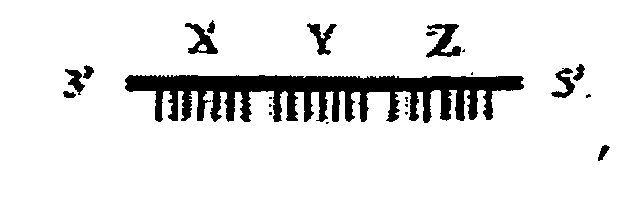
une seconde sonde de ladite paire de sondes comprenant 3 régions ou plus d'acide nucléique, ladite seconde sonde comprenant au moins une région Z' d'acide nucléique, une région Y' d'acide nucléique et une région X' d'acide nucléique et ayant la structure suivanteet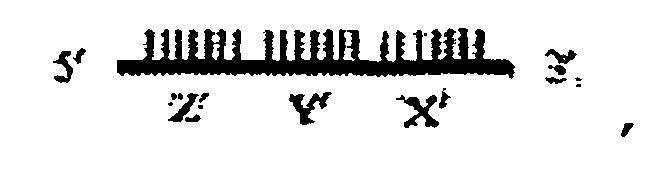 (b) la liaison de ladite pluralité de paires de sondes les unes aux autres pour former un polymère, caractérisée en ce que ladite région X d'acide nucléique est hybridable avec ladite région X' d'acide nucléique, ladite région Y d'acide nucléique est hybridable avec ladite région Y' d'acide nucléique et ladite région Z d'acide nucléique est hybridable avec ladite région Z' d'acide nucléique, de manière à ce que ladite pluralité de paires de sondes forme les structures suivanteslesquelles structures sont liées les unes avec les autres en alternance pour former ledit polymère.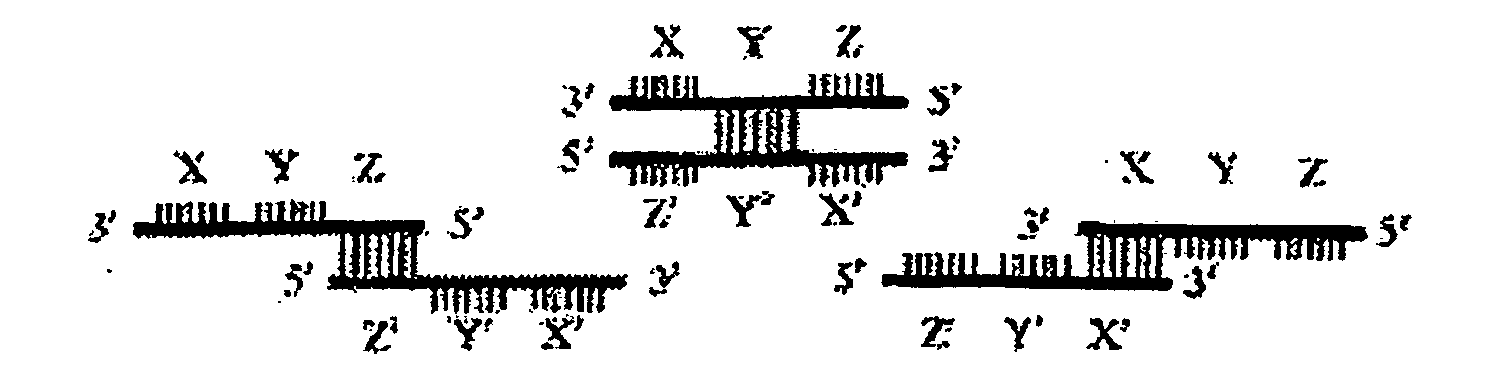
- Procédé selon la revendication 1, caractérisé en ce que ladite paire de sondes comprend deux sondes d'ADN, une sonde d'ADN et une sonde d'ARN, deux sondes d'ARN, deux sondes de PNA, une sonde de PNA et une sonde d'ADN ou une sonde de PNA et une sonde d'ARN.
- Procédé selon la revendication 1, caractérisé en ce que ladite région X d'acide nucléique est complètement complémentaire de ladite région X' d'acide nucléique, ladite région Y d'acide nucléique est complètement complémentaire de ladite région Y' d'acide nucléique et ladite région Z d'acide nucléique est complètement complémentaire de ladite région Z' d'acide nucléique.
- Procédé de détection d'un gène cible, le procédé comprenant(a) la fourniture d'une pluralité de paires de sondes d'acide nucléique, chaque sonde ayant une longueur de 10 à 1000 bases, une première sonde de ladite paire de sondes comprenant 3 régions ou plus d'acide nucléique, ladite première sonde comprenant au moins une région X d'acide nucléique, une région Y d'acide nucléique et une région Z d'acide nucléique et ayant la structure suivanteet

une seconde sonde de ladite paire de sondes comprenant 3 régions ou plus d'acide nucléique, ladite seconde sonde comprenant au moins une région Z' d'acide nucléique, une région Y' d'acide nucléique et une région X' d'acide nucléique et ayant la structure suivantecaractérisé en ce que une séquence d'une sonde de ladite paire de sondes est complémentaire d'une séquence dudit gène cible ;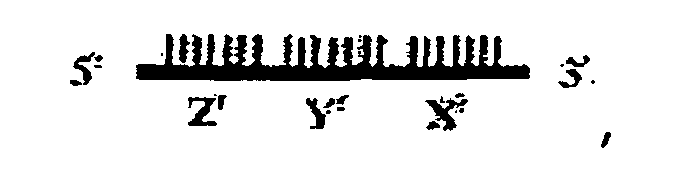 (b) la liaison dudit gène cible et de ladite pluralité de paires de sondes les uns aux autres de manière à ce que ladite pluralité de paires de sondes forme un polymère, caractérisée en ce que ladite région X d'acide nucléique est hybridable avec ladite région X' d'acide nucléique, ladite région Y d'acide nucléique est hybridable avec ladite région Y' d'acide nucléique et ladite région Z d'acide nucléique est hybridable avec ladite région Z' d'acide nucléique, de manière à ce que ladite pluralité de paires de sondes forme les structures suivanteslesquelles structures sont liées les unes avec les autres en alternance pour former ledit polymère ; et
 (c) la détection dudit polymère, détectant de cette manière ledit gène cible.
 - Procédé de détection d'un gène cible, le procédé comprenant(a) la fourniture (1) d'une pluralité de paires de sondes d'acide nucléique, chaque sonde ayant une longueur de 10 à 1000 bases, une première sonde de ladite paire de sondes comprenant 3 régions ou plus d'acide nucléique, ladite première sonde comprenant au moins une région X d'acide nucléique, une région Y d'acide nucléique et une région Z d'acide nucléique et ayant la structure suivanteet

une seconde sonde de ladite paire de sondes comprenant 3 régions ou plus d'acide nucléique, ladite seconde sonde comprenant au moins une région Z' d'acide nucléique, une région Y' d'acide nucléique et une région X' d'acide nucléique et ayant la structure suivanteet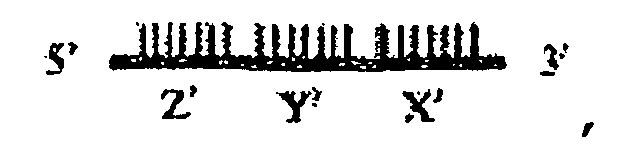
(2) une autre sonde qui contient une première séquence qui est complémentaire d'une séquence dudit gène cible et qui contient une seconde séquence qui est complémentaire d'une séquence d'une sonde de ladite paire de sondes ;(b) la liaison dudit gène cible, de ladite autre sonde et de ladite pluralité de paires de sondes les uns aux autres de manière à ce que ladite pluralité de paires de sondes forme un polymère, caractérisée en ce que ladite région X d'acide nucléique est hybridable avec ladite région X' d'acide nucléique, ladite région Y d'acide nucléique est hybridable avec ladite région Y' d'acide nucléique et ladite région Z d'acide nucléique est hybridable avec ladite région Z' d'acide nucléique, de manière à ce que ladite pluralité de paires de sondes forme les structures suivanteslesquelles structures sont liées les unes avec les autres en alternance pour former ledit polymère ; et (c) la détection dudit polymère, détectant de cette manière ledit gène cible.
 - Procédé selon la revendication 4, caractérisé en ce que ledit gène cible est lié à un complexe antigène/anticorps, détectant de cette manière ledit complexe antigène/anticorps.
- Procédé selon la revendication 5, caractérisé en ce que ledit gène cible est lié à un complexe antigène/anticorps, détectant de cette manière ledit complexe antigène/anticorps.
- Procédé selon l'une quelconque des revendications 4 à 7, caractérisé en ce que ladite paire de sondes comprend deux sondes d'ADN, une sonde d'ADN et une sonde d'ARN, deux sondes d'ARN, deux sondes de PNA, une sonde de PNA et une sonde d'ADN ou une sonde de PNA et une sonde d'ARN.
- Procédé selon l'une quelconque des revendications 4 à 7, caractérisé en ce que ladite région X d'acide nucléique est complètement complémentaire de ladite région X' d'acide nucléique, ladite région Y d'acide nucléique est complètement complémentaire de ladite région Y' d'acide nucléique et ladite région Z d'acide nucléique est complètement complémentaire de ladite région Z' d'acide nucléique.
- Procédé selon l'une quelconque des revendications 4 à 7, caractérisé en ce que ladite étape de détection (c) comprend l'incorporation d'un matériau fluorescent dans ledit polymère et ensuite la détection dudit matériau fluorescent.
- Procédé selon l'une quelconque des revendications 4 à 7, caractérisé en ce que au moins une sonde de ladite pluralité de paires de sondes comprend un matériau marqueur et ladite étape de détection (c) comprend la détection dudit matériau marqueur.
- Paire de sondes d'acide nucléique, chaque sonde ayant une longueur de 10 à 1000 bases, une première sonde de ladite paire de sondes comprenant 3 régions ou plus d'acide nucléique, ladite première sonde comprenant au moins une région X d'acide nucléique, une région Y d'acide nucléique et une région Z d'acide nucléique et ayant la structure suivanteet
une seconde sonde de ladite paire de sondes comprenant 3 régions ou plus d'acide nucléique, ladite seconde sonde comprenant au moins une région Z' d'acide nucléique, une région Y' d'acide nucléique et une région X' d'acide nucléique et ayant la structure suivanteet
caractérisée en ce que ladite région X d'acide nucléique est hybridable avec ladite région X' d'acide nucléique, ladite région Y d'acide nucléique est hybridable avec ladite région Y' d'acide nucléique et ladite région Z d'acide nucléique est hybridable avec ladite région Z' d'acide nucléique, de manière à ce que ladite paire de sondes forme l'une des structures suivantes
- Paire de sondes selon la revendication 12, caractérisée en ce que ladite paire de sondes comprend deux sondes d'ADN, une sonde d'ADN et une sonde d'ARN, deux sondes d'ARN, deux sondes de PNA, une sonde de PNA et une sonde d'ADN ou une sonde de PNA et une sonde d'ARN.
- Polymère, composé d'une pluralité de paires de sondes selon la revendication 12, caractérisé en ce que ladite pluralité de paires de sondes forme les structures suivanteslesquelles structures sont liées les unes avec les autres en alternance pour former ledit polymère.
- Polymère selon la revendication 14, caractérisé en ce que ladite paire de sondes comprend deux sondes d'ADN, une sonde d'ADN et une sonde d'ARN, deux sondes d'ARN, deux sondes de PNA, une sonde de PNA et une sonde d'ADN ou une sonde de PNA et une sonde d'ARN.
Applications Claiming Priority (4)
| Application Number | Priority Date | Filing Date | Title |
|---|---|---|---|
| JP31805698 | 1998-11-09 | ||
| JP31805698 | 1998-11-09 | ||
| JP6347699 | 1999-03-10 | ||
| JP06347699A JP3267576B2 (ja) | 1998-11-09 | 1999-03-10 | プローブ高分子の形成方法 |
Publications (3)
| Publication Number | Publication Date |
|---|---|
| EP1002877A2 EP1002877A2 (fr) | 2000-05-24 |
| EP1002877A3 EP1002877A3 (fr) | 2002-02-20 |
| EP1002877B1 true EP1002877B1 (fr) | 2005-09-07 |
Family
ID=26404605
Family Applications (1)
| Application Number | Title | Priority Date | Filing Date |
|---|---|---|---|
| EP99121773A Expired - Lifetime EP1002877B1 (fr) | 1998-11-09 | 1999-11-03 | Procédé pour l'amplification génique |
Country Status (6)
| Country | Link |
|---|---|
| US (1) | US6261846B1 (fr) |
| EP (1) | EP1002877B1 (fr) |
| JP (1) | JP3267576B2 (fr) |
| AT (1) | ATE304059T1 (fr) |
| DE (1) | DE69927113T2 (fr) |
| ES (1) | ES2248953T3 (fr) |
Cited By (1)
| Publication number | Priority date | Publication date | Assignee | Title |
|---|---|---|---|---|
| EP1997908A4 (fr) * | 2006-03-15 | 2010-09-29 | Eisai R&D Man Co Ltd | Procédé de formation d'un polymère de sondes de signal |
Families Citing this family (30)
| Publication number | Priority date | Publication date | Assignee | Title |
|---|---|---|---|---|
| US20030211496A1 (en) * | 2000-03-29 | 2003-11-13 | Getts Robert C | Quality control reagents for nucleic acid microarrays |
| KR100446358B1 (ko) | 2000-03-31 | 2004-09-01 | 산코 준야쿠 가부시키가이샤 | 프로우브 중합체 제작용 프로우브, 프로우브 중합체의 제작방법 및 그 이용 |
| KR20020065471A (ko) * | 2000-08-30 | 2002-08-13 | 산코 준야쿠 가부시키가이샤 | 유전자의 검출방법 |
| ES2273892T3 (es) * | 2000-10-11 | 2007-05-16 | Sanko Junyaku Co., Ltd. | Procedimiento de construccion de sondas de autoensamblaje y procedimiento de deteccion de las mismas. |
| US20050130139A1 (en) * | 2001-09-28 | 2005-06-16 | Mitsugu Usui | Method f amplifying dna chip signals |
| JPWO2003040367A1 (ja) | 2001-11-08 | 2005-03-03 | 三光純薬株式会社 | 遺伝子増幅反応で合成されたオリゴヌクレオチドによる自己集合体の形成方法、自己集合体及び遺伝子の検出方法 |
| US20040029142A1 (en) * | 2002-02-11 | 2004-02-12 | Schon Eric A. | Concatenation-based nucleic acid detection compositions and methods |
| CA2515734C (fr) * | 2003-02-14 | 2013-04-09 | Eisai Co., Ltd. | Procede d'amplification de signaux destine a la detection du gene exprime |
| AU2004213716B2 (en) * | 2003-02-21 | 2008-02-28 | Eisai R&D Management Co., Ltd. | Signal amplification method for detecting mutant gene |
| US7306915B2 (en) | 2004-03-22 | 2007-12-11 | Sysmex Corporation | Probe set for detection of target substance and detection method using the same |
| US7745124B2 (en) | 2004-04-28 | 2010-06-29 | Eisai R&D Management Co., Ltd. | Hybridization method |
| DE602005020319D1 (de) | 2004-09-08 | 2010-05-12 | Eisai R&D Man Co Ltd | Verfahren zur bildung eines signalsondenpolymers |
| ATE526402T1 (de) | 2005-02-28 | 2011-10-15 | Eisai R&D Man Co Ltd | Hilfssonden und verfahren zur verwendung davon |
| JPWO2006093150A1 (ja) * | 2005-02-28 | 2008-08-07 | エーザイ・アール・アンド・ディー・マネジメント株式会社 | シグナル増幅方法 |
| JP4616881B2 (ja) * | 2005-02-28 | 2011-01-19 | エーザイ・アール・アンド・ディー・マネジメント株式会社 | アシストプローブ及びその利用方法 |
| JP3941828B2 (ja) * | 2005-09-15 | 2007-07-04 | トヨタ自動車株式会社 | 内燃機関の空燃比制御装置 |
| EP1939622B1 (fr) | 2005-09-27 | 2011-09-21 | Eisai R&D Management Co., Ltd. | Procédé de formation d'un autoagrégat sur une microparticule et procédé de détection d'un analyte ciblé |
| EP2179052B1 (fr) * | 2007-07-09 | 2012-11-14 | Microsens Medtech Ltd | Détection de micro-organismes, basée sur leur activité ligase nad-dépendante |
| SG185315A1 (en) | 2007-10-24 | 2012-11-29 | Eisai R&D Man Co Ltd | Nucleic acid probe, and method of forming probe -polymer |
| JPWO2009057702A1 (ja) | 2007-10-31 | 2011-03-10 | エーザイ・アール・アンド・ディー・マネジメント株式会社 | 標的物質検出用ポリマー及び標的物質の検出方法 |
| JP2012070635A (ja) * | 2009-01-29 | 2012-04-12 | Eisai R & D Management Co Ltd | 核酸の検出方法 |
| WO2013172305A1 (fr) | 2012-05-15 | 2013-11-21 | エーザイ・アール・アンド・ディー・マネジメント株式会社 | Procédé de détection et nécessaire de détection d'arn |
| US10510435B2 (en) | 2013-04-30 | 2019-12-17 | California Institute Of Technology | Error correction of multiplex imaging analysis by sequential hybridization |
| CA2907493A1 (fr) | 2013-04-30 | 2014-11-13 | California Institute Of Technology | Marquage multiplex de molecules par marquage par code-barres a hybridation sequentielle |
| US12421540B2 (en) | 2016-08-01 | 2025-09-23 | California Institute Of Technology | Sequential probing of molecular targets based on pseudo-color barcodes with embedded error correction mechanism |
| GB201805479D0 (en) | 2018-04-03 | 2018-05-16 | Momentum Bioscience Ltd | Microorganism separation and detection |
| GB201914538D0 (en) | 2019-10-08 | 2019-11-20 | Momentum Bioscience Ltd | Microorganism capture from antimicrobial-containing solution |
| KR102261979B1 (ko) * | 2019-10-28 | 2021-06-07 | 재단법인 대구경북첨단의료산업진흥재단 | 핵산분해효소 연쇄 반응 |
| JP7062803B1 (ja) | 2021-03-31 | 2022-05-06 | 積水メディカル株式会社 | 抗薬物抗体測定方法 |
| GB202405229D0 (en) | 2024-04-12 | 2024-05-29 | Momentum Bioscience Ltd | Microorganism enumeration |
Family Cites Families (10)
| Publication number | Priority date | Publication date | Assignee | Title |
|---|---|---|---|---|
| CA1260372A (fr) * | 1984-04-27 | 1989-09-26 | Elazar Rabbani | Methode d'hybridation pour la detection de materiaux genetiques |
| US5273882A (en) * | 1985-06-13 | 1993-12-28 | Amgen | Method and kit for performing nucleic acid hybridization assays |
| US5175270A (en) * | 1986-09-10 | 1992-12-29 | Polyprobe, Inc. | Reagents for detecting and assaying nucleic acid sequences |
| CA2039517C (fr) * | 1990-04-03 | 2006-11-07 | David Segev | Amplification du signal d'une sonde d'adn |
| US5424413A (en) * | 1992-01-22 | 1995-06-13 | Gen-Probe Incorporated | Branched nucleic acid probes |
| WO1995019449A1 (fr) * | 1994-01-14 | 1995-07-20 | Aprogenex, Inc. | Populations de sondes d'hybridation non adjacentes |
| US5561043A (en) * | 1994-01-31 | 1996-10-01 | Trustees Of Boston University | Self-assembling multimeric nucleic acid constructs |
| US5605793A (en) * | 1994-02-17 | 1997-02-25 | Affymax Technologies N.V. | Methods for in vitro recombination |
| US5834252A (en) * | 1995-04-18 | 1998-11-10 | Glaxo Group Limited | End-complementary polymerase reaction |
| US5942391A (en) * | 1994-06-22 | 1999-08-24 | Mount Sinai School Of Medicine | Nucleic acid amplification method: ramification-extension amplification method (RAM) |
-
1999
- 1999-03-10 JP JP06347699A patent/JP3267576B2/ja not_active Expired - Lifetime
- 1999-04-15 US US09/292,563 patent/US6261846B1/en not_active Expired - Lifetime
- 1999-11-03 DE DE69927113T patent/DE69927113T2/de not_active Expired - Lifetime
- 1999-11-03 ES ES99121773T patent/ES2248953T3/es not_active Expired - Lifetime
- 1999-11-03 EP EP99121773A patent/EP1002877B1/fr not_active Expired - Lifetime
- 1999-11-03 AT AT99121773T patent/ATE304059T1/de not_active IP Right Cessation
Cited By (1)
| Publication number | Priority date | Publication date | Assignee | Title |
|---|---|---|---|---|
| EP1997908A4 (fr) * | 2006-03-15 | 2010-09-29 | Eisai R&D Man Co Ltd | Procédé de formation d'un polymère de sondes de signal |
Also Published As
| Publication number | Publication date |
|---|---|
| JP2000201687A (ja) | 2000-07-25 |
| ATE304059T1 (de) | 2005-09-15 |
| US6261846B1 (en) | 2001-07-17 |
| ES2248953T3 (es) | 2006-03-16 |
| DE69927113D1 (de) | 2005-10-13 |
| JP3267576B2 (ja) | 2002-03-18 |
| US20010019835A1 (en) | 2001-09-06 |
| EP1002877A3 (fr) | 2002-02-20 |
| DE69927113T2 (de) | 2006-01-19 |
| EP1002877A2 (fr) | 2000-05-24 |
Similar Documents
| Publication | Publication Date | Title |
|---|---|---|
| EP1002877B1 (fr) | Procédé pour l'amplification génique | |
| ES2324125T3 (es) | Cebadores y sondas de acidos nucleicos para detectar vih-1 y vih-2. | |
| US6001614A (en) | Methods of synthesizing labeled polynucleotides by ligation of multiple oligomers | |
| CN106434871B (zh) | 用于检测目标核酸的方法与组合物 | |
| EP0826069B1 (fr) | Procede de detection d'acides nucleiques a large plage dynamique, utilisant une serie complexe d'amorces | |
| EP0731848B1 (fr) | Essais en sandwiches d'acides nucleiques en phase de solution presentant un bruit de fond reduit | |
| CN103146825B (zh) | 核酸的检测 | |
| JP2021531778A (ja) | 核酸検出方法 | |
| US20080131890A1 (en) | Detection of nucleic acids | |
| CA2595729A1 (fr) | Procedes et compositions pour detection a plage dynamique augmentee de molecules d'acide nucleique | |
| KR100446358B1 (ko) | 프로우브 중합체 제작용 프로우브, 프로우브 중합체의 제작방법 및 그 이용 | |
| EP1428892B1 (fr) | Amorces et sondes à double usage pour l'amélioration d'essais d'hybridations parla perturbation de la formation de structures secondaires | |
| JPH05508323A (ja) | 蛍光分極によるdna/rnaの検出 | |
| US8063196B2 (en) | Highly orthogonal universal sequences for use in nucleic acid assays | |
| US7977108B2 (en) | Method for detecting a mutation in a repetitive nucleic acid sequence | |
| ES2256984T3 (es) | Deteccion de adn mediante un complejo de reasociacion de hebras. | |
| JP5099920B2 (ja) | 核酸試験用対照 | |
| KR102062418B1 (ko) | 표적 핵산의 검출 방법 | |
| AU772995B2 (en) | Methods of synthesizing polynucleotides by ligation of multiple oligomers | |
| WO2002061147A2 (fr) | Sonde moleculaire auto-complementaire | |
| US7306915B2 (en) | Probe set for detection of target substance and detection method using the same | |
| HK1198548B (en) | Methods and compositions for detecting target nucleic acids | |
| JP2007330134A (ja) | 核酸の検出方法 |
Legal Events
| Date | Code | Title | Description |
|---|---|---|---|
| PUAI | Public reference made under article 153(3) epc to a published international application that has entered the european phase |
Free format text: ORIGINAL CODE: 0009012 |
|
| AK | Designated contracting states |
Kind code of ref document: A2 Designated state(s): AT BE CH CY DE DK ES FI FR GB GR IE IT LI LU MC NL PT SE |
|
| AX | Request for extension of the european patent |
Free format text: AL;LT;LV;MK;RO;SI |
|
| RIN1 | Information on inventor provided before grant (corrected) |
Inventor name: USUI, MITSUGU |
|
| PUAL | Search report despatched |
Free format text: ORIGINAL CODE: 0009013 |
|
| AK | Designated contracting states |
Kind code of ref document: A3 Designated state(s): AT BE CH CY DE DK ES FI FR GB GR IE IT LI LU MC NL PT SE |
|
| AX | Request for extension of the european patent |
Free format text: AL;LT;LV;MK;RO;SI |
|
| RIC1 | Information provided on ipc code assigned before grant |
Free format text: 7C 12Q 1/68 A, 7G 01N 33/53 B |
|
| 17P | Request for examination filed |
Effective date: 20020607 |
|
| AKX | Designation fees paid |
Free format text: AT BE CH CY DE DK ES FI FR GB GR IE IT LI LU MC NL PT SE |
|
| 17Q | First examination report despatched |
Effective date: 20030110 |
|
| GRAP | Despatch of communication of intention to grant a patent |
Free format text: ORIGINAL CODE: EPIDOSNIGR1 |
|
| GRAS | Grant fee paid |
Free format text: ORIGINAL CODE: EPIDOSNIGR3 |
|
| GRAA | (expected) grant |
Free format text: ORIGINAL CODE: 0009210 |
|
| AK | Designated contracting states |
Kind code of ref document: B1 Designated state(s): AT BE CH CY DE DK ES FI FR GB GR IE IT LI LU MC NL PT SE |
|
| PG25 | Lapsed in a contracting state [announced via postgrant information from national office to epo] |
Ref country code: FI Free format text: LAPSE BECAUSE OF FAILURE TO SUBMIT A TRANSLATION OF THE DESCRIPTION OR TO PAY THE FEE WITHIN THE PRESCRIBED TIME-LIMIT Effective date: 20050907 Ref country code: BE Free format text: LAPSE BECAUSE OF FAILURE TO SUBMIT A TRANSLATION OF THE DESCRIPTION OR TO PAY THE FEE WITHIN THE PRESCRIBED TIME-LIMIT Effective date: 20050907 Ref country code: AT Free format text: LAPSE BECAUSE OF FAILURE TO SUBMIT A TRANSLATION OF THE DESCRIPTION OR TO PAY THE FEE WITHIN THE PRESCRIBED TIME-LIMIT Effective date: 20050907 |
|
| REG | Reference to a national code |
Ref country code: GB Ref legal event code: FG4D |
|
| REG | Reference to a national code |
Ref country code: CH Ref legal event code: NV Representative=s name: BOVARD AG PATENTANWAELTE Ref country code: CH Ref legal event code: EP |
|
| REG | Reference to a national code |
Ref country code: IE Ref legal event code: FG4D |
|
| REF | Corresponds to: |
Ref document number: 69927113 Country of ref document: DE Date of ref document: 20051013 Kind code of ref document: P |
|
| REG | Reference to a national code |
Ref country code: SE Ref legal event code: TRGR |
|
| PG25 | Lapsed in a contracting state [announced via postgrant information from national office to epo] |
Ref country code: IE Free format text: LAPSE BECAUSE OF NON-PAYMENT OF DUE FEES Effective date: 20051103 Ref country code: CY Free format text: LAPSE BECAUSE OF FAILURE TO SUBMIT A TRANSLATION OF THE DESCRIPTION OR TO PAY THE FEE WITHIN THE PRESCRIBED TIME-LIMIT Effective date: 20051103 |
|
| PG25 | Lapsed in a contracting state [announced via postgrant information from national office to epo] |
Ref country code: MC Free format text: LAPSE BECAUSE OF NON-PAYMENT OF DUE FEES Effective date: 20051130 Ref country code: LU Free format text: LAPSE BECAUSE OF NON-PAYMENT OF DUE FEES Effective date: 20051130 |
|
| PG25 | Lapsed in a contracting state [announced via postgrant information from national office to epo] |
Ref country code: GR Free format text: LAPSE BECAUSE OF FAILURE TO SUBMIT A TRANSLATION OF THE DESCRIPTION OR TO PAY THE FEE WITHIN THE PRESCRIBED TIME-LIMIT Effective date: 20051207 Ref country code: DK Free format text: LAPSE BECAUSE OF FAILURE TO SUBMIT A TRANSLATION OF THE DESCRIPTION OR TO PAY THE FEE WITHIN THE PRESCRIBED TIME-LIMIT Effective date: 20051207 |
|
| PG25 | Lapsed in a contracting state [announced via postgrant information from national office to epo] |
Ref country code: PT Free format text: LAPSE BECAUSE OF FAILURE TO SUBMIT A TRANSLATION OF THE DESCRIPTION OR TO PAY THE FEE WITHIN THE PRESCRIBED TIME-LIMIT Effective date: 20060207 |
|
| REG | Reference to a national code |
Ref country code: ES Ref legal event code: FG2A Ref document number: 2248953 Country of ref document: ES Kind code of ref document: T3 |
|
| ET | Fr: translation filed | ||
| PLBE | No opposition filed within time limit |
Free format text: ORIGINAL CODE: 0009261 |
|
| STAA | Information on the status of an ep patent application or granted ep patent |
Free format text: STATUS: NO OPPOSITION FILED WITHIN TIME LIMIT |
|
| 26N | No opposition filed |
Effective date: 20060608 |
|
| REG | Reference to a national code |
Ref country code: IE Ref legal event code: MM4A |
|
| REG | Reference to a national code |
Ref country code: CH Ref legal event code: PFA Owner name: SANKO JUNYAKU CO., LTD. Free format text: SANKO JUNYAKU CO., LTD.#TMM BLDG. 10-6 IWAMOTO-CHO 1-CHOME, CHIYODA-KU#TOKYO 101-0032 (JP) -TRANSFER TO- SANKO JUNYAKU CO., LTD.#TMM BLDG. 10-6 IWAMOTO-CHO 1-CHOME, CHIYODA-KU#TOKYO 101-0032 (JP) |
|
| REG | Reference to a national code |
Ref country code: NL Ref legal event code: TD Effective date: 20110711 |
|
| REG | Reference to a national code |
Ref country code: CH Ref legal event code: PFA Owner name: EIDIA CO., LTD. Free format text: SANKO JUNYAKU CO., LTD.#TMM BLDG. 10-6 IWAMOTO-CHO 1-CHOME, CHIYODA-KU#TOKYO 101-0032 (JP) -TRANSFER TO- EIDIA CO., LTD.#1-10-6 IWAMOTO-CHO CHIYODA-KU#101-0032 TOKYO (JP) |
|
| REG | Reference to a national code |
Ref country code: FR Ref legal event code: CD Owner name: EIDIA CO., LTD. Effective date: 20110830 |
|
| REG | Reference to a national code |
Ref country code: DE Ref legal event code: R082 Ref document number: 69927113 Country of ref document: DE Representative=s name: GRUENECKER PATENT- UND RECHTSANWAELTE PARTG MB, DE Effective date: 20110818 Ref country code: DE Ref legal event code: R082 Ref document number: 69927113 Country of ref document: DE Representative=s name: GRUENECKER, KINKELDEY, STOCKMAIR & SCHWANHAEUS, DE Effective date: 20110818 Ref country code: DE Ref legal event code: R081 Ref document number: 69927113 Country of ref document: DE Owner name: EIDIA CO., LTD., JP Free format text: FORMER OWNER: SANKO JUNYAKU CO., LTD., TOKIO/TOKYO, JP Effective date: 20110818 |
|
| REG | Reference to a national code |
Ref country code: ES Ref legal event code: PC2A Owner name: EIDIA CO., LTD Effective date: 20111102 |
|
| PGFP | Annual fee paid to national office [announced via postgrant information from national office to epo] |
Ref country code: FR Payment date: 20141119 Year of fee payment: 16 Ref country code: CH Payment date: 20141119 Year of fee payment: 16 Ref country code: GB Payment date: 20141119 Year of fee payment: 16 Ref country code: DE Payment date: 20141119 Year of fee payment: 16 Ref country code: SE Payment date: 20141119 Year of fee payment: 16 Ref country code: ES Payment date: 20141126 Year of fee payment: 16 |
|
| PGFP | Annual fee paid to national office [announced via postgrant information from national office to epo] |
Ref country code: NL Payment date: 20141119 Year of fee payment: 16 |
|
| PGFP | Annual fee paid to national office [announced via postgrant information from national office to epo] |
Ref country code: IT Payment date: 20141127 Year of fee payment: 16 |
|
| REG | Reference to a national code |
Ref country code: DE Ref legal event code: R119 Ref document number: 69927113 Country of ref document: DE |
|
| REG | Reference to a national code |
Ref country code: CH Ref legal event code: PL |
|
| GBPC | Gb: european patent ceased through non-payment of renewal fee |
Effective date: 20151103 |
|
| PG25 | Lapsed in a contracting state [announced via postgrant information from national office to epo] |
Ref country code: CH Free format text: LAPSE BECAUSE OF NON-PAYMENT OF DUE FEES Effective date: 20151130 Ref country code: LI Free format text: LAPSE BECAUSE OF NON-PAYMENT OF DUE FEES Effective date: 20151130 Ref country code: IT Free format text: LAPSE BECAUSE OF NON-PAYMENT OF DUE FEES Effective date: 20151103 |
|
| REG | Reference to a national code |
Ref country code: NL Ref legal event code: MM Effective date: 20151201 |
|
| REG | Reference to a national code |
Ref country code: FR Ref legal event code: ST Effective date: 20160729 |
|
| PG25 | Lapsed in a contracting state [announced via postgrant information from national office to epo] |
Ref country code: SE Free format text: LAPSE BECAUSE OF NON-PAYMENT OF DUE FEES Effective date: 20151104 |
|
| PG25 | Lapsed in a contracting state [announced via postgrant information from national office to epo] |
Ref country code: NL Free format text: LAPSE BECAUSE OF NON-PAYMENT OF DUE FEES Effective date: 20151201 |
|
| PG25 | Lapsed in a contracting state [announced via postgrant information from national office to epo] |
Ref country code: GB Free format text: LAPSE BECAUSE OF NON-PAYMENT OF DUE FEES Effective date: 20151103 Ref country code: DE Free format text: LAPSE BECAUSE OF NON-PAYMENT OF DUE FEES Effective date: 20160601 |
|
| PG25 | Lapsed in a contracting state [announced via postgrant information from national office to epo] |
Ref country code: FR Free format text: LAPSE BECAUSE OF NON-PAYMENT OF DUE FEES Effective date: 20151130 |
|
| REG | Reference to a national code |
Ref country code: ES Ref legal event code: FD2A Effective date: 20170127 |
|
| PG25 | Lapsed in a contracting state [announced via postgrant information from national office to epo] |
Ref country code: ES Free format text: LAPSE BECAUSE OF NON-PAYMENT OF DUE FEES Effective date: 20151104 |