EP1002965A1 - Palier refroidissable - Google Patents
Palier refroidissable Download PDFInfo
- Publication number
- EP1002965A1 EP1002965A1 EP98121957A EP98121957A EP1002965A1 EP 1002965 A1 EP1002965 A1 EP 1002965A1 EP 98121957 A EP98121957 A EP 98121957A EP 98121957 A EP98121957 A EP 98121957A EP 1002965 A1 EP1002965 A1 EP 1002965A1
- Authority
- EP
- European Patent Office
- Prior art keywords
- bearing
- flow paths
- bearing body
- sliding surface
- cooling
- Prior art date
- Legal status (The legal status is an assumption and is not a legal conclusion. Google has not performed a legal analysis and makes no representation as to the accuracy of the status listed.)
- Withdrawn
Links
- 239000012809 cooling fluid Substances 0.000 claims abstract description 28
- 238000001816 cooling Methods 0.000 claims abstract description 27
- WYTGDNHDOZPMIW-RCBQFDQVSA-N alstonine Natural products C1=CC2=C3C=CC=CC3=NC2=C2N1C[C@H]1[C@H](C)OC=C(C(=O)OC)[C@H]1C2 WYTGDNHDOZPMIW-RCBQFDQVSA-N 0.000 claims description 5
- 238000005452 bending Methods 0.000 claims description 5
- 239000000314 lubricant Substances 0.000 description 15
- 238000004519 manufacturing process Methods 0.000 description 4
- 238000010792 warming Methods 0.000 description 3
- 239000012530 fluid Substances 0.000 description 2
- 238000004804 winding Methods 0.000 description 2
- 230000006978 adaptation Effects 0.000 description 1
- 230000015572 biosynthetic process Effects 0.000 description 1
- 239000011248 coating agent Substances 0.000 description 1
- 238000000576 coating method Methods 0.000 description 1
- 238000010276 construction Methods 0.000 description 1
- 239000000835 fiber Substances 0.000 description 1
- 230000001050 lubricating effect Effects 0.000 description 1
- 239000000463 material Substances 0.000 description 1
- 239000000155 melt Substances 0.000 description 1
- 238000002844 melting Methods 0.000 description 1
- 230000008018 melting Effects 0.000 description 1
- 230000007935 neutral effect Effects 0.000 description 1
Images


Classifications
-
- F—MECHANICAL ENGINEERING; LIGHTING; HEATING; WEAPONS; BLASTING
- F16—ENGINEERING ELEMENTS AND UNITS; GENERAL MEASURES FOR PRODUCING AND MAINTAINING EFFECTIVE FUNCTIONING OF MACHINES OR INSTALLATIONS; THERMAL INSULATION IN GENERAL
- F16C—SHAFTS; FLEXIBLE SHAFTS; ELEMENTS OR CRANKSHAFT MECHANISMS; ROTARY BODIES OTHER THAN GEARING ELEMENTS; BEARINGS
- F16C37/00—Cooling of bearings
- F16C37/002—Cooling of bearings of fluid bearings
-
- F—MECHANICAL ENGINEERING; LIGHTING; HEATING; WEAPONS; BLASTING
- F16—ENGINEERING ELEMENTS AND UNITS; GENERAL MEASURES FOR PRODUCING AND MAINTAINING EFFECTIVE FUNCTIONING OF MACHINES OR INSTALLATIONS; THERMAL INSULATION IN GENERAL
- F16C—SHAFTS; FLEXIBLE SHAFTS; ELEMENTS OR CRANKSHAFT MECHANISMS; ROTARY BODIES OTHER THAN GEARING ELEMENTS; BEARINGS
- F16C17/00—Sliding-contact bearings for exclusively rotary movement
- F16C17/02—Sliding-contact bearings for exclusively rotary movement for radial load only
- F16C17/03—Sliding-contact bearings for exclusively rotary movement for radial load only with tiltably-supported segments, e.g. Michell bearings
Definitions
- the invention relates to a coolable bearing with a bearing body, the one sliding surface for the sliding contact of one bearing body.
- the invention relates a turbo machine warehouse.
- FIG. 10 shows the bearing of a turbine shaft in a radial plain bearing.
- the radial plain bearing is designed as a tilting segment bearing.
- Such a tilting segment bearing is the turbine shaft is supported with individual, tiltable bearing segments.
- Oil is supplied to the bearing as a lubricant.
- the oil is supplied via an annular channel in a bearing ring in which the tilting segments are held.
- the oil is conveyed from the annular channel through the segments to an entry edge via an oil hole in each case
- the oil passes into a gap between the turbine shaft and the tilting segments.
- Critical operating conditions of the bearing are reflected in an increase in the bearing temperature.
- Thermocouples are installed to monitor the bearing temperature.
- Hydrodynamic thrust bearings are shown on page 359 in the same Book described. Such axial bearings are used to accommodate Thrust z. B. by a turbine shaft. Axial bearings too are often designed as tilting segment bearings, such as B. in Figure 10.35 on page 361 recognizable.
- the object of the invention is to provide a heavy duty Camp.
- this object is achieved with a bearing a bearing body, which is a sliding surface for the sliding system of a body to be stored, wherein in the bearing body Flow paths for a cooling fluid are provided so that the The sliding surface can be cooled by the cooling fluid.
- Cooling fluid oil which is also used as a lubricant.
- the bearing is thus compared to pure external cooling of the bearing body is more resilient because the Friction generated heat is dissipated better and therefore it too a lower temperature increase comes.
- the flow paths are preferably each one along Channel line directed cooling channels with one channel wall each educated.
- the bearing body has cooling channels, for. B. cylindrical Holes through which the cooling fluid flows.
- the flow paths preferably run in one of support elements penetrated flow space.
- the flow paths are not formed by separate channels, but run in a flow space. All points in this Flow spaces are fluidly connected to one another.
- Such a flow space is, for. B. by a double-walled Structure of the bearing body is formed, with a sliding surface Part of the bearing body and an opposite part rear part of the bearing body one include gap-shaped flow space. To accommodate the bearing forces exerted on the sliding surface become the two Bearing body parts connected to each other by the support elements. The support elements flow through the flow space passing the cooling fluid and cooling the sliding surface.
- the flow paths preferably run parallel to the Sliding surface.
- the flow paths are thus at every point Sliding surface equally spaced, so that even cooling the sliding surface is made possible.
- the bearing body is subject to bending stress a mechanical tension can be generated.
- a mechanical tension can be generated.
- the flow paths preferably run in this area of minimal mechanical stress. So that is ensures that the mechanical strength of the bearing body is not affected by the flow paths.
- a first part of mutually parallel flow paths is preferred and a second part of parallel flow paths provided, the first part transversely, in particular runs perpendicular to the second part. This corresponds to one grid formed by the flow paths.
- Such a grid A flow path that runs transversely to one another is particularly granted efficient cooling of the sliding surface.
- Cooling fins are preferred along at least part of the flow paths Cooling fins arranged.
- the surface is through the cooling fins the flow paths enlarged. This leads to an improved Heat transfer between the cooling fluid and the environment the flow paths. This will improve cooling of the Sliding surface reached.
- At least part of the flow paths is preferably tortuous, especially like a serpentine.
- the flow paths can also be comparatively small Number of flow paths cooled a significant area become.
- a winding guide By appropriately guiding the flow paths a to the existing heat distribution in the bearing body adapted cooling take place.
- Such an adjustment to a heat distribution in the bearing body is preferably also thereby achievable that part of the flow paths one Cross-sectional area changing along the respective flow path having.
- a flow path that is extends from the edge of the bearing body inside, one cross-sectional area increasing from the edge to the inside exhibit. Due to the larger cross-sectional area inside increased cooling is achieved there by the cooling fluid.
- the edge of the bearing body can, for. B. then with one lesser cooling will get by if there is a flow around it is cooled with the lubricant.
- the bearing body is preferably composed of at least two parts can be assembled, in a surface of at least one of the grooves are introduced so that through these grooves the flow paths are formed in the assembled bearing body become.
- This configuration also leaves one in particular more complicated design of the flow paths in production engineering comparatively simple way to. For example can be a serpentine course of the grooves or a changing cross-section of the grooves milled into the surface become.
- the grooves lie after the bearing body parts have been joined together inside the bearing body and form the flow paths. Also the formation of cooling fins or turbulators In this way, the flow paths are manufacturing-related simply possible.
- the bearing is preferably designed as an axial bearing.
- the radial bearing can e.g. B. be designed as a liner. You can the flow paths z. B. in the circumferential direction inside of the bearing body extend along the sliding surface. You can but also z. B. run along the axial direction.
- the radial bearing can also consist of two or more bearing shells be constructed.
- the bearing body is preferably a tilting segment. Every tilt segment of a bearing is an independent component, which attaches itself to the body to be stored. With one horizontal arranged radial bearing carries only a part of the tilt segments those caused by the weight of the body to be stored essential bearing forces. Preferably only point these load-bearing tipping segments flow paths inside them on. In the case of an axial bearing, all tilt segments are preferably can be cooled by internal flow paths using a cooling fluid.
- the tilting segment further preferably has one of the sliding surfaces opposite back and one between sliding surface and Rear side surface on, the flow paths from one side surface to another side surface run through the tilting segment.
- the lubricant especially oil, occurs through the flow paths running through the tilting segment through it.
- a pressure gradient required for this is preferred constructed in that the flow paths towards a Direction of rotation of a rotating body to be supported are.
- a pressure gradient for the cooling fluid is e.g. B. also built up by means of a centrifugal force in that the Flow paths with respect to an axis of rotation of the body to be supported extend radially outward.
- the bearing is preferably designed as a turbomachine bearing. Particularly high forces occur in turbomachinery, so that here an improvement in the load capacity of the bearings through internal cooling of the bearing body is particularly advantageous is.
- the turbomachine is preferably a gas or Steam turbine or a turbogenerator.
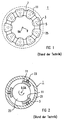
- FIG. 1 shows a plan view of a designed as a tilting segment bearing Axial bearing 1 according to the prior art.
- Tilting segments 3 are tiltable by means of support buttons 5 in the circumferential direction attached equidistant to a support ring 7.
- the warehouse 1 is symmetrical about an axis 9.
- Each tilt segment 3 is a bearing body 3 of the bearing 1 and has one Sliding surface 11 on. Rotates on the sliding surfaces 11 a body 25 to be stored (see FIG. 2), e.g. B. a turbine shaft.
- An axis of rotation 9A of the body 25 to be supported is parallel to axis 9 and perpendicular to each sliding surface 11.
- the sliding surfaces 11 are levels.
- FIG. 2 shows a cross section through a tilting segment bearing executed radial bearing 1 according to the prior art.
- Fastening elements 23 are attached to a support ring 21 equidistantly along a circumferential direction of the support ring 21 bearing body 3 designed as tilting segments attached.
- everyone the bearing body 3 has a sliding surface 11.
- Through the A turbine shaft 25 is supported on the bearing body 3.
- the difference to the axial bearing according to FIG. 1 is each sliding surface 11 directed parallel to the axis of rotation 9 of the turbine shaft 25.
- each sliding surface 11 is curved in the form of a segment of a circle.
- Each bearing 1 is heated during operation by friction. At the Occurrence of large bearing forces can cause this warming to be so great be that the temperature of the bearing is a critical value exceeds.
- This critical temperature can e.g. B. the Melt temperature of a bearing material.
- a lubricant is used, which reducing the friction between the bearing body 3 and the body 25 to be stored forms a lubricating film. By the lubricant is usually also cooled.
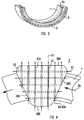
- FIG. 3 shows a cross section through a bearing shell 3 executed bearing body 3.
- the inside of the bearing shell 3 forms a sliding surface 11 for a body to be supported.
- the bearing body 3 becomes parallel to the sliding surface 11 of flow paths 31, 33 interspersed.
- a first part 31 of the flow paths is in the axial direction and a second part 33 of the Flow paths directed in the circumferential direction of the bearing shell 3.
- Each of the flow paths 31, 33 runs parallel to the Sliding surface 11.
- flowing cooling fluid 40 see e.g. FIG. 4
- e.g. B. oil which is also used as a lubricant
- Figure 4 shows a longitudinal section through one as a tilting segment trained bearing body 3 of a thrust bearing.
- the bearing body 3 is arranged according to Figure 1 on a support ring 7. With regard to the support ring 7, the bearing body 3 radially through a first part 31 of flow paths.
- a second part 33 of the flow paths leads with respect of the support ring 7 in the circumferential direction through the bearing body 3. Through the flow paths 31, 33 is thus a square Grid formed.
- the flow paths 31, 33 are cylindrical Holes formed.
- the second part 33 and the first Part 31 of the flow paths lie on different levels and therefore do not intersect.
- Each flow path 31, 33 is along a respective channel line 35 directed and has a respective channel wall 37 on.
- Figure 5 shows a section of a cross section through a Bearing body 3.
- Flow space 43 is provided in the bearing body 3 .
- Support elements 41 arranged in the flow space 43 . Between the support elements 41 lead through the flow space 43 flow paths 31, 33 for a cooling fluid 40.
- FIG 3 The arrangement of the flow space 43 in the bearing body is shown in FIG 3 clearly.
- Figure 6 is a longitudinal section through the Section of the bearing body 3 from Figure 5.
- the flow space 43 runs between a first one, which forms the sliding surface 11 Part 3a of the bearing body 3 and a second, the sliding surface 11 opposite, the back 55 forming part 3b of the bearing body 3.
- the first part 3a and the second part 3b of the bearing body 3b are interconnected by the support elements 41 connected. Through the support elements 41, the resilience of the bearing body 3 guaranteed. Through in the flow space 43 flowing cooling fluid 40 becomes the sliding surface 11 effectively chilled.
- FIG. 7 shows a bearing body constructed from two parts 3a, 3b 3.
- the first part 3a has a surface 53 in that from a first side surface 38c to an opposite one Grooves 51 guiding side surface 38d of the bearing body 3 are milled in.
- the second part 3b of the bearing body 3 is attached to the surface 53 with a contact surface 54.
- the grooves 51 are the flow paths 31, 33 formed.
- the flow paths 31, 33 are through such a multi-part construction of the bearing body 3 particularly easy to manufacture.
- serpentine, winding flow paths 31, 33 as grooves 51 in the Surface 53 are introduced. Such an execution is shown in Figure 8.
- FIG. 9 shows a flow path running in a bearing body 3 31, 33 with different cross-sectional areas F1, F2.
- the flow path 31, 33 leads from a first one Side surface 38c of the bearing body 3 to a second side surface 38d. Inside the bearing body 3, the Flow path 31, 33. A first cross-sectional area F1 in the area the side surface 38d is thus smaller than a second one Cross-sectional area F2 in the middle of the flow path 31, 33.
- Using different cross-sectional areas along the Flow paths 31, 33 can e.g. B. adapted to a cooling certain heat distribution in the bearing body 3 during operation can be achieved. Such an adaptation to heat distribution in the bearing body 3 could also be achieved that the density of the flow paths along the sliding surface 11 changed. It is also conceivable for flow paths 31 33 with different cross-sectional areas F to provide.
- FIG. 10 shows a flow path running in the bearing body 3 31, 33 shown.
- the flow path 31, 33 is as one channel directed along a channel line 35 with a channel wall 62 trained.
- One is along in the flow path 31, 33 the channel line 35 directed cooling fin 61 is arranged.
- It further cooling fins 61 can also be provided.
- Through the Cooling fin 61 becomes the surface of flow path 31, 33 enlarged. This leads to an improved heat transfer between the cooling fluid 40 and the vicinity of the flow path 31, 33.
- the flow path 31 is perpendicular to the channel line 35, 33 an annular turbulator is arranged. Through this turbulator 63 turbulence is generated in the cooling fluid 40. This improves also the heat transfer between the surroundings of the Flow paths 31, 33 and the cooling fluid 40.
- FIG. 11 shows a cross section through a bearing body 3, in which during operation due to bending stress a voltage S is caused.
- the voltage S is in the range the sliding surface 11 and in the area of the back 45 of the Bearing body 3 maximum.
- Inside the bearing body there are three there is a region B of a minimum voltage S. This region B lies around a neutral fiber N, at which the voltage S is zero is.
- a flow path 31, 33 is arranged in area B. The arrangement of the flow path 31, 33 in the area B the stability and strength of the bearing body 3 practically unaffected, since there are no noteworthy mechanical ones Stresses due to the bending stress occur.
Landscapes
- Engineering & Computer Science (AREA)
- General Engineering & Computer Science (AREA)
- Mechanical Engineering (AREA)
- Physics & Mathematics (AREA)
- Fluid Mechanics (AREA)
- Sliding-Contact Bearings (AREA)
- Mounting Of Bearings Or Others (AREA)
Priority Applications (1)
| Application Number | Priority Date | Filing Date | Title |
|---|---|---|---|
| EP98121957A EP1002965A1 (fr) | 1998-11-19 | 1998-11-19 | Palier refroidissable |
Applications Claiming Priority (1)
| Application Number | Priority Date | Filing Date | Title |
|---|---|---|---|
| EP98121957A EP1002965A1 (fr) | 1998-11-19 | 1998-11-19 | Palier refroidissable |
Publications (1)
| Publication Number | Publication Date |
|---|---|
| EP1002965A1 true EP1002965A1 (fr) | 2000-05-24 |
Family
ID=8232997
Family Applications (1)
| Application Number | Title | Priority Date | Filing Date |
|---|---|---|---|
| EP98121957A Withdrawn EP1002965A1 (fr) | 1998-11-19 | 1998-11-19 | Palier refroidissable |
Country Status (1)
| Country | Link |
|---|---|
| EP (1) | EP1002965A1 (fr) |
Cited By (3)
| Publication number | Priority date | Publication date | Assignee | Title |
|---|---|---|---|---|
| WO2004046571A1 (fr) * | 2002-11-15 | 2004-06-03 | Honeywell International Inc. | Refroidissement d'un palier de butee a profil hydrodynamique |
| US20220260118A1 (en) * | 2019-06-04 | 2022-08-18 | Nuovo Pignone Tecnologie -- S.R.L. | A bearing with pads having cooling micro-channels therein, and method |
| DE102021123523B4 (de) * | 2021-06-25 | 2025-04-30 | GEDEE WEILER Pvt Ltd. | Kühlvorrichtung für Lager, Anordnung mit einem Lager und Drehmaschine |
Citations (5)
| Publication number | Priority date | Publication date | Assignee | Title |
|---|---|---|---|---|
| US3583776A (en) * | 1969-11-07 | 1971-06-08 | Westinghouse Electric Corp | Forced-cooled bearing |
| DE2313320A1 (de) * | 1972-03-20 | 1973-10-04 | Brown & Sons Ltd James | Durch umgiessen eines oder mehrerer rohre, insbesondere kuehlrohr, geformtes gussteil |
| DE3217892A1 (de) * | 1982-05-12 | 1983-11-17 | Glyco-Metall-Werke Daelen & Loos Gmbh, 6200 Wiesbaden | Gekuehltes gleitlager |
| JPS6095215A (ja) * | 1983-10-28 | 1985-05-28 | Hitachi Ltd | パツト型軸受 |
| US5707718A (en) * | 1995-09-12 | 1998-01-13 | Mitsubishi Electric Home Appliance Co., Ltd. | Porous-plastic bearing and method of manufacturing porous-plastic bearing |
-
1998
- 1998-11-19 EP EP98121957A patent/EP1002965A1/fr not_active Withdrawn
Patent Citations (5)
| Publication number | Priority date | Publication date | Assignee | Title |
|---|---|---|---|---|
| US3583776A (en) * | 1969-11-07 | 1971-06-08 | Westinghouse Electric Corp | Forced-cooled bearing |
| DE2313320A1 (de) * | 1972-03-20 | 1973-10-04 | Brown & Sons Ltd James | Durch umgiessen eines oder mehrerer rohre, insbesondere kuehlrohr, geformtes gussteil |
| DE3217892A1 (de) * | 1982-05-12 | 1983-11-17 | Glyco-Metall-Werke Daelen & Loos Gmbh, 6200 Wiesbaden | Gekuehltes gleitlager |
| JPS6095215A (ja) * | 1983-10-28 | 1985-05-28 | Hitachi Ltd | パツト型軸受 |
| US5707718A (en) * | 1995-09-12 | 1998-01-13 | Mitsubishi Electric Home Appliance Co., Ltd. | Porous-plastic bearing and method of manufacturing porous-plastic bearing |
Non-Patent Citations (2)
| Title |
|---|
| LANG/STEINHILPER: "RADIALGLEITLAGER", 1978, SPRINGER- VERLAG BERLIN, BERLIN, article ",361", pages: 326,359 |
| PATENT ABSTRACTS OF JAPAN vol. 009, no. 242 (M - 417) 28 September 1985 (1985-09-28) * |
Cited By (6)
| Publication number | Priority date | Publication date | Assignee | Title |
|---|---|---|---|---|
| WO2004046571A1 (fr) * | 2002-11-15 | 2004-06-03 | Honeywell International Inc. | Refroidissement d'un palier de butee a profil hydrodynamique |
| US20220260118A1 (en) * | 2019-06-04 | 2022-08-18 | Nuovo Pignone Tecnologie -- S.R.L. | A bearing with pads having cooling micro-channels therein, and method |
| AU2020286909B2 (en) * | 2019-06-04 | 2023-08-31 | Nuovo Pignone Tecnologie - S.R.L. | A bearing with pads having cooling micro-channels therein, and method |
| US11828331B2 (en) * | 2019-06-04 | 2023-11-28 | Nuovo Pignone Tecnologie—S.R.L. | Bearing with pads having cooling micro-channels therein, and method |
| AU2020286909C1 (en) * | 2019-06-04 | 2024-01-11 | Nuovo Pignone Tecnologie - S.R.L. | A bearing with pads having cooling micro-channels therein, and method |
| DE102021123523B4 (de) * | 2021-06-25 | 2025-04-30 | GEDEE WEILER Pvt Ltd. | Kühlvorrichtung für Lager, Anordnung mit einem Lager und Drehmaschine |
Similar Documents
| Publication | Publication Date | Title |
|---|---|---|
| DE3779709T2 (de) | Axiallager mit kippsegmenten mit optimaler lokalisierung der kippachse. | |
| DE602004012546T2 (de) | Vakuumpumpe | |
| DE68906779T2 (de) | Spielkontrollvorrichtung fuer die schaufelspitzen einer gasturbine. | |
| EP1163430B1 (fr) | Element de revetement et systeme comportant un element de revetement et une structure support | |
| DE4116369A1 (de) | Rotortraglagervorrichtung | |
| EP3284966A1 (fr) | Système de palier, en particulier pour une turbomachine et turbomachine comprenant un tel système de palier | |
| EP3545205B1 (fr) | Système rotatif avec palier radial à gaz | |
| EP1780376A1 (fr) | Turbine à vapeur | |
| DE102009003377A1 (de) | Turbinengehäuse mit einem Hilfsflansch | |
| DE3446385C2 (de) | Axialgasturbine | |
| DE2725572A1 (de) | Hydrodynamisches gleitlager | |
| DE112009001535T5 (de) | Zylinder-Rollenlager | |
| DE2909973C2 (de) | Aerodynamisches federndes Mehrgleitflächenlager | |
| DE102009055151A1 (de) | Geteiltes Gleitlager für eine Kurbelwelle in einem Verbrennungsmotor und geteilte Gleitlagervorrichtung | |
| WO2005052321A1 (fr) | Dispositif de liaison refroidie pour disques de rotor de turbine | |
| EP3273078A1 (fr) | Palier magnetique actif et procede de refroidissement d'un palier magnetique actif | |
| EP1002965A1 (fr) | Palier refroidissable | |
| DE102019131245A1 (de) | Lageranordnung und Verfahren zum Montieren einer solchen | |
| DE19811040A1 (de) | Axiallaufscheibe | |
| WO2019214883A1 (fr) | Dispositif palier doté d'un arbre structuré | |
| EP2014951B1 (fr) | Elément de serrage et d'amortissement pour transmission à courroie synchrone | |
| DE102017222792A1 (de) | Lageranordnung | |
| DE102007030135A1 (de) | Verfahren und Vorrichtung zur Erleichterung der Abdichtung in einer Turbine | |
| DE10030698A1 (de) | Verfahren zum Schmieren und Kühlen eines hydrodynamischen Gleitlagers und Vorrichtung zur Durchführung dieses Verfahrens | |
| DE102024104796A1 (de) | Hydrodynamische Rotorwellengleitlagerung für eine Rotorwelle insbesondere einer Windkraftanlage |
Legal Events
| Date | Code | Title | Description |
|---|---|---|---|
| PUAI | Public reference made under article 153(3) epc to a published international application that has entered the european phase |
Free format text: ORIGINAL CODE: 0009012 |
|
| AK | Designated contracting states |
Kind code of ref document: A1 Designated state(s): AT BE CH CY DE DK ES FI FR GB GR IE IT LI LU MC NL PT SE |
|
| AX | Request for extension of the european patent |
Free format text: AL;LT;LV;MK;RO;SI |
|
| AKX | Designation fees paid | ||
| STAA | Information on the status of an ep patent application or granted ep patent |
Free format text: STATUS: THE APPLICATION IS DEEMED TO BE WITHDRAWN |
|
| 18D | Application deemed to be withdrawn |
Effective date: 20001125 |